Short- and long-term effects of diving on
pulmonary function
Kay Tetzlaff
1and Paul S. Thomas
2,3Number 6 in the Series
“
Sports-related lung disease
”
Edited by Yochai Adir and Alfred A. Bove
Affiliations: 1Dept of Sports Medicine, Medical Clinic, Eberhard-Karls-University of Tübingen, Tübingen, Germany. 2Faculty of Medicine, University of New South Wales, Sydney, Australia. 3Dept of Respiratory Medicine, Prince of Wales Hospital, Randwick, Australia.
Correspondence: Kay Tetzlaff, Dept of Sports Medicine, Medical Clinic, Eberhard-Karls-University of Tübingen, Hoppe-Seyler-Str. 6, 72076 Tübingen, Germany. E-mail: [email protected]
@ERSpublications
The effects of diving on pulmonary function largely depend on factors associated with the individual diving responsehttp://ow.ly/aIFS3095WNn
Cite this article as:Tetzlaff K, Thomas PS. Short- and long-term effects of diving on pulmonary function. Eur Respir Rev2017; 26: 160097 [https://doi.org/10.1183/16000617.0097-2016].
ABSTRACT The diving environment provides a challenge to the lung, including exposure to high ambient pressure, altered gas characteristics and cardiovascular effects on the pulmonary circulation. Several factors associated with diving affect pulmonary function acutely and can potentially cause prolonged effects that may accumulate gradually with repeated diving exposure. Evidence from experimental deep dives and longitudinal studies suggests long-term adverse effects of diving on the lungs in commercial deep divers, such as the development of small airways disease and accelerated loss of lung function. In addition, there is an accumulating body of evidence that diving with self-contained underwater breathing apparatus (scuba) may not be associated with deleterious effects on pulmonary function. Although changes in pulmonary function after single scuba dives have been found to be associated with immersion, ambient cold temperatures and decompression stress, changes in lung function were small and suggest a low likelihood of clinical significance. Recent evidence points to no accelerated loss of lung function in military or recreational scuba divers over time. Thus, the impact of diving on pulmonary function largely depends on factors associated with the individual diving exposure. However, in susceptible subjects clinically relevant worsening of lung function may occur even after single shallow-water scuba dives.
Introduction
The human respiratory system has adapted to breathing air at sea level, i.e.atmospheric pressure, which varies smoothly around 101 kPa. However, diving comprises exposure to distinct environmental conditions that challenge the respiratory system beyond normal physiology [1], e.g. elevated ambient pressure and
Copyright ©ERS 2017. ERR articles are open access and distributed under the terms of the Creative Commons Attribution Non-Commercial Licence 4.0.
Previous articles in this series: No. 1: Adir Y, Bove AA. Can asthmatic subjects dive? Eur Respir Rev 2016; 25: 214–220.No. 2:Szpilman D, Orlowski JP. Sports related to drowning.Eur Respir Rev2016; 25: 348–359.No. 3:van Ooij PJAM, Sterk PJ, van Hulst RA. Oxygen, the lung and the diver: friends and foes?Eur Respir Rev2016; 25: 496–
505.No. 4:Mijacika T, Dujic Z. Sports-related lung injury during breath-hold diving.Eur Respir Rev2016; 25: 506–512. No. 5:Luks AM, Swenson ER, Bärtsch P. Acute high-altitude sickness.Eur Respir Rev2017; 26: 160096.
Received: Sept 14 2016 | Accepted after revision: Feb 08 2017
Conflict of interest: None declared.
altered gas characteristics. Several factors associated with diving exposure may affect the respiratory system. Table 1 summarises environmental conditions associated with diving and their possible ( patho-) physiological impact on the lungs and airways. These conditions may be present alone or in combination, and their effects on pulmonary function may overlap, due to the particular diving exposure.
Diving encompasses heterogeneous activities with regards to the diving environment. Breath-hold diving exposes the body to immersion and hydrostatic pressure, and the exposure is limited by breath-hold duration. Diving with breathing support may utilise gas supply through self-contained underwater breathing apparatus (scuba) or by surface- or underwater habitat-based supply systems that deliver the breathing gas through pressure hoses to diver’s helmet or mask. Scuba diving is by far the most commonly practised exposure in recreational diving, with air being the usual breathing gas. Other breathing gases are available, such as enriched air nitrox which includes nitrogen–oxygen mixtures with proportions of oxygen exceeding 21%, or pure oxygen, and these will exert distinct effects on the respiratory system. In technical diving, different breathing gases are used during the same dive, and inert gases other than nitrogen may be used to reach greater depths. Saturation diving techniques, which entail equilibration of body tissues with gas mixtures breathed at depths as shallow as 20 m of seawater are still employed in commercial diving.
Commercial diving exposure, in particular saturation diving, may lead to long-term detrimental effects on the respiratory system [2–4], but there remains some controversy with regard to possible long-term injury to the lungs from scuba diving. Only more recently have studies investigated pulmonary function changes in recreational scuba divers and special populations such as adolescents and subjects with asthma or atopy. This article reviews the current literature evidence regarding the short- and long-term effects of diving on pulmonary function, with an emphasis on scuba diving. The studies reviewed were derived from the subject headings from PubMed, as detailed below.
Diving exposure
The diving environment is distinct from life at sea level with regards to a higher ambient pressure, since hydrostatic pressure increasingly adds to atmospheric pressure with diving depth. For example, ambient pressure at 10 m of seawater depth is twice the pressure at sea level,i.e.∼200 kPa. While the human lungs can withstand very high ambient pressure per se, it is the change in characteristics of the inspired gas under pressure that challenges the respiratory system.
TABLE 1Conditions associated with diving exposure and their impact on the physiology of the respiratory system and possibly resulting adverse clinical consequences
Pathophysiological changes Possible adverse clinical effects
Elevated pressure
Oxygen Hyperoxia Oxidative stress
Airway inflammation
Nitrogen Venous gas microbubbles Impaired diffusion capacity
Pulmonary hypertension
Immersion Central blood pooling
Reduced lung compliance Increased work of breathing
Dyspnoea
Scuba
Breathing gas Dry and cold gas
Increased density of gas Increased airway resistance
Respiratory heat loss Airway inflammation Airway narrowing Dyspnoea
Pressure regulator Increased work of breathing Dyspnoea
Aggravation of airway drying and cooling when bypassing nasal airways#
Exertion Increased work of breathing Dyspnoea
Carbon dioxide retention
Exercise-induced bronchoconstriction Capillary stress failure
Pulmonary oedema Water Increased heat conduction and convection
Increased respiratory heat loss
With breath-hold diving, total lung volume will decrease with increasing depth or ambient pressure, due to Boyle’s law. The pressure and density of the gas inside the lungs will increase accordingly. Since, theoretically, the human lung will only collapse completely at depths >200 m [5], gas exchange through the alveolar capillary interface will not cease up to that depth and, thus, nitrogen will diffuse along the alveolar–tissue pressure gradient to become dissolved in tissues during descent. Alveolar oxygen pressure will continue to increase with descent and so will arterial oxygen pressure, while alveolar carbon dioxide pressure will only increase to a minor degree, as large amounts of this highly soluble gas are taken up by the increased thoracic blood volume.
In scuba diving, the respired gas is compressed in a cylinder and inspiredvia a pressure reducer and a regulator integrated into a full-face mask or, most commonly, attached to a mouthpiece. The regulator reduces the cylinder high gas pressure to ambient pressure and supplies gas on demand. The compressed gas needs to be dry to prevent ice formation in the pressure regulators. At depth, the inspired gas will be delivered at ambient pressure,i.e.ventilatory volumes will be comparable to sea level, but the gas will be dense. For example, at a depth of 30 m, the regulator supplies air at four times the pressure at sea level; the density of air will be four times higher than breathing air at sea level. Inspiratory resistive loading and dead space from scuba equipment add to the work of breathing under water. Variations in posture may alter these values, and the work of breathing also increases and varies with posture.
Gases physiologic to humans at sea level can become harmful at depth. In the case of breathing air, a gas mixture mainly composed of nitrogen (78%) and oxygen (21%), with traces of water vapour, carbon dioxide and other gases, the partial pressure of oxygen will increase with depth. Breathing air at a depth of 40 m will mean that the arterial oxygen partial pressure is roughly equivalent to breathing 100% oxygen at the surface. Unlike oxygen, nitrogen as an inert gas is not metabolised. At increased pressure, nitrogen will exert narcotic effects. In addition, during descent (compression), nitrogen molecules will diffuse into body tissues where nitrogen partial pressures are below ambient nitrogen pressure. This tissue saturation with nitrogen is predominantly determined by depth and time at depth, while specific tissue saturation kinetics also apply. Upon ascent (decompression), diffusion will reverse and tissue nitrogen pressure will exceed alveolar nitrogen pressure. Nitrogen gas microbubbles may evolve from pre-existing gas nuclei and will transfer from tissues with the venous return to the lung microvasculature where they are filtered in capillaries, and nitrogen will diffuse into the alveolar space. These inert gas microemboli may exert inflammatory stress upon the lung microvasculature [6].
Factors unrelated to pressure and breathing gas provide additional respiratory effects of diving: water immersion poses changes on the cardiovascular system, with central pooling of blood in the chest cavity and cranial shift of the diaphragm. Respiratory effects that have been measured during head-out immersion in thermoneutral water include a decrease in lung volumes and an increase in airway resistance, while lung compliance decreases [7, 8]. An increase in diffusing capacity has been shown to be due to vascular engorgement [9]. Cold water immersion may lead to marked respiratory changes, such as hyperventilation and hypocapnia through neurogenic mechanisms [10]. Even at comfortable water temperatures, greater thermal conduction and convection of waterversusair accelerate heat loss and may cause peripheral vasoconstriction. Scuba equipment, wetsuits and weight belts add to the restrictive forces on the chest wall and abdomen, which may be further aggravated if equipment is excessively tight fitting. These factors impair the compliance of the chest wall and impede diaphragmatic breathing.
The combination of these conditions rather than the presence of a single factor alone may adversely affect the respiratory system. For example, in susceptible individuals pulmonary oedema may result from capillary stress failure when performing strenuous exercise in the immersed state, in particular during cold water immersion [11].
Lung function at depth
Airway resistance is directly proportional to gas density when the flow is laminar. Thus, an increase in density will increase airway resistance accordingly. As higher ambient pressure results in increased gas density, the extent to which flow in large airways is turbulent will increase substantially. It has been shown that when air is used as the breathing gas, maximum breathing capacity varies inversely as the square root of the gas density [12, 13]. This means that at a depth of 30 m, maximum voluntary ventilation is reduced by∼50% compared to sea-level values.
Short-term effects of diving on lung function
Pulmonary function testing has been established as a mandatory procedure in the routine medical assessment of fitness to dive, in order to detect conditions that may increase the risk of pulmonary injury as a result of diving. The presence of obstructive or restrictive ventilatory disorders would preclude a candidate from diving [15].
Given the conditions associated with diving and their possible effects on the respiratory system, potentially prolonged effects of diving may accumulate gradually over time. A question of interest was whether pulmonary function would normalise immediately after diving. Therefore, a number of studies investigated pulmonary function following single dives under varying conditions. Notably, many studies involved experimental dives in dry compression chambers to simulate diving exposure under somewhat controlled conditions.
Several studies showed that dry chamber dives using air as a breathing gas did not reveal significant changes in expiratory flows or volumes up to 24 h after simulated depths of 39–87 m [16–19]. However, a temporary decrease in the diffusion capacity of the lung for carbon monoxide (DLCO) was shown [17], reaching a maximum at 20 min post-dive, which was significantly correlated with venous gas microbubbles detected using Doppler ultrasound. A control condition with the subjects breathing pure oxygen during decompression did not reveal microbubbles or a significant decrease of DLCO, indicating that venous gas microbubbles may account for the change in DLCO after diving. The reduction in diffusion capacity was significantly higher in subjects who had venous gas microbubbles compared to those subjects without [18].
Interestingly, some studies did report changes in spirometric indices after wet scuba dives using air as the breathing gas. While no significant changes in ventilatory flows or volumes were found in healthy subjects after wet dives to 4.5 m in a pool or 50 m in a wet hyperbaric chamber [20] at 27°C, reductions in ventilatory flows and volumes were reported after open-sea bounce dives to 10 m and 50 m [21] or dives in cold water [22, 23]. One study in recreational scuba divers [24] reported a significant decrease in forced vital capacity (FVC) after open-sea dives at moderate water temperatures, but spirometry was recorded at different times of day and statistical analysis did not control for multiple comparisons. Thus, effects of submergence and static lung loading, as well as effects of respiratory heat and water loss, may contribute significantly to changes in lung function obtained after single wet scuba dives. A reduction inDLCOwas found after wet pool dives to 4.5 m, but not when breathing from scuba equipment nonimmersed at atmospheric pressure [20]. Thus, a reduction of diffusion capacity may also occur at shallow depths, related not to decompression stress, but due to subclinical pulmonary oedema or atelectasis. In addition, DLCO was found to decrease after wet dives at 5 m depth breathing 100% oxygen from an oxygen rebreather [25]; this decrease did not occur when subjects breathed oxygen from the same rebreather at 5 m in a dry hyperbaric chamber. This reduction in diffusion capacity after a wet dive breathing oxygen might indicate atelectasis formation.
Long-term effects of diving on lung function
The possibility of adverse long-term effects of diving on the respiratory system has been a concern in the health surveillance of commercial divers, in particular since persistent changes in lung function have been obtained after single deep saturation dives.
Cross-sectional studies
First evidence of persistent lung function changes in divers came from early cross-sectional studies in commercial divers employed by companies operating in the North Sea [34]. FVC was found to be on average 20% higher than predicted, and forced expired volume in 1 s (FEV1) was 17% above predicted; a high FVC appeared to be associated with deepest diving depth. The authors speculated that diving training contributed to large FVCs since divers had an average experience of 7.1 years and had been working at depths up to 340 m. A subsequent publication from the same group of authors [35] reported that the FEV1/FVC ratio in these divers decreased as FVC increased above 100% predicted and confirmed a positive correlation between FVC and years of diving. A subgroup of divers had low FEV1/FVC ratios and reduction of end-expiratory flows that were interpreted as an indication of obstructive airway changes. An alternative explanation suggested was that large vital capacity is a selection factor for the occupation of diving [36]. A cross-sectional comparison of lung volumes between Royal Navy divers and submariners confirmed larger FVCs in divers, but did not find an association with indices of diving exposure [37]. Accordingly, a study in US Navy divers [38] showed higher than predicted FVC (12.2%) and FEV1values 4.3% below predicted with no relationship between years of diving and lung function variables. Another large cross-sectional study using a registry database of 858 commercial divers and including 132 asymptomatic control subjects [39] revealed a positive association of maximal depth with FVC and negative association with FEV1/FVC ratio. A morphometric study [40] of divers’lungs found a correlation between the increases in FVC measured annually during routine examinations and increased mean alveolar cord length, which in turn reflects alveolar volume. The authors suggested that distension of the alveoli may cause narrowing of small airways. A large cross-sectional controlled study of pulmonary function in British and Norwegian commercial saturation divers [41] showed significantly lower forced expiratory flows and FEV1compared to matched control subjects, while closing volume was significantly higher. Importantly, cumulative time in saturation was negatively related to expiratory flows and FEV1. These findings were taken as evidence to suggest development of small airways disease in divers. Subsequent cross-sectional studies in German Navy scuba divers [42] confirmed a pattern of reduced expiratory flow rates at low lung volumes when compared to non-diving controls, and mid-expiratory flows at 25% and 50% of vital capacity were inversely related to years of diving. However, different group characteristics and selection effects may have confounded the results [43]. In a smaller controlled study on German Navy and commercial construction divers [44], high resolution computed tomography of the chest showed minor lobular air trapping without differences between groups and no relevant abnormalities of small or large airways. A large cross-sectional study in Israeli Navy military divers [45] reported that in those with large lungs,i.e.FVC >100% and FEV1⩾90% pred, FVC was not different between experienced and inexperienced divers, but forced expiratory flow at 50% of vital capacity was significantly reduced in the most experienced group. No differences were seen in DLCO. Of note, the 109 divers included in analysis were all nonsmokers. In a random sample of 151 professional divers registered with the Health and Safety Executive in the UK, there was little difference in lung function between divers and 102 offshore workers: after adjusting for smoking only forced expiratory flows at low lung volumes were significantly smaller in the divers [46]. Of note, the majority of divers had decompression diving experience and ∼40% had performed saturation diving. A number of smaller cross-sectional studies in Norwegian commercial construction divers and Croatian and Polish military divers [47–49] were consistent with a pattern of high FVC, normal FEV1and somewhat reduced mid-expiratory flows.
One early controlled study investigated a larger group of Egyptian special forces divers who were using scuba rebreathers with pure oxygen twice weekly for 90 min over a range of 2–10 years [50]. No differences in ventilatory flows or volumes and DLCO were found. A few cross-sectional studies on recreational scuba divers include a large controlled study of children and 32 adult scuba divers [51] with no significant differences between diving groups and respective controls for all ventilatory flows and volumes as well asDLCO. In another study of older recreational divers [52], mean age 52 years, ventilatory volumes were slightly higher and expiratory flows at low vital capacities slightly lower than predicted. However, all parameters were well within the normal range of variability [53].
Longitudinal studies
Therefore, the evidence was considered limited and future research was recommended, with the highest priority given to longitudinal studies. Subsequently, a number of longitudinal studies have been conducted in commercial and military divers, while long-term follow-up of recreational scuba divers is scarce.
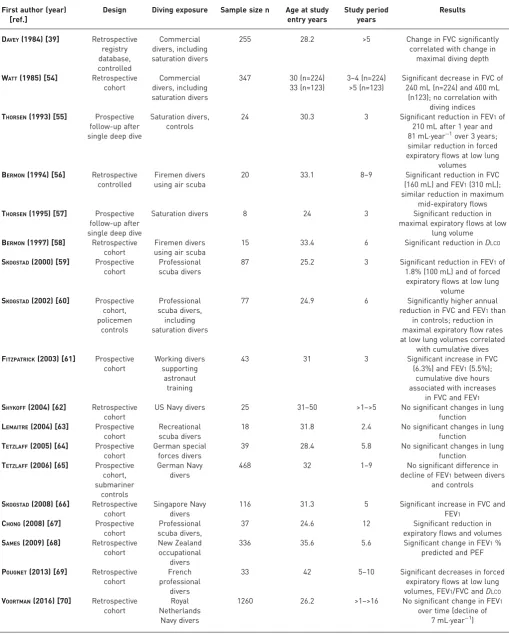
Table 2 lists all longitudinal studies on pulmonary function testing in divers that have been retrieved from searching the Medline/PubMed database from 1946 to December 31, 2016 (cut-off date). Including the three search terms“lung”or“pulmonary”, plus“physiology”or“function”plus“diving”revealed 799 hits. 17 publications provided data on 12 longitudinal cohort studies [54, 56, 58–70] and two studies that reported pulmonary function long-term follow-up testing after single deep dives [55, 57]. Studies were heterogeneous in regards to their methodology, study populations, observation period and outcomes.
Early studies in commercial saturation divers indicated an accelerated loss of FVC over time that was associated with diving exposure [54]. In a prospective follow-up of pulmonary function after a deep saturation dive, a decrease in FEV1was measured that was higher than normal, and was prominent after 1 year [55]. While a decrease in diffusion capacity after deep dives was found to recover during follow-up at 1 and 3 years, a reduction in flows at small lung volumes did not [57]. A prospective study of professional divers that were followed from the beginning of their diving career revealed annual reductions in both FVC and FEV1 that were greater than those obtained from matched police controls [59]. In addition, there was a greater reduction in expiratory flows at low lung volumes, as well as in DLCO. Regression analysis showed a significant relation between loss of lung function and indices of diving exposure. Thus, it appeared that diving contributed to the observed changes in lung function. It is noteworthy that the reduction in FEV1 of 28.3 mL annually was within the range expected for healthy normal persons, but the divers started diving young (<25 years), when FEV1 should not decline. In a long-term follow-up of a subset of 37 divers an annual reduction in FEV1 of 40.8 mL was observed. Although the majority of divers in this cohort were diving on air using scuba or surface supply, a subset was engaged in saturation diving.
In contrast to these results from commercial diving cohorts, more recently a number of studies in military or recreational scuba divers using air or enriched air nitrox reported no accelerated decline in lung function over time. In a study on nitrox divers undertaking astronaut training at shallow depths there was an increase in ventilatory volumes over 3 years. In US Navy scuba divers and German special forces divers using pure oxygen rebreathers there was no change in lung function over time [62, 64]. Likewise, no change was reported from a cohort of recreational scuba divers from France [63]. A large study in German Navy divers [65] could not find an accelerated decline in FEV1 compared to controls. Likewise, a recent large longitudinal cohort study of Royal Netherlands Navy divers showed no change in FEV1over time [70]. Another study in Singapore Navy divers reported significant increases in ventilatory volumes over time [67]. These results from longitudinal studies do not indicate long-term adverse effects of scuba diving on pulmonary function, and therefore contrast with the results obtained from commercial diving cohorts. Of note, diving exposure in terms of maximum depth and cumulative hours is less extreme in military air scuba divers or recreational scuba divers compared to commercial saturation divers, and decompression dives are performed less frequently. Moreover, possible exposure to toxic gases during underwater work is less likely to be present in military or recreational scuba divers.
Effects of diving on lung function in special populations
Paediatrics/adolescentsWith the increasing popularity of recreational scuba diving over the past decades came an increase in the number of children and adolescents participating, which makes up 5–10% of recreational scuba divers [71]. Data on the effects of diving on the juvenile respiratory system are sparse; only three studies have investigated lung function in children after single scuba dives.
TABLE 2Overview of longitudinal studies on lung function of divers
First author (year) [ref.]
Design Diving exposure Sample size n Age at study entry years
Study period years
Results
DAVEY(1984) [39] Retrospective registry database, controlled Commercial divers, including saturation divers
255 28.2 >5 Change in FVC significantly
correlated with change in maximal diving depth WATT(1985) [54] Retrospective
cohort
Commercial divers, including saturation divers
347 30 (n=224)
33 (n=123)
3–4 (n=224) >5 (n=123)
Significant decrease in FVC of 240 mL (n=224) and 400 mL
(n123); no correlation with diving indices THORSEN(1993) [55] Prospective
follow-up after single deep dive
Saturation divers, controls
24 30.3 3 Significant reduction in FEV1of
210 mL after 1 year and 81 mL·year−1over 3 years; similar reduction in forced expiratory flows at low lung
volumes BERMON(1994) [56] Retrospective
controlled
Firemen divers using air scuba
20 33.1 8–9 Significant reduction in FVC
(160 mL) and FEV1(310 mL); similar reduction in maximum
mid-expiratory flows THORSEN(1995) [57] Prospective
follow-up after single deep dive
Saturation divers 8 24 3 Significant reduction in
maximal expiratory flows at low lung volume BERMON(1997) [58] Retrospective
cohort
Firemen divers using air scuba
15 33.4 6 Significant reduction inDLCO
SKOGSTAD(2000) [59] Prospective cohort
Professional scuba divers
87 25.2 3 Significant reduction in FEV1of
1.8% (100 mL) and of forced expiratory flows at low lung
volume SKOGSTAD(2002) [60] Prospective
cohort, policemen controls Professional scuba divers, including saturation divers
77 24.9 6 Significantly higher annual
reduction in FVC and FEV1than in controls; reduction in maximal expiratory flow rates at low lung volumes correlated
with cumulative dives FITZPATRICK(2003) [61] Prospective
cohort
Working divers supporting
astronaut training
43 31 3 Significant increase in FVC
(6.3%) and FEV1(5.5%); cumulative dive hours associated with increases
in FVC and FEV1 SHYKOFF(2004) [62] Retrospective
cohort
US Navy divers 25 31–50 >1–>5 No significant changes in lung function
LEMAITRE(2004) [63] Prospective cohort
Recreational scuba divers
18 31.8 2.4 No significant changes in lung
function TETZLAFF(2005) [64] Prospective
cohort
German special forces divers
39 28.4 5.8 No significant changes in lung
function TETZLAFF(2006) [65] Prospective
cohort, submariner
controls
German Navy divers
468 32 1–9 No significant difference in
decline of FEV1between divers and controls SKOGSTAD(2008) [66] Retrospective
cohort
Singapore Navy divers
116 31.3 5 Significant increase in FVC and
FEV1 CHONG(2008) [67] Prospective
cohort
Professional scuba divers,
37 24.6 12 Significant reduction in
expiratory flows and volumes SAMES(2009) [68] Retrospective
cohort
New Zealand occupational
divers
336 35.6 5.6 Significant change in FEV1%
predicted and PEF POUGNET(2013) [69] Retrospective
cohort
French professional
divers
33 42 5–10 Significant decreases in forced
expiratory flows at low lung volumes, FEV1/FVC andDLCO VOORTMAN(2016) [70] Retrospective
cohort
Royal Netherlands
Navy divers
1260 26.2 >1–>16 No significant change in FEV1 over time (decline of
depth varied from 3 to 10 m, according to the subjects’age. There were significant reductions in FEV1and forced expiratory flows at low lung volumes, but not in FVC and residual volume. However, in five children the decrease in FEV1exceeded 12%. In conclusion, all available data unanimously point at a reduction of expiratory flows and volumes after even shallow water scuba dives in paediatric and adolescent divers. However, the mean changes, although being statistically significant, were within the variability of the measurements. In individual subjects there were clinically meaningful deteriorations in lung function, which is concerning given the risk of serious diving-related injury.
Atopic/asthmatic subjects
Asthma has been a concern in the assessment of fitness to dive since it may be associated with an increased risk of serious diving-related injury [75, 76]. Thus, due to obvious ethical reasons, only few studies have investigated the effects of diving on pulmonary function in asthmatics.
Immersion reduced ventilatory volumes in 12 subjects with mild exercise-induced asthma and 11 healthy controls. After exercise, there was a significant deterioration of FEV1and forced expiratory flow at 25–75% of FVC in the asthmatic subjects compared to both the post-exercise dry control condition and healthy control subjects [77]. In a study comparing changes in pulmonary function after a simulated wet chamber dive to 50 m between nine subjects with hay fever and nine healthy controls there were slight reductions in FVC 24 h after the dive and a reduction in specific airway conductance in the atopic subjects only [78], which was interpreted as an increased susceptibility of atopic subjects to diving exposure. Another study investigated pulmonary function in 15 atopic nonasthmatic subjects and 15 healthy controls after dry chamber dives to simulated 50 m depth and wet dives to 50 m in seawater [79]. There were slight but statistically significant reductions in FVC after the dry-chamber dive in both groups, while FVC decreased significantly after the wet dive only in controls. FEV1 did not change in either group or condition. However, atopic subjects responded with a worsening of FEV1 after methacholine challenge 20 min after both diving conditions, while controls did not. This reduction in lung function returned to baseline 24 h after the dives; thus, the authors concluded that scuba diving is associated with early worsening of airway responsiveness to methacholine. One study investigated pulmonary function in asthmatics after scuba dives [80]. Spirometry was performed before and after a 5 m pool dive at 25°C in 22 divers with asthma and 15 healthy controls. Significant post-dive reductions in FEV1and forced expiratory flows were found in the asthmatics, but not in controls. While this study indicates a trend of airway narrowing in susceptible individuals who may not have good control of their asthma after shallow water scuba dives, the changes were mostly small. Only very few study subjects (four out of 22) [80] had persistent asthma and took regular medication, so no definite conclusions on the effects of scuba diving on patients with current asthma in general can be made.
Summary
An increase in FVC above 100% pred has been an unequivocal finding from studies on lung function in divers. This phenomenon may be attributed to repeated exposure to breathing dense gas at depth,i.e. a training effect on the respiratory muscles. However, a correlation between large FVC and indices of diving experience was only inconsistently obtained. Thus, a natural selection for professional divers could be an alternative explanation. Several cross-sectional studies have shown that divers frequently have unusually large lung volumes and a lower FEV1/FVC ratio suggestive of obstructive airways disease or airflow limitation. As FVC appears to be increased in some divers out of proportion to FEV1, the usual accepted ratio of FEV1/FVC becomes unreliable, and may represent either a training effect, or selection bias, perhaps related to pulmonary dysanapsis, where lung volumes are larger than predicted, while the airway flow is within the normal predicted range [81].
It is concluded that the impact of diving on pulmonary function largely depends on factors associated with the individual diving exposure. However, in susceptible subjects clinically relevant worsening of lung function may occur even after single shallow water scuba dives. Future prospective studies could address the common problems in this field which include inadequate statistical power, heterogeneous subject populations and varied exposures, while the difficulties of performing such studies has to be acknowledged, and better funding would lead to the publication of more good-quality studies.
References
1 Bove AA. Diving medicine.Am J Respir Crit Care Med2014; 189: 1479–1486.
2 Segadal K, Gulsvik A, Nicolaysen G. Respiratory changes with deep diving.Eur Respir J1990; 3: 101–108.
3 Hope A, Lund T, Elliott DH,et al.Long Term Health Effects of Diving. An International Consensus Conference. Godøysund June 6–10. Bergen, John Grieg Forlag, 1993.
4 Cotes JE. Respiratory effects of diving.Eur Respir J1994; 7: 2–3.
5 Fitz-Clarke JR. Mechanics of airway and alveolar collapse in human breath-hold diving.Respir Physiol Neurobiol
2007; 159: 202–210.
6 Thom SR, Milovanova TN, Bogush M,et al.Microparticle production, neutrophil activation, and intravascular bubbles following open-water SCUBA diving.J Appl Physiol2012; 112: 1268–1278.
7 Agostoni E, Gurtner G, Torri G,et al.Respiratory mechanics during submersion and negative-pressure breathing.
J Appl Physiol1966; 21: 251–258.
8 Dahlbäck GO, Jönnson E, Linér MH. Influence of hydrostatic compression of the chest and intrathoracic blood pooling on static lung mechanics during head-out immersion.Undersea Biomed Res1978; 5: 71–85.
9 Guyatt AR, Newman F, Cinkotai FF, et al.Pulmonary diffusing capacity in man during immersion in water.
J Appl Physiol1965; 20: 878–881.
10 Tipton MJ. Environmental extremes: origins, consequences and amelioration in humans.Exp Physiol2016; 101: 1–14.
11 Adir Y, Bove AA. Lung injury related to extreme environments.Eur Respir Rev2014; 23: 416–426.
12 Maio DA, Farhi LE. Effect of gas density on mechanics of breathing.J Appl Physiol1967; 23: 687–693.
13 Wood LDH, Bryan AC. Effect of increased ambient pressure on flow-volume curve of the lung.J Appl Physiol
1969; 27: 4–8.
14 Van Liew HD. Mechanical and physical factors in lung function during work in dense environments.Undersea Biomed Res1983; 10: 255–264.
15 British Thoracic Society Fitness to Dive Group, a Subgroup of the British Thoracic Society Standards of Care Committee. British Thoracic Society guidelines on respiratory aspects of fitness for diving.Thorax2003; 58: 3–13.
16 Catron PW, Bertoncini J, Layton RP,et al.Respiratory mechanics in men following a deep air dive.J Appl Physiol
1986; 61: 734–740.
17 DujićZ, EterovićD, Denoble P,et al.Effect of a single air dive on pulmonary diffusing capacity in professional divers.J Appl Physiol1993; 74: 55–61.
18 Thorsen E, Risberg J, Segadal K,et al.Effects of venous gas microemboli on pulmonary gas transfer function.
Undersea Hyperb Med1995; 22: 347–353.
19 Tetzlaff K, Staschen CM, Koch A,et al.Respiratory pattern after wet and dry chamber dives to 0.6 MPa ambient pressure in healthy males.Respir Physiol1999; 118: 219–226.
20 Koehle MS, Hodges ANH, Lynn BM,et al.Diffusing capacity and spirometry following a 60-minute dive to 4.5 meters.Undersea Hyperb Med2006; 33: 109–118.
21 Skogstad M, Thorsen E, Haldorsen T,et al.Divers’pulmonary function after open-sea bounce dives to 10 and 50 meters.Undersea Hyperb Med1996; 23: 71–75.
22 Tetzlaff K, Friege L, Koch A,et al.Effects of ambient cold and depth on lung function in humans after a single scuba dive.Eur J Appl Physiol2001; 85: 125–129.
23 Uhlig F, Muth CM, Tetzlaff K,et al. Lung function after cold-water dives with a standard scuba regulator or full-face-mask during wintertime.Diving Hyperb Med2014; 44: 70–73.
24 Wilson A. Prevalence and characteristics of lung function changes in recreational scuba divers.Prim Care Respir J
2011; 20: 59–63.
25 van Ooij PJ, van Hulst RA, Houtkooper A,et al.Differences in spirometry and diffusing capacity after a 3-h wet or dry oxygen dive with aPO2of 150 kPa.Clin Physiol Funct Imaging2011; 31: 405–410.
26 Cotes JE, Davey IS, Reed JW,et al.Respiratory effects of a single saturation dive to 300 m.Br J Ind Med1987; 44: 76–82.
27 Suzuki S, Ikeda T, Hashimoto A. Decrease in the single-breath diffusing capacity after saturation dives.Undersea Biomed Res1991; 18: 103–109.
28 Thorsen E, Segadal K, Myrseth E, et al. Pulmonary mechanical function and diffusion capacity after deep saturation dives.Br J Ind Med1990; 47: 242–247.
29 Thorsen E, Hjelle J, Segadal K,et al.Exercise tolerance and pulmonary gas exchange after deep saturation dives.
J Appl Physiol1990; 68: 1809–1814.
30 Thorsen E, Segadal K, Reed JW,et al. Contribution of hyperoxia to reduced pulmonary function after deep saturation dives.J Appl Physiol1993; 75: 657–662.
31 Thorsen E, Segadal K, Kambestad BK. Mechanisms of reduced pulmonary function after a saturation dive.
Eur Respir J1994; 7: 4–10.
32 Thorsen E, Segadal K, Stuhr LEB,et al.No changes in lung function after a saturation dive to 2.5 MPa with intermittent reduction inPO2during decompression.Eur J Appl Physiol2006; 98: 270–275.
33 Lehnigk B, Jörres RA, Elliott DH, et al. Effects of a single saturation dive on lung function and exercise performance.Int Arch Occup Environ Health1997; 69: 201–208.
34 Crosbie WA, Clarke MB, Cox RAF, et al.Physical characteristics and ventilatory function of 404 commercial divers working in the North Sea.Br J Ind Med1977; 34: 19–25.
36 Bouhuys A, Beck GJ. Large lungs in divers?J Appl Physiol Respir Environ Exerc Physiol1979; 47: 1136–1137.
37 Clifford GM, Smith DJ, Searing CSM. A comparison of lung volumes between divers and submariners in the Royal Navy.J R Nav Med Serv1984; 70: 143–148.
38 Dembert ML, Beck GJ, Jekel JF,et al.Relations of smoking and diving experience to pulmonary function among U.S. Navy divers.Undersea Biomed Res1984; 11: 299–304.
39 Davey IS, Cotes JE, Reed JW. Relationship of ventilatory capacity to hyperbaric exposure in divers.J Appl Physiol Respir Environ Exerc Physiol1984; 56: 1655–1658.
40 Calder IM, Sweetnham K, Chan KK,et al.Relation of alveolar size to forced vital capacity in professional divers.
Br J Ind Med1987; 44: 467–469.
41 Thorsen E, Segadal K, Kambestad BK,et al.Divers’lung function: small airways disease?Br J Ind Med1990; 47: 519–523.
42 Tetzlaff K, Friege L, Reuter M,et al. Expiratory flow limitation in compressed air divers and oxygen divers.
Eur Respir J1998; 12: 895–899.
43 Merkus PJFM, Quanjer PH. Expiratory flow limitation in divers.Eur Respir J1999; 13: 1496–1497.
44 Reuter M, Tetzlaff K, Steffens JC,et al.Functional and high-resolution computed tomographic studies of divers’
lungs.Scand J Work Environ Health1999; 25: 67–74.
45 Adir Y, Shupak A, Laor A,et al.Large lungs in divers: natural selection or a training effect?Chest2005; 128: 224–228.
46 Health and Safety Executive. Co-ordinated Investigation into the Possible Long Term Health Effects of Diving at Work. Research Report 230. www.hse.gov.uk/research/rrpdf/rr230.pdf Date last accessed: October 25, 2016. Date last updated: June 2004.
47 Skogstad M, Haldorsen T, Kjuus H. Pulmonary and auditory function among experienced construction divers: a cross-sectional study.Aviat Space Environ Med1999; 70: 644–649.
48 Sekulic D, Tocilj J. Pulmonary function in military divers: smoking habits and physical fitness training influence.
Mil Med2006; 171: 1071–1075.
49 Konarski M, Klos R, Nitsch-Osuch A,et al.Lung function in divers.Adv Exp Med Biol2013; 788: 221–227.
50 Moselhi M, Abdallah SM, Azab YM. Pulmonary function in men with intermittent long-term exposure to hyperbaric oxygen.Undersea Biomed Res1980; 7: 149–157.
51 Lemaître F, Bedu M, Coudert J. Pulmonary function of recreational divers: a cross sectional study.Int J Sports Med
2002; 23: 273–278.
52 Lemaître F, Tourny-Collot C, Lemouton MC. Ventilatory function in experienced recreational scuba divers: evidence of small airways disease?Int J Sports Med2006; 27: 875–879.
53 Pellegrino R, Viegi G, Brusasco V,et al.Interpretative strategies for lung function tests.Eur Respir J2005; 26: 948–968.
54 Watt S. Effect of commercial diving on ventilatory function.Br J Ind Med1985; 42: 59–62.
55 Thorsen E, Segadal K, Kambestad BK,et al.Pulmonary function one and four years after a deep saturation dive.
Scand J Work Environ Health1993; 19: 115–120.
56 Bermon S, Lapoussière JM, Dolisi C,et al. Pulmonary function of a firemen-diver population: a longitudinal study.Eur J Appl Physiol Occup Physiol1994; 69: 456–460.
57 Thorsen E, Kambestad BK. Persistent small-airways dysfunction after exposure to hyperoxia.J Appl Physiol1995; 78: 1421–1424.
58 Bermon S, Magnié MN, Dolisi C,et al.Decreased pulmonary diffusing capacity of divers over a 6-year period.
Eur J Appl Physiol Occup Physiol1997; 76: 170–173.
59 Skogstad M, Thorsen E, Haldorsen T. Lung function over the first 3 years of a professional diving career.
Occup Environ Med2000; 57: 390–395.
60 Skogstad M, Thorsen E, Haldorsen T, et al. Lung function over six years among professional divers.
Occup Environ Med2002; 59: 629–633.
61 Fitzpatrick DT, Conkin J. Improved pulmonary function in working divers breathing nitrox at shallow depths.
Aviat Space Environ Med2003; 74: 763–767.
62 Shykoff BE, Petryszyn JD. Stability of pulmonary function in U.S. Navy divers.Undersea Hyperb Med2004; 31: 385–386.
63 Lemaître F, Bedu M, Coudert J. Pulmonary function in children and adult scuba divers: a longitudinal study.
Pediatric Exerc Sci2004; 16: 378–390.
64 Tetzlaff K, Friege L, Theysohn J,et al.Lung function in military oxygen divers: a longitudinal study.Aviat Space Environ Med2005; 76: 974–977.
65 Tetzlaff K, Theysohn J, Stahl C,et al.Decline of FEV1in scuba divers.Chest2006; 130: 238–243.
66 Skogstad M, Skare Ø. Pulmonary function among professional divers over 12 years and the effect of total number of dives.Aviat Space Environ Med2008; 79: 883–887.
67 Chong SJ, Tan TW, Lim JYJ. Changes in lung function in Republic of Singapore Navy divers.Diving Hyperb Med
2008; 38: 68–70.
68 Sames C, Gorman DF, Mitchell SJ,et al.The long-term effects of compressed gas diving on lung function in New Zealand occupational divers: a retrospective analysis.Diving Hyperb Med2009; 39: 133–137.
69 Pougnet R, Henckes A, Mialon P,et al.Evolution of the ventilator function of professional divers over 10 years.
Undersea Hyperb Med2013; 40: 339–343.
70 Voortman M, van Ooij PJAM, van Hulst RA,et al.Pulmonary function changes in Navy divers during their professional careers.Undersea Hyperb Med2016; 43: 649–657.
71 Winkler BE, Muth CM, Tetzlaff K. Should children dive with self-contained underwater breathing apparatus (SCUBA)?Acta Pediatr2012; 101: 472–478.
72 Lemaître F, Tourny-Chollet C, Hamidouche V,et al.Pulmonary function in children after a single scuba dive.
Int J Sports Med2006; 27: 870–874.
73 Winkler BE, Tetzlaff K, Muth CM,et al.Pulmonary function in children after open water SCUBA dives.Int J Sports Med2010; 31: 724–730.
75 Tetzlaff K, Muth CM, Waldhauser LK. A review of asthma and scuba diving.J Asthma2002; 39: 557–566.
76 Adir Y, Bove AA. Can asthmatic subjects dive?Eur Respir Rev2016; 25: 214–220.
77 Leddy JJ, Roberts A, Moalem J,et al.Effects of water immersion on pulmonary function in asthmatics.Undersea Hyperb Med2001; 28: 75–82.
78 Tetzlaff K, Staschen CM, Struck N,et al.Respiratory effects of a single dive to 50 meters in sport divers with asymptomatic respiratory atopy.Int J Sports Med2001; 22: 85–89.
79 Cirillo I, Vizzaccaro A, Crimi E. Airway reactivity and diving in healthy and atopic subjects.Med Sci Sports Exerc
2003; 35: 1493–1498.
80 Ivkovic D, Markovic M, Todorovic BS,et al.Effect of a single pool dive on pulmonary function in asthmatic and non-asthmatic divers.Diving Hyperb Med2012; 42: 72–77.
81 Ong LM, Bennett MH, Thomas PS. Pulmonary dysanapsis and diving assessments.Undersea Hyperb Med2009; 36: 375–380.
82 Neuman TS, Clausen JL. Recommend caution in defining risk factors for pulmonary barotrauma in divers.