Agricultural Extension Education Method for Water Use
Optimization
M. SHAHVALI
1**and F. EBRAHIMI
1*1Department of Agricultural Extension and Education, College of Agriculture, Shiraz
University, Shiraz, I. R. Iran
Received 8 April 2012, Accepted 15 June 2013, Available Online 3 March 2015
ABSTRACT- Agricultural extension agents should provide dry land producers with appropriate education to make them more interested in learning about water use optimization. Therefore, it is recommended to accompany education with art. In this regard, a study, using the randomized experimental research design, was carried out among dry land grape producers in Herayjan village, Southwest Iran, using the Morgan table for 70 producers. They were randomly divided into 2 experimental and control groups. The post-test only one control group design was applied through exposing the experimental group to educational treatment accompanied by poetry and the control group to related education only. The results showed that the experimental group had higher mean scores for water use optimization. Therefore, it is suggested that the agricultural extension method can positively change the attitude of dry land grape producers towards water use optimization when the educational method makes use of the art of poetry.
Keywords: Dry Fig Producers, Educational Method, Fars Province, Poetry Art, Water Use Optimization
INTRODUCTION
The dry land agriculture is usually under the higher pressure because of water deficiency. Dry grape producers in Fars province, southwest Iran, are also faced with serious water shortages (12). For successful crop production in this area the followings are strongly recommended (19): (a) to increase water precipitation in the soil; (b) to save soil moisture available for plant; (c) to prevent soil moisture evaporation during the growing season; (d) to increase plant water up -take efficiency; and (e) to select drought condition compatible varieties. Miniature and mulching are well known techniques to meet these goals.
Miniature technique is used to store water in the soil. It is a gel form synthetic polymer which keeps water, especially in sandy soils, for a long time (25). These super absorbent polymers are solid particles with the capacity of holding 400-1500 grams of water /gram of polymer (25). These polymers absorb water quickly, and then gradually
provide the plant with water (18). Depending on their composition and soil degradation rate, they can be used for 3 - 5 years without the risk of causing environmental pollution. In addition, due to continuous changes in super absorbents bulk (inflation during expansion and contraction during water loss), the rate of soil pore spaces will increase (27). In this regards, a number of pilot studies were carried out in arid and desert regions of central part of Iran to test synthetic polymer particles. The findings of the studies showed that polymers effectively compensated for water shortages as well as water consumption reduction (18). A research on dry grape production, using super absorbent polymers, was also conducted in Ivan city, in the fields that had no talent to produce any crop (10). At the same time, this technique was also used in some cities of Kohgiluyeh-Boyer Ahmad Province, in southwest Iran, in order to nurture some kinds of fruit trees, including citrus, apples and grapes. This also showed significant improvement in the quantity and quality of the products.
Mulching is another technique to save water in soil. It is soil surface coating by any substances that grow in soil and are stored in the same place; or any substances that grow in soil, but are transported before being applied in the main place. Mulch examples are: forage grasses arranged, plant debris, leaves, pruning parts of trees, animal manures, and sawdust (7). Mulches protect soil from wind and water erosions and from infiltrated rain and irrigation water; maintain soil texture; keep soil moisture by reducing evaporation; feed and maintain soil organisms; exacerbate weed control; protect soil against high heat; provide food for plants; and increase the organic matter in soil (3). It is reported that the erosion rate of the soil covered with mulches is about one fifth of the land without vegetation cover and prepared by moldboard plow by experiments conducted in Nebraska (7).This technique has been also used in pistachio orchards in Sirjan area, southwest Iran, resulting in significant effects on soil moisture preservation and soil surface evaporation reduction (9).
Generally speaking, it is shown that providing dry land grape producers with physical equipment only cannot be beneficial unless they have enough information about the methods of combating water deficiency. Having information and raising the awareness of farmers to optimize water use is therefore necessary; This includes increasing producers’ awareness about forecasting, changing, the planting pattern, improving irrigation systems, and changing different water storage techniques, which can reduce drought-induced losses (21). In this regard, using different extension education methods to prepare dry land grape producers with adequate information about water storage techniques could be very helpful to optimize water use (24).
MATERIALS AND METHODS
Theoretical Concepts
To provide dry land grape producers with information about water use optimization techniques, an extension educational plan was designed so that to encourage them to learn not only to keep their knowledge up to date (14, 24) but also to use their intuition and creativity to meet their goals (23).
understand reality but also to feel and tolerate it, and more importantly, it maintains the balance between human and his environment (5). Basically, art should, first and foremost, capture respondents’ feelings, and then stimulate their intellectual forces (22). Thus, art can encourage individuals to understand and forecast the environmental changes and to enhance their level of knowledge and skills (2). For example, poetry art, with its word articulation is the most delicate way of communicating feeling to human beings. It is, in fact a spiritual art, expressing and hence sharing one’s deepest emotion. It also creates imaginations that play an intermediate role between the body and spirit (Ibid). The idea that is expressed through poetry would be more useful and effective to convince listeners (16). The aim of a poet, through its imagination and verbal composition, is to create emotional impacts on the audience, and audience, in turn, can be matched with the poet’s sensation and perceive its message. Expressing abstract theorems with rhyme will have better effects on audiences' spirit and stimulates their emotions and kind feelings (1). A number of studies have been performed to find the impact of art on people’s everyday life, work and education. One of these studies, carried out by Manning and his colleagues, who seek to find out in what way can arts-based teaching, along with adult, work-related education, enhance professional development of an adult learner in Australia (15). Nine individuals participated in arts -based workshops to build work-related skills by using the contextual model of learning where the personal, socio-cultural and physical contexts were considered. The study highlights the potential benefits that learning through arts can bring substantial benefits to the workplace, including stimulating the motivation to learn, as well as creativity, strengthening confidence and improving communication skills. The role of the arts in health care and health promotion is also worth paying attention to as a way of promoting people’s mental health and well-being. Canterbury Christ Church University offers a course which examines how nurses can use arts to enhance the health care experience for both staff and patients. The course provides a positive learning experience for many students and broadens their perceptions of how to carry out mental, emotional and spiritual health promotion (20). It is also reported that a study focused on combining a knowing design with music and photography for primary students in Romania has succeeded to create unbound imagination, improve memory and thinking skills and achieve specific school competences. The results show an increase in the qualifiers from 44.5% to 89%, for all students. These findings encourage the wider use of diverse arts for learning (6).
In line with this, the present study intends to use poetry to educate dry grape producers to optimize water consumption. Naseri (16) asserts that poetry can be used as a positive vehicle in making the dry grape producers admit and apply the issues instructed. Poetry can be also used to explain the meanings and express objectives; in many cases, writers, speakers and even lay people use poems or proverbs to express their objectives. Sometimes, using a proper poem is more effective than giving a lengthy lecture. Also, as poems usually penetrate deep in heart and mind, they can be used to remember the subject in discussion better (11).
Study Area and Participants
Research Method and Design
A randomized research method in the form of the post-test only one control group design was applied in this study through 3 steps* (Fig. 1): First, sample population (i.e. 70 dry land producers) was divided into 2 experimental and control groups randomly. Then, an education technique, coupled with poetry, was employed for the experimental group and the same treatment without poem was applied to the control group. And finally, the post tests were administrated to both groups.
Step 1: Random
Step 2: Treatments Step 3: Post tests Groups
E X = (Education + poem art presentation) O1
C X = Education O2
Fig. 1. The post-test only one control group design. (4);
Where: E: Experimental group; C: Control group X: Treatment; O1and O2: post-tests. The treatment was designed to encourage dry land grape producers to optimize water use by affecting their:
1. "Emotional attitude toward water importance”;
2. "Behavioral attitude toward water use optimization"; and 3. "The cognitive attitude toward storage techniques importance". The content of education was exactly the same for two groups. The poem arts were added to the treatment offered to the experimental group by:
• Leaflets distributed among participants arriving the right binging of class as well as some posters hung on walls. The contents of poems on posters and leaflets were about the importance of water and soil moisture saving.
• During education interval some recorded verbal poems were presented on “the importance of water” and “water use”.
The objectives of this research were as follows:
• To examine the effect of poetry on the emotion and behavioral attitudes of dry land grape producers toward the importance of water and water use.
• To examine the impact of poetry on the cognitive attitude of dry land grape producers toward two water storage techniques importance.
Research Instruments
RESULTS
Grape dry land producers ‘post-tests mean scores (experiment and control groups) for the same questions are presented in Table 1. According to the Table, the mean scores for indices of those in the experimental group are higher than those in the control group.
Table 1. Dry grape land producers’ post test mean scores for two groups in Herayjan village, 2010.
indices †
Scores Xperiment
Control 1 Is it common sense that all creatures are created from water? 3.50 3.80 2 To what extent do people believe in water as the major development source? 3.60 3.35 3 How much are people interested in water saving? 3.30 3.30 4 To what extent do people believe in cleanliness, achievable only with water? 3.70 3.85 5 Do people believe that water is the most precious treasure? 3.60 3.75 6 Do people try to save water as a kind of blessing to God? 3.70 3.50 7 Can proper water use leads to psychological comfort for people? 3.65 3.40 8 Should we even in high rainfall seasons consume water properly? 3.00 2.95 9 Do people think that proper water use reduces production costs? 3.35 3.55 10 Do people think that proper water use increases production incomes? 3.75 3.30 11 To what extent do people believe that improper water use will cause regret
in future? 3.65 2.95
12 To what extent do people emphasize on water saving? 2.90 2.30 Mean scores (emotional questions about water importance) 3.48 3.33 1 Do people insulate hot water pipes of their houses? 2.15 2.00 2 Do people teach their children to use water properly? 2.85 2.55 3 How much do people cares about leaving the water valves open while
washing their hands and face? 3.15 2.95
4 How much do the family care about installing their water chiller in the shade? 2.30 2.45 5 How much do people use water as a sweep to clean their home yard? 3.55 3.75 6 How much do people care about replacing their leaking water valves? 3.25 2.75 7 Do people use glasses for drinking water in public places? 2.90 2.05 8 How much do people prevent the taps from being open continuously uring
the bath time? 2.95 2.65
9 Do people often use water hose for washing their car at home? 3.10 3.75 10 How often do people use a glass of water for brushing? 2.25 1.70 Mean scores (behavioral questions about water use ) 2.85 2.67 1 How is your knowledge about soil moisture storage methods useful? 2.90 2.70 2 How much can soil moisture storage methods improve the production
rate? 3.75 3.85
3 To what extent can soil moisture storage methods increase revenue? 3.65 3.75 4 Do you have enough financial support to use soil moisture storage ethods? 2.40 2.25 5 Do you believe in the usefulness of soil moisture storage methods? 3.60 3.15 6 How is your knowledge about the super absorbent application for water
and soil preservation? 3.05 2.20
7 How much do you think the use of mulch can preserve soil and water? 3.05 2.85 8 How much is the soil moisture storage methods necessary? 3.80 3.65 Mean scores (cognitive questions about moisture storage techniques) 3.28 3.05
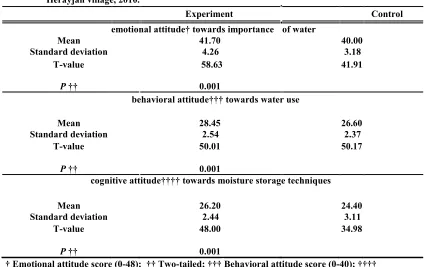
To examine differences between the two groups’ post test mean scores statistically, a mean comparison between two groups was run by two-tailed t-test separately. The results are shown in Table 2.
As Table 2 presents, the emotional attitude of the two groups of grape producers toward water importance differ significantly and the mean score of the experimental group is more than that of the control group. The same results are true about the grape dry land produces’ behavioral attitudes toward water use as well as cognitive attitudes toward water storage techniques importance.
The above results show that poetry plays a positive role in changing the attitude of the dry land grape producers toward water use optimization to increase the quality and quantity of the grape products. This could happen by having certain emotional attitudes towards water importance, using water more properly and being aware of moisture storage techniques.
Table 2. Comparing post test mean scores of the experimental and control groups in Herayjan village, 2010.
Experiment Control
emotional attitude† towards importance of water
Mean 41.70 40.00
Standard deviation 4.26 3.18
T-value 58.63 41.91
P†† 0.001
behavioral attitude††† towards water use
Mean 28.45 26.60
Standard deviation 2.54 2.37
T-value 50.01 50.17
P†† 0.001
cognitive attitude†††† towards moisture storage techniques
Mean 26.20 24.40
Standard deviation 2.44 3.11
T-value 48.00 34.98
P†† 0.001
† Emotional attitude score (0-48); †† Two-tailed; ††† Behavioral attitude score (0-40); †††† Cognitive attitude score (0-32)
CONCLUSIONS
farmers to forecast the environment changes, such as water deficiency, and to enhance their level of knowledge and skills to manage them. This study has clearly demonstrated the functions of poetry on land grape producers’ behavioral and cognitive attitude changes. In other words, the education treatment supplemented by poetry given to the experimental group has stimulated their emotion attitudes towards water importance and water use optimization, as well as getting higher cognitive attitude towards two water storage techniques, that is, miniatures and mulches. Hence, it seems desirable to integrate poetry into education for extension instructors to develop farmers’ competence in water use optimization. The logic behind this claim might be owing to the fact that art, including poetry, has been successful in personifying the environment and giving cultural identity to the environment so that the message could generally be understood by people, including farmers, in this case dry grape producers for optimal water use (23). Therefore, employing art, alongside the technical issues, improves knowledge and skills to optimize water use (2). The same results are also reported by Shahvali and Moshpheq (23) and Ebrahimi (3) by using caricatures and imagination arts for the same purposes.
ACKNOWLEDGMENTS
This study was carried out with cooperation of Agricultural Extension and Education Department by Mr. Farmandeh and Mr. Zarea; and Mr. Goodarzi and Mr. Abbasi personnel of Agriculture Department in Sepidan city; and Mrs. Daneshfard, who are gratefully acknowledged.
REFERENCES
1. Anonymous, 2009. Poet. Access date: 8. 11. 2010. Available on: http://fa.wikipedia.org. (In Farsi).
2. Daneshvar, S. 1996. Recognition and admiration of art. Siamac Book Press, Tehran. pp, 832. (In Farsi).
3. Ebrahimi, M. 2006. Mulch sprayed on organic agriculture. Access date: 11. 23. 2012. Available on: http://organic-agriculture.persianblog.ir. (In Farsi).
4. Farshadgohar, N. and M. H. Shahidi. 2002. Research methods and reference recognition in social science. Economic science college Press, Tehran University. pp, 312. (In Farsi).
5. Fisher, A. 1970. Necessity of art in the process of social development. Translation: F. Shirvanlu. Toos Press, Tehran. (In Farsi).
6. Gliga, F. 2011. Teaching by art therapy, Soc. Behav. Sci. J. 15:3042-3045.
7. Gupta, Y. 1998. The agronomic and breeding in rain-fed agriculture. Translation: A: Koochaki. Mashhad Jihad University Press. (In Farsi).
Press, Tehran. pp, 792. (In Farsi).
9. Islami, A. and M. Farzamnia. 2009. Influence of mulch application to increase soil moisture stored in pistachio orchards. Quar. Ira. J. of Irr. and Drain., 3(2):79-87. (In Farsi).
10. ISNA, 2008. The method of planting grapes with dry super absorbent polymers has done for the first time. Access date: 3. 17. 2010. Available on: http://www.iranabadi.ir. (In Farsi).
11. Jabbari, B. 2006. Poetry in different application fields. Access date: 5. 10. 2011 Available on: http://www.goftman-iran.info. (In Farsi).
12. JahanAfrooz, F., A. Esmati, N. Vahdati, A. Salmabadi, S. Eshaghi, M. Beladi, and A. Khaledi Kamanei. 2007. Water in culture and literature of the Iran. Parpyrar Cultural Institute, Tehran. (In Farsi).
13. Keshavarz, M. 2011, A social understanding of drought in Fars Province, Iran, PhD. Thesis, Shiraz University, Iran. (In Farsi).
14. Malasys, L. 1987. Village world (Education and Development). Translation: A. Zamanipoor. Higher Education Complex of Birjand. pp, 203. (In Farsi). 15. Manning, C., I. Verenikina, and I. Brown. 2010. Learning with the arts: what
opportunities are there for work-related adult learning? J. Vocat. Educ.Train. 62(3): 209-224.
16. Naseri, A. 2005. Application of Persian poetry in teaching philosophy. Access date: 8.27.2012. Available on: http:// gamfakm.blogfa.com. (In Farsi).
17. Organization of Surveying. 1997. National Atlas of "Agriculture". Printing of mapping the country, Tehran. (In Farsi).
18. Qarabaqy, A.S. 2006. Miniature warehouse to help agricultural water. Access date: 9. 22. 2013. Available on: http://entecnews.blogsky.com. (In Farsi).
19. Qaranjik, A. 2007. Agriculture: important points of dry farming. Access date: 2. 25. 2013. Available: http://www.gonbad-agri.ir. (In Farsi).
20. Robinson, S. 2007. Holistic health promotion: Putting the art into nurse education. Nurs. Educ. Prac. 7(3): 173–180.
21. Saadi, H. 2008. Necessity of dry land grape producers' education to deal with droughts. Access date: 8. 26. 2009. Available on: https://www.aftab.ir. (In Farsi).
22. Shahsavari, M. 2005. Taught from the devil and burned. Access date: 8. 6. 2009. Available on: http://www.persian-language.org. (In Farsi).
23. Shahvali, M. and J. Moshpheq. 2005. Study the role of caricature to change Shiraz agricultural organization experts’ attitude about sustainable agriculture, Shiraz. J. Agric. Sci. Nat. Resour. 91(1): 25-40. (In Farsi).
24. Shahvali, M. and J. Moshpheq. 2006. Study caricature operating information function with regard to personal characteristics, visual literacy and general caricature knowledge. Keyhan J. Caricature. 15 (176-175): 4-9. (In Farsi). 25. Shoaei, A. 2008. Usage of super absorbent polymers to reduce soil erosion.
26. Tolstoy, L. 2012. What is art? Translation: K. Dehgan. Fifteenth edition. Amir Kabir Press, Tehran. pp, 270. (In Farsi).
1 **
!
!
"
� *1
.
.
!
# $% -" # ! $ % & ' $( ) * + ! , "- ( . /0-(( .1( 2 3,$
3, .,
%. $ 4 5 6 (,
.
2
$3 $78 9 :
0-& . ; 2 .< 250 0-, ; ! (+ * . # ! ; @
+ $ A< %
B % !
70
& D $
$ .6 %
. 0( B % E FG
. H I $J 3, .(< (, K 7 % $ . . $J % $ .(<
0( B LM : N ! $0< % . 0 ! % $ 3 . 2 0
& $ AOF ' $( ) * . ( 2 $ + ! $ 4 .
K 7 (,
. 3, .(<
((
!
& $ AOF
' $( ) * P (, . . '! " # ( : � ��� � �� � ������ �� ��� ��� � ����� ��� ���� � �� �ی . ������
0- " $ ;
.- ( 2 M *
**