Pakistan J. Agric. Res. Vol 24 No. 1-4, 2011.
ESTIMATION OF GENETIC PARAMETERS TO FORMULATE
SELECTION STRATEGY FOR INCREASED YIELD IN LINSEED
M. Yasin Mirza, Mubashir A. Khan, M. Akmal, Akbar S. Mohmand, Malik S. Nawaz, Nazakat Nawaz and Najeeb Ullah*
ABSTRACT:- Genotypic differences among the genotypes in three seasons were statistically significant for plant height, number bolls plant-1, 1000-seed weight
and seed yield hectare-1. These studies were conducted at National Agricultural
Research Centre, Islamabad, Pakistan during rabi 2002-03, 2003-04 and 2004-05. Pooled genotypic and phenotypic variances were maximum for seed yield and mini-mum for 1000-seed weight. Genotypic coefficient of variation and phenotypic co-efficient of variation were observed maximum for seed yield and minimum for plant height. Broad sense heritability estimates were high for all the traits during three years ranging from 63% for plant height and 97% for seed yield. High herita-bility pooled estimates of 89% for 1000-seed weight and seed yield ha-1 coupled
with corresponding high estimates of genetic advance in percent of mean (17.23 and 18.33) for these traits indicated the predominance of additive gene effects. Mass selection based on these additively controlled traits is suggested for im-provement of yield. Plant height, number of bolls plant-1 and 1000-seed weight
showed genetic advance of 7.96, 8.85 and 17.23 % respectively with the prospects of improving seed yield up to the level of 18.33 %.
Key Words: Linseed; Genetic Parameters; Selection Strategy; Seed Yield; Pakistan.
INTRODUCTION
Linseed (Linum usitatissimum L.) also known as flax is cultivated for seeds and fibres. Its oil is largely of drying type and non-edible because of high amount of saturated fatty acids namely; palmitic acid and stearic acid alongwith unsatur-ated fatty acids viz., oleic, linoleic and linoleinic acids. Its oil content ranges from 33-45% with protein content of 24% (Gill, 1987). Singh and Marker (2006) re-ported that its oil is high in omega-3 fatty acid which is believed to be helpful in low-ering cholesterol level when included in the diet chain. Linseed cake is a supe-rior supplement for the dairy cattle due to its excellent palatability. Its meal con-tains 3% oil and 36% protein and serves as nutritious feed for cattle. It is a good source of calcium (170 mg100g-1),
phos-phorus (370 mg100g-1), potassium,
man-ganese, waxes (0.012-0.450 %), sterols and phospholipids (0.11-0.21 %).
In Pakistan average yield of linseed is quite low and the crop is only cultivated
in Sindh and Punjab provinces. It was grown on 5432 ha and total production of 3656 kgha -1 with average yield of 673 kgha-1 during
2008-09 (Anonymous, 2008-09).
Pyramiding of favorable genes for vari-ety development is an uphill task for a breeder and the success depends upon availability of large magnitude of genetic variability as the segregation patterns of yield and related traits are continuous and their phenotypic expres-sions are highly vulnerable to environmen-tal influences. The genetic variability and the heritability of polygenic characters in a population are useful parameters for esti-mating expected response to selection. The major function of heritability is to provide information on transmission of trait(s) from parents to the offspring and facilitate the evaluation of genetic and environmental ef-fects aiding in selection. Moreover, esti-mates of heritability can also be used to pre-dict genetic advance under different schemes of selection and help in anticipat-ing the genetic improvement of the crop.
Mahto and Rahman (1998), Popescu et
al. (1998), Mishra and Yadav (1999), Payasi et al. (2000), Noor (2004), Zaheer (2007) and Tadesse et al. (2010) have also evalu-ated linseed genotypes based on estimevalu-ated genetic parameters.
The objective of the present studies were to evaluate a collection of promising and improved linseed genotypes for their yield performance, and generating knowl-edge on different genetic parameters to for-mulate the selection strategy(s) for yield improvement of this crop.
MATERIALS AND METHODS
The experimental materials compris-ing populations of ten advanced/improved linseed lines namely; LS-24, LS-25, LS-26, LS-27, LS-29, LS-30, LS-31, LS-32, LS-33 and a check variety called Chandni were sown in randomized complete block design with four replications during rabi 2002-03, 2003-04 and 2004-05 at National Agricul-tural Research Centre, Islamabad, Paki-stan. Experimental unit comprised four 5m long rows keeping row-to-row and plant-to-plant spacing at 45 cm and 10 cm, respec-tively. At physiological maturity, data were recorded on ten randomly selected plants for four yield components including plant height, number of bolls plant, 1000-seed weight and seed yield hectare-1. The data
collected were subjected to analysis of vari-ance after Steel and Torrie (1980) for each year separately as well as on pooled basis over three years. Estimates of genotypic and phenotypic variances were computed following Singh and Chaudhry (1985). Ge-notypic and pheGe-notypic coefficients of varia-tion and broad sense heritability were es-timated after Burton (1952). Heritability estimates were grouped as high (>50%), medium (20-50%) and low (<20%) as pro-posed by Stansfield (1986). Genetic advance at 10% selection intensity and genetic ad-vance as percent of mean were computed using formula given by Johnson et al. (1955) and used by Allard (1960).
RESULTS AND DISCUSSION
Analysis of variance for each season as well as on pooled basis indicated statis-tically significant differences (P<0.01) among the genotypes for all the traits stud-ied. Results are in line with those of Payasi et al. (2000). Coefficient of variation for these traits ranged from 2 to 9 % showing the accuracy of the experimental design and randomization as supported by Gomez and Gomez (1984).
Agronomic Performance
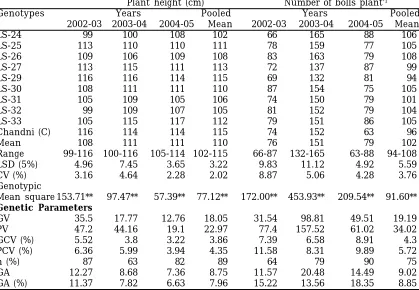
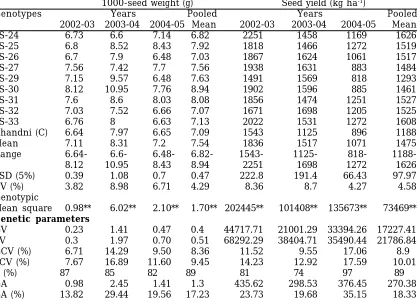
Mean performance of the promising genotypes against the check (Chandni) for three years separately and pooled over the years is presented (Tables 1 and 2). Char-acter wise results are discussed to iden-tify the superior genotype(s) out of tested ones.
Plant Height
On pooled mean basis, eight genotypes were dwarf with plant height ranging from 102 cm (LS-24) to 113 cm (LS-27) as against the check with value of 115 cm. However, six genotypes viz., 24, 25, 26, LS-30, LS-31 and LS-32 were dwarf and had short plant height in each season as against the check variety.
Number of Bolls Plant
It is believed that high number of bolls plant-1 reflect the yield potential of a crop
variety. In our study, the values of pooled means over three seasons showed that all the lines except LS-29 with 94 bolls plant-1,
possessed more number of bolls plant-1
ranging from 99( LS-27) to 108 in LS-26 as compared to Chandni having 96 bolls plant-1. 25, 26, 30, 32 and
LS-33 possessed large number of bolls plant-1
in each season as against the check.
1000-seed weight
Seed weight is an important yield com-ponent, hence needs particular emphasis for improving the yield of any crop. In this study, LS-25, LS-27, LS-29, LS-30, LS-31
and LS-33 were high in 1000-seed weight with values of 7.92, 7.56, 7.63, 8.94, 8.08 and 7.13 g, respectively as against the check (7.09 g) indicated by pooled mean values. Season wise data depicted that in 2002-03 all 9 entries; in 2003-04 five en-tries (25. 29, 30, 31 and LS-33) with seed weight of 8.0 to 10.95 g; and in 2004-05 six entries including 24, LS-25, LS-27, LS-30, LS-31 and LS-32 had higher 1000-seed weight than check vari-ety.
Seed Yield
It is an outcome of intricate relation-ship of several contributing characters. Consistency in yield performance over the years is an important measure of ranking for developing commercial varieties. Re-sults indicated that LS-24, LS-25, LS-26, LS-31, LS-32 and LS-33 showed consistent
high yield performance than check in each season. LS-24 produced maximum seed yield of 2251 kg ha-1 followed by LS-33 (2022
kg ha-1) in 2002-03. 32 followed by
LS-27 produced maximum yield of 1698 and 1631 kg ha-1 in 2003-04. While LS-25 and
LS-33 produced high yield of 1272 kg ha-1
in 2004-05 as compared to check. More-over, the pooled mean data also elucidated that all the varieties out yielded the check (1188 kg) with seed yield hectare-1 ranging
from 1293 kg (LS-29) to 1626 kg (LS-24). These results are in conformity with those of Noor (2004) and Zaheer (2007).
Genetic Parameters
Statistical measures such as geno-typic and phenogeno-typic variances, genogeno-typic and phenotypic coefficients of variation, broad sense heritability, genetic advance and genetic advance as percent of mean
ESTIMATION OF GENETIC PARAMETERS
Table 1. Mean performance for plant height (cm) and number of bolls plant-1 and
estimates of genetic parameters in linseed genotypes over three years
Plant height (cm) Number of bolls plant-1
Genotypes Years Pooled Years Pooled
2002-03 2003-04 2004-05 Mean 2002-03 2003-04 2004-05 Mean
LS-24 99 100 108 102 66 165 88 106
LS-25 113 110 110 111 78 159 77 105
LS-26 109 106 109 108 83 163 79 108
LS-27 113 115 111 113 72 137 87 99
LS-29 116 116 114 115 69 132 81 94
LS-30 108 111 111 110 87 154 75 105
LS-31 105 109 105 106 74 150 79 101
LS-32 99 109 107 105 81 152 79 104
LS-33 105 115 117 112 79 151 86 105
Chandni (C) 116 114 114 115 74 152 63 96
Mean 108 111 111 110 76 151 79 102
Range 99-116 100-116 105-114 102-115 66-87 132-165 63-88 94-108 LSD (5%) 4.96 7.45 3.65 3.22 9.83 11.12 4.92 5.59
CV (%) 3.16 4.64 2.28 2.02 8.87 5.06 4.28 3.76
Genotypic
Mean square 153.71** 97.47** 57.39** 77.12** 172.00** 453.93** 209.54** 91.60**
Genetic Parameters
GV 35.5 17.77 12.76 18.05 31.54 98.81 49.51 19.19
PV 47.2 44.16 19.1 22.97 77.4 157.52 61.02 34.02
GCV (%) 5.52 3.8 3.22 3.86 7.39 6.58 8.91 4.3
PCV (%) 6.36 5.99 3.94 4.35 11.58 8.31 9.89 5.72
h (%) 87 63 82 89 64 79 90 75
GA 12.27 8.68 7.36 8.75 11.57 20.48 14.49 9.02
GA (%) 11.37 7.82 6.63 7.96 15.22 13.56 18.35 8.85
provide precise estimates of genetic varia-tion for quantitative characters in any crop (Yadav and Dalal, 1972). In the present studies, the values of variances were found maximum for seed yield and minimum for 1000-seed weight for three years separately as well as for pooled means over the years. In genotypic and phenotypic coefficients of variations, maximum values (17.06% and 17.59% respectively) were observed for seed yield whereas minimum values (3.22% and 3.94%, respectively)or plant height during 2004-05 (Tables 1 and 2). Similar trend was observed on pooled means basis with maxi-mum and minimaxi-mum values of GCV and PCV for seed yield (8.90% and 10.01%) and for plant height (3.86% and 4.35%) respec-tively. Present findings corroborate with those of Mishra and Yadav (1999) and Payasi et al. (2000) who reported high GCV and PCV
for yield in linseed. Tadesse et al. (2010) reported high GCV and PCV for seed yield and low for plant height in linseed.
Relative amount of heritable portion of variance can be assessed through herita-bility estimation. Results demonstrated that broad sense heritability estimates were high for all the traits during each year separately as well as on pooled means ba-sis ranging from 63% for plant height in 2003-04 to 97% for seed yield in 2004-05. The higher estimates indicated that large proportion of the total variance was explic-itly due to the high genotypic variance and less environmental influence resulting in high heritable variation. The findings are in agreement with those of Mahto and Rahman (1998) who reported high herita-bility values for number of bolls per plant, 1000-seed weight and seed yield. Popescu
M. YASIN MIRZA ET AL.
Table 2. Mean performance for 1000 seed weight (g) and seed yield (kgha-1) and
estimates of genetic parameters in linseed genotypes over three years
1000-seed weight (g) Seed yield (kg ha-1)
Genotypes Years Pooled Years Pooled
2002-03 2003-04 2004-05 Mean 2002-03 2003-04 2004-05 Mean
LS-24 6.73 6.6 7.14 6.82 2251 1458 1169 1626
LS-25 6.8 8.52 8.43 7.92 1818 1466 1272 1519
LS-26 6.7 7.9 6.48 7.03 1867 1624 1061 1517
LS-27 7.56 7.42 7.7 7.56 1938 1631 883 1484
LS-29 7.15 9.57 6.48 7.63 1491 1569 818 1293
LS-30 8.12 10.95 7.76 8.94 1902 1596 885 1461
LS-31 7.6 8.6 8.03 8.08 1856 1474 1251 1527
LS-32 7.03 7.52 6.66 7.07 1671 1698 1205 1525
LS-33 6.76 8 6.63 7.13 2022 1531 1272 1608
Chandni (C) 6.64 7.97 6.65 7.09 1543 1125 896 1188
Mean 7.11 8.31 7.2 7.54 1836 1517 1071 1475
Range 6.64- 6.6- 6.48- 6.82- 1543- 1125- 818-
1188-8.12 10.95 8.43 8.94 2251 1698 1272 1626
LSD (5%) 0.39 1.08 0.7 0.47 222.8 191.4 66.43 97.97
CV (%) 3.82 8.98 6.71 4.29 8.36 8.7 4.27 4.58
Genotypic
Mean square 0.98** 6.02** 2.10** 1.70** 202445** 101408** 135673** 73469**
Genetic parameters
GV 0.23 1.41 0.47 0.4 44717.71 21001.29 33394.26 17227.41 PV 0.3 1.97 0.70 0.51 68292.29 38404.71 35490.44 21786.84 GCV (%) 6.71 14.29 9.50 8.36 11.52 9.55 17.06 8.9 PCV (%) 7.67 16.89 11.60 9.45 14.23 12.92 17.59 10.01
h (%) 87 85 82 89 81 74 97 89
GA 0.98 2.45 1.41 1.3 435.62 298.53 376.45 270.38 GA (%) 13.82 29.44 19.56 17.23 23.73 19.68 35.15 18.33
et al. (1998) found large heritability esti-mates for plant height, bolls m-2 and seed
yield. Mishra and Yadav (1999) also reported similar results for bolls plant-1; whereas
Payasi et al. (2000) reported high herita-bility value for seed yield; Noor (2004) for bolls plant-1, 1000-seed weight and seed
yield and Zaheer (2007) for bolls plant-1 and
1000-seed weight in linseed. Tadesse et al. (2010) also reported that heritability esti-mates were high for seed yield, number of bolls plant-1 and 1000-seed weight. These
characters showing high heritability, therefore, may respond effectively to phe-notypic selection.
Moreover, less difference between GCV and PCV and corresponding high heritabil-ity estimates were observed for all the char-acters studied (Tables 1 and 2), indicating less environmental influence on these characters and suggesting use of direct se-lection for their improvement. Popescu et al. (1998), Mishra and Yadav (1999), Noor (2004) and Zaheer (2007) reported similar findings in their studies conducted on lin-seed crop. Tadesse et al. (2010) who re-ported highest GCV and PCV for seed yield which are in line with our results.
High heritability per se is no index of high genetic gain, hence should be accom-panied by high GA% when describing the genetic parameters in any crop as cau-tioned by Kadir et al. (1996). In current stud-ies, bolls plant-1, 1000-seed weight and seed
yield ha-1 during three years as well as on
pooled means basis showed heritability of 75, 89 and 89%, respectively. Plant height in 2002-03, showed high heritability (87%) coupled with high values of GA% (11.37), indicating that these traits are under con-trol of additive genes and are helpful for selection based on phenotypic performance. Mahto and Rahman (1998) reported high heritability along with high GA% values for bolls plant-1, 1000-seed weight and seed
yield supporting that the expression of these traits was additively controlled. Popescue et al. (1998) also reported that plant height, bolls m-2 and seed yield were
controlled by additive gene effects. Mishra and Yadav (1999) found high heritability
and GA% for number of bolls plant-1
indi-cating the preponderance of additive gene action. Payasi et al. (2000) reported addi-tive gene effects controlling seed yield. Noor (2004) also found that additive gene action governed the expression of bolls plant-1 and
seed yield. Similarly, Zaheer (2007) in-vestigated additive gene effects for bolls per plant and 1000-seed weight.
The aforementioned estimates of broad sense heritability, genetic advance and genotypic variances were high for plant height, number of bolls plant-1, 1000-seed
weight and seed yield hectare-1. Therefore,
mass selection based on these additively controlled traits is suggested for yield im-provement in this crop. Mahto and Rahman (1998) reported that phenotypic selection made on the basis of bolls plant-1, 1000-seed
weight and seed yield would be effective for the improvement of yield. Moreover, Mishra and Yadav (1999) also emphasized the se-lection for high number of bolls plant-1 to
develop linseed varieties with high yield potential. These results also revealed that the characters with high genotypic coeffi-cient of variation possessed high genetic advance irrespective of heritability esti-mates and vice versa, showing the prepon-derance of genetic influence and the find-ings are in line with those of Ali et al. (2000) who investigated that genetic advance in percent of mean is a function of heritabil-ity and genotypic coefficient of variation. However, the later parameter was more important than the earlier.
Mean values of genetic advance in percent over the years indicated that ge-netic improvement for plant height, num-ber of bolls plant-1, 1000-seed weight and
seed yield can be achieved through selec-tion up to the level of 7.96, 8.85, 17.23 and 18.33% respectively within the perspective of tested materials. Zaheer (2007) also mentioned that 16-32% improvement in yield of linseed could be achieved by select-ing indirectly for the number of bolls per plant and 1000-seed weight. Tadesse (2010) reported genetic advance in percent of mean was high for seed yield and 1000-seed weight and are in agreement with our
ings.
In conclusion, progress from selection is realized only to the extent of identifica-tion of superior genotypes. Informaidentifica-tion on the relative magnitudes of different sources of variance provides a guide towards this objective. From the results achieved in these studies, it is recommended that plant height, number of bolls plant-1,
1000-seed weight and 1000-seed yield provide a good selection base as they had high values of heritability coupled with genetic advance. Emphasis should be placed on these char-acters for formulating selection strategy for the development of high yielding linseed varieties.
LITERATURE CITED
Ali, S.S. Jafri, S.J.H. Khan, T.Z. Mahmood, A. and Butt, M.A. 2000. Heritability of yield and yield components of rice. Pa-kistan J. Agric. Res. 16(2): 89-91. Allard, R.W. 1960. Principles of Plant
Breed-ing. John Willey and Sons, Inc., New York USA. p. 484.
Anonymous. 2008-09. Agricultural Statis-tics of Pakistan 2008-2009. Ministry of Food, Agriculture and Livestock (Eco-nomic Wing), Government of Pakistan, Islamabad.
Burton, G.W. 1952. Quantitative inherit-ance in grasses. Proc. 6th Int’l.
Grass-land Cong. 1: 277-283.
Gill, K.S. 1987. Linseed. Indian Council of Agric. Res. New Delhi.
Gomez, K. A. and Gomez, A. A. 1984. Sta-tistical Procedure for Agricultural Re-search 2nd edn. John Willey and Sons,
Inc., New York, USA.
Johnson, H.W. Robinson, H.F. and Comstock, R.E. 1955. Estimates of ge-netic and environmental variability in soybean. Agron. J. 47: 314-318.
Kadir, M. Biswas, B.K. Podder P. Alam, M.S. and Adhikary, S.K. 1996. Genetic param-eters, character association and path analysis in sesame. Bangladesh J. Agric. Res. 21(1): 37-43.
Mahto, C. and Rahman, M.H. 1998. Genetic variability of some quantitative
charac-ters in linseed (Linum usitatissimum L.). J. Res. Birsa Agric. University. 10(2): 161-165.
Mishra, A.K. and Yadav, L.N. 1999. Genetic parameters and association in linseed. Indian J. Agric. Res. 33(2): 113-118. Noor, S.A. 2004. Genetic variability and
cor-relation studies in linseed. M. Sc. (Hons) Agri. Dissert. Deptt. of Plant Breed. and Genet., Univ. of Arid Agric., Rawalpindi-Pakistan.
Payasi, S.K. Bose, U.S. and Singh, A.K. 2000. Pooled analysis of genetic param-eters in linseed (Linum usitatissimum L.). Advances in Plant Sci. 13(2): 559-562. Popescu, F. Marinescu, I. and Vasile, I.
1998. Combining ability and heritabil-ity of important characters for improv-ing linseed. Probleme-de-Genetica-Teoretica-si-Aplicata. 30(1-2):105-122. Singh, R.K. and Chaudhry, V.D. 1985.
Bio-metrical Methods in Quantitative Ge-netic Analysis. Klyani Publishers, New Delhi, India. p. 53-54.
Singh, S.B. and Marker, S. 2006. Linseed:A plant with many uses. Agrobios Newsl. 5(2):1-3.
Stansfield, W.D. 1986. Theory and Problems of Genetics. McGraw Hill Book Co. New York, USA. p. 220-221.
Steel, R.G.D. and Torrie, J.H. 1980. Prin-ciples and Procedures of Statistics. A Bio-metrical Approach. 2nd edn. McGraw-Hill,
Inc., New York, USA. p. 196-201.
Tadesse, T. Parven, A. Singh, H. and Weyessa, B. 2010. Estimates of variabil-ity and heritabilvariabil-ity in linseed germplasm. Int. J. Sustain. Crop Prod. 5(3): 8-16.
Yadav, T.P. and Dalal, J.L. 1972. Genetic variability and correlation studies in lin-seed. Punjab. Agric. Univ. J. Res. 11: 35-39.
Zaheer, A. 2007. Estimation of heritability and correlation studies in linseed germplasm (Linum usitatissimum L.). M. Sc. (Hons) Agri. Dissert. Deptt. of Plant Breed. and Genet., Univ. of Arid Agric., Rawalpindi, Pakistan.