The Thirty-Third AAAI Conference on Artificial Intelligence (AAAI-19)
Reasoning over Assumption-Based Argumentation
Frameworks via Direct Answer Set Programming Encodings
Tuomo Lehtonen
University of Helsinki, FinlandJohannes P. Wallner
TU Wien, AustriaMatti J¨arvisalo
University of Helsinki, FinlandAbstract
Focusing on assumption-based argumentation (ABA) as a central structured formalism to AI argumentation, we pro-pose a new approach to reasoning in ABA with and without preferences. While previous approaches apply either special-ized algorithms or translate ABA reasoning to reasoning over abstract argumentation frameworks, we develop a direct ap-proach by encoding ABA reasoning tasks in answer set pro-gramming. This significantly improves on the empirical per-formance of current ABA reasoning systems. We also give new complexity results for reasoning in ABA+, suggesting that the integration of preferential information into ABA re-sults in increased problem complexity for several central ar-gumentation semantics.
1
Introduction
The study of computational models for argumentation is a vibrant area of AI and knowledge representation (KR) re-search. As KR formalisms, computational models of argu-mentation capture various related paradigms, including non-monotonic reasoning and logic programming (Dung 1995), and furthermore open up avenues for various types of appli-cations (Atkinson et al. 2017).
Arguments most often have an intrinsic structure made explicit through derivations from more basic struc-tures. Computational models for structured argumenta-tion (Besnard et al. 2014; Bondarenko et al. 1997; Garc´ıa and Simari 2004; Besnard and Hunter 2008; Prakken 2010) provide tools for making the internal structure of argu-ments explicit. This is in contrast to abstract argumentation, where the structure of individual arguments is completely abstract, and reasoning over abstract argumentation frame-works (AFs) (Dung 1995) is restricted to the level of pair-wise knowledge of attacks between conflicting arguments. While there has been noticeable attention on computational approaches for AFs (Charwat et al. 2015), advancing under-standing of the complexity of and algorithms for reasoning over structured argumentation frameworks has received less attention and can be considered more challenging.
In this paper we focus on assumption-based argumenta-tion (ABA) (Bondarenko et al. 1997; Dung, Kowalski, and Toni 2009; Toni 2014; Cyras et al. 2018) as one of the central
Copyright c2019, Association for the Advancement of Artificial Intelligence (www.aaai.org). All rights reserved.
2
Assumption-Based Argumentation
We recall assumption-based argumentation (ABA) (Bon-darenko et al. 1997; Toni 2014; Cyras et al. 2018) and ABA+(Cyras and Toni 2016a; 2016c; Bao, Cyras, and Toni 2017) that equips ABA with preferences over assumptions. Since ABA+ is a strict generalization of ABA, we directly define the former and point out differences to the latter.We assume a deductive system (L,R) with L a for-mal language, i.e., a set of sentences, and Ra set of in-ference rules over L with a rule r ∈ Rhaving the form a0←a1, . . . , anwithai ∈ L. We denote the head of ruler byhead(r) ={a0}and the (possibly empty) body ofrby body(r) ={a1, . . . , an}.
A central concept in ABA+ is how a sentence can be derived from a given set of assumptions and a set of rules. In ABA, several notions of derivability are stud-ied (Dung, Kowalski, and Toni 2006; Dung, Toni, and Man-carella 2010), with tree-derivability (|=) the most com-monly considered one. ABA (without preferences) can be equivalently defined via forward-derivability, and we will make use of this fact here for developing ASP encod-ings for ABA under various semantics. In contrast, tree-derivability is central for defining ABA+, and the equiva-lence with forward-derivability does not carry over in gen-eral to ABA+. However, as we will show, tree-derivability and forward-derivability remain equivalent also for ABA+ under specific semantics, which allows for an ASP encoding similar to those we develop for ABA.
A sentences∈ Lis tree-derivable from a set of assump-tionsX ⊆ Aand rulesR ⊆ R, denoted byX |=R s, if there is a finite tree with the root labeled bys, the leaves la-beled by elements ofX, and for each internal node labeled withtthere is a ruler∈ Rs.t. the set of labels of the chil-dren of this node isbody(r)and the node itself is labeled by head(r). For each ruler∈Rthere is a node labeled in this way. In brief, there is a derivation tree from assumptionsX and rulesRto sentences. Unless not clear from the context, we will write|=Rwithout explicitly definingRand assume thatR⊆ Rfrom the given deductive system.
A sentencea∈ Lis forward-derivable from a setX ⊆ A
via rulesR, denoted byX `R a, if there is a sequence of rules (r1, . . . , rn) such thathead(rn) = a, for each rule ri we have ri ∈ R, and each sentence in the body of ri is derived from rules earlier in the sequence or inX, i.e., body(ri)⊆X∪Sj<ihead(rj).
IfX |=R sthen X `R s, and if X `R s there is an
X0 ⊆ X andR ⊆ Rsuch thatX0 |=R s. In words,|=is “stricter” (requires a tree derivation where all assumptions and rules are required for derivation), while`is simpler (no witness tree is required and redundant assumptions and rules are allowed). The deductive closure for an assumption setX w.r.t. rulesRis given byThR(X) = {a|X `R a}(there
is an equivalent definition via|=). If the type of derivation is not relevant, we generally refer to derivations.
An ABA+framework is a tupleF = (L,R,A, ,≤)with
(L,R)a deductive system, a set of assumptionsA ⊆ L, a function mapping assumptionsA to sentencesL, and a preorder≤onA. The strict counterpart<of≤is defined as
usual bya < biffa ≤b andb 6≤ a, fora, b ∈ A. In this paper, we focus on so-called flat ABA+frameworks where assumptions cannot be derived, i.e., do not occur in heads of rules. We also assume that each set in a tuple defining an ABA+is finite.
Definition 1. Let(L,R,A, ,≤)be an ABA+ framework, andA, B ⊆ Abe two sets of assumptions. Assumption set
A <-attacksBif
• A0 |=R bfor someA0 ⊆ A,b ∈ B, and@a0 ∈ A0 with
a0< b, or
• B0 |=R afor somea∈AandB0 ⊆Bs.t.∃b0 ∈B0with b0< a.
In words, setAattacksBif (i) from a subsetA0ofA, one can tree-derive a contrary of an assumption b ∈ B and no member inA0is strictly less preferred thanb, or (ii) fromB, via subsetB0 one can tree-derive a contrary of an assump-tiona∈Aand some member ofB0is strictly less preferred thana. Attacks of type (i) arenormal<-attacks and those of type (ii)reverse<-attacks, with the intuition that the (non-preference based) conflict in (i) succeeds and in case of (ii) is countered and reversed by the preference relation.
Definition 2. LetF = (L,R,A, ,≤)be an ABA+ frame-work. An assumption set A ⊆ A is called conflict-free if
A does not<-attack itself. Set A defends assumption set
B ⊆ Aif for allC ⊆ Athat <-attack B it holds thatA <-attacksC.
Definition 3. LetF = (L,R,A, ,≤)be an ABA+ frame-work. Further, letA ⊆ Abe a conflict-free set of assump-tions inF. SetAis
• <-admissibleinFifAdefends itself;
• <-completein F if A is admissible in F and contains every assumption set defended by A;
• <-groundedinFifAis the intersection of all<-complete assumption sets;1
• <-preferredinF ifAis<-admissible and there is no< -admissible set of assumptionsBinF withA⊂B; and • <-stableinFif each{x} ⊆ A \Ais<-attacked byA.
We use the term <-σ-assumption-set for an assumption set under a semanticsσ ∈ {adm,com,grd,stb,prf}, i.e., <-admissible,<-complete, <-grounded,<-stable, and <-preferred semantics, respectively.
An ABA framework, that is ABA+ without preferences, is a tuple F = (L,R,A, ,∅) (i.e. ≤= ∅). We will de-note ABA frameworks byF = (L,R,A, ), i.e., omitting the empty preference relation, and refer to the correspond-ing semantics, likewise, without the preference relation< (e.g., complete semantics instead of<-complete semantics). Attacks (∅-attacks) in ABA frameworks simplify to attacks from assumption setsAto assumption setsBwhenA`R b forb ∈ B(these are normal<-attacks when no preference information is available; reverse<-attacks are not present in ABA). Note that forward-derivability is sufficient for ABA.
Main reasoning tasks on ABA+are the following.
1
Definition 4. LetF = (L,R,A, ,≤)be an ABA+ frame-work and<-σa semantics. A sentences∈ Lis
• credulously accepted inF under semantics<-σif there is a<-σ-assumption-setAs.t.s∈ThR(A); and • skeptically accepted in F under semantics <-σ if s ∈
ThR(A)for all<-σ-assumption-setsA.
The tasks for ABA are analogous, the preference rela-tion<is simply disregarded. For ABA, credulous reasoning under admissible, complete, and preferred semantics coin-cide (Bondarenko et al. 1997; Cyras et al. 2018).
Example 1. LetF= (L,R,A, )be an ABA with assump-tionsA = {a, b, c, d}, sentencesL = {x, bc, cc, dc} ∪ A,
rules(x ← a),(cc ← b, x),(bc ← c), and(dc ← a, b), wherebc,cc, anddc are the contraries of b,c, andd,
re-spectively. The complete assumption sets are {a}, {a, b}, and {a, c, d}, with {a} the grounded assumption set (this assumption is not attacked). The sets {a, b} and {a, c, d} are also stable: e.g., the first set attacks via the second and fourth rules the assumptions{c}and {d}. Sentencex
is credulously accepted under admissible, complete, stable, and preferred. Under preference a < d, in the resulting ABA+ F0 = (L,R,A, ,≤)the set{a, b}is not<-stable (the attack from{a, b}todis reversed), while set{a, c, d}is
<-stable. By the further preferencec < b, the set{c}does not<-attack{b}, resulting in no<-stable assumption sets.
Computational complexity of reasoning over ABA is well-established (Dimopoulos, Nebel, and Toni 2002): cred-ulous reasoning for admissible, stable, and preferred seman-tics is NP-complete, while skeptical reasoning is P-complete under admissible, coNP-complete under stable, and Πp2 -complete under preferred semantics. Complexity of ABA with preferences has, to our knowledge, not being stud-ied in depth; Wakaki (2017) showed complexity results for p ABA, an alternative way of handling preferences in ABA. However, the results do not directly transfer to ABA+.
Finally, the so-called Axiom of Weak Contraposition (WCP) bridges ABA+with the semantics of ABA. Namely, if an ABA+ framework satisfies WCP, then further proper-ties on the semantics hold (Cyras and Toni 2016b), e.g., the grounded assumption set is guaranteed to exist.
Definition 5. An ABA+ (L,R,A, ,≤)satisfies the Axiom
of Weak Contraposition (WCP) if for eachA⊆ A,R⊆ R, andb∈ A, ifA|=R band∃a0 ∈Asuch thata0 < b, then
there is a≤-minimala∈Asuch thata < bandA0 |=R0 a for someA0⊆(A\ {a})∪ {b}andR0⊆ R.
3
Properties and Complexity Results
We discuss properties essential for developing our ASP en-codings, as well as establish complexity results for ABA+.ABA.We begin with slightly re-stating some of the ABA semantics in terms that are suited for subsequent encodings. Let(L,R,A, )be an ABA framework andE⊆ Abe a set of assumptions. Define DE = {a ∈ A | Eattacks{a}}. Recall that in ABAEattacks{a}iffE`Ra.
Proposition 1. Let(L,R,A, )be an ABA framework and
E⊆ Abe a conflict-free set of assumptions. It holds that • setEdefends an assumption set{a} ⊆ AiffA \DEdoes
not attack{a};
• setEis admissible iffA \DEdoes not attackE; and • setE is complete iffE is admissible and for eachb ∈
A \Ewe have{b}is attacked byA \DE.
For Proposition 1, which follows from the definitions, the main ingredient in checking if a set is admissible or com-plete is the setDE (which can be computed in polynomial time since`Ris decidable in polynomial time). Further, for
ABA frameworks, the grounded semantics can be character-ized by the functiondef(A) = {a ∈ A | Adefendsa}, as shown in (Bondarenko et al. 1997, Theorem 6.2). The grounded assumption set of an ABA framework is the least fixed point of def. The complexity of grounded and com-plete semantics of ABA has, to our knowledge, not been made explicit, but since DE, and thus def, can be com-puted in polynomial time, one can straightforwardly infer their complexity.
Corollary 2. For a given ABA framework, one can in poly-nomial time (i) compute the grounded assumption set, and (ii) verify whether a given set of assumptions is complete. ABA+. Tree-derivability is used for defining <-attacks in ABA+. Unlike in ABA, tree-derivations and forward-derivations are not equivalent when using them to define <-attacks. This can be seen when A normally <-attacks B: adding redundant assumptions toA(not used for deriving a sentence) may weaken the set and make it open for reverse <-attacks that are not present in the original definition via|=
(e.g. byA0=A∪ {a0}witha0< bfor ab∈BandA0`R b
butA0 6|=R b). However, normal <-attacks can be defined via`, which follows from (Dung, Kowalski, and Toni 2006; Dung, Toni, and Mancarella 2010), and reverse <-attacks in the special case of conflict-free setsAthat reversely <-attack a singleton set{b}.
Lemma 3. Let(L,R,A, ,≤)be an ABA+framework, and
A, B⊆ Abe two sets of assumptions, andb∈ A.
• SetAnormally<-attacksBiffA0 `R b, for someA0 ⊆
A,b∈B, and@a0 ∈A0witha0 < b.
• IfAis conflict-free, we haveAreversely<-attacks{b}iff {b} `Rafor somea∈Aandb < a.
To see why a conflict-free setAreversely<-attacks{b}
as stated in the second condition of the lemma, first note that, sinceAis conflict-free, we have∅ 6|=Rafor alla∈A. Thus also∅ 6`R a. This means that{b} `R aiff{b} |=R a, for somea ∈ A, since there is no subset of{b} that forward-derivesa, by presumption ofAbeing conflict-free.
A corollary of Lemma 3 is that one can check whether a set of assumptions is<-stable via relying only on forward-derivability. To make this explicit, we slightly re-state <-stable semantics in the following proposition.
Proposition 4. Let D = (L,R,A, ,≤) be an ABA+ framework. A conflict-free set E ⊆ A is <-stable iff for all{b} ⊆ Athat are not normally<-attacked byE, either
In this proposition we have explicitly distinguished be-tween normal and reverse<-attacks (which will also be use-ful for our ASP encodings), and explicated that the required conditions only rely on the notion of forward-derivability.
We move on to investigating the complexity of ABA+ se-mantics. Central to understanding the complexity of ABA+ is understanding the complexity of <-attacks. In ABA, attacks take a relatively simple form: sets of assump-tions attack single assumpassump-tions in the definition of an at-tack in ABA. In both ABA and ABA+ attacks satisfy ⊆ -monotonicity of the following form: ifA(<-)attacksBthen A0 (<-)attacksB0 wheneverA ⊆ A0 andB ⊆ B0 (Cyras and Toni 2016b, Lemma 3). That is, in ABA, ifAattacksb, thenAattacks anyBwithb∈B. Attacks in ABA+, while also⊆-monotone, may in cases not attack singleton sets of assumptions. Normal<-attacks in an ABA+framework are similar to attacks in an ABA, reverse <-attacks originate
from singleton sets of assumptions, yet attack a set of as-sumptions. Put differently, in ABA, if a setBis attacked, by A, then there is at least one singleton set{b} ⊆Bsuch that
{b} is attacked by A. The same does not hold for reverse <-attacks in ABA+.
As we show, the difference in attacks between ABA and ABA+ is significant from a computational perspective. We classify four types of (counter) <-attacks that are useful for understanding complexity of ABA+. For two sets of as-sumptions,AandB, we distinguish whether (i)Anormally <-attacksB, (ii)Areversely<-attacksB, (iii)Anormally <-attacks all subsetsB0 ⊆ B that <-attackA, and (iv)A reversely<-attacks all subsetsB0 ⊆Bthat<-attackA.
Proposition 5. Let(L,R,A, ,≤)be an ABA+framework, and Aand B two sets of assumptions. One can decide in polynomial time whether setA
1. normally<-attacksB, 2. reversely<-attacksB, or
3. normally<-attacks all subsetsB0⊆Bthat<-attackA.
Proof. (sketch) For (1), consider eachb∈Bseparately and compute Ab = {a ∈ A | a 6< b}. If Ab `R b then Ab
normally <-attacks {b}, and by monotonicityA normally <-attacksB. For (2), computeThR(B). For eacha∈A, if
a∈ThR(B), construct a directed graph with node set equal
toThR(B)and iteratively add edges fromato sentencesx whenever there is a rule applicable from ThR(B) witha
in the head andxin the body; continue this process for the body elements xas rules’ heads and their bodies (until a fixed point is reached). There is a tree-derivationB0 |=R a withB0 ⊆ B such that there is ab ∈ B0 withb < aiff there is a path fromato such a b. For (3), compute X =
{b ∈ B | Anormally<-attacks{b}}, which can be done in polynomial time according to (1). Next, check whether B \X <-attacks A (via 1 and 2). If so, thenA does not counter all<-attacks via normal<-attacks.
Note that the item 2 of Proposition 5 is polynomial-time decidable, since one does not need to find subset-minimal B0 ⊆ B that are reversely <-attacked by A. Item 3 is likewise polynomial-time decidable, since normal<-attacks
target only singleton sets of assumptions. Before delving into attacks of type (iv), we derive complexity of verifying whether a set of assumptions is <-stable based on Propo-sition 5. Note that conflict-freeness does not depend on the preference relation (Cyras and Toni 2016b, Theorem 5), and can be checked in polynomial time.
Theorem 6. Verifying whether a set of assumptions is< -stable in an ABA+ framework is in P. Checking credulous (skeptical) acceptance of a sentence under<-stable seman-tics in ABA+is NP-complete (coNP-complete).
This means that <-stable semantics exhibits the same computational complexity as (non-preference-based) stable semantics in ABA. Complexity does not carry over from ABA to ABA+for the other semantics under consideration. In fact, when considering counterattacks (defense) against potentially non-singleton sets of assumptions, i.e., scenario (iv) (from before Proposition 5), it is coNP-hard to decide.
Proposition 7. Deciding whether a given setAof assump-tions in an ABA+framework reversely counterattacks all as-sumption sets that<-attackAis coNP-complete. Hardness holds even when assuming WCP.
Proof. (sketch) Membership in coNP can be seen from con-sidering the complementary problem: for assumption setA, to check non-<-admissibility, guess setB, check whetherB <-attacksAand whetherAdoes not<-reversely attackB. Letφ = c1∧ · · · ∧cmbe a Boolean formula in conjunc-tive normal form over vocabulary X = {x1, . . . , xn}and clausesC ={c1, . . . , cm}. For a clausecj =l1∨ · · · ∨ls letneg(cj) = ¬l1, . . . ,¬lswith¬li = xifli = ¬xand
¬li =¬xifli =x. Construct ABA+F = (L,R,A, ,≤)
withA={a, b} ∪X∪ ¬X for¬X ={¬x|x∈X}and the following rules.
di←xi and di ← ¬xi for1≤i≤n; ac←d1, . . . , dm;
bc←xi,¬xi, ac for1≤i≤n; and bc←neg(c
j), ac for1≤j≤m,
withacandbcthe contraries ofaandbrespectively (no other contraries are needed). Complete the instance with setting b > xiandb >¬xifor1≤i≤n.
We claim that{a, b}is reversely<-attacking all assump-tion setsX that<-attack{a, b}inF iffφis unsatisfiable. Note that one cannot derive a contrary of any assumption from{a, b}. Thus{a, b}does not normally<-attack any as-sumption set and no asas-sumption set can reversely<-attack
{a, b}Thus,{a, b}is reversely<-attacking all assumption setsX that<-attack{a, b}inFiff{a, b}is<-admissible.
Assume that {a, b} is not<-admissible. Since {a, b} is conflict-free, there is aB ⊆ As.t.B <-attacks{a, b}and
onX: true ifxi is present in B, false otherwise. SinceB does not derivebc, all bodies of rulesbc ←neg(cj), acfor
1 ≤ j ≤mare not satisfied (at least one element of these bodies is missing/non-derivable fromB). ThusB satisfies each clause:B does not contain all elements fromneg(cj) iffB satisfies at least one literal in clausecjiffBsatisfies cj. Since this holds for all clauses,Bsatisfiesφ.
For the other direction, assume thatφis satisfiable with satisfying truth assignmentτ. ConstructB={xi|τ(xi) = 1} ∪ {¬xi |τ(xi) = 0}. Sinceτassigns each variable inX to either true or false,B`Rac(see above). Consider clause
cj. ThenBdoes not contain all sentences of bodyneg(cj). Thus,B 6`Rbc. This implies that{a, b}is not admissible.
The proof for coNP-hardness holds also when adding the following rules which enforce that WCP is satisfied by the constructed ABA+instance:xc
i ←b,¬xiand¬xci ←b, xi for each1 ≤ i ≤n, and for each clausecj =l1∨l2∨l3 adding(lc
1 ←b, l2, l3),(lc2 ←b, l1, l3), and(lc3←b, l1, l2), with these new contraries.
The previous proposition suggests that, in order to verify whetherAreversely<-counterattacks<-attacks fromB, it is required to check foreach subsetB0 ofBwhetherB0 is <-attackingAand, if so, whetherA <-attacks B0 (knowl-edge of<-attacks onBor any{b} ⊆Bis not sufficient). In particular, this contrasts complexity of<-admissibility and <-stability in ABA+.
Theorem 8. Verifying whether a set of assumptions is< -admissible in ABA+is coNP-complete. Hardness holds even when assuming WCP.
Verification complexity under admissibility is quite gener-ally a cornerstone of complexity of argumentative reasoning, as a majority of the central semantics require admissibility. An algorithm that implements a non-deterministic guess of an<-admissible assumption set (e.g. to check credulous ac-ceptance) requires a coNP-hard (sub)procedure to verify ad-missibility. This intuition leads to the next hardness result.
Theorem 9. Checking whether a sentence is credulously ac-cepted w.r.t.<-admissible semantics in ABA+isΣP
2-hard. Finally, we establish coNP-hardness for assumption-set ver-ification for<-complete or<-grounded in ABA+.
Theorem 10. Verifying whether a set of assumptions is< -complete or<-grounded in ABA+is coNP-hard.
4
ASP Encodings for ABA and ABA
+ Complementing our theoretical results, we develop answer set programming (Gelfond and Lifschitz 1988; Niemel¨a 1999) encodings for ABA and ABA+, enabling solving σ-assumption set enumeration and acceptance problems di-rectly using state-of-the-art ASP solvers.Answer Set Programming. An answer set pro-gram π consists of rules r of the form h ←
b1, . . . , bk,notbk+1, . . . , notbm, where h and each bi is an atom. A rule is positive ifk=m, a fact ifm= 0, and a constraint if there is no headh. An atombi is a predicate p(t1, . . . , tn) with each tj either a constant or a variable. An answer set program, a rule, and an atom, respectively, is
ground if it is free of variables. For a non-ground program, GP is the set of rules obtained by applying all possible sub-stitutions from the variables to the set of constants appearing in the program. An interpretationI, i.e., a subset of all the ground atoms, satisfies a positive ruler =h← b1, . . . , bk iff all positive body elements b1, . . . , bk are in I implies that the head atom is inI. For a programπconsisting only of positive rules, let Cl(π) be the uniquely determined interpretationIthat satisfies all rules inπand no subset of I satisfies all rules inπ. Interpretation I is an answer set of a ground programπifI =Cl(πI)whereπI ={(h← b1, . . . , bk) | (h ← b1, . . . , bk,notbk+1, . . . ,notbm) ∈ π,{bk+1, . . . , bm} ∩ I = ∅}} is the reduct; and of a non-ground programπifIis an answer set ofGP ofπ.
We make use of specific conditional literals (Gebser et al. 2015) from the extended ASP language ( https://potassco. org/), namely,p(X) :q(X, Y)(orp(X) :q(X)) only with q(X, Y)(q(X)) given as facts and the variables of predicate pbeing a subset of the variables of predicateq. Semantically, conditional literals simplify for our purposes to a conjunc-tion p(t1), . . . , p(tn)for all groundings to variable X for q(X, Y)(q(X)). We also use optimization statements from asprin (Brewka et al. 2015). For our purposes, a small sub-set of features is sufficient: we augment answer sub-set programs with optimization statements that enforce that only answer sets that are⊆-maximal w.r.t. a specified predicatepof arity one are returned (i.e.,Iis an optimal answer set if there is no answer setJ such that{p(t)| p(t)∈I} ⊂ {p(t)| p(t)∈
J}).
ASP Encodings for ABA.We represent an ABA framework F = (L,R,A, )withR={r1, . . . , rn}via the ASP facts
{asm(a).|a∈ A} ∪
{head(i, b).|ri∈ R, b∈head(ri)} ∪ {body(i, b).|ri∈ R, b∈body(ri)} ∪
{contrary(a, b).|b∈a, a∈ A},
i.e., rules are associated with a unique index, and a predicate
bodycontains all body elements.
We develop ASP encodingsπσ under a semanticsσ s.t. Ais aσ-assumption set iff there is an answer setM ofπσ withA={a|in(a)∈M}. We begin with an ASP module (subprogram) πcommon (see Listing 1) common to several semantics. The first two lines encode a non-deterministic guess of a subset of the given assumptions, withinandout
Listing 1: Moduleπcommon
in(X)←asm(X),notout(X).
out(X)←asm(X),notin(X).
supp(X)←asm(X),in(X).
supp(X)←head(R,X),trig in(R).
trig in(R)←head(R, ),supp(X) :body(R,X).
←in(X),contrary(X,Y),supp(Y).
defeated(X)←supp(Y),contrary(X,Y).
all ASP atomssupp(X)are present for eachbody(R, X)
of the current rule index R. Analogously, one can view the ASP conditional for R = i by expanding it to a list
supp(x1), . . . ,supp(xn) if ri = h ← x1, . . . , xn. The sixth rule ensures conflict-freeness of the guessed assump-tion set: whenever assumpassump-tionXis included, one can derive sentenceY from a guessed assumption set, andY is the con-trary ofX, we have a conflict. The last rule derives attacked (defeated) assumptions by the guessed assumption set.
With the preceding ASP rules, we encode ABA stable se-mantics by conjoiningπcommonwith a rule that all assump-tions not part of the guessed assumption set (i.e., those that areout) must be defeated:←out(X),notdefeated(X). A conflict-free assumption setAis admissible iff the set of assumptionsBthat are not attacked byAdo not attackA (Proposition 1). Accordingly, in Listing 2, we check whether a contrary of an in assumption is derivable from undefeated assumptions. Forπadmwe make use of the same scheme us-ing conditionals as forπcommon, except referring to different sets of assumptions (the undefeated assumptions). The ASP encoding for admissibility isπcommon∪πadm.
Complete semantics is encoded by conjoiningπcommon, πadm and the rule← out(X),notatt undef(X)which encodes the check for an assumption X not present in the guessed set of assumptions A and that is not attacked by the undefeated assumptions, which implies thatX is in fact defended byA. In case such anXexists, this ASP constraint ensures that such a guess does not lead to an answer set.
An admissible (complete) assumption setAis preferred if there is no superset ofAthat is also admissible (complete). To compute preferred assumption sets, we make use of as-prin (Brewka et al. 2015) and utilize the optimization state-ment #preference(p1,superset) {in(X) :asm(X)}
that, together with#optimize(p1), enforces that only an-swer sets are returned that are subset-maximal w.r.t.in (mir-roring subset maximality)
Listing 3 gives an ASP encoding of grounded ABA se-mantics. We directly encode the iterative defense of
assump-Listing 2: Moduleπadm
deriv undef(X)←asm(X),notdefeated(X).
deriv undef(X)←head(R,X),trig undef(R).
trig undef(R)←head(R, ),deriv undef(X) :body(R,X).
att undef(X)←contrary(X,Y),deriv undef(Y).
←in(X),att undef(X).
Listing 3: Moduleπgrd
rule(R)←head(R, ).
sentence(S)←head( ,S).
sentence(S)←contrary( ,S),notasm(S).
deriv(X)←asm(X).
deriv(X)←head(R,X),deriv rule(R).
deriv rule(R)←head(R, ),deriv(X) :body(R,X).
in(X)←asm(X),out(Y) :contrary(X,Y).
in(R)←rule(R),in(X) :body(R,X).
in(S)←in(R),head(R,S).
out(X)←in(Y),contrary(X,Y).
out(R)←out(X),body(R,X).
out(S)←sentence(S),out(R) :head(R,S).
out(S)←sentence(S),notderiv(S).
tions, starting from the empty set. The first three rules derive all rules and sentences present in the ABA framework. The next three ASP rules encode via predicatederivderivable sentences (in principle from the whole set of assumptions). In short, unlike for the other semantics, the remaining rules partition assumptions, rules, and sentences into three parts that are iteratively adapted: the set in, the set out, and ele-ments that are neither. Interestingly, this encoding is within a tractable ASP fragment: the unique answer set of the corre-sponding ground program is computable in polynomial time, since default negation not in the encoding is stratifiable. Hence polynomial-time computability of the grounded as-sumption set (Corollary 2) is preserved under this encoding.
ASP Encoding for ABA+ Stable Semantics. A conflict-free assumption setAis<-stb iff each assumptionb ∈ A
that is not <-normally attacked by A is either in A or reversely <-attacked by A (Prop. 4). By Lemma 3, one can check if a set of assumptions is <-stb via only using forward-derivability. Thus, we can implement<-stb seman-tics via forward-derivability (as for ABA above): perform an ASP guess of a set, check conflict-freeness via the cor-responding rules in πcommon, compute each {b} normally <-attacked (see also proof of Prop. 5), and from the remain-ing assumptions{c}not normally<-attacked whether they are reversely <-attacked. The encoding is independent of whether the given framework satisfies WCP or not.
5
Experiments
stable and preferred. We used Clingo v5.2.2 (Gebser et al. 2016) as the ASP solver, and SICStus Prolog v4.4.1 for aba-graph. The experiments were run on 2.83-GHz Intel Xeon E5440 quad-core machines with 32-GB RAM under Linux using a 600-second time limit per instance.
We used the ABA frameworks (which contain up to 90 sentences) and queries used by Craven and Toni (2016) and Lehtonen, Wallner, and J¨arvisalo (2017) in experiments on abagraph and aba2af ( http://robertcraven.org/proarg/ experiments.html), and also followed their setup when ap-plicable, considering the enumeration of all solutions w.r.t. a query sentence for ABAadm, and skeptical acceptance of a query for ABA stb. Within the capabilities of the sys-tems under comparison, we consider credulous acceptance for ABAgrd, and enumeration of all solutions (no query) for ABAprf and ABA+<-stb. Following (Lehtonen, Wall-ner, and J¨arvisalo 2017), for ABAadmwe filtered out trivial instances. For ABA+, the ABAplus algorithm requires WCP (recall Def. 5), and enforces WCP if not satisfied by chang-ing the input framework, which can be time-consumchang-ing. Hence for a fair comparison on ABA+, we generated smaller instances following (Craven and Toni 2016) over 10, 14, 18, 22, 26, 30 sentences with 10 frameworks per number of sen-tences and two preference relations per framework, and used the frameworks as modified by ABAplus as input to both ABAplus and our approach. We generated preferences by choosing a random permutation (ai)0<i≤n of the assump-tions, and for eachj < i, setaito be preferred toaj with two fixed probabilities, 15% and 40%.
Table 1 overviews the results. ASP, without any timeouts and very small cumulative runtimes, clearly outperforms the other systems on each problem (and supports more prob-lem types than the competing ABA systems). In contrast, the other systems exhibit high numbers of timeouts, especially on the ABA problems. Our approach benefits from not con-structing an AF unlike ABAplus and aba2af, for which the AF translation can often be a main bottleneck.
We studied the scalability of our approach by generat-ing larger instances in the style of series 4 benchmarks in (Craven and Toni 2016) (the other series of (Craven and
Table 1: Runtime comparison. Mean (mean), median (med.) and cumulative running times (cum.) over solved instances, #tois the number of timeouts. Number of instances: 1466 (adm), 6709 (stb,grd), 680 (prf), 120 (ABA+<-stb).
Running times(s)
Problem Approach #to mean med. cum.
ABAadm, ASP 0 0.020 0.008 29
enum. w/query abagraph 394 18.500 1.175 19832
aba2af 402 15.357 1.390 16341
ABAstb, ASP 0 0.009 0.008 59
skept. accep. aba2af 648 7.246 0.900 43918
ABAgrd ASP 0 0.020 0.012 29
cred. accep. abagraph 202 10.254 0.972 12961
ABAprf ASP 0 0.333 0.328 226
enum. wo/query aba2af 255 6.082 0.464 2585
ABA+<-stb ASP 0 0.018 0.008 2
enum. wo/query ABAplus 9 15.583 0.268 1729
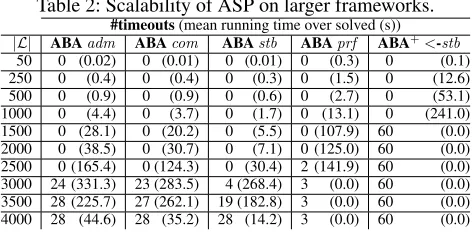
Table 2: Scalability of ASP on larger frameworks.
#timeouts(mean running time over solved (s))
|L| ABAadm ABAcom ABAstb ABAprf ABA+<-stb
50 0 (0.02) 0 (0.01) 0 (0.01) 0 (0.3) 0 (0.1)
250 0 (0.4) 0 (0.4) 0 (0.3) 0 (1.5) 0 (12.6)
500 0 (0.9) 0 (0.9) 0 (0.6) 0 (2.7) 0 (53.1)
1000 0 (4.4) 0 (3.7) 0 (1.7) 0 (13.1) 0 (241.0)
1500 0 (28.1) 0 (20.2) 0 (5.5) 0 (107.9) 60 (0.0)
2000 0 (38.5) 0 (30.7) 0 (7.1) 0 (125.0) 60 (0.0)
2500 0 (165.4) 0 (124.3) 0 (30.4) 2 (141.9) 60 (0.0)
3000 24 (331.3) 23 (283.5) 4 (268.4) 3 (0.0) 60 (0.0)
3500 28 (225.7) 27 (262.1) 19 (182.8) 3 (0.0) 60 (0.0)
4000 28 (44.6) 28 (35.2) 28 (14.2) 3 (0.0) 60 (0.0)
Toni 2016) gave either very easy instances or fixed sets of assumptions). In particular, we generated three frameworks for each number of sentences, with up to 4000 sentences and rule heads, 37% assumptions, and rules per head and body lengths, resp., randomly chosen within [1,min(ns/7,20)]
and [1,min(ns/8,20)]with number of sentences ns. The results are shown in Table 2 for credulous reasoning on 10 arbitrary queries per ABA framework underadm,com, and
stb; for assumption set enumeration under prf (as asprin does not directly support queries); and for ABA+credulous reasoning under<-stbwithout enforcing WCP. Here we can routinely solve instances with up to 3000 sentences for ABA and up to 1000 for ABA+. Within ABA, forprf the limit is somewhat lower due to both computational complexity and the task, but nevertheless significantly higher than for the other systems; even underadm abagraph could only solve the 50-sentence instances and none of the larger ones.
6
Conclusions
We proposed a new approach to reasoning in assumption-based argumentation with and without preferences via non-trivial ASP encodings of ABA reasoning tasks under several central argumentation semantics. Our approach extends and significantly improves on the empirical performance of the current state-of-the-art approaches to ABA reasoning. This motivates further study of alternative encodings based on e.g. the labelling-based view (Sakama and Rienstra 2017; Schulz and Toni 2017). Towards bridging the gap between the current knowledge on complexity of reasoning in ABA and ABA+, we provided complexity lower bounds for ABA+reasoning under several semantics. While credulous acceptance in ABA and ABA+ have the same complexity under the stable semantics, our results on the complexity of the verification task for ABA+strongly suggests that the in-tegration of preferential information into ABA may increase the computational complexity of acceptance problems.
Acknowledgements
Work supported in part by Academy of Finland (276412 and 312662) and Austrian Science Fund (FWF): P30168, I2854.
References
Bao, Z.; Cyras, K.; and Toni, F. 2017. ABAplus: Attack rever-sal in abstract and structured argumentation with preferences. In
Proc. PRIMA, volume 10621 ofLNCS, 420–437. Springer. Besnard, P., and Hunter, A. 2008.Elements of Argumentation. MIT Press.
Besnard, P.; Garc´ıa, A. J.; Hunter, A.; Modgil, S.; Prakken, H.; Simari, G. R.; and Toni, F. 2014. Introduction to structured ar-gumentation.Argument & Computation5(1):1–4.
Bondarenko, A.; Dung, P. M.; Kowalski, R. A.; and Toni, F. 1997. An abstract, argumentation-theoretic approach to default reason-ing.Artif. Intell.93:63–101.
Brewka, G.; Delgrande, J. P.; Romero, J.; and Schaub, T. 2015. asprin: Customizing answer set preferences without a headache. In
Proc. AAAI, 1467–1474. AAAI Press.
Caminada, M., and Schulz, C. 2017. On the equivalence between assumption-based argumentation and logic programming. J. Artif. Intell. Res.60:779–825.
Caminada, M.; S´a, S.; Alcˆantara, J.; and Dvoˇr´ak, W. 2013. On the difference between assumption-based argumentation and abstract argumentation. InProc. BNAIC, 25–32.
Charwat, G.; Dvoˇr´ak, W.; Gaggl, S. A.; Wallner, J. P.; and Woltran, S. 2015. Methods for solving reasoning problems in abstract argu-mentation - A survey.Artif. Intell.220:28–63.
Craven, R., and Toni, F. 2016. Argument graphs and assumption-based argumentation.Artif. Intell.233:1–59.
Craven, R.; Toni, F.; Cadar, C.; Hadad, A.; and Williams, M. 2012. Efficient argumentation for medical decision-making. InProc. KR, 598–602. AAAI Press.
Craven, R.; Toni, F.; and Williams, M. 2013. Graph-based dispute derivations in assumption-based argumentation. InTAFA 2013 Re-vised Selected Papers, volume 8306 ofLNCS, 46–62. Springer. Cyras, K., and Toni, F. 2016a. ABA+: assumption-based argumen-tation with preferences. InProc. KR, 553–556. AAAI Press. Cyras, K., and Toni, F. 2016b. ABA+: assumption-based argumen-tation with preferences.CoRRabs/1610.03024.
Cyras, K., and Toni, F. 2016c. Properties of ABA+ for non-monotonic reasoning. InProc. NMR.
Cyras, K.; Fan, X.; Schulz, C.; and Toni, F. 2018. Assumption-based argumentation: Disputes, explanations, preferences. In
Handbook of Formal Argumentation. College Publications. chap-ter 7, 365–408.
Dimopoulos, Y.; Nebel, B.; and Toni, F. 2002. On the computa-tional complexity of assumption-based argumentation for default reasoning.Artif. Intell.141(1/2):57–78.
Dung, P. M.; Kowalski, R. A.; and Toni, F. 2006. Dialectic proof procedures for assumption-based, admissible argumentation.Artif. Intell.170(2):114–159.
Dung, P. M.; Kowalski, R. A.; and Toni, F. 2009. Assumption-based argumentation. InArgumentation in Artificial Intelligence. Springer. 25–44.
Dung, P. M.; Mancarella, P.; and Toni, F. 2007. Computing ideal sceptical argumentation.Artif. Intell.171(10-15):642–674. Dung, P. M.; Toni, F.; and Mancarella, P. 2010. Some design guide-lines for practical argumentation systems. InProc. COMMA, vol-ume 216 ofFAIA, 183–194. IOS Press.
Dung, P. M. 1995. On the acceptability of arguments and its fun-damental role in nonmonotonic reasoning, logic programming and n-person games.Artif. Intell.77(2):321–358.
Egly, U., and Woltran, S. 2006. Reasoning in argumentation frame-works using quantified Boolean formulas. InProc. COMMA, vol-ume 144 ofFAIA, 133–144. IOS Press.
Egly, U.; Gaggl, S. A.; and Woltran, S. 2010. Answer-set pro-gramming encodings for argumentation frameworks. Argument & Computation1(2):147–177.
Fan, X.; Toni, F.; Mocanu, A.; and Williams, M. 2014. Dialogical two-agent decision making with assumption-based argumentation. InProc. AAMAS, 533–540. IFAAMAS/ACM.
Gaertner, D., and Toni, F. 2007a. CaSAPI: a system for credulous and sceptical argumentation. InProc. NMR, 80–95.
Gaertner, D., and Toni, F. 2007b. Computing arguments and at-tacks in assumption-based argumentation. IEEE Intelligent Sys-tems22(6):24–33.
Gaertner, D., and Toni, F. 2008. Hybrid argumentation and its properties. InProc. COMMA, volume 172 ofFAIA, 183–195. IOS Press.
Garc´ıa, A. J., and Simari, G. R. 2004. Defeasible logic program-ming: An argumentative approach. Theor. Pract. Log. Prog. 4(1-2):95–138.
Gebser, M.; Harrison, A.; Kaminski, R.; Lifschitz, V.; and Schaub, T. 2015. Abstract gringo. Theor. Pract. Log. Prog.15(4-5):449– 463.
Gebser, M.; Kaminski, R.; Kaufmann, B.; Ostrowski, M.; Schaub, T.; and Wanko, P. 2016. Theory solving made easy with Clingo 5. In Technical Communications of ICLP, OASICS, 2:1–2:15. Schloss Dagstuhl - Leibniz-Zentrum fuer Informatik.
Gelfond, M., and Lifschitz, V. 1988. The stable model semantics for logic programming. InProc. ICLP/SLP, 1070–1080. MIT Press.
Lehtonen, T.; Wallner, J. P.; and J¨arvisalo, M. 2017. From struc-tured to abstract argumentation: Assumption-based acceptance via AF reasoning. InProc. ECSQARU, volume 10369 ofLNCS, 57–68. Springer.
Matt, P.; Toni, F.; Stournaras, T.; and Dimitrelos, D. 2008. Argumentation-based agents for eprocurement. InProc. AAMAS Industry and Applications Track, 71–74. IFAAMAS.
Niemel¨a, I. 1999. Logic programs with stable model semantics as a constraint programming paradigm. Ann. Math. Artif. Intell.
25(3-4):241–273.
Prakken, H. 2010. An abstract framework for argumentation with structured arguments.Argument & Computation1(2):93–124. Sakama, C., and Rienstra, T. 2017. Representing argumenta-tion frameworks in answer set programming. Fundam. Inform.
155(3):261–292.
Schulz, C., and Toni, F. 2017. Labellings for assumption-based and abstract argumentation.Int. J. Approx. Reasoning84:110–149. Toni, F., and Sergot, M. 2011. Argumentation and answer set programming. InLogic Programming, Knowledge Representation, and Nonmonotonic Reasoning: Essays Dedicated to Michael Gel-fond on the Occasion of His 65th Birthday. Springer. 164–180. Toni, F. 2013. A generalised framework for dispute derivations in assumption-based argumentation.Artif. Intell.195:1–43.
Toni, F. 2014. A tutorial on assumption-based argumentation. Ar-gument & Computation5(1):89–117.