Volume 3, Issue 4, April 2014
Page 11
Abstract
Smart Home Wireless Sensor Networks (SHWSN) are now capable of incorporating large amounts of computing power to monitor the activities of its occupants and anticipate their needs. They can provide elders and disabilities with complex customization options to allow them to tailor their environment to precise requirements. According to the latest government projections in South Korea that 38% of its population will be defined as elderly by 2050, due to life expectancy rising and birth-rates falling to record lows [1], [2], and since the U.S.A. population aged over 65 reached 14% of population in 2010 with about 16% of the U.S. adults have a disability, actually for all of these high percentages, many governments are beginning to see smart home technology as a viable option in reducing the financial burden of supporting elder people through their retirement as well as for disabled people. This paper will give a snapshot on the state of the art in the smart home technology for elders and disabilities people. Also it proposes a new Elders/Disabilities Wireless Smart Home for assistive independent living (E/D-WSH) with its approximate cost compared with the Indian home automation market.
Keywords: Wireless Sensor Networks, Smart Home, Elder, Disabilities.
1.
I
NTRODUCTIONWireless Sensor Networks (WSNs) can be considered as a revolution in the field of data gathering and management. A lot of very vital applications can benefit from these networks to improve its performance and reach decisions based on realistic gathered information. Thus, a lot of applications can benefit from WSNs as habitat monitoring for gathering information about a plant or animal without disturbing them to learn optimal environmental conditions favorable for the flora/fauna’s growth, military applications where WSNs can provide real time information of the enemy activities to commando teams and thus making coordination and planning more effective, smart homes for networking various home appliances and managing them remotely [3], the WSNs can be also used in precision agriculture for monitoring environmental conditions in which farming is done to make it more profitable and sustainable [4], moreover, one important application is the traffic control and management approaches, it gathers the traffic information and controls the traffic flow according to the incoming traffic data [5].
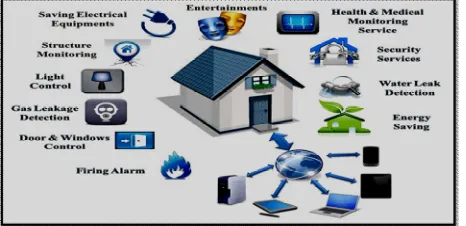
A Smart Home (SH) is understood as an integration system, which takes advantage of a range of techniques such as computers, network communication as well as synthesized wireless technology to connect all indoor subsystems that attach to home appliances and household electrical devices. In this way, smart home technology enables households to effectively centralize the management and services in a home, provide them with all-round functions for internal information exchange and help to keep in instant contact with the outside world, figure (1) demonstrates different applications for smart home. In terms of convenience, they help people in optimizing their living style, rearranging the day-to-day schedule, securing a high quality of living condition and in turn enable people to reduce bills from a variety of energy consumptions in that home. Smart homes could provide them with cheap affordable home support with health care advice for elders and disabilities.
Figure 1 Smart home applications
Independent Living for Persons with Disabilities
and
Elderly People Using Smart Home
Technology
Basma M. Mohammad El-Basioni1, Sherine Mohamed Abd El-Kader2, and Hussein S. Eissa3
1, 2,3
Volume 3, Issue 4, April 2014
Page 12
Smart home applications employ microcontrollers to monitor ovens, washing machines, lighting, refrigerators, and HVAC facilities (Heating/Ventilation/Air-Conditioning) with respect to temperature or humidity and to adjust accordingly to meet the home owner’s requirements. Figure (2) shows the development of smart home technologies along the past 13 years and the expected development in the next 6 years around the world. It shows how energy efficiency control is increasing rapidly in smart home techniques. It started in early 2000s by individual control until 2005 when centralized monitoring of all energy consumption applications started to have a centralized monitoring point to integrate all items. Starting 2010 tablets and other remote devices are used compute and control energy utilization in smart homes, and it is expected in the coming years that cloud computing technology will be used to connect home automation systems [6].Therefore, it is obvious that smart home applications to some extent takes responsible for the indoor energy management and supervision with the instructions of household owners. Such facilities are of very great importance to individuals in the community with elders and disabilities to help them run their daily activities on their own safely. Many governments are beginning to see smart home technology as a viable option in reducing the financial burden of supporting this generation through their retirement.
Figure 2 The development of wireless smart home technologies [6]
Figure (3) demonstrates the number of adults with and without disabilities, by age group in the United States [7]. According to the World Health Organization, disability has three dimensions: first, impairment in body function or structure, such as loss of a limb or loss of vision; second, limitation in activity, such as difficulty seeing, hearing, walking, or problem solving; and third, restriction in participating in normal daily activities, such as preparing a meal or driving a car. Any of these impairments, limitations, or restrictions is a disability if it is a result of a health condition in interaction with one's environment, and based on U.S. Department of Health and Human Services disability data standards released in 2011 that consider only serious limitation, about 16% of U.S. adults have a disability. The estimated proportion of adults with disabilities increases with age, and more than one third of all adults with disabilities are aged 45–64 years [8].
Figure 3 Number of adults with/without disabilities, by age group — National Health
Interview Survey, United States
Volume 3, Issue 4, April 2014
Page 13
2.
T
HES
TATE OFA
RT INW
IRELESSS
MARTH
OMER
EVOLUTIONAlthough the benefits of smart homes are numerous they can be divided into main four distinct categories, which are energy saving, support for elderly or disabled, safety and security and entertainment [[9]. Each of these categories is briefly discussed below
.
2.1 Energy Saving
The need to significantly reduce carbon emissions is arguably todays greatest challenge. Energy efficient smart technology can be utilized within the home to offer the user a host of energy saving ideas. The installation of smart meters will allow a whole host of energy saving techniques to be implemented within the home. Smart meters will allow feedback of energy consumption to easily be delivered to the user. Many researches explore the idea of using energy feed- back displays to inform user of the amount of energy being used by the various devices currently active within the home. With these displays motivation techniques can be used to encourage a reduction in energy usage. TV, laptop, tablet and mobile could be used to deliver information back to the user showing them their historic consumption, daily costs and comparisons with other homes.
Volume 3, Issue 4, April 2014
Page 14
transmissions, and energy consumption is approximately 29.8%, 42.3% and 17-22%. The authors in [17], designed a wireless sensor network protocol for smart energy meter applications. The system consists of a digital energy meter, a ZigBee coordinator, and a management program. The designed system is capable of automatically read the unit then send a terminal and a cover alarm to the management program. The system can support up to 100 energy meters, 10-hop network depth and automatically detects a new energy meter. Their experimental results showed that the proposed system is feasible to implement in practical applications for automatic meter reading especially in indoor and outdoor conditions. The system can be divided into two parts: the ZigBee-based energy meter and the rear-end processing system. The ZigBee-based energy meter is composed of a digital energy meter model EMS12C 15(45A) from Energy Max International Co., Ltd and ZigBee device model MNZB-24-A2/B0 from Atmel Corporate Co., Ltd, which is composed of Atmel MCU and Atmel RF front end. The digital energy meter is responsible for accumulating a power consumption data and storing it in the internal memory. The duty of ZigBee device is to read out the power consumption form the digital energy meter via UART communication and to communicate with the ZigBee coordinator. The rear-end processing system is composed of a ZigBee coordinator and the software designed for the proposed automatic energy meter. The ZigBee coordinator is responsible for initiating and maintaining the ZigBee devices on the network. The software of the proposed rear-end processing system is responsible for configuring the ZigBee network, correcting data from the ZigBee network, and storing data in the database system.2.2 Support for the Elderly and Disabled
Volume 3, Issue 4, April 2014
Page 15
complete SOPRANO system shown in laboratories as well as the sub-set of the system installed in real homes. In[21], the authors developed an intelligent and versatile home safety environment that could help the elderly and individual with disability live independently in their own home. This paper presents the design and development of a telehealth system and how it is integrated with its monitoring system to monitor the elderly at home. An Android-based smart phone with 3-axial accelerometer is used as the telehealth device which could detect a fall of the carrier. The smart phone is then connected to the monitoring system by using the TCP/IP networking method via Wi-Fi. A Graphical User Interface (GUI) is developed as the monitoring system which exhibits the information gathered from the system. In addition, the concept of a remote panic button has been tested and implemented in this project by using the same android based smart phone. With the developed system, elderly and chronically ill patients could stay independently in their own home with care facilities and secure in the knowledge that they are being monitored.2.3 Safety and Security
Volume 3, Issue 4, April 2014
Page 16
consisting of Moteivs Tmote Sky motes and a base station. The application sends a piece of alarm as a short message (SMS) on cellular phone of the homeowner in case of any intrusion activity has been detected at home.2
.
4 EntertainmentSmart home isn’t only designed for the elderly and disabled; with an overall goal of creating assistive environments it demonstrates the type of convenience technologies which could be common place in the average home. Smart home boasts an impressive array of smart devices that are connected to the homes network and are designed to monitor all aspects of daily life. Example of these devices includes a smart mailbox, capable of sensing when the post arrives, and a smart front door complete with RFID tag for keyless entry. The smart bathroom is capable of detecting low toilet paper, toilet flushes, occupants cleanliness as well as regulating the shower water temperature. Along with a whole host of other devices, the home is capable of sensing itself and the resident so it can, for example, replenish stocks when necessary or automatically controlling the home entertainment system depending on your location.
The work in [26] is a smart home entertainment systems provide high quality audio and video distribution throughout your house. For example, the user can access his entire CD collection in every room via one music servers with the album cover art displayed on his touch panel. Centralized Sky+ hard drive recorders can allow to watch recordings anywhere in the home - also multiple recorders can be installed, one for adults and one for kids, with a dedicated home cinema room (big screen and surround sound system) as part of the home entertainment system. In the bathroom, there is a remote bath filling systems which means that with only one press on a button in the kitchen the bath could be filled to the desired temperature, with Waterproof Mirror TV's, with the saunas and steam cabins controlled remotely to get them up to temperature ready for the person arrival. Lighting control systems can create a relaxing ambience in the room whilst bathing before subtly changing for shaving or teeth cleaning. A standardized communication system between different AV devices allowing to control multiple compatible home entertainment devices from the TV to the Blu-ray player or home entertainment system – with just one remote. All you need to do is connect the devices together using HDMI cabling. Once connected, the devices will simply pair and recognize one another allowing your TV remote to control other compatible devices [27].
3.
W
IRELESSS
ENSORN
ETWORKS
MARTH
OMEC
OMPONENTS3.1 Wireless Sensor Node
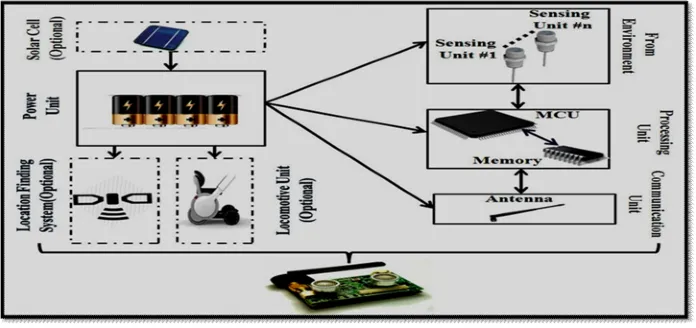
The wireless sensor network is composed of a large number of sensor nodes consist of sensing, processing, transmission, mobilizer, position finding system, and power units (some of these components are optional like the mobilizer and position finding system). Figure (4) demonstrates different components of the wireless sensor node. Sensor nodes coordinate among themselves to produce high-quality information about the physical environment. Each of these scattered sensor nodes has the capability to collect and route data either to other sensors or back to an external base station(s), mobile or tablets. A base station may be capable of connecting the sensor network to an existing communications infrastructure or to the Internet where a user can have access to the reported data.
Figure 4 The components of a sensor node
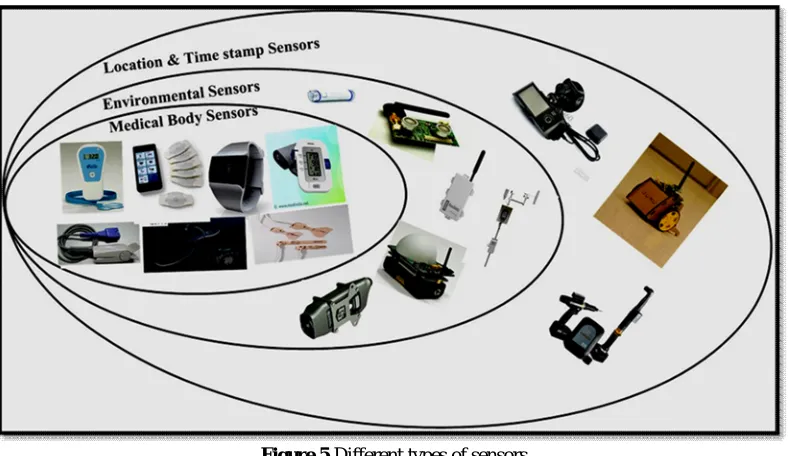
Figure (5) presents different types of sensors such as medical body sensors, environmental sensors, location sensors, and time stamps that are used in wireless smart home monitoring system [28].
Volume 3, Issue 4, April 2014
Page 17
instance, a core temperature sensor embedded in an ingestible capsule that is easy to swallow can measure a core body temperature. Also, some implants sensor can check medical information by using implant chip. These may diagnose conditions such as Parkinson's disease and paralysis. The VeriChip [29] is a small RFID chip sized grain of rice that is implanted under the skin. In addition, Endoscope sensor that is swallowed by patient measures internal body conditions by using various kinds of information.External sensor device: External types of body sensors include wearable and detachable electrical signaling devices. For example, Pulse Oximeter sensor measures heart rate and blood oxygen saturation. For blood oxygen saturation, the sensor detects colors of beams based on hemoglobin molecules. The sensor uses two beams on finger or earlobe then calculates the amount of beam rejected by hemoglobin. Moreover, a heart rate is measured by contracting and expanding of blood vessels. Also, Electrocardiograph sensor checks the cardiac information. Sensors detect cardiac rhythm then electrocardiograph obtains the information signal from the contraction and extension of the cardiac muscle. In addition, skin temperatures are detected by dermal body temperature sensor.
Figure 5 Different types of sensors
Environmental Sensors: Environmental variables such as temperature, humidity, air quality, illumination, and noise are also important factors in SHWSN. Sometimes environmental sensing data is combined with sensed body/location/time data to assist the analysis of personal situations. In addition, decision making is enhanced by operating smart actuators or providing feedback requests of a doctor. For instance, assume that elderly person enters the bathroom. His physiological condition using body sensors could be checked with his location by using location sensors. However, we cannot easily distinguish a cardiac episode from a period of staying in a hot tub unless location information is provided, since both situations can cause rapid heartbeat and degenerated ECG signal. In this case, temperature and humidity sensors can help to analyze the current situation and an acoustic sensor can trace the activity of the elderly person to make a context. In addition, a pre-installed actuator can reduce the CO2 level and can control the lighting level based on the air quality and illumination sensor readings to support better conditions. Therefore, it is important to include environmental types of sensors for determining a reliable context generation and a better quality of service. A dimmable lighting, fire alarm, flood alarm, heater, ventilate, and air conditioning are examples of systems that can be controlled by various types of actuators.
On-Volume 3, Issue 4, April 2014
Page 18
Board sensing equipment include Acoustic, Infrared, Pressure, and camera. With the use of sensed data, the location of a person can be processed by Triangulation, Trilateration, or Multilateration Approaches. Moreover, active RFID based localization schemes can be employed in the indoor health care system.3.2 Wireless Communication Standards for Smart Home
The transmission of measured data in the overall context of WSN needs to be performed for two different purposes [30], [31] first, for communicating the collected physiological signals from the sensors to the system’s central node; and second, for sending the aggregated measurements from the system to a remote station or to a physician’s cell phone. The first type of communication can be handled either by wires or by multiple wireless links. In case of wire, the user’s mobility and comfortableness can be severely hindered by the use of wires and moreover there is an increased risk of system failure. Alternatively, in the second case, data transmission to a remote station, which can be a PDA, a smart-phone, a pocket PC or a custom designed microcontroller-based device, can be done by one of the wide variety of available wireless technologies, Such as, WLAN, GSM, GPRS, UMTS, and WiMAX, which can offer wide coverage and ubiquitous network access. Furthermore, advances in the fourth generation (4G) mobile communication systems are expected to guarantee worldwide seamless access to the Internet at much higher data rates, and thus to facilitate more efficiently the need for gathering real-time measurements from a wearable health-monitoring system at a remote location. In this section, we will briefly discuss the features of the short-rang wireless communication technologies that have been utilized so far for smart home communications [22].
The Zigbee standard is the most commonly employed wireless communication standards in WSN [32] [33], it targets low-cost, low data-rate solutions with multimonth-to-multiyear battery life, and very low complexity. It operates in 16 channels in the 2.4 GHz industrial, scientific, and medical (ISM) band (250 kb/s, OQPSK modulation), in 10 channels in the 915 MHz band (40kbps, BPSK modulation) and in one channel in the 868 MHz band (20 kb/s, BPSK modulation). It utilizes Carrier Sense Multiple Access—Collision Detection (CSMA-CD) channel access or synchronized channel access based on a beaconing mechanism and Direct Sequence Spread Spectrum (DSSS) coding. Maximum transmission range is about 75 m and it supported network architectures include star, tree cluster, and mesh topologies. Finally, Zigbee uses an Advanced Encryption Standard (AES) algorithm with 128-bit keys to guarantee message integrity and privacy and to perform authentication. Table (1) provides a reference to the most important features of the most prevailing wireless communication technologies for SHWSN.
Table 1: Wireless communication standards for SHWSN.
Max. Data Rate Range Frequency
ZigBee 20/40/250 Kbps 10 – 75 m 868/915 MHZ or 2.4 GHZ
Bluetooth 1 - 3 Mbps 10 – 100 m 2.4 GHZ
IrDA 16 Mbps 1 m Infrared
MICS 500 Kbps 2 m 402 -405 MHZ
Z-wave 20 Kbp/s 30m indoor/
100m outdoor 868M/869/920/908/919/921/950MHz
Dash7 200 kbp/s 10m-10km 433 MHz
INSTEON 37 Kbps 45m 869/921/915MHz
802.11g 54 Mbps 200 m 2.4 GHZ
Bluetooth (IEEE 802.15.1 standard) [34] is an industry specification for short-range RF based connectivity between portable and also fixed devices. It is a low-power and low-cost RF standard, operating in the unlicensed 2.4 GHz spectrum. It uses a frequency hopping technique over 79 channels in the ISM band to combat interference and fading and it may support up to 3Mb/s in the enhanced data rate mode and maximum transmission distance of 100 m (although 10 m is the most common mode). Its basic configuration is the piconet, a star topology network with one master and seven slaves. Encryption is optional and is provided by a 64 or 128-bit SAFER+ algorithm, however, the Bluetooth framework is often found to be vulnerable to possible attacks and risks. Finally, the Bluetooth SIG announced the addition of two alternative protocol stacks, e.g., the Bluetooth low energy, an ultralow power technology for devices with limited battery capacity and the Bluetooth 3.0 specification which adopts the Wi-Fi PHY/MAC layers for higher data throughput. The Bluetooth low-energy technology allows for consumption of only a small fraction of the power of the original Bluetooth products and amongst others is targeting sports and wellness, and healthcare devices.
Volume 3, Issue 4, April 2014
Page 19
Medical Implant Communication Service (MICS) and Ultra WideBand (UWB). IrDA [35] is a low-cost communication protocol for short-range exchange of data over infrared light. Infrared remote controllers are widely exploited for the remote control of consumer electronics in home. Despite the fact that it is a low power technology that supports up to 16 Mb/s, it has the main disadvantage of requiring line-of-sight communication, thus making it impractical for WSN applications. MICS [36] is an ultralow power, unlicensed, mobile radio service for transmitting low-rate data in support of diagnostic or therapeutic functions associated with medical devices. It uses the 402–405 MHz frequency band, with 300 kHz channels. Effective Isotropic Rediated Power (EIRP) is limited to 25 μWand targets mostly devices such as pacemakers and defibrillators. Despite its favorable characteristics, MICS has not been utilized widely by researchers due to the lack of commercially available MICS solutions. Finally UWB (IEEE 802.15.3 ), operating in the frequency range of 3.1–10.6 GHz, is a standard that is inappropriate for BANs due to its high complexity and the unsuitable wide bandwidth modulation.Z-wave offers a low bandwidth half-duplex protocol designed for wireless communication in a low cost control network. The design goal of the protocol has been to transfer small amounts of time critical data. Z-wave is a preparatory protocol with very similar features as in Zigbee. Z-wave supports less data rate and a considerably less robust communication as compared to Zigbee.
Dash7 the goal of the Dash7 standard was to expand the market for low power wireless technologies by leveraging ISO 18000-7. The protocol is intended for RFID and wireless sensor networks. Dash7 has been designed based on the BLAST Concept, BLAST is an acronym for Bursty, Light-Weight, Asynchronous and Transitive. Dash7 operates in the 433.92 MHz frequency (available worldwide) and achieves a maximum data rate of 200Kbps (its data rate is dynamically adjustable from 28 kbps to 200 kbps). Dash7 is relatively long range adjustable from 10 meters to 10 kilometers.
INSTEON [37] is a dual- band mesh proprietary network solution which was developed by the Smart Labs Technology lead by a consortium of companies. INSTEON solutions use power line communication, RF or both. The solutions provided by INSTEON communicate in a peer-to-peer fashion. The goal of INSTEON has been to intercommunicate devices such as light switches, door locks, thermostats, clocks, smoke detectors, security sensors and remote controls, which were far from talking to each other due to the both complexity and expensive installation costs. INSTEON RF operates on 915 MHz/ 869.85MHz/921.0MHZ frequencies in different countries and the power line uses 131.65.KHz. INSTEON embedded devices can be used in a wide range of applications, such as: embedded sensors, heating ventilation and air-conditioning systems, lighting, home appliances and security systems. Also it can be used in entertainment consumer electronics, energy management, voice recognition and response, as well as other smart devices.
Actually, the IEEE 802.11 protocol is a set of standards for implementing a Wireless Local Area Network (WLAN), which is suited for high-data-rate applications over large areas. The IEEE 802.11 standard, commonly referred to as WiFi, is the most accepted technology for indoor wireless communications, but the basic shortcoming of this standard is the high power requirement of devices it used.
3.3 Routing Protocols for Smart Home Wireless Sensor Networks
In [38], the authors proposed a novel Dynamical Hierarchical routing Protocol with prime numbers (D-HiPr) addressing that use prime numbers as the sensor nodes’ 16-bit local address. The key advantages of this protocol meet the requirements of SHWSN well, where it is featured by; first, nontable-Driven; D-HiPr uses a single Location IDentifier (LID) for packet routing other than traditional routing table, this mechanism helps to save memory of the transmission nodes as well as reduce traffic delays. Second, Energy Saving; D-HiPr uses a very simple way to compute routing path and packets in smart home can arrive at the receiver faster and more computation saving to save energy of the relay nodes even it is battery powered. Third, mobility; D-HiPr needs no routing table, and the nature of the prime numbers makes the address allocation more flexible, therefore, D-HiPr can support the mobility of nodes better than traditional routing table. Fourth, End-to-end Communication; in smart home with D-HiPr, not all the packets need to be sent via the gateway. In real domain, most packets are directly passed between sensor nodes, and it improves the efficiency of smart home to reduce the traffic of the gateway. Finally, Medium Scalability; although the scalability of prime-numbered addressing is normally hundreds, however, it matches the scalability of smart home well as it is always composed of hundreds of sensors as well. Also the authors in this paper modified three typical WSN routing protocols, LEACH, SPIN, and DD to incorporate traditional WSN routing algorithms into their smart home architecture, and they made a comparable efficiencies between them.
In [39], a smart home gateway model is designed, in this model, a mobile is used to control the device and collect home information through home gateway with multi-hop routing mechanism to connect the gateway with the sensor network. Because the capability of the sensors is important for forming network, the authors took the factor of its energy and hops into account. They defined the capability from one sensor to the other as the measured value, and the measured value is calculated according to the following methods: if the hop between the sensor and gateway is h, and its energy is e,
Volume 3, Issue 4, April 2014
Page 20
for each other. Each sensor will broadcast its information to the nodes which it can connect, the information include the number of hops to the destination home gateway and its remaining energy. Each sensor will calculate the measured value and updates its mini-routing table based on the received information. When a sensor sends data of itself or from others, it will select the sensor whose measured value is the least as the next hop, and transfer the data to it. To avoid the question of loops, before each sensor send the data, it will add its ID in the head of the data. When a sensor found an ID in the head of the data, it will not forward the data package to the sensor.In [40], three routing strategies were proposed in an AODV-based/ZigBee-based network to offer diverse routing alternatives to be exploited in the Wireless-Powerline combined network. The joint-path strategy takes advantage of route entries to establish joint routes that may traverse multiple networks to destination nodes. The backbone-based routing strategy is built upon the joint-path routing mechanism to forwarded packets firstly through the power line. Composed of a wireless path and a backbone-based path, the dual-path routing strategy allows nodes failing to receive packets along one route to receive packets through another route as the two built-in routes are established independently from each other within each node.
In [41], the authors compared the performance two protocols in a Home Automation scenario with heterogenous traffic patterns including a mix of multipoint-to-point and point-to-multipoint routes in realistic dense non-uniform network topologies; the two protocols are, RPL, the routing protocol proposed by IETF for IPv6/6LoWPAN Low Power and Lossy Networks which has significant complexity, and the LOADng protocol which is a lightweight variant of AODV, emerges as an alternative solution. They used Contiki OS and Cooja simulator to evaluate the behavior of the Contiki RPL implementation and a basic non-optimized implementation of LOADng. The performance comparison results showed that RPL is better in the overall performance for their home automation scenario while LOADng could serve better sparse Low Power and Lossy Network (LLN) deployments with low-priority traffic in which the route hold tme can attain a large value. For home automation applications in which the response time is important, the results suggest that LOADng is not the best candidate. RPL delay is small and its overhead strongly depends on the implementation and a careful choice of parameters. Moreover, RPL has shown better results and less memory requirements than LOADng, but at the price of a higher implementation complexity. However, it is important to recall that they have used a simple flooding scheme and a better mechanism may reduce the control overhead. Furthermore, an intelligent route storing algorithm may reduce memory requirements of LOADng and improve the efficiency and scalability, but at the cost of a higher implementation complexity.
New routing protocols called Two-Hop Low Delay routing protocol (THLD) and Binary Tree Routing Protocol (BTRP) have been proposed in [42] to evenly distributing energy dissipation and reducing delay.The authors applied the THLD routing protocols to the networks of smart home. Then general n-tree multi-hop routing schemes are analyzed theoretically. The simulation results showed that both BTRP and THLD outperform Direct in terms of delay by introducing more energy dissipation costs with 25% and 20% respectively. Also, the lifetime of BTRP is not better than THLD, and BTRP performs better than THLD in terms of delay with 5%. Also the lifetime/delay metric in BTRP is greater than both THLD and Direct routing protocols with 5 % and 12% respectively.
4.
P
ROPOSEDE
LDERS/D
ISABILITIESW
IRELESSS
MARTH
OME FORA
SSISTIVEI
NDEPENDENTL
IVING(E/D-WSH)
As the remote and automatic control of windows and doors for example can represent a luxury or convenience matter for healthy people it represents an important issues for people who are can’t see these objects and have trouble to reach it, need repose or have to rest in beds, and forget always anything, who are blind, elder, and Alzheimer people. The system is considered as a smart home for ordinary persons but with enhancements to suite persons need special deal and care who are the blind and elder persons, offering facilities such as reminders, voice alarms and directives, and giving voice orders. Also, some nodes are equipped with rechargeable battery to take the heavy responsibilities of nodes that acquire its power from the main current in case of electric current cut for continuous proper work of the system in this case.
4.1 E/D-WSH System Scenario
The smart home system that presented in [3] offers the convenience and comfort needed for elders, but it can be enhanced to be more suitable for disabilities in general and for blind, sight impaired and Alzheimer people specially not only for elders. The assistive living for the people who lose the visual sense can be based on benefiting from blessings of hearing and speaking. The matter is how to make the home talks to blind people, guides them, and makes them to a high degree dispense with doing businesses by hands; also it is how to make blind people talk to their home. The E/D-WSH consists of the following systems:
Entering System: The Entering System (ES) is best to be through the two options finger print that is more convenient to elders and voice recognition that is more convenient for blind people.
Volume 3, Issue 4, April 2014
Page 21
equipped with a buzzer to alert about this event.RFID System: Identifying the place of the elders or blind people can be done by integrating RFID tags and readers with wireless sensor nodes.
Lighting System: The light switches will be opened and closed electronically in addition to the ordinary method. Also, all the lambs will be turned on/off through the home Remote Control (RC) or by voice commands. Generally, the user can choose the lambs he wants to open/close and determines a time schedule and/or an event from a set of available events to trigger the specified action; this set of events is based on the reported events by the sensors used in the system. The lighting system can be made more easier to more assist independent living for elders, such that it automatically sense the existence of people in a place and accordingly switches on/off the light using occupancy sensors.
Windows Control System: The windows will be turned on/off electronically by the remote control or by voice command if a certain situation happened. Also, the user of the system can choose the windows he wants to open/close and determines an event from a set of available events to trigger the specified action.
Microphone/ Speech Recognition System: A sensor node in each place will be equipped with a microphone and a speech recognition circuit programmed to identify some commands such as “open window1 in room1”, upon these commands these nodes send the appropriate commands to the appropriate nodes.
Proximity Sensor/ Sound Synthesizer System: Proximity sensor embedded in a sensor node can detect the approaching of a person and according to its place and what the sound synthesizer was configured by, it alerts and guides the blind and Alzheimer person, such as “you are approaching the wall of the kitchen don’t forget to take your medication now, its five o’clock”, “at the end of the wall turn right to enter the bathroom”, “you are at the corridor and you can go ahead to enter room1 or turn right to enter room2”, “take care you are approaching a two stairs”, etc. A detailed sound confirmation of what the system already have done acquiescently to the person order usually is issued after its related tasks completion and directed to the node that originated the order, for example, when a blind person (or an ordinary person) orders through a node in the bedroom the windows to be closed, the system sends a confirmation voice message to that node after it closes the windows to assure the person that the windows are actually closed.
Reminder system: simply the central controller which is a PC with suitable application can be fed in any time with a timing schedule relates important times through the day such as the time of taking the medicine, to program the system nodes by broadcasting commands to it to issue voice alarms at these times reminding and directing these times’ events, these alarms repeat after its events due time in some cases such as the passing of the person beside a node contain a proximity sensor.
Gas Leakage Detection System: smoke detectors and gas detectors will be used in the kitchen and in the bathroom to measure the required type of gases concentration, and warns about that following the same behavior of the windows motion sensors, in addition they will aid to home ventilation as a quick countermeasure through running the electric air hood. Also, a water leak sensor is used in the bathroom and the kitchen to alarm if the water leaks from its sources by mistake or forgetting and it is going to swamp the place.
Electrical Devices Monitoring: two cases are considered in our solution as in [3]; first, the sudden return of a cut electrical current and the second, is the long opening of the refrigerator door. Against cut of electricity and its sudden return problems, a current sensor will detect the cut of electricity and then isolate the electrical equipments from the electric current wire until it detects the return of the current and its stabilization, it supplies equipments with the electric current. This is different from the system in [3] in that it is a centralized action where one current sensor at the main power switch in the home open and close it complying to the just mentioned required action no need to broadcast a signal commands the electronic switches at the electrical outlets of the electrical equipments to do this separately each one for its relative device as done in [3]. Against long opening of the refrigerator door, a light intensity sensor will be put inside the refrigerator besides its lamp, if it detects that the lamp light is open for a specified period it runs the kitchen buzzer and sends a notification message to the central control.
Volume 3, Issue 4, April 2014
Page 22
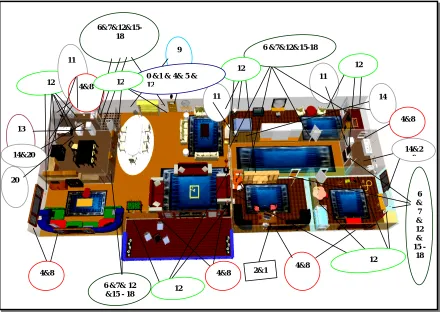
represents a one level home of area 210 m2 consists of a hall partitioned into a large part and a smaller part, large and small balconies, kitchen, large and small bathrooms, and three closed rooms, the walls of the home is made transparent in the figure to show its contents. The distribution of some sensor nodes in the home is explained in the figure, and the numbers in indicated in the figure are explained in table (2), where the proximity sensors, which are not presented in the figure, they will be in each node contain the 3-axis accelerometer and 6 nodes additional in other places.Figure 6 The distribution of sensor nodes in proposed E/D-WSH system
4.2 Communication Paradigm for the E/D-WSH System
The communication paradigm for E/D-WSH system is based on a fixed Base Station (BS) that takes an ID equal to zero, numbering of each room or a specified place by the ID of the node responsible for its light switching, the wireless nodes in each room which responsible for some operation like windows opening/closing form a Group with ID (GID) equals the room number and each one of them has its own ID starting from one and incremented by one, the remote control and node responsible for entering system take specific predefined IDs (e.g., IDRC= 100 and IDES= 200).
For initial setup, there are two types of announcement message the wireless and wired nodes use to inform about their existence. The announcement message which broadcasted by the wireless nodes will be approximately in the range that covers one room and it will contain the node ID, GID and type of node from the power point of view. The announcement message which broadcasted by the wired nodes in its maximum transmission range and if needed forwarded through multi-hops (nearest neighbor is the next hop) until it reaches the BS contains its ID, its type from the power point of view, and the IDs and GIDs of the wireless nodes it heard from. Upon these messages the nodes construct a table for neighbor nodes contains the ID, GID, node type regarding power, RSSI, and identifies special nodes such as the remote control or the BS. This communication paradigm also constitutes the basis for the previous work of [3].
The BS constructs a sleeping schedule [43] for wireless nodes, in which each node or group of nodes has a specific time to awake constituting a repeating round composed of all nodes awaking periods. At any time, a node can awake and transmit using CSMA/CA with optional acknowledgement. The remote control and the node responsible for the entering system are given a higher schedule rate. This schedule is passed to the wired nodes one after another according to their distance from the BS as indicated by the BS itself in the sent message. Each wired node stores awaking periods of the remote control and of any neighbor wireless node or group and sends them the start time to begin to compute the beginning of their slots and the length of the whole schedule. The time of reception of this schedule by the first wireless nodes or groups will be taken as the start time for all nodes to compute the start of the awaking periods, so as the message containing the schedule is propagated, a suitable time offset is embedded in this message by its sender to aid its receiver
12
4&8 11
11
11
6&7&12&15-18
6 &7&12&15-18
6 & 7 & 12 & 15 -
18
6 &7& 12 &15 - 18
9
2&1 9 4&8
4&8
12
13
12
4&8
14
14&20
20
12
12 0 &1 & 4& 5 &
12
Volume 3, Issue 4, April 2014
Page 23
compute the correct reference time as shown in figure (7).Figure 7 A plan view for the proposed E/D-WSH system with the propagation of the time offset
According to these schedules, the maximum delay time of a response to a command sent to wireless nodes
(
N
wrn
)
orwireless nodes groups
)
(
wrg
N
is computed from equation (1), where the maximum delay time of a response to a command sent to special nodes like front node or RC is computed also from equation (1)
m wrg
wrn Max
response
m
N
N
m
S
nd
_
(
(
)
1
(
1
)
2
)
(1)Where
,
:
_Max response nd
Maximum response delay of a wireless node or a wireless nodes group
m: is a variable equals 1 for wireless nodes and groups schedule, and equals 0 for special nodes schedule :
wr
N
Number of wireless nodes :
wrg N
Number of wireless nodes groups :
1
S Slot time for wireless nodes and groups schedule
:
0
S
Slot time for special nodes schedule
Reference time = current time – time refernce offset (2)
First slot start time = Reference time + (Sno
S) (3)Where:
Sno: slot number S: slot time
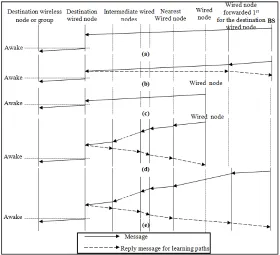
After that, each wireless node knows when it should be awake to receive and each wired node knows when its neighbor wireless nodes or groups are awake. The transmissions of commands and data, and how the rest of the network setup is done by learning paths to destinations are illustrated in the following figures. Figure (8) will demonstrate different
Wired node BS uous
4 Time reference offset + = delay 6
Wired node Wired node Wired node Wired node
Time reference offset =0 Time reference offset + = delay 1
Time reference offset + = delay 2
Time reference offset + = delay
3 Time reference offset + = delay
4
Time reference offset + = delay
5 Time reference offset + = delay
Volume 3, Issue 4, April 2014
Page 24
transmissions flows from the wired nodes to the BS, whereas figure (9) presents different cases of transmissions flows in case of the destination is a wireless node or group of nodes.Figure 8 Different cases of transmissions flows from wired node to the BS
Figure 9 Different cases of transmissions flows from different sources to wireless node or group of nodes.
4.3 E/D-WSH System Cost
Volume 3, Issue 4, April 2014
Page 25
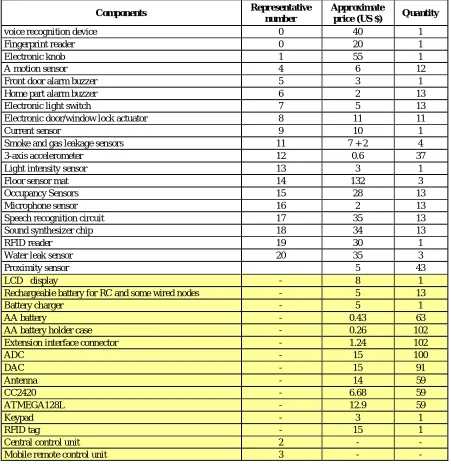
From this table and after adding an approximate value for the cost of the system fabrication, other secondary components required for fabrication, system software, and system installation. Where the H.W. fabrication process requires specific materials such as soldering, and some secondary components such as wires, covers, etc., which they all and the workmanship fees add additional costs, and the system software includes the framework which will run on the nodes which represents the whole network stack comprising the appropriate application to each node type and the programming interface which will be used to program nodes with the appropriate settings; also the software represents the user application which will run on the central controller and represents the user interface to the system through which he can monitor and control locally or remotely, also the system installation includes the inspection of the home identifying its places or contiguous parts which will be considered as one place, identifying what each place represents, a room, a salon, a kitchen, etc., identifying each place with a number, determining the appropriate places of nodes and accordingly the required number of nodes and the system cost, , delivering the system, setup of the programming interface on a PC, programming the nodes with appropriate IDs, installing the various wireless and wired nodes in the appropriate locations, setup the user application, powering the nodes and finally explaining the usage of the whole system, all the additional components are represented in table (2) by the shaded rows, so it could be said that the whole system will cost approximately $8100.Table 2 Approximate Cost for E/D-WSH System
Components Representative
number
Approximate
price (US $) Quantity
voice recognition device 0 40 1
Fingerprint reader 0 20 1
Electronic knob 1 55 1
A motion sensor 4 6 12
Front door alarm buzzer 5 3 1
Home part alarm buzzer 6 2 13
Electronic light switch 7 5 13
Electronic door/window lock actuator 8 11 11
Current sensor 9 10 1
Smoke and gas leakage sensors 11 7 + 2 4
3-axis accelerometer 12 0.6 37
Light intensity sensor 13 3 1
Floor sensor mat 14 132 3
Occupancy Sensors 15 28 13
Microphone sensor 16 2 13
Speech recognition circuit 17 35 13
Sound synthesizer chip 18 34 13
RFID reader 19 30 1
Water leak sensor 20 35 3
Proximity sensor 5 43
LCD display - 8 1
Rechargeable battery for RC and some wired nodes - 5 13
Battery charger - 5 1
AA battery - 0.43 63
AA battery holder case - 0.26 102
Extension interface connector - 1.24 102
ADC - 15 100
DAC - 15 91
Antenna - 14 59
CC2420 - 6.68 59
ATMEGA128L - 12.9 59
Keypad - 3 1
RFID tag - 15 1
Central control unit 2 - -
Volume 3, Issue 4, April 2014
Page 26
By Comparing the obtained E/D-WSH system cost by the cost of WB-SH system in [3] which is suitable for ordinary/elders people only without any assist for disabilities which is approximately 6000$, actually E/D-WSH system wouldn’t increase greatly the whole system cost.According to the “The Indian Home Automation Market”[6], Smart home solutions will cost, on average, about INR 250 to 300 per square foot, i.e., for our 210 m2 home example, the average cost is from 9140.130025068$ to 10968.1560300816$. Also they remarked that:
Home automation installed with lighting, HVAC, and security for a luxury apartment with 5,000 square feet will cost up to 15.0 lakhs (24261.3 $).
Lighting control, by itself, will cost about up to 3 lakhs (4852.26 $), with limited ballast relays and without a Web server. If a Web server is to be connected through an iPad or iPhone, then the cost would be approximately 6 lakhs (9665 $). If the solution is smartphone controlled, investments could be in the range of INR 4 to 6 lakhs (6469.68$ to 9704.52$). According to these findings, our proposed system cost which is approximately $8100, represents a convenient cost especially that it incorporates a lot of features and this cost includes adding an approximate value for the cost of the system fabrication, other secondary components, and system software.
5.
C
ONCLUSION ANDF
UTUREW
ORKSThis paper reviewed the state of the art in wireless smart home revolution, as presented in the paper smart home wireless sensor networks have the potential to revolutionize the assistive independent living for persons with disabilities and elderly people. This paper also proposed a new smart home wireless sensor networks suitable for elders, blind, sight impaired and Alzheimer people specially and for disabled people in general, which called E/D-WSH system. E/D-WSH system offers a complete solution for the whole home environment for elders and disabilities by designing entering system, fall detection system, RFID system, lighting system, microphone/ speech recognition system, proximity sensor/ sound synthesizer system, gas leakage detection system, electrical devices monitoring and home structure health system. The proposed system is extendable and easy in installation and maintenance it costs about $8100, with this system the home can be controlled locally using a remote control or an application on a PC or laptop, or remotely through the Internet.
Actually, E/D-WSH system still has some limitation that should be taken in consideration in our future research, the most important enhancement to be taking into account is the verbalizing of the energy saving benefit of smart home technology by, first, using other resources for supplying power especially the solar power, second, continuous measuring of power consumption loads of different devices in such a way that gives the home owner guidance to control their use of electrical devices to reach a specific level of consumption or certain electricity bill, also the usage control can be done automatically through special program.
REFERENCES
[1] H. Kwon, Y. Lee, and S. Lee, "Behavior-based needs of older adults concerning aging-friendly digital home applications using a web-based survey," in Aging Friendly Technology for Health and Independence , Springer, 2010, pp. 171-177.
[2] Y. X. Hung, C. Y. Chiang, S. J. Hsu, and C. T. Chan, "Abnormality detection for improving elder's as daily life independent," in Aging Friendly Technology for Health and Independence, Springer, 2010, pp. 186-194.
[3] B. M. M. El-Basioni, S. M. A. El-kader, and M. Abdelmonim, "Smart Home Design using Wireless Sensor Network and Biometric Technologies," International Journal of Application or Innovation in Engineering& Management (IJAIEM), vol. 2, no. 3, pp. 413-429, 2013.
[4] S. M. Abd El-kader and B. M. Mohammad El-Basioni, "Precision farming solution in Egypt using the wireless sensor network technology," Egyptian Informatics Journal, vol. 14, no. 3, pp. 221-233, 2013.
[5] M. M. Nabeel, M. F. el Deen, and S. El-Kader, "Intelligent Vehicle Recognition based on Wireless Sensor Network," International Journal of Computer Science Issues (IJCSI), vol. 10, no. 4, pp. 164-174, 2013.
[6] Dhivya Sundara Manohar, Suganya Rajan, Sasidhar Chidanamarri, and Kumar Ramesh, "The Indian Home Automation Market: Is Home Automation Technology in India Shifting from Concept to Practice?," Frost & Sullivan, 2013.
[7] M. M. C. G. Georges Benjamin, "CDC Grand Rounds: Public Health Practices to Include Persons with Disabilities, Centers for disease control and prevention," Morbidity and Mortality Weekly Report, vol. 62, no. 36, pp. 697-701, 2013.
[8] World report on disability," World Health Organization, 2013.
[9] P. Holroyd, P. Watten, and P. Newbury, "Why is my home not smart?," in Aging Friendly Technology for Health and Independence, Springer, 2010, pp. 53-59.
[10]H. A. Inji Ibrahim, "Energy Saving Through Smart Home," Journal on Power and Energy Engineering (JOPEE), vol. 2, no. 3, 2013.
Volume 3, Issue 4, April 2014
Page 27
[12]R. Yang and M. W. Newman, "Living with an intelligent thermostat: advanced control for heating and cooling systems," ACM Conference on Ubiquitous Computing, pp. 1102-1107, 2012.
[13]A. Zipperer, P. A. Aloise-Young, S. Suryanarayanan, R. Roche, L. Earle, D. Christensen, P. Bauleo, and D. Zimmerle, "Electric Energy Management in the Smart Home: Perspectives on Enabling Technologies and Consumer Behavior," in Proceedings of the IEEE, vol. 101, no. 11, pp. 2397-2408, 2013.
[14]F. A. T. Al-Saedi, "Peak Shaving Energy Management System for Smart House," International Journal of Computer Science & Engineering Technology (IJCSET), vol. 3, no. 10, pp. 359-366, 2013.
[15]A. Burkul, S. S. Wagh, and S. Bhosale, "Smart Energy Management System Using WSN," International Journal of Advanced Research in Computer Science and Electronics Engineering (IJARCSEE), vol. 2, no. 7, p. pp-572, 2013.
[16]J. Byun, I. Hong, and S. Park, "Design and Implementation of a Smart Home Energy Management System with Hybrid Sensor Network in Smart Grid Environments," The Eighth International Conference on Wireless and Mobile Communications (ICWMC), pp. 159-165, 2012.
[17]S. Thepphaeng and C. Pirak, "Design and Implementation of Wireless Sensor Network and Protocol for Smart Energy Meter," Proceedings of International Conference on Circuits, System and Simulation, vol. 7, no. 1, 2011.
[18]Ali Haktan Isilake, "Smart Home Applications for Disabled People by Using Wireless Sensor Network ." 2010.
[19]D. Schoech, "Interactive web-phone technology to support and optimize care plans for aging and people with disabilities," in Aging Friendly Technology for Health and Independence, Springer, 2010, pp. 138-143.
[20]B. G. C. H. I.Bierhoff, "Independence, Respect And Empowerment Via Soprano Use Cases," Proceedings of the AAL Forum 2011 Lecce, Partnerships for Social Innovation in Europe, pp. 227-235, 2012.
[21]J. V. Lee, Y. D. Chuah, and K. T. Chieng, "Smart Elderly Home Monitoring System with an Android Phone," International Journal of Smart Home, vol. 7, no. 3, pp. 17-32, 2013.
[22]A. Lodamo, "M2M Protocols, Solutions and Platforms for Smart Home Environments: Integrating C. STATUSTM and the MediaSense," The Department of Information Technology and Media (ITM), Mid Sweden University, M. Sc. Thesis, 2012.
[23]C. E. a. H. D. A.N.Gowda, "Control Smart Home System using Lab," International Journal of Engineering Science and Innovative Technology (IJESIT), vol. 2, no. 3 2013.
[24]J. Bangali and A. Shaligram, "Design and Implementation of Security Systems for Smart Home based on GSM technology," International Journal of Smart Home, vol. 7, no. 6, pp. 201-208, 2013.
[25]F. Kausar, E. Al Eisa, and I. Bakhsh, "Intelligent Home Monitoring Using RSSI in Wireless Sensor Networks," International Journal of Computer Networks & Communications (IJCNC), vol. 4, pp. 33-46, 2012.
[26]"Fully Integrated Home Entertainment Systems, Custom controls, http://www.customcontrols.co.uk/residential/whole-house-music-video-systems/home-entertainment.aspx," 2014.
[27]"SAMSUNG, Use One Remote to Control Your Entertainment System with Anynet+, http://www.samsung.com/nz/article/use-one-remote-to-control-your-entertainment-system-with-anynet," 2014.
[28]H. Lee, K. Park, B. Lee, J. Choi, and R. Elmasri, "Issues in data fusion for healthcare monitoring," Proceedings of the 1st international conference on PErvasive Technologies Related to Assistive Environments, vol. 3, no. 1, 2008.
[29]K. Michael, M. G. Michael, and R. Ip, "Microchip Implants for Humans as Unique Identifiers: a Case Study on VeriChip," Faculty of Informatics, p. 586, 2008.
[30]T. M. Salem and S. M. Abd El-kader, "Mapping Wireless Sensor Network Applications Requirements to Existing Operating Systems," International Journal of Computer Science Issues (IJCSI), vol. 10, no. 5, 2013.
[31]A. Pantelopoulos and N. G. Bourbakis, "A survey on wearable sensor-based systems for health monitoring and prognosis," IEEE Transactions on Systems, Man, and Cybernetics, Part C: Applications and Reviews, vol. 40, no. 1, pp. 1-12, 2010.
[32]Z. Alliance, "IEEE 802.15. 4, ZigBee standard, http://www.zigbee.org/.
[33]F. A. Hussien, "Ultra low power IEEE 802.15. 4/zigbee compliant transceiver," Texas A&M University at College Station, 2013.
[34]C. L. Yang, F. Ji, and W. W. Wang, "Design of Bluetooth-Based Smart Home Intelligent Controller," Applied Mechanics and Materials, vol. 336, pp. 1540-1544, 2013.
[35]R. Otte," Low-Power Wireless Infrared Communications," 2010.
[36]M. R. Yuce, S. W. Ng, N. L. Myo, C. K. Lee, J. Y. Khan, and W. Liu, "A MICS band wireless body sensor network," Wireless Communications and Networking Conference, 2007. WCNC 2007. IEEE, pp. 2473-2478, 2007.
[37]"INSTEON Compared, second edition ," http://www.insteon.net/pdf/insteoncompared.pdf , 2012.
[38]Y. Xu, S. Wu, R. Tan, Z. Chen, M. Zha, and T. Tsou, "Architecture and Routing Protocols for Smart Wireless Home Sensor Networks," International Journal of Distributed Sensor Networks, 2013.
[39]D. Yang and H. Zhang, "A Design of the Model for Smart Home Gateway," in the Proceedings of the 2nd International Conference on Computer Application and System Modeling, pp. 449-451, 2012.
Volume 3, Issue 4, April 2014
Page 28
[41]M. Vucinic, B. Tourancheau, and A. Duda, "Performance Comparison of the RPL and LOADng Routing Protocols in a Home Automation Scenario," Wireless Communications and Networking Conference, IEEE WCNC, 2013.
[42]G. Huang, X. Li, and J. He, "Binary Tree Routing for Parallel Data Gathering in Sensor Networks of Smart Home," in the Proceedings of the International Conference on communication, computing, and security, pp. 124-127, 2011.
[43]A. A. Hady, S. M. Abd El-kader, and H. S. Eissa, "Intelligent Sleeping Mechanism for wireless sensor networks," Egyptian Informatics Journal, vol. 14, no. 2, pp. 109-115, 2013.
Basma M. Mohammad is an assistant researcher in Computers and Systems Department at the Electronics Research
Institute (ERI) in Egypt. In May 2005, she completed her B.S. in Computers and Control Science, Faculty of Engineering, Zagazig University. During the 2005-2006 year, she joined the Professional Training Project (Network Management & Infrastructure (Tivoli) Track) which is organized by the Egyptian Ministry of Electricity and Information Technology. In 2007 year, she occupied the position of research assistant at Electronics Research Institute. Since 2011, she occupied her current position. Basma Mamdouh has published more than 5 papers and 2 book chapters. Her current research interests focus on Networks especially on Wireless Sensor Networks (WSN). Now, she is studying for Ph.D. degree.
S. Abd El-kader has her MSc, & PhD degrees from the Electronics & Communications Dept. & Computers Dept., Faculty of Engineering, Cairo University, at 1998, & 2003. Dr. Abd El-kader is an Associate Prof., Computers & Systems Dept., at the Electronics Research Institute (ERI). She is currently supervising 3 PhD students, and 10 MSc students. Dr. Abd El-kader has published more than 25 papers, 4 book chapters in computer networking area. She is working in many computer networking hot topics such as; Wi-MAX, Wi-Fi, IP Mobility, QoS, Wireless sensors Networks, Ad-Hoc Networking, realtime traffics, Bluetooth, and IPv6. She is an Associate Prof., at Faculty of Engineering, Akhbar El Yom Academy from 2007 till 2009. Also she is a technical reviewer for many international Journals. She is heading the Internet and Networking unit at ERI from 2003 till now. She is also heading the Information and Decision making support Center at ERI from 2009 till now. She is supervising many automation and web projects for ERI. She is supervising many Graduate Projects from 2006 till now. She is also a technical member at both the ERI projects committee and at the telecommunication networks committee, Egyptian Organization for Standardization & Quality since February 2007 till 2011.
Hussein S. Eissa had his B.Sc. and M.Sc. degrees from Electronics & Communications dept., Faculty of Engineering,
![Figure 2 The development of wireless smart home technologies [6]](https://thumb-us.123doks.com/thumbv2/123dok_us/9762782.1961258/2.612.164.462.245.377/figure-development-wireless-smart-home-technologies.webp)