ISSN: 2333-5807 (Print), 2333-5815 (Online) Copyright © The Author(s). All Rights Reserved. Published by American Research Institute for Policy Development DOI: 10.15640/jssw.v5n2a15 URL: https://doi.org/10.15640/jssw.v5n2a15
Relationship between Professional Commitment, Job Satisfaction and Professional
Roles’ Practice Level of Medical Social Workers
Huda Mahmoud Hassan Hegazy
1& Hind AqylAlmaizar
2Introduction
Work occupies an important place inindividuals’ lives. Their belonging to, and their satisfaction with their work, contribute to a higher level of life quality for them and their families. Social work is practiced through institutions that aspire to provide efficient assistance services to those who need it (clients). Any Organization must provide supportive and attractive work environment, and a good level of professional commitment and job satisfaction among its employees; in order to succeed, to achieve its vision and organizational goals, to become efficient and effective, and to achieve a high level ofprofessional Roles’ practice. In spite of the development of social work’s profession in Arab countries, it is still facing many challenges: societal recognition and importance of its status. Moreover, any profession derives its status and community recognition from the importance of its role in serving community. Social work in Saudi Arabia Kingdom is relatively new and faces some difficulties: lack of local programs in practices, conflicts among social workers, graduates’ conversion to other jobs, and professional fatigue, Fattouh (2002). The interest in social work requires the attention of its custodians (social workers) in various areas of professional practice. This interest must be represented in their choices, their professional preparation, and in their direction towards practicing their profession to acquire professional commitment, or through the development of their skills and experiences, and by providing an appropriate work environment for their practice.
Medical social workers need care and attention from the hospitals, so that they can overcome work pressures that weaken their professional commitment, reduce their job satisfaction, and may even make them leave social work. All those factors will directly affect the process of assistance to clients, and the status and effectiveness of practice in medical field. They may cause poor performance of professional roles with patients, their families, within medical institutions and the whole community. Based on this, the present study examined the relationship between professional commitment, job satisfaction and professional Roles’ practice level of medical social workers. It is also meant as a tool to benefit social institutions’ decision makers and managers from its results to provide an appropriate supportive social and professional environment to social medical work’s practice in the Kingdom of Saudi Arabia. Literature Review
Professional commitment
The commitment to a job expresses to which extent individuals understandtheir job practice, and whether it is meeting their different needs, or not. Al-Salami (1992: 75-76). Professionalism is seen as the individual’s positive feeling towards a particular profession satisfying material and moral needs.
1 Associate Professor, college of Art, King Saud University ,Professor, college of social work, Helwan University/ Phone:+9665527288231, email:[email protected],
The aspects that reflect the manifestation of professional commitment to social work as profession are: conviction of professional work, teamwork, and commitment to social work ethics. Many previous studies examined the professional commitment: Al Kandri (1992) examined the relationship between the qualitative dimension of commitment and some personal factors (gender, nationality, years of experience, educational qualifications, etc.) and other material and moral factors that decrease commitment. Awad (2013): high degree of professional commitment of psychologists and social workers in mental health centers/ significant differences in commitment level due to: gender (males had higher commitment than females), workplace, monthly income/no statistically significant differences concerning commitment’s degree attributed to: marital status, scientific qualification, years of experience/ identification of some obstacles: bureaucracy, routine, lack of appreciation and support and incentives, negative view of professionals, low salary, work pressures, contradictive and overlapping roles, inappropriate workplace. Giffords (2009: 389): weak professional and organizational commitment of social workers has a detrimental effect on clients/ professional transformations destroy the relationship, capacityand continuity of effective assistance, weaken organizations and profession. Due to the importance of studying medical social workers’ professional commitment in Saudi Arabia, and because of the absence of such studies; this study came to examine professional commitment level and its relationship to other variables (to be defined later).
Job Satisfaction
Shraideh (2010: 65) defines job satisfaction as the degree to which individuals feel that their psychological needs are met/ ability to respect oneself and others will lead to strong social relationships with colleagues and superiors, self-motivation and put away economic, social or psychological threats. Ozpehllan and Acar (2016) described job satisfaction through six basic combined and interdependent dimensions:
- Management skills,
- Job and work conditions, - External environment, - Pay,
- Promotion,
- Co-workers.
Job satisfaction can be defined as “the set of feelings and senses felt by individuals towards their job”. Medical social workers’job satisfaction can be measured through: work relationships with superiors/ colleagues/ clients and their families, material and moral incentives, nature and conditions of work.
Literature review:
Srivastava (2013): job satisfaction is related to some variables and is influenced by the correlation of job satisfaction with organizational commitment/ a strong positive correlation between them.
Pasupleti et al. (2009): job satisfaction has an impact on overall satisfaction with life: work pressures such as job dissatisfaction, family conflicts, work stress, ambiguity, role conflicts and burdens, severity.
Caricati et al. (2013) on nurses: job satisfaction is one of the most important determinants of individuals' intention to stay or leave health care organizations/ improving work environment can have a positive impact on job satisfaction. Professional commitment and job satisfaction
Literature review:
Salameh (2003): positive correlation/the higher job satisfaction is, the higher professional commitment becomes/no effect of gender. Al-Rubaie (2009): positive relationship between the degrees of the individuals, sample of the study, over the measures of participation in decision making and their professional satisfaction and commitment. Lu, et al.(2002): positive direct effect of professional commitment on job satisfaction/negative impact of job satisfaction on work pressures/indirect impact of professional commitment on pressures through job satisfaction. Shim et al., 2009: high level of job satisfaction/the intention to leave the profession is integrated with the sense of identity/ professionalism can be made of the sense of professional identity (and professional commitment)/helping to feel sufficiently responsible and professional, and well defining the limits of practice. Based on the previous literature, there is a need of a study that describes the relationship between professional commitment and job satisfaction of medical social worker Saudi Arabia.
Professional Commitment, job satisfaction and professional role practice
Literature review showed a gap in the correlation between the three variables in general, and it is deeper in medical social work in particular. Many researches defined links between job satisfaction and level of performance: Zayed and Ali, (2011): training program to develop professional performance skills led to the acquisition of scientific knowledge that enhanced the career, empowered the professional expertise and reinforced the positive trends for the care of persons with special needs, and led to the achievement of job satisfaction at a high degree. Shier and Graham (2010): factors associated with work environment (physical, cultural, regulatory, internal and external environment)/relationships at work (with clients, colleagues and supervisors)/specific forms of function (type and volume of work, flexibility, changes, determinants, perceptions of work) affect social work practitioners/ it is necessary to provide a supportive professional work environment to social workers and social work practice. So, the present study is intended to fill the gap in the literature and to study the relationship between professional commitment, job satisfaction and the level of professional role’s practice of medical social worker in Riyadh, Saudi Arabia.
Study Purpose and Hypotheses Objectives
The current study aims to determine the levels of professional commitment, job satisfaction and professional role practice of medical social workers; and define the relationships among them.
Hypotheses
The study tests the following hypotheses: The level of:
Professional commitment of medical social worker is expected to increase. Job satisfaction is expected to rise.
Professional role practice is expected to increase.
Proposed Study Model (form A)
Methodology
The current study belongs to descriptive studies because it is describing the relationship among the levels of professional commitment, job satisfaction and professional role practice of medical social workers. It was based on social survey method through a comprehensive inventory of social workers in the hospitals in which female students are trained in social work - King Saud University in Riyadh during the academic year 2015-2016.
Measures
The data collection process was based on a questionnaire prepared by the researchers, which consisted of four axes: Demographic and professional characteristics of the participants in the study. Professional commitment was measured in 36 expressions through 3 sub-variables: (conviction of professional work - team work - commitment to professional ethics).Job satisfaction was measured by 30 expressions through 3 sub-variables: (work relationships with colleagues, superiors and clients, material and moral incentives, promotion, nature of work and its conditions).Professional role practice was measured through 20 expressions representing the tasks of medical social workers specified by the Ministry of Health of Saudi Arabia (Manual of Policies and Procedures of Social Work Medical, 2015). The reliability of the questionnaire was determined by using the Kronbach alpha coefficient. Professional commitment coefficient was 0.827, job satisfaction’s one was 0.941, and professional role practice’s one was 0.885.
Statistical methods used
The study’s results were based on SPSS statistical program. A number of statistical methodsused to test the validity of the hypotheses are: frequencies and ratios, arithmetic means, standard deviation, T-test, One Way Anova, matrix (Pearson correlation coefficient).
Participants
A comprehensive inventory of social workers in hospitals (where social work students are trained)/ King Saud University / Riyadh’s city, 120 distributed questionnaires: (65) retrieved and valid for statistical analysis. The study lasted a full academic year 1436/1437 AH (2015/2016).
Sample characteristics
While 38.5% are absent from 3-4 days/ month/89.2% of have training courses: 29.3% have high benefit from these courses, 62.1% have benefited moderately and 8.6% have weak benefit, while 10.8% have not received training courses.
Results and Discussion Professional Commitment
Standard deviation and arithmetic average were used in Table (1), to determine the level of professional commitment. Category’s length = (Highest value - lowest value) ÷ the number of tool’s alternatives = (3-1) ÷ 3 = 0.66. So we get the following classification: Yes = 2.34 - 3.00, to some extent = 1.67 - 2.33, no = 1.00 – 1.66. The results indicated that medical social workers areconvinced of: Social work professionalism at an average of 2.59, Teamwork spirit at an average of 2.56, Adhere to the social work ethics with an average of 2.34. Social workers sample the study; have professional commitment average 2.5 of 3, which can be classified as high level and in line with what referred to Awad (2013). So, officials and decision-makers have to invest this: providing professional help to clients with high degree of quality, development and increase of organizations’ capacity, and development of the practice of social work. Accordingly, the validity of the study was examined. It was expected that the level of professional commitment of the social worker is high.
Table (1)
L Dimensions of job satisfaction standard deviation Arithmetic Average
1 Conviction of Professionalism 4.002 2.59
2 Teamwork Spirit 2.18 2.56
3 Commitment to Social Work Ethics 3.3 2.34
Total for professional commitment 7.911 2.5
Job Satisfaction
To ascertain the hypothesis that the level of job satisfaction of medical social workers is expected to increase. Standard deviation and arithmetic mean were used. Category’s length = (Highest value - lowest value) ÷ the number of alternatives of the tool = (5-1) ÷ 5 = 0.8. So we get the following classification: dissatisfied = 1.8 - 2.6, somehow satisfied = 2.61 - 3.41, Fairly Satisfied = 3.42- 4.22, completely satisfied = 4.23 – 5. The results indicated in Table (2) that social workers study sample, were very satisfied with the variables: "work relations with colleagues and superiors" with an average of (4.24) of 5/“nature of the work and its conditions" (3.88)/"material and moral incentives and promotion" with an average of (3.49). They have job satisfaction with an average of (3.85) of 5 which means that they are satisfied with their job as social workers in hospital because it satisfies their physical and moral needs. Their feelings and senses are positive towards their work,which proves the role of the organization (hospital) in providing an appropriate, and convenient work environment and satisfying their needs according to Maslow's pyramid. The management of health institutions must recognize the importance of satisfying social workers’ needs from their jobs, in order to create a spirit of creativity among them and motivate them to practice social work efficiently and effectively. This result was consistent with the studies Flores et al. (2012) and Shim et al. (2009), while it differs with Sweidan (2007) study. This difference is due to the different countries in which the studies were conducted and the different field of professional practice of social work; and also to the nature of admission and preparation programs, salary and material incentives and administrative procedures.
Table (2)
L Dimensions of professional commitment standard deviation Arithmetic Average
1 Work relationships with colleagues and superio 5.04 4.24
2 Incentives (material and moral) and Promotion 8.87 3049
3 Nature of work and its conditions 9.48 3.88
We conclude that the level of job satisfaction depends on the extent to which the job satisfies the employees’ needs, and that it differs among countries and from field of work to another, and from one institution to another. Finally, in order to reach the highest level of job satisfaction for social workers in medical field, the following must be available: good professional preparation, quality of training, identification of work methods, selection of persons willing to practice the profession, appropriate remuneration, rewards, moral appreciation, social coverage, development of social relationships in the work field, necessity of showing community appreciation to the efforts of social workers, Societal respect for the profession, respect of other professionals to social workers, and changing prejudgments and stereotypes (Reda, 2002, Ham et al., 2006).
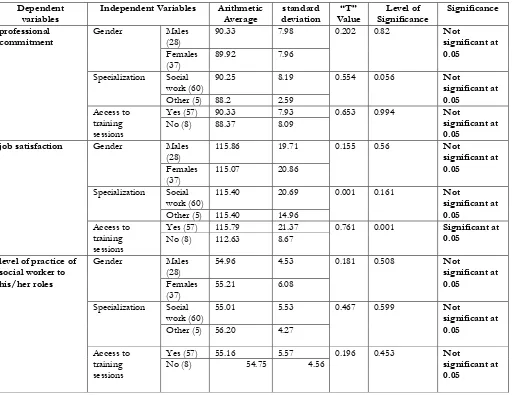
Table (3)
Shows the value of T-test and the level of its statistical significance of the differences between the averages of professional commitment, job satisfaction and the level of practice of social workers to their roles, according to gender, specialization,access to training
Dependent
variables Independent Variables Arithmetic Average deviation standard Value “T” Significance Level of Significance
professional
commitment Gender Males (28) 90.33 7.98 0.202 0.82 Not significant at
0.05
Females
(37) 89.92 7.96
Specialization Social
work (60) 90.25 8.19 0.554 0.056 Not significant at
0.05
Other (5) 88.2 2.59
Access to training sessions
Yes (57) 90.33 7.93 0.653 0.994 Not
significant at 0.05
No (8) 88.37 8.09
job satisfaction Gender Males
(28) 115.86 19.71 0.155 0.56 Not significant at
0.05
Females
(37) 115.07 20.86
Specialization Social
work (60) 115.40 20.69 0.001 0.161 Not significant at
0.05
Other (5) 115.40 14.96
Access to training sessions
Yes (57) 115.79 21.37 0.761 0.001 Significant at
0.05
No (8) 112.63 8.67
level of practice of social worker to his/her roles
Gender Males
(28) 54.96 4.53 0.181 0.508 Not significant at
0.05
Females
(37) 55.21 6.08
Specialization Social
work (60) 55.01 5.53 0.467 0.599 Not significant at
0.05
Other (5) 56.20 4.27
Access to training sessions
Yes (57) 55.16 5.57 0.196 0.453 Not
significant at 0.05
Table (4) Demonstrates the analysis of mono-variance analysis (One Way Anova) to indicate the differences in the responses of social worker on professional commitment according to the characteristics of the sample
Demographic
characteristics Source of variation Squares Total Degrees of freedom Average of Squares Value “F” Significance Level of Significance
Marital status Between groups 310.40 3 103.47 1.71 0.175 Not
significant at 0.05
Inside the
groups 3695.04 61 60.57
Age Between groups 293.49 4 73.37 1.19 0.33 Not
significant at 0.05
Inside the
groups 3711.96 60 61.87
Monthly income Between groups 185.80 5 37.16 0.574 0.720 Not
significant at 0.05
Inside the
groups 3819.64 59 64.74
Academic
qualification Between groups 98.55 1 98.55 1.59 0.212 Not significant at
0.05
Inside the
groups 3906.9 63 62.01
Years of
experience Between groups 314.76 3 104.92 1.734 0.169 Not significant at
0.05
Inside the
groups 369.68 61 60.50
Number of
absence days Between groups 160.34 2 80.17 1.293 0.282 Not significant at
0.05
Inside the
groups 3845.11 62 62.02
Number of
training courses Between groups 314.15 3 104.72 1.730 0.170 Not significant at
0.05
Inside the
groups 3691.30 61 60.51
taking advantage of the training courses
Between groups 484.61 2 242.31 4.27 0.018 Significant at
0.05
Inside the
groups 352.83 62 56.79
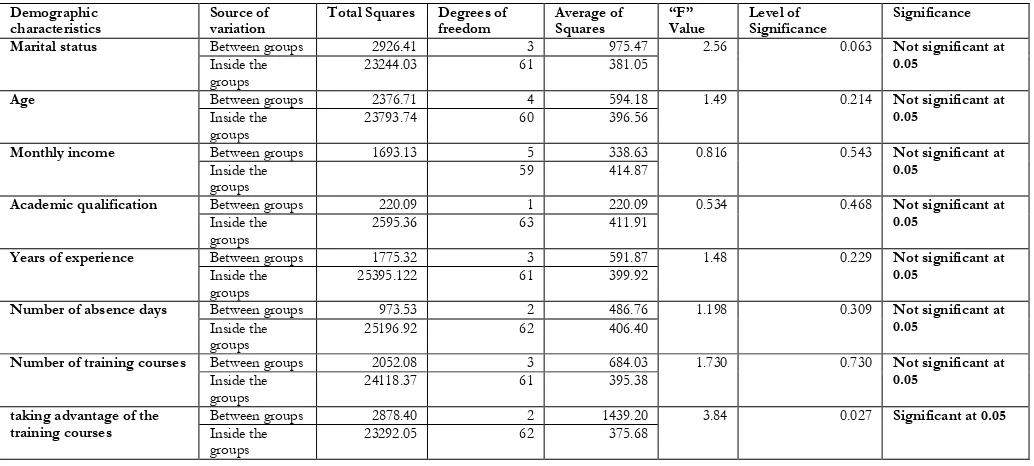
Table (5) Demonstrates the analysis of mono-variance analysis (One Way Anova) to indicate the differences in the responses of social worker on Job Satisfaction according to the characteristics of the sample
Demographic
characteristics Source of variation Total Squares Degrees of freedom Average of Squares “F” Value Level of Significance Significance
Marital status Between groups 2926.41 3 975.47 2.56 0.063 Not significant at
0.05
Inside the
groups 23244.03 61 381.05
Age Between groups 2376.71 4 594.18 1.49 0.214 Not significant at
0.05
Inside the
groups 23793.74 60 396.56
Monthly income Between groups 1693.13 5 338.63 0.816 0.543 Not significant at
0.05
Inside the
groups 59 414.87
Academic qualification Between groups 220.09 1 220.09 0.534 0.468 Not significant at
0.05
Inside the
groups 2595.36 63 411.91
Years of experience Between groups 1775.32 3 591.87 1.48 0.229 Not significant at
0.05
Inside the
groups 25395.122 61 399.92
Number of absence days Between groups 973.53 2 486.76 1.198 0.309 Not significant at
0.05
Inside the
groups 25196.92 62 406.40
Number of training courses Between groups 2052.08 3 684.03 1.730 0.730 Not significant at
0.05
Inside the
groups 24118.37 61 395.38
taking advantage of the
training courses Between groupsInside the 2878.40 2 1439.20 3.84 0.027 Significant at 0.05
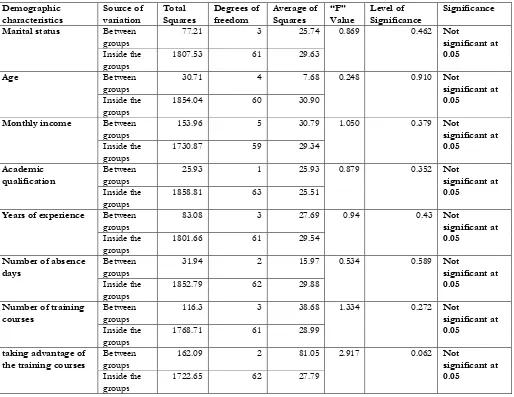
Table (6) Demonstrates the analysis of mono-variance analysis (One Way Anova) to indicate the differences in the responses of social worker on the Level of the practice of his Roles according to some variables
Demographic
characteristics Source of variation Total Squares Degrees of freedom Average of Squares “F” Value Level of Significance Significance
Marital status Between
groups 77.21 3 25.74 0.869 0.462 Not significant at
0.05
Inside the
groups 1807.53 61 29.63
Age Between
groups 30.71 4 7.68 0.248 0.910 Not significant at
0.05
Inside the
groups 1854.04 60 30.90
Monthly income Between
groups 153.96 5 30.79 1.050 0.379 Not significant at
0.05
Inside the
groups 1730.87 59 29.34
Academic
qualification Between groups 25.93 1 25.93 0.879 0.352 Not significant at
0.05
Inside the
groups 1858.81 63 25.51
Years of experience Between
groups 83.08 3 27.69 0.94 0.43 Not significant at
0.05
Inside the
groups 1801.66 61 29.54
Number of absence
days Between groups 31.94 2 15.97 0.534 0.589 Not significant at
0.05
Inside the
groups 1852.79 62 29.88
Number of training
courses Between groups 116.3 3 38.68 1.334 0.272 Not significant at
0.05
Inside the
groups 1768.71 61 28.99
taking advantage of
the training courses Between groups 162.09 2 81.05 2.917 0.062 Not significant at
0.05
Inside the
groups 1722.65 62 27.79
Professional Role Practice
To determine the level of practice of medical social workers for their professional roles, standard deviation and arithmetic average were used. According to the results, social workers (in the study sample) agree on the level of practicing their professional roles according to what is specified in the Policies and Procedures of Social Work Medical Manual issued by the Ministry of Health for 2015-2016, (2.75) from 3 indicating a high practice level. This may be due to the commitment of medical social workers in all hospitals to the tasks and responsibilities specified in the Manual, and to the satisfaction of social workers from their profession, job and institution.
Demographic Variables and Professional Commitment, Job Satisfaction, Professional Role Practice of Medical Social Workers
Results indicated that:
- No statistically significant differences at the level of significance (p ≥0.05) of social workers’ professional commitment, according to variables: gender - specialization - and access to training courses. The results differ with the findings of Alkandri (1992) study.
courses, which confirms that there is a positive relationship between access to training and the level of job satisfaction of medical social workers.
- No statistically significant differences at the level of significance (p ≥0.05) of social workers’ level of practice for their professional roles according to variables (gender - specialization - and obtaining training courses), due to their commitment to what came In the Policies and Procedures for Social and Medical Services issued by the Saudi Ministry of Health.
- No statistically significant differences at the level of significance (p ≥0.05) of social workers’ professional commitment, according to the variables: (marital Status - age - monthly income - qualification - years of experience - number of absence days - number of training courses); while there were significant differences were statistically significant at the abstract level (0.05 ≥ p), including at the level of professional commitment, according to benefit from training courses and the value of (F = 4.27) in favor of how high they benefit from.
This means that the high utilization of courses positively affect the level of social workers’ commitment. - No statistically significant differences using One Way Anova at the level of significance (0.05 p p) of social workers’ job satisfaction according to: (marital status - age - monthly income - academic qualification - years of experience - number of absence days - number of training courses); while there were statistically significant differences at the level of significance (0.05 ≥ p) among them at the level of job satisfaction according to the variable (benefit from training courses) and the value of (F = 3.84) for those who benefited greatly from the training courses. It is clear that those who had high benefit from training courses they have a high level of job satisfaction. - No statistically significant differences using One Way Anova at the level of significance (0.05 p p) of social workers’ level of practice of for their professional role according to: marital status - age - monthly income - academic qualification - years of experience - number of absence days - number of training courses - the extent of benefiting from the courses. This may be due to the fact that this role practice is defined in the Ministry of Health Manual 2015 – 2016. To determine the relationship between the levels of professional commitment, job satisfaction and professional role practice of social workers, we used the correlation coefficients according to Pearson’s matrix.
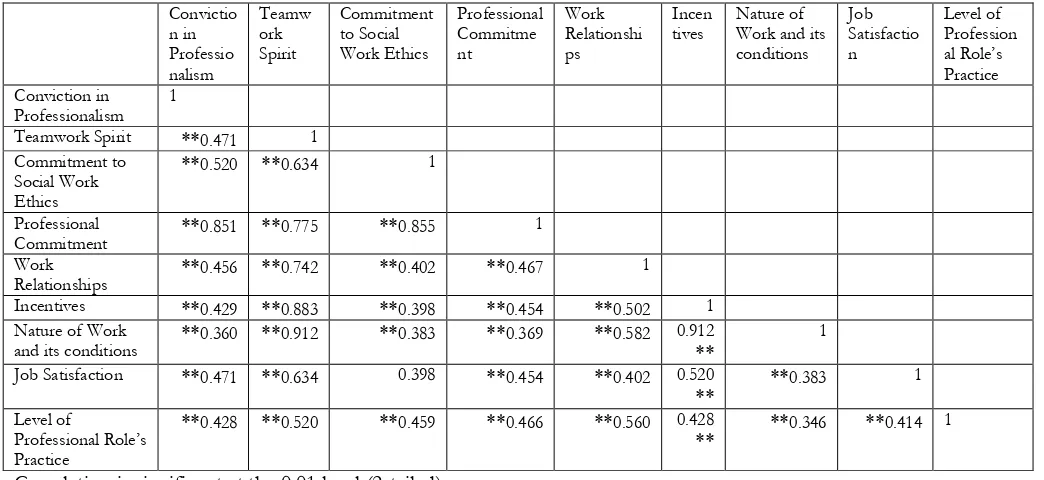
Table (7) reveals the relationship between Professional Commitment, Job Satisfaction and the Lev of Professional Role’s Practice of Medical Social Workers
Convictio n in Professio nalism Teamw ork Spirit Commitment to Social Work Ethics Professional Commitme nt Work Relationshi ps Incen
tives Nature of Work and its
conditions Job Satisfactio n Level of Profession al Role’s Practice Conviction in
Professionalism 1
Teamwork Spirit **0.471 1
Commitment to Social Work Ethics
0.520
** **0.634 1
Professional
Commitment **0.851 **0.775 **0.855 1
Work
Relationships **0.456 **0.742 **0.402 **0.467
1
Incentives **0.429 **0.883 **0.398 **0.454 **0.502 1
Nature of Work
and its conditions **0.360 **0.912 **0.383 **0.369 **0.582 0.912 ** 1
Job Satisfaction **0.471 **0.634 0.398 **0.454 **0.402 0.520
** **0.383
1
Level of
Professional Role’s Practice
0.428
** **0.520 **0.459 **0.466 **0.560 0.428
** **0.346 **0.414
1
Correlation is significant at the 0.01 level (2-tailed).**
In Table (7), the results showed that:
- Strong positive relationship between professional commitment and job satisfaction’s variables: work relations at a significant level (0.01) and correlation coefficient value (0.47)/ material and moral incentives at significant level (0.01) with correlation value of (0.454)/ nature of work and its conditions at significant level (0.01) with correlation level of (0.37).
- Strong positive correlation between professional commitment and job satisfaction at significant level (0.01) with correlation value of (0.454).
- A positive relationship between job satisfaction and professional commitment’s variables: conviction for professional work at level of (0.01) with correlation value of (0.471)/ commitment to social work ethics at level of (0.01)/ teamwork at significant level (0.01) with correlation value of (0.634).
Therefore, social workers’ professional commitment is an important factor in achieving job satisfaction. So, health institutions should pay attention to raise their professional commitment’s level, which in turn raises the level of job satisfaction, thus achieving stability in work.
- A strong positive relationship between professional commitment and the level of medical social workers’ role practice at significant level (0.01) with correlation value of (0.466). This result is important because it filled the gap in the previous literature which did not address the relationship between professional commitment and professional role practice of social workers.
- A statistically significant correlation between the levels of job satisfaction and professional role practice of social workers at significant level (0.01) with correlation value of (0.414). This result confirms what Zayed and Ali (2011) study showed; and what Shier and Graham (2010) pointed out about the effect of physical, organizational and social environment etc., on social work practice.
As a conclusion, and according to the results of this study, there is a positive relationship between commitment, job satisfaction and the level of professional role’s practice of the medical social workers.
Recommendations
The researchers recommend the following:
- Social Work educational institutions should pay attention to the professional preparation of social workers: in order to acquire appropriate knowledge, skills and positive attitudes towards professional practice, and to become convinced of professionalism and committed to social work values and ethics, and to work within a team.
- Social work institutions’ managers in general and medical institutions in particular, must enhance
professional commitment and job satisfaction of social workers; and provide a professional, organizational, social and physical environment appropriate to satisfy the needs of social workers, and thus positively affect the acceptance and satisfaction of the job, and ensure stability and continuity of social workers in their jobs in order to provide professional assistance to those who need it.
- Media institutions and decision-makers in the community have to improve the positive mental image of the
social worker in the community, which contributes to increase social recognition of the function of social workers and social work profession.
Acknowledgements
The authors would like to extend their sincere appreciation to the Deanship of Scientific Research at king Saud University for its funding this research (RGP – 1437/007). Huda Mahmoud Hassan Hegazyand Hind AqylAlmaizar
Arabic References
Ussein, MedhatFouadFattouh. (2002). "Contemporary Methods and Approaches to Address Difficulties and Challenges of Practicing Social Work in Saudi Society". Saudi Arabia, Riyadh: College of Social Work.
Al-Kandari, c. J. (1992). Professional commitment among teachers in Kuwait: problem and reasons. Educational Studies - Egypt.
Awwad, Youssef Diab (2013). Professional commitment of psychologists and social workers working in mental health centers of the Palestinian Ministry of Health.
Shraideh, Salem (2010). Job satisfaction: theoretical frameworks and practical applications, Amman, Sanaa Publishing and distribution House.
Suweidan, Majdi Saber. "Job Satisfaction of Social Workers in Kindergartens: A Field Study Applied to Government Kindergartens in Dakahlia Governorate". Helwan University: Faculty of Social Work.
Reda, HadiMokhtar Ali. "Social support and its impact on job satisfaction of social worker in Kuwaiti society." Annals of the Arts of Ain Shams –Egypt.
Al Rubaie, Khawla Ibrahim (2009). The degree of participation of private secondary school teachers in Jordan in making school decisions, and their relation to their job satisfaction and professional commitment, unpublished PhD thesis, Amman Arab University for Postgraduate Studies.
Zayed, Sami Mustafa Kamel Ahmed, and Ihab Abdul Khaliq Mohammed Ali. "The relationship between achieving job satisfaction and developing skills of professional performance of social workers in the field of care for persons with special needs: applied study by the Egyptian Association for the Protection of Children in Alexandria". Egypt Faculty of Social Work, Helwan University.
Ministry of Health (2015). Directory of Policies and Procedures of Social Service Departments, General Administration of Mental and Social Health, Riyadh, Indexing of the King Fahd National Library.
English References
Giffords, Elissa D., (2009). An Examination of Organizational Commitment and Professional Commitment and the Relationship to Work Environment, Demographic and Organizational Factors, Journal of Social Work. Ozpehlivan, Murat &Acar, Zafer. (2016) Development and validation of a multidimensional job satisfaction scale in
Flores, Rodrigo, Miranda, Paula, Muñoz, Carolina and Sanhueza, Guillermo (2012) Chilean social workers and job satisfaction: The impact of psychological states and role stress, International Social Work.
Ham1, Irene Van, Verhoeven, Anita A. H., Groenier, Klaas H., Groothoff, Johan W. &Haan, Jan De (2006) Job satisfaction among general practitioners: A systematic literature review, European Journal of General Practice. Simons, Kelsey &An, Sofiya (2015) Job Satisfaction Among Gerontological Social Workers in Ontario, Canada,
Journal of Gerontological Social Work.
Fu,weihui , Deshpande, Satish p.(2013).The Impact of Caring Climate, Job Satisfaction, and Organizational Commitment on Job Performance of Employees in a China’s Insurance Company, Journal of Business Ethics.
Pasupuleti, Sudershan, Allen, Reva I., Lambert, Eric G. and Tolar, Terry Cluse- (2009) Impact of Work Stressors on Life Satisfaction of Social Service Workers: A Preliminary Study, Administration in Social Work.
Caricati et al., (2013) Work climate, work values and professional commitment as predictors of job satisfaction in nurses, Journal of Nursing Management.
Lu. Kuei-Yun, Lin, Pi-Li, Wu, Chiung-Man, Hsieh, Ya-Lung and Chang, Yong-Yuan.(2002). The relationships among turnover intentions, professional commitment, and job satisfaction of hospital nurses,Journal of Professional Nursing.
Shim ,Woochan S. , Hwang, Myung Jin & Lee, Jaehooon (2009) Professional Identity, Job Satisfaction, and Retention of Licensed Social Workers in Korea, Asia Pacific Journal of Social Work and Development.