The Thirty-Third AAAI Conference on Artificial Intelligence (AAAI-19)
Distributed Representation of Words in Cause and Effect Spaces
Zhipeng Xie, Feiteng Mu
School of Computer Science Shanghai Key Laboratory of Data ScienceFudan University, Shanghai, China [email protected]
Abstract
This paper focuses on building up distributed representation of words in cause and effect spaces, a task-specific word embedding technique for causality. The causal embedding model is trained on a large set of cause-effect phrase pairs extracted from raw text corpus via a set of high-precision causal patterns. Three strategies are proposed to transfer the positive or negative labels from the level of phrase pairs to the level of word pairs, leading to three causal embedding models (Pairwise-Matching, Max-Matching, and Attentive-Matching) correspondingly. Experimental results have shown that Max-Matching and Attentive-Matching models signif-icantly outperform several state-of-the-art competitors by a large margin on both English and Chinese corpora.
Introduction
Causality, also referred to as causation, is a fundamental concept in human thinking and reasoning (Stukker, Sanders, and Verhagen 2008). It indicates a special semantic rela-tion between one process (the cause) with another process or state (the effect), where the cause is partially responsible for the effect, and the effect is partially dependent on the cause. Causality is commonly expressed, explicitly or im-plicitly, in text of most natural languages, which is of great value and has been exploited for various applications such as why-question answering (Oh et al. 2013), event predic-tion (Radinsky, Davidovich, and Markovitch 2012), and fu-ture scenario generation (Hashimoto et al. 2014).
One key to the success of these downstream applications lies in the automatic construction of a large causality base. Many methods have been proposed to mine causalities from text corpora, which can be categorized into classes. The old-est approaches used hand-coded domain-specific knowledge bases to extract explicit causal knowledge from text (Ka-plan and Berry-Rogghe 1991) and to rank the extracted possible causalities (Girju and Moldovan 2002). These works achieved satisfactory precision but low recall. New approaches employed machine learning algorithms to ex-tract explicit and implicit causalities from text (Girju 2003; Chang and Choi 2006; Hashimoto et al. 2015a), which relies heavily on feature engineering.
Copyright c2019, Association for the Advancement of Artificial Intelligence (www.aaai.org). All rights reserved.
In recent years, there is an upsurge of deep learning in natural language processing (Collobert et al. 2011), where distributed representation of words serves as the basis. The neural methods that learn vanilla distributed representation of words (calledword embeddings) usually capture only co-occurrence relationships between words (Levy and Gold-berg 2014b). Although such a general-purpose word em-beddings is helpful for various NLP tasks, the acquisition of generality is often at the cost of losing specificity to a certain degree. Some work has been devoted to enhance word embeddings for specific tasks. Task-specific word em-beddings capture task-specific word similarity. For exam-ple, if the task is about POS tagging, two nouns “cat” and “man” might be considered similar by the model (Faruqui et al. 2016). Tang et al. (2014) proposed learning sentiment-specific word embedding for sentiment analysis, where sen-timent information is encoded into the continuous represen-tation of words such that it can separate good andbad to opposite ends of the spectrum. Hashimoto et al. (2015b) pro-posed a novel method to train word embeddings for seman-tic relation classification, by predicting words between noun pairs using lexical relation-specific features. Li et al. (2017) developed a tailored neural network to learn contradiction-specific word embedding.
With vanilla word embedding, the underlying rationale of its wide applicability is the inference rule based on similar-ity, which states that if Ais similar toB, and Ahas some property or has a semantic relationRwithC, then it can be hypothesized thatBalso has the property or has the relation
techniques.
In this paper, we continue the line of task-specific word embedding research, and devote to causal word embedding. We develop three models to learn causal embeddings from the corpus of cause-effect phrase pairs extracted from a text corpus , and present quantitative evaluation results on both English corpus and Chinese corpus. In particular, we make the following contributions in this paper:
• We propose three methods (Pairwise Matching, Max Matching, and Attentive Matching) for building causal embeddings from a corpus of cause-effect phrase pairs, by transferring causal relationship from phrase-pair level to word-pair level. Performance evaluation has shown that Max Matching and Attentive Matching models perform much better than several state-of-the-art competitors, by a large margin, on both English and Chinese corpora. Here, Max Matching model assumes that there is at least one word pair carrying the causality information of the posi-tive phrase pair, which can be thought of as a special case of multi-instance learning, and Attentive Matching con-siders the causal relations between words and phrases.
• For Chinese corpus, we hand-craft a set of high-precision causal patterns and extract nearly 1.5 million of cause-effect phrase pairs from raw corpus. The quality of those extractions is satisfactory, with precision approaching 90%.
• We define a new task of identifying causal word pairs from cause-effect phrase pairs, and manually annotate a dataset of cause-effect phrase pairs accordingly. This annotated dataset can be used for evaluating the perfor-mance of causal embeddings, to promote the research on causal embeddings.
Related Work
To the best of our knowledge, there are two research pa-pers (Sharp et al. 2016; Zhao et al. 2017) that are closely related to this paper.
Sharp et al. (2016) generated a causality-specific embed-dings and demonstrated that these dedicated embedembed-dings is helpful in a downstream causal QA task. Their cEmbed-family methods for embedding construction are based on the Skip-Gram algorithm (Mikolov et al. 2013), by treating an effect phrase as the context of its cause and an cause phrase as the context of its effect. However, such treatment is based on the assumption that each word pair between a cause-effect phrase pair is causally related. This assumption is far from reality and introduces too much noise. The cEmbed-family models perform undistinguished in our performance evaluation.
Zhao et al. (2017) proposed to construct an abstract causality network from the specific one, and then to learn network embedding by a dual cause-effect transition model, in order to achieve generalization ability. However, their ap-proach has two shortcomings. Firstly, the construction of abstract causality network depends on the availability of knowledge resources, which limits its applicability. Sec-ondly, the rationality of generalizing a noun to its hyper-nym need further clarification, because it is doubtful whether
such a generalization will preserve the causal-effect relation-ship.
Causal Embedding Models
Given a corpus of N cause-effect phrase pairs D =
{(Ci, Ei)|1≤i ≤N}, we useVc ={c|∃Cisuch thatc ∈
Ci} to denote the vocabulary of cause words, and Ve =
{e|∃Eisuch thate∈Ei}to denote the vocabulary of effect
words. For a cause wordc ∈ Vc, its cause embedding is a vectorc(c), and the effect embedding of effect worde∈Ve
ise(e), both of sized(200 by default).
In this paper, we solve the causal embedding problem in a classification framework. Each phrase pair (C, E) ∈ D is thought of as a positive example, becauseC andE are causally related. Negative example (C, E) can be gener-ated by choosing randomly one phraseCfrom all the cause phrases inDand one phraseEfrom all the effect phrases. As a result, we obtain a dataset of positive examples and nega-tive examples for classification, where examples are phrase pairs.
Lett(C, E)denote the class label of phrase pair(C, E). The class label is assigned clearly at the phrase-pair level. In order to learn causal embeddings for words, we have to transfer the class information from phrase-pair level to word-pair level. This problem can be solved easily for neg-ative examples: for a given negneg-ative phrase pair(C, E), we assume that all word pairs(c, e), wherec ∈Cande ∈E, are negative (i.e., not causally related).
However, for positive examples, the situation is more complex, because we do not know which word pair domi-nates the causality between the phrase pair. Next, we pro-pose three strategies to deal with positive phrase pairs, lead-ing to three different causal embeddlead-ing models.
Model 1: Pairwise-Matching
The first strategy assumes that for each positive phrase pair, all the word pairs between the cause phrase and the effect phrase are treated as positive (i.e., being causally related). With this strategy, for a phrase pair(C, E), no matter pos-itive or negative, all the word pairs between CandE will inherit the class label from the phrase pair. The correspond-ing method works in a straightforward way as follows.
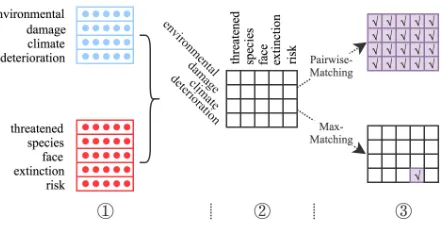
As illustrated in Figure 1, for a given word pair (c, e), Pairwise-Matching model first calculates a causal interac-tion score cs(c, e) as the inner product between the cause embedding ofcand the effect embedding ofe:
cs(c, e) =c(c)>·e(e) (1) and then uses sigmoid function to transform the score into a probability as the prediction of the class label:
p(c, e) =σ(cs(c, e)) = exp(cs(c, e))
1 + exp(cs(c, e)) (2) Given a training set D of phrase pairs, we choose the cross-entropy loss function as the objectiveJP M to
mini-mize:
JP M =
X
(C,E)∈D
X
c∈C,e∈E
−t(C, E) logp(c, e)
Figure 1: The architecture of Pairwise-Matching and Max-Matching models. Here,Àis “the cause and effect embed-dings”,Áis “the causal interaction scores between words”, the upper branch of  corresponds to Pairwise-Matching model, and the lower branch of  corresponds to Max-Matching one.
The focal loss (used in the following two models) was also tried, but we found that it is very unstable for pairwise-matching model. We conjecture that the reason is that focal loss is sensitive to noise, and the assumption of pairwise-matching introduces too much noise.
This model is similar to cEmbed-family models (Sharp et al. 2016). Quantitative evaluation shows that they have similar performance . The difference exists in the negative sampling part: Pairwise-Matching samples negative exam-ples at the phrase level, while cEmbed uses downsampling technique to sample negative examples at the word level.
Model 2: Max-Matching
The second strategy treats the task of learning causal em-bedding as a multi-instance learning problem (Maron and Lozano-P´erez 1998), where each phrase pair(C, E)can be mapped to a bag of word pairs{(c, e)|c∈C, e∈E}. We as-sume that the bag does not contain positive word pairs if the phrase pair is negative, and the bag contains at least one pos-itive word pair if the phrase pair is pospos-itive. In other words, it requires that there is at least one word pair carrying the causality information of the positive example. That is, for a given cause-effect phrase pair(C, E), it is expected that we can find a word pair(c, e)betweenC andE such that the cause word c ∈ C has a large causal interaction with the effect worde∈E.
The causal score of a phrase pair(C, E)is defined as the maximum causal interaction score among all the word pairs betweenCandE:
csM M(C, E) = max
c∈C,e∈Ecs(c, s) (4)
In other words, only the word pair with the highest causal interaction score is selected as the positive word pair which serves as the representative of the positive phrase pair (as illustrated in Figure 1.
The Max-Matching method also uses a sigmoid function to transform the causal scorecsM M(C, E)into the predicted
probability that the phrase pair(C, E)is positive or causally
related, as follows:
pM M(C, E) =
exp(csM M(C, E))
1 + exp(csM M(C, E))
(5)
The Max-Matching method uses focal loss (Lin et al. 2017) as the loss function, which focuses training on a sparse set of hard examples and prevents the vast number of easy negatives from overwhelming the model during training. We adopt focal loss function here, because during learning causal embedding, there are a vast number of easy negatives, and focal loss is suitable for this situation, especially for the max-matching strategy. For a given predicted probabilityp
and a target class labelt, the focal lossf l(p, t)is defined as:
f l(p, t) =
−α(1−p)γlog(p) ift= 1
−(1−α)pγlog(1−p) ift= 0 (6) whereαandγare two hyperparameters, which are set to 0.8 and 2.0 by default.
The total focal lossJM Mfor the training datasetDis cal-culated by summing all the focal losses of positive phrase pairs and the focal losses of all the negative word pairs:
JM M =
X
(C,E)∈D
t(C,E)=1
f l(pM M(C, E),1)
+ X
(C,E)∈D
t(C,E)=0 X
c∈C e∈E
f l(p(c, e),0)
(7)
wherep(c, e)is defined in Equation 2.
Model 3: Attentive-Matching
The third method considers the interaction between a cause word with the effect phrase and the interaction between an effect word with the cause phrase. It is expected that there is at least one cause word that has a close causal interaction with the effect phrase, and also at least one effect word that causally interacts with the cause phrase.
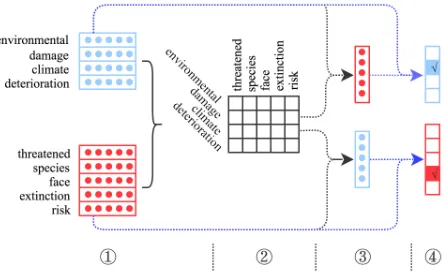
The architecture of Attentive-Matching model is illus-trated in Figure 2 to implement this idea. We firstly define the attentive representationCattof the cause phraseCwith
respect to the effect phraseE and the attentive representa-tion Eatt of the effect phraseE with respect to the cause
phraseC, as follows:
Catt=
m
X
i=1
aCi c(ci) (8)
Eatt=
n
X
j=1
aEj e(ej) (9)
wheremandnare the lengths ofCandErespectively,aC i
is the attention weight of the cause wordci on condition of
the effect phraseE, and aE
j is the attention weight of the
effect wordejon condition of the cause phraseC:
aCi =
Pn
j0=1exp(cs(ci, ej0)) Pm
i0=1 Pn
j0=1exp (cs(ci0, ej0))
(10)
aEj =
Pm
i0=1exp(cs(ci0, ej)) Pm
i0=1 Pn
j0=1exp (cs(ci0, ej0))
Figure 2: The architecture of Attentive-Matching model. Here, À is “the cause and effect embeddings”, Á is “the causal interaction scores between words”,Âis “the atten-tive representations of phrases”, andÃstands for “the causal interaction scores between words and phrases”.
The causal interaction score between a cause wordciand
the effect phrase E is defined as the inner product of the cause embedding ofciand the attentive representation ofE
with respect toC:
csAM(ci, E) =c(ci)>·Eatt (12)
Similarly, the causal interaction score between the cause phraseCand an effect wordejis calculated as:
csAM(C, ej) =e(ej)>·Catt (13)
Given a phrase pair(C, E), its causal score from cause to effect is defined as:
− →cs
AM(C, E) = max
ci∈CcsAM(ci, E) (14)
and its causal score from effect to cause is defined as:
←cs−
AM(C, E) = max ej∈E
csAM(C, ej) (15)
Finally, both the scores are transformed into two proba-bilities −→pAM(C, E) and ←−pAM(C, E) by sigmoid
func-tion, respectively. Therefore, for each positive phrase pair (C, E), there are two focal losses: one is from cause to ef-fect f l(−→pAM(C, E),1), the other is from effect to cause
f l(←−pAM(C, E),1).
The total focal lossJAM is the summation of all the
pos-itive losses and all the negative losses:
JAM =
X
(C,E)∈D
t(C,E)=1
f l(−→pAM(C, E),1) +f l(←−pAM(C, E),1)
+ X
(C,E)∈D
t(C,E)=0 X
c∈C e∈E
f l(p(c, e),0)
(16)
Model Training
We use simple gradient descent algorithm to train our mod-els, with learning rate of 0.005. Other related hyperparame-ters are listed as follows. The number of training epochs are
set to 30, and the batch size is 256. The words whose fre-quencies are less than 8 are pruned. The cause embeddings and the effect embeddings have the same dimensionality of 200. The negative sampling rate is 10, which means that we samples 10 negative phrase pairs for each positive phrase pair.
Evaluation on English Corpus
To make an evaluation on English, we build our models on a corpus of 815,233 cause-effect phrase pairs which was ex-tracted with a set of 13 rules from Gigaword and Simple English Wikipedia. Both the rules and the corpus are taken from (Sharp et al. 2016)1.
Direct Evaluation: Ranking Word Pairs
The models are evaluated on an external set of word pairs drawn from the SemEval 2010 Task 8 (Hendrickx et al. 2010)2, 865 of which were from the Cause-Effect relation and an equal number of which were randomly selected from the other eight relations. These pairs are then ranked and the goal is to rank the causal pairs above the others.
We compare our causal embedding models against several baseline and state-of-the-art models:
• Look-up: A word pair is ranked by the number of times that it appears in the extracted cause-effect phrase pairs.
• vEmbed: The vanilla word embeddings trained on raw text corpus with the skip-gram algorithm and a sliding window of 5.
• cEmbed: The cEmbed method (Sharp et al. 2016) treats the effect phrase as the context of the cause, and uses the variant of Skip-Gram implemented by Levy and Gold-berg (2014a) to train the causal embeddings.
• cEmbedBi: The bidrectional embedding model (Sharp et al. 2016) trains a second embedding model by reversing the input, which treats the cause phrase as the context of the effect, and ranks word pairs by the average of the scores returned by the two unidirectional causal embed-ding models.
• cEmbedBiNoise: The noise-aware bidirectional model makes an improvement on cEmbedBi by weigh a word pair by the likelihood that they are truly causal, which is approximated by the pointwise mutual information (PMI).
Figure 3 shows the precision-recall (PR) curve for these models and baselines. The Max-Matching and Attentive-Matching models perform consistently much better than other existing models and baselines including cEmbed-BiNoise, cEmbedBi and cEmbed, which is attributed to their more-reasonable assumptions. ThePairwise-Matching model performs similarly to thecEmbed-family models, be-cause they all share the same assumption that all word pairs between a cause-effect phrase pair are causally related.
It is also noted that the curves of all causal embedding models become straight at tail, which is caused by the fact
1
http://clulab.cs.arizona.edu/data/emnlp2016-causal/
2
Figure 3: Precision-recall curve of the compared models to rank causal word pairs above non-causal pairs
Model P@1
Random 16.4
CR 24.3
CR+vEmbed 34.6
CR+vEmbed+allCausalEmbed 37.9
Table 1: Performance on the Causal QA Task
that about 30% of test word pairs have at least one word missing from the training corpus.
Indirect Evaluation: Causal Question-Answering
Here, we would like to investigate whether the learned causal embeddings can help the downstream causal question-answering task. To do so, we conduct five-fold cross validation on a dataset of 3031 causal questions ex-tracted from the Yahoo! Answers corpus (Sharp et al. 2016), where each question has at least four alternatives (candidate answers). All the alternatives are generated by the commu-nity, and one of them is voted as the top answer. Our task is to identify the top answer from the alternatives. With ran-dom guess, the P@1 is 16.4%, which means that each causal question has more than 5 candidate answers on average.Here, we use a standard answer reranking architec-ture (Jansen, Surdeanu, and Clark 2014), where the candi-date answers are initially ranked by a shallow information retrieval method called candidate retrieval (CR). For each embedding model, no matter vanilla or causal, four features are computed for each question-answer pair: the maximum, the minimum, the average cosine similarity between word pairs, and the overall similarity between the composite ques-tion and answer vectors, where the composiques-tion vector is cal-culated as the mean vector of all its words. Then, the SVM ranker (a SVM classifier adapted for ranking) is applied to re-rank the candidate answers, with the initial CR score and the embedding-related features.
The following facts can be observed from Table 1 which lists the precision-at-one scores (P@1):
• The shallow candidate retrieval method (CR) achieves the P@1 of only 24.31%, which indicates the difficulty of this
causal QA task.
• With CR+vEmbed(word2vec), the P@1 is 34.6%, which illustrates the vanilla word embeddings are helpful.
• By augmenting the above configuration (CR+word2vec) with the derived features from all the causal embedding models, the P@1 gets increased to 37.9%, which demon-strates that causal embeddings are complementary to the vanilla word embeddings and make their own contribution in the downstream QA task.
We shall explore how to use CNN and RNN to build up the representations of questions and answers on the basis of vanilla embeddings and causal embeddings, as future work.
Evaluation on Chinese Corpus
Chinese Corpus construction
To build up causal embeddings for Chinese words, we have to collect a sufficiently large number of Chinese cause-effect phrase pairs from raw text corpus. It is too costly to be done by human annotation, so we make use of a few high-precision hand-crafted (causal) patterns instead.
Causality is pervasive in natural language. Part of them are marked by a variety of explicit causative devices (or called causal patterns) that can be categorized into two types: the causal verbs that mark causal relations within one clause, and the causal connectives that mark causal relations between clauses. However, these causal patterns usually sig-nal different causal strengths. Since our emphasis here is put on the high precision of the extractions, we choose only a limited number of hand-crafted strong patterns that have sufficiently high precision, some of which is listed in Table 2. Additionally, in Chinese, some strong causal connectives can only indicate the existence of causalities, but can not de-termine the exact position of the cause and effect text spans.
For example, the pattern signaling the
fact that there exists causality and the cause phrase follows the connective closely, but the position of ef-fect phrase is ambiguous, which may appear before the con-nective or after the cause phrase. Therefore, we choose the patterns that not only signal strongly the existence of causal-ity, but also be unanimouos in the location of cause phrase and effect phrase. The cause and effect phrases are extracted according to the dependency parses of causality sentences with a Chinese dependency parser PyLTP3. The extracted causal phrase pairs are further filtered by requiring that both the cause phrase and the effect phrase should have at least one content word (i.e., noun, verb or adjective).
We apply the above causal patterns on two raw Chinese corpora, the Baike corpus and the SogouCS corpus, where Baike is a 10GB data crawled from a Chinese encyclope-dia website and SogouCS4 (Wang et al. 2008) is the news data on the web, yielding to about 1.5 million of cause-effect phrase pairs in total. The statistics of the extractions are listed in Table 3.
To assess the quality of the extracted causality pairs, we randomly sample 500 cause-effect phrase pairs from each
3
https://github.com/HIT-SCIR/pyltp
4
Table 2: The causal patterns used to automatically extract cause-effect pairs. For connective patterns,<C>denotes the position of cause phrase, and<E>denotes the phrase position. For verb patterns, the cause phrase is alway on the left side of the verb, and the effect phrase on the right.
Corpus Pattern Type #Extracted CE Pairs
Baike causal connectivescausal verbs 356,654619,526
Sogou causal connectives 233,126
causal verbs 284,620
Total. 1,493,926
Table 3: Statistics of the extracted CE Pairs
subset and let annotators judge whether these pairs express causality. The results are shown in Table 4. It can be seen that the extracted cause-effect pairs have satisfactory precision of nearly 90%, and the extractions by causal verbs have slightly higher precision than those by causal connectives.
Corpus Pattern Type # Samples Precision
Baike causal connectives 500 88.4%
causal verbs 500 89.6%
Sogou causal connectivescausal verbs 500500 89.4%90.4%
Table 4: Quality of the extracted CE Pairs
Quantitative Evaluation
To assess our causal embedding models, we use a sim-ple causality-related task: identifying the causal word pair that carries the most significant causal information from a cause-effect phrase pair. For example, the causal word pair from the cause-effect phrase pair in Table 5. Identifying causal word pairs helpful in interpret-ing a cause-effect phrase pair, and can be used to extend the potential causality patterns and then to help identify implicit causality in text.
Table 5: A simple cause-effect phrase pair
To evaluate the performance of causal embedding models, we let two annotators to mark the causal word pairs from cause-effect phrase pairs, obtaining 715 pairs for which the
two annotators got the same annotating results: 360 pairs for Baike corpus and 355 pairs for Sogou, where the overall inter-annotator agreement is near to 80%.
Model Accuracy MRR
Look-up 6.8% 0.184
vEmbed 12.7% 0.305
cEmbed 19.1% 0.338
cEmbedBi 23.5% 0.404
cEmbedBiNoise 24.1% 0.400
Pairwise-Matching 24.9% 0.424
Max-Matching 58.6% 0.720
Attentive-Matching 53.0% 0.674
Table 6: Quantitative performance on Sogou test data of the causal embeddings trained from Baike corpus
Model Accuracy MRR
Look-up 8.4% 0.190
vEmbed 8.4% 0.272
cEmbed 18.9% 0.345
cEmbedBi 19.2% 0.344
cEmbedBiNoise 18.3% 0.334
Pairwise-Matching 19.5% 0.348
Max-Matching 42.9% 0.586
Attentive-Matching 42.1% 0.572
Table 7: Quantitative performance on Baidu test data of the causal embeddings trained from Sogou corpus
Given a cause-effect phrase pair pp = (C, E) where
C = c1c2. . . cm andE = e1e2. . . en, all the word pairs
betweenCandE get ranked according to their interaction scores cs(·,·)in Equation 1. For a word pairwp = (c, e) wherec ∈ C ande ∈ E, let r(wp, pp)denote the rank of word pairwpwith respect to the phrase pairpp. If the 1st ranked word pair is the same as the annotated causal word pair, then we say that the causal embedding has correctly identified the causal word pair. The accuracy of a causal em-bedding model on the test dataset is defined as the percent-age of the correctly identified causal word pairs. The mean reciprocal rank (MRR) is calculated as:
M RR= 1
|D| X
pp∈D
1
r(ann(pp), pp) (17)
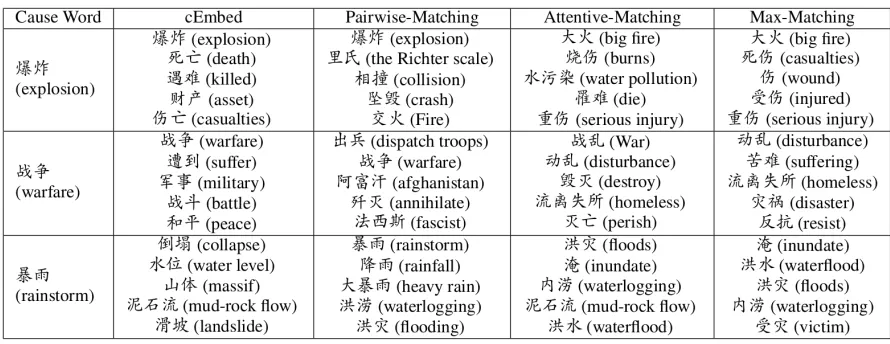
Table 8: Examples of top-5 effect words retrieved for the given cause words. For the cause word , it can be seen that the top-5 effect words retrieved by the Attentive-Matching model and the Max-Matching model are all correct. However, the words retrieved by cEmbed or Pairwise-Matching model are not the case. For example, for the cause word ,
is retrieved by vEmbed and is retrieved by Pairwise-Matching model.
Based on the two Chinese corpora and their respective annotated causal word pairs, we train the causal embed-dings on one corpus, and then evaluate their performance on the annotated word pairs of the other corpus. The ac-curacies and MRRs are reported in Table 6 and Table 7. It can be seen that cEmbed-family models and Pairwise-Matchinghave achieved similar accuracy and MRR values, which are far below those of Attentive-Matching model and Max-Matching model.Max-Matchingis the best model, no matter in Accuracy or in MRR value. The reason is because both thePairwise-MatchingandcEmbed-family models as-sume all word pair between a cause-effect phrase pair are causally related, yielding too much noise of false positives which will definitely do harm to the process of learning causal embeddings. WithMax-Matching, only one word pair with the highest interaction score is used as positive, all the other word pairs do not take part in the training, which has effectively controlled the noise. As toAttentive-Matching, it can be thought of as a soft version of Max-Matching. The false negatives are controlled in some degree, because most words (no matter cause words or effect words) will receive small attentive weights.
The causal embeddings trained from Baike corpus have better performance than those trained from Sogou corpus, partly because the Baike corpus of nearly 1 million pairs is larger than Sogou corpus of only half million pairs (see Table 3) and the Baike corpus can provide a higher coverage.
Qualitative Observation
To give more insight into the quality of different causal em-bedding models, we train causal emem-bedding models on the merged Baidu and Sogou corpus, and show the retrieved top-5 effect words to a given set of cause words in Table 8. Due to the space limitation, the results from effect to cause are not shown here.
It can be observed that all the top-5 words retrieved by
Max-MatchingandAttentive-Matchingare always causally related to the queries. The quality of the words retrieved by Pairwise-MathingandcEmbedis much lower.
As a conclusion, the qualitative observation, in accor-dance with the quantitative evaluation, manifests the supe-riority ofMax-MatchingandAttentive-Matchingin the task of learning causal embeddings.
Conclusion and Future Work
This paper proposes three models for learning causal em-beddings, with the following contributions:
• We propose three strategies to transfer the class label from the level of phrase pairs to the level of word pairs, leading to three causal embedding models.
• We construct automatically a large Chinese corpus of cause-effect phrase pairs by a few hand-crafted high-precision causal patterns, and annotate manually the causal word pairs that carry causal information between cause phrases and their effect phrases. Such an annotated dataset is helpful for evaluating causal embedding mod-els.
• Quantitative evaluation demonstrates that Attentive-MatchingandMax-Matchingmodels outperform the ex-isting models substantially, no matter on English or Chi-nese corpus.
In the future, we would like to improve the coverage of learned causal embeddings by making use of numerous weak causal patterns and explore the potential applicability of the learned causal embeddings in the downstream appli-cation such as event prediction and scenario generation.
Acknowledgments
Development Program of China (No.2018YFC0830901) and National High-Tech R&D Program of China (863 Pro-gram) (No. 2015AA015404). We are grateful to the anony-mous reviewers for their valuable comments.
References
Chang, D.-S., and Choi, K.-S. 2006. Incremental cue phrase learning and bootstrapping method for causality extraction using cue phrase and word pair probabilities. Information processing & management42(3):662–678.
Collobert, R.; Weston, J.; Bottou, L.; Karlen, M.; Kavukcuoglu, K.; and Kuksa, P. 2011. Natural language pro-cessing (almost) from scratch.Journal of Machine Learning Research12(Aug):2493–2537.
Faruqui, M.; Tsvetkov, Y.; Rastogi, P.; and Dyer, C. 2016. Problems with evaluation of word embeddings using word similarity tasks. InProceedings of the 1st Workshop on Eval-uating Vector Space Representations for NLP, 30–35. Girju, R., and Moldovan, D. 2002. Mining answers for cau-sation questions. In AAAI symposium on mining answers from texts and knowledge bases.
Girju, R. 2003. Automatic detection of causal rela-tions for question answering. In Proceedings of the ACL 2003 workshop on Multilingual summarization and ques-tion answering-Volume 12, 76–83. Association for Com-putational Linguistics.
Hashimoto, C.; Torisawa, K.; Kloetzer, J.; Sano, M.; Varga, I.; Oh, J.-H.; and Kidawara, Y. 2014. Toward future scenario generation: Extracting event causality exploiting semantic relation, context, and association features. InACL (1), 987– 997.
Hashimoto, C.; Torisawa, K.; Kloetzer, J.; and Oh, J.-H. 2015a. Generating event causality hypotheses through se-mantic relations. InAAAI, 2396–2403.
Hashimoto, K.; Stenetorp, P.; Miwa, M.; and Tsuruoka, Y. 2015b. Task-oriented learning of word embed-dings for semantic relation classification. arXiv preprint arXiv:1503.00095.
Hendrickx, I.; Kim, S. N.; Kozareva, Z.; Nakov, P.; ´
O S´eaghdha, D.; Pad´o, S.; Pennacchiotti, M.; Romano, L.; and Szpakowicz, S. 2010. Semeval-2010 task 8: Multi-way classification of semantic relations between pairs of nomi-nals. InProceedings of the 5th International Workshop on Semantic Evaluation, 33–38. Uppsala, Sweden: Association for Computational Linguistics.
Jansen, P.; Surdeanu, M.; and Clark, P. 2014. Dis-course complements lexical semantics for non-factoid an-swer reranking. InProceedings of the 52nd Annual Meeting of the Association for Computational Linguistics (Volume 1: Long Papers), volume 1, 977–986.
Kaplan, R. M., and Berry-Rogghe, G. 1991. Knowledge-based acquisition of causal relationships in text. Knowledge Acquisition3(3):317–337.
Levy, O., and Goldberg, Y. 2014a. Dependency-based word embeddings. InACL (2), 302–308.
Levy, O., and Goldberg, Y. 2014b. Neural word embed-ding as implicit matrix factorization. InAdvances in neural information processing systems, 2177–2185.
Li, L.; Qin, B.; and Liu, T. 2017. Contradiction detection with contradiction-specific word embedding. Algorithms 10(2):59.
Lin, T.; Goyal, P.; Girshick, R. B.; He, K.; and Doll´ar, P. 2017. Focal loss for dense object detection. InIEEE Interna-tional Conference on Computer Vision, ICCV 2017, Venice, Italy, October 22-29, 2017, 2999–3007.
Maron, O., and Lozano-P´erez, T. 1998. A framework for multiple-instance learning. InAdvances in neural informa-tion processing systems, 570–576.
Mikolov, T.; Sutskever, I.; Chen, K.; Corrado, G. S.; and Dean, J. 2013. Distributed representations of words and phrases and their compositionality. InAdvances in neural information processing systems, 3111–3119.
Oh, J.-H.; Torisawa, K.; Hashimoto, C.; Sano, M.; De Saeger, S.; and Ohtake, K. 2013. Why-question answer-ing usanswer-ing intra-and inter-sentential causal relations. InACL (1), 1733–1743.
Radinsky, K.; Davidovich, S.; and Markovitch, S. 2012. Learning causality for news events prediction. In Proceed-ings of the 21st international conference on World Wide Web, 909–918. ACM.
Sharp, R.; Surdeanu, M.; Jansen, P.; Clark, P.; and Ham-mond, M. 2016. Creating causal embeddings for ques-tion answering with minimal supervision. InProceedings of the 2016 Conference on Empirical Methods in Natural Lan-guage Processing, 138–148. Association for Computational Linguistics.
Stukker, N.; Sanders, T.; and Verhagen, A. 2008. Causal-ity in verbs and in discourse connectives: Converging evi-dence of cross-level parallels in dutch linguistic categoriza-tion. Journal of Pragmatics40(7):1296–1322.
Tang, D.; Wei, F.; Yang, N.; Zhou, M.; Liu, T.; and Qin, B. 2014. Learning sentiment-specific word embedding for twitter sentiment classification. InProceedings of the 52nd Annual Meeting of the Association for Computational Lin-guistics (Volume 1: Long Papers), volume 1, 1555–1565. Wang, C.; Zhang, M.; Ma, S.; and Ru, L. 2008. Automatic online news issue construction in web environment. In Pro-ceedings of the 17th international conference on World Wide Web, 457–466. ACM.