% ∃ ∗∗∀∀∗(∗
Technology enhanced reflection and
meta-reflection: Guiding learners through
reflective processes
Patrick Ainsworth
Abstract
Do your students submit reflective journals that read like ‘What I did On My Summer Holidays’? Inspired by the work of Professor Carolyn Mair, the purpose of this paper is to outline a ‘research project in progress’ focusing on technology-enhanced reflective practice. Findings to date will also be discussed.
In order to increase the efficiency of learning and the development of skills, students are expected
to work through reflective models and produce reflective journals for assessment. Many students,
however, appear not to engage with the reflective processes and often repeat unhealthy patterns.
In addition to this, reflective journals submitted for assessment can lack the detail and depth
required to gain higher grades and frequently take the form of simple descriptions of what happened
week by week. Even when students do engage with a reflective process, there still appears to be a
tendency to miss learning opportunities and not to notice barriers to learning due to the lack of
regular review of reflective diaries. The effectiveness of reflective models also need to be reviewed
(meta-reflection) as students also tend to neglect this even when encouraged to do so.
This paper introduces methods to guide students through reflective and meta-reflective processes
using online forums and spreadsheets. There will also be a summary of the success of these methods
so far in this evolving research project. Although this project is applied to the development of musical
Background
Course: BA (Hons) Popular Music Performance
Levels: four and five
Number of staff involved: four
Number of students involved: sixty-fourRationale
To the listener, compared with other styles of music, most popular music might appear quite simple, but the devil is in the detail. The majority of bands do not play well; the evidence for this can be experienced at many ‘local’ venues throughout the United Kingdom. The minority that do play well are far more likely to gain recognition, success and employment. As a part of BA Popular Music Performance course, students are encouraged to address this issue by studying and performing classic pieces in fine detail and reflecting on their progress. In doing this, they will learn how successful pieces are put together and performed, and how technical and performance skills are developed. Ideally they will then be able to transfer this knowledge to their own recordings and performances whether these are of cover versions, or original material.
The Student Task
As part of Unit MMR108: Music Performance 1, level four BA Popular Music Performance, students are given one song title per week. Their task is to access the correct version of the song and to learn their instrumental or vocal part(s) as accurately as possible. The students then perform the piece in ensembles to their peers and lecturers during a two-hour workshop. Self and peer evaluation takes place and lecturer input is provided throughout the session; performance of the piece is repeated many times during the session ideally with marked improvement each time. The ensemble line-ups are changed regularly to ensure that all students have the opportunity to perform.
performances. The students are assessed via a reflective journal at the end of the Unit and the process is repeated at level five using more challenging songs with a higher quality of performance expected.
Issues Encountered
The first version of this unit was delivered in the 2007/08 academic year. At this time it was expected that students would engage with the activity and be motivated to work through reflective cycles in a self-reliant manner. For this reason the course team chose to focus on the music content with a limited amount of reflective theory running alongside. Although many students progressed well, developing skills and producing some high quality performances, there were issues for some such as:
- slow improvement - poor motivation
- repetition of errors/unhealthy learning patterns - limited analyses of weaknesses
- problems connecting technical exercises to improved performance
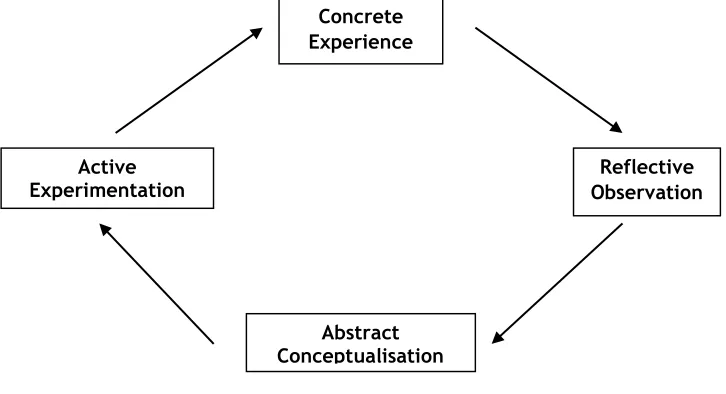
The reflective theory focused on Kolb’s (1984) model of experiential learning as follows:
Figure 1: Kolb’s model of learning
Concrete Experience
Reflective Observation
Abstract Conceptualisation Active
To aid understanding of this model, students were provided with examples that related directly to music skills development, rehearsal and performance such as:
Concrete Experience: the performance
Reflective Observation: self and peer evaluation in the workshop – identification of strengths and weaknesses
Abstract Conceptualisation: identification of methods to address weaknesses Active Experimentation: putting the above methods into practice during rehearsals
Students were encouraged to use the model to work on the fine detail of pieces and focus on musical passages that could last for less than one second, for example, for a drummer:
Concrete Experience: the performance
Reflective Observation: through self and peer evaluation, or by listening to a recording, a late entry into the chorus of the song after a drum fill at the end of the verse occurred regularly Abstract Conceptualisation: analyse the fill, discuss with drum tutor, find appropriate
technical exercise (sticking pattern) to practice
Active Experimentation: add sticking pattern to daily practice routine and apply to the drum fill
Many students did not appear to engage fully with the reflective process and tended to simply repeat the ‘concrete experience’ over and over again rather than working through the model. Even those that did engage with the process tended to move from ‘concrete experience’ to ‘active experimentation’ and back repeatedly missing two crucial stages of the cycle.
In addition to the issues outlined above, the following problems were encountered: - poor reflective writing
- low marks for the reflective journal assessment
- even those who did engage with Kolb’s model did not evaluate the reflective process (meta -reflection)
Method
Following a successful pilot in 2010/11 involving a level six collaborative project, a number of changes were be made to the delivery of the unit for level four students. These changes are outlined below and commenced in the academic year 2011/12. It should be noted that the ensemble skills of the level six students involved in the pilot did progress rapidly, however there was not a control sample so much of the success observed was anecdotal. (This group of students did win the annual, fiercely contested, competition to win a day’s recording at Abbey Road Studios).
Lecture time focusing on reflective learning was added to the unit. In addition to an introduction to
Kolb’s (1984) model, students were encouraged to use the resources available on the University Virtual
Learning Environment (VLE), particularly ‘Succeed@Solent>Writing assignments>Reflective thinking and writing’ (2012) and to study the work of Moon (2004). Time was also spent comparing and contrasting academic and reflective writing styles. Without getting too bogged down in reflective theory, students were also asked to evaluate the success of their progress and the effectiveness of reflective models used.
It was clear to the academics delivering the unit, that the replacement of practical music workshops by numerous lectures focusing on reflective theory, would not be popular with the students. For this reason much of the reflective content of the unit was introduced (by stealth) via the VLE. All BA Popular Music Performance students were using the VLE to access unit information; no paper hand-outs were provided thus good engagement with the VLE was evident.
Weekly online forums were introduced and the students were asked to discuss the songs prior to the workshops. Lecturers guided these online discussions; questions were provided which encouraged students to focus on important technical and performance aspects of each piece. In order to keep the
forums manageable, the year group was divided into groups based on the students’ first study
Figure 2: A small sample of a forum for drummers
From 2007, students had been encouraged to keep weekly reflective diaries. Many had done this, but even the most engaged students tended to focus on the song being studied, rather than looking back at previous weeks and using this information to inform their development. For this reason students were asked to use Microsoft Excel spreadsheets for their reflective diaries. These spreadsheets were based on a concept developed by Professor Carolyn Mair (2010) and were carefully designed to guide learners through the reflective process. These spreadsheets were attached to the forums and students were asked to download them, update them and upload them back to the forums each week. All the
Mair had used Excel spreadsheets with psychology students, so the column titles were adjusted for use with music students. The columns were headed as follows:
- My strengths - My weaknesses
- Methods I used to address my weaknesses - Success of these methods
- How will I apply these methods for other pieces? - What have I achieved technically?
- What have I achieved musically? - What have I learned?
- How do I feel?
- Comments regarding the forums
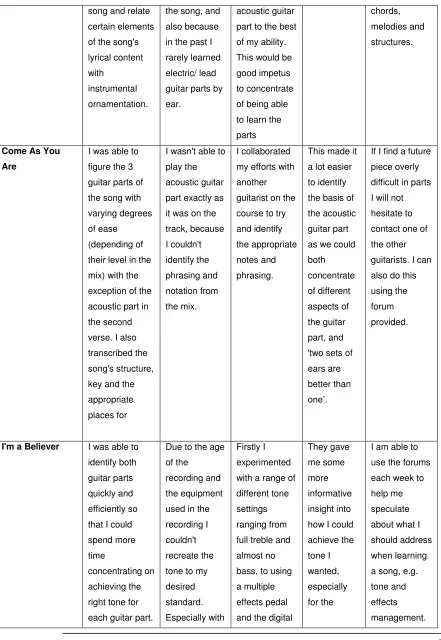
It can be clearly seen that working through the above titles for each song should automatically guide the students through reflective processes. In addition to this, part of Professor Mair’s concept was to format the spreadsheets so that the students could see their comments for as many weeks as possible on one page. This encouraged them to look at information from previous weeks in addition to focusing on the current song. It also enabled them to ascertain whether unhealthy learning patterns were being repeated and to evaluate the reflective process (meta-reflection). This simple idea addresses many of the issues associated with old-fashioned hand written reflective diaries. A transcription of part of a spreadsheet is shown below.
Song My
Strengths My Weaknesses Methods I used to address my weaknesses Success of these methods
How will I
apply these
methods for
other pieces?
Positively Fourth
Street
I was able to identify and play the acoustic guitar part of the song
competently throughout. I was also able to identify the structure of the
I had great difficulty identifying the electric guitar part of the song, this was partly due to the surprise and
unfamiliarity of
Unfortunately in the session I didn't attempt to figure out the electric guitar part fully and
concentrated mainly on playing the
song and relate certain elements of the song's lyrical content with
instrumental ornamentation.
the song, and also because in the past I rarely learned electric/ lead guitar parts by ear.
acoustic guitar part to the best of my ability. This would be good impetus to concentrate of being able to learn the parts
chords, melodies and structures.
Come As You
Are
I was able to figure the 3 guitar parts of the song with varying degrees of ease
(depending of their level in the mix) with the exception of the acoustic part in the second verse. I also transcribed the song's structure, key and the appropriate places for
I wasn't able to play the acoustic guitar part exactly as it was on the track, because I couldn't identify the phrasing and notation from the mix. I collaborated my efforts with another guitarist on the course to try and identify the appropriate notes and phrasing.
This made it a lot easier to identify the basis of the acoustic guitar part as we could both concentrate of different aspects of the guitar part, and 'two sets of ears are better than
one’.
If I find a future piece overly difficult in parts I will not hesitate to contact one of the other guitarists. I can also do this using the forum provided.
I'm a Believer I was able to identify both guitar parts quickly and efficiently so that I could spend more time
concentrating on achieving the right tone for each guitar part.
Due to the age of the
recording and the equipment used in the recording I couldn't recreate the tone to my desired standard. Especially with
Firstly I experimented with a range of different tone settings ranging from full treble and almost no bass, to using a multiple effects pedal and the digital
They gave me some more informative insight into how I could achieve the tone I wanted, especially for the
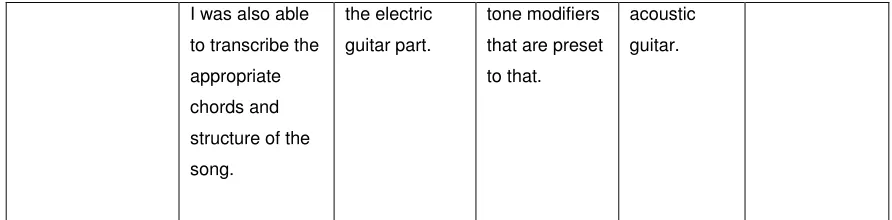
Figure 3: Transcription of part of a spreadsheet with student comments
At the end of the unit, students were required to format their spreadsheets carefully so that all text was visible, import them into Microsoft Word and submit them via Turnitin as a part of the reflective journal assessment. Apart from the addition of the spreadsheets, the brief for the reflective journal remained unchanged.
It should be noted at this point that, although level five students were not required to use forums or spreadsheets, additional lecture time focusing on reflective learning was also added to their unit. In the second year of this research project, many level five students (who had used spreadsheets at level four) chose voluntarily to use spreadsheets again to monitor their progress.
The success of the above methodology was (and is) assessed through the following:
engagement with the forums (although the completion of spreadsheets is compulsory, adding posts to the weekly forums is not)
a comparison of marks for the reflective journal assessment before and after this project commenced
interviews with students - this part of the project is in its infancy; so far four one to one interviews have taken place (see appendix for interview questions).
Findings
Engagement with the forums
Academic Year 2011/12 – 23 of 32 students contributed to the forums = 72% Academic Year 2012/13 – 18 of 32 students contributed to the forums = 56%
I was also able to transcribe the appropriate chords and structure of the song.
the electric guitar part.
tone modifiers that are preset to that.
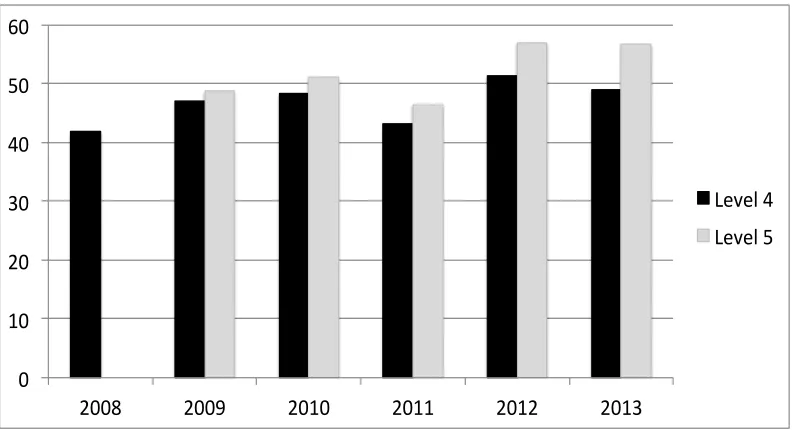
Average Marks for the reflective journal assessment
Older marks have been adjusted to take the new grade mark scale and late penalties into account.
Figure 4: Average marks for the reflective journal assessment (Project begins academic
year 2011/12)
Summary of Findings from Interviews (quotes anonymised due to ethical considerations)
students found the system useful –‘I could gain useful information from other students, if I missed a week, I could refer to the forums and spreadsheets to catch up. The system helped me to develop my lyric learning’.
students reflected on both positive and negative aspects of their performances. students did look back at what they had written in previous weeks.
students found the forums useful unless inaccurate comments were posted.
students felt that their skills improved –‘my listening skills have improved, I don’t just listen to the drum part; I listen to the other elements of the ensemble’.
students felt that the forums and spreadsheet helped them maintain focus.
Discussion of Findings
In the first year of the project (2011/12) engagement with the forums was above expectation, which was encouraging. Experience shows that at level 4, music students tend to focus on the more practical aspects of the course. In the second year of the project engagement dropped. There is no explanation
0
10
20
30
40
50
60
2008
2009
2010
2011
2012
2013
Level 4
for this as the content and delivery of the unit did not change. Anecdotal evidence from staff and students would tend to suggest that the 2011/12 level four cohort was more socially cohesive, but this would be impossible to prove without considerable additional research. Furthermore, the effect of social cohesiveness on student engagement is not considered within this piece of research.
An early finding showed that the average mark for the level four reflective journal assessment did rise after the project commenced (from 43.3% in 2010/11 to 51.4% in 2011/12). Initially this was thought to be a significant result, but once figures for all previous years were collated it was seen that for the year 2009/10 the average mark was 48.3%, so perhaps this rise is not as significant as originally thought.
Interestingly, although level five students were not asked to participate in online forums or to complete spreadsheets, the average mark for this group also increased. So perhaps the mark increases shown in the findings are not due to the introduction of forums and spreadsheets but simply a result of increased focus on reflective learning and writing at both levels.
Although the interview process has only recently commenced, initial findings are positive. The issue raised regarding inaccurate posts on the forums is usually dealt with within hours as lecturers receive email updates as soon as new posts are created so can monitor the forums closely.
Conclusions
The fact that engagement with the forums appears good is a particularly encouraging outcome as findings from the study involving psychology students that took place in 2010 at Solent University, showed that ‘few participants uploaded to the DB [database]’ (Mair, 2010). It is possible that music students might be more likely to upload comments to the VLE as it can be observed that they regularly work together in groups and frequently access music and communicate using the Internet.
Early evidence from interviews is positive, but it should be noted that, purely by coincidence, all four interviewees had engaged with the forums.
Future Development
To increase student engagement, the unit team are considering handing more responsibility for the content of the online forums to the students and asking them to include references to the forums in the reflective journal assessment.
Interview Questions
1. Was the system useful? If so can you describe how it helped improve your playing and performance?
2. How often did you use the spreadsheet?
3. What issues did you reflect upon: positive, negative, or both? 4. Was it helpful to look at what you had written in previous weeks? 5. Did you find the forums useful? If so, how did you use them? 6. Has your playing/performance improved? If so, how?
7. Do you think that your reflective writing has improved? 8. What did you like about the system?
9. What is the most important aspect of reflective practice for you?
Acknowledgements
Thanks to Professor Carolyn Mair for the concept
,
Sarah Hand for help setting up the forums and Domi Renault for myCourse (the University VLE) guidance.References
KOLB, D., 1984. Experiential Learning: Experience as the Source of Learning and Development.
MAIR, C., 2010. Reflection and Learning: Sharing Experience (REALISE) In: Solent Exchange 2010, Southampton, UK, September 2010. Southampton: Southampton Solent University
MOON, J., 2004. A handbook of reflective and experiential learning: theory and practice. Oxon: Routledge
SOUTHAMPTON SOLENT UNIVERSITY, 2012. Succeed@Solent>Writing Assignments>Reflective Thinking and Writing [online] [viewed September 2012]. Available from:
http://mycourse.solent.ac.uk/mod/book/view.php?id=2732
Contact
Patrick Ainsworth
Senior Lecturer in Music Performance School of Media Arts and Technology Tel: 023 8201 6503