Efficiency of Online vs. Offline Learning: A Comparison of Inputs and Outcomes
Shweta Singh
Assistant Professor of Marketing
CFO 404
School of Management
Texas Woman's University
P. O. Box 425738, Denton, Texas76204-5738
United States of America
David H. Rylander
Associate Professor of Marketing
School of Management
Texas Woman's University
P. O. Box 425738, Denton, Texas76204-5738
United States of America
Tina C. Mims
Adjunct Professor of Marketing
School of Management
Texas Woman's University
P. O. Box 425738, Denton, Texas76204-5738
United States of America
Abstract
As the trend toward online education intensifies, questions remain regarding the overall efficiency of online courses versus their in-class counterparts. The current paper seeks to estimate the efficiency of students who take online courses relative to the efficiency of students who are enrolled in offline courses. Efficiency outcomes are defined in terms of (1) quantitative scores achieved by the student at the end of the course, (2) the student’s viewpoint of how much they learned in the course and (3) the student’s level of satisfaction with the course.The authors use Data Envelopment Analysis (DEA) to estimate a model of student efficiency. Demographics, student experience and student preferences are examined as differentiating attributes. The sample is taken from a course offered both online and in a traditional classroom setting, with both formats being taught by the same instructor in a single semester.Implications include a better understanding of the strengths and weaknesses in efficiency of different course formats.
Keywords:
efficiency analysis, online learning, offline learning, student experienceIntroduction
Therefore, estimating the efficiency of students who take online courses relative to the efficiency of students who are enrolled in offline courses expands upon the current thinking in the literature.
Background
Scholars have laid ingots of evidence suggesting there is no difference in online versus offline student performance based on student demographic characteristics (Huh et al., 2010).In evaluating student performance based on student completion rates of materials, Olson (2002) found insufficient evidence to indicate that online versus offline delivery is a factor influencing a student‟s completion of his or her coursework.Others found lower student performance in online classes (e.g., Trawick, Lile and Howsen, 2010), while some even found higher learning in an online format (e.g., Detwiler, 2008). In a comparison of traditional and hybrid sections of Principles of Marketing, Priluck (2004) found no difference in performance, yet significant difference in student satisfaction.
As technology continues to braid its way into all teaching and learning methods, investigations reveal a consistent use of the term “performance.” Performance appears ubiquitous, unless otherwise stated by investigators, as “assessed at the end of the course” by the student‟s “final mark,” otherwise known as the course grade (Bliuc et.al., 2010; Olson, 2002). Other means of defining student performance include using student test scores or other graded items (e.g. discussion boards, homework) as a variable (McFarland andHamilton, 2005; Rivera and Rice, 2002). The term “performance”, unless otherwise indicated by the investigator, tends to indicate a grade achieved by the student irrespective of whether student performance is a course grade or an item grade.
So far as studies predict student performance, indications are that the format of learning, i.e. offline or online, is not a sufficient treatment to influence significant difference in a performance outcome (McFarland andHamilton, 2005; Rivera and Rice, 2002; Olson, 2002). In two studies reviewed, student learning was inferred by using the student grades during the end of the course (BiktimirovandKassen 2008, Brown andLiedholm 2002). Consistent results in the literature expose the possibility that more than the format of learning is a factor in identifying influencers to student performance.
While educators grapple with the transformation of formats and technical solutions for delivering coursework, so too are investigators engaged in a haze of indicators attempting to discover tactual aid for educators to use. Investigators have explored everything from a student‟s journal of activity (i.e hits, access, attendance) (BiktimirovandKlassen, 2008; Chen andPeng, 2008;CappelandHayen, 2004) to a student‟s age, race, GPA, homework, and test scores (Lundgren andNantz, 2002;ChuenandKan, 2002) to capture signposts on how an educator might enhance student learning in either online or offline forums. Distinctive in these research efforts are a few investigations that branch out to consider student learning styles, study patterns, and student learning approaches (Bliuc et.al., 2009; Lu, Yu and Liu., 2003). Taking a psychometric approach helps expand issues for future investigators to consider. Despite an increasing amount of research on technology and teaching, questions remain unanswered with regard to the overall efficiency of online courses versus their in-class counterparts.
When thinking about performance in terms of the role of the student as a producer, the student becomes a decision making unit (DMU) (Banker et.al., 1984). Our idea of categorizing students as DMUs yields factors to consider as investigators. One such factor that is commonly used in determining the performance of a DMU is an efficiency rating. This study seeks to estimate the efficiency of students who take online courses relative to the efficiency of students who are enrolled in offline courses.
Also comparable to DMUs, behaving as management decision makers of their own performance, students have certain “inputs” (e.g., time spent studying) that regulate student performance achieved. Also analogous to DMUs, students can have their performance efficiency determined by using ascertained inputs as required by the DEA model. Therefore, using a model such as the DEA model discussed here begins a new conversation for understanding the performance of online versus offline student learning environments.
Methodology
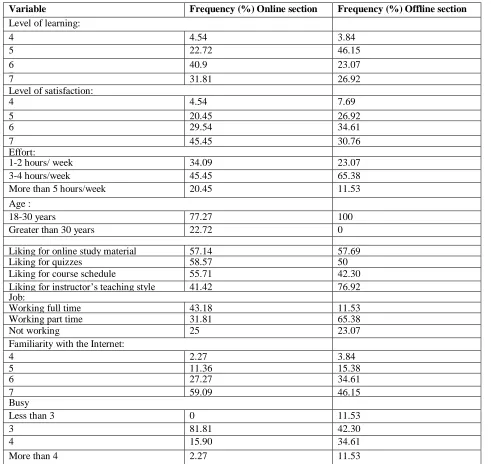
Data were collected from two sections of a Consumer Behavior class: one 100% online and the other 100% offline. Both sections were taught by the same instructor in the same time period. There were 26 students enrolled in the offline section and 44 students enrolled in the online section. A survey was administered at the end of the term to collect information on the students‟ level of satisfaction, perceived level of learning, and other differentiating characteristics. Please refer to Table 1 for the comparative frequency estimates of the variables used in this paper to predict student efficiency. Student efficiency scores were calculated using the DEA output-oriented VRS (variable returns to scale) model. Data Envelopment Analysis (DEA) is a nonparametric approach widely used in the area of operations research to calculate production efficiencies. It is an extreme point methodology based on the premise that firms use certain inputs to produce certain outputs and the „best‟ or most „efficient‟ is the one that produces the maximum output for a given level of input or uses the least amount of input to produce a given level of output.
Results
The input used in this paper is the student‟s effort level, measured by the number of hours in a week the students spend studying for the course. As compared tonearly 46% of the students in the online section, around 65% of the students enrolled in the offline section said they put in between 3to 4 hours studying for the course each week. Around 34% of online students and 23% of offline students said they put in between 1 to 2 hours of study whilenearly21% of the online students and around 12 % of offline studentsreported putting in 5 hours or more. The three measures of output were(1) the absolute scores the students received at the end of the course, (2) their self reported levels of learning and (3) self-reported satisfaction. While the average score for the online class was 78, the average score for the offline course was 70. The students were asked to rate their levels of satisfaction and learning using a 7 point likert scale. The average satisfaction score for the online class was 6.15 while the average satisfaction score for the offline class was 5.90. The average learning score for the online class was 6.00 while the average learning score for the offline class was 5.73.
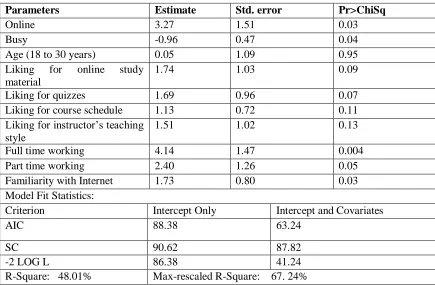
We used the EMS software to estimate our DEA model of efficiency. The output oriented model identifies the most efficient students as those who produce the highest possible outputs with given amounts of inputs. The variable return to scale specification assumes that the amount of outputs produced increase more or less proportionately to the increase in the input. While 38% of the offline students were classified as being efficient, 56% of the online students were deemed efficient. In order to better identify the discriminating variables that distinguish the efficient students from the inefficient ones, we used a Logit model. The estimates from the Logit model are provided in Table 2. We used a dummy variable „online‟ to indicate whether the student was enrolled in the online or the offline section of the course. Our results indicate that online students tend to be more efficient than offline students. Past studies have found no concrete evidence of the superiority of one method of instruction over the other. Consistent with past studies that have looked at the factors affecting student performance and satisfaction (McFarland and Hamilton, 2005), we find that efficiency decreases as students become busier. The variable „busy‟ is measured by the number of courses taken in a semester by the students. All course materials were made available online on the course webpage for both the online and the offline sections. All quizzes and exams were conducted online for both sections of the course.
Discussion
Comparison of online versus offline learning is no doubt of substantial interest to educators and the focus of numerous studies. As preference for online learning increases, mostly due to the convenience and flexibility it offers students, universities find themselves increasing the number of online format courses to meet the growing demand. However, the question remains whether the delivery format of a course, i.e. online versus offline, impacts student performance, their satisfaction and learning. Many a priori studies report mixed results. Our study takes a novel approach by opening a discussion for future investigators to consider measures that impact student efficiency. By using the DEA approach to estimating student efficiency in this investigation, we have found sufficient evidence to indicate that students taking the online course format are more efficient than their offline counterparts. The results indicate a difference between online versus offline formats when considering the number of hours students spend studying as an indicator of student performance. Student performance includes the student‟s final grade and self-reported level of learning and satisfaction from their course experience. Additionally, the DEA approach reveals sufficient evidence to indicate the course load negatively impacts the efficiency of students. Finally, students that work full or part-time, have familiarity with the Internet, a have preference for online course material all positively impacts a student‟s efficiency using the DEA approach.
Limitations of this study should be noted. The sample is not necessarily representative of other courses, other teaching approaches or other student populations. Additional research is needed with a variety of samples. However, the approach presented here, where the course content, timing, testing method and instructor are all controlled, can be used as a model. The sample courses also had differences in the student demographics. The online class had more older students who were more likely to have jobs, while the offline students carried heavier course loads. These differences could complicate interpretation of the results. As educators continue to struggle to meet intermingled needs of technology, teaching and learning through courses designed to fit a disparate population of students, investigators may benefit from operational models that liken the student to the producer of his or her own performance. This study generates a discussion for future investigators to consider additional indicators or even differing operational measures. The DEA approach helps explain student performance in offline versus online by relating the student‟s role to a DMU. Without the DEA approach, the investigation may not have yielded significant findings. Using the DEA approach, sufficient evidence exists to indicate characteristics of significance between offline versus online formats. This study and approach can help business schools make better decisions regarding course format and can demonstrate the value and potential of online courses.
REFERENCES
Banker, R.D. (1980).Studies in cost allocation and efficiency evaluation. Unpublished doctoral thesis, Harvard University, Graduate School of Business Administration.
Banker, R.D., Charnes, A., and Cooper, W.W. (1984). Some models for estimating technical and scale inefficiencies in data
envelopment analysis.Management Science, 30 (9, Sept.).
Banker, R.D. and Morey, R.D. (1986). Efficiency analysis for exogenously fixed inputs and outputs.Operations Research, 34
(4, July-Aug.).
Biktimirov, E.N. and Klassen, K.J. (2008). Relationship between use of online support materials and student performance in
an introductory finance course. Journal of Education for Business, 83 (3, Jan.-Feb.).
Bliuc, A., Ellis, R., Goodyear, P., and Piggott, L. (2010). Learning through face-to-face and online discussions: Associations
between student‟s conceptions, approaches and academic performance in political science. British Journal of
Education Technology, 41 (3).
Brown, B.W. and Liedholm, C.E. (2002). Can web courses replace the classroom in principles of microeconomics? Teaching
Microeconomics Principles, 92 (2).
Cappel, J.J. and Hayen, R.L.(2004). Evaluationing e-learning: A case study. Journal of Computer Information Systems,
Summer.
Chen, Y.F. and Peng, S.S. (2008). University students‟ Internet use and its relationships with academic performance,
interpersonal relationships, psychosocial adjustment, and self-evaluation. CyberPsychology& Behavior, 11 (4,
Aug.), 467-469.
Cheung, L.L.W., and Kan, A.C.N. (2002). Evaluation of factors related to student performance in a distance-learning
business communication course. Journal of Education for Business, 77 (5, May-June).
Detwiler, J.E. (2008). Comparing student performance in online and blended sections of a GIS programming class.
Huh, S., Jin, J.J., Lee, K.J., andYoo, S. (2010).Differential effects of student characteristics on performance: Online vis-à-vis
offline accounting courses.Academy of Education Leadership Journal, 4.
Lu, J., Yu, C.S., and Liu, C.(2003). Learning style, learning patterns, and learning performance in a WebCT-based MIS
course. Information & Management, 40(6),497-507.
Lundgren, T.D. and Nantz, K.S.(2002). Student attitudes toward Internet courses: A longitudinal study, Journal of Computer
Information Systems, Summer.
McFarland, D. and Hamilton, D. (2005-2006). Factors affecting student performance and satisfaction: Online versus
traditional course delivery. Journal of Computer Information Systems, (Winter), 25-32.
Olson, D. A (2002).Comparison of online and lecture methods for delivering the CS 1 course.Journal of Computer Sciences
in Colleges, 18 (2, Dec).
Priluck, R. (2004). Web-assisted courses for business education: An examination of two sections of Principles of Marketing.
Journal of Marketing Education, 26 (2), 161-173.
Rivera, J.C. and Rice, M.L.(2002). A comparison of student outcomes and satisfaction between traditional and web based
course offerings, Online Journal of Distance Learning Administration, 3 (Fall).
Trawick, M.W., Lile, S.E. and Howsen, R.M. (2010). Predicting performance for online students: Is it better to be home alone? Journal of Applied Economics and Policy, 29 (Spring), 34-46.
Table 1: Frequency Table of Relevant Variables
Variable Frequency (%) Online section
ssec Online
Frequency (%) Offline section Level of learning:
4 4.54 3.84
5 22.72 46.15
6 7
40.9 23.07
7 31.81 26.92
Level of satisfaction:
4 4.54 7.69
5 20.45 26.92
6 29.54 34.61
7 45.45 30.76
Effort:
1-2 hours/ week 34.09 23.07
3-4 hours/week 45.45 65.38
More than 5 hours/week 20.45 11.53
Age :
18-30 years 77.27 100
Greater than 30 years 22.72 0
Liking for online study material 57.14 57.69
Liking for quizzes 58.57 50
Liking for course schedule 55.71 42.30
Liking for instructor‟s teaching style 41.42 76.92
Job:
Working full time 43.18 11.53
Working part time 31.81 65.38
Not working 25 23.07
Familiarity with the Internet:
4 2.27 3.84
5 11.36 15.38
6 27.27 34.61
7 59.09 46.15
Busy
Less than 3 0 11.53
3 81.81 42.30
4 15.90 34.61
Table 2: Logit Output for identifying the most ‘efficient’ students
Parameters Estimate Std. error Pr>ChiSq
Online 3.27 1.51 0.03
Busy -0.96 0.47 0.04
Age (18 to 30 years) 0.05 1.09 0.95
Liking for online study material
1.74 1.03 0.09
Liking for quizzes 1.69 0.96 0.07
Liking for course schedule 1.13 0.72 0.11
Liking for instructor‟s teaching style
1.51 1.02 0.13
Full time working 4.14 1.47 0.004
Part time working 2.40 1.26 0.05
Familiarity with Internet 1.73 0.80 0.03
Model Fit Statistics:
Criterion Intercept Only Intercept and Covariates
AIC 88.38 63.24
SC 90.62 87.82
-2 LOG L 86.38 41.24