Volume 2, Issue 3, March 2013
Page 554
A
BSTRACTThe paper considers a stochastic model for a Base Transceiver System considering four types of failures viz. hardware, software, software based hardware, catastrophic failures and congestion of calls. Various faults in the system are categorized as minor or major fault(s). It is assumed that the occurrence of a minor fault leads to partial failure whereas a major fault and catastrophic failure leads to complete failure of the system. On failure, the technicians first inspect whether there is hardware or software or software based hardware failure then recovery of the relevant component is done. Using Markov processes and regenerative point technique various measures of system performance are obtained. On the basis of these measures the profit analysis of the system is carried out. Various conclusions about reliability and profit of the system are made on the basis of the graphical studies
Keywords: Base Transceiver System (BTS), catastrophic failure, congestion of calls, reliability, profit function, Markov process, regenerative point technique.
1.
I
NTRODUCTIONA base transceiver system (BTS) consists of both hardware and software components that facilitate wireless communication between user equipment and a network. User equipments are devices like mobile phones, WLL phones, computers with Wi-Fi facility etc and the network can be that of any wireless communication technologies like GSM, CDMA, Wi-Fi, WiMAX etc. When a BTS encounter failures either due to some hardware failure which include voltage standing wave ratio(VSWR) fail, AC failure, optical fiber cut, fan tray damage, double duplexer timing & management unit(DTMU), double duplexer transmitting & receiving unit(DTRU), double duplexer amplifier unit(DATU), double duplexer power unit(DDPU) fail etc. or some software failure which include faults in DTRU, DDPU, DATU, DTMU, transport device etc. or software based hardware failure like fault in DDPU, DTRU, DATU, DTMU, Transport device etc. In a BTS there may be catastrophic failure like power failure. In case of occurrence of major fault, there is complete failure of system whereas in case of occurrence of minor fault system performance and capacity may decrease. Moreover when there is saturation or congestion of calls in BTS then the services for some subscribers of network is reduced or calls are unattended. As BTS supports the air interface connection with mobiles so the reliability and availability plays a very significant role in mobile systems and hence need to be analyzed.
In the field of reliability modeling several researchers Gupta and Kumar (1983), Rizwan and Taneja (2000), Kumar et al (2010), Kumar and Bhatia (2011) analyzed a large number of systems considering various concepts such as different failure modes, maintenance, repairs, replacements, inspections, operational stages etc. For hardware-software systems, Teng et al (2006), Tumar and Smidts (2011), Welke et al (1995) discussed various types of hardware and software failures. Recently Kumar and Kapoor (2012) carried out the cost-benefit analysis of reliability model for a Base Transceiver System considering hardware/ software faults and congestion of calls. However none of the researcher has carried out the analysis of BTS considering the software based hardware failure and catastrophic failure.
Keeping this in view, the present paper analyses a one unit BTS system having hardware, software, software based hardware and catastrophic failures including congestion of calls. Various faults in the system are categorized as minor faults and major faults. Various minor faults includes VSWR fail, DTRU fail, DDPU fail, fan tray damage etc whereas
PROFIT EVALUATION OF A STOCHASTIC
MODEL ON BASE TRANSCEIVER SYSTEM
CONSIDERING SOFTWARE BASED
HARDWARE FAILURES AND CONGESTION
OF CALLS
Rajeev Kumar1 and Sunny Kapoor2
1
Professor, Dep’t of Mathematics, MD University Rohtak 2
Volume 2, Issue 3, March 2013
Page 555
major faults includes AC failure, transport device fail, optical fiber cut, DTMU fail etc. It is assumed that the occurrence of a minor fault leads to partial failure whereas a major fault and catastrophic failure leads to complete failure of the system. On failure, the technicians first inspect whether there is hardware or software or software based hardware failure then recovery of the relevant component is done. For analysis purpose the data used here is collected from Vodafone Space Tel Ltd, Bihar and various Failure/repair/replacement rates and probabilities computed from the data as given below:
Rate of occurrence of major faults =.0017
Rate of occurrence of minor faults =.0032
Rate of occurrence of software based major hardware faults =.000358
Rate of occurrence of software based minor hardware faults =.000408
Probability that the major hardware fault occurs in the system =.71
Probability that the major software fault occurs in the system =.17
Probability that the catastrophic fault occurs in the system =.12
Probability that the minor hardware fault occurs in the system =.75
Probability that the minor software fault occurs in the system =.25
Repair rate on occurrence of major hardware faults =.54
Repair rate on occurrence of major software faults =.57
Repair rate on occurrence of minor hardware faults =.98
Repair rate on occurrence of minor software faults =.83
Replacement rate on occurrence of software based major hardware faults =.84
Replacement rate on occurrence of software based minor hardware faults =.81
Replacement rate on occurrence of catastrophic faults =.60
Using Markov processes and regenerative point technique various measures of system performance are obtained. On the basis of these measures and estimated parameters the profit analysis of the system is carried out. Various conclusions about reliability and profit of the system are made on the basis of the graphical studies.
NOTATIONS
λ1/ λ2 Rate of occurrence of major/minor faults
λ3/ λ4 Rate of occurrence of software based major/minor hardware faults
Rate of congestion of callsα Rate with which system restored after congestion
a1/ a2 Probability that the major/minor hardware fault occurs in the system
b1/ b2 Pr Probability that the major/minor software fault occurs in the system
c1 Probability that the catastrophic fault occurs in the system
qij(t)/ Qij(t) Probability of transitions from state ‘i’ to state ‘j’
1 2
h h
g (t) / g (t)
P.d.f. of repair time of major/minor hardware fault1 2
s s
g (t) / g (t)
P. P.d.f. of repair time of major/minor software fault3 4
h h
h (t) / h (t)
P.d.f. of replacement time of software based major/minor hardware faultf
c
h (t)
P.d.f. of replacement time of catastrophic faulti1(t)/ i2(t) P.d.f. of inspection time of major/minor fault
I1(t)/ I2(t) C.d.f. of inspection time of major/minor fault
1 2
h h
G (t) / G (t)
C.d.f. of repair time of major/minor hardware fault1 2
s s
G (t) / G (t)
C.d.f. of repair time of major/minor software fault3 4
h h
Volume 2, Issue 3, March 2013
Page 556
fc
H (t)
C P.d.f. of replacement time of catastrophic faultO Oc
Operative state Congestion state
Oi/ Fi Down state/Failed state under inspection
r r
h s
O / O
Down state due to hardware/software fault under repairrp
sh
O
/ rpsh
F
Down state/Failed state due to software based hardware fault under replacementr r
h s
F / F
Failed state due to hardware/software fault under repairrp
cf
F
Failed state due to catastrophic fault under replacementOTHERASSUMPTIONS
1. A minor or major fault may be in a hardware or software components. 2.The system automatically restores from the congestion of calls. 3.The technicians immediately handle all types of faults at BTS site.
4.Rate of occurrence of fault, congestion and system restoration are constant whereas repair and inspection time distributions are arbitrary.
5.After each repair/replacement the system is as good as new. 6.Switching is perfect and instantaneous.
7.All random variables are mutually independent.
THEMODEL
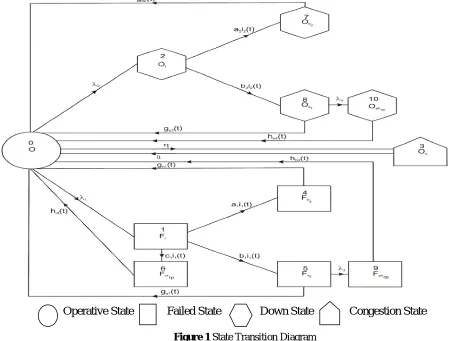
A diagram given in figure 1 shows various states of transition of the system. The description about the notations used and the states of the system are given in the Appendix. The epochs of entry in to state 0, 1,2,3,4,5,6,7,8,9,10 are regenerative point, i.e. all the states are regenerative states.
Operative State Failed State Down State Congestion State
Volume 2, Issue 3, March 2013
Page 557
2.
TRANSITION
PROBABILITIES
AND
MEAN
SOJOURN
TIMES
Let Qij(t) be the cumulative distribution function (c.d.f.) of first passage time from a regenerative state i to a
regenerative state j or to a failed state j without visiting any other regenerative state in (0, t] then various transition probabilities are given by the following equations:
1 2
( ) t 0 1 1
q ( t ) e
1 2
( ) t 0 2 2
q ( t ) e
1 2
( ) t 0 3
q ( t ) e
1 4 1 1
q ( t ) a i ( t ) q1 5( t ) b i ( t )1 1 q1 6( t ) c i ( t )1 1
2 7 2 2 q ( t ) a i ( t )
q2 8( t ) b i ( t )2 2
( t ) 30
q (t)
e
1
40 h
q (t)
g (t)
3 1 t
50 s
q (t)e g (t) 3 1 t s 59 3
q (t) e G (t)
f
60 c
q (t)
h (t)
q (t)
70
g (t)
h24 2 t
80 s
q (t)e g (t)
4 2 t
s
810 4
q (t) e G (t)
q (t)
90
h (t)
h3q
100(t)
h (t)
h4The non-zero elements * ij ij
s 0 p lim q (s)
1 0 1
1 2
p
2 0 2
1 2
p
0 3 1 2
p
*
14 1 1
p a i (0)
*
15 1 1
p b i (0)
* 16 1 1
p c i (0)
*
27 2 2
p a i (0)
*
28 2 2
p b i (0)
p30 1
1 * 4 0 h p g (0)
1 * 50 s 3 p g ( )
1
*
5 9 s 3
p 1 g ( )
f * 60 c p h (0)
2 * 7 0 h p g (0)
2 * 8 0 s 4 p g ( )
2 * 81 0 s 4 p 1 g ( )
3
* 90 h p h (0)
4
* 1 00 h p h (0)
By these transition probabilities, it can be verified that
p01+p02 +p03= p14+p15+ p16 = p27+p28= p50+p59 =p80+p810= 1
p30 = p40= p60= p70= p90= p100=1
The mean sojourn time (µi) in the regenerative state i is defined as the time of stay in that state before transition to any
other state, then
0 1 2 1 *' 1 i (0)1
*'
2 i (0)2
3 1 ' 1 * 4 gh (0)
1 *
5 s 3
3 1
(1 g ( ))
' f * 6 hc (0)
'
2 * 7 gh (0)
2 *
8 s 4
4 1
(1 g ( ))
' 3 * 9 hh (0)
'
4 * 1 0 hh (0)
The unconditional mean time taken by the system to transit for any regenerative state j, when it is counted from epoch of entrance into that state i, is mathematically stated as
ij ij
0
m
tq ( t)dtThus, m01 + m02 + m03 = 0 m14 + m15 +m16= 1 m27 + m28 = 2 m30 = 3
m40 = 4 m50 +m59= 5 m60 = 6 m70 = 7
m80 +m810= 8 m90 = 9 m100 = 10
MEANTIMETOSYSTEMFAILURE
To determine the MTSF of the system, the failed states of the system are taken as absorbing states. By probabilistic arguments, The following recursive relations for i(t), c.d.f of the first passage time from regenerative state i to failed
state, are obtained:
Volume 2, Issue 3, March 2013
Page 558
2(t) = Q27(t) 7(t) + Q28(t) 8(t)
3(t) = Q30(t) 0(t)
7(t) = Q70(t) 0(t)
8(t) = Q80 (t) 0(t) + Q810(t) 10(t)
10(t) = Q100(t) 0(t)
Using Laplace Stieltjes transforms, the above recursive relations are solved in terms of ** 0 (s)
The mean time to system failure (MTSF) when the system starts from the state 0,is
** 0 0
s 0
1 (s) N
T lim ,
s D
where
N = µ0 + p02 µ2 + p03µ3 + p02 (p27 µ7 + p28 µ8 + p28 p810 µ10)
D= 1 - p02- p03
OTHERMEASURESOFSYSTEMPERFORMANCE
Using probabilistic arguments for regenerative processes, various recursive relations are obtained and are solved to derive important measures of the system performance. Those are as given below:
Expected up time of the system (A0) = N1/ D1 Expected down time of the system (DT0) = N2/ D1 Expected congestion time of the system (CT0) = N3/ D1 Busy period of repair man (Inspection time only) (Bi) = N4/ D1 Busy period of repair man (Repair time only) ( BR0) = N5/ D1 Busy period of repair man (Replacement time only) (BRP0) = N6/ D1
where
N1= μ0 N2 = p02µ2 + p02 p27µ7 + p02 p28µ8 + p02 p28 p810µ10
N3= p03µ3 N4 = p01µ1 + p02µ2
N5 = p01p14µ4 + p01p15µ5 + p02p27µ7 + p02p28µ8
N6 = p01p15p59µ5 + p02p28p810µ10 + p01p16µ6
D1=µ0 + p01µ1+ p02µ2 + p03µ3 + p01p14µ4 + p01p15µ5+ p01 p16 µ6 + p02 p27µ7 + p02 p28 µ8
+ p01 p15 p59 µ9 + p02 p28 p810 µ10
3.
PROFIT
ANALYSIS
The expected profit incurred of the system is given by
P = C0 A0 C1DT0 C2 CT0 C3 BI0C4BR0-C5 BRP0-C
where
C0 = revenue per unit uptime of the system
C1= cost per unit downtime of the system
C2 = cost per unit congestion time of the system
C3 = cost per unit time of inspection
C4 = cost per unit time of repair
C5 = cost per unit time of replacement
C = cost of installation of the system
4.
GRAPHICAL
ANALYSIS
Volume 2, Issue 3, March 2013
Page 559
h11 1
t
h h
g ( t ) e ; s 1 1 1 t s s
g ( t ) e ;
h 2
2 2
t
h h
g ( t ) e ; s2 2 2 t s s
g ( t ) e ;
1 1
t 1
i ( t ) e ; ; 3 3 h 3 t
h h
h (t ) e ;
h 4
4 4
t
h h
h ( t ) e ;
c f
f f
t
c c
h ( t ) e
Various graphs for measures of system performances viz. MTSF and profit are plotted for different values of rates of occurrence of faults (λ1, λ2, λ3, λ4),probabilities of occurrence of hardware/software/catastrophic faults (a1, b1, a2, b2, c1),
inspection rates (1,2), hardware/software repair rate (
1 h , 2 h , 1 s , 2 s
),replacement rates (
3 h , 4 h , f c ),calls
congestion and system restoration rates (η , α).
Fig. 2 gives the graph between MTSF (T0) and rate of occurrence of major faults (λ1) for different values of rate of
occurrence of software based minor hardware faults (λ4). The graph reveals that MTSF decreases with increase in the
value of the rate of occurrence of major faults. Further it can be observed that MTSF decreases with the increase in the values of rate of occurrence of software based minor hardware faults.
Figure. 2 Fig. 2
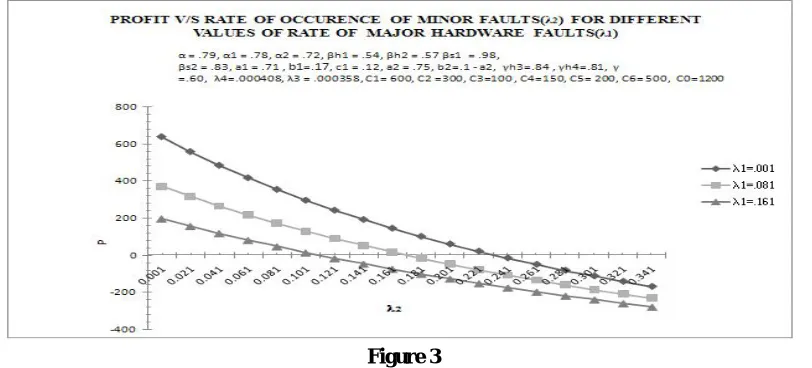
The graph in figure 3 shows the pattern of profit with respect to the rates of occurrence of minor faults (λ2) for different
values of rate of occurrence of major faults (λ1). The curve in the graph indicates that the profit of the system decreases
with the increase in the values of the rates of occurrence of minor as well as major faults. Further from the graph it may
also be noticed that for λ1= 0.001 the profit is > or = or < 0 according as λ2 is < or = or > 0.2326. Hence the system is
profitable to the company whenever λ2≤ 0.2326. Similarly, for λ1= 0.081 and λ1 = 0.161, the profit is > or = or < 0
according as λ2 is < or = or > 0.1708 and 0.1091, respectively. Hence in these cases the system is profitable to the
company whenever λ2≤ 0.1708 and 0.1091 respectively.
Figure 3
The graph in figure 4 shows the pattern of profit with respect to the rates of occurrence of major faults (λ1) for different
values of rate of occurrence of software based major hardware faults (λ3). The curve in the graph indicates that the
profit of the system decreases with the increase in the values of the rates of occurrence of major as well as software
based major hardware faults. Further from the graph it may also be noticed that for λ3 = 0.0001 the profit is > or = or <
0 according as λ1 is < or = or > 0.323. Hence the system is profitable to the company whenever λ1≤ 0.323. Similarly,
for λ3= 0.0031 and λ3= 0.0061, the profit is > or = or < 0 according as λ1 is < or = or > 0.185 and 0.131, respectively.
Hence in these cases the system is profitable to the company whenever λ1≤ 0.185 and 0.131 respectively.
2
2 2
t
Volume 2, Issue 3, March 2013
Page 560
Fig. 4
Figure 4
The graph in figure 5 shows the pattern of profit with respect to the rates of occurrence of minor faults (λ2) for
different values of rate of occurrence of software based minor hardware faults (λ4). The curve in the graph indicates that
the profit of the system decreases with the increase in the values of the rates of occurrence of minor as well as software
based minor hardware faults. Further from the graph it may also be noticed that for λ4 = 0.0001 the profit is > or = or <
0 according as λ2is < or = or > 0.220. Hence the system is profitable to the company whenever λ2≤ 0.220. Similarly,
for λ4= 0.0019 and λ4= 0.0037, the profit is > or = or < 0 according as λ2 is < or = or > 0.114 and 0.078, respectively.
Hence in these cases the system is profitable to the company whenever λ2≤ 0.114 and 0.078 respectively.
Figure. 5
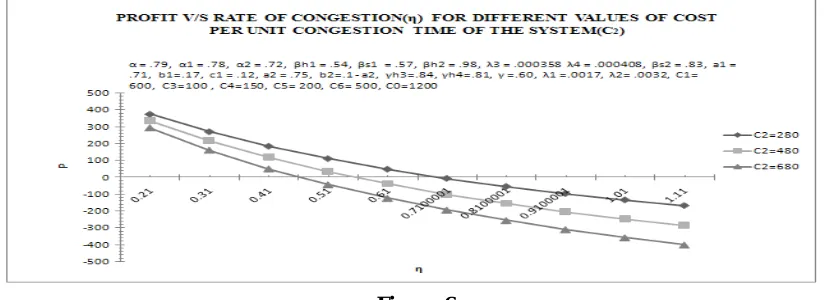
The graph in figure 6 shows the pattern of profit with respect to the rates of occurrence of congestion of calls (η) for
different values of cost per unit congestion time of the system (C2). The curve in the graph indicates that the profit of
the system decreases with the increase in the values of the rates of occurrence of congestion of calls as well as with cost per unit congestion time of the system. Further from the graph it may also be noticed that for C2= 280 the profit is > or
= or < 0 according as η is < or = or > 0.69. Hence the system is profitable to the company whenever η≤ 0.69. Similarly,
for C2 = 480 and C2= 680, the profit is > or = or < 0 according as η is < or = or > .56 and 0.46, respectively. Hence in
these cases the system is profitable to the company whenever η≤ 0.56 and 0.46 respectively.
Volume 2, Issue 3, March 2013
Page 561
Fig. 6
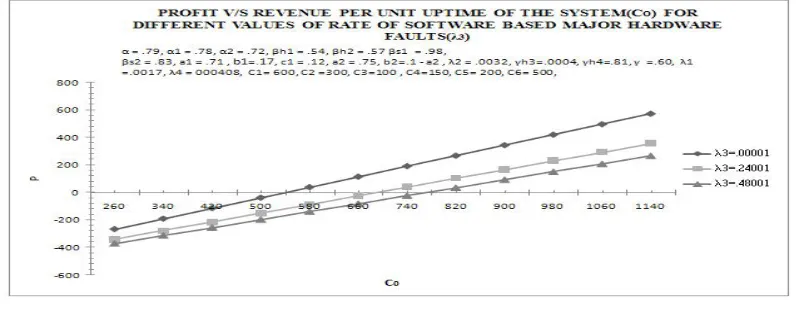
The curves in the figure7 shows the behavior of the profit with respect to the revenue per unit up time (C0) of the
system for the different values of rate of software based major hardware faults (λ3). It is evident from the graph that
profit increases with the increase in the values of revenue per unit up time of the system for a fixed value of the rate of occurrence of software based major hardware faults. From the fig. 7 it may also be observed that for λ3 = 0.00001, the
profit is > or = or < 0 according as C0 is > or = or < Rs.538.67. Hence the system is profitable to the company whenever
C0≥ Rs.538.67.Similarly, for λ3 = 0.24001 and λ3 = 0.48001 the profit is > or = or < 0 according as C0 is > or = or <
Rs.688.42 and Rs.769.71 respectively. Thus, in these cases, the system is profitable to the company whenever C0≥ Rs.
688.42 and Rs. 769.71 respectively.
Figure 7
5.
CONCLUSION
AND
DISCUSSION
From the graphs it is concluded that the mean time to system failure of the BTS deceases with the increase in the values of the rates of occurrence of major as well minor hardware, software and software based hardware faults. Further it may also be observed that profit of the system decreases with increase in the rate of occurrence of major and minor faults. It also decreases with increase in the rate of occurrence of software based hardware faults.
The profit of the system also decreases with increase in congestion rate and cost per unit congestion time of the system but increases with the increase in the revenue per unit uptime of the system. Various cutoff points for revenue per unit uptime, rate of occurrence of major and minor faults can be obtained. Also for fixed values of cost per unit congestion time of the system, cutoff points for rate of occurrence of congestion can be obtained.
REFERENCES
[1] Gopalan, M.N. and Bhanu, K.S. (1995) “Cost analysis of two-unit repairable system subject to online preventive maintenance and/or repair” Microelectron Reliability, 35(2), 251-258.
[2] Gupta, M.L. and Kumar, A. (1983) “On profit consideration of a maintenance system with minor repair”, Microelectron Reliability, 23,437-439.
[3] Kumar, R. and Bhatia, P. (2011) “Reliability and cost analysis of one unit centrifuge system single repairman and inspection”, Pure and Applied Mathematika Sciences, 74 (1-2), 113-121.
[4] Kumar, R., Kapoor, S.(2012) “Cost-benefit analysis of reliability model for a base transceiver system considering hardware/ software faults and congestion of calls”, International Journal of Advances in Science and Technology, Special Issue, 13-23.
[5] Kumar, R., Mor, S.S. and Sharma, M.K.(2010) “Reliability and cost benefit analysis of a three stage operational warranted sophisticated system with various minor and major faults”, Pure and Applied Mathematika Sciences, 72,29-38.
[6] Murari, K. and Goyal, V. (1983) “Reliability system with two types of repair facilities”, Microelectron Reliability, 23(6), 1015-1025.
[7] Rizwan, S.M. and Taneja, G.(2000) “Profit analysis of system with perfect repair at partial failure or complete failure”, Pure Applied Mathematika Sciences,LII(1-2),7-14.
[8] Teng, X., Pham, H. and Jeske, D.R. (2006) “Reliability modeling of hardware and software interactions, and its applications”, IEEE Transactions on Reliability, Vol. 55, No. 4, 571-577.
Volume 2, Issue 3, March 2013
Page 562
[10] Tuteja, R.K., Arora, R.T. and Taneja, G. (1991) “Analysis of two-unit system with partial failures and three types of repair” Reliability Engineering and System Safety, 33, 199-214.
[11] Welke, S.R., Johnson, B.W. and Aylor, J.H.(1995) “Reliability modeling of hardware/software systems”, IEEE Trans of Reliability, Vol 44, No.3,413-418.
AUTHORS PROFILE
Dr Rajeev Kumar is currently working as Professor in the Department of Mathematics, M.D. University, Rohtak. He has a teaching experience of about 24 years at various institutions like Punjab University, Chandigarh and M.D. University, Rohtak for wide range of UG/PG level courses. He has a research experience of about 24 years in the areas of ‘Reliability Engineering, Operations Research and Statistical Estimation’. He has done his M.Sc. and Ph.D. from M.D. University Rohtak, M.Phil from C.C.S. University, Meerut and PGDCA, from IGNOU, New Delhi. He is a life member of various academic/research societies/bodies. He has participated in around 30 National/ International symposia/conferences.
Sunny Kapoor received her M.Sc. in Mathematics (Gold Medal) from MD University Rohtak in 2004 and M.Phil. in Applied Mathematics from Kurukshetra University, Kurkshetra in 2007.Currently she is doing research in the area of Reliability Engineering.