ISSN: 2231-5373
http://www.ijmttjournal.org
Page 366
Vertex Prime Labeling of Path Related Graphs
Mukund V. Bapat1
1. Abstract:
Two graphs or two copies of given graph are joined by some paths are referred as path related graphs. In this paper we discuss two copies of given graph joined at same vertex by t paths of same length for vertex prime labeling. These families are denoted by G(t-Pm) where t is the number of paths Pm.We refer these graphs when t = 1
as G(Pm). We choose G as W4 and Gear graph G4. We also discuss W4(t-Pm) G4which is family of graphs having t-
paths of same length between W4 and G4. Key words:Path, labeling, vertex prime, graph.
Subject Classification: 05C78
2. INTRODUCTION:
The graphs we consider are finite, connected, and simple and un- directed. We refer F.Harary[4], Dynamic survey of graph labeling [3] for definitions and terminology. Deretsky, Lee, Mitchem Proposed a labeling called as vertex prime labeling of graph.[2].A function f : E(G) {1,2,..|E|} is such that for any vertex v the gcd of all labels on edges incidentwith v is 1. This is true to all vertices with degree at least 2.The graph that admits vertex prime labeling is called as vertex prime graph. They have shown that all forests, connected graphs, 5C2m , graph with exactly two components one of which is not odd cycle etc are vertex prime. One should refer A Dynamic survey of graph labeling by Joe Gallian[3]to find further work done in this type of labeling.
3.Preliminaries:
3.1 A wheel graph Wn is obtained by taking a cycle Cn and a new vertex w outside of Cn.W is joined to each vertex of Cn by an edge each. It has 2n edges and n+1 vertices. .In this paper we consider w4 and related graphs for vertex
prime labeling.
3.2 Gear graph Gn is obtained from Wn by inserting a new vertex between consecutive vertex of cycle Cn. It has 2n + 1 vertices and 3n edges.In this paper we consider G4 and related graphs for vertex prime labeling.
3.3Fusion of vertex. Let G be a (p,q) graph. letu≠v be two vertices of G. We replace them with single vertex w and all edges incident with u and that with v are made incident with w. If a loop is formed is deleted. The new graph has p-1vertices and at least q-1 edges.[6]
3.4 Let G1 be (p1,q1) and G2be (p2,q2) be any two graphs. We join two graphs G1and G2 by a path Pm.The resultant graph we denote as G1(Pm)G2.It has P1+P2+m-2 vertices and q1+q2+m-1 edges .In this paper we discuss W4(Pm)G4 for vertex prime labeling.
3.5 The collection of positive numbers will be co prime if
i) It contains the number ‘1’
ii) It contains two consecutive integers
ISSN: 2231-5373
http://www.ijmttjournal.org
Page 367
4. Theorems Proved:
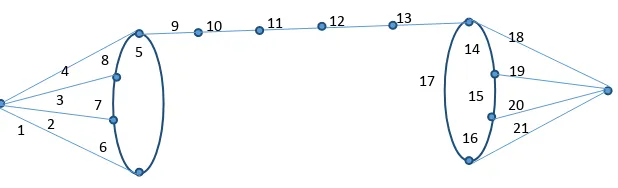
4.1 The graph obtained by joining two copies of W4 by path Pm i.e. G=W4(1-Pm) is vertex prime. The point of fusion on both copies is hub vertex of W4.Further if we change the point where the path is fused with W4 the resultant graph is also vertex prime.
Proof: We define this graph as : V1={w1,w2,uij/j = 1, 2, 3, 4. And i =1, 2)}. These are vertices on two copies of W4. V2= {v1, v2, ..vm}.These are vertices on path Pm.The edge set on pokes is given by E1={(wiuij) /j = 1, 2, 3, 4. And i =1, 2)}. E2 ={(uijuij+1)/j = 1, 2, 3, 4.where j+1 is taken modulo 4,and i = 1,2}.E2 are C4 -cycle edges on two copies of W4. E3 = {(vivi+1)/i = 1, 2, .., m-1.} Since we take the paths at hub wi we have w1 = v1 and w2 = vm. Thus V(G)=V1UV2. E(G) =E1UE2UE3.
Define f:E(G){1, 2, ..,m+15} as follows: f(wiuij)=j for i =1; j=1, 2, 3, 4
f(uijuij+1)=4+j, j=1, 2, 3, 4 and i =1; f(vivi+1)=8+i, i= 1, 2, ..,m-1;
f(uijuij+1)=m+7+j, j=1, 2, 3, 4 and i =2; f(wiuij)=m+11+j for i=2;j=1,2,3,4.
If we shift the point of fusion of Pm with W4 say to a vertex on outer cycle of W4, u1jandu2j for some j =1, 2, 3,4 then the only change will be v1 will be same as u1j and vm as u2j. The function described above will work as vertex prime label.
Thus the graph is vertex prime. #
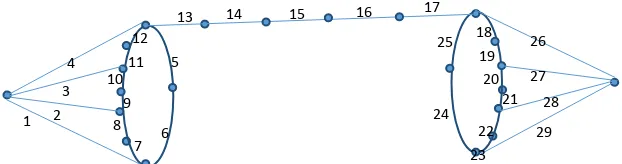
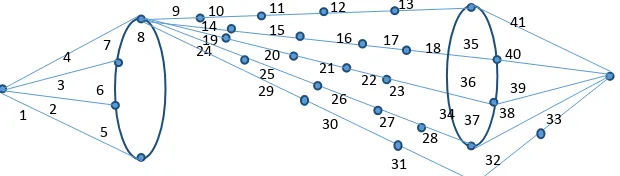
4.2Theorem: The graph G obtained by joining two copies of W4 by paths Pm between every pair of like vertex on two copies of W4(given by G1 and G2) is vertex prime. These are paths (ug(u)) where g(u) is image of u under any automorphism g on G4.Here u and g(u) are like vertices.
Proof:
We start with two vertex prime labeled copies of W4. Furtherthere will be five different paths from G1 to G2.We define this graph as : V1={w1, w2, uij/j = 1, 2, 3, 4. And i =1, 2)}. These are vertices on two copies of W4. V2= {vi,1, vi,2, .. vi,m}.These are path (Pm) vertices from vertex vi,1 on G1 to vi,m on G2. When the path will be (w1w2) then w1 will be vi,1and w2 will be vi,m. The edge set on pokes is given by E1={(wiuij) /j = 1, 2, 3, 4.;i =1, 2)}. E2={(uijuij+1)/j = 1, 2, 3, 4.where j+1 is taken modulo 4}. E2 are C4 -cycle edges on two copies of W4. E3 = {(vivi+1)/i = 1, 2, .., m-1.}. If we take the paths between hub wi we have w1 = v1 and w2 = vm.Thus V(G)=V1UV2. E(G) =E1UE2UE3.
Define f:E(G){1, 2, ..q} as follows where q= |E(G)|:
f(wiuij)=j for i =1; j=1, 2, 3, 4 f(uijuij+1)=4+j, j=1, 2, 3, 4 and i =1; f(uijuij+1)=8+j, j=1, 2, 3, 4 and i =2;
f(wiuij)=12+j for i=2;j=1,2,3,4.
3 4
5
2 1
8
7
6
11 12 10
9
16 15 14 13
17
20 19 18
21
Fig 4.1: A labeled copy of vertex prime graph W4(P6)Edge labels are shown.P6 is
ISSN: 2231-5373
http://www.ijmttjournal.org
Page 368
At this stage we have completed the vertexprime labeling of both copies of W4.f(vi,jvi,j+1)=16+i(m-1)+j, i= 1, 2, 3, 4, 5 ; j = 1, 2, .. (m-1)
Thus the graph is vertex prime. #
4.3Theorem:
The graph obtained by joining two copies of Gear graph G4(say G’ and G”) by path Pm i.e. G=G4(Pm) is vertex prime. The point of fusion on both copies is hub vertex of G4. Further if we change the point where the path is fused with G4 the resultant graph is also vertex prime.
Proof:
We define this graph as : V1={w1, w2, uij/j = 1, 2, ...8 And i =1, 2)}. These are vertices on two copies of G4. V2= {v1, v2, ..vm}.These are vertices on path Pm. The edge set on pokes is given by E1={(wiuij) /j = 1, 3, 5, 7. And i =1, 2)}. E2={(uijuij+1)/j = 1, 2, .., 8.where j+1 is taken modulo 8,i=1,2.}. E2 are C8 -cycle edges on two copies of G4. E3 = {(vivi+1)/i = 1, 2, .., m-1.} Since we take the paths fused at hub wi we have w1 = v1 and w2 = vm.Thus
V(G)=V1UV2. E(G) E1UE2UE3.
Define f:E(G){1, 2, ..,m+23} as follows:
f(wiuij)=t for i=2;j=1,3,5,7 and t is such that j = 2t-1
These are labels on pokes of G’
f(uijuij+1)=4+j, j=1, 2, .., 8 and i =1; These are labels on cycle C8 of G’
f(vivi+1)=12+i, i= 1, 2, ..,m-1;These are labels on path(vivm) f(uijuij+1)=m+11+j, j=1, 2, .., 8 and i =2;These are labels on cycle C8 of G”
f(wiuij)=m+19+t for i=2;j=1,3,5,7 and t is such that j = 2t-1
These are labels on pokes of G”. 4
3
2 1
13 9
14 8
7
6 5
16 12
11
10
17
18
15
21 20
19
25 22 23 24
27
26
Fig 4.2: A labeled copy of vertex prime graph with 5 pathspathson W4. Edge labels
are shown.
3
4 5
2
1 8
7 6 11
12
10 9
16 15 14
13 17
20 19 18
21
Fig 4.3: A labeled copy of vertex prime graph G4(1-P6)Edge labels are shown. 25
24
23 22
26
27 28
ISSN: 2231-5373
http://www.ijmttjournal.org
Page 369
If we change the end vertices of path from v1 = w1 to any vertex on cycle C8 of G’ and vm = w2 to any vertex on cycle C8 of G” The above labeling function f will work as it is and the resultant graph will be vertex prime.
Thus the graph is vertex prime. #
4.4 Theorem:
The graph G obtained by joining two copies of G4(given by G1 and G2) by paths Pm between every pair of like vertices G4 is vertex prime. These are paths (ug(u)) where g(u) is image of u under auto morphism g on G4.
Proof:
We start with two vertex prime labeled copies of G4. Furtherthere will be 8 different paths from G1 to G2.
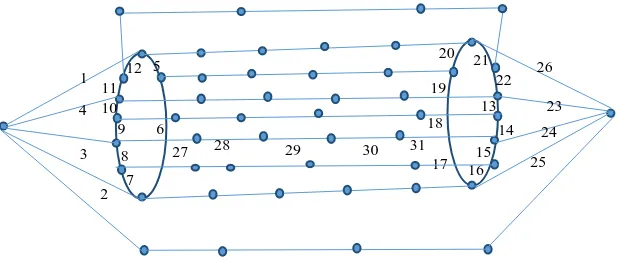
We define this graph as : V1= {w1, w2, uij/ j = 1, 2, ., 8. and i =1, 2)}. These are vertices on two copies of G4. V2= {vi,1, vi,2, .. vi,m}.These are path (Pm) vertices from vertex vi,1 on G1 to vi,m on G2. When the paths will be (w1w2) then w1 will be vi,1and w2 will bevi,m. The edge set on pokes is given by E1= {(wiuij) /j = 1, 3, 5, 7. And i =1, 2)}. E2={(uijuij+1)/j = 1, 2, .., 8 where j+1 is taken modulo 4}. E2 are C8 -cycle edges on each copy of G4. E3 = {(vivi+1)/i = 1, 2, .., m-1.}. Thus G has 9(m-1) edges. FurtherV(G)=V1UV2 and E(G) =E1UE2UE3.
Define f:E(G){1, 2, ..,q)} as follows where q =| E(G)| f(wiuij)=t for i=2;j=1,3,5,7 and t is such that j = 2t-1
f(uijuij+1)=4+j, j=1, 2, .., 8 and i =1;
f(uijuij+1)=12+j, j=1, 2, .., 8 and i =2;
f(wiuij)=20+j+t for i=2;j=1,3,5,7 and t is such that j = 2t-1
At this stage we have completed the vertex prime labeling of both copies of G4. f(vi,jvi,j+1)=24+i(m-1)+j, i= 1, 2, ..,12 ; j = 1, 2, .. (m-1), for any path (ug(u)) where u = vi,1 and g(u) = vi,m.
Thus the graph is vertex prime. #
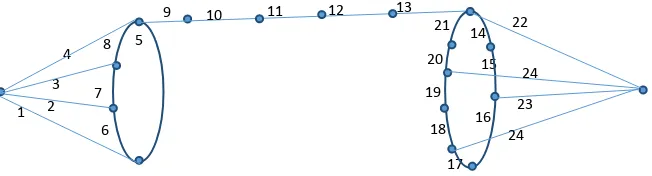
4.5Theorem: Let G be a graph obtained from W4 and G4 by joining their hub by a path Pm is vertex prime. If we shift the end points of path Pm from hub to any other vertex on respective graph then also the resultant graph is vertex prime.
4
3
2 1
13
9 14
8 7
6 5
16 12
11 10
17 18
15 21 20
19
25 22
23
24 27
26
Fig 4.4: A labeled copy of vertex prime graph with 9 pathsP6 on G4.A few of the edge labels
are shown.
ISSN: 2231-5373
http://www.ijmttjournal.org
Page 370
Proof:
We define the graph G as follows: V1={w1, w2, uij/j = 1, 2, 3, 4. for i =1 and are vertices on W4 and i = 2 then vertices are on G4.Further if i=2 then j =1,2, .,,8)}. V2 = {v1, v2, ..vm}.These are vertices on path Pm. The edge set on pokes is given by E1={(wiuij) /j = 1, 2, 3, 4; when i =1for pokes of W4 and when i =2 these are pokes of G4 and in that case j = 1,3,5,7)}. E2 ={( u1ju1j+1) /j = 1, 2, 3, 4.where j+1 is taken modulo 4}. These are cycle vertices of W4.E3 = {(vivi+1)/i = 1, 2, ,, m-1.} are edges on path Pm. E2’ = {( u2ju2j+1) /j = 1, 2, ,..8; where j+1 is taken modulo 8}. Care should be taken thatedge ( u21u22)- the C8 edge should be adjacent to last edge (vm-1vm) of path incident to C8. E2’ are C8 -cycle edges on G4. Since we take the paths at hub wi we have w1 = v1 and w2 = vm which is the hub of G4.Thus V(G)=V1UV2. And E(G) =E1UE2UE2’UE3.
Define f:E(G){1, 2, ..,m+19} as follows:
f(wiu1j)=j for i =1; j=1, 2, 3, 4
f(u1ju1j+1)=4+j, j=1, 2, 3, 4
f(vjvj+1)=8+j ; j = 1,2, ,m-1. f(u2ju2j+1)=m+7+j, j=1, 2, .., 8
f(wiuij)=m+15+t for i=2;j=1, 3,5,7 and t is such that j = 2t-1
Ifwe change the end vertices of path Pm then the same function f as above will work as vertex prime label function. Thus the above labeling is independent of end points of Pm.
Thus the graph is vertex prime. #
4.6Theorem:
Hub of W4 is joined to every vertex of other copy of W4 by paths Pm. The resultant graph is vertex prime.The result holds even if we change the starting point of path namely hub, to any other vertex on W4.
Proof:
We define this graph as : V1={w1, w2, uij/j = 1, 2, 3, 4. And i =1, 2)}. These are vertices on two copies of W4. V2= {vi,1, vi,2, .. vi,m where i = 1,2..,5 for five paths ends at five different vertices of W4 }.These are vertices on path Pm. The edge set on pokes is given by E1 = {(wiuij) /j = 1, 2, 3, 4. And i =1, 2)}. E2 = {(u1ju1j+1)/j = 1, 2, 3, 4.where j+1 is taken modulo 4 }U{(u2ju2j+1)/j = 1, 2, 3, 4.where j+1 is taken modulo 4 }.
E2 are C4 -cycle edges on two copies of W4. E3 = {(vi,jvi,j+1)/j = 1, 2, .., m-1; i = 1, 2,..5 }. Since we take the path starting at hub wi we have w1 = vi,1.Thus V(G)=V1UV2. E(G) =E1UE2UE3.
Define f:E(G){1, 2, ..,q} as follows q= |E(G)|:
f(wiuij)=j for i =1; j=1, 2, 3, 4
f(uijuij+1)=4+j, j=1, 2, 3, 4 and i =1;
Fig 4.5: A labeled copy of vertex prime graph W4(P6)G4Edge labels are shown. 14
15
19
18
17 16 3
4 8 9
6 2 1
5
7
11 12 13
10
20
21 22
24
23
ISSN: 2231-5373
http://www.ijmttjournal.org
Page 371
f((vi,jvi,j+1))=8+(m-1)(i-1)+j, j= 1, 2, ..,m-1;i=1, 2..5. f(uijuij+1)=5m+3+j, j=1, 2, 3, 4 and i =2; f(wiuij)=5m+7+j for i=2;j=1,2,3,4.
If we change starting point of all paths from hub to any other vertex on W4 still above labeling function f will serve as vertex prime label.
Thus the graph is vertex prime. #
Conclusions:
We have defined a new family of graphs G1(t-pm)G2.When t =1 write G1(pm)G2.When G1 = W4and G2 = G4 we have shown that graph is vertex prime. Further The graphs are vertex prime independent of starting and end point of path Pm.We have also shown that if we take 5 paths starting at hub vertex of W4 and each one ending at different vertex of other copy of W4, the resultant graph is vertex prime. If we change the starting vertex from hub to any other vertex of W4 still we have shown that the same function works as vertex prime label. It is necessary to investigate the similar graphs for vertex prime labeling.
References:
[1] Mukund V. Bapat Ph.D. thesis, university of Mumbai,India,2004.
[2] T. Deretsky, S. M. Lee, and J. Mitchem, On vertex prime labelings of graphs, in Graph Theory, Combinatorics and Applications Vol. 1, J. Alavi, G. Chartrand, O. Oellerman, and A. Schwenk, eds., Proceedings 6th International Conference Theory and Applications of Graphs (Wiley, New York, 1991) 359-369.
[3] Joe Gallian Dynamic survey of graph labeling 2016 [4] Harary,GraphTheory,Narosa publishing ,New Delhi [5] Yilmaz,Cahit ,E-cordial graphs,Ars combina,46,251-256.
[6] Introduction to Graph Theory by D. WEST, Pearson Education Asia. 1 Mukund V. Bapat, Hindale,Devgad,Sindhudurg,Maharashtra India: 416630
3 4
8
2 1
7
6
5
11 12 10
9
16 15 14
13
17 20
19 18
21
Fig 4.6: A labeled copy of vertex prime graph W4(P6)W4Edge labels are shown.All
paths starts from a cycle vertex of W4 22
28 27 26 25
24
29 23
32 30
36 35
34 33
41
37 38 39 40