The Thirty-Third AAAI Conference on Artificial Intelligence (AAAI-19)
Attentive Temporal Pyramid Network for Dynamic Scene Classification
Yuanjun Huang,
1,2,3,4Xianbin Cao,
1,3,4Xiantong Zhen,
1,3,4Jungong Han
2 1School of Electronics and Information Engineering, Beihang University, Beijing, 100191, China2Lancaster University, Lancaster, LA1 4YW, UK
3Key Laboratory of Advanced technology of Near Space Information System (Beihang University),
Ministry of Industry and Information Technology of China
4Beijing Advanced Innovation Center for Big Data-Based Precision Medicine
Abstract
Dynamic scene classification is an important yet challenging problem especially with the presence of defected or irrelevant frames due to unconstrained imaging conditions such as illu-mination, camera motion and irrelevant background. In this paper, we propose the attentive temporal pyramid network (ATP-Net) to establish effective representations of dynamic scenes by extracting and aggregating the most informative and discriminative features. The proposed ATP-Net detects informative features of frames that contain the most relevant information to scenes by a temporal pyramid structure with the incorporated attention mechanism. These frame features are effectively fused by a newly designed kernel aggrega-tion layer based on kernel approximaaggrega-tion into a discrimina-tive holistic representations of dynamic scenes. The proposed ATP-Net leverages the strength of attention mechanism to se-lect the most relevant frame features and the ability of kernels to achieve optimal feature fusion for discriminative represen-tations of dynamic scenes. Extensive experiments and com-parisons are conducted on three benchmark datasets and the results show our superiority over the state-of-the-art methods on all these three benchmark datasets.
Introduction
Dynamic scene classification has been extensively studied in the computer vision community in recent years (Feicht-enhofer, Pinz, and Wildes 2016) (Huang et al. 2018)(Va-sudevan et al. 2013), owing to its wide applications in video searching, autonomous driving (Yan et al. 2018b) and surveillance (Yan et al. 2018a). However, dynamic scene classification is still an unsolved problem, due to un-constrained imaging conditions such as poor illumination, abrupt camera motion, unfavorable viewpoints and irrele-vant background.
In comparison to static scenes, recognition of dynamic scenes in videos captured by moving cameras is more chal-lenging attributable to the introduced much more blurred and irrelevant video frames. In these videos, most video frames only contain background instead of meaningful label-related contents that are distractions for classification. Thus, exploiting what truly matters and selecting significant contents from video frames is the key component for dy-namic scene classification.
Copyright c2019, Association for the Advancement of Artificial Intelligence (www.aaai.org). All rights reserved.
Recently, scene classification methods mostly adopt convolutional neural networks (CNNs) (Zhou et al. 2016)(Huang et al. 2017b) that have proved to be very pow-erful of learning strong representations in wide range of vi-sual tasks. CNNs such as VGGnet (Simonyan and Zisser-man 2014b), Resnet (He et al. 2016), Densenet (Huang et al. 2017a) etc., are regarded as the feature extractors for obtain-ing local representations from different regions of images. However, these CNNs are designed to work with still im-age only and it is non-trivial, if not impossible, to extend these models to videos containing complex temporal clues. A straightforward way to deal with this problem is to use the average pooling strategy which simply takes the average of features along temporal frames. However, average pool-ing inevitably discards the temporal sequential information and introduces negative effects of irrelevant frames on the overall representations of scenes.
To achieve more accurate recognition of dynamic scene, it would be beneficial to fully explore the temporal dynamic information. There are basically two pathways to model temporal clues within CNNs. One way is to explicitly model the video as an ordered sequence of frames based on long short-term memory (LSTM) (Donahue et al. 2015) or gated recurrent unit (GRU) (Chung et al. 2014). These models usu-ally adopt memory cells to store, modify and access internal state so as to discover the long-range sequential informa-tion. Alternatively, another way of capturing the temporal information in CNNs resorts to the two-stream architecture (Simonyan and Zisserman 2014a) which uses both RGB and dense optical flows as the inputs for CNNs. By incorporating these two sources of information, the model encodes both spatial and temporal clues in the two-stream network. De-spite the success of these methods, the computational cost tends to be high, and in addition, indiscriminately using en-tire video frames for modeling will introduce negative ef-fects of irrelevant and noisy frames, thereby compromising the classification performance.
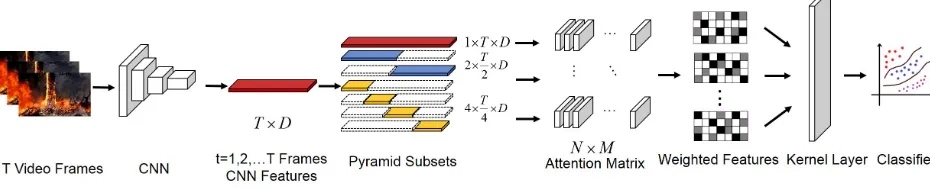
attention-Figure 1: Framework of the ATP-Net. For a given video sample containing T frames, we extract their CNN features with
t = 1,2, ..., T. Then we use pyramid structure to divide these CNN features into n pyramid CNN subsets wheren= 1,2,4. The total number of pyramid CNN subsets are N = 1 + 2 + 4 = 7. Next, these pyramid CNN subsets are fed into an attention matrix ofN ×M in order to obtain the weights of every frame of CNN features, where each element of attention matrix represents an attention module that is used for calculating frame weights. In the attention matrix, we have N ×M
attention modules in total in whichN represents the pyramid CNN subsets andM is the number of attention modules that we used for calculating weights of each pyramid CNN subsets. The pyramid CNN subsets and attention matrix enable our model to calculate weights from different temporal scales and reflect diversified aspects of video. The output of attention matrix is weighted features which are then aggregated in kernel aggregation layer. In the final stage, the output features are classified by softmax function.
aware features for better representations. Inspired by the success of spatial attention modules, some researchers ex-tend this idea to acquire temporal attentions. Neural aggre-gation network (NAN) (Yang et al. 2017) is proposed specif-ically for video face recognition, which incorporates atten-tion aggregaatten-tion module in CNNs and adaptively aggregates image-level features into video-level features. Since face im-ages in these videos do not always have pleasant viewpoint and clear facial details, the NAN filters blurred and irrel-evant face images out while focusing on essential face im-ages that supports recognition. While comparing with video-based face recognition, dynamic scene classification is more complicated due to the great variability of contents both tem-porally and spatially. Therefore, it is highly desired to extract the most informative and discriminative frames from videos of dynamic scenes for compact representations.
To this end, we propose the attentive temporal pyramid network (ATP-Net) for dynamic scene classification. Since video sequences usually contain hundreds of frames, find-ing key features within these frames is complicated. Thus, we stack multiple independent attention modules at temporal pyramid scales. The idea behind temporal pyramid structure is simple so that binary searching key features from hun-dreds of frames will rapidly and accurately locate the key frames from both long-term and short-term scales. As the temporal scale being extended, multiple pyramid attention features are extracted from videos. In order to better orga-nize these features, we design the kernel aggregation layer to achieve holistic representations. The kernel aggregation layer fuses multiple features based on kernel approximation such that the non-linear power of features can be signifi-cantly enhanced. The kernel aggregation layer and indepen-dent attention modules ensure the learning weight of these multiple attentions to keep diversified and fully describe dif-ferent aspects of videos. The newly designed kernel aggre-gation layer enjoys the benefits of both kernels and neural networks, and is adaptively learned from the training data.
Extensive experiments and comparisons are conducted on three benchmark datasets and the results show the superior-ity of the proposed ATP-Net over the state-of-the-art meth-ods on all these three benchmark datasets.
In summary, the major contributions of this work lie in the following three aspects:
–We propose the attentive temporal pyramid network (ATP-Net) for dynamic scene classification. The ATP-Net is able to filter out defected and irrelevant frames while focus-ing on essential contents detected from long-term to short-term temporal scales.
–We develop a kernel aggregation layer derived from ker-nel approximation to effectively aggregate multiple features from the temporal pyramid, achieving discriminative and compact feature representations.
– We evaluate the ATP-Net on three diverse benchmark datasets, which achieves new state-of-the-art performance on the benchmarks, substantially outperforming previous methods.
The rest paper is organized as follows. In methodology, the proposed ATP-Net is presented in details with theoret-ical analysis. The experimental section shows the results and comparisons with the state-of-the-arts baselines on three benchmark datasets. Finally, we draw some conclusions.
Methodology
Network overview
The pyramid CNN subsets containN = 7CNN subsets of size1×T×D,2×2
T×Dand4× 4
T×D. In the attention ma-trix, we haveN×Mattention modules in total in whichN
represents the pyramid CNN subsets andM is the number of attention modules that we used for calculating weights of each pyramid CNN subsets. The pyramid CNN subsets and attention matrix enable our model to rapidly locate where the key frames are and reflect diversified aspects of videos. In the final part, the kernel aggregation layer is employed to fuse features from the temporal pyramid. In the next follow-ing sections, we will detail each component of our model and illustrate how these elements work in our model.
CNNs for local features
For dynamic scene classification, it is very common to obtain spatial local features with various CNNs available. Since most CNN models are already pretrained on large dataset, e.g., Places2, imagenet and proved to be very power-ful, we can take advantage of these pre-trained models and use them directly for feature extraction. To be specific, we use Resnet-50 for spatial feature extraction networks.
The spatial features are defined as a set of ordered frame-level features extracted from each frame of a video. We use
Xof sizeT×Dto represent spatial features extracted from
Tframes of a given video sample with dimension ofD. The frame-level CNN featuresxtinX can be defined as :
X =x1,x2, ...,xT, (1) whereTis the total frames of the video data andDis the di-mension of CNN features. And the average pooling method can be denoted as:
¯
X = 1
T
T
X
t=1
xt. (2)
Attentive Temporal Pyramid Network
In our videos captured by moving cameras, lots of frames are blurred with changing viewpoints all the time which is not favorable for classification. Moreover, some videos are even untrimmed with only a small portion of video clips that are related to the scene class. Thus, exploiting what truly mat-ters in videos is very important in our task. To deal with the aforementioned problem, we propose the attentive temporal pyramid network (ATP-Net) which can be divided into two main modules: the single attention module and the temporal pyramid attention matrix.
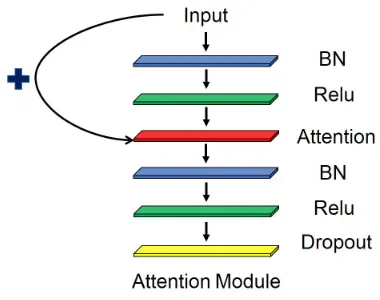
Attention module The attention module aims to filter de-fected or irrelevant frames out and only focus on the essen-tial contents. The network structure of attention module is depicted in Figure.2. We use 2 batch normalization layers, 2 Relu activations, 1 attention layer and 1 dropout layer to con-struct the attention module network. The input of attention module is added on the attention layer, which is commonly used as a residual component in Resnet.
Having obtained frame-level featuresX =x1,x2, ...,xT for a given video sample of T frames, the next step is to find the most proper weightsatthat linearly aggregate these
Figure 2: The network structure of attention module. 2 batch normalization layers, 2 Relu activations, 1 attention layer and 1 dropout layer are used in a single attention module.
frame-level features and yield best performance in the clas-sification stage:
f =
T
X
t=1
atxt, (3)
wherefis the weighted features. If we defineat= T1, then it will degrade to averaging pooling method. As in the at-tention module, we try to adaptively learn at in a neural network. The attention module consists of a fully-connected layer to learn the weights of frame-level features that can be defined as:
a= softmax(wxT+b), (4) where w and b are parameters of dimensionality T and D, respectively.
Inspired by the success of Resnet, we add a residual com-ponent in Eq. 3, and it will be changed into:
f0 =
T
X
t=1
(1 +at)xt. (5)
The shortcut in Eq. (5) will accelerate the fluent of gradient and achieve better performance.
nsubsets without overlapping, wheren= 1,2,4in our set-ting.Therefore, the total number of the pyramid subsets are
N = 1+2+4 = 7. Then theseNsubsets of data are fed into the corresponding independent attention modules to search the key frames from different temporal scales. In the pyra-mid attention structure, the solutions will be exploited from coarser to finer scales and such binary searching scheme can largely improve the efficiency and accuracy and find what truly matters in our videos. This process can be defined as:
f1=Attention(X1)
f2=Attention(X2)
...
fN =Attention(XN)
, (6)
whereXis theNdivided pyramid subsets andf is the gen-erated temporal pyramid attention features, reflecting atten-tions from both long-term scale and short-term scale.
Although we employ temporal pyramid structure to find optimal solutions of key frames, we can not expect one sin-gle attention module is enough for reflecting all aspects of the specific subsets of videos. As illustrated from previous research (Vaswani et al. 2017)(Lin et al. 2017), one single attention module can only reflect very limited aspects of the video, which is quite similar to convolution layers that have to use multiple kernels for better representation. Therefore, we need multiple attention modules to focus on the diversi-fied aspects of video subsets. In each pyramid subsets in Eq. 6, we stackM = 32independent attention modules to fully exploit essential frames of specific video subsets. Therefore, we haveN ×M attention modules to describe video. And the Eq. 6 can be extended to an attention matrixF in which each elements of the matrix is a single attention module:
F =
f11 f12 f13 · · · f1M
f21 . ..
f31 . .. ..
. . ..
fN1 fN M
(7)
whereN represents the pyramid subsets andM is the num-ber of independent attention modules for each specific pyra-mid subsets. As presented in Eq. (7), we have attention ma-trix ofN×M, which can exploit key frames from pyramid subsets of videos and employing multiple independent at-tention modules to better reflect diversified aspects of each pyramid parts.
Kernel Aggregation Layer
Incorporating the kernel aggregation layer brings three ad-vantages. Firstly, features from the attention matrix can be of very high dimensionality if being simply concatenated. The kernel aggregation layer can reduce the dimensionality of features. Secondly, the kernel aggregation layer is based on kernel approximation to leverage the great strength of ker-nels for non-linear feature learning, which maintains high non-linear discriminative ability of features. Thirdly, the ker-nel aggregation layer can be incorporated in an end-to-end neural network easily, which enjoys the benefits of back
propagation and improves performance. The kernel aggrega-tion layer is derived from the approximaaggrega-tion of shift invari-ant kernels based on random Fourier features underpinned by the well-known Bochner’s theorem.
Theorem 1 (Bochner) A continuous shift-invariant kernel functionk(x,x0) = k(x−x0)onRd is positive definite if
and only if it is the Fourier transform of a unique finite non-negative measure onRd. Definingζω(x) =ejω
>x
, for any x,x0∈
Rd,
k(x−x0) = Z
Rd
p(ω)ejω>(x−x0)dω=Eω[ζω(x)ζω(x0)∗]
(8)
where * is the conjugate andp(ω)is the Fourier transform of the kernel.
If the kernelk(δ)is properly scaled, then its Fourier trans-form p(w) will also be a proper probability distribution. Definingξw(x) =ejw
Tx
, for anyx,x0∈Rd, we have:
k(x−x0) = Z
Rd
p(w)ejwT(x−x0)dw=E[ξw(x)ξw(x0)∗], (9) where∗is the conjugate andξw(x)ξw(x0)∗ is an unbiased estimate ofk(x−x0)whenwis drawn fromp(w).
The kernel k(x,x0)can be approximated by drawing d
random samples as:
k(x,x0)≈ d X
i=1
*r 2
dcos(w
T ix+bi),
r 2
dcos(w
T
ix
0
+bi) +
,
(10) wherewis sampled from the probability distributionp(w), andbis uniformly sampled over[0,2π].
Thus, the corresponding approximated feature map takes the following form
φ(x) = r
2
d[cos(w
T
i x+bi)]i=1:d, (11)
whereφ(x) is called the random Fourier feature, and has been successfully used in various kernel methods.
Nevertheless, the power of kernel approximation based on random Fourier features remains largely underdeveloped, and only recently attracted attention. In the original ker-nel approximation methods, no adaptive learning is involved and the approximate features would be of high redundancy and of low discriminant ability, which deteriorate the per-formance while inducing unnecessary computational cost. In addition, approximating the kernel with a fixed configu-ration does not necessarily lead to high performance since it is still a very challenging task of how to choose the best kernel configuration.
Since random sampling from data-independent distribu-tions is not optimal, we propose to approximate kernels from data in a supervised way. Specifically, we design the kernel aggregation layer, which learns parameters ofw, bto gener-ate more compact but highly discriminative feature represen-tations.W andbare defined asW = [w1, ...,wc]∈ Rd×c
Fourier imbedding layer within neural networks and achieve nonlinear ability with cosine activations:
Φ(x) = cos(Wx+b), (12)
wherecosis the element-wise function,iindicates thei-th attention feature in the attention matrix, andWis the weight matrix of the nonlinear layer. The proposed kernel aggre-gation layer can be seamlessly integrated with other deep learning architectures and trained via back-propagation, which enjoys the benefits of neural networks for end-to-end learning. The outputs of kernel aggegration layers are concatenated to generate the final holistic representation for classification. In the final stage, a softmax function is used for classification.
Experiments
In this section, we first conduct our experiments on two benchmark dynamic scene datasets, i.e., YUPENN++ (Fe-ichtenhofer, Pinz, and Wildes 2017) and Maryland (Shroff, Turaga, and Chellappa 2010) and further experiment our model on a large activity dataset called ActivityNet. Then, we discuss our experimental setups on these three datasets. We report comprehensive experimental analysis on each component in our method. This allows us to observe the per-formance gain of each component under various experimen-tal conditions and achieve a deeper understanding of how these components work in our model. In the final part, the proposed work is compared with state-of-the-art methods on three datasets mentioned above, which further verifies the effectiveness of the proposed attentive temporal pyramid network (ATP-Net).
Datasets
We evaluate our proposed method on three benchmark datasets: YUPENN++ dataset (Feichtenhofer, Pinz, and Wildes 2017) , Maryland dataset (Shroff, Turaga, and Chel-lappa 2010) and AcivityNet dataset (Heilbron et al. 2015).
YUPENN++: YUPENN++ is a newly proposed dynamic scenes dataset which samples 20 scene classes and encom-passes a wide range of conditions including variations of il-lumination, view-points and seasonal changes. It is extended from the earlier YUPENN dataset that has only 14 scene classes and all videos are captured without camera motions. The 20 scene classes in newly proposed YUPENN++ dataset are as follows: beach, city street, elevator, forest fire, foun-tain, highway, lightning storm, ocean, railway, rushing river, sky clouds, snowing, waterfall, windmill farm, building col-lapse, escalator, falling trees, fireworks, marathon, waving flags. And the last six classes are the newly added classes in YUPENN++. In each scene classes of YUPENN++, there are 60 color videos with half of them captured by a static camera and the other half are captured by a moving camera. The camera motions include pan, tilt, zoom and jitter. Nor-mally, the videos captured with moving camera are much more difficult to be classified, compared with videos cap-tured by static cameras. Except for camera motion, there still exists other varying conditions that make this dynamic
scene datasets even more challenging, encompassing illu-minations, seasonal, scale and viewpoint. Each video sam-ple lasts about 5 seconds and has approximately 100-150 frames. All these samples have been resized to width of 480 pixels while preserving their original aspect ratio. Since this video dataset is much more challenging and includes sam-ples from previous used YUPENN dataset, we use this new dataset for evaluating our method.
Maryland: Compared with YUPENN++ that has 60 sam-ples over 20 classes, the Maryland dataset is quite small that contains 13 dynamic scene categories with 10 sam-ples in each categorie and has 130 video samsam-ples in to-tal. Though the number of video samples are quite small, each video samples from Maryland dataset contains much longer frames and the video length varies from 80 frames to thousands of frames. Because of the varying video length as well as camera motions and even scene cuts confounded with object motions in most samples, the Maryland dataset is still very challenging and different from the YUPENN++ dataset.
ActivityNet: Different from the previous two dynamic scene datasets, the ActivityNet mainly depicts human action or activities. It consists of 10024, 4926 and 5044 videos in training, validation and test sets, respectively. These videos are untrimmed and contain activities belonging to one of the 200 different classes. In total, it amounts to 849 hours of untrimmed videos with only 68.8 hours that are truly related to the content of activities. For each video samples, it lasts from tens seconds to up to 10 minutes and we extract video frames at 5 frames per second for training and testing. Since the video samples and classes are much larger than YU-PENN++ and Maryland dataset and videos are untrimmed with lots of irrelevant background, this ActivityNet is much more difficult for classification and assigned as the bench-mark dataset for Activity challenge competition from 2015 to now.
Implementation details
For constructing our model, we use the Pytorch language and all experiments are conducted on a workstation with an Intel Core I7 CPU and a NIVDIA Titan X GPU.
Data augmentation: All video samples are firstly con-ducted by data augmentation before feature extraction pro-cess. These video samples are resized to256×256, cropped at random position into224×224and through random hori-zontal flipping. Since the frames of video samples vary from tens to thousands, staking all frames in the neural network is not possible and not necessary. For each video sample, we randomly sample 100 consecutive frames during train-ing and use all frames for testtrain-ing. If video frames are less than100, we repeat the video until its frames are more than
100for selection.
Table 1: Accuracy (%) on the YUPENN++ dataset and Maryland dataset to show the effect of different attention matrix settings withN = 1,3,7andM = 1,8,32.
YUPENN++ Maryland
Avg 89.53 89.23
M M=1 M=8 M=32 M=1 M=8 M=32
N=1 88.05 89.63 90.64 89.23 90.77 90.77 N=3 87.77 90.83 92.03 90.77 92.30 92.30 N=7 89.63 91.38 92.03 90.77 92.30 93.85
Table 2: Accuracy (%) on the YUPENN++ dataset and Maryland dataset to show the effect of kernel aggregation layer.
Datasets YUPENN++ Maryland Concatenation 90.05 90.77
FC layer 92.03 93.85
Kernel layer 92.37 95.38
in ActivityNet dataset that contains more human activities, the Imagenet dataset (Deng et al. 2009) is more suitable for pre-training which has large quantities of human activity images. We extract features before the last fully-connected layer for spatial representation. The extracted features are with 2048-dimension in Resnet-50 model.
ATP-Net: The training procedure of ATP-Net follows standard ConvNet training (Huang et al. 2017a) (Zhou et al. 2016), with learningrate = 0.001,batchsize = 32 and momentum learning algorithm. We adopt the commonly-used cross entropy as the loss function. To keep consistency with previous research, different training and testing strate-gies are used in our experiments. In the YUPENN++ dataset, we use 10% for training and 90% for testing, which is a very strict train test ratio applied in (Feichtenhofer, Pinz, and Wildes 2017). In Maryland dataset, because of very limited video samples for both training and testing, we use50%for training and50% for testing that is more challenging than “leave-one-out” strategy used in the previous methods (Fe-ichtenhofer, Pinz, and Wildes 2014), to better present the improvements of our method. In Activitynet dataset, since no public testing labels are available, the performances on Activitynet datasets are all reported on validation set as it did in (Qiu, Yao, and Mei 2017).
Ablation study
We conduct an ablation study to separately evaluate the con-tribution of each component in our model to the overall per-formance.
In the ATP-Net, we have two main components, namely pyramid attention matrix and kernel aggregation layer.
Pyramid attention matrixFirstly, we focus on exploit-ing how pyramid attention matrix can affect the performance of dynamic scene classification. We consider average pool-ing as mentioned in Eq. 2 and different settpool-ings of pyra-mid attention matrix. To fully examine the performance, we vary the parameter ofN = 1,3,7andM = 1,8,32in the
attention matrix where N represents pyramid feature sub-sets we used andM is the total number of independent at-tention modules in a single pyramid feature subset. Thus, we will have 3 ×3 = 9 different attention matrix with
F1,1, F1,8, F1,32, F3,1, F3,8, F3,32, F7,1, F7,8, F7,32. The at-tention matrix experiments are conducted without kernel ag-gregation layer in order to avoid influences. Instead, we use a simple fully-connected layer with 512 hidden units and Relu activation to reduce feature dimensionality. The atten-tion matrix is evaluated on two dynamic scene datasets. As shown in Table 1, we observe a significant performance gain between the results of using average pooling and pyramid attention matrix withN = 7,M = 32on both YUPENN++ and Maryland datasets, which means that our ATP-Net can play an important role in this situation and exploits better representations. The accuracy rates are2.50%higher on the YUPENN++ dataset and4.62%higher on Maryland dataset. Since Maryland dataset contains much more moving camera situations and scene cuts, our ATP-Net can better deal with such challenging situations and improve the performance. We also observe that on both datasets, the performance is in-creasing with the addition of attention units. However, with the increase of pyramid structure N and number of atten-tion modulesM, the accuracy rates are becoming saturated on both sides. This indicates that more attention modules are helpful with more parameters, but it is not universal ap-plicable. By changing the data structure to a pyramid way, the two factorsN andM will generate an attention matrix which will be more beneficial. It is interesting that if we use only one single attention module, the performance is very limited or even worse, indicating that such single attention modules can only reflect partial aspects of video, especially in video of large frames (100 frames in our case).
Kernel aggregation layer:In the case of multiple pyra-mid attention matrix, the features can be of very high di-mensionality if simply concatenated. The kernel aggrega-tion layer is to reduce dimensionality while keeping the high nonlinear discriminative ability. We consider the effect of the kernel aggregation layer in Table 2 with the output of at-tention matrix atN = 7,M = 32. We compare the perfor-mance of simple concatenation, fully-connected (FC) layer with 512 hidden units and Relu activation and kernel ag-gregation layer. The performance is also evaluated on two dynamic scene datasets. As shown in Table 2, the kernel ag-gregation layer is slightly higher than FC layer with Relu in the YUPENN++ dataset and1.53%higher than FC layer in Maryland dataset, which indicate that our aggregation can perform better in moving camera situations. The simple con-catenation is of very high-dimensionality and poor in perfor-mance.
Comparison on dynamic scene classification
In this section, we compare our proposed ATP-Net with other state-of-the-art methods to further illustrate the effec-tiveness of our model. We use three benchmark datasets for evaluation, that is, the Maryland, YUPENN++ and Activi-tynet datasets.
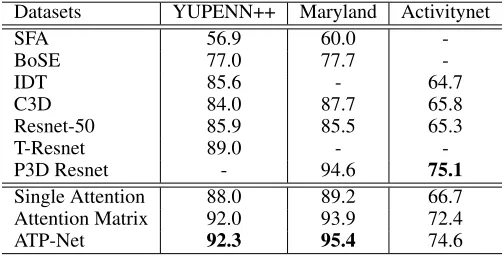
Table 3: Performance comparison of different algorithms on the YUPENN++, Maryland and Activitynet datasets.
Datasets YUPENN++ Maryland Activitynet
SFA 56.9 60.0
-BoSE 77.0 77.7
-IDT 85.6 - 64.7
C3D 84.0 87.7 65.8
Resnet-50 85.9 85.5 65.3
T-Resnet 89.0 -
-P3D Resnet - 94.6 75.1
Single Attention 88.0 89.2 66.7 Attention Matrix 92.0 93.9 72.4
ATP-Net 92.3 95.4 74.6
we use random split with fixed training/testing ratio of 10/90 in the YUPENN++ dataset, which means we use10%video samples from each classes for training and90%video sam-ples for testing. This training/testing ratio makes this YU-PENN++ dataset very challenging. As shown in Table 3, we select 6 best performing methods in dynamic scene clas-sification field for comparison, including SFA (Theriault, Thome, and Cord 2013), BoSE (Feichtenhofer, Pinz, and Wildes 2014), IDT (Wang and Schmid 2013), C3D (Tran et al. 2015), Resnet(He et al. 2016) (pre-trained on Ima-genet), T-Resnet (Feichtenhofer, Pinz, and Wildes 2017). Among these methods, only Resnet is a purely spatial al-gorithm which simply aggregates frame-level features with average pooling strategy. However, it is interesting to see that Resnet achieves very competitive performance on the YUPENN++ dataset. This is owing to the powerful feature learning of deep neural networks. Also, this result reflects that spatial information plays an essential role in dynamic scene classification task.
The top performing algorithm is the newly proposed ATP-Net. We also list the results of a single-attention model, at-tention matrix model for comparison. As can be concluded from Table 3, all our proposed methods have obtained very promising performance. It is particularly interesting to com-pare our methods to Resnet-50 since our ATP-Net is con-structed based on this CNN architecture. Even with a very small number of training samples, e.g.,10%of the total dy-namic scene dataset, our ATP-Net still generates distinctive representations and improves the performance largely. And the addition of attention as well as pyramid attention ma-trix can largely enhance the dynamic scene classification and outperform other spatiotemporal methods such as previous best BoSE and T-Resnet.
Maryland:For the Maryland dataset, we use more strict train/test split with only50%samples for training and50%
for testing. And compared with the YUPENN++ dataset, the Maryland dataset is even more challenging because of se-vere camera motions. As can be seen from Table 3, similar to our model, P3D Resnet (Qiu, Yao, and Mei 2017) is based on a Resnet-152 network, and has obtained94.6% perfor-mance. But our ATP-Net benefits from the pyramid attention structure and the newly designed kernel aggregation layer, that even with much less training samples our method still
achieves the top performance among these state-of-the-art algorithms. This suggests that our ATP-Net can quite well handle severe moving camera situations.
Activitynet:Different from previous two dynamic scene datasets, the ActivityNet dataset mainly depicts human ac-tion or activities. This dataset has large quantities of both training and testing samples and regarded as the bench-mark dataset for Activity challenge competition from 2015 to now. The video samples from this dataset is untrimmed which inevitably introduce much more noise and irrelevant background, which makes it very difficult for classification. We extend our model to this dataset, in order to evalu-ate the performance of ATP-Net under the large untrimmed video dataset. As can be seen from Table 3, even we do not achieve the top performance, we still get high performance. Since P3D Resnet uses Resnet-152 network to construct their model, it presents slightly higher performance to our ATP-Net that uses Resnet-50 network. And compared with the baseline method, Resnet-50, our ATP-Net constructed on Resnet-50 can improve the performance by9%, indicat-ing that the proposed attentive pyramid is very helpful for untrimmed video classification.
Conclusion
In this paper, we have presented the attentive temporal pyra-mid network (ATP-Net) for dynamic scene classification. The ATP-Net extracts multi-scale attentive features from a temporal pyramid attention matrix and aggregates these features by a newly designed kernel aggregation layer to achieve highly discriminative and compact representations. The ATP-Net has been extensively evaluated on three bench-mark datasets for dynamic scene classification. Experimen-tal results have shown that ATP-Net achieves the new state-of-the-art performance on the benchmarks and substantially outperforms previous methods.
Acknowledgments
References
Ba, J.; Mnih, V.; and Kavukcuoglu, K. 2014. Multiple object recognition with visual attention. arXiv preprint arXiv:1412.7755.
Chung, J.; Gulcehre, C.; Cho, K.; and Bengio, Y. 2014. Em-pirical evaluation of gated recurrent neural networks on se-quence modeling. arXiv preprint arXiv:1412.3555.
Deng, J.; Dong, W.; Socher, R.; Li, L. J.; Li, K.; and Li, F. F. 2009. Imagenet: A large-scale hierarchical image database.
2009 IEEE International Conference on Computer Vision and Pattern Recognition248–255.
Donahue, J.; Anne Hendricks, L.; Guadarrama, S.; Rohrbach, M.; Venugopalan, S.; Saenko, K.; and Darrell, T. 2015. Long-term recurrent convolutional networks for visual recognition and description. InProceedings of the IEEE conference on computer vision and pattern recogni-tion, 2625–2634.
Feichtenhofer, C.; Pinz, A.; and Wildes, R. 2014. Bags of spacetime energies for dynamic scene recognition. In2014, IEEE Conference on Computer Vision and Pattern Recogni-tion, 2681–2688.
Feichtenhofer, C.; Pinz, A.; and Wildes, R. 2016. Dy-namic scene recognition with complementary spatiotempo-ral features. IEEE Transactions Pattern Anal. Mach. Intell.
38(12):2389–2401.
Feichtenhofer, C.; Pinz, A.; and Wildes, R. P. 2017. Tem-poral residual networks for dynamic scene recognition. In
Proceedings of the IEEE Conference on Computer Vision and Pattern Recognition, 4728–4737.
He, K.; Zhang, X.; Ren, S.; and Sun, J. 2016. Deep residual learning for image recognition. In2016, IEEE Conference on Computer Vision and Pattern Recognition, 770–778. Heilbron, F. C.; Escorcia, V.; Ghanem, B.; and Niebles, J. C. 2015. Activitynet: A large-scale video benchmark for hu-man activity understanding. InComputer Vision and Pattern Recognition, 961–970.
Huang, G.; Liu, Z.; Weinberger, K. Q.; and van der Maaten, L. 2017a. Densely connected convolutional networks. In
Proceedings of the IEEE conference on computer vision and pattern recognition, volume 1, 3.
Huang, Y.; Cao, X.; Zhang, B.; Zheng, J.; and Kong, X. 2017b. Batch loss regularization in deep learning method for aerial scene classification. In Integrated Communi-cations, Navigation and Surveillance Conference (ICNS), 2017, 3E2–1. IEEE.
Huang, Y.; Cao, X.; Wang, Q.; Zhang, B.; Zhen, X.; and Li, X. 2018. Long-short term features for dynamic scene classification. IEEE Transactions on Circuits and Systems for Video Technology.
Lin, Z.; Feng, M.; Santos, C. N. d.; Yu, M.; Xiang, B.; Zhou, B.; and Bengio, Y. 2017. A structured self-attentive sentence embedding. arXiv preprint arXiv:1703.03130.
Mnih, V.; Heess, N.; Graves, A.; et al. 2014. Recurrent models of visual attention. InAdvances in neural informa-tion processing systems, 2204–2212.
Qiu, Z.; Yao, T.; and Mei, T. 2017. Learning spatio-temporal representation with pseudo-3d residual networks. In2017 IEEE International Conference on Computer Vision (ICCV), 5534–5542. IEEE.
Shroff, N.; Turaga, P.; and Chellappa, R. 2010. Moving vis-tas: Exploiting motion for describing scenes. In2010 IEEE International Conference on Computer Vision and Pattern Recognition, 1911 – 1918.
Simonyan, K., and Zisserman, A. 2014a. Two-stream con-volutional networks for action recognition in videos. In Ad-vances in Neural Information Processing Systems 27: An-nual Conference on Neural Information Processing Systems, 568–576.
Simonyan, K., and Zisserman, A. 2014b. Very deep convo-lutional networks for large-scale image recognition. CoRR
abs/1409.1556.
Theriault, C.; Thome, N.; and Cord, M. 2013. Dynamic scene classification: Learning motion descriptors with slow features analysis. In2013 IEEE Conference on Computer Vision and Pattern Recognition, 2603–2610.
Tran, D.; Bourdev, L. D.; Fergus, R.; Torresani, L.; and Paluri, M. 2015. Learning spatiotemporal features with 3d convolutional networks. InIEEE International Conference on Computer Vision, 4489–4497.
Vasudevan, A. B.; Muralidharan, S.; Chintapalli, S. P.; and Raman, S. 2013. Dynamic scene classification using spatial and temporal cues. InIEEE Conference on Computer Vision Workshops, 803–810.
Vaswani, A.; Shazeer, N.; Parmar, N.; Uszkoreit, J.; Jones, L.; Gomez, A. N.; Kaiser, Ł.; and Polosukhin, I. 2017. At-tention is all you need. InAdvances in Neural Information Processing Systems, 6000–6010.
Wang, H., and Schmid, C. 2013. Action recognition with improved trajectories. InIEEE International Conference on Computer Vision.
Wang, F.; Jiang, M.; Qian, C.; Yang, S.; Li, C.; Zhang, H.; Wang, X.; and Tang, X. 2017. Residual attention net-work for image classification. InComputer Vision and Pat-tern Recognition (CVPR), 2017 IEEE Conference on, 6450– 6458. IEEE.
Yan, C.; Xie, H.; Liu, S.; Yin, J.; Zhang, Y.; and Dai, Q. 2018a. Effective uyghur language text detection in complex background images for traffic prompt identifica-tion. IEEE transactions on intelligent transportation sys-tems19(1):220–229.
Yan, C.; Xie, H.; Yang, D.; Yin, J.; Zhang, Y.; and Dai, Q. 2018b. Supervised hash coding with deep neural network for environment perception of intelligent vehicles. IEEE trans-actions on intelligent transportation systems19(1):284–295. Yang, J.; Ren, P.; Chen, D.; Wen, F.; Li, H.; and Hua, G. 2017. Neural aggregation network for video face recogni-tion. arXiv preprint.