GENERAL SCIENCE LABORATORY 1110L Lab
Experiment 5 THE SPRING CONSTANT
Objective: To determine the spring constant of a spiral spring
Apparatus: Pendulum clamp, aluminum pole, large clamp, assorted masses, mass hanger, spiral spring, ruler, and 2-meter stick
Theory: A spring constant is the measure of the stiffness of a spring. If a mass m is attached to the lower end of the spring, the spring stretches a
distance of d from its initial position under the influence of the “load” weight.
W = mg (1)
The downward force, W, must be balanced by the upward restoring force of the spring when the system is at rest.
F = W = mg (2)
According to Hooke’s law the restoring force of the spring is directly
proportional to the elongation within the elastic limit (the maximum a spring can stretch without being permanently deformed) and can be written as
F = - k d (3)
where F is the restoring force in Newtons (N), k is the spring constant in (N/m) and d is the elongation (the stretched amount) in Meyers (m). The restoring force is in the opposite direction to its elongation, as shown by the
minus sign. When the applied force (the loaded weight) is used in calculation, the minus sign is not used and the above equation can be written as
F = k d
ormg = k d (4)
The spring constant, k, can therefore be calculated.
PROCEDURE
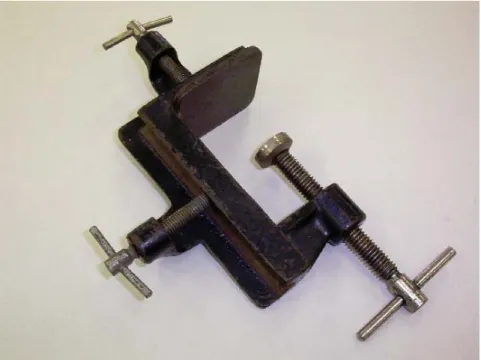
1. Clamp the large clamp to the end of the table so that the groove in the metal is vertical.
Figure 2: Large Clamp
2. Place the aluminum pole in the groove and tighten up the screw. 3. Clamp the pendulum clamp to the top of the Aluminum pole.
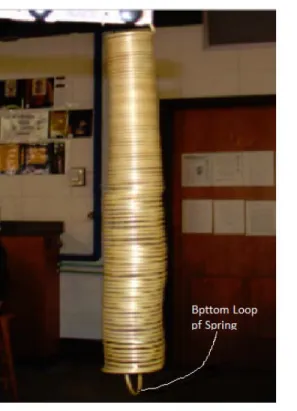
4. Loosen the black knob at the end of the Pendulum Clamp as we did in the Simple Pendulum Experiment and place the loop of the end of the spring behind the two metal fingers which are behind the black knob. Make sure the large diameter end of the spring is facing downward and the smaller diameter end is clamped to the Pendulum Clamp.
Figure 4: Spring attached to the Pendulum Clamp. Note the smaller diameter end of the spring is attached to the Pendulum Camp.
5. Record the position Xo, where the bottom loop of the spring hangs, along the 2 meter stick, when the spring is hung vertically without the mass hanger or any extra weights Make sure the zero end of the 2 meter stick is towards the ceiling.
6. Record the position of the spring on the 2 meter stick, Xi when different
amounts of mass are added on to the mass hanger. Do not to forget to include the mass of the mass hanger in your calculation of the total mass that is
hanging from the spring.
7. The difference between these two numbers Xi - Xo is then the elongation, d.
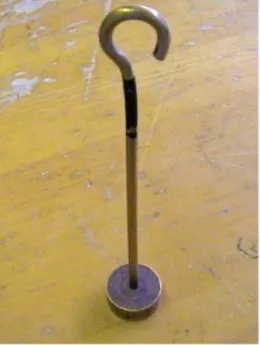
8. To start the experiment,hang a total mass of 200.0 grams from the bottom loop of the spring. Remember that the mass hanger has a mass of 50.0 g.
Figure 5 Mass Hanger
9. Measure the position Xi of where the bottom loop of the spring is now
stretched. Measure the position to the nearest tenth of a centimeter. Record in your data table.
10.Calculate the elongation d using equation (6). Convert to meters. Record in your data table
d = Xi
- X
o(6)
11.Repeat steps 8, 9 and 10 by adding 50.0 g at a time until a total mass of 450.0 grams is on the spring is reached.
Data Analysis:
1. Convert each mass in grams to (kg) and record them in the table. 2. Calculate each force F (N) using equation (2).
3. Calculate the elongation Using equation (6) 4. Calculate k from equation (5).
5. Find the average value of k. 6. Find the Range = kmax - kmin
7. Find standard deviation using the range. 8. Express your answer as (kaverage ± _____) N/m
9. Plot a graph of the force F in Newtons vs. the elongation d in meters on a piece of 10mm to the cm graph paper.
10. Using a straight edge, draw a best fit line through your data points. 11. Find the slope of your best fit straight lie. DO NOT USE ORIGINAL
DATA POINTS TO CALCULATE THE SLOPE!!!! The slope of the straight line is the spring constant.
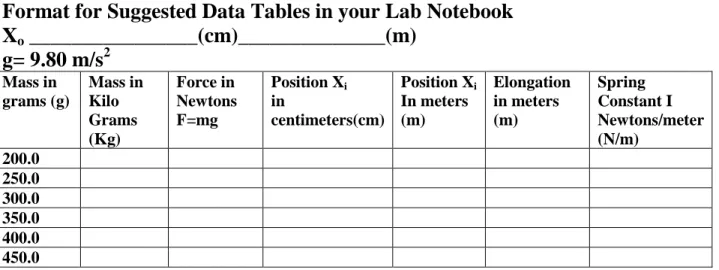
Format for Suggested Data Tables in your Lab Notebook Xo ________________(cm)______________(m)
g= 9.80 m/s2
Mass in grams (g) Mass in Kilo Grams (Kg) Force in Newtons F=mg
Position Xi
in
centimeters(cm)
Position Xi
In meters (m) Elongation in meters (m) Spring Constant I Newtons/meter (N/m) 200.0 250.0 300.0 350.0 400.0 450.0
Table of data for plot of Force vs. Elongation
Force in Newtons Elongation in Meters
Questions:
1.
What are the possible types of error in today’s experiment?
Give examples that apply to this experiment.
2.
How does the value of the spring constant differ between the
two methods used?
Lab Report Format
Your lab report for this experiment should have the following sections: 1. Title of experiment in center of the first page. Date to the left of the title.
Experimenters name with partners name(s) under experimenters name to the right of the title.
2. Apparatus
3. Original Data: Neatly filled out data pages.
4. Sample calculations: For this lab, an example (ONE) needs to be shown for each of the following calculations: Force F, elongation d, spring constant k, average spring constant kaverage, Standard Deviation of k, kstddev , and slope of your best fit line.
5. Results: State your results (in the form of a very short sentence). Make sure the numerical results are properly rounded and have the correct number of significant digits. Show the experimental values for k from both methods. Show the error in k by reporting the Standard Deviation in k.
6. Conclusions: Address the answers to the two discussion questions above. PROPER MATERIALS, ETC. FOR YOUR REPORTS
1. ALL data is to be recorded directly in your lab notebook. No scratch paper is to be used.
2. YOU ARE TO USE BLUE OR BLACK INK ONLY FOR RECORDING DATA AND DOING YOUR REPORTS IN YOUR NOTEBOOK.
3. REMEBER, ONLY THE FRONT OF THE PAGES IN YOUR LAB NOTEBOOK ARE TO BE USED FOR DOING YOUR LAB REPORT. I WILL NOT LOOK AT ANY
INFORMATIION ON THE BACKSIDE OF THE NOTEBOOK PAGES.
4. DO NOT TEAR OUT ANY PAGES FROM YOUR NOTBOOK.
1. DO NOT ERASE OR USE WHITEOUT FOR MISTAKES!!!!
All observations taken under the same experimental condition are equally valid and should be retained for analysis. Do not erase readings. If you must change a reading, draw a single line through it and then record the new measurement next to the old one.