POLITECNICO DI BARI
ENGINEERING FACULTY
DEPARTMENT OF MECHANICAL ENGINEERING
MECHANICAL ENGINEERING FINAL THESIS
PERFORMANCE OF A 50 MW
CONCENTRATING SOLAR POWER PLANT
Tutor:
Prof. Eng.
SERGIO CAMPOREALE
Author:
A
BSTRACT
The following document is the written memory of an engineering final thesis. The aim of this project is to study and simulate the viability of introducing a 50 MW solar power plant in the locality of Barletta, Italy.
The thesis is divided in two main parts: The first theoretical one which talks about solar energy and explains the two main processes with which profit can be taken from the sun: photovoltaic energy and thermal energy. It concentrates on the CSP technology to provide the reader with a good background on the subject. In the second part, the 50 MW plant is studied and simulated to arrive to the final design. During the simulation many variables and design parameters are taken into consideration to study their influence in the plant’s performance and to be able to choose the best possible combination in order to take the maximum electric power output from the designed plant. This simulation study is made possible by the GateCycle software. GateCycle is a software of the General Electric company that gives assistance in the performance prediction of thermal power plants, such as, combined cycle plants, fossil boiler plants, combined heat-and-power plants, advanced gas turbines as well as other types of energy systems.
In order to obtain accurate results from which to draw coherent conclusions it will be necessary to take into consideration Barletta’s annual weather conditions: Irradiation, wind, temperature and other factors. This information will be extracted from a database.
Table of contents
ABSTRACT ... 2
1. INTRODUCTION ... 4
2. SOLAR ENERGY ... 5
2.1. PHOTOVOLTAIC PLANTS ... 5
2.2. SOLAR COLLECTOR PLANTS ... 6
2.2.1. Sun irradiation ... 6
2.2.2. Non-concentrating solar power ... 7
2.2.3. Concentrating solar power ... 8
2.3. ENERGY STORAGE PLANTS ... 13
2.3.1. The Andasol project9,11 ... 15
2.4. SOLAR POWER:STATE OF THE ART. ... 18
2.5. SOLAR ENERGY IN ITALY ... 20
3. DESIGN AND SIMULATION OF THE 50 MW PLANT ...21
3.1. FUNCTIONING OF THE PLANT ... 21
3.1.1. Description of the thermodynamic cycle ... 23
3.2. CHARACTERISTICS OF THE SOLAR COLLECTORS USED FOR THE PLANT ... 27
3.3. TRACKING THEORY AND ORIENTATION OF CSP ... 28
3.4. CRITERIA FOLLOWED TO CHOOSE THE NUMBER OF REGENERATORS FOR THE PLANT ... 29
3.5. CRITERIA FOLLOWED TO CHOOSE THE PUMP EXIT PRESSURE ... 36
3.6. MACRO USED TO CALCULATE THE STEAM CYCLE EFFICIENCY ... 40
3.7. MACRO USED TO CALCULATE THE COLLECTOR’S EFFICIENCY ... 41
3.8. THE OVERALL PLANT EFFICIENCY ... 43
3.9. MACRO USED TO CALCULATE THE OIL FLOW RATES FOR A 50MW PLANT ... 43
3.10. MACRO USED TO CALCULATE THE COLLECTORS’ SURFACE ... 45
3.11. INFLUENCE OF ENVIRONMENT TEMPERATURE ON THE PLANT ... 47
3.12. INFLUENCE OF THE WORKING FLUID’S PRESSURE AND TEMPERATURE OF ENTRANCE ... 50
3.13. THE ADDITION OF A COOLING TOWER ... 55
4. THE PLANT’S FINAL DESIGN AND DESIGN POINT ...59
4.1. FUNCTIONING DESCRIPTION OF THE DESIGNED PLANT ... 64
5. CONCLUSIONS ...67
1. Introduction
The vast majority of the world’s population relies on energy. This demand for energy has been growing exponentially and on a yearly basis during the past decades, reaching a pace in which the earth’s energy resources are being consumed faster than the natural processes can replace them.
Together with industrial and technological progress of many countries has come a steep increase of fossil fuel consumption, which has unfortunately also caused negative consequences such as climate change, environmental pollution, depletion of natural resources and political disagreements amongst countries.
The time has come where the earth’s energy situation can be defined as critical, which might be one of the reasons why many countries are becoming more conscious on subjects related to energy consume, energy efficiency, climate change, investment in renewable energies, dependence on fossil fuels… This general concern has leaded some countries to establish CO2 limits, with contracts
and protocols such as the well-known Kyoto protocol, the intentions of which is to reduce the impact of the industrialized countries on climate change and natural resources, as well as to promote investment in higher energy efficiency and renewable energy systems.
As mentioned before, it is widely known that energy consume increases yearly and it is also a fact that fossil fuel reserves are limited and will eventually deplete. Therefore resorting to renewable and clean energies no longer remains a question. Many countries have investigated and invested on these types of energies; some of them, such as Sweden are already using up to 60% of sustainable energy for their overall electric power production1*.
This is one of the motivations of this thesis, to continue investigating and pursuing lower dependence on fossil fuels and more powerful sustainable energy systems. Italy is a country with a high percent of sun irradiation that can be used in many different ways; one of them is to produce thermal energy and electricity3.
This project intends to study the feasibility of introducing a 50MW solar power plant in the locality of Barletta, situated in the southern part of Italy where the sun’s irradiation is higher. The conclusions will be drawn from the results obtained by the simulation of the plant in a specific software called GateCycle.
2. Solar Energy
Solar energy is a highly renowned alternative energy type. The intensity of the sun’s irradiation that reaches the globe yearly is equivalent to 92 billion tons of petroleum2. A calculation from 2002 states that the energy received from the sun
in one hour was greater than the world used in one year3. Due to the latter, the
investigation of this source has lasted for years and continues to be a matter of great importance and relevance today.
There are two main ways of taking profit of the sun’s energy, which are photovoltaic plants and solar collector plants.
2.1. Photovoltaic plants
These types of plants employ solar panels that take profit from the sun’s light (photo) and convert it into direct current electricity (volts). This phenomenon takes place thanks to the light detection cells contained in the panels, which are made of photovoltaic material. The photovoltaic effect is closely related to the photoelectric effect in which electrons are ejected from a material upon energy exposure, such as light radiation. In the photovoltaic effect however, these
generated electrons are forced to flow within the material, which result in an electric current and the build up of voltage.
Due to the growing demand of renewable energy the photovoltaic (PV) market has considerably grown in the past years. In between 2004 and 2009 the photovoltaic capacity increased at an average annual rate of 60%, arriving to the global world capacity of 21GW1. In 2010 PV energy was generating electricity in more than 100
countries1.
However, photovoltaic plants are not yet profitable at industrial level. Although PV technology has developed substantially in the past years, the obtaining costs of its composing cells are still high. In addition to this, the efficiency with which these plants convert light into electricity is approximately 13%, a low level in relation to the surface that solar PV plants occupy.
2.2. Solar collector plants
Solar collector plants take profit of the sun’s electromagnetic waves and transform them into heat power, which is generally used to heat a liquid. These plants can be classified into two main categories: non-concentrating solar power and concentrating solar power (CSP), each of them is able to take profit from the sun’s irradiation in a different way.
2.2.1. Sun irradiation
Sun irradiation can be described as the flux of energy that the earth receives from the sun. This energy arrives as a set of waves at different frequencies, some of which are detectable by the human eye and another part, such as infrared rays, cannot be detected by the human eye.
Direct radiation: It is the unaltered radiation that comes directly from the sun without going through any changes on its way. It is characterized by its projection of a defined shade of those objects that intercept its path.
Diffuse radiation: Part of the sun irradiation that crosses the atmosphere is absorbed and reflected by clouds, dust particles in the air, trees, mountains, etc. As a consequence of this, this type of radiation goes in all directions. It does not produce shades on objects. Horizontal surfaces receive it more than vertical ones because they are exposed to the entire sky vault; whereas the vertical surfaces are only exposed to half of it.
Reflexed radiation: This is the radiation that is reflected by a surface. Its quantity depends on the surface’s reflection coefficient. In this case, it is vertical surfaces that receive all of the reflexed radiation, for they “look at” or are in the way of other surfaces, whereas horizontal surfaces that are not.
Global radiation: As its name indicates, this is the sum of the above-mentioned radiations.
There are many types of solar collectors in the market, each of which takes profit of different ways of sun radiation. Concentrating solar collectors, for instance, only capture direct radiation. Flat solar collectors, however, are able to capture direct and diffuse radiation. This is the reason why CSP plants are generally located in geographical areas where cloudiness and mist are not common.
2.2.2. Non-concentrating solar power
These types of plants are generally used to produce renewable heat power. The area to be heated is directly exposed to sunlight without mirrors, lenses or any types of auxiliary gadgets. This result in less complex models with low probabilities of failure but also results in plants with a lower efficiency level.
2.2.3. Concentrating solar power
These types of plants use gadgets such as lenses and mirrors to concentrate a large surface of sun exposure into a small area. This concentrated sunlight is then transformed into the heating of a particular fluid, which can be used directly to produce renewable heat, or can also be used to produce electricity.
In the case of electricity production the heated fluid will drive a heat turbine (usually a steam turbine) which mechanical power will be then transformed into electricity by an electrical power generator.
Today there are four main types of concentrating technologies: Parabolic trough, dish Stirling, concentrating linear Fresnel reflectors and solar power towers. Each one of them has its own advantages and disadvantages regarding its applications and their working. They also vary from one another in the way they focus and concentrate the sun’s irradiation.
2.2.3.1. Parabolic trough
These types of energy collectors consist on long, parabolic mirrors. Throughout the whole length of these mirrors, runs a tube that is positioned at the focal point of these parabolas. Sun irradiation is reflected by the mirror and, due to the implanted geometry, concentrated on the tube. The troughs can be aligned in a north-south position or an east-west position and they rotate during the day to track the sunlight during daylight hours. Inside the tube, at the focal point, runs a heat transfer fluid (usually oil) that absorbs the concentrated sun irradiation and rises its temperature up to 400°C. The heat of the high-temperature oil is used to produce steam, which will run through a steam turbine, producing mechanical power. The latter is then transformed into electrical power by an electrical power generator. As it will be
parabolic troughs also count with an energy storage system that stores heat power using molten salts.
2.2.3.2. Dish Stirling
Dish Stirling systems use a parabolic solar dish concentrator that tracks sunlight and focuses it into a cavity receiver. The working fluid in the receiver is heated to 250-700°C. This thermal energy is transformed into power by a Stirling engine generator. The use of this technology is of great interest because it provides the highest solar/electric efficiency among CSP technologies.
2.2.3.3. Fresnel reflectors
Fresnel reflector systems consist on numerous flat and thin mirrors that concentrate sunlight onto tubes through which runs a working fluid. This technology is similar to parabolic reflectors but differs from it in two main aspects; it presents a lower efficiency and therefore is simpler and lower-priced.
2.2.3.4. Solar power towers
This technology consists of a collector tower surrounded by an array of flat, movable mirrors (heliostats) that concentrate sunlight upon it. This generates thermal power; which heats water, transforming it in steam. Steam is used to run a turbine and therefore produce power.
2.2.3.5. Concentrating solar power technology
restrictions
As it has been stated before, concentrating solar power is a technology with great future prospects. Nevertheless, it presents a series of restrictions, some of which are yet to be solved.
The intermittency of its source, the sun. There can be casual, daily and seasonal; this can strongly vary depending on the geographical situation. This first restriction is, at the same time, one of the characteristics of solar energy and therefore cannot be solved. However, energy storage technologies are used in some cases to offset this effect.
Inflammability of the working fluid. In some solar plants, where oil is used as a working fluid, special precautions must be taken because fire could be started when the oil exceeds a certain temperature.
Toxicity of the working fluid. This is also a risk when working with oil as a working fluid.
Low efficiency rates are achieved in these types of plants. Partly because of the low temperature restriction that comes from the working fluid and also due to the difficulty to collect sunlight efficiently.
2.3. Energy storage plants
As previously mentioned, one of solar power technology’s restrictions or inconveniences is the unavailability of sunlight during certain periods of time such as night, cloudy days or even whole seasons in the case of some countries. Modern life however, requires continuous energy availability; therefore today’s energy systems should be prepared and designed to provide it.
When using solar energy power, one of the solutions to offset the effect of intermittency is to design hybrid plants that use sunlight when it is available and
fuel during non-solar periods. Nevertheless there are other solutions that do not require fossil fuel consumption and that can therefore deliver lower-priced and more ecological energy. These types of plants receive the name of energy storage plants.
There are numerous ways to store thermal energy: thermal mass systems, phase change materials, rechargeable batteries, high temperature storage using molten salts and pumped storage hydroelectricity, which uses the exceeding energy (when it is available) to pump water from a low level dam to a high level dam; this energy is then recovered by the release of water in the opposite direction, running through a hydroelectric power generator.
In the case that an energy storage system was introduced in this project’s scheme, the most adequate solution would have been energy storage using molten salts. The reason of this is that molten salts posses a high specific heat capacity and are not highly priced. Apart from this, they can stand high temperatures, compatible with a 50 MW power plant.
There are two main processes to load thermal energy storage systems: Indirect and direct systems. Direct systems use the same fluid in for storage and for the solar field whereas indirect systems use a different fluid for each purpose. One of the problems with direct systems is that molten salts solidify at temperatures in between 120 and 220°C and there is the risk that they may solidify in the solar field during the night.
Indirect energy storage systems are generally loaded by running hot working fluid from the solar field through heat exchangers. The cold molten salts, which come from the cold storage tanks, are also run through these same heat exchangers and consequently suffer a temperature rise. The heated molten salts are then reserved in a storage tank and subsequently used. Later, when there is energy demand during non-solar periods, the system operates in reverse: the molten salts transfer their reserved heat to the working fluid through the same heat exchangers. This creates steam once again, which activates the plant during hours without sunlight.
2.3.1. The Andasol project
9,11The first commercial parabolic solar power plant installed in Europe is Andasol1, which began to work in 2009 and is located near Gaudix; Andalusia, Spain. The project began with a 50 MW plant (Andasol1) and later on, two other plants were added, providing a total of 150 MW of electric power. Each one of these plants is able to provide clean energy to approximately 200,000 people.
The semi-arid climate and the high altitude (1,100m) make this area strategic for the location of parabolic trough plants, with a high annual direct insolation 2,200 kWh/m2year. Each of these plants is provided with a thermal energy storage
system, which consist of two tanks (ø = 36m, h = 14m), and that uses a molten salt mixture (60% sodium nitrate and 40% potassium nitrate). The molten salts absorb part of the available heat during the day and store it for the plant functioning during non-solar periods. A full reservoir is capable of holding up to 1,010 MWh of heat, which can make the turbine run at full load for about 7.5 hours. Each solar camp of the Andasol project occupies 510,120 m2 of surface and
consists of 156 cylindrical parabolic collectors; each of them has a four-meter width and a 150-meter length.
The cylindrical mirrors achieve an 82:1 solar concentration in the absorbing tubes and are provided with solar and inclination sensors in order to follow the sun’s rays during its natural path.
There are two main efficiencies to distinguish from in these types of plants:
radiation-steam efficiency and overall efficiency (radiation-electricity). Radiation- steam efficiency is the percentage of heat power that can be extracted from the arriving radiation from the sun and is approximately 43% for this plant. The overall efficiency on the other hand, is the percentage of electricity power that can be extracted from a unit of radiation power, which is 16% in the case of this plant. These plants operate 3,644 yearly hours at full load. The electricity produced during these hours prevents the emission of 152,000 tons of CO2 yearly.
There are other important parabolic trough solar thermal power plants working today, such as the Kramer Junction in California, which provides 354 MW of power and is the largest solar plant in the world. It is located in the California Mojave
desert, one of the areas with highest insolation in the United States. This plant is subdivided into nine other plants (SEGS I-SEGS IX). These are solar electric generating stations (SEGS) that use auxiliary natural gas boilers to provide backup capability during low and non-solar hours. The facilities occupy a surface of 6.5 km2.23
Nevertheless, for the fulfillment of this project is has been considered most interesting to focus on the Andasol project for its geographical closeness to Italy, where the realization of this thesis has taken place, and also because it provides the same power than the simulated plant.
The above image is a functioning scheme of an energy storage plant9:
2.4. Solar power: State of the art.
The development of technologies that take profit from the sun’s energy has been growing since the late 1990’s. However, the commercial use of concentrating solar power plants (CSP) did not start to arise until 1980. The PS10, installed in Andalusia; Spain, which was finished in 2005, was the first CSP plant to work in Europe, providing 11 MW of power.
It is said that using concentrating solar plants in less than one percent of the world’s deserts surface could generate enough electric power to satisfy the world’s demand of electricity12.
As for today, the solar thermal power industry is growing at a fast pace. In 2009 there were 1.2 GW of concentrated solar power under construction and another 13.9 GW announced to start working in 2014. In 2010, Spain was the country with most CSP projects, with 22 constructed projects for the equivalent of 1,037 MW. Today there are over 30 operational projects, which give a total electric power of 1282.65 MW. The largest constructed project is located in the Mojave Desert in California, USA; it counts with nine units and gives a total of 354 MW13.
Other large projects of 150, 100 and 50 MW are located in Spain, mainly in the south where the sun’s irradiation is higher. Other important projects of around 20 MW and 17 MW of power are built respectively in Morocco and Iran13.
Three World Bank projects for development countries have already been approved; they are solar thermal/combined cycle gas turbine plants that are expected to be located in Egypt, Mexico and Morocco13.
In Italy the Archimede solar power plant, located in Sicily, was finished in July 2010, with an operational power of 5 MW.
Today there are over 2,200 MW of concentrating solar power plants under construction, located mainly in Spain and the United States.
The following map was published by the trek-UK. Organization and it represents the world’s potential areas for CSP plant installation.
2.5. Solar energy in Italy
In 2009 Italy was the second largest market in photovoltaic technology in the world. Its first CSP plant, however, did not come until 201014.
Archimede is a concentrating solar power plant of 5 MW that uses energy storage. It is located in Sicily, Italy; it was unveiled the 14th of July 2010.
Archimede is the first CSP plant in the world to use molten salts as the heat transfer fluid and energy storage fluid. As it has been mentioned in previous sections, using molten salts as a working fluid has many advantages. To begin with, they can tolerate higher temperatures than oil (up to 550°C instead of the recommended 400°C of oil); which increases the overall efficiency and the profit power that can be taken from the plant. This feature also simplifies the plant design, since no water/oil heat exchangers need to be designed for it. Molten salts are cheaper and involve less toxicity risks than oil. Italy’s
development of this technology has opened the doors to other countries in sunny geographical areas, such as Northern Africa, Australia, Middle East and the U.S. to take profit from it and its advantages14.
ANEST, the Italian CSP association, states that by the year 2020 Italy could be giving a power of 3 to 5 thousand MW with CSP plants. This could create numerous job placements, as well as an industrial know-how in Italy. It seems that the Archimede project has just been a start in Italy’s CSP plants14.
3. Design and simulation of the 50 MW plant
This section of the project focuses on the design process of the 50 MW plant. This process, as well as the choosing of the used equipment and the values of the different variables and parameters of the plant, is done comparing the output data results in the GateCycle simulation of the plant.
The designed plant is a two-turbine concentrating solar power plant with parabolic trough collectors. It uses the Dowtherm A oil as the working fluid for the collectors and water/steam for the functioning of the cycle.
3.1. Functioning of the plant
Fig 10. is the scheme of a one regenerator CSP plant. As it can be seen in the image, the plant counts with two turbines: (1) and (2); one regenerator: (3); two superheaters: (4) and (5); an evaporator: (7); one economizer: (8); two splitters: (9) and (10); a condenser: (11) and a pump: (12).
In order to explain the plant’s functioning in the clearest way it is important to bear understand that this plant works with two different working fluids: oil and steam/water.
On the one hand, oil, which is represented in red lines in the image, is responsible of absorbing the heat power that is produced by irradiation at the collector. Once it passes through it, it enters the plant at a high temperature, typically in between 300 and 400 Celsius degrees. As shown in the image above, when entering the system it first passes through the superheaters: (5) and (6), where it exchanges heat with the steam produced by the evaporator, rising the steam’s temperature before it enters the turbine. The oil then passes through the evaporator (7) where it again gives away part of its heat to water, for its transformation to steam. When passing through the last piece of equipment: the economizer (8); the oil exchanges once again exchanges heat, giving it this time to liquid water for the increasing of its temperature at the entrance of the evaporator. This helps in the improvement of the power given by the plant and the plant’s efficiency. At this point the oil exits
the plant and goes back to the collector; where it receives power from the sun and is gets heated and ready to restart the process.
Water, on the other hand, transforms into steam with the heat power received by oil. The resultant reheated steam passes through turbines (1) and (2), where its heat power is transformed into mechanical and then electrical power. Depending on the number of regenerators used on the plant, there are extractions made from the turbines; which run through the regenerators and give away heat to cool water that also passes through them. Regenerators (3) are heat-exchanging devices that permit the heat exchange between steam coming from turbines and the cool water that comes out from the pump; its use can significantly increase the efficiency of the cycle, as well as the power given by the plant. This will be explained in further detail in the subsequent sections. Another very important device in the plant is the condenser (11). The remaining steam from the turbines, as well as the remaining hot water from the regenerators, is cooled here. In some cases, condensers cool the incoming water by making it exchange heat with water from rivers or the sea; which has a lower temperature. In other cases, when water from these sources cannot be used, condensers are connected to cooling towers, which cool the water by two different methods: making it exchange heat with environment air and by the partial evaporation of the incoming water.
After passing through the condenser, the resulting water goes into a pump, where it suffers a pressure increase. At this pressure it enters the regenerators, followed by the economizer, where it increases its temperature. After this the heated water enters the evaporator where it changes into steam. It then runs through the superheaters and enters the turbine in the form of heated steam. The process is repeated in a closed circuit.
3.1.1. Description of the thermodynamic cycle
The thermodynamic process followed by this plant is named Rankine cycle. It converts heat into work and is mostly used in power plants. This cycle generates approximately an 80% of the electric power used throughout the world.
3.1.1.1. The four processes of the Rankine cycle
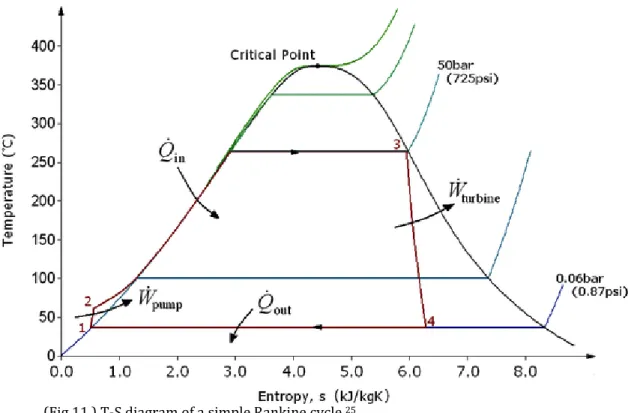
Fig. 11. is the T-S diagram of a simple Rankine cycle. It consists on four processes: 1-2, 2-3, 3-4 and 4-1.
Process 1-2: During this process water is pumped from low pressure to high pressure.
Process 2-3: In this part of the cycle, the high-pressure working fluid enters a boiler where it receives heat power and transforms into dry steam.
Process 3-4: The saturated dry steam expands by running through a turbine; therefore its temperature and pressure decrease notoriously. Some condensation may occur in this process.
Process 4-1: The resulting fluid that exits the turbine passes through the condenser where it is fully transformed into saturated water at a constant temperature.
There are some variations that can be made to the Rankine cycle in order to increase its efficiency: the adding of regenerators, economizers or superheaters.
Rankine cycle with superheat:
The efficiency of the steam turbine and, therefore the cycle, is limited by the water droplet formation in the expansion of the fluid at the exit of the turbine. Water droplets could eventually cause pitting and erosion to the turbine blades. A good solution to overcome this problem is to superheat the steam and hence move state 3 to the right; which produces a dryer steam at the exit of the turbine.
Rankine cycle with reheaters:
Two turbines working in series are used when reheating is applied. The steam that exits the turbine passes through another heat exchanger and is reheated to pass through the second low-pressure turbine. This increases the efficiency of the cycle because more steam passes through the turbines at a higher temperature. Apart from this, steam condensing is avoided at the exit of the turbine.
Rankine cycle using regenerators:
Two turbines working in series are also used when applying regeneration. Part of the steam that exits the first turbine is sent to the regenerator where it gives part of its heat to the cooled water that exits from the condenser. This increases the temperature at which the water enters the boiler. Therefore, with the same energy used by the boiler it is possible to produce steam at a higher temperature which increases the power produced by the turbines and hence the efficiency of the cycle.
(Fig 13.) T-S diagram, Rankine cycle with reheaters.
(Fig 14.) T-S diagram, Rankine cycle with regenerators.
In the simulation of the designed plant, several parameters are examined to study their influence in the plant’s performance. Being that the plant will have two turbines working in series, the number of regenerators and therefore extractions from the turbines need to be examined and decided. In addition to this, the influence of the pump exit pressure will also be studied to decide the optimal pressure. The influence of the environment temperature in the performance of the plant, as well as the inlet oil temperature to the plant will also be studied and fixated for the design point.
3.2. Characteristics of the solar collectors used for the
plant
The collectors used in this plant are parabolic trough collectors. As its own name indicates, these types of collectors have a parabolic geometry, which concentrates the sun’s rays in the focal point. These types of collectors are constructed as long parabolic mirrors, which have a thickness of approximately four millimeters and are typically coated by silver or polished aluminum to maximize the reflectance of
the incoming rays. The sunrays are reflected on this mirror and concentrated on a tube; which receives the name of Dewar tube.
The Dewar tube, also called absorber pipe is made of stainless steel and should resist the mechanical and thermal stress it will suffer with the running of the oil throughout its length. A coating treatment made of black crome or cerment is applied to its external surface; this coating promotes a high absorbance of the incoming spectral irradiation and has a very low emitting coefficient for infrared rays. Apart from this the Dewar tube is protected with an isolating glass tube, treated with antireflection coatings both in the inside and outside surfaces. This treatment helps maximize the quantity of radiation received by the Dewar tube and therefore, on the heat received by the oil. Vacuum is created between the steel tube and the glass covering tube to prevent heat escape due to the convection process.25
3.3. Tracking theory and orientation of CSP
As mentioned previously, concentrated solar power plants use the direct irradiation from the sun to produce energy. For this reason these types of plants need to be oriented appropriately toward the sun. Solar trackers are devices used
day in order to “follow” the sun’s path across the sky and therefore receive the maximum direct irradiation from it. To gather energy effectively, solar collectors should be positioned twenty degrees perpendicular to the sun on either side. Tracking systems are classified by their motions; they can rotate in one or two axis. Due to the length of parabolic trough collectors, these only rotate in one axis. In these types of plants, the mirrors are usually oriented in a north-south direction to maximize their efficiency in the absorbing of sunlight. Alternatively to this, however, is the possibility of orienting the mirrors in an east-west direction; this minimizes the irradiation-thermal efficiency of the collectors but has the advantage that the tracking system does not require tracking motors and only needs to be re-aligned with the change of seasons.
Being that the power produced by the designed plant is high, the troughs will be oriented in a north-south direction in order to obtain the maximum irradiation-thermal efficiency possible.
3.4. Criteria followed to choose the number of
regenerators for the plant
It is theoretically known that the number of regenerators increases the efficiency of the cycle. However, increasing the number of regenerators also entails a more complex and highly priced plant. Therefore there is the need to find a balance between efficiency and technical-economical resources. In order to do so the plant was simulated using: one, two and three regenerators. The hypotheses for this simulation were the same for all three cases and are stated on the table beneath.
Oil properties
Oil inlet temperature 673 K
Oil outlet temperature 530 K
Air flow rate 10 kg/s
Oil flow rate 5.38 kg/s
Oil inlet/outlet pressure 1 bar
Water/Steam properties in the economizer
Water temperature in the inlet of
economizer 453 K
Water pressure in the inlet of economizer
50 bar
As it can be noted from table /, the assumed air-flow rate has been 10 kg/s. The real circulating air-flow value that is needed for the production of the plant’s 50 MW will be calculated in subsequent sections. In this section however, it was only important to study the influence of the number of regenerators on the plant’s power, efficiency and general performance. It will also be noted in the tables beneath that the outlet power is much lower than the 50 MW of the design point; this is due to the initial air-flow assumption which will be later on changed to match the desired outlet power.
The following are the schemes of the one, two and three regenerator designs:
(Fig 18.) Two-regenerator scheme.
As it has been mentioned before, the plant works with oil as the working fluid. However, when simulating with GateCycle it is simpler to use air as the working fluid and make all the calculations with it, converting later on the airflow rate to oil flow rate using the following equation:
air , p air oil , p
oil c m c
m
Being and at the working
temperatures. This value for the cp,oil, has been extracted from the Dowtherm A
datasheet provided by the Dow Chemical company.
Apart from this, in the simulations using two and three regenerators there were extractions made from the low-pressure turbine. A criterion was necessary to decide the pressures at which to make these extractions. The procedure that was followed is the following:
Simulation using two regenerators:
First of all it is necessary to find h1, the enthalpy in between the enthalpy of water
the entrance of the economizer (hb) and the enthalpy of the water at the entrance
of the regenerator (ha).
After this the corresponding saturation pressure is found using the steam tables. This isP1, the extraction pressure of the low-pressure turbine.
Simulation using three regenerators:
The same procedure is followed; only in this case there are two extractions to be made from the low-pressure turbine.
Main extraction:
Once again the saturation pressure is found using the steam tables and assigned as the main extraction pressure.
Secondary extraction
The corresponding pressure,
The output from the simulations is classified by the number of regenerators used.
Simulation using one regenerator:
Steam cycle
Shaft power 0.52 MW
Net power 0.51 MW
Steam cycle efficiency 34%
Steam properties in the superheaters
Steam pressure in the outlet of the first
superheater 50 bar
Steam temperature in the outlet of the
first superheater 653 K
Steam temperature in the inlet of the
first superheater (outlet of evaporator) 537 K Steam pressure in the outlet of the 10 bar
Steam temperature in the outlet of the
second superheater 653 K
Steam properties in the high pressure turbine
Steam pressure in the outlet of the high
pressure turbine 10 bar
Steam temperature in the outlet of the
high pressure turbine 468 K
Steam properties in the low pressure turbine
Steam pressure in the outlet of the low
pressure turbine 0.05 bar
Steam temperature in the outlet of the
low pressure turbine 306 K
Simulation using two regenerators:
Steam cycle
Shaft power 0.55 MW
Net power 0.54 MW
Steam cycle efficiency 36%
Steam properties in the superheaters
Steam pressure in the outlet of the first
superheater 50 bar
Steam temperature in the outlet of the
first superheater 653 K
Steam temperature in the inlet of the
first superheater (outlet of evaporator) 537 K Steam pressure in the outlet of the
second superheater 10 bar
Steam temperature in the outlet of the
second superheater 653 K
Steam properties in the high pressure turbine
Steam pressure in the outlet of the high pressure turbine
10 bar Steam temperature in the outlet of the
high pressure turbine 468 K
Steam properties in the low pressure turbine
Steam pressure in the outlet of the low
pressure turbine 0.05 bar
Steam temperature in the outlet of the
low pressure turbine 306 K
Steam pressure in the extraction of the
low pressure turbine 1.4 bar
Steam temperature in the extraction of
the low pressure turbine 446 K
(Table 2.) Output for the one-regenerator case
Simulation using three regenerators:
Steam cycle
Shaft power 0.56 MW
Net power 0.55 MW
Steam cycle efficiency 37%
Steam properties in the superheaters
Steam pressure in the outlet of the first
superheater 50 bar
Steam temperature in the outlet of the
first superheater 653 K
Steam temperature in the inlet of the
first superheater (outlet of evaporator) 537 K Steam pressure in the outlet of the
second superheater 10 bar
Steam temperature in the outlet of the
second superheater 653 K
Steam properties in the high pressure turbine
Steam pressure in the outlet of the high
pressure turbine 10 bar
Steam temperature in the outlet of the
high pressure turbine 468 K
Steam properties in the low pressure turbine
Steam pressure in the outlet of the low
pressure turbine 0.05 bar
Steam temperature in the outlet of the
low pressure turbine 306 K
Steam pressure in the first extraction of
the low pressure turbine 2.92 bar Steam temperature in the first
extraction of the low pressure turbine 517 K Steam pressure in the second extraction
of the low pressure turbine 0.55 bar Steam temperature in the second
extraction of the low pressure turbine 366.19
3.5. Criteria followed to choose the pump exit pressure
In order to verify how the pump pressure influences the power, the efficiency andusing a pump pressure of 25, 50 and 100 bar. The results are shown in the tables beneath.
25 bar increase
Steam cycle
Shaft power 0.58 MW
Generator power 0.57 MW
Net power 0.57 MW
Steam cycle efficiency 31%
Oil properties
Oil inlet temperature 673 K
Oil outlet temperature 530 K
Oil flow rate 5.38 kg/s
Oil inlet/outlet pressure 1 bar
Water/Steam properties in the economizer
Water temperature in the inlet of
economizer 453 K
Water pressure in the inlet of
economizer 25 bar
Steam properties in the superheaters
Steam pressure in the outlet of the first superheater
25 bar Steam temperature in the outlet of the
first superheater 653 K
Steam temperature in the inlet of the
first superheater 497 K
Steam pressure in the outlet of the second superheater
10 bar Steam temperature in the outlet of the
second superheater 653 K
Steam properties in the high pressure turbine
Steam pressure in the outlet of the high
pressure turbine 10 bar
Steam temperature in the outlet of the
high pressure turbine 541.8 K
Steam properties in the low pressure turbine
Steam pressure in the outlet of the low
pressure turbine 0.05 bar
Steam temperature in the outlet of the
low pressure turbine 306 K
50 bar increase
Steam cycle
Shaft power 0.52 MW
Generator power 0.51 MW
Net power 0.51 MW
Steam cycle efficiency 34%
Oil properties
Oil inlet temperature 673 K
Oil outlet temperature 530 K
Oil flow rate 5.38 kg/s
Oil inlet/outlet pressure 1 bar
Water/Steam properties in the economizer
Water temperature in the inlet of
economizer 453 K
Water pressure in the inlet of economizer
50 bar
Steam properties in the superheaters
Steam pressure in the outlet of the first
superheater 50 bar
Steam temperature in the outlet of the
first superheater 653 K
Steam temperature in the inlet of the
first superheater (outlet of evaporator) 537 K Steam pressure in the outlet of the
second superheater 10 bar
Steam temperature in the outlet of the
second superheater 653 K
Steam properties in the high pressure turbine
Steam pressure in the outlet of the high
pressure turbine 10 bar
Steam temperature in the outlet of the
high pressure turbine 468 K
Steam properties in the low pressure turbine
Steam pressure in the outlet of the low
pressure turbine 0.05 bar
Steam temperature in the outlet of the
low pressure turbine 306 K
100 bar increase
Steam cycle
Shaft power 0.32 MW
Generator power 0.31 MW
Net power 0.31 MW
Steam cycle efficiency 32%
Oil properties
Oil inlet temperature 673 K
Oil outlet temperature 530 K
Oil flow rate 5.38 kg/s
Oil inlet/outlet pressure 1 bar
Water/Steam properties in the economizer
Water temperature in the inlet of
economizer 507.91 K
Water pressure in the inlet of
economizer 100 bar
Steam properties in the superheaters
Steam pressure in the outlet of the first
superheater 100 bar
Steam temperature in the outlet of the
first superheater 653 K
Steam temperature in the inlet of the
first superheater (outlet of evaporator) 584 K Steam pressure in the outlet of the
second superheater 30.5 bar
Steam temperature in the outlet of the
second superheater 653 K
Steam properties in the high pressure turbine
Steam pressure in the outlet of the high
pressure turbine 30.5 bar
Steam temperature in the outlet of the
high pressure turbine 508 K
Steam properties in the low pressure turbine
Steam pressure in the outlet of the low pressure turbine
0.05 bar Steam temperature in the outlet of the
low pressure turbine
306 K
As it can be observed from the tables above, the best solution is to use a 50 bar pressure increase in the pump. It can also be seen that the power diminishes with the increase of the pump’s pressure; this is due to the fact that the necessary power for the pump to propel water is taken from the power produced by the plant and the higher the pump pressure increase is the more power is needed to take the liquid to this pressure.
3.6. Macro used to calculate the steam cycle efficiency
Macros are a set of tools that help the user to elaborate different types of calculations and carry out relationships between the cycle system and the equipment data. They are algorithmic alternatives to “hand calculations”. To create a macro it is necessary to know which variables will be needed and which parts of the simulation equipment will be accessed. The GateCycle software displays a wide set of variables from the simulation equipment. However, in some cases it is also necessary to create user-defined-variables that can be relationships or calculations using the GateCycle variables. There are two types of macros: Set macros and Control macros, they will be explained in further detail throughout the project.In order to calculate the steam cycle efficiency it was necessary to use a Set macro. These types of macros assign a mathematical expression to a user-defined variable. In this case a variable under the name of “steam cycle efficiency” was created and assigned to the expression:
air , out air , in cycle
h
h
m
power
_
cycle
_
Net
3.7. Macro used to calculate the collector’s efficiency
Another Set macro will be used to calculate the collector efficiency. The collector’s efficiency depends on various technical parameters. In the case of this project it has been decided to use a simplified expression26 that depends only on the sun’sdirect irradiation (I), on the collector plane and on the temperature difference between the environment and the mean collector temperature ( T).
Assuming a North-South orientation of the plant’s mirrors, the collector is oriented horizontally at noontime and therefore the value of I corresponds to the direct radiation on the horizontal plane, which is available from solar maps.
According to the PVGIS solar map22, the site of Barletta (41.32N, 16.28E) receives
a global radiation of 799 W/m2, and a diffuse radiation of 205 W/m2. The
I T 0003 . 0 I
T 039 . 0 T 000045 .
0 75 . 0
2
collector
This time it will be necessary to create several user-defined-variables.
I: Barletta’s sun irradiation at design point (600 W/m2)22
Tmc: The mean temperature in the collector.
2 T T
Tmc inlet,collector outlet,collector Tamb: The mean temperature in Barletta at design point (20°C)22
ΔT: The temperature difference between the environment and the mean collector temperature T Tmc Tamb
3.8. The overall plant efficiency
Once the efficiency for the collector has been calculated and also that the steam cycle efficiency for the three cases (one, two and three regenerators); it is possible to calculate the global plant efficiency.
collector cycle
global
cycle collector global
One regenerator 34% 67% 23%
Two regenerators 36% 67% 24%
Three regenerators 37% 67% 25%
3.9. Macro used to calculate the oil flow rates for a 50
MW plant
As it has been explained previously, some hypothesis were made in order to study how the plant worked and how the regenerators affected the cycle efficiency, power, temperatures and other factors. For instance, with the hypotheses made, the installation using three regenerators gives a net power of 0.55 MW, while the one using one regenerator gives 0.52 MW; this helps to give a general idea of the influence of the number of regenerators in the plant. However, the plant that is being designed should give a fix power of 50 MW. In order to calculate the real oil flow rates a control macro was utilized.
Macros are a set of tools that help the user to elaborate different types of calculations and carry out relationships between the cycle system and the equipment data. They are an algorithmic alternative to “hand calculations”. To create a macro it is necessary to know which variables will be needed and which parts of the simulation equipment will be accessed. The GateCycle software displays a wide set of variables from the simulation equipment. However, in some cases it is also necessary to create user-defined-variables that can be relationships or calculations using the GateCycle variables. There are two types of macros: Set macros and Control macros, they will be explained in further detail throughout the project.
Control macros are used when the desired variable to be changed is an output variable, which is the case of the net cycle power. They set the chosen output variable to the desired value by changing a defined input variable. In this case it will set the net cycle power to 50 MW by changing the airflow rate from 10 kg/s, which was the initial hypothesis, to the corresponding value.
The obtained results for the three cases (one, two and three regenerators) are the following:
Power
(MW)
Air flow rate
(kg/s)
Oil flow rate
(kg/s)
One regenerator 50 981.73 528.62
Two regenerators 50 927.86 499.62
Three regenerators 50 912.37 491.28
Power
(MW)
Air flow rate
(kg/s)
Oil flow rate
(kg/s)
One regenerator 50 981.7 528.6
Two regenerators 50 927.9 499.6
Three regenerators 50 912.4 491.3
3.10. Macro used to calculate the collectors’ surface
Because the dimensions in which a solar plant are limited and sometimes occupying a larger surface also entails a highly priced plant, a crucial parameter in the designing stage is to determine the surface that it will occupy.The efficiency expression for the collectors is:
I T 0003 . 0 I T 039 . 0 T 000045 . 0 75 . 0 2 collector
However, another expression that is always valid for efficiency in solar collectors is:
I A
Q
collector
Being I the sun irradiation, A the overall surface and Q the heat power transmitted by the collectors:
) h h
( m
Q out,coll in,coll
It is important to bear in mind that hout,coll is the enthalpy at which the oil enters
the plant, in the same way that hin,coll is the enthalpy at which the oil exits the
system. The collectors give this energy difference.
A set macro was used to determine the surface occupied by the plants with one, two and three regenerators.
Qcollectors (MW) A (m2)
global
One regenerator 147.8 368,4 23%
Two regenerators 139.2 346,3 24%
Three regenerators 136.8 340,2 25%
3.11. Influence of environment temperature on the
plant
Once that the influence of the number of regenerators has been studied it is time to study how other factors affect the designed plant. Environment temperature is directly related to the overall plant efficiency and, therefore to the power of the plant. In the previous study a temperature of 20°C was used as the design point temperature. Nevertheless, it is important to study what happens when this temperature is different from the design point and how strongly it affects the plant’s performance. This study will be fulfilled using the one-regenerator scheme. In order to do so a study will be made using different temperature values: 0, 5, 10, 15, 20, 25, 30, 35, 40 and 45°C.
It is also important to study how the environment temperature affects the power produced by the plant. The overall plant efficiency, which was calculated before can also be defined as the electrical power produced, divided by the power that comes from the sun:
Environment temperature vs. Collector efficiency
65.5 66 66.5 67 67.5 68
0 5 10 15 20 25 30 35 40 45 50
Environment temperature [°C]
C ol le c tor e ff ic ie nc y [ % ]
Environment temperature vs. Global plant efficiency 22.4 22.5 22.6 22.7 22.8 22.9 23 23.1 23.2
0 5 10 15 20 25 30 35 40 45 50
Environment temperature [°C]
G lo b a l p la n t e ff ici e n cy [% ]
A
I
P
P
P
elect sun elect collector cycle globalBeing that the total surface covered by the plant does not change throughout the lifetime of the plant and that the sun irradiation is considered constant for this part of the study, the following graphic shows how the temperature affects the power given by the plant:
As it is shown on the graphics and can also be deduced from the collector efficiency expression, a temperature rise entails also an efficiency increment. However, a 45°C temperature difference affects the overall plant efficiency in approximately a 0.6%. It is similar in the case of the power given by the plant. A difference of 1.4 MW can be noticed when varying the temperature from 0 to 45 °C, which approximately represents a 0.4% of the total power. Therefore it can be
Environment temperature vs. Plant power
49.4 49.6 49.8 50 50.2 50.4 50.6 50.8 51 51.2
0 5 10 15 20 25 30 35 40 45 50
Environment temperature [°C]
Pl a n t p o w e r [MW ]
considered acceptable to use the design point temperature in the simulation of the plant.
3.12. Influence of the working fluid’s pressure and
temperature of entrance
Until now the temperature and the pressure of entrance of the working fluid have been considered constant and equal to the initial hypotheses estimations. However, in the same way it was important to study how the environment temperature affected the overall efficiency and the power given by the plant, it is also important to verify how the pressure and temperature influence the plant’s performance.
As it can be seen in the oil’s technical data sheet, the temperatures it can reach when working in the plant are limited by the recommended maximum and minimum, established to avoid reaching the auto ignition or the freezing point.
Oil inlet temperature vs. Plant power
30 35 40 45 50 55
360 365 370 375 380 385 390 395 400 405
Oil inlet temperature [°C]
Pl
a
n
t
p
o
w
e
r
[MW
Oil inlet temperature vs. Steam cycle
efficiency
30.00 31.00 32.00 33.00 34.00 35.00360 370 380 390 400 410
Oil inlet temperature [°C]
St e a m cyc le Ef fi ci e n cy [% ]
Oil inlet temperature vs. Global plant
efficiency
21.90 22.00 22.10 22.20 22.30 22.40 22.50 22.60 22.70360 365 370 375 380 385 390 395 400 405
Oil inlet temperature [°C]
G lo b a l p la n t e ff ici e n cy [% ]
Oil inlet temperature vs. Oil outlet
temperature, superheater outlet
temperature
200 250 300 350 400360 370 380 390 400 410
Oil inlet temperature [°C]
T e mp e ra tu re [ °C
] Oil inlet temperature
vs. Oil outlet temperature
Oil inlet tempearture vs. Superheater outlet temperature
Oil inlet temperature vs. Collector
efficiency
66.80 66.90 67.00 67.10 67.20 67.30 67.40 67.50 67.60 67.70360 365 370 375 380 385 390 395 400 405
Oil inlet temperature [°C]
C o ll e ct o r e ff ici e n cy [% ]
As it can be seen in the graphics above, the oil temperature of entrance is a determinant and influential variable in the plant’s performance. Before explaining the significant results in the power and the efficiency it is important to explain the
Oil inlet temperature vs. Water pressure and the Oil inlet temperature vs. Superheater outlet temperature graphs. These are all input variables that were altered in the following way for the correct functioning of the system:
Water pressure: One bar was increased in the pump pressure for every 5-Celsius degree increase in the oil inlet temperature.
Superheater outlet temperature: The superheater outlet temperature was modified in such way that it was always 20-Celsius degrees lower than the oil inlet temperature and therefore was increased in 5-Celsius degrees for every 5-Celsius degree increase in the oil inlet temperature.
Oil inlet temperature vs. Water pressure
42 43 44 45 46 47 48 49 50 51
360 365 370 375 380 385 390 395 400 405
Oil inlet temperature [°C]
W a te r p re ssu re [ b a r]
The output was the oil outlet temperature, the plant power and the efficiencies. As it can be seen in the Oil inlet temperature vs. Oil outlet temperature graphic, no significant changes occur in the oil outlet temperature when changing the oil inlet temperature and therefore the oil outlet temperature will be considered constant. In the case of the power given by the plant, one of the variables of greater relevance in this study, it can be seen that it increases when increasing the oil inlet temperature. On the one hand, by increasing the temperature of entrance the enthalpy of entrance is also increasing and therefore, in simple words, it can be said “more energy is entering the system”. Whereas, on the other hand, and as it was mentioned before, the oil outlet temperature remains practically constant and therefore “the same energy is exiting the system”. This entails an increase in the energy that stays in the system and therefore in the plant’s power. It can also be seen from the point of view that when increasing the oil inlet temperature the superheater temperature of exit also increases and therefore the steam that arrives to the turbines arrives with a greater amount of enthalpy, which causes the turbines to give a greater power.
Another important matter in this study is the overall efficiency. As it can be seen from the Oil inlet temperature vs. Global plan efficiency graphic, the plant’s overall efficiency increases when increasing the oil’s temperature of entrance. Knowing that the overall efficiency is the produced power of the plant divided by the irradiation power coming from the sun (
A I P sun _ the _ from _ Power power _ oduced Pr global )
and being that both the irradiation (I) and the Surface of the plant (A) have remained constant, the efficiency increase could have also been deducted by the increase in the plant’s power. There is another interesting perspective from which to study this increase, which is from the fact that the global efficiency is also the product between the cycle efficiency and the collector’s efficiency. The first one, as it can be seen in the Oil inlet temperature vs. Cycle efficiency graphic, increases when increasing the oil’s temperature of entrance; whereas the collector’s efficiency decreases when increasing the oil’s inlet temperature, as it is shown in the Oil inlet temperature vs. Collector efficiency graphic. The collector’s efficiency
does not decrease so steeply, in such a way that the product of both efficiencies increases when increasing the oil’s temperature of entrance.
The same study was done varying the pressure of entrance from 100 bar to 40 bar by 10 bar increments and it was verified that no relevant changes occur.
3.13. The addition of a cooling tower
A cooling tower is a heat rejecting device that extracts the unwanted heat from a system
resources to cool the water stream are available nearby or, in the cases where the water stream is cooled with water from a river or the ocean, there is a temperature outlet limit which can not be exceeded. In those cases the condenser is connected to a cooling tower. There are two main types of cooling towers: wet cooling towers and dry cooling towers. Wet cooling towers have a consumption of water that is approximately equal to the steam flowrate that is condensed in the condenser. Dry cooling towers do not consume water at all.
In wet cooling towers water is cooled by exterior air through two simultaneous processes: latent heat transfer and sensible heat transfer. In other words, water temperature is decreased partly because of heat exchange with air (sensible heat transfer) and partly because of evaporation of water droplets (latent heat transfer). About 80 percent of the cooling process is due to vaporization and the other 20 percent is due to heat exchange.
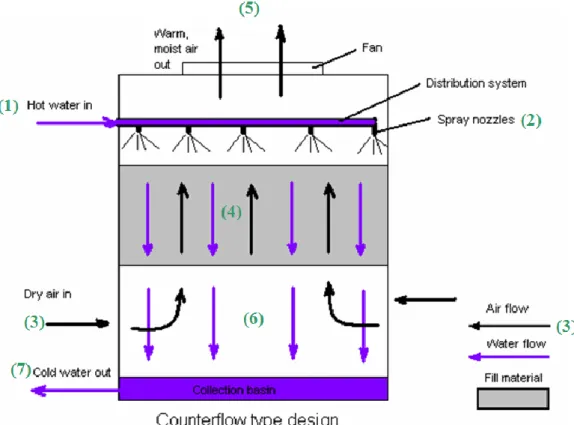
Figure 21 is a scheme of a wet cooling tower, which helps in the understanding of its functioning17. The water stream to be cooled enters the cooling tower at (1) and is sprinkled into water droplets at (2), the spray nozzles. In a parallel way, dry air enters the tower from beneath at (3) and is propelled upward, as we can see from the figure in (4). When dry air is travelling up it comes in contact with the sprinkled water droplets which begin to evaporate and humidify this dry air, transforming it into saturated air at its exit from the tower (5). This is where both heat transfer processes occur. When water is in contact with cool ambient air its temperature decreases because of sensible heat transfer with air. In a parallel way, the energy needed by the water droplets to evaporate is taken from the water and therefore this water is cooled. The cooled water descends (6), is collected at the collection basin and is then returned to the system (7).
In dry cooling towers, on the other hand, no water evaporation takes place and therefore are less effective devices than wet cooling towers, apart from the fact that the cooling
potential of a wet surface is greater than the one with a dry surface. Dry cooling towers are sometimes used when there is a lack of water resources.
The geographical situation of the designed plant permits the use of a wet cooling tower. Therefore the scheme including a cooling tower was studied to contemplate the situation in case it is needed.
The obtained results, however, are not as beneficial as they would be searched to be. The adding of the cooling tower entails a slight decrease in the plant’s power, of about 10 kW but a more important decrease in the steam cycle efficiency. The cycle’s efficiency diminishes in approximately 10 per cent; it goes from 33.8% when the cooling tower is not used and a 30.7% when the tower is added to the scheme. This is due to the fact that, in order for it to function properly, the condenser outlet pressure is necessarily increased when using a cooling tower. This also entails an increase in the condenser’s outlet temperature. The pressure rise goes from 0.05 bar to 0.2 bar, whereas the temperature increase goes from 306.05 K to 333.24 K; 300 and nine per cent respectively.
Apart from this, the ventilation system that propels the humid air to the exit of the cooling tower is driven by the power produced by the plant and therefore this is also one of the reasons why it diminishes.
4. The plant’s final design and design point
After studying the influence of the different parameters and input variables in the plant’s performance it is time to decide the best solution and the most adequate scheme for the designed plant.
To begin with, the scheme using three regenerators is considered the most adequate for the plant. It provides a significant decrease in the occupied surface, compared to the one and two-regenerator scheme. Apart from this, as it has been mentioned in previous sections of the project, it provides the plant with the highest efficiency and power combination.
The working fluid to be used is the DOWTHERM A oil from the Dow Chemical Company. It is one of the best working fluid oils that can be found in the market today. As a matter of fact, it is the working fluid used in the Andasol project. The technical data of this fluid is stated below.