Discovery, Innovation and Science in the Historic Environment
Research Report Series no. 04-2019
The
London
Protected Wreck, The Nore, off
Southend-on-Sea, Thames Estuary, Essex:
Compositional analyses of copper alloy and
pewter objects
Research Report Series 04-2019
The
London
Protected Wreck, The Nore,
off Southend-on-Sea, Thames Estuary, Essex
Compositional analyses of copper alloy and pewter objects
Florian Ströbele, Jörn Schuster© Historic England ISSN 2059-4453 (Online)
The Research Report Series incorporates reports by Historic England’s expert teams and other researchers. It replaces the former Centre for Archaeology Reports Series, the Archaeological Investigation Report Series, the Architectural Investigation Report Series, and the Research Department Report Series.
Many of the Research Reports are of an interim nature and serve to make available the results of specialist investigations in advance of full publication. They are not usually subject to external refereeing, and their conclusions may sometimes have to be modified in the light of information not available at the time of the investigation. Where no final project report is available, readers must consult the author before citing these reports in any publication. For more information write to [email protected]
or mail: Historic England, Fort Cumberland, Fort Cumberland Road, Eastney, Portsmouth PO4 9LD
Opinions expressed in Research Reports are those of the author(s) and are not necessarily those of Historic England.
SUMMARY
Seventeen copper alloy objects and 11 tin alloy objects from the London protected wreck site, Project HE PR6901, were analysed using XRF. The compositions of the objects are compared to reference material from other sites in order to show overall trends in metal composition. The results show that the alloy was chosen
depending on the type of object. The copper alloy objects, including the
navigational dividers, calipers and sundial, were mainly brass of consistent composition. The pins contained the highest zinc contents whereas the ring and weight were more complex alloys containing much less zinc and higher lead
contents. The two spoons with touchmarks had surviving tinned areas. The pewter objects were especially heterogeneous. Most of the cutlery and tableware was made from Guild specified, tin-rich alloys, whereas other types of object, including the button, chamber pot, and the threaded spout, contained more lead.
CONTRIBUTORS
Florian Ströbele carried out the material analysis of the objects with catalogue entries by Jörn Schuster, and photographs by Angela Middleton or Eric Nordgren. The finds were recovered in a collaborative project involving Cotswold Archaeology, site Licensee Steve Ellis, licensee divers, Southend Museums, and local volunteers. ACKNOWLEDGEMENTS
Thanks to Sarah Paynter for her valuable comments on this contribution and assistance with editing the text. We would also like to thank Angela Middleton for her assistance with handling and preparing the objects for analysis and James O. Davies for the front cover photograph.
ARCHIVE LOCATION
The archive will be deposited with Southend Museum Services. Please note that at the time of writing (Autumn 2018), the assemblage is still being worked on at Historic England, Fort Cumberland, and – in the case of the gun carriage – at York Archaeological Trust, York; so has not yet been deposited.
DATE OF RESEARCH 04 October 2018 CONTACT DETAILS
Fort Cumberland Fort Cumberland Road Portsmouth PO4 9LD Dr Florian Ströbele
ARCHÆOLOGICALsmallFINDS
Applegarth 10 Hillcrest Road Templecombe Somerset BA8 0LQ
Dr Jörn Schuster
CONTENTS
Introduction ... 1
Background ... 2
Brass ... 2
Pewter ... 3
Aims ... 5
The objects from the London ... 6
Copper alloy objects ... 6
Pewter objects ... 10
Methods ... 14
Results ... 15
Brass ... 15
Homogeneity of the alloys ... 15
Tinning of spoons ... 16
Pewter ... 17
Spoons and tableware ... 17
Other artefacts ... 17
Corrosion products ... 18
Discussion... 19
Brass ... 19
Dezincification ... 19
Object grouping ... 19
The weight SF3072 ... 21
The syringe SF3394-SF3395-SF3396 ... 21
Pewter ... 21
Object grouping ... 22
Conclusions ... 25
References ... 26
INTRODUCTION
The English Second Rate Ship of the Line London was in service for only 11 years. She was commissioned on the 3rd of July 1654 and launched in June 1656. The
London is particularly interesting, as she was one of only three types of that ship completed. Several contemporary diary entries including Samuel Pepys (Pepys 1665) point out that she was destroyed by an explosion, presumably caused by an accident in the gunpowder magazine while preparing salutes for the boarding of Vice Admiral Sir John Lawson on 7 March 1665. The accident caused more than 300 casualties, only 24 or 25 crew members survived. The wreck was lying in the Thames estuary at only a few meters depth. She was rediscovered in 2005 and designated a protected wreck, under the Protection of Wrecks Act of 1973, in 2008. During field work in 2014, 2015 and 2016, involving a collaboration between Historic England, Cotswold Archaeology, Licensee divers, Southend Museums, and local volunteers, over 700 objects were recovered from the seabed. The focus of this report is on the pewter spoons, vessels and a urethral syringe, as well as various objects made from copper alloys, mainly brass. Amongst those, the majority are
navigational dividers and calipers, but also a weight, a metal bar and base metal spoons can be found. The objects for analysis were selected based on the Post-Excavation assessment (Walsh et al. 2017).
BACKGROUND
Brass
Brass had become a very popular and widely used alloy for a wide range of objects and purposes, like tokens and jetons (Mitchiner et al. 1985), musical instruments (Bacon 2003), all kinds of dress accessories (Heyworth 1991, Dungworth 2003, Egan 2005), tableware, lighting and cutlery (Egan 2005), as well as scientific and navigational instruments (Dungworth forthcoming; Pollard and Heron 1996), at the time the London sank in the Thames estuary.
The process that was used to make brass is known as cementation. In this process solid copper metal is put in a crucible together with sulphur free zinc ores (calamine, a mixture of the zinc carbonate smithsonite, ZnCO3 and the zinc silicate
hemimorphite, Zn4Si2O7(OH2)*2H2O) and charcoal. The crucible is then sealed air tight and heated to a temperature where the zinc ores dissociate and reduce. The zinc carbonate smithsonite is especially crucial in this process as its dissociation provides additional carbon monoxide (CO) which, like the charcoal, acts as reducing agent to the zinc oxides (Bougarit and Bauchau 2010). Due to the low boiling point of metallic zinc (907°C) the metal will instantly evaporate as it forms. The zinc fumes react with the copper to form brass. The maximum zinc content that can be achieved in brass by using this method is 28% (Bayley 1990; Craddock 1990). The temperature for this process needs to be kept in a very distinct window, above 907°C in order to evaporate zinc and lower than ~970°C, which is where the solidus of a 28% zinc brass lies, in order not to form zinc-rich partial melts and make the brass unusable. This issue is especially critical when massive copper is in the cementation process due to the diffusion speed of zinc in copper.
The process could be modified in order to achieve a higher zinc content of the brass. By using granulated copper, the reaction surface was increased, the depth zinc vapours have to diffuse through solid copper reduced, and brass with up to 35% zinc could be produced. However, recent experiments have shown that it is possible to produce brass with a zinc content as high as 40% by using the cementation process (Bougarit and Bauchard 2010). Although it was possible to obtain a high zinc content, the mechanical properties, especially hardness and tensile strength start to plateau at a zinc content of about 20% and only increase significantly again, when the zinc content exceeds 35% (Wallbaum 1964).
As the first metallic zinc from India started to pour into the European market in the 16th century (Bougarit and Bauchard 2010), it is possible to find 17th-century objects made from very high zinc brasses, but these should be considered as an exception.
Pewter
Pewter is an alloy of tin and lead as the main elements, with copper, antimony and bismuth as minor elements. The British pewter industry started to become
regulated with the foundation of the pewterers’ guild in 1348 (Welch 1902). By the time that the London was built, the pewterers’ guild had defined three different alloys (grades) of pewter:
Fine pewter, which should be lead free and have a copper content of less than 4% and was intended for tableware (sadware) and cutlery.
Trifle also should have less than 4% copper and was allowed to contain up to 4% of lead. This alloy was also intended for eating ware (sad and hollow) but wasn’t as reflective and silver-like in appearance.
The last grade was lay pewter where the percentage of lead allowed is not exactly defined but the value was typically between 12.5 and 21% depending on the period and the reference. Lay was not to be used for sad, cutlery and drinking vessels (Hornsby et al. 1989).
In order to identify the maker and ensure the quality and use of high-grade pewter, the objects had to be stamped from the 16th century onwards (Welch 1902). Given the guild mostly had influence in the city of London, ‘uncontrolled’ pewter ware was still produced outside the city of London for quite a time (Hornsby et al. 1989). Adding a certain amount of copper, antimony, bismuth, or a combination of those elements to pewter can significantly change its material properties. Adding lead to tin does not significantly increase the hardness, but it was cheaper and easier to acquire than tin. The effect of adding copper to tin is beneficial as it can harden the alloy in order to make a more durable product. An even better hardening effect is achieved by adding antimony. A 3% addition of antimony would double the hardness of tin from 5VHN to 10VHN (Vickers Hardness Scale). The same effect can be achieved by adding as little as 0.7% of bismuth (Hedges 1960). Concerning the melting temperature of pewter, the effect of antimony, lead and bismuth is only very small, lowering the liquidus of the alloy slightly. On the other hand, copper has the opposite effect on the liquidus of the alloy, which can be brought up to 350°C (from 232°C for pure tin) by adding as little as 4% copper.
The effects of various alloying elements on tin were well known and by the 17th century, the pewterers’ guild advised their members to add 0.25-0.3% bismuth to their pewter. To secure the accessibility of bismuth, the Pewterers’ Company provided a supply of bismuth to their members at the Pewterers’ Hall in 1654 (Hatcher and Barker 1974). These years are exceptionally interesting when looking at the pewter from the London, and in the 1650s a French pewterer named James Taudin came to the city of London and set up his business there. Most likely, he, as other French pewterers, brought his own pewter recipe from France, of which we
have no exact information concerning its composition. By doing so he entered into a persistent conflict with the Company. He was fined in 1658 as well as being
required to discharge “all his stranger workmen” and was only allowed two apprentices. In that time also British pewterers offered ‘Hard Metal’ or ‘French Pewter’. It is not clear so far what the exact composition referred to by these terms was.
AIMS
This study aims to analyse the metal objects from the London and compare these to contemporary objects from other studies to better understand how different alloys were used at this time. The analysed objects are shown in Figures 1 to 30.
The brass objects from the London assemblage are of particular interest from a metallurgical point of view, as most of the objects have a ‘standard calamine brass’ composition with zinc values of about 20%, but some of the objects (for example pin SF3166, Fig. 8 and one part of the sundial SF3165, Fig. 14) have very high zinc contents that were possibly made by using the ‘modified calamine process’ (see BACKGROUND section).
The brass objects include navigational dividers; these are an interesting object group as they survive in quite a substantial number from very different locations (e.g. Portable Antiquity Scheme unique IDs SF-41967F and SFB4F3C8,
www.finds.org.uk). In particular the navigational dividers from the Stirling Castle (lost in 1703) are of interest as they have been analysed for their composition earlier and some of them are exactly the same type as the ones found on the London. Four dividers from the Stirling Castle (ID177, ID210, ID211, ID215) were analysed (Dungworth et al. forthcoming); each was made from several parts although only one of those was sampled in the course of the analysis, and these will be compared to the dividers found on the London.
Another type of object that is very common are spoons, made both from pewter and copper alloys, where a large number of analyses are available from a contemporary site, Southwark, in the city of London (Egan 2005; Dungworth 2002).
Some of the objects are outstanding and have been analysed to be able to get a better insight into the object biography. This applies for example to the pipe stopper (SF3040, Fig. 1), which is well preserved and one of the few known to be made from a base metal alloy (one very similar item is
https://finds.org.uk/database/artefacts/record/id/855349), and the syringe (SF3394-SF3396, Fig. 26-28).
THE OBJECTS FROM THE
LONDON
Copper alloy objects
Fig 1: SF 3040: Pipe stopper with double convex-sectioned hoop and long-oval octagonal bezel decorated with bird.
Fig 2: SF3041: Navigational dividers. Double-handed straight dividers. Straight semi-circular-sectioned arms each with arched middle forming open circle when dividers are closed. Hinged end ball-shaped.
Fig 3: SF3056: Spoon with deep, oval bowl (L 59.1mm; W 49.2mm) and flat hexagonal stem with straight end and no knop (L 105.6mm, W base 7.5mm, middle 5.8mm, end 7.6mm). Inside of bowl stamped with circular touchmark 7mm below join to stem: within beaded circle 3 spoons on
belt/band ending in letter “G” one end and “I” or, more likely, “P” at the other.
Fig 4: SF3072: Disc weight, 193.7g. Raised rim (W top 5.8-6.2mm, inside base 6.8-7.1mm) with groove along inner and outer edge; inside of the disc has two concentric double lines and central pivot spot (i.e. a total of six concentric rings). Back with central casting sprue scar, several concentric flat ridges and pronounced filing marks. No verification or other marks.
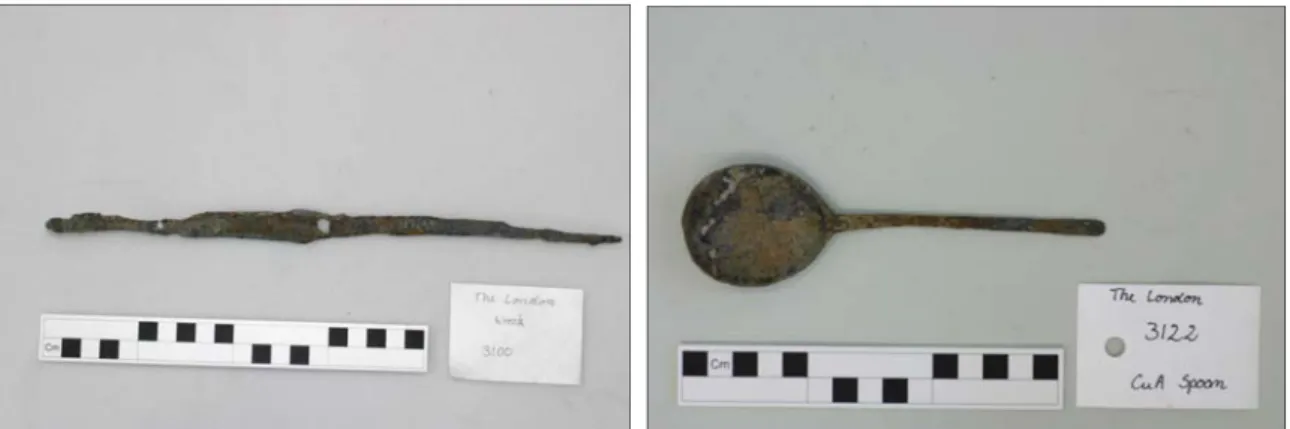
Fig 5: SF3100: Thin strip, tapering to irregular, corroded ends; mostly of flat, or flat ovoid section with rounded edges, segment between two perforations (diameter 6.3-8.4mm and 3.2-3.3mm) with flat convex outer- and shallow concave inner side.
Fig 6: SF3122: Spoon with oval bowl (L 60.1mm; W 48.9mm) and flat oval/hexagonal-sectioned stem (L 107.7mm; W base 7.3mm, middle 4.6mm, end 6.4mm) with rounded end and slightly bevelled corners and no knop. Most of surface covered in black patina with greenish beige corrosion areas. White metal covering at front of stem near base. Circular touchmark in centre of bowl 6mm below stem: "G", a spoon with bowl at top, followed by possibly another, ?central stem, rest illegible (probably the same as in spoon 3056).
Fig 7: SF3135: Pair of wing calipers. Arms joined by scarf-jointed hinge with domed rivet and rove. The wing has a semicircular end with two open holes either side; marked with number scales and lettering: on side with screw arm facing, stamped "YSE[R]" (antiq. Dutch for iron) above median double line and "I" (for number 1) below, scale runs from [0] to 50, increments of 1 marked outside of upper line. Reverse of wing stamped "LOOT" (antiq. Dutch for lead) above median double line and "[..?]EW" below (possible beginning of word obscured); upper scale as obverse but visible from tick for 7, visible number markings for 10 to 50.
Fig 8: SF3166: Very fine pin with wound wire head (diameter 1.3mm; 2 coils Z twist) stamped in shape of small sphere, round sectioned shaft with faint groves from wire drawing vice. No obvious remains of white metal coating.
Fig 9: SF3328: Sundial. Plain lid, shoulder decorated with double line above and single line below shoulder. Most of centre of lid missing, leaving hole with irregular outline. Lid rim with profiled edge creating lip on inside; some (c. 5mm) of edge split off and bent backwards inside lip. Possibly lid for sundial compass SF 3165.
Fig 10: SF3332: Spoon probe with widening spatula end (W 4.0mm, Th 0.8mm), flat end bent slightly upwards. Double-convex stem widening to flat, double-convex probe end (W 3.7mm, Th 2.1mm).
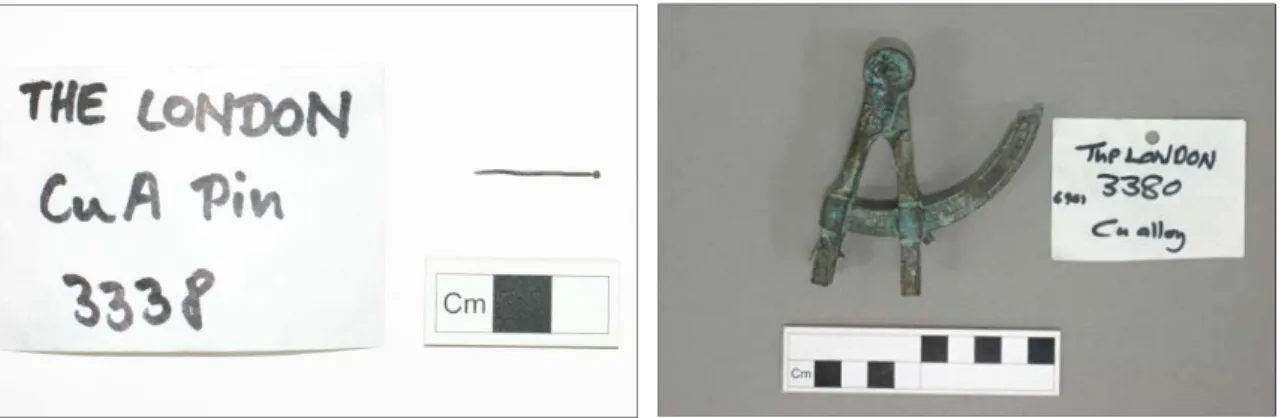
Fig 11: SF3338: Pin. Very fine pin with wound wire head (diameter 1.4mm; 3 coils Z twist).
Fig 12: SF3380: Calipers. Pair of wing calipers. Arms joined by scarf-jointed hinge with flush-set rivet; upper length of arms up to curved wing with flat inside and trapezoidal section; wing set in
rectangular-cuboid section held with flush-set rivet in one arm and winged screw in other. Lower length (L 18.1mm) of arms of octagonal cross section with longitudinally set 11mm-deep rectangular notches both containing residues of ?iron/?steel arms and tips. The wing has a profiled outer end; on side opposite screw it is marked with number scales. Scale outside arm towards end reads: I|2|I|4|I|?6|I|8|?I?, above scale is a ribbon of tick marks at half intervals to number boxes below. Scale between arms with visible number markings: ?|?6|5|4|3|2|?1, again with ribbon of half intervals above.
Fig 13: SF3392: Navigational dividers. Double-handed straight dividers. Straight plano-trapezoidal-sectioned arms each with arched middle forming open circle when dividers are closed; profiled scroll below arches. One arm shorter than the other: L1 105.4mm; L2 106.1mm. Hinged end ball-shaped joined by flush-set rivet.
Fig 14: SF3165: Sundial. Horizontal pocket sundial with compass disc. Chapter ring with folding gnomon over compass bowl with coloured, heavily corroded glass, needle missing. Chapter ring radially marked with numbers 4 to 11 on left and 1 to 8 on right; 12 o'clock position covered by loop holding gnomon; 6 o'clock position marked with "GC". Gnomon angle c. 48.78°.
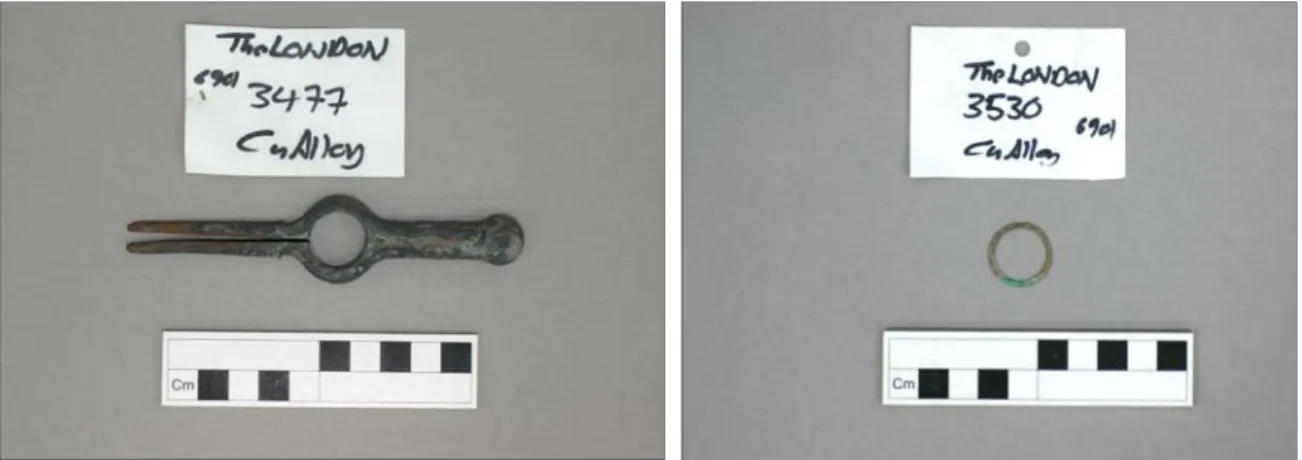
Fig 15: SF3477: Navigationaldividers. Double-handed straight dividers. Straight truncated pyramidal-sectioned arms (forming octagonal shape when closed) each with arched middle forming open circle when dividers are closed; profiled scroll below arches. Arms of equal length, section below circle has higher triangular shape than above; tips both with intentional (L1 5.4mm, L2 4.8mm) split. Hinged end double conical ball-shaped with flat equator.
Fig 16: SF3530: Ring/washer, flat rectangular-sectioned hoop with uneven outer and inner edges.
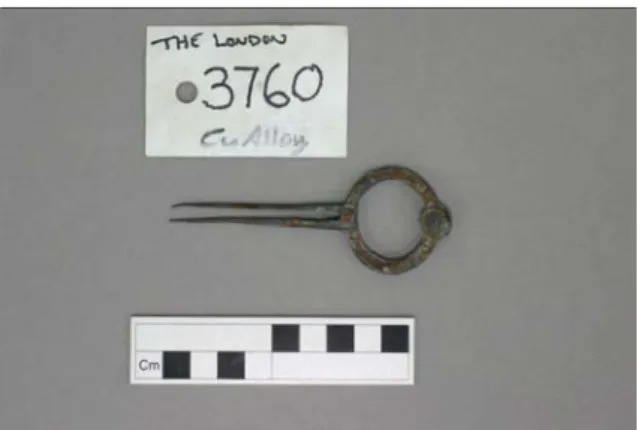
Fig17:SF3760:Navigationaldividers.Single handed dividers. Each arm with convex-arched top of 2 flat rectangular-sectioned strips, moving through each other when opening. Archedtops creatingcircle (diameter 38.5mm) when closed; circular hinge with flush rivet. Upper parts of straight, tapering arms rectangular-sectioned (L c. 15.3mm) with concave notch in middle of inside; lower parts of arms with bevelled outer edges. Pointed tips, one slightly bent inwards.
Pewter objects
Fig 18: SF3032: Spoon with round bowl (L 65.0mm; W 61.8mm) and hexagonal-sectioned stem (L 105.6mm; W base 10.2mm, middle 9.1mm, end 10.3mm) with straight end and no knop. No touchmark.
Fig 19: SF3039: Jug handle with 3-lugged hinge, right void containing remains of lid; plano-convex cross section. Both ends broken.
Fig 20: SF3043: Threaded spout (pre
conservation). Threaded spout with wide double flange (H between flanges 4.4mm, depth 4.2-5.1mm), thread with 3 full turns (L 9.2mm). Internal L of spout: 11.3mm).
Fig 21: SF3053: Chamber pot with globular body, very slight step to narrower neck and everted, upwardly-curved rim; rim flares very slightly and has straight, horizontal edge. Circular pedestal ring soldered onto base, a gentle ridge/seam runs along upper third of pedestal. Pot now distorted and broken into 2 larger body fragments (joining along one break) and base, and 6 smaller fragments (if interpretation as chamber pot is correct, handle is missing). Corrosion pustules cover entire surface.
Fig 22: SF3099: Spoon with oval bowl (L 67.0mm; W 48.7mm) and flat hexagonal-sectioned stem (L 110.5mm; W base 8.5mm, middle 8.4mm, end 10.1mm). No discernible touchmark.
Fig 23: SF3110: Neck fragment of jug or flagon with straight, vertical rim and hinge for missing lid and upper end of profiled handle; hinge has rivet with domed ends still in place. Surfaces covered in corrosion pustules and greyish patina with off-white patches of marine organism growth.
Fig 24: SF3153: Spoon with hexagonal-sectioned stem (L 92.7mm; W base 8.3mm, middle 6.7mm, end 6.5mm) with straight end, corrosion has deformed corners; most of ?round bowl missing apart from top near stem base, base at back of bowl ends in triangular profile. No touchmark visible, but area of bowl inside below stem base obscured by corrosion pustules. Entire surface with light grey patina and corrosion pustules.
Fig 25: SF3359: Button. Solid discoidal button with recessed octofoil (or piriform); central
subrectangular perforation for attachment of – now missing – separate ? iron wire shank.
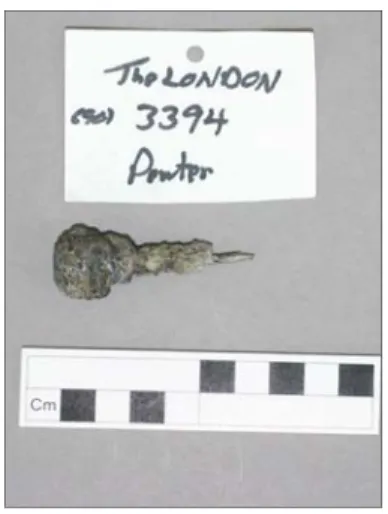
Fig 26: SF3394: Syringe. Spherical knop decorated with 2 double-lines above and below equator and carnies-profile base, set on tube surrounding hollow brass tube with broken end.
Fig 27: SF3395: Syringe. Top of barrel, end of cylindrical barrel body squashed, set in cylindrical socket with raised rims of semi-circular profile at top and base and slightly domed end cap. Cap crimped onto socket, hollow pipe set slightly off-centre. attached to cap; the pipe is the lower end of plunger 3394.
Fig 28: SF3396: Syringe.
Cylindrical barrel with cap/lid at one end (possibly crimped on); externally threaded nozzle (L 10mm; diameter 9.8mm) in centre of lid.
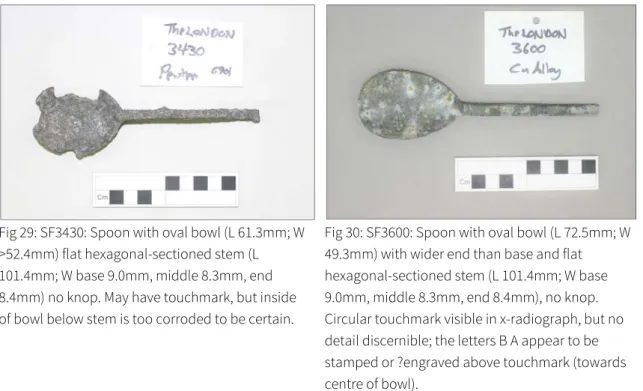
Fig 29: SF3430: Spoon with oval bowl (L 61.3mm; W >52.4mm) flat hexagonal-sectioned stem (L 101.4mm; W base 9.0mm, middle 8.3mm, end 8.4mm) no knop. May have touchmark, but inside of bowl below stem is too corroded to be certain.
Fig 30: SF3600: Spoon with oval bowl (L 72.5mm; W 49.3mm) with wider end than base and flat hexagonal-sectioned stem (L 101.4mm; W base 9.0mm, middle 8.3mm, end 8.4mm), no knop. Circular touchmark visible in x-radiograph, but no detail discernible; the letters B A appear to be stamped or ?engraved above touchmark (towards centre of bowl).
METHODS
All results presented for the London artefacts have been produced using an M4 Tornado XRF analyser at Historic England’s material science laboratory based at Fort Cumberland, Portsmouth. Prior to the analysis, a small spot (<¼mm2) was mechanically prepared using a scalpel to expose underlying fresh metal and avoid analysing corrosion. Whenever an object was made of several parts, such as the navigational dividers or the calipers with two arms, and sometimes several rivets and additional circles, a spot was prepared for analysis on every part, provided that the respective part could be reached with the X-ray beam of the instrument. In some cases where the results of the initial spot were very heterogeneous, a second spot was selected for preparation. On every prepared spot a number of analyses were undertaken in order to negate the effects of microscopic
inhomogeneities in the material.
The machine uses a rhodium tube and a 30mm2 SDD (silicon drift detector) with a resolution of ≤145 eV for manganese Kα. The tube has a polycapillary lens with a focus spot size of 25μm. All analyses were done using an acceleration voltage of 50kV and an anode current of 200μA. No filter was used, and all analyses were done in a vacuum. The counting time on each analysis point was 200 live seconds. The spectra were quantified using a standard enhanced fundamental parameter method calibrated against certified reference materials of known composition.
RESULTS
Each of the values given in Tables 1 and 2 represent the chemical composition of a single piece of metal which is equivalent to one part of an object. In some cases, objects are made from a single piece of material, like the spoons or the pipe stopper. In that case the results represent the average value calculated from various single analyses (number <<N>> is indicated in tables 1 and 2 as well). In the case of objects that are assembled from several parts, for example the calipers or the navigational dividers, a result is given for each part of the object that is made from one single piece of material.
Brass
The majority of the analysed copper alloy objects from the London are brass (Table 1), using the alloy nomenclature published by Bayley and Butcher (2004). Only one object (ring SF3530, Fig. 16) falls into the transition field brass/gunmetal and only one object (weight SF3072, Fig. 4) can be identified as gunmetal; additional
classification for this particular object will be provided below. The latter two objects have also significantly higher lead contents than the rest (22.7% for the ring and 7.3% for the weight). Among the objects analysed, no pure copper or bronze was identified. That is in good accordance with the observation that by the 17th century hardly anything other than brass was used for these types of object and only a small fraction of the copper alloys in use were gunmetal (Dungworth 2002, Fig. 6).
Homogeneity of the alloys
Several analyses were performed on a single prepared spot in order to gain
information on the homogeneity of the metal. While some objects seem to be very homogeneous (arm 1 of navigational dividers SF3477, Fig. 15: 73.8%<Cu<75.8%, 21.9%<Zn<22.5%, 0.74%<Sn<1.14%, 0.60%<Pb<2.09%, N=4) others seem to be extremely heterogeneous (copper alloy object SF3332 ‘spoon probe’, Fig. 10: 73.2%<Cu<86.9%, 11.5%<Zn<24.4%, DL<Sn<0.62%, 0.65%<Pb<1.93%, N=11). Some objects high in lead, which are more heterogeneous due to segregation, also have even broader ranges in composition (ring SF3530, Fig. 16: 45.3%<Cu<72.3%, 7.52%<Zn<11.11%, 3.14%<Sn<4.58%, 11.1%<Pb<40.7% N=5) (DL=detection limit, Sn=tin, Zn=zinc, Cu=copper, Pb=lead).
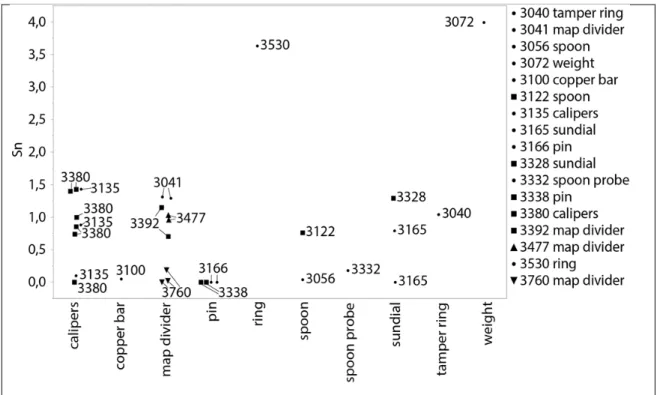
Figure 31 shows the variation in tin content amongst the brass objects. Around half of the objects have tin contents of <0.18% and the rest 0.7%>Sn>1.43%. Two of the objects (ring SF3530 and weight SF3072, Fig 16 and 4) are exceptional with
Sn>3.63%. Note that some objects, like the calipers (SF3380, Fig. 12) and the navigational dividers (SF3135, Fig. 7), have both higher and lower tin parts (see DISCUSSION section for more details).
Most of the brasses have zinc contents between 18.5% and 26.8% with an average of 22.3 (N=27), which ties in well with the majority of the contemporary brasses (Heyworth 1991; Egan 2005). Two objects are in an exceptional position. The chapter ring of sundial SF3165 (Fig. 14) with 29.9% zinc and the head of pin (SF3166, Fig. 8) with 28% zinc are at around the limit of what is achievable with the traditional (non-granulated copper) cementation method. The zinc content of only one object (arm 2 of caliper SF3380, Fig. 12) is 13.6% and considerably lower than the zinc content of the other brass objects. With the exception of the wing of caliper SF3380 (Fig. 12, 6.6% lead) and arm 2 of the navigational dividers SF3392 (Fig. 13) with 7.1% lead, all brass objects have lead contents lower than 3.1%. Tinning of spoons
The spoon SF3122 (Fig. 6) has some very small bright spots on the bowl as well as the stem. The spots are slightly raised and much smoother than the rest of the spoon. These spots were investigated in an unprepared state to check if they might be the residues of plating. A total of 21 analyses were performed on the spots in order to identify the material. The spots have a higher tin content (7.8% on average compared to the spoon (0.76%), the lead content is also higher (3.7%) than that of the spoon (1.1%), and the zinc contents are in good accordance (24.0% on the spots, 23.0% on the spoon).
Also, on spoon SF3056 (Fig. 3) some spots are raised from the corroded surface and are much smoother. In contrast to SF3122 (Fig. 6), these spots are dark grey-green.
Fig 31: Diagram showing tin content (weight %) by object type. Different symbols in one object type column e.g. spoons or dividers, represent different objects and have no significance in terms of chemistry.
Eight additional analyses were done on these spots and the zinc content is much lower (11.2%) than on the spoon (22%), while the tin content is higher (0.4% on the spoon, 8.1% on the spot). Differences in lead are also visible (1.55% on the spoon, 2.9% on the spot).
The analyses of SF3122 (Fig. 6) and SF3056 (Fig. 3) do support the interpretation of the bright spots as tinning. The conditions that are responsible for the different state of preservation are most likely also responsible for the different composition (different intensity of corrosion).
Pewter
Spoons and tableware
One pewter spoon (SF3430, Fig. 29) and a jug handle (SF3039, Fig. 19) are of a similar alloy (with more copper and bismuth), which can be considered as fine pewter (Table 2). Another spoon (SF3153, Fig. 24) is fine pewter, but almost free of copper and free of bismuth. No trifle alloy artefacts could be identified among the objects from the London. The jug (SF3110, Fig. 23) and one spoon (SF3600, Fig. 30) are made from a lay alloy and even higher levels of lead were detected in spoon (SF3032, Fig. 18). One spoon could not be analysed due to severe corrosion (SF3099, Fig. 22).
Other artefacts
The chamber pot (SF3053, Fig. 21), the button (SF3359, Fig. 25) and the threaded spout (SF3043, Fig. 20) are made from alloys very high in lead and are far from the threshold for fine, trifle and lay pewter. All of these objects are very inhomogeneous in terms of their composition. The button being the most compact object has tin values between 14.5% and 50.4% while its lead content varies between 47.2% and 85.4%. Copper is also variable and is between 0 and 2.8%. Also, the chamber pot has a very large spread in composition with tin ranging between 24.4% and 91.6% and lead from 6.0% to 75.6%. The threaded spout has the lowest tin values of all objects analysed. They are as low as 5.2% to 38.6% while the lead contents are the highest of the whole dataset (60.5% to 94.7%).
One artefact that is of particular interest is the syringe, recovered in three fragments (SF3394-SF3396, Fig. 26-28). As it is not in very good condition no effort was made to sample or clean the object prior to the analysis. Semi-quantitative XRF analyses (not listed here) were performed on the corroded surface in order to get an idea of the elements present. The corroded surface of the pewter parts shows lead contents between 6% and 50%. The copper content of the pewter corrosion is less than 1%. The plunger of the syringe seems to be made from a pewter-covered brass tube. A bit of the brass tube could be analysed and gave a zinc content of 20%-21%
which ties in well with the other technical brass objects from the London. However, the brass tube is highly inhomogeneous in terms of lead where results between 9.5% and 26% were obtained. No traces of mercury were found on any part of the syringe, thus it is unlikely that mercury was one of the liquids handled with it. Corrosion products
All of the pewter objects are corroded and show various grades of decomposition ranging from dark grey pustules (North and MacLeod 1987; Dunkle 2002) to a light grey to light yellow, heavily disturbed surface. On all but one of the artefacts (spoon SF3099, Fig. 22) metallic pewter could still be identified after removing the corrosion mechanically. The latter spoon has been completely corroded or altered, however, and no metallic material could be found. The analysis gave equal parts of iron, copper, tin and sulphur.
DISCUSSION
Brass
The homogeneity of the material is a crucial point to the understanding of the results. A molten copper-lead alloy segregates into a lead-rich and a copper-rich phase when it solidifies. This effect is noticeable at fairly low lead levels, as copper and lead are almost immiscible in the solid state (Korojy et al. 2009). Those
immiscible phases can easily reach a size where they can be picked up individually by the analytical instrument used. This results in a larger spread of the results with variable lead contents. Another effect that may influence the homogeneity of the results is corrosion in the marine environment, including dezincification and probably redeposition of the dissolved zinc close to, or directly on the objects’ surface. Such heterogeneities are likely to be present on a micro scale and may be picked up by the instrument that was used in this study as it focusses the x-rays to an area of 25μm diameter.
When reviewing the results and taking the dimensions and mass of the objects into account, it appears that the objects with a small diameter or thin profile and a (relatively) high surface to mass ratio have a tendency to be more heterogeneous, like the above-mentioned spatula and ring. More consistent results were obtained for bulkier objects, like the navigational dividers. Whether this heterogeneity was caused during production, by alteration due to the marine environment and corrosion, or by a combination of these factors is uncertain at this time. Dezincification
As is well-known from marine contexts, base metal objects may be subject to
dezincification or destannification during their exposure to the marine environment (North and MacLeod 1987). No systematic pattern was observed on the objects from the London; comparative analyses of the corrosion products (not listed here) and the prepared metal show higher zinc contents in the corrosion products in some of the objects and higher zinc contents in the prepared spots on other objects. This shows again that corrosion can be subject to very local conditions on a micro scale and that bulk or averaged metal analyses need to be treated with caution.
Object grouping
As stated above, the brass objects have a range of tin contents, however this is not thought to be significant, rather a consequence of the variability of the alloy used and the small number of analysed artefacts. This is supported by two observations:
Some of the objects have parts in both material groups thus two different material pools can be ruled out. It is far more likely that the variation of brass available to the founder covers the whole range.
If the navigational dividers from the Stirling Castle wreck and the objects fromSouthwark are taken into account as comparative objects, they close the gapbetween the two groups.
This argument however must be seen with caution, as from the documentation of the analyses on the Stirling Castle dividers it is clear that the analysis was only done on one part of the object.
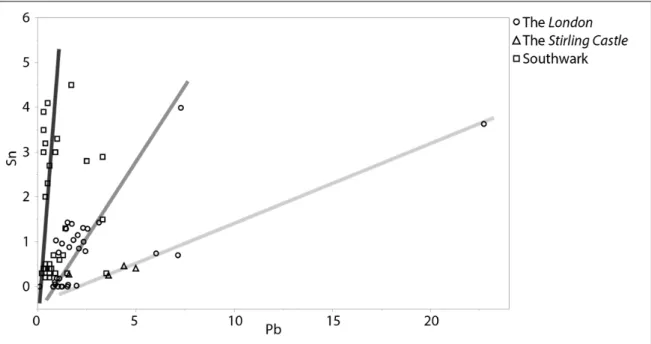
There do appear to be trends in the ratio of lead to tin in the brass alloys used for different types of objects however, particularly when these are compared with other contemporary assemblages, seen in the lead/tin diagram (Fig 32):
A high tin trend that is formed predominantly by the buckles and the sheet metal waste from Southwark. The Sn/Pb ratio in these objects is approximately 2-8.
An intermediate trend with a ratio of about 1 that is followed by most of the London objects.
A high lead trend with a Sn/Pb ratio around 0.1. This trend is followed predominantly by the Stirling Castle dividers, the two London ‘high lead’ outliers (dividers and calipers respectively, SF3392/SF3380, Figs 13 and 12) and with the highest lead, the ring (SF3530, Fig. 16).
Fig 32: Tin versus lead (weight %) diagram showing the different trends in material that could be observed. Low tin trend: light grey, intermediate trend: medium grey, high tin trend: dark grey.
The weight SF3072
The weight SF3072 (Fig. 4) has a composition that is not comparable to any other object from the dataset. Using the alloy nomenclature of Bayley and Butcher (2004) this particular object would be identified as gunmetal, but Bayley and Butcher (2004) do not take elements other than zinc and tin into account for their
classification. However, the composition is in very good accordance with an alloy called ‘Caldarium’, which is leaded antimony bronze. Caldarium is known to be a by-product of medieval and post-medieval liquation, a process that was used to de-silver copper (Dungworth and Nicholas 2004; Suhling 1976). The alloy was widely used to cast domestic vessels such as cauldrons, thus the name.
The syringe SF3394-SF3395-SF3396
Of particular interest was the question of whether the syringe (SF3394-SF3395-SF3396, Fig. 26-28) was used to handle mercury. As liquid mercury forms a stable and insoluble amalgam at room temperature (Yen et al. 2003), it is highly likely that this would have happened during the use of the syringe to handle mercury.
Likewise, the reduced environment of the seabed is known to cause the formation of cinnabar (mercury (II) sulphide) (Dunkle 2002). The analysis did not provide any evidence that the syringe was used for that purpose however, as no mercury was detected.
Pewter
Pewter corrosion is a very complex topic involving various factors, for example the oxygenation rate of the seawater, the formation of (protective) concretions, direct contact with other metals and materials, as well as sedimentary movement that may cause multiple phases of burial, exposure to water and reburial. The most common phases formed during pewter corrosion are various tin oxides and hydroxides like romarchite, hydroromarchite, and cassiterite, but tin chlorides, such as abhurite, are also common (MacLeod 1991; Dunkle et al. 2004). One particular corrosion
product (stannite: Cu2FeSnS4) needs to be considered when looking at spoon SF3099 (Fig. 22). Although it showed a metallic appearance after mechanical removal of the superficial corrosion, the analysis gave about equal parts of iron, copper, tin and sulphur. As the object seemed completely corroded or altered, the results were not included in this report. Stannite can form either when the object is removed from the anaerobic burial environment or when an aerobically corroded object is subsequently buried (MacLeod 1991). Thus, the results for spoon SF3099 (Fig. 22) emphasise how important local conditions are when investigating
Object grouping
Due to the small number of pewter objects from the London that were analysed, the results do not form a very clear picture. When looked at together with the reference material from Southwark and the Stirling Castle however, a more detailed
interpretation is possible (Fig. 33). In terms of the lead content most of the objects from Southwark form a tight cluster with lead contents of not more than 6.7%. Some of the objects from Southwark as well as from the Stirling Castle are lead free or have lead contents close to zero. The results from the London do not show a distinct lead free or a low lead group, thus, the border between ‘fine’ and ‘trifle’ cannot be seen clearly here. It is noteworthy that although up to 4% copper is allowed in fine, as well as trifle, alloys the majority of the spoons have copper
contents of less than 2.5%, which might indicate they were intended to be fine ware.
Fig 33: Comparison of the composition of the objects from the London (circles) to those from the Stirling Castle (triangles) and Southwark (squares) (in weight%).
If grouped by the antimony content (Fig. 34), the objects from the London have the lowest contents with DL<Sb<0.11% (DL=detection limit, Sb=antimony), while the Southwark objects lie at 0.5%<Sb<1.1%. The highest antimony contents can be found in the Stirling Castle objects with 2.7%<Sb<5.4%. Except for the antimony content, the spoons from the London, the Stirling Castle and from Southwark seem to be in good overall accordance. The majority of the spoons can be categorised as fine or lay pewter; only a small number are made from high lead pewter.
Fig 34: Plot showing variable antimony content of the objects (weight %).
Two pewter spoons from the London (SF3153, Fig. 24; SF3430, Fig. 29) can be found within the fine/trifle cluster that is formed by the Southwark and London spoons. Four spoons from Southwark plot on the low lead/ high copper trend of the diagram. In addition to these, a number of spoons (6 from Southwark and SF3600, Fig. 30; SF3032,Fig. 17) are made from alloys that need to be considered as lay, or from alloys that have even higher lead contents of up to 41%.
Another important point to notice is that only three objects contain enough bismuth to regard it as an intended addition. Spoon SF3430 (Fig. 28) and jug handle
SF3039 (Fig. 18) have bismuth contents of 0.73% and 0.62%, respectively, as well as lead contents of only ~1.2 % and copper contents of ~2%, and these alloys can easily be identified as either primary material or as very carefully recycled material. On the other hand, spoon SF3032 (Fig. 18) also has bismuth and copper, but at a considerably lower level and it has over 20% lead. This could be interpreted as a single or a repeated recycling step, where high grade pewter (fine or trifle) was diluted with lead. Recalculating the composition of the alloy, after subtracting the lead, would result in pewter with ~99% tin, 0.6% copper and 0.25% bismuth which would be fine pewter of excellent quality.
Buttons were made out of different materials, depending on their value, intended colour and wealth of their owner and garment they were used on. The analysis of buttons is predominantly made using a stylistic approach (Read 2010). From the excavations at Southwark, buttons made from pewter, tin, leaded gunmetal and brass/leaded brass are known (Egan 2005), but no quantitative results were
medieval period) are recorded in the Portable Antiquities Scheme database (www.finds.org.uk), but only a minute fraction of them has been analysed qualitatively in terms of chemical composition. Thus, the single analysed button from the London does not give a new insight into the topic.
CONCLUSIONS
As can be seen from the analyses of the pewter objects, in the case of tableware and cutlery the rules of the Pewterers’ Company concerning the lead content of the objects were obeyed in most cases. Only spoons (SF3032, Fig. 18 and SF3600, Fig. 30) were made from higher lead alloys. Concerning the question of how these came aboard the London, it is interesting that spoon SF3600 appears to be a personal belonging rather than provided by the Royal Navy. The owner’s mark suggests that it was owned by an unmarried man, at least at the time when the mark was applied (Cotterell 1929, 53–4). It would be interesting to see if the Navy had a ‘certified’ supplier of utensils or bought them as and when required. The other pewter objects that were not made from ‘company grade’ metal (button SF3359, Fig. 25, threaded spout SF3043, Fig. 20 and chamber pot 3053, Fig. 21) are also not intended to contain food and thus did not have to meet the restrictions.
Most of the dividers and calipers have zinc contents of around 20%, in common with instruments from other contemporary wrecks; this alloy probably had a good cost/material property ratio, as these instruments had to be precise and keep this precision on a long-term basis.
The two brass spoons (SF3056, Fig. 3, SF3122, Fig. 6) have maker’s marks; the marks are similar (although the one on SF3122 is incomplete) and the spoons have similar compositions and were both tinned so the analysis supports the theory that these are from the same manufacturer. The sundial lower case (SF3165) also has a distinctive composition, with small amounts of antimony, tin and lead, closely matched by the composition of the object thought to be the sundial upper case (SF3328), confirming that they belong to the same object.
REFERENCES
Bacon, A L 2003 A Technical study of the alloy composition of ‘brass’ wind musical instruments (1651-1867) utilizing non-destructive X-ray fluorescence. Volume 1. Unpublished PhD thesis. London: University College London. Bayley, J 1990 ‘The production of brass in antiquity with particular reference to
Roman Britain’, in Craddock, P T (ed.) 2000 years of zinc and brass. London: British Museum, 7-26.
Bayley, J and Butcher, S 2004 Roman Brooches in Britain: A technological and Typological Study based on the Richborough Collection. London: Society of Antiquaries of London.
Bougarit, D and Bauchau, F 2010 ‘The ancient brass cementation process revisited by extensive experimental simulation’. The Journal of the Mineral, Metals and Materials Society (TMS) 62/3, 27-33.
Cotterell, H H 1929 Old pewter, its makers and marks in England, Scotland and Ireland: an account of the old pewterer and his craft. London: Batsford. Craddock, P T 1990 ‘Zinc in Classical Antiquity’, in Craddock, P T (ed.) 2000 years
of zinc and brass. London: British Museum, 1-6.
Dungworth, D 2002 Analysis of post-medieval lead-tin alloy, copper alloy and glass artefacts from Southwark, London. Centre for Archaeology Reports 64/2002. London: English Heritage.
Dungworth, D 2003 Evidence for medieval and post-medieval copper alloy working at Guildhall Yard, London. Centre for Archaeology Reports 78/2003. London: English Heritage.
Dungworth, D and Nicholas, M 2004 ‘Caldarium? An antimony bronze used for medieval and post-medieval cast domestic vessels’. Historical Metallurgy 38/1, 24-34.
Dungworth, D, Whitewright, J and Middleton, A (forthcoming) ‘9.0 Metal’, in Whitewright et al. (eds.) The Stirling Castle, a 70-gun ship lost in the Great Storm of 1703: Summary report and guide to existing historical and archaeological archives. Maritime Archaeology Trust Monograph Series 4, British Archaeological Reports British Series.
Dunkle, S 2002 Romarchite and Other Corrosion phases on Metal Artifacts from the Queen Anne’s Revenge (1718). Unpublished MSc Thesis. Petersburg: Virginia Polytechnic Institute and State University.
Dunkle, S E, Craig, J R and Lusardi, W R 2004 ‘Romarchite and Associated Phases as common Corrosion Products on Pewter Artifacts from Marine
Archaeological Sites’. Geoarchaeology 19/6, 531-552.
Egan, G 2005 Material Culture in London in an age of transition: Tudor and Stuart period finds c 1450-c 1700 from excavations at riverside sites in Southwark. Museum of London Monographs 19.
Hatcher, J and Baker, T C 1974 A history of British Pewter. London: Longmann. Hedges, E S 1960 Tin and is alloys. London: Hodder and Stoughton Educational. Heyworth M 1991 ‘Metallurgical analyses of the dress accessories’, in Egan, G and
Pritchard, F (eds.) Medieval Finds from Excavations in London 3: Dress accessories. Woodbridge: Boydell Press.
Hornsby, P R G, Weinstein, R and Homer, R F 1989 Pewter: a celebration of the craft 1200-1700. London: Museum of London.
Korojy, B, Ekborn, L and Frederiksson, H 2009 ‘Microsegregation and Shrinkage of Copper-Lead Base Alloys’. Advances in Materials Science and Engineering 2009, article ID 627937. doi: 10.1155/2009/629737.
MacLeod, I D 1991 ‘Identification of corrosion products on non-ferrous artifacts recovered from shipwrecks’. Studies in Conservation 36/4, 222-234.
Mitchiner, M B, Mortimer, C and Pollard, A M 1985 ‘The chemical composition of English seventeenth-century case metal coins and tokens’. British Numismatic Journal 55, 144-163.
North, A N and MacLeod. I D 1987 ‘Corrosion of metals’, in Pearson, C (ed.) Conservation of Marine Archaeological Objects. London: Butterworths. Pepys S 1665 ‘The diary of Samuel Pepys’.
https://www.pepysdiary.com/diary/1665/03/ (accessed 8/11/2018)
Pollard, A M and Heron, C 1996 Archaeological Chemistry. London: Royal Society of Chemistry.
Read, B 2010 Metal Buttons c.900 BC- c.AD 1700. Huish Episcopi: Portcullis Publishing.
Suhling, L 1976 Der Seigerhüttenprozess. Stuttgart: Dr. Riederer Verlag.
Wallbaum, H J 1964 ‘Kupfer’, in Landolt-Börnstein: Zahlenwerte und Funktionen, IV. Bd.2 Tl., Bandtlb. Berlin: Springer Verlag, 639-690.
Walsh, M, Walker, K E and Evans, S 2017 London Protected Wreck Site, Thames Estuary. Post-Excavation assessment and updated project design. HE Project 6901. Unpublished PD submitted to Historic England.
Welch, C 1902 A History of the worshipful Company of Pewterers of the City of London. London: Blades, East and Blades.
Yen, Y-W, Gröbner, J, Hansen, S C and Schmid-Fetzer, R 2003 ‘Thermodynamic Assessment of the Hg-Sn System’. Journal of Phase Equilibria 24, 151-167.
APPENDICES
Table 1: Results of the copper alloy object analyses by XRF, wt%, where no value is reported = below detection
SF No/object/part Material S Fe Ni Cu Zn As Ag Sn Sb Pb Bi #N
3392 brass average 0.33 0.18 76.2 19.8 0.3 1.15 2.0 0.01 3
min 0.30 0.15 66.0 15.7 0.3 0.67 1.7
navigational
dividers arm1 max 0.42 0.21 77.5 21.1 0.6 1.47 15.8 0.03
brass average leaded
0.78 0.17 69.1 21.8 0.3 0.01 0.70 7.1 5
min 0.66 0.15 64.9 19.8 0.1 0.43 2.3
3392 navigational
dividers arm2 max 0.89 0.18 72.7 23.4 0.4 0.02 1.01 13.3
brass average 0.37 0.11 75.0 22.2 0.2 0.01 0.96 1.2 4
min 0.36 0.10 73.8 21.9 0.1 0.74 0.6
3477 navigational
dividers arm1 max 0.37 0.12 75.8 22.5 0.2 0.04 1.14 2.1
brass average 0.33 0.10 74.8 22.7 0.1 0.01 1.03 0.9 4
min 0.32 0.10 74.5 22.5 0.1 0.50 0.6
3477 navigational
dividers arm2 max 0.33 0.11 75.7 23.0 0.2 0.04 1.91 1.2
3530 gunmetal average 1.87 0.10 60.7 9.3 0.9 0.13 3.63 0.69 22.7 5
ring leaded min 1.61 0.08 45.3 7.5 0.7 0.06 3.14 0.52 11.1
SF No/object/ part Material S Fe Ni Cu Zn As Ag Sn Sb Pb Bi #N
3122 brass average 1.27 0.06 73.6 23.0 0.1 0.07 0.76 1.1 <0.01 4
spoon min 0.87 0.06 72.2 22.6 0.1 0.44 0.5
main mass max 2.30 0.07 74.5 23.2 0.2 0.18 1.09 1.4 0.01
plating average 5.3 3.59 0.07 55.2 24.0 0.2 0.16 7.78 3.7 20
brass average 0.1 0.29 0.12 70.9 26.4 0.1 0.01 0.02 2.0 3
min 0.1 0.26 0.09 70.1 24.5 0.1 1.8
3760 navigational
dividers arm1 max 0.1 0.30 0.13 72.6 27.4 0.1 0.02 0.03 2.2
brass average 0.1 0.33 0.11 71.1 26.8 0.1 0.01 1.5 4
min 0.1 0.31 0.10 70.7 26.5 0.1 1.1
3760 navigational
dividers arm2 max 0.1 0.34 0.11 71.5 27.3 0.1 0.03 1.8
brass average 0.2 0.27 0.18 76.4 21.7 0.1 0.18 1.0 4
min 0.1 0.26 0.17 76.0 21.3 0.1 0.07 0.8
3760 navigational
dividers rivet max 0.2 0.28 0.18 76.6 21.9 0.1 0.29 1.2
3040 brass average 0.67 0.13 75.6 20.5 0.2 0.02 1.04 0.02 1.8 0.04 20
pipe stopper min 0.55 0.12 74.3 18.2 0.1 0.47 1.2
max 0.98 0.15 78.0 21.4 0.3 0.07 1.34 0.10 2.6 0.26
brass average 0.93 0.12 73.2 21.9 0.2 0.06 1.31 0.02 2.3 5
min 0.51 0.08 72.1 20.0 0.1 0.01 0.77 1.8
3041
navigational
SF No/object/part Material S Fe Ni Cu Zn As Ag Sn Sb Pb Bi #N
3041 brass average 0.63 0.12 75.9 20.5 0.1 0.01 1.29 0.01 1.5 7
min 0.47 0.09 74.9 17.9 0.1 0.95 1.0
navigational
dividers arm2 max 0.99 0.13 77.3 21.6 0.2 0.40 1.90 0.05 2.3
3056 brass average 0.47 75.8 22.1 0.1 0.04 0.04 1.6 4
spoon min 0.44 74.0 20.8 <0.1 0.9
main mass max 0.53 77.5 23.4 0.1 0.06 0.06 2.0
plating average 9.3 1.02 67.1 11.2 0.2 0.19 8.13 2.9 5
3072 gunmetal average 0.67 0.46 78.0 5.8 0.9 0.07 3.99 2.72 7.3 16
weight min 0.52 0.39 68.1 5.0 0.3 0.01 2.77 1.83 1.4
max 1.19 0.57 83.1 8.0 1.3 0.13 5.21 4.16 18.2 0.03
3100 brass average 0.67 0.08 71.5 26.8 0.1 0.01 0.05 0.00 0.9 0.01 10
strip min 0.60 0.06 69.5 23.8 <0.1 0.4
max 0.75 0.13 73.9 27.7 0.1 0.03 0.26 0.00 2.2 0.03
3135 brass average 0.40 0.18 71.6 23.1 0.1 0.02 1.43 0.04 3.1 5
caliper min 0.35 0.15 69.9 22.6 0.1 0.72 2.0
wing max 0.50 0.22 73.7 23.5 0.2 0.05 2.09 0.11 5.6
3135 brass average 2.16 0.18 70.8 24.3 0.1 0.02 0.88 0.00 1.6 5
caliper min 1.51 0.16 69.8 23.6 0.1 0.67 0.8
SF No/object/part Material S Fe Ni Cu Zn As Ag Sn Sb Pb Bi #N
3135 brass average 0.37 0.16 73.6 24.8 0.1 0.10 0.9 5
caliper min 0.34 0.15 71.6 21.9 0.1 0.05 0.4
arm 2 max 0.45 0.20 76.9 26.6 0.1 0.01 0.13 1.5
3135 average 1.4 20.71 72.8 3.4 0.1 1.6 0.03 5
caliper min 0.5 4.57 35.5 0.4 0.4
loose rivet max 3.7 47.73 93.3 9.1 0.2 3.8 0.13
3165 brass average 0.51 0.08 76.5 19.3 0.2 0.03 0.79 0.23 2.4 5
sundial min 0.42 0.03 72.7 10.6 0.2 0.55 0.16 1.8
lower casing max 0.75 0.10 84.8 22.3 0.2 0.10 1.28 0.39 4.2 0.02
3165 brass average 0.22 0.03 69.0 29.9 <0.1 0.01 0.8 4
sundial min 0.20 0.01 64.3 18.0 0.3
chapter ring max 0.24 0.04 81.4 34.5 <0.1 0.02 0.06 1.4 0.01
3166 brass average 0.22 0.01 70.0 28.5 <0.1 0.01 1.2 2
pin min 0.21 69.5 28.0 <0.1 1.2
head max 0.22 0.01 70.5 29.1 <0.1 0.02 1.2
3166 brass average 0.11 0.02 74.7 24.3 0.1 0.8 3
pin min 0.11 0.02 73.8 23.6 0.1 0.5
shaft max 0.12 0.02 75.7 24.7 0.1 1.2
3328 brass average 0.83 0.14 73.5 21.1 0.3 0.05 1.29 0.34 2.5 4
SF No/object/part Material S Fe Ni Cu Zn As Ag Sn Sb Pb Bi #N
3332 brass average 0.47 0.06 79.4 18.7 0.1 0.03 0.18 0.01 1.1 10
spoon probe min 0.32 0.03 73.2 11.5 0.0 0.7
max 0.68 0.09 86.9 24.4 0.1 0.10 0.62 0.08 1.9
3338 brass average 0.14 72.1 26.6 <0.1 0.05 1.0 2
pin min 0.13 71.8 26.0 <0.1 0.05 0.7
head max 0.16 72.4 27.3 0.1 0.05 1.4
3338 brass average 0.13 72.6 26.0 0.1 0.02 1.3 4
pin min 0.12 72.3 25.8 <0.1 0.5
shaft max 0.15 73.1 26.2 0.1 0.05 1.8
3380 brass average 0.67 0.12 75.6 20.4 0.3 0.02 0.85 0.01 2.1 4
caliper min 0.61 0.11 74.7 18.9 0.2 0.57 1.0
arm 1 max 0.81 0.13 76.8 21.5 0.4 0.06 1.07 0.02 3.6
3380 brass average 0.70 0.05 82.2 13.6 0.2 0.04 1.40 0.09 1.7 4
caliper min 0.21 0.03 78.4 8.3 0.1 0.02 1.01 0.9
arm 2 max 1.80 0.08 89.3 16.8 0.2 0.07 1.66 0.14 2.2
3380 brass average 0.70 0.07 72.9 19.3 0.3 0.04 0.74 0.01 6.0 4
caliper leaded min 0.62 0.06 71.5 17.6 0.2 0.03 0.12 3.4
SF No/object/part Material S Fe Ni Cu Zn As Ag Sn Sb Pb Bi #N
3380 brass average 0.10 79.1 20.7 <0.1 0.1 4
caliper min 0.09 72.2 13.6 0.0
rivet (wing) max 0.12 86.3 27.4 <0.1 0.3
3380 brass average 0.56 0.11 76.9 19.3 0.2 1.43 0.03 1.5 4
caliper min 0.34 0.11 76.0 18.0 0.1 0.79 1.2
central rivet max 0.90 0.12 78.7 19.9 0.2 1.83 0.13 1.8
3380 brass average 0.62 0.10 76.0 19.7 0.2 1.00 2.3 5
caliper min 0.58 0.09 75.9 19.2 0.1 0.73 1.9
Table 2: Results of the pewter object analyses by XRF, wt%, where no value is reported = below detection, #N = number of analyses
SFNo/object/part
Alloy Cu Sn Sb Pb Bi #N
3153 fine average 1.3 96.1 0.01 2.6 0.01 8
spoon min 0.1 93 0.01 1
max 5.4 98.5 0.01 4.3 0.02
3110 lay average 0.1 85.9 0.01 13.9 0.01 6
jug min 0.1 61.3 0.01 38.6
max 0.3 97.4 0.01 2.6 0.1
3359 lead alloy average 0.9 31 68.2 0.1 10
button min 14.5 47.2
max 2.8 50.4 0.01 85.4 0.01
3430 fine average 2 96 0.01 1.2 0.73 10
spoon min 1.6 94.3 0.01 0.5 0.13
max 2.6 97.6 0.01 2.2 1.28
3032 lead alloy average 0.4 77.8 0.01 21.6 0.19 6
spoon min 0.2 60.4 0.01 12.5
max 1.1 87.2 0.01 39.4 1.08
3039 fine average 1.9 96.2 0.01 1.3 0.62 4
jug handle min 0.7 94.9 0.01 0.5 0.3
max 2.6 98.6 0.01 1.7 0.8
lead alloy average 0.2 12.7 0.11 87 0.01 9 3043
threaded spout min 0.1 5.2 60.5 0.01
max 0.4 38.6 0.5 94.7 0.01
3053 lead alloy average 0.7 61.5 0.02 37.4 28
chamber pot min 24.4 0.01 6
max 2.7 91.6 0.2 75.6 0.01
3600 lay average 3.6 84.1 0.01 12.3 0.01 10
spoon min 70.3 0.01 4.1
Historic England Research and the Historic Environment
We are the public body that helps people care for, enjoy and celebrate
England’s spectacular historic environment.
A good understanding of the historic environment is fundamental to ensuring people appreciate and enjoy their heritage and provides the essential first step towards its effective protection.
Historic England works to improve care, understanding and public enjoyment of the historic environment. We undertake and sponsor authoritative research. We develop new approaches to interpreting and protecting heritage and provide high quality expert advice and training.
We make the results of our work available through the Historic England Research Report Series, and through journal publications and monographs. Our online magazine Historic England Research which appears twice a year, aims to keep our partners within and outside Historic England up-to-date with our projects and activities.
A full list of Research Reports, with abstracts and information on how to obtain copies, may be found on www.HistoricEngland.org.uk/researchreports
Some of these reports are interim reports, making the results of specialist
investigations available in advance of full publication. They are not usually subject to external refereeing, and their conclusions may sometimes have to be modified in the light of information not available at the time of the investigation.
Where no final project report is available, you should consult the author before citing these reports in any publication. Opinions expressed in these reports are those of the author(s) and are not necessarily those of Historic England.
The Research Report Series incorporates reports by the expert teams within
Historic England. It replaces the former Centre for Archaeology Reports Series, the Archaeological Investigation Report Series, the Architectural Investigation Report Series, and the Research Department Report Series.