ISSN: 2252-8938, DOI: 10.11591/ijai.v8.i3.pp252-258 252
A multiple mitosis genetic algorithm
K. Kamil1, K.H Chong2, H. Hashim3, S.A. Shaaya4
1,2,3Department of Electrical and Electronic Engineering, Universiti Tenaga Nasional (UNITEN), Malaysia 4College of Engineering, Universiti Tenaga Nasional (UNITEN), Malaysia
Article Info ABSTRACT
Article history: Received May 13, 2019 Revised Jul 18, 2019 Accepted Aug 1, 2019
Genetic algorithm is a well-known metaheuristic method to solve optimization problem mimic the natural process of cell reproduction. Having great advantages on solving optimization problem makes this method popular among researchers to improve the performance of simple Genetic Algorithm and apply it in many areas. However, Genetic Algorithm has its own weakness of less diversity which cause premature convergence where the potential answer trapped in its local optimum. This paper proposed a method Multiple Mitosis Genetic Algorithm to improve the performance of simple Genetic Algorithm to promote high diversity of high-quality individuals by having 3 different steps which are set multiplying factor before the crossover process, conduct multiple mitosis crossover and introduce mini loop in each generation. Results shows that the percentage of great quality individuals improve until 90 percent of total population to find the global optimum.
Keywords: Crossover De’jong function Diversity Fast convergence Genetic algorithm
Copyright © 2019 Institute of Advanced Engineering and Science. All rights reserved. Corresponding Author:
K. Kamil,
Department of Electrical and Electronic Engineering, Universiti Tenaga Nasional,
Jln Ikram-UNITEN, 43000 Kajang, Malaysia. Email: [email protected]
1. INTRODUCTION
A Multiple Mitosis Genetic Algorithm is developed inspired from the process of mitosis in order to produce children where the method is proposed to improve the performance of simple genetic algorithm in the sense of having great diversity to prevent premature convergence. Mitosis is a type of cell reproduction process where the nucleus division occurred. A German biologist, Walther Flemming is the first person observed the process of mitosis in detail which resulting to be one of the scientific discoveries of all time. In mitosis process, chromosomes will replicate themselves to produce two nuclei genetically identical [1-4]. In the process of mitosis, a parent will replicate itself to produce two daughter that inherit the same number of chromosomes throughout the process. The idea of Multiple Mitosis Genetic Algorithm is inspired from the mitosis process where division of the nucleus occurred to reproduce. A parent will replicate itself to produce children that inherit the same number of chromosomes similar to the parent. In actual mitosis process, a parent will produce 2 children while Multiple Mitosis Genetic Algorithm (MMGA) proposed more productive parents where the number of children are produced based on the number of multiplying factor, M. M value can be predefined or randomly generated. The children will be generated during the crossover process where the crossover process is called multiple mitosis crossover [5].
offspring from its parents to increase the quality individuals to meet the final answer of an optimization problem. Mutation is another genetic operator use to maintain genetic diversity of a population by changing the genes of the chromosomes from its initial state. To maintain a great performance of GA, the individuals in a population has to be diverse. GA has its own weakness where it has the possibility of being trapped into a local optimum where it can cause premature convergence due to low diversity. Since mutation and crossover operators are the heart of genetic algorithm, it caught attention many researchers around the world to investigate and make improvement of the original GA for outstanding performance in finding its optimum solution [17-18].
Ajay in [19] proposed Fine-Tuned crossover inspired by untapped idea of mitochondrial DNA in order to improve the performance of normal GA by reducing the rate of dilution of diversity and delay the convergence. Dang in [20] shows that Jumpk function help to burst the diversity to reach the global optimum. In [21], Haneen presents the idea of adaptive parameter control to enhance the efficiency of the algorithm by providing an effective balance between diversity of the possible solutions and crossover selection. Shikha in [22] proposed Elitist and DGCA (Dynamic Genetic Clustering Algorithm) to reduce the effect of premature convergence problem. In [23], James include the diversity as a selection process in GA where he proposed two ways to measure the diversity of a population. It is found that by making the diversity as one of the factors to be considered during the selection process improve the performance of GA from premature convergence. Aprilia in [24] proposed hybrid GA where original GA is combined with VNS (Variable Neighborhood Search) to overcome the shortcomings on GA on premature convergence and local exploitation. In [25], Ammar propose another hybrid GA where he combined reordering crossover and fusion crossover to reduce the possibilities of premature convergence. This paper presents the idea to improve the performance of simple GA from premature convergence and improve the diversity of high-quality individuals by proposing Multiple Mitosis Genetic Algorithm (MMGA) where it produce higher number of children in one generation. Having greater number of children increase the possibilities to find the global optimum and avoid premature convergence.
2. RESEARCH METHOD
2.1. Algorithm
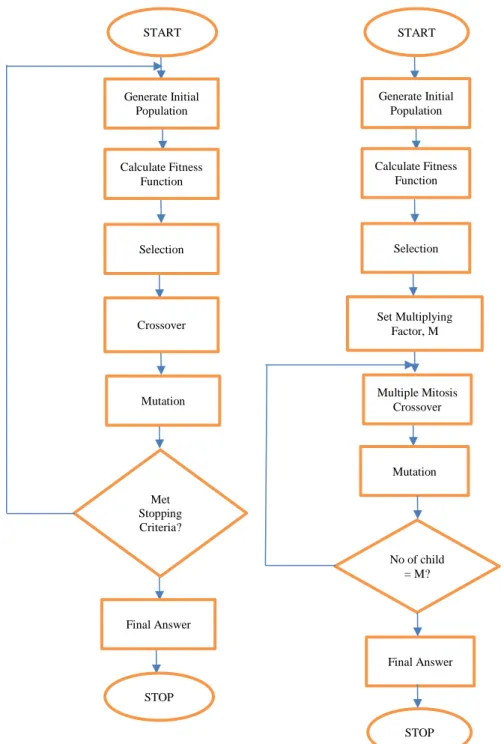
Figure 1 shows the flowchart of simple Genetic Algorithm and Figure 2 shows the flowchart of Multiple Mitosis Genetic Algorithm. As discussed above, simple GA have potential to eliminate good quality of genes in the new generation while the population going through the process of crossover and mutation. To improve the performance of GA to find the best optimum answer while maintaining the good quality genes, there are three different steps proposed in Multiple Mitosis Genetic Algorithm.
Step 1: Set Multiplying Factor, M
In MMGA, after selection process done, a multiplying factor, M is set by the user or it can also be generated randomly. M will determine the number of children that will be produced in the next generation. M is also determining the number of generations and stopping criteria for the Multiple Mitosis Genetic Algorithm.
Step 2: Multiple Mitosis Crossover
Multiple Mitosis Crossover is proposed to maintain the good quality genes to produced greater number of children limited by the multiplying factor, M. If the value of M is 10 means that 1 gene will produces 10 number of children in 1 generation. By doing this, quality genes have more potential to produce children inherit the good quality of the parents to prevent the potential of the good genes to be eliminated in the original process of crossover and mutation.
Step 3: Mini Loop
In simple GA, selected parents will go through the process of crossover and mutation one time in one generation. In the next generation, the old parents will be replaced by the new population which will reduce the possibility for fast convergence. In MMGA, mini loop is proposed to prevent good parents from being eliminated in the next generation and produce more quality children that inherit good genes from the parents where it will help to do fast convergence.
Figure 1. Simple Genetic Algorithm Figure 2. Multiple Mitosis Genetic Algorithm
Experimental result will show the advantage of Multiple Mitosis Genetic Algorithm in producing more quality genes from the selected parents to maintain the diversity and prevent premature convergence. To test the performance of Multiple Mitosis Genetic Algorithm in generating great diversity and fast convergence, De Jong’s sphere model function has been selected shown in (1). This function is the simplest function to test optimization method and most widely used functions by researcher to test
Generate Initial Population
START
Calculate Fitness Function
Selection
Crossover
Mutation
Met Stopping Criteria?
Final Answer
STOP
No of child = M? START
Generate Initial Population
Calculate Fitness Function
Selection
Set Multiplying Factor, M
Multiple Mitosis Crossover
Final Answer
STOP Mutation
In this experiment, n= 2 which represent for 𝑥1 and 𝑥2. The results will compare the diversity of the
good children produced and the effect to the convergence for different number of Multiplying Factor, M to observe the performance of the develop method.
2.2Parameter setting
In this experiment, the parameter set to find the minimum global of De Jong’s Sphere Model using Multiple Mitosis Genetic Algorithm shown in Table 1.
Table 1 Parameter setting
Paramter Setting
Number of generations 1
Population size 4
Probability of crossover 1.0
Probability of mutation 0.01
Multiplying factor, M 10, 20, 30, 40, 50
Chromosome length 17 bits, binary representation
3. RESULTS AND DISCUSSION 3.1. Results and analysis
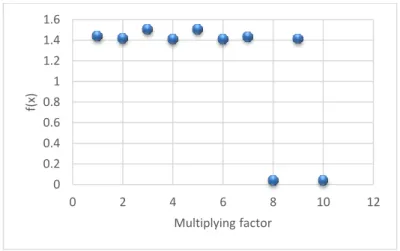
Figure 3 shows the distribution of the individual produced from the Multiple Mitosis Crossover when M =10 for a parent. From the figure, it shows that 10 numbers of children produced when M is set to 10 where only 20 percent from the individual are below 0.8 which approaching the final global minimum,
𝑓1(𝑥) = 0.
Figure 3. Distribution of Individual for M=10
The same function and parameter are now tested by increasing the number of M to 20 where it is expected that 20 number of children from the same selected quality parent will be produced. The individuals produced are also expected converging to the final global minimum. Figure 4 shows the improvement of the results where 70 percent of the individuals produced are below 0.8 and approaching the final global minimum 0. The same experiment is conducted again by different value of multiplying factor, M = 30, M = 40 and M = 50.
0 0.2 0.4 0.6 0.8 1 1.2 1.4 1.6
0 2 4 6 8 10 12
f(
x)
Figure 4. Distribution of Individual for M=20
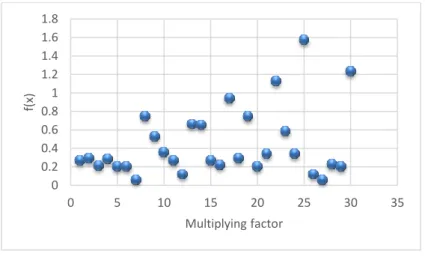
Figure 5 shows the result for multiplying factor, M=30. 83 percent of the individuals produced are scattered below 0.8 which again show the improvement on the quality of the genes produced.
Figure 5. Distribution of Individual for M=30
Figure 6 shows that 92 percent of the individuals are less than 0.4 where 45 percent of it are now have greater fitness which less than f(x)= 0.2. Figure 7 shows the individuals produced from the single generation of Multiple Mitosis Genetic Algorithm is 90 percent which is lower when M=40. However, the individuals produced below 0.2 are better in quality where the density of the individuals are high below 0.2, 88 percent approaching global minimum, 0. The convergence of the individuals to approach final answer can also be observed from the density of the individuals that increasing while approaching global minimum value from Figure 3 to Figure 7.
0 0.2 0.4 0.6 0.8 1 1.2 1.4 1.6 1.8
0 5 10 15 20 25
f(
x)
Multiplying factor
0 0.2 0.4 0.6 0.8 1 1.2 1.4 1.6 1.8
0 5 10 15 20 25 30 35
f(
x)
Figure 6. Distribution of Individual for M=40
Figure 7. Distribution of Individual for M=50
Table 2 shows the summary of the results. From M=10 to M=40 the percentage of individuals have fitness below 0.8 is increasing while reducing about 2 percent for M=50. Figure 7 shows that the quality of the individuals increasing where more individuals are approaching the global minimum compared to previous figures.
Table 2 Summary of the results for M=10 to M=50
No of Multiplying Factor, M No of children produced Percentage of children < 0.8 (%)
10 10 20
20 20 70
30 30 83
40 40 92
50 50 90
4. CONCLUSION
This paper presented a new idea to improve the performance of simple GA by increasing the diversity of great individuals in order to meet the global optimum. The objectives to increase the diversity of the great individuals are achieved. Multiplying factor have been increased from 10 to 50 with step size of 10 to observed the percentage of great quality individuals scattered to find the final answer. It is proving that as the factor increases, the number of children is increased, and finally the idea proposed managed to avoid premature convergence.
0 0.2 0.4 0.6 0.8 1 1.2 1.4 1.6 1.8
0 10 20 30 40 50
f(
x)
Multiplying Factor
0 0.2 0.4 0.6 0.8 1 1.2 1.4 1.6 1.8
0 10 20 30 40 50 60
f(
x)
ACKNOWLEDGEMENTS
This research project has been funded by the Internal Grant of Universiti Tenaga Nasional (UNITEN), Malaysia.
REFERENCES
[1] Mitsuhiro Yanagida, “The Role of Model Organisms in the History of Mitosis Research”, Cold Spring Harb
Perspect Biol doi: 10.1101/cshperspect.a015768, 2016.
[2] Clotilde Cadart et.al, “Exploring the Function of Cell Shape and Size during Mitosis”, CellPress, vol. 29(2), pp. 159-169, 2014.
[3] Radhika M Bavle and Radhika, “Mitosis at a Glance”, Journal of Oral and Maxillofacial Pathology: JOMFP. 18. S2-5. 10.4103/0973-029X.141175, 2014.
[4] Hermin Pancasakti et.al, “Chromosomes and Mitotic Cell Division Phase in Onion Roots after 24 Hours Acetoorcein Soaking Time”, Journal (BIOMA), vol. 14(2) pp. 46-48, 2012.
[5] Adèle L. Marston and Angelika Amon, “Erratum: Meiosis: Cell-cycle Controls Shuffle and Deal”, Journal of
Nature Reviews Molecular Cell Biology, pp. 983-997, 2005.
[6] N. Chakraborti, “Genetic Algorithms in Materials Design and Processing”, Journal of International Material
Reviews, vol. 49, pp. 246-260, 2013.
[7] R. Kiran Kumar et.al, “Dimensionality Reduction and Classification of Hyperspectral Images using Genetic Algorithm”, Indonesian Journal of Electrical Engineering and Computer Science, vol. 3, no. 3, pp. 503-511, 2016. [8] Timmy Manning et.al, “Naturally Selecting Solutions The Use of Genetic Algorithms In Bioinformatics”, Journal
of Bioengineered, pp. 266-278, 2013.
[9] Hsin-Pin Fu et.al, “A Decision Support System Based on A Genetic Algorithm for The Utilization of Leftovers”,
International Journal of Computational Intelligence, vol. 9, pp. 483-496, 2016.
[10] José Alberto Salinas-Pérez et.al, “Evolutionary Algorithm for the Analysis of Mental Disorders in Macro-urban Areas: The Case of Barcelona”, Spatial Economic Analysis, pp. 270-288, 2015.
[11] Min-Yuan Cheng et.al, “Optimizing Mixture Properties of Biodiesel Production Using Genetic Algorithm-Based Evolutionary Support Vector Machine”, Intenational Journal of Green Energy, pp. 1599-1607, 2016.
[12] Muhammad Arif et.al, “Counting of People in the Extremely Dense Crowd using Genetic Algorithm and Blobs Counting”, International Journal of Artifical Intelligence, vol. 2, 2013.
[13] Ahmad Yani et.al, “Optimum Reactive Power to Improve Power Factor in Industry Using Genetic Algorithm”,
Indonesian Journal of Electrical Engineering and Computer Science, 2019.
[14] Amina Bedboudi et.al, “A Heterogeneous Population-Based Genetic Algorithm for Data Clustering”, Indonesian
Journal of Electrical Engineering and Informatics (IJEEI), vol. 5, no. 3, pp. 275-284, 2017.
[15] L. Haldurai et.al, “A Study on Genetic Algorithm and Its Application”, International Journal of Computer Science
and Engineering, vol. 4, pp. 139-143, 2016.
[16] Patrick Kwaku Kudjo et.al,”Review of Genetic Algorithm and Application in Software Testing”, International
Journal of Computer Applications, pp. 1-6, vol. 160(2), 2017.
[17] A.J. Umbarkar1 and P.D. Sheth2, “Crossover Operators in Genetic Algorithms: A Review”, Journal on Soft
Computing, pp. 1083-1092, 2015.
[18] Siew Mooi Lim et.al, “Crossover and Mutation Operators Of Genetic Algorithms”, International Journal of
Machine Learning and Computing, Vol. 7, No. 1, pp. 9-12, 2017.
[19] Ajay Shrestha and Ausif Mahmood, “Improving Genetic Algorithm with Fine-Tuned Crossover and Scaled Architecture”, Journal of Mathematics, pp. 1-10, 2016.
[20] Duc-Cuong Dang et.al, “Emergence of Diversity and Its Benefits for Crossover in Genetic Algorithms”,
International Conference on Parallel Problem Solving from Nature, pp 890-900, 2016.
[21] Haneen Algethami and Dario Landa-Silva, “Diversity-Based Adaptive Genetic Algorithm for a Workforce Scheduling and Routing Problem”, IEEE Congress on Evolutionary Computation (CEC), pp. 1171- 1178, 2017. [22] Ms. Shikha Malik1 and Mr. Sumit Wadhwa2, “Preventing Premature Convergence in Genetic Algorithm Using
DGCA and Elitist Technique”, International Journal of Advanced Research in Computer Science and Software
Engineering. vol. 4, pp 410-418, 2014.
[23] James Byron and Wayne Iba, “Population Diversity as a Selection Factor: Improving Fitness by Increasing Diversity”, Proceedings of the 2016 on Genetic Evlutionary Computation Conference Companion, pp. 953-959, 2016.
[24] Aprilia and Wayan, “Hybrid Genetic Algorithm for Optimization of Food Composition on Hypertensive Patient”,
International Journal of Electrical and Computer Engineering, vol.8, pp. 4673-4683,2018.