Industry-Based Sustainability
Reporting on Key Issues
From Transparency
to Performance
Industry-Based Sustainability
Reporting on Key Issues
From Transparency
to Performance
Steve Lydenberg
Jean Rogers
David Wood
REPORT AUTHORS
Steve Lydenberg, Chief Investment Officer, Domini Social Investments
Jean Rogers, PhD, Principal, Arup
David Wood, PhD, Director, Initiative for Responsible Investment, Harvard University
ACKNOWLEDGEMENTS
The authors would like to thank Andrea Fernandez of Arup for her critical role in providing assistance with this report’s development, including sector research and significant input to testing the materiality screening approach and translation of issues to key performance indicators.
We would also like to acknowledge the review of report drafts and invaluable feedback from Mike Wallace (GRI), Allen White (Corporation 20/20), Adam Kanzer (Domini Social Investments), Mike Krzus (Grant Thornton), and Jane Nelson (Kennedy School of Government).
Additionally, the authors are grateful for the support and leadership of the Hauser Center and the Initiative for Responsible Investment at Harvard University in promoting the understanding of environmental, social, economic issues in corporate governance and the relationship of disclosure to improved performance and the advancement of a prosperous and equitable society.
DESIGN
Tim Pattinson, Arup www.arup.com
PAPER
Interior stock: 80# Reincarnation Matte Book Cover stock: 95# Reincarnation Matte Cover All stock is 100% recycled, with a 60% post-consumer waste content.
PRINTING
www.greenerprinter.com
Printed with soy and vegetable-based inks, using wind-powered presses.
Foreword
Executive Summary
Mandatory Sustainability Reporting
Introduction
The Growth of Voluntary Sustainability Reporting
The Need for Mandatory Sustainability Reporting
Usefulness of Key Performance Indicators
Convergence with Financial Reporting and
Establishing Key Performance Indicators
Role of Key Sustainability Performance Indicators
A Six-step Method for Identifying Key Sustainability
Performance Indicators by Industry Sector
Results from the Experiment
Conclusion and Recommendations
Endnotes and Resources
Appendices
Table of Contents
1
2
3
01
02
04
05
10
14
16
18
28
34
38
44
iv
vi
II INITIATIVE FOR RESPONSIBLE INVESTMENT
List of Figures and Tables
Figures
1 Six-Step method for developing industry specific key
performance indicators
2 Universe of ESG issues and opportunities
3 Materiality test
4 Establishing the cut-off point for “minimum” materiality
5 Framework for ESG key performance indicators and
management disclosures
6 Key performance indicators and management disclosures:
Guidance for airlines subsector
7 Material issues across the six subsectors
8 KPI’s in practice –
comparable and complete data set
A1 Proposed relationship between minimum ESG disclosure
requirements and complete disclosure in a company’s Form 10-K
C1 Financial vs. Sustainability Reporting
D1 Sustainability Guidance: Key Performance Indicators for
Airlines Subsector
D2 Sustainability Guidance: Key Performance Indicators for
Automobiles Subsector
D3 Sustainability Guidance: Key Performance Indicators for
Banks Subsector
D4 Sustainability Guidance: Key Performance Indicators for
Conventional Electricity Subsector
18 19 21 23 25 27 29 32 47
59 62 63 64 65
III
FROM TRANSPARENCY TO PERFORMANCE
D5 Sustainability Guidance: Key Performance Indicators for
Paper Subsector
D6 Sustainability Guidance: Key Performance Indicators for
Diversified REITs Subsector
E1 Example of Integrated Reporting: Sustainability Reporting as
part of Form 10-K Report
F1 US Financial Reporting Cycle
F2 Example of Integrating ESG Reporting into Financial
Reporting
G1 Categories Highlighting Subsectors Reviewed
Tables
A1 GRI vs. Industry-specific KPIs
F1 Roles and Responsibilities in the current US Financial
Reporting System
F2 Options for different models to strengthen ESG Reporting
66 67 71 79 83 86
48 77 81
IV INITIATIVE FOR RESPONSIBLE INVESTMENT
The need to set down our thoughts on how a system of Key Performance Indicators (KPIs) might be developed and integrated into the broader movement to mandate the disclosure of sustainability data grew from three convictions. First, we were convinced that improved disclosure of sustainability data in the US is both necessary and needed urgently. Second, we were convinced that it must be mandatory, or at least to some extent. Third, we believed that better guidance could enable companies to be in a stronger position to rise to the challenge of sustainability reporting and see benefits rather than burdens. It is our hope that establishing sustainability KPIs for all sectors will enable companies to move from a compliance driven “disclosure” mindset to one of managing—and even competing on—performance on the sustainability issues that matter most.
At the same time, we recognized that it is difficult to determine exactly which of the many facts and figures that make up the full range of sustainability data—crucial information about how corporations affect our daily lives and their implications for generations to come—should be disclosed. Many have tried their hand at enumerating those most important sustainability data points. The Global Reporting Initiative is chief among those tackling this task, but the French government’s New Economic Regulations of 2001 have set out its own list of 40 key indicators; Dow Jones and FTSE have come up with scoring systems and key indicators in constructing their sustainability stock indexes; and SustainAbility and AccountAbility have devised systems for determining the most material and comprehensive sustainability reports.
One thing was clear to us from these various and varied initiatives—the guidance must be relevant to the core operations of the business, and the sustainability data disclosed as a result must be relevant to key stakeholders in the corporation, including not just the stockowners, but customers, employees, communities, suppliers, and the environment. Transparency in the data these stakeholders want and need is the crucial first step on the road to better performance—i.e., changing corporations’ actual practice in daily life and making companies more responsive to global challenges and the needs of today’s society.
V
FROM TRANSPARENCY TO PERFORMANCE Deciding which data points should be
disclosed and by whom is critical for the success of this next step in the managing of corporations’ relations with society. This decision must successfully identify those data points that are most important to the widest array of stakeholders for issues on which change is most needed and most possible in a resource constrained society. The process for making this decision must itself be transparent and trustworthy. The result must be practical and useful.
Determining a legitimate process for implementation is the important first step in going down the road to mandatory disclosure. If the process is properly conceived, the most appropriate data points will flow from it naturally and evolve as needed to address new issues and concerns. For this reason, we have concentrated here on how a process for determining KPIs might be best developed, rather than on determining indicators themselves, although we have used hypothetical case studies to demonstrate how this process might produce specific results. This process provides new insights into how to approach understanding the materiality of sustainability issues, as a prelude to disclosure and management. As such, it is useful not only for regulatory or standards-setting bodies, but for corporations struggling to put processes in place to manage the risks and
opportunities associated with material, non-financial issues facing their sector.
We recognize that the task at hand is challenging and its implications extend well beyond the financial community. Many regulators, financial professionals, and non-governmental organizations around the world today are tackling this challenge, as countries around the world move toward imposing their specific solutions to this problem. What exactly will be the outcome of this movement toward mandatory sustainability
disclosure in the US and beyond may not be entirely clear today, but we hope that the ideas brought forward in this paper can contribute to that important debate.
David Wood June 2010
Cambridge, Massachusetts Jean Rogers
VI INITIATIVE FOR RESPONSIBLE INVESTMENT
This paper proposes a method for identifying key performance indicators on the sustainability—or social and environmental—impacts of US corporations in specific industries. We believe that mandatory reporting by US corporations on their impacts on society and the environment is not only desirable, but inevitable. What specific data needs to be reported and in what form, however, remain challenging questions. We believe that it is crucial to pursue simultaneously both mandatory reporting of sustainability indicators in a standardized format and reporting on key performance indicators specific to particular industries. Thorough work has been done by the Global Reporting Initiative (GRI) on establishing a credible set of universally applicable indicators. More work needs to be done on how to determine relevant sector-specific key performance indicators as a minimum basis for sustainability reporting.
Over 3,000 corporations around the world now engage in sustainability reporting. Historically, sustainability reporting by US corporations lags behind that of their peers in other regions of
the world1. As an increasing number
of governments and stock exchanges encourage or require sustainability reporting, corporations and financial markets in the United States run the risk of diminishing their competitiveness in sustainability. This data can be crucial in aligning business practices with those of a sustainable economy and in providing a means for benchmarking the performance of large corporations as they interact with society and the environment. Our method for developing key
performance indicators (KPIs) for sustainability relies on three principles— simplicity, materiality, and transparency. Building on a broad disclosure framework such as that of the Global Reporting Initiative, this method suggests how those sustainability KPIs most material to all stakeholders can be identified.
VII
FROM TRANSPARENCY TO PERFORMANCE We believe that this proposed method
for establishing KPIs can be useful for, among others:
• Regulators or stock exchanges contemplating increased targeted requirements for sustainability reporting;
• Corporations seeking to enhance the credibility of their sustainability reporting and improve its integration into financial reporting on material factors;
• Stakeholders seeking to better understand the most important elements of a corporation’s sustainability performance; • Investors seeking to improve the
sustainability analysis they incorporate into their assessments of company value.
Our goal is to encourage the uptake of sustainability reporting in the United States. This can be achieved in part through the development of concise guidance on key material sustainability issues for specific industry sectors. Focusing on key sustainability issues for each sector can facilitate the emergence of a reporting framework in which sustainability and financial reporting converge.
Our goal is to encourage the uptake
of sustainability reporting in the
United States. This can be achieved in
part through the development of concise
guidance on key material sustainability
issues for each sector that should be
2 INITIATIVE FOR RESPONSIBLE INVESTMENT
Over the past three decades, advocates from various stakeholder groups— investors, employees, communities, environmentalists, consumers, and regulators alike—have sought to expand corporate reporting to include environmental, social and governance (ESG) data. Substantial progress has been made by such organizations as the Global Reporting Initiative (GRI) both in defining what constitutes enhanced corporate reporting in these areas and in convincing corporations to produce voluntary reports addressing sustainability and ESG issues (further information about GRI can be found in Appendix A)2.
Introduction
These reports go by a variety of names, including sustainability, ESG, corporate social responsibility, triple-bottom-line, corporate citizenship, and environmental, health and safety reporting. In this paper, we will refer to these generally as “sustainability” or “ESG” reports3. As voluntary sustainability reporting has become an increasingly common practice among large corporations, the question arises as to whether or not such reporting should remain strictly voluntary, or should be mandated by regulators or stock exchanges. A number of governments have already made broad-based sustainability reporting essentially mandatory—France and Sweden, for example (see Appendix B).
According to the World Federation
of Exchanges4 there were almost 50
socially responsible investing (SRI) indices offered directly or indirectly by stock exchanges; these indices are predicated on, and therefore encourage, the
disclosure of a broad range of social and environmental indicators—the JSE in South Africa and Bovespa in Brazil, for example.
As voluntary sustainability reporting has
become an increasingly common practice
among large corporations, the question
arises as to whether or not such reporting
should remain strictly voluntary.
3
FROM TRANSPARENCY TO PERFORMANCE Although the United States is still far from
a system of mandatory sustainability reporting, in early 2010, the US Securities and Exchange Commission (SEC)
issued guidance to US corporations on their obligation to report on climate-change-related data when it might be deemed material to an assessment of the firm’s future prospects. This guidance reminds corporations that they already have an obligation to report on social and environmental factors that might materially affect the firms’ performance5. The SEC guidance was based on existing legal requirements to report on emerging trends, events and uncertainties. The guidance was warranted because NGO and investor surveys of SEC filings show that, in the absence of SEC guidance, environmental and social issues disclosure in SEC filings is sparse, inconsistent, and typically omits large issues facing the company6.
This paper argues that sustainability reporting must to some extent be made mandatory in order to assure that comparable sustainability data is available to investors and other stakeholders who might wish to form judgments of the materiality of this data on their own. It also argues that tailored key sustainability performance indicators, which vary in their materiality from industry to industry, should play an important role in such disclosure.
We wish to stress at the outset that this paper does not provide a definitive list of KPIs for industries. Rather it suggests a method by which such KPI indicators can be established in a transparent and flexible manner. By demonstrating the feasibility and benefits of such an approach, we hope to encourage the consideration of the important role that KPIs should play in mandatory reporting schemes in the US. For illustrative purposes we have conducted an experimental test of the method we are proposing, in order to help readers understand its promise.
The examples of KPIs that we have derived should not be taken as more than suggestive at this point. Our focus is on outlining a process that could be implemented in the US to address the materiality of sustainability issues and determine KPIs for all sectors in a cost- and time- effective manner.
A determination of which body is most appropriate for ultimately establishing the KPIs themselves falls outside the scope of this report.
4 INITIATIVE FOR RESPONSIBLE INVESTMENT
According to the CorporateRegister.com, the number of sustainability and similar reports issued yearly by corporations has grown from 26 in 1992 to over 3,000 in 20087. The world’s largest companies now issue sustainability reports as a matter of course. In the United Kingdom, for example, some 86 percent of the FSTE 100 corporations issued sustainability reports in 2007. The 10 largest South African corporations all included a sustainability report in their 2007 annual reports to stockowners.
The Growth of Voluntary
Sustainability Reporting
The major players in industries with direct impacts on the environment, such as the chemical, electric utility, oil and gas and mining industries, have aggressively taken up sustainability reporting.
According to the CorporateRegister.com, in the first nine months of 2008 alone, some 80 major chemical companies worldwide issued sustainability reports, while 80 reports were issued by mining companies, 200 by oil and gas companies, and the electricity sector accounted for roughly another 230 reports. Similarly, a KPMG study published in October 2008 found that almost 80 percent of the Global Fortune 250 companies report publicly on social and environmental data8. This is a marked increase from a 2005 KPMG report which found only 50 percent of these companies publishing sustainability information.
This strong growth in voluntary sustainability reporting suggests that both corporations and their stakeholders find value in the publication of this data. However, we believe that without mandatory reporting, the crucial task of transforming sustainability reporting into actual improvements in sustainability performance will remain an especially difficult task.
Companies reporting on a voluntary
basis may choose different time periods in
which to report; as well as reporting on
different indicators in different formats.
5
FROM TRANSPARENCY TO PERFORMANCE
RATIONALE FOR A
MANDATORy REGIME
Voluntary sustainability reporting, while increasingly recognized for its valuable contributions, presents a number of challenges. For example, companies reporting on a voluntary basis may: • Choose different time periods in whichto report—some may report annually, some biannually, some at irregular intervals, and some only once and then not at all;
• Report on different indicators— companies in the same industry may choose to report on the a variety of different key indicators;
• Report in different formats and using different metrics—even when reporting on the same indicators, companies may report data covering different time periods, using different units of measurements, or choosing different benchmarks against which to measure performance.
Mandatory reporting has the potential to address these challenges, and can bring with it a number of additional benefits. A mandatory regime will, for instance:
The Need for Mandatory
Sustainability Reporting
• Create a level playing field for corporations disclosing crucial information related to sustainability performance;
• Allow investors and others to make apples-to-apples comparisons of the relative sustainability performance of companies within a specific sector; • Enable the full range of stakeholders
to hold robust debates on the effects of corporate activity;
• Help internalize costs from corporate activity that the current disclosure regimes allow to be externalized onto society.
We argue here that mandatory reporting must capture a broad set of potential sustainability indicators which can be used to describe companies’ impacts. The Global Reporting Initiative has, over the past decade, made substantial progress in assembling such a list of indicators relevant to a wide spectrum of stakeholders and applicable to corporations across all sectors. The GRI model therefore appears to provide a useful framework for broad-based mandatory reporting. For example, the mandatory sustainability scheme recently adopted by Sweden for companies with state ownership and strongly encouraged for other corporations in that country, relies on the GRI’s comprehensive set of indicators.
6 INITIATIVE FOR RESPONSIBLE INVESTMENT
We also argue that mandated reporting of key performance indicators is crucial for an effective disclosure framework. These KPIs may or may not be already captured by in a set of broad-based indicators. However, highlighting key performance indicators for each industry and sector will direct the reporting efforts of corporations and the assessment efforts of those using corporations’ sustainability reports to those issues and data points most material to the broadest set of stakeholders.
Implementing a mandatory reporting regime, without specifying a minimum set of KPIs to be reported, results in increased disclosure – but not the ability to compare, track, and improve performance on the things that really matter. Reporting will be more privalent, but the outcomes will not necessarily be better for the additional effort expended.
Properly designed, mandated transparency, whether broad based or focused on KPIs, allows public officials to set appropriate rules and regulations to moderate the social and environmental impacts of corporations. It enables NGOs to engage corporations on their effects on communities and the environment. It provides individuals and communities – whether as consumers, employees, neighbors or concerned citizens—with the information they need to inform important decisions.
In addition, mandated sustainability disclosure permits stakeholders to send clear market signals to corporations on their sustainability performance.
It will encourage companies to compete on how they mitigate their sustainability risks and how they capitalize on their sustainability opportunities. In short, mandatory reporting regimes create better disclosure, which, when incorporating key sustainability performance indicators, can lead to better performance in those areas most crucial to stockowners, other stakeholders, and society.
ALTERNATIVES TO A
MANDATORy REGIME
The arguments most often made against mandatory reporting, and in favor of continuing the current regime of voluntary reporting, are typically ones of practicality and costs—it is difficult for regulators or stock exchanges to determine what data should be required and how to monitor the adequacy of its reporting; and it is expensive for companies to compile sustainability data. As a half-way step toward mandatory reporting, a number of governments have mandated that companies engage in corporate social responsibility reporting without defining which sustainability indicators are to be reported or in what format. Under some such systems companies can choose not to report at all as long as they explain why they have chosen not to do so. As of 2009, Denmark, for example, had adopted a mandated disclosure system of this type, as had Malaysia.7
FROM TRANSPARENCY TO PERFORMANCE Another approach that encourages
sustainability reporting, but that falls short of actual mandates for specific indicators, has been taken up by several stock exchanges around the world—that is, the creation of socially responsible investment (SRI) indexes. The JSE (Johannesburg Stock Exchange) pioneered this approach with the launch of its SRI Index in 2001. Others that have followed in its footsteps include the Brazilian Bovespa (Corporate Sustainability Index) and the OMX (GES Sustainability Nordic Index). As of 2009, 15 of the 51 stock exchanges in the World Federation of Exchanges had launched sustainability or environmental indexes of one sort or another9. Sustainability indexes encourage publicly traded companies to monitor and report on their initiatives, but typically do not specify key sustainability performance indicators.
Although these steps toward mandatory reporting are encouraging, they are not sufficient to the task of assuring that comparable data on the most material sustainability issues for particular industries is available. According to EIRIS10, good quality ESG disclosure is crucial for holistic investment decision-making, but it is currently lacking across the market. Half steps toward mandatory reporting are still too unreliable to fully align the conduct of business with the creation of sustainable economies generally or to most effectively improve the actual sustainability performance of corporations.
Mandatory reporting allows third parties to: • Fairly judge companies’ sustainability
policies and practices;
• Compare them to those of their peers and assess their progress or lack of progress over time in achieving sustainability goals;
• Understand how corporations in practice are or are not supporting governments’ efforts to create just and sustainable societies.
Without mandatory reporting, the kind of benchmarking necessary to drive improved performance on key sustainability issues in each sector will not be possible11.
Mandatory reporting regimes create
better disclosure, which, when
incorporating key sustainability
performance indicators, can lead to
better performance in those areas
most crucial to stockowners, other
stakeholders, and society.
8 INITIATIVE FOR RESPONSIBLE INVESTMENT
These issues include many of the major challenges facing societies around the world today. For instance, advocates point out that ESG information can help society address crucial challenges of our time such as:
• Climate change and the efficient use of energy;
• Releases of toxic chemicals into the environment;
• Sustainable management of forests, fisheries, and other natural resources; • Safety and decent conditions in the
workplace;
• Equal access to technologies and financial services for all members of society;
• Availability of water;
• Equal opportunities in employment; • The need for sustainable products and
services.
US CONTExT
Mandatory reporting is particularly important in the United States, which is host to one of the largest and most diverse set of publicly traded corporations in the world. As of year-end 2009, there were over 5,000 US companies listed on the New York and NASDAQ stock exchanges with a combined domestic market capitalization of over $15 trillion, and many more public firms that are traded over the counter12.
The number of companies reporting and the quality of the reporting by these companies leaves much to be desired, although these are signs of recent progress. As of 2009, only 130 US companies had registered their sustainability reports with the Global Reporting Initiative13. And those US corporations who do report appear not to be doing as good a job as their peers in other countries.
The U.K. consultancy group SustainAbility conducts a biannual survey of the state of CSR reporting in conjunction with the United Nations Environmental Program. “Tomorrow’s Value” most recently published in 2006 listed the 50
companies scoring highest for quality in their CSR reporting. Only five of the top 50 CSR reports were from the United States—Nike (No.10), Hewlett-Packard (15), Ford and General Electric (tied at 25) and Gap (34)14.
The move toward mandatory
sustainability reporting regimes is an
important step toward capital markets
that create long-term wealth and
sustainability for shareholders
and society alike.
9
FROM TRANSPARENCY TO PERFORMANCE Authors of a 2010 report from
PricewaterhouseCoopers and Craib Design and Communications looked at CSR reports issued in 2009 by more than 1,000 companies worldwide. The report found that because companies take varying approaches to CSR reporting, it can be challenging to assess companies’ actual performance, or to gauge their efforts in comparison to one another. The report found that less than 30 percent of S&P 500 companies issued CSR reports in the US, compared to 75 percent of S&P Europe 350 firms. US businesses also trailed European ones in publishing greenhouse gas emission targets, in explaining supply-chain engagement and in obtaining third-party assurance of reports.
As recently as 2009, Microsoft, Cisco and Oracle were removed from the NASDAQ Global Sustainability Index (QCRD) due to a failure to disclose 2 out of 5 quantatitive environmental metrics that adhere to GRI15.
Companies often cite a number of reasons for not devoting resources to sustainability reporting. These include the fact that ESG reporting involves an expense and time commitment they are reluctant to bear, that compiling and publishing sustainability reports distracts management from what it considers its “core” business, and that management is unclear as to the relevance of such reporting to their stakeholders.
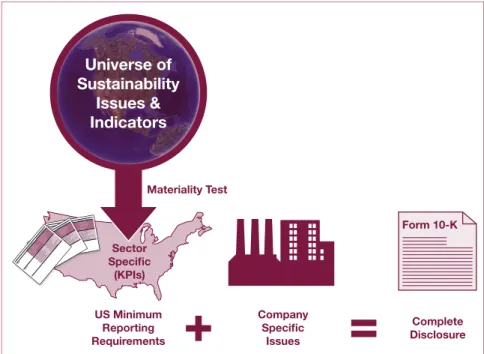
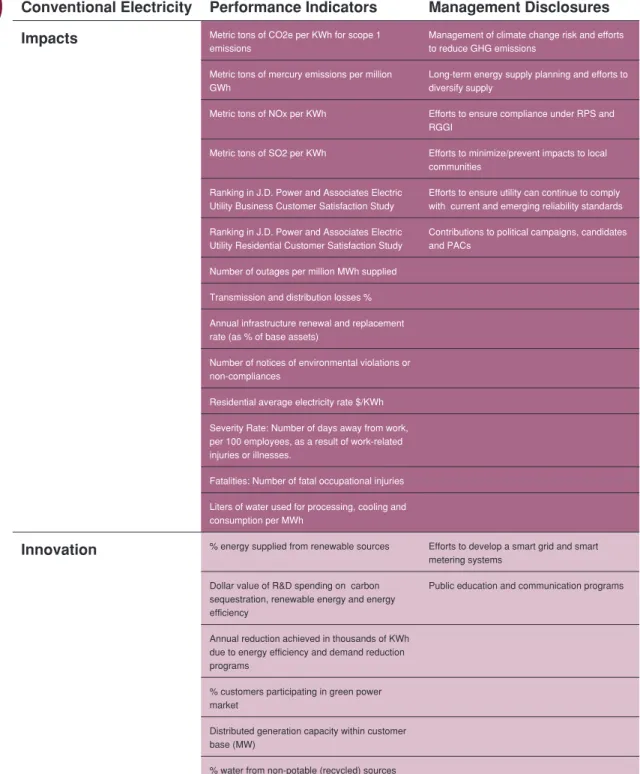
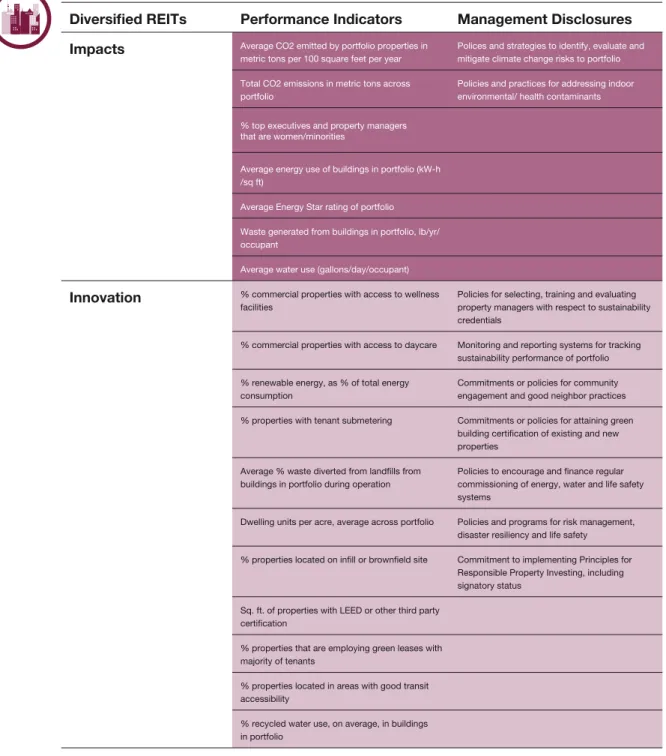
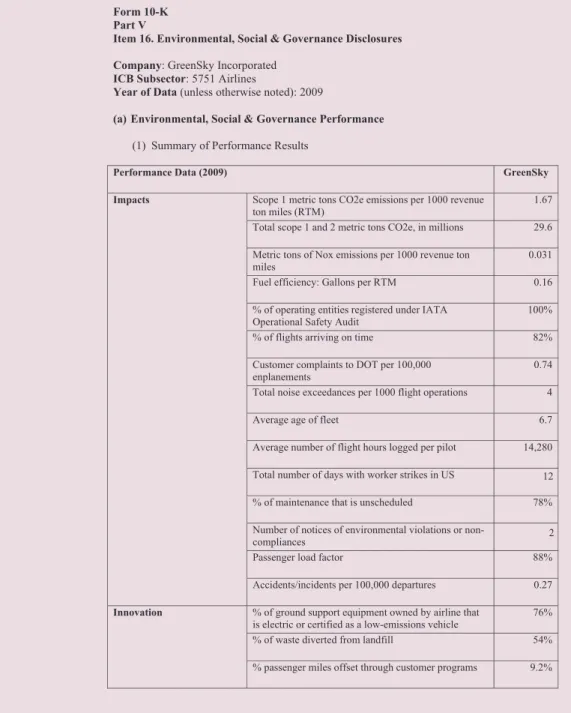
Given the size and scope of the universe of US publicly traded corporations, we believe that only a mandatory sustainable reporting regime can assure that an adequate volume of high-quality data is available to stockowners and other stakeholders. We therefore support the July 2009 call by the US Social Investment Forum (SIF) for the Securities and Exchange Commission to require corporate issuers to report annually on a comprehensive, uniform set of sustainability indicators comprised of both universally applicable and industry –specific components16. We also support SIF’s request that the SEC issue interpretive guidance to clarify what discussions companies are required to include regarding short- and long-term sustainability risks in the Management Discussion and Analysis (MD&A) section of their Form 10-K filings (See Appendix D for the type of guidance that SEC might issue for each sector regarding performance indicators and management disclosures, and Appendix E for an example of a corporate ESG disclosure response to that guidance in a Form 10-K format).
In short, we believe that the move toward mandatory sustainability reporting regimes is an important step toward capital markets that create long-term wealth and sustainability for shareholders and society alike. This can be facilitated by issuing clear, sector based guidance to which companies can respond in their Form 10-Ks or elsewhere.
10 INITIATIVE FOR RESPONSIBLE INVESTMENT
To maximize the usefulness of mandatory reporting, it is essential the reporting regime integrate a means of identifying key sustainability performance indicators on a sector by sector basis. These indicators focus on the sustainability data that is most material to most stakeholders and enable corporate management, investors, and other stakeholders to encourage improvements in the most important aspects of a company’s sustainability performance.
Reporting on sustainability and ESG performance is a crucial step toward a market that rewards the creation of long-term wealth in a just and sustainable society. Sustainability key performance indicators (KPIs) can play a crucial role in supporting markets that create such long-term wealth. They can form the backbone of sustainability disclosure that tracks, and allows for improvement on, those issues most tied to a corporation’s environmental and social impact and most material to a company’s financial performance.
Usefulness of
Key Performance Indicators
A reporting regime without KPIs poses major challenges:
• Companies can expend substantial time and expense gathering data irrelevant to their primary societal and environmental impacts;
• Sustainability reports containing excessive amounts of extraneous information can make analysis and decision-making difficult for investors, regulators, NGOs, consumers, and others;
• Companies can be at the mercy of ever-increasing requests for information from an ever-increasing number of interested parties; • Companies with prominent brands
may be subject to disproportionate pressures to increase their reporting. One of the chief challenges of
sustainability reporting is striking a balance between comprehensiveness and relevance. KPIs can help in achieving the appropriate balance.
Sustainability disclosure tracks, and
allows for improvement on, those issues
most tied to a corporation’s environmental
and social impact and most material to a
company’s financial performance.
11
FROM TRANSPARENCY TO PERFORMANCE Comprehensive lists of potentially
relevant data have been developed by the Global Reporting Initiative and other organizations. The GRI’s G3 Guidelines for sustainability reporting identify and disseminate a broad list of sustainability indicators—some 80 in number— across environmental, social, and economic dimensions. In addition, the GRI is developing detailed, specific reporting guidance for industry sectors that highlight numerous indicators most relevant to that sector.
To address the issue of the relevance of specific indicators, the GRI and organizations such as AccountAbility17 have also developed guidelines that companies can follow on materiality, which help identify issues of greatest importance. These guidelines, however, are general and it is up to individual companies to determine those issues they deem most material.
A more limited and targeted approach is taken by responsible investors such as the Swiss money management firm, Pictet & Cie. Pictet takes the position that focusing on a limited number of key indicators—potentially as few as one or two per industry—is the most productive approach to sustainability research. In its March 2005 paper “Less Can Be More: A New Approach to SRI Research,” Pictet argues that it “is often easier to answer a lot of irrelevant questions than to find the answers to the few really relevant ones” and calls for the identification of a limited number of “key impact factors.”18
More recently, calls for KPIs have been coming from other European financial professionals: the European Federation of Financial Analyst Societies (EFFAS) published a guideline for the Integration of ESG into Financial Analysis and corporate valuation, which recommends incorporation of KPIs into the MD&A disclosure, in order to achieve comparability and benchmarkability19. The German Federal Environment of Ministry has also released its SD-KPI Standard 2010-2014 which presents minimum reporting standards for relevant sustainability information in annual reports
and management commentaries20. These
industry-specific KPIs were compiled by the Ministry from questionnaires completed by SRI investment analysts on particular ESG topics.
GRI Sector Supplements
Recognizing the need for CSR disclosure tailored to the specifics of certain industries, the Global Reporting Initiative has developed a series of Sector Supplements21 to its general reporting guidelines.
As of early 2010, the GRI had initiated work on sector supplements for 15 industries such as airports, apparel and footwear and food processing, and completed work on supplements for the electric utilities, financial services, and mining and metals industry.
The GRI initiates work on a sector supplement when a quorum of companies in a sector approach GRI with interests and the ability to fund the development of the guidelines.
These sector supplements provide additional guidance to companies on which GRI indicators are regarded as most relevant to stakeholders. They also highlight sections of the GRI general guidelines that require particular attention, as well as identify occasional new issues.
As with the GRI’s general guidelines, these sector supplements have been developed through an elaborate stakeholder consultative process typically involving industry, NGOs, government and labor.
12 INITIATIVE FOR RESPONSIBLE INVESTMENT
In our view, a KPI approach that focuses in on a limited number of the most relevant sustainability issues for specific industries has many virtues. Among other things, it can help:
• Identify those sustainability aspects of sector-specific performance that impact society either negatively or positively;
• Define the most relevant information that can be reasonably collected and reported;
• Present in a usable, standardized format data that allows comparison of relative corporate sustainability performance.
In other words, a limited number of KPIs can help contribute to a balanced reporting regime that serves the dual demands of comprehensiveness and practicability. Such a regime can build on the extensive work defining and measuring corporate sustainability already in existence, and can also guide corporations and stakeholders as they focus on issues with the greatest sustainability implications at any given time. (Appendix C provides a brief review of different sustainability reporting frameworks in use today.)
Key performance indicators work best when focused on a specific industry because the importance of specific ESG information categories varies substantially across sectors: the electronics industry faces specific challenges in supply chain management, use of toxic chemicals in manufacturing and waste disposal; retail groceries in managing their
employee relations and the sustainability of the products they sell; the mining industry in human rights practices, tailings management, availability of water, government relations; and so on. As noted below, standard industry classifications suggest that there are over 100 industry subsectors for which meaningfully different sets of KPIs can be identified.
Identifying key performance indicators by sector captures the specific ESG issues most relevant to a given corporation, while at the same time enabling comparability among peer groups. It creates a tailored, usable and standardized framework for stakeholders that is flexible enough to accommodate different sorts of corporate activity. Furthermore, developing KPI’s for specific industries headquartered in a particular country, such as the US, enables those KPIs to take advantage of existing data collection systems and commonly used industry terminology and to reflect national standards and policy.
13
FROM TRANSPARENCY TO PERFORMANCE
RELATION BETWEEN
KPI AND BROADER
DISCLOSURE FRAMEWORKS
A KPI approach complements and enhances broader sustainabilitydisclosure regimes in a number of ways. First, it dovetails with broad-based disclosure in the sense that many KPIs recur across industries. Identification of these recurring KPIs highlights those universally applicable indicators that are of greatest significance throughout the corporate world. At the same time, KPIs can enhance broad-based disclosure by identifying those KPIs that are material to only a few, or even just one or two, industry sectors. These unique sector-specific issues are often the most material, because they stem from the core activities and business models of the companies in that sector. This highlights ways in which KPI reporting can fill important gaps in broader approaches. Moreover, a KPI approach permits issues to be highlighted and addressed in detail that may be of substantial relevance to stakeholders other than the stockowners traditionally served by the financial materiality principle in reporting.
Ultimately, we believe that decisions on how to coordinate and balance sustainability reporting on more universal issues with a focus on key performance indicators will vary from region to region and country to country. Such methods should be fully transparent so that these differences can be fully understood. In addition, they should be designed with sufficient flexibility to allow for change over time.
In this paper, we propose a six-step method for assessing the materiality of a broad range of sustainability issues by industry, and then, hypothetically model the application of the method to six industries: airlines, automobiles, diversified REITS, conventional electricity, forest and paper products, and retail banks. (See Appendix D for a complete list of the KPIs for each of the six industries reviewed.)
Defining a limited number of KPIs can
help contribute to a balanced reporting
regime that serves the dual demands of
comprehensiveness and practicability.
14 INITIATIVE FOR RESPONSIBLE INVESTMENT
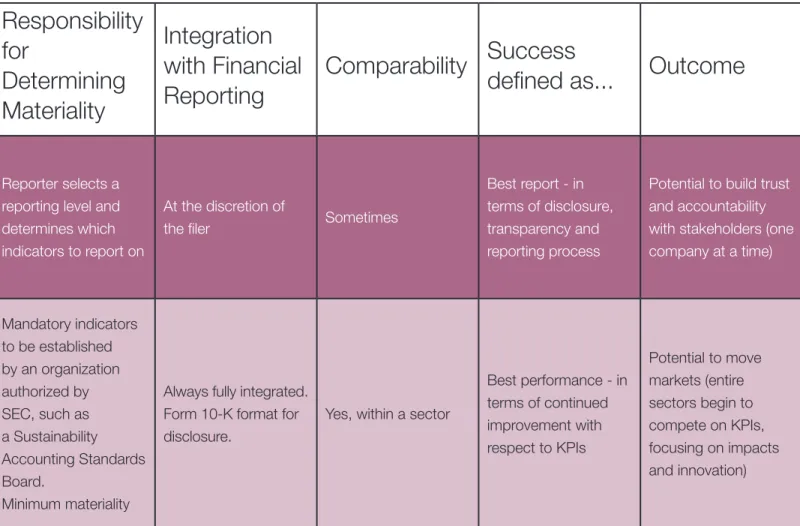
This paper proposes a method for identifying KPIs, but it leaves for further consideration two crucial questions. The first is how KPIs should be integrated into financial reporting. The second is which authority should be empowered to define KPIs for each industry.
We believe that there is little question that reporting on KPIs can and should be integrated into mainstream financial reporting. If KPIs are to serve a useful role in driving fundamental change in business practices, their implications for the core business operations and its finances need to be spelled out and understood. Integration with financial reporting can help address one of the chief concerns about sustainability reporting today—that is, the belief that it can be simply greenwashing that pays lip service to high profile issues without driving any change to fundamental business practices. Integrated reporting helps to inform companies’ decision-making by identifying potential financial and non-financial risks and rewards within their operations and allowing investors and other stakeholders to understand how sustainability issues play out in the day-to-day decision making about the basic operations of a company.
Convergence with Financial
Reporting and Establishing
Key Performance Indicators
Additional work needs to be done to better understand where and how KPIs could most usefully be integrated into financial reporting. In “One Report”, Eccles and Krzus22set forth a compelling business case for integrated reporting, without specifying regarding what should be included in the integrated report or how this could be accomplished in a comparable format. To help readers understand how this could be achieved we have included six examples of concise sector guidance for minimum ESG disclosure in Appendix D. We have included in Appendix E one hypothetical example of how a company could achieve integrated reporting using a US corporation’s Form 10-K.
15
FROM TRANSPARENCY TO PERFORMANCE More complicated is the related question
of who should be granted the authority to define KPIs for each industry. Five options seem likely:
• Securities regulators, i.e., the
Securities and Exchange Commission in the US
• Accounting standards setting bodies, i.e., Financial Accounting Standards Board
• A new body that could be created to set sustainability reporting standards, such as a Sustainability Accounting Standards Board
• Stock exchanges, i.e., New York Stock Exchange, NASDAQ
• Other third parties, i.e., GRI, academic institutions, trade associations, financial research firms, credit rating agencies, etc.
The problem of who should determine KPIs is further complicated by the international nature of corporate activities these days. In many industries—such as automobiles, airlines, pharmaceuticals and steel—peer-to-peer comparisons cut across national lines. If different countries establish different methodologies
for determining KPIs and mandate substantially differing sets of KPIs, meaningful peer-to-peer comparisons could be difficult to achieve.
For the purposes of this paper we have concentrated primarily on demonstrating the viability of a sector-based KPI method and its benefits, and we leave the vital question of institutional control for further discussion. Appendix F puts forward possible policy scenarios for convergence of financial and sustainability reporting in the US.
We believe that establishing the principle of, and method for, mandatory reporting of KPIs is an important first step, and that the challenges involved in putting this method into practice should be resolved in the context of a comprehensive discussion of the virtues and drawbacks of the various approaches.
Successfully implementing integrated
reporting requires concise guidance regarding
the most material KPIs that should be
Role of Key Sustainability
Performance Indicators
18 INITIATIVE FOR RESPONSIBLE INVESTMENT
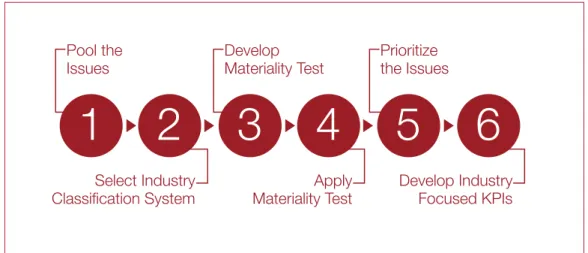
To meet the dual challenges of comparability and practicability for establishing KPIs by industry and sector, we have developed a six step method as follows (see Figure 1):
1 Assemble a broad universe of
sustainability risks or opportunities that could apply to all industries.
2 Select an industry classification system.
3 Establish a definition of materiality to address non-financial issues.
4 Apply the materiality test to the sustainability issues potentially applicable to each industry sector.
A Six-Step Method for Identifying
Key Performance Indicators
by Industry Sector
5 Rank the materiality of these issues
within each industry and establish a threshold that defines those issues that are key.
6 Create a tailored set of key
performance indicators for the most material issues for each sector. Below we apply this method to six industry subsectors, as defined by the Industry Classification Benchmark: airlines, automobiles, diversified REITS, conventional electricity, paper and retail banks. These six were chosen in order to represent a diversity of business practices —from manufacturing (automobiles, paper) to investment products (REITs) to services (airlines, electricity and retail banks).
1
2
3
4
5
6
Pool the Issues
Select Industry
Classification System Materiality TestApply Develop IndustryFocused KPIs Develop
Materiality Test Prioritize the Issues Figure 1: Six-Step method for
developing industry specific key performance indicators
This method was used to develop a tailored set of key performance indicators for industry subsectors, from a broad range of issues and opportunities. The method was used for 6 ICB industry subsectors with good results, and could be applied to the remaining 108 industry subsectors for a complete characterization of materiality by sector.
19
FROM TRANSPARENCY TO PERFORMANCE
T
TH
HEE M
MEET
TH
HO
OD
D IIN
N D
DEET
TAAIILL
S
Stteepp 11:: AAsssseemmbbllee aa bbrrooaadd uunniivveerrssee oof f ssuussttaaiinnaabbiilliittyy rriisskkss oorr ooppppoorrttuunniittiiees s tthhaatt ccoouulldd aappppllyy ttoo aallll iinndduussttrriieess The existing body of work on enhanced corporate reporting offers an excellent pool of issues from which to work. For this hypothetical exercise, we have drawn largely from the universe of indicators created by the Global Reporting Initiative. We have organized issues under the headings of community, customer, employees, supply chain, environment and governance (see Figure 2).
The advantages of starting with GRI’s universe of sustainability issues are many, not the least of which is that they have emerged from a continuing multi-stakeholder engagement that looks beyond any single group’s view of long-term impact of corporate behavior. Any reporting system will require periodic review of the universe of issues as new issues emerge and others fall away and as economies and societies evolve. As a multi-stakeholder, consultative organization, the GRI has incorporated review processes with organizational stakeholders that allow for the evolution of issues.
- Pollutants & Emissions - Biodiversity
- Climate Change Management - Energy
- Environmental Management - Materials & Waste
- Product & Operational Efficiency - Product Environmental Impact - Product Quality and Innovation - Research & Development - Transport
- Water - Competitive and Ethical Behaviour
- Customer Privacy - Customer Satisfaction - Product Impacts on Health - Marketing & Communications - Product Safety
- Sour
- Sourcing Practicescing Practices - Supply Chain Impacts - Supply Chain Impacts
- Business Model
- Executive Compensation Policies - Lobbying & Political Contributions - Standards & Codes of Conduct
- Child & Forced Labor - Diversity & Equal Opportunity - Staff Engagement
- Occupational Health & Safety - Labor Rights & Compensation - Recruitment & Succession Planning - Training & Development
- Corporate Citizenship/Philanthropy - External Communication/
Stakeholder Engagement - Impact on Communities - Political Risk/Conflict
Universe of
Sustainability Issues
& Opportunities
Customer Community Governance Employee Supply Chain EnvironmentFFiigguurree 22:: UUnniivveerrssee ooff EESSGG iissssuueess aanndd ooppppoorrttuunniittiieessAA wwiiddee rraannggee ooff EESSGG iissssuuees s ffoorrmmeedd tthhee ssttaarrttiinngg ppooiinntt ffoorr ddeetteerrmmiinniinngg wwhhaatt iissssuueess aanndd ooppppoorrttuunniittiieess aarree mmaatteerriiaall tto o aa ssppeecciifificc iinndduussttrryy ssuubbsseeccttoorr..
20 INITIATIVE FOR RESPONSIBLE INVESTMENT
Step 2: Select an industry classification system
To facilitate comparative assessments of KPIs, we selected a classification method to identify distinct industry groups of corporations engaged in similar activities and facing comparable ESG challenges and opportunities. We chose the sector classification system known as the Industry Classification Benchmark (ICB)23. The system was developed jointly by Dow Jones Indexes and FTSE and is supported by the ICB Universe Database, which contains more than 60,000 companies and 65,000 securities worldwide. We utilized the classification at the ICB subsector level, which identifies 114 industry subsectors to which our method would apply (see Appendix G). Other classification systems, such as the Standard Industrial Classification (SIC) or the North American Industry Classification System (NAICS) could also be utilized. We recognize that there are limitations to any sector based approach. Not every corporation fits into a sectoral definition. Indeed, large conglomerates often participate in multiple subsectors. A KPI-based regime will have to take these complications into account and, like every classification system, will ultimately require judgment in its application.
Step 3: Establish a definition of materiality with which to test the relevance of these issues.
The next step is to extract from this universe of sustainability issues those that are most material to assessing the performance of each specific industry sector. To do this, we adapted a materiality test derived from existing sources.
The definition of materiality is of crucial importance in all discussions of disclosure. Understanding the materiality of ESG issues and how materiality changes with respect to particular industry sectors is critical for successful implementation of a minimum ESG reporting scheme. Our working definition of materiality is a modified version of the materiality test developed by AccountAbility and advocated by the Global Reporting Initiative. Our major substantive revision to the AccountAbility definition of materiality was to increase the emphasis on positive material opportunities for sustainability innovation (in business models or offerings) that might bring competitive advantage. Our definition is broader in scope than the definitions of materiality historically used by financial regulatory parties, but by no means precludes definitions of financial materiality. Nor is it intended to replace corporate managers’ responsibility to report on all financially material issues, whether or not they conform with the ESG materiality tests identified through this process. This process results in a minimum setofmaterial issuessubject to mandatory KPI reporting.
The 6 Subsectors Used to Test the KPI Method
(Defined according to ICB)
• 5751 Airlines: Companies providing primarily passenger air transport.
• 3353 Automobiles: Makers of motorcycles and passenger vehicles, including cars, sport utility vehicles (SUVs) and light trucks.
• 8674 Diversified REITs: Real estate investment trusts or
corporations (REITs) or listed property trusts (LPTs) that invest in a variety of property types without a concentration on any single type.
• 7535 Conventional electricity: Companies generating and
distributing electricity through the burning of fossil fuels such as coal, petroleum and natural gas, and through nuclear energy.
• 1737 Paper: Producers, converters, merchants and distributors of all grades of paper. (Excludes forestry)
• 8355 Banks: Banks providing a broad range of financial services, including retail banking, loans and money transmissions. (Excludes banks providing investment banking services).
21
FROM TRANSPARENCY TO PERFORMANCE Our materiality test includes five
categories of impact to be evaluated at a sector (or sub-sector) level (see Figure 3). They are:
• Financial impacts/risks:Issues that
may have a financial impact or may pose a risk to the sector in the short-, medium-, or long-term (e.g., product safety)
• Legal/regulatory/policy drivers:
Sectoral issues that are being shaped by emerging or evolving government policy and regulation (e.g., carbon emissions regulation)
• Peer-based norms: Sustainability
issues that companies in the sector tend to report on and recognize as important drivers in their line of business (e.g., safety in the airline industry)
• Stakeholder concerns and societal
trends:Issues that are of high
importance to stakeholders, including communities, non-governmental organizations and the general public, and/or reflect social and consumer trends (e.g., consumer push against genetically modified ingredients)
• Opportunity for innovation: Areas
where the potential exists to explore innovative solutions that benefit the environment, customers and other stakeholders, demonstrate sector leadership and create competitive advantage.
1
Financial Impacts/Risk
2
Legal/Regulatory/Policy Drivers
3
Industry Norm/
Competitiveness Issue
4
Stakeholder Concerns/
Social Trends
5
Opportunity for
Innovation
Universe of Potential Sustainability Issues
Sustainability Issues Most Relevant to the Sector
FFiigguurree 33:: MMaatteerriiaalliittyy tteessttOOuurr sseeccttoorr--bbaasseedd mmaatteerriiaalliittyy tteesstt iinncclluuddeess,, aammoonngg ootthheer r ffaaccttoorrss,, ooppppoorrttuunniittiieess ffoorr EESSGG iinnnnoovvaattiioonn,, ssttaakkeehhoollddeerr ccoonncceerrnnss aanndd ssoocciieettaall ttrreennddss. . AAppppllyyiinngg tthhee 55--ppaarrtt tteesstt iinnvvoollvveedd rraannkkiinngg tthhee bbrrooaadd uunniivveerrssee ooff iissssuueess wwiitthh rreessppeecctt ttoo tthheeiir r m
22 INITIATIVE FOR RESPONSIBLE INVESTMENT
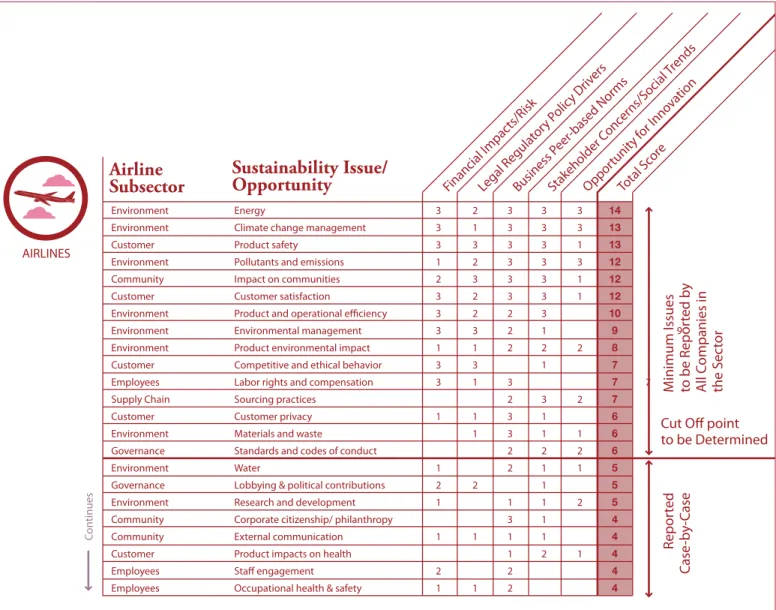
Step 4: Apply the materiality test to the sustainability issues potentially applicable to each industry sector. To identify sector-specific material issues within the broad universe of sustainability topics, we constructed a hypothetical score for each issue on a four-point (0-3) Likert scale using each of the five materiality categories. These scores were then added together to give each issue an overall score of 0-15, with the higher scoring issues understood to be more material to the particular subsector. Although the scores presented here were not derived through a comprehensive and transparent assessment process that would ultimately be necessary, they are indicative of the kinds of ratings and rankings that might emerge.
Even under the most rigorous conditions, there will be limitations to such an approach:
• This method relies on subjective judgments for each category of analysis. Users must remind themselves that the numbers
generated through this process rely on judgment both in development and in application.
• The five measurements of materiality listed above, though meant to capture a broad universe of stakeholder concerns, may still be overly focused on corporate performance as measured by managers and investors—that is, by what is material
in the current financial system, rather than a system that is fully aligned with the creation of long-term wealth. • The materiality tests must also balance
the effects of outsized impact—for example, an overwhelming priority to product safety or supply chain management— with the inclination to weigh all five categories equally. For this hypothetical exercise, we chose six specific industry subsectors as examples— airlines, automobiles, property-REITS, electric utilities and banks—to illustrate how the proposed process would lead to differentiated results.
Before testing the materiality of sustainability issues at a subsector level, it is important to translate these issues into meaningful ones for the subsector. This means identifying how each issue from the pool would apply to or manifest itself within the subsector, given the particular nature and context of that subsector. This process is an art more than a science, but is essential to achieving a sector-specific understanding of materiality.
For example, the universal pool of issues includes Community Impacts, which could refer to noise in the context of the airlines industry, but also refer to resettlement in the context of the mining industry. Similarly, Product Safety for the airlines industry refers to accidents/safety, whereas it could refer to product recalls for the food products industry.
23
FROM TRANSPARENCY TO PERFORMANCE
Financial I mpac
ts/Risk
Legal R egula
tory P olicy Dr
ivers
Business P
eer-based Nor ms Stakeholder C oncerns/S ocial Trends Oppor tunit
y for I nnova tion Total S core M inimum Issues
to be R
epor ted b y A ll C ompanies in the S ec tor Repor ted Case -b y-Case
Cut Off point to be Determined
Airline
Subsector
Sustainability Issue/
Opportunity
Con
tinues
AIRLINES
Environment Energy 3 2 3 3 3 14
Environment Climate change management 3 1 3 3 3 13
Customer Product safety 3 3 3 3 1 13
Environment Pollutants and emissions 1 2 3 3 3 12
Community Impact on communities 2 3 3 3 1 12
Customer Customer satisfaction 3 2 3 3 1 12
Environment Product and operational efficiency 3 2 2 3 10
Environment Environmental management 3 3 2 1 9 9 Environment Product environmental impact 1 1 2 2 2 8
Customer Competitive and ethical behavior 3 3 1 7
Employees Labor rights and compensation 3 1 3 7 7 Supply Chain Sourcing practices 2 3 2 7
Customer Customer privacy 1 1 3 1 6
Environment Materials and waste 1 3 1 1 6
Governance Standards and codes of conduct 2 2 2 6
Environment Water 1 2 1 1 5
Governance Lobbying & political contributions 2 2 1 5
Environment Research and development 1 1 1 2 5
Community Corporate citizenship/ philanthropy 3 1 4
Community External communication 1 1 1 1 4
Customer Product impacts on health 1 2 1 4
Employees Staff engagement 2 2 4
Employees Occupational health & safety 1 1 2 4
Figure 4: Establishing the cut-off point for “minimum” materialityThis figure shows a portion of the results of the materiality assessment conducted for the airlines subsection. Higher total scores indicate higher materiality relative to other issues the airline is facing. An appropriate cut-off point can established based on the materiality score to determine the minimum issues to be reported by all companies in a subsector. Other issues would be reported on if an individual company determines that the issue is material to their stakeholders. These results are not definitive, but rather illustrative of the transparency of this method. Any stakeholder can see and comment on the relative significance of an issue with respect to other issues in the sector.
The results of this exercise show that some issues are material across all six industry subsectors, and others are relevant only to a particular subsector. This exercise makes it possible to rank issues in terms of their materiality, helps stakeholders identify key issues, and allows corporations to efficiently allocate resources to those issues most relevant to their sustainability performance. Step 5: Rank the materiality of these issues within an industry and establish a threshold that defines those issues that are key
Once the materiality tests have been applied to the broad set of sustainability issues and those issues ranked by their relative importance within a particular
industry, a determination needs to be made as to where to draw the line in establishing material issues. (see the example in Figure 4).
Judgment is required here, but consistency in logic across sectors is also desirable. There are several logical approaches. One could take a particular score as the cut-off point– say, all issues that scored 10 or higher on the ranking system.
24 INITIATIVE FOR RESPONSIBLE INVESTMENT
Alternatively, a set number of issues for all industry sectors could be chosen, say eight, and those top-eight ranked issues declared key. A third approach might be to select as key the top quartile (25%) scoring issues for any subsector. The greatest challenge in this step of the process is to assure that in the end the number of key indicators strikes an appropriate balance between manageability, comprehensiveness, and materiality in assessing a sector’s ESG impacts.
The results of our exercise suggest that that the identification of a manageable, but reasonably comprehensive, set of key indicators might prove relatively simple. A review of the six industry examples in Appendix D reveals a fairly clear differentiation between those issues that score highly within a sector on the materiality test and those that do not. Again, our scores are not the result of the sort of thorough, multiparty process that a complete analysis would require, but they offer an indication of how the method would work.
Step 6: Create a tailored set of key performance indicators for the most material issues for each sector In this final and perhaps most complicated step, it is necessary to translate the general sustainability issues into sector specific KPIs. For the purposes of this hypothetical exercise, we have chosen to define two differing types of KPIs and two methods of disclosure for each type.
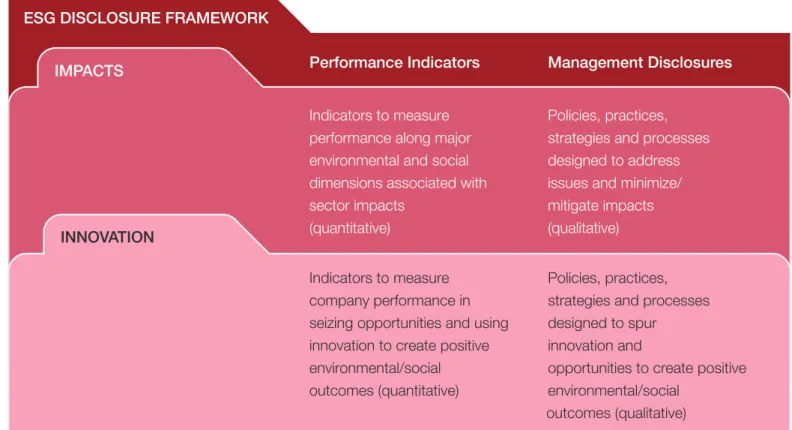
We distinguish between KPIs that we call Impact indicators and what we call Innovation indicators (see Figure 5). The Impact indicators are corporate actions taken in the course of daily business operations that substantially impact stakeholders. These include environmental emissions, workplace safety records, community giving, product quality programs, policies on vendor labor standards, business ethics standards and public policy stands on climate change, among others.
The Innovation indicators relate to business model decisions such as the launch of new products or strategies that target major sustainability or social justice challenges of our times. These include decisions to enter the renewable energy or energy efficiency markets, to develop vaccines that prevent childhood disease in developing countries, to assure access to mobile phones for the rural poor, to encourage small-scale entrepreneurship as a marketing tactic for products in mature markets, or to
25
FROM TRANSPARENCY TO PERFORMANCE stress the benefits of healthy foods or
lifestyles in product lines.
For each of these two sets of indicators, metrics can be developed that are either Performance Based or Management Oriented.
Performance Basedmetrics are typically
quantitative, but backward looking. They report specific data on companies’ records either for key stakeholder issues—where the focus is often on risks avoided; or for key business strategies—where the focus is often on specific positive social and environmental outcomes in addressing sustainability challenges. They tend to be specific, measureable, comparable,
reliable and capable of being reported in normalized formats.
Management Orientedmetrics address
these same issues, but capture general corporate policies and strategies, either as a proxy for performance or to provide additional context. They are generally reflective and qualitative, focusing on written policies, best practices, process innovations, and overall business strategies.
Figure 5: Framework for ESG key performance indicators and management disclosuresIssues which are deemed to be material for the subsector are translated into indicators for reporting. Indicators are developed here using this framework which addresses ESG impacts as well as opportunities. The framework allows for indicators that are quantitative as well as quantitative. Quantitative indicators take the form of a comparable KPI, while qualitative indicators would become a management disclosure
Performance Indicators Management Disclosures
Indicators to measure performance along major environmental and social dimensions associated with sector impacts
(quantitative)
Policies, practices, strategies and processes designed to address issues and minimize/ mitigate impacts (qualitative)
IMPACTS
ESG DISCLOSURE FRAMEWORK
Indicators to measure company performance in seizing opportunities and using innovation to create positive environmental/social outcomes (quantitative)
Policies, practices, strategies and processes designed to spur
innovation and
opportunities to create positive environmental/social
outcomes (qualitative) INNOVATION
26 INITIATIVE FOR RESPONSIBLE INVESTMENT
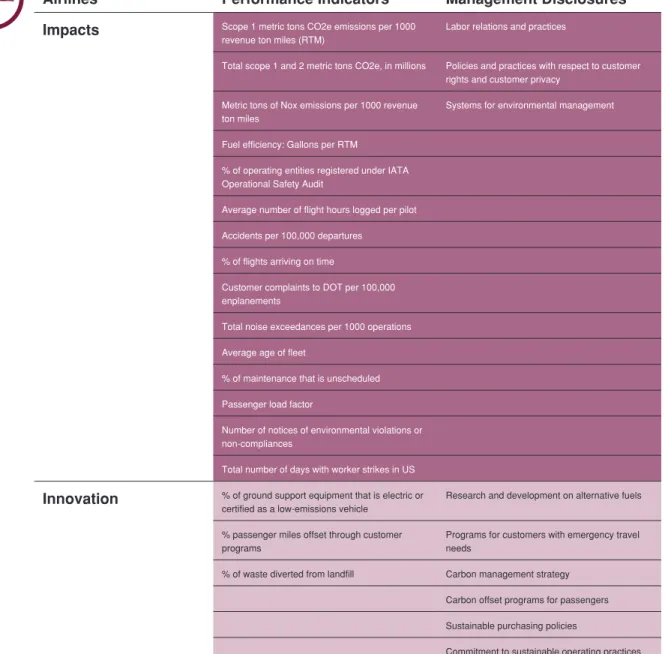
As an example, Figure 6 presents a summary of key performance indicators and management disclosures for the airlines subsector. This represents a complete set of guidance on material issues that could be given to the subsector, as a basis for minimum reporting requirements.
For a given material issue, appropriate metrics may reflect any combination of these two types of indicators and two types of disclosure. For example, within the airlines subsector that we analyzed, we found that:
• Energy (specifically, alternative fuels) was a material issue for which the most appropriate metric for disclosure was “research and development on alternative fuels.” (Innovation/ Management Oriented)
• Product environmental impact (specifically, carbon emissions from flights) was a material issue for which the most appropriate metric for disclosure was “% carbon emissions per passenger miles flown.” (Innovation/Performance Based)
• Customer privacy was a material issue for which the most appropriate metric for disclosure was “policies and practices with respect to
customer rights and privacy.” (Impact/ Management Oriented)
• Operational efficiency was a material issue for which one of the most appropriate metrics for disclosure was “passenger load factor.” (Impact/ Performance Oriented)
The six industry case studies
demonstrate how this process might work in practice. We should emphasize here that these case studies are offered in the spirit of exploration and discovery and we make no claim to have identified the correct sets of industry key performance indicators.