MULCHING AND REDUCING IRRIGATION LEVELS FOR
MAXIMIZING WATER USE EFFICIENCY OF SNAP BEAN
Abdelhamid E.A. Sherif
Soils, Water and Environment Research Institute, Agricultural Research Center,
Egypt.
Saad Abou-El-Hassan
Central Lab of OrganicAgriculture, Agricultural Research Center,
Egypt.
Manal M.H. Gad
El-Moula
Central Laboratory for Agricultural Climate, Agricultural Research Center,
Egypt.
ABSTRACT
Maximizing water use efficiency is an urgent need to increase the agricultural production in arid and semi-arid regions. An experiment was conducted during two successive seasons of 2016 and 2017, to study possibility maximizing water use efficiency for snap bean via reducing irrigation levels and using different types of mulch. The experiment was executed at the site of Central Laboratory for Agricultural Climate (CLAC), Agricultural Research Center, Giza, Egypt. Three irrigation levels (60, 80 and 100% of standard evapotranspiration) and five types of mulch (non-mulch, black plastic, date bunches, palm fiber and rice straw), were applied on snap beans cv. Paulista. All vegetative growth properties, nutritional status of plants and yield of pods were improved significantly by increasing irrigation level to 100%. The different types of mulch led to a significant increment in growth, NPK content of plants and yield of pods compared to non-mulch. The highest yield and quality of pods were produced by irrigation level 60% with black plastic mulch, irrigation level 80% with palm fiber mulch and irrigation level 100% with mulches of date bunches, palm fiber and rice straw. Using irrigation level 60% with black plastic mulch recorded the highest efficiency for water use and reducing weed growth.
Keywords:
Snap bean, mulching, irrigation levels, water use efficiency1.
INTRODUCTION
Water is the most important factor limiting expansion in the production of different crops under arid and semi-arid conditions. Crop growth, yield and quality are affected by available water in the root zone. It is highly desirable obtain the highest yield using the lowest possible quantity of water (El-Noemani et al., 2010 and 2015).Irrigation scheduling technique is very critical to use the drip irrigation efficiently, because while excess irrigation causes a decrease in the yield, inadequate irrigation also results in a water stress and a reduction in production (Sezenet al., 2005;Onder et al., 2006). Water content in the root zone is affected not only by the level of irrigation added to the plants but also by other factors such as evaporation from the soil surface (Sezenet al., 2005;Onder et al., 2006). Mulch plays an important role in reducing the loss of large quantities of irrigation water by reducing evaporation from the soil surface
(Hatfieldet al., 2001; Bhardwaj, 2013; Komla, 2013; Teame et al., 2017).
Mulch is a protective layer of any material is placed on the soil surface. The major types of mulch are inorganic and organic. Inorganic mulches include gravel, stone and plastic. Organic mulching uses rice straw, palm leaf, sawdust, sugarcane trash, banana leaves, plant residues, papers, poultry litter and compost etc. However, black plastic sheet and rice straw have been more common
(Liang et al., 2002; Berglund et al., 2006; Payam et al., 2013). Water conservation and erosion control are the most important objectives for using mulch particularly in arid and semi-arid regions (Bhardwaj, 2013). Mulching suppresses weed growth (Li et al.,
root growth of plants. Mulching improves the availability of nutrient absorption of roots(Muhammad et al., 2009; Payam et al.,
2013) and encourages favorable soil microbial activity. All previous benefits improve physical, chemical and biological properties of soil and ultimately enhance the growth and yield of crops (Khonok et al., 2012).
Beans (Phaseolus vulgaris, L.) are one of the most important leguminous crops in Egypt for local marketing and export. The cultivated area with snap beans in Egypt is about 59.3 thousand feddans (feddan = 0.42 hectare), produced about 249.4 thousand tons (Ministry of Agriculture and Land Reclamation, 2015).Green bean cultivation is expanded in the new reclaimed lands in Egypt, which is characterized as an arid land with limited sources of irrigation water. Therefore, growers have to adopt modern techniques of cultivation to improve water use efficiency. Water management is a critical factor of bean production (Abdel-Mawgoud, 2006). Plant growth stages are affected by moisture availability in soil during the growth cycle. Low irrigation level reduced vegetative growth of plant as shoot weight, leaf area and number of leaves (Mahmoud, 2000; El-Noemani et al., 2009 on peas and Abdel-Mawgoud, 2006; El-Shawadfy, 2008 on beans). Moreover, increasing irrigation level increased the yield and pod quality of beans (Amer et al.,
2002; Metin et al., 2005, Abdel-Mawgoud, 2006;Onderet al., 2006;El-Shawadfy, 2008). El-Noemani et al.(2010)mentioned that increasing irrigation level up to 100% of Et0 exhibited the highest vegetative growth of bean plants. Meanwhile, the highest yield was produced using level 80%.
This study aims to evaluate possibility maximizing water use efficiency for snap bean via reducing irrigation levels and using different types of soil mulch.
2.
MATERIALS AND METHODS
The experiment was carried out on snap beans under a greenhouse of white nets at the site of Central Laboratory for Agricultural Climate (CLAC)at Dokki, Giza Governorate, during two successive seasons of 2016 and 2017.
Plant Material
Seeds of beans cv. Paulistawere sown on 20thof Septemberin the both seasons.The physical and chemical properties of the soil are shown in Table (1).
Table 1.Analyses of the experimental soil Clay
% Silt
% Sand
% Texture pH 1:2.5
EC 1:10 dS/m
Cations meq/l Anions meq/l Ca++ Mg++ Na+ K+ HCO3- Cl- SO4=
48.4 42.3 8.3 Clay 8.25 1.26 2.80 1.55 7.14 1.18 2.44 6.40 3.58
The Experimental Layout
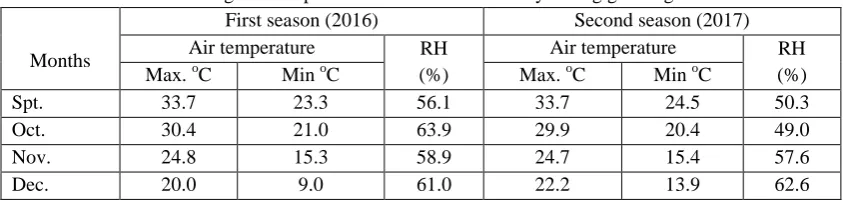
The experiment area was divided into ridges(100 cm width). The seeds were sown at a distance of 30 cm in two rows on the ridge, three seeds in each placement. Climatic data of air temperature and relative humidity (RH %) were recorded under experiment conditions by the meteorological station of CLAC during both growing seasons and the date are shown in Table (2).
Table 2. Average air temperature and relative humidity during growing seasons
Months
First season (2016) Second season (2017) Air temperature RH
(%)
Air temperature RH (%) Max. oC Min oC Max. oC Min oC
Spt. 33.7 23.3 56.1 33.7 24.5 50.3
Oct. 30.4 21.0 63.9 29.9 20.4 49.0
Nov. 24.8 15.3 58.9 24.7 15.4 57.6
Dec. 20.0 9.0 61.0 22.2 13.9 62.6
Experimental Design
The experiments were arranged in split plot design with four replicates, where the three irrigation levels 60, 80 and 100% of standard evapotranspiration (ET0) were adapted in the main plots and the five types of mulch (non-mulch, black plastic, date bunches, palm fiber and rice straw), were randomized in the sub main plots. The plot area was 5 m2 (5 m length and 1 m width). Different types of mulch were placed on the soil surface before sowing the seeds. The date bunches were chopped before use. Both date bunches and rice straw were used with a thickness of 2 cm (20 L/m2 mean3 and 1 kg/m2 for date bunches and rice straw respectively), while two layers of palm fiber (14 L/m2 mean 1 kg/m2) were placed on the ridge. The plants were irrigated using drippers of 4 L/hr. capacity. The mineral fertilizers of NPK were applied at the rates of 60 kg N, 30 kg P2O5 and 48 kg K2O/fed., according to recommendations of
irrigated twice weekly and the time of irrigation depended upon irrigation level for each treatment. Other agricultural practices were done according to recommendations of Ministry of Agriculture (2010).
Calculation of water requirements and water use efficiency
Data of reference evapotranspiration (ET0) for Dokki distance were obtained from meteorological data of CLAC. The amount of irrigation water requirement (IR) was calculated according to FAO (1998):
IR(m3/day) =[(ET0* Kc * R) + LR]* (area / 1000) Where:
ETo = reference evapotranspiration (mm/day) Kc = crop coefficient (0.3 to 1)
R = reduction factor resulting by shading plants for soil (0.25 to 0.9) LR = leaching requirement (assumed 25% of the total applied water)
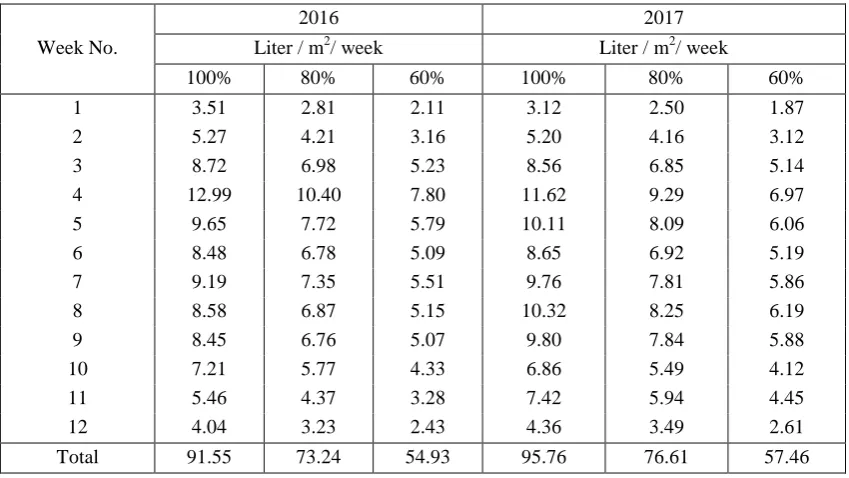
The irrigation quantities under different irrigation levels for snap bean in the two studied seasons are represented in Table (3). The water use efficiency (WUE) was calculated according to FAO (1982):
WUE (kg/m3) = Yield (kg) / IR (m3)
Table 3. The irrigation requirements under different irrigation levels for snap bean in both seasons
2016 2017
Week No. Liter / m2/ week Liter / m2/ week
100% 80% 60% 100% 80% 60%
1 3.51 2.81 2.11 3.12 2.50 1.87
2 5.27 4.21 3.16 5.20 4.16 3.12
3 8.72 6.98 5.23 8.56 6.85 5.14
4 12.99 10.40 7.80 11.62 9.29 6.97
5 9.65 7.72 5.79 10.11 8.09 6.06
6 8.48 6.78 5.09 8.65 6.92 5.19
7 9.19 7.35 5.51 9.76 7.81 5.86
8 8.58 6.87 5.15 10.32 8.25 6.19
9 8.45 6.76 5.07 9.80 7.84 5.88
10 7.21 5.77 4.33 6.86 5.49 4.12
11 5.46 4.37 3.28 7.42 5.94 4.45
12 4.04 3.23 2.43 4.36 3.49 2.61
Total 91.55 73.24 54.93 95.76 76.61 57.46
Data Recorded
Soil measurements
Soil moisture (20 cm depth) was measured before irrigation directly to determine the moisture retention weekly by using soil moisture meter. Soil temperature (5 cm depth) was measured weekly in the next day for irrigation using soil thermometer.
Plant measurements
Growth and nutritional status
At the fruit set stage, after 45 days from sowing, three plants were randomly taken from each plot to measure plant height, leaf number and fresh shoot weight of plant. In addition, chlorophyll reading was measured in the third upper leaf using Minolta Chlorophyll Meter Spad 501. Nutrient content (NPK) in bean plants were determined in the third upper leaf according to the procedure described by FAO (2008).Total nitrogen was determined by Kjeldahl method, phosphorus was determined using Spectrophotometer and potassium was determined photo-metrically using Flame photometer.
Yield and quality characters of pods
Weed measurements
Weeds were removed by hand at two weeks interval. Total fresh weight of weeds was recorded every two weeks cumulatively until the end of season.
Statistical analysis
Data of the two seasons were arranged and statistically analyzed by the analysis of variances according to Snedecor and Cochran (1980) with SAS software, version 2004. Treatment means was compared by Tukey test at significance level 0.05.
3.
RESULTS AND DISCUSSION
Soil moisture
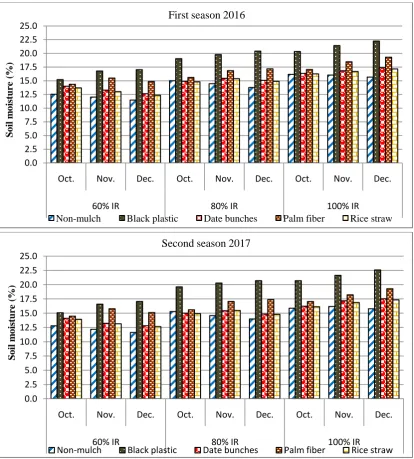
Effects of irrigation levels and mulch types on soil moisture content in both seasons are shown in Fig. (1). Increasing irrigation level increased soil moisture content, conversely, reducing irrigation level reduced soil moisture content. All mulch types increased moisture content of soil compared to non-mulch soil. The highest values of soil moisture were obtained using irrigation level 100% with black plastic mulch; irrigation level 100% with palm fiber mulch came in the second order. Irrigation level 60% with non-mulch gave the lowest moisture content. These results may be due to that using mulching decrease the evaporation rate from soil surface and led to increase the soil moisture content(Hatfield et al., 2001;Bhardwaj, 2013; Komla, 2013;Kwambeet al., 2015;Teame et al.,
2017).
Fig. 1. Effect of irrigation levels and mulch types on soil moisture content in both seasons. 0.0
2.5 5.0 7.5 10.0 12.5 15.0 17.5 20.0 22.5 25.0
Oct. Nov. Dec. Oct. Nov. Dec. Oct. Nov. Dec.
60% IR 80% IR 100% IR
Non-mulch Black plastic Date bunches Palm fiber Rice straw
So
il
m
o
is
ture
(%)
First season 2016
0.0 2.5 5.0 7.5 10.0 12.5 15.0 17.5 20.0 22.5 25.0
Oct. Nov. Dec. Oct. Nov. Dec. Oct. Nov. Dec.
60% IR 80% IR 100% IR
Non-mulch Black plastic Date bunches Palm fiber Rice straw
So
il
m
o
is
ture
(%)
Soil temperature
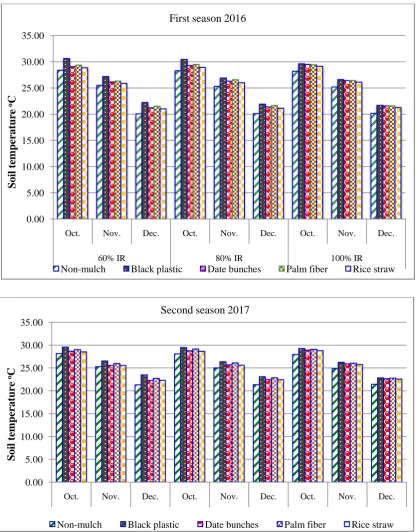
Fig. (2)illustrates the effects of irrigation levels and mulch types on soil temperature in the two growing seasons. Different levels of irrigation did not show clear differences in soil temperature. Different types of mulch raised soil temperature compared to non-mulch soil. Black plastic mulch recorded highest values of soil temperature; palm fiber mulch came in the second order, followed by mulches of date bunches and rice straw. The lowest values of soil temperature resulted by non-mulch soil. These results can be attributed to that using black plastic and organic mulches decrease heat release from the soil compared to non-mulch soil. Besides, organic mulches increase biological activity in the soil, which helps raise the soil temperature. These results are in agreement with those of Liang et al. (2002), Chaudhry et al. (2008), Sinkeviciene et al. (2009), Pakdel et al. (2013), Payam et al. (2013)and
Alharbi (2015).
Fig. 2. Effect of irrigation levels and mulch types on soil temperature in both seasons. 0.00
5.00 10.00 15.00 20.00 25.00 30.00 35.00
Oct. Nov. Dec. Oct. Nov. Dec. Oct. Nov. Dec.
60% IR 80% IR 100% IR
Non-mulch Black plastic Date bunches Palm fiber Rice straw
First season 2016
Soil
t
em
perat
ure
ᴏ
C
0.00 5.00 10.00 15.00 20.00 25.00 30.00 35.00
Oct. Nov. Dec. Oct. Nov. Dec. Oct. Nov. Dec.
Non-mulch Black plastic Date bunches Palm fiber Rice straw
Soil
t
em
perat
ure
ᴏ
C
Vegetative properties
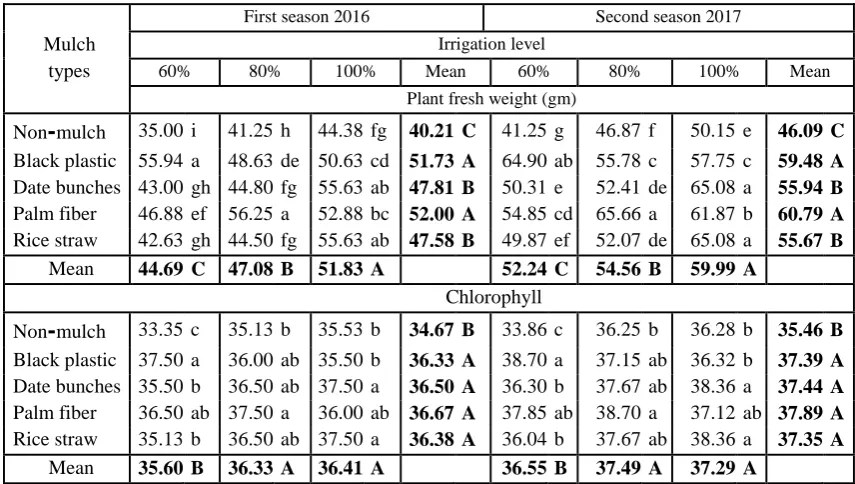
Data found in Table(4 and 5) show the effect of irrigation levels and mulch types on vegetative growth properties of snap bean plants. In both seasons, all vegetative growth properties were increased significantly by increasing irrigation level to 100%, except chlorophyll reading, where no significant differences between irrigation levels 100 and 80%.The positive effect of increasing irrigation level up to 100% on vegetative growth properties could be explained as a result of promoting the division and elongation of cells which need more water supplies (Hammad,1991; Mahmoud, 2000).These results are accordance with those obtained by Abdel-Mawgoud(2006), El-Shawadfy(2008), El-Noemani et al.(2010 and 2015).
Table 4. Effect of irrigation levels and mulch types on vegetative growth properties of snap bean plants in both seasons. Mulch
types
First season 2016 Second season 2017 Irrigation level
60% 80% 100% Mean 60% 80% 100% Mean Plant height (cm)
Non
-
mulch 40.16 h 42.07 g 43.95 f 42.06 D 45.17 e 47.64 d 50.71 c 47.84 D Black plastic 48.40 ab 47.93 bc 47.27 d 47.87 A 57.10 a 55.97 ab 54.34 b 55.80 A Date bunches 42.34 g 44.56 ef 48.87 a 45.26 C 48.50 d 51.74 c 56.84 a 52.36 C Palm fiber 44.49 ef 48.57 ab 47.57 cd 46.87 B 51.89 c 56.93 a 54.83 ab 54.88 B Rice straw 42.17 g 44.90 ef 48.81 a 45.29 C 48.27 d 51.47 c 56.77 a 52.17 C Mean 43.51 C 45.60 B 47.29 A 50.19 C 52.75 B 54.70 ALeaf number/plant
Non
-
mulch 14.00 h 16.50 fg 17.75 ef 16.08 C 15.50 g 18.75 f 19.75 def 18.00 C Black plastic 22.38 a 19.25 cd 20.25 bc 20.63 A 25.25 ab 22.25 cd 23.50 bc 23.67 A Date bunches 16.63 fg 17.77 ef 22.25 a 18.88 B 19.50 ef 20.50 def 26.75 a 22.25 B Palm fiber 18.25 de 22.50 a 20.88 b 20.54 A 22.00 cde 26.50 a 24.50 abc 24.33 A Rice straw 16.25 g 17.75 ef 22.25 a 18.75 B 19.00 f 20.50 def 26.50 a 22.00 B Mean 17.50 C 18.75 B 20.68 A 20.25 C 21.70 B 24.20 AMeans followed in same column by similar letters are not statistically different at 0.05 levels according to Tukey test.
Table 5. Continued effect of irrigation levels and mulch types on vegetative growth properties of snap bean plants in both seasons.
Mulch types
First season 2016 Second season 2017
Irrigation level
60% 80% 100% Mean 60% 80% 100% Mean
Plant fresh weight (gm)
Non
-
mulch 35.00 i 41.25 h 44.38 fg 40.21 C 41.25 g 46.87 f 50.15 e 46.09 C Black plastic 55.94 a 48.63 de 50.63 cd 51.73 A 64.90 ab 55.78 c 57.75 c 59.48 A Date bunches 43.00 gh 44.80 fg 55.63 ab 47.81 B 50.31 e 52.41 de 65.08 a 55.94 B Palm fiber 46.88 ef 56.25 a 52.88 bc 52.00 A 54.85 cd 65.66 a 61.87 b 60.79 A Rice straw 42.63 gh 44.50 fg 55.63 ab 47.58 B 49.87 ef 52.07 de 65.08 a 55.67 B Mean 44.69 C 47.08 B 51.83 A 52.24 C 54.56 B 59.99 AChlorophyll
Non
-
mulch 33.35 c 35.13 b 35.53 b 34.67 B 33.86 c 36.25 b 36.28 b 35.46 B Black plastic 37.50 a 36.00 ab 35.50 b 36.33 A 38.70 a 37.15 ab 36.32 b 37.39 A Date bunches 35.50 b 36.50 ab 37.50 a 36.50 A 36.30 b 37.67 ab 38.36 a 37.44 A Palm fiber 36.50 ab 37.50 a 36.00 ab 36.67 A 37.85 ab 38.70 a 37.12 ab 37.89 A Rice straw 35.13 b 36.50 ab 37.50 a 36.38 A 36.04 b 37.67 ab 38.36 a 37.35 A Mean 35.60 B 36.33 A 36.41 A 36.55 B 37.49 A 37.29 A Means followed in same column by similar letters are not statistically different at 0.05 levels according to Tukey test.fresh weight. No significant differences found in chlorophyll reading among all mulch types. The superiority of all mulch treatments can be attributed to that mulch maintains soil moisture, regulates soil temperature and reduces salinity in the root zone, which provide ideal conditions for the roots to absorb water and nutrients, and improve the vegetative growth of plants (Bu et al., 2002; Liang et al.,
2002; Khonok et al., 2012; Kumar and Lal, 2012; Bhardwaj, 2013).
Regarding the interaction between irrigation levels and mulch treatments, the highest values of plant growth resulted from irrigation level 100% with mulches of date bunches and rice straw, irrigation level 80% with palm fiber and irrigation level 60% with black plastic mulch. This was probably because of trapped moisture and the warmth under the plastic mulch, which provided favorable conditions for nutrient absorption in the root zone. In the plastic mulch, there was probably less nutrient volatilization thus most of the time the available nutrients are used for vegetative growth by the plant. These findings are similar to those of Tarara (2009) on tomato and Kwambe et al. 2015 on green beans.
The nutritional status of plants
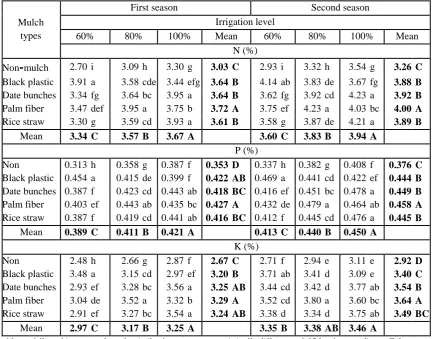
Data in Table (6)revealed that the irrigation levels and mulching significantly affected NPK content of bean plants in the two seasons. The irrigation level of 100% gave the highest values of NPK content of plants followed by irrigation level 80%,while the lowest NPK content was obtained by irrigation level 60%. The increasing uptake of NPK by 100% irrigation level may be due to the effect of good soil water content under 100% irrigation level, which increases NPK content of plants (Abdel-Mawgoud, 2006 on beans Ngouajio et al., 2007 on tomato; Abdrabbo et al., 2009 on cucumber; Hashem et al., 2014 on lettuce).
The different mulch treatments led to the occurrence of a significant increment in NPK content of plants compared to non-mulch. The highest value of N content resulted from palm fiber mulch, the highest P content obtained by palm fiber and black plastic mulch, whereas the mulch of palm fiber, date bunches and rice straw gave the highest K content of plants. The good effect of different mulches on the nutritional status of plants may be due to mulch reduces salinity in the root zone, prevents the loss of nutrients by volatilization or leaching, as well as mulch reduces the competition of weeds with plants on nutrients and water, which increases the nutrient absorption by plants (Muhammad et al., 2009; Payam et al., 2013).
Table 6. Effect of irrigation levels and mulch types on nutritional status of snap bean plants in both seasons.
Mulch types
First season Second season Irrigation level
60% 80% 100% Mean 60% 80% 100% Mean N (%)
Non
-
mulch 2.70 i 3.09 h 3.30 g 3.03 C 2.93 i 3.32 h 3.54 g 3.26 C Black plastic 3.91 a 3.58 cde 3.44 efg 3.64 B 4.14 ab 3.83 de 3.67 fg 3.88 B Date bunches 3.34 fg 3.64 bc 3.95 a 3.64 B 3.62 fg 3.92 cd 4.23 a 3.92 B Palm fiber 3.47 def 3.95 a 3.75 b 3.72 A 3.75 ef 4.23 a 4.03 bc 4.00 A Rice straw 3.30 g 3.59 cd 3.93 a 3.61 B 3.58 g 3.87 de 4.21 a 3.89 B Mean 3.34 C 3.57 B 3.67 A 3.60 C 3.83 B 3.94 AP (%)
Non 0.313 h 0.358 g 0.387 f 0.353 D 0.337 h 0.382 g 0.408 f 0.376 C Black plastic 0.454 a 0.415 de 0.399 f 0.422 AB 0.469 a 0.441 cd 0.422 ef 0.444 B Date bunches 0.387 f 0.423 cd 0.443 ab 0.418 BC 0.416 ef 0.451 bc 0.478 a 0.449 B Palm fiber 0.403 ef 0.443 ab 0.435 bc 0.427 A 0.432 de 0.479 a 0.464 ab 0.458 A Rice straw 0.387 f 0.419 cd 0.441 ab 0.416 BC 0.412 f 0.445 cd 0.476 a 0.445 B Mean 0.389 C 0.411 B 0.421 A 0.413 C 0.440 B 0.450 A
K (%)
Non 2.48 h 2.66 g 2.87 f 2.67 C 2.71 f 2.94 e 3.11 e 2.92 D Black plastic 3.48 a 3.15 cd 2.97 ef 3.20 B 3.71 ab 3.41 d 3.09 e 3.40 C Date bunches 2.93 ef 3.28 bc 3.56 a 3.25 AB 3.44 cd 3.42 d 3.77 ab 3.54 B Palm fiber 3.04 de 3.52 a 3.32 b 3.29 A 3.52 cd 3.80 a 3.60 bc 3.64 A Rice straw 2.91 ef 3.27 bc 3.54 a 3.24 AB 3.38 d 3.34 d 3.75 ab 3.49 BC
Mean 2.97 C 3.17 B 3.25 A 3.35 B 3.38 AB 3.46 A Means followed in same column by similar letters are not statistically different at 0.05 levels according to Tukey test.
(2000), Zhan get al. (2005), Muhammad et al. (2009) and Payam et al. (2013), they reported that using mulch improved crop response to water and available nutrients in the soil. The differences in NPK content between organic mulches and plastic mulch may be due to that organic mulches are efficient in reduction of nitrates leaching, improve soil physical properties, supply organic matter, improve nitrogen balance, release some nutrient to soil, as well as increase biological activity in root zone (Muhammad et al., 2009; Bhardwaj, 2013; Payam et al., 2013).
Yield of snap bean pods
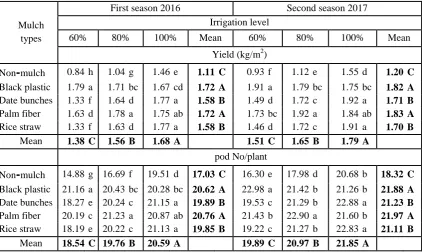
The results illustrated in Table (7) showed that the yield of pods(yield/m2 and pod number/plant), significantly affected by the treatments of irrigation levels and mulch types in both seasons. The highest yield of pods was obtained with irrigation level 100%.Irrigation level 80% came in the second order. Finally, irrigation level 60% produced the lowest values. The positive effect of irrigation level 100% on yield of pods can be explained by the increase of NPK uptake by plants as shown in Table (6), which improved of vegetative growth. This stimulates photosynthesis in plants, which is reflected on increment of yield. The same results were reported by Amer et al. (2002), Metin et al. (2005), Abdel-Mawgoud (2006),Onder et al. (2006) and El-Shawadfy (2008).
All mulch treatments increased the yield of pods compared to non-mulch treatment. Both black plastic and palm fiber mulches produced the highest yield of snap bean pods. The superiority of black plastic and palm fiber mulches can be attributed to the ability in maintaining soil moisture and reducing weed growth. Hence, providing optimum conditions for nutrient absorption and good plant growth, which is reflected on yield increment. These results were in line with those obtained by Li et al. (2004), Tarara (2009), Khonok et al. (2012) and Kwambe et al. (2015).
Interaction between irrigation levels and mulch types, significant effected on yield of snap bean pods. The highest yield were produced using irrigation level 100% with mulches of date bunches, palm fiber and rice straw, also using irrigation level 80% with palm fiber and irrigation level 60% with black plastic mulch. Applying irrigation level 60% without mulch gave the lowest yield. This negative effect can be ascribed to that irrigation level at 60% was not sufficient for plants. Moreover, non-mulch increased water evaporation and weed growth, which competed with plants for water and nutrients, led to low growth of plants, which is reflected on the low yield. These results are supported by the studies of Zhan get al. (2005), Sinkeviciene et al. (2009) and Payam et al. (2013).
Table 7. Effect of irrigation levels and mulch types on yield of snap bean pods plants in both seasons.
Mulch types
First season 2016 Second season 2017 Irrigation level
60% 80% 100% Mean 60% 80% 100% Mean Yield (kg/m2)
Non
-
mulch 0.84 h 1.04 g 1.46 e 1.11 C 0.93 f 1.12 e 1.55 d 1.20 C Black plastic 1.79 a 1.71 bc 1.67 cd 1.72 A 1.91 a 1.79 bc 1.75 bc 1.82 A Date bunches 1.33 f 1.64 d 1.77 a 1.58 B 1.49 d 1.72 c 1.92 a 1.71 B Palm fiber 1.63 d 1.78 a 1.75 ab 1.72 A 1.73 bc 1.92 a 1.84 ab 1.83 A Rice straw 1.33 f 1.63 d 1.77 a 1.58 B 1.46 d 1.72 c 1.91 a 1.70 B Mean 1.38 C 1.56 B 1.68 A 1.51 C 1.65 B 1.79 Apod No/plant
Non
-
mulch 14.88 g 16.69 f 19.51 d 17.03 C 16.30 e 17.98 d 20.68 b 18.32 C Black plastic 21.16 a 20.43 bc 20.28 bc 20.62 A 22.98 a 21.42 b 21.26 b 21.88 A Date bunches 18.27 e 20.24 c 21.15 a 19.89 B 19.53 c 21.29 b 22.88 a 21.23 B Palm fiber 20.19 c 21.23 a 20.87 ab 20.76 A 21.43 b 22.90 a 21.60 b 21.97 A Rice straw 18.19 e 20.22 c 21.13 a 19.85 B 19.22 c 21.27 b 22.83 a 21.11 B Mean 18.54 C 19.76 B 20.59 A 19.89 C 20.97 B 21.85 A Means followed in same column by similar letters are not statistically different at 0.05 levels according to Tukey test.Quality of snap bean pods
Data in Table (8) explained that the quality of snap bean pods (weight, diameter and length of pod), significantly affected by the using of irrigation levels and mulch in both seasons. Irrigation level 100% produced the highest quality of snap bean pods. The lowest quality was resulted with irrigation level 60%.The positive effect of irrigation level 100% on quality of pods can be because to increase NPK uptake by plants as shown in Table (6), which improved of vegetative growth. This resulted more stimulate of photosynthesis and better carbohydrates build up, thus increasing weight, diameter and length of bean pods. The same results were reported by Amer et al. (2002), Metin et al. (2005), Abdel-Mawgoud (2006),Onder et al. (2006) and El-Shawadfy (2008).
maintain soil moisture and reducing weed growth, thus providing optimum conditions for nutrient absorption and good plant growth, which reflected on improved quality of pods. These results were in line with those obtained by Li et al. (2004), Tarara (2009), Khonok et al. (2012) and Kwambe et al. (2015).
The highest values of quality of snap bean pods were produced from irrigation level 100% with mulches of date bunches, palm fiber and rice straw, also irrigation level 80% with palm fiber and irrigation level 60% with black plastic mulch. Irrigation level 60% without mulch gave the lowest quality. This negative effect can be ascribed to irrigation level at 60% is insufficient for plants. In addition, non-mulch increases water evaporation and weed growth, which compete with plants, thus leads to low growth of plants, which is reflected in the low weight, diameter and length of pods. These results are supported by the studies of Zhan get al. (2005),
Sinkeviciene et al. (2009) and Payam et al. (2013).
Table 8. Effect of irrigation levels and mulch types on quality of snap bean pods in both seasons.
Mulch types
First season 2016 Second season 2017 Irrigation level
60% 80% 100% Mean 60% 80% 100% Mean Pod weight (g)
Non
-
mulch 3.60 e 4.25 d 4.65 c 4.17 C 3.83 g 4.31 f 4.88 d 4.34 C Black plastic 5.45 a 5.25 ab 5.03 b 5.24 A 5.72 a 5.29 bc 5.18 c 5.40 A Date bunches 4.50 cd 5.03 b 5.48 a 5.00 B 4.64 ef 5.27 c 5.70 a 5.20 B Palm fiber 5.25 ab 5.53 ab 5.40 a 5.39 A 5.32 bc 5.60 a 5.51 ab 5.47 A Rice straw 4.48 cd 5.05 b 5.45 a 4.99 B 4.58 e 5.16 c 5.64 a 5.13 B Mean 4.66 C 5.02 B 5.20 A 4.82 C 5.13 B 5.38 APod diameter (mm)
Non
-
mulch 6.12 f 6.38 f 6.87 de 6.45 C 6.48 g 6.90 ef 7.10 de 6.83 C Black plastic 7.74 a 7.35 bc 7.27 bc 7.45 A 7.74 a 7.42 bc 7.33 cd 7.50 A Date bunches 6.81 e 7.19 cd 7.70 a 7.23 B 6.85 ef 7.32 cd 7.75 a 7.31 B Palm fiber 7.35 bc 7.74 a 7.59 ab 7.56 A 7.43 bc 7.78 a 7.62 ab 7.61 A Rice straw 6.71 e 7.24 c 7.71 a 7.22 B 6.77 f 7.31 cd 7.77 a 7.28 B Mean 6.95 C 7.18 B 7.43 A 7.05 C 7.34 B 7.51 APod length (cm)
Non
-
mulch 13.38 g 13.79 ef 13.74 f 13.64 C 13.64 f 13.99 e 14.15 de 13.93 C Black plastic 15.13 a 14.51 b 14.55 b 14.73 B 15.32 a 14.59 bc 14.61 b 14.84 B Date bunches 14.12 cd 14.37 bc 15.29 a 14.59 B 14.33 cd 14.61 bc 15.34 a 14.76 B Palm fiber 14.59 b 15.18 a 15.10 a 14.96 A 14.69 b 15.30 a 15.15 a 15.05 A Rice straw 14.06 de 14.49 b 15.26 a 14.60 B 14.22 de 14.58 bc 15.30 a 14.70 B Mean 14.25 C 14.47 B 14.79 A 14.44 C 14.61 B 14.91 A Means followed in same column by similar letters are not statistically different at 0.05 levels according to Tukey test.Water use efficiency
Data in Table (9) showed that increasing irrigation level to 100% led to decrease water use efficiency for snap bean in both seasons. The highest WUE obtained by irrigation level 60%, while irrigation level 80% was moderated. These results are agreement with those obtained by Sezen et al.(2005),Onder et al.(2006),El-Noemani et al. (2010),Hegab et al. (2014) and El-Noemani et al.
(2015).They revealed that increase irrigation level led to the WUE decline.
Using black plastic and palm fiber mulches gave the highest WUE, whereas the lowest WUE was obtained by non-mulch treatment. The superior effect of using mulch on WUE may be due saving soil moisture and decreasing weed populations. Similar results were obtained Brahman et al. (2008),Khonok et al. (2012), Khonok et al. (2013)and Kwambe et al. (2015).
Table 9.Effect of irrigation levels and mulch types on water use efficiency (WUE) of snap bean in both seasons.
Mulch types
First season 2016 Second season 2017 Irrigation level
60% 80% 100% Mean 60% 80% 100% Mean WUE kg/m3
Non
-
mulch 15.23 g 14.15 h 15.92 g 15.10 C 16.17 g 14.57 g 16.13 g 15.62 C Black plastic 32.45 a 23.26 cd 18.20 f 24.64 A 33.20 a 23.32 de 18.24 f 24.92 A Date bunches 24.22 c 22.27 d 19.33 e 21.94 B 25.94 c 22.41 e 20.00 f 22.78 B Palm fiber 29.63 b 24.25 c 19.07 ef 24.32 A 30.07 b 25.01 cd 19.15 f 24.74 A Rice straw 24.12 c 22.25 d 19.74 e 22.04 B 25.41 c 22.38 e 19.97 f 22.59 B Mean 25.13 A 21.24 B 18.45 C 26.16 A 21.54 B 18.70 C Means followed in same column by similar letters are not statistically different at 0.05 levels according to Tukey testWeeds
Data in Table(10)revealed that increasing irrigation level to 100% led to increase the total weed weight compared to irrigation level 60%, which gave the lowest total weed weight. Increasing weight of weeds associated with increasing irrigation level may be attributed to increase the vegetative growth of weeds, thus increasing its ability to compete with plants on water and nutrients (Rahman et al., 2008;Hashemet al., 2014).
Applying different types of mulch had a significant influence on the weed mass. It was found that all the types of mulch contributed to a decrease in the mean mass of weeds compared to non-mulch treatment. Black plastic mulch was the most efficient on weed reduction followed by palm fiber mulch. These results were supported by the findings of Hashemet al. (2014) onlettuce,
Kosterna et al. (2014) on broccoli and tomato and Kwambe et al. (2015) on green bean; they stated that the frequency of weeds was more in non-mulched soil than in mulched plots.
Using black plastic mulch with irrigation levels 60, 80 and 100% respectively gave the highest efficiency on weed reduction. Non-mulch with irrigation levels 100, 80 and 60% respectively gave the lowest efficiency on weed reduction. These results may be due to the high efficiency of black plastic mulch in suppressing weed growth, especially with the use of low irrigation level (Rahman
et al., 2008;Hashemet al., 2014; Kosterna et al., 2014; Kwambe et al., 2015).
Table 10. Weed fresh weight of snap bean field during 2016 and 2017 seasons.
Mulch types
First season Second season Irrigation level
60% 80% 100% Mean 60% 80% 100% Mean weed fresh weight kg/m2
Non-mulch 1.313 c 1.427 b 1.602 a 1.447 A 1.343 c 1.463 b 1.638 a 1.481 A Black plastic 0.043 l 0.090 k 0.155 j 0.096 E 0.040 k 0.078 k 0.134 j 0.084 E Date bunches 0.313 h 0.375 g 0.565 e 0.418 C 0.282 h 0.340 g 0.502 e 0.375 C Palm fiber 0.143 j 0.210 i 0.335 gh 0.229 D 0.133 j 0.178 i 0.288 h 0.199 D Rice straw 0.353 gh 0.430 f 0.625 d 0.469 B 0.319 gh 0.390 f 0.556 d 0.422 B Mean 0.433 C 0.506 B 0.656 A 0.424 C 0.490 B 0.623 A Means followed in same column by similar letters are not statistically different at 0.05 levels according to Tukey test
4.
CONCLUSION
Maximizing water use efficiency for green beans could be accomplished by reducing the level of irrigation either to 60% with black plastic mulch or to 80% with palm fiber mulch without any reduction of yield or quality.
5.
ACKNOWLEDGEMENT
This work has been supported by Central Lab of Organic Agriculture (CLOA), Central Laboratory for Agricultural Climate (CLAC) and Soil, Water and Environment Research Institute, Agriculture Research Center, Giza, Egypt. The authors gratefully acknowledge Prof. Aly Elsherbiny and Prof. A. Elbehary for the manuscript review
6.
REFERENCES
[2] Abdrabbo, M.A.A., A.A. Farag and M.K.Hassanein, 2009. Irrigation requirements for cucumber under different mulch colors. Egypt. J. Hort., 36: 333-346.
[3] Alharbi, A., 2015. Effect of mulch on soil properties under organic farming conditions in center of Saudi Arabia. Journal of American Science. 11(1): 108-115.
[4] Amer, A.H., M.O. Sawan and S.R. Salman, 2002. Water requirements of snap bean (Phaseolus vulgaris L.) as affected by sowing date under newly reclaimed soil at Shark El – Owinat Region. J. Agric. Sci. Mansoura Univ., 27(9): 6135-6145. [5] Berglund, R., B. Svensson and U. Gertsson. 2006. Impact of plastic mulch and poultry manure on plant establishment in
organic strawberry production. J. Plant Nutr., 29 (1):103-112.
[6] Bhardwaj, R.L., 2013. Effect of mulching on crop production under rainfed condition – A review. Agri. Reviews, 34(3): 188-197.
[7] Bu, Y.S., H.L., Shao and J.C. Wang. 2002. Effects of different mulch materials on corn seeding growth and soil nutrients’ contents and distributions. J. Soil Water Cons., 16(3): 40-42.
[8] Chaudhry, M.R., Malik, A.A. and M. Sidhu, 2008. Mulching Impact on Moisture Conservation, Soil Properties and Plant Growth. Pakistan J. Water Resource, 8(1): 1-8.
[9] El-Noemani, A.A., A.A.A., Aboellil and O.M. Dewedar, 2015. Influence of irrigation systems and water treatments on growth, yield, quality and water use efficiency of bean (Phaseolus vulgaris L.) plants. International Journal of ChemTech Research, 8(12): 248-258.
[10]El-Noemani, A.A., H.A. El-Zeiny, A.M. El-Gindy, E.A. El-Sahhar and M.A. El-Shawadfy. 2010. Performance of some bean (Phaseolus Vulgaris L.) varieties under different irrigation systems and regimes. Australian Journal of Basic and Applied Sciences, 4(12): 6185-6196.
[11]El-Noemani, A.A., M.A.H. Aboamera,A.A.A. Aboellil and O.M. Dewedar, 2009. Growth, yield, quality and water use efficiency of pea (Pisum sativum L.) plants as affected by evapotranspiration (ETo) and sprinkler height. Minufiya J. Agric. Res., 34(4): 1445-1466.
[12]El-Shawadfy, M., 2008. Influence of different irrigation systems and treatments on productivity and fruit quality of some bean varieties M. Sc. Thesis, Fac. of agric., Ain shams Univ.
[13]FAO, 1998. Crop Evapotranspiration: Guide Lines for Computing Crop Water Requirements. By: R. Allen, L. Pereira, D. Raes and M. Smith. FAO Irrigation and Drainage Paper No. 56. Rome, Italy.
[14]FAO, 1982. Crop water requirements irrigation and drainage. Paper No. 24, Rome Italy.
[15]FAO, 2008. Guide to laboratory establishment for plant nutrient analysis. Fertilizer and Plant Nutrition Bulletin 19.
[16]Hammad, S.A.A., 1991. Physiological response of snap bean plant . to water supply. M.Sc. Thesis, Agric. Botany Department. Fac. Agric. Minufiya University.
[17]Hatfield, J. L., T. J.Sauer and J. H. Prueger, 2001. Managing soils to achieve greater water use efficiency: A review. Agronomy Journal, 93(1): 271-280.
[18]Hashem F.A., M.A.A. Abdrabbo, S. Abou-El-Hassan and M.A. Abul-Soud, 2014. Maximizing water use efficiency via different organic mulches and irrigation levels. Res. J. Agric. & Biol. Sci., 10(2): 109-117.
[19]Hegab, A.S.A., M.T.B. Fayed, M.M.A. Hamada and M.A.A. Abdrabbo, 2014. Productivity and irrigation requirements of faba-bean in North Delta of Egypt in relation to planting dates. Annals of Agricultural Science, 59(2): 185–193.
[20]Khonok, A., A.A. Gohari and R.E. Dargah, 2012.Effect of Irrigation Management and Straw Mulch on Yield of Common Bean (Phaseolus vulgaris L.).American-Eurasian Journal of Agronomy 5(3): 40-43.
[21]Khonok, A., 2013. The Evaluation of Water Use Efficiency in Common Bean (Phaseolus vulgaris L) In Irrigation Condition and Mulch. Scientia Agriculturae, 2(3): 60-64.
[22]Kosterna, E., 2014.The effect of soil mulching with organic mulches, on weed infestation in broccoli and tomato cultivated under polypropylene fibre, and without a cover. Journal of Plant Protection Research 54 (2): 188-198.
[23]Komla, A.N., 2013. Effect of Organic Mulch on Growth and Yield of Sweet Pepper (Capsicum annuum L.), University of Ghana.
[24]Kumar, S.D. and B.R. Lal. 2012. Effect of mulching on crop production under rainfed condition: A Review. Int. J. Res. Chemistry and Environ., 2(2): 8-20.
[25]Kwambe, X.M., M.T. Masarirambi, P.K. Wahome and T.O. Oseni, 2015. The effects of organic and inorganic mulches on growth and yield of green bean (Phaseolus vulgaris L.) in a semi-arid environment. Agric. Biol. J. N. Am., 6(3): 81-89. [26]Li, F.M., Q.H Song, P.K. Jjemba and Y.C. Shi, 2004. Dynamics of soil microbial biomass C and soil fertility in cropland
mulched with plastic film in a semiarid agro-ecosystem. Soil Biology and Biochemical Systems, 36(2): 1893-1902.
[27]Liang, Y.l., C.E. Zhang and D.W. Guo, 2002. Mulch types and their benefit in cropland ecosystems on the loess plateau in China. J. Plant Nutrition, 25(5): 945-955.
[28]Metin,S.S., A. Yazar, M. Canbolat, S. Eker and G. Felike, 2005. Effect of drip irrigation management on yield and quality of field grown green beans. Agricultural Water Management, 71(3): 243-255.
[29]Ministry of Agriculture and Land Reclamation (EAS), Economic Affairs Sector 2015. The Indicators Agriculture Statistics. [30]Ministry of Agriculture and Land Reclamation 2010. Cultivation and Cultivation and service of beans. Bulettien No. (1214):
[31]Ministry of Agriculture and Land Reclamation, 2013. Soils, Water and Environment Research Institute, Agricultural Research Center.
[32]Mahmoud., 2000. Effect of irrigation on growth and yield of pea (Pisum sativum L.). M.Sc. Thesis, Horticulture Science (Vegetable Crops) Department of Horticulture, Faculty of Agriculture, Minufiya University.
[33]Muhammad, A.P., I. Muhammad, S. Khuram, and Anwar-UL-Hassan. 2009. Effect of mulch on soil physical properties and NPK concentration in Maize (Zea mays) shoots under two tillage system. International Journal of Agriculture & Biology, 11: 120-124.
[34]Ngouajio, M., G. Wang and R. Goldy, 2007 Withholding of drip irrigation between transplanting and flowering increases the yield of field-grown tomato under plastic mulch Agric. Water Management, 87: 285-291.
[35]Onder, S., S. Bozkurt, G. Sayilikan, D. Onder and M, Kara 2006. Effects of water stress and mulch on grean bean yield and yield components in greenhouse condition. Asian J. Plant Sci. 5(1): 127-132.
[36]Pakdel, P., A. Tehranifar, H. Nemati, A. Lakzian and M. Kharrazi., 2013. Effect of different mulching materials on soil properties under semi-arid conditions in northeastern Iran. Wudpecker, J. Agric. Res., 2(3): 80-85.
[37]Payam, P., A. Tehranifar, H. Nemati, A. Llakzian and M. Kharrazi, 2013. Effect of different mulching materials on soil properties under semi-arid conditions in Northeastern Iran. Wudpecker J. Agric. Res., 2(3): 80-85.
[38]Rahman, A., H. Yahataa, G. Miahb, T. Ahamedb and N. Begum, 2008.Effectiveness of tree leaf mulch comparing with conventional mulches on common bean at different irrigation levels: growth, yield, water use efficiency and weed infestation.Archives of Agronomy and Soil Science, 54(3): 331-342.
[39]Sezen S.M., A.Yazar, M. Canbolat, S. Eker and G. Çelikel 2005. Effect of drip irrigation management on yield and quality of field grown green beans. Agricultural Water Management, 71(3): 243-255.
[40]Shogren, R.L., 2000. Biodegradable mulches from renewable resources. J. Sust. Agr. 16(4): 33-47.
[41]Sinkeviciene, A., D. Jodaugiene, R. Pupaliene and M. Urboniene, 2009. The influence of organic mulches on soil properties and crop yield. Agron. Res., 7(1): 485-491.
[42]Snedecor, G.W. and W.G. Cochran 1980. Statistical methods. Sixth Edition, Iowa state university press, Ames., Iowa, U.S.A.
[43]Teame, G., A. Tsegay and B. Abrha, 2017. Effect of organic mulching on soil moisture, yield, and yield contributing components of sesame (Sesamum indicum L.). International Journal of Agronomy 2017:1-7.
[44]Zhang, X., S. Chen, M. Liu, D. Pei and H. Sun, 2005.Improved water use efficiency associated with cultivars and agronomic management in the northChina plain. Agron. J., 97(3): 783-790.