Proceedings of the
Seventh International Workshop on
Graph Transformation and Visual Modeling Techniques
(GT-VMT 2008)
Graph Transformations for the
Resource Description Framework
Benjamin Braatz and Christoph Brandt
16 pages
Guest Editors: Claudia Ermel, Reiko Heckel, Juan de Lara
Managing Editors: Tiziana Margaria, Julia Padberg, Gabriele Taentzer
Graph Transformations for the
Resource Description Framework
Benjamin Braatz1and Christoph Brandt2
Institut f¨ur Softwaretechnik und Theoretische Informatik Technische Universit¨at Berlin, Germany
Computer Science and Communications Research Unit Universit´e du Luxembourg, Luxembourg
Abstract: The Resource Description Framework (RDF) is a standard developed by the World Wide Web Consortium (W3C) to facilitate the representation and ex-change of structured (meta-)data in the “Semantic Web”. While there is a large body of work dealing with inference on RDF, a concept for transformation and manipu-lation is still missing. Since RDF uses graphs as a formal basis, this paper pro-poses the use of algebraic graph transformations with their wealth of well-known constructions and results for this purpose. It turns out that RDF graphs are an in-teresting application area for graph transformation methods, where some significant differences to classical graphs yield practically relevant solutions for features like attribution, typing and globally unique nodes.
Keywords: Resource Description Framework, Algebraic Graph Transformation, Category Theory
1
Introduction
The Resource Description Framework (RDF) (see [MM04]) consists of a set of specifications, which provide an abstract syntax, semantics and several concrete representations for storage, exchange and reasoning on arbitrary (meta-)data. Its primary use case is the “Semantic Web”, in which the creation of globally distributed knowledge bases is envisaged. In Section 2 we summarise the abstract syntax of RDF and provide a categorical framework for it.
The theoretical treatment of RDF mainly consists of inference mechanisms, which allow to derive information from RDF data stores by the use of inference rules like, e. g., the transitivity of a predicate. This focus is also apparent in the SPARQL Query Language for RDF (see [PS07]), the proposed standard for accessing an RDF data store, which in contrast to SQL does not contain any structures for manipulating the data themselves, but only constructs for retrieval.
This contribution proposes the use of algebraic graph transformation for the purpose of ma-nipulating RDF data stores. Such a transformation approach allows for the formal treatment of reversibility, dependencies and conflicts of transformations. Moreover, it facilitates the use of grammars to restrict the possible structures and their development. InSection 3we investigate several well-known graph transformation approaches concerning their suitability for RDF and in
Section 4we present our proposal for an RDF transformation concept.
As a use case for rule-based transformations, consider a web-based application storing bibli-ographical information in an RDF data store. With a set of grammar rules we can restrict the possible modifications to these data, such that only sensible information is represented at any given time, e. g., it can be ensured that each publication has a title and an author or an editor. Complex rules, derived from the simple ones in the grammar by certain constructions such as union and sequential composition, could be used to implement and formally analyse changes done by committing a whole form in the web interface. For example, the effect of a form to add or edit a whole publication of a certain type can be given by a rule constructed from all grammar rules applicable to this type of publication. Reversibility allows us to undo any changes done by applying a rule, where the analysis of dependencies would allow us to undo any of the last unre-lated changes instead of only the very last one. Moreover, the analysis of conflicts between rules applied to the same graphs would enable us to resolve concurrent modifications to the data store. InSection 5the possibilities, which are already achieved by this contribution, are summarised and possible lines of future work are related to their benefits in this example scenario.
2
The Resource Description Framework
In this section we reformulate and slightly extend the theoretical underpinning of RDF in the framework of category theory. Some of the specific phenomena of RDF theory correspond to well-known constructions in category theory and can hence be treated more elegantly in this set-ting, which makes this reformulation worthwhile independently of the transformation approach developed in the following sections.
2.1 RDF Graphs
The basic building blocks of RDF are Uniform Resource Identifiers (URIs) (see [BFM98]) and literals. For the purposes of this paper we assume to have a given setURIof URIs, where we will use XML Namespaces (see [BHLT06]) to shorten URIs. The namespacesrdf:,rdfs:andxsd:are used for pre-defined URIs in the corresponding RDF and XML Schema specifications.
Literals are Unicode strings (see [Uni07]), which can be typed literals (with a URI denoting the data type of the literal) or plain literals (with an optional language tag denoting the human language of the literal). We formalise this by assuming a setStringof all Unicode strings and a setLang of all language tags (including the empty tag to support optionality). The set of all literals is then constructed by Lit:= (URI×String) + (Lang×String), where ×denotes the (Cartesian) product and+the disjoint union of sets.
example, the datatypes of XML Schema (see [BM04]) are recommended in the RDF specifica-tions, such that literals like(xsd:integer,42)or(xsd:date,2008-03-29)may be used in RDF graphs. Hence, an extension of the theory by algebraic specifications or similar techniques as it is necessary for attributed graphs (see, e. g., [EEPT06]) is not needed in RDF.
RDF graphs are now given by sets of statements, where a statement is a triple consisting of a subject, a predicate and an object. In the language of graph theory subjects and objects are nodes and statements are edges labelled with predicates. Subjects and objects can be URIs, literals or “blank nodes”, where blank nodes are nodes, which do not have a global identity, but are local to the graph. Predicates are always given by URIs.
Definition 1(RDF Graph) An RDF graphG= (GBlank,GTriple)consists of a setGBlankof blank nodes and a setGTriple⊆(GBlank+URI+Lit)×URI×(GBlank+URI+Lit)of triples.
Remark1 (Differences to RDF specifications) The formal specifications of RDF (see [KC04] and [Hay04]) assume the blank nodes to be drawn from an infinite set, which is given globally. Our approach is to keep the blank nodes local to the graphs and use category theoretical machin-ery to ensure disjointness of blank nodes from unrelated graphs in the following subsections.
Moreover, the RDF specifications only allow literals as objects, but not as subjects of triples. The relaxation of this requirement is, however, common in later literature (see e. g. [MPG07]) and eases our formal treatment significantly.
Since the edges are defined by a subset of the possible triples, there may be at most one edge with a given predicate between the same nodes. Thus, RDF graphs are a special kind of simple graphs, as opposed to multigraphs, which may have an arbitrary number of edges between two nodes. This is justified by the interpretation of edges as true statements about the world, since it should not make any difference, how often a statement is assured to be true, but only if it is true at all.
The use of global sets of URIs and literals enables the distributed creation and storage of information regarding the same entities and resources, where their connection is established by the usage of identical URIs without the need to give explicit relations or morphisms.
In order to allow the typing of nodes by classes, the declaration of domains and codomains for predicates, and hierarchies of classes and predicates, RDF defines some special URIs for these concepts in “vocabularies” (see [BG04]). In [MPG07] it is shown that from the rather verbose vocabulary in [BG04] only the predicatesrdf:type,rdfs:dom,rdfs:range,rdfs:subClassOf andrdfs:subPropertyOfare needed to achieve the same essential structure. A triple(s,rdf:type,c) states that one of the classes of nodesis represented by the nodec. Triples(p,rdfs:dom,c)and (p,rdfs:range,d)require for a triple(s,p,o)using the URI pas a predicate thatcis among the classes of the subjectsanddamong the classes of the objecto. A triple(c,rdfs:subClassOf,d) means that each node of classcis also of classdand, finally, a triple(p,rdfs:subPropertyOf,q) implies that for each statement(s,p,o)also the statement(s,q,o)holds.
ont:Workshop rdfs:dom ont:heldAt ont:Conference rdfs:range
ex:GT-VMT08 ex:ETAPS08
rdf:type
ont:heldAt
rdf:type
(xsd:integer,24) (hu,Budapest) ex:accepted
ex:number
ex:venue
Figure 1: Example of an RDF graph
its flexibility: Nodes may have several classes or no classes at all instead of exactly one class in the case of typed graphs. This facilitates the representation of information, for which there is no schema available yet, and the application of different schemata to the same instance information. Moreover, schemata and typing of an RDF graph may be easily modified at runtime.
Example1 (RDF graph) InFigure 1a small example of an RDF graph is depicted, where some information about GT-VMT 2008 is represented. URIs are visualised by ellipses, literals by rectangles, and blank nodes by circles. The triples of the RDF graph are given by the arrows in the figure.
In the upper row a simple ontology for workshops being held at conferences is introduced. This schema is instantiated in the second row to state that the workshop GT-VMT 2008 is held at the conference ETAPS 2008. We use different namespaces,ont:for the ontology andex:for the instance information, to illustrate the possibility that the ontology namespace and its elements are defined elsewhere and just imported into this graph.
The third row gives some additional information about the number of accepted contributions for GT-VMT 2008 by a typed literal, and about the venue of ETAPS 2008 by a plain literal, where the language tag states that the Hungarian name of the venue is “Budapest”. This is not really necessary in this case, since Budapest has the same name in most languages, but is already useful for cities like Beijing, Moscow, Rome or Munich, which have different names and transcriptions in different languages.
2.2 RDF Graph Homomorphisms
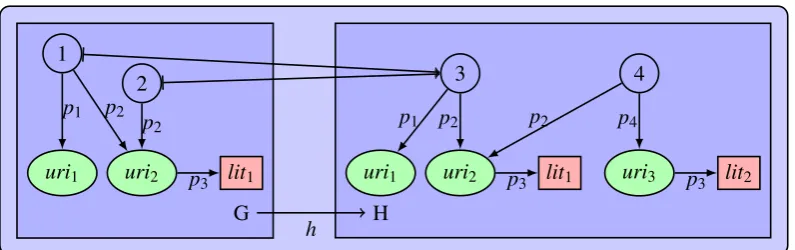
To obtain a category of RDF graphs we define RDF graph homomorphisms, which capture the structural relationships between RDF graphs. Essentially these are subgraph relations modulo a translation of the blank nodes, which means that blank nodes can be renamed, identified and included into a larger set of blank nodes before the accordingly translated triples are included into the triples of the codomain graph.
G
lit1
uri2 uri1
1
2
p1 p2
p2
p3
H
uri1 uri2 lit1 uri3 lit2
3 4
p1 p2 p2 p4
p3 p3
h
Figure 2: Example of an RDF graph homomorphism
(hBlank)#(GTriple)⊆HTriple, where the extension(hBlank)# ofhBlank to triples is constructed by (hBlank)#:= (hBlank+idURI+idLit)×idURI×(hBlank+idURI+idLit).
Remark2 (Relationship to concepts of RDF) RDF graph homomorphisms are not considered explicitly in the normative RDF specifications. However, a notion of graph equivalence, corre-sponding to a bijective homomorphism in the sense of the above definition, is defined in [KC04] and [Hay04], where there are some technical differences resulting from the different treatment of blank nodes mentioned inRemark 1.
Example 2 (RDF graph homomorphism) InFigure 2 an example is shown, which abstractly illustrates the possibilities of an RDF graph homomorphism. The blank nodes1and2of graphG
are identified to the blank node3in graphH, i. e., the homomorphismhis non-injective. In order to satisfy the required triple set inclusion, the triples(3,p1,uri1),(3,p2,uri2)and(uri2,p3,lit1) are included inH. Moreover, H also has some additional information not in the image of h, namely the blank node4 and the triples (4,p2,uri2), (4,p4,uri3) and(uri3,p3,lit2), i. e., h is non-surjective.
Our first result is that RDF graphs and their homomorphisms in fact establish a category. Moreover, arbitrary limits and colimits can be constructed in this category.
Proposition 1(CategoryRDFHom) RDF graphs and RDF graph homomorphisms constitute a category, denoted byRDFHom. This category is complete and cocomplete, i. e., it has limits and colimits over all diagrams.
Proof sketch. Composition and identities are just the composition and identities of the underly-ing translations of blank nodes, i. e., composition and identities in the categorySet, which are known to satisfy associativity of composition and neutrality of identities. The required triple set inclusions for compositions follow easily from the underlying inclusions, while they are imme-diately obvious for identical triple sets.
sets to be the triple setCTripleof the colimit graph.
Limits can be constructed similarly by first taking the limit LBlank of the blank nodes in
Set. The reverse translation of the triple sets in the diagram to triple sets over LBlank can be built by{(s,p,o)|(hBlank)#(s,p,o)∈GTriple} for all graphs Gand corresponding functions
hBlank:LBlank→GBlank. Finally, the triple setLTripleof the limit is obtained by the set-theoretic intersection of the translated triple sets.
Remark3 (Interpretation of limits and colimits) The merge of RDF graphs defined in [Hay04], which takes the union of RDF graphs, while “standardising apart” common blank nodes, is naturally obtained as the coproduct of RDF graphs in our category-theoretical setting. The more complex colimits can be used to construct merges over common blank nodes, which are protected from being standardised apart.
Intersections of RDF graphs are not treated explicitly in the RDF specifications. The limit constructions in RDFHom can be used to formalise such intersections under common blank nodes.
2.3 RDF Graph Instantiations
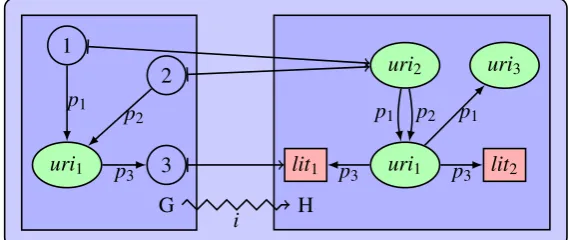
In [Hay04] blank nodes are interpreted as existential variables and an instance of an RDF graph is defined to be a graph, where some of the blank nodes are replaced by concrete URIs or literals. This leads to the following definition of a more general kind of morphism on RDF graphs. Note that the name “instantiation” does not refer to the instantiation of a schema or ontology, but to the instantiation of a blank node.
Definition 3(RDF Graph Instantiation) Given RDF graphsG andH, an RDF graph instan-tiationi:G→H is given by an assignment functioniBlank: GBlank→HBlank+URI+Lit, such that(iBlank)#(GTriple)⊆HTriple, where the extension(iBlank)#ofiBlankto triples is constructed by (iBlank)#:= (iBlank+idURI+idLit)×idURI×(iBlank+idURI+idLit).
Remark 4 (Related concepts) RDF graph instantiations are a combination of instances and subgraph relationships in the sense of [Hay04]. This is particularly interesting, because the Interpolation Lemma of [Hay04] states: “S entails a graphE if and only if a subgraph of S is an instance ofE.” Using the notion of RDF graph instantiation this is simplified to: “Sentails
E if and only if there is an instantiationi:E→S.” The characterisation of entailment by graph homomorphisms is also examined in [Bag05], where RDF graphs are translated into directed, labelled multigraphs and RDF entailment is shown to correspond to their morphisms.
Instantiations may also be used to formalise queries on an RDF data store. A data store, given by an RDF graph D, is queried using a pattern, given by another RDF graph P. The result of the query should be the set of all possible instantiationsi: P→D. In [CF07] a related but more complex approach is taken, where SPARQL queries and RDF data sets are translated to conceptual graphs and the results are computed by finding conceptual graph homomorphisms.
G 3
uri1
2 1
p1
p2
p3
H
lit1 uri1
uri2
lit2
uri3
p1 p2
p3 p3
p1
i
Figure 3: Example of an RDF graph instantiation
G,(uri2,p2,uri1)entails(2,p2,uri1)and(uri1,p3,lit1)entails(uri1,p3,3). The non-surjectivity of the instantiationimeans that not all information inHis used to entailG. In this and follow-ing figures we depict instantiations by jagged arrows, while plain homomorphisms are shown as normal arrows.
In the following proposition we show that RDF graph instantiations give rise to another cat-egory, which comprisesRDFHomas a subcategory. This category is neither complete nor co-complete. InSubsection 4.1we will, however, examine circumstances under which pushouts of instantiations exist.
Proposition 2(Category RDFInst) RDF graphs and RDF graph instantiations constitute a category, denoted byRDFInst, withRDFHom⊆RDFInst. This category does not have limits and colimits in general.
Proof sketch. The composition of instantiations i: G→H and j:H →K can be obtained by (j◦i)Blank:= (jBlank+idURI+idLit)◦iBlank. Identities idGare given by embeddings idG,Blankof the blank node set GBlank into the coproductGBlank+URI+Lit. Associativity of composition and neutrality of identities follow from the corresponding properties ofSet. The required triple set inclusions are again direct consequences of the underlying inclusions in the composed instan-tiations. The inclusion ofRDFHomintoRDFInstis obvious, since each blank node translation
hBlank:GBlank→HBlankis also an assignmenthBlank:GBlank→HBlank+URI+Lit, which simply does not use the possibilities of the extended codomain.
The existence of colimits is impeded by instantiations of the same blank node to different URIs or literals, which cannot be reconciled. The existence of general limits is on the other hand inhibited by the non-existence of a final object, into which unique instantiations are impossible, since a blank node can be instantiated to arbitrary URIs or literals.
3
Which Transformation Approach?
them-L K R
G C H
m
l
c r
n
l0 r0
(PO) (PO)
Figure 4: Double pushout transformation
selves, but also for features like reversibility (to support undoing of editing transformations) and reasoning about dependencies (to achieve structured version histories).
3.1 Double Pushout Approach
The Double Pushout (DPO) approach is one of the predominant approaches in algebraic graph transformation. Its theory has been reformulated in the framework of adhesive HLR categories in [EEPT06]. The main idea of DPO transformations is to split the task of transforming a graph into the deletion of graph elements by a pushout complement and the creation of new elements by a pushout. A DPO transformation is shown inFigure 4, where the ruleL←K→Ris applied to the graphGvia the matchm:L→Gby first constructing the contextCby a pushout complement and then the resulting graphHwith comatchn:R→Hby a pushout ofRandCoverK.
DPO transformations are always reversible due to their symmetric structure. If a graphH is obtained from a graphGby the application of a ruleL←K→R, then a graph isomorphic toG
may be reconstructed fromH by the inverse ruleR←K→L. Moreover, there is an extensive theory about the dependencies and conflicts between DPO transformation rules.
Most instantiations of the DPO approach ensure or require unique pushout complements in order to facilitate unique transformation results. This is not possible for RDF graphs as can be seen in the example inFigure 5, where two different pushout complements for the same given situation are shown. The ambiguity results from the fact that the triple(u1,p1,u2), deleted in the context graphK, can be deleted as inC inFigure 5(a) or it can be preserved as inC∗ in
Figure 5(b). The graphGis a pushout (set-theoretic union of the triples) in both cases.
G l2
u2
u1
l1
p1
p2 p2
C l1 u1 u2 l2
p2 p2
L u1 u2
p1
K u1 u2
l
m c
l0
(PO)
(a) Pushout complement with deletion
G l2
u2
u1
l1
p1
p2 p2
C∗ l1 u1 u2 l2
p1
p2 p2
L
u1 p1 u2 l K u1 u2
m c∗
l∗
(PO)
(b) Pushout complement without deletion
Figure 5: Ambiguity of pushout complements inRDFHom
3.2 Single and Sesqui Pushout Approach
An early alternative approach to algebraic graph transformation is the Single Pushout (SPO) approach studied in [EHK+97]. Instead of splitting deletion and creation into seperate construc-tions the SPO approach achieves both at the same time by pushouts in a suitable category of partial morphisms. Among the key characteristics of such partial pushouts are the deletion in un-known context (if a node is deleted all edges connected to this node are also deleted even if they are not mentioned in the rule) and the precedence of deletion over preservation (if a deleted node is identified to a preserved one by the match the node is deleted leading to a partial comatch).
A recent proposal is the Sesqui Pushout (SqPO) approach introduced in [CHHK06]. It also features deletion in unknown context but does not allow the identification of deleted and pre-served nodes. This is achieved by a split into deletion and creation similar to the DPO approach, where deletion is modelled by final pullback complements instead of pushout complements.
The SPO and SqPO approaches both result in deletion in unknown context, which is not desir-able in our case, because it impedes the reversibility of transformations. Implicitly deleted edges may not be reconstructed. While this could be resolved by using, e. g., an SqPO approach with a condition prohibiting dangling edges or an SPO approach with an additional condition to avoid identifications, we opt for modifying the DPO approach in the following section.
3.3 The Need for a Modified Approach
C∗ C G
L K
m
l
c
l0
c∗
l∗ x
(MPOC)
(a) Minimal pushout complement
L K R
G C H
m
l
c r
n
l0 r0
(MPOC) (PO)
(b) MPOC-PO transformation
Figure 6: MPOC and MPOC-PO transformation
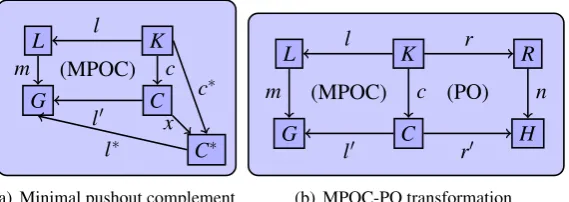
that the result we want to achieve in this situation is the deletion of the triple. Hence, our ap-proach, developed in thefollowing section for RDF, is to resolve the ambiguity by canonically selecting the minimal pushout complement (MPOC), i. e., a pushout complement in which as much as possible is deleted.
Definition 4(Minimal Pushout Complement) Given morphisms l:K →L andm: L→Gin an arbitrary category, a minimal pushout complementCoflandmwith morphismsl0:C→G
andc:K→Cis a pushout complement, i. e., Gis a pushout ofLandC overK, such that for each pushout complementC∗oflandmwith morphismsl∗:C∗→Gandc∗:K→C∗there is a unique morphismx:C→C∗withl0=l∗◦xandc∗=x◦c(cf.Figure 6(a)).
An MPOC-PO transformation is now given by a DPO transformation with the additional side condition that the deletion in the left-hand square ofFigure 6(b)is an MPOC, while the creation in the right-hand square is still done by a pushout.
Definition 5 (MPOC-PO Transformation) An MPOC-PO transformation rule is given by a spanL←K→Rof morphisms in an arbitrary category. An application of this rule to an object
Gvia a morphismm:L→Gas match is given by the diagram inFigure 6(b)resulting in the objectHwith the morphismn:R→Has comatch.
This should preserve most of the well-behavedness of the DPO approach, because the only difference is the added side condition, which ensures uniqueness of the transformation result.
Proposition 3(Uniqueness of Transformation Results) The result of an MPOC-PO transfor-mation is unique up to isomorphism.
Proof sketch. Since two minimal pushout complements have unique morphisms in both direc-tions and their composidirec-tions have to be the respective identities as unique endomorphisms, they are obviously isomorphic.
Moreover, pushouts are unique up to isomorphism in any category and, hence, the result of first constructing an MPOC and then a pushout is also unique up to isomorphism.
for pushouts and MPOCs inRDFInst, which under certain conditions also imply their existence. The use of MPOCs as a way to canonically select the result of a deletion may also be beneficial when applying the DPO approach to simple graphs or other categories, where there are non-unique pushout complements.
4
RDF Graph Transformations and Basic Results
In this section we apply MPOC-PO transformations to RDF graphs, where the necessary con-structions are explicitly developed and sufficient conditions on the rule and match morphisms are given to ensure existence of the transformation results. Moreover, conditions for the reversiblity of RDF graph transformations are shortly discussed.
4.1 MPOC-PO Transformations for RDF
For the creation of elements we need pushouts inRDFInst. Sufficient conditions for their exis-tence can be achieved by restricting one of the instantiations in the given span to be an injective homomorphism. This ensures that contradictions can arise neither due to assignments of one blank node to different URIs or literals (the homomorphism cannot assign a blank node to a URI or literal, but only to a blank node) nor due to the identification of several blank nodes assigned to different URIs or literals (injectivity prevents identifications).
Theorem 1(Pushouts inRDFInst) Given an injective RDF graph homomorphism r:K→R and an RDF graph instantiation c:K→C, a pushout H with an injective RDF graph homomor-phism r0:C→H and an RDF graph instantiation n:R→H can be constructed by
• the blank node set HBlank:=CBlank+ (RBlank\rBlank(KBlank))with the injection r0Blank of CBlankinto the coproduct and the assignment nBlank, which acts on nodes from KBlankas cBlankdoes and on the new nodes as an injection into the coproduct, and
• the triple set HTriple:= (r0Blank)#(CTriple)∪(nBlank)#(RTriple).
Proof sketch. The construction ofHBlankensures that the assignmentnBlankis well-defined, be-cause the inclusion ofCBlank enables its acting like cBlank on the preserved nodes, while the addition of the new elements ofRBlankfacilitates their injective mapping. The union construction of the triple set guarantees the satisfaction of the corresponding triple set inclusions, while the commutativitynBlank◦rBlank=rBlank0 ◦cBlankalso holds by construction.
For each other graphH∗with instantiationsn∗:R→H∗ andr∗:C→H∗, such thatn∗◦r=
r∗◦can assignmentxBlank:HBlank→HBlank∗ +URI+Litis uniquely induced by the requirement that it acts on blank nodes fromCasr∗does (x◦r0=r∗) and on blank nodes fromRasn∗ does (x◦n=n∗).
We have chosen a concrete, asymmetric construction in this theorem in order to highlight that the (possibly very large) host graph can be left unchanged, while the additional blank nodes are added disjointly. This is also closer to possible implementations, which should construct the pushout directly instead of following the elegant but inefficient categorical construction.
For the deletion we will use the concept of MPOC introduced inDefinition 4. In the following theorem we give sufficient conditions and a construction for MPOCs inRDFInst. Two of these conditions, namely the identification and the dangling condition, are well-known from the ordi-nary DPO approach, while the third ensures that deleted blank nodes are not assigned to URIs or literals, which cannot be deleted.
Theorem 2(Minimal Pushout Complements inRDFInst) Given an injective RDF graph ho-momorphism l:K→L and an RDF graph instantiation m:L→G, such that the deleted blank nodes in LBlank\lBlank(KBlank)
• are not identified to other nodes (identification condition),
• are not assigned to URIs or literals, and
• are not assigned to blank nodes, which are used in triples in GTriple\(mBlank)#(LTriple)
(dangling condition),
an MPOC C with an injective RDF graph homomorphism l0:C→G and an RDF graph instan-tiation c:K→C can be constructed by
• the blank node set CBlank:=GBlank\mBlank(LBlank\lBlank(KBlank))with the inclusion lBlank0
of this set into GBlankand the assignment cBlank, which behaves like mBlank◦lBlank, and
• the triple set CTriple:=GTriple\(mBlank)#(LTriple\(lBlank)#(KTriple)).
Proof sketch. The assignmentcBlankis well-defined and the triple inclusion of(cBlank)#(KTriple) intoCTripleis satisfied, because the blank nodes in the range ofmBlank◦lBlankand the triples from
KTriple are explicitly not removed inC, while the commutativity mBlank◦lBlank=lBlank0 ◦cBlank also holds by this construction.
The blank node setGBlank may be reconstructed fromLBlankandCBlankby the pushout con-struction inTheorem 1, since the removed triplesmBlank(LBlank\lBlank(KBlank))are exactly the ones that are added by the pushout. Moreover, the pushout construction also recovers the triple setGTriple. Hence, the construction in fact leads to a pushout complement.
For each other pushout complementC∗ with instantiationsc∗:K→C∗ andl∗:C∗→Gthe blank node setC∗Blankhas to be isomorphic toCBlank, because otherwise the pushout construction would also result in a non-isomorphic blank node set. The blank node bijectionxBlank:CBlank→
l
l0
r
r0
m c n
1 2 3
p1 p2
1 3 1 3
p3
l1 u1 4
p4 p1
p2
l1 u1
p4
l1 u1
p4
p3
Figure 7: Example of an RDF graph transformation
Remark6 (Pushouts and MPOCs of proper instantiations) The conditions given inTheorem 1
andTheorem 2are sufficient, but not necessary, respectively. In fact, it is possible to construct pushouts of (proper) RDF graph instantiations if the assignments of blank nodes do not contra-dict. For our application to RDF graph transformation the given constructions over homomor-phisms are, however, general enough, since we do not want to instantiate blank nodes in the rule but only in the match.
We now have both constructions that are necessary to define RDF graph transformations as MPOC-PO transformations.
Definition 6 (RDF Graph Transformation) An RDF graph transformation rule is given by a span L←K →Rof injective RDF graph homomorphisms. An application of this rule to an RDF graph G via an RDF graph instantiation m:L→ G as match is given by a MPOC-PO transformation as defined in Definition 5 resulting in the RDF graph H with the RDF graph instantiationn:R→Has comatch.
Example4 (RDF graph transformation) InFigure 7an example of an RDF graph transforma-tion is depicted, where the rule replaces a sequential occurrence of predicates p1 and p2 by a single occurrence of p3, while deleting the intermediate blank node. Such a rule is not typical forreasoningin RDF, since inference only yields additional triples, but does not delete anything. We claim, however, that such deleting transformations are useful for editingRDF data, e. g., if the predicates p1andp2are deprecated and shall be replaced byp3.
The following corollary summarises the existence and uniqueness properties of RDF graph transformations.
Corollary 1(Applicability and Uniqueness of RDF Transformations) An RDF graph transfor-mation rule L←K→R is applicable via a match instantiation m:L→G if m does not identify deleted blank nodes to other nodes, does not assign deleted blank nodes to URIs or literals and does not assign deleted blank nodes to blank nodes occuring in triples not in the range of m. In this case the resulting RDF graph H with comatch n:R→H is unique up to isomorphism.
of the result and fromProposition 3regarding its uniqueness.
4.2 Reversible Transformations
While DPO transformations are always reversible due to their symmetric structure, MPOC-PO transformations are only reversible if the creation pushout is also an MPOC. In RDF graph transformations this is the case if none of the additional triples inRis already present inC.
Theorem 3(Reversibility of RDF Graph Transformations) Given the RDF graph transforma-tion inFigure 6(b), the application of the inverse rule R←K→L to the graph H via the match n:R→H is possible and leads to a graph G0 isomorphic to G provided that(r0Blank)#(C
Triple)∩ (nBlank)#(RTriple) = (nBlank◦rBlank)#(KTriple) = (r0Blank◦cBlank)#(KTriple).
Proof sketch. The given condition ensures that the right square is not only a pushout, but that
Cis also an MPOC in this square, since all common triples ofCTripleandRTripleare also in the interfaceKTripleand will therefore not be removed by the MPOC construction.
In order to constrain RDF graph transformations to reversible cases negative application con-ditions could be used, which disallow all triples added by the rule from being already present in the host graph. To achieve the same expressibility additional rules could be added, which have these triples in their left-hand sides and just perform the other changes of the rule. A complete discussion is, however, outside the scope of this paper.
5
Summary and Future Work
In this contribution we have formalised RDF in a category theoretical framework, provided a transformation approach for RDF graphs and shown under which circumstances transformations are applicable and reversible. These results can provide a useful basis for the rule-based modifi-cation and creation of RDF data.
Considering the application scenario sketched in theintroduction, the theory developed so far allows us to define a set of grammar rules. If an RDF data store is only modified using these rules, certain structural conditions can be ensured, such as a publication in the bibliography application having at least one title. Moreover, the reversibility of transformations allows us to undo the last rule-based changes to the data store.
Another use case for transformation rules is the automatic application of a set of rules on all possible matches, which could be used, e. g., to add references to a related ontology, where the (non-deleting) rules would require certain predicates and types from the present ontology in their left-hand sides and add the corresponding predicates and types from the new ontology in their right-hand sides. Since the left- and right-hand sides can be whole graphs, intermediate structures in the source ontology can be by-passed by simpler structures in the target ontology. Vice versa, intermediate blank nodes may be introduced, if the target ontology needs them.
structures, such as the title of a publication in our scenario, can exist only once. On the other hand it is needed to ensure termination of automatic transformations (by prohibiting the right-hand side to be already present in the graph) and reversibility of rule applications (as already mentioned inSubsection 4.2).
Analysis techniques for dependencies and conflicts should be adapted to RDF transformations. These would enable us to develop a transformation-based version control system for RDF data stores, in which independent changes can be reverted independently and merged automatically. Moreover, the analysis of critical pairs for transformation rules could be used to propose default resolutions for merge conflicts.
Bibliography
[Bag05] J.-F. Baget. RDF Entailment as a Graph Homomorphism. In Gil et al. (eds.),The Semantic Web – ISWC 2005. LNCS 3729, pp. 82–96. Springer, 2005.
doi:10.1007/11574620 9
ftp://ftp.inrialpes.fr/pub/exmo/publications/baget2005a.pdf
[BFM98] T. Berners-Lee, R. T. Fielding, L. Masinter. RFC 2396 – Uniform Resource Identi-fiers (URI): Generic Syntax. Internet Engineering Task Force (IETF), Aug. 1998.
http://tools.ietf.org/html/rfc2396
[BG04] D. Brickley, R. V. Guha (eds.).RDF Vocabulary Description Language 1.0: RDF Schema. World Wide Web Consortium (W3C), Feb. 2004.
http://www.w3.org/TR/2004/REC-rdf-schema-20040210/
[BHKR07] I. Boneva, F. Hermann, H. Kastenberg, A. Rensink. Simulating Multigraph Trans-formations Using Simple Graphs. In Ehrig and Giese (eds.),Graph Transformation and Visual Modeling Techniques (GT-VMT 2007). Electronic Communications of the EASST 6. 2007.
http://eceasst.cs.tu-berlin.de/index.php/eceasst/article/view/62
[BHLT06] T. Bray, D. Hollander, A. Layman, R. Tobin (eds.).Namespaces in XML 1.0 (Second Edition). World Wide Web Consortium (W3C), Aug. 2006.
http://www.w3.org/TR/2006/REC-xml-names-20060816/
[BM04] P. V. Biron, A. Malhotra (eds.).XML Schema Part 2: Datatypes (Second Edition). World Wide Web Consortium (W3C), Oct. 2004.
http://www.w3.org/TR/2004/REC-xmlschema-2-20041028/
[CF07] O. Corby, C. Faron-Zucker. Implementation of SPARQL Query Language Based on Graph Homomorphism. In Priss et al. (eds.),Conceptual Structures: Knowledge Architectures for Smart Applications. Proc. ICCS 2007. LNCS/LNAI 4604, pp. 472– 475. Springer, 2007.
[CHHK06] A. Corradini, T. Heindel, F. Hermann, B. K¨onig. Sesqui-Pushout Rewriting. In Cor-radini et al. (eds.),Graph Transformations. Proc. ICGT 2006. LNCS 4178, pp. 30– 45. Springer, 2006.
doi:10.1007/11841883 4
[EEPT06] H. Ehrig, K. Ehrig, U. Prange, G. Taentzer. Fundamentals of Algebraic Graph Transformation. Monographs in Theoretical Computer Science. Springer, 2006.
doi:10.1007/3-540-31188-2
[EHK+97] H. Ehrig, R. Heckel, M. Korff, M. L¨owe, L. Ribeiro, A. Wagner, A. Corradini. Algebraic Approaches to Graph Transformation – Part II: Single Pushout Approach and Comparison with Double Pushout Approach. In Rozenberg (ed.),Handbook of Graph Grammars and Computing by Graph Transformation. Vol. 1: Foundations. Chapter 4. World Scientific, 1997.
[Hay04] P. Hayes (ed.).RDF Semantics. World Wide Web Consortium (W3C), Feb. 2004.
http://www.w3.org/TR/2004/REC-rdf-mt-20040210/
[KC04] G. Klyne, J. J. Carroll (eds.). Resource Description Framework (RDF): Concepts and Abstract Syntax. World Wide Web Consortium (W3C), Feb. 2004.
http://www.w3.org/TR/2004/REC-rdf-concepts-20040210/
[MM04] F. Manola, E. Miller (eds.).RDF Primer. World Wide Web Consortium (W3C), Feb. 2004.
http://www.w3.org/TR/2004/REC-rdf-primer-20040210/
[MPG07] S. Mu˜noz, J. P´erez, C. Gutierrez. Minimal Deductive Systems for RDF. In Franconi et al. (eds.), The Semantic Web: Research and Applications. Proc. ESWC 2007. LNCS 4519, pp. 53–67. Springer, 2007.
doi:10.1007/978-3-540-72667-8 6
http://www2.ing.puc.cl/∼jperez/papers/minimal-rdf-camera-ready-ext.pdf
[PS07] E. Prud’hommeaux, A. Seaborne (eds.).SPARQL Query Language for RDF. World Wide Web Consortium (W3C), Nov. 2007.
http://www.w3.org/TR/2007/PR-rdf-sparql-query-20071112/
[Uni07] The Unicode Consortium. The Unicode Standard, Version 5.0.0. 2007.