Phylogenetic analyses and morphological
characteristics support the description of a
second species of
Tridimeris
(Annonaceae)
Andres Ernesto Ortiz-Rodriguez1, Marcos Alberto Escobar-Castellanos2,
Miguel Angel Pérez-Farrera2
1 Departamento de Biologia Evolutiva, Instituto de Ecologia A.C., Xalapa, Veracruz, Mexico 2 Instituto de Ciencias Biológicas, Universidad de Ciencias y Artes de Chiapas, Tuxtla Gutierrez, Chiapas, Mexico
Corresponding author:Andres Ernesto Ortiz-Rodriguez ([email protected])
Academic editor:T. Couvreur | Received 1 September 2016 | Accepted 31 October 2016 | Published 8 November 2016
Citation: Ortiz-Rodriguez AE, Escobar-Castellanos MA, Pérez-Farrera MA (2016) Phylogenetic analyses and morphological characteristics support the description of a second species of Tridimeris (Annonaceae). PhytoKeys 74: 79–95. doi: 10.3897/phytokeys.74.10371
Abstract
Based on phylogenetic and morphological evidence, Tridimeris chiapensis Escobar-Castellanos & Ortiz-Rodr., sp. n. (Annonaceae), a new species from the karst forest of southern Mexico, is described and illustrated. The new species differs from Tridimeris hahniana, the only described species in the genus, in that the latter has flowers with sepals densely tomentose outside, one (rarely two) carpel(s) per flower and fruits densely covered with golden-brown hairs, while Tridimeris chiapensis has flowers with glabrous sepals outside, two to five carpels per flower and glabrous fruits. Furthermore, a shallow triangular white patch at the base of the inner petals is found in T. chiapensis, a morphological character shared with the sister genus Sapranthus but absent in T. hahniana. Geographically, both species occur allopatrically. With just one known locality and seven individuals of Tridimeris chiapensis recorded in one sampling hectare, and based on application of the criteria established by the IUCN, we conclude tentatively that the species is critically endangered.
Keywords
Dimery, Neotropical, Miliuseae, tropical rainforest
http://phytokeys.pensoft.net
Copyright Andres E. Ortiz-Rodriguez et al. This is an open access article distributed under the terms of the Creative Commons Attribution License (CC BY 4.0), which permits unrestricted use, distribution, and reproduction in any medium, provided the original author and source are credited.
Introduction
Annonaceae is a plant family composed of about 110 genera and 2,500 species of trees and lianas (Couvreur et al. 2012, Erkens et al. 2012). Most genera of Annonaceae (except Asimina, endemic to the USA) are exclusively tropical and many are impor-tant floristic elements in several lowland forests. Within continents, the endemism at generic level is very high and only the genus Xylopia is pantropical (Doyle and Le Thomas 1997). Recent phylogenetic analyses (Richardson et al. 2004, Chatrou et al. 2012) show that Annonaceae is composed of four major lineages, and on that basis, the family is now classified into four subfamilies: Anaxagoreoideae, Ambavioideae, Annonoideae and Malmeoideae. Of these, Annonoideae (50 genera and 1600 spe-cies) and Malmeoideae (50 genera and 700 spespe-cies) are the most species-rich line-ages in Annonaceae (Pirie and Doyle 2012). In Mexico the family is represented by eleven genera, Anaxagorea, Annona, Cymbopetalum, Desmopsis, Guatteria,
Mosan-nona, Sapranthus, Stenanona, Tridimeris, Unonopsis and Xylopia, of which Tridimeris
is endemic.
Tridimeris is a monotypic and poorly studied genus. Baillon (1869) described its
only species, Tridimeris hahniana Baill., based on exemplars from Veracruz, Mexico (Turner 2013). The species, restricted to eastern Mexico in the states of San Luis Potosí, Puebla and Veracruz (Figure 1), is easily recognizable by its greenish and dimerous flowers (two sepals and four petals) and its large and fleshy fruits densely covered with golden-brown hairs (Schatz 1987). Dimery is uncharacteristic in Ne-otropical Annonaceae and it has been recorded only in Anaxagorea silvatica R. E.
Fr.,Ephedranthus dimerus J. C. Lopes, Chatrou & Mello-Silva and, Malmea dimera
Chatrou (Lopes et al. 2014). Phylogenetic analyses based on molecular characters (Saunders et al. 2011, Chaowasku et al. 2012, 2014, Xue et al. 2011, 2014, Ortiz-Rodriguez et al. 2016) show that Tridimeris hahniana belongs to the Malmeoide-ae tribe MiliuseMalmeoide-ae, where along with Desmopsis, Sapranthus and Stenanona it forms the subtribe Sapranthinae (Ortiz-Rodriguez et al. 2016). Sapranthus and Tridimeris
are closely related and together form the sister group of the remaining members of Sapranthinae. Although Sapranthus and Tridimeris have contrasting floral character-istics, with Tridimeris showing axillary, dimerous and greenish flowers whilst Sapran-thus shows leaf-opposed, trimerous and usually brown to purple colored flowers, both genera are characterized by large and fleshy fruits, these last characteristics being their most obvious synapomorphy (Schatz 1987).
Figure 1. Distribution range of Tridimeris chiapensis Escobar-Castellanos & Ortiz-Rodr. (red dot) and Tridimeris hahniana Baill (black dots).
Material and methods
Molecular data
primer (10 µM), 0.10 µL Taq polymerase (5U/µL) (Promega), 0.56 µL of BSA (Promega), 2 µL of template DNA, and finally dH2O added to bring to volume. The PCR program
used comprised 35 cycles of 94°C for 45 s, 53 °C–65 °C for 30 s (annealing temperatures depending on each primer pair), 72°C for 2 min, with the initial denaturation for 3 min at 94°C and a final extension for 7 min. at 72°C. PCR products were purified with the QIAquick PCR Purification kit (Qiagen) and sequenced using the BigDye Terminator Cycle Sequencing kit (Applied Biosystems, Foster City, California, USA). The products were analyzed on a 310 automated DNA sequencer (Applied Biosystems) at the Universi-ty of Washington High Throughput Genomics Unit, Seattle, Washington. The sequences obtained were first edited and assembled in Sequencher ver. 4.1 (Gene Codes Corp., Ann Arbor, MI, USA), and subsequently aligned using PhyDE-1 ver. 0.9971 (Müller et al. 2010). Additionally, sequences of the coding region matK, ndhF, rbcL and ycf1 and
psbA-trnH and trnL-F spacers of other Neotropical genera of Miliuseae (Desmopsis, Sapranthus,
Stenanona and Tridimeris hahniana) and a few representatives of Asian Miliuseae were
obtained from GenBank and included in the molecular matrix. [The samples, localities and GenBank accession numbers are listed in Appendix 1].
Phylogenetic analyses
Phylogenetic relationships among taxa were estimated using Bayesian inference (BI), maximum likelihood (ML), and parsimony methods. Analyses of six cpDNA regions were conducted separately (for regions with information available for the new species) and in combination.
For BI,three partitioning strategies were used: (1) data matrix divided into six parti-tions based on DNA region identity, (2) six plastid markers concatenated and analyzed without partitioning, and (3) 2-partitioned, distinguishing coding (matK, ndhF, rbcL
the Bayes factor scale of strength of evidence in favor of one hypothesis is: 0–2 (not worthy of mention), >2–6 (positive), >6–10 (strong), >10 (very strong).
For the ML analysis, the dataset was divided based on Bayes factor results (see above and results). Phylogenetic reconstruction was performed using RAxML ver. 8.2.4 (Stamatakis 2014) under the general time-reversible (GTR ) nucleotide substitu-tion model and 1000 non-parametric bootstraps using the CIPRES Science Gateway (Miller et al. 2010). Bootstrap support values were interpreted as weak (50–70%), moderate (71–80%) and strong support (81–100%).
The most parsimonious trees were obtained using the ratchet strategy (Nixon 1999) in Winclada ver. 1.0000 (Nixon, K. C. 1999–2002), running NONA ver. 2.0 (Goloboff 1993) on a combined dataset of six plastid regions, with nucleotide char-acters treated as unordered and equally weighted, 1000 iterations, holding 10 trees per iteration with 10% of nodes constrained, and all other parameters set to default. Branch support was assessed using bootstrap resampling, 1000 bootstrap-resampled pseudoreplicate matrices were each analyzed using 100 random addition sequences (multi*100). Ten trees were retained during TBR swapping after each search initiation (hold/10) using NONA ver. 2.0 and performed in WinClada, with the same interpre-tations of support level as in the ML analyses.
Morphological differentiation
We examined the specimens of Tridimeris hahniana deposited at XAL herbarium (Thiers 2016). Also, we consulted the digitized type specimens available at JSTOR Global Plants (http://plants.jstor.org/). The putative new species was recognized using the unique combination of features criteria (Donoghue 1985) through comparisons with morphologically similar species and literature review (Schatz 1987). Finally, we elaborated the species description following terminology presented in Hickey (1973).
Conservation status
We assessed the conservation status by calculating the extent of occurrence (EOO) and the area of occupancy (AOO) using the GeoCAT tool (Bachman et al. 2011) and ap-plying the IUCN Red List Categories and criteria (IUCN 2001).
Results
Analysis of individual cpDNA regions
1–4). Analyses of the matK, rbcL and ycf1 coding regions showed that Sapranthinae is composed of two main subclades, the Desmopsis-Stenanona clade and the Sapranthus
-Tridimeris clade, while the analysis of trnL-F spacer showed very low resolution
recov-ering only the Sapranthus-Tridimeris clade (Suppl. material 1–4). Each phylogenetic hypothesis unequivocally placed the new species within the Sapranthus-Tridimeris clade.
Analysis of combined data
The concatenated 32-accession dataset contained 6419 aligned positions, of which 746 were variable and 208 were parsimony informative. For the Bayesian analyses, the sub-stitution model was GTR+G for matK, trnL-F, psbA-trnH and unpartitioned datasets, GTR+G+I for rbcL, ndhF and coding datasets and HKY+G for non-coding dataset.
The six partitioned strategy considerably improved the mean −lnL values in the Bayesian analyses (mean −lnL non-partitioned = –15754.57; mean –lnL 2-parti-tioned= –15725.73; mean –lnL 6-partitioned = –15722.11). Bayes factor comparison indicated that the analyses using six partitions provided a better explanation of the data than unpartitioned and 2-partitioned analyses. For the ML analyses the likelihood score of the optimal ML tree, was ln L = –15572.87. The parsimony analysis of the combined regions resulted in 20 most parsimonious trees of 1030 steps with a Con-sistence Index of 0.79 and a Retention Index of 0.60. The subsequent presentation of the results is restricted to the 50% majority rule consensus tree derived from Bayesian analyses using six partitions.
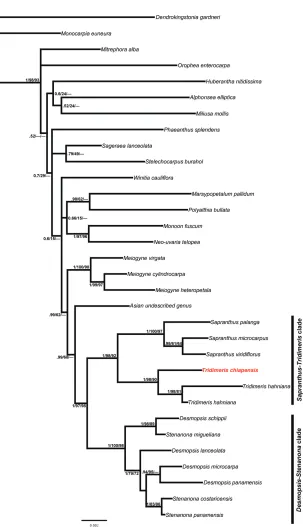
The partitioned BI, ML and parsimony analyses resulted in similar tree topologies. The 50% majority-rule consensus BI tree resulting is shown in Fig. 2. All phylogenetic analyses indicate that the Neotropical Miliuseae (Sapranthinae subtribe) forms two strongly supported clades: the Desmopsis-Stenanona clade (1.0 PP, 100% bootstrap support (MLBS), 98% MP bootstrap support (MPBS)) and the Sapranthus-Tridimeris
clade (1.0 PP, 98% MLBS, 92% MPBS). The first clade includes the genera Desmopsis
and Stenanona, however, they appear to be not monophyletic and species of both
gen-era appear intermingled. The second clade is composed of Sapranthus and Tridimeris, with each resolved as monophyletic group (Sapranthus, 1.0 PP, 98% MLBS, 97% MPBS; Tridimeris, 1.0 PP, 100% MLBS, 90% MPBS). The phylogenetic hypothesis indicates that effectively the new species, Tridimeris chiapensis, is part of the genus
Tridimeris.
Morphological differentiation
Table 1. Comparison of diagnostic morphological characters of Tridimeris chiapensis and Tridimeris hahniana.
Characters Tridimeris chiapensis Tridimeris hahniana
Pedicel Glabrous Golden tomentose
Sepals Glabrous outside Densely tomentose outside Inner petals Thick and fleshy Flat and thin
Carpels 2–5 1 (occasionally 2)
Monocarps Glabrous Golden brown tomentellous
Distribution Mexico (Chiapas) Mexico (Puebla, San Luís Potisí and Veracruz)
Discussion
The phylogenetic analyses showed that Tridimeris chiapensis and T. hahniana form a strongly supported monophyletic group (Fig. 2). The two species of Tridimeris share axillary inflorescences, dimery flowers (two sepals and four petals), greenish petals, and large and fleshy fruits. Furthermore, both species have pocket domatia in the axils of secondary veins. As in previous studies, Tridimeris and Sapranthus appear to be closely related (Saunders et al. 2011, Chaowasku et al. 2012, 2014, Xue et al. 2011, 2014, Ortiz-Rodriguez et al. 2016) and together form the Sapranthus-Tridimeris clade.
Tridimeris chiapensis clearly differs from T. hahniana by its number of carpels per
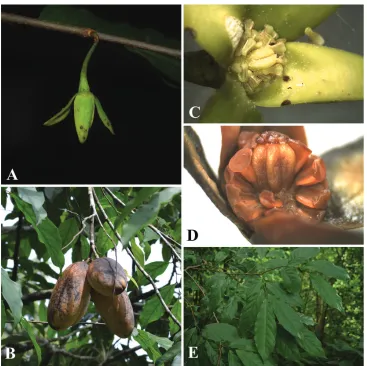
flowers, fruit surface, glabrous pedicels and sepals, and by the presence of a triangular white patch near the base of inner petals (Fig. 3). A similar white patch is found in the inner petals of Sapranthus viridiflorus G.E. Schatz, which have been considered by Schatz (1998) as a vestigial food body since food bodies are morphological modifications of a specific area of inner petals as food reward for floral visitors (Schatz 1987). However, a more detailed study of these structures is needed, as well as the compounds present in this structure and its anatomical characteristics in order to determine its function.
Ecologically T. chiapensis inhabits wet forests on karstic topography around 1000 m elevation, while T. hahniana occurs in lowland wet forests (200–900 m) or even in cloud forests in the northern portion of its distribution (Schatz 1987). The type local-ity of T. chiapensis, the protected natural area La Pera in Chiapas, is a karstic zone cov-ered mostly by tropical rain forest. This area among other similar regions of southern Mexico, are considered centers of plant endemism (Wendt 1987).
Taxonomic treatment
Tridimeris chiapensis Escobar-Castellanos & Ortiz-Rodr., sp n. urn:lsid:ipni.org:names:77158527-1
Figs 1–3
Figure 3. Tridimeris chiapensis Escobar-Castellanos & Ortiz-Rodr. A Dimerous flower B Large and fleshy fruits C Flower showingthepollen release and a triangular white patch at the base of the inner petals D Five carpels surrounded by numerous stamens E Leafy branches. Photographs by Marcos Escobar-Castellanos.
km. 12 desvío a Montebello, 1081 m, 16°52'20.3"N, 93°19'32.5"W, 11 August 2016 (fl) Escobar-Castellanos M. A. 0689 (holotype HEM; isotypes: XAL, MO).
Diagnosis.Tridimeris chiapensis is phylogenetically related to Tridimeris hahniana
with which it shares axillary and dimerous flowers and large and fleshy fruits. How-ever, Tridimeris chiapensis differs in having flowers with glabrous sepals, a triangular white patch near the base of inner petals and 2-5 carpels per flower and glabrous fruits (Fig. 3), while T. hahniana has flowers with sepals densely tomentose outside, 1 or 2 carpels per flower and fruits densely covered with golden-brown hairs.
wide, narrowly elliptic to obovate, the apex acute to acuminate, the base acute to obtuse, sometimes asymmetrical; upper surface glabrous, the lower side glabrescent; venation brochidodromus, 6–9 veins per side, pocket domatia in the axils of the main veins; the midrid impressed above and slightly canaliculate toward the base (sometimes with erect to appressed light-brown hairs), lateral veins barely elevated above; the midrib and lateral veins prominently elevated below and with sparsely light-brown hairs, lateral veins decurrent at midrid insertion ; petiole swollen, 0.5–1 cm long, canaliculate, with sparsely light-brown hairs. Inflorescences always one-flowered, axillary, sometimes arising on leafless part of branches (ramiflory), the pedicel glabrous, 1–1.7 cm long, bearing 2–3 minute, densely golden tomentose and broadly ovate basal bracts. Sepals 2, connate, to 2 mm long × 4–5 mm wide, decur-rent along the pedicel, broadly ovate, rounded at apex, glabrous inside and outside, the margins ciliate. Petals 4, in two subequal whorls, 8–14 mm long × 3–5 mm wide, lanceolate to triangular, green to yellowish green, glabrous inside and outside, the margins ciliate, acute at apex, the base truncate and cusped around the stamens; the outer petals, more or less thin, with faint venation, reflexed at anthesis; the inner petals thicker and fleshier and not reflexed with a shallow, more or less triangular white patch near the base. Stamens, c.a. 40, 1–1.5 mm long, extrorse, filament very short, apical part of connective expanded over the thecae, shield-shaped, ellipsoid to angulate, glabrous. Carpels, 2–5 per flower, to 2.5 mm long; the stigma more or less globose and essentially glabrous; style absent; the ovaries ellipsoid and more or less curved, like a small banana with sparsely light-brown hairs; the ovules, 12–18, lateral, in two rows. Monocarps, 1-4 per fruit, large and fleshy, 8–11 cm long × 3–5 cm wide, ellipsoid, the apex and base rounded, glabrous, shortly stipitate, stipes to 7 mm long; young monocarps green, yellow to light brown when ripe with a peach-like sweet odor; seeds lunate to wedge-shaped, 1.3–2.2 cm long with lamellate ruminations.
Habitat and ecology.The type locality of Tridimeris chiapensis is locally named as “La Pera” and “Pozo Turipache” or “El Pozo” and it lies within the ecological state reserve La Pera, which is mostly covered by tropical rainforest. Thin soils, rough lime-stone outcrops, caves, crevices, sinkholes and almost no surface water that form a typi-cal karst landscape can be observed around El Pozo (Wake and Johnson 1989). Also, fogs forming cloudbanks are common throughout the year, though absent during the dry season (Wake and Johnson 1989).
Tridimeris chiapensis forms part of the understory vegetation and it is associated
with Mortoniodendron ocotense Ishiki & T. Wendt, M. vestitum Lundell, Trichilia
mos-chata Sw., Neea tenuis Standl., Pseudolmedia glabrata (Liebm.) C.C. Berg, Quararibea
funebris (La Llave) Vischer, Quercus lancifolia Schltdl. & Cham. and Heliocarpus
ap-pendiculatus Turcz. (Escobar-Castellanos 2016).
Phenology. The species was found in full bloom in August and bearing fruits in March and May.
Conservation status. Tridimeris chiapensis is known only from the type locality at the ecological state reserve La Pera. According to the criteria established by the IUCN, it is possible to tentatively determine that the species is Critically Endangered [CR B1ab (iii)]. The Area of occupancy (AOO) of T. chiapensis is 0.314 km² and the Extent of occurrence (EOO) is 1.519 km², suggesting a very restricted overall distribution. Although the only known population of the species is located within a protected natural area, only 7 individu-als of Tridimeris chiapensis in one hectare of sampling were recorded (Escobar-Castellanos 2016). The 3000 ha of La Pera’s rainforest estimated by Espinosa (2014) and its species are threatened by non-sustainable activities (logging, fires, illegal settlements) and forests in this region are fragmented and only some remnants persist which are surrounded by roads, croplands and cattle pastures (Medina et al. 2006, Luna-Reyes et al. 2015).
Additional specimens examined.MEXICO. Chiapas, Municipio de Berriozábal: Zona Sujeta a Protección Ecológica “La Pera”, Campamento “Trepatroncos” car-retera Berriozábal-Joaquín Miguel Gutiérrez, km. 12 desvío a Montebello, 1081 m, 16°52'20.3"N, 93°19'32.5"W, May 2014 (fr) Escobar-Castellanos M. A. 0599 (HEM), May 2015 (fr) Ortiz-Rodriguez A. E.801 (XAL); Zona Sujeta a Protección Ecológica “La Pera”, Predio “La Selva”, desvío hacia San Joaquín, carretera Berriozábal-Joaquín Miguel Gutiérrez, Sistema kárstico, 14 km al NO de Berriozábal. Plot X, Tree No. 27, 1049 m, 19°52'50.45"N, 93°19'07.92"W, 11 August 2016 (fl) Escobar-Castellanos M.
A. 0690 (HEM); Zona Sujeta a Protección Ecológica “La Pera”, Predio “La Selva”,
desvío hacia San Joaquín, carretera Berriozábal-Joaquín Miguel Gutiérrez, Sistema kárstico, 14 km al NO de Berriozábal, 1050 m, 19°52'54.62"N, 93°19'09.77"W, 31 March 2014 (fr) Escobar-Castellanos M. A. 0556 (HEM).
Acknowledgements
References
Bachman S, Moat J, Hill AW, de Torre J, Scott B (2011) Supporting Red List threat assess-ments with GeoCAT: geospatial conservation assessment tool. ZooKeys 150: 117–126. doi: 10.3897/zookeys.150.2109
Chaowasku T, Johnson DM, van der Ham RWJM, Chatrou LW (2012) Characterization of Hubera (Annonaceae), a new genus segregated from Polyalthia and allied to Miliusa. Phy-totaxa 69: 33–56. doi: 10.11646/phyPhy-totaxa.69.1.6
Chaowasku T, Thomas DC, van der Ham RWJM, Smets EF, Mols JB, Chatrou LW (2014) A plastid DNA phylogeny of tribe Miliuseae: insights into relationships and character evolution in one of the most recalcitrant major clades of Annonaceae. American Journal of Botany 101: 691–709. doi: 10.3732/ajb.1300403
Chatrou LW, Pirie MD, Erkens RHJ, Couvreur TLP, Neubig KM, Abbott JR, Mols JB, Maas JW, Saunders RMK, Chase MW (2012) A new subfamilial and tribal classification of the pantropical flowering plant family Annonaceae informed by molecular phylogenetics. Bo-tanical Journal of the Linnean Society 169: 5–40. doi: 10.1111/j.1095-8339.2012.01235.x Couvreur TLP, Maas PJM, Meinke S, Johnson DM, Keßler PJA (2012) Keys to the genera of
Annonaceae. Botanical Journal of the Linnean Society 169: 74–83. doi: 10.1111/j.1095-8339.2012.01230.x
Donoghue MJ (1985) A critique of the biological species concept and recommendations for a phylogenetic alternative. The Briologist 88: 172–181. doi: 10.2307/3243026
Doyle JA, Le Thomas A (1997) Significance of palynology for phylogeny of Annonaceae: exper-iments with removal of pollen characters. Plant Systematics and Evolution 206: 133–15. doi: 10.1007/BF00987945
Doyle JJ, Doyle JL (1987) A rapid DNA isolation procedure for small quantities of fresh leaf tissue. Phytochemical Bulletin 19: 11–15.
Escobar-Castellanos M (2016) Estructura, diversidad y composición florística del bosque tro-pical perennifolio de la zona sujeta a conservación ecológica La Pera, Berriozabal, Chiapas. Bachelor’s Thesis, Universidad de Ciencias y Artes de Chiapas, Mexico.
Espinosa JFR (2014) La dinámica de la vegetación en la zona sujeta a conservación ecológica “La Pera”, en el municipio de Berriozábal, Chiapas. Bachelor’s Thesis, Universidad de Ciencias y Artes de Chiapas, Mexico.
Erkens RHJ, Chatrou LW, Couvreur TLP (2012) Radiations and key innovations in an early branching angiosperm lineage (Annonaceae; Magnoliales). Botanical Journal of the Lin-nean Society 169: 117–134. doi: 10.1111/j.1095-8339.2012.01223.x
Fay MF, Bayer C, Alverson S, de Bruijn AY, Chase MW (1998) Plastid rbcL sequence data indicate a close affinity between Diegodendron and Bixa. Taxon 47: 43–50. doi: 10.2307/1224017
Fay MF, Swensen SM, Chase MW (1997) Taxonomic affinities of Medusagyne oppositifolia (Medusagynaceae). Kew Bulletin 52: 111–120. doi: 10.2307/4117844
Goloboff P (1993) Nona: A Tree Searching Program. http://www.cladistics.com/Downloads.html Hickey LJ (1973) Classification of the architecture of dicotyledonous leaves. American Journal
IUCN (2001) IUCN Red List Categories and Criteria (Version 3.1). IUCN Species Survival Commission, Gland, Switzerland and Cambridge. http://www.iucnredlist.org/info/cat-egories_criteria2001
Kass RE, Raftery AE (1995) Bayes factors. Journal of the American Statistical Association 90: 773–795. doi: 10.2307/2291091
Lopes J de C, Chatrou LW, Mello-Silva R (2014) Ephedranthus dimerus (Annonaceae), a new species from the Atlantic Forest of Brazil, with a key to the species of Ephedranthus. Brit-tonia 66: 70–74. doi: 10.1007/s12228-013-9311-3
Luna-Reyes R, Pérez-López PE, García-Jiménez MA, Jiménez-Lang O, Gutiérrez-Morales OS, Cundapí-Pérez C, De Coss JEV, Peña LJC, Pérez-Sánchez JE, Rivera AS (2015) Registros adicionales recientes, distribución potencial y notas sobre el hábitat y ecología de la sala-mandra saltarina negra Ixalotriton niger (Caudata: Plethodontidae). Lacandonia 9: 65–78. Medina SL, Ruiz SBC, Tejeda C (2006) Ordenamiento ecológico de la zona municipal de
protección de recursos naturales “La Pera”, municipio de Berriozábal, Chiapas. Quehacer Científico en Chiapas 1: 21–31.
Müller J, Müller K, Neinhuis C, Quandt D (2010) PhyDE-Phylogenetic Data Editor. http:// www.phyde.de/download.html
Nixon KC (1999) The parsimony ratchet, a new method for rapid parsimony analysis. Cladistics 15: 407–414. doi: 10.1111/j.1096-0031.1999.tb00277.x
Nixon KC (1999–2002) WinClada ver. 1.0000 Published by the author, Ithaca, NY. http:// www.cladistics.com/
Olmstead RG, Michaels HJ, Scott KM, Palmer JD (1992) Monophyly of the Asteridae and identification of major lineages inferred from DNA sequences of rbcL. Annals of the Mis-souri Botanical Garden 79: 249–265. doi: 10.2307/2399768
Ortiz-Rodriguez AE, Ruiz-Sanchez E, Ornelas JF (in press) Phylogenetic Relationships among members of the Neotropical Clade of Miliuseae (Annonaceae): Generic Non-monophyly of Desmopsis and Stenanona. Systematic Botany.
Pirie MD, Doyle JA (2012) Dating clades with fossils and molecules: the case of Annonaceae. Bo-tanical Journal of the Linnean Society 169: 84–116. doi: 10.1111/j.1095-8339.2012.01234.x Posada D (2008) jModelTest: Phylogenetic Model Averaging. Molecular Biology and Evolution
25: 1253–1256. doi: 10.1093/molbev/msn083
Rambaut A, Drummond AJ (2007) Tracer v1.4. http://beast.bio.ed.ac.uk/Tracer
Richardson JE, Chatrou LW, Mols JB, Erkens RHJ, Pirie MD (2004) Historical biogeography of two cosmopolitan families of flowering plants: Annonaceae and Rhamnaceae. Philo-sophical Transactions of the Royal Society of London, Series B: Biological Sciences 359: 1495–1508. doi: 10.1098/rstb.2004.1537
Ronquist F, Huelsenbeck JP (2003) MrBayes 3: Bayesian phylogenetic inference under mixed models. Bioinformatics 19: 1572–1574. doi: 10.1093/bioinformatics/btg180
Saunders RMK, Su YCF, Xue B (2011) Phylogenetic affinities of Polyalthia species (Annon-aceae) with columellar-sulcate pollen: enlarging the Madagascan endemic genus Fenerivia. Taxon 60: 1407–1416.
Schatz GE (1998) New species of Sapranthus B. C. Seemann and Unonopsis R. E. Fries (An-nonaceae) from Mesoamerica. Novon 8: 436–440. doi: 10.2307/3391870
Stamatakis A (2014) RAxML Version 8: A tool for Phylogenetic Analysis and Post-Analysis of Large Phylogenies. Bioinformatics. doi: 10.1093/bioinformatics/btu033
Su YCF, Smith GJD, Saunders RMK (2008) Phylogeny of the basal angiosperm genus Pseudu-varia (Annonaceae) inferred from five chloroplast DNA regions, with interpretation of morphological character evolution. Molecular Phylogenetics and Evolution 48: 188–206. doi: 10.1016/j.ympev.2008.03.028
Taberlet P, Gielly L, Pautou G, Bouvet J (1991) Universal primers for amplification of three non-coding regions of chloroplast DNA. Plant Molecular Biology 17: 1105–1109. doi: 10.1007/BF00037152
Thiers B (2015) Index Herbariorum: A global directory of public herbaria and associated staff. New York Botanical Garden’s Virtual Herbarium. http://sweetgum.nybg.org/ih/
Turner MI (2013) Clarifying the nomenclature of Tridimeris (Annonaceae). Phytoneuron 15: 1–2. Wake DB, Johnson JD (1989) A new genus and species of plethodontid salamander from
Chiapas, Mexico. Contributions in Science 411: 1–10.
Wendt T (1987) Las selvas de Uxpanapa, Veracruz-Oaxaca, México: evidencia de refugios flo-rísticos cenozoicos. Anales del Instituto de Biología, Universidad Nacional Autónoma de México, Serie Botánica 58: 29–54.
Xue B, Su YCF, Mols JB, Keßler PJA, Saunders RMK (2011) Further fragmentation of the polyphyletic genus Polyalthia (Annonaceae): Molecular phylogenetic support for a broader delimitation of Marsypopetalum. Systematics and Biodiversity 9: 17–26. doi: 10.1080/14772000.2010.542497
Xue B, Thomas DC, Chaowasku T, Johnson DM, Saunders RMK (2014) Molecular phylo-genetic support for the taxonomic merger of Fitzalania and Meiogyne (Annonaceae): New nomenclatural combinations under the conserved name Meiogyne. Systematic Botany 39: 396–404. doi: 10.1600/036364414X680825
Appendix
Appendix 1. Voucher specimens for the accessions cited in this study. The information is presented in the following order: Taxon; GenBank accessions: rbcL; matK; ndhF;
trnLF; psbA-trnH; ycf1; Voucher information (herbaria in parentheses). Long dash (—)
= sequence not available.
Alphonsea elliptica Hook.f. & Thomson; AY318966; AY518807; JQ690401; AY319078; JQ690402; KJ418378; Van Balgooy 5141 (L); Gardner & Sidisunthorn ST 2214, Indonesia. Asian undescribed GenusA; —; KC857607; KC857608; KC857606; —; JX544757; Chaowasku 108(L) Thailand. Dendrokingstonia gardneri Chaowasku; KJ418381; KJ418391; KJ418385; KJ418406; KJ418399; KJ418378; Gardner & Sidisunthorn ST 2214 (L) Thailand. Desmopsis lanceolata
AY518804; JX544771; AY319173; AY841461; JX544758; Chatrou et al. 85 (U) Cos-ta Rica. Desmopsis panamensis (B.L. Rob.) Saff.; GQ981723; GQ981981; —; —; GQ982207; —; R. Perez STRI: BCI 158574, no collection data, Panama. Desmopsis schippii Standl.; AY319060; AY518805; JQ723786; AY319174; —; —; Chatrou et al. 94 (U) Costa Rica, Alfaro 4572 (U) Costa Rica. Huberantha nitidissima (Dunal) Chaowasku; KF682103; JQ889989; KF682116; KF682105; KF709056; JQ889976; Ford & Metcalfe 4708 (HKU) Australia, Ford AF 4967, no collection data, Australia.
Marsypopetalum pallidum(Blume) Kurz; AY318980; AY518834; —; AY319092; —; —; Kessler PK 3192 (L) Thailand. Meiogyne cylindrocarpa (Burck) Heusden; KF301029; AY518796; KF611914; KF573500; KJ418402; JQ723931; L. Raulerson & M. Mesngon 18331 (L) Guam, Ridsdale DV-M1-1930 (L) no locality data, Mar-ler s.n. Tinian Island. Meiogyne heteropetala (F. Muell.) D.C.Thomas, Chaowasku & R.M.K.Saunders; JQ723853; AY773280; JQ723790; JQ723906; KC857559; JQ723927; Sankowsky 4140(BRI) Australia, Kemp TH 7267 (L) Australia. Meiogyne virgata (Blume) Miq.; AY318982; AY518798; JQ723805; AY319094; JX544784; JQ723945; Kessler PK 2751 (L) Indonesia. Miliusa mollis Pierre; AY318990; AY518851; JQ690503; AY319101; JQ690504; JQ690505; Kessler PK 3207 (L) Thailand. Mitrephora alba Ridl.; AY318994; AY518855; JQ723807; AY319106; JQ889978; JQ723947; Chalermglin 530706 (HKU) Thailand. Monocarpia euneu-ra Miq.; AY318998; AY518865; AY841412; AY319111; AY841477; —; Slik 2931(L) Borneo. Monoon fuscum (King) B.Xue & R.M.K.Saunders; AY318973; AY518787; JX544779; AY319085; KM924989; JX544767; Kessler PK 3222 (L) Thailand. Neo-uvaria telopea Chaowasku; JX544755; JX544751; JX544778; JX544783; JX544791; JX544766; Chaowasku 77 (L) Thailand. Orophea enterocarpa Maingay ex Hook.f. & Thomson; AY319006; AY518815; JQ690416; AY319119; JQ690417; JQ690418; Chalermglin 440403 (TISTR) Thailand. Phaeanthus splendens Miq.; JX227921; AY518864; JX544777; AY319126; JX544790; JX544765; Kessler B 1564 (L) In-donesia. Polyalthia bullata King; JX227908; JX544825; JX544839; JX227859; JX544809; JX544818; P. Chalermglin 521115 (HKU) Thailand, Chaowasku 34 (L) Thailand. Sageraea lanceolata Miq.; AY319050; AY518799; JX544774; AY319164; JX544787; JX544762; Ridsdale DV-M2-1692 (L) Malaysia. Sapranthus microcar-pus (Donn. Sm.) R.E. Fr.; AY319052; AY518806; —; AY319166; —; —; Maas et al. 8457 (U) Honduras. Sapranthus palanga R.E. Fr.; JQ590193; JQ586518; —; —; HG963548; —; Adrian Guadamuz BioBot00012, no collection data, Costa Rica.
Sapranthus viridiflorus G.E. Schatz; AY319051; AY743493; AY841422; AY319165; AY841515; JQ723955; Chatrou et al. 55 (U) Costa Rica. Stelechocarpus burahol
(Blume) Hook. f. & Thomson; AY319053; AY518803; JQ723814; AY319167; JX544788; JQ723956; Mols 13 (L) Indonesia, Karim s.n. (HKU), Singapore. Ste-nanona costaricensis R.E. Fr.; AY319069; AY518801; JX544772; AY319183; AY841516; JX544759; Chatrou et al. 67 (U) Costa Rica. Stenanona migueliana
Ortiz-Rodr. & G.E. Schatz; KU727397; KU727316; —; KU727435; KU727358; KY026103; Andres E. Ortiz-Rodriguez 796 (XAL) Mexico. Stenanona panamensis
Rica. Tridimeris hahniana Baill.; AY319055; —; —; AY319169; —; —; Schatz 1198 (K), Mexico; JX544753; JX544750; JX544773; JX544782; JX544786; JX544761—; Maas 8646 (U) Mexico. Tridimeris chiapensis Escobar-Castellanos & Ortiz-Rodr.; KY026100; KU727329; —; KY026101; —; KY026104; Andres E. Ortiz-Rodriguez 801 (XAL) Mexico. Winitia cauliflora (Scheff.) Chaowasku; AY319054; AY518800; JX544776; AY319168; JX544789; JX544764; no collection data, Hort. Bot. Bog. XV-A-196 (L).
Supplementary material 1
Figure S1. The 50% majority-rule consensus tree from the Bayesian analysis of
rbcL coding region
Authors: Andres Ernesto Ortiz-Rodriguez, Marcos Alberto Escobar-Castellanos, Miguel Angel Pérez-Farrera
Data type: JPEG image
Explanation note: Numbers on branches of the major clades indicate Bayesian pos-terior probabilities (PP), maximum likelihood (MLBS) and parsimony (MPBS) bootstrap values in that order.
Copyright notice: This dataset is made available under the Open Database License (http://opendatacommons.org/licenses/odbl/1.0/). The Open Database License (ODbL) is a license agreement intended to allow users to freely share, modify, and use this Dataset while maintaining this same freedom for others, provided that the original source and author(s) are credited.
Supplementary material 2
Figure S2. The 50% majority-rule consensus tree from the Bayesian analysis of
matK coding region
Authors: Andres Ernesto Ortiz-Rodriguez, Marcos Alberto Escobar-Castellanos, Miguel Angel Pérez-Farrera
Data type: JPEG image
Explanation note: Numbers on branches of the major clades indicate Bayesian pos-terior probabilities (PP), maximum likelihood (MLBS) and parsimony (MPBS) bootstrap values in that order.
Supplementary material 3
Figure S3. The 50% majority-rule consensus tree from the Bayesian analysis of
ycf1 coding region
Authors: Andres Ernesto Ortiz-Rodriguez, Marcos Alberto Escobar-Castellanos, Miguel Angel Pérez-Farrera
Data type: JPEG image
Explanation note: Numbers on branches of the major clades indicate Bayesian pos-terior probabilities (PP), maximum likelihood (MLBS) and parsimony (MPBS) bootstrap values in that order.
Copyright notice: This dataset is made available under the Open Database License (http://opendatacommons.org/licenses/odbl/1.0/). The Open Database License (ODbL) is a license agreement intended to allow users to freely share, modify, and use this Dataset while maintaining this same freedom for others, provided that the original source and author(s) are credited.
Supplementary material 4
Figure S4. The 50% majority-rule consensus tree from the Bayesian analysis of
trnLF spacer
Authors: Andres Ernesto Ortiz-Rodriguez, Marcos Alberto Escobar-Castellanos, Miguel Angel Pérez-Farrera
Data type: JPEG image
Explanation note: Numbers on branches of the major clades indicate Bayesian pos-terior probabilities (PP), maximum likelihood (MLBS) and parsimony (MPBS) bootstrap values in that order.