Association Between ApoE Polymorphism in
Obesity Markers in Healthy Adults Who Follow
the Greek Orthodox Fasting Rules
1. Department of Nutrition and Dietetics, Alexander Technological and Educational Institute of Thessaloniki, Thessaloniki, Greece 2. Department of Animal Production, School of Agricultural Technology, Technological Educational Institute of Thessaloniki,
Thessaloniki, Greece
3. Laboratory of Animal Physiology, Department of Zoology, School of Biology, Aristotle University of Thessaloniki, Thessaloniki, Greece
4. First Gymnasium of Arta, Greece
5. Internal Medicine Department of Arta General Hospital, Greece 6 3 Philippou Manolaki Street, Arta GR 47132, Greece
7. IRCCS, San Raffaele Pisana, Rome, Italy
8. Department of Social Medicine, Preventive Medicine and Nutrition Clinic, Medical School, University of Crete, Heraklion, Crete, Greece
Corresponding author:
Dr. Elias Tassoulas
3 Philippou Manolaki Street, Arta GR 47132, Greece. Emal: [email protected]
* Corresponding author. E-mail: [email protected]
Abstract
Aim
Apolipoprotein E (ApoE) is one of the major triglyceride-rich lipoproteins, which acts as a genetic determinate of cardiovascular disease (CVD). A common polymorphism in this gene codes for 3 isoforms E2, E3 and E4 with equivalent allele ε2, ε3 and ε4, located on chromosome 19. Three alleles of apoE gene, e2, e3, and e4, are responsible for the major ApoE isoforms: ApoE2, ApoE3, and ApoE4. The ApoE phenotype has been reported to be the strongest genetic factor that affects serum lipid and lipoprotein concentrations, as well as influencing anthropometric parameters including obesity risk.
Methods
This case control study of randomly selected, free living individuals from North Greece investigated whether traditional Greek Orthodox dietary practices could affect obesity markers independent of genetic influences, by examining the association between ApoE genetic polymorphisms and BMI. Waist circumference (WC), waist hip ratio (WHR) and % fat mass (% FM), were measured in healthy adults who follow the rules of Greek Orthodox fasting compared to those who did not. 382 subjects (246 women and 136 men) were included in the analysis, 161 fasters and 220 non-fasters as a control group.
Results
Age affected obesity markers in all participants with more obesity in the older subjects. ApoE alleles did not differ between fasting and controls. When fasters where classified as obese and non-obese, there was no association with age (p>0,077). In the control group, BMI and WC were associated with age and gender and WHR with apoE alleles (p<0.001). In the fasting group these correlations are not observed (p=0.545 and p=0.365 respectively). In addition two-way ANOVA, including multiple comparison testing, demonstrated interactions between independent variables (sex, age apoE alleles and fasting status) and their influence on BMI, %BF and WHR. ApoE alleles and age significantly influence WHR (p=0.014). Between the three alleles statistically significant differences in WHR is observed only in the young participants; mean±SD is 0.82±0.08, 0.86±0.1 and 0.81±0.09 in E2, E3 and E4 carrier, respectively (p=0.04). Possibly Apo E4 showed a protective role against the increase of WHR, but age counterbalanced this effect.
ISSN: 2410-2636 © Barcaray Publishing
© 2018 Author(s). This is an Open Access article distributed under the terms of the Creative Commons Attribution CC-BY-4.0 license CC-BY-4.0 (http://creativecommons.org/ licenses/by/4.0/), which permits use, distribution and reproduction, provided the original work is properly cited. Published by Barcaray (International) Publishing.
Conclusions
Obesity and overweight rates were very high (66.9% men and 55.3% women). Age affected obesity markers in all participants. BF was higher, while WC and WHR were lower in women compared to men, independent of fasting status. However BMI values are smaller in women compared to men only in the controls. BMI did not differ significantly between the sexes in the fasting group; thus BMI is significantly higher in fasting women compared to non-fasting ones. In the present study we found that the effect of ApoE alleles on adiposity was associated with age. Between the three alleles statistically significant differences in WHR were observed only in the younger participants. Possibly Apo E4 played a protective role against the increase of WHR, but age counterbalanced this effect. In conclusion, even if genetic risks factor influence the susceptibility to obesity and cardiometabolic disorders, lifestyle changes may ameliorate these effects.
Keywords: diet, fasting, obesity
Citation: Koulouri, Alexandra A*1, Papadopoulou, Sousana K*1, Loukovitis, Dimitrios*2, Rodopaios, Nikolaos*1, Vasara, Eleni*3, Hassapidou, Maria*1, Biskanaki, Fani*4 ,Tasoulas, Dimitrios*5, Tassoulas, Elias*6, Coats, Andrew JS*7, Kafatos, Anthony*8 Association Between ApoE Polymorphism in Obesity Markers in Healthy Adults Who Follow the Greek Orthodox Fasting Rules. International Cardiovascular Forum Journal. 2018;15:29-35 DOI: 10.17987/icfj.v15i0.568
Introduction
Obesity is a significant problem and it is considered to have epidemic dimensions worldwide. Obesity constitutes a central risk factor for atherosclerotic CVD development and progression because of its association with many other cardiovascular risk factors [1,2]. According to the IDEA study, waist circumference is a strong predictor of CVD, stronger than BMI [3] and independently of the relationship that BMI has with CVD risk [4]. For that reason is important to understand the pathogenesis of adiposity and its relationship with metabolic risk and cardiovascular disease. Apolipoprotein E (ApoE) is one of major triglyceride-rich lipoproteins. It is a 34 kDa circulating protein which associates with chylomicron remnants, very low density lipoproteins and high density lipoproteins. ApoE is the main ligand for the binding to their receptors [5].
ApoE is a foundational component of all lipoprotein particles apart from LDL and it works as a high-affinity ligand for lipoprotein receptors. It seems to be a genetic determinate of CVD since it influences factors which are related to obesity and lipid profiles [6]. ApoE4 is a risk factor for Alzheimer’s and cardiovascular disease [7]. ApoE alleles determine the risk of Alzheimer disease, atherosclerosis and the efficiency of dyslipidaemia therapy [8].
Apolipoprotein E genes are of critical importance in cholesterol and TG metabolism. A common polymorphism in this gene codes for 3 isoforms E2, E3 and E4 with equivalent allele ε2, ε3 and ε4, located on chromosome 19. Numerous studies have found that ε4 is associated with a higher risk of CVD in males and females. Three alleles of apoE gene, e2, e3, and e4, are responsible for the major ApoE isoforms: ApoE2, ApoE3, and ApoE4, with respective allele frequencies of 10, 75, and 15% [8]. ApoE3 is the most common one in the Caucasian population [9,6,7].
The effect of genetic polymorphism in the ApoE gene has shown to have effects on lipid profiles and cardiovascular risk in adults [10]. The ApoE phenotype has been reported to be the strongest genetic factor that affects serum lipid and lipoprotein concentrations. It has been estimated to account for 16% of the genetic variation in serum LDL-cholesterol levels [11].
It has been shown that ApoE polymorphism also influences anthropometric parameters [12] such as adiposity in all
genotypes, and it has variable effects in different ethic groups [13], but it is more definite in ε2 homozygote patients [14]. Other researchers state that there is a certain point of fat accumulation where ApoE plays a role in adipose functionality [5].
The religious teachings of the Greek Orthodox church contain instructions concerning diet and fasting. Many of the ancient religious dietary practices have a history going back to traditional dietary knowledge, and they may well have modern-day health implications. Greek orthodox holy books recommend a total 180—200 fasting days/year. During these periods meat, fish, milk and dairy product intakes are proscribed every Wednesday and Friday throughout the year and additionally there are three longer fasting periods Christmas (40 days), Easter (45 days) and Assumption (15 days). Seafood such as shrimps, squid, cuttlefish, octopus, lobsters, crabs as well as snails are allowed on all fasting days throughout the year. During fasting periods calorie restriction is not required, but Greek orthodox adherents seem to consume more carbohydrates and less fat. A major difference between Greek Orthodox fasting and vegetarianism is that even during fasting periods, protein consumption may not differ [15]. The Greek Orthodox fasting practices can therefore be characterized as requiring a periodic vegetarian diet which includes fish and seafood [16]. This periodic vegetarianism seems to have beneficial effects on markers of CVD [16] although previous research hasn’t shown an influence of vegetarianism on ApoE levels [17], which rather depend only on the genotype [18].
The aim of our study was to investigate whether this type of nutritional model can affect obesity markers independent of genetic influences. Thus, we examined the association between ApoE genetic polymorphisms and BMI, WC, WHR, % FM, in healthy adults who follow the rules of Greek Orthodox fasting.
Materials and methods
2.1. Study population
divided into two age groups 18-35 (young adults) and 50-77 (old adults) and those two age groups were further sub-divided into two subgroups, fasters and controls. Fasters in the young group had been practising the orthodox fasting rituals from early childhood and in the older age group for a mean of 20 years. Finally, 382 subjects (246 women and 136 men) were included in the analysis, 161 fasters and the remaining non-fasters were regarded as a control group.
Each patient underwent anthropometric measurements, and biochemical examinations on the same day. Height was measured to the nearest 0.5 cm with a stadiometer, with an accuracy of 0.5 cm (SECA 220, Seca Corporation, Columbia, USA). Body weight was measured using a regular calibrated digital scale with an accuracy of ±100g (Seca 707, Seca Corporation, Columbia, USA). Body mass index (BMI) was defined as the individual’s body mass divided by the square of height (kg/m2).
Waist circumference (WC) was measured between the top of the iliac crest and the bottom of the rib margin, at the end of gentle expiration. Hip circumference (HC) was measured over the maximum posterior extension of the trochanters. Circumferences were measured with a tape to the nearest 0.1 cm over the naked skin. The Waist to Hip ratio (WHR) was calculated as waist circumference (cm) / hip circumference (cm).
Blood samples were drawn after a minimum 8-hour overnight fast, collected in EDTA-containing tubes, and centrifuged at 3,000 rpm for 20 minutes (Hanil Science Industrial Co., Ltd, Seoul, Korea). All samples were stored at -80o C.
2.2 Ethics Statement
The Study protocol was approved by the Committee of the Technological institution of Thessaloniki. At the beginning of the study all subjects gave written informed consent for participation.
2.3 Body composition
Body composition was determined by Dual energy X-ray Absorptiometry (DXA). Fat mass (FM) and fat-free mass (FFM) were calculated with Lunar DPX Bravo equations, using a Lunar Prodigy Full Oracle (GE Healthcare, enCore software version 13.2). Body composition (fat mass, fat-free soft tissue mass) was obtained according to standard procedures, by trained personnel. All participants were scanned in light clothing lying at on their back and with arms by their sides. The two discrete energies X-rays that the scanner detects is 140 keV and 70 keV. This allows two components to be distinguished in those pixels that do not contain bone, fat and fat-free tissue [19]. Fat mass and fat-free mass were expressed in kilograms.
2.4 DNA extraction and genotyping
Genomic DNA was isolated from frozen whole blood, using the PureLink Genomic DNA Mini Kit (Invitrogen by Life Technologies). The quality and quantity of DNA were checked using a NanoDrop 1000 Spectrophotometer (Thermo Scientific). The DNA concentration of each sample was adjusted to 20 ng/ ul through dilution with distilled water and arrayed into 96-well PCR plates.
DNA amplification was performed on a 2720 thermal cycler
(Applied Biosystems) using the AmpliTaq Gold® 360 Master Mix (Applied Biosystems) with the following primers: P3-apoE: 5’-CTCGCGGATGGCGCTGAGG and P5-P3-apoE: 5’-CGGGCACGGCTGTCCAAGG. PCR (total volume 25 ul) cycling conditions were as follows: 5 minutes at 95°C for DNA denaturation, 35 cycles (60 sec at 95°C (denaturation), 45 sec at 65°C (annealing), and 120 sec at 72°C (extension)), and finally 10 minutes at 72°C. Using the aforementioned primer combination, a 270 bp fragment of the Apo E gene was amplified, which encompasses the codons 112 and 158 containing the polymorphic sites. Post-PCR samples were sequenced using the BigDye Terminator v3.1 Cycle Sequencing Kit (Applied Biosystems) on an ABI 3500 Genetic Analyzer (Applied Biosystems). Two SNPs, a C→T at codon 112 and a C→T at codon 158, were genotyped to identify the E2, E3 and E4 alleles in each sample.
2.5 Data analysis
Continuous variables (BMI, %BF, WC and WHR) are expressed as mean±SD. The normality of the distribution of continuous variables was tested by the Kolmogorov-Smirnov test. Categorical variables are expressed as percentage. ApoE alleles frequencies were calculated from genotype frequencies. Hardy-Weinberg equilibrium was assessed using the χ2 test.
World Health Organization standards were used for BMI categorization: normal weight: <25 kg/m2, overweight: 25 - 29.9 kg/ m2 and obese: >30 kg/m2. Abdominal obesity was described as waist circumference more than 102 cm in men and 88 cm in women. WHR values above 0.9 for men and 0.8 for women, respectively, defined also abdominal obesity. Body fat status was evaluated according to age and sex of the participants [20,21].
Chi square2 tests were used in order to assess association among categorical variables concerning BMI, %BF, WC, WHR and the independent variables (age, sex, mode of nutrition, ApoE alleles). In order to further analyse the possibility of associations, odds ratios (ORs) and corresponding 95% confidence intervals (CIs) binary or multinomial logistic regression models were used.
T-test and analysis of variance tests were used to compare the mean values of continuous variables between two groups or across groups, respectively. In order to assess if there is any interaction between the independent variables (sex, age, mode of nutrition, ApoE alleles) on obesity indices (BMI, %BF, WC, WHR), two-way Anova with Bonferroni multiple comparison tests were used.
For all comparisons p-value<0.05 was considered to be statistically significant. Statistical analysis was performed with SPSS statistical software package version 20, IBM (SPSS Inc. Chicago, IL, USA).
Results
Table 2 shows, no significant difference between the sexes (p=0.379) (using Pearson Chi Square test) regarding the allelic distribution. The genotype distribution was in Hardy-Weinberg equilibrium (x2=5.77; p=0.05).
Table 3 shows the baseline characteristics of the population. BF is higher while WC and WHR are lower in women compared to men independent of fasting status. However BMI values are smaller in women compared to men only in the controls. BMI did not differ significantly between sexes in the fasting group.
Age affected obesity markers in all participants. In both fasters and controls, mean values of all studied obesity indexes are significant lower in younger than in older participants (p<0.001). The comparison of mean values of indexes across carriers of the different ApoE alleles didn’t show any significant difference in both fasting and controls.
χ2 analysis identified that according to WC when the participants where classified as obese and non obese, there was no association with age (p>0,077). On the other hand in the control group, χ2 analysis showed that all indexes were related to age while BMI and WC were also associated with sex (p=0,006 &p=0,01, respectively) and WHR with apoE alleles (p<0.001). In the fasters group these correlations are not observed (p=0.545 and p=0.365 respectively).
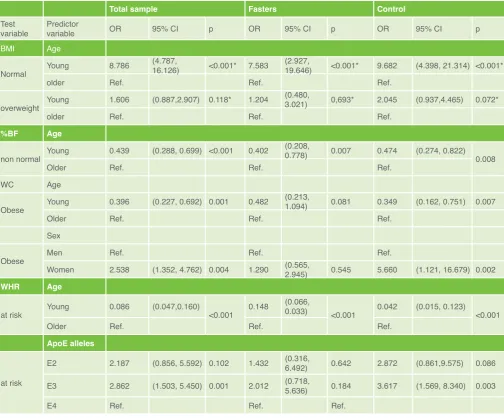
Table 4 shows the multiple logistic regressions evaluating the contribution between independent variables (sex, age, nutritional model, ApoE polymorphism) and obesity markers. In both groups participants ≤35 years old are less likely to be obese, according to their BMI (p<0.001 fasters και p<0.001 control) and according to their %BF (p<0.007 και p<0.008 respectively). In the control group, women compared to men were more likely to be normal weight rather than obese (p=0.001) according to BMI but, according to WC are more likely to have over normal values. In the fasting group, sex and age did not appear to have any influence (p<0.542, p<0.081 respectively). WHR in the young, fasters and control, was less likely to be over normal compared to the older age subjects. An influence of ApoE alleles was observed only in the control group. ApoE3 carriers were more likely to have over normal WHR compared to ApoE4 carriers (p=0.003).
In addition two-way ANOVA, including multiple comparison testing, demonstrated interactions between independent variables (sex, age apoE alleles and fasting status) and their influence on BMI, %BF and WHR. There is a statistical significant interaction between sex and age to BMI (p=0.016). Only in the young group
was BMI significant higher in men compared to women (p<0.001). Concerning %BF there was a significant interaction between sex and fasting (p=0.027). In the men there was no difference between the fasters and non-fasters (p=0.645), in women fasters seem to have significantly higher %BF compared to the controls (p=0.002). ApoE alleles and age significantly influence WHR (p=0.014). Between the three alleles statistically significant differences in WHR is observed only in the young participants; mean±SD is 0.82±0.08, 0.86±0.1 and 0.81±0.09 in E2, E3 and E4 carrier, respectively (p=0.04). Possibly Apo E4 showed a protective role against the increase of WHR, but age counterbalanced this effect.
Discussion
In our study, the allelelic frequencies were 9.5%, 78.8% and 11.8% respectively, for the APOE2, E3, and E4 allele. The distribution of ApoE genotypes in our study resembles the findings of the only previous study in Greek population [22]. Similarly, Caucasian populations had similar values (8%, 77% and 15%), while a Chinese population study showed values of 8.4%, 85.2% and 6.4% and a Japanese study showed 3.5%, 85.1% and 11.2% respectively [23]. Accordingly, in a Chinese population, the ɛ2, ɛ3, and ɛ4 allelelic frequencies were 8.3%, 83.4%, and 8.3% for men and 8.7%, 82.9%, and 8.4% for women, respectively [24]. In an urban Tehran (Iran) population, frequencies of E2, E3, and E4 alleles were 9.7%, 73%, and 14.6%, respectively
Table 1. Distribution of ApoE genotypes. Τotal sample
N=382 (%)
Males Ν=146 (%)
Females n=236 (%)
E2/3 9.2 9.8 8.1
E3/3 78.8 78.0 80.1
E3/4 11.5 12.2 10.3
E2/2 0.3 0 0.7
E4/4 0.3 0 0.7
Table 2. Distribution of ApoE alleles
Τotal sample N=382 (%)
Males Ν=146 (%)
Females n=236 (%)
Ε2 9.4 9.8 8.8
Ε3 78.8 78.0 80.1
Ε4 11.8 12.2 11.0
Table 3. Athropomentric status of participants according to sex and fasting status.
Men Women p
Total
[13]. Higher values for APOE4 presented in French-Canadians, where contribution of the APOE2, E3, and E4 allele found to be 6.9%, 69.1%, and 24.0%, respectively [25]. It is remarkable that frequency of the ApoE4 phenotype varies markedly around the world, but Finland has one of the highest prevalences [26]. As a result, Finnish men were 6.2% APOE2 carriers, 60.1% APOE3 carriers and 33.8% APOE4 carriers [27].
In our study population, the obesity and overweight rates (according to BMI classification) were very high (66.9% men and 55.3% women). Based on WHR, those at risk for abdominal obesity were found to be 73.5% of men and 73.4% of women. Based on WC, abdominal obese and at risk were 42.4% of men and 44.9% of women. Those with an above-normal body fat level included 61% of men and 61.2% of women. Age affected obesity markers in all participants. In both fasters and controls, the mean values of all the measured obesity indexes were significant lower in younger compared to older participants (p<0.001).
Similarly, in a previous survey of 17,341 Greek men and women, the overweight prevalence was 35.2% (41.0% in men, 29.8%
in women), the obesity prevalence was 22.3% (25.8% in men, 18.4% in women), and that for abdominal obesity 26.4% in men and 35.9% in women [28]. Accordingly, the prevalence of overweight and obesity in the present study was also similar to WHO [29] estimates for the Greek population and a bit higher than the results of the Eurostat 2014 report [30].
To our knowledge there has been no other study estimating the association of genotypes and Greek Orthodox fasting in obesity. BF is higher, while WC and WHR are lower in women compared to men, independent of fasting status. However BMI values are smaller in women compared to men only in the controls. BMI did not differ significantly between the sexes in the fasting group; thus BMI is significantly higher in fasting women compared to non-fasting ones. This can be attributed to the fact that orthodox women who follow the rules of their church in terms both of living and eating, may have paid less attention to their physical appearance or dieting outside of the religious dietary restrictions, perhaps related to a preferential focus on spiritual concerns.
In the present study we found that the effect of ApoE alleles on Table 4. Logistic regression model for BMI, %BF, WC and WHR in study population
Total sample Fasters Control
Test
variable Predictor variable OR 95% CI p OR 95% CI p OR 95% CI p
BMI Age
Normal Young 8.786
(4.787,
16.126) <0.001* 7.583 (2.927, 19.646) <0.001* 9.682 (4.398, 21.314) <0.001*
older Ref. Ref. Ref.
overweight Young 1.606 (0.887,2.907) 0.118* 1.204
(0.480,
3.021) 0,693* 2.045 (0.937,4.465) 0.072*
older Ref. Ref. Ref.
%BF Age
non normal Young 0.439 (0.288, 0.699) <0.001 0.402
(0.208,
0.778) 0.007 0.474 (0.274, 0.822) 0.008
Older Ref. Ref. Ref.
WC Age
Obese Young 0.396 (0.227, 0.692) 0.001 0.482
(0.213,
1.094) 0.081 0.349 (0.162, 0.751) 0.007
Older Ref. Ref. Ref.
Sex
Obese Men Ref. Ref. Ref.
Women 2.538 (1.352, 4.762) 0.004 1.290 (0.565, 2.945) 0.545 5.660 (1.121, 16.679) 0.002
WHR Age
at risk Young 0.086 (0.047,0.160) <0.001 0.148
(0.066,
0.033) <0.001 0.042 (0.015, 0.123) <0.001
Older Ref. Ref. Ref.
ApoE alleles
at risk
E2 2.187 (0.856, 5.592) 0.102 1.432 (0.316, 6.492) 0.642 2.872 (0.861,9.575) 0.086
E3 2.862 (1.503, 5.450) 0.001 2.012 (0.718, 5.636) 0.184 3.617 (1.569, 8.340) 0.003
E4 Ref. Ref. Ref.
Odds Ratios (OR) are unadjusted. Ref: Reference category. p: p-value for the binary logistic regression model.
adiposity was associated with age. Between the three alleles statistically significant differences in WHR were observed only in the younger participants. Possibly Apo E4 played a protective role against the increase of WHR, but age counterbalanced this effect. When we analyzed our population according to mean values we could not identify any effect of obesity markers in either group, fasters or control. When we sub-divided the population into normal or non-normal, ApoE4 showed a protective role against the increase of WHR and age in younger male group. This result warrants further investigation.
The protective effect of the ApoE allele on obesity status is controversial. Thus, Zarkesh et al [13] did not find any association between obesity related factors and Apo E polymorphism while Zeljko et al [31] reported a strong relation between the Apo E polymorphism and obesity status suggesting that it plays an important role in obesity development in a Roma population of Croatia.
Apo E plays a key role in lipid metabolism, and thus encoding this gene has been of great importance in order to find its effect on obesity and cardiometabolic disorders [13]. Obesity might contribute to heart failure through different effects such as increased cardiac output and total blood volume, hypertrophy and diastolic dysfunction of left ventricular, adipositas cordis [32] and alterations in cardiac metabolism [33]. It can lead to diabetes which subsequently adversely affects survival in established heart failure syndromes [34]. However, BMI cut-off points might be appropriate for defining overweight optimally in populations like Asian Indians that have higher percentage of body fat compared to whites [35].
Obesity and central obesity are associated with many cardiometabolic diseases [20]. A key reason for the accelerating CVD epidemics is changing in lifestyles such as unhealthy eating habits and diminished physical activity These diseases can also impact economic growth due to healthcare expenditure and diminished productivity [9]. Cardiovascular diseases afflict both the affluent communities and poorer ones. Numerous studies have revealed that mutations in specific genes can cause the early development of CVD. A genetic analysis of hyperlipidemic patients found a correlation in the development of CVD due to interaction of hyperlipidemic genes and environmental factors such as unhealthy diet, stress, sedentary life style and smoking habit [36].
An early allelic discrimination can act as a prognostic procedure against health disorders. APOE genotyping can provide a rapid quantitative diagnosis of metabolic disturbances such as dysbetalipoproteinemia, Alzheimer disease and in population screening for CHD risk factors [8]. MetS is also increased in a dose-dependent manner when carrying APOE*4 alleles. So, considering that health disturbances can be prevented and reverted more effectively if detected early, the characterisation of an individual’s APOE genotype may be helpful for identifying at-risk overweight persons [37], and may help in determining who may benefit from traditional health promoting practices such as Yoga [38].
In conclusion, even if genetic risks factor influence the susceptibility to obesity and cardiometabolic disorders, we
should always bear in mind that the environmental conditions play an important essential role in the development of disease. Thus, a healthy lifestyle, including both balanced nutrition and physical activity, taking into account the culture, the religion and the ethics of each population should be promoted through intervention programs such as those described recently that have suffered from sub-optimal implementation [39]. Government and international policies, food and beverage industries, educational institutions, local communities should work towards lifestyle changes that reinforce well-being [9].
Declarations of interest
The authors declare no conflicts of interest.
Acknowledgements
The authors state that they abide by the authors’ responsibilities and ethical publishing guidelines of the International Cardiovascular Forum Journal [40].
References
1. Smolková B, Bonassi S, Buociková V, et al. Genetic determinants of quantitative traits associated with cardiovascular disease risk. Mutat Res 2015; 778:18-25. DOI: 10.1016/j.mrfmmm.2015.05.005
2. Echouffo-Tcheugui JB, Caleyachetty R, Muennig PA, Narayan KM, Golden SH. Cumulative social risk and type 2 diabetes in US adults: The National Health and Nutrition Examination Survey (NHANES) 1999-2006. Eur J Prev Cardiol. 2016 Aug;23(12):1282-8. doi: 10.1177/2047487315627036. 3. Wildman RP, Gu D, Reynolds K, et al. Are waist circumference and body
mass index independently associated with cardiovascular disease risk in Chinese adults? ,Am J Clin Nutr. 2005; 82(6): 1195-202. DOI: 10.1093/ ajcn/82.6.1195
4. Rankinen T, Bouchard C. Genetics of food intake and eating behavior phenotypes in humans, Annu Rev Nutr 2006; 26:413-34. DOI: 10.1146/ annurev.nutr.26.061505.111218
5. Torres-Perez E, Ledesma M, Garcia-Sobreviela MP, et al. Apolipoprotein E4 association with metabolic syndrome depends on body fatness. Atherosclerosis 2016; 245: 35-42. DOI: 10.1016/j. atherosclerosis.2015.11.029
6. Kolovou G, Damaskos D, Anagnostopoulou K, Cokkinos DV. Apolipoprotein E gene polymorphism and gender. Ann Clin Lab Sci 2009; 39(2): 120-33. 7. Bennet AM, Angelantonio E, Ye Z, Wensley F, et al. Association of
apolipoprotein E genotypes with lipid levels and coronary risk. JAMA 2007; 298(11): 1300-11. DOI: 10.1001/jama.298.11.1300
8. Dergunov AD. Apolipoprotein E genotype as a most significant predictor of lipid response at lipid-lowering therapy: mechanistic and clinical studies. Biomed Pharmacother. 2011 Dec;65(8):597-603. doi: 10.1016/j. biopha.2011.04.003.
9. Kumar A. Changing trends of cardiovascular risk factors among Indians: a review of emerging risks. Asian Pac J Trop Biomed 2014; 4(12): 1001-8. Doi : 10.12980/APJTB.4.201414B401
10. Rodríguez-Carmona Y, Pérez-Rodríguez M, Gámez-Valdez E, et al Association between Apolipoprotein E Variants and Obesity-Related Traits in Mexican School Children,. J Nutrigenet Nutrigenomics 2014; 7(4-6):243-51. doi: 10.1159/000381345
11. Sing CF, Davignon J. Role of the apolipoprotein E polymorphism in determining normal plasma lipid and lipoprotein variation. Am J Hum Genet 1985; 37: 268–85.
12. Wauters M, Considine R, Löfgren A, et al. Associations of leptin with body fat distribution and metabolic parameters in non-insulin-dependent diabetic patients: no effect of apolipoprotein E polymorphism, Metabolism 2000; 49(6): 724-30. DOI: 10.1053/meta.2000.6255
13. Zarkesh M, Daneshpour MS, Faam B, et al. Is there any association of apolipoprotein E gene polymorphism with obesity status and lipid profiles? Tehran Lipid and Glucose Study (TLGS). Gene. 2012; 509(2): 282-5. DOI: 10.1016/j.gene.2012.07.048
14. Koopal C, van der Graaf Y, Asselbergs FW, Westerink J, Visseren FL; SMART study group. Influence of APOE-2 genotype on the relation between adiposity and plasma lipid levels in patients with vascular disease. Int J Obes (Lond). 2015 Feb;39(2):265-9. doi: 10.1038/ijo.2014.105. 15. Trepanowski JF, Bloomer RJ. The impact of religious fasting on human
health. Nutr J 2010; 22: 9:57. doi: 10.1186/1475-2891-9-57
16. Sarri KO, Tzanakis NE, Linardakis MK, et al. Effects of Greek Orthodox Christian Church fasting on serum lipids and obesity. BMC Public Health 2003; 3(1), 1. doi: 10.1186/1471-2458-3-16
18. Tejedor MT, Garcia-Sobreviela MP, Ledesma M, Arbones-Mainar JM. The apolipoprotein E polymorphism rs7412 associates with body fatness independently of plasma lipids in middle aged men. PLoS One 2014; 30;9(9): e108605. doi: 10.1371/journal.pone.0108605
19. Moreno M, Puig J, Moreno-Navarrete JM, et al. Lean mass, and not fat mass, is an independent determinant of carotid intima media thickness in obese subjects. Atherosclerosis 2015; 243(2):493-8. DOI: 10.1016/j. atherosclerosis.2015.09.012
20. Hassapidou M. Papadopoulou S.K., Vlahavas G., Kapantais E., Kaklamanou D., Pagkalos I., Tzotzas T. (2013). The Associations Of Physical Activity And Leisure-Time Activity Patterns with obesity and Cardiometabolic Co Morbidities In Greek Adults: Data from the National Epidemiological Survey. Hormones, 12(2), 265-274
21. Papadopoulou S.K., Laparidis K., Hassapidou M. (2005). Relation of Smoking, Physical Activity and Living Residence to Body Fat and Fat Distribution in Elderly men in Greece. International Journal of Food Sciences and Nutrition, 56(8), 561-566. DOI: 10.1080/09637480500439266 22. Liberopoulos E, Miltiadous G, Hatzivassiliou M et al. Apolipoprotein E
polymorphism in northwestern Greece: frequency and effect on lipid parameters. Ann Clin Lab Sci 2004; 34(3): 347-54.
23. Davignon J, Gregg RE, Sing CF. Apolipoprotein E polymorphism and atherosclerosis. Arteriosclerosis 1988; 8(1): 1-21.
24. Tao MH, Liua JW, LaMonteb MJ, et al. Different associations of apolipoprotein E polymorphism with metabolic syndrome by sex in an elderly Chinese population. Metabolism Clinical and Exprimenta 2011; 60: 1488–96. DOI: 10.1016/j.metabol.2011.03.004
25. Thifault E, Cormier H, Bouchard-Mercier A, et al. Effects of age, sex, body mass index and APOE genotype on cardiovascular biomarker response to an n-3 polyunsaturated fatty acid supplementation. J Nutrigenet Nutrigenomics 2013; 6(2): 73-82. DOI: 10.1159/000350744
26. Gerdes LU, Klausen IC, Sihm I, Faergeman O. Apolipoprotein E polymorphism in a Danish population compared to findings in 45 other study populations around the world. Genet Epidemiol 1992; 9:155–67. 27. Virtanen JK, Mursu J, Virtanen HEK, et al. Associations of egg and
cholesterol intakes with carotid intima-media thickness and risk of incident coronary artery disease according to apolipoprotein E phenotype in men: the Kuopio Ischaemic Heart Disease Risk Factor Study. Am J Clin Nutr 2016; 103: 895–901. DOI: 10.3945/ajcn.115.122317
28. 3Tzotzas T, Vlahavas G, Papadopoulou SK, et al. Marital status and educational level associated to obesity in Greek adults: Data from the National Epidemiological Survey. BMC Public Health 2010; 10, 732. doi: 10.1186/1471-2458-10-732
29. http://www.who.int/en/
30. http://ec.europa.eu/eurostat/data/database
31. Zeljko HM, Škarić-Jurić T, Narančić NS, et al. E2 allele of the apolipoprotein E gene polymorphism is predictive for obesity status in Roma minority population of Croatia. Lipids Health Dis 2011; 10:9. doi: 10.1186/1476-511X-10-9
32. Poirier P, Giles TD, Bray GA, Hong YL, Stern JS, Pi-Sunyer FX, et al. Obesity and cardiovascular disease: pathophysiology, evaluation, and effect of weight loss. AHA summary statement. Arterioscler Thromb Vasc Biol 2006; 26: 968-976. DOI: 10.1161/CIRCULATIONAHA.106.171016
33. Fragasso G. Deranged Cardiac Metabolism and the Pathogenesis of Heart Failure. Card Fail Rev. 2016 May;2(1):8-13. doi: 10.15420/cfr.2016:5:2. 34. Targher G, Dauriz M, Laroche C, Temporelli PL, Hassanein M, Seferovic
PM, Drozdz J, Ferrari R, Anker S, Coats A, Filippatos G, Crespo-Leiro MG, Mebazaa A, Piepoli MF, Maggioni AP, Tavazzi L; ESC-HFA HF Long-Term Registry investigators. In-hospital and 1-year mortality associated with diabetes in patients with acute heart failure: results from the ESC-HFA Heart Failure Long-Term Registry. Eur J Heart Fail. 2017 Jan;19(1):54-65. doi: 10.1002/ejhf.679.
35. Joshi PP. Why is coronary heart diseases increasing in Indians? Cardiovascular risk factors in the Indian scenario. South Asian J Prev Cardiol 2003; 7: 4.
36. Sai RA, Dhamodaran V, Thiagarajan P. Role of genetic variants in development of cardiovascular diseases. Int J Pharm Sci Health Care 2012; 1(2): 45-53.
37. Torres-Perez E, Valero M, Garcia-Rodriguez B., et al. The fat expandability (FATe) Project: biomarkers to determine the limit of expansion and the complications of obesity, Cardiovasc Diabetol 2015; 14(1): 40. doi: [10.1186/s12933-015-0203-6]
38. Cramer H, Langhorst J, Dobos G, Lauche R. Yoga for metabolic syndrome: A systematic review and meta-analysis. Eur J Prev Cardiol. 2016 Dec;23(18):1982-1993. doi: 10.1177/2047487316665729.
39. De Backer G, De Bacquer D, Rydén L, Kotseva K, Gaita D, Georgiev B, Gotcheva N, Mancas S, Miličić D, Pająk A, Reiner Ž, Wood D; EUROASPIRE investigators. Lifestyle and risk factor management in people at high cardiovascular risk from Bulgaria, Croatia, Poland, Romania and the United Kingdom who participated in both the EUROASPIRE III and IV primary care surveys. Eur J Prev Cardiol. 2016 Oct;23(15):1618-27. doi: 10.1177/2047487316645474