ISSN-L: 2501 - 1235 Available on-line at: www.oapub.org/edu
doi: 10.5281/zenodo.3249491 Volume 5 │ Issue 10 │ 2019
ANALYZING THE EFFECT OF POST ACTIVATION POTENTIATION
ON VERTICAL JUMP HEIGHT IN VOLLEYBALL PLAYERS
Sarika1,
Manpreet Bir Kaur2,
Shweta Shenoy3i
1PhD, Assistant Professor, MYAS-GNDU,
Department of Sports Sciences and Medicine, Guru Nanak Dev University,
Amritsar, Punjab, India
2M.P.T. (Sports), MYAS-GNDU,
Department of Sports Sciences and Medicine, Guru Nanak Dev University,
Amritsar, Punjab, India
3PhD, Dean & Head, Professor, MYAS-GNDU,
Department of Sports Sciences and Medicine, Guru Nanak Dev University, Amritsar, Punjab, India
Abstract:
The aim of the study was to find the effect of post activation potentiation (PAP) on jump performance in volleyball players and to compare its effects between males and females. Forty volleyball players were randomly divided into control and experimental group. The experimental group performed a PAP protocol consisting of 3 sets of 10 repetitions at 50% of 10 RM, 75% of 10 RM, 100% of 10 RM (repetition maximum) back squats. At the end of the last set of squats subjects performed 3 successive vertical jumps. Control group subjects performed only warm up for 10 minutes prior to assessment of jump performance. Results showed highly significant difference (p=0.0002) between the pre and post values of vertical jump height in males and significant difference (p=0.0008) in females. The findings of the present study also vivid that there were statistically significant difference (p=0.0130) between the post values of vertical jump height in males as compared to females. This study illustrate that stronger athletes have a greater potentiation, which is due to an ability to become more fatigue resistant as strength level increase and post-activation potentiation effect shows enhancement of on jump performance in volleyball players. This protocol might be helpful for the athletes as well as athletic trainers, coaches to formulate an effective training protocol for the athlete who will enhance their acute performance.
Keywords: post-activation potentiation, vertical jump, back squats, volleyball
1. Introduction
Volleyball is a team sport played at all competitive levels (youth, Olympic, and professional) and places an emphasis on explosive movements such as jumping, hitting, and blocking (Marques, M. C., et al., 2006; Marques et al., 2008). New roles in attack and defense have conditioned the need for more intensive study of volleyball players’ skills, especially the ability of explosive force of leg muscles that in volleyball terminology it refers to vertical jump. Explosive strength of legs is very important during the vertical jump and speed of movement in area given that the explosive force can only be achieved with high-intensity work, which does not last long, it is clear that its energy resources are mainly anaerobic mechanism (Leka, L. et al. (2014).
Post-activation potentation (PAP) is defined as an increase in muscle performance after a conditioning contraction. The conditioning contraction could be a maximal voluntary contraction (Hanada et al., 2000), an evoked tetanic contraction (post tetanic potentiation) (Desmedt and Hainaut, 1968) or a series of evoked twitches (Sale, 2002). The heavy resistance exercise is hypothesized to induce PAP, thus increasing the acute performance of the bodyweight exercise, with the prospect of superior chronic neuromuscular adaptations. (Sygulla, K. S., & Fountaine, C. J. (2014))
The principles of PAP have been applied by practitioners to enhance athletic performance and optimize training. Some coaches advocate that athletes should perform heavy resistive exercise prior to competing in events that require high power outputs (Scott, S. L., & Docherty, D. (2004)). Jumping exercises are often chosen because of their similarity to sports movements and because of their relatively low complexity. Studies by Gourgoulis et al., 2003, Young et al., 1998, and Gullich and Schmidtbleicher (1996) all used back squats involving various types of loading and rest periods to initiate PAP, and all of these methods appeared successful in eliciting PAP. There is handful literature available regarding the effect of post-activation potentiation on sprint performance but to the best of our knowledge there are very less studies focused on its effect on vertical jump height in volleyball players. So, the purpose of present study was to find the effect of Post-activation potentiation on jump performance in volleyball players.
2. Methodology
2.1 Subjects
10, Group B (control male) - 10, Group C (experimental female) - 10, Group D (control female) - 10.
2.2Procedure
The procedure was explained to the players and duly signed informed consent was taken from each player. The players completed a physical activity Readiness-Questionnaire (PAR-Q) before participation. Body weight and height were measured using weighing machine and stadiometer. After warm up the subjects were randomly allocated into experimental group and control group. Prior to performing the experimental protocol baseline measurements were recorded for the 10RM Back Squat. Subjects rested for 2 minutes between each successive stage. Players were asked to jump and vertical jump height was measured using Sergeant jump test. The dynamic warm-up protocol was done regularly by players which consisted of (in specific order): 20 high knees, 20 buttock kickers, 20 lunges, 20 karaoke, 20 A-skips, 20 side shuffle, 30 s of line hops (both feet), 15 s of line hops (one set each leg), 10 broad jumps, 10 squat hops, 10 leg sweeps (hamstring warm up), 20 reverse lunges, 20 walking quad/hamstring stretch, 20 straight leg bounding, 10 leg swings, 10 medium arm circles, and 10 large arm circles. Along with this PAP protocol was added which consists of following and 2 min rest was included between each successive sessions.
Table 1a: PAP protocol given to the experimental males and females volleyball players groups
Set Amount of weight Repetitions
1 50% of 10RM 10
2 75% of 10 RM 10
3 100% of 10 RM 10
Control Group: No PAP treatment and only warm up and were then assessed.
3. Result & Discussion
The comparison between parameters of the study was assessed using mean and standard deviation. The performance of subjects pre and post data was assessed by using the paired sample t-test and unpaired t-test.
Table 1b: Demographic and anthropometric characteristics of experimental and control group of the volleyball players
Group Group A
(male experimental)
Group B (male control)
Group C (female experimental)
Group D (female control)
The mean and standard deviation values of age, height, weight and BMI of the 4 groups that are group A (experimental-male) , B (control-male) , C (experimental-female) and D (control-female) of volleyball players.
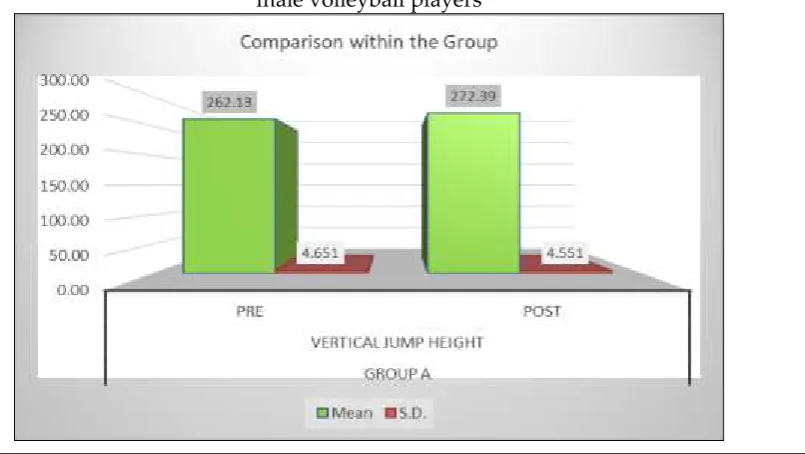
Table 2: Pre and post mean values in group A (experimental) male of volleyball players
Paired T Test Group A
Vertical Jump Height
. Pre Post
Mean 262.13 272.39
S.D. 4.651 4.551
Number 10 10
Mean Difference 10.26
Paired T Test 7.232
P value 0.0002
Table Value at 0.05 2.37
Result Significant
Table 2 shows statistically significant difference in pre and post values of vertical jump height of Group A (experimental) male of volleyball players. Findings of present study showed significant improvement in post values as compared to pre values in experimental male. The present study is in agreement with (McCann and Flanagan et al., 2010) who found that a back squat enhanced vertical jump performance in NCAA Division I male and female volleyball players. The present study is in agreement with the result of present study is in affirm to the results of study done by (Radclife and Radcliffe 1996, Young, Jenner and Griffiths 1998 and Gourgoulis et al., 2003), with jump performance significantly improving by 1.5%, 2.8% and 2.39% respectively. These were multifarious studies that analyzed the effect of PAP response on vertical jump performance.
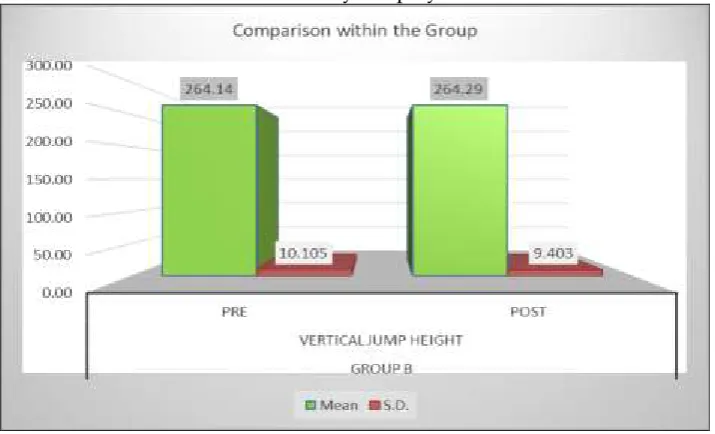
Table 3: Pre and post mean values in group B (control) male of volleyball players
Paired T Test Group B
Vertical Jump Height
. Pre Post
Mean 264.14 264.30
S.D. 10.105 9.403
Number 10 10
Mean Difference 0.15
Paired T Test 0.375
P value 0.7185
Table Value at 0.05 2.37
Result Not-Significant
Table 3 shows statistically, non-significant difference in pre and post values of vertical jump height of group B (control) male of volleyball players.
Graph 2: Pre and post mean values in group B (control) male volleyball players
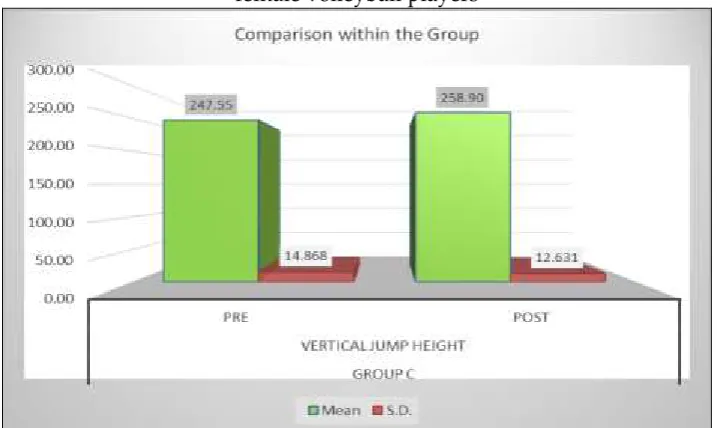
Table 4: Pre and Post mean values in Group C (experimental) female volleyball players
Paired T Test Group C
Vertical Jump Height
. Pre Post
Mean 247.55 258.90
S.D. 14.868 12.631
Number 10 10
Mean Difference 11.35
Paired T Test 5.636
Table 4 shows statistically, significant difference in pre and post values of vertical jump height of (group C) experimental females. The result of current study vivid that there was significant improvement in post values as compared to pre values in experimental females. (McCann 2010) conducted study on the PAP and vertical jump height and found that the complex training variables which includes 5 repetitions of either the back squat or hang clean (midthigh) with a load equal to their 5 repetition maximum (5RM) will increase VJ height, thus acutely enhancing athletic performance. Minimal research exists on female athletes as a whole let alone the PAP response, therefore comparisons and potential conclusions are somewhat limited.
Graph 3: Pre and Post mean values in Group C (experimental) female volleyball players
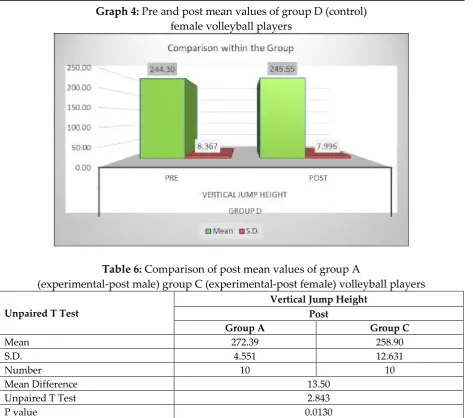
Table 5: Pre and post mean values of group D (control) female volleyball players
Paired T Test Group D
Vertical Jump Height
. Pre Post
Mean 244.30 245.55
S.D. 8.367 7.996
Number 10 10
Mean Difference 1.25
Paired T Test 1.852
P value 0.1064
Table Value at 0.05 2.37
Result Not-Significant
Graph 4: Pre and post mean values of group D (control) female volleyball players
Table 6: Comparison of post mean values of group A
(experimental-post male) group C (experimental-post female) volleyball players
Unpaired T Test
Vertical Jump Height Post
Group A Group C
Mean 272.39 258.90
S.D. 4.551 12.631
Number 10 10
Mean Difference 13.50
Unpaired T Test 2.843
P value 0.0130
Table Value at 0.05 df 14 2.15
Result Significant
Graph 5: Comparison of post mean values of group A
(Experimental-Post- Male) group C (Experimental-Post-Female) volleyball players
When comparison done between performances of males and females, males showed higher mean values as compared to females. Previous studies have found the PAP response to highly individualized thus the results of present study clearly mirror this trend.
4. Conclusion
This study concluded that significant differences were observed between pre and post values of vertical jump height of experimental males and experimental females groups. Significant differences were found between the post values of vertical jump height in males as compared to females.
Acknowledgment
The authors thank volleyball players, coaches. The author wishes to thank to the research guide, teachers, coaches, research scholars, friends and family.
References
Desmedt, J. E., & Hainaut, K. (1968). Kinetics of myofilament activation in potentiated contraction: staircase phenomenon in human skeletal muscle. Nature (London), 217(5128), 529-532.
Gourgoulis, V., Aggeloussis, N., Kasimatis, P., Mavromatis, G., & Garas, A. (2003). Effect of a submaximal half-squats warm-up program on vertical jumping ability. The Journal of Strength & Conditioning Research, 17(2), 342-344.
Güllich, A., & Schmidtbleicher, D. (1996). MVC-induced short-term potentiation of explosive force. New studies in athletics, 11, 67-84.
Hamada, T., Sale, D. G., MacDougall, J. D., & Tarnopolsky, M. A. (2000). Postactivation potentiation, fiber type, and twitch contraction time in human knee extensor muscles. Journal of applied physiology, 88(6), 2131-2137.
Hodgson, M., Docherty, D., & Robbins, D. (2005). Post-activation potentiation. Sports medicine, 35(7), 585-595.
Leka, L. (2014). The importance of jumping in volleyball and its comparison between the two cup finalists of Kosovo 2014-women (Doctoral dissertation, Kolegji AAB).
Marques, M. A. C., González-Badillo, J. J., & Kluka, D. A. (2006). In-Season resistance training for professional male volleyball players. Strength and conditioning journal, 28(6), 16.
Marques, M. C., Van den Tillaar, R., Gabbett, T. J., Reis, V. M., & González-Badillo, J. J. (2009). Physical fitness qualities of professional volleyball players: determination of positional differences. The Journal of Strength & Conditioning Research, 23(4), 1106-1111.
McCann, M. R., & Flanagan, S. P. (2010). The effects of exercise selection and rest interval on postactivation potentiation of vertical jump performance. The Journal of Strength & Conditioning Research, 24(5), 1285-1291.
Radcliffe, J., & Radcliffe, J. (1996). Effects Of Different Warm-up Protocols On Peak Power Output During A Single Response Jump Task 1127. Medicine & Science in Sports & Exercise, 28(5).
Sale, D. G. (2002). Postactivation potentiation: role in human performance. Exercise and sport sciences reviews, 30(3), 138-143.
Scott, S. L., & Docherty, D. (2004). Acute effects of heavy preloading on vertical and horizontal jump performance. Journal of Strength and Conditioning Research, 18(2), 201-205.
Sygulla, K. S., & Fountaine, C. J. (2014). Acute post-activation potentiation effects in NCAA division II female athletes. International journal of exercise science, 7(3), 212. Wilson, J. M., Duncan, N. M., Marin, P. J., Brown, L. E., Loenneke, J. P., Wilson, S. M., ...
& Ugrinowitsch, C. (2013). Meta-analysis of postactivation potentiation and power: effects of conditioning activity, volume, gender, rest periods, and training status. The Journal of Strength & Conditioning Research, 27(3), 854-859.
Creative Commons licensing terms