Graph Computation Models
Selected Revised Papers from GCM 2015
Composition of
M
,
N
-adhesive Categories
with Application to Attribution of Graphs
Christoph Peuser and Annegret Habel
21 pages
Guest Editors: Detlef Plump
Managing Editors: Tiziana Margaria, Julia Padberg, Gabriele Taentzer
Composition of
M
,
N
-adhesive Categories
with Application to Attribution of Graphs
Christoph Peuser1∗and Annegret Habel2
1[email protected] 2[email protected]
Carl von Ossietzky Universit¨at Oldenburg, Germany
Abstract: This paper continues the work onM,N -adhesive categories and shows some important composition properties for these categories. We present a new
concept of attributed graphs and show that the corresponding category isM,N
-adhesive. As a consequence, we inherit all nice properties forM,N-adhesive
sys-tems such as the Local Church-Rosser Theorem, the Parallelism Theorem, and the Concurrency Theorem for this type of attributed graphs.
Keywords: Graph transformation, attributed graphs, composition, adhesive cate-gories, adhesive systems
1
Introduction
The double-pushout approach to graph transformation, which was invented in the early 1970’s,
is the best studied framework for graph transformation [Roz97,EEKR99,EKMR99,EEPT06,
EEGH15]. As applications of graph transformation come with a large variety of graphs and graph-like structures, the double-pushout approach has been generalized to the abstract settings
of high-level replacement systems, adhesive, M-adhesive, M,N -adhesive, and W-adhesive
categories. This paper continues the work of Habel and Plump [HP12] on M,N -adhesive
categories.
In the literature, there are several variants of attribution concepts, e.g. typed attributed graphs in the sense of Ehrig et al. [EEPT06], attributed graphs in the sense of Poskitt and Plump [PP12], attributed graphs as a graph with a marked sub-graph in the sense of Kastenberg and Rensink [KR12], separation of the graph structure and their attribution and data in the sense of Golas [Gol12], and attributed structures in the sense of Duval et al. [DEPR14]. The use of attributed graphs allows a more compact representation of a system. While graph transformation systems are Turing complete, representing numerical values as part of the graph can lead to very large representations of parts of a system that may be comparatively unimportant. Instead attributes allow us to concentrate on graphically representing those parts of a system we are primarily interested in.
Our main aim is to consider composition of categories to make it easier to define new models
for transformation systems. To this end we prove closure results ofM,N -adhesive categories
against product, functor, slice and coslice, comma, string and multiset category. We apply our
∗ This work is supported by the German Research Foundation through the Research Training Group (DFG GRK
results to the construction of a categoryAttGraphsof attributed graphs from the well-known cat-egoryGraphsof unlabelled graphs and a categoryAttof attribute collections. By closure results
forM,N -adhesive categories, we obtain that the categoryAttGraphsisM,N-adhesive. By
the results in [HP12], the Local Church-Rosser Theorem, the Parallelism Theorem and the
Con-currency Theorem hold for the new type of attributed graphs provided that the HLR+-properties
[HP12] are satisfied.
The paper is structured as follows. In Section2, we recall the definition ofM,N -adhesive
categories. In Section3, we prove some basic composition results and show that the string and
multiset categories areM,N-adhesive provided that an underlying category is. In Section4,
we introduce the categoryAttGraphsof attributed graphs and show that it isM,N-adhesive.
In Section5we present some related work and, in Section6some concluding remarks.
This paper is an extended version of the paper [PH15]. It contains all proofs and additional examples.
2
M
,
N
-adhesive Categories
In this section, we recall the definition of M,N -adhesive categories, introduced in [HP12],
generalizing the one ofM-adhesive categories [EGH10]. We assume that the reader is familiar
with the basic concepts of category theory; standard references are [EEPT06,Awo10].
Definition 1(M,N -adhesive Categories) A categoryC isM,N-adhesive, where M is a
class of monomorphisms andN a class of morphisms, if the following properties are satisfied:
1. MandN contain all isomorphisms and are closed under composition and decomposition.
Moreover,N is closed underM-decomposition, that is, f;g∈N, g∈M implies f ∈
N.
2. ChasM,N -pushouts andM-pullbacks. Also,M andN are stable under pushouts and
pullbacks.
3. M,N -pushouts areM,N -van Kampen squares.
In the following we might sometimes use ’M,N-adhesive’ without specifying M andN
explicitly, especially in the sense of ’preservingM,N-adhesiveness’.
Remark1 ChasM,N -pushouts, if there is a pushout whenever one of the given morphisms is inM and the other morphism is inN .ChasM-pullbacks, if there exists a pullback whenever at least one of the given morphisms is in M. A classX ∈ {M,N }is stable underM,N
-pushoutsif, given theM,N -pushout (1) in Figure1,m∈X impliesn∈X and stable under
M-pullbacks if, given the M-pullback (1) in Figure1, n∈X implies m∈X. AnM,N
-pushout is an M,N-van Kampen squareif for the commutative cube (2) in Figure 1with the pushout (1) as bottom square,b,c,d,m∈M, f ∈N , and the back faces being pullbacks, we have that the top square is a pushout if and only if the front faces are pullbacks.
A
C
B
D
f g
m
n
(1)
A A0
B B0
C C0
D D0
b c
d f
m
n
g
(2)
Figure 1:M,N -pushout andM,N-van Kampen square
Lemma 1 (M-adhesive⇒ M,N -adhesive [HP12]) Let Cbe any category and N be the class of all morphisms inC. ThenCisM,N-adhesive if and only ifCisM-adhesive.
In the following, we give some examples of categories that areM,N-adhesive.
Lemma 2 (Basic M,N-adhesive Categories [EEPT06]) The following categories are M -adhesive and, by Lemma1,M,N-adhesive whereN is the class of all morphisms inC: The categorySetsof sets and functions, whereM is the class of all injective functions. The category Graphsof graphs and graph morphisms, whereMis the class of all injective graph morphisms. The category LGraphsof labelled graphs and graph morphisms, whereM is the class of all injective graph morphisms. The discrete category1 over some set L, referred to asDisc(L), is
M-adhesive: Disc(L) only has identity morphisms, for which proving the required properties becomes trivial.
The categoryPLGraphsof partially labelled graphs and graph morphisms isM,N -adhesive, but not M-adhesive [HP12]: M and N are the classes of all injective and all (injective) undefinedness-preserving2graph morphisms, respectively.
3
Composition of
M
,
N
-Adhesive Categories
There are various ways to construct new categories from given ones. Beside the standard
con-structions (product, slice and coslice, functor and comma category as defined in [EEPT06]) we
consider the constructions of a string category and a multiset category. For each of these con-structions, we prove a composition result, saying more or less, whenever we start withMi,N
i-adhesive categories, then the new constructed category isM,N-adhesive for someM,N.
We briefly recall the definition of the comma category, we refer to [EEPT06] for the definiton of product, slice and coslice and functor category.
Definition 2(Comma Category[EEPT06]) Given two functors F1: C1→CandF2: C2→C
and an index setI, the comma categoryComCat(F1,F2,I)is defined as follows: The objects are all triples(C1,C2,op)withC1an object inC1,C2an object inC2, and a family of morphisms
1The discrete category over some collectionShasSas objects and only identity morphisms.
op= [opi]i∈I where opi:F1(C1)→F2(C2)is a morphism inC. The morphisms from(C1,C2,op)
to(C10,C20,op0)are all pairs(g,h)whereg:C1→C10 andh:C2→C20 are morphisms inC1 and
C2respectively, such that the following diagram commutes for alli∈I:
F1(C1)
F2(C2)
F1(C10)
F2(C20)
opi
F2(h)
F1(g)
op0i =
The composition of morphisms inComCat(F1,F2,I)is defined componentwise, and the
iden-tities are pairs of ideniden-tities in the component categoriesC1andC2.
First, we consider the standard constructions: product, slice and coslice, functor, and comma
category ([EEPT06] A2 and A6).
Theorem 1(Standard Constructions) M,N-adhesive categories can be constructed as fol-lows:
1. IfCiisMi,Ni-adhesive (i=1,2), then the product categoryC1×C2isM,N - adhesive whereM =M1×M2andN =N1×N2.
2. If C isM,N-adhesive and X is an object of C, then the slice category C\X and the coslice category X\Cover X areM0,N 0-adhesive where the morphism classesM0,N 0 are restricted to the slice and coslice category, i.e., forX ∈ {M,N},X0=X ∩C\X andX0=X ∩X\C, respectively.
3. IfCisM,N -adhesive, then for every categoryX, the functor category[X,C]isMft,Nft -adhesive with functor transformationsMftandNft.3
4. Let Ci be Mi,Ni-adhesive and Fi: Ci →C be functors (i=1,2), where F1 preserves M1,N1-pushouts and F2preservesM2-pullbacks. Then the comma categoryComCat(F1,F2,I)
isMc,N c-adhesive whereMc= (M1×M2)∩Mor,Nc= (N1×N2)∩Mor, andMor
is the set of all morphisms of the comma category.
Remark 2 Statement 4 in Theorem 1 above also holds for the case of a comma category ComCat(F1,F2,I), with|I|=1 and both functorsF1,F2 pointing intoSets, where the
mor-phismopis always bijective. We will useF1↓bijF2as a shorthand for these categories.
Proof. The proof is a slight generalization of the corresponding one forM-adhesive categories
(see Theorem 4.15 in [EEPT06]).
1. The product categoryC1×C2isM,N-adhesive, becauseM andN inherit the required
composition and decomposition properties fromM1andM2andN1andN2respectively.
Pushouts along(M,N )-pairs of morphisms can be constructed componentwise. So can
3For a classX,X
ftdenotes the class of natural transformationst:F→G, where all morphismstX:F(X)→G(X)
the van Kampen square, since pullbacks can also be constructed componentwise. The
stability ofM andN is inherited from pushouts and pullbacks inCi.
2. Morphisms, pullbacks and pushouts can similarly be constructed componentwise for both slice categoriesC\X and coslice categoriesX\C. This construction also ensures thatM0
andN0are stable under pushout and pullback.
3. The functor category [X,C], whereMft andNft are functor transformations, is M,N
-adhesive, because the functor transformationsMft (orNft) are monomorphisms in[X,C]
and the required composition and decomposition properties are inherited fromM (orN).
Pushouts and pullbacks and the M,N-van Kampen square are constructed pointwise,
i.e. for each objectX ∈[X,C]. The pointwise construction also ensures thatMft andNft are stable under pushout and pullback.
4. The comma categoryComCat(F1,F2,I)isMc,Nc-adhesive, becauseMc andNc
in-herit the required composition and decompostion properties fromMi andNi. Mc,Nc
-pushouts can be constructed componentwise, since F1 preserves them. Mc-pullbacks
can be constructed componentwise, sinceF2preserves them. ConsequentlyMc,N c-van
Kampen squares can equally constructed componentwise. All of these constructions can also be done if we restrict ourselves to objects with a bijective morphism op. The
compo-nentwise construction ensures thatMcandN care stable under pushout and pullback.
Example1 ([EEPT06]) The categoryGraphsof unlabelled graphs is isomorphic to the functor category[E V,Sets]. For the type graphT G, the categoryGraphsT Gof graphs typed over
T Gis isomorphic to the slice categoryGraphs\T G.
Given a category C, we construct a string category C∗and prove thatM,N -adhesive
cate-gories are closed under string construction.
Definition 3(String Category) Given a categoryC, thestring categoryC∗is defined as follows: The objects are stringsa1. . .amof objects ofC, including the empty stringλ. The morphisms
between two stringsa1. . .amandb1. . .bnwithm≤nare strings of morphisms such thata1. . .am isembeddedinb1. . .bn, i.e. f1:a1→bi+1, . . . ,fm: am→bi+minC. The empty stringλ is an initial element forC∗.
a1 . . . am
b1 . . . bi bi+1 . . . bi+m bi+m+1 . . . bn
f1 fm
Lemma 3 For every morphism f:A→B, the commuting square consisting of f and the iden-tities idA,idB is a pushout and a pullback.
Proof. Follows from standard category theory.
Theorem 2(CM,N -adhesive⇒C∗ M∗,N ∗-adhesive) IfCisM,N-adhesive, then the string categoryC∗overCisM∗,N∗-adhesive whereM∗ andN∗ contain those morphisms which are strings of morphisms inM andN , respectively. N ∗ is further restricted to mor-phisms that preserve length, i.e. where domain and codomain are of equal length.
We will use this decomposition frequently in the following proofs.
Lemma 4(Decomposition of String Morphisms) Any string morphism f:a1. . .am→b1. . .bn
can be decomposed into f=:a1. . .am→bi+1. . .bi+mthat preserves length and f+:bi+1. . .bi+m→
b1. . .bnan embedding that consists of identity morphisms inCsuch that f =f=;f+. Both
mor-phisms are inM∗orN ∗, if f is inM∗orN∗respectively.
Proof. Straightforward.
Proof of Theorem2. By inspection of Definition1.
1. Closure properties: M∗ andN ∗contain all isomorphisms, since an isomorphism inC∗
must be a list of isomorphisms inCandM andN , respectively contain all isomorphisms in
C. Isomorphisms must further be lists of equal length andM∗ andN ∗contain all morphisms
with domain and codomain of equal length. Composition and decomposition properties can be
inherited fromC, e.g. the composition of morphisms inM∗andN ∗implies the composition
of a list of morphisms inM andN, respectively, which is possible sinceCisM,N-adhesive.
This also applies to the closure ofN ∗ under M∗-decomposition, since f;g∈N ∗ implies a
domain and codomain of equal length, which in turn implies f∈N∗.
2a. Existence ofM∗,N ∗-pushouts andM∗-pullbacks:Given the morphisms f:a1. . .am→
b1. . .bn andg: a1. . .am→c1. . .cm, where f ∈M∗ andg∈N ∗ we can construct M∗,N∗
-pushouts as follows (see Figure4b): We decompose f into f= and f+as in Lemma4. We can
construct (1) as a pushout componentwise from pushouts in the underlying category C. If we
have a string of length zero, the resulting pushout will be the identity square of λ. The
mor-phisms f+,i+in(2)consists entirely of identity morphisms inC, making each component of(2)
a pushout inCby Lemma3. Then(2)is a pushout inC∗. By composition of pushouts(1) + (2)
is a pushout.
Note that the remaining morphisms inb1. . .bn→d1. . .dnmust be isomorphisms for(2)to be a pushout, since the pushout object is only unique up to isomorphism we can assume, without loss of generality, that the remaining morphisms are identities.
2b. C∗has pullbacks alongM∗-morphisms:Given two morphismsf:a1. . .am→c1. . .co∈
M∗andg:b
1. . .bn→c1. . .cothe pullback object is constructed by identifying the largest sub-stringci. . .ci+xwhere all elementscjhave a coimage in botha1. . .amandb1. . .bnand construct-ing their pullbacks inC. If there is no such common substring, the empty stringλ is the pullback
object instead.
A A00
A0
B=
B00= B0=
B B00 B0 C C00 C0 D= D00= D0=
D D00 D0 i1 i2 i3 i4 C0 C00 C
D0=
D00=
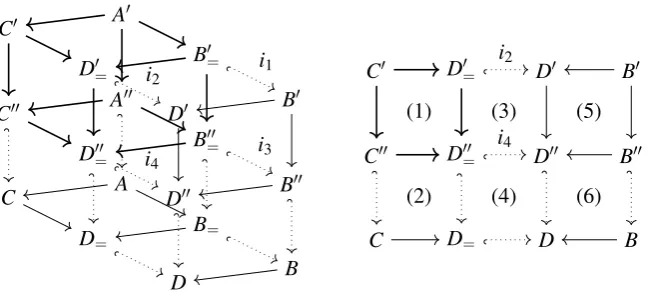
D= D0 D00 D B0 B00 B i2 i4 (1) (2) (3) (4) (5) (6)
Figure 2: Van Kampen square for the string category (I)
The top face is a pushout⇒the front faces are pullbacks:
1. We construct the cube in Figure2by decomposing the pushout at the top face as seen above
into a pushout with morphisms that preserve length and another where the horizontal morphisms do not preserve length and decomposing all vertical morphisms in the commutative cube into
pairs according to Lemma4.
2.The morphisms in the middle layer of the cube are determined by those in the bottom layer, since the vertical morphisms in the lower half of the cube consist of identity morphisms only. As a result the middle layer consists of pushouts as well.
3. The core cube in the upper back is a van Kampen square, with the pushout ofA00→C00and
A00→B00= as bottom face. This core cube can be constructed componentwise from cubes inC,
since all morphisms preserve length. If these strings are of length 0 this is an identity cube of empty stringsλ.
4. Since the top face of the core cube is a pushout, (1) consists of pullbacks inCby the van Kampen property and is therefore a pullback inC∗.
5. (2) and (3) are pullbacks, since their vertical and horizontal morphisms respectively consist of identity morphisms only and and the morphism shared with (1) preserve length. The pullback objects are then limited to the length ofD00=and we can construct the pullbacks componentwise
from pullbacks inCaccording to Lemma3.
6. The commuting square (4) consists entirely of morphisms composed of identity morphisms inC. ThenD00= is the largest string for which each element has a pullback inCand therefore (4) is a pullback.
7. We examine the commutative square (5) componentwise: Some of its components have a coimage in the front right square of the core cube via the morphisms i1. . .i4. Since these
morphisms consists of identity morphisms inC, these components are pullbacks. The remaining
components of (5) have horizontal morphisms that coincide with those morphisms that are part of the top and bottom pushout that are identities, making these components pullbacks as well. Thus, (5) is a pullback.
A A00
A0
B=
B00= B0=
B B00
B0
C C00
C0
D= D00= D0=
D D00
D0
i1
i2
i3
i4
A0
B0=
B0 C0
D0=
D0
i1
i2
(1)
(2)
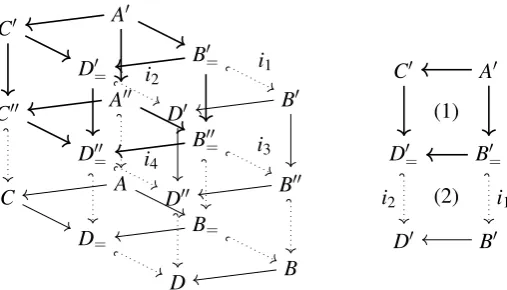
Figure 3: Van Kampen square for the string category (II)
9. By composition of pullbacks(1) + (2) + (3) + (4)and(5) + (6)are pullbacks.
The front faces are pullbacks⇒the top face is a pushout:
1. We decompose the vertical morphisms and the bottom pushout as in the cube in Figure3.
Additionally we construct the pushouts in the middle layer analogously.
2. The commutative cube in the upper back is a van Kampen square. We construct this cube
componentwise from cubes inC, since all morphisms preserve length.
3. Since the upper square at the right front face is a pullback andi1,i2,i3,i4consist of idenities,
B0=,B00=,D0=,D00=is a pullback.
4. Then (1) is a pushout by the van Kampen property ofC, i.e. all component cubes have front faces as pullbacks, therefore all components of the top face are pushouts.
5. (2) is a pushout by Lemma3, sincei1,i2consists of identities.
6. By composition of pushouts,(1) + (2)is a pushout. This concludes the proof.
Example2 The categoryStrings=Disc(L)∗of strings, whereDisc(L)is the discrete category over some alphabetL, isM∗,N ∗-adhesive.
Given a category C, we construct a multiset category C⊕ and prove that M,N -adhesive
categories are closed under multiset construction. In contrast to the above construction for a string category, we can construct a multiset category by ignoring the order of elements. We use {|. . .|}to denote a multiset, e.g{|a,a,b|}denotes the multiset with elementsa,aandb.
Definition 4(Multiset Category) Given a categoryC, themultiset categoryC⊕ is defined as follows: The objects are multisets{|A1. . .Am|}of objects ofC, including the empty multiset /0. The morphisms between two objects{|A1. . .Am|} and{|B1. . .Bn|}(with m≤n) are strings of morphisms fi:Ai→Bji inC, where ji=jkimpliesi=k,i∈ {1, . . . ,m}.
A
C0
C
B0 B
D E
F G
f
g
(1) (2)
(20) (3)
(a) A pushout inC⊕
a1...am
c1...cm
bi+1...bi+m b1...bn
di+1...di+m d1...dn
g
f= f+
i+
f
(1) (2)
(b) A pushout inC∗
Figure 4: Pushouts in String and Multiset Categories
Theorem 3 (C M,N-adhesive ⇒ C⊕ M⊕,N⊕-adhesive) If C is M,N -adhesive, then the multiset category C⊕ over C is M⊕,N ⊕- adhesive where M⊕ and N⊕ contain those morphisms which are strings of morphisms inM andN , respectively.
Lemma4applies to morphisms inM⊕orN⊕.
Proof. By inspection of Definition1.
1. Closure properties: M⊕ andN⊕ contain all isomorphisms, since an isomorphism in
C∗must be a list of isomorphisms inCandM andN, respectively contain all isomorphisms
inC. Composition and decomposition properties can be inherited fromC, e.g. the composition
of morphisms inM⊕ andN ⊕ implies the composition of a list of morphisms inM andN,
respectively, which is possible sinceCisM,N-adhesive.
2a. Existence ofM⊕,N ⊕-pushouts andM⊕-pullbacks: Given the morphisms f: A→B
andg:A→C, where f ∈M⊕ andg∈N ⊕ and #A=l,#B=m,#C=n 4, we can construct
M⊕,N⊕-pushouts as follows (see Figure4a): We decompose f:A→Bas in Lemma4, where
f=preserves cardinality and f+consists of identities inC. We decomposeganalogously. We can construct (1) as a pushout componentwise from pushouts in the underlying categoryC. If #A=0 thenA,B,C,Dare the empty multiset /0. (2) (and analogously (2’)) is a pushout by Lemma3. (3)
consists entirely of identity morphisms inCand is therefore a pushout as well. By composition
of pushouts(1) + (2) + (20) + (3)is a pushout.
2b. C⊕has pullbacks alongM⊕-morphisms:Given two morphismsf:A1. . .Am→C1. . .Co∈
M⊕ and g:B
1. . .Bn→C1. . .Co the pullback object is constructed by identifying the largest subsetCi. . .Ci+x where all elementsCj have a coimage in bothA1. . .AmandB1. . .Bnand
con-structing their pullbacks inC. If there is no such common subset, the empty multiset /0 is the
pullback object instead.
3. M⊕,N ⊕-pushouts areM⊕,N ⊕-van Kampen squares: The top face is a pushout⇒the front faces are pullbacks:
1. We decompose the top and bottom pushout as in Figure5.
4# denotes the cardinality of a multiset, i.e. for a multisetf:A→
A A00
A0
B=
B00= B0=
B B00
B0
C=
C=00 C=0
E E00 E0
F F00
F0
C C00
C0
G G00
G0
D D00
D0
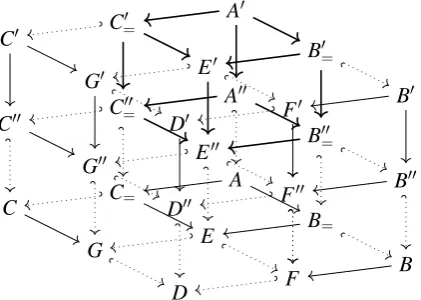
Figure 5: Van Kampen square for the multiset category
2. We decompose all vertical morphisms in the cube into pairs where the first morphism preserves cardinality and the second morphism is an inclusion consisting of identity morphisms
inC(see Lemma4).
3. We construct the interior morphisms shown in the cube above analogoulsy to the construc-tion in the proof for the string category, once alongA→Band once alongA→C.
4. The remaining pullbacks on the front sides can also be constructed analogously to the
construction in the previous proof, using Lemma3.
The front faces are pullbacks⇒the top face is a pushout:
1. We decompose the bottom pushout as in the cube in Figure5.
2. We decompose all vertical morphisms in the cube into pairs where the first morphism preserves cardinality and the second morphism is an inclusion consisting of identity morphisms
inC(see Lemma4).
3. We construct the interior morphisms shown in the cube above analogoulsy to the construc-tion in the proof for the string category, once alongA→Band once alongA→C.
4. The remaining pushouts on the top side can also be constructed analogously to the con-struction in the previous proof, using Lemma3.
This concludes the proof.
Example3 The categoriesMultiSets=Disc(L)⊕of multisets is M⊕,N ⊕-adhesive for suit-ableM,N.
Finally, we will look at the possibilities that these compositions give us.
may, however lead to a large part of the graph structure consisting of these queues, when they are in fact a minor element of the overall model. We sketch a rule in this setting below, adding a reader to the end of a queue that is associated with a catalog number.
Reserve(catnr, readernr):
catalog catnr readernr
tail elem
−
⇒ catalog catnr readernr
tail elem elem
−
We could instead introduce queues as distinct components of the underlying model, using the compositions detailed in this chapter: We define the categoryPLGraphs×Disc(R×C)∗, where Ris a fixed set of reader numbers andC a set of catalog numbers and Disc(A) is the discrete category over some setA. An object of this category is a labelled graph together with a string of pairs of readers and catalog numbers. Instead of adding additional nodes like in the rule above, we append a pair of catalog number and reader number to the queuehqi. Note that we would a notion of abstract rules here that allow us to refer to a queue of arbitrary length, such as e.g. the rule schemata in GP [PP12].
Reserve(catnr, readernr):
catalog catnr readernr
hqi −
⇒ catalog catnr readernr
hq,(catnr,readernr)i −
If we want to separate queues for every title in the library we could instead have used a comma category: We define the categoryPLGraphs↓bijQ, whereQ : (Disc(R)∗)⊕→Setsis some func-tor that preserves pullbacks andPLGraphsis analogous toGraphs, mapping a graph to a union of its nodes and edges. The definition contains a multiset ((Disc(R)∗)⊕), since we may need more than one instance of a certain queue as transformations might otherwise have unwanted side effects. Now the rule can instead add the reader number directly to the queue associated with the catalog number. Again, some notion of abstract rules would be required.
Reserve(catnr, readernr):
catalog catnrh
qi readernr −
⇒ catalog catnrh
q,readernri readernr −
In all of the above cases, the resulting category isM,N -adhesive, sincePLGraphsand dis-crete categories areM,N-adhesive and the constructions we used preserveM,N-adhesiveness.
4
Attributed Graphs
Defining a category ofattribute collectionswhich collect all the attributes of a node or an edge is our first step. These attribute collections consist of a set of names, each of which is associated with a value. Attributed graphs are defined, where each node or edge is associated with such an attribute collection.
We start by defining a categoryPLfor representing the values. Since we can view labels as
isolated attribute values, we will consider the simpler case of labels in the following definition.
LetLbe a label set including the symbol⊥indicating undefinedness. As morphisms we use all
identities as well as all morphisms from⊥to a label inL.
Lemma 5 (PLis a Category) For each alphabet L, the class of all elements in L∪ {⊥}5 as
objects and all morphisms of the form⊥ →x and x→x (x∈L∪ {⊥}) forms the categoryPL where the composition of x→y and y→z is x→z and the identity on x is x→x.
a b . . . z
⊥
Proof. Follows directly from the definiton.
It can be shown that the categoryPLisM,N-adhesive.
Lemma 6(PLisM,N-adhesive) The categoryPLisM,N-adhesive whereM andN are the classes of all morphisms and all identities, respectively.
Proof. By inspection of Definition1:
1. Closure properties:M andN contain all identity morphisms, which are the only
isomor-phisms inPL. They are also closed under composition and decompostion. Since f;g∈N ⇒
f,g∈N,N is closed underM-decomposition.
2. PL hasM,N-pushouts:SinceN contains only identity morphisms, there are only two
cases, with either⊥ →lor another identity morphism as the horizontal morphism:
l l
l l
m
f g
n
(3)
⊥ l
⊥ l
m
f g
n
(4)
The diagrams (3) and (4) are pushouts: the morphismsg,nare the only possible morphisms to
obtain commutativity and the universal property holds. SincePLcontains the initial element⊥,
PLhas allM-pullbacks. M is trivially stable under pushouts and pullbacks, sinceM contains
all morphisms. N is stable under pushouts and pullbacks because in the two cases above, the
only possible morphisms f,gare identity morphisms and therefore inN .
3. In PL,M,N-pushouts areM,N-van Kampen squares: Let (1) be a pushout, where
m∈M and f ∈N . We have to show that, given a commutative cube (2) with (1) as bottom
l l
l l l
l
l l
(a)
⊥ ⊥
l l
⊥ ⊥
l l
(b)
l
⊥
l
⊥
l
⊥
l
⊥
(c)
⊥ ⊥
l
⊥ ⊥
⊥
l
⊥
(d)
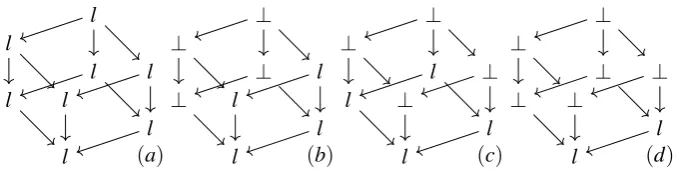
Figure 6: Possible commutative cubes inPL
face,b,c,d∈M and pullbacks as back faces, the following holds:
the top face is a pushout⇔the front faces are pullbacks
We have already identified the possible pushouts (3) and (4) above. These pushouts lead to four possible cases for back faces that are pullbacks (see Figure6):
For the pushout (3): The possible spans to construct the back faces of the cube with are:
• l←l→l, which lead to the identity cube(a). Then all faces in the cube are pushouts as
well as pullbacks and, therefore, constitute anM,N-van Kampen square.
• ⊥ ← ⊥ → ⊥, which leads to the cube(c)with pullbacks as back faces. Then the top face is the pushout(3)and the front faces are pullbacks.
• l← ⊥ →l, ⊥ ← ⊥ →l, for both of which at least one of the back faces will not be a pullback
For the pushout (4): The possible spans to construct the back faces of the cube with are:
• ⊥ ← ⊥ →l, which leads to the cube(b)with pullbacks as back faces. Then the top face is the pushout(4)and the front faces are pullbacks.
• ⊥ ← ⊥ → ⊥, which leads to the cube(d)with pullbacks as back faces. Then the top face is the pushout(3)and the front faces are pullbacks.
In both cases it is possible to contruct different commutative cubes, but all of these do not have pushouts as top faces nor pullbacks as front faces.
Definition 5 (Graphs: Graphs→Sets) The functor Graphs:Graphs→Sets is defined to
map graphs to their underlying set of nodes and edges and is given as follows: For a graphG0=
(V0,E0,s0,t0), letGraphs(G0) =V0+E0and for a graph morphism fG0:A→B, letGraphs(fG0) be a functor, defined byGraphs(f)(x) =fV0(x)ifx∈V0 and fE0(x)otherwise.
Lemma 7 The functor Graphs:Graphs→SetspreservesM,N-pushouts, whereM is the class of injective graph morphisms,N is the class of all morphisms.
Proof. Given a pushout(P)inGraphs, we have to show thatGraphs((P))is a pushout inSets, i.e. for every pair of commuting morphismsg1:Graphs(B)→X andg2:Graphs(C)→X there
A
C
B
D f1
f2 π1
π2
(P)
Graphs(A)
Graphs(C)
Graphs(B)
Graphs(D)
X Graphs(f1)
Graphs(f2) Graphs(π1)
Graphs(π2)
g1
g2
g Graphs((P))
Letx∈D, then eitherx∈Borx∈C. Ifx∈B, theng1(x)∈X, if otherwisex∈Ctheng2(x)∈X.
We can thus defineg(x) =
(
g1(x) ifx∈B
g2(x) otherwise
It remains to show thatgis unique: The above construction follows directly fromg1,g2 and
Graphs(π1),Graphs(π2). If we assume a different morphismg0:Graphs(D)→Xit would have
to follow these same constraints, henceg0=g.
Definition 6(PL: PL⊕→Sets) The functorPL:PL⊕→Setsis defined to map a multiset of labels to a set with distinct elements and is given as follows: For a multiset of labelsm0:L0→N let PL(m) =S
l0∈L0m¯(l0), where for l0∈L0, ¯m(l0) ={l10, ...,lk0}iff m(l
0) =k. For a morphism
f:m1→m2letPL(f) =PL(m1)→PL(m2)be a morphism inSets, such thatPL(f)(l10) =l20 iff
PL(l1) =l01,PL(l2) =l20 and f(l1) =l2withl1,l2∈m1,m2respectively.
Example5 Given a morphism f:{|a,a,b|} → {|a,a,b,b|}inDisc(L)⊕,PL(f)is the morphism
{a1,a2,b1} → {a1,a2,b1,b2}. PL ’flattens’ a multiset into a set by making sure that there are
distinct elements in the set for all elements in a multiset.
Lemma 8 The functor PL:PL⊕→Setspreserves pullbacks.
Proof. Given a pullback(P)inPL⊕, we have to show thatPL((P))is a pullback inSets, i.e. for
every pair of commuting morphisms g1: X →PL(B) and g2: X →PL(C) there is a unique
morphismg:X →PL(A).
A
C
B
D
π1
π2 f1
f2
(P)
PL(A)
PL(C)
PL(B)
PL(D)
X
PL(π1)
PL(π2) PL(f1)
PL(f2)
g1
g2 g
PL((P))
Letx∈A, then bothx∈Bandx∈Cdue to the morphismsπ1,π2. We can thus defineg(x0) =x
It remains to show thatgis unique: The above construction follows directly fromg1,g2 and
PL(π1),PL(π2). If we assume a different morphismg0:X→PL(A)it would have to follow these
same constraints, henceg0=g.
Definition 7(Att=idSets↓bijPL) The categoryAttofattribute collectionsis the comma cat-egoryidSets↓bijPLwhereidSetsdenotes the identity functor overSets.
Lemma 9(Attis Mc,Nc-adhesive) The category Att of attribute collections is Mc,Nc
-adhesive where Mc,N c are the classes of morphisms induced by the comma category
con-struction.
Proof. Att=idSets↓bijPLisMc,N c-adhesive, sinceSetsandPLareM,N -adhesive and a
multiset and comma category construction preserveM,N-adhesiveness.
To construct attributed graphs we define a functor from multisets of these attribute collections to sets for later use in the definition of a comma category. We also prove that this functor pre-serves pullbacks, since this is required for the comma category to preserveM,N-adhesiveness.
Definition 8(Att:Att⊕→Sets) The functorAtt:Att⊕→Setsis defined to map attribute col-lections to sets with distinct values and is given by the following: A triple(idSets(S),PL(m),op)⊕ is mapped to the setS⊕+PL(m)⊕where⊕is flattened analogously to the wayPLdoes (see Def-inition6). A morphism f:A→BinAtt⊕is mapped to a morphismAtt(f): Att(A)→Att(B), where elements inAtt(A) are mapped to elements inAtt(B)based on the original mappings in Att⊕.
Lemma 10(Attpreserves pullbacks) The functor Att:Att⊕→Setspreserves pullbacks.
Proof. In the same way that the defintion ofAtt is analogous to that ofPLthe preservation of pullbacks can be proven in a similar way.
Definition 9(AttGraphs=Graphs↓bijAtt) The categoryAttGraphsofattributed graphsis the comma categoryGraphs↓bijAtt.
Now we are able to show that the categoryAttGraphsof attributed graphs isM,N-adhesive.
The categories Graphs of graphs and Att of attribute collections are MG,NG and MA,N
A-adhesive and the compositions of multiset category and comma category preserveM,N-adhesiveness.
Theorem 4(AttGraphsisMc,Nc-adhesive) The categoryAttGraphsof attributed graphs is
Mc,Nc-adhesive whereMc,N care the classes of morphisms induced by the comma category
construction.
Proof. The proof is illustrated in Figure7. By Lemmata2and9,GraphsandAttareMG,NG andMA,NA-adhesive, respectively. MG,NGare monomorphisms inGraphsandMA,NA are
the classes of morphisms induced by the comma category construction ofAtt. By Theorem3,
Att⊕isM⊕,N⊕-adhesive. By Theorem1and Lemmata7and10,Graphs↓bijAttisMc,Nc
Graphs Lem2 Att Lem9
Att⊕
Graphs↓bijAtt
AttGraphs
Thm3
Thm1
= Def9
Figure 7: Proof of “AttGraphsisMc,N c-adhesive”.
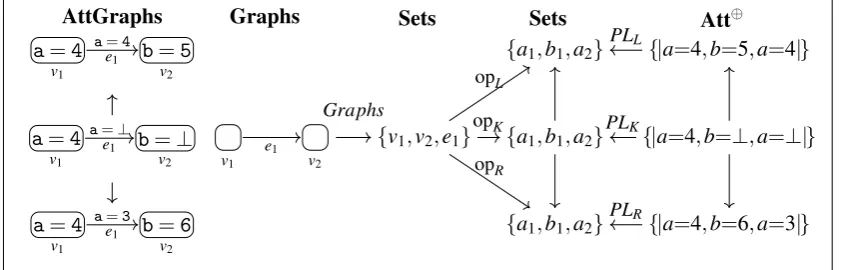
Example 6 Figure8 shows an attributed graph in our setting. The functor Graphs maps the unlabelled graphUgiven below to a set{v1,v2,e1}of nodes and edges. The functorAttmaps the
multiset{|a=4,b=5,a=4|}to the set{a1,b1,a2}: whenever an elementxoccursntimes in the
multiset, the symbolsx1, . . . ,xn occur in the corresponding set. In our case, there is a bijective morphism op :Sets→Sets. Now we get an attributed graphG= (U,lG) from the unlabelled graphUand the multiset{|a=4,b=5,a=5|}by definingattG(x) =Att−1(op(Graphs(x)))for each itemxinU. The resulting attributed graph is given in the picture below. To represent an attributed graph we write its attribute collections into their corresponding nodes or next to their corresponding edges.
v1 v2
e1 {v
1,v2,e1} {a1,b1,a2} {|a=4,b=5,a=4|}
Graphs Sets Sets Att⊕
a=4
v1
b=5
v2
a=4
e1
AttGraphs
attG(x) =Att−1(op(Graphs(x)))
Graphs op bijective Att
Figure 8: Example of an object ofAttGraphs
AttGraphs Graphs Sets Sets Att⊕
a=4
v1
b=5
v2
a=4
e1
a=4
v1
b=⊥ v2
a=⊥
e1
a=4
v1
b=6
v2
a=3
e1
v1 v2
e1 {v1,v2,e1} {a1,b1,a2} {|a=4,b=⊥,a=⊥|}
{a1,b1,a2} {|a=4,b=6,a=3|}
{a1,b1,a2} {|a=4,b=5,a=4|} opL
PLL
Graphs op
K PLK
opR
PLR
Figure 9: Example rule overAttGraphs
a=4
v1
b=⊥ v2
a=⊥
e1
a=4, c=7
v1
b=6
v2
a=3
e1
Figure 10: Matches need not specifyallattributes
AttGraphs versus PLGraphs We based our approach on partially labelled graphs and we have to consider whether we have actually gained anything with this new category. We could, for example, define partially labelled graphs over an alphabet of sequences of hname,valuei -pairs which would also allow us to model graphs with attributes (this is close to the approach to attribution in [PP12]). In contrast to labels inPLGraphs, the attribute collections inAttGraphs have an internal structure. This allows us to write rules which specify only those attributes that we want to change, such as in Figure10. Unlike in a sequence of attributes, named attributes can be deleted without implicitly changing the meaning of other, following attributes.
On Attributed Graph Transformation So far we have only considered rules that use concrete attribute values. In practice we would want to have more abstract rules with variables, such that a rule may e.g. compute the sum of two attributes and write the result to a third attribute. To
allow computations in our rules we could adopt rule schemata as in e.g. [PP12]. A rule schema
may contain variables or terms in place of attribute values. These variables are instantiated during matching and the terms evaluated, resulting in a concrete rule that we can handle with our
approach. Alternatively we would have to prove that relevant algebra form anM,N -adhesive
category to be able to handle computations directly, such as in [Gol12] or [DEPR14].
5
Related Concepts
Throughout the literature, various versions of adhesive and quasiadhesive, weak adhesive HLR,
shown to be alsoM-adhesive ones. The categories of labelled graphs, typed graphs, and typed
attributed graphs in [EEPT06], are known to be M-adhesive categories if one chooses M to
be the class of injective graph morphisms [EGH10]. Each such category induces a class ofM
-adhesive systems for which several classical results of the double-pushout approach hold.
Unfortunately, the framework of M-adhesive systems does not cover graph transformation
with relabelling. In [HP12], the authors generalizeM-adhesive categories toM,N -adhesive
categories, where N is a class of morphisms containing the vertical morphisms in
double-pushouts, and show that the category of partially labelled graphs is M,N-adhesive, where
M andN are the classes of injective and injective, undefinedness-preserving graph morphisms,
respectively. Independently, Golas [Gol12] provided a general framework for attributed objects,
so-called W-adhesive systems which allows undefined attributes in the interface of a rule to
change attributes, which is similar to relabelling. By Lemma1and Theorem 5 in [PH15], the
hierarchy of adhesive categories in [EGH10] is extended in the following way:
adhesive ⇒6⇐ adhesive HLR⇒6⇐M-adhesive⇒6⇐M,N -adhesive⇒6⇐W-adhesive
Composition of adhesive categories has previously been considered for M-adhesive
cate-gories: the standard constructions of product, slice and coslice, functor, and comma categories are given in [EEPT06].
Parisi-Presicce et al. [PEM87] impose a simple structure on the sets of labels to allow variables both graphs and rules. As special case, they consider a preordering on the sets of labels to allow partially labelled graphs, i.e., partial labelling functions, and to allow the label-preserving matching morphisms. It is easy to see that this situation is a special case of [PEM87], 3.2 and 3.4 obtained by imposing a flat ordering on the labelling alphabet with a new “label” as top element. As far as we see, this is the first time where a special class of matching morphisms is considered.
In the literature, there are several variants of attribution concepts, e.g.:
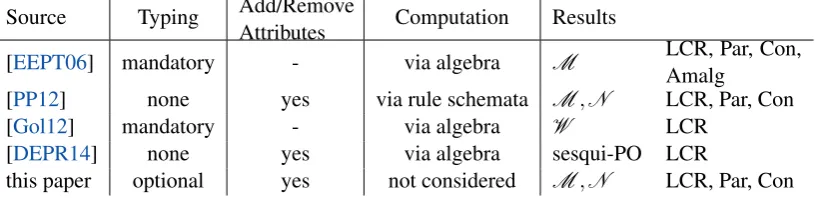
Ehrig et al. Ehrig et al. [EEPT06] introduce typed attributed graphs, expanding the graph by including an algebra for attribute values. To facilitate attribution, typed attributed graphs extend graphs by attribution nodes and attribution edges. All possible data values of the algebra are assumed to be part of the graph. Nodes and edges are attributed by adding an attribution edge that leads to an attribution node. In contrast to typed attributed graphs our attributed graphs can have at most one value for an attribute. We constructed untyped graphs and even the attributes themselves have no types. Typed attributed graphs require that the graph is typed and thus do not allow e.g. the addition of attributes to a node or edge.
Poskitt and Plump.Poskitt and Plump [PP12] use a different approach to attribution. Here la-bels are replaced by sequences of attributes. Rules are complemented by rule schemata in which terms over the attributes are specified. These variables are substituted with attribute values and evaluated during rule application. Adding or removing attributes is possible, since the graphs are not typed. It is, however, not possible to find a match without fully specifying other, potentially uninteresting, attributes.
Golas. Attributed structures, as presented by Golas [Gol12], are likely the closest to our ap-proach. Attributed structures can be defined over arbitraryM-adhesive categories but are strictly
Source Typing Add/Remove
Attributes Computation Results
[EEPT06] mandatory - via algebra M LCR, Par, Con,
Amalg
[PP12] none yes via rule schemata M,N LCR, Par, Con
[Gol12] mandatory - via algebra W LCR
[DEPR14] none yes via algebra sesqui-PO LCR
this paper optional yes not considered M,N LCR, Par, Con
Table 1: Comparison of Attribution Concepts
systems have been proven for these attributed structures. Since attributes are added to elements of the underlying structure based on a type, addition or removal of attributes is not possible.
Duval et al. Duval et al. [DEPR14] base their approach on sesqui-pushout rewriting to allow for cloning and merging of nodes. The addition or removal of attributes is also possible.
In most of these approaches attributes are based on an algebra that allows performing some computations on the attributes, in our setting this would require additional work to proveM,N -adhesiveness for a suitable category. Fortunately we only need to provide this proof for such attributes once, enabling us to construct many different attributed structures without concerning ourselves with e.g. the underlying graphs. Alternatively we could follow the approach of [PP12] and introduce rule schemata to allow for computations over attributes.
The comparison is summarized in Table 1, based on the necessity of typing the graph, the
ability to add or remove attributes via rules, whether computations over attribute values are supported and what properties have been shown for these approaches, where LCR is the Local-Church-Rosser Theorem, Par is the Parallelism Theorem, Con is the Concurrency Theorem and Amalg is the Amalgamation Theorem.
Further approaches are e.g.L¨owe et al. [LKW93] which views graphs as a special case of
algebras. These algebras can then additionally specify types for attributes. Kastenberg and
Rensink. [KR12] take a similar approach to [EEPT06], but instead of only encoding the data values, operations and constants are also included in the graph.
6
Conclusion
In this paper, we have continued the work on M,N -adhesive categories and have presented
several examples (see Table2).
The main contributions of the paper are the following:
(1) Closure results for M,N -adhesive categories: product, slice/coslice, functor, comma,
string, and multiset categories.
(2) A new concept of attributed graphs with a proof ofM,N-adhesiveness.
Category Structures Adhesiveness Reference
Sets sets M-adhesive [EEPT06]
PL sets of labels M,N-adhesive Lemma6
Att attribute collections M,N-adhesive Lemma9
Graphs unlabelled graphs M-adhesive [EEPT06] LGraphs labelled graphs M-adhesive [Ehr79] PLGraphs partially labelled graphs M,N-adhesive [HP12,PH15] AttGraphs attributed graphs M,N-adhesive Theorem4
Table 2: Examples ofM,N-adhesive categories
Further topics might be:
(1) Proof of the HLR+-properties for the categoryAttGraphs to obtain the Local
Church-Rosser Theorem, the Parallelism Theorem and the Concurrency Theorem for this type of attributed graphs.
(2) Generalization of the approach to systems with so-called left-linear rules, i.e., rules where only the left morphism of the rule is required to be inM as, e.g., in [BGS11].
Acknowledgements. We would like to thank the anonymous referees as well as Wolfram Kahl and Berthold Hoffmann for helpful feedback on earlier versions of this paper.
Bibliography
[Awo10] S. Awodey.Category Theory. Oxford University Press, 2010.
[BGS11] P. Baldan, F. Gadducci, P. Soboci´nski. Adhesivity Is Not Enough: Local
Church-Rosser Revisited. InMathematical Foundations of Computer Science (MFCS 2011).
Lecture Notes in Computer Science 6907, pp. 48–59. 2011.
[DEPR14] D. Duval, R. Echahed, F. Prost, L. Ribeiro. Transformation of Attributed Structures
with Cloning. InFundamental Approaches to Software Engineering. Lecture Notes in
Computer Science 8411, pp. 310–324. 2014.
[EEGH15] H. Ehrig, C. Ermel, U. Golas, F. Hermann. Graph and Model Transformation
-General Framework and Applications. Monographs in Theoretical Computer Science. Springer, 2015.
[EEKR99] H. Ehrig, G. Engels, H.-J. Kreowski, G. Rozenberg (eds.). Handbook of Graph
Grammars and Computing by Graph Transformation. Volume 2: Applications, Lan-guages and Tools. World Scientific, 1999.
[EEPT06] H. Ehrig, K. Ehrig, U. Prange, G. Taentzer.Fundamentals of Algebraic Graph
[EGH10] H. Ehrig, U. Golas, F. Hermann. Categorical Frameworks for Graph Transformation
and HLR Systems based on the DPO Approach.Bulletin of the EATCS112:111–121,
2010.
[Ehr79] H. Ehrig. Introduction to the Algebraic Theory of Graph Grammars. In
Graph-Grammars and Their Application to Computer Science and Biology. Lecture Notes in Computer Science 73, pp. 1–69. 1979.
[EK80] H. Ehrig, H.-J. Kreowski. Applications of Graph Grammar Theory to Consistency,
Synchronization and Scheduling in Data Base Systems.Information Systems5:225–
238, 1980.
[EKMR99] H. Ehrig, H.-J. Kreowski, U. Montanari, G. Rozenberg (eds.).Handbook of Graph
Grammars and Computing by Graph Transformation. Volume 3: Concurrency, Paral-lelism, and Distribution. World Scientific, 1999.
[Gol12] U. Golas. A General Attribution Concept for Models in M-adhesive
Transforma-tion Systems. InGraph Transformations (ICGT’12). Lecture Notes in Computer
Sci-ence 7562, pp. 187–202. 2012.
[HP12] A. Habel, D. Plump.M,N -adhesive Transformation Systems. InGraph
Transfor-mations (ICGT 2012). Lecture Notes in Computer Science 7562, pp. 218–233. 2012.
Long version available at: http://formale-sprachen.informatik.uni-oldenburg.de/pub/
index.html.
[KR12] H. Kastenberg, A. Rensink. Graph Attribution Through Sub-Graphs. Technical
re-port TR-CTIT-12-27, University of Twente, 2012.
[LKW93] M. L¨owe, M. Korff, A. Wagner. An Algebraic Framework for the Transformation
of Attributed Graphs. InTerm Graph Rewriting: Theory and Practice. Pp. 185–199.
John Wiley, 1993.
[PEM87] F. Parisi-Presicce, H. Ehrig, U. Montanari. Graph Rewriting with Unification and
Composition. InGraph Grammars and Their Application to Computer Science.
Lec-ture Notes in Computer Science 291, pp. 496–514. 1987.
[PH15] C. Peuser, A. Habel. Attribution of Graphs by Composition ofM,N -adhesive
Cat-egories. In Proceedings of the 6th International Workshop on Graph Computation
(GCM 2015). CEUR Workshop Proceedings 1403, pp. 66–81. 2015.
[PP12] C. M. Poskitt, D. Plump. Hoare-Style Verification of Graph Programs.Fundamenta
Informaticae118(1-2):135–175, 2012.
[Roz97] G. Rozenberg (ed.).Handbook of Graph Grammars and Computing by Graph
Trans-formation. Volume 1: Foundations. World Scientific, 1997.
[SI13] D. Singh, A. I. Isah. A Note on Category of Multisets (MUL).International Journal