Available on-line at: www.oapub.org/edu
doi: 10.5281/zenodo.3555581 Volume 5 │ Issue 12 │ 2019
THE EFFECT OF A GOAL SETTING EXERCISE PROGRAM
ON IMPROVING UPPER BODY STRENGTH, LOWER EXTREMITY
STRENGTH, BALANCE AND COMMITMENT TO EXERCISE
OF PATIENTS WITH SCHIZOPHRENIA
Lena Gabršček1,
Dimitrios Kokaridas2i,
Georgia Maggouritsa2,
George Loules2,
Periklis Stoforos3,
Yiannis Theodorakis2,
Charalampos Krommidas1
1University of Ljubljana,
Ljubljana, Slovenia
2University of Thessaly,
Trikala, Greece
3Agia Anastasia S.A.,
Trikala, Greece
Abstract:
The purpose was to examine the effect of goal setting on improving upper body strength, lower extremity strength and balance of individuals with schizophrenia and to monitor the effect of goal setting toward commitment to exercise of schizophrenia patients. The sample consisted of four patients with schizophrenia, aged 48 to 58 years old, all randomly selected and separated into two groups (control and experiment). All patients were already involved in exercising twice per week of 45 minutes each session, within psychiatry hospital premises. Additional goals for experimental group individuals included two extra 10-15 minutes of workout per week to improve post measure results. Instruments used prior and after the application of the goal setting intervention program included the Five times sit to stand test, the Arm curl test and the Time up and go test. Results showed that participants of the experiment group improved their performance in all post measures while control group individuals also improved their scores in two out of the three tests used in this study. Although no generalizations can be made due to the small sample of this study, goal setting seems to have the potential to promote exercise commitment and adoption in patients with schizophrenia.
Keywords: goal setting, schizophrenia, patients, exercise
1. Introduction
Schizophrenia is a chronic and severe psychotic disorder defined by a group of symptoms, such as delusions, hallucinations or physical agitation, loss of autonomy, deterioration in social, occupational or interpersonal relationships, lasting for at least six months (Andreasen & Black, 2001; Oertel-Knöchel et al., 2014). It is characterized by fundamental disturbances in thinking, emotions, perception (Rössler, Salize, van Os, & Riecher-Rössler, 2005), disorganized speech and bizarre behavior (Marder & Chopra, 2014) and usually has a poor long-term outcome (Acil, Doğan, & Doğan, 2008; Andreasen & Black, 2001; van Os & Kapur, 2009). Furthermore, people with schizophrenia usually suffer from poor physical health (Daley, 2002; Deenik et al., 2019; Vancampfort et al., 2011) which might also be a consequence of inappropriate habits like drinking, smoking, poor nutrition and lack of physical activity that might cause even bigger functional disability (Caldwell, 2012; Roick, 2007; van Os & Kapur, 2009). All of this leads to significantly poorer quality of life and standard of living (Acil et al., 2008).
Researchers (e.g., Acil et al., 2008; Doğan et al., 2004; Faulkner & Biddle, 1999; Knittle, Gellert, Moore, Bourke, & Hull, 2019; Vancampfort et al., 2011) claim that treating schizophrenia should be complementary and not only focused on medical treatment. Antipsychotic drugs, that are mainly used for treating schizophrenia, are effective for delusions and hallucinations (van Os & Kapur, 2009), but on the other hand cannot prevent deterioration of quality of life and social functionalities, decrease in work efficacy or job loss and impairment of cognitive functions (Acil et al., 2008). There are also many side effects including weight gain, movement disorders, somnolence, drowsiness, etc. (Achtyes et al., 2018). In that case, mild to moderate exercise interventions turned out to be an efficient way of improving mood state (Maggouritsa et al., 2014a), self-esteem (Daley, 2002; Maggouritsa et al., 2014a), personal care and social limitations (Maggouritsa et al., 2014b), quality of life (Acil et al., 2008; Oertel-Knöchel et al., 2014), physical activity and metabolic health (Deenik et al., 2019), cognitive skills and reducing psychopathological symptoms (Oertel-Knöchel et al., 2014) of patients with schizophrenia. Moreover, physical fitness following exercise improves, which may help patients with schizophrenia coping better with daily activities (Acil et al., 2008; Kokaridas et al., 2013).
Therefore, people with schizophrenia could use exercise as a strategy to cope with mental illness with the support from others or by themselves (Faulkner & Biddle, 1999).
motivational mechanism which influences the degree of effort in striving toward a goal (Locke & Latham, 1991). Attainment of goals can be enhanced by directing an individual’s attention to the task, by offering feedback and by using suitable task strategies (i.e., how to perform/attain behavior) and rewards (Locke & Latham, 1991; Weinberg, Hermison, Rosenkranz, & Hookom, 2005).
In sports setting goal setting turned out to be one of the most efficient tools to direct person’s self-regulatory efforts (Orlick, 2016; Tylor & Wilson, 2005). It is important that goals are optimally difficult, challenging and proximal in order to ensure high self-efficacy performance, which increases the likelihood of achieving those goals (Evans & Hardy, 2002).
Meta-analysis (McEvan et al., 2016), observing goal setting intervention effectiveness, showed significant effects of goal setting regardless of goal specificity, which means that even when the goal was vaguely defined (e.g., to be more active) the effect of goal setting was medium. Furthermore, results showed that significant intervention effects were evident regardless of the individual(s) who prescribed the goal (e.g., set by an interventionist, participant or as a collaboration of both) and regardless using prolonged programs (e.g., year-long) or brief protocols (e.g., one week).
However, goal setting involves many neurocognitive processes including planning, initiating, information processing, self-monitoring behaviors, and sequencing (Tyson, Laws, Roberts, & Mortimer, 2004) which might be defective in patients with psychiatric disabilities such as schizophrenia patients (Brett, Sykes, & Pires-Yfantouda, 2017). Patients with schizophrenia are often hospitalized and goal setting has also been recognized as an essential part of psychiatric rehabilitation (Brett et al., 2017; Cavelti et al., 2018; Clarke, Crowe, Oades, & Daene, 2009; McGuire, Lysaker, & Wasmuth, 2015). It is important that clinicians try to maximize patients’ participation in treatment decisions in order for recovery to be self-directed (McGuire et al., 2015).
Goal setting interventions have been used with patients with schizophrenia as a therapeutic tool but not in an exercise setting. To our knowledge, to date, no studies have been published that observed the effect of goal setting in an exercise setting among schizophrenia patients on their physical fitness.
2. Method
2.1. Participants
The sample consisted of four patients with schizophrenia, two females and two males, aged 48 to 58 years old, all randomly selected for research purposes. All the participants were diagnosed with schizophrenia and were hospitalized in Agia Anastasia S.A., a psychiatric hospital in Trikala, for at least 3 years.
Furthermore, all four patients were already involved in exercising twice per week (Tuesdays and Wednesdays) of 45 minutes each session, within psychiatry hospital premises, at an exercise program held by adapted physical education students and faculty members of DPESS, University of Thessaly, Greece during the last year. Training program included exercises that fairly cover all aspects of general physical condition and take moderate physical effort to perform. Each training session started with a ten minutes warm-up period (walking and flexibility exercises) followed by 25 minutes of aerobic, strength, balance and coordination exercises and a cool-down period of ten minutes of breathing and relaxation (Kokaridas et al., 2013).
The study was approved by the Institutional Review Board of University of Thessaly and informed con-sent was received from all participants’ prior program initiation.
2.2.Instruments
Instruments used prior and after the application of the goal setting intervention program included the following tests:
A. Five times sit to stand test - FTSST (Csuka & McCarty, 1985) is defined as the time spent for standing up from and sitting down on a chair with five repetitions and is commonly used to measure functional lower extremity strength in older adults. The test requires the participant to stand up and sit down five times as fast as possible without using hands to push up from a standard armless -43-47 cm high- chair (Paul & Canning, 2014). Hips should be flexed at about 90 degrees with feet flat on the floor. The researcher provided the following instructions according to the standardized laboratory protocol: “When I say “go”, I want you to stand up and sit down five times as quickly as you can but safely”. Timing begins and stops when the subject’s back touches the backrest of the chair on the fifth repetition, with better functional ability represented as a shorter time required to perform the task (Whitney et al., 2005).
the total number of times the participant bended and straightened the elbow within a 30 seconds time frame (Różańska-Kirschke, Kocur, Wilk, & Dylewicz, 2006).
C. Timed up and go (TUG) was used to measure basic mobility and balance which includes a series of movements such as standing up, walking, sitting and anticipatory aspects of postural control (Shamway-Cook & Wollacott, 2007). Participants were told to sit on a standard chair with their hips flexed at 90 degrees and feet resting on the floor. On the order “go”, they were asked to stand up, walk 3 meters as quickly and safely as possible, turn around, walk back and sit down on the same chair. When the researcher said “go”, timing began and stopped when the participant touched the backrest of the chair with his/her back. Shorter times spent to perform TUG indicate a better level of functional balance (Whitney et al., 2005).
2.3. Procedure
An experimental procedure designed to examine the effect of goal setting program on improving patients’ body strength, lower extremity strength and balance took place for a month in Agia Anastasia S.A. First, the four patients were randomly split into two groups, that is, a control group and an experimental group of one female and one male patient each one. Patients in both groups were told that they will perform three tests (Five times sit to stand test, Arm curl test and Timed up and go) prior and after the intervention. With the group A, which consisted one female and one male patient, no goals were set and they were asked not to do any extra workouts during the four weeks apart from their participation at the regular exercise program of the psychiatry hospital, twice per week.
On the other hand, the experiment group participated in the regular exercise program of the psychiatry hospital, plus specific goals were set about their exercise schedule during the week. Goals were set following their discussion with experiment group individuals so as to maximize participation and ensure that their improvement would be self-directed (McGuire et al., 2015).
3. Results
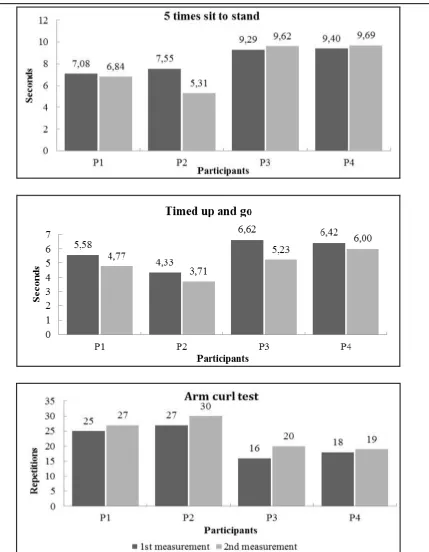
Due to the small sample, descriptive statistics were used to examine athletes’ improvement on three tests. Emphasis was also given to the percentage analysis of each participant’s performance improvement. Comparison between pre and post results for each individual revealed that (experiment group) participants 1 and 2 improved their scores in all of the tests. On the other hand, participant 3 and 4 of the control group also improved their results on Timed up and go test and Arm curl test, but not on the Five times sit to stand test (Table 1).
As given below in Table 2, participant 1 improved most on the Timed up and go test (15%), while participant 2 improved most on the 5 times sit to stand test (30%). Participant 3 and 4 improved their times on Timed up and go and arm curl test, with participant 3 displaying the highest performance difference among all four individuals on both tests (21% and 20% improvement). The lowest percentage improvement was noted for participant 4 of the control group (7% and 5% for each test respectively).
Table 1: Pre and post test results of participants
5 times sit to stand
Timed up and go
Arm curl test
1st 2nd 1st 2nd 1st 2nd
Participant 1 7.08 6.84 5.58 4.77 25 27
Participant 2 7.55 5.31 4.33 3.71 27 30
Participant 3 9.29 9.62 6.62 5.23 16 20
Participant 4 9.40 9.69 6.42 6.00 18 19
Note: Results of first two tests are shown in seconds, while Arm curl test shows number of repetitions.
Table 2: Percentage improvement of participants in pre- and post-test measures
5 times sit to stand
Timed up and go
Arm curl test
Participant 1 3% 15% 7%
Participant 2 30% 14% 10%
Participant 3 / 21% 20%
Participant 4 / 7% 5%
Note: / shows no improvement on test.
Figure 1: Performance across experimental conditions
5. Discussion
maintenance of participation and commitment to exercise of schizophrenia patients. Results showed that participants of the experiment group improved their performance in all post measures while the control group individuals also improved their scores in two out of the three tests used in this study. Results reveal the importance of exercise for improving physical condition aspects of patients with schizophrenia, either for control group individuals participating in their regular exercise program or for the experiment group participants adding a goal setting program of extra work out, that seemed to further improve their functional lower extremity strength compared to the control group individuals where no such improvement was noted.
Lack of physical activity is very common among schizophrenia patients (Caldwell, 2012; Roick, 2007; van Os & Kapur, 2009). Treatment of schizophrenia mainly includes the use of antipsychotic drugs (van Os & Kapur, 2009) that produce many side effects due to medication, including weight gain, movement disorders, somnolence, drowsiness (Achtyes et al., 2018), that affect patients’ ability to cope with daily activities.
Since goal setting turned out to be an efficient tool to promote exercise for a wide variety of populations (e.g. Andersson & Moss, 2011; Knittle et al., 2019; McEvan et al., 2016; Nyman et al., 2018; Saelens et al., 2000), the idea of this study was, that goal setting might not only be a useful technique as part of psychiatric rehabilitation (Brett et al., 2017; Cavelti et al., 2018; Clarke et al., 2009; McGuire et al., 2015), but also as an additional mean in an exercise setting to promote patients’ physical aspects and commitment to exercise.
Nevertheless, goal setting involves many neurocognitive processes that might be defective in patients with schizophrenia (Brett et al., 2017) and that was the reason why the researchers and the experiment group patients set mutual goals. McEvan et al. (2016) noted that significant goal setting intervention effects were evident regardless of who prescribed the goal and that goal does not have to be very specific for the medium effect of goal setting. In this perspective, two non-specific goals were set for the experiment group, that is, to do extra exercises twice a week and to improve test results. The nurse, who was discreetly monitoring the activity of the experiment group without the knowledge of the patients, as well as both individuals, confirmed that prescribed intervention was followed without skipping any extra work-out sessions, which means that commitment to exercise as a goal was achieved. Goal setting in exercise programs for patients with schizophrenia seems to have the potential to contribute to the adoption and maintenance of participation to exercise.
tool in goal setting to direct an individuals’ attention to the task and help them attain goals (Locke & Latham, 1991; Weinberg et al., 2005).
Descriptive statistics also showed that participants of the experiment group displayed a percentage improvement in all post measures of the three tests performed, whereas control group individuals also improved their scores on timed up and go and arm curl test due to their participation at the regular exercise program of the psychiatry hospital, twice per week. Training program already included simply designed exercises such as lifting exercises with small weights that helped them improve their scores at the arm curl test or walking, balance, and coordination activities, that helped them improve at the timed up and go test.
On the other hand, only the experiment group included squats in their extra work out that contributed to post measure improvements in the Five times sit to stand test compared to control group individuals who even achieved lower post results at the specific test. Also, it has to be taken into account that in all three tests, experiment group individuals performed better in all initial measurements compared to the control group participants, thus, their improvement rate was more difficult to achieve in post results.
6. Conclusion
Overall, collected data in this study showed that goal setting did help patients with schizophrenia to improve their scores in all three applied tests, even though the intervention lasted only for a month, a finding that is consistent with McEvan’s et al. (2016) meta-analysis findings. Since control group individuals also improved their performance in two out of the three tests in post measures, the most promising result of this study was the potential of goal setting as a technique to promote commitment to exercise, since both patents of the experiment group followed the intervention program without dropouts and they required to continue the goal setting work out afterwards.
Conflicts of interest
The authors declare that there are no conflicts of interest.
References
Achtyes, E., Simmons, A., Skabeev, A., Levy, N., Jiang, Y., Marcy, P., & Weiden, P. J. (2018). Patient preferences concerning the efficacy and side-effect profile of schizophrenia medications: a survey of patients living with schizophrenia. BMC
Psychiatry, 18(1), 292. doi:10.1186/s12888-018-1856-y
Acil, A. A., Doğan, S., & Doğan, O. (2008). The effects of physical exercises to mental state and quality of life in patients with schizophrenia. Journal of Psychiatric &
Mental Health Nursing, 15(10), 808-815. doi:10.1111/j.1365-2850.2008.01317.x
Andersson, E. K., & Moss, T. P. (2011). Imagery and implementation intention: A randomised controlled trial of interventions to increase exercise behaviour in the general population. Psychology of Sport and Exercise, 12(2), 63-70. doi:10.1016/j.psychsport.2010.07.004
Andreasen, N. C., & Black D. W. (2001). Introductory Textbook of Psychiatry (3rd Eds.).
American Psychiatric Publishing, Washington, DC.
Caldwell, B. A. (2012). Exercise therapy for schizophrenia. International Journal of
Evidence-Based Healthcare, (4), 411-412. doi:10.1111/j.1744-1609.2012.00299.x
Brett, C. E., Sykes, C., & Pires-Yfantouda, R. (2017). Interventions to increase engagement with rehabilitation in adults with acquired brain injury: A systematic review. Neuropsychological rehabilitation, 27(6), 959-982. doi:10.1080/09602011.2015.1090459
Cavelti, M., Tschümperlin, R. M., Hubl, D., Kupper, Z., Caspar, F., & Westermann, S. (2018). Therapeutic relationship and concordance of client- and clinician-rated motivational goals in treatment of people with psychosis: An exploratory study.
Psychosis: Psychological, Social and Integrative Approaches, 10(2), 90-98.
doi:10.1080/17522439.2018.1449885
Clarke, S., Crowe, T., Oades, L., & Deane, F. (2009). Do goal-setting interventions improve the quality of goals in mental health services? Psychiatric Rehabilitation Journal, 32(4), 292-299.
Csuka, M. & McCarty, D. J. (1985). Simple method for measurement of lower extremity muscle strength. TheAmerican Journal of Medicine, 78(1), 77-81.
Daley, A. J. (2002). Exercise therapy and mental health in clinical populations: is exercise therapy a worthwhile intervention? Journal of Continuing Professional
Development, 8, 262-280.
illness: The MULTI study I. Schizophrenia Research, 204, 360-367. doi:10.1016/j.schres.2018.07.033
Doğan, S., Doğan, O., Tel, H., Coker, F., Polatöz, O., & Doğan, F. B. (2004). Psychosocial approaches in outpatients with schizophrenia. Psychiatric Rehabilitation Journal, 27, 279-282.
Evans, L. & Hardy, L. (2002). Injury rehabilitation: A goal-setting intervention study.
Research Quarterly for Exercise and Sport, 73(3), 310-319.
Faulkner, G., & Biddle, S. (1999). Exercise as an adjunct treatment for schizophrenia: A review of the literature. Journal of Mental Health, 8(5), 441-457. doi:10.1080/09638239917157
Knittle, K., Gellert, P., Moore, C., Bourke, N., & Hull, V. (2019). Goal achievement and goal-related cognitions in behavioral activation treatment for depression.
Behavior Therapy, 50(5), 898-909. doi:10.1016/j.beth.2019.01.005
Kokaridas, D., Maggouritsa, G., Stoforos, P., Patsiaouras, A., Theodorakis, Y., & Diggelidis, N. (2013). The effect of a token economy system program and physical activity on improving quality of life of patients with schizophrenia: a pilot study. American Journal of Adapted Psychology, 2(6), 80-88.
Latham, G. P., & Locke, E. A. (1991). Self-Regulation through Goal Setting.
Organizational Behavior and Human Decision Process, 50, 212-247.
Maggouritsa, G., Kokaridas, D., Stoforos, P., Patsiaouras, A., Diggelidis, N., & Theodorakis, Y. (2014a). The effect of a physical activity program on improving body cathexis and self-esteem of patients with schizophrenia. Inquires in Sport &
Physical Education, 12(1), 40-51.
Maggouritsa, G., Kokaridas, D., Theodorakis, I., Patsiaouras, A., Mouzas, O., Dimitrakopoulos, S., & Diggelidis, N., (2014b). The effect of a physical activity programme on improving mood profile of patients with schizophrenia.
International Journal of Sport and Exercise Psychology, 12(3), 273-284.
Marder, S. R., & Chopra, V. (2014). Schizophrenia. Oxford: Oxford University Press. McEwan, D., Harden, S. M., Zumbo, B. D., Sylvester, B. D., Kaulius, M., Ruissen, G. R.,
… Beauchamp, M. R. (2016). The effectiveness of multi-component goal setting interventions for changing physical activity behaviour: A systematic review and meta-analysis. Health Psychology Review, 10(1), 67-88. doi:10.1080/17437199.2015.1104258
McGuire, A. B., Lysaker, P. H., & Wasmuth, S. (2015). Altered self-experience and goal setting in severe mental illness. American Journal of Psychiatric Rehabilitation, 18(4), 333-362. doi:10.1080/15487768.2015.1089800
Oertel-Knöchel, V., Mehler, P., Thiel, C., Steinbrecher, K., Malchow, B., Tesky, V., … Hänsel, F. (2014). Effects of aerobic exercise on cognitive performance and individual psychopathology in depressive and schizophrenia patients. European
Archives of Psychiatry & Clinical Neuroscience, 264(7), 589-604.
doi:10.1007/s00406-014-0485-9
Orlick, T. (2016). In pursuit of excellence. Champaign IL. Human Kinetics.
Paul, S. S., & Canning, C. G. (2014). Five-repetition sit-to-stand. Journal of Physiotherapy, 60, 168.
Roick, C., Fritz-Wieacker, A., Matschinger, H., Heider, D., Schindler, J., Riedel-Heller, S., & Angermeyer, M. C. (2007). Health habits of patients with schizophrenia.
Social Psychiatry and Psychiatric Epidemiology, 42(4), 268-276.
doi:10.1007/s00127-007-0164-5
Różańska-Kirschke, A., Kocur, P., Wilk, M., & Dylewicz, P. (2006). The Fullerton Fitness Test as an index of fitness in the elderly. Medical Rehabilitation, 10(2), 9-16.
Rössler, W., Salize, H. J., van Os, J., & Riecher-Rössler, A. (2005). Size of burden of schizophrenia and psychotic disorders. European Neuropsychopharmacology: The
Journal of the European College of Neuropsychopharmacology, 15(4), 399-409.
doi:10.1016/j.euroneuro.2005.04.009
Saelens, B. E., Gehrman, C. A., Sallis, J. F., Calfas, K. J., Sarkin, J. A., & Caparosa, S. (2000). Use of self-management strategies in a 2-year cognitive-behavioral intervention to promote physical activity. Behavior Therapy, 31(2), 365-379. doi:10.1016/S0005-7894(00)80020-9
Shumway-Cook, A., & Wollacott, M. H. (2007). Motor Control: Translating Research into
Clinical Practice. Philadelphia: Lippincott Williams & Wilkins.
Taylor, J., & Wilson, G. (2005). Applying sport psychology: Four perspectives. Champaign, IL: Human Kinetics.
Tyson, P. J., Laws, K. R., Roberts, K. H., & Mortimer, A. M. (2004). Stability of set-shifting and planning abilities in patients with schizophrenia. Psychiatry Research,
129(3), 229-239. doi:10.1016/j.psychres.2004.09.007
Weinberg, R. S., Harmison, R. J., Rosenkranz, R., & Hookom, S. (2005). Goal Setting. In J. Taylor & G. Wilson (Eds.), Applying sport psychology: Four perspectives. (pp. 101– 116). Champaign, IL: Human Kinetics.
Whitney, S. L., Wrisley, D. M., Marchetti, G. F., Gee, M. A., Redfern, M. S., & Furman, J. M. (2005). Clinical measurement of sit-to-stand performance in people with balance disorders: Validity of data for the Five-Times-Sit-to-Stand test. Physical
Therapy, 85(10), 1034-1045.
Vancampfort, D., Probst, M., Scheewe, T., Maurissen, K., Sweers, K., Knapen, J., & De Hert, M. (2011). Lack of physical activity during leisure time contributes to an impaired health related quality of life in patients with schizophrenia.
van Os, J., & Kapur, S. (2009. Schizophrenia. The Lancet, 374(9690), 635-645. doi:10.1016/S0140-6736(09)60995-8
Creative Commons licensing terms