ISSN-L: 2501 - 1235 Available on-line at: www.oapub.org/edu
DOI: 10.46827/ejpe.v6i6.3266 Volume 6 │ Issue 6 │ 2020
COMPARISON OF PET LEP AND
TRADITIONAL MENTAL IMAGERY METHODS
IN THE PERFORMANCE OF FOOTBALL GOALKEEPERS
Fatemeh Sadeghii
Master of Motor Behavior, Payame Noor University of Tehran, Iran
Abstract:
Mental imagery has long been the focus of researchers in sports psychology and motor learning. The purpose of this study is to compare Pet Lep and traditional mental imagery methods in the performance of football goalkeepers. For this purpose, 30 (13 males and 17 females) male and female goalkeepers aged 18 to 30 years were selected as a statistical sample using random cluster sampling. Subjects were divided into three groups and underwent specific exercises. The program of the first group consisted of practical exercises with mental imagery using the Pet Lep method, the second group consisted of practical exercises with mental imagery using the traditional method, and the third group consisted of practical exercises. Then, in the seventh, fourteenth, first and twenty-eighth sessions, all subjects were given a standard ball test and their learning progress was measured. The collected data were then statistically analyzed by one-factor analysis of variance test and Tukey test. Research findings showed that there is a significant difference in the level of learning the ball skill between Pet Lep mental imagery group and traditional illustration group and traditional illustration group and control group in all three stages of training. Also, a significant difference was observed in the retention of ball skills after one week of training between the Pet Lep mental imaging group and the traditional and control mental imaging groups. Finally, it is suggested that sports coaches and trainers use the Pet Lep imaging method in appropriate situations.
Keywords: Pet Lep illustration, traditional illustration, retention test
1. Introduction
Psychologists have come up with different definitions of mental imagery in recent decades these include illustration as the use of the senses to recreate or create an experience in the mind (Vealey & Greenleaf, 2001). This feature has also been considered
by sports psychologists in sports and learning various skills it is defined as the mental exercise of repeating a physical skill in the brain without any apparent movement of the limbs in order to learn and refine the technique. Of course, athletes' perceptions during training may be involved with all the senses (Lang et al, 1980). Nowadays, sports scientists have resorted to mental training in order to update the methods of training science and shorten the learning process of beginners and take professional athletes off the plateau in learning. Among the features of these exercises; it is safe, inexpensive, does not require equipment and trainers, is not time consuming training and does not cause fatigue (Sheikh et al, 2007). Therefore, by recommending mental exercises, you can save money, facilities, time, space, manpower, etc.; on the other hand, it also increased the efficiency of athletes (Winter and Martin, 1992). Also, through mental training, injured beginners or athletes who are away from training for other reasons can be involved in training (Driediger et al, 2006).
Gregg & Hall (2005) showed that; mental imagery is one of the most popular techniques in psychology. Barrow, M.A. et al (2007) also showed that; mental imagery can be used very artistically in sports. Smith, Wright, Alisopp and Westhead (2007) in their article entitled "Mental Imaging by Pet Lep and Exercise Method" pointed out the numerous uses of this method in exercise. In fact, it should be said that this method gives athletes and sports coaches a tool beyond physical training and skills.
Some scholars such as Collins & Hale (1997), Goginsky & Collins (1996) and Vealey (1994) criticized the lack of empirical and theoretical structure of scientific research and applied activities related to this title. They highlighted weaknesses in mental training methods, including fatigue. In response to such criticisms, Holmes and Colin (2001) developed the Pet Lep model. This model is based on neuroscience findings, especially since neurophysiological findings are the main cause of actual imaging and movement. The acronym "Pet Lep" refers to practical and important components that should be considered when using mental imagery. The components include physical, environmental, skills, time, learning, excitement and intellectual factors. It should be noted that mental imagery can be a very effective method in performance balance. Holmes and Colin (2002) noted that; functional balance is not effective in physical relaxation and it even seems to be in stark contrast to the athletes' physical condition. In their view, mental imagery is more effective when all the senses are involved and kinetic emotions are experienced during actual skill performances. The physical components of this model are related to the physical reactions of athletes in sports situations. Some sports psychologists such as Williams and Harris (2001) Athletes are best able to visualize skill or movement if they are in a relaxed position.
a similar environment, location images and audio tapes of the crowd can be used. If the structure of the mental imagery model is used, it should include descriptions of people's reactions to the environment and different from the descriptions of environmental stimuli (Smith et al, 2001). The component related to the task (skill in question) is an important factor, as a skill is conceived and embodied, it must be commensurate with the skill that must actually be performed. For applied mental imagery, a process called "response training" must be performed (Lang et al, 1980). This process involves the participant focusing on the responses of the real environment by invoking and reinforcing physiological and behavioral reports in the skill implementation environment, which emphasizes the direction of effective mental imagery.
Given the potential for injury to athletes in sports and to prevent the loss of their potential talents as well as to avoid their severe decline and discover the best training methods, the researchers sought to select the most appropriate type of mental imagery for athletes by examining and comparing both types of mental training.
2. Methodology
3. Results
At first, the results of the first, second and third tests as well as the retention test were reviewed in all three groups and as shown in Table 1, in all four tests, the Pet Lep Imaging Group scored better on average than the other two groups.
Table 1: Mean and standard deviation of the scores of the studied groups in the first, second, third and retention tests
Group Statistics First test Second test Third test Retention test
SD M SD M SD M SD M
Pet Lep mental imagery ± 5.54 47.27 ±4.49 53.53 ±6.91 57.73 ±6.91 55.33 Traditional mental imagery ±4.43 34.07 ±6.54 41.53 ±5.35 43.27 ±4.26 42.27 Control ±4.82 28.78 ±5.65 28.78 ±7.86 37.53 ±4.33 34.35
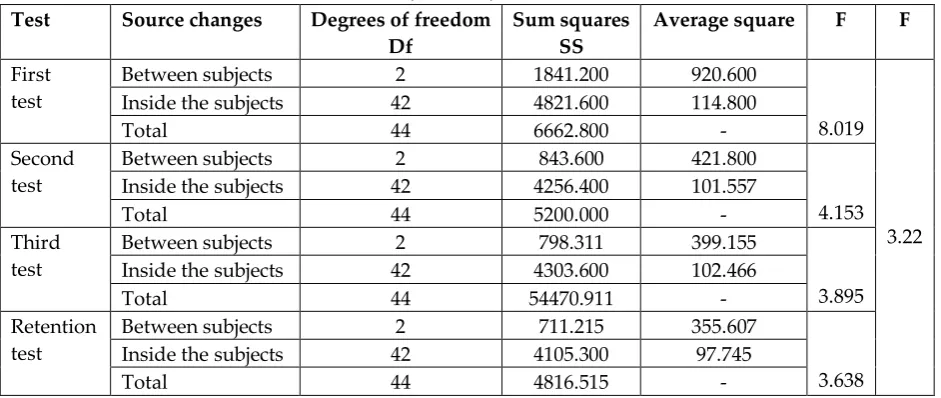
According to the data observed in Table 2, because the F calculated in all three groups and in the four tests performed is greater than the critical F of Table 2 at the probability level of P <0.05, therefore, there is a significant difference between the mean of the two groups at least.
Table 2: Summary of one-factor analysis of variance of the first, second, third and retention tests
Test Source changes Degrees of freedom Df
Sum squares SS
Average square F F
First test
Between subjects 2 1841.200 920.600
8.019
3.22 Inside the subjects 42 4821.600 114.800
Total 44 6662.800 -
Second test
Between subjects 2 843.600 421.800
4.153 Inside the subjects 42 4256.400 101.557
Total 44 5200.000 -
Third test
Between subjects 2 798.311 399.155
3.895 Inside the subjects 42 4303.600 102.466
Total 44 54470.911 -
Retention test
Between subjects 2 711.215 355.607
3.638 Inside the subjects 42 4105.300 97.745
Total 44 4816.515 -
Then, to determine the significant difference between the means of the groups, Tukey test was used, the information obtained is shown
Table 3: Tukey test
Tests Group Average Comparison M1 M2 M3 H.S.D
First test
First 2 - 10.2 20.19 9.516
Second 42 - - 9.99
Third 44 - - -
Second test
First 2 - 11.00 20.6 8.95
Third 44 - - - Third
test
First 2 - 10.46 20.2 8.99
Second 42 - - 9.74
Third 44 - - -
Retention test
First 2 - 9.53 20.98 8.78
Second 42 - - 11.45
Third 44 - - -
• There is a significant difference in the level of goalkeeping ball learning between the Pet Lep mental imagery group and the traditional mental imagery group in all three stages of training. Also, there is a significant difference in the rate of ball learning between the Pet Lep mental imagery group and the control group in all three stages of training;
• There is a significant difference in the amount of ball learning between the traditional mental imagery group and the control group in all three stages of training;
• There is a significant difference in the retention of ball skills after one week of training between the Pet Lep mental imagery group and the traditional mental imagery group;
• There is a significant difference in the retention of ball skills after one week of training between the Pet Lep mental imagery group and the control group;
• There is a significant difference between the traditional mental imagery group and the control group in the level of retention of ball skills after one week of training.
4. Conclusion and Discussion
experimental groups of the study used a combination of practical training and mental imagery, but the average of the mental imagery group with Pet Lep method is higher than the group that did mental imagery in the traditional way, and the difference between the means of the two groups is different. There is significance. This finding is consistent with the findings of Potter et al. (2004) Smith et al. (2007) and Holmes and Collins (2001). These results support the Pet Lep method of mental imagery and the benefit of the Pet Lep model is not limited to a specific age group and level of experience or sports assignments. Perhaps one of the superior factors of this illustration can be considered in the assimilation of the mind and the competitive way, which makes the person use all the details to imagine himself in a real training environment. Thus, studies show that; Pet Lep model is more effective than traditional methods of mental imaging, also, although the different elements of the Pet Lep model are individually important the more of these elements, the more effective the mental imagery. Finally, the effect of mental image on learning sports skills must be acknowledged and opened a new approach in this field so that sports coaches can be more and more familiar with the mental image using the Pet Lep method in the development and evolution of sports. Of course, it must be said that; all methods of mental training are useful and cause athletes' motor skills. Athletes' training coaches are expected to be able to teach their students better illustration techniques in favorable conditions. At higher levels, it is also suggested that by determining the best method of mental training and familiarizing coaches and athletes with the appropriate conditions, we see the best performance resulting from mental training.
References
Barrow, M. A. Weigand, D. A., Thomas, S. Hemmings, B. and Walley, M. (2007). Elite and novice athletes' imagery use in open and closed sports. Journal of Applied Sport Psychology, 19; PP: 93-104.
Botterill, C. (1997). The role of emotion in sport performance: The missing link?. Journal of Applied Sport Psychology, 9, P: 12.
Collins, D., & Hale, B. D. (1997). Getting closer… but still no cigar! Comments on Bakker, Boschker and Chung (1996). Journal of Sport and Exercise Psychology, 19; PP:207-212.
Conroy, D. E. (1997). A test of the utility of alpha chamber technology and imagery training for enhancing decision making in tennis. Unpublished master's dissertation. Chapel Hill, NC: University of North Carolina.
Dave Smith, Caroline Wright, Amy Alisopp, and Hayley Westhead. (2007). It's all in the mind: Pet Lep based imagery and sports performance. Journal of Applied Sport Psychology, 19; PP: 80-92.
Driediger, M. Hall, C & Callow, N. (2006). Imagery use by injured athletics: A qualitative analysis. Journal of sport science; 24(3); PP: 261-271.
Edgar, T. (2001). Mental practice strategies of elite track & field athletes. Psychology, Volume 1. Issue 2. PP 244-225.
Goginsky, A. M., & Collins, D. (1996). Research design and mental practice. Journal of Sports Sciences, 14; PP: 381-392.
Gray, J. J., Haring, M. J., Banks, M. N. (1984). Mental rehearsal for sport performance: Exploring the relaxation-imagery paradigm. Journal of sport Behavior, 7, PP: 68-78.
Gregg, M & Hall, C. (2005). The imagery ability, imagery use and performance relationship. Sport Psychologist, 2005/19/93-99. Human Kinetics Publisher, Inc. Grouios, G. (1992). Mental practice: A review. Journal of Sport Behavior, 15, PP: 42-59. Hardy, L., & Callow, N. (1999). Efficacy of external and internal visual imagery
perspectives for the enhancement of performance on tasks in which from is important. Journal of Sport and Exercise Psychology, 21; PP: 95-115.
Holmes, P. S., & Collins, D. J. (2001). The Pet Lep approach to motor imagery: Afunctional equivalence model for sport psychologists. Journal of Applied Sport Psychology, 13; PP: 60-83.
Lang, P. J., Kozak, M.J., Miller, G. A., Levin, D. A., & Mclean, A. (1980). Emotional imagery: Conceptual structure and pattern of somato-visceral response. Psychophysiology, 17, PP: 179-192.
Lang, P. J. (1985). The cognitive psychophysiology of emotion: Fear and anxiety. In .H. Tuma & J. D. Maser (Eds), Anxiety and the anxiety disorder (PP: 131-170). Hillsdale, NJ: Lawrence Erlbaum Associates.
Lee, A. B., & Hewitt, J. (1987). Using visual imagery in a floatation tank to improve gymnastic performance and reduce physical symptoms. International Journal of sport Psychology, 18(3); PP: 223-230.
Lejeune, M., Decker, C., & Sanckez, X. (1994). Mental rehearsal in table tennis performance. Perceptual and motor skills, 79; PP: 627-641.
Ruby, P., & Decety, J. (2001). Effect of subject's perspective talking during simulation of action: A PET Investigation of agency. Nature Neuroscience, 4, PP: 546-550. Sheikh, Mahmoud Movahedi, Ahmad Reza Assad, Mohammad Reza (2007). The effect
of the precedence and latency of mental training on learning a perceptual motor skill with emphasis on internal and external imagery. Journal of Research in Sports Science, No. 19.
Smith, D. & Collins, D. (2004). Mental practice, motor performance and the late CNV. Journal of Sport and Exercise Psychology, 26, PP: 412-426.
Smith, D., Collins, D., & Hale, B. (1998). Imagery perspectives and karate performance. Journal of Sports Sciences, 16, PP: 103-104.
Smith, D., Holmes, P. Whitemore, L., Collins, D., & Devonport, T. (2001). The effect of theoretically based imagery scripts on hockey penalty flick performance. Journal of Sport Behavior, 24, PP: 408-419.
Tenenbum, G., Bar-Eli, M., Hoffman, J. R., Jablonovski, R., Sade, S., & Shitrit, D. (1995). The effect of cognitive and somatic psyching-up techniques on isokinetic leg strength performance. Journal of Strength and Conditioning Research, 9, PP: 3-7. Vealey, R. S. (1994). Current status and prominent issues in sport psychology
interventions. Medicine and Science in Sport and Exercise, 26; PP: 495-502.
Vealey, R. S., & Greenleaf, C.A. (2001). Seeing believes: Understanding and using imagery in sport. In J. M. Williams (Ed), Applied Sport Psychology: Personal growth to peak performance. Mountain View, CA: Mayfield Publishing Company.
Weinberg, R. S. & Gould, D. (2003). Foundations of sport and exercise psychology (3rd
ed.). Champaign, IL: Human Kinetics.
Whetstone, T. S. (1995). Enhancing psychomotor skill development through the use of mental practice. Journal of Industrial Teacher Education, 32, Retrieved November 15, 2004, from http://scholar.Lib.Vt.Edu/ejournals/JITE/v32n4/whetstone.html. Williams, J. M., & Harris, D. V. (2001). Relaxation and energizing techniques for
regulation of arousal. In J. M. Williams (Ed). Applied Sport Psychology: Personal growth to peak performance (4th ed. PP: 229-246). London: Mayfield Publishing
Co.
Winter, G.; K Martin. (1992). A Practical Guide to Sports Psychology. Translated by Mohammad Kazem Vaez Mousavi. National Olympic Committee. First Edition. Tehran.
Creative Commons licensing terms