ARTIGO ORIGINAL
ABSTRACT
Introduction: Cellulitis and erysipelas represent the most frequent cause of hospitalization in the dermatology department of Santa Maria Hospital in Lisbon, Portugal. The aim of this study was to investigate whether patient demographics, comorbidities, previous episodes of cellulitis/erysipelas, the presence of complications, laboratory markers at admission, microbial isolation or previous use of antibiotics, are associated with prolonged stays.
Material and Methods: Retrospective analysis, including patients admitted with cellulitis/erysipelas in the inpatient dermatology de-partment of Santa Maria Hospital between July 1st 2012 and June 30th 2017.
Results: There were 372 admissions, corresponding to 348 patients. The median length of stay was 11 days. Increased age (p = 0.002, OR 1.03, 95% CI 1.01 – 1.04), previous episode of cellulitis/erysipelas requiring hospitalization (p = 0.005, OR 4.81, 95% CI 1.63 – 14.23), the presence of cellulitis/erysipelas-associated complications (p = 0.001, OR 3.28, 95% CI 1.63 – 6.59), leukocy-tosis (p = 0.049, OR 1.81, 95% CI 1.00 – 3.30), high levels of C-reactive protein (p = 0.035, OR 1.03, 95% CI 1.00 – 1.06) and a positive culture result (p = 0.002, OR 2.59, 95% CI 1.41 – 4.79) were associated with prolonged hospitalization.
Discussion: Prolonged hospitalization for cellulitis/erysipelas is associated with higher costs, additional clinical investigation, invasive treatments, prolonged courses of antibiotic therapy, risk of nosocomial infections, and delayed return to activities of daily living. Thus, the investigation of clinical-laboratory factors associated with prolonged hospitalization for cellulitis / erysipelas is essential and may be useful for the construction of a severity score.
Conclusion: The knowledge of the characteristics that are associated with prolonged stay among patients with cellulitis/erysipelas may be relevant to improve health care, by reducing the length of hospital stay and associated risks and costs.
Keywords: C-Reactive Protein; Cellulitis; Erysipelas; Hospitalization; Leukocytosis
Clinical and Laboratory Factors Associated with Prolonged
Hospital Stay among Patients with Cellulitis/Erysipelas
Fatores Clínico-Laboratoriais Associados ao Internamento
Prolongado em Doentes com Celulite/Erisipela
Ângela RODA1, Ana Marcos PINTO1, Ana Rita FILIPE2, Ana Rita TRAVASSOS1, João Pedro FREITAS1, Paulo FILIPE1,3,4
Acta Med Port 2019 Jun;32(6):448–452 ▪
https://doi.org/10.20344/amp.
107351. Serviço de Dermatologia. Hospital de Santa Maria. Centro Hospitalar Universitário Lisboa Norte. Lisboa. Portugal. 2. Unidade de Saúde Pública de Oeiras. Agrupamento de Centros de Saúde de Lisboa Ocidental e Oeiras. Oeiras. Portugal. 3. Clínica Universitária de Dermatologia. Faculdade de Medicina. Universidade de Lisboa. Lisboa. Portugal.
4. Instituto de Medicina Molecular. Faculdade de Medicina. Universidade de Lisboa. Lisboa. Portugal. Autor correspondente: Ângela Roda. [email protected]
Recebido: 28 de abril de 2018 – Aceite: 02 de outubro de 2018 | Copyright © Ordem dos Médicos 2019 RESUMO
Introdução: A celulite e a erisipela constituem a causa mais frequente de internamento no Serviço de Dermatologia do Hospital Santa Maria. Este estudo teve como objetivo investigar se as características demográficas, as comorbilidades, a existência de episódios prévios de celulite/erisipela, a presença de complicações associadas, os parâmetros laboratoriais na admissão, o isolamento de microrganismo em cultura ou o uso prévio de antibióticos estão associados a internamentos prolongados.
Material e Métodos: Estudo retrospetivo, incluindo os doentes internados no Serviço de Dermatologia do Hospital Santa Maria com o diagnóstico de celulite/erisipela, entre 1 de julho de 2012 e 30 de junho de 2017.
Resultados: Existiram 372 internamentos, correspondendo a 348 doentes. A mediana do tempo de internamento foi de 11 dias. A idade (p = 0,002, OR 1,03, 95% IC 1,01 – 1,04), a existência de internamento prévio por celulite/erisipela (p = 0,005, OR 4,81, 95% IC 1,63 – 14,23), a presença de complicações associadas à celulite/erisipela (p = 0,001, OR 3,28, 95% IC 1,63 – 6,59), a leuco-citose (p = 0,049, OR 1,81, 95% IC 1,00 – 3,30), valores elevados de proteína C reativa (p = 0,035, OR 1,03, 95% IC 1,00 - 1,06) e o isolamento de microrganismo em cultura (p = 0,002, OR 2,59, 95% IC 1,41 – 4,79) estiveram associados a internamentos prolongados. Discussão: A par dos maiores custos associados, o internamento prolongado por celulite/erisipela está frequentemente associado à necessidade de investigação clínica adicional, a tratamentos invasivos, a cursos prolongados de antibioterapia, ao risco de infeções nosocomiais e ao atraso no retorno às atividades da vida diária. Assim, o estudo dos fatores clínico-laboratoriais associados ao inter-namento prolongado por celulite/erisipela é fundamental e poderá ser útil para a construção de um score de gravidade.
Conclusão: O conhecimento de características clínicas e laboratoriais associadas ao internamento prolongado poderá ser relevante para melhorar os cuidados de saúde, através da redução dos tempos de internamento e dos seus riscos e custos associados. Palavras-chave: Celulite; Erisipela; Hospitalização; Leucocitose; Proteína C-Reactiva
INTRODUCTION
A Cellulitis and erysipelas are the leading causes of admission to the Department of Dermatology of the Hos-pital Santa Maria, corresponding to around 18% of annual admissions.
Even though cellulitis can be differentiated from
erysip-elas, this is mainly based on unclear clinical criteria and is irrelevant regarding the approach to treatment and man-agement. Therefore, both terms are interchangeably used in clinical practice.1
ARTIGO ORIGINAL on hospital length of stay (LOS) of patients with
cellulitis/er-ysipelas. This study was aimed at defining the association between prolonged LOS and patient’s demographic charac-teristics, comorbidities, the presence of previous episodes of cellulitis/erysipelas or previous complications associated with both conditions, laboratory parameters on admission, positive cultures or previous antibiotic treatment.
MATERIAL AND METHOD
This was a retrospective study involving patients aged 18 or older admitted to the Department of Dermatology of the Hospital de Santa Maria between 1 Jul 2012 and 30 Jun 2017 and diagnosed with cellulitis / erysipelas, regardless of the location of the affected area.
The following explanatory variables were assessed: de-mographic characteristics, including patient’s age and gen-der, the presence of comorbidities, namely diabetes melli-tus, peripheral vascular disease (affecting veins, arteries and lymphatic vessels), immune impairment (associated with infectious, haematological and pharmacological dis-ease); history of cellulitis/erysipelas, namely the presence of at least one previous episode of cellulitis/erysipelas, at least one previous admission due to cellulitis/erysipelas and compliance with antibiotic prophylaxis; the presence of complications associated with cellulitis/erysipelas (in-cluding abscess, lymphangitis, necrosis, skin ulcers, blis-ters, osteoarticular involvement); the presence of a portal of entry [all the conditions involving skin barrier disruption, including fungal infections of the skin, hair and nails, viral (herpetic infections), bacterial (folliculitis, boils), traumatic wounds, surgical wounds, insect bites and stings]; labo-ratory parameters on admission, namely white blood cell count, neutrophil count, C-reactive protein (CRP) level;
positive culture (ulcer or abscess exudate and/or blood cul-ture); antibiotic treatment of the current episode of cellulitis/ erysipelas on the week previous to admission.
The selection of variables was based on the pathophys-iology of the disease and its hypothetical relationship with the length of stay in hospital.
Statistical analysis
Categorical variables were presented in the descriptive analysis as frequencies and rates and continuous variables as means and standard deviations, or medians and inter-quartile range, depending on the type of data (normally or non-normal distributed, respectively). The Shapiro-Wilk test of normality was used and cut-off based [-1; 1] skewness and kurtosis values were analysed.
Hospital admissions were divided into two different groups, depending on the length of stay (greater than 14 days of 14 days and less); this dichotomisation was based on the median LOS of our group of patients and was sub-sequently defined. A length of hospital stay greater than 14 days was considered as a prolonged LOS.
Chi-square or Fisher’s exact test were used in bivari-ate analysis in order to check for an association between categorical variables and Student’s t-test was used for the assessment of continuous variables.
Finally, an improved logistic regression model was de-veloped, with a stepwise data entry method, including sta-tistically significant variables in bivariate analysis, aimed at defining which variables were associated with prolonged LOS.
Only two-tailed p-values were reported, with a 0.05 sig-nificance level (α). Data analysis was made by use of the SPSS, version 23 software.
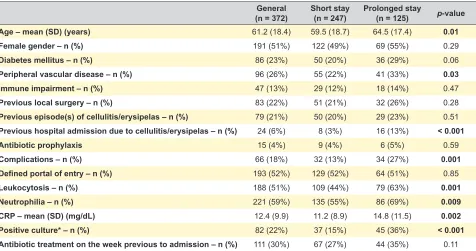
Table 1 – Univariate analysis of the characteristics of patients admitted with cellulitis/erysipelas General
(n = 372) Short stay(n = 247) Prolonged stay(n = 125) p-value
Age – mean (SD) (years) 61.2 (18.4) 59.5 (18.7) 64.5 (17.4) 0.01
Female gender – n (%) 191 (51%) 122 (49%) 69 (55%) 0.29
Diabetes mellitus – n (%) 86 (23%) 50 (20%) 36 (29%) 0.06
Peripheral vascular disease – n (%) 96 (26%) 55 (22%) 41 (33%) 0.03
Immune impairment – n (%) 47 (13%) 29 (12%) 18 (14%) 0.47
Previous local surgery – n (%) 83 (22%) 51 (21%) 32 (26%) 0.28
Previous episode(s) of cellulitis/erysipelas – n (%) 79 (21%) 50 (20%) 29 (23%) 0.51 Previous hospital admission due to cellulitis/erysipelas – n (%) 24 (6%) 8 (3%) 16 (13%) < 0.001
Antibiotic prophylaxis 15 (4%) 9 (4%) 6 (5%) 0.59
Complications – n (%) 66 (18%) 32 (13%) 34 (27%) 0.001
Defined portal of entry – n (%) 193 (52%) 129 (52%) 64 (51%) 0.85
Leukocytosis – n (%) 188 (51%) 109 (44%) 79 (63%) 0.001
Neutrophilia – n (%) 221 (59%) 135 (55%) 86 (69%) 0.009
CRP – mean (SD) (mg/dL) 12.4 (9.9) 11.2 (8.9) 14.8 (11.5) 0.002
Positive culture* – n (%) 82 (22%) 37 (15%) 45 (36%) < 0.001
ARTIGO ORIGINAL
RESULTS
A total of 372 hospital admissions were recorded during the study period, corresponding to 348 patients, with an 11-day median length of stay, mostly affecting the lower limb (n = 284, 76%), followed by the face (n = 42, 11%) and the upper limb (n = 36, 10%). Forty four percent of the hospital admissions were considered as prolonged LOS (n = 125).
Patient’s characteristics are shown in Table 1. A signifi-cantly higher mean age was found in the group of patients with prolonged LOS [64.5 (17.4) vs. 59.5 (18.7); p = 0.01] while no significant differences were found as regards tient’s gender (p = 0.29), even though mostly female pa-tients with prolonged LOS were found. Rates of 29% vs. 20%, 33% vs. 22%, 14% vs. 12% and 26% vs. 21% were found as regards prolonged vs. short stay, respectively, in patients with diabetes mellitus, peripheral vascular disease, immune impairment and previous local surgery. A previous history of cellulitis/erysipelas was found in 21% of hospital admissions and at least one previous hospital admission due to the same reason was found in 6% of the cases. As regards the episode of cellulitis/erysipelas underlying the
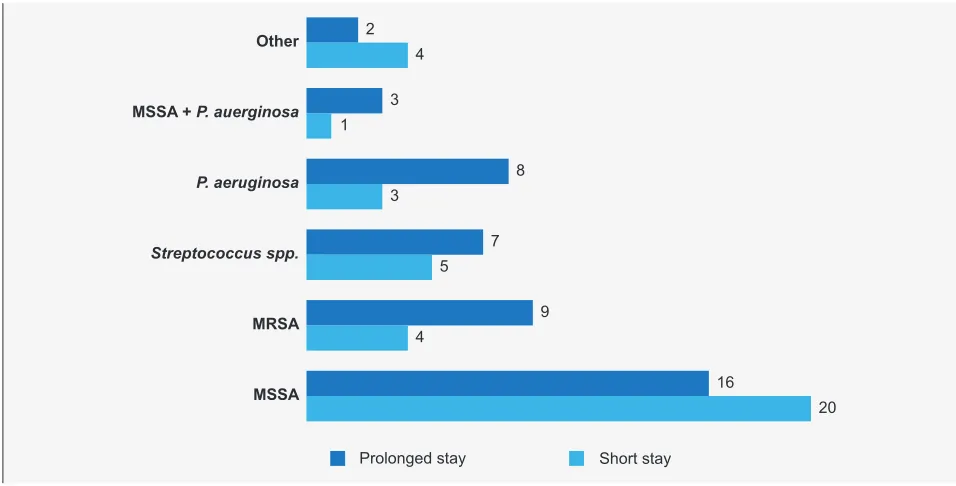
hospital admission, the presence of complications was significantly more frequent in patients with prolonged LOS (27% vs. 13%; p = 0.001). The complications associated with cellulitis/erysipelas are shown in Table 2. The identifica-tion of a portal of entry was similar in both groups (52% vs. 51%). Cultures were carried out in 262 admissions, which were positive in 31% (n = 82) of the cases (72 cases with a positive exudate culture, seven with a positive blood culture and three with both positive exudate and blood cultures). The microorganisms that were grown are shown in Fig. 1. Finally, no significant differences were found as regards an antibiotic treatment on the week previous to admission, even though this was more frequently found in the group with a prolonged LOS (35% vs. 27%) (p = 0.11).
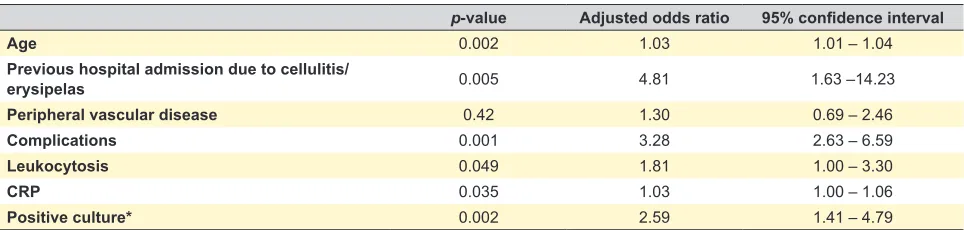
The adjustment of the model of logistic regression has allowed for the identification of patient’s age (p = 0.002), previous admission with cellulitis/erysipelas (p = 0.005), presence of complications (p = 0.001), leukocytosis (p = 0.049), CRP value (p = 0.035) and positive culture (p = 0.002) as factors associated with prolonged LOS (Ta-ble 3). The presence of previous admission with cellulitis/ Table 2 – Complications associated with cellulitis/erysipelas
General
(n = 66) Short stay(n = 32) Prolonged stay(n = 34)
Abscess – n (%) 33 (50%) 11 (35%) 22 (64%)
Lymphangitis – n (%) 22 (33%) 18 (56%) 4 (12%)
Skin ulcer – n (%) 4 (6%) 1 (3%) 3 (9%)
Necrosis – n (%) 1 (2%) 0 (0%) 1 (3%)
Skin blister – n (%) 2 (3%) 1 (3%) 1 (3%)
Osteoarticular involvement – n (%) 4 (6%) 1 (3%) 3 (9%)
Figure 1 – Microorganisms grown in culture.
MSSA: methicillin-sensitive Staphylococcus aureus; MRSA: methicillin-resistant Staphylococcus aureus; P. aeruginosa: Pseudomona aeruginosa; spp.: species. Others, including: Serratia marcescens (n = 3), E. coli (n = 1), Klebsiella pneumoniae (n = 1), Pantoea agglo-merans (n = 1)
Prolonged stay Short stay MSSA + P. auerginosa
Other
P. aeruginosa
Streptococcus spp.
MRSA
MSSA
2 4
3 1
8 3
7
9 4
16
ARTIGO ORIGINAL
erysipelas and the presence of complications were the most significant variables.
The authors declare having followed the ongoing pro-tocols at the healthcare institution as regards the publica-tion of any personal data. An anonymised dataset has been used and none of the authors had any access to any identi-fication elements of the patients. The study was carried out according to the Helsinki Declaration of the World Medical Association.
DISCUSSION
This is the first Portuguese study on the clinical and lab-oratorial factors associated with prolonged LOS of patients admitted with cellulitis/erysipelas. Therefore, it was found that patient’s age, the presence of at least one previous hospital admission with cellulitis/erysipelas, the presence of complications, leukocytosis, CRP value on admission and a positive culture were associated with a long hospital stay.
In addition to higher associated costs, prolonged LOS due to cellulitis/erysipelas is frequently associated with the need for additional clinical evaluation with diagnostic tests (including imaging), with invasive procedures, including surgical drainage or debridement, long-term antibiotic treat-ment, with the risk of nosocomial infections and delayed re-covery of the activities of daily living, with an impact on the patient’s quality of life.
Despite no ideal antibiotic regimen has ever been es-tablished, a therapeutic protocol based on the presence of comorbidities and previous antibiotic treatment is followed in our department. Even though clinical guidelines have al-ready been recommended for the approach and treatment of patients with cellulitis/erysipelas, there are still few data allowing for the identification of patients at risk of prolonged LOS and, in addition, that could benefit from a more aggres-sive treatment.2,3
In line with our study, other studies have looked for the characteristics of patients with cellulitis/erysipelas associ-ated with prolonged LOS. According to the North-American multi-centric study by Gang et al. on 4,224 hospital admis-sions due to lower limb cellulitis/erysipelas, variables such as patient’s age, female gender, diabetes mellitus, tachy-cardia, hypotension, leukocytosis, neutrophilia and elevat-ed serum creatinine were associatelevat-ed with prolongelevat-ed LOS.4 In a study from New Zealand, involving 51 patients admit-ted with lower limb cellulitis, it has been found that an ele-vated neutrophil count, the score of oedema and the use
of diuretics were independently associated with prolonged LOS.5 In 2003, Carratalà et al. have examined 332 patients admitted with cellulitis, regardless of its location and have reached the conclusion that patients with multiple comor-bidities, hypoalbuminaemia, kidney failure or skin necrosis on admission remained longer in the hospital.6 In addition, an Australian study involved 395 episodes of cellulitis/er-ysipelas affecting different anatomical locations has found that over 60 years of age, symptoms lasting more than 4 days, the presence of hypoalbuminaemia, the presence of bacteraemia and methicillin-resistant Staphylococcus aureus (MRSA) were associated with prolonged LOS. On the other hand, neutrophilia and elevated serum creatinine were not associated with prolonged LOS in this analysis.7 Finally, a Canadian study based on the national database of 65,454 patients admitted with cellulitis has shown that over 65 years of age, female gender and congestive heart failure were factors associated with prolonged LOS.8
Heterogeneous results still exist and could be influ-enced by the absence of clearly defined criteria for the di-agnosis and approach to patients with cellulitis/erysipelas, leading to different approaches in the different centres, as well as regarding the average LOS.9–11 However, Gang et al. argued that the results of these studies could represent an important tool for the construction of a severity score,4 in line with the scores applied to pneumonia that led to the reduction of the rates of hospital admission, as well as LOS and associated complications.12–15
The presence of potential confounding factors for pro-longed LOS is one of the major limitations of this obser-vational study, including unfavourable social background or other complications not directly related to the episode of cellulitis/erysipelas. However, the application of an im-proved logistic regression model, with a stepwise data en-try method, was aimed at reducing the statistical impact of confounding factors.
CONCLUSION
In conclusion, the knowledge of the predictive clinical and laboratorial characteristics could be relevant to im-proved healthcare delivery, aimed at reducing the length of stay and associated risks and costs.
HUMAN AND ANIMAL PROTECTION
The authors declare that the followed procedures were according to regulations established by the Ethics and Table 3 – Improved logistic regression, including 70% of data (262/372), due to missing values
p-value Adjusted odds ratio 95% confidence interval
Age 0.002 1.03 1.01 – 1.04
Previous hospital admission due to cellulitis/
erysipelas 0.005 4.81 1.63 –14.23
Peripheral vascular disease 0.42 1.30 0.69 – 2.46
Complications 0.001 3.28 2.63 – 6.59
Leukocytosis 0.049 1.81 1.00 – 3.30
CRP 0.035 1.03 1.00 – 1.06
ARTIGO ORIGINAL Clinical Research Committee and according to the Helsinki Declaration of the World Medical Association.
DATA CONFIDENTIALITY
The authors declare that they have followed the proto-cols of their work centre on the publication of patient data. Informed consents were obtained.
CONFLICTS OF INTEREST
The authors declare that there were no conflicts of inter-est in writing this manuscript.
FINANCIAL SUPPORT
The authors declare that there was no public or private financial support in writing this manuscript.
REFERENCES
1. Caetano M, Amorim I. Erysipelas. Acta Med Port. 2005;18:385–93. 2. Stevens DL, Bisno AL, Chambers HF, Dellinger EP, Goldstein EJ,
Gorbach SL, et al. Practice guidelines for the diagnosis and management of skin and soft tissue infections: 2014 update by the Infectious Diseases Society of America. Clin Infect Dis. 2014;59:e10–52.
3. Eron LJ, Lipsky BA, Low DE, Nathwani D, Tice AD, Volturo GA. Expert
panel on managing skin and soft tissue infections. Managing skin and
soft tissue infections: expert panel recommendations on key decision
points. J Antimicrob Chemother. 2003;52:i3–17.
4. Garg A, Lavian J, Lin G, Sison C, Oppenheim M, Koo B. Clinical characteristics associated with days to discharge among patients admitted with a primary diagnosis of lower limb cellulitis. J Am Acad Dermatol. 2017;76:626–31.
5. Morpeth SC, Chambers ST, Gallagher K, Frampton C, Pithie AD. Lower limb cellulitis: features associated with length of hospital stay. J Infect. 2006;52:23–9.
6. Carratalà J, Rosón B, Fernández-Sabé N, Shaw E, del Rio O, Rivera
A, et al. Factors associated with complications and mortality in adult patients hospitalized for infectious cellulitis. Eur J Clin Microbiol Infect Dis. 2003;22:151–7.
7. Figtree M, Konecny P, Jennings Z, Goh C, Krilis SA, Miyakis S. Risk
stratification and outcome of cellulitis admitted to hospital. J Infect.
2010;60:431–9.
8. Baibergenova A, Drucker AM, Shear NH. Hospitalizations for cellulitis in Canada: a database study. J Cutan Med Surg. 2014;18:33–7.
9. Levell NJ, Wingfield CG, Garioch JJ. Severe lower limb cellulitis is best
diagnosed by dermatologists and managed with shared care between primary and secondary care. Br J Dermatol. 2011;164:1326–8. 10. Arakaki RY, Strazzula L, Woo E, Kroshinsky D. The impact of dermatology
consultation on diagnostic accuracy and anti- biotic use among patients
with suspected cellulitis seen at outpatient internal medicine offices: a
randomized clinical trial. JAMA Dermatol. 2014;150:1056–61.
11. Strazzula L, Cotliar J, Fox LP, Hughey L, Shinkai K, Gee SN, et al.
Inpatient dermatology consultation aids diagnosis of cellulitis among hospitalized patients: a multi-institutional analysis. J Am Acad Dermatol. 2015;73:70–5.
12. Dean NC, Silver MP, Bateman KA, James B, Hadlock CJ, Hale D. Decreased mortality after implementation of a treatment guideline for community-acquired pneumonia. Am J Med. 2001;110:451–7.
13. Dean NC, Suchyta MR, Bateman KA, Aronsky D, Hadlock CJ. Implementation of admission decision support for community-acquired pneumonia: a pilot study. Chest. 2000;117:1368–77.
14. Menéndez R, Torres A, Zalacaín R, Aspa J, Martín-Villasclaras JJ, Borderías L, et al. Guidelines for the treatment of community-acquired pneumonia: predictors of adherence and outcome. Am J Respir Crit Care. 2005;172:757–62.