Brainstorming Strategy and Writing Performance:
Effects and Attitudes
Soheila Abedianpour
Department of ELT, Yasuj Branch, Islamic Azad University, Yasuj, Iran
Arezoo Omidvari
Department of ELT, Yasuj Branch, Islamic Azad University, Yasuj, Iran
Abstract—The study sought to examine the impact of employing brainstorming strategy, as a pre-writing strategy, on advanced EFL students' writing ability. Moreover, the study sought to investigate the attitudes of the participants in terms of the efficacy of brainstorming for developing writing performance. Sixty participants were randomly assigned to two groups participating in Writing II course at Atlas Language Institute in Yasouj, Iran. The highest as well as the lowest achievers were deleted in order to have an almost homogenous group. The participants were randomly assigned to control (No = 30) and experimental (No = 30) groups. Both groups had the same teacher. Based on the results of the pretest and posttest, learners that were treated with brainstorming made significant progress in writing. Furthermore, questionnaire scores indicated that the majority of the learners found brain storming a useful strategy in enhancing their writing skills. The results of the current study highlight the effectiveness of employing brainstorming as a pre-writing strategy in developing EFL students’ writing skill.
Index Terms—brainstorming, writing performance, advanced English as a foreign language (EFL) learners
I. INTRODUCTION
According to Fitze and Glasgow (2009,) several forms of knowledge including grammar- vocabulary- and rhetorical structure of the language are needed for writing as an ability interrelated with creativity. Writing motivates thinking and learners are compelled to focus and organize their opinions. Based on Maghsoudi and Haririan’s (2013) remarks writing also reinforces learning and reflects in the language. As Yong (2010) noted writing can also foster collaborative skills of the learners. According to Cohen and Brooks-Carson (2001), creating opinions can produce anxiety especially for those experiencing writing in the context of a second or foreign language. According to McDonough (2004), collaborative group arguments can diminish the level of anxiety in the learner. He also believed that chances for communication can be provided through such activities. Based on Mohamed and Mahmoud (2004) collaborative tasks can trigger a supportive instruction environment to exchange opinions and knowledge. According to Johnson (2000), student learning can be enhanced and social relation can be promoted through the potential of cooperative learning. O'Donnell (1985) said that positive interaction also can be increased via collaborative group work. Hirst (2005) discussed that collaboration can contribute to an increase in producing opinions. Similarly, Richards and Rodgers (2011) argued that communicative competence can be developed by cooperative learning.
The majority of the students think that writing is not a cooperative work and also it is an individual attempt. They may never share their composition with their classmates and do not require their friend's written reflection and have no feedback for them. Thus, enhancement of the quality of learners' composition is required for English writing teachers to give learners more collaborative environment and also make them eager to share their production with their classmates. Nowadays composition tasks are not paid enough attention as a significant element in the context of EFL by both learner and instructors in some educational settings in Iran. Therefore, the present investigation seeks to provide some preparation for writing classes to make learners become skilled in structural writing production. Composition classes seem to be boring for the learners and they do not enjoy them since they are not involved in such classes. On the other hand, stimulating them is not easy at all. Therefore, the present study seeks the effectiveness of the Iranian learners' composition skill which is based on the enhancement the brainstorming strategy to progress their writing skill. In fact investigators believe that the implementation of brainstorming tasks is one of the ways to obtain this target. Thus, the current research investigates the effectiveness of the Iranian learners' writings which is based on developing the brainstorming strategy to improve their writing skills. Indeed many researchers (e.g., Amoush, 2015; Hashempour, Rostampour, & Behjat, 2015; Maghsoudi, & Haririan, 2013; Manouchehry, Farangi, Fatemi, & Qaviketf, 2014; Mahdian Mehr, Aziz Malayeri, & Bayat, 2016; Rashtchi, & Beiki, 2015) believe that one way to achieve this goal is through applying brainstorming activity. However, no research study, to date, to the best knowledge of the researchers have explored the effect of brain storming strategy on writing performance as well as examining the attitudes of learners concerning the efficacy of this strategy for improving writing performance.
The Nature of Writing Performance
This is a traditional viewpoint that language classes which writing performances initially to support and reinforce patterns of oral language use- the notion is supplanting vocabulary and grammar in a second language is valuable. French and Rhoder (1992) strongly emphasized on the critical role of writing in L2 acquisition and expressed that writing is closely associated with creativity. Composition is one of the tasks that we can be requested to conduct enhancing learners “one of the skill that is necessary for learners to improve during their educational courses is writing". They are also required to progress their ability to write in activities such as meaningful sentence- coherent ideas- use interactional phrases- select appropriate words and idioms and use them in their writing. According to Chien (2012) the majority of the investigations on L2 writing has been dependent on the relation between competence of writing and strategy use has revealed that writing proficiency is writing intertwined to writing strategy use. For example Bai (2013) understood that writing strategies including planning - revising and assessing were importantly related to English language proficiency. Regarding this issue PRE is a task in class motivating learners to write that can make thoughts stimulated to be triggered. In this step learners let their own writing to be reflected and measure their improvements. Also the teachers require to enhance flexibility and adopt their instruction to the various needs of the learners. The learners who want to write take time to think about their topic and produce opinions. Sometimes a learner is disappointed since he/she con not think of anything to say related to the title in the prewriting stage.
According to Rimes (1983), the writing process in the classroom as a plan for teaching that prepare learners a collection of planning learning experiences to contribute them to figure out the entity of writing at any point. There are lots of strategies to seek opinions about the title and various ways to be closer to your composition. In this part learners will be trained lots of techniques and strategies to produce opinions. One of these strategies is brainstorming. As a matter of fact it is a revolutionary strategy for opinion generating which is tried and practiced in many offices and laboratories. It is intriguing to understand that a qualified brainstorming session is sudden and the secret of such issue is also well planning. Based on the Tarker and Shamates (1992) brainstorming is a mean to motivate quantity much more than quality. It starts with expression of the target and learners have some few seconds to write short information quickly and then can give their perceptions. When the list of brainstorming is perfect argument certifies about thoughts and requires to be taken later. In fact brainstorming contributes the learners to convey the ideas from the brain to speaking organs or to the related members to abilities like writing. It is a band or individual inventiveness strategy by which attempts are made to discover an end for a special complication.
The Brainstorming Strategy
According to Luchini (2010), the different cognitive and linguistic characteristics involved in the writing ability make it a difficult task for students to learn. It is necessary for the learners to enhance support opinions they plan to interact through the process of writing. They require to arrange - amend and rewrite before their manuscripts are completed. However according to Furneaux (1999) writing is considered as a “tedious chore" for teachers and learners if it concentrates only on the products. Learners can be actively involved in writing process by brainstorming. Based on Richards (1990) brainstorming can progress the learners cognitive skill and contribute them to produce opinions. In his investigation Richards revealed that learners who were instructed in brainstorming strategy were more effective in making classifying opinions than others. KhalafIbnian (2011) has pointed to the positive role of brainstorming in the development of organization and mechanics of writing. The positive effect of brainstorming on the writing skills of the learners has also been documented by Rao (2007). The study by Alkhatib (2012) highlighted the effect of brainstorming on the problem solving of the L2 learners and Maghsoudi and Haririan (2013) showed that brainstorming helps the L2 learners gain more independence and success in writing. Storch (2005) declared that cooperative writing raises the writing quality; progress learner stimulation (swain.1998); promote knowledge pooling (Donato. 1994) and developed concentration on discourse structure- grammar- and usage if vocabularies (Swain, 1998). Based on Franken’s (2002) investigation collaborative interaction had positive influence on learners’ summary writing. Storch (2005) revealed that pair work among group members resulted in opinion sharing; also- he showed that learner working in categories wrote more summarized but grammatically exact and sophisticated argumentative essay than the learners who worked and wrote personally. According to an investigation conducted by Storch (2007) comparing the generated texts written in pairs and individually had discovered no important divergence concerning accuracy; however he came to this result that cooperative influenced learners’ word selection.
According to Wigglesworth and Storch (2009), cooperation in writing tasks positively affects the writing accuracy of learners and Furneaux (1999) maintained that topic familiarity has a significant role in the writing skill of L2 learners. However, Anderson (2007) indicated that topical knowledge is less important than general knowledge in students writing ability.
Previous Studies
performance positively, making them more active. This, in turn, may push them to be more serious in taking on more important responsibility in their own learning.
In their study, Fatemi and Qaviketf (2014) sought to investigate g the impact of two types of brainstorming strategies on EFL learners' writing ability. The researchers invited sixty Iranian EFL intermediate learners to take part in this study. They were selected from a language institute in Iran. Then, the students were divided into the following three groups: two experimental groups and one control group. The students took an essay writing test which served as the pretest and posttest in both experimental and control groups. Each experimental group was taught either of the two strategies of brainstorming. The statistical analysis of the collected data showed that the experimental groups had a better performance on their posttest than on pretest. Moreover, the participants in the experimental groups outperformed those in the control group significantly on the posttest. The results of the ANOVA showed that the instruction of brainstorming strategies influenced EFL learners’ writing performance positively and the students in the experimental group two had a better performance than those in experimental group one. The treatment made the students in both experimental groups more active and aware of their learning, resulting in more responsibility on their part. Based on the results of the study, the researcher suggests some implications for L2 teaching and learning. That is, L2 learners can learn more effectively if they become more aware of their learning processes and decide to act accordingly. L2 instructors are also recommended to increase the learners’ confidence in writing by adopting the brainstorming strategies.
Amoush (2015) carried out a study to identify the effect of using brainstorming strategy on the enhancement of writing performance among English Students at a University in Jordan. Eighty students (male and female) attending university were divided into two groups; experimental (they were taught, using brainstorming strategy) and control (they were taught traditionally). To collect the required data, the researcher used writing essay as a research instrument. Data analysis was performed using t-test, the results of which showed the positive effect of brainstorming on the writing progress of English learners in Jordan.
Hashempour, Rostampour, and Behjat (2015) investigated the effect of pre-writing strategies like brainstorming, listening, questioning and answering and outlining on Iranian male and female English learners at advanced level of language proficiency. The study used pretest, instruction, posttest as well as a questionnaire at the end of the treatment with the aim of measuring the students' attitude toward instruction research instruments. The findings of the study indicated no significant relationship between using brainstorming strategy, its subcategories and EFL learners' writing performance. Moreover, the findings indicated no significant difference between males and females with respect to using brainstorming and the three subcategories either.
Rashtchi and Beiki (2015) sought to shed light on to the possible effect of the following two types of brainstorming strategy on Iranian EFL learners' writing performance: teacher-generated cooperative brainstorming versus learner-generated cooperative brainstorming. Thirty female EFL learners were selected from language institute, using convenience sampling. Having taken a writing pretest, the participants in two intact classes were randomly divided into the following two groups: teacher-generated cooperative brainstorming (TG) and learner generated cooperative brainstorming (LG) groups. Each group consisted of 15 students. The results of the study indicated that learner generated cooperative brainstorming had better effect on writing performance of L2 learners than teacher-generated cooperative brainstorming. Based on the results of attitude questionnaire, it was also found that learners favored the inclusion of both learner and teacher generated cooperative brainstorming.
Mahdian Mehr, Aziz Malayeri, and Bayat (2016) conducted a qualitative study, dealing with the effect of brainstorming technique on expository writings among Iranian EFL learners. It sought to examine the effect of brainstorming technique in the development of communicative skill in a training environment. In this context, the treatment was made up of a narrative composition (the TWE essay test) – the first observation and writing in the L2 – a sequencing expository compositions for later observations. The latter was assessed based on accuracy and complexity. In fact, the papers were rated by two university professors as raters. Then, the collected essays were analyzed by the researchers. Therefore, they analyzed the papers by the TEEP rubric 2014 to verify the optimum accuracy (and consistency). In short the findings showed that two raters enjoyed similar awareness of the scores which were assigned to the writing papers, revealing the effectiveness of brainstorming technique on the participants' writing ability.
III. RESEARCH QUESTIONS
The purpose of the present study was to answer the following research questions:
Q1: Does brainstorming strategy have any significant impact on writing performance of Iranian advanced EFL learners?
Q2: What are the attitudes of the learners towards the effectiveness of brainstorming strategy in improving their writing performance?
IV. METHOD
Sixty Iranian advanced students of Sadra Language Institute in Yasouj were selected out of 90 who volunteered to participate in the study based on their scores in Nelson Test of English Language Proficiency. They were both male and female. Nelson test was used to homogenize the participants in terms of English language proficiency. In other words, based on the results of Nelson test, only those learners whose test results were within the range of ±1 standard deviation were selected as participants with homogenized level of language proficiency (Negari, 2011). These participants were then divided into two equal groups of experimental and control groups (each group containing 30 learners). The groups contained both male and female learners with age range of 20 to 36 years old and all had passed three English writing courses (Negari, 2011).
Instruments
Instructional Material
In this study, the students own text book, the “Academic Writing Practice for IELTS” text book, were covered during the semester. This possibly had some advantages: (a) students would pay more attention to it, as an authentic material, rather than some unreal materials; (b) difficulty level of the passages was geared to the level of students.
Testing Material
Three instruments were used in the study: The Nelson Test and two compositions. The Nelson test was used for homogenizing the participants in terms of English language proficiency. The test was chosen from Nelson series with version number of 300B (Negari, 2011). The test contained 4 parts including cloze test, structure test, vocabulary test, and pronunciation test. Totally 50 items with multiple-choice format comprised the test and the allocated time for taking the test was 45 minutes. In order to select participants with homogenized level of language proficiency, initially a group of advanced students got to take the test and then using mean score and standard devotion of the group, those students with scores within the range of mean score ±1 standard deviation were selected as the homogenized English language learners (Negari, 2011).. In the next step, the selected students were asked to choose one topic and write a composition on it (i.e. either modern education or future employment) before the instruction, at the beginning of the course, (pretest) and after the instruction, at the end of the course, (posttest). The topics for the pretest and posttest were the same. The subjects were required to write their compositions in at least five paragraphs in at most 90 minutes.
The scoring of the composition was done on a scale of 0 to 20 by two experienced English teachers. Inter-rater reliability, or the degree to which the two raters agree in their evaluations of the same composition, for the pretest and posttest were 0.87 and 0.85 respectively.
Questionnaire on Attitudes towards the Efficacy of Brain Storming Strategy
Dorneyei (2003, p.52) maintains that “borrowing questions” from established questionnaires is one of the sources based on which researchers can choose the items intended for their studies. He believes that questions that have been used previously have most probably been piloted and the chances are that they possess the required quality. Along the same lines, the items included in the questionnaire of this study were borrowed from previously-constructed, valid and reliable questionnaires measuring learners’ attitudes towards different aspects of language learning (e.g. Abdi, 2013; Boonmoh, 2003; Boonmoh, 2010; Chatzidimou, 2007; Cohen, 2006; Dashtestani, 2013; Dyson & Haselgrove, 2001; Fry & Gosky, 2007; Golonka et al., 2012; Jian, et al. 2009; Laufer, 2000; Marzban, 2011; Nesi, 2009; Stirling, 2003).
After borrowing items, drawing on the previously used questionnaires and developing the first draft of the questionnaire, in order to assure their appropriacy in the current research context, it was piloted twice. The first draft was once piloted on five students with characteristics the same as participants of the study to gain insights in terms of the choice of vocabulary items and grammar used in the questionnaire and a second time to run Chronbach’s Alpha for the purposes of establishing the required internal consistency. After the first piloting phase of the study, the questionnaires were collected and analyzed. Two days after that, 20 minute meetings were held with each one of the participants to gather their viewpoints in terms of the items. Each meeting unfolded following these steps:
The respondents were given the questionnaires and asked to respond to the items again.
The questionnaires filled out in this session were compared with the previously filled out questionnaires and any differences were spotted.
The learner was asked to answer why there was a change in the answers provided. Most of the changes were found to be rooted in respondents’ misunderstanding in terms of grammar, vocabulary items used and the instructions.
The findings were used to make revisions to the questionnaires. In this regard, learners’ suggestions concerning vocabulary and grammar were taken into account.
Some of the items were found to be rather difficult by the learners due to grammar and content. After all these revisions were carried out the questionnaire was piloted again on 20 learners with the same characteristics of the participants. The data gathered in this pilot study underwent Cronbach’s Alpha to assure the internal consistency of the questionnaire. The results of Cronbach’s Alpha indicated that the questionnaire had a reliability index of .78 which is considered satisfactory.
Procedure
because each item had only one correct response. Then, scores which were very high or too low on the test were discarded. The selected subjects were randomly (every other one) assigned to two groups: experimental and control groups.
After the sampling and selection stage, the two groups were pretested on writing ability. The pretest included essay writing on a given topic. Therefore, the two groups were required to write an essay on a given topic for 45 minutes. The written essays were collected and scored by two raters and average scores of the two raters were considered as the writing pretest scores of the learners in experimental and control groups. The composition of both groups was assessed holistically by two experienced EFL teachers. The raters read each composition independently and then assessed the overall quality of the composition in numerical values for the ease of computation.
Then, the students in both group participated in twelve sixty-minute study sessions. While the students in the experimental group received the instruction with a focus on brainstorming strategy, the control group did not availed themselves of the brainstorming strategy. To put it another way, the learners in control group practiced writing using product based approach. In this approach, learners just receive a sample writing and they are asked to follow the sample in writing their essays. In experimental group, students are involved in brainstorming and creative writing. In this approach, students are cognitively get involved and write based on their own plan of action. The steps for writing in experimental group included thinking, verbalizing, brainstorming ideas, classifying ideas and writing down the ideas.
The topics for writing essays in both groups were the same and started from the easiest to the most difficult. The topics used in the study were the ones in Foroutan (2013) and included plants, times, weather, air pollution etc. The topics were considered to suit students’ interest, personal information and they had enough ideas, information, and knowledge about the topics in order to develop them. Students participated constructively and enthusiastically in the classroom interventions and were very positive about them.
After the treatment period was finished, the learners in the two groups took the writing posttest. In writing posttest, the learners were asked to write an essay on a given topic. The essays were collected and then scored by two raters. The average scores of the two raters were used as the writing posttest scores of the participants. It should be noted that essays either in pretest or posttest were scored in line with criteria in Jacobs et al. (1981). According to Jacobs et al. (1981) writing products can be scored using five components of content (30 points), organization (20 points), vocabulary (20 points), language use (25 points), and mechanics (5 points).
At the end of the study, the questioner on attitudes towards the efficacy of brain storming strategy was administered to 20 participants in the experimental group to address the second research question in the present study.
VRESULTS
Selection of the Participants
Initially, Nelson was given to the 90 original participants. Following that, 60 subjects out of 90 whose scores fell within the range mean score ±1 standard deviation were selected. The purpose of this procedure was to select participants who were in the same range of English language proficiency. The descriptive statistics of the participants after taking the Nelson test is found in Table 1.
TABLE 1
DESCRIPTIVE STATISTICS OF NELSON SCORES FOR THE INITIAL 90SUBJECTS
N Minimum Maximum Mean Std.
Deviation Skewness Kurtosis
Statistic Statistic Statistic Statistic Statistic Statistic Std.
Error Statistic
Std. Error
Nelson 90 34.00 47.00 38.14 7.16 -.11 .25 -.471 .503
Valid N
(listwise) 90
Table 1 shows that the initial 09 students had a mean score of 38.14 (SD=6..7). The highest score was found 47 and lowest score was found 34. Skewness was 0.47 and kurtosis was 0.117. Due to the fact that mean score is the best indicator of central point of Nelson scores, students whose scores fell between +1 and -1 standard deviation were selected as the study’s participants. Table 2 shows the descriptive statistics of the 60 students whose scores fell within the range of mean score ±1SD.
TABLE 2
DESCRIPTIVE STATISTICS OF NELSON SCORES FOR THE 60STUDENTS WHOSE SCORES FELL WITHIN MEAN SCORE ±1SD N Minimum Maximum Mean Std. Deviation Skewness Kurtosis
Statistic Statistic Statistic Statistic Statistic Statistic Std. Error Statistic Std. Error
Homogenized participants 60 37.00 45.00 43.0000 3.71438 -.166 .309 -.704 .608
After removing the participants with scores below or beyond mean score ±1SD the, mean score of the group was 43.00 (SD=3.71). Though mean score was not changed drastically, the standard deviation was almost dropped to half. These 60 intermediate English language learners served as the actual participants of the study.
Homogenizing the Participants in terms of writing
In order to make sure about the homogeneity of the two groups in terms of writing ability before starting the experimentation, the writing pretest scores of the two groups were compared using independent samples t-test. At first, the normality assumption of the scores for the pretest was established. Table 3 displays the results of One-Sample Kolmogorov-Smirnov Test of normality for the writing pretest scores of the control and experimental group.
TABLE 3
RESULTS OF ONE-SAMPLE KOLMOGOROV-SMIRNOV TEST OF NORMALITY FOR THE WRITING PRETEST SCORES OF THE CONTROL AND EXPERIMENTAL
GROUP
One-Sample Kolmogorov-Smirnov Test
Pretest Control Pretest Experimental
N 30 30
Normal Parametersa,b Mean 13.1667 12.6333
Std. Deviation 2.10227 2.04237
Most Extreme Differences
Absolute .187 .148
Positive .146 .122
Negative -.187 -.148
Kolmogorov-Smirnov Z 1.027 .812
Asymp. Sig. (2-tailed) .243 .524
a. Test distribution is Normal. b. Calculated from data.
As noticed in Table 3, the significance values are both above the critical value of 0.05 and thus the data sets are fit for parametric tests. Therefore, an independent samples t-test was run on the pretest scores of the two groups. Table 4 shows the descriptive statistics for the writing pretest scores of the experimental and control groups.
TABLE 4
DESCRIPTIVE STATISTICS OF THE SCORES OF WRITING PRETEST FOR THE TWO GROUPS
Group Statistics
Groups Pretest N Mean Std. Deviation Std. Error Mean
Pretest Both Groups Control 30 13.1667 2.10227 .38382
Experimental 30 12.6333 2.04237 .37288
Table 5 illustrates the results of independent samples t-test on the pretest writing scores of the experimental and control group.
TABLE 5
INDEPENDENT SAMPLES T-TEST RESULTS ON THE WRITING PRETEST SCORES OF THE EXPERIMENTAL AND CONTROL GROUP
Independent Samples Test
Levene's Test for Equality of Variances
t-test for Equality of Means
F Sig. t df Sig.
(2-tailed)
Mean Difference
Std. Error Difference
95% Confidence Interval of the Difference Lower Upper
Pretest Both Groups
Equal variances assumed
.055 .816 .997 58 .323 .53333 .53513 -.534 1.600
Equal variances not assumed
.997 57.92 .323 .53333 .53513 -.536 1.602
As indicated in Table 5, the significant value equals 0.323 which is higher than the confidence level of 0.05 and therefore it can be inferred that the means of the two groups for writing pretest scores are not significantly different. Thus, the two groups were homogeneous in terms of writing performance prior to the administration of the treatment.
Answering the First Research Question
TABLE 6
RESULTS OF ONE-SAMPLE KOLMOGOROV-SMIRNOV TEST OF NORMALITY FOR THE WRITING POSTTEST SCORES OF THE CONTROL AND
EXPERIMENTAL GROUP
One-Sample Kolmogorov-Smirnov Test
Posttest Control Posttest Experimental
N 30 30
Normal Parametersa,b Mean 13.5667 16.3333
Std. Deviation 3.86571 3.50697
Most Extreme Differences
Absolute .189 .175
Positive .189 .151
Negative -.087 -.175
Kolmogorov-Smirnov Z 1.034 .961
Asymp. Sig. (2-tailed) .236 .315
a. Test distribution is Normal. b. Calculated from data.
As presented in Table 6, the significance values are both above the critical value of 0.05 and thus the data sets are appropriate for parametric tests. Therefore, an independent samples t-test was run on the posttest scores of the two groups. Table 7 illustrates the descriptive statistics for the writing posttest scores of the experimental and control groups.
TABLE 7
DESCRIPTIVE STATISTICS OF THE SCORES OF WRITING POSTTEST FOR THE TWO GROUPS
Group Statistics
Groups Posttest N Mean Std. Deviation Std. Error Mean
Posttest Both groups Control 30 13.5667 3.86571 .70578
Experimental 30 16.3333 3.50697 .64028
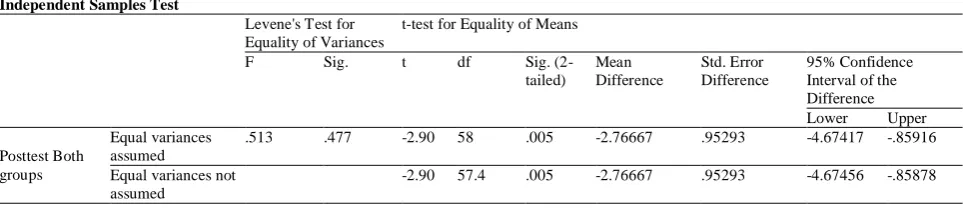
Table 8 illustrates the results of independent samples t-test on the posttest writing scores of the experimental and control group.
TABLE 8
INDEPENDENT SAMPLES T-TEST RESULTS ON THE WRITING POSTTEST SCORES OF THE EXPERIMENTAL AND CONTROL GROUP
Independent Samples Test
Levene's Test for Equality of Variances
t-test for Equality of Means
F Sig. t df Sig.
(2-tailed) Mean Difference
Std. Error Difference
95% Confidence Interval of the Difference Lower Upper
Posttest Both groups
Equal variances assumed
.513 .477 -2.90 58 .005 -2.76667 .95293 -4.67417 -.85916
Equal variances not assumed
-2.90 57.4 .005 -2.76667 .95293 -4.67456 -.85878
As seen in the Table 8, the significant value is 0.005 with p value of p ≤0.05. Therefore, a significant difference was found between the experimental and control group in terms of their writing performance. Moreover, as observed in Table 7, the mean of the scores for the control and experimental groups are 13.56 and 16.33. Therefore, it can be concluded that the group which received brain storming strategy had a better performance in terms of their writings compared to performance of the control group.
Answering the Second Research Question
TABLE 9
RESULTS OF THE QUESTIONNAIRE ON LEARNERS’ ATTITUDES TOWARDS THE EFFICACY OF BRAINSTORMING IN WRITING
Strongly disagree Disagree Neutral Agree Strongly Agree items 2(10%) 3(15%) 2(10%) 5(25%) 8(40%) 1. I enjoy brainstorming activities
2(10%) 2(10%)
4(20%) 5(25%)
7(35%) 2. I enjoy talking with classmates during
brain storming activities
1(5%) 3(15%)
3(15%) 4(20%)
9(45%) 3. I am interested in finding different ideas
during brain storming activities
1(5%) 3(15%)
1(5%) 7(35%)
8(40%) 4. It is more fun do brain storming for
writing than writing alone.
2(10%) 1(5%)
2(10%) 5(25%)
10(50%) 5. Using brain storming is a useful
technique in writing.
2(10%) 2(10%)
3(15%) 8(40%)
5(25%) 6. My classmates find brainstorming
activities very interesting.
1(5%) 1(5%)
3(15%) 7(35%)
8(40%) 7. I feel more relaxed to do brainstorming
activities than working alone while writing. 1(5%) 1(5%) 210%) 9(45%) 7(35%) 8. I could improve my writing better when
I was doing brain storming activities
1(5%) 3(15%)
2(10%) 840%)
6(30%) 9. I totally agree that brain storming
activities are useful and fun.
1(5%) 1(5%)
2(10%) 7(35%)
9(45%) 10Brain storming should be used more as a
means in promoting learners’ English writing ability. 2(10%) 6(30%) 3(15%) 5(25%) 4(20%) 11. I feel uncomfortable when doing
brainstorming. 4(20%) 6(30%) 5(25%) 2(10%) 3(15%) 12. I find it difficult to work with
classmates during brainstorming activities.
4(20%) 8(40%)
2(10%) 2(10%)
4(20%) 13. I prefer individual writing tasks to
brain storming activities.
3(15%) 9(45%)
1(5%) 3(15%)
4(20%) 14. I think that my writing could be much
better through using individual writing activities. 3(15%) 8(40%) 2(10%) 4(20%) 3(15%) 15. I think I could learn more grammar
points through working individually while writing comparing to brainstorming.
1(5%) 1(5%)
2(10%) 8(40%)
8(40%) 16. I feel that individual writing tasks bring
negative attitudes towards learning how to write in English
4(20%) 5(25%)
3(15%) 4(20%)
4(20%) 17. I often have trouble doing brain
storming activities. 3(15%) 8(40%) 4(20%) 3(15%) 2(10%) 18. I don’t often use e-texts.
4(20%) 8(40%)
1(5%) 4(20%)
3(15%) 19. I would choose individual activities if I
am not asked to participate in brainstorming by the teacher.
7(35%) 9(45%)
1(5%) 1(5%)
2(10%) 20. I often find individual writing tasks
more useful than brain storming activities in developing my writing abilities.
As Table 9 displays, most of the students reported that brain storming was more effective than individual writing tasks. Furthermore, regarding the kind of writing tasks they felt more comfortable with, the number of students who preferred brain storming was higher than the ones who preferred individual writing tasks. The results also illustrated that the major advantage of brain storming tasks was the convenience that using such tasks offered. Moreover, the respondents were more inclined to use brain storming to improve their writing ability. Based on the findings learners could get more benefits from brain storming in comparison with individual tasks. However, some students preferred individual tasks.
VI. DISCUSSION AND CONCLUSION
The results of this study are in contradiction with the findings of Hashempour, Rostampour and Behjat (2015) who found that there is no significant relationship between brainstorming strategy and learners' writing performances. But the results of the study are congruent with the findings of a number of other researchers in the related literature (e.g. Sari Navaee and Asadi, 2015; Shorofat, 2007; Ibnian, 2011; Haririan, Maghsoudi and Madani, 2014; Rashtchi and Beiki, 2015; Rao, 2007; and Manouchehry et.al. 2014) who found that brainstorming strategy develops writing performance of learners. The findings of the present study were in line with the study by Rao (2007) on the effect of brainstorming on the writing ability of L2 learners. Rao (2007) maintained that the brainstorming can stimulate the thinking process of the learners and help the learners create and organize their ideas in a logical manner. Also, the results of this study were in line with the findings of Pearson and Fielding (1991), who found that brainstorming strategy befits particularly students who show evidence of poor writing. Jacobs (1988) reported that the success of brainstorming strategy refers to the fact that it:
Increases the quantity of language students use, Enhances the quality of the language they use,
Equalizes the learning opportunities for all students, and
Creates a less threatening learning environment for language use.
More specifically, the main reason for the success of brainstorming strategy refers to its nature: Brainstorming provides multiple opportunities for input-output treatment whereby students receive repeated input and feedback from a variety of sources through teacher presentation and group work. Brainstorming enabled the participants in the experimental group to discover their classmates' perspectives and develop a range of ideas (Christmas, 2008). Activating students' background knowledge in the pre-writing stage strengthened students’ thinking skills and thus developed their writing performance. The other fact is that through brainstorming, we equalized learners' involvement in the writing task and encouraged ideas regarding the content and structure of the compositions particularly for lower performers.
To sum up, in this research we examined the effects of brainstorming strategy on the writing performance of Iranian advanced EFL learners. The results of the study corroborate the idea that if the brainstorming strategy is employed thoroughly and systematically, it can significantly improve the achievement of intermediate students’ writing performance. Despite these results, the researcher thinks, it is surprising that there are still language teachers who do not avail their writing classes of the benefits of brainstorming strategy.
REFERENCES
[1] Abdi, R. (2013). The effect of using hypertext materials on reading comprehension ability of EFL learners. Procedia - Social
and Behavioral Sciences, 25(6), 503-514.
[2] Al-khatib, A. B. (2012). The effect of using brainstorming strategy in developing creative problem solving skills among female students in Princess Alia University College. American International Journal of Contemporary Research, 2(10), 29-38. [3] Amoush, Kh. H. (2015). The impact of employing brainstorming strategy on improving writing performance of English major
students at Balqa Applied University in Jordan. Journal of Education and Practice, 6(35), 88-92.
[4] Arndt, V. (1987). Six writers in search of texts: A protocol-based study of L1 and L2 writing. ELT Journal, 41(3), 257-267 [5] Bai, R., Hu, G., & Gu, P. Y. (2013). The relationship between use of writing strategies and English proficiency in Singapore
Primary Schools. The Asia-Pacific Education Researcher, 39(1), 1-11.
[6] Boonmoh, A. (2003). Problems with using electronic dictionaries to translate Thai written essays into English. Unpublished MA thesis, King Mongkut’s University of Technology Thonburi, Bangkok.
[7] Boonmoh, A. (2010). Teachers’ use and knowledge of electronic dictionaries. ABAC Journal, 30(5), 56-74.
[8] Chatzidimou, K. D. (2007). Dictionary use in Greek education: an attempt to track the field through three empirical surveys.
Horizontes de Lingua Aplicada, 6(1), 91-104.
[9] Chien, S. C. (2012). Students use of writing strategy and their English writing achievements in Taiwan. Asia Pacific Journal of
Education, 32(1), 93-112.
[10] Christmas, B. (2008). The role of brainstorming in improving students writing performance in the EFL classroom. Online Available: http://sydney.edu.au/cet/docs/research/The%20Role%20of%20 Brainstorming%20in%20Improving%20St udents%2 0Writing.pdf. Retrieved April 22, 2016。
[11] Cohen, P. (2006). Strategies for Comprehending Electronic Text in Digitally Mediated Times. New York: Addison Wesley Longman.
[12] Cohen, A. D., & Brooks-Carson, A. (2001). Research on direct versus translated writing: Students‟ strategies and their results.
The Modern Language Journal, 85(2), 169-188.
[13] Dashtestani, R. (2013). Barriers to the implementation of CALL in EFL courses: Iranian EFL teachers’ attitudes and perspectives. The JALT CALL Journal, 8 (2), 55-70.
[14] Dornyei, Z. (2003). Questionnaires in Second Language Research: Construction, Administration, and Processing. Mahway, New Jersey: Lawrence Erlbaum.
[15] Dyson, M. C., & Haselgrove, M. (2001). The influence of reading speed and line length on the effectiveness of reading from screen. International Journal of Human-Computer Studies, 54, (3), 585– 612.
[16] Fitze, M., & Glasgow, R. (2009). Comparing the effect of collaborative and non-collaborative pre-Writing activities on first drafts. Journal of Research in Education, 19(1), 67-83.
[18] French, N., & Rhoder, C. (1992). Teaching Thinking Skills. Garland Publication, INC, New York, USA, 238.
[19] Fry, W., Gosky, M. (2007). Supporting Social Studies Reading Comprehension with an Electronic Pop-up Dictionary. Journal
of Research on Technology in Education. 24, (2), 225–240.
[20] Furneaux, C. (1999). Recent materials on teaching writing. ELT Journal 53(1), 56-61.
[21] Golonka, E. M., Bowles, A. R., Frank, V. M., Richardson, D. L., & Freynik, S. (2012). Technologies for foreign language learning: a review of technology types and their effectiveness. Computer Assisted Language Learning, 10, (3), 311-322. [22] Haririan, J., Maghsoudi, M. and Madani, D. (2014). The Effect of Brainstorming Strategies on Iranian EFL Learners' writing
Skill, Journal of Social Issues & Humanities, 2(4), 90-97.
[23] Hashempour, Z., Rostampour, M., & Behjat, F. (2015). The effect of brainstorming as a pre-writing strategy on EFL advanced learners’ writing ability. Journal of Applied Linguistics and Language Research, 2(1), 86-99.
[24] Hirst, L. A., & Slavik, C. (2005). Effective language education practices and native language survival. In: Native American Language Issues, edited by Reyhner J (pp. 133-142). Choctaw, OK: NALI Board of Executors.
[25] Hosseini, H., and Mohammad, S. (2014). Competitive Team-Based Learning versus Group Investigation with Reference to the Language Proficiency of Iranian EFL Intermediate Students. International Journal of Instruction, 7 (1), pp. 177-188.
[26] Jacobs, G. (1988). Cooperative goal structure: A way to improve group activities. ELT Journal, 42(2), 97–100.
[27] Javaherbakhsh, M., R. (2010). The Impact of Self-Assessment on Iranian EFL Learners’ Writing Skill. English Language
Teaching, 3(2). pp. 213-2018.
[28] Jian, H. L., Sandnes, F. E., Law, K. M., Huang, Y. P., & Huang, Y. M. (2009). The role of electronic pocket dictionaries as an English learning tool among Chinese students. Journal of Computer Assisted Learning, 25(6), 503-514.
[29] Johnson, D. W., Johnson, R. T., & Stanne, M. B. (2000). Cooperative learning methods: Meta – analysis. Available: http://www.co-operation.org/pages/cl-methods.html. Retrieved April 5, 2016.
[30] KhalafIbnian, S. (2011). Brainstorming and essay writing in EFL class. Journal of Theory and Practice in Language Studies,
1(3), 263-272.
[31] Laufer, B. (2000). Electronic dictionaries and incidental vocabulary acquisition: does technology make a difference? In: U. Heid et al. (eds.), 849–854.
[32] Luchini, P. L. (2010). Evaluating the effectiveness of a complimentary approach to teaching writing skills. International
Journal of Language Studies (IJLS), 4(3), 73-92.
[33] Maghsoudi, M., & Haririan, J. (2013). The impact of brainstorming strategies Iranian EFL learners' writing skill regarding their social class status. International Journal of Language and Linguistics, 1(4-1), 60-67.
[34] Mahdian Mehr, M., Aziz Malayeri, F., & Bayat, A. (2016). The effects of brainstorming as a prewriting activity on Iranian EFL learners prompted expository writing. International Journal of Educational Investigations, 3(3), 85-93.
[35] Manouchehry, A., Farangi, M. R., Fatemi, M. A., & Qaviketf, F. (2014). The effect of two brainstorming strategies on the improvement of Iranian intermediate EFL learners’ writing skill. International Journal of Language Learning and Applied
Linguistic world (IJLLALW), 6(4), 176-187.
[36] Marzban, A. (2011). Improvement of reading comprehension through computer-assisted language learning in Iranian intermediate EFL students. Procedia Computer Science. 16(3), 310-319.
[37] McDonough, K. (2004). Learner-learner interaction during pair and small group activities in a Thai EFL context. System, 32(3), 207–224.
[38] Mohamed, M., & Mahmoud, A. W. (2014). The effectiveness of using the cooperative language learning approach to enhance EFL writing skills among Saudi University Students. Journal of Language Teaching and Research, 5(3), 616-625.
[39] Mu, C. (2005). A taxonomy of ESL writing strategies. In Redesigning Pedagogy: Research, Policy, Practice, May 30-June 1 2005 (pp. 1-10). Singapore.
[40] Nesi, H. (2009). Dictionaries in electronic form. In Cowie, A.P. The Oxford History of English Lexicography. Oxford: Oxford University Press.
[41] Negari, G., M. (2011). A study on strategy instruction and EFL learners’ writing skill. International Journal of English
Linguistics, 1 (2), 128-139.
[42] Nobahar, B. & Shaghaghi, M. (2013). The effect of concept mapping on Iranian intermediate EFL learners' self-efficacy and expository writing accuracy. Theory and Practice in Language Studies, 3 (11), 2117-2127.
[43] O’ Donnell, A. M., Dansereau, D. F., Rockin, T., Lambiotte, J. C., Hythecker, V. I., & Larson, C. O. (1985). Cooperative learning: Direct effects and transfer. Written Communication, 2 (3), 307-315.
[44] Osborn, A. F. (1963). Applied imagination: Principles and procedures of creative problem solving (Third Revised Edition). New York, NY: Charles Scribner’s Sons
[45] Paulus, P. B., Dzindolet, M. T., Poletes, G., & Camacho, L. M. (1993). Perception of performance in group brainstorming: The illusion of group productivity. Personality and Social Psychology Bulletin, 19(1), 78–89.
[46] Pearson, D and Fielding, M. (1991). A schema-theories view of basic process in reading comprehension. In P. D. Pearson (Ed.),
Handbook of reading research (pp. 255-292). New York: Longman.
[47] Raimes, A. (1983). Techniques in teaching writing. New York & Oxford: Oxford University Press.
[48] Raimes, A. (1985). Language proficiency: Writing ability and composing strategies: A study of ESL College student writers. In A. Cumming (Ed.), Bilingual performance in reading & writing (pp. 139 - 172). Ann Arbor: John Benjamins.
[49] Rao, Z. (2007). Training in brainstorming and developing writing skills. ELT Journal, 61(2), 100-106.
[50] Rashtchi, M., & Beiki, M. (2015). The effect of teacher-generated cooperative brainstorming versus learner-generated cooperative brainstorming on activating EFL learners’ background knowledge in essay writing classes. Indian Journal of
Fundamental and Applied Life Sciences, 5(2), 1218-1227.
[52] Sari Navaee, M. and Asadi, M. (2015). The effect of brainstorming on reading comprehension of Iranian EFL learners, ICT &
innovations in education- international electronic journal, 3(2), 26-34.
[53] Sasaki, M. (2000). Toward an empirical model of EFL writing processes: an exploratory study. Journal of Second Language
Writing, 9(3), 259-91
[54] Sasaki, M. (2002). Building an empirically-based model of EFL learners’ writing processes. In S. Ransdell & M.-L. Barbier (Eds.), New directions for research in L2 writing (pp. 49–80). Dordrecht, The Netherlands: Kluwer Academic.
[55] Shorofat, A. (2007). The effect of Using Syncetics and Brainstorming on Ninth Grade Creative Writing. Unpublished Ph.D. Thesis, the University of Jordan.
[56] Stirling, J. (2003). The portable electronic dictionary: Faithful friend or faceless foe. Retrieved from http://www.elgweb.net/ped-article.html. Retrieved June 15, 2016.
[57] Storch, N. (2005). Collaborative writing: Product, process, and students‟ reflections. Journal of Second Language Writing, 14(3) 153–173.
[58] Victori, M. (1999). An analysis of writing knowledge in EFL composing: a case study of two effective and two less effective writers. System, 27(4), 537-555.
[59] Wigglesworth, G., & Storch, N. (2009). Pair versus individual writing: Effects on fluency, complexity and accuracy. Language
Testing, 26(3) 445-466.
[60] Yong, M. F. (2010). Collaborative writing features. Journal of Language Teaching and Research, 41(1), 18-30.
Soheila Abedianpour earned her master's degree in Islamic Azad University, Yasooj Branch, Yasooj Iran. Faculty of Humanities Science, Department English (M.A) Thesis on Teaching English Language.