3-ALKOXY-1,5-DIARYL-4,5-DIHYDROXYIMIDAZOLIDIN-2-ONES AND
3-ALKOXY-1-ALKYL-5-ARYL-4,5-DIHYDROXYIMIDAZOLIDIN-2-ONES: SYNTHESIS AND
STRUCTURE
V. G. Shtamburg,
[a]*V. V. Shtamburg,
[a]A. A. Anishchenko,
[b]S. V. Shishkina,
[c]A. V. Mazepa
[d]and I. S. Konovalova
[c]Keywords: 4-Nitrophenylglyoxal, N-alkoxy-N’-arylureas, N-alkoxy-N’-alkylureas, 3-alkoxy-1,5-diaryl-4,5-dihydroxyimidazolidin-2-ones, 3-alkoxy-1-alkyl-5-aryl-4,5-dihydroxyimidazolidin-2-3-alkoxy-1,5-diaryl-4,5-dihydroxyimidazolidin-2-ones, synthesis, structure.
It has been found that 4-nitrophenylglyoxal reacts with N-alkoxy-N’-arylureas and N-alkoxy-N’-alkylureas in acetic acid medium with the selective formation of the diastereomers of the 3-alkoxy-1,5-diaryl-4,5-dihydroxyimidazolidin-2-ones and 3-alkoxy-1-alkyl-5-aryl-4,5-dihydroxyimidazolidin-2-ones with cis-orientation of OH-groups. The X-ray structural analysis of 3-propyloxy-4S,5S-4,5-dihydroxy-1-methyl-5-(4-nitrophenyl)imidazolidin-2-one and of 3-n-butyloxy-4S,5S-4,5-dihydroxy-1-(4-methylphenyl)-5-(4-nitrophenyl)imidazolidin-2-one has demonstrated this structural feature of these compounds.
* Corresponding Authors Phone: +380-97-651-61-72 E-Mail: [email protected]
[a] 49005 Ukraine, Dnepr, Gagarina st., 8. Ukrainian State University of Chemical Technology
[b] 49050 Ukraine, Dnepr, Nauchnaya st. 25. O. Gonchar Dnepropetrovsk National University.
[c] 61001 Ukraine, Kharkov, Science ave., 60. STC "Institute for Single Crystals," National Academy of Sciences of Ukraine [d] 65080 Odessa, Luystdorfskaya Doroga st., 86. A.V.
Bogatsky Physico-Chemical Institute of NAS of Ukraine
INTRODUCTION
Arylglyoxals are widely used in syntheses of heterocycles as syntones.1-6 But the study of the arylglyoxals interaction
with N-hydroxyurea7-9 and its derivatives8,10 has started
recently and needs to be continued.
Arylglyoxals such as phenyl-, bromophenyl-, chlorophenyl-, fluorophenyl-, methoxyphenyl- and
4-methylglyoxal easily react with N-hydroxyurea in acetic
acid medium (Scheme 1) at the room temperature yielding the proper 5-aryl-3-hydroxyimidazolidine-2,4-diones
(5-aryl-3-hydroxyhydantoins) 1a-f.8 However,
4-nitrophenylgyoxal in acetic acid medium at room
temperature reacts with N-hydroxyurea giving only a
mixture of 5-aryl-3,4,5-trihydroxyimidazolidin-2-ones, 2a
and 3a, in molar ratio near 3:1 (room temp., 25 h).9
3-Hydroxy-5-(4-nitrophenyl)hydantoin (1g) is not formed.
This example has demonstrated, that the presence of a strong electron-withdrawing substituent on the benzene ring of arylglyoxals prevents a further conversion of 5-aryl-3,4,5-trihydroxyimidazolidin-2-ones into
5-aryl-3-hydroxy-imidazolidin-2,4-diones.9
We have obtained similar results in aqueous medium.
4-Nitrophenylgyoxal9 and 4-chlorophenylglyoxal7 form only
the mixtures of 5-aryl-3,4,5-trihydroxyimidazolidin-2-ones (2a,b and 3a,b) at 14-20 °C (Scheme 2).
Scheme 1. Arylglyoxal’s interaction with N-hydroxyurea in acetic acid (Ref. 8).
Scheme 2. Interaction of nitrophenylgyoxal hydrate and 4-chlorophenylglyoxal hydrate with N-hydroxyurea in aqueous medium.
In these mixtures, the diastereomers of 5-aryl-3,4,5-trihydroxyimidazolidin-2-ones (2a, 2b) with cis orientation of hydroxyl groups at C-4,5 carbon atoms are the main
products.7-9 The structure of compounds 2a,b has been
proved by XRD study.7,9
Phenylglyoxal reacts with N-hydroxyurea in aqueous
solution at the room temperature, forming the mixture of unstable 3,4,5-trihydroxy-5-phenylimidazolidin-2-ones
(2c,3c) and 3-hydroxy-5-phenylhydantoin (1a).7,8 The
compounds 2c and 3c are easily transformed to hydantoin 1a
by heating.7,8
4-Methoxyphenylglyoxal and 4-methylphenylglyoxal
form with N-hydroxyurea a mixture of
5-aryl-3-hydroxyhydantoins (1c,1d) and acyclic ureas (4c,4d)7
(Scheme 3).
OH
OH O
Ar H
H N
O H2N
OH
N
Ar O
O OH N
H H
Ar = p-XC6H4, X = H (a), Cl(b), Me(c),
OMe(d), Br(e), F(f) AcOH
1a-f
O
OHH
O
OHH O
O
A
Arr
H
H NN
H
HOO OOHH
O
O
O
OHH N
N
A
Arr HH
H
H
N
N
H
HOO HH
O
O
O
OHH
N
N
H
H
A
Arr OOHH
H
H
N
N
O
O
H
H22NN
O
OHH
H
H22OO
A
Arr ==pp--OO22NNCC66HH44((aa))
,
,pp--CCllCC66HH44((bb))
+ +
2
2aa,,bb 33aa,,bb
Scheme 3. Interaction of methylphenylgyoxal hydrate and 4-methoxyphenylglyoxal hydrate with N-hydroxyurea in aqueous solution.
In acetic acid medium, the majority of arylglyoxals reacts
with N-alkoxyureas forming only 3-alkoxy-5-arylhydantoins
(5a-e) (Scheme 4).
Scheme 4. Interaction of arylglyoxals with N-alkoxyureas in acetic acid medium.
The arylgyoxal’s interaction with N-alkoxy-N’-arylureas
(6) has been particularly studied.10 It has been shown that
anhydrous phenylglyoxal reacts with N-ethoxy-N’
-phenylurea (6a) in CH2Cl2 at 20 ºC yielding
3-ethoxy-1,5-bis(phenyl)imidazolidine-2,4-dione 7 in moderate (46 %)
yield10 (Scheme 5). Using N-benzyloxy-N’
-(4-nitrophenyl)urea (6b), anhydrous phenylglyoxal produces
(CH2Cl2, 20 ºC)
3-benzyloxy-4,5-dihydroxy-1-(4-nitrophenyl)-5-phenylimidazolidine-2-one 8 (56 %) and
3-benzyloxy-1-(4-nitrophenyl)-5-phenylhydantoin 9 (6 %).10
Scheme 5. Interaction of phenylglyoxal with N-alkoxy-N’-arylureas.
Scheme 6. Synthesis acyclic substituted N-alkoxyureas 10.
But the reaction between phenylglyoxal and N-
benzyloxy-N’-(2-bromophenyl)urea (6c) and N-ethoxy-N’
-(2-bromophenyl)urea (6d) in dichloromethane solution
(Scheme 6) at room temperature gives only acyclic ureas (10a,b).10,11 It is probable that the bulky ortho-bromo substituent prevents the further cyclization. The structure of
ureas 10a,b has been confirmed by XRD study. In the
crystalline state, compound 10a exists in two forms (10aA
and 10aB), which are distinguished by the pyramidality
degree of the acyclic amide nitrogen atom. The sum of bond
angles centered of this atom (Σß) is 336.0(3)º and 341.2(3)º
in the molecules 10aA and 10aB10, respectively. The urea
10b exists in the single form, the sum of bond angles
centered on the nitrogen atom is 340.0(3)º.11
So, the goal of our current research was to investigate the
interaction of 4-nitrophenylglyoxal with N-alkoxy-N’
-arylureas 6 in acetic acid medium.
EXPERIMENTAL
1H NMR spectra were recorded on a Varian VXP-300
spectrometer and Varian Jemini 400 spectrometer (300 and
400 MHz, respectively). 13C NMR spectra were recorded on
a Varian VXP-300 spectrometer (75 MHz) and Varian Jemini 400 spectrometer (100 MHz). The solvents were DMSO-d6 (for the compounds 6, 11a-g, 13b and 14a, b) and
CDCl3 (for the compounds 6a, 13a and 14a) 1H NMR
chemical shifts were reported relative to the residual solvent
protons as an internal standard ((CD3)2SO: 2.500 ppm) or
with TMS as an internal standard (in CDCl3). Solvent
carbon atoms served as an internal standard for 13C NMR
spectra ((CD3)2SO: 39.52 ppm). Mass spectra were recorded
on a VG 70-70EQ mass spectrometer in fast atom bombardment mode (FAB). The solvents were purified and dried according to the standard procedures.4-Nitrophenylglyoxal hydrate was obtained according to
published procedures.9
N-Ethoxy-N’-phenylurea (6a)
This compound was obtained according to published
procedures,10 yield was 60 %, colorless crystals, m.p.
101-104 ºC. 1H NMR (400 MHz, DMSO-d
6): δ = 1.213 (3H, t, J
= 7.2 Hz, NOCH2Me), 3.823 (2H, q, J = 7.2 Hz, NOCH2Me),
6.985 (1H, t, J = 7.6 Hz, C(4)H Ph), 7.257 (2H, t, J = 7.6,
Hz C(3)H, C(5)H Ph), 7.567 (2H, d, J = 7.6 Hz, C(2)H,
C(6)H Ph), 8.702 (1H, s, NH), 9.410 (1H, s, NHO). 1H
NMR (300 MHz, CDCl3): δ = 1.337 (3H, t, J = 7.0 Hz,
NOCH2Me), 3.987 (2H, q, J = 7.0 Hz, NOCH2Me), 7.105
(1H, t, J = 7.8 Hz, C(4)H Ph), 7.336 (2H, t, J = 7.8 Hz,
C(3)H, C(5)H Ph), 7.488 (2H, d, J = 7.8 Hz, C(2)H, C(6)H
Ph), 7.608 (1H, s, NH), 7.708 (1H, s, NHO). MS (FAB) m/z
361 [2M+H]+ (4), 181 [M+H]+(100). Anal. Calc. for
C9H12N2O2: C 59.99, H 6.71, N 15.55. Found: C 59.81, H
6.83, N 15.44.
N-Methoxy-N’-phenylurea (6e)
A solution of phenyl isocyanate (918 mg, 7.706 mmol) in dry benzene (8 mL) was added to the solution of methoxyamine (444 mg, 9.434 mmol) in dry benzene (4
O OHH O OHH O O A Arr H H H H N N O O H H22NN
O
OHH NN
A Arr OO
O O O OHH N N H H H H A Arr ==
p p--XXCC66HH44,,
X X ==
M
Mee((cc)),,OMOMee((dd)) 4c4c , ,dd
1 1cc,,dd + +
H H22NN
N N O OHH H HOO H H O
O OO
+ +
H H22OO
A Arr O O O O P Phh H H C CHH22CCll22,,
O O O O
P
Phh HH
A
Arr ==pp--OO22NNCC66H4H4
7 7
8
8 99 6
6aa
6 6bb
P PhhHHNN
H H N N O OEEtt O O A ArrHHNN
H H N N O OBBnn O O
C CHH22C ll2C2
N N NN
O O
O OBBnn O O P Phh A Arr H H N
N NN
O O P Phh H H O O O OEEtt P Phh N N NN
O O P
Phh OBOBnn A Arr H H O OHH H H
+
+
N N O O N N H H BBrr
H
H
O
OHH O
O
P
Phh
O
ORR
N
NHH O
O
N
N
O
ORR
H
H
B
Brr
O
O
O
O
P
Phh H
H
R
R ==((aa))BBnn,,((bb))EEtt
+ +
1
100aa,,bb
6
6cc,,dd C
CHH22CCll22
A
Arr
O
O
O
OHH H
HOO HH
A
Arr ==pp--XXCC66HH44,,
X
X ==((aa))HH,,((bb))FF,,((cc))CCll,,((dd))BBrr,,((ee))tthhiieennyyll
H
H22NN
H
H
N
N
O
ORR
O
O A AccOOHH
5 5aa--ee N
N NN
O
O
H
H OORR
H
H
A
Arr
O
mL). The reaction mixture was maintained in a closed bulb at 20 ºC for 6 days, the obtained precipitate was then filtered off, washed with dry benzene (1mL) and dried under
vacuum (2 mm Hg) to yield 6e as colorless crystals, m.p.
112–113 ºC. 1H (400 MHz, DMSO-d
6): δ = 3.615 (3H, s,
NOMe), 6.984 (1H, t, J = 7.6 Hz, C(4)H Ph), 7.255 (2H, t, J
= 7.6 Hz, C(3)H, C(5)H Ph), 7.575 (2H, d, , J = 7.6 Hz,
C(2)H, C(6)H Ph), 8.840 (1H, s, NH), 9.482 (1H, s, NHO).
MS (FAB) m/z333 [2M+H]+ (10), 167 [M+H]+(100). Anal.
Calc. for C8H10N2O2: C 57.82, H 6.07, N 16.86. Found: C
57.65, H 6.26, N 16.73.
Ina similar manner, N-alkoxy-N’-arylureas (6f-j) and N -alkoxy-N’-alkylureas (13a, b) were obtained:
N-Benzyloxy-N’-phenylurea (6f)
This compound was obtained as colourless crystals, yield
78 %,m.p. 104-105ºC. 1H NMR (400 MHz, DMSO-d
6): δ =
4.824 (2H, s, NOCH2), 6.981 (1H, t, J = 7.6 Hz, C(4)H PhN),
7.252 (2H, t, J = 7.6 Hz, C(3)H, C(5)H PhN), 7.331 (1H, t, J
= 6.8 Hz, C(4)H PhCH2), 7.384 (2H, t, J = 6.8 Hz, C(3)H,
C(5)H PhCH2), 7.463 (2H, d, J = 6.8 Hz, C(2)H, C(6)H
PhCH2), 7.514 (2H, d, J = 7.6 Hz, C(2)H, C(6)H PhN),
8.704 (1H, s, NH), 9.465 (1H, s, NHO). MS (FAB) m/z 243
[M+H]+(86), 91 Bn+ (100). Anal. Calc. for C
14H14N2O2: C
69.41, H 5.82, N 11.56. Found: C 69.57, H 5.75, N 11.50.
N-Methoxy-N’-(4-methylphenyl)urea (6g)
Obtained as colourless crystals, yield 95 %, m.p. 152-154
ºC. 1H NMR (400MHz, DMSO-d
6) :δ = 2.233 (3H, s, Me),
3.605 (3H, s, NOMe), 7.059 (2H, d, J = 8.4 Hz, C(3)H,
C(5)H Ar), 7.446 (2H, d, J = 8.4 Hz, C(2)H, C(6)H Ar),
8.745 (1H, s, NH), 9.411 (1H, s, NHO). MS (FAB) m/z181
[M+H]+ (100). Anal. Calc. for C
9H12N2O2: C 59.99, H 6.71,
N 15.55. Found: C 59.68, H 6.56, N 15.39.
N-n-Butyloxy-N’-(4-methylphenyl)urea (6h)
Obtained as colourless crystals, yield 72 %, m.p. 78-79 ºC.
1H NMR (400 MHz, DMSO-d
6): δ = 0.900 (3H, t, J = 7.2
Hz, NO(CH2)3Me), 1.355 (2H, sex, J = 7.2 Hz,
NO(CH2)2CH2Me), 1.602 (2H, quint, J = 7.2 Hz,
NOCH2CH2CH2Me), 2.223 (3H, s, Me), 3.756 (2H, t, J =
7.2 Hz, NOCH2CH2CH2Me), 7.061 (2H, d, J = 8.4 Hz,
C(3)H, C(5)H Ar), 7.426 (2H, d, J = 8.4 Hz, C(2)H, C(6)H
Ar), 8.551 (1H, s, NH), 9.348 (1H, s, NHO). MS (FAB) m/z
223 [M+H]+ (100), 133 (10), 106 (22). Anal. Calc. for
C12H18N2O2: C 64.84, H 8.16, N 12.60. Found: C 64.79, H
8.21, N 12.43.
N-Ethoxy-N’-(4-bromophenyl)urea (6i)
Obtained as colourless crystals, yield 92 %, m.p. 109-110
ºC. 1H NMR (400 MHz, DMSO-d
6): δ = 1.204 (3H, t,J =
7.2 Hz, NOCH2Me), 3.812 (2H, q, J = 7.2 Hz, NOCH2Me),
7.432 (2H, d, J = 9.2 Hz, C(2)H, C(6)H C6H4Br), 7.569 (2H,
d, J = 9.2 Hz, C(3)H, C(5)H C6H4Br), 8.874 (1H, s, NH),
9.515 (1H, s, NHO).MS (FAB) m/z261 [M+H]+ (16), 259
[M+H]+ (15), 102 (100). Anal. Calc. for C
9H11BrN2O2: C
41.72, H 4.28, N 10.81. Found: C 41.59, H 4.21, N 10.56.
N-n-Butyloxy-N’-(4-bromophenyl)urea (6j)
Obtained as colourless crystals, yield 61 %, m.p. 104-105
ºC. 1H NMR (400 MHz, DMSO-d
6): δ = 0.89 (3H, t, J = 7.4
Hz, NO(CH2)3Me), 1.35 (2H, sex, J = 7.4 Hz,
NOCH2CH2CH2Me), 1.60 (2H, quint, J = 7.4,
NOCH2CH2CH2Me), 3.76 (2H, t, J = 6.6 Hz, NOCH2), 7.43
(2H, d, J = 8.8 Hz, C(2)H,C(6)H, C6H4Br), 7.56 (2H, d, J =
8.8 Hz, C(3)H,C(5)H, C6H4Br), 8.85 (1H, s, NH), 9.54 (1H,
s, NHO). MS (FAB) m/z 289 [M+H]+ (95), 287 [M+H]+
(100), 273 (17), 271 (17), 209 (40). Anal. Calc. for
C11H15BrN2O2: C 46.01, H 5.26, N 9.76. Found: C 46.13, H
5.34, N 9.58.
N-Propyloxy-N’-methylurea (13a)
Obtained as colourless oil, yield 90 %, nD20 1.4550. 1H
NMR (300 MHz, CDCl3): δ = 0.95 (3H, t, J = 7.0 Hz,
NOCH2CH2Me), 1.67 (3H, sex, J = 7.0 Hz, NOCH2CH2Me),
2.86 (3H, br. s, NMe), 3.77 (2H, t, J = 7.0 Hz, NOCH2),
5.73 (1H, s, NH), 7.61 (1H, s, NHO). Anal. Calc. for C5H12N2O2: C 45.44, H 9.15, N 21.20. Found: C 45.37, H
9.24, N 21.46.
N-Ethoxy-N’-(1-naphthyl)methylurea (13b)
Obtained as colourless crystals, yield 74 %, m.p.
145-146ºC. 1H NMR (400 MHz, DMSO-d
6): δ = 1.157 (3H, t, J
= 7.0 Hz, NOCH2Me), 3.752 (2H, q, J = 7.0 Hz, NOCH2Me),
4.740 (2H, d, J = 6.0 Hz, NCH2), 7.353–7.386 (1H, m, H
C10H7), 7.414–7.430 (1H, m, H C10H7), 7.495 (1H, t, J = 6.8
Hz, H C10H7), 7.535–7.572 (2H, m, NH and H C10H7), 7.827
(1H, d, J = 8.0 Hz, H C10H7), 7.942 (1H, d, J = 8.0 Hz, H
C10H7), 8.173 (1H, d, J = 6.8 Hz, H C10H7), 9.138 (1H, s,
NHO). MS (FAB) m/z 245 [M+H]+ (52), 243 [M–H]+ (7),
198 (6), 156 (13), 141 NafCH2+ (100), 117(14). Anal. Cal.
for C14H16N2O2: C 68.83, H 6.60, N 11.47. Found: C 68.73,
H 6.51, N 11.38.
Preparation of cis-diastereomer, 4S,5S-dihydroxy-3-methoxy-5-(4-nitrophenyl)-1-phenylimidazolidin-2-one (11a)
4-Nitrophenylglyoxal hydrate (102 mg, 0.518 mmol) was
added to the solution of 6e (86 mg, 0.518 mmol) in acetic
acid (5 mL). The reaction mixture was stirred at 19 ºC for 19 h, then it was frozen and acetic acid was evaporated at 15ºC under vacuum (2 mmHg), the residue was washed by cold water (5 mL), dried under vacuum (2 mm Hg) to yield 154
mg (86 %, purity 95 %) cis-diastereomer, 4S,5S
-4,5-
dihydroxy-3-methoxy-5-(4-nitrophenyl)-1-phenylimidazoli-din-2-one (11a) as colourless crystals, m.p. 158-159 (with
decomp., CH2Cl2–hexane). 1H NMR (400 MHz, DMSO-d6):
δ = 3.828 (3H, s, NOMe), 4.931 (1H, d, J = 6.5 Hz, CHOH),
7.066 (1H, t, J = 8.0 Hz, C(4)H Ph), 7.136 (1H, d, J = 6.5
Hz, CHOH), 7.207 (2H, t, J = 8.0 Hz, C(3)H, C(5)H Ph),
7.288 (1H, s, OH), 7.384 (2H, d, J = 8.0 Hz, C(2)H, C(6)H
Ph), 7.763 (2H, d, J = 8.5 Hz, C(2)H, C(6)H C6H4NO2),
8.150 (2H, d, J = 8.5 Hz, C(3)H, C(5)H C6H4NO2). 13C
NMR (100 MHz, DMSO-d6): δ = 64.0 (OMe), 87.1, 87.6
(CHOH, COH), 123.2, 124.8, 125.4, 128.26, 128.29 (C-2,C-6 C6H4NO2,C-3,C-5 Ph, C-4 Ph, C-3,C-5 C6H4NO2, C-2,C-6
Ph), 135.9 (C-1, C6H4NO2), 147.0, 147.2 (C-1 Ph, C-4
MS (FAB, KI) m/z 384 [M+K]+(20), 346 [M+H]+ (82),
192(100). Anal. Calc. for C16H15N3O6: C 55.65, H 4.38, N
12.17. Found: C 55.63, H 4.39, N 12.10.
3-Ethoxy-4S,5S-4,5-dihydroxy-5-(4-nitrophenyl)-1-phenylimi-dazolidin-2-one (11b)
4-Nitrophenylglyoxal hydrate (176 mg, 0.893 mmol) was
added to the solution of 6a (161 mg, 0.893 mmol) in acetic
acid (6 mL). The reaction mixture was stirred at 17 ºC for 23 h, then it was frozen and acetic acid was evaporated at 15ºC under vacuum (2 mmHg), the residue was washed with water (6 mL), dried under vacuum (2 mmHg) to yield 286
mg (89 %, purity 96 %) cis-diastereomer, 3-ethoxy-4S,5S
-
4,5-dihydroxy-5-(4-nitrophenyl)-1-phenylimidazolidin-2-one (11b) as colourless crystals, m.p. 145-146ºC (with
decomp., THF–CH2Cl2–C6H14). 1H NMR (300 MHz,
DMSO-d6):δ = 1.24 (3H, t, J = 6.9 Hz, NOCH2Me), 4.06
(2H, q, J = 6.9 Hz, NOCH2Me), 4.91 (1H, d, J = 6.6 Hz,
CHOH), 7.06 (1H, t, J = 7.5 Hz, C(4)H, Ph), 7.11 (1H, d, J
= 6.6 Hz, CHOH), 7.21 (2H, t, J = 7.5 Hz, C(3)H, C(5)H
Ph), 7.25 (1H, s, OH), 7.40 (2H, d, J = 7.5 Hz, C(2)H,
C(6)H Ph), 7.77 (2H, d, J = 8.7 Hz, C(2)H, C(6)H
C6H4NO2), 8.15 (2H, d, J = 8.7 Hz, C(3)H, C(5)H C6H4NO2).
13C NMR (75 MHz, DMSO-d
6): δ = 13.97 (Me), 71.36
(NOCH2), 87.14, 87.74 (CHOH, COH), 123.29, 124.72,
125.33, 128.27, 128.31, 136.03 (C Ph, C C6H4NO2), 147.25,
147.26 (C-1 Ph, C-4 C6H4NO2), 156.93 (C=O). MS (FAB)
m/z 360 [M+H]+(100), 342 [M+H-H
2O]+(8), 223 (74), 181
(99), 150 (26), 91 (30). Anal. Calc. for C17H17N3O6: C 56.82,
H 4.77, N 11.69. Found: C 56.55, H 4.70, N 11.79.
3-Benzyloxy-4S,5S-4,5-dihydroxy-5-(4-nitrophenyl)-1-phenyl-imidazolidin-2-one (11c)
4-Nitrophenylglyoxal hydrate (80 mg, 0.406 mmol) was
added to the solution of 6f (98 mg, 0.405 mmol) in acetic
acid (5 mL), the reaction mixture was stirred at 18 ºC for 21 h, then it was frozen and acetic acid was evaporated at 16ºC under vacuum (2 mm Hg), the residue was twice washed with cold water (3 mL), dried under vacuum (2 mm Hg) giving 147 mg (86 %, purity 96 %) 3-benzyloxy-4S,5S-4,5-
4,5-dihydroxy-5-(4-nitrophenyl)-1-phenylimidazolidin-2-one (11c) as colourless solid, m.p. 62-65ºC (with decomp.,
CH2Cl2–hexane). 1H NMR (400 MHz, DMSO-d6): δ = 4.813
(1H, d, J = 6.0 Hz, CHOH), 5.053 (2H, s, NOCH2), 7.068
(1H, t, J = 7.6 Hz, C(4)H PhN), 7.212 (2H, t, J = 7.6 Hz,
C(3)H, C(5)H PhN), 7.272 (1H, d, J = 6.0 Hz, CHOH),
2.277 (1H, s, OH), 7.313–7.414 (5H, m, CH2Ph), 7.481 (2H,
d, J = 6.8 Hz, C(2)H, C(6)H PhN), 7.704 (2H, d, J = 8.8 Hz,
C(2)H, C(6)H C6H4NO2), 8.136 (2H, d, J = 8.8 Hz, C(3)H,
C(5)H C6H4NO2). 13C NMR (75 MHz, DMSO-d6): δ = 77.86
(NOCH2), 87.28, 87.44 (CHOH, COH), 123.30, 124.71,
125.37, 128.12, 128.20, 128.28, 128.35, 129.06, (C PhN, C
PhCH2, C C6H4NO2), 135.93, 136.08 (C-1 Bn, C-1
C6H4NO2), 147.18, 147.29 (C-1 PhN, C-4 C6H4NO2),
156.77 (C=O). MS (FAB) m/z 422 [M+H]+(16), 243 (34),
194 (7), 150 (15), 91 Bn+ (100). Anal. Calc. for C
22H19N3O6
C 62.70, H 4.54, N 9.97. Found: C 62.39, H 4.65, N 9.81.
4S,5S-4,5-Dihydroxy-3-methoxy-1-(4-methylphenyl)-5-(4-nitrophenyl)imidazolidin-2-one (11d)
4-Nitrophenylglyoxal hydrate (151 mg, 0.765 mmol) was
added to the solution of 6g (138 mg, 0.765 mmol) in acetic
acid (5 mL). The reaction mixture was stirred at 17 ºC for 21 h, then it was frozen and acetic acid was evaporated at 16 ºC under vacuum (2 mm Hg), the residue was twice washed with cold water (5 mL), dried under vacuum (2 mm Hg)
giving 245 mg (89 %, purity 95 %) 11d as colourless
crystals, m.p. 157-159ºC (with decomp., CH2Cl2–hexane).
1H NMR (400 MHz, DMSO-d
6): δ = 2.168 (3H, s, Me),
3.825 (3H, s, NOMe), 4.924 (2H, d, J = 6.4 Hz, CHOH),
7.005 (2H, d, J = 7.6 Hz, C(3)H, C(5)H C6H4Me), 7.099
(1H, d, J = 6.4 Hz, CHOH), 7.237 (1H, s, COH), 7.248 (2H,
d, J = 7.6 Hz, C(2)H, C(6)H C6H4Me), 7.753 (2H, d, J = 8.4
Hz, C(3)H, C(5)H C6H4NO2), 8.142 (2H, d, J = 8.4 Hz,
C(2)H, C(6)H C6H4NO2). 13C NMR (75 MHz, DMSO-d6): δ
= 20.43 (Me), 64.05 (NOMe), 87.13, 87.74 (CHOH, COH), 123.25, 125.23, 128.39, 128.86, 133.24, 134.90 (C Ar),
147.18, 147.28 (C-1 C6H4Me, C-4 C6H4NO2), 156.92
(C=O). MS (FAB) m/z 360 [M+H]+(86), 342
[M+H-H2O]+(8), 299 (28), 257 (10), 209 (100), 181 (85), 150 (40),
133 (44), 106 (25), 90 (39). Anal. Calc. for C17H17N3O6: C
56.82, H 4.77, N 11.69. Found: C 56.85, H 4.77, N 11.46.
3-n-Butyloxy-4S,5S-4,5-dihydroxy-1-(4-methylphenyl)-5-(4-nitrophenyl)imidazolidin-2-one (11e)
4-Nitrophenylglyoxal hydrate (105 mg, 0.533 mmol) was
added to the solution of 6h (119 mg, 0.533 mmol) in acetic
acid (4 mL). The reaction mixture was stirred at 17 ºC for 19 h, then it was frozen and acetic acid was evaporated under vacuum (2 mm Hg), the residue was twice washed with cold water (4 mL) at 4 ºC for 20 h, dried under vacuum (2
mmHg) giving 193 mg (90 %, purity 94 %) 11e as
colourless crystals, m.p. 139-141 (with decomposition, CH2Cl2-hexane).
1H NMR (400 MHz, DMSO-d
6) δ = 0.902 (3H, t, J = 7.2
Hz, NOCH2CH2CH2Me), 1.385 (2H, sex, J = 7.2 Hz,
NOCH2CH2CH2Me), 1.617 (2H, quint, J = 7.2 Hz,
NOCH2CH2CH2Me), 2.166 (3H, s, Me), 3.948–4.046 (2H,
m, NOCH2), 4.893 (1H, d, J = 6.0 Hz, CHOH), 7.000 (2H, d,
J = 8.4 Hz, C(3)H, C(5)H C6H4Me), 7.029 (1H, d, J = 6.0
Hz, CHOH), 7.191 (1H, s, OH), 7.255 (2H, d, J = 8.4 Hz,
C(2)H, C(6)H C6H4Me), 7.755 (2H, d, J = 8.1 Hz, C(2)H,
C(6)H C6H4NO2), 8.141 (2H, d, J = 8.1 Hz, C(3)H, C(5)H
C6H4NO2). 13C NMR (75 MHz, DMSO-d6): δ = 13.78
[(CH2)3Me], 18.60 (CH2), 20.39 (C6H4Me), 30.08 (CH2),
75.66 (NOCH2), 87.08, 87.94 (CHOH, COH), 123.21,
125.06, 128.33, 128.80 (C-3, C-5 C6H4NO2, C-3,C-5
C6H4Me, C-2,C-6 C6H4Me, C-2, C-6 C6H4NO2), 133.33,
134.71 (C-4 C6H4Me, C-1 C6H4NO2), 147.24, 147.30 (C-1
C6H4Me, C-4 C6H4NO2), 157.00 (C=O). MS (FAB) m/z
402 [M+H]+(12), 384 [M+H-H
2O]+(4), 257 (7), 251 (26),
241 (17), 235 (7), 223 (100), 195 (15), 150 (38), 133 (34), 106 (46). Anal. Calc. for C20H23N3O6: C 59.84, H 5.78, N
1-(4-Bromophenyl)-3-ethoxy-4S,5S-4,5-dihydroxy-5-(4-nitrophenyl)imidazolidin-2-one (11f)
4-Nitrophenylglyoxal hydrate (56 mg, 0.281 mmol) was
added to the solution of 6i (73 mg, 0.281 mmol) in acetic
acid (4 mL). The reaction mixture was stirred at 17 ºC for 22 h, then it was frozen and acetic acid was evaporated at 15ºC under vacuum (2 mm Hg), the residue was twice washed with cold water (5 mL) and dried under vacuum (2 mm Hg)
to yield 110 mg (89 %, purity 93 %) of 11f as colourless
crystals, m.p. 165-166ºC (with decomp.)(CH2Cl2-hexane).
1H NMR (300 MHz, DMSO-d
6): δ = 1.23 (3H, t, J = 6.8 Hz,
NOCH2Me), 4.05 (2H, q, J = 6.8 Hz, NOCH2Me), 4.90 (1H,
d, J = 6.6 Hz, CHOH), 7.16 (1H, d, J = 6.6 Hz, CHOH),
7.35 (1H, s, OH), 7.35–7.43 (4H, m, C6H4Br), 7.76 (2H, d, J
= 8.7 Hz, C(2)H, C(6)H C6H4NO2), 8.16 (2H, d, J = 8.7 Hz,
C(3)H, C(5)H C6H4NO2). 13C NMR (75 MHz, DMSO-d6): δ
= 13.94 (Me), 71.40 (NOCH2), 87.13, 87.51 (CHOH, COH),
117.65, 123.39, 126.12, 128.20, 131.25, 135.49 (C Ar), 146.88, 147.35 (C-1 C6H4Br, C-4 C6H4NO2), 156.55 (C=O).
MS (FAB) m/z 440 [M+H]+(39), 438 [M+H]+(39),
261(100): 259 (94), 223 (81), 214 (48), 150 (45). Anal. Calc. for C17H16BrN3O6: C 46.59, H 3.68, N 9.59. Found: C 46.32,
H 3.74, N 9.35.
1-(4-Bromophenyl)-3-n-butyloxy-4S,5S-4,5-dihydroxy-5-(4-nitrophenyl)imidazolidin-2-one (11g)
4-Nitrophenylglyoxal hydrate (50 mg, 0.254 mmol) was
added to the solution of 6j (73 mg, 0.254 mmol) in acetic
acid (5 mL). The reaction mixture was stirred at 18 ºC for 18 h, then it was frozen and acetic acid was evaporated at 16ºC under vacuum (2 mm Hg), the residue was twice washed with cold water (5 mL) and dried under vacuum (2 mm Hg)
to yield 110 mg (93 %, purity 93 %) of 11g as colourless
solid, m.p. 114-117 ºC (with decomp., CH2Cl2-hexane). 1H
NMR (300 MHz, DMSO-d6): δ = 0.90 (3H, t, J = 7.0 Hz,
NO(CH2)Me), 1.40 (2H, sex, J = 7.0 Hz,
NOCH2CH2CH2Me), 1.61 (2H, quint, J = 7.0 Hz,
NOCH2CH2CH2Me), 3.97–4.02 (2H, m, NOCH2), 4.90 (1H,
d, J = 6.3 Hz, CHOH), 7.16 (1H, d, J = 6.3 Hz, CHOH),
7.33–7.47 (5H, m, C6H4Br and COH), 7.76 (2H, d, J = 8.4
Hz, C(2)H, C(6)H C6H4NO2), 8.17 (2H, d, J = 8.4 Hz,
C(3)H, C(5)H C6H4NO2). 13C NMR (75 MHz, DMSO-d6): δ
= 13.78 [(CH2)3Me], 18.58 (CH2), 30.04 (CH2), 75.72
(NOCH2), 87.12, 87.59 (CHOH, COH), 117.69 (C-4
C6H4Br), 123.40 (C-3, C-5 C6H4NO2), 126.18, 128.24
(C-2,C-6 C6H4NO2, C-2,C-6 C6H4Br), 131.26 (C-3,C-5
C6H4Br), 135.50 (C-1 C6H4NO2), 146.89, 147.38 (C-1
C6H4Br, C-4 C6H4NO2), 156.59 (C=O). MS (FAB) m/z468
[M+H]+ (19), 466 [M+H]+ (18), 450 [M+H-H
2O]+ (10), 289
(100), 287 (84), 251 (88), 195 (68), 150 (94). Anal. Calc. for
C19H20BrN3O6: C 48.94, H 4.32, N 9.01. Found: C 48.75, H
4.46, N 8.96.
4S,5S-4,5-Dihydroxy-1-methyl-5-(4-nitrophenyl)-3-propyloxyimidazolidin-2-one (14a)
A solution of 13a (177 mg, 1.336 mmol) in acetic acid (4
mL) was added to the mixture of nitrophenylglyoxal hydrate (263 mg, 1.336 mmol) and acetic acid (2 mL). The reaction mixture was stirred at 11 ºC for 4 h, then it was frozen and acetic acid was evaporated at 11ºC under vacuum (2 mm Hg), the residue was dissolved in water (3 mL) at 4ºC and
the aqueous solution was frozen and acetic acid was evaporated at 10ºC under vacuum (2 mm Hg) to give 400
mg (96 %, purity 99 %) of 14a as colourless crystals, m.p.
151-152ºC (with decomp., CH2Cl2-hexane). 1H NMR (300
MHz, DMSO-d6), δ = 0.92 (3H, t, J = 7.2 Hz,
NOCH2CH2Me), 1.62 (2H, sex, J = 7.2 Hz, NOCH2CH2Me),
2.52–2.74 (3H, m, NMe), 3.84–3.96 (2H, m, NOCH2), 4.71
(1H, d, J = 7.8 Hz, CHOH), 6.73 (1H, d, J = 7.8 Hz, CHOH),
6.78 (1H, s, OH), 7.72 (2H, d, J = 8.7 Hz, C(2)H, C(6)H
C6H4NO2), 8.28 (2H, d, J = 8.7 Hz, C(3)H, C(5)H C6H4NO2).
1H NMR (300 MHz, CDCl
3): δ = 0.95 (3H, t, J = 7.2 Hz,
NOCH2CH2Me), 1.69 (2H, sex, J = 7.2 Hz, NOCH2CH2Me),
2.69 (3H, s, NMe), 3.97 (2H, td, 3J = 6.9 Hz, 2J = 1.8 Hz,
NOCH2), 4.50 (1H, br. s, CHOH), 4.61 (1H, br. s, CHOH),
4.92 (1H, s, OH), 7.66 (2H, d, J = 9.0 Hz, C(2)H, C(6)H
C6H4NO2), 8.27 (2H, d, J = 9.0 Hz, C(3)H, C(5)H C6H4NO2).
13C NMR (75 MHz, DMSO-d
6): δ = 10.30 (Me), 21.23
(OCH2CH2Me), 25.15 (NMe), 77.44 (NOCH2), 85.85, 88.25
(CHOH, COH), 123.39 (C-3,C-5 C6H4NO2), 128.07 123.39
(C-2,C-6 C6H4NO2), 147.12, 147.47 (C-1, C-4 C6H4NO2),
158.79 (C=O). MS (FAB) m/z312 [M+H]+(69), 294 [M+H–
H2O]+(20), 278 (5), 237 (100), 221 (15), 195 (32), 150 (62),
133 (58). Anal. Calc. for C13H17N3O6: C 50.16, H 5.50, N
13.50. Found: C 50.08, H 5.67, N 13.46.
3-Ethoxy-4S,5S-4,5-dihydroxy)-1-(1-naphthyl)methyl-5-(4-nitrophenyl)imidazolidin-2-one (14b)
Amixture of4-nitrophenylglyoxal hydrate (134 mg, 0.680
mmol) and 13b (157 mg, 0.641 mmol) was dissolved in
acetic acid (4 mL) with stirring. The reaction mixture was maintained at 16 ºC for 6 h, then acetic acid was evaporated at 16ºC under vacuum (2 mm Hg), the residue was washed by cold water (5 mL), then it was filtered off and dried under vacuum (2 mm Hg) yielding 252 mg (93 %, purity
93 %) of 14b as yellowish solid, m.p. 155-156ºC (with
decomp., CH2Cl2-hexane). 1H NMR (400 MHz, DMSO-d6):
δ = 1.254 (3H, t, J = 6.8 Hz, NOCH2Me), 3.98–4.13 (2H, m,
NOCH2Me), 4.531 (1H, d, 2J = 15.0 Hz, NCH2), 4.837 (1H,
d, J = 6.9 Hz, CHOH), 4.918 (1H, d, 2J = 15.0, NCH
2),
6.894–6.916 (2H, M, CHOH, COH), 7.09–7.17 (2H, m, C10H7), 7.321 (2H, d, J = 8.7 Hz, C(2)H, C(6)H C6H4NO2),
7.43–7.52 (3H, m, C10H7), 7.672 (2H, d, J = 8.7 Hz, C(3)H,
C(5)H C6H4NO2), 7.75–7.85 (2H, m, C10H7), ), 8.07–8.13
(1H, m, C10H7). 13C NMR (75 MHz, DMSO-d6): δ = 14.00
(NOCH2Me), 41.29 (NCH2), 71.38 (NOCH2), 86.02, 87.82
(CHOH, COH), 122.05 (C-3, C-5 C6H4NO2), 123.37, 124.80,
125.55, 126.10, 127.49, 127.50 (C10H7), 127.63 (C-2, C-6
C6H4NO2), 128.26, 130.87, 132.53, 132.91 (C10H7), 146.63
(C-1 C6H4NO2), 147.14 (C4 C6H4NO2), 158.80 (C=O). MS
(FAB) m/z 424 [M+H]+ (15), 245(18), 223(29), 182(28),
156(20), 141 NafCH2+ (100). Anal. Calc. for C22H21N3O6: C
62.41, H 5.00, N 9.92. Found: C 62.28, H 4.86, N 9.83.
Crystals of the compound 11e were grown from CH2Cl2
-C6H14 at 10 °С. The studied crystal was monoclinic,
C20H23N3O6, at 20
°
С, a = 15.261(3) Å, b = 19.409(2) Å, c =15.676(3) Å, β = 117.31(2) °, V = 4125.6(14) Å3, M
r =
401.41, Z = 8, space group P21/c, dcalc.= 1.293 g/cm3,
µ
(MoKα) = 0.097 mm -1, F(000) = 1696. Crystals of the
compound 14a were grown from CH2Cl2-C6H14 at -14
°
С.The studied crystal was monoclinic, C13H17N3O6, at 20
°
С, a= 25.112(5) Å, b = 11.250(2) Å, c = 10.591(2) Å, β =
94.360(17)°, V = 2983.6(11) Å3, M
r = 311.29, Z = 8, space
F(000) = 1312. X-ray structural study of compounds 11e
and 14a was performed on a Xcalibur 3 automatic
four-circle diffractometer (MoKα-radiation, graphite
monochromator, Sapphire-3 CCD detector, ω-scanning,
2θmax=50
°
).The structures were solved by direct methods using the
SHELX-201613 software. The positions of the hydrogen
atoms were located from electron density difference maps
and refined by the “riding” model with Uiso = nUeq of the
carrier atoms (n=1.5 for methyl groups and hydroxyl groups
and n=1.2 for other hydrogen atoms). Full-matrix
least-squares refinement of the structures against F2 in anisotropic
approximation for non-hydrogen atoms was converged to
wR2 = 0.230 using 7224 reflections (R1 = 0.1037 for 2769
reflections with F>4σ(F), S = 0.981) for structure 11e and
wR2 = 0.292 using 1759 reflections (R1 = 0.1256 for 635
reflections with F>4σ(F), S = 0.958) for structure 14a. The atomic coordinates, molecular geometry parameters, and
crystallographic data of compounds 11e and 14a were
deposited at the Cambridge Crystallographic Data Center, 12 Union Road, CB2, 1EZ UK [fax:+44-1223-336033, e-mail: [email protected] and is available on request
quoting the deposit number CCDC 1942124 (11e) and
number CCDC 1942123 (14a)].
RESULTS AND DISCUSSION
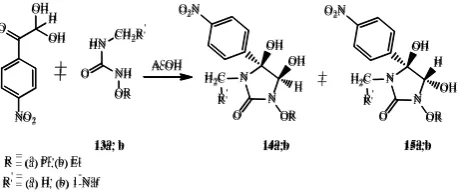
We have found that 4-nitrophenylglyoxal with N
-alkoxy-N’-arylureas (6a,e-j) in acetic acid medium at 17–20ºC
selectively forms
3-alkoxy-1-aryl-4,5-dihydroxy-5-(4-nitrophenyl)imidazolidin-2-ones (11a-g), mainly as
diastereomers with cis orientation of 4-HO- and
5-HO-groups (93–96%) (Scheme 7). The diastereomers 12a-g with
trans orientation of 4-HO- and 5-HO-groups have been
observed in the trace amounts in the reaction mixtures (1H
NMR).
Scheme 7. Synthesis of 3-alkoxy-1-aryl-4,5-dihydroxy-5-(4-nitrophenyl)imidazolidin-2-ones (11a-g, 12a-g).
Under similar conditions, 4-nitrophenylglyoxal reacts with
N-propyloxy-N’-methylurea (13a) and N-ethoxy-N’
-(1-naphthyl)methylurea (13b) give
3-alkoxy-1-alkyl-4,5-dihydroxy-5-(4-nitrophenyl)imidazolidin-2-ones (14a,b)
mainly as cis diastereomer (Scheme 8).
The trans diastereomers 15a,b have been observed in
reaction products in the trace amounts as well. The cis
diastereomers 11 and 14 can be easily obtained in pure form
by the crystallization.
Scheme 8. Synthesis of 3-alkoxy-1-alkyl-4,5-dihydroxy-5-(4-nitrophenyl)imidazolidin-2-ones (14a,b, 15a,b).
Firstly, the cis orientation of 4-HO- and 5-HO-groups has
been proposed for the compounds 11a-j and 14a,b based on
their 1H NMR spectra. For compounds 11a-j and 14a,b the
doublet of CHOH proton is situated in the higher field than
doublet of CHOH proton of trans diastereomers 12a-j and
15a,b, as earlier it has been demonstrated for
5-aryl-3,4,5-trihydroxyimidazolidin-2-ones 2a,b7-9 (Table 1).
Table 1. The characteristic 1H NMR chemical shifts of doublet of CHOH proton of 2a,b, 3a,b, 11a–g, 12a-g and 14a,b, 15a,b.
Figure 1. The molecular structure of 3-n-butyloxy-4S,5S-4,5- dihydroxy-1-(4-methylphenyl)-5-(4-nitrophenyl)-imidazolidin-2-one (11eA), showing the atom labelling. Displacement ellipsoids are drawn with the 50% probability level according to the data X-ray structural analysis.
There are two molecules of compound 11e (11eA and
11eB) in the asymmetric part of the unit cell. Molecules
11eA and 11eB have some different structural parameters.
Earlier the similar existence of compound in the two
geometrical forms in the crystal was found for the N
-alkoxyurea 10a10 and in other cases.13-15
cis Diastereomers trans Diastereomers
δ, ppm (J, Hz) δ, ppm (J, Hz)
2a 4.55(7.5)9 3a 4.91(5.4)9
2b 4.52(7.2)7 3b 4.84(5.7)8
11a 4.93(6.5) 12a 5.20(5.5)
11b 4.91(6.6) 12b 5.18(6.0)
11c 4.81(6.0) 12c 5.23(6.0)
11d 4.92(6.4) 12d 5.19(4.8)
11e 4.90(6.0) 12e 5.17(3.9)
11f 4.90(6.8) 12f 5.17(5.7)
11g 4.90(6.3) 12g 5.16(5.1)
14a 4.71(7.8) 15a 5.04(6.0)
14b 4.81(7.2) 15b 5.16(6.0)
O OHH
O OHH O O
H H
N NOO22
N N O OHH
O OHH
O O
O ORR N N
H H A Arr O O22NN
N NHH O O H H NN
O ORR A Arr
A AccOOHH
N N O OHH
H H
O
O O
ORR N N
O O HH A
Arr O O22NN
+
+
6 6aa,,ee-ii
-+
+
1
111aa--gg 1122aa--gg
A
Arr ==pp--MMeeCC66HH44,,
R
R==((dd))MMee,,((ee))BBuu A
Arr ==PPhh,,
R
R==((aa))MeMe,,((bb))EttE,,((cc))BBnn
A
Arr ==pp-B-BrrCC66HH44,,
R
R==((ff ))EEtt,,((gg))BBuu 1
111,,1122
O OHH
O OHH O O
H H
N NOO22
A AccOOHH N NHH O O H HNN
O ORR C CHH22RR
' '
1
133aa,,bb 1144aa,,bb 1155aa,b,b
R
R'' ==((aa))HH,,((bb))11--NNaaff R
R ==((aa))PPrr,,((bb))EttE
+
+
NN ++N N O O H H22CC
O ORR
H H O OHH
O OHH
R R'' O O22NN
N N
N N O O H H22CC
O ORR
O OHH O O HH
H H
The five-membered ring has an envelope conformation in
both molecules. The C(2) atom deviates on 0.37 Å (11eA)
and 0.53 Å (11eB) off the plain of remaining ring atoms.
The N(1) atom has a pyramidal configuration. The sum of
bond angles centered at the N(1) atom (Σß) is 339.3° in
molecule 11eA and 336.8 in molecule 11eB. The N(2)
nitrogen atom has a planar configuration (Σß is 358.3° in
molecule 11eA and 359.5° in molecule 11eB). The C(3)–
OH group has axial orientation relative to five-membered ring(the torsion angle N(1)–C(2)–C(3)–O(3) is 97.0(5)°
(molecule 11eA), -87.9(6)° (molecule 11eB). The C(2)–OH
group has equatorial orientation to five-membered ring (the
torsion angle С(1)–N(1)–C(2)–O(2) is 143.7(5)° (molecule
11eA), 154.6(5)° (molecule 11eB).
The 4-nitrophenyl substituent has equatorial orientation to
five-membered ring [the torsion angle N(1)–C(2)–C(3)–С(4)
is -142.0(5)°(molecule 11eA), 152.3(5)°(molecule 11eB)]. It
is rotated relatively to the C(2)–C(3) endocyclic bond [the
torsion angle C(2)–C(3)–С(4)–C(9) is 75.8°(molecule 11eA),
104.4° (molecule 11eB)]. The nitro group is slightly rotated
towards the plane of the aromatic cycle [the torsion angle
C(6)–С(7)–N(3)–O(4) is -7.2(2)° (molecule 11eA),
-15.4(2)° (molecule 11eB), the torsion angle C(8)–С(7)–
N(3)–O(5) is -0.3(1)° (molecule 11eA), -18.6(9)° (molecule
11eB)].
In the compound 11e the ordinary bonds O(2)–C(2) and
O(3)–C(3) are in some way different: the O(3)–C(3) bond [1.399(6) Å (11eA), 1.405(6) Å (11eB)] is little bit longer
than the O(2)–C(2) bond [1.380(7) Å (11eA), 1.369(7) Å
(11eB)]. The similar bond difference was found for
5-aryl-3,4,5-trihydroxyimidazolidin-2-ones 2a9, 2b7. The lengths of
O(6)–N(1) bond [1.410(6) Å (11eA), 1.401(6) Å (11eB)] is
similar to the same bond’s lengths in compounds 2a,b
[1.398(7) Å in compound 2a,9 1.405(1) Å in compound 2b7].
The butyloxy group has +ас-conformation to the
endocyclic С(2)–N(1) bond in the molecule 11eA and –ас
-conformation in the molecule 11eB [the torsion angle
C(2)-N(1)–O(6)–С(17) is 121.3(6)° (molecule 11eA), -107.6(6)°
(molecule 11eB)]. It has transoid conformation [the torsion
angle N(1)–О(6)–C(17)–С(18) is -179.0(7)° (molecule
11eA), 170.1(6)° (molecule 11eB), the torsion angle О(6)–
C(17)–С(18)–С(19) is 171.7(1)° (molecule 11eA),
-159.4(1)° (molecule 11eB)].
In the crystal, the molecules 11eA and 11eB are linked
into dimers by the intermolecular hydrogen bond O(3В)
-H(3В)…O(1А)’ (x, y, z) (H…O 1.87 Å, O-H…O 167°).
These dimers form the chains toward crystallographic direction [0 0 1] due to intermolecular hydrogen bonds
O(3А)–H(3А)…O(2A)’ (1-x, 1-y, -z) (H…O 2.23 Å, O–
H…O 148°) и O(3B)–H(3B)…O(1А)’ (x, y, z) (H…O1.87
Å, O–H…O 167°).
The molecular structure 4S,5S
-4,5-dihydroxy-1-methyl-5-(4-nitrophenyl)-3-propyloxyimidazolidin-2-one (14a) is
very similar to the molecular structure of compound 11e.
There are two molecules of 4S,5S
-4,5-dihydroxy-1-methyl-5-(4-nitrophenyl)-3-propyloxyimidazolidin-2-one
(14a) (14aA and 14aB) in the asymmetric part of the unit
cell. These molecules have different structural parameters.
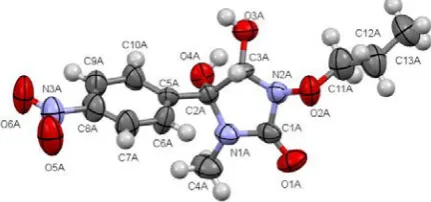
Figure 2. Molecular structure of 4S,5S-4,5-dihydroxy-1-methyl-5-(4-nitrophenyl)-3-propyloxyimidazolidin-2-one (14aA) with atoms represented by thermal vibration ellipsoids of 50% probability level according to the data of X-ray structural analysis.
The five-membered ring has an envelope conformation in both molecules. The C(3) atom deviation of the plane of the
remaining ring atoms is 0.42 Å in the molecule 14aA and
0.46 Å in the molecule 14aB. The nitrogen atom N(1) has
the planar configuration (Ʃβ=356° in the molecule 14aA and
Ʃβ=357° in the molecule 14aB). The nitrogen atom N(2) has
the pyramidal configuration (Ʃβ=337.4° in the molecule
14aA and Ʃβ=336° in the molecule 14aB). The hydroxyl
group at the C(2) atom has an axial orientation relatively to the five-membered ring [the N(2)–C(3)–C(2)–O(4) torsion
angle is -90.6(7)° in 14aA, 92.3(7)° in 14aB)]. The hydroxyl
group at the C3 atom has an equatorial orientation to the
five-membered ring (the С(1)–N(2)–C(3)–O(3) torsion
angle is -146.2(7)° (14aA), 152.1(7)° (14aB)).
The 4-nitrophenyl substituent is equatorially oriented to the five-membered ring [the torsion angle N(2)–C(3)–C(2)–
С(5) is 147.6(6)° (14aA), -150.6(7)° (11eB). It is rotated
towards the C(2)–C(3) endocyclic bond (the torsion angle
C(3)–C(2)–С(5)–C(6) is -68.6° (14aA), 74.4° (14aB)]. The
nitro group is slightly rotated towards the plane of the
aromatic cycle [the torsion angle C(7)–С(8)–N(3)–O(5) is
-2.8(2)° (14aA), 10.5(2)° (14aB), the torsion angle C(9)–
С(8)–N(3)–O(6) is -4.9(2)° (14aA), 5.4(1)° (14aB)].
In the compound 14a the ordinary bonds O(4)–C(2) and
O(3)–C(3) are in some way different: the O(4)–C(2) bond
[1.427(8) Å (14aA), 1.431(9) Å(14aB)] is a longer than the
O(3)–C(3) bond [1.381(9) Å (14aA), 1.387(9) Å(14aB)].
The similar bond difference takes place in the compounds
2a,2b,11e.7,9 The length of O(2)–N(2) bond [1.420 (8) Å
(14aA), 1.418 (8) Å (14aB)] is similar to the same bond’s
length in the compound 11e. The propyloxy group has –ас
-conformation to the endocyclic С(3)–N(2) bond in the
molecule 14aA and +ас-conformation in the molecule 14aB
[the torsion angle С(3)–N(2)–O(2)–С(11) is - 106.8(8)°
(14aA), 115.5(8) (14aB)]. It has transoid conformation [the
torsion angle N(2)–О(2)–C(11)–С(12) is 175.8(8)° (14aA),
175.5(9)° (14aB), the torsion angle О(2)–C(11)–С(12)–
С(13) is -174.2(9)° (14aA), -179.0(1)° (14aB)].
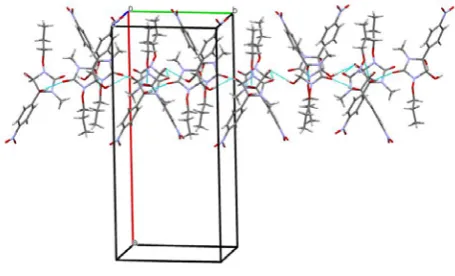
In the crystal molecules 14aA and 14aB are linked in the
dimers by the intermolecular hydrogen bond O(3В)–
H(3В)…O(1А)’ (x, y, z) (H…O 1.98 Å, O–H…O 167°).
These dimers form the chains toward crystallographic direction [0 1 0] due to intermolecular hydrogen bonds
O(3А)–H(3А)…O(4В)’ (x,1+y,z) (H…O 2.06 Å, O–H…O
178°) and O(4А)–H(4A)…O(2А)’ (x, 1.5-y, -0.5+z) (H…O
Figure 3. The rearrangement molecules 14aA and 14aB in the crystal according to the data of X-ray structural analysis.
For the studied reaction of arylglyoxals with N
-hydroxyurea,7-9 N-alkoxy-N’-arylureas10 and N-alkoxy-N’
-alkylureas a possible mechanism results dominating the
formation of the diastereomers with cis orientation of 4-HO-
and 5-HO-groups has been proposed (Scheme 9). At the first
stage, the open-chain N-alkoxyurea 16A is formed which
has intramolecular hydrogen bond. The intermediate 16A
can isomerize into the enolic form 16B possessing the same
intramolecular hydrogen bond. In the further cyclization of
intermediate 16A (route i Scheme 9), or intermediate 16B
(rout ii Scheme 9) yields the diastereomer with cis
orientation of 4-HO- and 5-HO-groups due to presence of this intramolecular hydrogen bond. The mild conditions of the reaction (no heating) preserve the further isomerization
of the forming cis diastereomers 11, 14 into trans
diastereomers 12, 15.
Scheme 9. The proposed mechanism of the interaction of 4-nitrophenylglyoxal with N-alkoxy-N’-arylureas and N-alkoxy-N’-alkylureas.
It is probable that the presence of such a strong electronegative substituent in 5-aryl’s moiety, as nitro group,
destabilizes “benzylic” cation C and makes impossible the
further transformation of the compounds 11 and 14 into
hydantoins 1.9 Thus, as for the reaction of
4-nitrophenylglyoxal with N-alkoxy-N’-arylureas (6a,e-i) and
N-alkoxy-N’-alkylureas (13a,b) it has been discovered that the process leads only to the mixture of diastereomers of 3-alkoxy-4,5-dihydroxy-5-(4-nitrophenyl)imidazolidin-2-ones
(11a-g,12a-g) and
3-alkoxy-1-alkyl-4,5-dihydroxy-5-(4-nitrophenyl)imidazolidin-2-ones (14a,b and 15a,b).
The diastereomer with sic orientation of HO-groups is the
main product in both cases. The structure of 3-n
-butyloxy-4S,5S
-4,5-dihydroxy-1-(4-methylphenyl)-5-(4-nitrophenyl)-imidazolidin-2-one (11e) and 4S,5S
-4,5-dihydroxy-1-methyl-5-(4-nitrophenyl)-3-propyloxyimidazo-lidin-2-one
(14a) has been studied by X-ray structural analysis.
Conclusions
4-Nitrophenylglyoxal reacts with N-alkoxy-N’-arylureas
(6a,e-i) and N-alkoxy-N’-alkylureas (13a,b) in acetic acid medium at the room temperature forming mainly
3-alkoxy-4,5-dihydroxy-5-(4-nitrophenyl)imidazolidin-2-one (11a-g)
and
3-alkoxy-1-alkyl-4,5-dihydroxy-5-(4-nitrophenyl)-imidazolidin-2-ones (14a,b), respectively, which have cis
oriented hydroxyl groups. X-Ray structural analysis of 3-n
-butyloxy-4S,5S
-4,5-dihydroxy-1-(4-methylphenyl)-5-(4-nit-rophenyl)imidazolidin-2-one (11e) and 4S,5S
-4,5-
dihydroxy-1-methyl-5-(4-nitrophenyl)-3-propyloxyimidazo-lidin-2-one (14a) has confirmed this special structural
feature of these compounds.
References
1Eftekhari-Sis, B., Zirak, M., Akrabi, A., Arylglyoxals in Synthesis of Heterocyclic Compounds, Chem. Rev., 2013, 113(5), 2958–3043, DOI 10.1021/cr300176g.
2Konnert, L., Lamaty, F., Martinez, J., Colacino, E., Recent Advances in the Synthesis of Hydantoins: The State of the Art of Valuable Scaffold, Chem. Rev., 2017, 117(23), 13757– 13809, DOI 10.1021/acs.chemrev.7b00067.
3Meusel, M., Gutschow, M., Recent Developments in Hydantoin Chemistry. A Review, Org. Prep. Proceed. Int., 2004, 36(5), 391–443, http// dx.doi.org/10.1080/00304940409356627.
4Suarez, A., Martinez, F., Sanz, R., Synthesis of α-functionalized
α-3-yl carbonyls through direct SN reactions of indol-3-yl α-acyloins, Org. Biomol. Chem., 2016, 14, 11212−11219. https://doi.org./10.1039/c6ob02125e.
5Suarez, A., Martinez, F., Suarez-Pantiga, S., Sanz, R., PTSA-Catalysed Reaction of Indoles with 2-Oxoaldehydes: Synthesis of Bis-α,α(indol-3-yl) Ketones. Chem. Select, 2017, 1, 1–5. DOI: 10.1002/slct.201700013.
6Anishchenko, A. A., Shtamburg, V. G., Shtamburg, V. V., Mazepa, A. V., Unusual Spontaneous α→β Isomerization of Unsymmetrical Benzoins, Eur. Chem. Bull., 2013, 2, 361– 366, https://doi.org./10.17628/ecb2013.2/361-366
7Shtamburg, V. G., Anishchenko, A. A., Shtamburg, V. V., Shishkin, O. V., Zubatyuk, R. I., Mazepa, A. V., Rakipov, I. M., Kostyanovsky, R. G., Synthesis and crystal structure of new imidazolidine-2,4-dione and imidazolidin-2-one derivatives, Mendeleev Commun., 2008, 18, 102–104. DOI: 10.1016/j.mencom.2008.03.018.
8Shtamburg, V. G., Shtamburg, V. V., Anishchenko, A. A., Zubatyuk R. I., Mazepa, A. V., Klotz, E. A., Kravchenko, S. V., Kostyanovsky, R. G., Single-stage synthesis of 3-hydroxy- 3-alkoxy-5-arylimidazolidine-2,4-diones by
A Arr H HOO
H H OO HH
O O
A
Arr ==pp--OO22NNCC66HH44
R
R'' ==AA rr((1111aa-g-g)),,MeMe((1414aa)),,CCHH22NaNaff((1414bb))
+
+
R R'' H HNN
H HNN
O O RR
O O
A Arr
O O OO HH
H H
N N
H HNN OO
O ORR
R R''
A Arr
O O OO
H H
N N
H HNN OO
O ORR
R R'' H H
1 166AA
1 166BB
((iiii))
((ii))
N N N N O O O ORR R R'' HH O O O O H H A Arr H H N N N N O O O ORR R R'' HH O O O O A Arr H H H H A
A BB
N N N N O O O ORR R R'' O O O O H H A Arr H H H H 1 111,1,144
+ +HH++,,--HH
2 2OO
N N N N O O O ORR R R'' H HOO HH
A Arr
--HH++
N N N N O O O ORR R R'' A A rr H H O O C
reaction of arylglyoxal hydrates with N-hydroxy- and N-alkoxyureas, Chem. Heterocycl. Compd., 2015, 51(6), 553– 559, DOI 10.1007/s10593-015-1735-0
9Shtamburg, V. G., Shtamburg, V. V., Anishchenko, A. A., Mazepa, Shishkina, S. V., Konovalova, I. S., Synthesis and structure of 3,4,5-trihydroxy-5-(4-nitrophenyl)imidazolidin-2-one. Eur. Chem. Bull., 2019, 8(4), 110–114. DOI: 10.17628/ecb.2019.8.110-114.
10Kostyanovsky, R. G., Shtamburg, V. G., Shishkin, O. V., ., Zubatyuk R. I., Shtamburg, V. V., Anishchenko, A. A., Mazepa, A. V., Pyramidal nitrogen in the crystal of N- [(benzoyl)-(hydroxy)methyl]-N-benzyloxy-N’-(2-bromophe-nyl)urea. Mendeleev Commun., 2010, 20, 167–169. DOI: 10.1016/j.men.com.2010.05.015.
11Shtamburg, V.G., Anishchenko, A. A., Shtamburg, V. V., Pletenez, A. V., Zubatyuk R. I., Shishkin, O. V., Synthesis and structure of N-[(benzoyl)-(hydroxy)methyl]-N-ethoxy-N’-(2-bromophenyl)urea. Voprosy Khim, Khim. Technol., 2011, N5, 13–17 [In Russian].
12Sheldrick, G. M., SHELXT – integrated space-group and crystal-structure determination, Acta Crystallogr., Sect. A: Found.
Crystallogr., 2015, A71(1), 3–8.
https://doi.org./10.1007/S2053273314026370
13Shishkin, O. V., Shtamburg, V. G., Zubatyuk R. I., Olefir, D. A., Tsygankov, A. V., Prosyanik, A. V., Mazepa, A. V., Kostyanovsky, R. G., Chiral Ureas with Two Electronegative Substituents at 1-N and Unusual Case of Coexisting a Pyramidal and Almost Planar 1-N in The Same Crystal,
Chirality, 2009, 21(7), 642–647.
https://doi.org/10.1002/chir.20668
14Shtamburg, V. G., Kostyanovsky, R. G., Tsygankov, A. V., Shtamburg, V. V., Shishkin, O. V., Zubatyuk R. I., Mazepa, A. V., Kravchenko, S. V., Geminal systems. 64. N-Alkoxy-N-chloroureas and N,N-dialkoxyureas, Russ. Chem. Bull., 2015, 64(1), 62–75. https://doi.org./10.1007/s11172-015-0822-9
15Shtamburg, V. G., Anishchenko, A. A., Shishkina, S. V., Shtamburg, V. V., Mazepa, A. V., Kravchenko, S. V., Klots, E. A., The reaction of alloxan with indole and furanes. The structure of 5-indol-3-yl-5-hydroxypyrimidin-2,4,6(1H,3H,5H)-trione, Eur. Chem. Bull., 2017, 6(4), 151– 154. DOI: 10.17628/ecb.2017.6.151-154.