The Impact of Learner’s Autonomy on Teaching
Oral Skills (Speaking Skills) in an EFL
Classroom
Marium Bushra Qamar ELC, Jazan University, K.S.A
Abstract—This paper describes a study conducted to determine the impact of learner's autonomy on attaining
oral skills. The objective of this research is to strengthen the idea that a learner centered classroom is an ideal environment for teaching oral skills and to promote communicative approach of teaching. True learning can only be achieved when the learner is made an equal partner in the learning process instead of a Muppet. This research follows an experimental design. The population of the study were preparatory year students of Jazan University. This research was delimited to ELC prep year students studying at AI Ardah College of Translational study. A random sample of 100 preparatory year students were taken from Al-Ardah college with 50 students in the experimental group were students who were free to practice learners autonomy (learner centered approach) and another 50 formed the controlled group. Results were generated with the help of pre tests and post tests and plotted in the form of graphs. The purpose of this research is to show that the traditional teacher centered approach can no longer encompass the needs of the modem classroom. The educational process needs to be an active blend of modeling, coaching. scaffolding and fading. This research is implacable to ESL learners and teachers alike. It also makes recommendations for future study.
Index Terms—autonomy, student centered classroom, teacher centered approach, motivation, learner based
approach, rehearsal, reflection
I. INTRODUCTION
Attaining Oral skills in a second language is an interactive process that involves processing the information received and producing a linguistically understandable utterance. Oral communication is defined as a process transmitting information and ideas verbally from one person to another. Oral communication occurs in formal situations like business presentations or official meetings, classroom lecturers, speeches or informal situation like face to face conversations and discussions, storytelling etc Jeremy Harmer (2001, p. 269-271) mentions these elements as
Language Features Social Processing
By language features he means that the following elements are necessary for effective speaking. i ) Language Features
a)Connected speech: (The ability of the speaker to produce more connect sounds not just separated phonemes. These sounds may be modified, omitted, added, or weakened in the connected speech).
b) Expressive device:(use effectively pitch volume, speech delivery speed and non verbal communication)
c) Lexis and grammar: (to use some language functions and lexical structures).
d) Negotiation language: (to produce well understood utterances) ii) Mental-Social Processing is dependent on three features. a) Language processing
b) Interacting with others: c) Information processing
It refers to the ability of the speakers to put language structures in a coherent order. The speaker is able to process the information given by the other speaker and respond to it appropriately. It should be kept in mind that oral speech is ephemeral (not permanent as it disappears as soon as the speaker finishes talking) and it is contrasted by the endurance of written expression. Also speaking requires orthography that is phonemes, stress, rhythm, intonation; whereas, in writing there are pictures, charts and punctuation marks (graphemes). This makes teaching Oral skills is a mammoth task which is dependent on a number of factors since speech conventions are much different from writing.
and mimes. The students who learn the target language in a teacher oriented classroom often carry translation books with them as they soon forget the word or they may encounter a situation for which they have not memorized a dialogue.
A. Background of the Study
The concept of learners autonomy in teaching speaking skills of a foreign language, has been gaining momentum worldwide from the end of twentieth century. It helps language learners to come out from the shyness, anxiety and fear of a new language as here they are in charge of their own learning. When learners use resources for learning on their own, it helps to increase ownership of responsibility for learning English. With progress in education especially in second language learning in the 19th century, some educators influenced by psychologists such as Jean Piaget, John Dewey and Maria Montessori replaced traditional curriculum approaches with "hands-on" activities and group work. It assists language learners in building schemata for communicative competence.
A person is judged by the way he speaks, his tone, his choice of words, his speaking speed etc. However speaking in a second language creates a mental block where the speaker cannot think of the words to express his thoughts in the target language and he is unable to express himself. Autonomous learning helps the speaker overcome the mental block while switching between L1 and L2
It strengthens student motivation .Students are urged to use the target language. It promotes peer communication .Students adopt an active approach which reduces disruptive behavior. Students develop a tolerant and outgoing approach to the target language. It bridges student-teacher relationship. It brings out discovery learning. It makes students responsible for their own learning. Hence it allows students to use target language in order to negotiate meaning with others in a group work, project work, while the teacher provides guidance, modeling, and feedback .Teaching students how to be proficient in the target language does not necessarily mean that by the end of the term students would acquire the status of highly articulate native speaker but these recommendations show that the route leading to mutual intelligibility of L2. It gives the students a familiar domain where they can access and use language on their own keeping in mind the cultural aspect. An autonomous classroom enables the student to express his/her point of view and engage in friendly, conversational and collaborative discussions. It allows students to use language with flexibility
B. Statement of the Problem
Effective teaching of oral skills requires the learner to engage with the cognitive and social dimensions of language learning. It is dependent upon selecting the right materials, selecting the right method, procedure of evaluation and especially environment which fosters teacher- student relationship. In KSA still the centuries old method of teacher centered classroom is prevalent in many EFL classrooms. The students are spoon-fed by the teacher on what to speak or the students memorize passages or dialogues and reproduce in the class. The evaluation is based on grammatically correct utterances regarding certain situations like meeting new people or going to the market which students have memorized by heart. The teacher is in complete control and there is no autonomous learning. Such mechanical environment can only show the students about correct use of language like grammar rules but never the correct usage. This teacher centered classroom using contextualized EFL textbooks is very de-motivating for many underachievers who are shun out in place of class favorites who can cram and speak well. Unfortunately these students when faced with real life situations can mostly forget what they have memorized and are unable to speak well despite scoring good grades in English. Students suffer from speech anxiety and lack of confidence. For students to produce independent utterance they require material of their level and a complete student centered classroom where they are doing most of the talking. The researcher believes that if the learners practice autonomy through group discussions, pair works on general topics they would be able to speak much fluently and accurately in situations given outside their books. Also they would be highly motivated by positive reinforcement.
C. Significance of the Study
There is a need for establishing a comfortable and low-threat learning environment for the purpose of second language acquisition. Speaking a foreign language is a source of extreme anxiety as it affects novice speakers' self-esteem and confidence. A relaxed classroom with learner’s autonomy helps in the better language acquisition. Taking a student centered approach the teacher makes the student share responsibility for their learning and let the students set task for their learning goals. This research establishes that, a proactive and interactive atmosphere is essential for mastering the full range of discourse needed for spontaneous communication.
Also this study establishes that there is a need to bridge up the gap between teachers and learners to help achieve objectives." Students are involved in self evaluation or assessment" (Ellis and Sinclair, 1989). Since the students develop their own learning paths and evaluate their own progress, teachers and learners tend to have a consensus on contents methodology and principles. Students create their own syllabus and perform the tasks according to how they comprehend them. The teacher appreciates learner guided tasks as a part of a course. This research is significant for teachers to understand their teaching style and student’s learning preferences.
D. Research Question
E. Delimitation
The research was delimited to preparatory year students studying English at Al -Ardah College of Translational of Jazan University, K.S.A.
II. LITERATURE REVIEW
Educational pedagogy expects the teacher to be an expert, personal model, facilitator and delegator at the same time. An EFL teacher has to follow a teaching style that inculcates in the students 'self-direction' (Candy, 1991). Teaching methods include the general principles and management strategies used for classroom instruction. A teacher’s choice of teaching method depends on his/her educational philosophy. There are two main teaching approaches.
A. Teacher-centered Approach (Direct Instruction)
Direct instruction means the traditional teaching method that relies on lecturers and teacher led demonstrations. Direct instruction forms the bases of teacher-centered approach, In this approach teachers are the main authority figure. They are the experts and students are viewed as empty pitchers whose primary role is to passively receive information with an end goal of testing and assessment. Teachers are the main providers of knowledge. In a quiet classroom the teacher provides the speaking topics. Students work alone and each speaks at his turn. The focus of the teacher is on language forms and structures. The instructor monitors and corrects every utterance. Thus the main focus is on getting the learners to perform in tests, exams, etc rather than catering to their needs.
B. Learner Centered Approach (Cooperative and Inquiry Based Learning)
In student centered learning as the name suggests all members have to contribute on the topic and give their opinion. In this method students have a chance to listen to the opinion of other students, hear arguments and negotiations and organize their thoughts into spoken expressions Learner centered approach believes in hands on experience and makes learner a participant in the learning process. It emphasizes on a strong sense of community. This model depends on teaching techniques such as “Think-Pair-Share” and reciprocal teaching. Cooperative learning and inquiry based learning are included in student-centered approach because learners are placed with the responsibility of their own learning and development. This bonding as a team gives them motivation to continue the process of learning even outside the classroom. Crandall (1999) has consistently maintained that "cooperative learning reduces anxiety and increases self-confidence.”
In a student-centered classroom, students and instructors share the focus. The level of interaction between students and teacher is equal and students are not bound to listen to the teacher exclusively. Group work is used a major tool to promote student’s collaboration and communication. Students complete independent tasks together. Student’s progress is measured by formal and informal assessment forms such as group projects, student portfolios, and class participation. The teacher’s role is to coach, promote a student learning and overall comprehension of material. Teaching and students are connected and learning is continuously kept in check.
C. Autonomous Learner
Student-Centered Learning represents a teaching environment within an educational institution and is characterized by problem-solving, critical thinking and reflective thinking. Thus the learner develops a particular kind of psychological association with the process and content of his learning. So, all these aspects make learning according to Benson and Voller, (1997) "a spontaneous, purposeful and prolific process and thus learner autonomy gets the place of uniqueness.”
Knowledge is something that needs to be up piece by piece. Howard Gardner’s Theory of Multiple intelligences also supports student-centered classroom because it promotes diverse learning styles. So, materials for teaching speaking skills depend upon a learner’s communicative competence in varied situations and also his ability to produce extempore speech. It consists of written texts, sound recordings, conversations by native speakers, suggestopedia, video recordings, films, electronic dictionaries, educational and authentic materials. Some educational practices also incorporate Bloom's Taxonomy and practical life related oral communications. A teacher teaching in a student-centered classroom must be aware of the diverse backgrounds of So, learners should be allowed to set their learning objectives and to opinions. Learner autonomy allows learners to select their learning materials and to employ their own experience as their mentor.
D. The Role of Motivation
"Learner autonomy is a goal seen as linked to motivation" (Garcia & Pintrich, 1996; Brown, 2001). Motivation may be task motivation which fosters intrinsic goal orientation, task value, and self-efficacy. Achievement depends on the learners and their readiness for the task. If a student fails to achieve a task, then he needs to revise, until he/she reaches the desired goal. Thus motivation to learn is a cognitive response which arises when the learner develops the knowledge and mastery of given task and feels positively reinforced in the form of rewards or achievement. It is prerequisite that the students perceive the new learning as part of a wider picture and enjoy the task or the learning experience. We can deduce that optimum motivation Is directly proportional to classroom environment that supports and cultivates it Therefore, motivating students to learn includes not only stimulating them to see the value of what they are learning, but also providing them with guidance from an activity how to go about learning it.
III. METHODOLOGY
This research followed an experimental design. The population of the study consisted of prep year students of Jazan University, KSA. A random sample of 100 prep year students was taken from Ardah college of Translational Studies, Jazan University in order to delimit the study. Fifty students formed the controlled group were a teacher cantered traditional approach was applied. This group was named group A. Another fifty students constituted the experimental group B. These students were free to practice learner’s autonomy and a learner centered approach was adopted by the teacher. Both the groups were given pre tests to check their proficiency, accuracy and fluency in the target language speaking skills, at the beginning of a month long experiment. After a lapse of 4 weeks both groups were subjected to a post test to mark their progress. The experimental group was given autonomy to choose their own learning material learner and students worked by group cooperation. The results were then tabulated in the form of graphs to bring out the difference in progress.
IV. DATA COLLECTION AND ANALYSIS
The data obtained from this study was in the form of scores of pre tests and post test conducted on group A and group B. The topics for pre-test from both the groups included Social Interactions and leave taking, Self Introduction related to family, nationality, marital status, occupation, etc. After one month post tests were conducted on teacher centred group A and learner centred group B under observation with student autonomy. The post test required the students to choose from a number of topics to speak on like Buying needed items from a mall or a pharmacy or ordering food from a restaurant, Describing hobbies and job preferences or opinion The use of target language was the focus. Students were scored on the basis of three variables where
N1=Accuracy(10 marks), N2 =Fluency (10 marks)
N3= Comprehension and use of ideas in the target language. (10 marks) An average score of the tests was calculated with the help of the formula
Average is equal to sum of variables (accuracy(10) + fluency(10)+ comprehension(10) divided by number of variables
Ave =∑ N1(10)+N2(10)+N3(10) = 30÷3 = 10
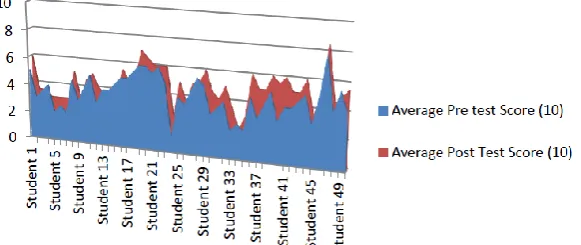
So the average marks are calculated out of 10 for each test and the results were plotted in the form of graphs. Graph 1 (Group A) Difference between pre test and post test score
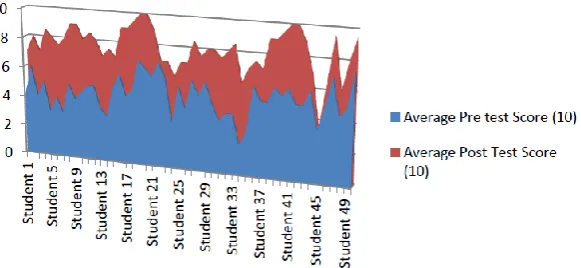
Fig 2: Group B (Experimental Group) Difference between pre test and post test score
Nearly all the students in group A got near or less the same score as pre test in post test as is illustrated by a graph given in figure 1. On the other hand, the students of group B exposed to experimental environment showed a marked difference between their pre test and post test score. The graphic representation of the results clearly depicts a remarkable improvement in the oral skills of the student of group B as can be observed in figure 2. These results establish the fact that speaking is at transactional activity and the best way to acquire second language learning is by adopting learner centered approach where activities like drills, mimes, speeches, storytelling and debates actually facilitate second language learning. Also students benefit a great deal by observational activities like listening to Received Pronunciation from native speakers. Thus learner’s autonomy allows student to achieve true learning in the sense that they understand and begin to think in the target language setting. Also activities like guided group discussions are a good way to encounter diversity in class. Since students come from different backgrounds they do not have the same speaking level. Thus the shy ones with less command on target language have an equal chance to listen to discussion in a group and give their opinions to the group leader.
It is clear from the results that as autonomous learners have made significant gains in attaining accent, pronunciation, vocabulary, fluency and accuracy in the target language. With the help of learner centered classroom they developed a more reflective approach towards their English Language speaking skills. They become much more effective learners, than the students placed in teacher centered classroom. The analysis of this data shows that learner’s autonomy is a basic element in providing motivation for the L2 learner. By adopting such techniques the EFL teacher can provide an environment in which learners can practice speaking and check their performance to monitor their learning progress.
V. CONCLUSION
The ability to share information in an effective manner concerning verbal, non verbal communication is indeed a skill which needs to be mastered. However the seeds of proficient speaking are best sowed in a learner centered classroom where learners are allowed to assume greater control over their own learning as is depicted by this research. A traditional teacher centered classroom does not foster language learning as efficiently as the classroom where students have access to learner’s autonomy since individual learners differ in their learning habits, interests, needs, level of motivation, and develop varying degrees of independence Learner autonomy stresses that each individual will learn at his own pace.
A. Self Assessment
Self Evaluation is an autonomous learning scheme. It tends to create a non-threatening environment in a language classroom which enhances learning and brings out the full potential of students. Since the teacher is a facilitator, she\he provides the learner with necessary equipment, guidance. Autonomous learning requires a learner’s real self-evaluation. After students self-assess and revise their work, they can turn it in for a grade. Through this way, when entire learning process will be in the students hand he/she would be able to remove mental blocks and overcome negative barriers like fear, anxiety and lack of confidence. The output will be fruitful because learning is affected by how students feel about themselves. In-class or peer review feedback is also an efficient way of correction since the other students give honest but encouraging comments to their fellow students. By promoting choice, self-confidence and autonomy, learner centered approach tends to reestablish its goal of encouraging students to improve their communication skills. The students feel empowered by their experience. Self-assessment is not a process by which students get to know their own grades. They must also manage discrete elements such as stated by (Burns & Joyce, 1997)"Turn-taking, rephrasing, providing feedback, and redirecting." In order for self-assessment to be effective, students must a criteria or a rubric which would help them achieve learning targets for a given assignment.
B. Revision\ Reflection \ Rehearsal
autonomy. Carl Rogers (1969) stated that "the only learning which significantly influences behavior and education is self discovered". This helps the teachers to revise the course in order to make it better suited for the future. This step is crucial for review of individual work.
VI. SUGGESTIONS AND RECOMMENDATIONS
Over the turn of the century, there was a major shift in the role of a student and a teacher. Researchers believe that every teacher should identify her teaching strategy at the very beginning of the class. In a speaking skill class, it is evident from this research that a teacher should adopt learners autonomy from the very beginning of her term, to stimulate learners’ motivation by channels of socialization.
The EFL teacher should follow these steps in a speaking skill class to make her teaching more effective The teacher should model students’ attitudes and orientations towards learning.
The teacher should present the task in an interesting manner
The teacher should state the purpose of the activity the students are going to do, and highlighting the strategies that maybe useful in achieving the task.
The teacher should inculcate in students goal orientation by assigning students a group goal. The teacher promotes group cohesion which links the members to one another and to the group itself.
The teacher is expected to encourages group reward system, that influences students’ motivation
The teacher should attain feedback from the whole class or groups individually and evaluate performance. The teacher should guide and coach students by helping them to learn the use of various visual aids The teacher should answer student queries in a question and answer session.
The teacher should play the role of an observer instead of dominating the learning process.
The teacher adopts the technique of scaffolding and fading in the environment, listening to the murmur of the learners in the classroom as they practice target language. The teacher takes note of the mistakes in speaking but opts for peer correction or self evaluation
This research would serve as an excellent starting point for EFL teachers teaching speaking skills and learners who wish to enhance communicative competence in English to revise their strategies by including learner’s autonomy as a necessary element for optimum output in communication, critical thinking, and problem solving. The results clearly point out the interdependence of language and communication
REFERENCES
[1] Benson & P. Voller. (1997) (Eds.). Autonomy and independence in language learning (pp. 181-203). Longman: London. [2] Brown, H. D. (2001). Teaching by principles, 2nd Ed. New York: Longman.
[3] Burns, A., & Joyce, H. (1997). Focus on speaking. Sydney: National Center for English Language Teaching and Research
Press
[4] Candy, P. (1991). Self-direction for lifelong learning: A comprehensive guide to theory and practice. San Francisco: Jossey-Bass Publishers.
[5] Crandall, J. (1999). Cooperative language learning and affective factors. In Arnold, J. (Ed.) Affect in language learning (pp. 226-245). Cambridge University Press.
[6] Dornyei, Z. (2003).Attitudes, orientations, and motivations in language learning: Advances in theory, research, and applicati ons.
Language Learning 53 (S1), p14.
[7] Ellis. G and Sinclair. B. (1989). Learning to Learn English Learner's Book: A Course in Learner Training: Cambridge: Cambridge University Press
[8] Harmer, J. (2001). The practice of English language teaching (3rd ed.). (pp.269-271) London: Longman
[9] Masgoret, A. M. & Gardner, R. C. (2003). Attitudes, motivation, and second language learning: A meta-analysis of studies conducted by Gardner and Associates. Language Learning 53(S), 167-210.
[10] Rogers, C. (1969). Freedom to Learn. Columbus, Ohio: Merill.
Marium Bushra Qamar was born in Pakistan In 1981 .During her school years at the Convent of Jesus and Mary, she excelled in debates, dramatics and academics along with being an enthusiastic student leader. She finished college and University with a distinction medal, in English literature and linguistics in 2006 from the National University of Modern Languages (NUML), Pakistan. Her first thesis was on “Plato’s republic as an antithesis to Shakepeare’s Hamlet. She then took certification of Cambridge CELTA.
She started her career as a permanent lecturer of English at the graduate faculty of English language, literature and linguistics at NUML, Islamabad, Pakistan in 2006 and worked for 4 years. She has also worked as a research associate. She taught a wide range of courses like action research, dissertation, history of English literature, semantics, TOFEL,IELTS In 2010 she travelled to Saudi Arabia .She is currently teaching as a senior lecturer at English Language Center, Jazan University , She has written numerou s research papers.