ISSN: 2501 - 1235 ISSN-L: 2501 - 1235 Available on-line at: www.oapub.org/edu
doi: 10.5281/zenodo.1485845 Volume 5 │ Issue 1 │ 2018
FIBRINOLYTIC ACTIVITY IN
ACTIVE AND SEDENTARY MEN AT REST
Fotios Mavrovouniotisi
School of Physical Education and Sport Sciences, Aristotle University of Thessaloniki,
Greece
Abstract:
The purpose of the present study was to examine the effects of exercise in the form of recreational team sports on resting fibronolytic activity of healthy men. Thirty-four healthy men, 20-37 years old, volunteered to participate in the research. The subjects were separated in two groups, exercisers who participated regularly during the last six months in recreational team sports such as volleyball, basketball and football (Group A, n=17) and inactive men who, on average, did not exercise regularly with a frequency of more than 1 hour per fortnight during the last six months (Group B, n=17). Measurements of anthropomorphological and hemodynamic characteristics were taken place. For the evaluation of resting fibrinolytic activity, tissue-type plasminogen activator (t-PA) and plasminogen activator inhibitor-1 (PAI-1) at rest were measured. For data analysis, descriptive statistics and independent samples t-tests of the SPSS ver. 20.0 for windows was used. The results showed that hemodynamic state of exercisers is better than that of inactive men, since they have lower heart rate (64.82+15.23 vs 69.41+11.61 bpm), systolic blood pressure (114+10.58 vs 115.35+12.90 mmHg), and diastolic blood pressure (72.06+10.91 vs 78.65+12.13 mmHg) at rest. In addition, there were observed significantly more increased resting t-PA levels (t=-3.49, p<0.01), as well as significantly more decreased resting PAI-1 levels (t=2.26, p<0.05) in the group of young men who participate in regular exercise in the form of team sports compared with the group of young men who didn’t participate in any exercise. Consequently, it could be said that physical fitness achieved through the regular participation in recreational team sports, such as football, volleyball and basketball, effect positively on blood fibrinolytic activity. Thus, aiming on fibrinolytic activity improvement, the regular participation in recreational team sports should be emphasized.
Keywords: physical conditioning, physical fitness, recreational team sports, hemostasis, cardiovascular health.
1. Introduction
Nowadays, people's inactivity, as a combination of reduced movement in everyday life and reduced participation in exercise, has increased. Unfortunately, inactivity is not just a social phenomenon, but has many negative health consequences. As for cardiovascular diseases, the abstention from exercise is associated with an increased risk for cardiovascular complications development (Van den Burg et al., 1994). It is worth to be mentioned that life expectancy for sedentary people at age of 50 years, is 1.5 years shorter than for people engaging in moderate daily physical activity and more than 3.5 years shorter than for people with high physical activity levels, for both sexes (Franco et al., 2005).
On the other side, physical activity results in increased exercise capacity and physical fitness which can lead to many health benefits. Regular exercise helps to prevent cardiovascular diseases, since the attributable to exercise biological changes have been suggested as possible mechanisms by which exercise contributes to lower risk of cardiovascular lesions, fewer cardiac events and lower mortality rates for coronary heart disease. Physical activity improves cardiac risk factor profiles and may, also, lead to an improvement in endothelial function (Appenzeller, & Atkinson, 1983; Haskell et al., 1988; Morris et al., 1990; Paffenbarger, & Hyde, 1980; Sherman, 2000; Tsopanakis, & Tsopanaki, 1990). Physical activity makes the blood more fluid and less prone to clots, causing hematological changes such as increased fibrinolysis and reduced viscosity of blood that may protect against thrombosis and increase athletic performance (Eichner, 1986).
However, despite the health benefits derived from exercise, participation rates in physical activity are small. Worldwide, about 28% of men and 34% of women are insufficiently active (Hallal et al., 2012; Haskell et al., 2009; WHO, 2010). More specifically, in Europe, more than one quarter of adults are not sufficiently active (Hallal et al., 2012; International Sport and Culture Association, 2015; WHO, 2014), while in Greece have been recorded sedentary life rates over 60% (Makrilakis et al., 2004).
Thus, regular participation in exercise is very significant. According to Grant et al. (2002), in order to achieve regular participation in exercise programs, the exercise/activity must be well-accepted and pleasant for the participants. In addition, concerning adherence, exercise programs should be more simply and conveniently on participation and relatively low cost (King, 2001). Such a form of exercise especially for men, are recreational team sports.
the production and secretion of plasminogen activators and by certain plasminogen activators inhibitors, with primarily responsible t-PA and PAI-1 (Astrup, 1956; Aznar, & Estelles, 1994; Gardikas, 1989; Saksela, 1985; Smokovitis, 1992; Takada, & Takada, 1993; Van den Burg et al., 2000; West, 1985). In addition, it seemed of interest to evaluate how physical conditioning through the regular participation in recreational team sports affects resting fibrinolytic activity. Therefore the purpose of the present study is to examine the effects of exercise in the form of recreational team sports such as volleyball, basketball and football on the fibronolytic activity of healthy men, through the measurement of t-PA and PAI-1 at rest.
2. Methods
2.1 Sample
Thirty-seven young healthy men, 20-37 years old, volunteered to participate in the research. According to their occupation with physical activity and sports, the subjects were separated in two groups, exercisers who participated regularly in recreational team sports (Group A) and inactive men (Group B). There were 18 exercisers and 19 inactive men. Exercisers considered those who participated systematically during the last six months in football, volleyball and basketball teams. Inactive men considered those who, on average, did not exercise regularly with a frequency of more than 1 hour per fortnight during the last six months. In addition, entry criteria included no history of angina, myocardial infarction, stroke, chronic pulmonary disease, diabetes, hypertension, any medication use, current smoking, or exercise-limiting orthopedic impairment.
A written informed consent for the participation in the research was obtained from each man. All the men, before the beginning of the research, underwent medical control so that it could be certified that they do not suffer from any cardiovascular or other disease and, also, that they do not take any medication. Additionally, they answered a questionnaire about any health problems, while a research assistant was present in order to give any essential clarifications if there were any questions.
Two men were excluded due to their medical history. In addition, one man who didn’t participate in team sports but was a cyclist was excluded of the research. Finally, 17 (seventeen) healthy male subjects, who were systematically participated in football, volleyball, and basketball teams constituted Group A, and 17 (seventeen) healthy male subjects who were not participate in any physical activity were constituted Group B. Procedures were in agreement with the ethical standards of the Declaration of Helsinki of the World Medical Association (2000).
2.2 Measurements
A. Anthropomorphological characteristics
measured with a precision of 0.5 cm using a Seca 216 height measuring. In addition,
Body Mass Index (BMI) was estimated (body mass/height2).
B. Hemodynamic characteristics
Systolic and diastolic blood pressure at rest were measured with an analog sphygmomanometer. In addition, Heart Rate (HR) at rest was measured with a Polar - Sport Tester. Measurements were done with each subject in a resting position for at least 10 min.
C. Fibrinolytic factors
For fibrinolytic activity evaluation, t-PA and PAI-1 were measured. All blood samples were drawn between 8:00 and 11:15 AM, in order to avoid the known diurnal variation in fibrinolytic variables (Angleton et al., 1989). Concerning the Group of exercisers, samples were drawn at least 36 hours after the last exercise bout to avoid the potential acute effects of exercise.
D. Blood sampling procedure
9 ml of venous blood was taken from the vein of the forearm, the radial or ulnar with venipuncture and 20 or 21 (0.9 or 0.8 mm) gauge needle commonly used for the veins of the forearm. Samples were drawn with each subject in a resting position for at least 20 min. Subjects were fasted for 12-14 hours.
E. Assays
For the determination of fibrinolytic factors t-PA and PAI-1, a tube with 3.8% anticoagulant trisodium citrate (Να3C6H5O7.2H2O) was used, at a ratio of 9:1 that is 9
volumes of blood to 1 volume of anticoagulant.
Then, after centrifugation at 3000 rpm for 10 min at room temperature, the supernatant (plasma) was taken, placed in ependorf tubes (without anticoagulant) and frozen at -20° C. After the collection of all the samples, they were all processed in the Physiology Laboratory of the Department of Veterinary Medicine of Aristotle University of Thessaloniki. The assays were made using Τint ELIZA method of Biopool (Enzyme linked immunosorbent assay).
In particular, t-PA antigen assay was determined by the enzyme linked immunosorbent assay ELIZA, TintElize t-PA (Biopool, Umea, Sweden, catalogue number 1105). The reliability and validity of the measurement has been checked (Boscato, 1986; Ranby et al., 1986). The exact curve is linear between 0 and 30 ng/ml (0 to 0.6 ng t-PA). Within assay coefficient of variation (CV) is 5.5% at 6 ng/ml t-PA and 4.9% at 15 ng/ml t-PA. The corresponding between assay CV is 3.5% at 6 ng/ml t-PA and 5.4% at 15 ng/ml t-PA.
2.3 Statistical Analyses
For data analysis, descriptive statistics and independent samples t-tests for the evaluation of the differences between the two groups, of the SPSS ver. 20.0 for windows was used.
3. Results
In Table 1, the anthropomorphological characteristics of the Group of inactive men and the Group of exercisers are presented.
Table 1: Anthropomorphological characteristics for Group of exercisers and Group of inactive men
Anthropomorphological characteristics Inactive men (n=17)
Exercisers (n=17)
Height (cm) 1.78+8.03 1.88+7.07
Body Weight (Kg) 84.44+10.03 82.88+8.18 BMI (Kg/m2) 26.83+3.22 23.40+1.29
In Table 2, the hemodynamic characteristics of the Group of inactive men and the Group of exercisers are presented. It is obvious that hemodynamic state of exercisers is better than that of inactive men, since they have lower HR, systolic blood pressure and diastolic blood pressure at rest. However, from t-tests application, it appears that these differences are not significant.
Table 2: Hemodynamic characteristics for Group of exercisers and Group of inactive men
Hemodynamic Characteristics Inactive men Exercisers
HR (bpm) 69.41+11.61 64.82+15.23
Systolic Blood Pressure (mmHg) 115.35+12.90 114.00+10.58 Diastolic Blood Pressure (mmHg) 78.65+12.13 72.06+10.91
t-PA at rest
2,04
3,76
0 1 2 3 4 5 6
ng/ml
Inactive Men
Exercisers
Figure 1: Resting t-PA in inactive men and exercisers
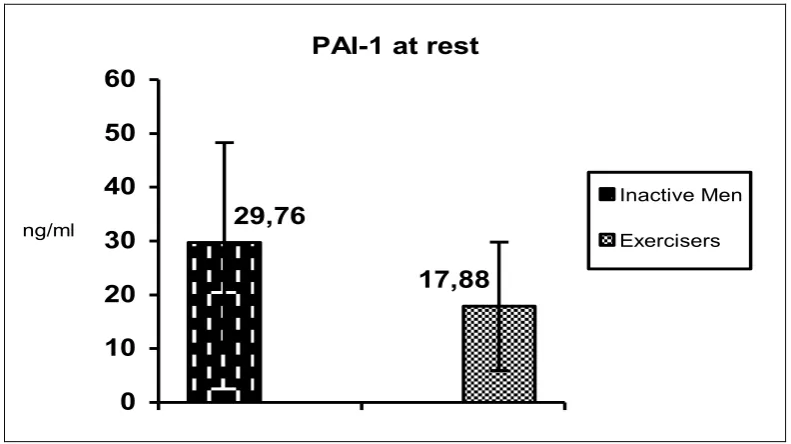
Concerning PAI-1 at rest, data processing showed that the exercisers’ group had lower PAI-1 than the group of inactive men (Figure 2). In addition, the application of t-test showed that the difference between the two groups as for PAI-1 at rest is statistically significant (Table 3).
PAI-1 at rest
29,76
17,88
0 10 20 30 40 50 60
ng/ml
Inactive Men
Exercisers
Figure 2: Resting PAI-1 in inactive men and exercisers
In Table 3, the results from the t-tests for t-PA and PAI-1 are presented.
Table 3: t-PA and PAI-1
for Group of exercisers and Group of inactive men
As it is presented in Table 3, exercisers have at rest very significantly higher level of t-PA, but significantly lower PAI-1 than inactive men. It is worth mentioning that the results show the favourable effects of the regular participation in exercise in the form of team sports, on the fibrinolytic activity at rest.
4. Discussion
In the present study resting levels of t-PA and PAI-1 were examined in two groups of healthy men, exercisers who participated regularly in recreational team sports, and inactive men who didn’t participate in any physical activity. t-PA and PAI-1 were chosen due to their significance in the procedure of fibrinolysis, as they are primarily responsible for blood fibrinolytic activity regulation (Astrup, 1956; Aznar, & Estelles, 1994).
Coagulation and fibrinolytic cascades are complex self-regulated mechanisms. As long as these two mechanisms maintain equilibrium, the organism is protected from bleeding by coagulation and at the same time clot development stays within control of the thrombolytic mechanism (Patelis et al., 2016). From the literature review, it is evident that exercise results in activation of both the coagulation and fibrinolytic cascades (Smith, 2003).
Short term submaximal and maximal exercise has been shown to induce increases in platelet number and activity, activation of coagulation leading to a slight but significant thrombin generation and activation of fibrinolysis, that are short lasting (Prisco et al., 1994). On the other side, exercise training programs induce changes such as a decrease in PAI-1 levels and an increase in fibrinolytic capacity at rest after training. Thus, chronic prolonged aerobic exercise as well as exercise training programs induce a spectrum of more long-term changes. So, it is important to distinguish between physiological events that occur with acute bouts of exercise and those changes which accompany physical conditioning (Ferguson et al., 1987).
Acute exercise leads to a transient activation of the coagulation system, which is accompanied by an increase in the flbrinolytic capacity in healthy subjects (Koenig, & Ernst, 2000; Willich et al., 1993). Beneficial effects from exercise have been found in healthy individuals of any age, especially those who in different conditions follow a sedentary life-style (Kahraman et al., 2011; Stratton et al., 1991). This increased fibrinolytic activity has been reported using various exercise protocols incorporating various exercise intensities and durations (Davis, et al., 1976; Dooijewaard et al., 1991; El-Sayed et al., 2000; Molz et al., 1993; Rankinen et al., 1995; Rocker et al., 1990; Takada, & Takada, 1993).
2011). It could be said that after maximal short-term exercise, fibrinolysis is clearly activated in healthy young subjects. This increase is directly dependent on exercise duration. Additionally, it is worth mentioning that fibrinolysis is already activated after 15 sec maximal exercise duration. In addition, the participation in maximal short-term exercise does not lead to a relevant activation of blood coagulation, but it is only slightly altered within the normal range (Hilberg et al., 2003).
Fibrinolytic activity increase which comes in response to physical exercise is not retained permanently after the end of exercise, but is transient. The significant increases in endogenous t-PA and reductions in PAI-1 activity persist for at least 1 h after exercise cessation (Ivey et al., 2003). More specifically, the value of enzymic system factors return to initial level after 45 to 60 min from the end of intense exercise (Bartsch et al., 1982; Ferguson et al., 1987; Moltz et al., 1993; Rosing et al., 1970), or after 30 to 60 min from the end of progressively increased maximal exercise on a bicycle-ergometer (Dufaux et al., 1991), or 2 hours after long distance running (Hansen et al., 1990), or 24 hours post-marathon (Prisco et al., 1998). In addition, in vitro tests suggest that coagulation remains activated after fibrinolysis has returned to baseline levels (Smith, 2003). However, frequent, regular exercise is the one that can bring about more permanent results in clot dissolving (Rauramaa, & Salonen, 1994).
So, in the present study was observed significantly more increased resting t-PA levels as well as significantly more decreased resting PAI-1 levels in the group of young men who participated in regular exercise in the form of team sports compared with the group of young men who didn’t participate in any exercise. Similar results, also, found other researchers in normal subjects, as well as in coronary patients after their participation in programmed sports (Ferguson et al., 1987; Speiser et al., 1988).
Moreover, Stratton et al. (1991) examined the effects of 6 months of intensive endurance exercise training on resting fibrinolytic activity in 10 young (24-30 years) and in 13 old healthy male subjects (60-82 years). After training, maximum oxygen consumption was increased very significantly for the young as well as the old group (44.9+5.0 to 52.9+6.6 ml/kg/min, and 29.0+4.2 to 35.5+3.6, respectively). In addition, the old group had a 39% increase in t-PA activity, a 141% increase in the percentage of t-PA in the active form, a 58% decrease in PAI-1 activity, and a 13% decrease in fibrinogen, whereas the young group had no significant changes in any of the measured variables. From the results it was concluded that intensive exercise training enhances resting t-PA activity and reduces fibrinogen and PAI-1 activity in older men.
In addition, El-Sayed (1996) examined the effect of high and low intensity exercise conditioning programs on components pertinent to blood fibrinolysis and selected lipid profile variables in sedentary, but healthy individuals, who were submitted in high intensity and low intensity exercise on a bicycle ergometer for 20 min,
three times a week for 12 weeks at an intensity corresponding to 80% and 30% VO2max,
group. The results show that high, but not low, intensity physical conditioning enhances significantly the cardiorespiratory fitness and reduces the resting level of PAI activity.
Thus, it is the participation of healthy, sedentary individual in high intensity physical conditioning that may be linked with the favourable effects of exercise conditioning on fibrinolytic activity (El-Sayed, 1996). This finding is exactly in accordance with the present study, and may explain the present results as the intensity of team sports is high. Besides, athletes appear to have a better fibrinolytic activity at rest than non-athletes, as they present significantly higher t-PA and lower PAI-1. This is probably due to athletes better fitness compared to non-athletes, as fibrinolytic activity seems to be associated with fitness (Handa et al., 1992; Williams et al., 1980). Similarly, in the present study, exercisers better hemodynamic state in comparison with inactive men’s hemodynamic state proves their better fitness achieved through their participation in the high intensity recreational team sports.
As for coronary patients, Estelles et al. (1989) examined fibrinolytic activity in two groups of patients after myocardial infarction. One of the groups participated in a cardiac rehabilitation program of submaximal intensity, with two exercise sessions per week, each of which began with 45 min of gymnastics and followed by 30 min of pedaling on a bicycle ergometer to 70-80% of HRmax, for six months, while the other group did not participate in any sports activities. The results indicated that fibrinolytic activity, measured by t-PA capacity, decreased significantly in the patients who were not participating in the rehabilitation program whereas it increased slightly in the patients involved in the rehabilitation program. In addition, PAI levels increased significantly in patients who were not in the sports program, but remained constant or decreased slightly in patients in the rehabilitative sports program. Thus, it could be said that the participation in regular exercise can lead in an improvement in fibrinolytic activity, while no-exercise program can lead in a decrease in the fibrinolytic capacity. This improved state in resting fibrinolytic activity is evident in the subjects of the present study due to their participation in regular exercise.
Moreover, six months of exercise training may increase fibrinolytic activity reducing PAI-1 in patients with peripheral arterial disease and may serve as an intervention to reduce cardiovascular mortality and morbidity in these patients (Killewich et al., 2004). It is evident that chronic aerobic exercise training may decrease coagulation potential and increase fibrinolytic potential in both healthy individuals and cardiovascular disease patients, contributing to decreased risk for ischaemic event, both at rest and during physical exertion (Womack et al., 2003). Thus, physical activity has profound effects on thrombogenic factors (Mavrovouniotis, 2012).
occurrence of clot dissolution (Arnout et al., 1984; Stassen et al., 2004; Van den Burg et al., 2000; West, 1985).
The results of the present study are very significant since they prove that regular participation in recreational team sports leads in an increased fibrinolytic activity at rest. On the contrary, the reduced fibrinolytic activity could be an important pathogenic factor as for coronary artery disease (Chakrabarti et al., 1968), which is related with increase in PAI activity. More specifically, a reduced t-PA level or/and a high PAI level constitute an additional thromboembolic risk factor for coronary artery patients and an additional factor in reinfarction (Gram, & Espersen, 1987; Hamsten et al., 1987). It is worth mentioning that according to Stratton et al. (1991), the intensive exercise training induced enhancement in resting t-PA activity and reduction in fibrinogen and PAI-1 activity are potential mechanisms by which habitual physical activity might reduce the risk of cardiovascular disease. This is a favourable effect of the regular participation in team sports also proved in the present study, meaning that the regular participants in team sports have a reduced risk for cardiovascular disease.
Avoiding a sedentary lifestyle during adulthood not only prevents cardiovascular disease independently of other risk factors but also substantially expands the total life expectancy and the cardiovascular disease–free life expectancy for men and women. This effect is already seen at moderate levels of physical activity, and the gains in cardiovascular disease–free life expectancy are twice as large at higher activity levels (Franco et al., 2005). Thus, adherence and regular participation in physical activities, such as team sports, is very significant.
5. Conclusions
In conclusion, improving fibrinolytic capacity, either by reducing PAI activity or by increasing t-PA activity, may be favourable for healthy individuals’ cardiovascular system. Consequently, it could be said that the regular participation in recreational team sports may improve fibrinolytic capacity. Therefore, the value of regular participation in exercise in the form of team recreational sports in fibrinolytic activity and in the overall cardiovascular health of the participants should be emphasized.
References
Angleton, P., Chandler, W.L., Schmer, G. (1989). Diurnal variation of tissue plasminogen activator (t-PA) and its rapid inhibitor (PAI-1). Circulation, 79: 101-106.
Appenzeller, O., Atkinson, R. (1983). Sports Medicine: Fitness - Training - Injuries (2nd Edition). Baltimore –Munich: Urban & Schwarzenberg.
Arnout, J., Hoylaerts, M.F., Lijnen, H.R. (2006). Haemostasis. Handbook of Experimental Pharmacology, 17(2): 1-41.
Aznar, J., Estelles, A. (1994). Role of plasminogen activator inhibitor type 1 in the pathogenesis of coronary artery diseases. Haemostasis, 24: 243-251.
Bartsch, P., Schmidt, E.K., Straub, P.W. (1982). Fibrinopeptide after strenous physical exercise at high altitude. Journal of Applied Physiology: Respiratory, Environmental and Exercise Physiology, 53(1): 40-43.
Boscato, L.M. (1986). Incidence and specificity of interference in two-site immunoassay. Clinical Chemistry, 32(8): 1491-1495.
Chakrabarti, R., Hocking, E-D., Fearnley, G.R., Mann, R.D., Atlwell, T.N., Jackson, P. (1968). Fibrinolytic activity and coronary artery disease. Lancet, 1: 987-996.
Davis, G.L., Abildgaard, C.F., Bernauer, E.M., Britton, M. (1976). Fibrinolytic and hemostatic changes during and after maximal exercise in males. Journal of Applied Physiology, 40(3): 287-292.
Declerck, P.J. (1993). Multicenter evaluation of commercially available methods for the immunological determination of plasminogen activator inhibitor-1 (PAI-1). Thrombosis and Haemostasis, 70: 858-863.
Dooijewaard, G., De Boer, A., Turion, P.N.C., Cohen, A.F., Breimer, D.D., Kluft, C. (1991). Physical exercise induces enhancement of Urokinase-type Plasminogen activator (u-PA) levels in plasma. Thrombosis and Haemostasis, 65(1): 82-86. Dufaux, B., Order, U., Liesen, H. (1991). Effect of a short maximal physical exercise on
coagulation, fibrinolysis, and complement system. International Journal of Sports Medicine, 12: S38-S42.
Eichner, E.R. (1986). Coagulability and rheology: hematologic benefits from exercise, fish, and aspirin. Implications for athletes and nonathletes. The Physician and Sportsmedicine, 14(10): 102-110.
El-Sayed, M.S. (1996). Effects of high and low intensity aerobic conditioning programs on blood fibrinolysis and lipid profile. Blood Coagul Fibrinolysis, 7(4): 484-490. El-Sayed, M.S., Sale, C., Jones, P.G., Chester, M. (2000). Blood hemostasis in exercise and
training. Medicine and Science in Sports and Exercise, 32(5): 918-925.
Estelles, A., Aznar, J., Tormo, G., Sapena, P., Tormo, V., Espana, F. (1989). Influence of a rehabilitation sports programme on the fibrinolytic activity of patients after myocardial infarction. Thromb Res, 55: 203-212.
Ferguson, E.W., Bernier, L., Banta, G.R., Yu-Yahiro, J., Schoomaker, E.B. (1987). Effects of exercise and conditioning on clotting and fibrinolytic activity in men. J. Appl. Physiol., 62(4): 1416-1421.
Franco, O.H., de Laet, C., Peeters, A., Jonker, J., Mackenbach, J., Nusselder, W. (2005). Effects of physical activity on life expectancy with cardiovascular disease. Arch Intern Med. 165(20): 2355-2360. doi:10.1001/archinte.165.20.2355.
Gardikas, K.D. (1989). Haematology (5th Edition). Athens: Scientific Publications Parisianos (in greek).
Grant, S., Corbett, K., Todd, K., Davies, C., Aitchison, T., Mutrie, N., Henderson, Β., Dargie, Ε. (2002). A comparison of physiological responses and rating of perceived exertion in two models of aerobic exercise in men and women over 50 years of age. British Journal of Sports Medicine, 36(4): 276-281.
Guyton, A. (1984). Human Physiology (1st Edition). Athens: Medical Publications Litsas (in greek).
Hallal, P.C., Andersen, L.B., Bull, F.C., Guthold, R., Haskell, W., Ekelund, U. (2012). Global physical activity levels: surveillance progress, pitfalls, and prospects. The Lancet, 380 (9838): 247-257.
Hamsten, A., De Faire, U., Walldins, G., Szamosi, A., Landon, C., Blomback, M., Wiman, R. (1987). Plasminogen activator inhibitor in plasma, risk factor for recurrent myocardial infarction. Lancet, 2: 3-9.
Handa, K., Terao, Y., Mori, T., Tanaka, H., Kiyonaga, A., Matsunaga, A., Sasaki, J., Shindo, M., Arakawa, K. (1992). Different coagulability and fibrinolytic activity during exercise depending on exercise intensities. Thrombosis Research, 66(5): 613-616.
Hansen, J-B., Wilsgard, L., Olsen, J.O., Osterud, B. (1990). Formation and persistence of procoagulant and fibrinolytic activities in circulation after strenous physical exercise. Thrombosis and Haemostasis, 64(3): 385-389.
Haskell, W.L., Blair, S.N., Hill, J.O. (2009). Physical activity: Health outcomes and importance for public health policy. Preventive Medicine, 49(4): 280-282.
Haskell, W.L., Stefanick, M.L., Superko, R. (1988). Influence of exercise on plasma lipids and lipoproteins. In E.S. Horton & R.L. Terjung (Eds.), Exercise, nutrition and energy metabolism (pp. 213-227). New York: MacMillan.
Hilberg, T., Prasa, D., Sturzebecher, J., Glaser, D., Schneider, K., Gabriel, H.H. (2003). Blood coagulation and fibrinolysis after extreme short-term exercise. Thromb Res, 109(5-6): 271-277.
International Sport and Culture Association (2015). The economic cost of physical
inactivity in Europe. Retrieved from:
http://inactivity-time-bomb.nowwemove.com/download-report/The Economic Costs of Physical
Inactivity in Europe (June 2015).pdf
Ivey, F.M., Womack, C.J., Kulaputana, O., Dobrovolny, L.C., Wiley, L.A., Macko, R.F. (2003). A single bout of walking exercise enhances endogenous fibrinolysis in stroke patients. Medicine and Science in Sports and Exercise, 35(2): 193-198. Kahraman, S., Bediz, C.S., Piskin, O., Aksu, I., Topcu, A., Yuksel, F., Demirkan, F.
(2011). The effect of the acute submaximal exercise on thrombin activatable fibrinolysis inhibitor levels in young sedentary males. Clin Appl Thromb Hemost, 17: 414-420.
Killewich, L.A., Macko, R.F., Montgomery, P.S., Wiley, L.A., Gardner, A.W. (2004). Exercise training enhances endogenous fibrinolysis in peripheral arterial disease. Journal of Vascular Surgery, 40(4): 741-745.
Koenig, E., Ernst, E. (2000). Exercise and thrombosis. Coronary Artery Disease, 11: 123-127.
Makrilakis, K., Panagiotakos, D., Pitsavos, Chrysohoou, C., Ioannidis, I., Dimosthenopoulos, C., Toutouzas, P., Stefanadis, C., Katsilambros, N. (2004). The association between physical activity and the development of acute coronary syndromes in diabetic subjects (the CARDIO2000 II study). European Journal of Cardiovascular Prevention & Rehabilitation, 11: 298-303.
Mavrovouniotis, F. (2012). Physical activity and fibrinolytic response. Journal of Physical Education and Sport, 12(4), Art 70: 482-490.
Molz, Α.Β., Heyduck, Β., Lill, Η., Spanuth, Ε., Rocker, L. (1993). The effect of different exercise intensities on the fibrinolytic system. European Journal of Applied Physiology and Occupational Physiology, 67(4): 298-304.
Morris, J.N., Clayton, D.G., Everitt, M.G., Semmence, A.M., Burgess, E.H. (1990). Exercise in leisure time: coronary attack and death rates. British Heart Journal, 63: 325-334.
Paffenbarger, R.S., Hyde, R.T. (1980). Exercise as protection against heart attack. The New England Journal of Medicine, 302(18): 1026-1027.
Patelis, N., Karaolanis, G., Kouvelos, G.N., Hart, C., Metheiken, S. (2016). The effect of exercise on coagulation and fibrinolysis factors in patients with peripheral arterial disease. Exp Biol Med (Maywood), 241(15): 1699-1707.
Prisco, D., Francalanci, I., Filippini, M., Hagi, M.I. (1994). Physical exercise and hemostasis. Int J Clin Lab Res, 24(3): 125-131.
Prisco, D., Paniccia, R., Bandinelli, B., Fedi, S, Cellai, A.P, Liotta, A.A, Gatteschi, L., Giusti, B., Colella, A., Abbate, R., Gensini, G.F. (1998). Evaluation of clotting and fibrinolytic activation after protracted exercise. Thrombosis Research, 89: 73-78. Ranby, M., Bergsdorf, N., Nilsson, T., Mellbring, G., Winblad, B., Bucht, G. (1986). Age
dependence of tissue plasminogen activator concentrations in plasma, as studied by an improved enzyme-linked immunosorbent assay. Clinical Chemistry, 32(12): 2160-2165.
Rankinen, T., Vaisanen, S., Penttila, I., Rauramaa, R. (1995). Acute dynamic exercise increases fibrinolytic activity. Thrombosis and Haemostasis, 73: 281-286.
Rauramaa, R., Salonen, J. (1994). Physical activity, fibrinolysis and platelet aggregability. In C. Bouchard & R. Shephard & T. Stephens (Eds.), Physical activity, fitness and health (pp. 2171-2479). Champaign, Illinois: Human Kinetics Pubs.
Rocker, L., Taenzer, M., Drygas, W.K., Lill, H., Heyduck, B., Altenkirch, H.U. (1990). Effect of prolonged physical exercise on the fibrinolytic system. European Journal of Applied Physiology, 60: 478-481.
Rosing, D.R., Brakman, P., Redwood, D.R., Goldstein, R.E., Beiser, G.D., Astrup T., Epstein, S.E. (1970). Blood fibrinolytic activity in man. Diurnal variation and the response to varying intensities of exercise. Circulation Research, 27: 171-184. Saksela, O. (1985). Plasminogen activation and regulation of pericellular proteolysis.
Sherman, D. (2000). Exercise and endothelial function. Coronary Artery Disease, 11: 117-122.
Smith, J. (2003). Effects of strenuous exercise on haemostasis. Br J Sports Med, 37(5): 433-435.
Smokovitis, A. (1992). Issues of Physiopathology. Thessaloniki: Aristotle University of Thessaloniki (in greek).
Speiser, W., Langer, W., Pschaick, A., Selmayr, E., Ibe, R., Nowacki, P.R., Muller-Berghaus, G. (1988). Increased blood fibrinolytic activity after physical exercise: comparative study in individuals with different sporting activities and in patients after myocardial infarction taking part in a rehabilitation sports program. Thromb. Res, 51: 543-555.
Stassen, J. M., Arnout, J., Deckmyn, H. (2004). The hemostatic system. Current Medicinal Chemistry, 1(17): 2245-2260.
Stratton, J.R., Chandler, W.L., Schwartz, R.S., Cerqueira, M.D., Levy, W.C., Kahn, S.E., Larson, V.G., Cain, K.C., Beard, J.C., Abrass, I.B. (1991). Effects of physical conditioning on fibrinolytic variables and fibrinogen in young and old healthy adults. Circulation, 83: 1692-1697.
Takada, A., Takada, Y. (1993). The physiology of the fibrinolytic system. Japanese Journal of Physiology, 43: 1-19.
Tsopanakis, A., Tsopanaki, Ch. (1990). Lipoprotein ratio in the evaluation of lipid adaptation in high performance athletes. Sports Science: Theory and Practice, 5(2): 57-72 (in Greek).
Van den Burg, P.J., Dooijewaard, G., Van Vliet, M., Mosterd, W., Kluft, C., Huisveld, I. (1994). Differences in u-PA and t-PA increase during acute exercise: Relation with exercise parameters. Thrombosis and Haemostasis, 71(2): 236-239.
Van den Burg, P.J, Hospers, J.E, Mosterd, W.L, Bouma, B.N, Huisveld, I.A. (2000). Aging physical conditioning and exercise-induced changes in hemostatic factors and reaction products. Journal of Applied Physiology, 88(5): 1558-1564.
West, J.B. (1985). Best and Taylor's physiological basis of medical practice (11th Edition). Baltimore: Williams & Wilkins.
WHO-World Health Organization (2010). Global recommendations on physical activity for health. Geneva, World Health Organization, 2010. Retrieved from:
http://apps.who.int/iris/bitstream/10665/44399/1/9789241599979 eng.pdf
WHO-World Health Organization (2014). Noncommunicable Diseases (NCD) Country Profiles, 2014. Retrieved from: http://www.who.int/nmh/publications/ncd-profiles-2014/en/
Williams, R.S., Logue, E.E., Lewis, J.L., Barton, T., Stead, N.W., Wallace, A.G., Pizzo, S. V. (1980). Physical conditioning augments the fibrinolytic response to venous occlusion in healthy adults. The New England Journal of Medicine, 302(18): 987-991.
Womack, C.J, Nagelkirk, P.R., Coughlin, A.M. (2003). Exercise-induced changes in coagulation and fibrinolysis in healthy populations and patients with Cardiovascular Disease. Sports Medicine, 33(11): 795-807.
Creative Commons licensing terms