Research Article
a
April
2018
Special Issue: National Conference on Emerging Trends in Engineering 2018
Conference Held at Sri Venkatesa Perumal College of Engineering & Technology, Puttur, A.P., India
Computer Science and Software Engineering
ISSN: 2277-128X (Volume-8, Issue-4)
IoT Based Home Security System Using Raspberry Pi with
Email and Voice Alert
R. Rani
Assistant Professor, ECE Department,
Vemu Institute of Technology, P.Kothakota, India
S. Lavanya
B.Tech 3rdYear S, ECE Department,
Vemu Institute of Technology, P.Kothakota, India
B. Poojitha
B.Tech 2ndYear, ECE Department,
Vemu Institute of Technology, P.Kothakota, India
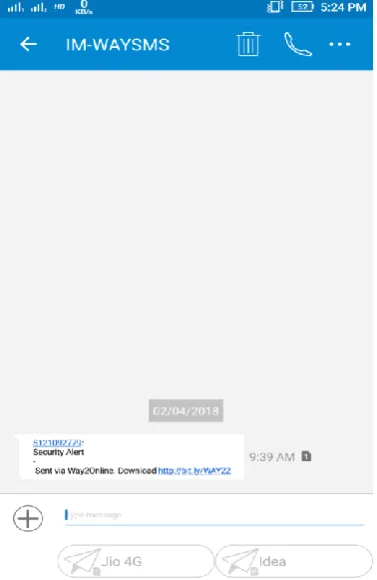
Abstract: This paper is based on the concepts of IoT, where in an unauthorized or unwanted intrusion or motion is detected using different hardware and software tools. This paper makes the use of an Raspberry Pi 3 board. For example: If an Intruder or unauthorized persons enter into our zone the PIR Sensor detects the person activity then the security system capture the image of the unauthorized person and also give real time alert SMS to the authorized person After the real time SMS alert the security system gives the buzzer sound. The image will be captured using Pi Camera which is attached to the Raspberry Pi. The captured image will be sent to the authorized person via g-mail by the usage of inbuilt WIFI module in the Raspberry Pi board. The real time alert SMS is sent using the WAY2SMS which is connected through the internet. After completion of all these activities the buzzer will be activated and also sends voice messages through loud speaker.
Keywords: Raspberry Pi 3, Buzzer, Pi Camera, PIR Sensor,sms alert, wi-fi module,way2sms.
I. INTRODUCTION
In the world of Internet of Things, when we have all the technologies to revolutionize our life, it's a great idea to develop a system which can be controlled and monitored from anywhere. There are many types of good security systems and cameras out there for home security but they are much expensive so today we will build a low cost simple Raspberry Pi based Intruder Alert System, which not only alert you through an email but also sends the picture of Intruder when it detects any.
In this IOT based paper, we will build a Home Security System using PIR Sensor and PI Camera. This system will detect the presence of Intruder and quickly alert the user by sending him a alert mail. This mail will also contain the Picture of the Intruder, captured by Pi camera. Raspberry Pi is used to control the whole system. This system can be installed at the main door of your home or office and you can monitor it from anywhere in the world using your Email over internet.
Existing Method:CCTV (Closed Circuit Television) is the existing Technology
Disadvantages:
Wired Technology
Wireless Technology
Limited Camera View
Easy to Hack
No Real Time Alert
No proper assurance of Complete Security
Figure1: Closed circuit television
Implementing Method:
ISSN(E): 2277-128X, ISBN: 978-93-87396-07-4, pp. 119-123 Advantage:
a. Impossible to Hack b. Real time Alert c. Able to send messages
d. Able to send captured Image to the mail
e. Provides High Security
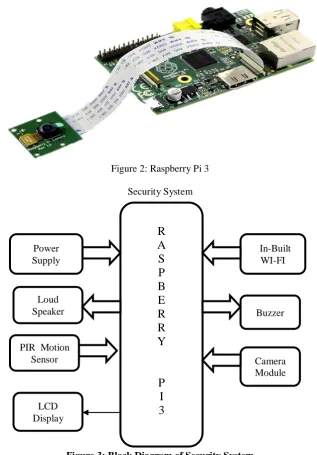
Figure 2: Raspberry Pi 3
Security System
Figure 3: Block Diagram of Security System
II. WORKING EXPLANATION
Working of this Project is very simple. A PIR sensor is used to detect the presence of any person and a Pi Camera is used to capture the images when the presence it detected.
Whenever anyone or intruder comes in range of PIR sensor, PIR Sensor triggers the Pi Camera through Raspberry Pi. Raspberry pi sends commands to Pi camera to click the picture and save it. After it, Raspberry Pi creates a mail and sends it to the defined mail address with recently clicked images. The mail contains a message and picture of intruder as attachment. Here we have used the message “Please find the attachment”, you can change it accordingly in the Code given at the end. The real time alert SMS is sent using the WAY2SMS which is connected through the internet. After completion of all these activities the buzzer will be activated.
A. Raspberry Pi 3:
The Raspberry Pi is a series of small single-board computers developed in the United Kingdom by the Raspberry Pi Foundation to promote the teaching of basic computer science in schools and in developing countries. The original model
became far more popular than anticipated, selling outside its target market for uses such as robotics. It does not include peripherals (such as keyboards, mice and cases). However, some accessories have been included in several official and unofficial bundles.
R
A
S
P
B
E
R
R
Y
Y
P
I
3
In-Built WI-FI
Camera Module Loud
Speaker Power Supply
Buzzer
LCD Display PIR Motion
ISSN(E): 2277-128X, ISBN: 978-93-87396-07-4, pp. 119-123
Figure 4: Raspberry Pi 3
Features of Raspberry Pi 3:
1. CPU: Quad-core 64-bit ARM Cortex A53 clocked at 1.2 GHz 2. GPU: 400MHz Video-Core IV multimedia
3. Memory: 1GB LPDDR2-900 SDRAM (i.e. 900MHz)
4. USB ports: 4 5. Bluetooth: 4.1 6. Weight: 45g
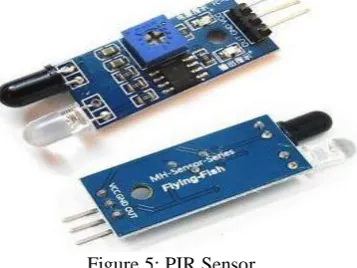
B. PIR Motion Sensor:
Infrared radiation is electromagnetic radiation (EMR) with longer wavelengths than those of visible light, and is therefore invisible to the human eye. It is sometimes called infrared light. It extends from the nominal red edge of the visible spectrum at 700 nanometers (frequency 430 THz), to 1 millimetre (300 GHz)although specially pulsed lasers can allow humans to detect IR radiation up to 1050 nm.). Most of the thermal radiation emitted by objects near room temperature is infrared. Like all EMR, IR carries radiant energy, and behaves both like a wave and like its quantum particle, the photon
Figure 5: PIR Sensor
C. Camera Module:
The Raspberry Pi Camera Module v2 replaced the original Camera Module in April 2016. The v2 Camera Module has a Sony IMX219 8-megapixel sensor (compared to the 5-megapixel Omni Vision OV5647 sensor of the original camera).The Camera Module can be used to take high-definition video, as well as stills photographs. It’s easy to use for beginners, but has plenty to offer advanced users if you’re looking to expand your knowledge. There are lots of examples online of people using it for time-lapse, slow-motion, and other video cleverness. You can also use the libraries we bundle with the camera to create effects
Figure 6: Camera module
ISSN(E): 2277-128X, ISBN: 978-93-87396-07-4, pp. 119-123
Figure 8: Intruder detection system using camera module
Figure 7: Screenshot of E-mail alert on Internet browser
ISSN(E): 2277-128X, ISBN: 978-93-87396-07-4, pp. 119-123
III. CONCLUSION
Security can be provided without the human intervention by automating the device using IOT. Here, any intrusion can be detected. This information can be used for maintenance of the devices and also for providing the registered user with any information about the intrusion. Thereby, this system can find its applications in many fields such as home automation, office security system and so on.
IV. FUTURE SCOPE
The further extension of this paper is real time surveillance and Artificial Intelligence. To record direct videos and send to nearest police stations and also send alert voice messages to authorized persons.
REFERENCES
[1] Mrutyunjaya Sahani, Chiranjiv Nanda, Abhijeet Kumar Sahu and Biswajeet Pattnaik, “Web-Based Online Embedded Door Access Control and Home Security System Based on Face Recognition” 2015 International Conference on Circuit, Power and Computing Technologies [ICCPCT]
[2] Rhythm Haji,Arjun Trivedi, Hitarth Mehta, ProfA.B.Upadhyay “Implementation of Web-Surveillance using Raspberry Pi”International Journal of Engineering Research & Technology (IJERT) Vol. 3 Issue 10, October- 2014, IJERT.
[3] Jinsoo Han; Chang-Sic Choi; Ilwoo Lee, "More efficient home energy management system based on ZigBee communication and infrared remote controls," Consumer Electronics, IEEE Transactions on ,vol.57, no.1, pp.85,89, February 2011.
[4] Erdem, H.; Uner, A., "A multi-channel remote controller for home and office appliances," Consumer Electronics, IEEE Transactions on,vol.55, no.4, pp.2184,2189,November 2009.Yuksekkaya, B.; Kayalar, A.A.; Tosun, M.B.; Ozcan, M.K.; Alkar,A.Z., "A GSM, internet and speech controlled wireless interactive home automation system," Consumer Electronics, IEEE Transactions on , vol.52, no.3, pp.837,843, Aug. 2006. [5] Chia-Hung Lien; Ying-Wen Bai; Ming-Bo Lin,"Remote-Controllable Power Outlet System for Home Power
Management," ConsumerElectronics, IEEE Transactions on , vol.53, no.4, pp.1634,1641, Nov.2007.
Vernon, S.; Joshi, S.S., "Brain–Muscle–Computer Interface: Mobile-Phone Prototype Development and Testing," Information Technologyin Biomedicine, IEEE Transactions on , vol.15, no.4, pp.531,538, July2011. [6] Faundez-Zanuy, M. Are inkless fingerprint sensors suitable for mobile use? IEEE Aerospace and Electronic
Systems Magazine, Vol. 19, No.4, pp. 17-21, April 2004.
[7] I.S. Jacobs and C.P. Bean, “Fine particles, thin films and exchange anisotropy,” in Magnetism, vol. III, G.T. Rado and H. Suhl, Eds. New York: Academic, 1963, pp. 271-350.
[8] K. Elissa, “Title of paper if known,” unpublished. R.Nicole, “Title of paper with only first word capitalized,” J.Name Stand. Abbrev., in press.
[9] Y. Yorozu, M. Hirano, K. Oka, and Y.Tagawa,“Electron spectroscopy studies on magneto-optical media and plastic substrate interface,” IEEE Transl. J. Magn. Japan, vol. 2, pp. 740-741, August 1987 [Digests 9th
Annual Conf. Magnetics Japan, p. 301, 1982].
[10] M. Young, The Technical Writer’s Handbook. Mill Valley, CA: University Science, 1989. [11] Raspberry Pi Official website [Online], Available: http://www.raspberrypi.org/
[12] Peter H.N. de and W. Lao, J. Han With, “Automatic video based human motion analyzer for consumer surveillance system”, IEEE Trans Consum Electron, Vol. 55, No. 2, pp. 591-598, 2009.
[13] The Robot control using the wireless communication and the serial communication, by JONG HOON AHNN, Project Advisor: Professor Mark Campbell, Cornell University May 2007.
[14] Pandurang H. Tarange, Rajan G. Mevekari, Prashant A. Shinde ”Web based Automatic Irrigation System using