129
© 2018 by the Serbian Biological Society How to cite this article: Zhao B, Teng L, Zhang J, Xiang H, Li M, Liang K. Thigmotropicresponses of Oryza sativa L. to external rubbing stimulation. Arch Biol Sci. 2018;70(1):129-139.
Thigmotropic responses of
Oryza sativa
L. to external rubbing stimulation
Benliang Zhao1,2, Lili Teng1, Jia-en Zhang1,2,*, Huimin Xiang1,2, Meijuan Li1 and Kaiming Liang3
1Institute of Tropical and Subtropical Ecology, South China Agricultural University, Guangzhou, 510642, China
2Key Laboratory of Agro-Environment in the Tropics, Ministry of Agriculture of the People’s Republic of China, Guangdong
Engineering Research Center for Modern Eco-agriculture and Circular Agriculture, Guangzhou, 510642, China
3The Rice Research Institute of Guangdong Academy of Agricultural Sciences, Guangzhou 510640, China
*Corresponding author: [email protected]
Received: May 3, 2017; Revised: August 13, 2017; Accepted: August 14, 2017; Published online: September 19, 2017
Abstract: Our aim was to study the morphological and physiological responses of rice to rubbing stimulation. Rice was subjected to rubbing 30 times/day (R30), 60 times/day (R60), 90 times/day (R90) and 0 times/day (control) for 35 days. The height, elongation rates and second internode length were significantly decreased by the three treatments, whereas stem width increased significantly. The tiller number and chlorophyll contents of the top third and top fifth of leaves increased significantly after R30 and R60. In R90, the aboveground biomass was significantly decreased and dead leaf biomass was increased. In R30 and R60, the transpiration rates were 16% and 13% higher than in the control, whereas photosyn-thetic rates increased 25% and 23%, respectively. Root biomass was significantly increased in R30, and root/aboveground was enhanced in R90. Stomatal conductance and root triphenyltetrazolium chloride-deoxidizing ability was significantly increased by the three treatments. The SOD activities in all treatments and the control were similar after stimulation. POD and CAT activities increased significantly in R30 and R60, and malondialdehyde increased by 42% in R90. Membrane per-meability in R30 and R60 decreased 26% and 15%, respectively. The calcium content and soluble protein content increased in R30, whereas the magnesium content decreased. The nitrogen content increased significantly in R30 and R60. The silicon content in the whole plant and the size of stomata increased significantly in the three treatments. Thus, rubbing stimulation had complex effects on rice growth.
Key words: thigmomorphogenesis; rice; mechanical stimulation; nutrients; enzyme activity
INTRODUCTION
Mechanical stimulation is a widespread physical factor in the living environment of a plant and in-cludes wind, animal and plant rubbing, the impacts of rainfall and hail on stems and leaves, soil parti-cle hindrance, shaking, vibration, and other factors [1,2]. Mechanical stimulation has dual effects on plant growth and development. Low-intensity mechanical stimulation promotes the division and growth of plant cells, whereas high-intensity mechanical stimulation impairs plant growth and development [3]; thus, plant growth and development are regulated by mechanical stimulation among others.
Thigmomorphogenesis is often used to describe morphological changes in the process of mechanical stimulation-induced growth of plants without
spe-cialized induction cells [4]. Plants subjected to me-chanical stimuli such as wind, touching or rubbing usually have short, thick stems and distribute more of their biomass to the roots [1,2]. Mechanical stimula-tion can significantly change plant morphology. The height of Liquidambar styraciflua L. was reduced by 80% compared with the control after shaking for 30 s every day for 27 days [5]. The leaves of Nicotiana
tabacum, when bent 40 times/day, had shorter and
thicker stems [1]. Arabidopsis plants exposed to re-petitive touch stimulation showed a delayed flowering stage and decreased inflorescence elongation com-pared with the unstimulated control [2,6]. Mechanical stimuli promoted branching in Arabidopsis thaliana
Mechanical stimuli can affect plant cell character-istics, plant resistance, enzyme activity, endogenous hormones and other physiological and biochemical indicators. The cold resistance of Lycopersicon
escu-lentum Mill. cv. Caruso was enhanced after applying
brushing stimulation to plants twice a day and the formation of this resistance might be related to an increase in soluble sugar content [9]. Wind-induced mechanical stimulation of bean can improve the pest-resistance potential [10]. Mechanical stimulation ap-plied to Cucumis sativus leaves can improve resistance to pathogens [11]. Mechanical vibration stimulation can promote the growth of the Actinidia chinensis cal-lus [12]. Mechanical stimulation by stroking in Glycine max (L) Merr. can promote 4-aminobutyric acid syn-thesis and inhibit hypocotyl elongation [13].
Changes in Ca2+ are commonly involved in the physiological responses of plants to mechanical stimu-lation. Wind stimulation can induce a cytoplasmic Ca2+ increase in transgenic seedlings of Nicotiana
plumbaginifolia [14]. In the mesophyll tissue of N.
plumbaginifolia, the cytoplasmic Ca2+ concentration
of cells increased significantly under rotation stimula-tion [15].
However, few studies have been performed on the response of rice to mechanical stimuli. Field in-vestigations have shown that mechanical stimulation associated with biological activity significantly affect rice growth and development, morphology and physi-ology. In Asia, farmers raised ducks in paddy fields, and the diverse activities of ducks directly stimulated the rice, and involved touching the stems, rubbing leaves, trampling the rhizosphere and shaking the aboveground [16,17]. These stimulating effects sig-nificantly changed the morphological traits of rice in paddy fields, including decreased plant height, thicker and harder rice stems, enhanced lodging re-sistance and improved tillering and leaf area expan-sion [18,19]. Thus, the anatomical structure of the rice culm internodes was significantly impacted by the ducks’ activities [20]. Moreover, after raising crabs
(Eriocheir sinensis), crayfish (Macrobrachium
nippon-ensis) and fish (Aristichthys nobilis, Carassius auratus
gibelio) in paddy fields, the leaf area index and the leaf
area of the rice canopy were increased significantly. Plant height, the aerenchyma of the rice and the stem thickness were also improved significantly [21].
We previously observed that the plant height, biomass and root-zone methane oxidative capacity of rice plants all changed after stimulation by vibra-tion [22]. The biological activities in paddy fields are closely related to the surface friction between animals and plants, and the gentle rubbing caused by this bio-logical behavior could affect rice growth. However, until now, information about the response of rice to continuous rubbing has been limited. Therefore, the objective of this study was to investigate the changes in rice morphology with different intensities of rubbing and to identify related responses in the physiologi-cal traits of rice. This study will contribute to further understanding plant responses as affected by changes in physical factors and adaptation processes.
MATERIALS AND METHODS
Plant material and pot experimental conditions
Trial design and rubbing parameters
Three rubbing treatments were designed: rubbing stimulations 30 times/day (R30), 60 times/day (R60) and 90 times/day (R90). For the control, no rubbing stimulation was applied (0 times/day). Rubbing was performed using a feather duster each day from 9 am to 10 am. The aboveground part was rubbed upward to the maximum height during growth using a feather duster at a position 2 cm above the water surface. Two feather dusters were used together to rub one plant from opposite sides at the same height. In each rub-bing, the supporting poles inside the feather dusters were kept at a distance of 1 cm from the stem. All treatments and the control were laid out in a rand-omized design with 3 replications, and the gentle rub-bing stimulation continued for 35 days.
Determination of rice morphological characteristics
At 7, 14, 21, 28 and 35 days, shoot height was deter-mined using a ruler, and tiller number was recorded. The elongation rate was calculated from equation 1 (Eq. 1).
(cm/ day) Hf Hi
R
t
(Eq. 1)
where R is the height increase rate, Hf is the final height (cm) at measurement time, Hi is the initial height (cm) and t = 7, 14, 21, 28, and 35 days. After 35 days of stimulation, the internode length was record-ed, and the stem width was determined using a vernier caliper. The fresh weights of the shoot, root and dead leaf were determined using an electronic balance after 35 days of stimulation. For the determination of root biomass, the entire soil contents were removed from the pots and immersed in deionized water. The rice roots were carefully washed to remove any adhering soil. The dead leaves in the treatments and the control were collected using tweezers. Roots and dead leaves were cleaned with deionized water 3-5 times and dried using filter paper. The root:aboveground ratio was cal-culated based on the fresh weight at 35 days.
Root activity, enzyme activity, malondialdehyde (MDA) and membrane permeability assay
Roots were washed with deionized water, and the root tips were cut into small pieces (0.5 cm in length). Root activity was determined using the triphenyltetrazo-lium chloride (TTC) method after 35 days of stimula-tion based on the amount of deoxidized triphenylfor-mazan per root and expressed as µg/(g∙h) [23]. Fresh top first leaves in the fully expanded state collected after 35 days of stimulation (0.10 g) were homog-enized in liquid nitrogen in 50 mmol/L phosphate buffer (pH 7.8) containing 1% (w/v) polyvinylpyr-rolidone (PVP). After mixing for 10 s on an oscilla-tor (xw-80A, Shanghai Jingke Ltd.), the homogenate was centrifuged at 15,000×g for 20 min at 4°C. The supernatant was used for enzyme activity assay de-terminations of superoxide dismutase (SOD), per-oxidase (POD) and catalase (CAT). SOD activity was determined based on the inhibition of the reduction of nitroblue tetrazolium (NBT) [24] and expressed as U/g FW. POD activity determination was based on guaiacol oxidation at 470 nm by H2O2. POD activity was expressed as U/g FW [25]. CAT activity was de-termined based on H2O2 consumption. The enzyme activity was expressed as U/g FW [26]. Fresh leaves (0.10 g) were homogenized with liquid nitrogen in 50 mmol/L of phosphate buffer. After mixing for 10 s, the homogenate was centrifuged for 20 min at 4°C at 15,000×g. One mL of supernatant was used for the determination of MDA [27]. The MDA content was expressed as μmol MDA/g FW. Leaf membrane per-meability was determined according to the published method [28].
Assay of chlorophyll content, soluble sugar content and soluble protein
soluble sugar content, 0.5 mL of extract was placed in a 20-mL tube, and 5 mL of anthrone in ethyl acetate (2%), 1.5 mL of deionized water and 5 mL of sulfuric acid were added. The mixture was mixed on an oscil-lator and placed in a 99°C water bath for 1 min. After cooling, the absorbance of the mixture was recorded at 595 nm; the soluble sugar content was expressed as mg/kg FW. The soluble protein was measured using the Coomassie Plus protein assay [30]. Leaves (0.1 g) were homogenized in liquid nitrogen by grinding fresh leaves with pre-cooling buffer (0.05 M PBS, pH 7.0). The soluble protein was expressed as mg/kg FW.
Measurements of photosynthetic gas exchange
Photosynthetic gas exchange parameters were ob-tained from 9 am to 10 am with a photosynthesis system (CIRAS-1, PP Systems International Ltd., UK) after 35 days of stimulation. The leaf photosynthesis rate, transpiration rate and stomatal conductance were measured from the top first fully expanded leaves in the control and treatments. During measurement, the leaf temperature was 25±2°C.
Determination of nutrient contents
After 35 days of stimulation, rice plants in 3 replicates in the control and treatments were removed from the bucket. The collected plants were washed with purified water 3-5 times and dried in an oven. The dried plants were ground to determine the content of nutrients [31]. In addition, fresh top first leaves in the fully expanded state were sampled in 3 replicates from the control and treatments. The leaf blade and sheath of each sampled leaf were carefully separated using scissors. Dried leaves were ground for the determination of nitrogen, calcium and magnesium content [31]. The N content was de-termined using micro-Kjeldahl digestion, distillation and titration through an automatic Kjeldahl apparatus (VELP Scientific Inc., Italy). For determinations of Ca and Mg, dried leaves were homogenized with mortars and ashed at 525°C for 1 h in digestion crucibles. The Ca and Mg contents were determined using atomic ab-sorption spectroscopy. The contents of N, Ca and Mg in the leaves were then calculated based on the weight and measured concentration. To determine silicon con-tent, whole plants or leaf samples (0.10 g) were placed in plastic tubes and mixed with 3 mL of 50% NaOH
before treatment in an autoclave at 121°C for 20 min. The Si content in whole plants, leaf blades and sheaths was determined using the modified high-temperature alkaline fusion method [32].
Analysis of the leaf sheath structure by scanning electron microscopy
After 35 days of rubbing stimulation, a small part of the leaf sheath (0.5 cm width × 0.5 cm length) was se-lected randomly for measurements of cell area (µm2), stoma quantity, stoma area (µm2) and vascular bundle area (µm2). The sheaths were rinsed in 2.5% (w/v) glutaraldehyde for 4 h at 4°C. Each sheath was washed with phosphate buffer solution three times, followed by dehydration in 30%, 50%, 70%, 90% and 100% eth-anol solutions and immersion in methylbutyl acetate. After drying to a critical point under vacuum, the sheaths were adhered to a copper platform before gold plating with an ion-sputtering apparatus. The sheath samples were analyzed using scanning electron micro-scopy (SEM; XL-30-ESEM, Philips, Amsterdam, the Netherlands). The cell area (µm2), stroma area (µm2) and vascular bundle area (µm2) were calculated from the width (μm) and length (μm) determined using the standard scale provided by SEM.
Statistical analysis
Data were processed using OriginPro (OriginLab Cor-poration, USA). One-way ANOVA was performed in SPSS 13.0. Multiple comparisons were performed using the Duncan method.
RESULTS
Change in morphological traits under rubbing stimulation
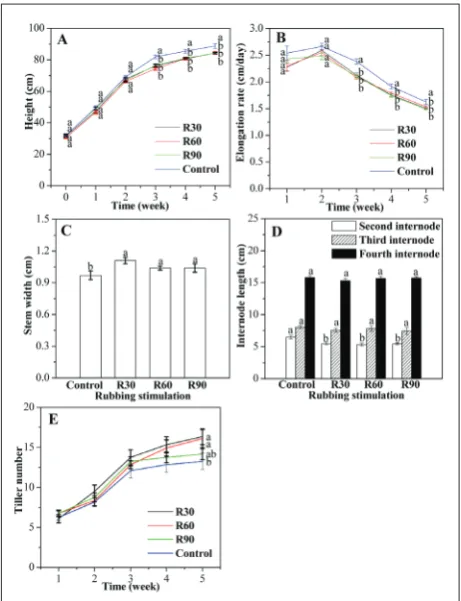
The elongation rates peaked at week 2 and decreased steadily at week 3 to 5 (Fig. 1B). Moreover, rubbing the aerial part influenced the stem width (Fig. 1C). The
stem widths in R30, R60 and R90 were significantly higher than that of the control. Internode length was also significantly affected by rubbing (Fig. 1D). The length of the second internode decreased under con-tinuous rubbing. R30, R60 and R90 decreased the length of the second internode by 14.99%, 17.61% and 15.76%, respectively, compared with the control. No significant changes in the lengths of the third and fourth internodes were observed between the three treatments and the control. Rubbing also induced a change in the tiller number per hill (Fig. 1E). After 35 days, the tiller numbers in R30 and R60 increased significantly and were 23.25% and 21.36% higher than that of the control, respectively.
Change in biomass traits under rubbing stimulation
The R90 treatment decreased the aboveground mass significantly, whereas the aboveground bio-masses in R30 and R60 were similar to that of the control (Fig. 2A). The root fresh biomass in R30 was significantly higher than that in the control but was not significantly different from those in R60 and R90 (Fig. 2A). The ratio of root:aboveground biomass was improved in R90 compared with the control (Fig. 2B). Because the aboveground biomass decreased and the root biomass was not affected, rubbing stimulation led to an increase in the root:aboveground ratio in R90. An increase in the biomass of dead leaves was observed in R90, indicating that intensive rubbing had a negative effect on growth (Fig. 2C). Dead leaf bio-masses in R30 and R60 were not significantly different from that in the control.
Fig. 1. Changes in height (A), elongation rate (B), stem width (C),
internode length (D) and tiller number (E) of rice (Oryza sativa
L.) under rubbing stimulation of the aboveground part for 35 days. R30 – rubbing 30 times/day; R60 – rubbing 60 times/day; R90 – rubbing 90 times/day; Control – rubbing 0 times/day. Different letters indicate significant differences between treatments and control at P<0.05 according to the Duncan method. Stem width and internode length was measured after 35 days.
Fig. 2. Changes in biomass (A), root:aboveground ratio, (B) and dead leaf biomass (C) of rice (Oryza sativa L.) under rubbing stimulation of
Changes in root activity, enzyme activities, MDA and membrane permeability under rubbing stimulation
The activities of SOD in all treatments and the control were similar after rubbing stimulation (Fig. 3A). The POD and CAT activities in R30 and R60 were signifi-cantly higher than those in the control (Fig. 3B, 3C). No significant differences in these two enzymes’ ac-tivities were observed among R30, R60 and R90. The MDA content of leaves in R30 and R60 was similar to that in the control, whereas the MDA content in R90 was significantly enhanced and increased by 42.22% (Fig. 3D). The membrane permeability of leaves in R30 and R60 was significantly decreased, by 25.64% and 14.96%, respectively, compared to that of the con-trol (Fig. 3E). Furthermore, the membrane permeabil-ity of the leaves was distinctly higher in R60 than in R30. Compared with the control, the root activity in
the treatments increased significantly after stimulation (Fig. 3F). The root activity in R30, R60 and R90 was 19.41%, 19.07% and 12.98% higher than that in the control, respectively, but no differences were observed between treatments.
Changes in chlorophyll, nutrients, soluble protein and soluble sugar under rubbing stimulation
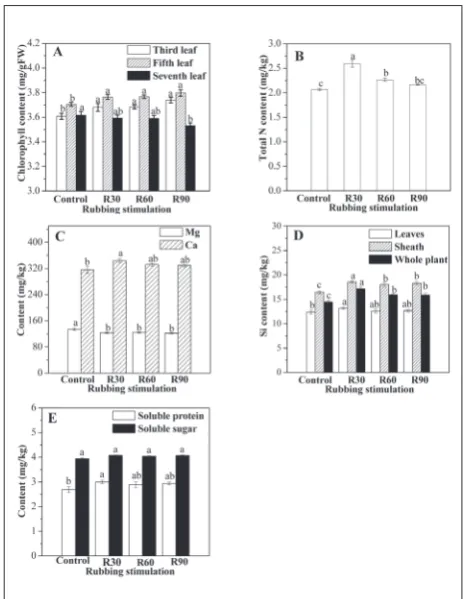
The chlorophyll content of third leaves in R30, R60 and R90 was 1.94%, 1.94% and 3.6% higher than that of the control, respectively (Fig. 4A). In addition, the chlorophyll contents of the fifth leaves in all treatments were significantly enhanced. For the seventh leaves, the chlorophyll contents in R30 and R60 were similar to the control but were significantly lower in R90.
The N contents in R30 and R60 were significantly enhanced to 25.12% and 9.18%, respectively, higher
Fig. 3. Changes in SOD (A), POD (B), CAT (C), MDA (D),
mem-brane permeability (E) and root activity (F) of rice (Oryza sativa
L.) under rubbing stimulation of the aboveground part for 35 days. R30 – rubbing 30 times/day; R60 – rubbing 60 times/day; R90 – rubbing 90 times/day; Control – rubbing 0 times/day. Dif-ferent letters indicate significant differences between treatments and control at P<0.05 according to the Duncan method.
Fig. 4. Changes in the contents of chlorophyll (A), total N (B), Ca
and Mg (C), Si (D), soluble sugar and soluble protein (E) of rice
than the control (Fig. 4B). The N content in R60 was similar to that in R90, but significantly lower than that in R30. The Ca content in R30 was significantly en-hanced and was 8.72% higher than that in the control, whereas the Ca contents in R60 and R90 remained un-changed compared with the control (Fig. 4C). The Mg contents of leaves in R30, R60 and R90 all decreased significantly compared with those in the control (Fig. 4C). The Si content of leaves in R30 was 6.54% higher than that of the control (Fig. 4D). The Si content of sheaths in response to rubbing stimulus increased in all three treatments compared with the control; the increases in R30, R60, and R90 were 13.23%, 9.82% and 11.59%, respectively. The Si content of the whole plant in R30, R60 and R90 was 18.98%, 10.26% and 9.91%, respectively, higher than that in the control.
No significant differences in soluble sugars in leaves were observed in response to the three treat-ments compared to the control (Fig. 4E). The soluble protein in R30 significantly increased after rubbing stimulation, whereas the soluble protein levels were similar in R60, R90 and the control.
Changes in photosynthesis, transpiration and stomatal conductance under rubbing stimulation
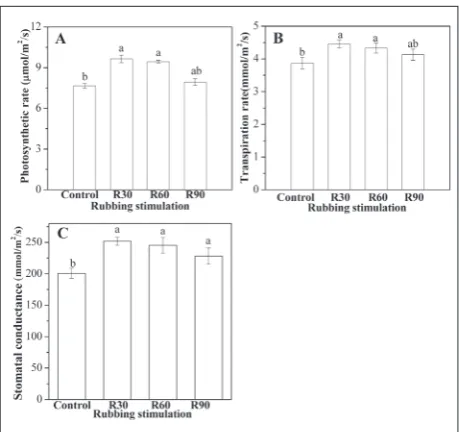
The photosynthesis rate increased significantly in R30 and R60 compared with the control, by 24.84% and 23.32%, respectively, but R90 was not significantly dif-ferent from the control (Fig. 5A). The transpiration rate in R30 and R60 was 15.52% and 13.06%, respec-tively, higher than that of the control. Transpiration rate in R90 remained unchanged compared with that in the control (Fig. 5B). Compared with the control, the stomatal conductance rate in R30, R60 and R90 was increased by 25.40%, 22.21% and 13.65%, respec-tively (Fig. 5C).
Changes in sheath microstructure under rubbing stimulation
The cell area, stoma quantity and vascular bundle area were not significantly different among R30, R60, R90 and the control (Table 1). The size of stomata in R30, R60 and R90 increased 19.06%, 20.40% and 15.61%, respectively, compared with the control.
DISCUSSION
Stem elongation inhibition is a classical plant response to stimuli, including touching, rubbing and flexing.
Fig. 5. Changes in photosynthetic rate (A), transpiration rate (B)
and stomatal conductance (C) of rice (Oryza sativa L.) under
bing stimulation of the aboveground part for 35 days. R30 – rub-bing 30 times/day; R60 – rubrub-bing 60 times/day; R90 – rubrub-bing 90 times/day; Control – rubbing 0 times/day. Different letters indicate significant differences between treatments and control at P<0.05 according to the Duncan method.
Table 1. Change in microstructure of rice sheath under rubbing stimulation on the aboveground part for 35 days.
Traits Control R30Rubbing stimulation*R60 R90
Cell area (µm2) 1438.39±150.61a 1435.95±107.91a 1507.48±86.46a 1404.73±99.59a
Stoma quantity 9.50±0.71a 11.75±0.70a 10.25±0.84a 9.50±0.53a
Stoma area (µm2) 180.65±11.77b 215.09±15.51a 217.51±5.55a 208.85±8.99a
vascular bundle area (µm2) 1222.73±212.62a 1159.51±102.07a 1258.42±170.82a 1123.16±139.71a
Rubbing can be considered an environmental factor. Elongation rates also slowed down after rubbing on the aerial part in this trial. A similar phenomenon was reported in the response of Maytenus ilicifolia to mechanical stimulus, in which stem bending induced a reduction in height increment among its seedlings [33]. Rubbing on the aerial part increased the stem width. Similarly, trampling stimulation can decrease the vertical height and increase the basal diameter of dryland shrub species [34].
The tiller number can change under external stimuli. Inoculation with the beneficial fungus
Tri-choderma sp. SL2 was reported to increase the tiller
number [35]. The growth of internodes is regulated by cell division in the intercalary meristem and ex-tension of individual cells between nodes [36]. Here, rubbing stimulation reduced the second internode of the stem and increased the stem width. The reduction of internodes was attributed to both reduced elon-gation of epidermal and cortical cells and a reduced number of cells in the vascular and pith tissues [37]. The enhancement of stem width was helpful in im-proving lodging resistance. Rubbing applied to the fourth internode of Solanum lycopersicum inhibited the elongation of the internode in the rubbed area and the neighboring internodes [38].
The allocation of total-plant biomass between aboveground and the root was closely related to disturbance intensity. The aboveground biomass decreased in R90, indicating excessive disturbance of growth. The dead leaf biomass also increased in R90. R90 was a negative environmental stress for aboveground elongation and biomass accumulation. However, the root biomass was enhanced in R30, as more biomass was allocated to roots during rubbing stimulation. Mechanical stimuli can alter the auxin distribution and regulate root development through the mechanical and chemical feedback of a plant [39]. The root:aboveground ratio was altered significantly in R90, suggesting that R90 greatly influenced the morphological traits. Partial mechanical stimula-tion increased the total biomass, root:shoot ratio and number of ramets of Leymus secalinus [40]. The bio-mass of Hedysarum laeve was negatively affected by mechanical perturbation [41]. Brushing significantly decreased the total biomass of Plantago major leaves [42]. The response of plants to stimuli is a gradually
adapted physiological state. When the stress is in the threshold range, plants can adapt, and plant assimila-tion and growth can be promoted. However, beyond the threshold range, stress destroys plant tissue and cells and impairs plant growth [43]. Root activity is an important physiological index for evaluating the state of plant growth. Considering the increase in root biomass and root activity in R30, rubbing with some intensity was possibly beneficial for root metabolism. Thus, root activity can be an indicator that partly re-flects the adaptive responses of rice to aboveground disturbances. Interestingly, R90 was beneficial to root activity but impaired whole-plant biomass accumula-tion by increasing the dead leaf biomass. We assume that nutrient transport from rice roots to aboveground might be hindered by disturbance from rubbing. Simi-larly, stem bending as a mechanical stimulus led to an increase in the root biomass of Maytenus ilicifolia
seedlings [33].
Environmental stresses or disturbances can induce the production of reactive oxygen species (ROS) and damage plant tissues. SOD, CAT and POD are closely related with ROS produced by external stimulation. In this work, rubbing stimulation induced increases in CAT and POD of leaves in R30 and R60 to protect normal metabolism. However, SOD activity did not exhibit a similar increase. A similar phenomenon was reported in the response of rice under the chemical stress of 1-octyl-3-methylimidazolium chloride ionic liquid, in which the CAT of leaves was enhanced, but SOD was not significantly changed [44]. The enzyme-responsive thresholds for SOD, CAT and POD under stress were not synchronous. We deduced that the POD and CAT of leaves responds more sensitively to rubbing stimulation. The SOD, CAT and POD activi-ties of leaves in R90 were not different from those in the control and the normal metabolism in R90 was possibly impaired by stimulation.
cells due to changes in membrane permeability. The MDA content in R90 increased significantly; however, no significant changes in SOD, POD and CAT activi-ties were observed, suggesting that rice leaf tissue was damaged. The soluble protein in R30 significantly in-creased after rubbing stimulation. Plants adapt to stress by increasing their soluble protein levels [46].
The top third, fifth and seventh of leaves are re-sponsible for approximately 80% of net whole-plant photosynthesis in the growth period of grain filling [47]. All treatments improved the chlorophyll con-tents of the third leaves, which contributed to less leaf senescence and higher rice yield. The increase in the chlorophyll content in the fifth leaves could be related to changes in nutrient transport.Mechanical stimula-tion reduced the chlorophyll content of the aquatic macrophyte Elodea nuttallii by about 40% [48].The significant decrease in the chlorophyll content of seventh leaves in R90 indicated that excessive stimuli damaged the photosynthesis process. R30 and R60 effectively enhanced the N contents in rice. Rubbing stimulation on the aerial part improved the capacity of N uptake. The rubbing stimulus led to changes in the Ca contents of leaves. Ca is a sensor for mechani-cal perturbations and mechanimechani-cally stimulatingstems caused an increase in the Ca of leaves in R30. In this trial, rubbing retarded Mg accumulation in plant tis-sue. Rubbing may have influenced nutrient transloca-tion, leading to changes in the utilization of mineral elements.
Si can help alleviate damage from biotic stresses and improve both the mechanical properties and the regeneration of the cell walls of rice [49]. The increas-es in Si content in the sheath and whole plant suggincreas-est- suggest-ed that the rice was more resistant to environmental stresses after continuous rubbing. Si accumulation in rice was greatly influenced by rubbing.
Photosynthesis is sensitive to diverse environmen-tal disturbances. In this trial, rubbing had a positive effect on the photosynthesis rate of rice, which was en-hanced in R30 and R60. The transpiration rate can be used to assess the growth of plants under wind stimu-lation [50, 51]. In contrast to wind stress, rubbing was beneficial for the transport and allocation of nutrients in tissues due to improvements in the transpiration rate. Briefly, rubbing simulated the photosynthesis and
the transpiration rate, suggesting a potential means of improving yield. The size of stomata was enhanced in all treatments, which may have been the main reason for the increased stomatal conductance.
CONCLUSIONS
Low-intensity rubbing stimulation promoted the growth and development of rice by improving the till-er numbtill-er, chlorophyll content, transpiration rate and nutrient contents. Low-intensity rubbing stimulation also enhanced the resistance of rice plants by improv-ing enzyme levels and soluble protein content. High-intensity rubbing stimulation led to leaf damage and accelerated leaf senescence. Low-intensity rubbing stimulation enhanced photosynthesis, transpiration, stomatal conductance and the stoma area. In practice, low-intensity rubbing stimulation can be achieved by regulating the density of duck, fish, crab and crayfish in a paddy field. In summary, appropriate mechanical stimulation is helpful for improving rice growth and resistance to environmental stress.
Acknowledgments: This work was supported by the Doctoral
Fund of the Ministry of Education of China (20124404110009), S cience and Technolog y Program of Guangdong (2015B090903077), the Foundation for High-level Talents in Higher Education of Guangdong ([2013] No. 246), the Guangzhou Pearl River S&T Nova Program (201506010042), the Guangdong Natural Science Foundation (2016A030313410), the Guangdong Award Funds for Outstanding Young Teachers in Higher Edu-cation Institutions (YQ2015026), the Undergraduate Training Programs for Innovation (201610564081) and Key Laboratory of Tropical Agro-Environment Funds.
Author contributions: BLZ, LLT and JEZ conceived and designed
research. BLZ and LLT conducted experiments. HMX contrib-uted analytical tools. MJL and KML analyzed data. BLZ wrote the manuscript. All authors read and approved the manuscript.
Conflict of interest statement: The authors do not have any
con-flicts of interest.
REFERENCES
1. Anten N, Casado-Garcia R, Nagashima H. Effects of mechan-ical stress and plant density on mechanmechan-ical characteristics, growth, and lifetime reproduction of tobacco plants. Am Nat. 2005;166(6):650-60.
3. Uchida A, Yamamoto KT. Effects of mechanical vibration on
seed germination of Arabidopsis thaliana (L.) Heynh. Plant
Cell Physiol. 2002;43(6):647-51.
4. Badel E, Ewers FW, Cochard H, Telewski FW. Acclimation of mechanical and hydraulic functions in trees: impact of the thigmomorphogenetic process. Front Plant Sci. 2015;6:266. 5. Neel PL, Harris RW. Motion-induced inhibition of
elonga-tion and inducelonga-tion of dormancy in liquidambar. Science. 1971;173(3991):58-9.
6. Johnson KA, Sistrunk ML, Polisensky DH, Braam J.
Arabi-dopsis thaliana responses to mechanical stimulation do not require ETR1 or EIN2. Plant Physiol. 1998;116(2):643-9. 7. Liu Y, Schieving F, Stuefer JF, Anten NPR. The effects of
mechanical stress and spectral shading on the growth and allocation of ten genotypes of a stoloniferous plant. Ann Bot. 2007;99(1):121-30.
8. Pigliucci M. Touchy and bushy: Phenotypic plasticity and
integration in response to wind stimulation in Arabidopsis
thaliana. Int J Plant Sci. 2002;163(3):399-408.
9. Keller E, Steffen KL. Increased chilling tolerance and altered carbon metabolism in tomato leaves following application of mechanical stress. Physiol Plant. 1995;93(3):519-25. 10. Jr. Cipollini DF. Wind-induced mechanical stimulation
increases pest resistance in common bean. Oecologia. 1997;111(1):84-90.
11. Wang BC, Wang JB, Zhao HC, Zhao H. Stress induced plant resistance and enzyme activity varying in cucumber. Colloids Surf B Biointerfaces. 2006;48(2):138-42.
12. Yang XC, Wang BC, Liu YY, Duan CR, Dai CY. Biological
effects of Actinidia chinensis callus on mechanical vibration.
Colloids Surf B Biointerfaces. 2002;25(3):197-203.
13. Bown AW, Zhang G. Mechanical stimulation, 4-aminobutyric acid (GABA) synthesis, and growth inhibition in soybean hypocotyl tissue. Can J Bot. 2000;78(1):119-23.
14. Knight MR, Smith SM, Trewavas AJ. Wind-induced plant motion immediately increases cytosolic calcium. Proc Natl Acad Sci USA. 1992;89(11):4967-71.
15. Haley A, Russell AJ, Wood N, Allan AC, Knight M, Campbell AK, Trewavas AJ. Effects of mechanical signaling on plant cell cytosolic calcium. Proc Natl Acad Sci USA. 1995;92(10):4124-8.
16. Zhang JE, Zhao BL, Chen X, Luo SM. Insect damage reduction while maintaining rice yield in duck-rice farm-ing compared with mono rice farmfarm-ing. J Sustain Agric. 2009;33(8):801-9.
17. Zhao BL, Zhang JE, Li HZ, Xu HQ, Quan GM, An M. Effect of Lolium multiflorum Lam. as a substitute feedstuff for ducks in a rice-duck farming system. Agroecol Sustain Food Syst. 2015;39(7):727-46.
18. Khumairoh U, Groot JCJ, Lantinga EA. Complex agro-eco-systems for food security in a changing climate. Ecol Evol. 2012;2(7):1696-704.
19. Zhang JE, Zhao MY, Chen J, Huang ZX. Effects of integrated rice-duck farming system on the growth of rice. Eco Sci. 2005;2:117-9. Chinese.
20. Zhang JE, Quan GM, Huang ZX, Luo SM, Ouyang Y. Evi-dence of duck activity induced anatomical structure change and lodging resistance of rice plant. Agroecol Sustain Food Syst. 2013;37(9):975-84.
21. Yang Y, Zhang HC, Hu XJ, Dai QG, Zhang YJ. Characteristics of growth and yield formation of rice in rice-fish farming system. Sci Agri Sin. 2004;37(10):1451-7. Chinese.
22. Zhao BL, Zhang JE, Lv XH, Peng L, Padilla H. Methane oxi-dation enhancement of rice roots with stimulus to its shoots. Plant Soil Environ. 2013;59(4):143-9.
23. Islam E, Yang X, Li T, Liu D, Jin X, Meng F. Effect of Pb toxicity on root morphology, physiology and
ultrastruc-ture in the two ecotypes of Elsholtzia argyi. J Hazard Mater.
2007;147(3):806-16.
24. Beauchamp C, Fridovich I. Superoxide dismutase: improved assays and an assay applicable to acrylamide gels. Anal Bio-chem. 1971;44(1):276-87.
25. Wu FB, Zhang GP, Dominy P. Four barley genotypes respond differently to cadmium: lipid peroxidation and activities of antioxidant capacity. Environ Exp Bot. 2003;50(1):67-78. 26. Rao MV, Paliyath G, Ormrod DP, Murr DP, Watkins CB.
Influence of salicylic acid on H2O2 production, oxidative
stress, and H2O2-metabolizing enzymes: salicylic
acid-mediated oxidative damage requires H2O2. Plant Physiol.
1997;115(1):137-49.
27. Heath RL, Packer L. Photoperoxidation in isolated chloro-plasts: I. Kinetics and stoichiometry of fatty acid peroxida-tion. Arch Biochem Biophys. 1968;125(1):189-98.
28. Gunes A, Inal A, Alpaslan M, Eraslan F, Bagci EG, Cicek N. Salicylic acid induced changes on some physiological param-eters symptomatic for oxidative stress and mineral nutrition
in maize (Zea mays L.) grown under salinity. J Plant Physiol.
2007;164(6):728-36.
29. Fritschi FB, Ray JD. Soybean leaf nitrogen, chlorophyll content, and chlorophyll a/b ratio. Photosynthetica. 2007;45(1):92-8.
30. Bradford MM. A rapid and sensitive method for the quantita-tion of microgram quantities of protein utilizing the principle of protein-dye binding. Anal Biochem. 1976;72(1-2):248-54.
31. Bao SD. Soil Agro-chemistrical Analysis. 3rd ed. Beijing:
Agri-cultural Press; 2000. 264 p. Chinese.
32. Dai WM, Zhang KQ, Duan BW, Sun CX, Zheng KL, Cai R, Zhuang JY. Rapid determination of silicon content in rice. Rice Sci. 2005;12(2):145-7.
33. Volkweis CR, Lopes Dranski JA, Oro P, Malavasi UC, Mala-vasi MDM. Effect of the thigmomorphogenesis in the
mor-phometry of maytenus ilicifolia (schrad.) planch. seedlings.
Cienc Florest. 2014;24(2):339-46.
34. Xu L, Freitas SMA, Yu F, Dong M, Anten NPR, Werger MJA. Effects of trampling on morphological and mechanical traits of dryland shrub species do not depend on water availability. PLOS One. 2013;8(1):e53021.
35. Doni F, Isahak A, Zain CRCM, Yusoff WMW.
Physiologi-cal and growth response of rice plants (Oryza sativa L.) to
Trichoderma spp. inoculants. AMB Express. 2014;4:45. 36. Ma J, Cheng Z, Chen J, Shen J, Zhang B, Ren Y, Ding Y, Zhou
Y, Zhang H, Zhou K, Wang JL, Lei C, Zhang X, Guo X, Gao H, Bao Y, Wan JM. Phosphatidylserine synthase controls cell elongation especially in the uppermost internode in rice by regulation of exocytosis. PLOS One. 2016;11(4):e01531194. 37. Biro RL, Hunt ER, Erner Y, Jaffe MJ. Thigmomorphogenesis:
mechanically-perturbed or ethrel-treated bean plants. Ann Bot. 1980;313-314(6):381-6.
38. Saidi I, Ammar S, Demont-Caulet N, Thevenin J, Lapierre
C, Bouzid S, Jouanin L. Thigmomorphogenesis in Solanum
lycopersicum: morphological and biochemical responses in stem after mechanical stimulation. Plant Sci. 2009;177(1):1-6. 39. Sassi M, Traas J. When biochemistry meets mechanics: a sys-tems view of growth control in plants. Curr Opin Plant Biol. 2015;28:137-43.
40. Sui Y, He W, Pan X, Dong M. Partial mechanical
stimula-tion facilitates the growth of the rhizomatous plant
Ley-mus secalinus: modulation by clonal integration. Ann Bot. 2011;107(4):693-7.
41. Wang Y, He W, Dong M, Yu FH, Zhang LL, Cui QG, Chu Y. Effects of shaking on the growth and mechanical properties of Hedysarum laeve may be independent of water regimes. Int J Plant Sci. 2008;169(4):503-8.
42. Anten NPR, Alcala-Herrera R, Schieving F, Onoda Y. Wind
and mechanical stimuli differentially affect leaf traits in
Plan-tago major. New Phytol. 2010;188(2):554-64.
43. Lichtenthaler HK, Wenzel O, Buschmann C, Gitelson A. Plant stress detection by reflectance and fluorescence. In: Csermely P, editor. Stress of life: From molecules to man. New York: Annals of the New York Academy of Sciences; 1998. p. 271-85. 44. Liu H, Zhang S, Zhang X, Chen C. Growth inhibition and
effect on photosystem by three imidazolium chloride ionic liquids in rice seedlings. J Hazard Mater. 2015;286:440-8.
45. Kaur N, Dhawan M, Sharma I, Pati PK. Interdependency of reactive oxygen species generating and scavenging system in salt sensitive and salt tolerant cultivars of rice. BMC Plant Biol. 2016;16:131.
46. Khan SU, Gurmani AR, Jalal-Ud-Din, Qayyum A, Abbasi KS, Liaquat M, Ahmad Z. Exogenously applied gibberellic acid, indole acetic acid and kinetin as potential regulators of source-sink relationship, physiological and yield attributes in
rice (Oryza sativa) genotypes under water deficit conditions.
Int J Agric Biol. 2016;18(1):139-45.
47. Huang L, Dai L, Wang L, Leng Y, Yang Y, Xu J, Hu J, Rao Y, Zhang G, Zhu L, Dong G, Guo L, Qian Q, Zeng D. Genetic dissection for chlorophyll content of the top three leaves
during grain filling in rice (Oryza sativa L.). J Plant Growth
Regul. 2015;34(2):381-91.
48. Atapaththu KSS, Asaeda T. Growth and stress responses of
Nuttall’s waterweed Elodea nuttallii (Planch) St. John to water
movements. Hydrobiologia. 2015;747(1):217-33.
49. He C, Ma J, Wang L. A hemicellulose-bound form of silicon with potential to improve the mechanical proper-ties and regeneration of the cell wall of rice. New Phytol. 2015;206(3):1051-62.
50. Telewski FW. Is windswept tree growth negative thigmotro-pism? Plant Sci. 2012;184(184):20-8.