International Journal Advances in Social Science and Humanities
Available online at: www.ijassh.com
RESEARCH ARTICLE
Stakeholder Involvement, Commitment and Managed Change in
Public Universities in Uganda
Yunia Musasizi*, Immaculate Tusiime, Grace Nalweyiso
Department of Business Administration, Faculty of Entrepreneurship and Business Administration, Makerere University Business School.
Abstract
The purpose of the study was to establish the relationship between Stakeholder involvement, commitment and managed change in Public Universities in Uganda. A cross sectional and quantitative research design was adopted for this study. A correlation and regression analysis was used to establish if a change in the independent variables resulted into a change in the dependent variable. Since the study population was small that is 5 public universities in Uganda, a population census was taken. Validity and reliability of data was tested, data was analysed using SPSS and results presented based on the study objectives. Results revealed positive and significant relationships between stakeholder involvement and managed change and commitment and managed change which implies that improvement of one variable leads to improvement of the other. In addition, Stakeholder involvement was found to be a better predictor of managed change than commitment which implies that to improve on managed change; emphasis should be put on improvement of stakeholder involvement and lesser emphasis on commitment. The study recommends that there is a need for public institutions to involve stakeholders so as to build their commitment to the useful changes that are being introduced to ensure achievement of the purpose for which they were sought for. The study contributes to the available knowledge on management of change in public universities and also provision of future reference to other researchers.
Introduction
In today’s dynamic business environment, organizational changes and methods of addressing them are prevalent. The way businesses manage change and how successful they are at it, depends largely on the nature of business, the change and the people involved. It is also dependent on how well the organization and people understand the need for the change and the process involved [1]. Applying change management activities can be instrumental in realizing goals for planned and unplanned changes both internally and externally. It also helps diagnose problems associated with the transition before they become a crisis [1].
Change is no longer an irregular outing, an inconvenient upheaval by organizations. Change is something organizations have to learn to live with, structure and manage. Change is here to stay, and the winners will
be the ones who cope with it [2]. Adaptation to change has become a common agenda for organizations of all types, health care, business, social, governmental, educational, and cultural. In all organizations, the effects of change are multifaceted. "New competitors enter the marketplace and sweep away established customer bases, technology changes the rules of how business can be undertaken, legislation demands changes in the way products and services are delivered, and deregulation throws up whole new trading blocks and industry sectors. Behind it all the expectations of customers grow as they become ever more knowledgeable and demanding," [2].
commitment through creating confidence, competence and self esteem by giving the individuals the opportunity to experience success as soon as possible in the new ways of working, hence creating passion for change.
Organizations constantly change in order to adapt to the dynamic environment in which they operate. However it is never easy to implement change. According to Coomes and Liew [3], involving both the internal and external stakeholders in the implementation of change initiatives is vital to its success. However, failure to involve the various stakeholders and thus low commitment from them may be leading to continued failure by organizations to manage reform-driven change.
For instance, in 2001 due to changes in the Laws of Uganda, Makerere University Business School (MUBS) which was created after the merging of the then National College of Business Studies and Faculty of Commerce of Makerere University, transformed from a constituent college of Makerere University to a "public tertiary institution" affiliated to Makerere University. However this arrangement did not work well, resulting in continuous disputes over MUBS autonomy and the authority Makerere University has over it. For instance in 2006, MUBS was declared an independent institution by the High Court but the decision was later reverted by government (Uganda radio network, September 29, 2006). Later in 2010, MUK proposed to scrap 24 of the courses offered in MUBS claiming that they are duplicated (The observer, 2010). This arose after MUK started offering some of the business programs offered at MUBS. Mid 2015, government proposed to make MUBS a tertiary institution with powers to award degrees. The staff was not consulted on this which led to them rejecting the proposal claiming that they asked for a fully-fledged university and not a degree awarding institution. They felt that their views were not considered in the decision taken. (Daily Monitor, June 6, 2015).
Although there have been several studies on
change management, little has focused on stakeholder involvement, commitment and managed change in public universities in Uganda [3]. Hence, the need to establish whether there is any relationship between stakeholder involvement and commitment in successful management of organizational change in Uganda’s public universities. The significance of this paper lies in its benefit to the stakeholders.
Literature Review
Stakeholder Involvement
According to the stakeholder theory, the organization should take into consideration the needs, interests and influences of people and groups who either impact on or may be impacted by its policies and operations as stipulated.
The participation of stakeholders in the internal governance of organizations is crucial to their effective running as explained by the acknowledgement that an organization has to interact with its environment for its survival [4]. The resource dependency theory [5] also argues that there is need for an organization to be open to its environment due to its dependence on that environment to obtain critical resources. The theory asserts that organizational survival depends on the firm’s ability to acquire and retain resources from other actors in the external environment and therefore must enter into transactions and relations with the elements of the environment that can supply the required resources and service. It further states that an organization needs resources and has to negotiate with people, groups and other organizations that own these resources and where necessary involve them in decision making in order to attain its goals. In higher education, these resources can be government funding, staff, and students. An increased emphasis on the inclusion of other stakeholders (such as parents, community groups, and relevant others) in order to empower and localize decision-making in these institutions.
Commitment
“organizational commitment” to refer to acceptance of organizational values and willingness to stay. It reflects peoples’ attitudes towards the organizations’ goals and values, a desire to stay with the organization, and a willingness to expend effort on its behalf. Meyer and Allen [7] and Dunham et [8] identified three types of commitment; affective commitment, continuance commitment, and normative commitment. Affective commitment is the emotional attachment, identification, and involvement that an employee has with its organization and goals [9-11].
Continuance commitment is the willingness to remain in an organization because of the investment that the employee has with “nontransferable” investments such as retirement, relationships with other employees, or things that are special to the organization [12]. Normative commitment is the commitment that a person believes he or she has to the organization or their feeling of obligation to their workplace.
Managed Change
According to Storey [13], improvement of organizational efficiency and performance is a central objective of any strategic change initiative. The expected outcomes of such change include: increased competitiveness, enhanced organizational flexibility, quality and efficiency, in addition to reduced operating costs and considerable improved organizational performance [14].
It is known that over 90 per cent of organizations have undergone change of one sort or another during the last few years, usually involving downsizing, but for a variety of reasons, 66 per cent of change programs do not work [15] or do not deliver the expected results, and one can detect what appears to be a reducing popularity of change initiatives. Hence the need to plan, manage, implement, control and monitor change.
Stakeholder Involvement and Managed Change
Mayfield [16] acknowledges that involving stakeholders from the start in the change process, as well as throughout the process of implementation is important in change
management, and will facilitate the unfreezing described by Lewin [17]. Active participation by employees involved in the change process is the most important component for effective long term change. Managers’ ideal way of implementing change is to communicate the change, involve people in the change process and allow time for people to adjust to the new process [18].
Barriers to change are created when key people are left out of the change process and there is lack of communication during the implementation phase of a project. Communication of the reason and the necessity of organizational change is essential. Gill [19] stated that communicating inconsistent or conflicting messages can lead to misunderstandings about the change process which allows rumors to develop and leads to loss of commitment of employees.
Involvement of individuals is not only in the planning and implementation of change [20,21], but also in receiving appropriate support from the organization such as adequate training that provides them with the skills and tools necessary to handle the change [22,23].
Central to much of the early literature [22,24,25], as well as to more contemporary contributions [26-29], is the idea that involvement in the change process is key to reducing resistance to change by reducing anxiety, creating a stronger sense of ownership of the change and enabling individuals to contribute actively to the shaping of the change. This therefore can generate a more positive attitude towards the change and hence ultimately help to reduce resistance [30]. Resistance to change in organizations is largely brought about by the fear of the unknown by stakeholders. But when handled correctly, using known and tested change management techniques such as involving them, change can be implemented successfully, achieving set goals and objectives and to budget [31].
of shareholders, employees, customers, suppliers, lenders and society in order to develop change initiatives that stakeholders would support. In a study carried out by Coomes and Liew [3], it was found that involving both the internal and external stakeholders in the implementation of change initiatives is vital to its success. Hence, the support of all stakeholders is key to the success of change in organizations. Stakeholders are engaged to give an organization a competitive edge and their involvement ensures success of the change process. Parlalis [33] argues that a bottom-up approach rather than a top-down change process with the participation of the stakeholders is ideal in the public sector organizations if they are to succeed with the implementation of the changes. This approach increases stakeholders’ ownership over the changes and also pushes decision-making downward.
Robbins et al. [34] recommended identifying stakeholders and their interests, ranking them by their importance to the organization and managing relations with them accordingly. While Donaldson and Preston [35] propose that organizations that involve stakeholders will be more successful in meeting their organizational change objectives than those that do not. Peltokorpi et al. [36] argues that one of the reasons for low success in managing change initiatives is the failure to secure stakeholder participation and support. Organizational change is dependent on the resources possessed by various stakeholder groups and balancing stakeholder expectations has a direct influence on how they are motivated to support proposed change.
Commitment and Managed Change
Organizations often have to change the way they do business and adapt to new business environments in order to grow, remain competitive, and to survive [37,38]. These changes often involve reorganization which affects employees in many ways (laying off, new job requirements, etc). Consequently, the employees have begun to re-evaluate their commitment and relationship with organizations [39].
The definition of organizational commitment is based on an intrinsic exchange between the organization and employee as well as on emotional attachment between the employee and the organization. Study found that change can detach an employee from the organization and large scale change can reduce an employee’s commitment to the company. If an organization focuses on the structural aspects of change alone by planning the technical aspects of the change and does not guide and support its personnel then there will be a lack of commitment on the part of the employees. Failure to manage change effectively may reduce organizational effectiveness and employee well being, and damage managers’ careers [37].
Various scholars have noted the importance of commitment as a key to the success of change initiatives [40-44]. In addition, Conner et al. [42] described commitment to change as “the glue that provides the vital bond between people and change goals” and that the “most prevalent factor contributing to failed change projects is a lack of commitment by the employees” [43]. Commitment by employees to a new process can be described in terms of individual psychological processes .
Meyer and Allen’s Organizational Commitment Model [45] proposed three components of commitment: affective (willingness to maintain in an organization due to an existing affection); continuance (willingness to maintain in an organization due to a belief that it is advisable to do so given costs attached in case of failure to do so); and normative (willingness to maintain in an organization as it is the moral and ethical option).
change); and a sense of obligation to provide support for the change (normative commitment to change). In other words, individuals can feel bound to support a change initiative because they want to, have to, and or ought to which in the end leads to managing change.
Research has suggested that high affective organizational commitment indicates a general readiness to move forward with the organization [40, 47, 48] and a general tendency to perform a range of behaviors in favor of the organization. During change, such readiness and tendency will produce the positive attitudes and intention to exert efforts to support the change hence managed change. For instance, Herscovitch and Meyer [40] found that affective organizational commitment was positively associated with commitment to change and change relevant behaviors. That is, employees who are affectively committed to the organization are also likely to display favorable attitudes and supportive behavior towards organizational changes which in turn leads o managed change.
In contrast to those who are affectively committed to their organization, employees who are not affectively committed to the organization do not have emotional attachment to the organization, congruent values or identification with their organization (Allen & Meyer, 1990). These employees tend to create a psychological distance between themselves and the organization and also tend to be fairly insensitive to organizational events [40] like change initiatives hence negatively impacting on their management.
If employees do not see a clear benefit of the change, their commitment to the process will diminish. For instance, some studies [49] have suggested that, as change becomes more disruptive, individuals may experience increased levels of uncertainty, fear of failure, or loss of control [50, 51]. In the absence of effective managed change, such experiences can negatively affect followers’ attitudes towards the specific change in question. In addition, if top management does not present full commitment to change
then the process is surely doomed [19]. In organizations, innovation often fails when a top-down approach is taken without gaining commitment from employees. Employees may resist change by taking the attitude that if it “was not invented here” then we will not use it.
A key theme in the commitment literature is that, because of their sense of psychological attachment to and identification with the organization and because of their internalization of organizational values and goals, employees who are committed to their employing organization are more likely to engage in pro-change behaviors that are of direct benefit to the organization rather than anti-change behaviors.
In conclusion, to overcome barriers to change, organizations need to involve stakeholders so as to ensure their commitment to the change process. Committed stakeholders exhibit greater job satisfaction, motivation and attendance as well as decreased amounts of resistance to change.
Research Methodology
were anchored on a five (5) point Likert scales ranging from 5-strongly agree to 1 - strongly disagree. Part one of the questionnaires was used to capture biographic data of the respondents and part two was to collect data on stakeholder involvement, commitment and management of public universities. Cronbach’s alpha
coefficient test and Content validity index were done to ensure reliability and validity of the instrument respectively. Alpha coefficient of above 0.7 for individual test variables was derived meaning the instrument was reliable as shown below.
Table 1: Content Validity Index and Reliability analysis of the instrument
Variables Anchor Cronbach Alpha
Coefficients Content Index Validity
Stakeholder Involvement 5 Point 0.928 0.854
Commitment 5 Point 0.876 0.747
Managed Change 5 Point 0.786 0.685
Source: primary data
Stakeholder involvement was measured using the works of Kananga (1982). This has two categories; job involvement which tests the stakeholders’ willingness to carry out the current activities and work centrality which tested the stakeholders’ general willingness to carry out activities in a planned setting.
Commitment was measured based on Meyer and Allen [7] and Dunham et al [8] who stipulate three types of commitment; affective commitment [9,10,11], continuance commitment and normative commitment using the linkert scale of 1-5 to establish stakeholders’ identification, willingness and feeling of obligation to the institution. Managed change was measured based onthe central objectives of any strategic change initiative to be improvement of organizational efficiency and enhancement of organizational flexibility
After data collection, it was edited, coded and checked to ensure that it had the required quality, accuracy and completeness. Data was analyzed using an SPSS 17.0 program which provided descriptive outputs. Correlation analysis was carried out to establish the strength of the relationship between variables. Multiple regression analysis was also used to determine variance in the dependent variable that is explained by the independent variables.
Findings
To determine the general attributes of the respondents, frequency tables were used. These attributes included; the qualification, age, gender, length of service in the university and category as shown in table 2 below.
Table 2: Attributes of Respondents
Variable N=356 Description Frequency (%)
Highest qualification PhD 64 17.9
Masters 216 60.7
Degree 76 21.4
Age bracket 25-35 years
36-45 years 122 106 34.3 29.8
46-55 years
Above 55 years 90 38 10.6 25.3
Gender
Female 139 39.3
Length of service in the university
1-5 years 114 32.1
6-10 years 127 35.7
10-20 years 114 32.1
Category of staff
Academic 216 60.7
Administrative 76 21.4
Source: Primary data
Results in table 2 revealed that most of the respondents held a master’s degree (60.7%) followed by those who held a first degree (21.4%), and the least percentage (17.9%) were PhD holders. This implies that the respondents had the knowledge on the study. This does not differ from the expectation that university staff should be fairly learned.
The majority of the respondents were in the age bracket of 25-45 years (34.3%). Those in the age bracket of above 36-45 years came in second position (29.8%), the age bracket of 46-55 years (25.3%) and the age bracket of above 55 years took the remaining percentage (10.6%) which reflects that most university positions in Uganda are normally taken by relatively young people who still have a long time to serve the institutions and thus change greatly affects them.
Table 2 further shows that 139 respondents were female representing 39.3 % and 216 respondents were male representing 60.7% of the total respondents. This means that male is increasingly taking on university positions in selected public universities. This may be a result of increasing numbers of male graduates compared to the females
possibly due to high rates of girl child school drop outs in the early stages of education.
Results from table 2 also indicate that majority of the respondents had worked for the selected public universities between six to ten years representing 35.7% and the rest (those who had worked between 1 -5 years and 10 -20 years) shared 32.1%. This reflects presence of relative job stability in public universities [51] and have witnessed the change initiatives that have taken place in the past.
The greatest number of respondents was academic staff (60.7%) and administrative staff was represented by 21.4%. This tends to agree with the notion that academic staff are the core human resources of the universities [52] and more knowledgeable on changes in the institutions.
Correlation Analysis
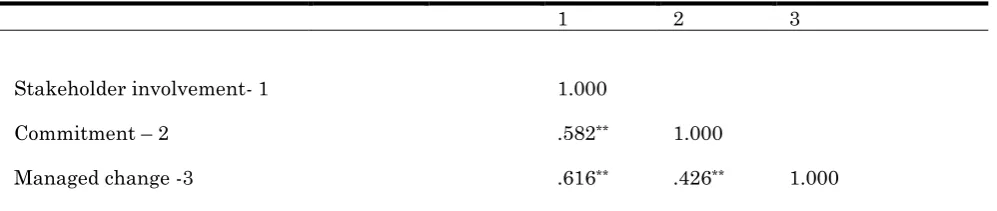
The purpose of this study was to establish the relationship between Stakeholder involvement, Commitment and Managed change in public universities in Uganda. The Pearson correlation test therefore was used to determine the above purpose as shown below;
Table 3: Zero - order correlation
1 2 3
Stakeholder involvement- 1 1.000
Commitment – 2 .582** 1.000
Managed change -3 .616** .426** 1.000
Stakeholder Involvement and Managed Change in Public Universities
The findings from the table 3 above, indicate a significant positive relationship between stakeholder involvement and managed change (r = .616, p<.0.01). In essence, this means that an improvement in stakeholder involvement is associated with an improvement in managed change. Therefore a decline in stakeholder involvement will lead to unsuccessful managed change. Thus, public universities that involve stakeholders will be more successful in meeting their organizational change objectives than those that do not.
Commitment and Managed Change in Public Universities
Results from table 3 show that commitment significantly correlates with managed change (r = .426, p<.01). This means that the more committed employees of public universities are the better change can be effectively managed. Similarly, low levels of
commitment are associated with unsuccessful managed change. This indicates that when employees have a desire to provide support for the change based on a belief in its inherent benefits, change will be successful but if they recognize costs associated with the change, no or little support for change will be given and hence failed change.
Multiple Regression Analysis
Regression analysis was done since there was more than one predictor variable impacting on the dependent variable. The regression model reveals the extent to which the variance in Managed Change is explained by Stakeholder Involvement, and Organisational Commitment. It also helped to establish the significance of each of the independent variables (Stakeholder Involvement and Commitment) on the variance in Managed Change. Results were obtained as presented in table below.
Table 4: Multiple Regression Analysis Coefficientsa
Model Unstandardized
Coefficients
Standardized Coefficients
t Sig.
B Std. Error Beta
(Constant) .877 .391 2.242 .029
stakeholder involvement .410 .109 .489 3.763 .000
commitment .031 .122 .033 .254 .800
a. Dependent Variable: Managed change
R Square = .446 F Statistic = 13.871 Adjusted R Square = .414 Sig.( F Statistic) =.000
Results in table 4 indicate that Stakeholder involvement and commitment only explain 41.4% (adjusted R square.414) of the variance in Managed Change. This implies that 58.6% of the variance in Managed Change is explained by other factors outside the model used. When Stakeholder involvement and commitment are each looked at independently, the findings in table 4 above indicate that the effect of Stakeholder involvement on Managed Change is significant (Beta = .489, P<.05). On the other hand, the impact of Commitment on Managed Change is insignificant (Beta = .033, P>, .05).
This implies that Stakeholder involvement is a significant predictor of Managed Change than commitment hence a positive change in Stakeholder involvement leads to 48.9% similar positive change in Managed Change. The findings further revealed that the overall model was well specified (F = 13.871, P<.01. This means that the overall model outcomes are reliable.
Discussion of the Findings
Relationship between Stakeholder
Involvement and Managed Change in Selected Public Universities of Uganda
relationship between involving stakeholders and managed change in public universities. These findings are in line with Coomes and Liew [3] who found out that involving both the internal and external stakeholders in the implementation of change initiatives is vital to its success. The managers need to understand the concerns of shareholders, employees, customers, suppliers, lenders and society in order to develop change initiatives that stakeholders would support. Hence, the support of all stakeholders is key to the success of change in Organizations. In a working environment where change is constant, there is need to develop competence in managing change. Changes, even small ones, inevitably involve a range of people, from the positive to the negative, from the influential to the powerless, from the interested to those who really don’t care. Regardless of their position, there is need to manage the situation, and the various people who can and will affect the outcome, if the change is to be delivered on time and in full [32].
Relationship between Commitment and Managed Change in Selected Public Universities of Uganda
Results further revealed that commitment significantly correlates with managed change which means that the more committed employees of public universities are, the better change can be effectively managed. This is in a way that if employees are willing to stay due to the affection they have for the organisation or the costs attached to leaving the organisation or the ethical obligation to stay with the
organisation, then change initiatives will be successful and well managed.
This conforms to research findings that suggested that high affective organizational commitment indicates a general readiness to move forward with the organization [40,48] and a general tendency to perform a range of behaviors in favor of the organization. During a change, such readiness and tendency will produce the positive attitudes and intention to exert efforts to support and manage the change. For instance, Herscovitch and Meyer [40] found that affective organizational commitment was positively associated with change relevant behaviors.
Conclusion
The study revealed a significant positive relationship between stakeholder involvement and managed change in Uganda’s public universities. This implies that in order to ensure that change is successfully managed; there is need for involvement of stakeholders. However, further analysis revealed that the impact of organizational commitment on managed change is insignificant. Thus, it is important that public universities engage the different stakeholders as change is implemented so as to gain their commitment to the change initiative. Other factors that impact on management of change in public universities that were not handled in this study should be studied to ensure effective change implementation. There is need to conduct studies on the influence of change and its management on the quality of Uganda’s education system.
References
1. Mittal R, Batra T, Luthra D, Maheshwari U (2012) Effective Change Management: An Indispensable Ingredient of Successful. TCS. 2. Bainbridge C (1996) Designing for change: A
practical guide for business transformation, New York: John Wiley.
3. Coomes C, Chern Li Liew (2007) Stakeholder involvement in the development and maintenance of web sites for children, Online Information Review, 3:199-217.
4. Davis D (2006) Supporting parent, family and community involvement in your school,
Northwest Regional Educational Laboratory, 2000.
5. Pfeffer J, Salancik GR (1978) The External Control of Organizations: A Resource Dependence Perspective. New York, Harper & Row.
6. Gallie D, White M (1993) Employee Commitment and the Skills Revolution, First Findings from the Employment in Britain Survey, Policy Studies Institute, London. 7. Meyer JP, Allen NJ (1991) A three
organizational commitment, Human Resource Management Review, 1:61-98. 8. Dunham, R, Grube J, Castaneda M (1994)
Organizational commitment: The utility of an integrative definition, Journal of Applied Psychology, 79(3):370-380.
9. Mowday R, Steers R, Porter L (1997) The measurement of organizational commitment, Journal of Vocational Behavior, 14:224-247.
10. Meyer JP, Allen NJ, Smith CA (1993) Commitment to organizations and occupations: Extension and test of a three component conceptualization, Journal of Applied Psychology, 78:538-551.
11. O’Rielly C, Chatman J (1986) Organizational commitment and psychological attachment: The effects of compliance, identification, internalization of pro-social behaviors, Journal of Applied Psychology. 71(3):492-499.
12. Reichers AE (1985) A Review and reconceptualization of organizational Commitment, Academy of Management Review, 10(3):465-476.
13. Storey J (1995) Focusing on how business changes affect individuals. People Management, 1(8):53.
14. McGreevy M (2009) Why change works sometimes. Industrial and Commercial Training, 41(6):305- 313.
15. Sturdy A, Grey C (2003) Beneath and beyond organizational change management: Exploring alternatives. Organization, 10:651-62.
16. Mayfield P, (2014) Engaging with stakeholders is critical when leading change, Industrial and Commercial Training, 46(2):68-72
17. Lewin,K (1951) General Field Theory, New York: Harper Row.
18. Doyle M, Claydon T, Buchanan D (2000) Mixed results, lousy process: contrast and contradictions in the management experience of change. British Journal of Management, 11:59-80.
19. Gill R (2003) Change management -or change leadership? Journal of Change Management, 3(4):307-18.
20. Judson AS (1991) Changing Behaviours in Organizations: Minimizing Resistance to Change. London: Blackwell Business.
21. Cunningham JB, Kempling JS (2009) Implementing change in public sector organizations. Management Decision, 47(2):330-44.
22. Kotter, JP, Schlesinger LA (1979) Choosing strategies for change, Harvard Business Review, 57(2):106-14.
23. Kotter JP (1995) Leading change: why transformation efforts fail, Harvard Business Review, May-June, 59-67.
24. Coch L, French Jr. JRP (1948) Overcoming resistance to change. Human Relations, 1(4):512-32.
25. Lawrence PR (1954) How to overcome resistance to change, Harvard Business Review, 32(3):49-57.
26. Carnall C (1994) Managing Change, Prentice-Hall: London.
27. Hultman KE (1995) Scaling the wall of resistance. Training and Development, 10(1):15-18.
28. McCrimmon M (1997) The Change Master -Managing and Adapting to Organisational Change, London: Pitman Publishing.
29. Young M (2009) A meta-model of change, Journal of Organizational Change Management, 22(5):524-48.
30. Giangreco A, Peccei R (2005) The nature and antecedents of middle managers’ resistance to change: Evidence from an Italian context. The International Journal of Human Resources Management, 16(10):1812-29. 31. Edmonds J (2011) Managing successful
change, Industrial and Commercial Training, 43(6):349-353.
32. Freeman RE, McVea J (2001) A Stakeholder Approach to Strategic Management. Darden Business School Working Paper No.
33. Parlalis SK (2011) Management of organisational changes in a case of de-institutionalisation, Journal of Health Organization and Management, 25(4):355-384.
34. Robbins SP, Bergman R, Stagg I, Coulter M
(2003) Management, 3rd ed., Prentice
Hall, Frenchs Forest, NSW.
36. Peltokorpi A, Alho A, Kujala J, Aitamurto J, Parvinen P (2008) Stakeholder approach for evaluating organizational change projects, International Journal of Health Care Quality Assurance, 21(5):418-434.
37. Herold DM, Fedor DB, Caldwell SD, Liu Y (2008) The effects of transformational leadership and change leadership on employees’ commitment to a change: A multi-level study. Journal of Applied Psychology,93(2):346-357.
38. Martins L (2008) Organizational development and change. Manuscript prepared for S. Zedeck (Ed.). APA Handbook of Industrial and Organizational Psychology, Volume III.
39. Dordevic B (2004) Employee commitment in times of radical organizational changes. Series: Economics and Organization 2(2):111-117.
40. Herscovitch L, Meyer JP (2002) Commitment to organizational change: Extension of a three-component model. Journal of Applied Psychology, 87:474-487.
41. Armenakis AA, Harris S, Field H (1999) Paradigms in organizational change: Change agent and change target perspectives. In R. Golembiewski (Ed.), Handbook of Organizational Behavior. New York: Marcel Dekker.
42. Conner DR (1992) Managing at the speed of change: How resilient managers succeed and prosper where others fail. New York: Villard Books.
43. Conner RD, Patterson RW (1982) Building commitment to organizational change. Training and Development Journal, 36:18-30.
44. Klein KJ, Sorra JS (1996) The challenge of innovation implementation. Academy of Management Review, 21:1055-1080.
45. Meyer JP, Allen NJ (1997) Commitment in the Workplace: Theory, Research and Application. London: Pitman Publishing. 46. Meyer JP, Herscovitch L (2001) Commitment
in the workplace: toward a general model. Human Resource Management Review, 11:299-326.
47. Brickman P (1987) Commitment. In CB Wortman, R Sorrentino (Eds.), Commitment, Conflict, and Caring, 1-18. Englewood Cliffs, NJ: Prentice Hall.
48. Eagly AH, Chaiken S (1993) The psychology of attitudes. Orlando, FL: Harcourt.
49. Caldwell SD, Herold DM, Fedor DB (2004) Towards an understanding of the relationships between organizational change, individual differences, and changes in person-environment fit: A cross-level study. Journal of Applied Psychology, 89:868-882. 50. Ashford SJ (1988) Individual strategies for
coping with stress during organizational transitions. Journal of Applied Behavioral Science, 24:19-36.
51. Fullan GM (2001) Leading in a culture of change, New Jersey: Jossey Bass.