IMMIGRATION AND NATURALIZATION POLICES IN GERMANY: CHANGING THE WAY WE EXAMINE THE DEVELOPMENT OF TURKISH IMMIGRANTS
Randall C. Denison
A thesis submitted to the faculty of the University of North Carolina at Chapel Hill in partial fulfillment of the requirements for the degree of Master of Arts in the Department of Political
Science, Concentration European Governance.
Chapel Hill 2013
Approved by: Donald Searing John D. Stephens
ii ABSTRACT
RANDALL DENISON: Immigration and Naturalization Policies in Germany: Changing the Way We Examine the Development of Turkish Immigrants
(Under the direction of Donald Searing)
Turkish immigrants, residing in Germany, claim that the development of immigration
and naturalization polices in conjunction with violent acts made by extremists is valid
evidence that German nationals are motivated by racial prejudice. Consequently, they assert
that individuals descending from Turkish ancestry are coerced to fully integrate into the
national culture and transform themselves into “ideal Germans.” The study of ethnocentric
intolerance in Germany is not a new issue in political science, but rather a long-term
commitment to investigating and understanding the nature of social relations in the German
Federal Republic. The conventional wisdom argues that the arrival and subsequent
entrenchment of Turkish immigrants produced concern for economic competitiveness among
German nationals. Under the belief that Turkish immigrants would easily obtain employment
at lower wages and that they would request social assistance from the state, Germans would
become increasingly intolerant and discriminatory towards all ethnic minorities, most
especially Turks. I contend that the conventional wisdom fails to provide a sufficient causal
explanation for the occurrence of ethnocentric intolerance. I find that while self-interest
influences social relations, the relationship between Turks and Germans is not simply
predicated on a conflict of economic interests. I also contend that a sufficient causal
explanation for German-Turkish relations must take into consideration at least four variables:
iii
TABLE OF CONTENTS
LIST OF TABLES……….iv
LIST OF FIGURES………...v
Chapter I. INTRODUCTION………...…1
II. REALISTIC CONFLICT THEORY…………....………...4
III. HISTORICAL OVERVIEW OF IMMIGRATION AND NATURALIZATION POLICIES…………..………...…...…8
The Emergence of Turkish Residents………..……...8
Gradual Reforms to Immigration and Naturalization……….……11
IV. A REALISTIC CAUSAL EXPLANATION………..18
The Influential Role of Institutions……….18
Self-interest as an Explainable Variable……….20
Racial Prejudice: Myth or Factor?...22
A Fourth Variable: National Identity………....…….……….27
V. CONCLUSION………...………30
iv
LIST OF TABLES
Table
1. The Growth of Turkish Population in Germany……..………..…………...…….. 11 2. Attitudes towards Immigration of Different
v
LIST OF FIGURES
Figure
1. Naturalization Rates in Germany,
INTRODUCTION
The main conception of tolerance is one in which self-interest determines the endurance of practices and persons. The conventional wisdom is that material needs and innate desires propel individuals forward and encourage them to commit actions intended to produce a positive outcome: the fulfillment of one’s own needs and desires. Even in
situations when the outcome is less successful than originally projected, individuals’ actions are determined by conscious and subconscious forces. This theoretical concept of tolerance is a gross underestimation because it excludes political or even sociological elements as a possible variables. Since these factors are not taken into consideration, the conventional wisdom is not capable of generating a sufficient causal explanation for intolerance.
2
between conflict theories (e.g. realism) and ontological approaches (e.g. social identity theory). Such a union could show that intolerance is not merely a consequence resultant from the clash of competing viewpoints, but rather a clash of sociological elements.
In the first section of this article, I propose that the case of Turks in Germany can best be explored through a theoretical model similar to the multivariate analysis developed by Paul Sniderman and Louk Hagendoorn. Sniderman and Hagendoorn’s analysis presents a normative union between ontological studies and conflict theories, which claims no single variable can stand alone and offer the best causal explanation. Standalone variables are insufficient because the causes behind ethnocentric actions transcend their limited
peripheries. Instead, the ideal approach envisioned by Sniderman and Hagendoorn is termed “realistic conflict theory.” Under realistic conflict theory, sociological elements are treated as significant variables equal to the traditional self-interest variable. In the case of ethnic
discrimination and racial violence in Germany, I propose that scholars consider the use of an analysis which examines issues through multiple lenses.
I contend this model will offer a sufficient explanation for the current state of social relations between ethnic Turks and non-ethnic Turks in Germany. The state of social relations deserves attention, because the present tension serves as a symptom from the development of immigration and naturalization policies since the 1950s. These policies experienced a broad transformation from labor-exclusive to integration-oriented to open inclusion. A historical account will indicate the transition was motivated by subtle changes in the thought processes of German residents and, to a greater extent, the national
3
overview presents a particular question: why do ethnic Turks, especially those who were naturalized or born citizens, feel that they are perceived by their fellow citizens as Ausländer (foreigners)?” This article will show that a multivariate analysis can indicate the following: social tension exists between ethnic Germans and ethnic Turks; the development of
CHAPTER ONE
REALISTIC CONFLICT THEORY
This section will present the theoretical framework for our case study. I contend that ontological studies and conflict theories by themselves are insufficient to explain social relations between ethnic Turks and ethnic Germans since each separate approach fails to address specific elements which are addressed by the other approach. Instead, the examination of social relations in Germany is best explained when conflict theories and ontological studies are incorporated into a single theoretical approach. The ideal approach likely will resemble realistic conflict theory as presented by Paul Sniderman and Louk Hagendoorn in their book titled When Ways of Life Collide. I will show that realistic conflict theory offers a model of multivariate analysis, incorporating sociological elements with the self-interest variable, which can be utilized to provide an adequate explanation for the occurrence of ethnocentric intolerance.
Throughout their study of hostilities between Dutch citizens and Muslim immigrants, Sniderman and Hagendoorn propose a normative union built on the incorporation of
ontological studies and conflict studies. That approach offers an adequate causal explanation for the occurrence of ethnocentric discrimination and violence; and, in so doing,
demonstrates that multiple variables influence the emergence and development of social tension. One variable for the occurrence of conflicts between ethnicities is self-interest. Sniderman and Hagendoorn write:
5
some are. But whether they recognize it or not, their root concern is about their economic well-being, not their cultural identity.1
Self-interest is a significant variable behind the development of social relations between ethnic minorities and ethnic majorities. In a comparison of respondents, those individuals whose employment opportunities are jeopardized by competition from ethnic minorities are more likely to consider ethnic minorities as a considerable threat than those individuals whose employment opportunities are not jeopardized. What’s more, self-interest does not necessitate the actual existence of a threat to one’s interests, but rather the perception that a threat exists. In cases where one ethnic group holds a strategic advantage in the labor market over another ethnic group, members from the former group may exhibit anxiety even though economic concern is ostensibly unwarranted. This observation implies that the mere
perception of a threat can influence interaction between ethnicities by magnifying the importance an individual places on the fulfillment of self-interest.
Another salient variable is national identity. In a comparison of respondents, those individuals who attach meaning, or value, to the identity of their nation-state are more likely to be concerned about the preservation of the national identity than individuals who do not attach meaning. Sniderman and Hagendoorn are admittedly not surprised from this result. Social identity theory presupposes that individuals are driven by an insatiable need to evaluate themselves in opposition to neighboring individuals. This drive necessitates a bifurcated categorization of groups into individuals with similarities and individuals without similarities. The establishment of that distinction in turn produces the notion that one side is inherently superior to the other side. What surprised Sniderman and Hagendoorn was the
1 Paul M. Sniderman and Louk Hagendoorn, When Ways of Life Collide: Multiculturalism and its Discontents
6
degree to which importance on identity increased sensitivity to political discourse. In comparison of respondents, those individuals concerned about national identity are no more likely to support exclusionary policies designed to preserve the national identity than those who are not concerned. Accounting for respondents’ alignment on the political spectrum, importance on national identity increases sensitivity to political discourse. This result indicates the existence of a third salient variable: prejudice.
Prejudice can be defined as “a readiness to belittle minorities, to dislike them, to shun them, to be contemptuous of them, and to feel hostility toward them.”2 Prejudice is a
significant variable since it increases the likelihood that an individual will support ethnic discrimination. The positive correlation is dependent on two factors: objectification of social entities and universality across the political spectrum. In the first instance, prejudice
objectifies members from ethnic minorities with artificial labels that establish stereotypical images which disregard differences and ascribe specific characteristics. This objectification fortifies the notion of irreconcilability: that ethnic majorities and minorities are diametric opposites. 3 In the second instance, prejudice is not restricted to any particular side of the political spectrum. Sniderman and Hagendoorn explain:
No one supposes there is no prejudice on the [political] left. But the
conventional wisdom that the danger lies to the political right tacitly assumes that being on the left to some degree immunizes one against the effects of intolerance. If one stops and gives some thought to the matter, however, the assumption is not obviously plausible. What reason is there to suppose that the psychology of intolerance changes depending on the political perspectives from which a person views the world? Intensely dislike minorities and you will be disposed to ill treat them whatever your political point of view.4
2 Ibid: 45.
3 Ibid: 44.
7
The conventional wisdom is that prejudice solely impacts members of the political right. That perspective often portrays members of the political left as sacrosanct from ethnic
discrimination. Sniderman and Hagendoorn boldly reject this assertion as a myth. Aggression towards ethnic minorities exists across the political spectrum regardless of party preferences.
In summation, Sniderman and Hagendoorn provide us a comprehensive theoretical approach which successfully unites segments from ontological studies with those from
CHAPTER TWO
HISTORICAL OVERVIEW OF IMMIGRATION AND NATURALIZATION POLICIES This section aims to examine the development of immigration and naturalization policies from the early 1960s to the mid-2000s. It starts out with a discussion on the official invitation for foreign laborers to migrate to Germany from other European countries. Then, it discusses efforts utilized by the German state to discourage foreign laborers from
establishing a permanent residence. Afterwards, it focuses on the liberalization of the naturalization policy following the conclusion that the labor-exclusive immigration policy failed to prevent the entrenchment of foreign laborers. This section will demonstrate that the state sought to maintain a division between German nationals and ethnic minorities via these immigration and naturalization policies. In the former case, the regulation of immigration was designed to prevent the formation of intimate connections. In the latter case, the naturalization process was utilized to preserve a legal distinction between those individuals who are considered “German” and those individuals who are not considered “German”.
The Emergence of Turkish Residents
9
economic growth, which exceeded initial projections. Due to this oversight and damages incurred from two major wars, the country suffered from a shortage of manual laborers, which impeded the national recovery from attaining its full potential. An official invitation to permit the entrance of Gastarbeiter (guest workers) from various nation-states was deemed a viable, albeit risky, solution to the labor shortage. In addition to diplomatic talks with other European countries, the German Federal Republic initiated negotiations with the Turkish Republic for the recruitment of laborers in 1961.
Although the Gastarbeiter were perceived as a vital necessity to the postwar recovery process, the negotiation team from the German Federal Republic exhibited concerns. The negotiators were apprehensive about the creation of a bilateral agreement, because the national economy was projected to stabilize in the late 1960s. Estimates indicated the
Gastarbeiter were needed only for a period of three to five years before the demand for labor would decline to sustainable levels. They hypothesized that the Gastarbeiter may refuse to return home after they began to benefit from higher wages and welfare benefits. What’s more, the negotiators held the belief that all Turks are Muslims. Even though the Republic of Turkey proclaimed itself to be a strict secular state, they were concerned that Turkish
laborers might not acclimate to a non-Muslim environment; and that the immigration of Muslims might result in the emergence of Islamic traditions and the subsequent
diminishment of the Gemeinshaft (harmonious community).
10
from low growth and a high rate of unemployment. Turkish negotiators calculated that the exportation of laborers would decrease unemployment and improve popular support for government initiatives. Additionally, a bilateral agreement was seen as an opportunity to regulate the actions of foreign recruiters, levy foreign currencies, and increase the population of laborers with skilled trades.5
The ratification of the bilateral agreement was predicated on the unconditional acceptance of concessions imposed by the German State. These stipulations were as follows:
1. Work visas were limited to a length of three years and residence permits to two. 2. Eligible candidates were required to participate in medical examinations,
administrated by the German Liaison Office in Istanbul, with intent of identifying risks to both themselves and the Gemeinshaft.
3. Familiennachzug (family reunions)between the Gastarbeiter and their relatives within the German Federal Republic were not permitted.
Noncompliance with these concessions meant the protraction, if not termination, of negotiations for the recruitment of laborers from Turkey. At initial glance, one could claim that the German state sought to preserve the integrity of its culture through the
discouragement of integration. Contemporaneously, one could argue that the health, religious preferences, and skills set of Turkish citizens were taken in serious consideration. In addition to these provisions, ministries from each country oversaw administration and neutrality of the
5 Aytaç Eryılmaz, “40 Years in Germany: At home abroad,” Private View Spring Edition (March 2002): 62 –
63; Faruk Şen, “Forty year later: Turkish immigrants in Germany,” Private View Spring Edition (March 2002): 28 – 29; Faruk Şen, “The Historical Situation of Turkish Migrants in Germany,” Immigrants & Minorities, Vol. 2, Nos.2&3 (July/November 2003): 208 – 209; Oliver Razum, Nuriye N. Sahin-Hodoglugil, and Karin Polit, “Health, Wealth or Family Ties? Why Turkish Work Migrants Return from Germany,” Journal of Ethnic and Migration Studies, Vol. 31, No. 4 (July 2005): 720; Filiz, Ovalı, Tavşan, Cengiz Tavşan, Ayşe Sağsöz, “The
11
recruitment process. Employers, seeking to increase their rosters, submitted requisitions with information on the nature of the profession and the quantity of workers to the German
Federal Work Office for verification and approval. Afterwards, requests were first transferred to the Liaison Office and then the Turkish Labor Exchange where applicants were screened before referred back to the Liaison Office. Eligible candidates who completed the second phase of the recruitment process (e.g. an interview and examinations) were granted visas, and shipped to Munich for registration and assignments.6
Gradual Reforms to Immigration and Naturalization
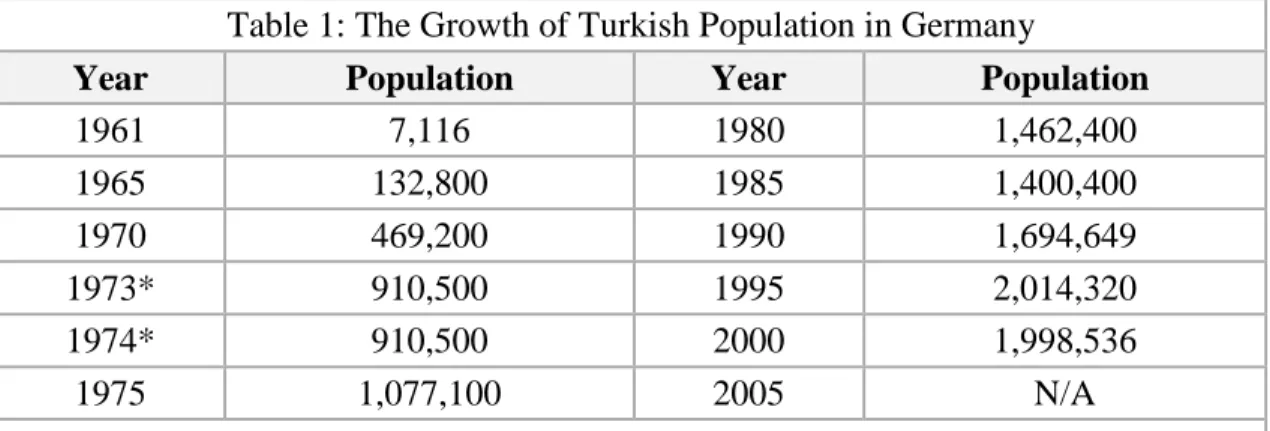
Despite meticulous efforts made during the bilateral negotiations, the population of Turkish immigrants grew unabated. The preliminary number of laborers who migrated from Turkey was 7,116 individuals in 1961. Over the course of the next decade, the number exploded to 910,500 with negligible resistance. The sole recorded stagnation of the
population occurred when levels remained constant between 1973 and 1974 (Table 1). The slowdown was likely resultant from the economic recession generated from the embargo on oil exportation imposed by the Organization of Arab Petroleum Exporting Countries; and the nullification of the bilateral work agreement between Germany and Turkey.
6 Aytaç Eryılmaz, “40 Years in Germany: At home abroad,” Private View Spring Edition: 63–64. Table 1: The Growth of Turkish Population in Germany
Year Population Year Population
1961 7,116 1980 1,462,400
1965 132,800 1985 1,400,400
1970 469,200 1990 1,694,649
1973* 910,500 1995 2,014,320
1974* 910,500 2000 1,998,536
1975 1,077,100 2005 N/A
12
Although unforeseeable in the 1970s, three variables contributed to the entrenchment of ethnic Turks in Western Germany. The first is the issue of Familiennachzug. Gastarbeiter argued that economic decline produced emotional and financial constraints which hindered their ability to sustain long distance relationships with their families, and necessitated a return to their homeland. This news stirred compassion among employers who had vested interests in the maintenance of their low-cost, trained laborers. The demand for reform coerced the German state to permit the entrance of spouses and offspring. A second variable is the identification of Western Germany as the home country. The growing population of ethnic Turks increased demand for European as well as Turkish-oriented commodities (e.g. döner, kibbeh). As Turks established lifestyles incorporating elements from German and Turkish culture, some individuals, especially children, built intimate connections with their newfound communities and identified themselves as Germans. The third variable is that ethnic Turks became accustomed to their living standards. Turkey suffered from mass civil disobedience, racial violence, comparatively lower educational standards, and limited economic opportunities. What’s more, the country underwent three distinct coup d’états which changed the nature of sociopolitical life and led to the emigration of human capital to Western Europe (e.g. intellectuals and refugees).7
The combined strength of these variables produced a second population increase ranging from 1,077,000 ethnic Turks in 1975 to 1,400,400 in 1985 (Table 1). Given that the
7 Kutay Erdem, Ethnic Marketing for Turks in Germany: Influences on the Attitude Towards Ethnic Marketing:
13; Faruk Şen, “Forty year later: Turkish immigrants in Germany,” Private View Spring Edition: 28; Simon Green, “The Legal Status of Turks in Germany,” Immigrants & Minorities, Vol. 2, Nos.2&3 (July/November 2003): 230 – 233. For more information on the history of the Turkish Republic, see Sina Akşin, Turkey: From Empire to Revolutionary Republic Trans. Dexter H. Mursaloğlu (New York: New York University Press, 2007); Feroz Ahmad, Turkey: The Quest for Identity (Oxford: Oneworld Publications, 2003); Ersin Kalaycıoğlu, and
13
population increased by 35%, the state offered financial incentives designed to encourage remigration. In particular, individuals were eligible to receive 10,500 deutsche marks (DM) (est. €5368) with the option of an additional 1,500 DM (est. €767) for each of their children. The distribution of these incentives were conditioned on the notarization of legal contracts “which stated [the signers] will never be allowed to live in Germany again.”8 The distribution of financial incentives were deemed a viable attempt to curtail immigrant entrenchment since it addressed two concerns: the pursuit of economic opportunities and a reconnection with cultural roots. Despite these considerations, the aggregate number of volunteers only ranged from 186,000 to 400,000 individuals. This evident failure shows that living standards found in Germany eclipsed those in Turkey.9
As the total population of ethnic Turks rose from 1,400,400 in 1985 to 2,053,564 individuals in 1999, political discourse pertaining to the treatment of immigrant minorities as citizens evolved. In the mid-1980s, roughly sixty percent of ethnic Turks had resided for a minimum of ten years. At the same time, the naturalization rate per year was an estimated 0.3%. Simon Green argues that the “government policy traditionally made few concessions to the possibility that its large and settled immigrant population, and especially its
descendants, might wish to become German nationals. Again, this approach rose out of the ‘non-immigration country’ position…which explicitly defined naturalization as an
8 Kutay Erdem, Ethnic Marketing for Turks in Germany: Influences on the Attitude Towards Ethnic Marketing:
14.
9 Oliver Razum, Nuriye N. Sahin-Hodoglugil, and Karin Polit, “Health, Wealth or Family Ties? Why Turkish
14
exceptional act.”10 The phrase ‘exceptional act’ refers to broad demands stipulated in the Einbürgerungsrichtlinien (1977 Guidelines on Naturalization). An eligible candidate for naturalization was required to prove a ten-year minimum of legal residence, demonstrate a commitment to German values, pay 5000 DM (est. €2556) for administrative fees, refuse to join ethnic associations, and possess citizenship from only one country.11
These facts did not go unnoticed. Former Chancellor Helmut Kohl, during the reunification transition, insisted the failure of previous administrations to prevent the entrenchment of an
10 Simon Green, “The Legal Status of Turks in Germany,” Immigrants & Minorities, Vol. 2, Nos.2&3: 239.
11 Elspeth Guild, C. A. Groenendijk, Sergio Carrera, Illiberal liberal states: immigration, citizenship, and
15
immigrant population necessitated that German citizens accept the inclusion of ethnic minorities. Low naturalization rates and the Einbürgerungsrichtlinien were considered evidence that members of ethnic minorities were dissuaded to integrate into German culture. This call for inclusion inspired the political elite to address the exclusionary elements of the naturalization process through the minor liberalization of the Auslaendergesetz (Alien Act) in 1990. Under the reformed law, members of two subgroups were made immediate candidates for citizenship: residents of at least 15 years and individuals aged from 16 to 23 years old. As Figure 1 demonstrates, the increase in the naturalization rate for ethnic Turks coincides with the enactment of these reforms.Despite the positive outcome from the liberalization of the Auslaendergesetz, the naturalization policy continued to suffer from impediments. In particular, children born into non-national families were considered under German law as Ausländer. Consequently, they were required to willingly undergo naturalization upon reaching the age of adolescence. In addition, these children were forbidden from possessing citizenship from Germany and their country of origin. The issue of dual citizenship was not emotional or cultural, but rather economical. Green writes: “Until the mid-1990s, Turkish [naturalization] law limited inheritance to Turkish nationals, and the administrative
procedure involved in obtaining release from one’s Turkish citizenship could take … three years.”12 In essence, the German state’s rejection of dual citizenship meant ethnic minorities were handed an obligatory choice: incur the costs of unconditional integration into or
12 Sarah Yentl Solari, “German Nationality: An Illustration of Institutionalized Discrimination” (Thesis
16
exclusion from German culture. These limitations were addressed by members of the Social Democratic Party who proposed additional reforms to the Auslaendergesetz in 1999.13
The second round of reforms is divided into five segments. First, the minimum length of legal residence was decreased from fifteen to eight years. Second, the principle of ius soli was introduced. After January 1st 1990, children were deemed natural-born citizens on the condition that one of their parents satisfied the first condition and held a valid residence permit.14 Third, the ban on dual citizenship was partially lifted. For instance, native-born children were entitled to possess dual citizenship until reaching the age of 23. Afterwards, their German citizenship was revoked unless they denounced the other citizenship in question. Fourth, verification of language proficiency was deemed mandatory for foreign nationals. Fifth, individuals were obligated to sign notarized pledges of loyalty to the German constitution. What’s more, these documents authorized security authorities to perform
random loyalty tests without requiring just cause. These reforms were deemed a substantial success since naturalization rates for 1999 and 2000 were comparatively higher than previously recorded levels.15
The first and second round of reforms to the Auslaendergesetz inspired an opportunity for further amendment. In July 2001, the Süssmuth Commission released a report; in which a proposal for a new immigration law was made. Then, the Bundesministerium des Innern
13 Elspeth Guild, C. A. Groenendijk, Sergio Carrera, Illiberal liberal states: immigration, citizenship, and
integration in the EU: 92 – 93; Sarah Yentl Solari, “German Nationality: An Illustration of Institutionalized Discrimination”: 27 – 29; Simon Green, “The Legal Status of Turks in Germany,” Immigrants & Minorities, Vol. 2, Nos.2&3: 239 – 240; David Horrocks and Eva Kolinsky, Turkish Culture in German Society Today: 92 – 93.
14 Children who were born prior to January 1st 1990 are still considered as ‘foreigners,’ not citizens by birth.
15 Sarah Yentl Solari, “German Nationality: An Illustration of Institutionalized Discrimination”: 30 – 31; Simon
17
(Federal Ministry of Interior) drafted legislation titled the Zuwanderungsgesetz (Immigration Act). The Zuwanderungsgesetz was designed “to modernize German immigration and
residence policy, and in many ways represented the culmination of the country’s very gradual transformation into a self-acknowledged country of immigration.”16 The draft recommended the formation of quotas for immigrants with developed skill sets; easier entrance for child immigrants; more efficient identification of refugees; streamlined residence permit system and compulsory training courses pertaining to culture and linguistics. After consultation with the Bundesverfassungsgericht den Bundesratsbeschluss (Federal Constitutional Court of the Federal Council), the Bundestag (German Parliament) and the Bundesrat (Federal Council) ratified the Zuwanderungsgesetz.
Immigration and naturalization policies of the German Federal Republic underwent a comprehensive makeover from labor-exclusive to integration-oriented to open inclusion. The historical overview suggests that the transition favored the easement of concerns, which reverberated among members of ethnic minorities, in response to a change within the national consciousness. One must not infer that the entire nation underwent of period of sociological change since ethnic discrimination continued to exist. Instead, the historical overview indicates that a segment of German nationals started to accept the presence of immigrant minorities. Those observations present a set of questions. First, what is the best causal explanation for the transformation of immigration and naturalization policies? Second, in what manner has the transition influenced social relations between Turks and Germans? To what extent do members from each subgroup consider each other equal citizens? The next section will endeavor to provide an answer for these queries.
CHAPTER THREE
A REALISTIC CAUSAL EXPLANATION
The compilation of research material pertaining to the case of ethnic Turks offers the opportunity to test realistic conflict theory as presented by Sniderman and Hagendoorn. I propose that the transition of immigration and naturalization policies was influenced by four factors: a network of institutions, self-interest, racial prejudice, and national identity. I also propose that these four factors had a significant impact on social relations between ethnic Turks and ethnic Germans. This section argues that realistic conflict theory offers a sufficient causal explanation for ethnocentric intolerance. I begin with a detailed examination of the aforementioned factors with regard to their impact on immigration and naturalization policies. Then, I present a brief synopsis of social relations between Turks and Germans.
The influential role of institutions
19
the state to promote “full social integration of foreign workers and their families,” but also encourage “foreign workers and their families to return to their home countries.”17
Minkenberg points out that the contradictory nature of the document was resultant from the preexistence of the Christian Democratic welfare state. Unlike the other main variants, the Christian Democratic model influenced the policy-making process through the establishment of a network where political parties, lobbies, and private businesses competed for political dominance. Immigration and naturalization policies were no different; their future was not directly predicated on the outcome of national elections or the will of the majority. Instead, a specific network, including the Bundesagentur für Arbeit (Federal Employment Agency), the Bundesministerium für Arbeit und Soziales (Federal Ministry of Labor and Social Affairs) and private businesses, oversaw their development in an
administrative and apolitical manner. This explanation is appropriate since it at least clarifies the decision over the allowance of Familiennachzug in the 1970s.18 Given private businesses held a position of influence, the acquisition of their support was a necessary success for the Gastarbeiter who longed to reunite with their families, but decidedly remained within the territorial confines of the host country. Were it not for employers’ concerns regarding their labor pools’ maintenance and overall productivity, the likelihood that private businesses would support the authorization of Familiennachzug might have been smaller.
Based on these observations, it is more apparent that a network of institutions played a role in the development of immigration and naturalization policies through joint
collaboration and implementation of administrative practices designed to stir the interest of
17 Michael Minkenberg, “The Politics of Citizenship in the New Republic,” West European Politics Vol. 26,
No. 4 (2003): 220.
20
foreign laborers and foster their initial migration to the German Federal Republic. It would be a considerable miscalculation, however, to presume that institutions are solely responsible for the development of social relations, considering that additional variables are involved.
Self-interest as an Explainable Variable
Minkenberg posits that the development of immigration and naturalization policies, via a network of institutions, positioned ethnic minorities into a precarious situation where they were offered social rights, but simultaneously denied political ones. What’s more, he posits that social concessions to ethnic minorities resulted in the promotion of ‘social welfare chauvinism’ (the notion that foreigners are not entitled access to the nation’s wealth). His analysis leads readers to the belief that the national unification further promoted the perception of welfare chauvinism among citizens residing in the former Eastern bloc. Accounting for residence, East Germans were more likely to feel resentful towards
immigrant minorities, because of limitations inherent to the West German welfare model. In particular, the model was designed to counteract social inequalities through high wages and state protectionism. The national unification incorporated two distinctly different regions under a single welfare model. Whereas living standards for West Germans were accounted for, the welfare model was incapable of addressing social inequalities among East Germans, who suffered from comparatively higher unemployment levels and regional impoverishment. Sensitivities towards welfare chauvinism resulted in the entrenchment of diametric attitudes towards the immigration of migrant groups.
21
Germans (respectfully 57.25% and 63.5% compared to 60.5% and 54.5%). A distinct difference in attitudes, however, occurs when support for inclusionary and exclusionary policies are considered. The former tended to support the unregulated inclusion of migrant laborers from EU and non-EU countries (33.5% and 9.25%), whereas the latter tended to support exclusionary policies designed to forbid further immigrants from entering into the country (27% and 40.25%). The difference in attitudes indicates that while a relatively small subgroup tended to prefer a complete prohibition on immigration, comparatively more East Germans than West Germans share anxieties about the growing population of immigrant minorities. Thus, this examination of welfare chauvinism demonstrates that self-interest is also a likely variable which influences social relations between Germans and Turks.
It would be remiss to infer, however, that Minkenberg’s analysis is free from criticism. In particular, it is difficult to assess the significance of self-interest as a variable given that the survey responses do not account for either the respondents’ ethnicity or the ethnicities of the migrant groups. Consequently, we cannot be certain how the population
Table 2
Attitudes towards Immigration of Different Migrant Groups to Germany (%)
West East
1991 1992 1996 2000 1991 1992 1996 2000
Labor migrants from EU countries
Without regulation 34 35 33 32 13 13 11 13
Partial regulation 56 56 55 62 62 63 51 66
Prohibited regulation 10 9 12 7 25 24 38 21
Labor migrants from non-EU countries
Without regulation 11 10 8 8 4 4 4 4
Partial regulation 61 62 59 72 56 59 46 57
Prohibited regulation 28 28 33 20 36 36 49 40
Source: Michael Minkenberg, “The Politics of Citizenship in the New Republic,” West European
22
responds to the immigration of individuals who are identified as ethnic Turks. Despite this uncertainty, there is sufficient evidence to speculate that concerns regarding economic well-being produce a readiness to dislike individuals who are not deemed as Germans. That negative disposition combined with limited evidence necessitates the examination of additional variables.
Racial Prejudice: Myth or Factor?
The incorporation of prejudice as a salient variable will reveal two observations: ethnic Turks feel that ethnic Germans perceive them as ‘foreigners,’ and that the self-interest variable alone does not offer the best causal explanation. Let’s begin with a recent case which received international attention in no small part due to Chancellor Angela Merkel. On February 23rd 2012, Mrs. Merkel took the center stage of a memorial service which was held for ten victims of ethnocentric violence and their families. Instead of presenting an uplifting speech, she provided a sober address, in which she requested the victims’ families to accept the sincere condolences of the German state and find the capacity to forgive it.
The victims, eight of whom were ethnic Turks, were targeted and murdered by unknown assailants. Between 2000 and 2011, security authorities investigated the individual cases; probed for potential causes ranging from interpersonal disagreements to illegal
activities; and repeatedly failed to identify a plausible connection among the victims. In November 2011, it was discovered that the murder spree was committed by a covert terrorist cell self-proclaimed as the Nationalsozialistischer Untergrund (National Socialist
23
security authorities and the German state itself. Aiman Mazyek, the head of the Central Muslim Council in Germany, is quoted saying, “We cannot go back to ‘business as usual,’ this is a watershed. In the past we have dismissed racism as a fringe problem or a neo-Nazi affair, but racism is eating its way into the center of society.”19 Accusations such as this necessitated a response from the Bundestag decidedly enacted a cross-party resolution, in which it expressed “deep shame,” authorized a “parliamentary inquiry,” and vowed “to improve coordination among national and regional intelligence authorities.”20 These concessions did not appease critics, primarily because they were deemed as insufficient measures which failed to address a much larger issue. Ekin Deligöz, a parliamentarian for Die Grünen (The Greens) writes:
By concentrating on the procedure and not the heart of the matter, this leads to a downplay of the real issue, that the far right is as strong as it has ever
been…We still trust our German neighbors, the pharmacist on the corner or my workman, but the country – the politicians, the government – we don’t trust them… There is a feeling that they speak of a nation under the rule of the law, but then throw up a wall when it is about our rights.
Members of ethnic minorities feel that the national culture and political system are designed to pressure – if not outright coerce – them into adopting customs perceived as authentically ‘German.’ In addition, ethnic minorities feel modern Germans will perceive all individuals who are not ethnically German as ‘outsiders,’ regardless of their adoption of authentic customs. Among ethnic Turks, the conventional wisdom is that they are perceived not as
19 Alexandra Hudson, “Merkel apologizes for neo-Nazi murders,” The Montreal Gazette, February 24 2012:
<http://www.montrealgazette.com/news/Merkel+apologizes+Nazi+murders/6201791/story.html> {accessed March 22 2012}
20 David Crossland, “Germany holds state ceremony for Muslims murdered by neo-Nazis,” The National,
24
fellow Germans, but instead as mere vermin conspiring to feed off the welfare state, dilute the national gene pool, and undermine all that is considered to be “German.”. One male expresses his displeasure towards similar derogatory statements:
Yes, Turkey is my homeland, but that’s it! I identify myself only partly with it. It is the land in which I was born, grew up, went to school…And there are certain things that I appreciate about it. But with the land Turkey, I have very little to do. I do not accept the system there, this nationalistic
structure…this…even racist and Islamist structure. I do not want to live there; not now and not in the future…and I do not want to imagine a future for my children there.21
Moreover, racial prejudice conceivably serves as a variable since neither the murder of ten individuals nor the aforementioned ethnocentric statements are new phenomena. Roughly 130 individuals, including immigrants, asylum seekers and displaced persons, were murdered for ethnocentric reasons between 1989 and 2006. In 2007, 11 incidents of hate crimes
directed towards private businesses were reported. The Federal Criminal Police Office reported that “politically and racially motivated crimes by the far right hit a record high of more than 20,000 incidents in 2008. Between January 2010 and the summer of 2011, 100 party officials from the political left were victims of arson, vandalism, robberies, and other life-threatening crimes.22
Racial prejudice is not solely confined to these random incidents of violence; but rather expands outward to the political spectrum. The most infamous case is the
21 Esin Bozkurt, Conceptualising “Home”: The Question of Belonging Among Turkish Families in Germany:
206.
22 Anonymous, “Far-Right Attacks Reached New Record in Germany in 2007,” March 20 2008:
<http://www.spiegel.de/international/germany/0,1518,540550,00.html>; Anonymous, “Far-Right Attacks Reached New Record in Germany in 2007,” March 20 2008:
<http://www.spiegel.de/international/germany/0,1518,540550,00.html>; Tristana Moore, “In Germany, a Disturbing Rise in Right-Wing Violence,” December 23 2009:
<http://www.time.com/time/world/article/0,8599,1949518,00.html>; Gary Younge, “Germans still struggle to resolve issues of race,” March 14 2011: <http://www.guardian.co.uk/world/2011/mar/15/germans-struggling-resolve-issues-race>;Markus Deggerich, “Neo-Nazis Target Left Party Officials,” January 2 2012:
25
Nationaldemokratische Partei (NPD, or National Democratic Party); the oldest nationalist organization in existence since the demise of the Deutsches Reich (German Reich) in 1945. At its inception, the NDP was organized by patriots and nationalists who disagreed with the philosophical principles embedded within liberalism and communism. These members offered a policy platform founded on an idiosyncratic mixture of Nazism and conservatism; in which they contended for the complete reunification of the nation-state and removal of all foreign nationals. Among the strategic tactics utilized to stimulate popular support for these policies, the most relevant one is the arousal of Fremdenfeindlichkeit (a dislike of anything foreign). John David Nagle contends that “[t]he NPD seeks to capitalize on a deep-seated xenophobia which is focused mainly against Americans, foreign workers… and Jews. Connected with this xenophobia is the … claim that foreign influences are destroying or polluting German culture.”23 In his definitive examination of the NPD, Nagle provides a comprehensive analysis emphasizing its historical development, campaign strategies and voter profile. Even though the NPD suffered an electoral defeat to the Christian Democratic Union during the 1970s and has failed repeatedly to extend its political power to include the federal government, its rhetoric and existence is dependent on the presence of deep-seated xenophobia: a remnant from the heyday of Nationalsozialismus (National Socialism).
Under the Deutsches Reich, the entrenchment of xenophobia was resultant from bilateral oratory utilized by the Nazis. On the one hand, party leaders incorporated openly racist commentary into their public speeches. In a speech titled, “The Jews or US…,” Robert Ley writes:
If the Jew wants to fight, it is fine with us. We have wanted that fight for a long time. There is no room in the world for the Jews any more. The Jew or
23 John David Nagle, The National Democratic Party: Right Radicalism in the Federal Republic of Germany
26
us, one of us will have to go. We know that the Jew will lose, that he and his devilish, life-denying and destructive doctrines will be destroyed.24
Despite the aggressive undertones within this overt declaration of war against individuals of Judaist faith, the xenophobic tendencies of Nazism were often overlooked by the average German citizen. Claudia Koonz contends that one of the most attractive aspects of Nazism itself was not the appeals to anti-Semitism or geopolitical expansionism, but rather the calls for national renewal and self-sacrifice. In The Nazi Conscience, Koonz explains this
sociological observation:
When addressing general audiences, devoted Nazis muted their poisonous racism and instead foregrounded ethnic fundamentalism. They spoke about their ‘longing for inner freedom, for the joy in work itself and not merely as a means of growing rich. National Socialism is nothing more than the greatest celebration of life.’ … Rather than dwelling on biology and race, they
emphasized the spiritual qualities of the Volk. An inclusive call for Germanic renewal had the potential to ameliorate non-Nazi teachers’ disenchantment with the day-to-day bureaucracy and enable them to overlook the fanaticism of some fellow teachers.25
The notion of self-sacrifice, supplemented by a perceptual need for national renewal, motivated individuals, regardless of their respective standings within civil society, to set aside materialistic concerns for an alleged greater cause: the preservation of the Vaterland, Gemeinshaft and the Führer himself. As the average citizen became desensitized to evident racial nuances embedded within the National Socialistic rhetoric, xenophobia gradually became an integral, albeit cloaked, part of their thought process. These observations indicate that racial prejudice impacts the manner in which Germans perceive and interact with
immigrants. The absence of statistical evidence, however, necessitates consideration of
24 Robert Ley, “Wir oder die Juden…,” Die Hoheitsträger 3 (May 1939): 4 – 6.
<http://www.calvin.edu/academic/cas/gpa/ley3.htm>
27
additional factors. Koonz’s discussion on the use of national renewal as a propaganda tactic brings in question the final variable which this article will discuss: national identity.
A Fourth Variable: National Identity
In 2007, Jens Hainmueller and Michael J. Hiscox tested the following question: is opposition to the immigration of ethnic minorities in Europe driven by fears of labor-market competition? Hainmueller and Hixcox performed their experiment by analyzing survey responses, pertaining to attitudes towards immigration, shown in the 2003 European Social Survey. Contrary to Minkenberg’s assessment of welfare chauvinism and other economic models which claim that tolerance is impacted by labor-market competition, their results indicate that ethnocentric intolerance is not influenced by immigrants’ places of birth, skill attributes, and employment status. Though economic models assume that the influx of immigrants has adverse effects on the real earnings of native-born workers, recent empirical evidence suggests that the actual effect is rather limited, and that the conventional belief about the relationship between labor-market competition and ethnocentric intolerance is inherently flawed. Hainmueller and Hiscox suggest that ethnocentric intolerance, or anti-immigration sentiments, is influenced by the relationship between respondents’ educational levels and concerns about national identity. The findings are as follows:
[E]ducated respondents are significantly less racist and place far greater value on cultural diversity in society, and they are also more likely to believe that immigration generates benefits for their national economy as whole. … For those who support immigration and worry about the growth of extremist, often violent, anti-immigration movements in Europe, the conclusions … are not encouraging. … Anti-immigration sentiments appear to be far more
powerfully associated with cultural values that have more to do with conceptions of national identity than they do with concerns about personal, economic circumstances.26
26 Jens Hainmueller and Michael J. Hiscox, “Educated Preferences: Explaining Attitudes Toward Immigration
28
These results suggest that the demarcation between tolerance and intolerance is amplified by the degree to which respondents’ educational levels influences the importance of national identity. In a comparison of individuals, those who are more educated are less likely to perceive the effects of immigration as a national threat than those who are not educated. These results also indicate that financial assistance, job-creation programs, and other
conventional measures employed by statesmen and politicians will not alleviate ethnocentric intolerance since such an objective could only be achieved through the complete eradication of national identity. Instead, Hainmueller and Hiscox hypothesize that adjustments to educational programs might result in increased public opinion for inclusionary policies and mitigated social hostilities. While the soundness of this hypothesis remains to be seen,
national identity is also a variable that influences social relations between Germans and Turks. Based on the evidence presented within this section, three variables impact the
development of ethnocentric intolerance towards ethnic Turks: self-interest, racial prejudice, and national identity. Although the lack of further statistical evidence prevents us from making conclusive remarks, it seems that these variables have a role in the development of social relations in Germany. The federal government’s extension of social rights to include Turkish residents has likely resulted in welfare chauvinism, economic resentment, and, more broadly, concern for self-interest. Self-interest in conjunction with emphasis on preservation of the national identity has likely heightened a readiness to dislike ethnic minorities and thereby compelled individuals towards intolerance. This conclusion would suggest that
29
advancement of ethnocentric intolerance. The role of institutions proves this point.
Technocratic administrations (e.g. the Bundesagentur für Arbeit and the Bundesministerium für Arbeit und Soziales) are likely responsible for the progress of immigration and citizenship policies; the creation of legal distinctions between ‘German’ and ‘Auslander;’ and the
CONCLUSION
Political scientists often disregard the salience of sociological elements when
examining the development of tolerance. The traditional viewpoint has revolved around the
notion that concern for economic well-being produces perceptual differences and conflicts of
interest. This article rejects that proposition. On the one hand, self-interest is a significant
variable that influences the manner in which individuals interact with one another. The
examination of ethnic Turks residing in Germany confirms that statement. Welfare
chauvinism, as Minkenberg demonstrates, increases the likelihood that a resident will support
exclusionary or anti-immigrant policies. At the same time, it is not simply the case that
self-interest is the predominant variable behind human interaction. Realistic conflict theory
correctly postulates that social interaction cannot be reduced to a single variable or a numeric
code consisting of ones and zeros. Instead, social interaction between two or more groups
must be perceived as a wide-sweeping process where multiple factors are involved.
The second section of this article provides an overview of the development of
immigration and naturalization policies. This historical account demonstrates that the
German state’s regulation of foreign laborers’ entrance has experienced a gradual
transformation from labor-exclusive to integration-oriented to open inclusion. The third
section provides a causal explanation for the manner in which these policies developed by
highlighting the existence of ethnocentric intolerance and its likely causes. An examination
31
factors collectively influenced the development of immigration and naturalization policies; (2) the occurrence of ethnocentric violence is likely tied the role of these variables in German culture; and (3) realistic conflict theory, as laid down by Phil Sniderman and Louk
Hagendoorn, is a viable approach capable of sufficiently examining alleged cases of
ethnocentric intolerance.
As already stated above, it is premature and rather careless to think that self-interest, racial prejudice and national identity provide a complete explanation for ethnocentric
intolerance in the German Federal Republic. Considering the impact from institutions on the
policy-making process, there is sufficient justification for scholars to perform further studies
on the causes and effects of intolerance within any given community. This supposition
necessitates that scholars seek opportunities where they may perform related research and
contribute to the academic community. Let us take the NDP for an example. To what extent
has the organization’s evident anti-immigrant platform influenced the decision-making
process of registered voters? How could scholars measure the NDP’s impact on intolerance
among registered voters? Accounting for other variables (e.g. self-interest), how is the NDP’s
impact affected? In a hypothetical situation, the results could indicate one of two scenarios.
The first scenario is that Germans are more likely to support exclusionary policies when
taking into consideration the NDP. This would indicate that accusations made by ethnic
Turks are reflective of the general sentiment within the NDP’s voting bloc. The second
scenario is that a majority of Germans do not tend to support the exclusion of immigrant
minorities despite the campaign strategies and outreach programs utilized by the NDP. This
would suggest that accusations of racial discrimination might be misplaced or in error. In
32
Germany are sufficient and necessary in order to identity other variables and determine their
significance. Once additional areas of interest are addressed, scholars then theoretically can
present a complete explanation for ethnocentric intolerance in Germany.
Although this article provides a foundation for scholars to examine non-related cases
of ethnocentric intolerance, one must not misconstrue that the variables influencing social
relations between ethnic Turks and ethnic Germans are applicable to all other cases of
intolerance. The traditional notion of an absolute truth is an anachronism, long since
disproven by nineteenth-century scholars and their subsequent acolytes. The modern wisdom
is that while circumstances can share similarities, each case of ethnocentric intolerance is
inherently different to some measurable degree. The case of Turks in Germany and the
influential variables therein might not necessarily be applicable to the case of Kurds in the
Netherlands, Japanese immigrants in the United States, Hungarians in Slovakia, or even
displaced Roma in Italy. Therefore, we must tread with the utmost caution and patience when
33
BIBLIOGRAPHY
Aytaç Eryılmaz. “40 Years in Germany: At home abroad.” Private View Spring Edition. March, 2002: 62 – 67.
Claudia Koonz. The Nazi Conscience. Cambridge: Havard University Press, 2005. David Horrocks and Eva Kolinsky. Turkish Culture in German Society Today. Oxford:
Berghahn Books, 1996.
Jan van Dijk, et al. “The Burden of Crime in the EU” in Research Report: A Comparative Analysis of the European Crime and Safety Survey. European Commission, 2005. Edgar Klüsener. Turkish Immigrants in Germany and Their Cultural Conflicts. Munich:
GRIN Verlag, 2007.
Elspeth Guild, C. A. Groenendijk, Sergio Carrera. Illiberal liberal states: immigration, citizenship, and integration in the EU. Burlington, VT: Ashgate Publishing, 2009. Esin Bozkurt. Conceptualising “Home”: The Question of Belonging Among Turkish
Families in Germany. Frankfurt: Campus Verlaq, 2009.
Faruk Şen. “Forty year later: Turkish immigrants in Germany.” Private View Spring Edition March, 2002: 28 – 35.
Faruk Şen. “The Historical Situation of Turkish Migrants in Germany.” Immigrants & Minorities Vol. 2, Nos.2&3 July/November 2003: 208 – 227.
Filiz, Ovalı, Tavşan, Cengiz Tavşan, Ayşe Sağsöz. “The Reflections of the Attempts of Adaptation, Integration and Assimilation to Different Environments on Houses: A Study of Turks Living in Germany.” International Journal of Academic Research Vol. 3, No. 2, March 2011:739 – 748.
Jan Skrobanek, “Perceived Discrimination, Ethnic Identity and the (Re-)Ethnicisation of Youth with a Turkish Ethnic Background in Germany,” Journal of Ethnic and Migration Studies Vol. 35, No. 4, April 2009: 535 – 554.
Jenny D. White. “Turks in the New Germany.” American Anthropologist Vol. 99, No. 4 1997: 754 – 769.
Kutay Erdem. Ethnic Marketing for Turks in Germany: Influences on the Attitude Towards Ethnic Marketing. Munich: GRIN Verlag, 2006.
Michael A. Hogg. “Social Identity Theory.” In Contemporary Social Psychological Theories. Ed. Peter James Burke: 111 – 136. Stanford: Stanford University Press, 2006.
Michael Minkenberg. “The Politics of Citizenship in the New Republic,” West European Politics Vol. 26, No. 4, 2003: 219–240.
34
John David Nagle. The National Democratic Party: Right Radicalism in the Federal Republic of Germany. Berkeley and Los Angelos: University of California Press, 1970.
Oliver Razum, Nuriye N. Sahin-Hodoglugil, and Karin Polit. “Health, Wealth or Family Ties? Why Turkish Work Migrants Return from Germany.” Journal of Ethnic and Migration Studies, Vol. 31, No. 4, July 2005: 719 – 739.
Paul M. Sniderman and Louk Hagendoorn. When Ways of Life Collide: Multiculturalism and its Discontents in the Netherlands. Princeton: Princeton University Press, 2007: Sarah Yentl Solari. “German Nationality: An Illustration of Institutionalized Discrimination.”
Thesis submitted in partial fulfillment of the requirements for the degree of Master of Arts in Political Science. Virginia Polytechnic Institute and State University,
Blacksburg. April, 2008: i – 84.
Sarah Elise Wiliarty. The Postwar Transformation of Germany: Democracy, Prosperity, and Nationhood. Ann Arbor: University of Michigan Press, 1999.
Simon Green. “The Legal Status of Turks in Germany.” Immigrants & Minorities, Vol. 2, Nos.2&3 July/November 2003: 228 – 246.
Statistisches Bundesamt (Federal Statistical Office), Wiesbaden, Germany. https://www.destatis.de/DE/Startseite.html