
CHEMICAL CHARACTERIZATION OF SECONDARY ORGANIC AEROSOL CONSTITUENTS AND CRITICAL INTERMEDIATES FROM ISOPRENE
PHOTOOXIDATION
Ying-Hsuan Lin
A dissertation submitted to the faculty of the University of North Carolina at Chapel Hill in partial fulfillment of the requirements for the degree of Doctor of Philosophy in the Department of Environmental Sciences and Engineering, Gillings School of Global Public Health.
Chapel Hill 2013
Approved by:
Jason D. Surratt
Harvey E. Jeffries
Kenneth G. Sexton
Richard M. Kamens
Ilona Jaspers
iii
ABSTRACT
YING-HSUAN LIN: Chemical Characterization of Secondary Organic Aerosol and Critical Intermediates from Isoprene Photooxidation
(Under the direction of Dr. Jason D. Surratt)
Isoprene is a substantial contributor to the global secondary organic aerosol (SOA) burden, with implications for public health and the climate system. The mechanism by which isoprene-derived SOA is formed and the influences of environmental conditions on isoprene SOA formation, however, remain unclear. As a result, systematic laboratory experiments and field studies are required to fully understand these atmospheric processes for the construction of accurate chemical mechanisms implemented in air quality models.
Laboratory smog chamber studies investigate isoprene SOA formation by isolating interactions between SOA precursors and key environmental factors, such as levels of nitrogen oxides (NOx= NO + NO2), aerosol acidity, and relative humidity in a controlled
atmosphere. Recently, NOx-dependent chemical pathways for isoprene SOA formation have
iv
methacrylic acid epoxide (MAE), this dissertation identifies the formation of atmospheric epoxides derived from isoprene as key precursors to SOA formation under low-NOx and
high-NOx conditions, respectively. Subsequently, the atmospheric relevance of chamber
findings was confirmed by field measurements, and further supported by computational chemistry and atmospheric modeling. Finally, ambient aerosol samples collected using conditional approaches were analyzed to investigate the effects of aerosol acidity on heterogeneous isoprene SOA formation in the rural atmosphere influenced by anthropogenic sulfur dioxide (SO2) and ammonia (NH3) emissions.
v
To the Almighty God, my beloved family,
vi
ACKNOWLEDGEMENTS
vii
My gratitude is extended to Dr. Zhenfa Zhang, for his strong organic synthesis support that has greatly facilitated the research projects within this dissertation. I also appreciate the assistance from Dr. Wanda Bodnar and Leonard Collins of the Biomarker Mass Spectrometry Facility who have helped me successfully complete many important chemical analyses for this dissertation.
I am truly thankful to all of the collaborators in the studies within this dissertation, including Dr. Tad Kleindienst, Dr. Ken Docherty, Dr. Edward Edney, Dr. Libero Bartolotti, Dr. Havala Pye, Dr. Deborah Luecken, Dr. William Vizuete, Dr. Ying Xie, Dr. Ivan Piletic, Dr. Eladio Knipping, Dr. Eric Edgerton, and Dr. Stephanie Shaw.
I have been extremely fortunate to work with super supportive and friendly research groups in the department. I would like to thank the past and the present group members from Surratt/Kamens Lab: Dr. Haofei Zhang, Dr. Elias Rosen, Dr. Yang Zhou, Weruka Rattanavaraha, Jyoti Bapat, Sri Hapsari Budisulistiorini, Caitlin Rubitschun, Wendy Marth, Maiko Arashiro, Tianqu Cui, Sarah Park, Caroline Coulter, Gabby Agostini, Kasper Kristensen, and Xinxin Li. I also greatly appreciate the friendship from Sexton/Jeffries Lab: Dr. Seth Ebersviller, Dr. Kim Lichtveld, and Jose Zavala, as well as from the whole air group.
I would like to thank all the ESE faculty and staff for their long-term inspiration and assistance throughout my PhD program.
I acknowledge the funding support for my education, including the Dissertation Completion Fellowship from UNC the Graduate School (2012-2013), the CEHS Pilot project (2012-2013), EPRI-PM2.5 Conditional Sampling (2011), the Gillings Innovation Lab project
viii
I am very grateful to many of my wonderful and faithful friends, especially Ya-Ru Li, Hsin-Yi Hung, Elizabeth Ku, and Ting-Huei Chen for always being there to pick me up and constantly encouraging me.
ix
TABLE OF CONTENTS
LIST OF TABLES ... xii
LIST OF FIGURES ... xiii
LIST OF SCHEMES...xx
LIST OF ABBREVIATIONS ... xxi
Chapter I.Introduction ...1
1.1 Background significance... 1
1.2 Current knowledge gaps ... 7
1.3 Objectives of this dissertation ... 8
References ... 13
Chapter II. Isoprene Epoxydiols as Precursors to Secondary Organic Aerosol Formation: Acid-Catalyzed Reactive Uptake Studies with Authentic Compounds ...18
2.1 Overview ... 18
2.2 Introduction ... 19
2.3 Experimental Section ... 21
2.3.1 Synthesis of Reactive Intermediates ... 21
2.3.2 Chamber Experiments ... 21
2.3.3 Ambient Aerosol Collection ... 22
2.3.4 Aerosol-Phase Chemical Analyses ... 23
x
2.4 Results and Discussion ... 25
2.4.1 Authentic Standards ... 25
2.4.2 Aerosol Growth from Reactive Uptake Experiments ... 25
2.4.3 Chemical Characterization of Aerosol-Phase Reaction Products ... 27
2.5 Supporting Information... 41
References ... 53
Chapter III. Epoxide as a Precursor to Secondary Organic Aerosol Formation from Isoprene Photooxidation in the Presence of Nitrogen Oxides ...56
3.1 Overview ... 56
3.2 Introduction ... 57
3.3 Results and Discussion ... 59
3.4 Materials and Methods... 68
3.5 Supporting Information... 77
References ... 102
Chapter IV. Investigating the Influences of SO2 and NH3 Levels on Isoprene-Derived Secondary Organic Aerosol Formation Using Conditional Sampling Approaches ...108
4.1 Overview ... 108
4.2 Introduction ... 109
4.3 Experimental Section ... 112
4.3.1 Collection of PM2.5 by conditional sampling ... 112
4.3.2 SO2 conditional sampling ... 113
xi
4.3.4 Filter extractions and chemical analyses for isoprene
SOA tracers ... 114
4.3.5 Inorganic ion measurements ... 116
4.3.6 Calculation of aerosol acidity ... 117
4.4 Results and Discussion ... 118
4.4.1 Identification and quantification of isoprene SOA tracers at YRK ... 118
4.4.2 Comparisons of continuous inorganic measurements to filter-based IC data ... 122
4.4.3 Ambient aerosol acidity and isoprene SOA tracers ... 122
4.4.4 Particle sulfate loadings and isoprene SOA tracers ... 124
4.5 Conclusions ... 125
References ... 144
Chapter V. Conclusions and Implications ...149
Appendix A:Technical Note: Synthesis of isoprene atmospheric oxidation products: isomeric epoxydiols and the rearrangement products cis- and trans-3-methyl-3,4-dihydroxytetrahydrofuran ...156
Appendix B:Secondary organic aerosol formation from methacrolein photooxidation: Roles of NOx level, relative humidity, and aerosol acidity ...164
xii
LIST OF TABLES
Table 2-1. Experimental conditions and results for IEPOX reactive
uptake experiments ... 34
Table 2-2. Ratios of m/z 82 signal to both the average signal at m/z 81 and m/z 83 (82:avg(81,83)) and total organic signal (82:org) and C5H6O+ to m/z 82 (C5H6O+:m/z 82) and total organic signal (C5H6O+:org) obtained from HR-AMS mass spectra of synthesized standards. ... 35
Table 2-3. Mass concentrations of IEPOX-derived SOA tracer compounds in a representative ambient PM2.5 sample collected in Yorkville, GA (YRK) during the Summer of 2010... 36
Table S2-1. Summary of IEPOX-derived SOA tracers characterized in this study. ... 42
Table S3-1. Main SOA constituents identified by UPLC/ESI-HR-Q-TOFMS in MACR/ NOx photooxidation experiments ... 85
Table S3-2. Summary of experimental conditions for indoor chamber dark reactive uptake experiments ... 86
Table S3-3. Summary of field measurements taken in Chapel Hill, NC to detect gaseous MAE ... 87
Table S3-4. Species added to CMAQ simulations ... 88
Table S3-5. Reactions removed from CMAQ Simulations... 89
Table S3- 6. Reactions added to CMAQ simulations ... 90
Table 4-1. Summary of average meteorological data and complementary collocated measurements ... 127
Table 4-2. Isoprene SOA tracers quantified in PM2.5 samples (ng m-3) collected under high- and low-SO2 conditions ... 128
xiii
LIST OF FIGURES
Figure 1-1. Simplified representation for the photooxidation of a
generic VOC ... 11
Figure 1-2. Published route of the NOx-dependent heterogeneous isoprene SOA formation mechanisms. The boxed species represent particle-phase SOA constituents that have been detected in laboratory-generated and ambient aerosol samples. The double-boxed species represents the unreacted particle-phase IEPOX, proposed as a
result of equilibrium gas-to-particle partitioning. ... 12
Figure 2-1. GC/MS TIC traces and mass spectra of
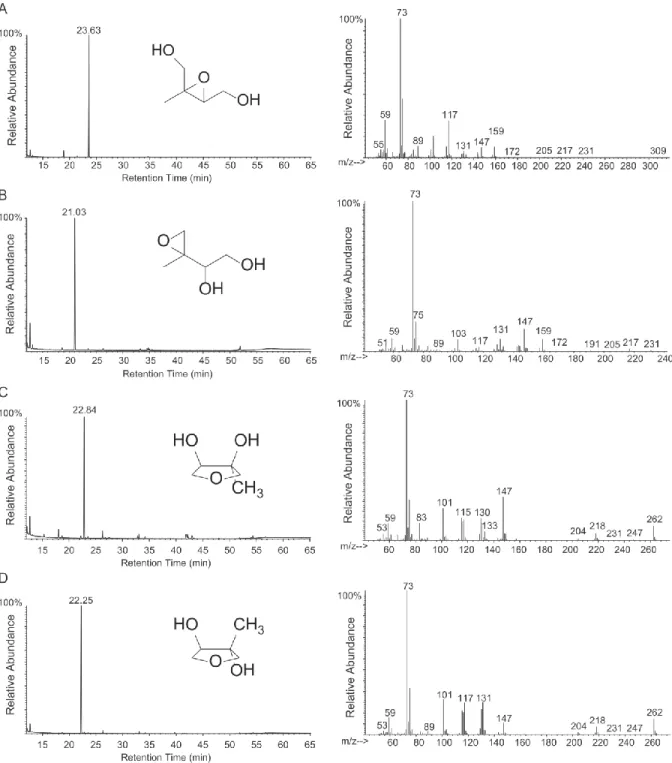
TMS-derivatized authentic standards. (A) cis-β-IEPOX, (B) δ-IEPOX, (C) cis-3-MeTHF-3,4-diol, (D) trans -3-MeTHF-3,4-diol. δ-IEPOX isomers could not be
separated on this GC column. ... 37
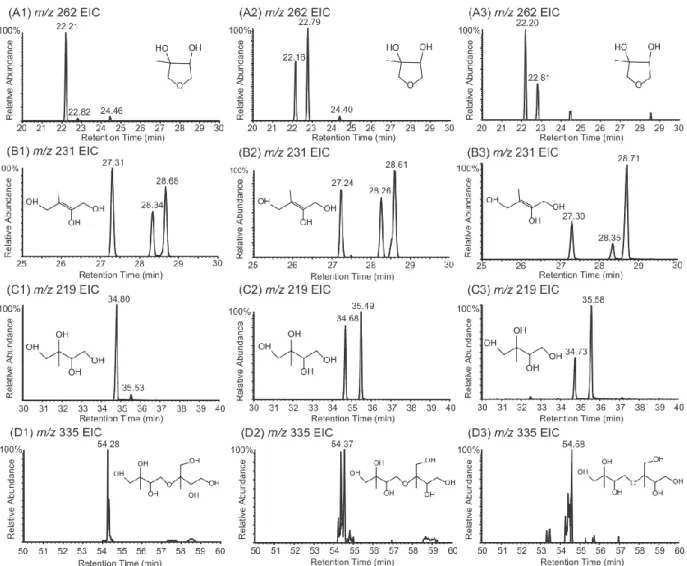
Figure 2-2. GC/MS extracted ion chromatograms (EICs) of TMS-derivatized particle-phase reaction products from reactive uptake of cis-β-IEPOX (A1-D1) and δ-IEPOX (A2-D2) experiments in the presence of acidic seed aerosol, and from field samples (A3-D3) collected in Yorkville, GA during the summer of 2010. Specifically, (A) shows EIC of m/z 262 from 3-MeTHF-3,4-diols, (B) shows the EIC of m/z 231 from C5-alkene triols, (C)
shows EIC of m/z 219 from 2-methyltetrols, and (D)
shows EIC of m/z 335 from dimers. ... 38
Figure 2-3. Normalized peak area of IEPOX-derived SOA tracers detected under acidic and neutral conditions. Aerosol-phase reaction products analyzed by GC/MS:
3-MeTHF-3,4-diols (m/z 262); C5-alkene triols (m/z 231);
2-methyltetrols (m/z 219); dimers (m/z 335).
Organosulfate derivatives analyzed by UPLC/(–)ESI-Q-ToFMS: organosulfate derivative of the 2-methyltetrols (m/z 215); organosulfate derivative of the dimers (m/z
333). ... 39
xiv
Overall, the largest contributions at these masses arise from oxidized organic fragments including C3H7O2+
(m/z 75), C5H6O+ (m/z 82), and C5H8O2+ (m/z 100). The
exception is at m/z 53 where the majority of signal from
the reduced fragment C4H5+. ... 40
Figure S2-1A.1H NMR (400 MHz, chloroform-d) of
(2-methyloxirane-2,3-diyl)dimethanol (cis-β-IEPOX). ... 43
Figure S2-1B.13C NMR (100 MHz, chloroform-d),
(2-methyloxirane-2,3-diyl)dimethanol (cis-β-IEPOX). ... 43
Figure S2-1C. 1H NMR (400 MHz, chloroform-d) racemic mixture of δ-IEPOX diastereomers [(2′R)-1S]/[(2′S)-1R ]-1-(2-methyloxiranyl)-1,2-ethanediol (2a) and [(2′S
)-1S]/[(2′R)-1R]-1-(2-methyloxiranyl)-1,2-ethanediol
(2b). Signal assignments are based on Adam et al. ... 44
Figure S2-1D.13C NMR (100 MHz, chloroform-d), racemic mixture of δ-IEPOX diastereomers 2a and 2b ([(2′R
)-1S]/[(2′S)-1R]- and [(2′S)-1S]/[(2′R)-1R
]-1-(2-methyloxiranyl)-1,2-ethanediol, respectively). ... 44
Figure S2-2A.1H NMR (400 MHz), chloroform-d) of cis
-3-methyltetrahydrofuran-3,4-diol. ... 45
Figure S2-2B.13C NMR (100 MHz, chloroform-d) of cis -3-methyltetrahydrofuran-3,4-diol. Partial signal assignments are based on the presence of splittings consistent with 2JC – H or 3JC – H coupling, possible
only for signals of C3 and C4. The 1:1:1 triplet at 77.2 ppm is due to natural abundance 13
C-chloroform-d. ... 45
Figure S2-2C.1H NMR (400 MHz), chloroform-d) of trans
-3-methyltetrahydrofuran-3,4-diol. ... 46
Figure S2-2D.13C NMR (100 MHz), chloroform-d) of trans -3-methyltetrahydrofuran-3,4-diol. One ring carbon
signal is obscured by the 13C-chloroform-d signals. ... 46
Figure 3-1. Proposed mechanism for SOA formation from isoprene
photooxidation in the presence of NOx ... 72
xv
smog chamber experiment, (B) authentic MAE standard, and (C) an ambient air sample collected from Chapel
Hill, NC during summer 2012. ... 73
Figure 3-3. GC/EI-MS traces showing the presence of 2-MG in aerosol collected from an (A) isoprene/NOx
photooxidation experiment, (B) MACR/NOx
photooxidation experiment, (C) dark reactive uptake study of MAE, and (D) ambient PM2.5 sample from
downtown Atlanta, GA. ... 74
Figure 3-4. Relative zpe corrected energies (green) and product yields (orange) for the reaction of MPAN with OH calculated at m062x/ maug-cc-pvtz level of theory. Results are shown for the adjusted value of -2.80 kcal
mol-1 for the TS2 transition state energy. ... 75
Figure 3-5. July 21 to August 20, 2006 (A) mean and (B) maximum surface layer MAE concentration over the continental
U.S. simulated by the updated CMAQ model. ... 76
Figure S3-1. (a) Experimental time profile of formation of MAE in the gase phase and subsequent particle nucleation from MACR photooxidation in the presence of NOx.
Particle data are corrected for wall losses. Near maximum MAE detection, particle nucleation and growth begins, indicating the role of MAE in forming SOA. (b) MACR photooxidation experiment in the presence of NOx: 1 ppmv MACR was injected into the
outdoor smog chamber before sunrise, and completely reacted in the course of experiments when MAE
reached the peak concentration. ... 92
Figure S3-2. Simulation results of the box model (time-concentration profiles) for the MACR outdoor chamber experiment carried out on July 15, 2012. Panel (a) compares the model results of O3 (blue),
NOx (NO+NO2) (pink and yellow, respectively), and
MACR (red) with the measurements. The O3, NO, and
MACR comparisons are in good agreement. The NO2
model does not agree with the measurement because the NOx instrument measures PANs and some organic
nitrates as NO2. Panel (b) shows the comparison
xvi
blue) and the upper bound (assuming MAE
contributes 80% of measured particle mass, shown in red). Two mass yields of MAE from MPAN + OH oxidation were applied to this model (18% and 32%, respectively) and the results were comparable to the
measurements. ... 93
Figure S3-3. Dark reactive uptake of synthetic MAE onto acidified and neutral sulfate seed aerosols. Prior to the start of each experiment, the chamber was flushed with clean house air for over 24 h to replace at least five chamber volumes. Chamber-background aerosol concentrations were monitored before all the experiments to ensure no pre-existing aerosols were present. Acidic and neutral sulfate seed aerosols were introduced into the chamber by atomizing solutions of 0.06 M MgSO4 +
0.06 M H2SO4 (aq) or 0.06 M (NH4)2SO4 (aq),
respectively. Precleaned microliter glass syringes were used to inject known amounts of MAE into a 10 mL glass manifold. The manifold was wrapped with calibrated heating tapes and heated to 60°C. Gas-phase MAE was introduced into the chamber by flowing heated N2 (g) (~60°C) through the manifold at
a flow rate of 2 L min-1 for 2 h. Reactive uptake of MAE is only observed in the presence of acidified
sulfate seed aerosol. ... 94
Figure S3-4. MAE-derived organosulfate (C4H8O7S) from (a)
isoprene/NOx photooxidation experiments, (b)
MACR/NOx photooxidation experiments, (c) dark
reactive uptake studies of MAE, and (d) ambient fine aerosol samples. The field sample shown here was collected from Jefferson Street in downtown Atlanta,
GA, on August 9, 2008. ... 95
Figure S3-5. CMAQ predicted hourly average concentration of MAE in Chapel Hill, North Carolina (-79.07 longitude, 35.94 latitude) plotted as a function of time of day. Boxplots indicate the minimum, 25th percentile, median, 75th percentile, maximum hourly average concentrations for July 21 to August 20, 2006 by hour.
... 96
xvii
Figure S3-7. (a) 1H and (b) 13C NMR spectra of benzyl
2-methyloxirane-2-carboxylate. ... 98
Figure S3-8. (a) 1H and (b) 13C NMR spectra of synthetic MAE. ... 99
Figure S3-9. Characterization of synthetic MAE standard by UPLC/ESI-HR-Q-TOFMS operated in negative ion mode. (a) Total ion chromatogram (TIC) of synthetic MAE. (b) Extracted ion chromatogram (EIC) of m/z
101, which corresponds to deprotonated MAE. (c) Accurate mass measurement of synthetic MAE supports elemental composition (C4H5O3–) and
identity of standard. ... 100
Figure S3-10. Spatial distribution of isoprene oxidation products from CMAQ model runs, which includes: (a) MACR;
(b) MPAN; (c) MPAA; (d) MAE... 101
Figure 4-1. Proposed chemistry leading to isoprene SOA: NOx
-dependent pathways (Surratt et al., 2010). For simplicity, only the cis-β-IEPOX isomer is shown for IEPOX in the
low-NOx (or NO-limited) pathway. ... 130
Figure 4-2. Representative (a) UPLC/ESI-HR-Q-TOFMS base peak chromatogram and (b) GC/EI-MS total ion
chromatogram of the PM2.5 sample collected at YRK on
June 27, 2010 under high- SO2 conditions, showing
isoprene-derived SOA tracers were major SOA
constituents detected at this site during summertime. ... 131
Figure 4-3. Correlations between isoprene-derived organosulfates: (a) Correlations between IEPOX-derived organosulfate (m/z 215) and organosulfate derivatives of IEPOX-derived dimers (m/z 333) support the common isoprene low-NOx pathway and formation mechanisms of these
two tracers. (b) Correlations between the IEPOX-derived organosulfate (m/z 215) and the MPAN-derived organosulfate (m/z 199) suggest similar limiting factors for organosulfate formation, as these two species have been known to form from isoprene photooxidation
through low-NOx and high-NOx pathways, respectively. ... 132
Figure 4-4. Temporal variations of low-NOx SOA tracers and OM. ... 133
Figure 4-5. Temporal variations of isoprene high-NOx SOA tracers
xviii
Figure 4-6. Comparisons of on-line continuous particle analyzer data and filter-based IC measurements: (a) NH4+, (b)
SO42-, (c) NO3-. ... 135
Figure 4-7. Frequency distribution of the neutralization degree from aerosol samples calculated by on-line continuous particle analyzer data (blue) and filter-based IC data
(red). ... 136
Figure 4-8. NH4+ to SO42– plus NO3– ratios from on-line continuous
particle analyzer data, grouping based on sampling
conditions.. ... 137
Figure 4-9. E-AIM II modeling: in situ aerosol pH can only be calculated in very few cases (3 out of 50) in our samples. 31 aerosol samples were calculated as fully neutralized ([H+] free < 0) that could not be modeled by E-AIM II. 16
samples were modeled as no LWC. ... 138
Figure 4-10. Effects of aerosol acidity on IEPOX-derived SOA formation: (a) SO2 conditional samples (b) NH3
conditional samples. The sum of IEPOX-derived SOA tracers was enhanced with less-neutralized (i.e., more acidic) aerosols for SO2 conditional samples, but no
clear associations were observed for NH3 conditional
samples. ... 139
Figure 4-11. Effects of aerosol acidity on isoprene high-NOx SOA
formation: (a) SO2 conditional samples (b) NH3
conditional samples. No clear associations between aerosol acidity and the sum of MPAN-derived SOA tracers were observed for either SO2 or NH3 conditional
samples. ... 140
Figure 4-12. Correlations between the sum of IEPOX SOA tracers and the particle sulfate loadings: (a) SO2 conditional
samples (b) NH3 conditional samples. Positive
correlations were observed for both SO2 and NH3
conditional samples, indicating a role of particle sulfate loadings for providing surface area that limits the
IEPOX uptake and forming SOA tracers. ... 141
Figure 4-13. Correlations between the sum of MPAN-derived SOA tracers and the particle sulfate loadings: (a) SO2
xix
Positive correlations were observed for both SO2 and
NH3 conditional samples, suggesting surface area could
be a limiting factor that modulates isoprene high-NOx
SOA formation. ... 142
Figure 4-14. Correlations between the sum of isoprene SOA tracers (combining IEPOX- and MPAN-derived SOA) and the particle sulfate loadings for all PM2.5 samples collected
in this study from (a) June 25 to July 14, 2010 (SO2
conditional sampling period) and (b) July 29, 2010 to
August 6, 2010 (NH3 conditional sampling period). ... 143
Figure 5-1. Updated NOx-dependent chemical mechanisms leading
to heterogeneous isoprene SOA formation. The boxed species represent particle-phase SOA constituents that have been detected in laboratory-generated and ambient aerosol samples. Red-colored species indicate the new
xx
LIST OF SCHEMES
Scheme 2-1. Proposed acid-catalyzed intramolecular rearrangement
of IEPOX ... 32
Scheme 2-2. Fragmentation pathways of trimethylsilylated
xxi
LIST OF ABBREVIATIONS
2D-GC/MS two-dimensional gas chromatography mass spectrometry
2-MG 2-methylglyceric acid
3-MeTHF-3,4-diols 3-methyltetrahydrofuran-3,4-diols
AMS aerosol mass spectrometry
BEPOX 1,4-dihydroxy-2,3-epoxybutane
BPC base peak chromatogram
BSOA biogenic secondary organic aerosol
BSTFA N,O-Bis(trimethylsilyl)trifluoroacetamide
BVOCs biogenic volatile organic compounds
C5 five-carbon skeleton
CIMS chemical ionization mass spectrometry
CMAQ Community Multiscale Air Quality model
DMA differential mobility analyzer
DMS dimethyl sulfide
E-AIM extended aerosol thermodynamics model
EC elemental carbon
EI electron ionization
EIC extracted ion chromatogram
EPRI Electric Power Research Institute
GC/MS gas chromatography mass spectrometry
xxii
HMML hydroxymethyl-methyl-α-lactone
HO2 hydroperoxyl radical
HOMPAN the OH adduct of methacryloylperoxynitrate
HR-AMS high-resolution time-of-flight aerosol mass spectrometer
IARC International Agency for Research on Cancer
IEPOX Isoprene epoxydiols
ISOPOOH isoprene hydroxyhydroperoxides
IUPAC International Union of Pure and Applied Chemistry
LWC liquid water content
MACR methacrolein
MAE methacrylic acid epoxide
MCPC mixing condensation particle counter
MeF methylfuran
MPAN methacryloylperoxynitrate
MPAN methacryloylperoxynitrate
MVK methyl vinyl ketone
NEB nudged elastic band
NH3 ammonia
NH4+ ammonium
NIEHS National Institute of Environmental Health Sciences NIST National Institute of Standards and Technology
NMR nuclear magnetic resonance
xxiii
NO3 nitrate radical
NO3– nitrate
NOx nitrogen oxides
NTP National Toxicology Program
O3 ozone
OC organic carbon
OH hydroxyl radical
PM particulate matter
PMF positive matrix factorization
PTFE polytetrafluoroethylene
r correlation coefficient
RH relative humidity
RO2 peroxy radicals
ROG reactive organic gases
RONO2 organic nitrates
ROOH hydroperoxide
SEARCH Southeastern Aerosol Research and Characterization Study
SEMS scanning electrical mobility sizing
SI supporting information
SMPS scanning mobility particle sizer
SO2 sulfur dioxide
SO42– sulfate
xxiv
Tg yr-1 tetragram (1012 grams) per year
TMCS trimethylchlorosilane
TMS Trimethylsilyl
TS transition state
UNC-CH The University of North Carolina at Chapel Hill UPLC/ESI-HR-Q-TOFMS ultra-performance liquid chromatography interfaced to
electrospray high-resolution quadrupole time-of-flight mass spectrometry
VOC volatile organic compound
YRK Yorkville, GA
Chapter I
Introduction
1.1 Background significance
Atmospheric aerosols are complex and dynamic mixtures consisting of suspended liquid or solid particulate matter (PM) and surrounding gases (1). Depending on their size, concentration and chemical composition, atmospheric aerosols can affect air quality, climate, and human health (2). Ambient fine aerosols with an aerodynamic diameter ≤ 2.5 μm (PM2.5)
are of particular concern, owing to the fact that they can directly scatter or absorb incoming solar radiation or act as cloud condensation nuclei that indirectly leads to an imbalance between incoming and outgoing solar radiation, and ultimately climate change (3). From a public health perspective, inhalation of PM2.5,which can penetrate and deposit deeply into
the human respiratory system, has been linked to cardiovascular and pulmonary diseases in numerous epidemiological studies (4, 5). Although the importance of PM2.5 has been
recognized, the assessment of its real impact on climate change and human health remains difficult because of considerable uncertainties in current scientific understanding of its sources, composition, and formation mechanisms (3, 6).
The sources of ambient PM2.5 have both primary and secondary origins. Primary
aerosols refer to particles being directly emitted into the atmosphere, whereas secondary aerosols are particles generated from atmospheric transformation of gaseous precursors. In general, the bulk chemical composition of PM2.5 can be attributed to organic carbon (OC),
2
crustal material (7). Organic compounds have been found to be the major constituents of ambient PM2.5 (8, 9). Particularly, secondary organic aerosol (SOA) arising from
photochemical transformation of both anthropogenic and biogenic volatile organic compound (VOC) emissions contributes to a substantial fraction (20-90%) of the total ambient PM2.5
mass (10).
Isoprene (2-methyl-1,3-butadiene, C5H8) is the most abundant non-methane hydrocarbon
emitted from terrestrial vegetation into the Earth’s atmosphere, with annual global emission rates estimated to be around 600 Tg yr-1 (11). Despite the high emission strength of isoprene, not until recently has the atmospheric oxidation of this globally dominant biogenic VOC been recognized to lead to SOA formation (12-16). Recent modeling work using SOA yields, which describe the potential of SOA formation from a gaseous precursor at thermodynamic equilibrium, derived from laboratory chamber experiments (1–2% under high-NOx
conditions (14), and 3% under low-NOx conditions (15)) estimate that isoprene-derived SOA
may substantially contribute (~ 30–50%) to the SOA mass burden on the global scale (17, 18), likely making it the single largest source of SOA formation on Earth.
The early laboratory chamber investigations concluded that isoprene was not an important source of SOA formation under atmospheric conditions due to the high volatility of its known first-generation oxidation products, such as methacrolein (MACR) and methyl vinyl ketone (MVK). These chamber experiments were usually performed in the presence of initially high ozone (O3) or nitric oxide (NO) levels (19, 20). At the time of these initial
3
However, when 2-methyltetrols were first identified in PM2.5 collected from the Amazonian
rain forest by Claeys et al. (12), this re-opened the possibility that isoprene oxidation produces ambient SOA for reasons unknown. 2-Methyltetrols are oxygenated polyols with the same carbon skeleton (C5) as isoprene. The observation of 2-methyltetrols in ambient
PM2.5 was proposed as one major SOA constituent derived from isoprene photooxidation
since these compounds are not of primary biological origin (12). As a result, this groundbreaking finding indicated that the photooxidation of isoprene could potentially contribute to ambient SOA and has stimulated a considerable number of chamber experiments to revisit isoprene SOA formation under simulated atmospheric conditions.
Isoprene SOA yields have been examined in several laboratory chamber studies to provide parameterizations for atmospheric modeling to assess its contributions to the global SOA burden. Various experimental conditions have been found to influence isoprene SOA formation, including the level of nitrogen oxides (NOx = NO + NO2) (14, 15), aerosol acidity
(22, 23), relative humidity (24, 25), extent of reaction (26), temperature (27), and preexisting aerosol loadings (28). Among these influential factors, the initial NOx level (particularly the
initial NO level) has been proposed to be key in controlling isoprene SOA formation by differentiating the reactions of peroxy radicals (RO2) with NO and HO2 (29), and
consequently, the difference in volatility of the subsequent reaction products from RO2+NO
vs. RO2+HO2 pathways that result in different measured SOA yields (14, 15) and distinct
chemical compositions of SOA constituents (16).
Figure 1-1 shows a simplified representation for the photooxidation of a generic VOC. When the NO level is high (i.e., high-NOx conditions), the RO2 radical generated from the
4
volatile fragmentation products (e.g., MACR or MVK) or organic nitrates (RONO2). In
general, the RO2+NO pathway corresponds to lower measured SOA yields in chamber
studies, especially when the VOC under examination has 10 carbons or less (14). When NO is at sub-ppb levels (i.e., low-NOx conditions), the RO2+HO2 pathway becomes competitive,
which leads to the production of less volatile hydroperoxides (ROOH). Thus, higher measured SOA yields have been observed when the experiments were performed at low-NOx
levels (15).
Detailed chemical characterization of SOA constituents generated from chamber studies under these two regimes supports the proposals of NOx-dependent chemical pathways to
isoprene SOA formation (16, 30). Further, heterogeneous reactions of isoprene SOA formation have been elucidated by identification of critical intermediates (30). Figure 1-2 summarizes the published route from prior work that identified isoprene epoxydiols (IEPOX) (30, 31) and methacryloylperoxynitrate (MPAN) (30, 32) as likely key gas-phase precursors leading to isoprene SOA formation under low-NOx and high-NOx conditions, respectively.
Under low-NOx conditions, Paulot et al. (31) utilized chemical ionization mass
spectrometry (CIMS) techniques that resulted in the detection of gas-phase photooxidation products from isoprene with a molecular weight of 118, and characterized them as gas-phase C5-epoxydiol isomers (i.e., IEPOX) arising from the oxidation of isoprene
hydroxyhydroperoxides (ISOPOOH). Based on theoretical quantum chemistry calculations, these second-generation gas-phase oxidation products were suggested likely to be key intermediates in the formation of isoprene SOA under low-NOx conditions, and the formation
1,4-5
dihydroxy-2,3-epoxybutane (BEPOX), a structurally related surrogate of IEPOX, and observed its rapid and enhanced uptake onto acidified sulfate seed aerosols. Nevertheless, owing to the lack of a firm chemical proof to support the conclusion that the IEPOX are formed in the gas phase and act as the precursors for isoprene low-NOx SOA tracers, such as
2-methyltetrols, there is still little agreement regarding the mechanism responsible for SOA formation following isoprene oxidation under low-NOx conditions (33).
Under high-NOx conditions, isoprene SOA has been shown to form from the oxidation of
MPAN (30, 32). Chan et al. (32) and Surratt et al. (30) observed that increasing the initial NO2/NO ratios favors the formation of MPAN from both isoprene and MACR
photooxidation, and results in enhanced SOA yields. Specifically, at atmospherically relevant NO2/NO ratios of 3-8, the SOA yields were observed to be 3 times higher than those
measured at lower NO2/NO ratios (32). Identification of similar chemical constituents in
SOA produced from the photooxidation of isoprene, MACR, and MPAN further supports the central role of MPAN oxidation under these conditions (30). The fate of the transient resulting from the addition of OH to MPAN and the exact pathway by which isoprene high-NOx SOA (i.e., 2-methylglyceric acid and its corresponding oligoesters) is formed, however,
remains unclear. Although a C4-hydroxynitrate-PAN or potentially other unknown C4
-preserving products formed from further oxidation of MPAN have been proposed by Surratt et al. (30) as the main precursor to the isoprene high-NOx SOA, there was no chemical
evidence to support either hypothesis.
In addition to NOx-dependent pathways, aerosol acidity has also been suggested to be a
critical factor to influence SOA yields, especially under low-NOx conditions. Prior work by
6
experiments conducted in the presence of preexisting neutral to acidic seed aerosol under low-NOx conditions. The observation of enhanced SOA yields due to increased seed aerosol
acidity provided some evidence that acid-catalyzed heterogeneous chemistry likely has a major role under this condition. Since prior work by Surratt et al. (30) showed that acidified sulfate aerosol did not enhance the SOA yield from isoprene oxidation under high-NOx
conditions, the lack of an acid enhancement effect under high-NOx conditions could be due
to the fact that there was much HNO3 produced from OH + NO2 gas-phase reaction in the
chamber experiments. It is possible that HNO3 could have partitioned onto the preexisting
neutral seed aerosol and provided sufficient aerosol acidity, and thus, the effects aerosol acidity from acidified sulfate aerosol on SOA yields could have been masked. Furthermore, since oligomers and organosulfates have been observed as isoprene SOA constituents in both chamber-generated aerosol and ambient PM2.5 samples, the observation of these high
molecular weight products in SOA derived from isoprene suggested the likely importance of heterogeneous chemistry as shown in Figure 1-2. As a result, these exact heterogeneous reactions remain to be determined, and require systematic studies for further investigation.
7
1.2 Current knowledge gaps
It has been noted that current atmospheric models tend to under-predict the organic aerosol mass compared to field observations (39-41). Since isoprene-derived SOA is a substantial contributor to the total organic aerosol mass, without accurate representation of isoprene SOA formation mechanisms, assessment of the impact of atmospheric aerosols on both the climate system and human health risks could be difficult. Further elucidating the gas-phase oxidation and subsequent heterogeneous and aerosol-phase chemistry leading to SOA formation from isoprene photooxidation is important to improve the predicting capability of our existing air quality models.
The reasons for the under-prediction of organic aerosol mass in current air quality models may result from a number of potential issues, including (but not limited to):
1) Unidentified SOA precursors;
2) SOA formation mechanisms not fully understood;
3) Parameterizations derived from laboratory studies do not reflect ambient conditions; 4) Uncertainties associated with emission inventories;
5) Uncertainties associated with measurements of ambient aerosols.
Moreover, since isoprene has only recently been recognized as a significant source of ambient PM2.5, inhalation exposure to isoprene-derived PM induced health effects are largely
unknown. Epidemiological studies have shown that health risks from exposure to ambient PM2.5 have significant spatial and temporal differences (7, 42). Such differences in health
effects might be due to variations in the ambient PM2.5 chemical composition, which could in
8
hypothesis, however, is lacking owing to the fact that the detailed chemical composition of SOA constituents has not been fully understood nor well characterized. Sparse information regarding molecular characteristics of SOA constituents is available, and thus, understanding the mode of action of these environmental stressors is difficult.
1.3 Objectives of this dissertation
This dissertation aims to contribute to the scientific understanding of SOA formation from isoprene photooxidation that are important for improving air quality model simulations, environmental management and risk assessment. Specifically, chemical characterization of SOA constituents from both laboratory experiments and field studies is a critical element in advancing current knowledge in atmospheric aerosol chemistry. Hazard identification of isoprene SOA constituents and critical intermediates will be helpful to provide information for evaluating public health risks from exposure to ambient PM2.5 in isoprene-rich regions.
In this dissertation, PM2.5 and gas-phase samples collected from both laboratory chamber
experiments and field campaigns were analyzed to characterize isoprene SOA formed by heterogeneous reactions (Figure 1-2), part of which represents a missing SOA source that is not incorporated in current air quality model predictions due to our lack of understanding of this chemistry. By coupling controlled smog chamber experiments with synthetic organic chemistry, critical intermediates that lead to SOA formation through heterogeneous chemical pathways under low-NOx and high-NOx conditions were identified. SOA constituents were
9
was employed for structural elucidation of previously unidentified compounds. SOA tracers were quantified in field samples to confirm the chamber findings, as well as to evaluate the atmospheric relevance and significance of the newly identified pathways.
In the following chapters, Chapters 2 and 3 describe research work on isoprene SOA formation at low-NOx and high-NOx levels, respectively. In Chapter 2, controlled laboratory
studies were performed with synthesized isoprene epoxydiols (IEPOX), which are second-generation products produced by the atmospheric oxidation of isoprene under low-NOx
conditions, to systematically explore their reactive uptake potentials on neutral and acidic sulfate. Results from this study conclusively support previous mass spectrometric evidence for the role of IEPOX in forming SOA from isoprene oxidation, and demonstrate that isoprene SOA is increased in the presence of sulfuric acid, confirming that aerosol formation from VOCs emitted by terrestrial vegetation could be enhanced due to anthropogenic pollution such as SO2 emissions.
In Chapter 3, methacrylic acid epoxide (MAE) is identified as a previously unreported precursor to isoprene SOA formation under high-NOx conditions. MAE is proposed to arise
from decomposition of the OH adduct of methacryloylperoxynitrate (HOMPAN). This hypothesis is supported by chemical characterization of SOA constituents derived from synthetic MAE compared with those from photooxidation of isoprene, methacrolein, and MPAN under high-NOx conditions. Computational chemistry calculations were carried to
10
significance and relevance of MAE chemistry across the U.S., especially in urban areas heavily impacted by isoprene emissions.
Chapter 4 presents field work that was conducted in the Southeastern U.S. to investigate the anthropogenic influences on isoprene SOA formation. Ambient PM2.5 samples were
collected from Yorkville, GA, a rural site within the Southeastern Aerosol Research and Characterization Study (SEARCH) network during the summer of 2010. This field study is an extension of our laboratory work to assess the atmospheric relevance of our laboratory findings regarding the influence of sulfuric acid derived from anthropogenic emissions on ambient SOA formation. In this study, environmental thresholds for SOA sample collection depended upon either ambient sulfur dioxide (SO2) or ammonia (NH3) levels. Aerosol acidity
was estimated to evaluate the atmospheric significance of laboratory parameters that have been shown to enhance SOA formation.
Finally, Chapter 5 summarizes the conclusions derived from this dissertation. The implications and future directions are also discussed.
11
12
13
REFERENCES
1. Hinds WC (1999) Aerosol technology : properties, behavior, and measurement of airborne particles (Wiley, New York).
2. Hallquist M, et al. (2009) The formation, properties and impact of secondary organic aerosol: current and emerging issues. Atmos. Chem. Phys. 9(14):5155-5236.
3. Solomon S, et al. (2007) Climate change 2007: The physical science basis.
Contribution of working group I to the fourth assessment report of the intergovernmental panel on climate change:235-337.
4. Brunekreef B, Holgate ST (2002) Air pollution and health. The Lancet
360(9341):1233-1242.
5. Pope III CA, Dockery DW (2006) Health effects of fine particulate air pollution: lines that connect. J. Air Waste Manag. Assoc. 56(6):709-742.
6. Pöschl U (2005) Atmospheric aerosols: Composition, transformation, climate and health effects. Angew. Chem. Int. Edit. 44(46):7520-7540.
7. Bell ML, Dominici F, Ebisu K, Zeger SL, Samet JM (2007) Spatial and temporal variation in PM2. 5 chemical composition in the United States for health effects studies. Environ. Health Perspect. 115(7):989-995.
8. Zhang Q, et al. (2007) Ubiquity and dominance of oxygenated species in organic aerosols in anthropogenically-influenced Northern Hemisphere midlatitudes. Geophys. Res. Lett. 34(13):L13801.
9. Jimenez JL, et al. (2009) Evolution of Organic Aerosols in the Atmosphere. Science
326(5959):1525-1529.
10. Kanakidou M, et al. (2005) Organic aerosol and global climate modelling: a review.
Atmos. Chem. Phys. 5(4):1053-1123.
14
12. Claeys M, et al. (2004) Formation of secondary organic aerosols through photooxidation of isoprene. Science 303(5661):1173-1176.
13. Edney E, et al. (2005) Formation of 2-methyl tetrols and 2-methylglyceric acid in secondary organic aerosol from laboratory irradiated isoprene/NOx/SO2/air mixtures
and their detection in ambient PM2.5 samples collected in the eastern United States.
Atmos. Environ. 39(29):5281-5289.
14. Kroll JH, Ng NL, Murphy SM, Flagan RC, Seinfeld JH (2005) Secondary organic aerosol formation from isoprene photooxidation under high-NOx conditions. Geophys.
Res. Lett. 32(18):L18808.
15. Kroll JH, Ng NL, Murphy SM, Flagan RC, Seinfeld JH (2006) Secondary organic aerosol formation from isoprene photooxidation. Environ. Sci. Technol. 40(6):1869-1877.
16. Surratt JD, et al. (2006) Chemical composition of secondary organic aerosol formed from the photooxidation of isoprene. J. Phys. Chem. A 110(31):9665-9690.
17. Henze DK, Seinfeld JH (2006) Global secondary organic aerosol from isoprene oxidation. Geophys. Res. Lett. 33(9):L09812.
18. Henze DK, et al. (2008) Global modeling of secondary organic aerosol formation from aromatic hydrocarbons: high- vs. low-yield pathways. Atmos. Chem. Phys.
8(9):2405-2420.
19. Kamens RM, Gery MW, Jeffries HE, Jackson M, Cole EI (1982) Ozone-Isoprene Reactions: Product Formation and Aerosol Potential. Int. J. Chem. Kinet. 14:955-975.
20. Pandis SN, Paulson SE, Seinfeld JH, Flagan RC (1991) Aerosol formation in the photooxidation of isoprene and β-pinene. Atmos. Environ. 25(5):997-1008.
21. Pandis SN, Harley RA, Cass GR, Seinfeld JH (1992) Secondary organic aerosol formation and transport. Atmos. Environ. 26(13):2269-2282.
15
23. Surratt JD, et al. (2007) Effect of acidity on secondary organic aerosol formation from isoprene. Environ. Sci. Technol. 41(15):5363-5369.
24. Dommen J, et al. (2006) Laboratory observation of oligomers in the aerosol from isoprene/NOx photooxidation. Geophys. Res. Lett. 33(13):L13805.
25. Zhang H, Surratt J, Lin Y-H, Bapat J, Kamens R (2011) Effect of relative humidity on SOA formation from isoprene/NO photooxidation: enhancement of 2-methylglyceric acid and its corresponding oligoesters under dry conditions. Atmos. Chem. Phys. 11:6411-6424.
26. Ng NL, et al. (2006) Contribution of first-versus second-generation products to secondary organic aerosols formed in the oxidation of biogenic hydrocarbons.
Environ. Sci. Technol. 40(7):2283-2297.
27. Kleindienst T, Lewandowski M, Offenberg J, Jaoui M, Edney E (2009) The formation of secondary organic aerosol from the isoprene+ OH reaction in the absence of NOx. Atmos. Chem. Phys 9(17):6541-6558.
28. Kleindienst TE, Edney EO, Lewandowski M, Offenberg JH, Jaoui M (2006) Secondary organic carbon and aerosol yields from the irradiations of isoprene and α-pinene in the presence of NOx and SO2. Environ. Sci. Technol. 40(12):3807-3812.
29. Kroll JH, Seinfeld JH (2008) Chemistry of secondary organic aerosol: Formation and evolution of low-volatility organics in the atmosphere. Atmos. Environ. 42(16):3593-3624.
30. Surratt JD, et al. (2010) Reactive intermediates revealed in secondary organic aerosol formation from isoprene. Proc. Natl. Acad. Sci. USA 107(15):6640-6645.
31. Paulot F, et al. (2009) Unexpected epoxide formation in the gas-phase photooxidation of isoprene. Science 325(5941):730-733.
32. Chan A, et al. (2010) Role of aldehyde chemistry and NOx concentrations in
secondary organic aerosol formation. Atmos. Chem. Phys. 10(15):7169-7188.
16
34. Carlton A, Wiedinmyer C, Kroll J (2009) A review of Secondary Organic Aerosol (SOA) formation from isoprene. Atmos. Chem. Phys. 9(14):4987-5005.
35. Liggio J, Li S-M, McLaren R (2005) Heterogeneous reactions of glyoxal on particulate matter: Identification of acetals and sulfate esters. Environ. Sci. Technol.
39(6):1532-1541.
36. Altieri KE, Carlton AG, Lim H-J, Turpin BJ, Seitzinger SP (2006) Evidence for oligomer formation in clouds: Reactions of isoprene oxidation products. Environ. Sci. Technol. 40(16):4956-4960.
37. Haan DOD, et al. (2009) Secondary organic aerosol-forming reactions of glyoxal with amino acids. Environ. Sci. Technol. 43(8):2818-2824.
38. Galloway M, et al. (2009) Glyoxal uptake on ammonium sulphate seed aerosol: reaction products and reversibility of uptake under dark and irradiated conditions.
Atmos. Chem. Phys. 9(10):3331-3345.
39. de Gouw JA, et al. (2005) Budget of organic carbon in a polluted atmosphere: Results from the New England Air Quality Study in 2002. J. Geophys. Res.
110(D16):D16305.
40. Heald CL, et al. (2005) A large organic aerosol source in the free troposphere missing from current models. J. Geophys. Res. 32(18):L18809.
41. Volkamer R, et al. (2006) Secondary organic aerosol formation from anthropogenic air pollution: Rapid and higher than expected. Geophys. Res. Lett. 33(17):L17811.
42. Dominici F, et al. (2006) FIne particulate air pollution and hospital admission for cardiovascular and respiratory diseases. JAMA 295(10):1127-1134.
43. Zhang Z, et al. (2012) Technical Note: Synthesis of isoprene atmospheric oxidation products: isomeric epoxydiols and the rearrangement products cis- and trans-3-methyl-3,4-dihydroxytetrahydrofuran. Atmos. Chem. Phys. 12(18):8529-8535.
44. Zhang H, et al. (2012) Secondary organic aerosol formation from methacrolein photooxidation: Roles of NOx level, relative humidity and aerosol acidity. Environ.
17
1 Chapter II is reproduced by permission from “Isoprene epoxydiols as precursors to
secondary organic aerosol formation: Acid-catalyzed reactive uptake studies with authentic compounds” by Ying-Hsuan Lin, Zhenfa Zhang, Kenneth S. Docherty, Haofei Zhang, Sri Hapsari Budisulistiorini, Caitlin L. Rubitschun, Stephanie L. Shaw, Eladio M. Knipping, Eric S. Edgerton, Tadeusz E. Kleindienst, Avram Gold, and Jason D. Surratt, Environmental Sciences & Technology, 46 (1), 250-258, 2012. Copyright (2012) American Chemical Society.
Chapter II
Isoprene Epoxydiols as Precursors to Secondary Organic Aerosol
Formation: Acid-Catalyzed Reactive Uptake Studies with Authentic
Compounds
12.1 Overview
Isoprene epoxydiols (IEPOX), formed from the photooxidation of isoprene under low-NOx conditions, have recently been proposed as precursors of secondary organic aerosol
(SOA) on the basis of mass spectrometric evidence. In the present study, IEPOX isomers were synthesized in high purity (> 99%) to investigate their potential to form SOA via reactive uptake in a series of controlled dark chamber studies followed by reaction product analyses. IEPOX-derived SOA was substantially observed only in the presence of acidic aerosols, with conservative lower-bound yields of 4.7–6.4% for β-IEPOX and 3.4–5.5% for δ-IEPOX, providing direct evidence for IEPOX isomers as precursors to isoprene SOA. These chamber studies demonstrate that IEPOX uptake explains the formation of known isoprene SOA tracers found in ambient aerosols, including 2-methyltetrols, C5-alkene triols,
(3-MeTHF-19
3,4-diols) in the particle phase. Analysis of these novel tracer compounds by aerosol mass spectrometry (AMS) suggests that they contribute to a unique factor resolved from positive matrix factorization (PMF) of AMS organic aerosol spectra collected from low-NOx,
isoprene-dominated regions influenced by the presence of acidic aerosols.
2.2 Introduction
Isoprene (2-methyl-1,3-butadiene, C5H8) is the single largest biogenic non-methane
hydrocarbon emitted into the Earth’s atmosphere (1), and has been estimated to contribute substantially to the global SOA budget (2, 3). In remote forested regions where the environments are characterized by high isoprene emissions and low-NOx concentrations,
reactions with hydroxyl radicals (OH) are responsible for the vast majority of isoprene oxidation, thereby forming considerable amounts of low-volatility products that readily form SOA (3, 4). Isoprene-derived SOA species are likely to be formed by heterogeneous reactions (5, 6); however, there is little agreement regarding the mechanism(s) responsible for SOA formation following isoprene oxidation under low-NOx conditions.
Laboratory investigations based on mass spectrometric analysis and modeling studies have led to the hypothesis that gas-phase IEPOX isomers arising from the oxidation of isoprene hydroxyhydroperoxides (ISOPOOH) are likely to be key intermediates in the formation of isoprene SOA under low-NOx conditions (5, 6). Paulot et al. (5), for example,
reported the formation of gaseous IEPOX in high yield (~ 50%) from the OH-initiated oxidation of isoprene. Additionally, the identification of isoprene-derived SOA constituents including 2-methyltetrols (4), C5-alkene triols (7), dimers (8), as well as their organosulfate
20
be kinetically favorable under typical tropospheric conditions, with reaction rates enhanced by acidity (10-12). The importance of IEPOX reactions has also been supported by Surratt et al. (6) who performed reactive uptake chamber experiments with 1,4-dihydroxy-2,3-epoxybutane (BEPOX), a structurally related surrogate of IEPOX, and observed its rapid and enhanced uptake onto acidified sulfate seed aerosols.
In the present work, we investigate the reactive uptake of authentic synthesized IEPOX isomers onto pre-existing sulfate seed aerosols in a series of controlled dark chamber studies under acidic and neutral conditions. The objectives of this work were to demonstrate SOA formation through the IEPOX route in the low-NOx regime, and to examine the influence of
aerosol acidity on IEPOX-derived SOA formation. SOA yields from reactive uptake of cis -β-IEPOX and a mixture of racemic diastereomers of δ--β-IEPOX were measured, as well as the detailed chemical composition of the resultant SOA. The SOA constituents chemically characterized from the chamber studies were directly compared to fine aerosol samples collected from the rural southeastern U.S. (Yorkville, GA) during the summer of 2010, to confirm the atmospheric relevance of the chamber findings. The results of this comparison provide substantial support for the role of IEPOX in forming organic aerosol in the Earth’s troposphere. In addition, reactive uptake of the IEPOX isomers on acidified sulfate seed aerosol was observed to yield cis- and trans-3-methyltetrahydrofuran-3,4-diols (3-MeTHF-3,4-diols), heretofore unreported products of an intramolecular rearrangement in the particle phase.Analysis of these tracer compounds by aerosol mass spectrometry (AMS) suggests the possibility that they contribute to a unique factor resolved from the positive matrix factorization (PMF) analysis of AMS data collected from low-NOx, isoprene-dominated
21
2.3 Experimental Section
2.3.1 Synthesis of Reactive Intermediates
cis-β-IEPOX, the racemic mixture of δ-IEPOX diastereomers ([(2′R)-1S]/[(2′S)-1R]- and [(2′S)-1S]/[(2′R)-1R]-1-(2-methyloxiranyl)-1,2-ethanediols), and cis- and trans -3-methyltetrahydrofuran-3,4-diols were synthesized according to schemes developed in-house. Complete synthetic procedures and characterization will be described in a forthcoming publication. The identity and purity of each synthesized compound was confirmed by 1H- and
13
C-NMR (Figures S2-1-S2-2), and gas chromatography/mass spectrometry (GC/MS) with electron ionization (EI) (Figure 2-1).
2.3.2 Chamber Experiments
Chamber experiments were conducted in an indoor 10-m3 flexible Teflon chamber at UNC. Prior to the start of each experiment, the chamber was flushed continuously with clean house air for over 24 h corresponding to a minimum of 5 chamber volumes. A scanning mobility particle sizer (SMPS) system equipped with a cylindrical differential mobility analyzer (DMA, Model 3081, TSI, Inc.) and a condensation particle counter (CPC, Model 3022, TSI, Inc.) was used to measure aerosol size distributions and particle volume concentrations inside the chamber. Chamber background aerosol concentrations were monitored before all experiments to ensure that there was no pre-existing aerosol in the chamber. Either acidic or neutral seed aerosols were introduced into the chamber by atomizing 0.06 M MgSO4+ 0.06 M H2SO4 (aq) and 0.06 M (NH4)2SO4 (aq) solutions,
22
ppbv). The manifold was wrapped with calibrated heating tapes heated to 60°C, and flushed with N2 (pre-heated to 60°C) at 5 L min-1 for at least 2 h until no additional increase in
aerosol volume was observed by the SMPS. After stabilization of particle volume concentrations, aerosol samples were collected on 47 mm diameter, 1.0-µm pore size Teflon membrane filters (Pall Life Science) for product analyses, at a sampling flow rate of ~20 L min-1 for 2 hours. For each experiment, two Teflon filters were stacked in the filter holder. The front filter was collected to examine particle-phase reaction products, whereas the back filter was collected to correct for any gas-phase IEPOX absorption on the filters. All experiments were carried out in the dark at a constant temperature (20–25°C) under dry (RH<5%) conditions. Control experiments were also performed to rule out potential artifacts. These included chamber blank experiments along with addition of reactive intermediates (β- and δ-IEPOX) or seed aerosol (i.e., acidic and neutral seed) to the chamber in isolation. Details regarding experimental conditions are fully listed in Table 2-1.
2.3.3 Ambient Aerosol Collection
Ambient PM2.5 filter samples collected from the Southeastern Aerosol Research and
23
collected when the ambient SO2 mixing ratio was ≥ 0.50 ppbv during the day time, in order
to examine how IEPOX-derived SOA formed under atmospherically relevant aerosol acidities.
2.3.4 Aerosol-Phase Chemical Analyses
Teflon filters collected from the chamber experiments were extracted with 20 mL high-purity methanol (LC-MS CHROMASOLV-grade, Sigma-Aldrich) under 45 min of sonication. The filter extracts were blown dry under a gentle N2 stream at room temperature.
24
were blown dry, the extract residues were reconstituted with 150 µL of a 50:50 (v/v) solvent mixture of methanol containing 0.1% acetic acid (LC-MS CHROMASOLV-grade, Aldrich) and water containing 0.1% acetic acid (LC-MS CHROMASOLV-grade, Sigma-Aldrich), and 5 µL of each sample was injected onto the LC column eluted with solvent of the same composition. Ambient quartz filter samples were extracted and analyzed in the same manner as Teflon filters from the chamber studies, except the sample extracts were filtered through 0.2 µm PTFE syringe filters (Pall Life Science, Acrodisc®) to remove suspended quartz filter fibers and insoluble particles (likely soot and soil). The efficiency of the extraction protocols was evaluated by spiking 5 replicates of pre-baked blank quartz filters with standards, including meso-erythritol (≥99%, Sigma), cis- and trans -3-MeTHF-3,4-diols, and sodium propyl sulfate (electronic grade, City Chemical LLC). Extraction efficiencies (62-82%) are taken into account for each IEPOX-derived SOA constituent that is quantified in the field samples.
2.3.5 High-Resolution Aerosol Mass Spectrometry of Aerosolized Standards
High-resolution mass spectra of synthesized standards (β- IEPOX, δ-IEPOX, and cis- and
25
mass spectrum, a single synthesized sample was added directly to the atomizer and the mass spectrum of the sample was then collected. The atomizer and sampling lines were rinsed extensively with several aliquots of distilled water between each analysis. All spectra were collected with the HR-AMS operating in W-mode (m/Δm=4000-5000) and all spectra were averaged over a period of 5-10 min depending on the resulting particle concentration (with the exception of β-IEPOX, all samples were averaged for 5 min). Unit resolution and HR-AMS data was analyzed with the Squirrel and Pika software packages, respectively, developed by the Jimenez group at the University of Colorado-Boulder (16).
2.4 Results and Discussion
2.4.1 Authentic Standards
Although synthesis of cis-β-IEPOX (17), the racemic δ-IEPOX diastereomers (18), and
cis-3-MeTHF-3,4-diol (19) has been reported, original routes were devised to provide standards in high purity via streamlined procedures. The 1H-NMR spectra are either identical to those reported for the published compounds (Figures S2-1A, S2-1B and S2-2A) or in agreement with the structure assigned (Figure S2-2B). Total ion current (TIC) chromatograms and GC/MS spectra of the TMS-derivatized standards shown in Figure 2-1 demonstrate purity. Noteworthy are the differences in retention times of the IEPOX and 3-MeTHF-3,4-diol isomers, and the presence of a strong molecular ion (m/z 262) in the EI mass spectra of the 3-MeTHF-3,4-diol isomers, the significance of which will be discussed below.
2.4.2 Aerosol Growth from Reactive Uptake Experiments
26
observed aerosol growth is truly from the reactive uptake of IEPOX. In addition, chemical analyses of filters collected from these blank experiments revealed no detectable SOA constituents.
Comparisons of aerosol growth under acidic and neutral conditions are shown in Figure S2-3, in which ~ 15 mg IEPOX was injected in the presence of acidified or neutral sulfate seed aerosols. From the wall-loss uncorrected SMPS data, reactive uptake of both β- and δ-IEPOX is enhanced under acidic conditions relative to that under neutral conditions. Measured SOA yields are summarized in Table 2-1. SOA yields (Y) are defined as the ratio of mass concentration of SOA formed (ΔM0) to mass concentration of IEPOX reacted
(ΔROG) (20). SOA density of 1.25 g cm-3
27
requires use of an on-line soft ionization MS technique, such as a chemical ionization, as previously employed by Paulot et al. (5), to accurately quantify the mixing ratios of IEPOX during the course of the experiments. Another limitation of this study that should be noted is that all chamber experiments were conducted under low RH (< 5%) conditions, and as a result, the sulfuric acid seed aerosol atomized into the chamber could be much more acidic than a sulfuric acid seed aerosol in the atmosphere. Further studies are required to estimate aerosol acidity and measure SOA yields under atmospherically relevant conditions of aerosol acidity.
2.4.3 Chemical Characterization of Aerosol-Phase Reaction Products
28
pathway are suggested in Schemes 2-1 and 2-2, respectively. Scheme 2-2 leads to the diagnostic ion at m/z 204. Consistent with formation through acid-catalyzed cyclization, the concentrations of the 3-MeTHF-3,4-diols were measured to increase from 0.27 to 2.29 µg m-3 on changing from neutral to acidic conditions in δ-IEPOX reactive uptake chamber experiments, and from non-detectable (n.d.) to 1.25 µg m-3 in β-IEPOX experiments. In a prior study, Wang et al. (7) have proposed the 3-MeTHF-3,4-diols as intermediates in the formation of C5-alkene triols through acid-catalyzed rearrangement of epoxydiol derivatives
of isoprene via δ-IEPOX, and indicated C5-alkene triols are possibly formed in acidic
ambient conditions with low RH that do not allow the complete hydrolysis of IEPOX. Our findings support this plausible mechanism, and further demonstrate the formation of 3-MeTHF-3,4-diols in the particle phase. An important implication stemming from the identification of the 3-MeTHF-3,4-diols in the particle phase is the suggestion of a mechanism for trapping gaseous IEPOX in the generation of SOA from isoprene. The EICs associated with the remaining TMS-derivatives in Figure 2-2 correspond to the products observed in the chamber study. Thus, our chamber studies demonstrate that in addition to the 3-MeTHF-3,4-diols, the previously identified low-NOx isoprene SOA tracer compounds are
formed from reactive uptake of gaseous IEPOX.
29
neutral conditions to 0.61 µg m-3 under acidic conditions in the δ-IEPOX reactive uptake chamber experiments.
A recent study by Robinson et al. (26) shows that methylfuran (MeF) contributes a significant fraction (up to 15% by mass) of submicron aerosol (PM1) above a Malaysian
maritime tropical rainforest. PMF analysis of AMS organic mass spectral data resolved a robust factor that accounted for upwards of 53% of the PM1 organic mass (26). The time
series of this factor was highly correlated with the time series of the first-generation isoprene oxidation products (methylvinyl ketone and methacrolein) identified by proton transfer reaction mass spectrometry, and its spectrum was characterized by prominent MeF fragments at m/z 53 and m/z 82 (mostly C5H6O+). These observations led Robinson et al. (26) to suggest
that isoprene oxidation plays a significant role in the formation of SOA in this remote forested region. A similar factor has also been observed by Slowik et al. (27) from PMF analysis of AMS organic mass spectra from Ontario. While the origin of MeF has not been established in the Robinson et al. (26) and Slowik et al. (27) studies, we considered that 3-MeTHF-3,4-diols might be a source of MeF under conditions of analysis by AMS and 2D-GC/MS techniques when thermally desorbed and subjected to EI, especially since the atmospheric conditions in both the Robinson et al. (26) and Slowik et al. (27) studies are favorable for IEPOX formation (i.e., high isoprene emissions and low NOx levels). This
possibility was investigated by atomizing solutions of our pure synthetic standards into a HR-AMS. Full AMS unit mass resolution (UMR) mass spectra of synthesized standards are available in Supporting Information (Figures S2-7 and S2-8). High resolution spectra at m/z
30
is mostly due to C5H6O+. The elemental composition of m/z 53 (mostly C4H5+), m/z 75
(mostly C3H7O2+), and m/z 100 (mostly C5H8O2+), might aid in interpreting PMF analyses of
AMS field datasets. HR-AMS mass spectra of β- and δ-IEPOX authentic standards also show similar mass spectral patterns, indicating further that this series of compounds may be useful for interpreting PMF results from prior studies. Ratios of m/z 82 to both the average signal at
m/z 81 and m/z 83 (82:avg(81,83)) and total organic signal (82:org) as well as the ratio of C5H6O+ to m/z 82 (C5H6O+:m/z 82) and total organic signal (C5H6O+:org) from HR-AMS
mass spectra of the synthesized standards are reported in Table 2-2. These ratios correspond well to those reported by Robinson et al. (26) for the 82Fac resolved from Borneo where maritime air in this remote tropical rainforest could have provided acidic aerosol surfaces due to dimethyl sulfide (DMS) oxidation, thus providing conditions favorable to the formation of increased amounts of isomeric 3-MeTHF-3,4-diols and other IEPOX-derived SOA constituents.
2.4.4 Atmospheric Abundance
Mass concentrations of IEPOX-derived SOA tracers quantified in the field sample from Yorkville are reported in Table 2-3. Cis- and trans-3-MeTHF-3,4-diols were quantified using authentic standards, whilemeso-erythritol was used as a surrogate to quantify 2-methyltetrols, C5-alkene triols, and dimers. Sodium propyl sulfate was used as a surrogate standard to
quantify IEPOX-derived organosulfates. For each tracer compound, mass concentrations are expressed as the sum of all corresponding isomers. The identified low-NOx IEPOX-derived
31
Estimated mass concentrations of isomeric 3-MeTHF-3,4-diols and the organosulfate derivatives are higher than previously reported, possibly due to the sampling of high SO2
32
33



![Figure S2-1D. 13 C NMR (100 MHz, chloroform-d), racemic mixture of δ-IEPOX diastereomers 2a and 2b ([(2′R)-1S]/[(2′S)-1R]- and [(2′S)-1S]/[(2′R)-1R]-1-(2-methyloxiranyl)-1,2-ethanediol, respectively)](https://thumb-us.123doks.com/thumbv2/123dok_us/8255628.2187283/68.918.120.704.598.1005/figure-chloroform-racemic-mixture-diastereomers-methyloxiranyl-ethanediol-respectively.webp)


