MORE EFFICIENT ESTIMATORS FOR CASE-COHORT
STUDIES WITH UNIVARIATE AND MULTIVARIATE
FAILURE TIMES
Soyoung Kim
A dissertation submitted to the faculty of the University of North Carolina at Chapel Hill in partial fulfillment of the requirements for the degree of Doctor of Philosophy in the Department of Biostatistics.
Chapel Hill 2013
Approved by: Dr. Jianwen Cai Dr. David Couper Dr. Ka He
c
Abstract
SOYOUNG KIM : More efficient estimators for case-cohort studies with univariate and multivariate failure times
(Under the direction of Dr. Jianwen Cai)
Case-cohort study design is generally used to reduce cost in large cohort studies when
the disease rate is low. The case-cohort design consists of a random sample of the entire
cohort, named subcohort, and all the subjects with the disease of interest. When the rate
of disease is not low or the number of cases are not small, the generalized case-cohort
study which selects subset of all cases is used. In this dissertation, we study more efficient
estimators of multiplicative hazards models and additive hazards models for the traditional
case-cohort study as well as the generalized case-cohort study.
We first study more efficient estimators for the traditional case-cohort studies with rare
diseases. When several diseases are of interest, several case-cohort studies are usually
con-ducted using the same subcohort. When these case-cohort data are analyzed, the common
practice is to analyze each disease separately ignoring data collected in subjects with the
other diseases. This is not an efficient use of the data. In this study, we propose more
efficient estimators by using all available information. We consider both joint analysis of
the multiple diseases and separate analysis for each disease. We propose an estimating
equation approach with a new weight function. We establish that the proposed estimator
is consistent and asymptotically normally distributed. Simulation studies show that the
proposed methods using all available information gain efficiency. For comparing the effect
of the exposure on different diseases, tests based on the joint analysis are more powerful
than those based on the separate analysis assuming independence. We apply our proposed
method to the data from the Busselton Health Study.
We also consider the additive hazards regression model for the stratified case-cohort
stud-ies. Additive hazards model is more appropriate when risk difference is of interest. Risk
difference is more relevant to public health because it translates directly into the number
of disease cases that would be avoided by eliminating a particular exposure. We propose
an estimating equation approach for parameter estimation in additive hazards regression
model by making full use of available information. Asymptotic properties of the proposed
estimators were developed and simulation studies were conducted. We apply our proposed
Acknowledgments
I would like to thank my dissertation advisor, Dr. Jianwen Cai for supporting me
during past three years. I have learned the lesson and gained the experience throughout my
dissertation research process. She has set an example of excellence as a researcher, mentor,
instructor, and role model.
I also would like to thank the committee members, Dr. David Couper, Dr. Ka He, Dr.
Wenbin Lu, Dr. Donglin Zeng, and Dr. Haibo Zhou for all of their guidance through this
Table of Contents
List of Tables . . . viii
1 Introduction. . . 1
2 Literature review . . . 3
2.1 Univariate failure time from cohort studies . . . 3
2.1.1 The Cox proportional hazards model . . . 3
2.1.2 Additive hazards model . . . 5
2.2 Multivariate failure time from cohort studies . . . 6
2.2.1 Multiplicative risk models . . . 6
2.2.2 Additive risk models . . . 10
2.3 Case-cohort studies . . . 11
2.3.1 Case-cohort studies vs nested case-control studies . . . 11
2.3.2 Univariate failure time . . . 12
2.3.3 Multivariate failure time . . . 18
3 More efficient estimators for case-cohort studies with rare events . . . . 22
3.1 Introduction . . . 22
3.2 Model definitions and assumptions . . . 23
3.2.1 Estimation for univariate failure time . . . 24
3.2.2 Estimation for multivariate failure time . . . 25
3.3 Asymptotic properties . . . 26
3.3.2 Proofs of Theorems . . . 28
3.4 Simulations . . . 45
3.5 Data analysis . . . 50
3.6 Concluding remarks . . . 51
4 Stratified case-cohort studies with nonrare events . . . 53
4.1 Introduction . . . 53
4.2 Model and estimation . . . 55
4.2.1 Model . . . 55
4.2.2 Estimation . . . 57
4.3 Asymptotic properties . . . 59
4.3.1 Proofs of Theorems . . . 63
4.4 Simulations . . . 91
4.5 Data analysis . . . 97
4.6 Concluding Remarks . . . 98
5 Additive hazards model for stratified case-cohort design . . . 101
5.1 Introduction . . . 101
5.2 Model . . . 103
5.2.1 Estimation for univariate failure time . . . 105
5.2.2 Estimation for multivariate failure time . . . 108
5.3 Asymptotic properties . . . 109
5.3.1 Asymptotic properties of ˜βGII and ˜ΛII0k(β˜GII, t). . . 109
5.3.2 Proofs of Theorems . . . 111
5.4 Simulations . . . 129
5.5 Data Analysis . . . 136
5.6 Concluding remarks . . . 139
6 Summary and Future Research. . . 140
List of Tables
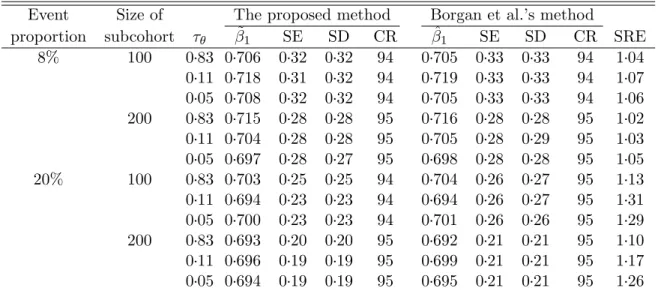
3.1 Simulation result for a single disease outcome: β1=log(2) =0.693 . . . 47
3.2 Simulation result for multiple disease outcomes: [β1, β2] =[0.1,0.7] . . . . 48
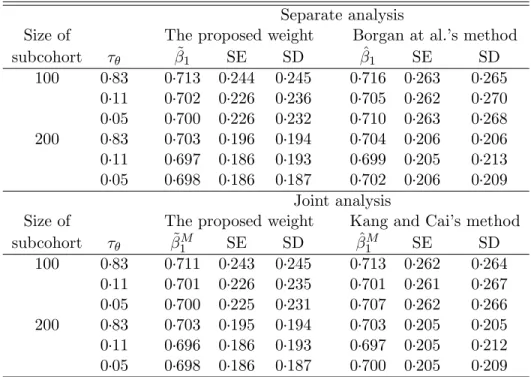
3.3 Comparison between separate and joint analysis: β1=log 2, Pr(∆=1)=0.2 48
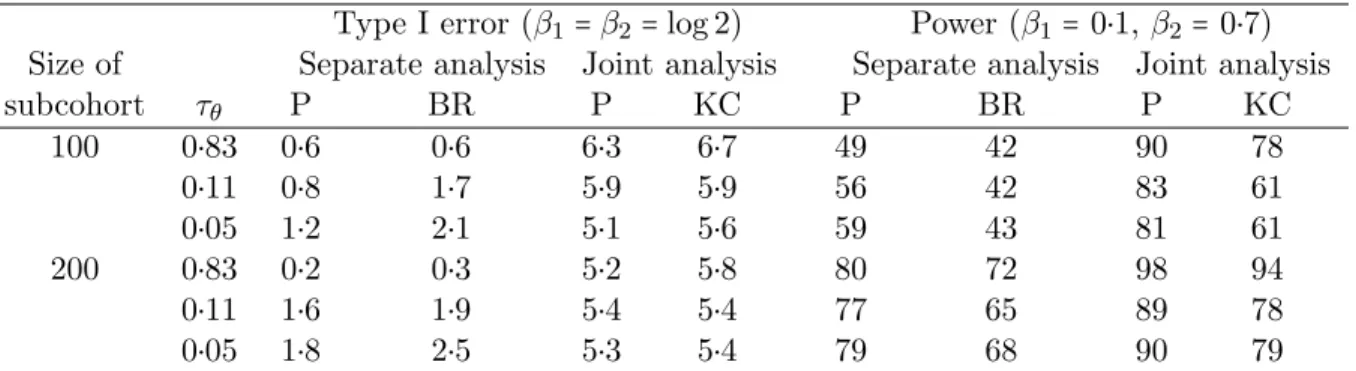
3.4 Type I error and power (%) in separate and joint analyses: Pr(∆=1)=0.2 . 49
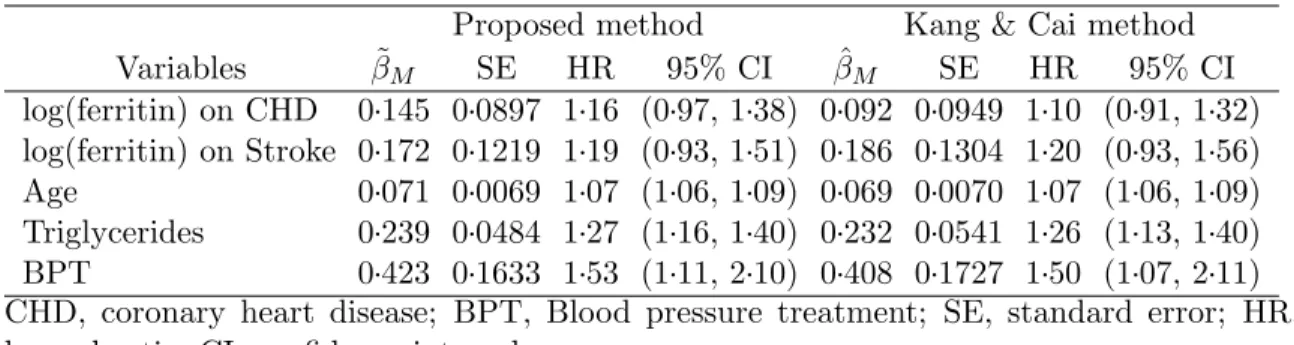
3.5 Analysis results for the Busselton Health Study . . . 51
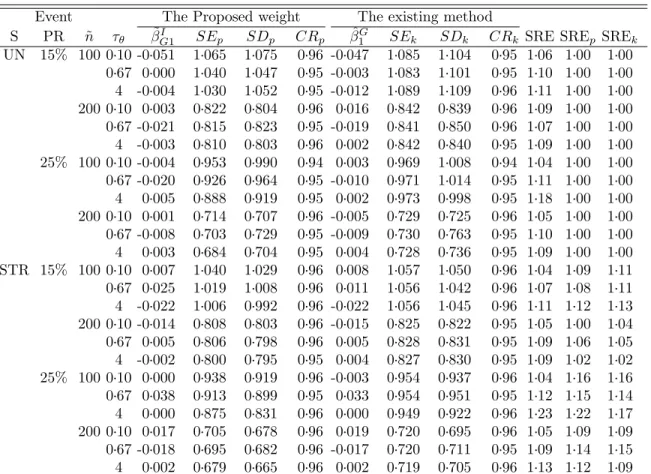
4.1 Simulation result with a single disease outcome (K=1): β1=log(2) =0.693 93
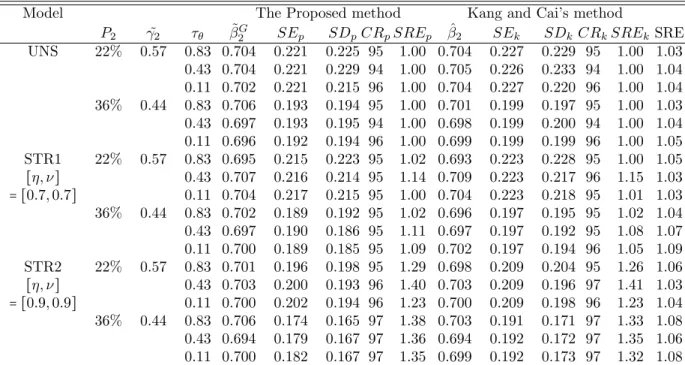
4.2 Simulation result with multiple disease outcomes (K =2): β=[0.1, 0.7] . . . 95
4.3 Type I error and power (%) in separate and joint analyses: [η, ν] = [0.7,0.7] 96
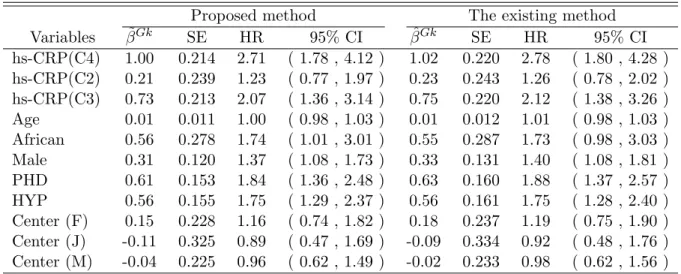
4.4 Results for the effect of hs-CRP from the ARIC Study . . . 98
5.1 Simulation result for the traditional case-cohort study: K=1, β1=0 . . . 131
5.2 Simulation result for the generalized case-cohort study: K=1,β1 =0 . . . . 132
5.3 Simulation result for the traditional case-cohort study: K=2, β0=0.3 . . . . 133
5.4 Simulation result for the generalized case-cohort study: K=2,β0 =0.3 . . . 135
Chapter 1
Introduction
In large epidemiologic cohort studies, several thousands of subjects are usually followed
for many years and such studies can be expensive. Most of the cost and effort involve the
assembly of the covariate information for all cohort members. However, if the disease is rare,
much of the covariate information on disease free subjects is largely redundant [Prentice,
1986]. In order to reduce the high cost, Prentice [1986] proposed the case-cohort design.
Under the case-cohort study design, the covariate histories are collected only for subjects in
a randomly selected sample, named subcohort, from the entire cohort and all the cases (i.e.
the subjects with the event of interest). In this dissertation, we develop statistical methods
for case-cohort study design with univariate and multivariate failure time data.
One important advantage of the case-cohort study design is that the same subcohort can
be used for studying different diseases, whereas for other designs such as the nested
case-control design, new matching of cases and case-controls needs to be done for different diseases
[Wacholder et al., 1991; Langholz and Thomas, 1990].
For example, in the Busselton Health Study [Cullen, 1972] two case-cohort studies were
conducted. The purpose of this study is to investigate the effect of serum ferritin on
coro-nary heart disease and stroke, respectively. Serum ferritin was measured on a random
sample of the cohort as well as all subjects with coronary heart disease and/or stroke. The
existing methods do not use the covariate information collected on subjects with stroke
when studying the serum ferritin effect on coronary heart disease and vice versa. This is
exposure information is needed.
The case-cohort study design was originally proposed to reduce the cost in the cohort
study when the disease of interest is rare. Consequently, the traditional case-cohort sampling
involves all the cases (i.e. the subjects with the event of interest). In recent years, in order
to preserve the raw material collected in the study, case-cohort study design is also used
in situations when the disease is not rare. In such studies, it is not desirable to conduct
the traditional case-cohort studies which collect the expansive covariate information on all
cases. Sampling only a fraction of the cases is more practical [Breslow and Wellner, 2007;
Cai and Zeng, 2007; Kang and Cai, 2009]. Existing methods do not make the full use of
all available information about all diseases from the generalized case-cohort studies and a
correlate of the exposure available for all cohort members. It is desirable to develop new
statistical methods which use all available information.
There are two principal frameworks for modeling risks: the multiplicative and additive
risks model. Much work for the case-cohort studies were on multiplicative risks models
using proportional hazards models. However, the multiplicative risks model is not always
applicable in biomedical studies. Furthermore, the researchers could be interested in the
risk difference attributed to the exposure. The risk difference is more related to public
health since it translates directly into the number of disease cases that would be avoided by
eliminating a particular exposure [Kulich and Lin, 2000b]. Under such situation, the
addi-tive hazards model would be more appropriate. It will be important to develop statistical
methods for the additive hazards model using all available information from case-cohort or
generalized case-cohort studies.
Chapter 2
Literature review
In this chapter, we review the literature on statistical methods for both univariate and
multivariate survival data from cohort studies, case-cohort studies, and case-control studies.
The rest of this chapter is organized as follows. We review literature on statistical methods
in cohort studies for univariate failure time in section 2.1 and multivariate failure time
in section 2.2. In section 2.3, we review literature on statistical methods for case-cohort
studies.
2.1 Univariate failure time from cohort studies
In subsection 2.1.1, we first review the Cox proportional hazards model, the most popular
model for survival analysis with a single failure time. We review the literature on survival
analysis for additive hazards models from cohort studies in subsection 2.1.2.
2.1.1 The Cox proportional hazards model
The Cox proportional hazards model [Cox, 1972] is the most commonly used method
in survival analysis to examine the relationship between the effects of covariates and the
failure time. The Cox proportional hazards model specifies the hazard rate for failure time
T for a given covariate vector Z. Specifically, the Cox model is given by
λ{t∣Z} =λ0(t)eβ T
whereλ0(t) is an unspecified baseline hazard function and β0 is ap-dimensional fixed and
unknown parameter vector.
LetTi be the failure time, Ci denote the potential censoring time, andXi=min(Ti, Ci)
denote the observed time for subject i. Let Yi(t) =I(Xi ≥t) be an at risk indicator and
∆i =I(Ti ≤Ci) be failure indicator where I(.) is the indicator function for subject i. Let Ni(t) = I(Xi ≤ t,∆i = 1) denote the observed counting process for failure for subject i.
Suppose that there are nindependent subjects and τ denotes the end of study time. The partial likelihood score function introduced by Cox [1975] is given by
U1(β) =
n
∑
i=1
{Zi(Xi) −S (1)
(β, Xi) S(0)(β, X
i) }∆i,
or equivalently using counting process form
U2(β) =
n
∑
i=1 ∫
τ
0 Zi
(u)dNi(u) − ∫
τ
0 S(1)
(β, u) S(0)(β, u)d
¯ Ni(u),
where
¯ Ni(t) =
n
∑
i=1
Ni(t), S(0)(β, t) =n−1
n
∑
i=1
Yi(t)eβ
′Zi(t) , S(1)
(β, t) =n−1
n
∑
i=1
Yi(t)Zi(t)eβ
′Zi(t) .
The regression parameter β can be estimated by solving the score equation U2(β) =0.
We denote the solution by ˆβ. Under some regularity conditions, ˆβ has been shown to be consistent and follow a normal distribution with meanβ0 and covariance matrix Σ given by
Σ= ∫
τ
0 v
(β0, t)s(0)(β0, t)λ0(t)dt,
wherev(β0, t) =s(2)(β0, t)/s(0)(β0, t) − {s(1)(β0, t)/s(0)(β0, t)}⊗2,s(d)(β0, t) =
E[S(d)(β0, t)] for d=0,1,2, and S(2)(β, t) =n−1∑ni=1Yi(t)Zi(t)⊗2eβ′Zi(t). The asymptotic
variance Σ can be estimated byΣ̂= −{∂U
2(β)/∂β∣β
2.1.2 Additive hazards model
Another framework commonly used for regression with censored failure time is the
addi-tive hazards model. Much work has been conducted under the assumption of multiplicaaddi-tive
hazards models. However, epidemiologists often are interested in the risk difference. Risk
difference is another measure of association. It is very relevant to public health decisions,
because it translates directly to the expected number of disease cases that would be
pre-vented in the population by removing a certain exposure [Kulich and Lin, 2000b]. When
the risk difference is of interest, the additive hazards model is very useful.
The additive hazards model takes the following form:
λa(t;Z) =λa0(t) +βa′0Z(t), (2.2)
where Z(.) is ap-vector of possibly time-varying covariates, βa0 is a p-vector of regression
parameters, and λa0(t) is an unspecified baseline hazard function. The regression
param-eter of the additive hazards model represents the risk difference for one unit change in
the covariate while adjusting for the other covariates in the model. Lin and Ying [1994]
proposed estimators under model (2.2) and studied the asymptotic properties of the
esti-mators. Mimicking the partial likelihood score function for the proportional hazards model,
the estimating function to estimate βa0 in (2.2) is given by
Ua(β) =
n
∑
i=1 ∫
τ
0
{Zi(t) −Z¯a(t)} {dNi(t) −Yi(t)βa′Zi(t)dt},
where ¯Za(t) = ∑nj=1Yj(t)Zj(t)/ ∑
n
j=1Yj(t). The estimator ˆβa is defined as the solution to U(β) =0 and takes the explicit form
ˆ βa= [
n
∑
i=1 ∫
τ
0 Yi
(t){Zi(t) −Z¯a(t)}⊗2dt] −1
[
n
∑
i=1 ∫
τ
0
{Zi(t) −Z¯a(t)}dNi(t)].
Under some regularity conditions, Lin and Ying [1994] showed the random vector
n−1/2
with a covariance matrix which can be consistently estimated byA−1BA−1, where
A=n−1
n
∑
i=1 ∫
τ
0 Yi
(t) {Zi(t) −Z¯a(t)} ⊗2
dt and B=n−1
n
∑
i=1 ∫
τ
0
{Zi(t) −Z¯a(t)} ⊗2
dNi(t).
Lin and Ying [1994] also proposed the estimator for the baseline cumulative hazard function:
ˆ
Λa0(βˆa, t) = ∫
t
0
∑ni=1{dNi(u) −Yi(u)βˆa′Zi(u)du} ∑nj=1Yj(t)
.
They also showed that n1/2
{Λˆa0(β, .ˆ ) −Λ0(.)} converges weakly to a zero-mean Gaussian
process whose covariance function at (t, s)(t≥s) can be consistently estimated by
∫
s
0
n∑ni=1dNi(u) {∑nj=1Yj(u)}
2 +C
′
(t)A−1BA−1C(s) −C′(t)A−1D(s) −C′(s)A−1D(t),
whereC(t) = ∫0tZ¯a(u)duand D(t) = ∫0t∑ n
i=1{Zi(u)−Z¯a(u)}dNi(u) ∑nj=1Yj(u) .
2.2 Multivariate failure time from cohort studies
In section 2.2, we review the literature on survival analysis for multivariate failure time
data. Several approaches dealing with multiple failure times or recurrent event data have
been proposed. We review literature on statistical methods for multiplicative hazards
mod-els in subsection 2.2.1 and additive hazards modmod-els in subsection 2.2.2.
2.2.1 Multiplicative risk models
There are in general two types of commonly used models dealing with correlated failure
times: 1) marginal models, 2) frailty models. The marginal model approach does not
specify the form of the dependence among correlated failure times while the frailty model
approach formulates the exact nature of dependence among correlated failure times through
Marginal models
Several authors have studied marginal models. Wei et al. [1989] proposed semiparametric
methods for each marginal distribution of failure times with Cox-type proportional hazards
form.
Let Zik(t) = (Zi1k(t), . . . , Zipk(t))′ be the covariate vector for the ith subject and the kth failure type and βk= (β1k, . . . , βpk)′be the failure-specific regression parameter. Under
the failure-specific model, the hazard function for the ith subject and the kth failure type is given by
λk{t∣Zik(t)} =λ0k(t)eβkZik(t), (2.3)
whereλ0k(t) is an unspecified baseline hazard function fork=1, . . . , K.
The kth failure-specific partial likelihood function [Cox, 1972, 1975] is
Lk(βk) =
n
∏
i=1 [
exp{βk′Zik(Xik)} ∑l∈R
k(Xik)exp{β ′
kZlk(Xik)}
]
∆ik ,
whereRk(t) = {l∶Xlk≥t}is the set of subjects at risk just prior to timetwith respect to the kth type of failure. The maximum partial likelihood estimator ˆβk is defined as the solution
to the partial likelihood equation ∂logLk(βk)/∂βk = 0 and they are generally correlated.
Under some regularity conditions, it is shown that ˆβk is a consistent estimator for βk and
n1/2 (βˆ′
1−β′1, . . . ,βˆ′K−βK′ )converges in distribution to a zero-mean normal random vector
with covariance matrix Qwhere
Q= ⎡ ⎢ ⎢ ⎢ ⎢ ⎢ ⎢ ⎢ ⎢ ⎢ ⎣
H11(β1, β1) ⋯ H1K(β1, βK)
⋮ ⋮
with
Hkl(βk, βl) =Ak−1(βk)E{w1k(βk)w1l(βl)′}A−l1(βl), Ak(βk) = ∫
τ
0 vk
(βk, t)s(k0)(βk, t)λ0k(t)dt, vk(β, t) =s(2)
k (β, t)/s
(0)
k (β, t) − {s
(1)
k (βk, t)/s
(0)
k (βk, t)}
⊗2 , s(kd)(β, t) =E[Y1k(t)Z1k(t)⊗dexp{β′Z1k(t)}],
wik(βk) = ∫ ∞
0
{Zik(t) −s(1)
k (βk, t)/s
(0)
k (βk, t)}dMik(t), and
Mik(t) =Nik(t) − ∫
t
0 Yik
(t)λik(u)du.
Spiekerman and Lin [1998] and Clegg et al. [1999] extended the models proposed by
Wei et al. [1989] to formulate the general form by allowing for exchangeable failure time
of each distinct failure type in the cluster. Suppose that there are J clusters, K distinct failure types, each of which consists of L exchangeable failure times. Let Tjkl denote the
failure time and Cjkl the censoring time, and Xjkl=min(Tjkl, Cjkl) the observed time for
component l of disease k in cluster j. Let Yjkl(t) = I(Xjkl ≥ t) be an at risk indicator,
∆jkl=I(Tjkl≤Cjkl) be failure indicator whereI(.)is the indicator function and Njkl(t) = I(Xjkl≤t,∆jkl=1)be the observed counting process for failure for component lof disease k in cluster j. Specifically, the following model for the lth component of the kth type of failure is considered:
λkl{t∣Zkl(t)} =λ0k(t)eβ T
0Zkl(t) ,
whereλ0k(t)(k=1, . . . , K)are unspecified baseline hazard functions.
The pseudo-partial score function is given by
USL(β) =
J
∑
j=1
K
∑
k=1
L
∑
l=1 ∫
τ
0
{Zjkl(u) −
Sk(1)(β, u) S(0)
k (β, u)
}dNjkl(u),
where Zjkl is the covariate vector for thelth component of thekth failure type in thejth
cluster and S(d)
k (β, t) =J
−1
∑Jj=1∑
L
l=1Yjkl(t)Zjkl(t)
The maximum pseudo-partial-likelihood estimator ˆβSL for β0 is defined as the solu-tion to USL(β) = 0 and n1/2(βˆSL−β0) is shown to converge weakly to a p-variate
nor-mal vector with mean 0 and covariance matrix Ω = A−1BSLA−1 where A = ∑Kk=1Ak and BSL = E[∫0τ{Zjkl(u) − S
(1)
k (β0,u)
S(k0)(β0,u)
}dMjkl(u)]⊗2. In addition, Spiekerman and Lin [1998]
showed the uniform convergence and joint weak convergence of the Aalen-Breslow type
estimators for the cumulative baseline hazard functions ˆΛ0k(t, β)where
ˆ
Λ0k(t,βˆ) = ∫
t
0
dN.k.(u) nSk(0)(β, uˆ )
.
Frailty models
Marginal model approaches are appropriate when the main interest is to estimate the
effects of risk factors while the correlation among failure times is considered as a nuisance.
However, when the correlation among failure times is of interest, an alternative approach
is needed. Frailty models have been proposed under such situation. Frailty model specifies
the intra-subject correlation explicitly through an unobservable random variable (frailty).
Specifically, the failure times given the frailty are assumed independent and the conditional
hazard given the frailtyWi is assumed to follow the following model:
λik(t∣Wi) =Wiλ0(t)exp{βT0Zik(t)},
whereWi,i=1, . . . , n, are assumed to be independent and follow a probability distribution
is often assumed for the frailty distribution. Other distributions such as the positive stable
distribution, the inverse Gaussian distribution, or the log-normal distribution have also been
proposed.
Frailty models have been studied by many authors. In approaches for nonparametric
maximum likelihood, Klein [1992] proposed the estimation of the frailty by using an EM
algorithm based on a partial likelihood. As an alternative of a partial likelihood, a
penal-ized likelihood procedure is used by Therneau and Grambsch [2000] who showed an exact
Ripatti and Palmgren [2000] generalized the results of Therneau and Grambsch [2000] by
as-suming the frailties from a log-normal distribution and thus they got a flexible specification
of variance components which can explain negative dependencies.
2.2.2 Additive risk models
The previous subsection discussed multiplicative hazards models. In this subsection, we
will review additive hazards models with multivariate failure time data from cohort studies.
When all the failure times are independent, several authors have studied additive hazards
models from cohort studies. Martinussen and Scheike [2002] and Lin et al. [1998] has applied
the additive hazards model to interval censored data. Moreover, the additive hazards model
has been applied to measurement error problems by Kulich and Lin [2000b], to frailty models
by Lin and Ying [1997], and to cumulative incidence rates by Shen and Cheng [1999].
For correlated or clustered data, marginal additive hazards models are proposed by Yin
and Cai [2004]. They proposed the additive hazards model
Λjki(t;Zjki) =λ0k(t) +β0′kZikl(t),
where Zjki(t) is a possibly time-varying covariate vector for failure type k of subject i in
cluster j. An estimating function forβ0k is
UkA(β) =
J
∑
j=1
n
∑
i=1 ∫
τ
0
{Zjki(t) −Z¯kA(t)} {dNjki(t) −Yjki(t)β′Zjki(t)dt},
where ¯ZkA(t) =
∑Jj=1∑ni=1Yjki(t)Zjki(t)
∑Jj=1∑ni=1Yjki(t) . The estimator ˆβ
A
k is defined as the solution toUkA(β) =
0, which is given by
ˆ βkA=
⎡ ⎢ ⎢ ⎢ ⎢ ⎣
J
∑
j=1
n
∑
i=1 ∫
τ
0 Yjki
(t){Zjki(t) −Z¯kA(t)}⊗2dt ⎤ ⎥ ⎥ ⎥ ⎥ ⎦
−1⎡ ⎢ ⎢ ⎢ ⎢ ⎣
J
∑
j=1
n
∑
i=1 ∫
τ
0
{Zjki(t) −Z¯kA(t)}dNjki(t) ⎤ ⎥ ⎥ ⎥ ⎥ ⎦ .
Under some regularity conditions, n1/2
(βˆ1A′−β01′ , . . . ,βˆAK′−β0′K)′ was shown to converge in
vectorDjkA(β′0j, β0′k) =A−j1E[U1Aj(β0j)U1Ak(β0k)]Aj−1 whereAj =E[∑Ll=1∫
τ
0 Y1jl(t){Z1jl(t) −
¯
Zj(t)}⊗2dt]. Under the working independence assumption, the baseline cumulative hazard
function for failure typek can be estimated by
ˆ
ΛA0k(t; ˆβk) = ∫
τ
0
∑Jj=1∑
n
i=1{dNjki(u) −Yjki(u)βˆ
A′
k Zjki(u)du} ∑Jj=1∑ni=1Yjki(u)
.
Under some regularity conditions, as n → ∞, n1/2[{ΛˆA01(t) −Λ01(t)}, . . . ,{ΛˆA0K(t) −
Λ0K(t)}] was shown to converge weakly to a zero-mean Gaussian random field. For a
specific subject with the covariate vectorZ0(t), the cumulative hazard function can be
es-timated by ˆΛA(t; ˆβkA, Z0) = ΛˆA0k(t; ˆβkA) + ∫0tβˆkA′Z0(u)du. To ensure monotonicity, a minor
modification was made, i.e. ˆΛ∗
0k(t) =maxs≤tΛˆ
A
0k(s) for k=1, . . . , K. By similar arguments
as in Lin and Ying [1994], it can be shown that ˆΛ∗
0k(t) and ˆΛA0k(t) are asymptotically
equivalent.
Pipper and Martinusse [2004] also considered marginal additive hazards models for
clus-tered data. By using Lin and Ying [1994]’s estimators, they provided estimating equations
for the regression parameters and association parameters for marginal additive hazards
models. Further, Yin [2007] developed a test for checking the additive structure using
clus-tered data. By relaxing the linear assumption about covariate effects, Zeng and Cai [2010]
proposed a general class of additive transformation risk models for clustered failure time
data.
2.3 Case-cohort studies
2.3.1 Case-cohort studies vs nested case-control studies
In large epidemiologic cohort studies, several thousands of subjects are followed and
thus such studies can be expensive. To reduce the cost in large cohort studies, several study
designs have been proposed. Among different sampling schemes, nested case-control study
design and case-cohort study design are widely used when the disease rate is low. In this
subsection, we will review the literature on nested case-control study design and case-cohort
Thomas [1977] originally suggested nested cacontrol study design which involves
se-lection of a number of controls from those at risk at the failure time of each case. Prentice
and Breslow [1978] further developed the conceptual foundations of the nested case-control
design by deriving the conditional likelihood. However, there are some limitations in the
nested case-control studies: inefficiency for the alignment of each selected control subject
to its matched case and a strict application which involves the selection of a new set of
controls for each distinct disease category.
To address the problems, case-cohort study design was proposed by Prentice [1986] as
an alternative to the nested case-control study design. Case-cohort study design involves
selection of a random sample, named subcohort, and all cases. The subcohort constitutes
the comparison set of cases occurring at a range of failure times. The subcohort also provides
a basis for covariate monitoring during the course of cohort follow-up [Prentice, 1986].
Langholz and Thomas [1990] compared case-cohort studies with nested case-control
studies. They showed that the nested case-control approach is better than the case-cohort
study if there is moderate random censoring or staggered entry. It also has been shown
that case-cohort study design for a single disease outcome has higher efficiency than nested
case-control study design; however, the difference is very small. Compared to the nested
case-control studies, a major advantage of the case-cohort design is the ability to study
several disease outcomes using the same subcohort.
We will review the literature for case-cohort studies with univariate failure time in
subsection 2.3.2 and multivariate failure time in subsection 2.3.3.
2.3.2 Univariate failure time
Prentice [1986] proposed a case-cohort design and established asymptotic properties of
their proposed estimators. He considered a relative risk regression model [Cox, 1972]:
λ{t∣Z(u),0≤u<t} =λ0(t)r{β′0Zi(t)}, (2.4)
λ0(t) is a baseline hazard function.
Prentice [1986] proposed the pseudolikelihood function for estimation of the relative risk
parameterβ0 in case-cohort studies given by
̃ L(β) =
n
∏
i=1 ⎛ ⎜ ⎝
rii/ ∑
l∈R(˜ ti) rli
⎞ ⎟ ⎠
∆i
where rli = Yl(ti)r{β0′Zl(ti)}, ˜R(ti) = F(t) ∪C˜, F(t) = {i∣Ni(t) ≠ Ni(t−)}, and ˜C is a
random subcohort.
The maximum pseudolikelihood estimator ˜βCC is defined as a solution to UCC(β˜) = 0
where
UCC(β) = ∂log ̃ L(β)
∂β =
n
∑
i=1
Ui(β) =
n
∑
i=1 ∆i
⎛ ⎜ ⎝
cii− ∑
l∈R(˜ ti)
bli/ ∑
l∈R(˜ ti) rli
⎞ ⎟ ⎠ ,
bli = Yl(ti)Zl(ti)r′{βTZl(ti)}, cli = blir−1{βTZl(ti)}, and r′(u) = dr(u)/du. Under some
regularity conditions, Prentice [1986] reasoned thatn−1/2U
CC(β)converge weakly to a
nor-mal variate with mean zero and variance matrix A and that n1/2
(β˜CC−β0) converges in
distribution to a normal variate with mean zero and variance matrix S =Ω−1AΩ−1 which
can be estimated by nI(β˜)−1V˜(β˜)I(β˜)−1 where
I(β) = −
∂2logL̃(β) ∂β∂βT ,
˜
V(β) =
n
∑
j=1
∆j{vjj+2δ(tj) ∑ {k∣tk<tj}
∆kvkj},
vkj = − ∑ (
Bk+bjk−bik Rk+rjk−rik )
′ (cij −
Bj
Rj
)rijRj−1,
Rj = ∑
l∈R(˜ tj)
rlj, Bj= ∑
l∈R(˜ tj)
blj, δ(t) =0 if C˜=R(˜ t) and 1 otherwise.
An estimator of the baseline cumulative failure rate function Λ0(t) = ∫0tλ0(u)duis
ˆ
Λ0(t) =nn˜ −1∫
t
0
[
n
∑
i=1
where ¯N(t) = ∑ni=1Ni(t).
Self and Prentice [1988] proposed a slightly different estimator from Prentice [1986].
While the “comparison risk set” of Self and Prentice [1988] at timet included only all sub-cohort members at risk at timet, Prentice [1986] added any subjects out of subcohort but who were observed to fail at time t. Self and Prentice [1988] established asymptotic dis-tribution theory for the pseudolikelihood estimators along with that for the corresponding
cumulative failure rate estimators by using a combination of martingale and finite
pop-ulation convergence results. Specifically, they considered the maximum pseudolikelihood
estimator ˜βSP, defined as a solution to∂logL(β˜)/∂β=0, where
logL̃(β) =
n
∑
i=1 ∫
τ
0 logr
{β′Zi(t)}dNi(t) − ∫
τ
0 log[ ∑
i∈C˜
Yl(t)r{β′Zi(t)}]dN¯(t),
and ˜C is a random subcohort of size ˜n. They also considered a natural estimator of the cumulative baseline hazard function which is given by
˜
ΛSP(t) =˜nn−1∫
t
0 [ ∑
i∈C˜
Yi(u)r{β˜SP′ Zi(u)}]−1dN¯(u).
Under some regularity conditions, they showed that ˜βSP is a consistent estimator ofβ0 and n−1/2U˜
(β0)converges in distribution to zero mean Gaussian process with covariance matrix
Σ(β0) +A(β0) where Σ(β) = −limn→∞n−1∂2logL̃(β)/∂β2 is the variation associated with
the cohort and A(β) corresponds to the variation introduced by sampling the subcohort.
Therefore, n−1/2
(β˜SP −β0)was shown to converge in distribution to a zero-mean Gaussian
random variable with covariance matrix Σ−1
(β0) +Σ−1(β0)A(β0)Σ−1(β0) by Taylor series
expansions. Moreover,n−1/2
(β˜SP−β0)and n−1/2(Λ˜SP−Λ0)were shown to converge weakly
and jointly to Gaussian random variables with mean zero. They also proposed the estimator
of the limiting covariance matrix betweenn−1/2
{Λ˜SP(u)−Λ0(u)}andn−1/2{Λ˜SP(t)−Λ0(t)}.
Self and Prentice [1988] showed that Prentice [1986]’s estimator ˜β and their estimator ˜
βSP are asymptotically equivalent by showing that an individual’s contributions to S(1)
is somewhat different from Self and Prentice [1988]’s one, two estimators converge to the
same form asymptotically.
Alternative variance estimators which can be computed easily using the existing software
are proposed since the variance estimators by Prentice [1986] and Self and Prentice [1988]
are complicated. Wacholder et al. [1989] developed bootstrap variance estimates. Barlow
[1994] proposed a robust estimator of the variance. By using time-varying weights, he
proposed a pseudolikelihood function which are different from those of Prentice [1986] and
Self and Prentice [1988]. The weight wi(t)of subject iat timet is defined as
wi(t) = ⎧ ⎪ ⎪ ⎪ ⎪ ⎪ ⎪ ⎪ ⎪ ⎨ ⎪ ⎪ ⎪ ⎪ ⎪ ⎪ ⎪ ⎪ ⎩
1 ifdNi(t) =1
m(t)/m˜(t) ifdNi(t) =0 andi∈C˜
0 ifdNi(t) =0 andi/∈C.˜ ⎫ ⎪ ⎪ ⎪ ⎪ ⎪ ⎪ ⎪ ⎪ ⎬ ⎪ ⎪ ⎪ ⎪ ⎪ ⎪ ⎪ ⎪ ⎭
wherem(t)is the number of disease-free individuals in the cohort at risk at timetand ˜m(t)
is the number of disease-free individuals in subcohort at risk at time t. The conditional probability of failure at failure time tj is given by
pi(tj) =
Yi(tj)wi(tj)ri(tj) ∑nk=1Yk(tj)wk(tj)rk(tj)
,
where ri(t) = exp{β0TZi(t)}. Prentice [1986]’s likelihood used an indicator function as a
weight, i.e., wi(t) = 1 if dNi(t) = 1 or i∈ C˜, otherwise the weight is zero. Whereas Self
and Prentice [1988]’s likelihood used a denominator summed over subcohort members only,
Barlow [1994]’s pseudolikelihood preserved the correct expectation for the denominator at
each failure time.
The estimator ˆβBproposed by Barlow [1994] is defined as the solution to the estimating
equation defined by the derivative of the logarithm of the pseudolikelihood∑t∑idNi(t)
log(pi(t)). The robust variance estimator using infinitesimal jackknife estimator is
ˆ
V ar(βˆB) =I−1(βˆB)Vˆ(βˆB)I−1(βˆB) = 1
where ˆei=βˆ−β−ˆ iand ˆβ−i is an estimate ofβ without observationi. Barlow [1994] proposed
to estimate ˆei by I−1(βˆ)ˆci(τ) where I(βˆB) = ∑t∑ipˆi(t)[zi(t) −Eˆ(t)][zi(t) −Eˆ(t)]′ is the
information matrix, ˆE(t) = ∑nk=1pˆi(t)Zi(t) is the estimator for the conditional expectation of the covariate at time t, and ˆci(τ) = ∫0τYi(t)[dNi(t) −pˆi(t)][zi(t) −Eˆ(t)]dN¯(t) is the
estimated influence of an individual observation on the overall score for subjectiat timeτ. Stratified case-cohort studies were discussed in Prentice [1986]. Borgan et al. [2000]
developed methods for analysis of such exposure stratified case-cohort samples. Suppose
that the baseline data are available for the full cohort and can be partitioned intoQstrata. A stratified relative risk regression model is considered:
λq{t∣Z(t)} =λ0q(t)r{βqTZ(t)}, q=1, . . . , Q.
A pseudolikelihood function for β over strata is
˜
Lq(β) = ∏
tj ⎛ ⎝
exp{β′Zij(tj)}wij(tj) ∑k∈R(˜ tj)Yk(tj)exp{β
′Z
k(tj)}wk(tj) ⎞ ⎠ ,
where tj is failure time, ˜R(tj) is case-cohort set, and wij(tj) is weight for the case ij at
timetj. They proposed three types of estimators for the stratified case-cohort design:
I ∶ R(˜ tj) =C, w˜ k(tj) =ns(k)/ms(k), II ∶ R(˜ tj) =C˜∪F, wk(tj) =n0s
(k)/m 0
s(k) ifk∈C˜/F, wk(tj) =1 if k∈F, III ∶ wk(tj) =ns(k)/ms(k),R(˜ tj) =C˜ ifij ∈C,˜ R(˜ tj) =C˜∪ij/{Js(i
j)} ifij /∈C,˜ where ˜C is the subcohort set,F is a set of all cases,nl and ml are the number of subjects
in the cohort and subcohort in stratuml, respectively,n0l and m0l are the number of cases in the cohort and subcohort in stratuml, respectively, and s(k)is the sampling stratum of
individualk. If the case occurs outside the subcohort, subcohort memberJs(ij)swaps place with the case so that the caseij is inside ˜R(tj) while the “swapper”Js(i
j) is removed from this set. They showed that all of the proposed analysis methods were more efficient than
results of Borgan et al. [2000] by using weighted likelihood estimation in two-phase stratified
sample.
Chen [2001b] proposed a unified approach which includes 1) nested case-control
sam-pling, 2) case-cohort samsam-pling, and 3) classical case-control designs and allow the presence
of staggered entry. The estimating equation to cover three samplings is given by
UCh(β) =
n
∑
i=1 ∫
τ
0
[Zi(t) −
∑nj=1wijZj(t)exp{β′Zj(t)}Yj(t) ∑nj=1wijexp{β′Zj(t)}Yj(t)
]dNi(t),
where wij is a weight function for the respective design. They also developed the weight
function based on estimating each missing covariate by a local average. Samuelsen et al.
[2007] extended the class of designs proposed by Chen [2001b] to accommodate stratified
designs.
All work that we discussed in this subsection so far was about proportional hazards
mod-els for case-cohort studies. Other type of modmod-els have also been studied. The accelerated
failure time model and the proportional odds regression model for case-cohort are proposed
[Kong and Cai, 2009; Chen, 2001a]. Kulich and Lin [2000a] applied additive hazards
mod-els to case-cohort studies. The model they considered is in the same form as (2.2). The
subcohort can be selected by Bernoulli sampling with arbitrary selection probabilities or
by stratified simple random sampling. Using Bernoulli sampling, they proposed a weighted
estimating function:
UH(β) =
n
∑
i=1 ρi∫
τ
0
{Zi(t) −Z¯H(t)} {dNi(t) −Yi(t)βTZi(t)dt},
where ¯ZH(t) = ∑ n
j=1ρjYj(t)Zj(t)
∑nj=1ρjYj(t) and the weight function ρi has the following form: ρi = ∆i+ (1−∆i)ξiαˆ−1, and ˆα= ∑ni=1ξi(1−∆i)/ ∑
n
i=1(1−∆i). The estimator ˆβH is defined as a solution to UH(β) =0. An estimator for the cumulative baseline hazard function Λ0(t) is
ˆ
Λ0H(t) = ∫
τ
0
∑ni=1dNi(u) ∑nj=1ρjYj(u)
− ∫
τ
0 ˆ
βHZ¯H(u)du.
Under some regularity conditions, n1/2
to a zero-mean normal random vector with covariance matrix D−1
A(ΣA+ΣH)DA−1, where DA=E[∫0τ{Z1(t)−e(t)}⊗2Y1(t)dt], ΣA(β) =E[∫0τ{Z1(t)−e(t)}⊗2dN1(t)], ΣH(β) =E{(1−
˜
α)α˜−1(1−∆1)[∫0τ{Z1(t) −e(t)}dM1(t)]⊗2}, e(t) = E{Z1(t)Y1(t)}/E{Y1(t)}, and Mi(t) = Ni(t) − ∫0tYi(s)sΛ0(s) − ∫0tβ0TZi(s)Yi(s)ds. They also showed that n1/2(Λ0ˆ H(t) −Λ0H(t))
converges weakly on [0, τ] to a zero-mean Gaussian process whose covariance function at (s, t) is
hT(s)DA−1(ΣA+ΣH)D−A1h(t) +R1(s, t) −hT(s)D−A1R2(t) −hT(t)D−A1R2(s),
whereR1(s, t) =E[{∆1+(1−∆1)/α˜} ∫0sπ−01(u)dM1(u) ∫0tπ−01(v)dM1(v)],R2(t) =E[∫0t{Z1(u)− e(u)}π0−1(u)dN1(u)],h(t) = ∫0te(u)du, and π0(u) =Pr(X1≥t).
2.3.3 Multivariate failure time
Clustered failure time and multiple outcomes have been studied for the case-cohort
design. In this subsection, we will review the related literature.
Lu and Shih [2006] considered the clustered failure time data. Conventional case-cohort
studies for univariate failure time data cannot be directly applied to clustered failure time
data since failure times within a cluster are correlated. Lu and Shih [2006] considered
marginal proportional hazards model (2.4). Suppose there areJ independent clusters, and each cluster contains n correlated subjects. The estimating function proposed by Lu and Shih [2006] is given by
ULS(β) =
J
∑
j=1
n
∑
i=1 ∫
τ
0
[Zji(t) −ELS(β, t)dNji(t)],
whereELS(β, t) =SLS(1)(β, t)/SLS(0)(β, t),SLS(d)(β, t) =J−1∑Jj ∑in=1HjHjiYji(t)e{β TZ
ji(t)} ×Zji(t)⊗d,Hj indicates whether or not clusterjis selected into the subcohort, andHjiis the
indicator for subject(j, i)being sampled as a potential individual in the subcohort. ˜βLS can
be estimated by solvingULS(β) =0. Under some regularity conditions, ˜βLS was shown to be
normal distribution with mean zero and with covariance matrix A−1
LS(β0)ΩLS(β0)A−LS1(β0)
where ΩLS(β)consists of the variations associated with the cohort and subcohort sampling
and ALS(β) = −limJ→∞∂ULS(β)/∂β.
Zhang et al. [2011] extended Lu and Shih [2006]’s method by proposing Bernoulli
sam-pling and using different risk sets. Since information on all failures in the full cohort is
available, failures outside the subcohort can also contribute to the risk set for independent
subjects. Thus, they constructed the risk sets using the information in the subcohort as
well as the information collected on future deaths whereas Lu and Shih [2006] used only
subcohort subjects to construct the risk set.
Kang and Cai [2009] considered case-cohort studies with multiple disease outcomes. The
marginal hazards function [Cox, 1972] is assumed to follow the model:
λik{t∣Zik(t)} =Yik(t)λ0k(t)eβ T
0Zik(t) ,
whereλ0k(t)is an unspecified baseline hazard function for disease outcomek. The
pseudo-partial likelihood score equation proposed by Kang and Cai [2009] is given by
̂
UKC(β) =
n
∑
i=1
K
∑
k=1 ∫
τ
0
{Zik(t) − ̂ S(1)
k (β, t)
̂
Sk(0)(β, t)
}dNik(t),
whereŜ(d)
k (β, t) =n
−1
∑ni=1ρik(t)Yik(t)Z ⊗d
ik (t)e
βTZik(t)ford= 0,1 and 2,ρ
ik(t) =∆ik+ (1−
∆ik)ξiαˆk−1(t), and ˆαk(t) = ∑ni=1(1−∆ik)ξiYik(t)/{∑
n
i=1(1−∆ik)Yik(t)}. Moreover, Kang and Cai [2009] proposed a weighted estimating equation approach for estimating the parameters
in the marginal hazards regression models for the multivariate failure time data from the
generalized case-cohort study with multiple disease outcomes. The weighted estimating
function follows as
̃
UKC(β) =
n
∑
i=1
K
∑
k=1 ∫
τ
0 wik
(t){Zik(t) − ̃ S(1)
k (β, t)
̃ S(0)
k (β, t)
}dNik(t),
where S̃(d)
k (β, t) = n
−1
∑ni=1wik(t)Yik(t)Z ⊗d
ik (t)e βTZ
ik(t) for d = 0,1 and 2 , w
ik(t) = (1−
ξi)Yik(t)},ηik is an indicator for subject ioutside the subcohort by random sampling. The
estimator ˜βKC is defined as solution to the equations ŨKC(β) =0. A Breslow-Aalen-type
estimator of the baseline cumulative hazard function is ˜Λ0k(β˜KC, t), where
˜
Λ0k(β, t) = ∫
t
0
∑ni=1wik(u)dNik(u) nS˜(0)
k (β, u)
Under some regularity conditions, they showed that ˜βKC is a consistent estimator ofβ0 and n1/2
(β˜KC−β0) is asymptotically normally distributed with mean zero and with variance
matrix in the form
ΣKC(β0) =A(β0)−1{Q(β0) +
1−α
α V1(β0) + (1−α)
K
∑
k=1
pr(∆1k=1)(
1−qk qk
)V2k(β0)}A(β0)−1,
where
A(β) =
K
∑
k=1 ∫
τ
0 vk
(β, t)s(k0)(β, t)λ0k(t)dt, Q(β) =E{
K
∑
k=1
MZ,˜1k(β)}⊗2,
V1(β) = var(
K
∑
k=1
(1−∆1k) ∫
t
0
[R1k(β, t) −
Y1k(t)E{(1−∆1k)R1k(β, t)} E{(1−∆1k)Y1k(β, t)}
dΛ0k(t)]),
V2k(β) = var[dMZ,˜1k(β) − ∫
t
0 Y1k
(t)
E{dMZ,˜1k(β)∣∆1k=1, ξ1=0} E{Y1k(t)∣∆1k=1}
],
˜
Zik(β, t) = Zik(t) −ek(β, t), MZ,ik˜ (β) = ∫
τ
0 ˜
Zik(β, t)dMik(t), Rik(β, t) = Yik(t)Z˜ik(β, t)eβ
TZ ik(t)
.
Competing risks have also been considered for case-cohort studies with multiple
dis-eases. Sorensen and Andersen [2000] studied competing risks models for case-cohort studies
assuming proportional hazards models and considered correlation between estimated effects
of exposures on the different outcomes due to re-use of the same subcohort. By studying
competing risks data for case-cohort studies, the asymptotic correlation was established.
Despite progress of case-cohort studies for proportional hazards models with multiple
diseases outcomes, additive hazards models for the case-cohort design with multiple diseases
[2000a]’s method to competing risks analysis for the additive hazards model. Further study
on the additive hazards models for the case-cohort design with multiple diseases outcomes
is needed.
In this dissertation, we will study the following three topics: (1) more efficient estimators
for case-cohort studies, (2) Generalized case-cohort studies with multiple events, and (3)
Additive hazards models for traditional and generalized case-cohort studies. The proposal
Chapter 3
More efficient estimators for case-cohort
studies with rare events
3.1 Introduction
For large epidemiologic cohort studies, assembling some types of covariate information,
e.g. measuring genetic information or chemical exposures from stored blood samples, for all
cohort members may entail enormous cost. With cost in mind, Prentice [1986] proposed the
case-cohort study design, which requires covariate information only for a random sample
of the cohort, named the subcohort, as well as for all subjects with the disease of interest.
One important advantage of the case-cohort study design is that the same subcohort can
be used for studying different diseases, whereas for designs such as the nested case-control
design, new matching of cases and controls is needed for different diseases [Langholz and
Thomas, 1990; Wacholder et al., 1991].
Many methods have been proposed for case-cohort data under the proportional
haz-ards model. Prentice [1986] and Self and Prentice [1988] studied a pseudo-likelihood
ap-proach, which is a modification of the partial likelihood method [Cox, 1975] that weights
the contributions of the cases and subcohort differently. To improve the efficiency of the
pseudo-likelihood estimator, Chen and Lo [1999] and Chen [2001b] studied different classes
of estimating equations and used a local type of average as weight, respectively. Borgan
et al. [2000] proposed using time-varying weights, and Kulich and Lin [2004] developed a
class of weighted estimators by using all available covariate data for the full cohort. Breslow
methods with two-phase stratified samples. Various other semiparametric survival models
have also been modified to accommodate case-cohort studies [e.g. Chen, 2001a; Chen and
Zucker, 2009; Kong et al., 2004; Kulich and Lin, 2000a; Lu and Tsiatis, 2006].
Taking advantage of the case-cohort design, several diseases are often studied using the
same subcohort. In such situations, the information on the expensive exposure measure
is available on the subcohort as well as any subjects with any of the diseases of interest.
For example, in the Busselton Health Study, two case-cohort studies were conducted to
investigate the effect of serum ferritin on coronary heart disease and on stroke, respectively
[Knuiman et al., 2003]. Serum ferritin was measured on the subcohort, a random sample of
the cohort, as well as in all subjects with coronary heart disease and/or stroke. Typically,
the coronary heart disease analysis would not include any exposure information collected
on stroke patients not in the subcohort, and vice versa. In this paper, we develop more
efficient estimators for a single disease outcome, which can effectively use all available
exposure information. Because it is often of interest to compare the effect of a risk factor
on different diseases, we propose a more efficient version of the Kang and Cai [2009] test of
association across multiple diseases.
3.2 Model definitions and assumptions
Suppose that there are n independent subjects in a cohort study with K diseases of interest. Let Tik denote the potential failure time and Cik denote the potential censoring
time for disease k of subject i. Let Xik = min(Tik, Cik) denote the observed time, ∆ik = I(Tik≤Cik)the indicator for failure, andNik(t) =I(Xik≤t,∆ik=1)andYik(t) =I(Xik≥t)
the counting and at-risk processes for disease k of subjecti, respectively, whereI(⋅) is the
indicator function. Let Zik(t) be a p×1 vector of possibly time-dependent covariates for
disease kof subjectiat timet. The time-dependent covariates are assumed to be external [Kalbfleisch and Prentice, 2002]. Letτ denote the end of study time. We assume thatTik is
independent ofCik given the covariatesZik and follows the multiplicative intensity process
[Cox, 1972]
λ {t∣Z (t)} =Y (t)λ (t)eβ T
0Zik(t)
whereλ0k(t) is an unspecified baseline hazard function for diseasek of subject iand β0 is p-dimensional vector of fixed and unknown parameters. Model (3.1) can incorporate disease-specific effect model,λik{t∣Zik∗(t)} =Yik(t)λ0k(t)eβ
T
kZik∗(t), as a special case. Specifically, we
define β0T = (βT1, . . . , βkT, . . . , βKT) and Zik(t)T = [0Ti1, . . . ,0Ti
(k−1),{Z ∗
ik(t)} T,0T
i(k+1), . . . ,0
T iK],
letting 0T be a 1×pzero vector. Then we have β0TZik(t) =βkTZik∗(t).
Assume that there are ˜nsubjects in the subcohort. Letξi be an indicator for subcohort
membership, i.e. ξi = 1 denotes that subject i is selected into the subcohort and ξi = 0
denotes otherwise. Let ˜α = pr(ξi = 1) = n˜/n denote the selection probability of subject i into the subcohort. The covariates Zik(t) (0 ≤ t ≤ τ) are measured for subjects in the
subcohort and those with any disease of interest.
3.2.1 Estimation for univariate failure time
First, we consider the situation in which only one disease is of interest, but covariate
information is available for subjects with other diseases. In the Busselton Health study, for
example, this corresponds to the situation in which we are interested in the effect of serum
ferritin on coronary heart disease with additional serum ferritin measurements available on
subjects outside the subcohort who had stroke.
In this situation, the observable information is {Xik,∆ik, ξi, Zik(t),0 ≤ t ≤Xik} when ξi =1 or ∆ik = 1, and is (Xik,∆ik, ξi) when ξi = 0 and ∆ik = 0 (k =1, . . . , K). If we are
interested in diseasekand ignore the covariate information collected on subjects with other diseases, we can use Borgan et al. [2000]’s estimator with time-varying weights. Specifically,
the estimator is the solution to
̂ Uk(β) ≡
n
∑
i=1 ∫
τ
0
⎧ ⎪ ⎪ ⎨ ⎪ ⎪ ⎩
Zik(t) − ̂ S(1)
k (β, t)
̂ S(0)
k (β, t)
⎫ ⎪ ⎪ ⎬ ⎪ ⎪ ⎭
dNik(t) =0, (3.2)
where Ŝ(d)
k (β, t) = n
−1
∑ni=1ρik(t)Yik(t)Zik(t)⊗deβ TZ
ik(t) for d = 0,1 and 2 with a⊗0 = 1, a⊗1
=a, and a⊗2 =aaT, and the time-varying weight ρik(t) =∆ik+ (1−∆ik)ξiαˆ−k1(t) with
ˆ
αk(t) = ∑ni=1ξi(1−∆ik)Yik(t)/{∑
n
among censored subjects who remain in the risk set at timetfor disease k. This estimator does not use the covariate information from subjects outside the subcohort who had other
diseases.
To use the collected covariate information on subjects who are outside the subcohort
and have other diseases, we consider the pseudo-partial likelihood score equations
̃ Uk(β) =
n
∑
i=1 ∫
τ
0
⎧ ⎪ ⎪ ⎨ ⎪ ⎪ ⎩
Zik(t) − ̃ S(1)
k (β, t)
̃
Sk(0)(β, t) ⎫ ⎪ ⎪ ⎬ ⎪ ⎪ ⎭
dNik(t) =0, (3.3)
where
̃ S(d)
k (β, t) = n
−1
n
∑
i=1
ψik(t)Yik(t)Zik(t)⊗deβ TZ
ik(t)
(d=0,1,2), ψik(t) =
⎧ ⎪ ⎪ ⎨ ⎪ ⎪ ⎩
1−
K
∏
j=1
(1−∆ij) ⎫ ⎪ ⎪ ⎬ ⎪ ⎪ ⎭
+
K
∏
j=1
(1−∆ij)ξiα̃−k1(t),
and α̃k(t) = ∑ni=1ξi{∏
K
j=1(1−∆ij)}Yik(t)/ ∑
n i=1{∏
K
j=1(1−∆ij)}Yik(t). Here α̃k(t) is the proportion of sampled subjects among subjects who do not have any diseases and are
remaining in the risk set at time t. Our proposed weight for disease k is ψik(t) =1 when
∆ij =1 for some j, and ψik(t) = ̃α−k1(t) when ξi = 1 and ∆ij = 0 for all j (j = 1, . . . , k).
This weight takes the failure status of the other diseases into consideration, and thus our
proposed estimator will use the available covariate information for other diseases.
3.2.2 Estimation for multivariate failure time
For multivariate failure time data in case-cohort studies, Kang and Cai [2009] proposed
the pseudo-likelihood score equations
̂
UM(β) ≡
n
∑
i=1
K
∑
k=1 ∫
τ
0
⎧ ⎪ ⎪ ⎨ ⎪ ⎪ ⎩
Zik(t) − ̂ S(1)
k (β, t)
̂ S(0)
k (β, t)
⎫ ⎪ ⎪ ⎬ ⎪ ⎪ ⎭
dNik(t) =0, (3.4)
with the corresponding solution denoted ˆβM.
k in the estimating equation, the quantity Ŝ(d)
k (β, t) does not use the covariate
informa-tion collected on subjects with other diseases outside the subcohort. In order to improve
efficiency, we consider the pseudo-likelihood score equations with new weights
̃
UM(β) ≡
n
∑
i=1
K
∑
k=1 ∫
τ
0
⎧ ⎪ ⎪ ⎨ ⎪ ⎪ ⎩
Zik(t) − ̃
Sk(1)(β, t) ̃
S(0)
k (β, t)
⎫ ⎪ ⎪ ⎬ ⎪ ⎪ ⎭
dNik(t) =0. (3.5)
When there is only a single disease of interest, i.e. K =1, (3.5) reduces to (3.3). Let β̃M
denote the solution of equation (3.5). We estimate the baseline cumulative hazard function
for disease kusing a Breslow–Aalen type estimatorΛ̃M
0k( ̃βM, t), where
̃
ΛM0k(β, t) = ∫
t
0
∑ni=1dNik(u) nS̃(0)
k (β, u)
. (3.6)
3.3 Asymptotic properties
3.3.1 Asymptotic properties of β˜M and Λ˜M
0k(β˜M, t)
Because the estimators for the univariate failure time are special cases of those for the
multivariate failure time, we present results only for the multivariate case. We make the
following assumptions:
(a) (Ti, Ci, Zi, i=1, . . . , n) are independently and identically distributed, where Ti= (Ti1, . . . , TiK)T,Ci= (Ci1, . . . , CiK)T, and Zi= (Zi1, . . . , ZiK)T;
(b) pr{Yik(t) =1} >0 for t∈ [0, τ] ,i=1, . . . , nand k=1, . . . , K;
(c) ∣Zik(0)∣ + ∫0τ∣dZik(t)∣ <Dz< ∞fori=1, . . . , nandk=1, . . . , K almost surely, whereDz
is a constant;
(d) for d=0,1,2, there exists a neighborhood B of β0 such that s(kd)(β, t) are continuous
functions and supt∈(0,τ),β∈B∥S (d)
k (β, t) −s
(d)
k (β, t)∥ →0 in probability, whereS
(d)
k (β, t) =
n−1
∑ni=1Yik(t)Zik(t)
⊗deβTZik(t);
(e) the matrixAk(β0) = ∫0τvk(β0, t)sk(0)(β0, t)λ0k(t)dt is positive definite for k=1, . . . , K,
(f) for all β ∈ B, t∈ [0, τ], and k =1, . . . , K, S(1)
k (β, t) = ∂S
(0)
k (β, t)/∂β, and S
(2)
k (β, t) =
∂2S(0)
k (β, t)/(∂β∂β
T), where S(d)
k (β, t), d = 0,1,2 are continuous functions of β ∈ B
uniformly in t∈ [0, τ] and are bounded on B × [0, τ], and s(0)
k is bounded away from
zero onB × [0, τ];
(g) for all k=1, . . . , K,∫0τλ0k(t)dt< ∞; and
(h) limn→∞α˜=α,where ˜α=n˜/nand α is a positive constant.
We summarize the asymptotic results in the following theorems and provide the proofs
in Section 3.3.2.
Theorem 1. Under regularity conditions (a)–(h), β˜M converges in probability to β0 and n1/2
(β˜M−β0)converges in distribution to a mean zero normal distribution with covariance
matrix A(β0)−1Σ(β0)A(β0)−1, where
A(β) =
K
∑
k=1
Ak(β), Σ(β) =VI(β) +1 −α
α VII(β), VI(β) =E{
K
∑
k=1
W1k(β)} ⊗2
, VII(β) =E{
K
∑
k=1 ∫
τ
0 Ω1k
(β, t)dΛ0k(t)} ⊗2
, Wik(β) = ∫
τ
0
{Zik(t) −eik(β, t)}dMik(t),
Ωik(β, t) =
K
∏
j=1
(1−∆ij) ⎡ ⎢ ⎢ ⎢ ⎢ ⎣
Qik(β, t) −
Yik(t)E{∏Kj=1(1−∆1j)Q1k(β, t)} E{∏Kj=1(1−∆1j)Y1k(t)}
⎤ ⎥ ⎥ ⎥ ⎥ ⎦ , Qik(β, t) =Yik(t){Zik(t) −ek(β, t)}eβ
TZ ik(t)
.
The covariance matrix Σ(β0) consists of two parts: VI(β0) is a contribution to the
variance from the full cohort, and VII(β0) is due to sampling the subcohort from the full
cohort.
We summarize the asymptotic properties of the proposed baseline cumulative hazard
estimator ˜ΛM0k(β˜M, t) in the next theorem.
Theorem 2. Under regularity conditions (a)–(h), Λ˜M0k(β˜M, t) is a consistent estimator
HK(t)}T in D[0, τ]K with mean zero and the following covariance function Rjk(t, s)
be-tween Hj(t) and Hk(s) for j≠k
Rjk(t, s)(β0) =E{η1j(β0, t)η1k(β0, s)} +
1−α
α E{ζ1j(β0, t)ζ1k(β0, s)},
where
ηik(β, t) =lk(β, t)TA(β)−1
K
∑
m=1
Wim(β, t) + ∫
t
0 1
s(0)
k (β, u)
dMik(u),
ζik(β, t) =lk(β, t)TA(β)−1
K
∑
m=1 ∫
τ
0 Ωim
(β, u)dΛ0m(u)
+
K
∏
j=1
(1−∆ij) ∫
t
0 Yik
(u) ⎡ ⎢ ⎢ ⎢ ⎢ ⎣
eβTZik(u) −
E{∏Kj=1(1−∆1j)e
βTZ1k(u)Y 1k(u)} E{∏Kj=1(1−∆1j)Y1k(u)}
⎤ ⎥ ⎥ ⎥ ⎥ ⎦
dΛ0k(u) s(0)
k (β, u)
,
and lk(β, t)T = − ∫
t
0 ek
(β, u)dΛ0k(u).
3.3.2 Proofs of Theorems
Under the assumptions in Section 3.3.1, we will provide the proofs for the main theorems.
We denote
S(d)
k (β, t) =n
−1
n
∑
i=1
Yik(t)Zik(t)⊗deβ TZ
ik(t)
Wik(β) = ∫
τ
0
(Zik(t) −eik(β, t))dMik(t), Mik(t) =Nik(t) − ∫
t
0 Yik
(u)eβ0Zik(u)λ0k(u)du,
Ωik(β, t) =
K
∏
j=1
(1−∆ij) ⎡ ⎢ ⎢ ⎢ ⎢ ⎣
Qik(β, t) −
Yik(t)E[∏Kj=1(1−∆1j)Q1k(β, t)] E[∏Kj=1(1−∆1j)Y1k(t)]
⎤ ⎥ ⎥ ⎥ ⎥ ⎦ , Qik(β, t) =Yik(t)(Zik(t) −ek(β, t))eβZik(t)
∥f∥ =sup
t
∣f(t)∣, ∥d∥ =max
i
∣di∣, ∥D∥ =max
ij
∣Dij∣
where f is a function, d is a vector, andD is a matrix.
The following lemmas play important roles for proving theorems.
lemma 1. Let Hn(t) and Wn(t) be two sequences of bounded process. If we assume that
![Table 4.2: Simulation result with multiple disease outcomes (K = 2): β = [0.1, 0.7]](https://thumb-us.123doks.com/thumbv2/123dok_us/8228819.2181345/103.918.135.820.352.717/table-simulation-result-multiple-disease-outcomes-k-β.webp)
![Table 4.3: Type I error and power (%) in separate and joint analyses: [η, ν] = [0.7, 0.7]](https://thumb-us.123doks.com/thumbv2/123dok_us/8228819.2181345/104.918.139.797.141.327/table-type-i-error-power-separate-joint-analyses.webp)