TITLE: CONCEPTUALIZING AND CURATING DIGITAL DOCUMENTARIES
Heather Lynn Barnes
A dissertation submitted to the faculty at the University of North Carolina at Chapel Hill in partial fulfillment of the requirements for the degree of Doctor of Information and Library
Science in the School of Information and Library Science.
Chapel Hill 2020
Approved by:
ABSTRACT
Heather Lynn Barnes: Conceptualizing and Curating the Digital Documentary (Under the direction of Helen R. Tibbo)
Documentary filmmaking has evolved through its inceptions in 1922’s Nanook of the North to 2018’s Icarus alongside disruptive changes in technology, production methods, and filmmaking styles. Ubiquitous video devices and internet distribution platforms have expanded the universe of nonfiction video in forms as divergent as fleeting, six-second Vine videos and studio-developed, feature-length films. Given these immense changes, film archivists have begun to wrestle with the conundrum of preserving digital moving images. Before the digital age, films could be preserved using relatively-settled archival techniques; digital production and
distribution have thrown wrenches into the moving image preservation works. Documentary films are particularly fragile cultural objects because they are often produced by independent filmmakers with limited resources for preserving their digital media.
ACKNOWLEDGEMENTS
“Let me explain. No – there is too much. Let me sum up.” – Inigo Montoya, The Princess Bride
TABLE OF CONTENTS
LIST OF TABLES AND FIGURES………...…….x
CHAPTER I: THE DOCUMENTARY FILMMAKING LANDSCAPE………..1
CHAPTER II: LITERATURE REVIEW………...5
Section 1. Moving image archiving and digital curation………...………..6
Section 2. The documentary film genre in theory and practice………...18
Section 3. Intersections with multimedia art and games………25
Section 4. Research methods in context……….34
CHAPTER III: METHODS………...………..……….41
Section 1. Overview of Collective Case Study Method....………..41
Section 2. Study Limitations………...45
CHAPTER IV: RESULTS………...46
Section 1. Introduction………...46
1.A. Interview Themes……….46
1.B. Concept Development and Pre-Production………...47
1.C. Production and Editing………..49
1.D. Distribution and Social Media Marketing……….50
1.E. Learning and Using Digital Technology………...52
1.F. Preservation Awareness and Concerns………..54
Section 3. Key Findings……….64
Section 4. Sources of Contextual Data for Documentary Films & Filmmakers………66
CHAPTER V: ANALYSIS AND DISCUSSION………75
Section 1. The Digital Documentary Lifecycle………..73
Section 2. The Research Data Lifecycle and Documentary Filmmaking………...74
Section 3. Towards a Digital Curation Approach for Documentary Films………76
Section 4. Conclusions and Implications for Future Research………...85
APPENDIX 1: RESEARCH PROJECT INVITATION TEXT……….……..89
APPENDIX 2: DIGITAL DOCUMENTARY CURATION MODEL………...…….90
APPENDIX 3: GUIDED INTERVIEW SCRIPT………..………..93
APPENDIX 4: SUMMARY OF INDIVIDUAL CASES ………...95
LIST OF TABLES AND FIGURES
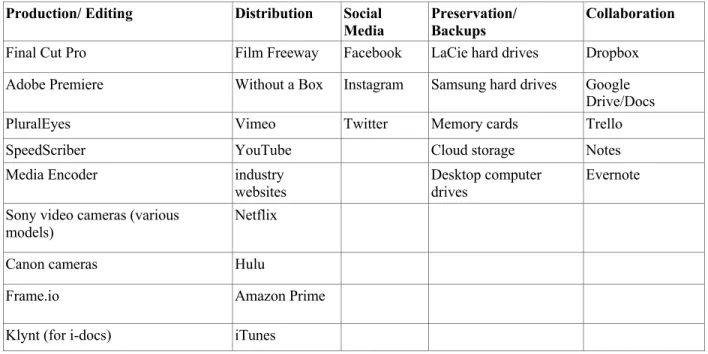
TABLE 1. Digital tools employed in the documentary production lifecycle………...……61
TABLE 2. Digital platforms employed by respondents in distribution and social media marketing………...67
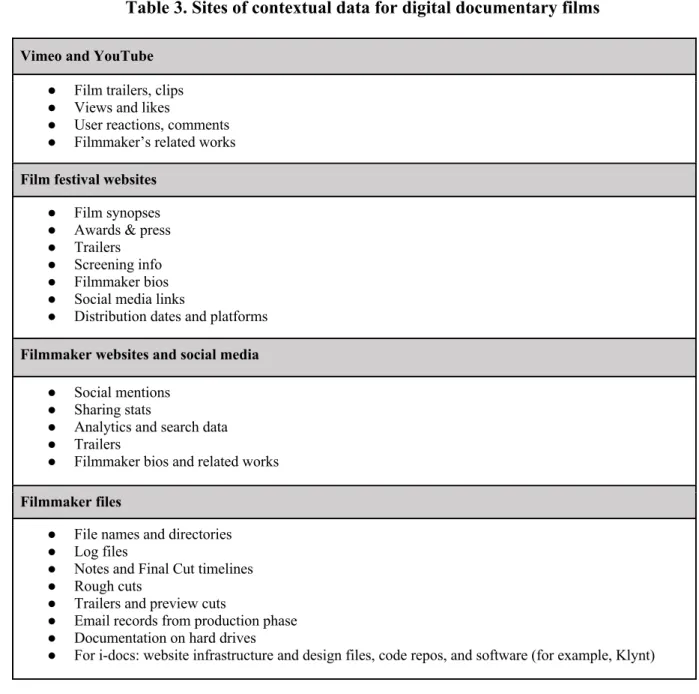
TABLE 3. Sites of contextual data for digital documentary films………...68
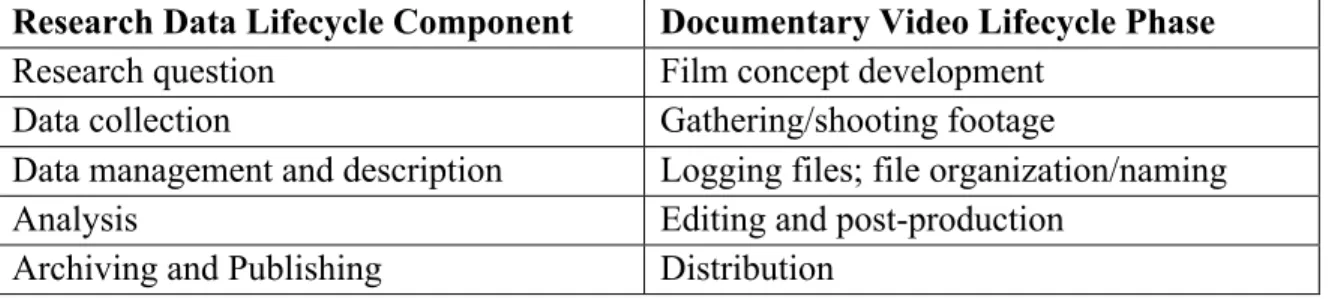
TABLE 4. Research data lifecycle alignment with documentary video lifecycle………76
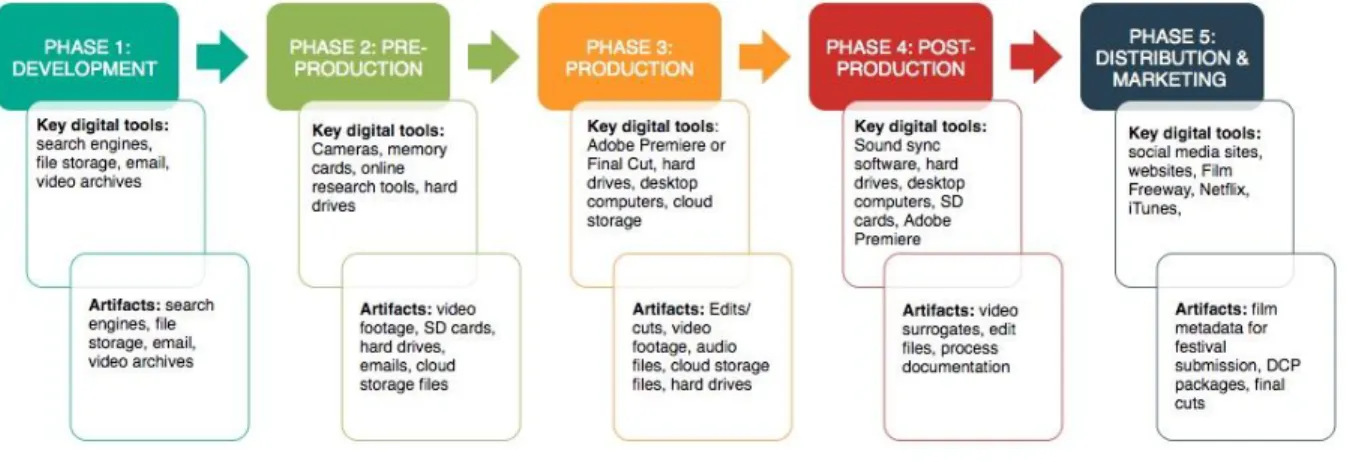
FIGURE 1. Contextual artifacts and lifecycle stages of a digital documentary……….…..73
FIGURE 2. The research data lifecycle………75
CHAPTER I. THE DOCUMENTARY FILMMAKING LANDSCAPE
It is not often that audiences have an opportunity to experience a film. By film, I refer not to Netflix or Amazon videos on binge, but the old-fashioned polyester film stock that whirls on a projection reel, beeps mysterious beeps in the first few frames and flickers with specks of dust dancing across the screen. In the churn of the digital revolution, most have forgotten—and children will never know—the experience of sitting in a dark classroom, observing the teacher unpack a film from its round, silver canister, hearing the distinctive whir of the dusty film projector, and seeing the random scratches on the surface of the film. Pocket-sized screens now serve any movies via phone, tablet, and desktop anytime, anywhere. Digital media flow in and out of our consciousness like the landscape whizzes by on a train. Movie-watching can now be as solitary as book-reading. All in all, the film experience has been transformed.
The process of getting a movie from a filmmaker’s head to the now-digital projector of a theater has changed, too. What used to involve large, cumbersome machines to shoot and edit can now emerge in bits and bytes from devices as tiny as an iPhone, complete with titles and festival-ready. (For reference, see the iPhone Film Festival, iphoneff.com.) Film scholar Bordwell summarizes this transformation (2013, p 7):
A movie like Hugo (2011), which traces in mythical terms the birth of the film industry, reminds us that movies started with artists playfully experimenting with new tools and
technology. We know this history because some of the films created in these early years have survived. In that long trajectory of film’s evolution, the documentary genre has become increasingly popular. Between 1995 and 2019, documentary filmmakers produced over 2,200 documentaries, resulting in sales of more than $2.2 billion.
Documentary filmmaking has evolved from its experimental beginnings in
1922’s Nanook of the North, in tandem with changes in technology, production methods, and filmmaking styles. Movie production and distribution has shifted from traditional film to digital technologies. Documentarians now have an abundance of options when it comes to sharing their work. They can work directly with a distribution company, submit it to PBS or A&E, pitch it to Netflix or HBO, or let it travel the festival circuit. Digital documentary films are shared with audiences in a variety of ways, including streaming platforms like Netflix, in theaters, and at film festivals. Ubiquitous video devices and easy-access internet distribution platforms have
revolutionized the average person’s ability to create and disseminate nonfiction video in forms as divergent as fleeting, six-second Vine videos, and studio-developed, feature-length films. They are increasingly digital, interactive, participatory, small-scale, and independent.
This dissertation sits at the intersection of contemporary documentary filmmaking, moving image archiving, and digital preservation. It focuses on documentary filmmaking as a microcosm of the changes that have occurred throughout the film industry. Documentaries are not just films, but historical documents – they capture life as we live it and help create a
documentaries. Documentaries and archives are connected. Ken Burns’ epic historical works like Baseball and Vietnam rely heavily on archival footage for raw material. Likewise, documentary filmmakers in ten, twenty, or fifty years will need footage from this century.
The focus of this dissertation is independent documentary filmmaking; that is, films produced outside of formal, commercial studio structures. Indies operate outside the commercial movie industry, tend to rely on informal sources of funding, and distribute work through film festivals and other informal means (for example, YouTube, Vimeo, and other media websites). Curation approaches to documentaries and independent films have not been a focus of archives literature. (It is also unclear how the digital shift has affected filmmakers’ ability to find and use “born-digital” archival materials; however, this question is beyond the scope of the current study.)
Digital moving images face substantive preservation risks. Documentarians employ an increasingly complex suite of digital tools and services to create their films; many of these tools and platforms are proprietary/commercial. In this dissertation, I investigate how documentary filmmakers employ digital platforms explore current practices and attitudes related to their stewardship of the digital media they create. I then compare their workflows to existing data lifecycles in the humanities and sciences and propose a new digital video curation framework that archivists and film curators may use to 1) establish relationships with current filmmakers and 2) identify sites of relevant contextual information (metadata) to assist in film curation and description. I synthesize current conceptualizations of the documentary form with emerging approaches to curation of research data in the humanities and sciences.
commercial platforms like HBO and Netflix. Some of the most recent subtypes of documentary filmmaking depend on co-creating narrative structures with audiences. These newer forms bear little resemblance to the traditional, linear movie form with which most viewers of
documentaries are familiar. Integrating influences and research strategies from qualitative methods enables me to consider both the material/infrastructure elements of digital documentaries while examining the documentary genre’s recent forays into transience, performativity, and liveness.
The multiple-case study approach holds promise for exploring digital documentaries and their creators. The need to connect digital curation resources with creators has been discussed in the digital curation literature. Because documentary artists are creating with entirely digital workflows, documentaries are useful units of analysis for archival scholars wrestling with how to preserve interactive and web-based multimedia. A multiple-case study of digital documentaries and their filmmakers provides a rich space in which to examine curation approaches to
documentary moving images.
1. What patterns in use and understanding of technology throughout the production and distribution stages emerge from a comparison of documentary filmmakers’ digital workflows?
2. Which digital tools and platforms have respondents used in creating digital
documentaries? What are the information infrastructures employed in the production, distribution, and online sharing of digital documentaries?
CHAPTER II. LITERATURE REVIEW
To provide context and historical background for this investigation, I explore digital moving image archiving in light of current tensions and transition points between traditional and digital moving image preservation. I also examine the current documentary filmmaking
landscape, including a survey of its common types and genres. I explore the connections between video archiving and the preservation of games and digital art. Finally, I describe prevalent
research methods for investigating documentary films and digital media practices. Section 1. Moving Image Archiving and Digital Curation
Film preservation efforts have grown alongside the flourishing of film since the early days of Lumière and Méliès, two of the earliest filmmakers. Moving image archiving has become a field of practice in its own right, with opportunities for curators and archivists to learn preservation techniques via moving-image archiving programs at the George Eastman House and University of California, Los Angeles, for example. According to the AHDS Moving Images and Sound Archiving Study: “Moving images probably present the most complex preservation
problem that most institutions will have to face over the next decade or so” (AHDS 2006,
The film industry has now shifted to digital production, distribution, and
exhibition/screening methods. Lenk (2014) has observed a dramatic increase in digital projection with the influx of new, 2K-equipped theaters. According to an industry report by IHS Cinema Intelligence, more than 90% of the world’s theaters are currently digital; sales and production of film stock have declined significantly. The exponential growth of born-digital media has added to the sense of urgency in archives to develop the necessary archivial infrastructure and
expertise. Moving image archivists continue to debate and explore best practices for preserving video. Before the digital turn, films were printed on film stock and could be preserved using techniques that, if appropriately implemented, ensured the films’ survival for decades. Digital production and distribution have thrown proverbial wrenches into the moving image preservation works.
Brand (2012) describes tensions in the evolving moving image preservation landscape as containing both “perils and opportunities.” As moving-image technology and production
workflows shift, archivists must revise their approaches to curating moving images. Bordwell’s (2012) Pandora’s Digital Box: Films, Files, and the Future of Movies, traces the history of film from its nitrate days to its current digital incarnation. Significant shifts in film-industry
technology—from production to preservation—have been both complex and contested. Over the past hundred years, new filmmaking processes have frequently overtaken their predecessors. Until the advent of digital motion pictures, film stock was relatively amenable to preservation if housed in favorable conditions. A well-preserved polyester print could be expected to last in the range of about a hundred years. Digital formats, however, pose substantive challenges for
process. Digital preservation “dilemmas” as wide-ranging as file format obsolescence and storage costs have brought uncertainty to the film industry.
Partly in response to concerns about digital moving image preservation, the Academy of Motion Picture Arts and Sciences, in collaboration with the Library of Congress’s National Digital Information Infrastructure and Preservation Program (NDIIPP), produced The Digital Dilemma and The Digital Dilemma II. The “dilemma” described by AMPAS relates to tensions between the desire to preserve film and concerns about the high costs and the need for advanced technology, staff expertise, and custom digital archives infrastructure. Digital Dilemma
I (2007) concluded that film preservation faced two primary challenges: “1) Every enterprise has similar problems and issues with data preservation; and 2) No enterprise yet has a long-term strategy or solution that does not require significant and ongoing capital investment and
operational expense” (p. 1). The challenges are visible in the differences between film and digital video. Film archivists can control motion picture film deterioration through proper
environmental controls, inspection procedures, and degradation detection. Data is vulnerable to “invisible failure” at various levels, including hardware, software, storage devices, and
networked storage systems.
Studios have tended to preserve the film components they most value, but the immense costs of digital preservation make saving everything an expensive practice. For the commercial film industry, there is a strong financial incentive to preserve film assets, but for many, these burdens are impossible to bear (Digital Dilemma I, p. 46):
incurs ongoing preservation costs that are significantly higher than archiving film—on an annual basis, $8.83 per running minute to archive a film master versus $104.2815 per running minute to archive a 4K digital master.
The costs and complexities of digital storage, digital archiving workflows, and the growing abundance of data needing stewardship ensure that the digital dilemma remains unsolved. Digital Dilemma II notes that costs of digitization should decrease over time and that uncertainty around best practices in digital curation may linger:
The digital dilemma is far from solved. Unless preservation becomes a requirement in planning, budgeting, and marketing strategies, it will remain unsolved for independent filmmakers, documentarians, and nonprofit audiovisual archives alike.
As digital becomes the predominant mode of moving image production, challenges continue to shift and evolve. Definitions of film and film archives have also evolved.
Fossati’s From Grain to Pixel (2011) explores how film archives are defined, noting that digital film differs in fundamental ways from its analog predecessor. Rather than separating analog and digital collections into separate silos, Fossati argues, film archivists should embrace an all-encompassing “panorama of the media” (Fossati p. 17). Cultural heritage institutions have been wrestling with the analog/digital divide for some time and will likely continue to do so. The argument that a “born-digital” movie carries with it the same conceptual and theoretical
meanings of an analog film is far from settled. For example, in Moving Image History and the F-Word; or, “Digital Film” Is an Oxymoron, Streible writes of the need to use precise language related to film history and archival practice (2013, p. 228):
experience the nearly complete transition from photochemical film to digital video, historians, scholars, and archivists need to use vocabulary precisely.
Streible argues that the cultural heritage community must perpetuate knowledge
surrounding film history and preservation. He views the phrase “moving image” as preferable to “film” (particularly in archival training programs) because “moving image connects the various incarnations of the medium (film and digital) under one umbrella” (p. 230). Streible also notes that even digital objects have some physical attributes; for example, digital media require computer hardware to run. Maintaining the distinctions between film and digital moving images remains essential. Film preservation now requires an understanding of the differences across a wide array of analog and digital video formats.
Fossati (2011) argues that the film world is “still witnessing a progressive hybridization of technologies where analog and digital coexist in many segments of the production chain” (p. 14). There has been a mixed-use of old and new technologies, with film preservation techniques persisting alongside new approaches to, for example, digital restoration. Brand (2012) describes a shift “from an emphasis on preservation by duplication and storage of the duplicated elements to preservation through digitization and storage of original materials” (Brand p. 94). Fossati’s comprehensive analysis of the transition from analog to digital describes it as an increasingly complex interplay between the two modes, one that involves “convergence/divergence”:
Convergence/divergence underlines the dynamics of transitions in film restoration practice in a field pulled between two forces: on the one hand, the convergence of technology, standards, means, and, on the other hand, the divergence of analog and hybrid multi-specialized means.
Dilemma II featured in-depth interviews as well as surveys with filmmakers to assess their perceptions of digital filmmaking and preservation. The interviews aimed to discover how filmmakers store and manage their digital media. Researchers found that many filmmakers continue to use a mix of digital and analog methods. Hard drives, Betacam, and DigiBeta were commonly-cited storage technologies, and a few filmmakers continued to use film stock. At least a third of respondents had tried to migrate their media to current storage formats; however, a majority had not completed this step. Filmmakers in the study were responsible for preservation costs, a significant barrier. On a more positive note, filmmakers observed that reported access to archival moving images has expanded in recent years.
A few media studies scholars have explored the concept of “artist-as-archivist,” describing how personal digital archiving strategies become part of the media production workflow. Filmmakers’ knowledge and awareness of best practices for digital preservation are often limited. For example, Brand (2012, p. 93-95), an experimental film artist and scholar, expresses concern about the lack of clarity in how to best provide care for his media. Because Brand works in the domain of experimental filmmaking, the audiences for his films are often small, and his funding for media preservation is limited. As an active filmmaker, Brand’s
preservation concerns fade next to his need to work on new projects. He notes, “I usually choose production of new works over preservation and distribution of old ones” (p. 94).
Brand (2012) remarks on some of the advantages of digital distribution, such as the more extensive audience base: his films are now capable of reaching anyone with an internet
image collections, the downsides include the fact that not all films are online; access, Knight argues, remains limited. It is essential to consider how movies are selected to be uploaded; archives often make choices about how to limit the size of collections placed online. Archivists may feel pressured to make everything available online: “User expectations are such that people now expect resources to be accessible online as and when it suits them” (Deazley and Stobo 2013, p. 3). The Digital Millennium Copyright Act enables archives to process materials for preservation and/or replacement, but copying or un-encoding media is restricted. Archives may choose to avoid working with materials that are still under copyright. Recently, the development of Creative Commons and other forms of open-access licenses have provided an added degree of flexibility, both for rights holders and for cultural heritage institutions.
Looking at the challenges of providing moving images online from a user- and collection-level perspective, La Barre and Cordeiro (2016) address the distinct metadata and contextual needs of moving image collections - which information is most critical to capture? Metadata schemas for moving images vary and are not yet stable. Another major challenge related to the over-abundance of digital media is that archives often cannot handle the overflow of materials. Howard Besser (2013), argues that “activist-archivists” could employ automated metadata collection and other digital processing tools. For example, the Occupy movement has generated a deluge of documentary media—more than 166,000 YouTube postings in its first six months. Videos exist on a wide array of devices and platforms, including phones, digital
working with Occupy Movement activists to include Creative Commons rights statements in video recordings and deposit agreements (which allow archives to use and disseminate
materials); crowd-sourcing some of the selection process to help with the overwhelming number of videos; and making sure that copies of videos reach the Internet Archive with complete metadata.
What Besser describes as an “inter-relation problem” complicates the collection of digital objects. When materials originate from online platforms or a dizzying array of devices and software, they tend to have more in common with other materials from those platforms, rather than with each other. Each platform relies on custom code, infrastructure, and metadata. Commercial services like YouTube may seem like a good option for storing digital media, but they do not reflect current standards for digital preservation.
For film archives managing digital audiovisual materials, the process includes a preliminary assessment of a collection as to materials that are critical for retention. Copyright issues related to the film’s ownership and distribution also need to be resolved. The AMPAS reports (Digital Dilemma I and II), for example, set specific goals for moving image archives. Criteria include (DD-1, p. 49):
1) Guaranteed access for at least 100 years
2) Immunity from extended periods of neglect and financial hardship
3) Ability to create duplicate masters to fulfill future (and unknown) distribution needs 4) Picture and sound quality which meets or exceeds that of original camera negative and production sound recordings
image collections that manage digital content (CCSDS 2012). The OAIS model is a “general model, equally applicable to a national archive as to, for instance, a domestic collection of photographs” (Walsh 2014, p. 19).
The OAIS requires information packages that define and contain each element of the moving image. These include the Submission Information Package (SIP), Archival Information Package (AIP), and Dissemination Information Package (DIP). The SIP depends heavily on the materials provided by the film’s creator(s). For example, as Walsh [2013] outlines the process, a submission file generally includes a Digital Cinema Package (a data file generated by the
filmmaker or company hired specifically to create the package), HDCAM tapes, or files in one of many possible video codecs. The OAIS model requires that archives 1) intake the right types of data from creators/sources; 2) ensure that the archive will have control over the data so that staff can perform preservation functions, 3) have a clear sense of the data’s potential users, 4) make sure that data can be represented autonomously (without creator intervention), 5) enable
authenticated distribution in ways that protect the original files, and 6) provide access to the data (CCSDS 2012).
When archives align with the OAIS model, such compliance supports their designation as trustworthy. ISO 16363, which delineates Audit And Certification Of Trustworthy Digital
Repositories “defines a recommended practice for assessing the trustworthiness of digital repositories” (ANSI 2012, online). It is applicable to the entire range of digital repositories. ISO 16363:2012 can be used as a basis for certification.
OAIS do not designate particular moving image file formats or workflows as “ideal”; instead, they outline general principles that, when reflected in an overall preservation context, provide the components necessary for practical digital preservation (Center for Research Libraries 2020, online). These standards are essential for distilling digital curation knowledge for the moving image archiving community.
Approaches to understanding, documenting, and curating interactive media have begun to emerge. InterPARES (interpares.org) is one example of a project that focused on the curation of interactive digital objects. In recent years, Jesse de Vos’s Archiving Interactives project has produced a compelling curation model for interactive new media. The most promising
approaches emerge from the research data services and data curation literature, which document some of the collaborative work that libraries and archives have begun to imagine and implement in partnership with content creators.
The evolving conversation around digital curation of research products and data provides a useful lens for thinking about how archivists and film curators might approach working directly with documentary film producers. Tammaro et al. (2016) discuss the increased opportunities for data curators to engage creators/producers in the cultural heritage sector. Molloy (2014)
The idea that digital curators can and should work directly with content curators has emerged and evolved alongside increasingly data-intensive, discipline-specific needs for computing platforms, metadata guidance, publishing, copyright consultations, and archiving of scholarship via institutional repository or other digital archives. Ray’s volume on research data management (2014) includes a discussion of the intertwined relationship of the Rice University digital scholarship center with faculty producing large-scale digital humanities projects. As content is produced, the digital curation coordinator assists by providing workflow and metadata documentation. Sustainability in digital humanities is an ongoing concern expressed in the literature that is addressed in part through data curation guidance. Sabharwal’s research on digital humanities curation (2015, 2017) highlights the fact that despite a lack of clarity around what constitutes “archives,” humanists and archivists continue to engage in highly collaborative ways to document and curate digital humanities projects.
By way of contrast, scholars and practitioners engaged in digital humanities projects have bemoaned the difficulty of sustaining large-scale, complex, and often-interactive works (Maron 2014, Hedges 2013). A recent project out of the University of Pittsburgh, entitled Sustaining, aimed to provide a framework for ensuring DH projects’ sustainability over time (see
sustainingdh.org). The workshops offered through the project provide documentation strategies and a modified version of the NDSA Levels of Preservation to help project teams build
sustainability into each stage of a project, rather than just at an undefined endpoint (National Digital Stewardship Alliance 2018, online). Finally, Boutard’s (2014) explored the feasibility of mixed-methods digital curation for the arts. His work provides critical perspectives on how content creators and curators might approach stewardship of these materials by combining digital preservation and digital curation frameworks in conjunction with art documentation
strategies. Artist statements and formal art documentation has developed as a set of strategies to contextualize and provide stewardship for both traditional and digital artworks. Integrating these richly descriptive strategies with digital preservation workflows may provide appealingly robust methods for capturing both the technical infrastructure and contextual information of digital media.
In summary, a wide range of subject disciplines has benefited from academic library efforts to embed data stewardship across campuses and to engage directly with content creators. The sciences maintain an emphasis on reproducibility and open sharing of data. Digital
Section 2. The Documentary Film Genre in Theory and Practice
John Grierson, one of the first documentary filmmakers, defined the form as the “creative treatment of reality” (filmreference.com, 2017). Documentary films attempt to represent reality by capturing life as it happens. Subtypes include historical, personal, experimental, animated, participatory, and several other forms. (Nichols 1991, 2017). The genre continues to evolve (Winston 2017, introduction): “Documentary has never attracted such audiences, never been produced with such ease from so many corners of the globe, never embraced such variety of expression. The very distinctions between the filmed, the filmer, and the spectator are being dissolved.” In this decade, documentary filmmakers have embraced interactive and non-linear forms, and film theorist Vivian Sobchack, in her dissertation, Collecting Visible Evidence (1999), goes so far as to say that the contemporary documentary film is an “experience” rather than a “thing.”
In memory studies, moving images (and documentaries in particular) are considered a form of cultural memory. In The Emergence of Cinematic Time, Doane refers to the
“archivability of presence” as one of the potential gifts of a documentary (p. 25); in
documentaries, filmmakers gather footage of everyday life and from the footage create stories. Cultural memory solidifies through the media forms it inhabits. In another connection to archival practice, digital “remediation” (digitizing film and allowing it to circulate) helps prevent cultural forgetting: “Remediation frees footage from forgetting by liberating it from the shelves. What is not remediated will soon be forgotten” (p. 15).
changes in how filmmakers and audiences participate in the roles of producers and consumers (Hight 2008, Ocak 2014, Rogers 2012). For documentary as a genre, specific sub-forms and strategies have emerged that push the boundaries of the documentary definition. Distribution is a critical part of the documentary life cycle, in part because, as Virginia Crisp notes, “distribution acts as a gatekeeper, separating producers from potential audiences” (Crisp p. 3). The availability of web-based and streaming video has dramatically changed the distribution landscape; online ‘platforms’ include significant players such as Amazon, Netflix, Hulu, Apple, and a long tail of smaller distributors. Informal or “user-generated” content on YouTube, Vimeo, and other sites comprise a growing subtype, with “pirated” media remaining widely popular via file-sharing platforms.
De Jong et al. (2014) refer to how digital documentary production has become
democratized. Scholars, including Juhasz (2014), Kalafatoglu (2016), and Thorson et al. (2013), explore grassroots, participatory documentary modes, which have exploded onto the wide-open space provided by the internet. Low-cost cameras and free editing tools have opened
digital media itself, questioning its ability to glean truth from historical narratives. Morris uses archival footage in his films to critique both the old and the new as forms of objective truth. He believes digital technology is no magic bullet for achieving a coherent historical narrative. Relying on these materials to establish evidence is always an incomplete, highly subjective practice.
Amateur video (that is, small-scale documentary video) has caught the attention of archivists and scholars for its candid depictions of everyday life. The home movie and the amateur film (also referred to as micro-histories and personal documentaries) fit a specific niche. Home movies, in particular, contribute to the historical documentation of personal, intimate, and vernacular experiences. They serve, as Karen Lury notes in Amateur Filmmaking (Rascaroli et al. 2014) as both “artifact and anecdote” (p. 115); that is, they tell personal stories (anecdotes) and help to document non-official history (artifacts) of their time. Lury argues that home movies should probably not be called home movies, but rather informal or casual documentaries. They no longer focus solely on life in the home, nor do they remain under the creator’s control after being shared on networked media. One of the impacts of the digital revolution has been to make possible broader sharing of amateur and home video on social media, user-generated platforms like YouTube, and other online spaces. As Rascoroli et al. (2014) argue, “after decades of neglect, old amateur films are now being recuperated, studied and digitized, sometimes incorporated in new films and artwork, and cataloged and repositioned within archives and repositories” (p. xv).
art that reflect authorship and style. Home movies, on the other hand, often lack a plot, titles, or specific genres; they emerge organically from the activities and informality of everyday life. The informal nature of home movies provides a rich source of historical material. “Amateur and news footage can mobilize what historians have called ‘history from below,’ the memories of everyday people rather than official histories” (p. 266). Given this move toward inclusivity, Zimmerman and others envision a shift from “considering the archive as a place to collect and store images to rethinking the archive as a convener of new spaces for collaboration, public works, and the staging of encounters” (p. 269). Like the reconceived documentary film, the archive is an “experimental encounter.”
Efrén Cuevas (in Rascaroli et al.) describes home movies as “microhistory” and explores how they have merged into the documentary genre. Filmmakers such as Ross McElwee [Bright Leaves, Sherman’s March] have woven home movie footage into the larger narrative of their films. Cuevas argues that documentaries using home movie footage are “the filmic equivalent of the micro-historical studies written by professional historians” (2014, p. 139); that is, they are “documents for a history of everyday life” (p. 140). Within this genre, two possible approaches include home movie footage taken from a broad set of films (cumulative) or footage of one person’s family life.
while the movement was ongoing, arguing that waiting until the movement had dissipated would lead to loss of data and critical documents. Besser also devised a list of recommended practices for archivists interested in documenting events as they happen. Thorson et al. highlight that the documentary materials associated with the Occupy movement are cross-platform, appearing on multiple websites and social media platforms. The most effective strategies for collecting this type of documentation are still up for debate.
The Internet and digital methods have brought a high degree of playful, non-linear, and creative strategy to documentary production and distribution (Aufderheide 2015; Dixon 2015; Dovey & Rose 2013). Social media and other participatory platforms have helped to redefine documentaries as both offering and accepting engagement. As O’Flynn (2012) notes, “digital and Web 2.0 technologies are also blurring prior divisions between fiction and non-fiction, text and paratext, director and audience” (p. 143). Web-based documentaries in particular enable greater participation on the part of audiences. Some documentary filmmakers have embraced both “transmedia” and “interactive” approaches that cross platforms and boundaries, often using social media, video platforms, blogs, text and photographic databases, and other media (Almeida and Alvedos 2010). The term transmedia refers to “a design strategy of distributing narrative content across platforms rather than a distinct and singular model of production” (O’Flynn 2012, p. 149). Similarly, Henry Jenkins defined transmedia documentaries as the “narrative
documentaries. Interactive documentaries are usually single works published on one platform (O’Flynn 2012, 2015); they involve audience participation (O’Flynn 2012, p.2):
i-docs are often designed as databases of content fragments, often on the web, though not always, wherein unique interfaces structure the modes of interaction that allow audiences to play with documentary content. The story or stories are encountered as changeable non-linear experiences, the narrative or storyline is often designed as open, evolving, and processual, sometimes including audience created content.
Transmedia works may or may not contain interactive/participatory elements. Both forms may take advantage of social media sharing. Aufderheide (2015) notes the proliferation of conferences on the emergent form of interactive documentary. Interactive documentaries allow the audience to choose pathways and experiences. “Database-driven” documentaries are a sub-type of this genre. These projects encourage users to access content in a flowing, choose-your-own-adventure strategy with different outcomes at each encounter. The audience, which becomes a collaborator in the documentary’s construction, can rearrange the material at their leisure, creating a personalized experience. These types of documentaries are participatory, collaborative experiences. Multiple voices/users help co-create the documentary narrative, subverting the familiar “voice of God” narration present in many documentaries.
Participatorydocumentaries are interactive works in which community members collaborate to tell stories about their shared experiences. The Sandy Storyline, an online project that documents stories related to the devastating superstorm Sandy, defines participatory documentary as “an inclusive and collaborative process that engages communities in designing and carrying out the collection and dissemination of their own story” (sandystoryline.com).
motivations for expanding archival outreach and guidance to community organizations that produce documentary media is that these entities create works not typically collected by mainstream or institutional archives (Flinn et al. 2009, p. 3). With the advent of
digital/networked collections, there is an increased level of urgency among archivists and researchers across the literature to identify cultural heritage materials of enduring value and to implement participatory models (Carletti 2016). Many of the standards, and best practices are designed for large academic institutions, government agencies (i.e., the Library of Congress), or organizations with a specialized focus on preservation (i.e., the Digital Curation Centre). A small body of work focused on community archiving -- the works of Jeannette Bastien and Andrew Flinn, for example -- argues that it is critical to examine how digital archive best practices can be put to use for a non-expert, community-driven, ephemeral, and small-scale media context.
Best practices would help guide community documentary projects effectively in digital archives management. Many archival institutions have been discussing community archives and conducting outreach (AMIA, for example, holds a community archiving session at its annual conference); however, there are limited standardized guidance documents for community-led and informal-organizational archives, creating a divide in the area of guidance for organizations that wish to preserve their digital records. Without attention to digital preservation, the activities and work of cultural memory-creators are likely to face substantive risks. Models for supporting independent media creators can help fill the gaps for this vital source of documentary material. Section 3. Intersections with Multimedia Art and Games
The literature on variable media artwork preservation and video games relates to documentary moving image curation. Scholars investigating these related fields have explored how to preserve interactivity, digital art, and cross-platform materials. Although LIS research focusing on documentaries is limited, it is possible to draw parallels between documentaries and other genres of digital or “new” media. This section focuses on literature related to curation of digital multimedia works, specifically:
1) web-based videos published on common video distribution platforms such as YouTube, and
crawlers in addition to preserving metadata (Lee and Tibbo 2008); preserving context within digital collections (Lee 2007); the VidArch project on preserving digital video collections and defining the contextual information needed (Marchionini 2009); and how blogs both provide additional contextual information for video and serve as an essential part of a documentation plan or strategy (Lee et al. 2008, 2011). Researchers have also examined tools for automating metadata capture from YouTube videos (Capra et al. 2008; Shah 2010). Bonn (2016) looks at video collections of documentary materials—videos documenting intangible heritage—and argues that context must go well beyond the video files to completely represent the heritage practices they portray.
in or are affected by events, and allowing the collection trajectory to evolve if it becomes necessary have been the three principles on which the #blacklivesmatter Web Archive was constructed” (Rollason-Cass and Reed 2015, p. 243).
In a similar vein with Rollason-Cass and Reed, Welburn et al.’s
#ButHowLongWillTheyMatter? (2016) explores the on-the-fly preservation of informal
“resistance” and social justice-oriented videos captured “through the lens of street videography, citizen journalism, and incidental documentation of events” (abstract). Pietrobruno (2013) argues that identifying cultural heritage collections on YouTube and employing social archiving can better support underrepresented cultural heritage materials (p. 1261):
From both within and beyond the borders of Western countries, the social archiving of heritage on YouTube has the potential to problematize dominant narratives in which national heritage privileges male practitioners. YouTube, as an archive of intangible heritage, can circulate practices of the marginalized and challenge traditional
performances of heritage […].
Interactive media (experimental art, games, software, digital music performances) pose challenges for digital curators. These types of media are often difficult to reproduce once
divorced from original contexts. Rather than approach digital multimedia works as static objects, scholars have suggested that they are processes with active components. Boutard (2015)
Crowdsourced curation can help preserve interactive digital media, Boutard argues, but we need more collaboration, non-prescriptive models of curation, and the flexibility to meet the unique curation needs of each work (2016a and b).
Current research has embraced the process-oriented approach and extends the possibility of employing a wider net for collection and documentation, including rich metadata for
contextualization of interactive media and software-based art, video games, and other variable media. In Innocenti’s (2012) work Preventing Digital Casualties. Innocenti argues that art history plays a crucial curatorial role: “[C]uration of digital art is as much an art historical curation problem, as it is an engineering problem” (p. 473). Likewise, Giannachi (2015) describes the challenges of preserving interactive art, particularly from the user’s perspective, and argues strongly for a process-based, fluid approach to documentation of digital performance art, writing that “artwork is not just the object, but the network of processes that capture its reception over time” (p. 45). Earlier work by Fauconnier and Fromme’s (2004) on capturing unstable media had outlined several of the significant challenges of preserving interactivity in the electronic arts. The authors outline several initiatives designed to tackle the problem of
Several papers on multimedia argue for a more process-oriented curation approach that departs somewhat from the idea of a static “original”: “For unstable media art,” write Fauconnier et al., (2004), “it is difficult to define the notion of ‘original state’ of an art object. Documenting the context of electronic art activities is important, as well as a perspective of process over product” (p. 9). Preservation of variable media requires attention to the notions of art-as-process; the importance of context; multi-disciplinarity; user interaction with the works; electronic art-as-activity; and a reduced need to emulate the “original” artwork perfectly. The Capturing Unstable Media project aimed to create models for documentation and curation of unstable media using a case study approach. The project team quickly discovered that standardization of a conceptual model for unstable digital art would be elusive; however, several core components emerged. The research and development processes related to the art; documentation of how the piece was implemented; user interaction details; and artist collaborations and specific roles are some of the critical components that provide the basis for the Capturing Unstable Media Conceptual Model (CMCM). These components include the following (Fauconnier 2004, p. 5):
In short, the following characteristics of electronic art need to be taken into account when trying to capture unstable media: (1) electronic art activities are process-based; (2)
context is very important; (3) the activities are heterogeneous in materials and practices; (4) projects are usually created through interdisciplinary or multi-disciplinary
collaboration; (5) user interaction is an essential activity in the dissemination phase of many projects; (6) it is important to speak about electronic art activities and not just artworks; (7) preserving and reconstructing objects becomes less relevant than in contemporary art preservation.
The CMCM model illustrates how to document software-as-performance. The model integrates elements of interaction, time/event-related occurrences, discrete projects,
(occurrences), some of which may contain elements of audience or user interaction. Documentation is a critical part of the production.
The notion of performance documentation is visible in Rinehart (2007), who developed a “formal notation system” for variable media art. The approach is similar to a musical score that enables curators and users in the present to “perform” a media work given formalized
instructions. Scores, which are inherently sets of directions, “provide the clearest example of a description that compiles formalized (systematic) discrete elements into documents that aid in the re-performance or re-creation of works of art. Musical scores also demonstrate how to navigate the border between prescription (maintaining the integrity of the work) and the variability that is inherent in media art” (p. 182). Scores rely on notation systems; Rinehart’s notation (Media Art Notation System, or MANS) is a conceptual model that provides
interoperability with other systems and the flexibility needed to “recreate” or restage media works. It relies on the MPEG-21 and Digital Item Declaration (DIDL) conceptual models, which permit XML-based descriptors that refer specifically to interactivity (“choices”) on the part of users. The model includes the following data elements:
Corresponding DIDL XML elements are indicated in <BRACKETS>. Score: didl xml metadata document itself
<DIDL>
Descriptor: descriptive data about score document <DESCRIPTOR>
Work: logical media artwork or project <CONTAINER>
Descriptor: descriptive data about work or project <DESCRIPTOR>
Version: occurrence/state/ account of work <ITEM>
Part(optional): logical sub-component <ITEM>
Choice(optional): variables affecting configuration <CHOICE>
<RESOURCE>
Video games fall into a separate category of digital media entities in that they require acknowledgment of the user’s ability to make choices within the software. Carta (2017)
describes the continued challenge of video game preservation, noting that emulation has been a preferred approach (versus migration, which is costly and error-prone in the context of video games). Carta argues that for authenticity purposes, video games need to carry forward the original manifestation as much as possible: “To play a game as it was is necessary to preserve its technical and experiential manifestations: what makes a given game that game” (Carta 2017, online). Barwick et al. (2011) also explored game preservation using a comparative case study approach. The approach outlined by Carta includes both hardware and software metadata in order to convey more of the experience. In digital curation literature, emulation is a core digital preservation strategy for games; Lee et al. (2015) developed a complete metadata schema for the preservation of video games; this type of approach (customized schema based on
domain-specific descriptors) could also be useful for curating online, interactive documentaries.
Interactive digital art installations (particularly web-based works) comprise another fertile area for exploration of digital curatorial approaches that may help frame the preservation of digital documentaries. For example, Marcal (2012) argues that the archivists of digital art should embrace its “transience” and explores the possible application of performance-ethnographic techniques in documenting and preserving works.
Dekker (2014) describes the complex and amorphous project “mouchette.org” and the challenges of preserving all of its many interactive and almost-immediately obsolete
“documentation as a process,” Dekker asks, “What would a conservator have to know about the work, and how would having to continuously care for it affect existing workflows? Would a stable or fixed situation suffice, or could it still be interactive, thereby leaving it to the audience to keep the work alive or even let it evolve?” (2014, online). Preserving performative works such as mouchette also bring into play thorny conservation issues related to the ever-evolving
technology and inextricably-networked context:
[T]he process of creation for mouchette.org is heterogeneous, involving incompatibilities, constraints, rules, and a certain amount of improvisation that continually re-negotiates its own structures. Net art poses several challenges for conservation: it can consist of old and often outdated material aesthetics; reading code and software can be difficult;
maintenance can be very time-consuming; users participating in the work can change it. Artwork can evolve into new pieces.
Tedone (2017), an artist and media scholar who writes about networked art, has
suggested a new curatorial technique called “online critical tracing” which relies (in shorthand) on “identification of patterns of association between networked images from an observer’s point of view” (p. 59). It radically shifts the perspective from the curation of a single object to an understanding of how circulation and the network situate a digital entity.
Dekker’s article about mouchette provides a fascinating example of how digital art conservation is as much about the evolving relationships (digital, social) of a piece as it is the software and hardware components of the work. How a digital entity sparks connections that exist temporarily to provide the artwork with its circulatory drive, then ghost away, must come to the mind of the digital archivist working with these types of pieces. How could these works be theorized? Dekker (2014, online) writes:
of mouchette.org and ensures its continuation in different versions. Stories will continue to be told through multiple authors and caretakers, and because Neddam does not want to control its growth, mouchette.org keeps generating more objects, events, and comments. Together with evolving communities that are growing around the mouchette.org is a circulation of traces, experiences, and sharing that started at some point and progresses without a definite plan.
Section 4. Research Methods in Context
In this section, I describe how the multiple-case comparative approach to investigating digital documentaries provides the foundation for understanding their curation requirements. Rather than conceptualize the digital documentary as a discrete, static object, it is essential to view them as combining both digital infrastructure and narrative, “live” elements. A multi-disciplinary framework for this research is necessary as there is very little LIS literature that addresses filmmakers as content creators.
Much of the documentary studies literature aims to define and describe the genre, which is still evolving. Authors like Tryon (2011), Aufderheide (2015), and O’Flynn (2012) describe a growing, creative, and experimental field. Documentaries have commonly been studied using case methods approaches; for example, Whiteman (2004) and Raijmakers et al. 2006. In general, much of the literature on documentaries integrates qualitative research within a descriptive or case study approach. There is a keen interest in continuing to define what a documentary is and what it looks like in digital contexts. The emerging subtype of transmedia and interactive documentary drives a small portion of current documentary studies literature. Case studies of individual documentaries are common and reflect an interest in defining the form through filmmaker practices.
Case studies involve a holistic, thorough approach to understanding a research
context; when the boundaries between phenomenon and context are not clearly evident; and in which multiple sources of evidence are used” (Yin 2009, p. 23). They do not mandate a specific method for data collection; instead, they are open to a variety of data collection techniques. Data collection is immersive and sustained, which enables the researcher to create a detailed,
substantive description of the phenomenon studied. Case studies may involve
primarily-qualitative data collection strategies, but the method is flexible enough to integrate quantitative data. Data can exist in the form of documents, reports, databases, artifact analyses, interviews, websites, and other materials.
Pickard (2013) writes that case studies have been misused as a “catch-all” (p. 101) or as a format synonymous with ethnography and other qualitative methods. He argues that the primary driver behind the case study should be the central research question. There are three primary types of case studies: intrinsic, instrumental, and collective. Intrinsic case studies provide information about specific situations, but beyond that do not have a clearly-defined purpose. In contrast, an instrumental case study is designed to explore phenomena (p. 102) and address research questions. Collective case studies use multiple cases to explore a focal phenomenon and usually include cases of the instrumental type. The current research integrates this definition, aiming to develop collective case studies to explore the phenomenon. Pickard also notes that because case study research falls into an interpretivist research paradigm, there is an inherently open-ended, unstructured quality to initial phases of the research (as opposed to a highly-detailed plan, which is more common in positivist/post-positivist paradigms).
substantively different characteristics exist across a series of sites. Bounding cases is part of the case study selection process. Mills (2010) describes commonsense, theoretical, methodological, and spatial/temporal bounding strategies, each of which brings affordances and disadvantages to case bounding. Many of these strategies are relatively unavoidable in case research; for example, there are usually time limitations for research projects, which sets the predetermined beginning and ending points for the case. Commonsense bounding rests more on conceptual frameworks for limiting the case; for example, one might study libraries or library systems, the organization defining the boundaries of the case.
In collective-case studies, the research question helps the researcher identify the sites of study (Pickard 2013). Within each case, Pickard notes, purposive sampling helps determine the data sources. Wildemuth (2009) also recommends “strategic” selection of sites/cases (p. 54), and Yin (2009) describes methods for selecting cases that may fall into the following categories: 1) representative/typical; 2) critical; 3) extreme/unique; 4) revelatory; or 5) longitudinal. Pickard notes that purposive sampling is the primary method for sampling but suggests it remain open-ended; it may be challenging to ascertain which data sources are most useful for the study before embarking on the study. Much of the information gleaned from an individual site emerges organically and without presupposition. However, it is crucial to identify possible participants who may provide useful information throughout the study (Pickard 2013, p. 105). Phases of data collection include an initial orientation to the site, focused exploration and collection of data, “member checking” (a concept that derives from Lincoln and Guba’s (1985) original work on naturalistic research), and writing up the study.
overview”; “focused exploration”; and “member checking.” The initial phase helps determine data sources and case bounding and provides a sense of the case’s scope. Focused exploration, phase two, embodies the collection of data, observations, and interviews as well as analysis (iterative). Phase three, member checking, helps to ground the data in the perceptions of community members affiliated with the case(s). Participants engage with the researcher in assessing the reports and overall research narrative, grounding the overall research “story” and integrating a participatory component to the research.
According to McCammon (2017), semi-structured interviews may be implemented at various stages of the research process to illuminate the phenomenon studied. The interview can help “move the innovation process from general topics (domains) to more specific insights (factors and variables). It can be used to develop a preliminary hypothesis, explain relationships, and create a foundation for further research” (2017, online). Interviews start with a well-designed series of open-ended, guiding questions that aim to explore the phenomenon at hand and to determine the interviewees’ practices, behaviors, attitudes, and perceptions of the phenomenon.
The advantages of the semi-structured or “guided” interview for descriptive research include the ability to follow the interviewee’s lead in describing the phenomenon. Surveys would unnecessarily “box in” the interviewee, and, at this stage, there is not enough information about the phenomenon to design cut-and-dried questions. The open-ended interview pairs well with case study data from other sources such as data sets, website materials, reports, and policy documents (Cohen 2006).
questions on the spot. These are considered an intensive and challenging type of data collection approach. However, Pickard notes, guided interviews can remove some of the uncertainty of the unstructured interview by providing a list of critical topics to be covered during the interview. It is flexible enough to allow respondents to bring in unanticipated points but focused enough to ensure that relevant areas are covered.
With case studies, the approach is mostly qualitative, and analysis begins during the data collection phase and continues throughout (Pickard 2013). The exploration phase of a multiple-case study integrates data from a wide range of sources particular to the phenomenon studied, and analysis of these materials helps to shape subsequent inquiry. Data analysis of guided interviews is also an iterative and cyclical process, occurring throughout the research project. Initial memoing can help to elucidate key themes and concepts that the researcher can revisit throughout the interviewing phase. As Pickard notes, analysis and coding of qualitative data may continue until the researcher notes a substantial degree of “saturation,” the notion that the data provide enough support for the emergent themes and concepts and that additional data gathering may not serve to improve or expand these themes substantially.
analyzing these types of works, and the case study method provides entry points into new situations.
The limited body of literature addressing curation of interactive moving images suggests that this type of research is in its exploratory phase; as such, a more open-ended, iterative, and descriptive approach can be useful -- all of which are essential qualities carried well by the case study. Given the limitations of case study research, it is essential to apply some counteracting checks. Wildemuth (2009) discusses the quality criteria presented in Lincoln and Guba’s work on naturalistic research. These criteria can be employed, writes Wildemuth, in advance of developing the case study. Criteria include 1) resonance criteria: how well the case study report supports the theory applied; 2) rhetorical criteria: strength of the report’s organization and coherence; 3) empowerment criteria: qualities that spur action and change; and 4) applicability criteria: the degree to which others can draw inferences from the study (p. 56).
Theoretical perspectives that inform this research include the work of Lev Manovich, who writes about digital media in a cultural context. Manovich views digital media as software-driven “cultural interfaces” that create a triad of culture-user-platform (Manovich 2001).
Manovich argues that digital media works should instead be described as “cultural interfaces” -- short for human-computer-culture interface -- because the user, the software, and the platform are interconnected elements within the experience of the media object. In There is Only Software, Manovich writes:
Similarly, Jain (2003) defines experiential digital objects as an integration of the user and the experience:
“[Users] must be able to explore and experience events from multiple perspectives and revisit them as often as needed to obtain that insight. In an experiential computing environment, users apply their senses directly, observing event-related data and
information of interest. Moreover, users explore the data by following their own personal interests within the context of an event.” (p. 49)
The focus on software code as the underlying “script” for digital media works brings into play the notion of performance. In order to experience an interactive documentary, for example, users must cause a series of programs to run (or perform); one of the key differences between an i-doc and a traditional documentary film is that the user or audience member has a significantly more agency in the execution of the documentary narrative/script and thus the experience of it. The user engages with the materials, launching scripts. Thus, both users and the underlying programs/scripts involved should be considered in the final data analysis and included in descriptive materials and curation models for digital docs. Even for traditional docs, the underlying digital objects assembled to create the doc are themselves scripts. As Innocenti (2012) writes, digital art performs:
CHAPTER III: METHODS Section 1. Overview of the Collective Case Study Method
Via comparative-case study and semi-structured interviews, this project explores the digital production, editing, asset management practices, and perceptions of the digital documentary field for a sample of 14 documentary filmmakers and identifies key sites of contextual metadata for their recent digital works. Data were gathered via online, guided interviews with filmmakers and via identification of the websites, digital marketing, and social media platforms associated with the most recent films. As a comparative-case study, results were analyzed holistically as a collection of cases. Case boundaries were defined as follows: one discrete case consists of 1) filmmaker interview data and 2) the digital infrastructure and sites of production (websites, tools, and platforms) associated with their most recently-screened
documentary.
Open-ended interviews generally followed a formal interview guide, intending to achieve detailed conversations about the following broad topics (See Appendix 3 for the detailed
interview script.):
1) descriptions of the most recently-completed films, concept development, and general overviews of the production workflows for the films;
2) key decisions made about digital tools, software, and hardware;
4) perceptions of the challenges and benefits of using digital production and distribution protocols (software, hardware, and cloud platforms);
5) strategies related to data/file management and backups;
6) perceptions of the challenges of preserving/archiving digital media; 7) closing questions about the future direction of digital documentaries.
Conversations with the 14 participant filmmakers delved into the ways in which
documentary production and distribution workflows have become infused with decisions about digital tools, storage, backups, and use of cloud services. Filmmakers were asked to discuss at a fine-grained level their data and file management practices (naming conventions and organizing strategies) and challenges related to self-archiving digital media. They were asked to describe how they currently care for the digital media created in the moviemaking process and the extent to which they are aware of risks to that media.
The resulting interviews generally aligned with the semi-structured interview guide but also included related sub-topics of particular interest to the filmmakers’ unique backgrounds and career trajectories. I aimed to conceptualize the digital landscape using the filmmakers’ most recent documentaries; however, if there was a current film in progress or other relevant works completed, the filmmakers were welcome to speak about those films as well.
To identify potential filmmakers, I first developed a database of approximately 330 films, including their associated filmmakers, that screened in the last two years at a subset of five documentary-focused film festivals in the United States. The film festivals included the following venues:
1. Atlanta DocuFest (Georgia)
3. Boston GlobeDocs (Massachusetts)
4. Chagrin Falls Documentary Film Festival (Ohio) 5. Full Frame Film Festival (North Carolina)
In selecting the film festivals, I sought broad coverage of the documentary festival market, avoiding selecting films from only one festival or geographic location. I also tried to select festivals that had current, active websites and published complete programs from which to draw film titles and filmmaker names. From the festival programs of each site, I identified a mix of feature-length and short films and their associated filmmakers, and from this data created a working spreadsheet of contacts and films from 2017 and 2018. I sent the first set of invitations to a sample of 269 filmmakers whose films had screened at the selected festivals in 2018. After confirming several interviews with respondents from the 2018 cohort, it was clear that to reach saturation; additional filmmakers would need to be identified. I then drew a second, smaller sample of 60 additional films/filmmakers from 2017 programs. Because it was necessary to contact the filmmakers via email, I had to exclude those for whom I could not locate email addresses or who only had social media handles. The final list of cases/participants interviewed is summarized in Appendix 4.
Approved descriptions of the study were included as part of the formalized interview request, and I scheduled all interviews via Skype with consenting participants on a rolling basis. (See the Appendices for consent scripts and invitation emails.) After extending an initial set of invitations to the 2018 sample of 269 filmmakers, eight participants responded affirmatively and completed Skype interviews. One of these filmmakers introduced a ninth respondent as a