• No results found

PubMedCentral-PMC5342656.pdf

N/A
N/A
Protected

Academic year: 2020

Share "PubMedCentral-PMC5342656.pdf"

Copied!
16
0
0

Loading.... (view fulltext now)

Full text

(1)

E A R T H S C I E N C E S

2017 © The Authors, some rights reserved; exclusive licensee American Association for the Advancement of Science. Distributed under a Creative Commons Attribution NonCommercial License 4.0 (CC BY-NC).

Continental igneous rock composition: A major control

of past global chemical weathering

Clément P. Bataille,

1

* Amy Willis,

2

Xiao Yang,

1

Xiao-Ming Liu

1

*

The composition of igneous rocks in the continental crust has changed throughout Earth

s history. However, the

impact of these compositional variations on chemical weathering, and by extension on seawater and atmosphere

evolution, is largely unknown. We use the strontium isotope ratio in seawater [(

87

Sr/

86

Sr)

seawater

] as a proxy for

chem-ical weathering, and we test the sensitivity of (

87

Sr/

86

Sr)

seawater

variations to the strontium isotopic composition

(

87

Sr/

86

Sr) in igneous rocks generated through time. We demonstrate that the

87

Sr/

86

Sr ratio in igneous rocks is

correlated to the epsilon hafnium (

e

Hf) of their hosted zircon grains, and we use the detrital zircon record to

recon-struct the evolution of the

87

Sr/

86

Sr ratio in zircon-bearing igneous rocks. The reconstructed

87

Sr/

86

Sr variations in

igneous rocks are strongly correlated with the (

87

Sr/

86

Sr)

seawater

variations over the last 1000 million years,

sug-gesting a direct control of the isotopic composition of silicic magmatism on (

87

Sr/

86

Sr)

seawater

variations. The

cor-relation decreases during several time periods, likely reflecting changes in the chemical weathering rate

associated with paleogeographic, climatic, or tectonic events. We argue that for most of the last 1000 million years,

the (

87

Sr/

86

Sr)

seawater

variations are responding to changes in the isotopic composition of silicic magmatism rather

than to changes in the global chemical weathering rate. We conclude that the (

87

Sr/

86

Sr)

seawater

variations are of

limited utility to reconstruct changes in the global chemical weathering rate in deep times.

INTRODUCTION

The chemical weathering of silicates transfers elements from the

continental crust to seawater and exerts a direct control on several

bio-geochemical cycles. For instance, chemical weathering of silicates

transfers calcium (Ca) and magnesium (Mg) to seawater and regulates

atmospheric carbon dioxide levels and temperature at the surface by

controlling the rate of marine carbonate precipitation (

1

). Despite

dec-ades of research, the mechanisms controlling chemical weathering

throughout Earth

s history remain highly debated (

2

). The flux of

ele-ments from continental weathering to seawater is thought to be primarily

controlled by the rate of chemical weathering. This rate depends mostly

on runoff, temperature, and erosion and is thus modulated through time

by changes in topography (

3

,

4

), paleogeography (

5

), climate (

5

7

), and

biological evolution (

8

,

9

). The type of rock being weathered is also a

critical parameter in understanding chemical weathering because

min-erals have distinct chemical composition and dissolution kinetics (

10

).

However, the chemical composition of rocks subject to weathering is

usually not accounted for when reconstructing the long-term changes

in global chemical weathering.

The interpretation of the strontium isotope ratio in seawater [(

87

Sr/

86

Sr)

seawater

] is a good illustration of this issue. The (

87

Sr/

86

Sr)

seawater

variations are commonly used to estimate changes in global

chem-ical weathering rates throughout Earth

s history (

11

). The (

87

Sr/

86

Sr)

seawater

curve displays an overall exponential increase controlled

by the progressive differentiation of the Earth

s crust and the associated

increase in the rubidium-to-strontium ratio (Rb/Sr) (

11

,

12

). This

trend is superimposed by second-order fluctuations at the scale of

tens of million years, which are interpreted as reflecting changes in

the relative Sr flux from isotopically distinct sources (

11

15

). This

in-terpretation assumes that the

87

Sr/

86

Sr ratios of the radiogenic and

un-radiogenic Sr sources change too slowly or are not large enough to

control the (

87

Sr/

86

Sr)

seawater

variations (

11

). For instance, the steep

rise in (

87

Sr/

86

Sr)

seawater

ratio in the last 40 million years (My) has been

explained by several competing

flux

-based hypotheses, including

(i) an enhanced radiogenic Sr flux from radiogenic continental surfaces

associated with uplift (

3

,

16

) or glacial processes (

7

,

17

,

18

) and (ii) a

decreased unradiogenic Sr flux from the oceanic crust associated with

slower seafloor spreading rate (

19

) or cooler ocean temperature (

20

).

Rapid changes in the composition of the

87

Sr/

86

Sr ratio of continental

surfaces have been invoked to explain some more specific features in

the (

87

Sr/

86

Sr)

seawater

curve. For instance, the emplacement of large

ig-neous provinces (LIPs) or the uplift of ophiolites can rapidly decrease

the average

87

Sr/

86

Sr ratio from continental weathering (

21

23

),

whereas the weathering of Sr-rich radiogenic metalimestones could

raise the

87

Sr/

86

Sr of rivers (

24

,

25

). In contrast, little attention has been

given to the potential variations in the average

87

Sr/

86

Sr ratio in

igne-ous rocks generated at plate margins. Plate margin magmatism is the

dominant contributor to new continental crust (

26

,

27

) and serves as

parent rock to a large portion of the siliciclastic sediments of Earth

s

surface (

28

). The

87

Sr/

86

Sr ratios in silicic rocks generated in this

tec-tonic setting are more variable than those in basalts (

29

,

30

), and the

impact of these compositional variations on the (

87

Sr/

86

Sr)

seawater

variations has not been explored.

Erosion and burial remove rocks from the surface through time,

which complicates the reconstruction of the compositional evolution

of igneous rocks (

31

). Fortunately, eroded components of rocks, such

as zircon, are preserved in the siliciclastic sedimentary record. Zircon

grains can survive multiple sedimentary cycles, because of their

re-sistance to physiochemical alteration (

32

), and contain a wealth of

geochemical information on their hosting igneous rock (

32

).

Uranium-lead dating (U-Pb date) provides precise crystallization age of the

zircon grains, whereas epsilon hafnium (

e

Hf) records the degree to

which a melt incorporates juvenile mantle versus reworked

preexist-ing crust sources (

32

). Large compilations of integrated U-Pb date

and

e

Hf from detrital zircon have been used to reconstruct the

evo-lution of the continental crust throughout Earth

s history (

33

36

).

However, generation and preservation biases in the detrital zircon

1

Department of Geological Sciences, University of North Carolina at Chapel Hill,

Chapel Hill, NC 27599, USA.

2

Department of Statistical Science, Cornell University,

Ithaca, NY 14853, USA.

Figure

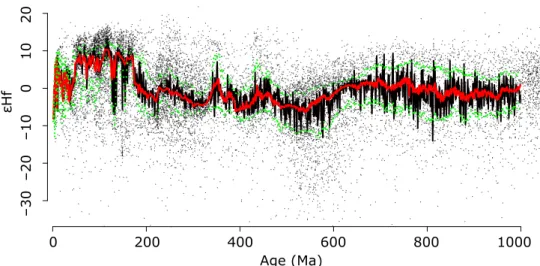
Fig. 1. Plot of eHf of detrital zircon grains versus U-Pb date. Black dots represent the nonresampled eHf data from a screened subset of database S1
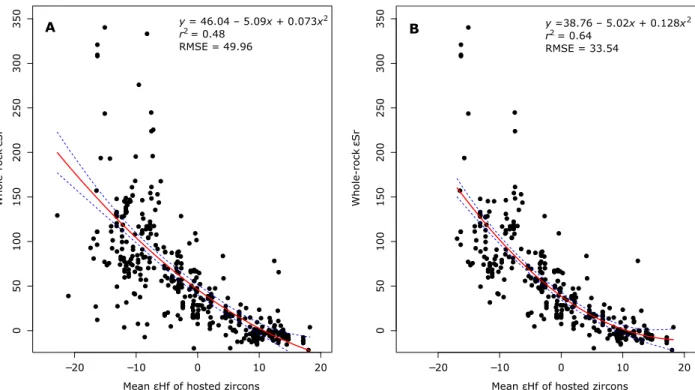
Fig. 2. Plot of eHf values of inherited zircon grains versus whole-rock eSr values for Phanerozoic igneous rocks
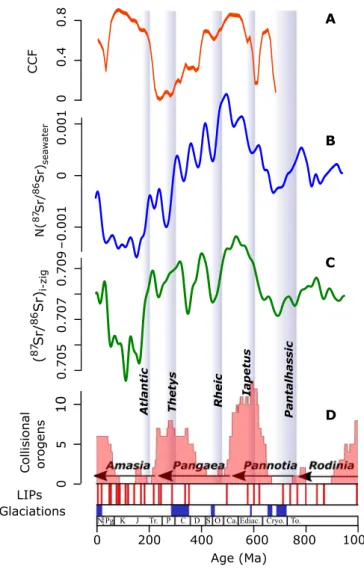
Fig. 4. Interpretation of the marine Sr budget. Maximum correlation coefficient through time (A) between the N( 87 Sr/ 86 Sr) seawater ratio (B) and the ( 87 Sr/ 86 Sr) i-zig ratio (green) (C)

References

Related documents

74, 81 (1980) (affirming the state court’s decision on the ground that Supreme Court rulings do not “limit the authority of the State to exercise its police power or its sovereign

(It could be suggested that coming from a funds management perspective our cautious housing outlook and argument for a reallocation of household wealth away from housing may

HOME LOANS BY MAJOR FUNCTIONALITY (primarily from the lender’s point of view, the determining function of a home loan): Standard Variable Rate Home Loans (SVRHL), Basic Home

By investigating how Christian Right leaders and interest groups have shaped American political discussion of and policy treatment towards Israel in presidential campaigns, policy

• The new EU Data Protection Regulation tends to ignore the negative effect the new Regulation could have on scientific and medical research. • A viable alternative could be to have

Through an examination of Hooker’s theology of certainty and assurance, which themselves rely on particular understandings of how God is known and experienced, we will seek

Off Cocaine-Related Memory in Rats 12 Marijuana Smoking Is Associated With a Spectrum of Respiratory Disorders Director’s Perspective 2 Steroid Abuse Is a High- Risk Route to