A NEEDS ASSESSMENT TO ADDRESS FAMILY PRESENCE DURING RESUSCITATION
Carolina Rosser Dimsdale
A DNP project submitted to the faculty at the University of North Carolina at Chapel Hill in partial fulfillment of the requirements for the degree of Doctor of Nursing Practice in the School
of Nursing.
Chapel Hill 2016
© 2016
ABSTRACT
Carolina Rosser Dimsdale: A Needs Assessment to Address Family Presence During Resuscitation
(Under the direction of Meg Zomorodi)
TABLE OF CONTENTS
LIST OF TABLES ... vii
LIST OF ABBREVIATIONS ... viii
INTRODUCTION ... 1
Problem Statement ... 2
Purpose of Project ... 3
CHAPTER ONE: BACKGROUND AND SIGNIFICANCE ... 4
Patient Perspective ... 4
Family Perspective ... 5
Healthcare Professional Perspective ... 6
Professional Organizations ... 8
The Setting ... 9
Summary ... 10
CHAPTER TWO: CONCEPTUAL FRAMEWORK ... 11
Background of Comfort Theory ... 11
Concepts of Comfort Theory ... 11
Assumptions of Comfort Theory ... 12
Comfort Theory in Nursing ... 12
Using Kolcaba’s Model Interprofessionally ... 13
Using Kolcaba’s Model for Family Presence During Resuscitation ... 14
Ottawa Decision Support Framework ... 14
CHAPTER THREE: RESEARCH METHODOLOGY ... 16
Setting ... 16
Sample ... 17
Data Collection ... 17
Measures ... 18
Data Analysis Plan ... 18
Summary ... 19
CHAPTER FOUR: RESULTS ... 20
Demographics ... 20
Comfort with Family Presence During Resuscitation ... 21
Role in FPDR ... 23
Support Needed for FPDR ... 25
Resistance to FPDR ... 27
CHAPTER FIVE: DISCUSSION ... 28
Process and Sample ... 28
Themes from Text Data ... 28
Family Facilitator Role ... 28
Resistance ... 29
Support ... 29
Barriers ... 31
Use of the Word Protocol ... 31
Provider Resistance ... 31
Using the Needs Assessment to Develop an Implementation Plan ... 32
Future Work ... 33
Surgery v. Medicine ... 34
Stepdown Units ... 35
Electronic Medical Record Metrics ... 35
Implications for DNPs ... 36
Limitations ... 36
Conclusion ... 37
APPENDIX A: SURVEY TOOL ... 39
APPENDIX B: FAMILY PRESENCE DURING RESUSCITATION GUIDELINE DRAFT ... 43
LIST OF TABLES
LIST OF ABBREVIATIONS AACN American Association of Critical Care Nurses
ACLS Advanced Cardiac Life Support
APP Advanced Practice Provider
BLS Basic Life Saving
CINAHL Cumulative Index of Nursing and Allied Health Literature
CPR Cardiopulmonary Resuscitation
DNP Doctor of Nursing Practice
ECMO Extracorporeal Membrane Oxygenation FPDR Family Presence During Resuscitation
ICU Intensive Care Unit
IOM Institute of Medicine
IRB Institutional Review Board
MD Medical Doctor
NP Nurse Practitioner
PA Physician Assistant
RN Registered Nurse
INTRODUCTION
Resuscitation is fast-paced, physical, intense and many times emotional for both health care professionals and observers. In an inpatient setting, family members are often rushed out of the room for fear of both immediate and long-term consequences to the family, the patient and the providers (Jordahl, 2015). Many times, there is concern that families would be traumatized by Advanced Cardiac Life Support (ACLS) or demand futile treatment during what may be the end of their loved one’s life. This fear of trauma, along with the intensive and fast paced decision making needed during resuscitation, often keeps the family away from the bedside during resuscitation. The healthcare team may feel protective of onlookers, fearful of litigation, or self-conscious while performing ACLS (Doolin et al., 2011). In many hospitals, there is no protocol for family presence during resuscitation (MacLean et al., 2003), which can leave the decision to involve family members up to the healthcare professionals’ critical thinking skills or comfort level with family presence during resuscitation (FPDR). Despite endorsement of facility guidelines by many of healthcare’s governing bodies (AACN, 2016; Wolf, et al., 2012) and evidence supporting the need for FPDR in ICUs (Powers & Candela, 2016), there is great variability of FPDR implementation in intensive care units.
In 2001, the Institute of Medicine (IOM) strongly recommended that healthcare delivery systems become patient-centered rather than clinician or disease-centered, with treatment
(ANA, 2015) requires nurses to faithfully safeguard the rights and wishes of the patient, which is of paramount importance at times of critical illness. It is sometimes difficult to gauge the wishes of the critically ill patient, due to them being unconscious, sedated, or intubated, so health care professionals in the ICU must rely on best evidence when making decisions about patient-centered care.
The first formal written policy endorsing Family Presence During Resuscitation (FPDR) was implemented in 1982 by Foote Hospital in Michigan (Doolin et al., 2011; Hanson &
Strawser, 1992) and since then FPDR has been studied thoroughly from the perspectives of both the healthcare team and the family, with evidence supporting the need for FPDR (Jabre et al., 2013). Due to established evidence, FPDR was considered a priority topic by the American Association of Critical Care Nursing (AACN), yet only 5% of American hospitals reported having formal written policies in place (MacLean et al., 2003). More recently, the AACN supports Level B evidence for offering the option of presence at the bedside during resuscitation and states that all patient care units should have an approved standard of care for FPDR (AACN, 2016). However, there are few published studies that report established protocols or guidelines for FPDR, resulting in a discrepancy between recommended practice and actual implementation of FPDR in the ICU setting.
Problem Statement
institution. Without a clear guideline that states recommendations and defines roles for the practice of FPDR, implementation is not likely to occur. Current practice at this institution makes FPDR ‘provider dependent,’ meaning decisions regarding FPDR are typically deferred to the provider leading the resuscitation, who may be unfamiliar with the patient’s wishes and can have inconsistent opinions and biases towards FPDR. Without guidelines, there is not consistent practice. In order to develop guidelines, it is important to understand the current practices of the healthcare system and to identify any specific barriers or facilitators to implementation of FPDR. Purpose of Project
CHAPTER ONE: BACKGROUND AND SIGNIFICANCE
The literature reveals that health care professionals have mixed opinions about FPDR (Doolin et al., 2011; Zavotsky et al., 2014), and can find it favorable or intimidating, However, the research is clear that there are great benefits to family members who witness the resuscitation of a loved one (Meyers et al., 2000). Despite the conflict of opinions from the healthcare
professional point of view, the current body of research has been so compelling for family and patient benefit, that many professional organizations have supported the family’s right to be involved and now recommend family presence with the use of a trained facilitator (Jordahl, 2015).
Patient Perspective
There is a paucity of literature on the perspective of FPDR from a patient perspective, due to the low survival rates of patients (Grice, 2003; Lederman & Wacht, 2014; MacLean et al., 2003). Overall, patients seem to support FPDR despite believing that it may be traumatic for their loved ones (Wolf et al., 2012). A survey by Mortelmans et al. (2009) found that the
Family Perspective
Despite the emotional stress inherent in a resuscitation attempt, most family members believe that it is their desire, right, duty, and obligation to be present during their loved one’s emergency procedures (Lowry, 2012). Being present can decrease family members’ anxiety and fear about what is happening to their loved ones, especially when partnering with a designated staff member who supports them in the midst of the resuscitation (Doolin et al., 2011; Moons & Norekval, 2008).
The death of a critically ill family member can cause complications such as depression, anxiety, post-traumatic stress syndrome, and complicated grief (Azoulay et al., 2005). In a recent study of 570 relatives of patients who required cardiopulmonary resuscitation (CPR) in the prehospital setting, Jabre et al.(2013) randomly assigned a group to systematically be offered FPDR and a control group who was treated using a standard practice. They concluded that FPDR did not affect resuscitation characteristics, patient survival, or the level of emotional stress in the healthcare team and did not result in medicolegal claims (Jabre et al., 2013). They also determined that FPDR was associated with positive results on psychological variables like PTSD and anxiety on day 90 (Jabre et al., 2013). In a follow-up study one year after the events, Jabre demonstrated those psychological benefits persisted for those family members offered the possibility to witness the resuscitation of a relative. Meyers and colleagues (2000) noted that 94 to 100 percent of families involved in family presence events would do so again (n=39). Given this evidence, a FPDR guideline should be offered so that all family members can be offered this experience, rather than relying on healthcare professional preference or unit culture.
has been discussed by multiple healthcare policymakers. The purpose of the family facilitator is to focus exclusively on the observers to answer questions, provide support, and handle the development of any disruptive family reactions. Family facilitators may be registered nurses, physicians, NP, PA, social workers, chaplains, child-life specialists, respiratory care
practitioners, family therapists, or nursing students (AACN, 2016). The American College of Critical Care, along with the American Heart Association and the American Association of Critical Care Nurses, recommend that the resuscitation team includes such a role (AACN, 2016; Davidson et al., 2007, Hazinski, 2015) and described the facilitator as a team member designated and trained to support the family during FPDR.
Healthcare Professional Perspective
While research has shown positive outcomes related to patient and family perception of FPDR, there is great variation in healthcare professional viewpoints of FPDR. Those approving of family presence thought that it clarified the efforts of the code team and facilitated sure understanding and conviction that everything that could have been done to help the patient was actually done (Basol, 2009; ENA 2012; McClement, 2009). Health professionals felt that it enhanced communication, facilitated education, humanized the patient, provided dignity, and also supported the grieving process in the case of unsuccessful resuscitation (Basol, 2009; ENA 2012; McClement, 2009). Another perceived benefit to FPDR was the facilitation of the family’s decision making regarding the goals of the resuscitative efforts (Knott & Kee, 2005).
understanding while witnessing resuscitation may include potentially disruptive behavior including verbal outbursts, crying and shouting, syncope or physically touching the patient. Resuscitation is fast-paced and intense; thus healthcare professionals may find it difficult to work effectively in the midst of a frightened, grieving family. In a survey of 592 health professionals, 24% who disapproved of the presence of family members listed medicolegal concerns as their primary objection (McClenathan, Torrington, & Uyehara, 2002). In their descriptive study, Oman and Duran (2010) collected data on 106 resuscitations and found that family members did not interfere with the care of the patient, nor was team communication negatively affected. In a prospective study where patients were randomized to either participate in FPDR or standard of care, there were no medicolegal conflicts (n = 570) or presence of PTSD in the families that witnessed resuscitation (Jabre, 2013). A follow up study by Jabre and colleagues (2014) suggested that there were psychological benefits to those families that had been grouped in the family presence category. Implementing guidelines for FPDR has the potential to improve communication and ease decision-making stress in the resuscitation setting, while not increasing the chance of litigation.
In 2002, Tucker published results of a health care provider survey concerning staff’s support for FPDR. They demonstrated a significant difference in the responses from nurses, attending physicians, and residents concerning FPDR and comfort during family attendance. Nurses also felt more comfortable with the family attendance as compared to attending and resident physicians (Tucker, 2002). There have been more recent studies also demonstrating that nurses and physicians have somewhat differing opinions about FPDR (Doolin et al., 2011; Howlett, Alexander, & Tsuchiya, 2010). When asked if staff supported FPDR, nurses had the most affirmative response (96%), followed by attending physicians (79%), and only 19% of medical residents (Tucker, 2002). As suggested in Tucker’s survey, nurses tend to favor FPDR more than physicians (Baumhover, 2009; Grice, 2003). Nurses who hold advanced certification and membership in professional organizations are more likely to support FPDR (Ellison, 2003). Studies also confirm that experienced physicians tend to favor FPDR more than inexperienced physicians (Critchell, 2007; Duran, 2007; MacLean et al., 2003; Mason, 2003). Meyers et al. (2000) showed that differences in attitudes exist even within specialties. Some studies have suggested that in settings where more invasive procedures were performed, there was a
corresponding decrease in the approval of FPDR (Ganz & Yoffe, 2012; Fulbrook et al., 2007). Pediatric team members perceived more benefits to FPDR than did adult providers (Zavotsky et al., 2014).
Professional Organizations
topic of providing emotional support to family during resuscitation, but instead continued their 2010 recommendations:
In the absence of data documenting harm and in light of data suggesting that it may be helpful, offering select family members the opportunity to be present during a
resuscitation is reasonable and desirable (assuming that the patient, if an adult, has not raised a prior objection). (Neumar, et al., 2015, p. 23)
The need for hospitals to have a written protocol addressing FPDR and the role of a family facilitator is deemed a Level D level of evidence (AACN, 2016). The ENA has published guidelines that are suitable for adaptation to intensive care units including educational slides and handouts, a family presence department assessment tool, a staff assessment and educational needs assessment tool, a sample family presence guideline, and other supporting documents in an effort to increase family presence. This resource is readily available to all organizations online.
There are several other professional organizations that have published statements supporting FPDR. The Society of Critical Care Medicine (SCCM), the American College of Emergency Physicians (ACEP), and the American Academy of Pediatrics (AAP) all favor FPDR in clinical practice. European guidelines also recommend practice of FPDR (Fulbrooke et al., 2007; Lippert et al., 2010). The publications, recommendations and effort of these organizations speaks to the strength and compelling nature of the current evidence.
The Setting
The hospital’s current code blue policy contains a non-specific supporting statement for FPDR:
they are in the room/area, a staff member will be assigned to be with them to support and explain the ongoing situation.
Despite the recommendations from professional organizations for hospitals to implement FPDR, and the evidence suggesting that FPDR is a positive experience for family members, implementation of FPDR has not occurred consistently. There is no current standard to use when developing FPDR guidelines, as the last time that United States hospitals have been formally surveyed regarding the implementation of FPDR protocols was over a decade ago (MacLean et al., 2003). While the evidence strongly supports FPDR, implementation of FPDR has generally been weak. Therefore, a needs assessment of current healthcare professionals beliefs, experience with and decision making regarding FPDR is needed to understand how best to design an
implementation plan for FPDR. Summary
CHAPTER TWO: CONCEPTUAL FRAMEWORK
Kolcaba’s Theory of Comfort was selected as the conceptual framework for this Doctor of Nursing (DNP) project because of its applicability to each member of the team as well as the patient’s family and loved ones. Kolcaba demonstrates congruence with respected nursing values while also addressing the objective of increasing family and patient satisfaction (Kolcaba, 2006). This well documented framework will provide a consistent and thematic focus for this DNP project.
Background of Comfort Theory
Katharine Kolcaba is a nurse theorist who created a holistic, humanistic, mid-range nursing theory in 1991, which has identified comfort as a value-added outcome for evidence based practice. Kolcaba proposes that when people are more comfortable, they engage more fully in health-seeking behaviors that include internal behaviors, external behaviors, or a peaceful death (Kolcaba, 2006). It is Kolcaba’s belief that the human experience takes place in four contexts: physical, psychospiritual, sociocultural, and environmental (Kolcaba, 2006). The framework has historically been used as a basis for organizational culture change, especially Magnet initiatives, hospice care, decision-making at end of life, and nursing research (Kolcaba, 1995; Kolcaba, 2010).
Concepts of Comfort Theory
the four social contexts of human experience (Kolcaba, 2010). Kolcaba observed that discomfort is more than a negative physical sensation or distress and that other aspects of
comfort/discomfort affect holistic beings (Kolcaba, 2003) and her definition of comfort is a positive concept which accounts for many aspects beyond simply physical wellbeing. The three defined types of comfort are relief, ease, and transcendence. The framework is intuitive and universal in that all humans can relate to their own state of comfort.
Assumptions of Comfort Theory
Kolcaba assumes that human being have holistic responses to complex stimuli and that comfort is a desirable holistic outcome that is foundational to the discipline of nursing. Another assumption is that human beings actively strive to meet their basic comfort needs. The most significant assumption made by Kolcaba is that when comfort needs are met, the patient is strengthened and therefore has better outcomes. (Kolcaba, Stoner & Durr, 2010) Not only are the patient’s health outcomes improved, but the institution benefits. When patients and families engage in health-seeking behaviors more fully, the institution can experience reduced cost of care and length of stay, increased patient satisfaction, and enhanced financial stability (Kolcaba, 2003; Kolcaba, 2001).
Comfort Theory in Nursing
The role of comfort in patient care has deep historic roots in nursing, dating back to Florence Nightingale’s Notes on Nursing (Nightingale, 1914). At that time, comfort was referenced frequently, but not yet defined. Nightingale viewed the environment as an element that can aid healing and the restoration of health, as does Kolcaba (Kolcaba, 2001).
the application of the theory will be expanded and applied to the entire multidisciplinary team as well as the family. The role of the family facilitator has been described in many studies as a key variable to the success of positive outcomes of FPDR (Guzetta, 2007; Meyers et al., 2000; Moons & Norekval, 2008). The AACN suggests that the role of the family facilitator should include preparing families for being at the bedside, supporting them before, during, and after the event, and providing support during unexpected reactions of the family (AACN, 2016).
The comfort theory will also be applied to nursing staff, as we wish to facilitate their understanding and commitment to the proposed FPDR theory. This application of Kolcaba’s model to nursing makes sense as nurses are the designers of many of the comfort measures intended to motivate patients and families to make healthy decisions and learn/adhere to new health regimens (Kolcaba, 1994). Therefore, the satisfaction, dedication and comfort of intensive care nurses are very important variables in the effectiveness of patient care. Furthermore, comfort theory suggests that the comfort of nurses corresponds directly to improved patient outcomes and increased organizational strength (Kolcaba, 2001). Using Kolcaba’s Model Interprofessionally
Using Kolcaba’s Model for Family Presence During Resuscitation
In order for healthcare professionals to feel comfortable and confident with family presence during resuscitation, resistance and stigma towards FPDR must be overcome. By conducting a needs assessment, concerns that healthcare professionals have when making decisions about involving family during resuscitation efforts will be identified. Those identified concerns and recommendations from the needs assessment will be used to develop guidelines for implementing FPDR throughout ICUs at this institution. By assessing every member of the code team, concerns will be identified and recommendations will be made to address these issues. The process of identifying needs, in order to develop interventions aimed at addressing the identified needs, will allow for greater sustainability for the developed guidelines.
Ottawa Decision Support Framework
In addition to Comfort Theory, an adjunct methodology was explored that is described and utilized within the Population Needs Assessment Tool. The Ottawa Decision Support Framework is an evidence based, mid-range theory for guiding patients making health or social decisions. It describes a three-step process to identify decision support needs, provide tailored decision tools, and evaluate the effect of those interventions. This framework has been used in multiple settings including decision making for palliative care nurses (Murray, Miller, Fiset, O’Connor, & Jacobsen, 2004) and as a patient tool for women’s hormone therapy (O’Connor, Jacobsen, & Stacey, 2002). Ottawa’s foundational belief holds that decisional support can improve decision quality by addressing unresolved needs (Ottawa Hospital Research Institute, 2015). This thoughtful and holistic approach to decision making will advise both needs
Summary
The goal of this project is to empower families in a stressful situation and provide them the best environment possible to handle the moment in a healthy and graceful manner.
Kolcaba’s theory can direct our approach to the loved ones in the code setting. In order to support family’s decision-making and make their experience as informed as possible, Kolcaba’s comfort measures will be prioritized. Developing guidelines for FPDR may fulfill the
CHAPTER THREE: RESEARCH METHODOLOGY
The purpose of this DNP project was to conduct a systematic needs assessment to provide tailored recommendations for implementation of a FPDR protocol in the adult intensive care units at the chosen institution. The project consisted of an adult ICU focused needs assessment followed by development of FPDR guidelines based on the results of the assessment. The project was conducted under the supervision of a committee of three mentors over a time span of
approximately eight months. The appropriate institutional review board (IRB) determined that the project was not human research. Approval to conduct the needs assessment and guideline recommendations was also granted by the Hospital’s Code Blue leadership committee. The Code Blue Committee is a multidisciplinary group appointed by hospital leadership charged with overseeing code blue policies throughout inpatient services and hospital-based clinics that report to a Patient Safety and Clinical Quality Committee.
Setting
Both phases of this project were conducted at a tertiary and quaternary hospital in the Southeastern United States. It is a large academic institution that hosts robust and respected medical education and research programs. In 2015, the hospital had an average adult daily census of 750 patients and 957 inpatient beds. There are 5 adult intensive care units—the Coronary Care Unit (CCU), the Cardiothoracic ICU (CTICU), Neuroscience ICU (NSICU), Medical ICU (MICU), and Surgical ICU (SICU).
syndrome, cardiac arrest, and heart failure. The Cardiothoracic ICU cares for patients with ventricular assist devices, extracorporeal membrane oxygenators, heart and lung transplants, and heart valve implantations. The NSICU is comprised of 24 beds and commonly cares for patients with traumatic brain injury, stroke, and brain tumors. The MICU is also made up of 24 beds and sees a variety of diagnoses including sepsis, cancer, chronic and acute respiratory failure, and endocrine disorders. Both general and emergency surgery patients stay in the SICU, which has 24 beds.
Sample
Eligible participants were team members who occupied a code role in intensive care units. This included providers (physicians, nurse practitioners, and physician assistants), intensive care nurses, respiratory therapists, front desk receptionists, chaplains, and operations administrators, as defined by the current Code Blue policy.
Data Collection
Following IRB review, participants were recruited through the hospital’s email listserv. The administration at the institution distributed the email to the participants on the listserv in order to maintain anonymity of the participants. The email contained an introduction and purpose of the DNP project along with a hyperlink to the needs assessment. Two weeks later an email reminder was sent to remind administration and participants of the needs assessment. The needs assessment remained open for a total of 5 weeks. Results obtained from the needs
Measures
A needs assessment is a study in which data are collected for estimating the needs of a group, community, or organization (Jacobsen & O’Connor, 1999). For the needs assessment portion of this project, we utilized a workbook published by M.J. Jacobsen and A. O’Connor originally in 1999 and revised in 2006 entitled ‘Population Needs Assessment: A workbook for assessing patients’ and practitioners’ decision making needs.’ This particular needs assessment tool was based on the Ottawa Decision Support Framework (2006) and has been used to develop over 30 patient decision aids, practitioner decision support resources, and evaluation tools to measure the quality and outcomes of providing decision support (Ottawa Hospital Research Institute, 2015). It is well known for being the recommended tool of Dartmouth-Hitchcock Medical Center. This systematic tool is designed specifically for groups of people to evaluate a program or decision, establish priorities, and raise awareness of needs and potential
interventions.
Questions were adapted for use to assess decision-making needs for family presence during resuscitation. The needs assessment consists of 17 questions addressing FPDR and
demographics. The needs assessment, along with the email introduction is presented in Appendix A.
Data Analysis Plan
Summary
To effect a meaningful practice change, we used an established framework to assess the decision-making needs of staff in the intensive care units. The Ottawa Decision Making
CHAPTER FOUR: RESULTS
A total of 200 participants responded to the needs assessment. Not all respondents answered every question, thus data will be reported in percentages and frequencies. The results of this needs assessment are presented using demographic characteristics, quantitative results, and qualitative themes. Based on the quantitative and text data from the needs assessment, four themes emerged from the needs assessment respondents upon appraising the data - comfort, role, support, and resistance. These themes will be discussed in further detail in the following
sections. Demographics
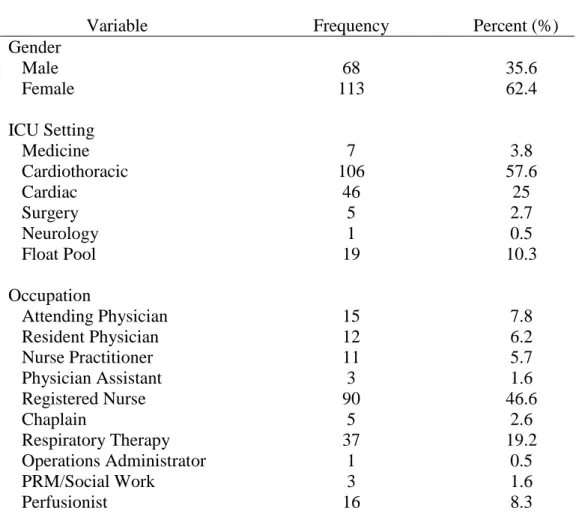
Participants ranged in age from 21 to 64 years old (M = 36, SD = 11.7), with an average of 18 years of education. The majority of respondents were female (62.4%). Of the 193
responses to the question regarding occupation, 7.8% of the respondents were Attending Physicians, 6.2% Fellow or Resident physicians, and 46.6% Adult ICU Nurses. Of the
Table 1. Needs Assessment Response Demographics (n=181)
Variable Frequency Percent (%)
Gender Male Female 68 113 35.6 62.4 ICU Setting Medicine Cardiothoracic Cardiac Surgery Neurology Float Pool 7 106 46 5 1 19 3.8 57.6 25 2.7 0.5 10.3 Occupation Attending Physician Resident Physician Nurse Practitioner Physician Assistant Registered Nurse Chaplain Respiratory Therapy Operations Administrator PRM/Social Work Perfusionist 15 12 11 3 90 5 37 1 3 16 7.8 6.2 5.7 1.6 46.6 2.6 19.2 0.5 1.6 8.3
Comfort with Family Presence During Resuscitation
There were varying levels of comfort, experience, and maturity regarding the practice of FPDR in this sample. Some respondents enthusiastically supported the practice while others declared that they would never be comfortable with it.
41% agree), while 66 respondents (33%) disagreed with the statement and 22 (11%) strongly disagreed.
Text responses throughout the needs assessment supported these findings, with suggestions about how to improve comfort level with FPDR. Of the 192 respondents who responded to the question about how to improve comfort level with FPDR, 63.5% (n = 192) selected more education as a method to improve comfort, followed by development of a written protocol (49%), and role-playing practice scenarios (21.9%), The most consistent comment and response centered around the need for a designated person to be with the family, with 72.4% of respondents (n = 192) indicating this as a resource to improve comfort with FPDR.
Of the 194 people who responded to the question “How do you feel when making the decision to include family presence during a resuscitation?,” 32% said confident while 18.6%
said unsure about what to do. About a quarter (24.2%) of the respondents indicated concern about ‘what could go wrong’ during FPDR, with 3.6% reporting feeling distressed or upset about the decision to include the family, and 10.3% responding that they were constantly thinking about the decision to have family present during resuscitation. Twenty percent (20%) of respondents wavered between the choice to include or not include family during resuscitation, and 2.6% of respondents indicated that they delayed the decision of whether to include family. The remaining 23.2% said that they ‘don’t really consider this decision’. Text data focused on the need for the decision to be family driven and that FPDR was situational.
were able to articulate interventions that would encourage their comfort with implementation of FPDR. These variables were organized into additional themes that are presented in Table 2. Table 2. Support Identified to Improve Comfort with FPDR
Themes Examples of Responses Family Facilitator “There needs to be a
way to handle family members that become
obstructive.”
“Support for family before and during, explaining that it may be traumatic to watch.”
“A nurse assigned to the family member to explain things and answer questions.” Safety “Only if family is
not going to pass out and become a patient themselves.”
“Needs to be enough staff to cover the rest of the unit.”
“Safety of patient is the primary concern.” Resistance “Family during code
is a bad idea.” “I’m not comfortable with their presence and won’t be.”
“There would be nothing that would make me
comfortable with it.”
Chaplain “Chaplain should automatically be called by the HUC.”
“Chaplain involvement”
“Early chaplain involvement.”
Role in FPDR
The questions asking about staff responsibilities in a code event make up the theme of ‘role in FPDR’. The absence of FPDR guidelines results in confusion regarding staff’s role in family involvement and support. Questions about employee’s decision-making process were asked to learn more about their perception of their role in the code setting.
When asked the multiple selection question ‘Who should determine if it is appropriate for the family to be present during a resuscitation’ 69.4% selected Provider while 58.3% selected
Of the 176 people who responded to the question ‘What is your role in deciding to include family or not?’ most people endorsed a supporting role saying that they provide support
to family (45%, n = 79) or make the decision with the family (14%, n = 24) while 10.8% of people said that they made the decision for the family (n = 19). Fifty-four people felt that it was not their decision to include family in the resuscitation event (30.7%).
When asked “If your patient required resuscitation and the family was in the waiting room, would you call them back?”, many respondents said ‘no, they would not’ (49.3%, n = 73).
Support Needed for FPDR
Respondents identified many system resources needed to implement FPDR practice in the ICUs. Use of a family facilitator, chaplain presence, legal support, adequate staffing, and the need for a formalized protocol were the most common responses. There was confusion as to whether a policy currently existed on FPDR in the ICUs, with the majority of the 64 respondents (79.7%) indicating a policy did not exist.
When asked “what influences your decision to include family members in resuscitation efforts?” the majority of reported concerns centered around the fear of the effect on the family
watching their loved one suffering (71.7%, n = 139). There were 28 additional comments to this ‘select all that apply’ question. One respondent expressed their concern with the family’s emotional distress, saying “Resuscitation is a very emotional thing. I feel that if they can be sheltered from this, it may help them cope easier.” The fear of being sued influenced decisions in 11.9% of respondents (n = 23); 18% worried about the family judging their clinical skills (n = 35), and 42.8% feared the family physically imposing on resuscitation efforts (n = 83). One comment touched on the family’s potential misinterpretation of the code process saying “I worry that the family will see something they deem disorganized in terms of resuscitation efforts”. There were 88 people (45.4%) who worried that family would distract them from the
resuscitation efforts. Three respondents said that the decision to have family at the bedside was not within their scope of practice. Another comment specifically referred to a surgical open chest code that is protocolled in the CTICU and said that this code in particular was not appropriate for family members to observe due to its graphic nature.
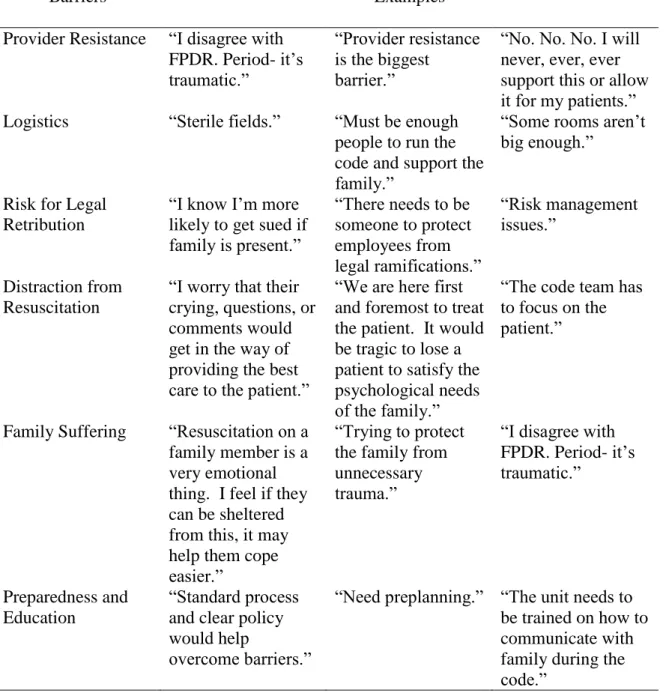
resistance, logistical concerns, risk for legal action, distraction from resuscitation, family suffering, and a need for education were the main themes. These themes are presented as Table 3.
Table 3. Identified Barriers to FPDR
Barriers Examples
Provider Resistance “I disagree with FPDR. Period- it’s traumatic.”
“Provider resistance is the biggest
barrier.”
“No. No. No. I will never, ever, ever support this or allow it for my patients.” Logistics “Sterile fields.” “Must be enough
people to run the code and support the family.”
“Some rooms aren’t big enough.”
Risk for Legal Retribution
“I know I’m more likely to get sued if family is present.”
“There needs to be someone to protect employees from legal ramifications.” “Risk management issues.” Distraction from Resuscitation
“I worry that their crying, questions, or comments would get in the way of providing the best care to the patient.”
“We are here first and foremost to treat the patient. It would be tragic to lose a patient to satisfy the psychological needs of the family.”
“The code team has to focus on the patient.”
Family Suffering “Resuscitation on a family member is a very emotional thing. I feel if they can be sheltered from this, it may help them cope easier.”
“Trying to protect the family from unnecessary trauma.”
“I disagree with FPDR. Period- it’s traumatic.”
Preparedness and Education
“Standard process and clear policy would help
overcome barriers.”
Resistance to FPDR
A small percentage (11%) of respondents said that they strongly disagreed with the statement “I am comfortable with FPDR” (n = 22). Throughout the needs assessment, there were many comments that reflected a resolute disapproval of FPDR. Some were short and decisive saying “No, it is unprofessional” and “Won’t happen on my watch”. Others explained further – “Bad idea for patients in almost all circumstances. Some of us forget that we are here first and foremost to treat the patient.” Another comment read “[this is] just not a place for family during active ACLS protocol.” When asked for suggestions to help overcome barriers to FPDR, four of 41 comments reflected an unwavering obstructive sentiment like “No. No. No. I will never, ever, ever support this or allow it for my patients.”
Of note, there were qualitative responses that did not seem to pertain to the original question, but elaborated on general feelings or thoughts towards FPDR. Some comments
included stories of clinical experiences such as “recently a patient’s daughter literally stood over the shoulder of the respiratory therapist during the intubation…” and others were factual
CHAPTER FIVE: DISCUSSION Process and Sample
Of the 200 responses, the majority were from registered nurses and staff who work in a cardiothoracic surgery setting. This could be due to the fact that the CTICU has over three times as many healthcare professionals as the other units. Additionally, I am an advanced care provider in this setting and thus participants in this area may have been more likely to respond. We were unable to calculate a response rate because we were unable to determine the number of
individuals who received the email from the administrators inviting them to participate in the needs assessment.
Themes from Text Data Family Facilitator Role
Resistance
To lead a quality improvement project successfully, Kotter and Schlesinger (2008) recommend “diagnosing resistance” to anticipate potential barriers in the implementation process. Despite the support for FPDR reported in the needs assessment, there were some
participants who expressed resistance with implementing FPDR. This could be due to the role of healthcare professionals in the intensive care unit. The initial reaction of caregivers to a stressful and potentially traumatizing event is to remove family with the intent of sparing them pain (Hunter, Goddard, Rothwell, Ketharaju, & Cooper, 2010; Smith, Medeves, Harrison, Tranmer, & Waytuck, 2009). This may be a paternalistic and protective reflex, but the premise behind family centered care is inclusiveness, openness, and collaboration (Institute for Patient- and Family-Centered Care, 2010). Therefore, staff education should center around these concerns in order to
help change attitudes regarding family involvement with resuscitation.
This needs assessment is unique in that it collected information about FPDR from a variety of professionals. Many publications studying FPDR have focused on specific disciplines rather than the views of a multidisciplinary population. Therefore, it is difficult to gauge
similarities in our findings as compared to past studies because our needs assessment population included persons in a variety of roles. Evidence has consistently shown that nurses favor the practice of FPDR more often than physicians (Doolin et al., 2011; Howlett, Alexander, & Tsuchiya, 2010; Meyers et al., 2000). When considering our results, we acknowledge the importance of developing guidelines through a multi-disciplinary lens.
Support
existence of a current FPDR protocol and a lack of information about FPDR’s implications. In order to implement FPDR, a comprehensive education program should be designed, that will discuss the content of current evidence, strategies for incorporating family into the code process, and interventions to support the psychosocial needs of family. To address all members of the intensive care units, education should be multi-faceted, utilizing a variety of means such as presentations, memos, or small group discussion. Self-paced online learning modules should also be considered, as this has been shown to improve nurse’s recognition of family presence benefits and increase confidence in implementing FPDR (Powers & Candela, 2016).
Regardless of whether the institution decides to implement FPDR as a policy, education about FPDR is needed. One strategy would be to disseminate the results of the needs assessment, implement education about FPDR, and collect feedback from unit and organizational leadership to instill buy-in for the development of FPDR guidelines.
Barriers
Use of the Word Protocol
After receiving feedback from the survey, one consideration that has come to light is the verbiage and implication of using the word protocol. Multiple comments seemed to respond negatively to the idea of such a fragile experience being protocolled, as if the word itself had a negative connotation to it in the ICU setting and therefore is a barrier to implementation. The nursing staff, who represent the majority of our survey population, have numerous, perhaps excessive protocols to adhere to during their shift. The idea of an additional protocol to learn can be overwhelming and off-putting. In the case of FPDR, each and every situation is going to be different requiring critical thinking, independent decision-making, and judgment on the part of the staff. It is not the presence of the family that will be mandated, but rather the offering of the option that is strongly recommended by current evidence. In order to move toward
implementation of FPDR, careful and thoughtful consideration should be given to this
terminology. When working to develop the next steps of the FPDR, key stakeholders will be identified who will then help define the best terminology; for example, alternate wording could be guideline or best practice. In the writing of this paper, the word guideline was suggested as guidelines allow guidance for change without implementation of a rigid policy or procedure. Provider Resistance
Historically, many health care professionals thought that FPDR was inappropriate and traumatizing to families, as well as bothersome or disrupting to the resuscitation team (Bradley, Lensky & Brasel, 2015). While there is some resistance to FPDR indicated in the results of this needs assessment, there are also respondents who felt that FPDR was important. When
guideline. Change, especially in a large organization, is not an instant process and strategies aimed at implementing change over time should be utilized. Results from this needs assessment are the first step in recognizing the organization’s need for change and to make recommendations to best address the change.
In this needs assessment, some respondents provided rationale for their reluctance such as the sterile and/or graphic nature of a surgical/open chest code and concern for staffing to provide appropriate family support. Both of these concerns are appropriate and can be addressed within the FPDR guidelines. Many other responses did not give a constructive concern, but reflected an unwavering refusal to practice FPDR. There were also many comments that were indecisive stating “it depends” and “if it is appropriate”. These responses also corroborate the need for education and guidelines to assist staff in gaining consistency for FPDR across all intensive care units.
The primary intervention for this resistance will be education. Bassler et al. showed that after educating 46 nurses on the multiple benefits of FPDR, the percentage of nurses who would offer it increased from 11% to 79% (Bassler et al., 1999). Since that study, we have identified even more benefits. We will work towards a wider acceptance of FPDR by disseminating current evidence and offering lectures to all involved parties before implementing the guidelines for use in clinical practice. The results of this needs assessment have provided much insight into how to structure the hospital’s education on FPDR.
Using the Needs Assessment to Develop an Implementation Plan
process will be to partner with a senior nursing leader to present the findings of this needs assessment to key stakeholders including the ICU Medical Directors Committee, Code Blue Committee, and the Nursing Clinical Practice Policy Committee. It is important that all key stakeholders have the opportunity to provide feedback on the FPDR guidelines, based on
evidence and organizational culture. Following finalization of the guidelines, an implementation plan would be deployed in collaboration with the stakeholders. Recommendations concerning implementation of FPDR guidelines include the following:
1. The FPDR guidelines would be shared at key meetings and venues.
2. Education sessions would be offered for all multidisciplinary staff from the adult ICUs concerning current evidence and purpose of the guidelines.
3. Work towards creating a comprehensive training program for a family facilitator role. 4. Multi-disciplinary involvement for implementation.
5. Work towards institutional support that allows FPDR advocates to be staffed during each shift.
Future Work
Family Facilitator Training
The importance of the family facilitator role has been declared both in our institution’s needs assessment and in the literature. Research has shown that education both improves staff’s understanding of FPDR and changes the likelihood of staff to practice FPDR, specifically through online training programs (Powers & Candela, 2016). Another potential form of preparation for FPDR could include case studies and simulations akin to an ACLS mega code. To thoroughly prepare staff for supporting families in this critical time, we will partner with the Clinical Education and Professional Development office to integrate a voluntary educational module into a Learning Management System. The training for this role will be integral to our efforts to provide consistent evidence-based clinical care.
Surgery v. Medicine
Stepdown Units
The majority of the recent studies on FPDR have taken place in the Emergency Department, pre-hospital, or intensive care setting. This makes sense given the acuity of this patient population. However, there are many cultural, staffing, and visitation variables that make the step down setting different than intensive care. For example, it may be more common for family members to already be in patient rooms during a code blue event in the step down setting. The patient to nurse ratio is higher than in the intensive care unit.
In order to pursue a hospital and system-wide FPDR guideline, we would recommend performing a similar needs assessment and implementation of the policy in the intermediate care units. The questions would be modified to include things like patient transfer to ICU timing and step down care patient flow interruptions. Then these variables would be addressed in the stepdown guidelines.
Electronic Medical Record Metrics
The electronic medical record (EMR) can be a valuable tool to evaluate the prevalence of FPDR as well as the clinical effects of guideline implementation. There is a Code Blue
Implications for DNPs
The Doctor of Nursing Practice is a terminal degree that prepares nurses to take part in translational science, which is the practice of transforming evidence into clinical practice. In many cases, this involves a practice or system change which may affect many levels of the interprofessional team. A DNP prepared nurse has earned the skills and training to appraise the existing evidence for quality and applicability to a particular system or care delivery problem. They will facilitate defining an intervention or innovation (in this case a practice change),
analyzing the adaptive capability of the current leadership and stakeholders as well as the system readiness for change. Lastly, the role of the DNP is to translate evidence into practice through communication, leadership, and change management (American Association of Colleges of Nursing, 2015).
Translational research is the cornerstone of the DNP and we believe that it is perfectly suited for applicability in this project. Many authors have suggested that implementing FPDR should be a nurse driven practice change (Biban, Soffiati, & Santuz, 2009; MacLean et al., 2003; Zavotsky et al., 2014). The substantial nursing response in this needs assessment suggests that nurses are vitally interested in this topic, and their expertise should be utilized to assist in the development of a patient centered guideline such as FPDR.
Limitations
One shortcoming of this project was the process of the needs assessment distribution. The design of distribution involved the institution’s email and most of the administration responsible to distribute the email did not respond with a distribution number. As a result, we could not calculate an accurate response rate. The variety of roles represented in the
to be completely omitted from the results – Health Unit Coordinators and Pharmacists. Given that this was a convenience sample, there is potential for underrepresentation of more moderate opinions.
Conclusion
Family presence during resuscitation is understandably a challenging concept due to the complexity and nature of the cardiac arrest setting. The American Association of Critical Care Nurses, the Emergency Nurses Association, and the American Heart Association stand firmly in support of FPDR and evidence clearly shows that it can improve family outcomes. However, research has shown repeatedly that healthcare providers are not uniformly supportive of FPDR in the adult population. The purpose of this DNP project was to complete an institutional needs assessment to guide creation of FPDR guidelines for the ICUs, where there is currently no guideline for consistent practice of family presence during resuscitation. A needs assessment based on the Ottawa Decision Making Framework was performed on multidisciplinary staff to assess current beliefs surrounding this practice. For this project, it was essential that the
APPENDIX A: SURVEY TOOL
Hello! I am Callie Dimsdale, an Acute Care Nurse Practitioner in the Heart Center. We are conducting a needs assessment to learn more about the current practice of family presence during resuscitation and your thoughts on this topic.
We value your input! Although completing this short survey is voluntary, it will provide
essential information for the development of guidelines for family presence during resuscitation.
Your participation is completely voluntary and responses are anonymous. The responses will be used to provide recommendations to the policy committee. You should be able to complete the survey in approximately 5 minutes. The survey will be open from June 13th- July 4th, 2016.
[Insert survey link] Thank you!
Callie Dimsdale MSN, ACNP-BC, AACC Doctor of Nursing Practice 2016
The purpose of this assessment is to gain feedback that will guide development of a protocol for family presence during resuscitation for the hospital’s Adult Intensive Care Units. Your
responses will remain anonymous and will be used to aid in discussions for protocol development.
As you complete this survey keep in mind that the term ‘family’ refers to patient visitors (friends, family, etc.) and ‘resuscitation’ refers to a Code Blue.
Thank you for your input! Survey
1. Have you ever experienced family presence during resuscitation? a. yes
b. no
2. I am comfortable with family presence during resuscitation. (1-4) 1. strongly disagree
2. disagree 3. agree
4. strongly agree
3. Who should determine if it is appropriate for the family to be present during a resuscitation?
a. Provider (MD, PA, NP) b. Primary RN
c. Chaplain d. The family
e. Family should not be present f. Comment box
4. What is your role in deciding to include family or not? a. I make it for them
b. The family and I make it together/we have talked about it before
c. I provide support or advice for family members to make the decision on their own d. Don’t know
e. Not my decision f. Comment box
5. Does your unit have a current policy on family presence during resuscitation? a. Yes, we have a policy
b. No, we don’t have a policy c. I Don’t Know
a. Education
b. Written protocol kept in the ICU for reference c. Practice Role Playing Scenarios
d. Risk Management Involvement
e. A designated person to be with the family f. I’m already comfortable with family presence *multiple select
7. If your patient required resuscitation and the family was in the waiting room, would you call them back?
a. Yes b. No
8. How do you feel when making the decision to include family presence during a resuscitation?
a. Confident
b. Unsure about what to do
c. Worried about what could go wrong d. Distressed or upset
e. Constantly thinking about the decision f. Wavering between choices
g. I delay the decision
h. I don’t really consider this decision i. Comment box
*Multiple select
9. What influences your decision to include family members in resuscitation efforts? a. I desire to have family present
b. Fear of being sued
c. Worry about the family judging your clinical skills
d. Fear of the family physically imposing on resuscitation efforts
e. Concern for family members having to watch their loved one suffering f. Fear of family’s physical wellbeing (passing out)
g. Worry that family will distract you from resuscitation efforts *Multiple select
10. Is there anything else that could help overcome barriers to implementing family presence during resuscitation?
a. Comment box Demographics
Which ICU do you primarily work in? a. Medicine ICU
d. Surgery ICU e. Neuro ICU f. Float Pool ICU What is your occupation?
a. Attending Physician b. Fellow/Resident c. Nurse Practitioner d. Physician Assistant e. Registered Nurse f. Respiratory Therapist g. Pharmacist
h. Perfusionist i. Chaplain
j. Health Unit Coordinators k. Operations Administrator
l. Patient Resource Manager/Social Worker How long have you worked on your unit?
a. Comment box
How long have you practiced in your role? a. Comment box
How old are you? a. Comment box What gender describes you?
a. Female b. Male
APPENDIX B: FAMILY PRESENCE DURING RESUSCITATION GUIDELINE DRAFT Family Presence During Resuscitation Guideline Draft
Definitions:
Family: Family members or significant others with whom the patient shares a significant relationship. (AACN, 2016)
Resuscitation: Any event requiring defibrillation, emergent pacing, Cardiopulmonary Resuscitation (CPR), Advanced Cardiac Life Support (ACLS).
Setting:
Cardiac Intensive Care Unit Surgical Intensive Care Unit Medical Intensive Care Unit Cardiothoracic Intensive Care Unit Neurology Intensive Care Unit
Family members of all patients undergoing resuscitation should be given the option to be present at the bedside, if deemed appropriate and safe by ICU staff.
(AACN, 2016; ENA, 2012) Evidence:
1. Family members who are present experience neither prolonged distress nor greater anxiety than those in matched control groups. Furthermore, they may experience fewer symptoms including PTSD or anxiety after the event (Jabre, 2014).
2. For patients who are aware of their surroundings (such as when a patient awakens shortly after a successful resuscitation), FPDR can provide comfort through the presence of loved ones (Bradley, Lensky & Brasel, 2015; Eichorn, D. et al., 2001).
3. There is no data from real-life situations to support that FPDR worsens the quality of resuscitative efforts (Bradley, Lensky & Brasel, 2015).
Development of FPDR guidelines
To develop guidelines addressing FPDR, a systematic needs assessment was performed to evaluate current attitudes and practices in the adult ICU setting. Results revealed acceptance of FPDR if a facilitator was present, overall support of the family-centered care principle, and some themes of resistance. Therefore the following components of clinical practice are recommended.
Key Components to Clinical Practice:
Facilitator: In the event of FPDR, a “family facilitator” will be assigned to assess families for readiness and the situation for appropriateness, answer questions, attend to their needs, and provide post-resuscitation support. Potential facilitators will include nurses, physicians, advanced practice providers, case managers, social workers, or chaplains. Assessment: Assess whether FPDR is appropriate in a given situation. First, the medical team
or overly disruptive. If the facilitator believes that the family members are suitable candidates for FPDR, then he or she should offer the opportunity to be present in or adjacent to the resuscitation area. Finally, staff should support family members in a decision not to witness resuscitation, and ensure that their emotional and informational needs are being met even if they are not at the bedside.
Number of Visitors: Limit the number of family members brought to the setting to one or two. Greater numbers of visitors will be difficult to accommodate, given the constraints of the care area, and will stretch the facilitator’s ability to maintain control of the visitors, offer emotional support, and answer questions. If a legal decision-maker (i.e, healthcare power of attorney or next of kin) for the patient has been identified, it can be beneficial to preferentially offer FPDR to that person, since he or she may be called upon to participate in real-time decisions during the resuscitation.
Preparing the Family: The facilitator should prepare the family members by providing
‘ground rules’ for their presence such as where they will stand, how to ask questions, and cautions about disrupting medical personnel providing patient care. Family members should be oriented to what to expect such as the patient’s appearance, invasive procedures and the presence of blood and equipment, and presence of busy, interprofessional health care team.
Facilitator’s Role in the Care Area: The FPDR facilitator must remain by the side of the family members. S/he should offer comfort and support, explain interventions and terminology when appropriate, and assist with grieving, while always being prepared to usher the family out of the care area should they become emotionally overwhelmed or distracting to the medical team. Facilitators with medical training should resist any temptation to participate in the procedures, assist caregivers, or critique what is occurring. Given the physical constraints of the resuscitation area and provided that the medical team is not disrupted, family members may be allowed to approach the bedside and offer physical comfort to their loved one.
Surrogate Decision-Making: Family members present during an unsuccessful resuscitation might be asked to make decisions about continuing resuscitative efforts, or initiate such a request themselves. If the legal decision-maker is present (e.g., the patient’s health care power of attorney or other designee as recognized by state law or institutional policy) it is appropriate for the medical team to follow an informed decision by the surrogate. If no legal decision-maker is available or clearly identifiable, the provider directing the resuscitation should make her or his own decision about the appropriateness of
continuing resuscitation efforts based on an assessment of the likelihood of success, and any available guidance provided by loved ones present.
Post-Event Family Support: Families may need continued support and the opportunity to debrief afterwards. If the patient dies, families should be allowed as liberal access as possible to their loved one’s body, and staff should refer families to a hospital or outside bereavement program.
REFERENCES
American Association of Colleges of Nursing. (2015). The Doctor of Nursing Practice: Current Issues and Clarifying Recommendations. Retrieved from
https://www.aacn.nche.edu/aacn-publications/white-papers/DNP-Implementation-TF-Report-8-15.pdf.
American Association of Critical-Care Nurses. (2016). AACN practice alert: Family presence during resuscitation and invasive procedures. Critical Care Nurse, 36(1) doi:
http://dx.doi.org/10.4037/ccn2016980.
American Nurses Association. (2015). Code of ethics for nurses with interpretative statements. Silver Spring, MD.
Azoulay, E., Pochard, F., Kentish-Barnes, N., Chevret, S., Aboab, J., Adrie, C.,… Schlemmer, B. (2005). Risk of post-traumatic stress symptoms in family members of intensive care unit patients. American Journal of Respiratory Critical Care Medcine, 171, 987-994.
Basol, R., Ohman, K., Simones, J., & Skillings, K. (2009). Using research to determine support for a policy on family presence during resuscitation. Dimensions in Critical Care Nursing, 28, 237-247.
Benjamin, M., Holger, J., & Carr, M. (2004). Personal preferences regarding family member presence during resuscitation. The American Academy of Emergency Medicine, 11, 750-753.
Biban, P., Soffiati, M., & Santuz, P. (2009). Neonatal resuscitation in the ward: The role of nurses. Early Human Development, 85, S11-S13.
Bradley, C., Lensky, M., & Brasel, K. (2015). Fast Facts and Concepts #232.
Implementation of a Family Presence During Resuscitation Protocol. Retrieved from http://www.mypcnow.org/blank-sopqs
Critchell, D. C. & Marik, P. E. (2007). Should family members be present during
cardiopulmonary resuscitation? A review of the literature. American Journal of Critical Care, 18, 357-66.
Davidson, J.E., Powers, K., Hedayat, K.M., Tieszen, M., Kon, A.A., Shepard, E.,…Armstrong, D. (2007). Clinical practice guidelines for support of the family in the patient-centered intensive care unit: American College of Critical Care Medicine Task Force 2004-2005. Critical Care Medicine, 35, 605-622.
Doolin, C.T., Quinn, L.D., Bryant, L.G., Lyons, A.A., & Kleinpell, R.M. (2011). Family presence during cardiopulmonary resuscitation: Using evidence-based knowledge to guide the advanced practice nurse in developing formal policy and practice guidelines. Journal of the American Association of Nurse Practitioners. 23(1), 8-14.
Duran, C.R., Oman, K.S., Abel, J.J., Koziel, V.M., & Szymanski, D. (2007) Attitudes toward and beliefs about family presence: A survey of healthcare providers, patients’ families, and patients. American Journal of Critical Care, 16, 270-9.
Ellison, S. (2003). Nurses’ attitudes toward family presence during resuscitative efforts and invasive procedures. Journal of Emergency Nursing, 29, 515-21.
Fulbrook, P., Latour, J., Albarran, J., de Graaf, W., Lynch, F., Devictor, D., & Norekval, R. (2007). The presence of family members during cardiopulmonary resuscitation: European Federation of Critical Care Nursing Associations, European Society of Paediatric and Neonatal Intensive Care and European Society of Cardiology Council on Cardiovascular Nursing and Allied Professions Joint Position Statement. European Journal of
Cardiovascular Nursing, 6, 255-8.
Fulbrook, P., Latour, J., & Albarran, J. (2007). Paediatric critical care nurses’ attitudes and experiences of parental presence during cardiopulmonary resuscitation: A European study. International Journal of Nursing Studies, 44, 1238-1249.
Ganz, F., & Yoffe, F. (2012). Intensive care nurses’ perspectives of family-centered care and their attitudes toward family presence during resuscitation. Journal of Cardiovascular Nursing. 27, 220-227.
Goldgerger, Z., Nallamothu, B.K., Nichol, G., Chan, P.S., Curtis, J.R., & Cooke, C.R. (2015). Policies Allowing Family Presence During Resuscitation and Patterns of Care During In-Hospital Cardiac Arrest. Circulation: Cardiovascular Quality and Outcomes, 8, 226-234. Doi:10.1161/CIRCOUTCOMES.114.001272/-/DC1.
Hanson, C., & Strawser, D. (1992). Family presence during cardiopulmonary resuscitation: Foote Hospital Emergency Department’s nine-year perspective. Journal of Emergency Nursing, 18, 104-106.
Howlett, M. S., Alexander, G. A., & Tsuchiya, B. (2010). Health care providers’ attitudes regarding family presence during resuscitation of adults: An integrated review of the literature. Clinical Nurse Specialist, 24, 161-174.
Hunter J.D., Goddard C., Rothwell M., Ketharaju S., & Cooper H. (2010). A survey of intensive care unit visiting policies in the United Kingdom. Anaesthesia, 65, 1101-1105.
Institute of Medicine (IOM). (2000). Crossing the Quality Chasm: A New Health System for the 21st Century. Washington DC, National Academies Press.
Institute for Patient- and Family-Centered Care (2010). What are the core concepts of patient and family centered care? Retrieved from http://www.ipfcc.org/faq.html
Jabre, P., Belpomme, V., Azoulay, E., Jacob, L., Bertrand, L. Lapostolle, F.,… Vicaut, E. (2013). Family presence during cardiopulmonary resuscitation. New England Journal of
Jabre, P., Tazarourte, K., Azoulay, E., Borron, S.W., Belpomme, V., Jacob, L.,… Adnet, F. (2014). Offering the opportunity for family to be present during cardiopulmonary resuscitation: One-year assessment. Intensive Care Medicine, 40, 981-987. Jacobson, M. J. & O’Connor, A. (1999). Population Needs Assessment: A workbook for
assessing patients’ and practitioners’ decision making needs. University of Ottawa. Knott, A., & Kee, C. C. (2005). Nurses’ beliefs about family presence during resuscitation.
Applied Nursing Research, 18, 192-198.
Koberich, S., Kaltwasser, A., Rothaug, O., & Albarran, J. (2010). Family witnessed resuscitation-experience and attitudes of German intensive care nurses. Nursing in Critical Care, 15, 241-250.
Kolcaba, K. (1994). A theory of holistic comfort for nursing. Journal of Advanced Nursing, 19, 1178-84.
Kolcaba, K. (2001). Evolution of the Mid Range Theory of Comfort for Outcomes Research. Nursing Outlook, 49, 86-92.
Kolcaba, K. (2003). Comfort Theory and Practice: A Vision for Holistic Health Care. New York, NY: Springer.
Kolcaba, K., Stoner, M., & Durr, K. (2010). Comfort Theory. Retrieved March 1, 2016, from http://www.thecomfortline.com/theory.html#development.
Kolcaba, K., Tilton, C., & Drouin, C. (2006). Comfort Theory. A Unifying Framework to Enhance the Practice Environment. Journal of Nursing Administration, 36, 538-544. Kotter, J. & Schlesinger, L. (2008). Choosing Strategies for Change. Harvard Business Review.
July-August. Retrieved from https://hbr.org/2008/07/choosing-strategies-for-change Lowry, E. (2012). “It’s Just What We do”: A qualitative study of emergency nurses working
with well-established family presence protocol. Journal of Emergency Nursing, 38, 329-334.
Lippert, F., Raffay, V., Georgiou, M., Steen, P.A., Bossaert, L. (2010). European Resuscitation Council Guidelines for Resuscitation, Section10: The ethics of resuscitation and end-of-life decisions. Resuscitation, 81, 1445-51.
Lederman, Z. & Wacht, O. (2014). Family presence during resuscitation: Attitudes of Yale- New Haven Hospital staff. Yale Journal of Biological Medicine, 87, 63-72.