IMPACTS OF POVERTY REDUCTION PROGRAMS IN REMOTE RURAL LANDSCAPES: EVIDENCE FROM CASH TRANSFERS IN ZAMBIA
Kathleen Lawlor
A dissertation submitted to the faculty at the University of North Carolina at Chapel Hill in partial fulfillment of the requirements for the degree of Doctor of Philosophy in the Department
of Public Policy.
Chapel Hill 2015
Approved by: Sudhanshu Handa Erin Sills
ABSTRACT
Kathleen Lawlor: Impacts of Poverty Reduction Programs in Remote Rural Landscapes: Evidence from Cash Transfers in Zambia
(Under the direction of Sudhanshu Handa)
This dissertation, composed of three studies, examines the potential for unconditional cash transfers to reduce poverty in rural Africa and considers the serious challenges posed by weak market access, natural resource dependence, and climate shocks that threaten food supplies. To investigate these questions we harness the randomized roll-out of Zambia’s Child Grant Program, which extends – unconditionally – payments of 60 kwacha (about $12) per month to households with a child under the age of five.
We find that these relatively small cash payments are transformative for rural Zambian households in numerous ways. First, cash transfers empower poor, rural households facing weather and other negative income shocks to employ coping strategies typically used by the non-poor, such as spending savings. The transfers also enable households to substantially increase their food consumption and overall food security over time, despite widespread drought and flooding. Second, cash transfers allow households to expand their farms. Third, the income effects of cash are powerful enough to shift livelihood strategies and convert subsistence farmers into small-scale farmers that sell some fraction of their crops in markets, purchase agricultural inputs, and own non-farm businesses.
bicycles can empower households already engaged in agricultural markets to increase their crop sales over time – even in the context of declining crop revenues. We also find that cash has a greater impact on farm expansion for households living far from markets, while households living close to markets are more likely to use the transfer to start non-farm businesses and consume charcoal.
These three studies provide evidence that unconditional cash transfers facilitate rural households’ autonomous adaptation and development decisions and these decisions are helping households escape poverty, despite challenges posed by climate change and remoteness.
ACKNOWLEDGEMENTS
Completion of this dissertation would not have been possible without the support of many individuals and organizations. Thanks must be extended to my committee members – Ashu Handa, Erin Sills, Pete Andrews, Dick Bilsborrow, and Ben Davis – for their advice and support. This dissertation has also benefitted from very helpful comments from David Seidenfeld and participants at the 2014 APPAM Fall Conference. I must extend special thanks to my
advisor, Ashu Handa, for sharing his data and guidance and, most importantly, for being an excellent teacher of microeconomic theory and econometrics. I am also particularly grateful for Erin Sills’ insightful advice on numerous projects over the years. I would also like to
acknowledge the support I received from the UNC Doctoral Dissertation Completion Fellowship, UNC Public Policy Hammer Fund, UNC Transportation Grant, UNC Weiss Urban Livability Fellowship, and the EPA Science to Achieve Results (STAR) Fellowship during my doctoral studies. Finally, this dissertation analyzes data collected for the impact evaluation of the Zambian Child Grant Program, which is being implemented by the American Institutes for Research and the University of North Carolina at Chapel Hill under contract to UNICEF-Zambia. The evaluation is commissioned by the Government of Zambia’s Ministry of
TABLE OF CONTENTS
LIST OF FIGURES………....ix
LIST OF TABLES………..….x
CHAPTER 1: BACKGROUND AND OVERVIEW………..…1
1.1. Introduction………...1
1.2. Randomized impact evaluation of the Zambia Child Grant Program………..….6
1.3. Results…..……….8
1.3.1. Cash transfers and weather shocks………8
1.3.2. Cash transfers, natural resource use, and market access………....9
1.3.3. Cash transfers, bicycles, and market participation………...10
1.3.4. Can cash transfers be transformative for household livelihoods?...11
References………..14
CHAPTER 2: CASH TRANSFERS ENABLE HOUSEHOLDS TO COPE WITH WEATHER SHOCKS AND AVOID POVERTY TRAPS: EVIDENCE FROM ZAMBIA…...16
2.1. Introduction……….16
2.2. Poverty traps, shock coping, and cash transfers: Theory and evidence………..19
2.3. Conceptual framework………22
2.4. Data and descriptive statistics……….…25
2.5. Estimation strategy……….…….27
2.5.1. Testing assumptions of the impact estimates’ econometric models………27
2.6. Results……….32
2.7. Conclusions and policy implications……….………….34
References………..37
CHAPTER 3: POVERTY-ENVIRONMENT RELATIONSHIPS UNDER MARKET HETEROGENEITY: CASH TRANSFERS AND PRODUCER-CONSUMERS IN ZAMBIA………..41
3.1. Introduction……….…41
3.2. Cash transfers, transaction costs, and impact heterogeneity: Theory and evidence……….…….43
3.3. Conceptual framework………...………...…..45
3.4. Data and descriptive statistics……….……48
3.5. Estimation Strategy……….51
3.5.1. Testing assumptions of the impact estimates’ econometric models………52
3.5.2. Identification strategy for impact estimates………..……...53
3.6. Results………...……..54
3.7. Discussion and Conclusions………...…………55
References………..59
CHAPTER 4: CYCLING OUT OF POVERTY? THE IMPACTS OF CASH TRANSFERS AND BICYCLES ON MARKET ACTIVITY IN RURAL ZAMBIA……….60
4.1. Introduction………...……..60
4.2. Cash transfers, supply-side constraints, and poverty traps……….62
4.3. Conceptual framework………..……..65
4.4. Data and descriptive statistics………...………..66
4.5. Estimation Strategy………...………..68
4.5.2. Moderation………...………70
4.6. Results……….………71
4.6.1. Do bikes mediate the effects of cash?...………..71
4.6.2. Do bikes moderate the effects of cash?...72
4.6.3. Causal mechanisms………..……74
4.7. Discussion and Conclusions……….……..75
References………..77
APPENDIX 1: FIGURES………..78
LIST OF FIGURES
Figure 1 - Welfare dynamics under the poverty trap hypothesis………..….78 Figure 2 - Heterogeneous impacts of cash on decision to use fuelwood by
market distance in 2012……….78 Figure 3 - Heterogeneous impacts of cash on per capita fuelwood consumption
by market distance in 2012………79 Figure 4 - Heterogeneous impacts of cash on decision to use charcoal
by market distance in 2012………....79 Figure 5 - Heterogeneous impacts of cash on per capita charcoal consumption
by market distance in 2012………80 Figure 6 - Heterogeneous impacts of cash on decision to consume bushmeat
by market distance in 2012………80 Figure 7 - Heterogeneous impacts of cash on per capita bushmeat consumption
by market distance in 2012………81 Figure 8 - Heterogeneous impacts of cash on decision to farm
by market distance in 2012………81 Figure 9 - Heterogeneous impacts of cash on per capita area farmed
by market distance in 2012………82 Figure 10 - Heterogeneous impacts of cash on per capita area farmed
by market distance for non-farm business owners in 2012………82 Figure 11 - Heterogeneous impacts of cash on ownership of non-farm businesses
by market distance in 2012………83 Figure 12 - Theory of change: Potential role of bikes in both mediating
LIST OF TABLES
Table 1 - Study sample sizes……….……….84
Table 2 - Shocks experienced during 12 months prior to collection
of baseline data in 2010 and round 2 in 2012….………...84 Table 3 - Specific shocks experienced….………..85 Table 4 - Covariance of shocks: Average percent reporting the shock within
a community cluster, averaged across communities….……….86 Table 5. Coping strategies employed by households experiencing negative shocks………….…87 Table 6 - Mean characteristics and equivalence at baseline tests for full panel
as well as four shock sub-group panels in 2010….………...88 Table 7 - Equivalence at baseline tests for full panel’s exposure to shocks
and stated coping strategies in 2010….……….89 Table 8 - Equivalent time trends between treatment and control households
with respect to shock exposure….……….………90 Table 9 - The impact of cash on coping strategies associated with poverty traps
amongst households experiencing negative income shocks in the 12 months prior to
collection of round 2 data in 2012……….………91 Table 10 - The impact of cash on coping strategies not associated with poverty traps
amongst households experiencing negative income shocks in the 12 months prior to
collection of round 2 data in 2012……….………92 Table 11 - The impact of cash on food consumption amongst households experiencing
and avoiding negative income shocks……….………...94 Table 12 - The impact of cash on food security amongst households experiencing
and avoiding negative income shocks……….…………...95 Table 13 - The impact of cash on food consumption amongst households experiencing
and avoiding negative income shocks, controlling for the effect of shock covariance……….…96 Table 14 - The impact of cash on food security amongst households experiencing
and avoiding negative income shocks, controlling for the effect of shock covariance………….97 Table 15 - Mean characteristics and tests for equivalence between
Table 16 - Mean characteristics and tests for equivalence between control and treatment
groups at 2010 baseline amongst households more than 10km from a market……….99 Table 17 - Mean characteristics and tests for equivalence between control
and treatment groups at 2010 baseline amongst households within 10km of a market………...100 Table 18 - The decision to farm and land area used in 2012……….…..101 Table 19 - Types of non-farm businesses owned in 2012……….…..102 Table 20 - Natural resource use at 2010 baseline: Means and tests for equivalence
between control and treatment groups……….…103 Table 21 - Natural resource use at 2010 baseline: Means and tests for equivalence
between control and treatment groups amongst households more than 10km from a market….104 Table 22 - Natural resource use at 2010 baseline: Means and tests for equivalence
between control and treatment groups amongst households within 10km of a market………...105 Table 23 - The impact of cash on use of fuelwood, charcoal, bushmeat and land
for farming...106 Table 24 - The impact of cash on charcoal and bushmeat consumption in Kaputa district……107 Table 25 - The impact of cash on consumption of fuelwood, charcoal, and land
amongst households with consumption at baseline (fuelwood, charcoal) or in 2012 (land)…...108 Table 26 - The impact of cash on use of fuelwood, charcoal, and land within
10km of a market……….109 Table 27 - The impact of cash on consumption of fuelwood and land amongst households
with consumption at baseline (fuelwood) or 2012 (land) within 10km of a market………110 Table 28 - The impact of cash on use of fuelwood, charcoal, and land
more than 10km from a market……….………...111 Table 29 - The impact of cash on consumption of fuelwood and land amongst households
with consumption at baseline (fuelwood) or 2012 (land) more than 10km from a market…….112 Table 30 - The impact of cash on household ownership of non-farm businesses………...……113 Table 31 - The impact of cash on ownership of non-farm businesses
more than 10km from a market……….………...114 Table 32 - The impact of cash on ownership of non-farm businesses
Table 33 - The impact of cash on the decision to farm, amongst households
with a non-farm business……….………116 Table 34 - The impact of cash on the area farmed, amongst farming households
with a non-farm business……….……….……...117 Table 35 - Bike ownership trends……….………...118 Table 36 - Mean characteristics and tests for equivalence at 2010 baseline
between (a) those ever owning a bike and those never owning a bike
and (b) the cash transfer group and the control group……….118 Table 37 - Agricultural market activity at 2010 baseline: Means and tests
for equivalence between the cash and control group………...119 Table 38 - Agricultural market activity at 2010 baseline: Means and tests
for equivalence between those ever owning bikes and those never owning bikes………..120 Table 39 - The impact of cash and bikes on engagement in agricultural markets
and non-farm business……….………121 Table 40 - The impact of cash and bikes on crop sales and agricultural
input purchases, amongst those with such activity at baseline………123 Table 41 - Impact of bikes and cash on crop sales (kwacha):
CHAPTER 1:
BACKGROUND AND OVERVIEW
1.1. Introduction
Over the past decade, numerous econometric studies have investigated the effectiveness of cash transfer programs in reducing poverty in developing countries. This large and growing body of evidence reveals that cash transfers are highly effective in reducing poverty in various countries across the world (Journal of Development Effectiveness, 2010). Cash transfer programs, which extend regular cash grants to poor households, are designed to relieve the immediate acute effects of extreme poverty and break the intergenerational transmission of poverty to children. Many of the most studied and well-known cash transfer programs, such as Mexico’s Progresa (now known as Oportunidades) and Brazil’s Bolsa Familia, make the extension of payments conditional on children’s health clinic visits as well as school enrollment and attendance.
The main goal of cash transfer programs is social protection, with a specific focus on improving children’s welfare and well-being. Blank et al. (2010) review several definitions of
social protection and note that most definitions emphasize the reduction of households’ vulnerability to economic shocks, which enables them to “protect” their consumption and achieve a minimum standard of living, above that of extreme poverty. The general theory of change motivating conditional cash transfer programs is that parents require a pecuniary incentive to vaccinate their children or enroll them in school and the payments provide
Taken together, the cash plus conditions should lead to an improvement in children’s human capital and ability to escape poverty over the long-term.
Economic theory suggests that conditions attached to transfers change the relative prices of goods and thus introduce substitution effects that affect behavior. This behavior may be economically efficient, if cash encourages households to consume more of a good that is socially beneficial (i.e., has positive externalities), such as childhood vaccinations, than they would have in the absence of this incentive. However, economic theory also suggests that conditionalities may be inefficient for multiple reasons. Because compliance with conditions imposes transaction and opportunity costs on households, there is risk of adverse selection, where only those who would have taken the obliged actions anyways opt-in to the program (because their costs of compliance are minimal). Additionally, there are real programmatic costs associated with monitoring compliance with conditions and these program expenditures could instead be spent on increasing the size of the transfer or enrolling more beneficiaries. For these reasons and others, cash transfer programs in Africa tend to be unconditional, though the focus remains on social protection for children.1
Beyond protecting households’ consumption and children’s human capital, cash transfer programs also have significant potential to contribute to poverty reduction more broadly. For example, if households use the cash grants to increase agricultural production and sell their production and labor in markets, cash transfers could push households onto self-propelled growth trajectories that allow them to escape poverty. Particularly in Africa, where the depth of
poverty is especially severe2 and there are few employment opportunities, these small infusions of cash have the potential to be transformative.
Historically, poverty reduction programs in low-income countries have focused on targeted sector interventions, including in-kind transfers of livestock, agricultural inputs, improved cookstoves, or other assets; training in agricultural techniques, health practices, or small-business development; supply-side interventions to increase the quantity and quality of educational and health care facilities; and the extension of microcredit. However, as Blattman and Niehaus (2014) observe, evidence is accumulating that many of these targeted sector interventions have seriously underperformed.3 When put in this larger historical context, cash transfers – conditional or not – clearly represent a revolutionary approach to fighting poverty.
All of these approaches are based on certain assumptions – explicitly or implicitly – about what works to reduce poverty. Implicitly, traditional development interventions that give in-kind transfers rather than cash are suggesting that donors/governments/NGOs know what the poor need to get out of poverty – and they know better than the poor themselves. Supply-side interventions assume there is existing demand for education and health services that is not being met due to lack of infrastructure, whereas educational training programs assume demand is lacking and technological adoption and agricultural output low due to a lack of information. And while the explicit assumption guiding microcredit approaches is obviously that the poor are credit-constrained, the implicit assumption – given the way microcredit lending operates – is that
2Nearly half of Sub-Saharan Africa’s population lives in extreme poverty (measured as living on less than $1.25/day) (World Bank (2013(a)). Rural poverty remains particularly severe on the continent; in some African countries 90% of those living below the poverty line reside in rural areas (Chen and Ravallion, 2007).
poverty is perpetuated by a lack of credit for profit-making endeavors, rather than a lack of credit and finance for basic needs.
In contrast, an unconditional cash transfer approach might assume that the poor
themselves are best placed to decide how small amounts of development finance should be spent in order to improve their lives; that demand for health care, education, and improved
technologies is low due to income constraints; and that an inability to satisfy basic needs – rather than start a small business – is the major force perpetuating poverty, with food consumption and agricultural production constrained by a lack of income, credit, and savings.
Cash transfers could potentially be more effective in reducing poverty than targeted sector interventions for several reasons. First, it may be that the primary constraint on household agricultural production, market engagement, and savings is income, rather than information. Second, because cash transfers enable the poor themselves to decide what changes to make to their livelihood strategies, this could allow those who are more entrepreneurial to diversify their livelihoods beyond farming, while also allowing those more skilled at agriculture to expand their farms. From an economic standpoint, such self-selection could lead to efficiency gains as well as avoid saturation of agricultural markets by enabling diversification of livelihoods at the local level. Finally, because cash transfers respect individual’s autonomy and agency and empower the poor to make their own decisions, transfers could be more effective than traditional sector
approaches at tackling multiple dimensions of poverty, including capability deprivation and lack of voice, choice, and action (per Sen, 1999).
However, questions remain about the effectiveness of cash transfers in achieving development impacts beyond protection of children’s human capital. Unconditional cash
children’s human capital or that the transfers won’t be put towards productive uses and will instead foster dependency and idleness (Blattman and Niehaus, 2014). Additionally, cash transfer programs’ emphasis on the demand side might cause these programs to overlook important supply-side constraints that hinder households’ ability to convert cash transfers into health visits, education, or purchases. Supply-side constraints could also cause cash transfers to induce
localized inflation if, for example, a rising demand for food cannot be met by increased
agricultural production. In rural Africa, supply-side constraints may be particularly problematic. Experience with cash transfers in remote rural areas of Africa is still being tested (Davis et al., 2012). As the “last frontier” of global poverty eradication (World Bank, 2013(a)), these settings face unique challenges given weak market access (Barrett et al., 2001) and the complex poverty-environment relationships that characterize agricultural communities living on less-favored lands (Barbier, 2010). Moreover, these challenges facing rural Africa will only be compounded in coming years by the erratic weather patterns induced by climate change, which are predicted to take devastating tolls on rain-fed agriculture and food security in Africa (IPCC, 2014).
All of these characteristics of rural Africa suggest strong potential for poverty traps – the self-reinforcing conditions that cause poverty to persist (Dasgupta, 1997). For example,
subsistence farmers coping with drought and a failed harvest may have no other choice but to reduce food consumption, given a lack of savings, liquidity, and credit (Zimmerman and Carter, 2003; World Bank, 2013(b)). Such short-term coping strategies can lead to malnutrition and the degradation of human capital, especially children’s, weakening their ability to escape poverty over the long-run.4 Similarly, poor communities dependent on natural resources for farming and
livelihoods may degrade their natural capital in an effort to improve their situation, thereby pushing themselves farther into poverty (Barbier, 2010). Finally, weak infrastructure and limited market access in rural areas pose significant supply-side constraints on the rural poor’s ability to escape poverty, suggesting the existence of “fractal poverty traps” (Barrett and Swallow, 2005). In this context of multiple poverty traps, many of which repeat and reinforce themselves at multiple scales (from the household to the community to the region), can cash transfers be an effective development tool?
The many unconditional cash transfer programs currently being implemented in rural Africa offer fertile ground for investigating the impacts of cash transfers beyond protection of children’s health and education to include examination of impacts on household agricultural production, market participation, and income generation. These programs also provide an opportunity to critically assess whether cash transfers can work to reduce poverty in the context of potential poverty traps posed by weak market access, natural resource dependence, and climate shocks that threaten food supplies.
This dissertation, composed of three studies, investigates these questions using data from the randomized roll-out of an unconditional cash transfer program currently being implemented in Zambia, the Zambia Child Grant Program.
1.2. Randomized impact evaluation of the Zambia Child Grant Program
be the cost of purchasing one meal per day for an average-sized household for a month. The Ministry of Community Development, Mother and Child Health began implementing the program in 2010, in three districts with the highest rates of child mortality and malnutrition in Zambia: Kalabo, Kaputa, and Shongombo. These districts are extremely remote, situated more than two days car travel from the country’s capital, Lusaka.
Zambia’s Child Grant Program is being rolled out in phases, enabling the program to first conduct a rigorous evaluation of the pilot phase before scaling up. The evaluation employs a multi-site, clustered randomized design. Thirty communities from each of three districts were first randomly assigned to either treatment or control status. All eligible households within treatment communities were then enrolled in the program. Next, 28 households from each control and treatment community were randomly selected to participate in the study. Baseline surveys were administered prior to randomly assigning communities to treatment or control status and the start of the program. In sum, in 2010, baseline data were collected from 2,515 households living in 90 communities (45 control, 45 treatment) across Kaputa, Kalabo, and Shangombo. A second round of data was collected in 2012.
In addition to collecting detailed information on children’s health and schooling, households were asked about their consumption, income, assets, agricultural production, and other livelihood activities. Households were also surveyed about their exposure to a long list of potential negative income shocks as well as their specific coping strategies. Households in the sample are quite poor, with 92% living below the poverty line5 and 90% ranking as severely food insecure. The vast majority are subsistence farmers, farming, on average, less than 1 hectare of land. At baseline, only 22% of households sold crops and only 13% purchased agricultural inputs
(i.e., seeds, fertilizer, or pesticides). On average, households live 19 km from food markets, though there is considerable variation in the study sample.
1.3. Results
1.3.1. Cash transfers and weather shocks
The first chapter of this dissertation situates cash transfers in the specific context of climate change in Africa and the severe risks it poses for development. Climate models predict dramatic disruptions to rainfall patterns in Sub-Saharan Africa, with disastrous consequences for agricultural yields and food security and a potential reversal of gains made in the region’s fight against poverty (IPCC, 2014). How the international community chooses to address climate mitigation and adaptation has significant implications for global inequality and intergenerational equity. While crop insurance and “ecosystem-based adaptation” are often cited as important climate adaptation strategies for rural Africa, little attention has been paid to the potential role of unconditional cash transfers. This study is the first to provide econometric evidence of how cash transfers could help households in rural Africa cope with extreme weather events affecting agricultural production.
Between the first and second rounds of data collection for this study, 81% of the sample experienced droughts and floods as well as sharp fluctuations in food and crop prices. A common shock-coping strategy employed by poor, rural households is to simply reduce food
overall food security. We also find some evidence that this positive impact of cash on shock-coping is greatest when transfers are received prior to shock exposure, rather than ex-post. This evidence demonstrates that extending relatively small cash payments unconditionally and
regularly to the rural poor is a powerful policy option for fostering climate-resilient development.
1.3.2. Cash transfers, natural resource use, and market access
The second chapter of this dissertation considers how cash transfers affect the
environment and examines whether variation in market access is associated with heterogeneous impacts on natural resource use. The theoretical and empirical ambiguity characterizing poverty-environment relationships motivates this study. Some suggest that reducing poverty could decrease rural households’ pressure on natural resources, while others argue poverty reduction increases such pressure by enhancing the poor’s ability to clear land and harvest resources. Recent literature, however, suggests this ambiguity may be clarified by more attention to market access when investigating poverty-environment relationships. This is because non-farm
livelihood opportunities as well as resource quality and quantity likely vary depending on market access. For example, land resources may be less available and more degraded close to market centers due to the lower transaction costs of bringing agricultural and forest goods to market.
from markets, on the other hand, are more likely to use cash transfers to enter farming or expand their already-existing farms.
1.3.3. Cash transfers, bicycles, and market participation
To date there has been little examination of how cash transfers’ effectiveness in remote rural areas may be hindered by supply-side constraints. That is, in areas far from markets dominated by subsistence farming, how will households be able to convert cash transfers into increased consumption and production? We consider this issue of market access and investigate whether bicycle ownership increases the effectiveness of the cash transfers. While there is little in the academic literature regarding the role of bikes in development, there is widespread belief amongst the numerous bicycle initiatives currently being implemented across Africa that bikes can increase poor households’ consumption, income, and use of social services (see, for example, the work of World Bicycle Relief, which has a large presence in Zambia).
1.3.4. Can cash transfers be transformative for household livelihoods?
Taken together, these studies provide evidence that relatively small cash transfers can be transformative for rural African households in numerous ways. First, cash transfers offer a powerful, yet simple, approach for empowering the rural poor to manage the risks climate change poses to their well-being and livelihoods. Second, cash transfers enable households to increase their agricultural production. Households invest the cash grants in their farms and this effect is particularly strong amongst households living far from markets. Third, cash transfers facilitate households’ participation in markets. The income effects of cash transfers are powerful enough to shift livelihood strategies. Cash converts subsistence farmers into small-scale farmers that sell some of their production and purchase inputs. Cash also encourages entrepreneurial farmers, particularly those living close to markets, to diversify into non-farm enterprises.
Additionally, the impacts of cash transfers on natural resources will vary according to market distance and this heterogeneity has important implications for sustainable development. For example, our study suggests that, in this region, households receiving cash living close to markets will increase their consumption and/or production of charcoal (the number one driver of forest degradation in Zambia) and those living far from markets will enter farming or expand their existing farms. Can cash transfers truly be transformational for development in this context, given the potential for poverty-environment traps? These findings suggest areas for future
research as well as the need to pair traditional sector interventions with cash transfer programs. For example, cash transfer programs in ex-urban areas could consider facilitating households’ adoption of alternative fuels through market mechanisms. In more remote areas, cash transfers could explore opportunities for expanding agricultural extension services to encourage land-intensive practices as well as the safe handling of pesticides and fertilizers.
In conclusion, these three studies provide evidence that unconditional cash transfers facilitate households’ autonomous adaptation and development decisions. For example,
However, cash transfers are likely not an adequate replacement for many traditional development approaches. There are important supply-side constraints on rural households’ ability to convert cash transfers into consumption and production, which can only be tackled by large-scale initiatives to improve infrastructure. Bicycle initiatives can also help improve market access, but their efficaciousness in remote communities will likely be limited by absolute
REFERENCES
Attanasio, O.P., V. Oppedisano, M. Vera-Hernandez. 2015. Should cash transfers be
conditional? Conditionality, preventive care, and health outcomes. American Economic Journal: Applied Economics 7(2): 35-52.
Baird, S., C. McIntosh, B. Özler. 2011. Cash or Condition? Evidence from a cash transfer
experiment. George Washington University, University of California, San Diego and The World Bank.
Banerjee, A., D. Karlan, and J. Zinman. 2015. Six randomized evaluations of microcredit: Introduction and further steps. American Economic Journal: Applied Economics 7(1): 1-21.
Barbier, E.B. 2010. Poverty, environment and development. Environment and Development Economics 15(6): 635-660.
Barrett, C.B., T. Reardon, and P. Webb. 2001. Nonfarm income diversification and household livelihood strategies in rural Africa: concepts, dynamics and policy implications. Food Policy 26: 315–331.
Barrett, C.B. and B.M. Swallow. 2005. Fractal poverty traps. World Development 34(1): 1–15. Blank, L., S. Devereux, and S. Handa. 2010. The case for social protection for children. Chp 2 in
Social Protection for Africa’s Children, Handa, S., S. Devereux, and D. Webb (Eds.). Routledge: New York. p. 15-27.
Blattman, C. and P. Niehaus. 2014. Show them the money: Why giving cash helps alleviate poverty. Foreign Affairs (May/June). Available at:
http://www.foreignaffairs.com/articles/141214/christopher-blattman-and-paul-niehaus/show-them-the-money
Chen, S. and M. Ravallion. 2007. Absolute poverty measures for the developing world, 1981– 2004. PNAS 104(43): 16757–16762.
Dasgupta, P. 1997. Nutritional status, the capacity for work, and poverty traps. Journal of Econometrics 77: 5-37.
Davis, B., M. Gaarder, S. Handa, J. Yablonski. 2012. Evaluating the impact of cash transfer programmes in sub-Saharan Africa: an introduction to the special issue. Journal of Development Effectiveness 4(1): 1-8.
Handa, S., C.T. Halpern, A. Pettifor, H. Thirumurthy. 2014(a). The Government of Kenya’s Cash Transfer Program reduces the risk of sexual debut among young people age 15-25. PLOS One 9(1): e85473. doi:10.1371/journal.pone.0085473
Handa, S., D. Seidenfeld, B. Davis, G. Tembo and the Zambia Cash Transfer Evaluation Team. 2014(b). Are cash transfers a silver bullet? Evidence from the Zambian Child Grant. Innocenti Working Paper no. 2014-08. UNICEF Office of Research: Florence. IPCC. 2014. Summary for policymakers. In: Climate Change 2014: Impacts, Adaptation, and
Vulnerability. Part A: Global and Sectoral Aspects. Contribution of Working Group II to the Fifth Assessment Report of the Intergovernmental Panel on Climate Change [Field, C.B., V.R. Barros, D.J. Dokken, K.J. Mach, M.D. Mastrandrea, T.E. Bilir, M. Chatterjee, K.L. Ebi, Y.O. Estrada, R.C. Genova, B. Girma, E.S. Kissel, A.N. Levy, S. MacCracken, P.R. Mastrandrea, and L.L. White (eds.)]. Cambridge University Press: New York. Journal of Development Effectiveness. 2010. Special Issue: Conditional cash transfer
programmes: opening the black box. Vol. 2, Issue 1: 1-157.
Kidd, S. and R. Calder. 2012. The Zomba conditional cash transfer experiment: An assessment of its methodology. Development Pathways Issue Brief No. 6, September. Available at
www.developmentpathways.co.uk
Sen, A. 1999. Development as Freedom. Anchor Books: New York.
UNICEF Office of Research-Innocenti. 2014. Improving child outcomes through social
protection: Evidence from the transfer project. Presentation for the African Union Expert Consultation on Children and Social Protection Systems in Africa, April. Available at:
www.unc.edu/projects/transfer
World Bank. 2013(a). Global Monitoring Report 2013: Rural-Urban Dynamics and the Millennium Development Goals. Washington, DC: World Bank. DOI: 10.1596/978-0-8213-9806-7.
World Bank. 2013(b). World Development Report 2014: Risk and Opportunity – Managing Risk for Development. Washington, DC: World Bank. Doi: 10.1596/978-0-8213-9903-3. Zimmerman, F. J. and M.R. Carter. 2003. Asset smoothing, consumption smoothing and the
CHAPTER 2:
CASH TRANSFERS ENABLE HOUSEHOLDS TO COPE WITH WEATHER SHOCKS AND AVOID POVERTY TRAPS: EVIDENCE FROM ZAMBIA
2.1. Introduction
capabilities (per Sen, 1999), and thus ability to escape poverty, is essential for building resilience to climate change (Barrett and Constas, 2014).
This study investigates whether cash transfers enable households facing weather and other negative income shocks to avoid adverse coping strategies that can lead to poverty traps. To test this hypothesis, we harness data from the impact evaluation of Zambia’s Child Grant Program. The Child Grant Program is one of the Government of Zambia’s largest social protection programs. The program provides unconditional cash transfers of 60 kwacha (U.S. $12) per month to poor households with children under five years old. A randomized control trial was implemented with 2,515 households to investigate the impact of the program on a range of protective and productive outcomes between 2010 and 2012, with the baseline data collected just prior to program implementation. In addition to containing extensive information on both
treatment and control households’ consumption, income, assets, and schooling decisions, the study also records the specific types of shocks experienced by respondents as well as their stated coping strategies.
coping strategies. We also consider how the covariance of shocks across a community affects coping strategies.
Given the preponderance of shocks these households experienced and the knock-on effects of weather shocks in agricultural economies, we first develop a new framework for classifying negative shocks. Because weather shocks can affect not only households’ production
of agricultural goods for both home consumption and market sales, but also the price of these goods (due to increased scarcity or increased demand), we group together those shocks affecting agricultural production and prices. Next, we group together all other negative shocks affecting households’ assets, labor supply, and other sources of income. In addition to its basis in economic theory, this framework also has the nice property of separating those shocks more likely to be covariate and exogenous to the household (the agricultural production and price shocks) from those more likely to be idiosyncratic and the result of endogenous household choices (the asset, labor, and other income shocks).
We find that amongst households facing agricultural production and price shocks, cash reduces the likelihood of reducing food consumption and increases the likelihood of employing more resilient coping strategies, such as spending savings. This analysis of stated coping strategies is supported by the behavioral data, which show that receiving cash enables households to smooth food consumption in the face of both covariate shocks affecting
However, our analysis suggests that the timing of the transfer may matter. Our data allow us to disentangle the effects of cash on shock coping amongst those (1) shocked only at baseline, prior to program implementation; (2) shocked only after the program began; (3) repeatedly shocked; and (4) never shocked. The effect of cash on group (1) is akin to receiving cash as ex-post disaster aid, while the effect of cash on group (2) [and somewhat group (3)] is akin to receiving cash ex-ante as part of a proactive, climate-resilient development program. We find that cash has strong, positive impacts on food security when the transfer is received prior to shock exposure, but some evidence that its impact may be weakened when received ex-post. But differential out-migration between treatment and control households experiencing weather shocks at baseline limits our ability to make strong causal statements regarding the timing of the cash transfer.
Taken together, these results have significant implications for the design of climate change adaptation programs. While cash transfers are not routinely considered in the policy discourse concerning climate adaptation programming, because ex-ante transfers enable
households to avoid negative coping strategies and even increase food consumption in the face of covariate weather shocks, cash transfers offer a sound approach for building climate-resilience amongst the world’s most vulnerable and facilitating their “autonomous adaptation” to a
changing environment (as suggested by Wood, 2011). And because cash also enables households to productively cope with the many other idiosyncratic shocks the rural poor routinely face, cash transfers offer a “no-regrets” approach for climate adaptation programs.
2.2. Poverty traps, shock coping, and cash transfers: Theory and evidence
reduce consumption (World Bank, 2013(b)). On average, households tend to respond to negative income shocks by employing strategies that allow them to maintain their typical level of
consumption (World Bank, 2013(b)). However, poor households often lack access to
mechanisms such as insurance and credit that facilitate consumption smoothing – causing the poor to employ a different set of coping strategies than wealthier households (Morduch, 1995; Zimmerman and Carter, 2003; Carter et al., 2007; World Bank, 2013(b)). Moving children from school to the labor force is another coping strategy commonly employed by the poor (Beegle et al., 2004; de Janvry et al., 2006(a) and 2006(b)). The poor may also resort to increased
harvesting of common-pool resources (e.g., firewood, bushmeat, etc.) to satisfy consumption and income needs in the face of shocks (Pattanayak and Sills, 2001).
All of these coping strategies commonly used by the poor can weaken their potential for escaping poverty in this generation or the next by reducing household production, hindering the cognitive development of young children via malnutrition, limiting household members’ future schooling and work possibilities, or degrading the productivity of natural assets. This theory of ‘poverty traps’ is articulated most eloquently by Dasgupta (1997) and supported by numerous studies analyzing long-run poverty dynamics (e.g., Glewwe et al., 2000; Carter et al., 2007; Hoddinott et al., 2008; and as summarized by Barrett et al., 2007 and World Bank 2013(b)).
Classical theories of macroeconomic growth – unconditional and conditional
equilibria and argue that the concept of poverty traps therefore contradicts classical theories of economic growth. Figure 1 depicts their description of poverty trap dynamics.
In the space of future well-being mapped onto current well-being, welfare dynamics create an S-shaped curve with three equilibrium points as shown. In this figure, WPL marks the poverty line. Those at the middle equilibrium point (WC) can easily be pushed down into the low-level (poor) equilibrium (WL) by negative income or asset shocks or easily pushed up to the high-level (non-poor) equilibrium (WH) by positive shocks. Once households find themselves at either the low- or high-level equilibrium they will tend to converge back to this point, despite small positive or negative income shocks that temporarily knock them off. Those at the low-level equilibrium are thus in a poverty trap; those that move above the middle equilibrium are moving along a self-propelled growth trajectory. This implies that those at the middle equilibrium are at a highly unstable point, which marks an important threshold.
Cash transfer programs aim to help households escape poverty traps by providing cash that can be used to increase consumption of food, schooling, and health services, thereby
increasing adults’ capacity for work and preventing the intergenerational transmission of poverty to children. Cash transfers should also foster resilience in the face of shocks and enable
missing. Given greater dependence on subsistence farming, weaker infrastructure and social services, and more severe poverty in Sub-Saharan Africa, results from Latin America are likely not generalizable to the African context.
More research is currently needed to identify interventions that can help poor households avoid coping strategies associated with poverty traps in the face of shocks. Following the theory and evidence it might seem the obvious answer is to make poor households non-poor via cash transfer programs. However, identifying the thresholds that define poverty traps remains a difficult task (Carter and Barrett, 2006; Dercon, 2007) and Carter and Barrett (2006) argue these thresholds may best be identified by measuring assets rather than consumption or income levels, which are the targets of cash transfer programs. This implies that cash transfers may not
necessarily help households avoid poverty traps even if the transfer is predicted to push households above a consumption-based poverty line.
The weather-related risks posed by climate change, which will disproportionately affect the poor in developing countries (IPCC, 2014), increase the importance of identifying
interventions that can help households living in remote rural areas respond to negative shocks.
2.3. Conceptual framework
We examine whether receiving cash transfers effects households’ shock coping and consider the wide range of possible strategies suggested in the literature to be commonly used by the poor. Because we are primarily interested in the relationship between cash transfers and poverty traps, we distinguish between (1) coping strategies hypothesized in the literature to lead to poverty traps, including reducing food consumption, selling assets, sending children away or to work, and doing casual labor for others6; and (2) other coping strategies, many of which are
generally considered to be positive, such as starting a business, spending savings, and reducing non-food consumption. Borrowing from the valuation literature on stated and revealed
preferences, we examine both households’ stated coping strategies as well as their revealed coping strategies (i.e., behavioral responses measured in the data). For the revealed coping strategies, we focus on food consumption, given the centrality of this outcome to avoiding poverty traps and building human capital. We use two measures of this outcome: per capita monthly food consumption and whether a household ranks as severely food insecure, based on their response to a series of questions commonly used to measure food security.7
Following Dercon (2002), Carter and Maluccio (2003), Takasaki et al. (2004), and Debela et al. (2012), we distinguish between covariate and idiosyncratic shocks in our analysis, as the available strategy sets for dealing with each type of shock should differ, with covariate shocks posing greater risk of poverty trap coping (Skoufias, 2003). However, such a distinction is not necessarily easy to make. While, extreme weather events and price changes should be covariate shocks; and other negative shocks, such as job loss or illness tend to be idiosyncratic, this does not hold in all cases. For example, in the case of communicable disease, illness can affect a large portion of a community at once and where shocks are self-reported (as they are in our study), some might perceive a weather event as a negative shock while others take no notice of it.8 The literature reflects various strategies for distinguishing between covariate and
idiosyncratic shocks: (1) use of the household-specific community mean (e.g., Debela et al.,
poverty traps. This is because the labor on others’ farms is very low-wage and typically results in farmers delaying planting time on their own fields, which reduces yields. They argue farmers engage in such a sub-optimal allocation of off-farm labor because farmers in subsistence economies are severely cash-constrained.
7Based on the FANTA food security scoring system.
2012); (2) use of the general community mean (e.g., de Janvry et al., 2006(a)); or (3) establishing a (somewhat arbitrary) cutoff for what constitutes “covariate” (e.g., Carter and Maluccio, 2003).
A second conceptual challenge for shock coping studies concerns how to identify the impact of a specific shock (such as a weather shock) when households experience multiple shocks at once (e.g., a weather shock, illness, and job loss in the same year). Some choose to only examine one type of shock (e.g., Beegle et al., 2006; Jack and Suri, 2014) or examine shocks separately (e.g., de Janvry et al., 2006), even though households might have experienced multiple shocks. How to classify and group together the numerous specific shocks households experience is another challenge, with no one framework consistently used in the literature. For example, Carter and Maluccio (2003) group together all reported shocks, including illness, job loss, crop failure, and theft, by converting them into monetary values of loss; while Debela et al. (2012) distinguish between labor and non-labor shocks.
We employ the common strategy of using the household-specific community mean, which is the percent of the sample community that experienced a shock, exclusive of the
household. This community mean measure is useful for investigating how a marginal increase in shock covariance across a community affects shock coping. But because we are particularly interested in weather shock coping, we also develop a new framework for categorizing shocks that allows us to distinguish the weather-related (and generally more covariate and plausibly exogenous) shocks from the non-weather (and generally more idiosyncratic, possibly
demand. Additionally, weather shocks can increase crops’ susceptibility to disease and pests, as well as damage crop storage facilities. For these reasons, we group together all shocks affecting agricultural production and prices. We then group together all other negative shocks affecting households’ assets, labor supply, and non-farm income. And because our unique dataset contains households’ account of how they coped with each specific shock, we can use this information to investigate the differences between how households cope with the largely covariate agricultural production and price shocks versus the more idiosyncratic asset, labor, and other non-farm income shocks.
We also compare the impacts two policy design options: (1) extension of the cash transfer prior to experiencing a negative income shock and (2) extension of the transfer in the wake of the shock. This allows us to estimate the difference between what an ex-post disaster aid cash
transfer program might be able to accomplish with one that is focused on building households’ climate resilience ex-ante.
2.4. Data and descriptive statistics
There were 221 households that migrated out of the study area after the collection of baseline data (see Table 1). Handa et al. (2014) examine the effect this attrition had on the sample and find no differential attrition between the control and treatment groups in terms of rates or their observable household characteristics. These authors also investigate whether out-migration led to overall attrition bias (i.e., whether those that remain in the sample are, on average, different from the overall baseline sample). They find that the sample stays generally the same over time, in terms of observable household characteristics, with the principal
study lived in Kaputa district at baseline, where a lake important for fishing and farming
livelihoods is drying up, causing mass migration out of the area. While this out-migration due to weather shocks does not bias our results, it does have implications for external validity.
There was a sharp increase in the percent of households experiencing negative weather shocks (droughts, floods, or storms) between the survey waves – from 42% in 2010 to 71% in 2012 (Table 2). When the shocks to crop production and prices, which are likely knock-on effects of the weather shocks, are factored in, a total of 81% of the sample experienced
agricultural production and price shocks in 2012. Shocks to households’ assets, labor, and non-farm income show much lower frequency in the sample (experienced by 36% of the sample in 2012) and their prevalence did not increase as sharply over time. Drought (47%), food price change (35%), floods (30%), illness (22%), livestock disease (11%), and crop disease/pests (11%) were the most commonly reported shocks (see Table 3).9
We investigate the covariance of each specific shock within communities by calculating the percent of the sample that experienced the shock for each community. Table 4 shows the average of these percentages for each shock. The average covariance levels for communities do not differ much from the averages for the overall sample (Table 3) and indicate that the
agricultural production and price shocks are indeed much more covariate than the asset, labor, and other income shocks.
Households employed a wide range of coping strategies for dealing with these shocks. We asked households about their primary as well as secondary coping strategy for each shock they reported. We combine the primary and secondary strategies to compute the tallies in Table 5. All of the principal coping strategies identified in the literature as leading to poverty traps are
represented in our dataset. We also classify “doing nothing” as a poverty trap coping strategy based on empirical analysis of household characteristics at baseline, which shows that
households who “did nothing” in the wake of a shock had significantly lower food consumption than those who reported a different coping strategy, although they were similar along all other observable characteristics. Reducing food consumption (including “doing nothing”) and doing piece work for others are the dominant poverty trap coping strategies in our dataset.
2.5. Estimation strategy
2.5.1. Testing assumptions of the impact estimates’ econometric models
Due to random assignment of the program, treatment status should not be correlated with
observed or unobserved characteristics of participating households or communities. We confirm whether randomization yielded similar observable characteristics between treatment and control households by testing for their equivalence at baseline. We test for equivalence at baseline in terms of basic characteristics of the recipient/respondent and household, self-reported shocks, and our key outcomes of interest (stated and revealed coping strategies) and report these results in Tables 6 and 7. We restrict our analysis to just the panel of households that remained in the survey for both rounds and cluster robust standard errors at the community-level (and do so for all subsequent models). We examine equivalence at baseline for all variations of the sample used in subsequent impact estimates: the full panel as well as the four shock sub-groups.
however, were 7 percentage points less likely to report an agricultural production or price shock at baseline (see Table 7).
We also find some interesting differences between control and treatment households at baseline in terms of stated coping strategies (Table 7). Prior to receiving cash, households in treatment communities were more likely to increase household production or reduce non-food expenses in the wake of agricultural production and price shocks than those residing in control communities. In the face of asset, labor, and other negative income shocks, treatment households were more likely to do piece work for others or participate in a work program and less likely to obtain loans/gifts or “do nothing”. These differences in stated shock coping strategies at baseline need to be considered when examining our impact estimates, and draw our focus to examination of just those stated coping strategies balanced at baseline.
Our analysis of revealed coping strategies (food consumption and food security score) breaks the full panel down into four shock sub-groups, based on the temporal trends of shock experience. We therefore test for equivalence at baseline for these four sub-groups as well and find that they are generally balanced in terms of observable characteristics and our key outcomes of interest. This equivalence at baseline allows us to attribute any estimated differences in
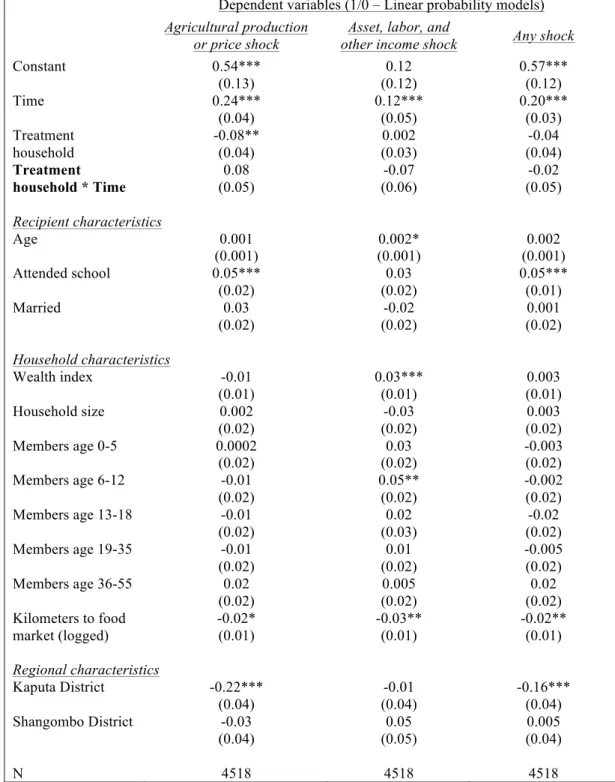
Next, we examine whether treatment and control households are experiencing the same time trend with respect to shock exposure. The time trend could be different due to either (1) differential weather patterns between treatment and control communities over time or (2) actual impacts of cash on the likelihood of experiencing or perceiving a shock (i.e., cash might reduce the likelihood of falling ill by improving nutrition or it might cause one to not notice a change in prices that other perceive as significant). To test for differential time trends, we run a difference-in-difference model, specified in Equation (1) as follows:
(1) Yigt = B0 + B1Postigt + B2Cashig + B3(Postigt*Cashig) + B4Xig + B5 Zg + Wg +Eigt
where Yigt measures whether a shock was reported by household i in district g in period t, Postigt
is a dummy variable equal to 1 if the observation is in 2012, Cashig is a dummy variable equal to 1 if the household is in the treatment group, Xig represents a vector of household and recipient characteristics measured at baseline, Zg, is a vector of baseline prices for food and other
important consumption goods, Wg is a district fixed effect, and Eigt is the error term. We include controls for baseline characteristics and prices and district fixed effects to increase the precision of our estimates. The coefficient of interest in this model is B3, which captures the effect of being in a treatment community on self-reported shocks.
2.5.2. Identification strategy for impact estimates
To understand the impact of cash on households’ stated coping strategies, we run a series of first difference models using the 2012 survey data and restricted to those who reported a negative shock. This model can be written as:
(2) Yigt = B0 + B1Cashig + B2Xig + B3Zg + Wg +Eigt | Shock2012=1
where all terms are defined as they were in Equation (1), but now Yigt is a dummy variable coded as 1 if a household reported using the specific coping strategy in question. The identifying assumption for this model is that both the treatment and control groups would have had, on average, similar, shock coping strategies in 2012, had the treatment group not received cash. However, our equivalence at baseline tests shows that this assumption does not hold for certain shock coping strategies. Therefore, we focus our discussion of results on those stated coping strategies balanced at baseline.
To further probe household coping strategies, we use both rounds of data and examine whether cash may have affected households’ food consumption and overall food security score. Like Equation (2), these models are conditional on households’ shock experience. We run four sets of models, as specified below:
(3) Yigt = B0 + B1Postigt + B2Cashig + B3(Postigt*Cashig) + B4Xig + B5Zg + Wgt +(eigt + µit + vi) | Shock2010=1 & Shock 2012=1
(4) Yigt = B0 + B1Postigt + B2Cashig + B3(Postigt*Cashig) + B4Xig + B5Zg + Wgt +(eigt + µit + vi) | Shock2010=0 & Shock 2012=0
(5) Yigt = B0 + B1Postigt + B2Cashig + B3(Postigt*Cashig) + B4Xig + B5Zg + Wgt +(eigt + µit + vi) | Shock2010=1 & Shock 2012=0
(6) Yigt = B0 + B1Postigt + B2Cashig + B3(Postigt*Cashig) + B4Xig + B5Zg + Wgt +(eigt + µit + vi) | Shock2010=0 & Shock 2012=1
{Shocked both rounds}
{Never shocked}
{Shocked round 1 only}
where terms reflect their definitions as described for Equations (1) and (2), though here Yigt is, depending upon the series of models, monthly per capita food consumption or a dummy variable coded as 1 if the household ranks as severely food insecure. For the purposes of transparency, we also decompose the error term here into its various components, with eigt representing truly random error and µit representing unobserved household characteristics that vary over time and vi
those that are time-invariant. Time-invariant characteristics at the level of the treatment group (i.e., on average) are removed in the differencing. And while, econometrically, unobserved time-varying characteristics at the level of the treatment group remain in the error (as well as µit and vi), the randomized research design provides strong assurance that there are no systematic differences between the treatment and control groups along either observed or unobserved characteristics. Therefore, there is little reason to believe that our estimates reported in Tables 11 and 12 are biased by unobserved heterogeneity.
the shock frequencies in our data and our randomized research design, we believe our sets of difference-in-difference models are more appropriate (and more transparent). Moreover, by disaggregating the analysis according to the temporal experience of shocks, we are able to have a higher degree of external validity and answer an important policy design question: Does it matter whether cash is extended before or after a household experiences a negative shock?
2.6. Results
We find that cash reduces the likelihood of employing negative coping strategies associated with poverty traps and increases the likelihood of employing positive coping strategies. Tables 9 and 10 present the impacts of cash on stated coping. We run two sets of models for each coping strategy: The first restricted to those who experienced agricultural production or price shocks in 2012; the second restricted to those who experienced an asset, labor, or other negative income shock in 2012. We find that amongst those that experienced an agricultural production or price shock, cash reduces the likelihood of reducing food consumption (“doing nothing”) by 14 percentage points and increases the likelihood of spending savings by 6 percentage points. Cash also increases the likelihood of using social services (visiting the clinic or seeking help from the government or an NGO) by 2 percentage points in the case of
agriculture and price shocks and by 12 percentage points for other shocks. Importantly, all of these stated coping strategies were balanced at baseline, implying that we can confidently attribute the observed differences reported here to the cash transfer program.
overall food security (Tables 11 and 12).10 We find that cash increases monthly per capita food expenditures by 31% for those never shocked, by 35% for those shocked only after program implementation (round 2), and by 29% for those shocked both prior to and during the program. [Because food consumption amongst those shocked only prior to the start of the program (round 1) was not balanced at baseline, we can not estimate the impact of cash for this sub-group.]. We see a similar trend with the food security scores. Cash decreases the probability of being severely food insecure by 24 percentage points amongst those never shocked, by 25 percentage points amongst those shocked round 2 only, and by 25 percentage points amongst those shocked both rounds. For those shocked at round 1 only, we do not find evidence that cash has any effect on food security.
We then add a variable measuring shock prevalence in each of the 90 sample
communities to our difference-in-difference models to understand the effect of shock covariance on the impact of cash (see Tables 13 and 14). This variable is the percent in each community sample reporting a shock, exclusive of the household. When this variable is added to the difference-in-difference models, the effects of cash on food consumption and food security remain relatively unchanged from the original estimates presented in Tables 11 and 12 – even though a one percentage point increase in community shock prevalence increases the likelihood of being food insecure by 14 percentage points for those shocked both rounds. For these two shock groups we also see that a one percentage point increase in community shock prevalence increases their food consumption by 30 and 33 percent, respectively. This suggests that the
mechanism by which cash increases food security in the face of covariate shocks is by enabling households to increase food production and/or purchases.
2.7. Conclusions and policy implications
We find that cash transfers enable households to cope with negative shocks in ways that do not increase the likelihood of falling into a poverty trap. Cash empowers the poor, rural households in our study to employ shock-coping strategies commonly used by the non-poor, such as spending savings. The cash transfers provided by Zambia’s Child Grant Program are able to increase both food consumption and food security even while the covariance of shocks within a community increases the likelihood of being severely food insecure.
The most recent report from the Intergovernmental Panel on Climate Change (IPCC) states that “Throughout the 21st century, climate-change impacts are projected to slow down
economic growth, make poverty reduction more difficult, further erode food security, and
prolong existing and create new poverty traps (p. 20) …” Our study provides evidence of a program -- unconditional cash transfers – that can work to help
households avoid the poverty traps that climate change threatens to create and entrench.
Moreover, we show that a specific program design feature – extending cash to households before severe shocks to agricultural production and prices occur – achieves strong, positive impacts on food consumption and food security.
may be due to limited interaction between the environmental policy community and the social protection community. There is clearly a need to link these two policy communities and their attendant literatures.
While Wood (2011) argues that cash transfers should be given a greater role in climate adaptation and the recent World Development Report (World Bank, 2013(b)) also highlights the value of cash transfers for risk management and shock-coping in the context of climate change, to date there have been no published evaluations of cash transfer programs that focus on climate and adaptation questions.11 This study therefore fills an important gap in the literature and offers policy-relevant evidence that should inform the design of climate adaptation programs.
One advantage cash transfers offer over other potential adaptation interventions is their unique ability to address the context of climate change, which is characterized by “deep uncertainty.” In their discussion of the economics of risk and uncertainty in the 2014 World Development Report, The World Bank describes problems of deep uncertainty as those where “…experts cannot agree on which models to use…; on the probability distributions of key uncertain parameters…; or on the values of alternative outcomes” (2013(b), p. 93). Climate change is one such problem, because while models converge on predictions of disrupted rainfall patterns in Africa, at the local level models diverge – some predict decreases in rainfall and droughts, others predict increased rainfall and floods. Given that cash transfers have already been demonstrated by numerous studies (Fiszbein and Schady, 2009) to reduce both short-term
poverty and its long-term determinants, they therefore offer a “no regrets” (Woods, 2011) strategy for climate-resilient development policy. Further, as also argued by Woods (2011) cash
REFERENCES
Asfaw, S., B. Davis, and J. Dewbre. 2011. Cash transfer programs in Sub-Saharan Africa: measuring the impact on climate change adaptation. Presented at the 4th meeting of the Wye City Group on Statistics on Rural Development and Agriculture Household Income, Rio de Janeiro, Brazil, 9-11 Nov.
Baez, J.E., D. Kronick, and A.D. Mason. 2013. Rural households in a changing climate. World Bank Working Paper.
Barrett, C.B., and M.A. Constas. 2014. Toward a theory of resilience for international development applications. PNAS www.pnas.org/cgi/doi/10.1073/pnas.1320880111
Barrett, C.B. and B.M. Swallow. 2005. Fractal poverty traps. World Development 34(1): 1–15. Barrett, C.B., B.J. Barnett, M.R. Carter, S. Chantarat, J.W. Hansen, A.G. Mude, D.E. Osgood,
J.R. Skees, C.G. Turvey, and M.N. Ward. 2007. Poverty traps and climate risk:
Limitations and opportunities of index-based risk financing. IRI Technical Report 07-02. The International Research Institute for Climate and Society.
Beegle, K., R.H. Dahejia, and R. Gatti. 2006. Child labor and agricultural shocks. Journal of Development Economics 81: 80-96.
Blank, L., S. Devereux, and S. Handa. 2010. The case for social protection for children. Chp 2 in Social Protection for Africa’s Children, Handa, S., S. Devereux, and D. Webb (Eds.). Routledge: New York. p. 15-27.
Boone, R., K. Covarrubias, B. Davis, and P. Winters. 2013. Cash transfer programs and agricultural production: the case of Malawi. Agricultural Economics 44: 365-378. Carter, M.R. and J.A. Maluccio. 2003. Social capital and coping with economic shocks: An
analysis of stunting of South African children. World Development 31(7): 1147-1163. Carter, M.R. and C.B. Barrett. 2006. The economics of poverty traps and persistent poverty: An
asset-based approach. Journal of Development Studies 42(2): 187-199.
Carter, M.R., P.D. Little, T. Mogues, and W. Negatu. 2007. Poverty traps and natural disasters in Ethiopia and Honduras. World Development 35(5): 835-856.
Cooper, P.J.M., R.D. Stern, M. Noguer, and J.M. Gathenya. 2013. Climate Change Adaptation Strategies in Sub-Saharan Africa: Foundations for the Future. Chp. 13 Available at:
http://dx.doi.org/10.5772/55133