rstb.royalsocietypublishing.org
Review
Cite this article:
Groner ML
et al. 2016
Managing marine disease emergencies in an
era of rapid change.
Phil. Trans. R. Soc. B
371
:
20150364.
http://dx.doi.org/10.1098/rstb.2015.0364
Accepted: 9 December 2015
One contribution of 14 to a theme issue
‘Marine disease’.
Subject Areas:
ecology, health and disease and epidemiology,
evolution
Keywords:
adaptive management, marine disease,
response plan, surveillance, impact mitigation,
environmental law
Author for correspondence:
Maya L. Groner
e-mail: [email protected]
†
These authors contributed equally to this
study.
‡
Present address: Department of Health
Management, Atlantic Veterinary College,
University of Prince Edward Island,
Charlotte-town, Prince Edward Island, Canada C0A 2E0.
Electronic supplementary material is available
at http://dx.doi.org/10.1098/rstb.2015.0364 or
via http://rstb.royalsocietypublishing.org.
Managing marine disease emergencies in
an era of rapid change
Maya L. Groner
1,†,‡, Jeffrey Maynard
2,3,†, Rachel Breyta
4, Ryan B. Carnegie
5,
Andy Dobson
6, Carolyn S. Friedman
4, Brett Froelich
7, Melissa Garren
8, Frances
M. D. Gulland
9, Scott F. Heron
10,11, Rachel T. Noble
7, Crawford W. Revie
1,
Jeffrey D. Shields
5, Raphae¨l Vanderstichel
1, Ernesto Weil
12, Sandy
Wyllie-Echeverria
13,14and C. Drew Harvell
21Centre for Veterinary Epidemiological Research, Atlantic Veterinary College, University of Prince Edward Island,
Charlottetown, Prince Edward Island, Canada C1A 4P3
2Department of Ecology and Evolutionary Biology, Cornell University, Ithaca, NY 14853, USA 3Laboratoire d’Excellence ‘CORAIL’ USR 3278 CNRS—EPHE, CRIOBE, Papetoai, Moorea, French Polynesia 4School of Aquatic and Fisheries Sciences, University of Washington, Seattle, WA 98195, USA
5Department of Aquatic Health Sciences, Virginia Institute of Marine Science, College of William and Mary,
Gloucester Point, VA 23062, USA
6Department of Ecology and Evolutionary Biology, Princeton University, Princeton, NJ 08544, USA 7Institute of Marine Sciences, University of North Carolina-Chapel Hill, Morehead City, NC 28557, USA 8Division of Science and Environmental Policy, California State University Monterey Bay, 100 Campus Center,
Seaside, CA 93955, USA
9The Marine Mammal Center, Sausalito, CA 94965, USA
10NOAA Coral Reef Watch, NESDIS Center for Satellite Applications and Research, 5830 University Research Ct.,
E/RA3, College Park, MD 20740, USA
11Marine Geophysical Laboratory, Physics Department, College of Science, Technology and Engineering, James
Cook University, Townsville, Queensland 4814, Australia
12Department of Marine Sciences, University of Puerto Rico, Mayaguez, PR 00680, USA 13Friday Harbor Laboratories, University of Washington, Friday Harbor, WA 98250, USA
14Center for Marine and Environmental Studies, University of the Virgin Islands, St Thomas, VI 00802, USA
MLG, 0000-0002-3381-6415
Infectious marine diseases can decimate populations and are increasing among some taxa due to global change and our increasing reliance on marine environments. Marine diseases become emergencies when significant ecological, economic or social impacts occur. We can prepare for and manage these emergencies through improved surveillance, and the development and iterative refinement of approaches to mitigate disease and its impacts. Improv-ing surveillance requires fast, accurate diagnoses, forecastImprov-ing disease risk and real-time monitoring of disease-promoting environmental conditions. Diver-sifying impact mitigation involves increasing host resilience to disease, reducing pathogen abundance and managing environmental factors that facilitate disease. Disease surveillance and mitigation can be adaptive if informed by research advances and catalysed by communication among observers, researchers and decision-makers using information-sharing plat-forms. Recent increases in the awareness of the threats posed by marine diseases may lead to policy frameworks that facilitate the responses and man-agement that marine disease emergencies require.
1. Introduction
Frequent and severe disease outbreaks are hypothesized to be a consequence of cumulative natural and anthropogenic stressors and could affect many marine species [1–3]. Most recently, a wasting disease outbreak decimated populations of sea stars (Asteroidea) in intertidal and sub-tidal regions of eastern and western North America [4]. In addition to uncounted deaths in the east, millions of indi-viduals died in California, Oregon and Washington in 2013 and 2014 and more are dying now in Alaska [5]. The high mortality rate, unprecedented geographi-cal scope and multi-species sgeographi-cale of impacts caught the scientific and resource
management community by surprise, emphasizing that we lack an effective framework for the detection and manage-ment of marine diseases.
The recent experience with the sea star wasting disease (SSWD) outbreak suggests early detection and diagnosis is the key to response and management. Fortunately, as reports of marine disease impacts are increasing, so is interest in creating policy to manage marine diseases. Such policy needs to address several basic questions including: (i) which marine disease outbreaks warrant management responses? And, (ii) how can we prepare for and manage marine disease emergencies? To answer these questions, we describe how coordinated research and management of marine diseases can reduce disease and its impacts for a var-iety of marine organisms. We provide examples of ongoing marine disease surveillance and response and discuss some of the inconsistencies in the coordination of these efforts. In the USA and Canada, governmental, non-profit and aca-demic agencies often coordinate management responses. However, many recent marine disease outbreaks constitute emergencies not covered under current policies. Managing emerging outbreaks is essential and viable with strategic investment in research and response.
2. Which marine disease outbreaks are
emergencies that warrant management
responses?
Every disease is not an emergency. Parasites and pathogens are common in seaweeds and fishes. The typical fish caught by any marine angler often contains several parasite species, yet may still appear healthy. Most infectious agents do not
cause noticeable disease and, even when they do, the result-ing population impacts may be beneficial to the marine community by returning host abundances to carrying capacity [6]. Even mass mortalities may not constitute an emergency if the die-off is localized, the outbreak is self-limit-ing, the system is resilient to the loss of the host, the species’ existence is not under other threats, or the infectious agent does not put human communities at risk. However, when a disease causes large declines in the host population resulting in endangerment of that taxa or precipitating lasting ecologi-cal, economic or social impacts (figure 1), it becomes an emergency [2,3,7].
We define marine diseases as emergencies for their dis-ruption of ecosystem functioning if they remove keystone predators or foundational species. For instance, the recent SSWD outbreak described in the introduction remains an emergency (figure 1a). Resultant ecological impacts are still unfolding and include a reduction in long-term ecological integrity through shifts in populations of foundation species such as mussels and ecosystem engineers like sea urchins. Seagrass wasting disease is a historical example (figure 1b) [8]. In the 1930s, a seagrass wasting disease epidemic in the North Atlantic extirpated an entire coastal ecosystem that had provided food for migratory birds and valuable habitat for commercially important fish and shellfish [9]. A range of ecosystem services deteriorated as a result, including sedi-ment retention, filtration of waste nutrients and carbon sequestration [8,10]. While some ecological effects may be expected from most marine diseases, they are of higher con-cern when they reduce ecosystem services, biodiversity or ecosystem-level resilience to additional stresses.
The most costly epidemics are those affecting commercial species. The annual global value of wild and farmed fisheries is estimated in the 100s of billions of US dollars [11]. At least
ecological economic social
(b)
(a) (c)
(d)
(e)
(f)
Figure 1.
Marine diseases classifiable as emergencies due to the scope and scale of ecological, economic and social impacts. (a) Sea star wasting disease,
(b) eelgrass wasting disease, (c) shrimp white spot disease, (d) white plague disease in the Caribbean coral
Dendrogyra cylindrus, (e)
Vibrio parahaemolyticus
and
V. vulnificus
infections in oysters and (
f
) epizootic shell disease in lobsters. Most of these as well as many other marine disease emergencies cause significant
impacts in more than one category. (Online version in colour.)
rs
tb.r
oy
alsocietypublishing.org
Phil.
Trans.
R.
Soc.
B
371
:20150364
67 infectious diseases have been identified as negatively impacting the economy of marine-based industries [12]. For example, billions of dollars were lost in the early 1990s as a result of a global pandemic of white spot syndrome in penaeid shrimp [12] (figure 1c). The pandemic was exacer-bated by the high susceptibility of hosts to this viral pathogen and the movement of infected product among farms [12]. Subsequent management and mitigation of white spot has resulted in a return to profitable shrimp farm-ing [13]. Economic losses associated with reduced ecotourism following disease outbreaks can also be substantial. Coral dis-eases have led to widespread mass mortality of acroporid corals throughout their geographical distribution [14]. In the early 1980s, white band disease changed the structure and composition of Caribbean coral reefs and affected reef-dependent fisheries and tourism industries (figure 1d) [14]. These examples demonstrate that marine diseases can cause emergencies if the economic costs are substantial.
Marine disease emergencies can also have significant social impacts capable of disrupting public safety, threaten-ing human health or decreasthreaten-ing the resilience of local human communities. Along with our reliance on ocean resources, the probability of humans acquiring infections from marine organisms is also increasing [15]. These include brucellosis, leptospirosis and trichinellosis from marine mammals, avian influenza from marine birds and cryptosporidiosis and vibriosis from shellfish [16]. The most common infection route is ingestion through seafood, such as oysters. For example, transmission of pathogenic
Vibrio parahaemolyticus and V. vulnificus through shellfish or other means can cause human gastrointestinal illness, septicaemia, cellulitis and, in some cases, death (figure 1e) [17]. BothV. parahaemolyticusand the more lethalV. vulnifi-cus have increased recently as a direct response to ocean warming [18]. The emergence of epizootic shell disease in lobsters also demonstrates how marine diseases can impact human communities. Shell disease has severely damaged the historic southern New England stock, redu-cing an important resource for lobster fishermen in Long Island Sound and Cape Cod [19,20]. In turn, these losses have downstream impacts on the livelihood and economic vitality of these fishing communities. Collectively, these examples demonstrate how disease outbreaks that constitute emergencies can have ecological, economic and social impacts.
3. How can we systematically prepare for and
manage marine disease emergencies?
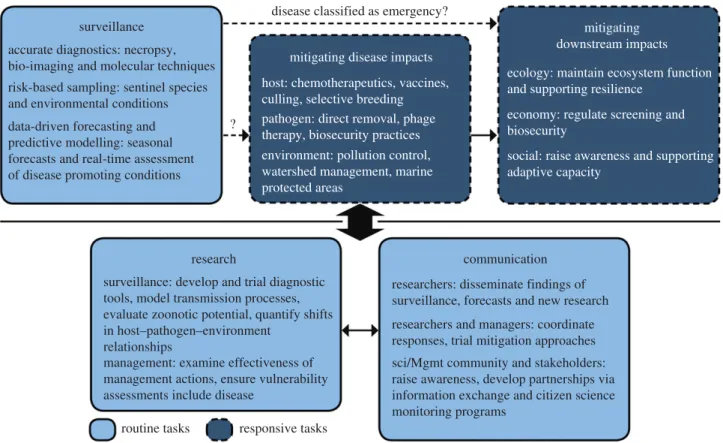
Preparing for and managing marine diseases requires sur-veillance and responsive mitigation (figure 2). Filling key information and capacity gaps through research, outreach and education informs management programmes for dis-ease surveillance and mitigation. Consequently, the process used to prepare for and manage a disease emergency is adaptive; one refines diagnostic methods, initiates surveil-lance programmes and tailors impact mitigation as research advances and capacity among the community builds (figure 2). The response framework we recommend below highlights how effective disease surveillance creates opportunities to proactively mitigate disease and its impacts.
(a) Pathogen and disease surveillance: the key to
proactive impact mitigation
Disease surveillance requires the use of fast and accurate diagnostic tools to identify causative agents within clinically unhealthy individuals or to determine the presence of certain pathogens in a host or environment. Some governmental, non-profit and academic organizations do on-going marine disease surveillance for numerous diseases (electronic sup-plementary material, table S1). Federal agencies such as the National Oceanic and Atmospheric Administration and the National Institutes of Health monitor diseases of marine mammals in the USA, universities and state agencies monitor diseases in many crustaceans and shellfish in the USA and Canada, and a variety of organizations including academic institutions, international non-governmental organizations and federal and state agencies monitor diseases of corals around the globe. Diagnostic tools are critical for early detec-tion in the absence of visible or clinical signs or when the causative agent is unknown or multifactorial (e.g. dual infec-tions or a combination of infection and temperature). Such tools have to be paired with strategic spatio-temporal sampling designed to detect new or emerging pathogens close to their onset. This risk-based surveillance is impor-tant because knowledge gaps in how infectious agents propagate and disperse in the ocean constrain predictive modelling. Nonetheless, when possible, data-driven fore-casting of disease-promoting conditions or modelling of disease dynamics can inform sampling programmes. This can result in the application of mitigation strategies before, or at the onset of an outbreak. Delaying diagnoses will be likely to make the problem more difficult to manage.
Fortunately, new diagnostic techniques are under devel-opment [21]. Recent advances in diagnostic tools such as quantitative PCR, flow cytometry and immunocapture tech-niques improve the ability to quantify specific pathogens at low cost. For example, in a single run with the commercially available platform Fluidigm BioMarkw, it is possible to
sim-ultaneously perform 96 unique diagnostic tests on 96 samples while maintaining high analytical sensitivity [22]. The Department of Fisheries and Oceans Canada is using this platform to monitor wild and farmed salmonids for a multi-tude of infections [23]. In total, 47 assays for 46 microbes suspected or known to cause disease worldwide, including four viruses that are listed by the World Organisation for Animal Health (OIE), are in development for simultaneous assessment using this platform [23,24]. The utility of such diagnostic tools will continue to improve as we focus on their application to marine disease.
Although powerful, diagnostic methods have their limit-ations [25]. For example, qPCR recognizes and quantifies DNA of the target species (assuming high specificity of the assay), but does not imply viability or infection [26]. These assays, when fully validated, can be used as proxies for parasite or disease presence, especially in locations where the disease (agent) has been confirmed. Validation of diagnostic tools is a critical, non-trivial step. The OIE Manual of Diagnostic Tests for Aquatic Animals describes assay validation as a four-stage pathway to assess a test’s ‘fitness-for-purpose’ (e.g. screening versus confirmatory assay) in a designated target population/ species: stage 1, analytical characteristics; stage 2, diagnostic sensitivity and specificity; stage 3, reproducibility among lab-oratories; and stage 4, programme implementation [24].
rs
tb.r
oy
alsocietypublishing.org
Phil.
Trans.
R.
Soc.
B
371
:20150364
Completion of stages 1, 2 and 3 is interpreted as being fit for the originally intended purpose, usually at a national level, and would be expected for tests used in a diagnostic laboratory set-ting. Without validation, interpretation of diagnostic test results becomes challenging with unknown false positive and negative rates. Development of validated diagnostic tools for pathogens in non-commercial species, such as seastars, sea urchins and many species of crabs or lobsters, is needed and may shed light on the ecological role of the pathogen, whether it is obli-gate, facultative or opportunist, a generalist or a specialist, and if it is newly introduced to an area.
The advantages of rapid diagnostic tools are only realized with strategic spatio-temporal sampling, which can be informed through identification of risk factors using epide-miological models, risk analysis and disease simulations. Risk factors can relate to the host (e.g. species, demographic stage and sex), pathogen (e.g. range expansions or changes in virulence) or environment (e.g. temperature or salinity). Filter-feeding shellfish that act as bioaggregators of microbes in the water column can help monitor for the presence of human pathogens. For instance, mussels in the northeast coast of the USA have the highest disease prevalence and parasite burdens in the USA mussel watch programme, suggesting that this may be an area to target future surveil-lance [27]. Similarly, marine mammals are monitored as sentinel species for zoonotic pathogens, due to their phyloge-netic and dietary similarity to humans, long-life and high-level of exposure to pathogens [16]. In both cases, diagnostic tools and strategic sampling have been paired to detect and respond to diseases as well as understand their ultimate causes (figure 3).
For some diseases affecting tropical corals, web-accessible seasonal forecasts and near real-time assessments of outbreak
likelihoods exist. White syndrome outbreaks in Australia’s Great Barrier Reef occurred with greater severity following mild winters and when summer conditions were warm [28,29]. These empirical findings were made possible by stra-tegic monitoring programmes that assessed disease presence and severity for 10 years. The forecasting tools developed from such observations can visualize outbreak likelihoods as high, medium or low based on data-driven mathematical algorithms that query remotely sensed sea surface tempera-ture datasets (figure 4). Assessments showing high outbreak likelihoods trigger managers to target monitoring efforts and, if disease is severe, implement actions to reduce impacts or support recovery. Essentially, forecasting dis-ease-promoting conditions increases support for and the vigilance of those engaged in disease surveillance, which can result in earlier and more robust disease detection.
Forecasting tools can be developed for other diseases if two criteria are met: (i) the major environmental risk factors for disease are known; and (ii) the relevant environmental data are available regularly and at a sufficiently high quality and spatial and temporal resolutions to represent conditions the organisms experience [30]. Candidate diseases for the development of forecasting tools include seagrass wasting disease and abalone withering syndrome because field and experimental data exist to calibrate and validate models. Recent advances allow such forecasts and real-time assess-ments of environmental conditions to be paired with models of disease transmission and spread. For example, three-dimensional oceanographic models that enable hydro-dynamic modelling of environmentally sensitive pathogens has proved useful for predicting transmission probabili-ties of salmon pathogens, thereby influencing aquaculture strategies in Norway [31]. Monitoring of environmental
disease classified as emergency?
? surveillance
mitigating disease impacts
mitigating downstream impacts
research communication
surveillance: develop and trial diagnostic tools, model transmission processes, evaluate zoonotic potential, quantify shifts in host–pathogen–environment
relationships
management: examine effectiveness of management actions, ensure vulnerability assessments include disease
routine tasks responsive tasks
host: chemotherapeutics, vaccines, culling, selective breeding
ecology: maintain ecosystem function and supporting resilience
economy: regulate screening and biosecurity
social: raise awareness and supporting adaptive capacity
researchers: disseminate findings of surveillance, forecasts and new research
researchers and managers: coordinate responses, trial mitigation approaches
sci/Mgmt community and stakeholders: raise awareness, develop partnerships via information exchange and citizen science monitoring programs
pathogen: direct removal, phage therapy, biosecurity practices environment: pollution control, watershed management, marine protected areas
accurate diagnostics: necropsy, bio-imaging and molecular techniques
risk-based sampling: sentinel species and environmental conditions
data-driven forecasting and predictive modelling: seasonal forecasts and real-time assessment of disease promoting conditions
Figure 2.
A framework for adaptively managing marine disease emergencies. Routine disease surveillance enables early detection of more diseases. A working group
then determines whether the disease is an emergency, triggering responsive efforts to mitigate disease and downstream impacts. Surveillance tools and mitigation
approaches are informed by research and catalysed by effective communication among researchers, managers and stakeholders. (Online version in colour.)
rs
tb.r
oy
alsocietypublishing.org
Phil.
Trans.
R.
Soc.
B
371
:20150364
conditions conducive to marine disease outbreaks will be increasingly important as the climate changes. As with diag-nostics and sampling, developing data-driven forecasting tools and predictive modelling for marine diseases will require new investments in research that could be facilitated by policy changes.
(b) Shifting host – pathogen – environment
relationships to mitigate disease
Management interventionscanreduce the extent or severity of the outbreak itself, dispelling the notion among some that nothing can be done to reduce marine diseases [12]. Miti-gation options include targeting the host or the infectious agent, ameliorating disease-promoting environmental con-ditions, or some combination (figure 5). The majority of mitigation efforts undertaken to date have been for diseases related to aquaculture and for marine mammals in wildlife hospitals. Nonetheless, there are some examples of disease mitigation in wild populations (table 1). These programmes often target the host by reducing the pool of infectious or sus-ceptible individuals. This includes vaccination (e.g. on fish farms [39] or, for marine mammals [40]), application of chemical treatments to lower pathogen intensity [39], culling of diseased individuals or even whole populations (e.g. sabel-lid worms in abalone and various pathogens in farmed salmon [12]), and proper disposal of sick individuals that incorporates biosecurity measurements (e.g. crabs with bitter crab syndrome, bycatch or offal from processing plants) [41,42]. Host populations can also be manipulated by promoting increased resistance to disease. Frequencies of resistant genotypes may be increased in wild populations through the designation of marine protected areas (MPAs) or sanctuaries, or in aquaculture populations through selec-tive breeding. Both of these methods are being used to increase resistance in oysters affected by MSX and dermo dis-eases [33]. Managers are not forced to watch in despair as a marine disease emergency unfolds.
Interventions that directly target marine pathogens are effective by either direct removal of pathogens or manipu-lation of microbial communities to reduce pathogen virulence. Methods for direct removal of sea lice on salmon farms include biological control by co-stocking with endemic cleaner fish that are sea louse predators [43]. In another approach, mussels (Mytilus edilus) are placed near salmon farms to filter larval sea lice and pathogenicVibrio bacteria species from the water column [44,45]. These multi-trophic approaches are promising for sustainable management of various types of infections in aquaculture and warrant con-tinued development. Phage therapy also has potential. In this approach, pathogenic bacteria are targeted with specific viruses that lyse the cells [46] or, in the case of the rickett-sia-like organisms that cause withering syndrome in abalone, reduce the virulence of the infected cells [47]. Inter-ventions like these require creative problem-solving based on research.
Altering the environmental conditions where marine dis-eases occur can also be effective at reducing impacts. Many natural marine habitats provide ecosystem services in the form of disease reduction. For example, shrimp aquaculture benefits from nearby mangrove forests, through filtering of water-borne pollutants and supply of larval broodstock [48]. Mangroves restoration could improve water quality and reduce nutrients that trigger disease and reduce the need to import shrimp larvae (which might introduce dis-ease). Similarly, because seagrasses have been shown to filter and detoxify human pathogens and other pollutants [8,49], protecting or restoring seagrasses that harbour valu-able bacteria with algicidal properties against harmful algal blooms could have beneficial effects [50]. While environ-mental manipulations are most feasible on smaller scales, such as those relevant to aquaculture, they can also occur at larger scales. For example,Vibrio sp. are known to increase with nutrient-driven increases in estuarine plankton [51]. Watershed-based reductions of nutrient loading to estuarine systems can retain the natural abundance and diversity of
400x
(b) (a)
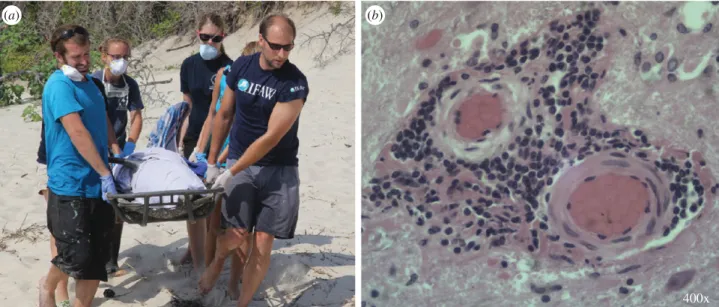
Figure 3.
Cetacean morbillivirus (CeMV) causes dolphin stranding and mortality. Identifying CeMV as the cause of a mortality event depends on: fresh tissues,
trained responders (a), and available, equipped diagnostic laboratories. In 2013/2014 CeMV was detected by PCR, virus isolation and histology, which stains intensely
brown where the virus is present (b). This rapid response effort was made possible under the US Marine Mammal Health and Stranding Program. Under future
legislation, similar coordinated responses could be possible for diseases in other marine taxa. Photos courtesy of Virginia Aquarium & Marine Science Center (both)
and David Rotstein (b). (Online version in colour.)
rs
tb.r
oy
alsocietypublishing.org
Phil.
Trans.
R.
Soc.
B
371
:20150364
bacterial and phytoplankton species in the receiving waters, thereby reducing risks to human health [52]. Another effec-tive strategy is to reduce the impacts of other stressors on diseased species. For example, designation of MPAs can decrease the amount of damage resulting from boats, aban-doned fishing gear and human impacts [53]. Such areas have lower coral disease prevalence than adjacent areas that are frequently visited and fished [54].
(c) Mitigating downstream impacts of marine diseases
Mitigating marine disease itself reduces downstream ecologi-cal, economic and social impacts; however, in many cases the impacts themselves require mitigation. The local context and constraints, including whether the affected populations and communities can benefit from changes in human activities or habitat restoration, will dictate what types of restoration are possible. A recent meta-analysis suggests that, while often slow, restoration of impacted ecosystems can be suc-cessful [55]. These actions may help to mitigate economic and social impacts, though there are also more direct options.
Direct mitigation of economic impacts of diseases can include revising stock-recruitment fishery models to expli-citly account for disease [56] and ensuring biosecurity practices reduce or eliminate transport of infected individuals and product. Both the Pacific herring and Tanner crab indus-tries have used stock assessment models that include disease and adjust allowable catch to account for disease-induced mortality [32,38]. Changes to those fisheries models were implemented after disease outbreaks occurred, but such model adjustments can be made more proactively in the future for other marine diseases through increased monitor-ing of risk factors.
The billions of dollars lost due to white spot disease among panaeid shrimp in the 1990s demonstrates the role that biose-curity practices play in reducing economic impacts (figure 1c). Biosecurity is also critically important for reducing the most alarming of social impacts: human illness and death. Concerns about spillover of marine diseases into humans usually involve food or water-borne contact. Such contact can often be reduced through public health messaging. For example, when a V. parahaemolyticusoutbreak occurs in a particular
CL CL
CA
WH
SW SW
10 km
N
*
CB
no risk
(a) (b) (c)
at risk
outlooks, May to September near real-time risk assessment, October to March
low high
CB
seasonal outlook outbreak risk
N CA
WH
300 km
Figure 4.
Predictive tools developed for the coral disease white syndromes (WS) in Australia’s Great Barrier Reef. Statistical analyses were used to relate sea surface
temperature patterns in the winter (seasonal forecast (a)) and summer (near real-time risk assessment (b,c)) to WS prevalence during outbreak and non-outbreak
years [28,29]. These web-accessible tools are monitored by managers and scientists and used to target response efforts. Forecasting and near real-time monitoring of
disease-promoting conditions can increase vigilance and support for surveillance efforts, resulting in earlier disease detection. (Online version in colour.)
host pathogen environment
(b)
(a) (c)
Figure 5.
Management of oysters in the eastern US to reduce the impacts of
Perkinsus marinus
(dermo) and
Haplosporidium nelsoni
(MSX) can target the host, the
pathogen or the environment. Disease-resistant hosts are protected in sanctuaries from harvest to promote an increase in the frequency of resistant genotypes (a).
Biosecurity management focuses on pathogen screening in aquacultured seed (viewed histologically here) to prevent disease introduction into new areas and
exacer-bation of disease where it occurs (b). Conserving and restoring three-dimensional reef habitat enhances growth, reproduction and recruitment of healthy oyster
metapopulations (c). (Online version in colour.)
rs
tb.r
oy
alsocietypublishing.org
Phil.
Trans.
R.
Soc.
B
371
:20150364
area, the Interstate Shellfish Sanitation Conference requires the Shellfish Control Authority to immediately close the affected area, issue an advisory and initiate a recall of oyster and other shellfish products [57]. These examples can be tailored for use with other marine diseases.
Disease management must be adaptive and involve information exchange. Importantly, timely implementation and trial of mitigation actions hinges entirely on disease surveillance. For some types of marine disease management decisions, competing interests will have to be balanced and many groups will need to be involved. Resolving contentious issues that may involve public health or industry viability will require clear policy and coordinated efforts. This attests to the value of future policy for bringing increased attention and resource mobilization to marine disease responses.
4. Future directions and conclusion
Some marine disease outbreaks that qualify as emergencies are ongoing (e.g. sea star wasting in Alaska and morbillivirus in
dolphins along the eastern seaboard of the USA) and new out-breaks are certain to occur in the coming years. The framework we used to summarize marine disease management can maxi-mize opportunities to mitigate the impacts of future disease emergencies. For the framework we recommend to be adaptive, both surveillance and responsive impact mitigation need to be informed by research and catalysed by effective communication among research, management and stakeholder groups. Key areas for investment of research effort include as follows.
(a) Surveillance
— Developing and evaluating more diagnostic tools and increasing capacity among the science and management communities to use these tools.
— Developing hydrodynamic models of pathogen propa-gation and dispersal.
— Quantifying the nature of shifts in host, pathogen and environment relationships under climate and anthropogenic change and using these data to develop monitoring and forecasting tools.
Table 1.
Marine disease mitigation in wild North American populations. Included are the disease mitigated, host and pathogen species, the agencies that have
conducted the mitigation, the strategies implemented and the project goal.
disease
host
pathogen
mitigation approach
agency
agoal
bitter crab disease
snow crabs
Hematodinium
sp.
dispose of infected animals in
landfills; no culling of
diseased animals at sea [19]
DFO
control
bitter crab disease
Tanner crab
Hematodinium
sp.
include disease in fisheries
models [32]
NOAA
control
epizootic shell
disease
American
lobster
bacterial dysbiosis
moratorium on being considered
on mid-Atlantic fishery [20]
ASMFC
recovery
MSX, dermo
oysters
Haplosporidium
nelsoni, Perkinsus
marinus
promotion of resistant
populations through
sanctuaries from harvest,
rotational harvest programs
[33,34]
VMRC, MDNR
recovery
sabellid infestation
abalone,
black
turban
snails
sabellid polychaete
Terebrassabella
heterouncinata
culling of highly susceptible and
preferred hosts (black turban
snails), installing screens
at abalone mariculture
facility [35]
CDFG
eradication
black band disease
12 coral
species
bacterial colonies
vacuuming bacterial mat from
affected area and then sealing
with underwater epoxy [36]
NOAA,
universities
control disease
disease outbreak
corals
various
close the reef to any human
activities [36]
NOAA
prevent
transmission
viral haemorrhagic
septicaemia
(VHS)
salmonids
viral haemorrhagic
septicaemia virus
(VHSv)
quarantine and cull hatchery
salmon testing positive [37]
WDFW
control
icthyophoniasis, VHS
Pacific
herring
Ichthophonus hoferi,
VHSv
include disease in fisheries
models [38]
NOAA
control
a
WDFW, Washington Department of Fish and Game; CDFG, California Department of Fish and Game; DFO, Department of Fisheries and Oceans Canada; ASMFC,
Atlantic States Marine Fisheries Commission; VMRC, Virginia Marine Resources Commission; MDNR, Maryland Department of Natural Resources.
rs
tb.r
oy
alsocietypublishing.org
Phil.
Trans.
R.
Soc.
B
371
:20150364
— Developing data-sharing and disease-mapping tools to transfer information among scientists, managers and the public.
(b) Impact mitigation
— Trialling and evaluating management actions implemented to mitigate disease and its downstream impacts.
— Supporting the adaptive capacity of human communities dependent on fisheries.
— Ensuring that vulnerability assessments of fisheries include disease.
— Developing models and monitoring programmes to assess disease impacts and mitigation plans.
(c) Development of marine disease adaptive
management policies
How might changes to policy help us diagnose and manage marine diseases? One limitation is the lack of a coordinated response or timely funding. For instance, investigation of
the sea star wasting disease depended on interested parties donating time and resources. The need for policy that supports marine disease emergency responses and manage-ment is starting to be recognized by some governing bodies. In response to the ongoing SSWD outbreak, Washing-ton state representative Dennis Heck of the US Congress introduced a bill that, if passed, will become the Marine Dis-ease Emergency Act (MDE Act, HR936). This bill would increase capacity for timely and coordinated responses to future marine disease outbreaks and would: (i) ensure marine disease outbreaks are considered for classification as ‘emergencies’; (ii) appoint a working group in the US National Oceanic and Atmospheric Administration to advise on assessing, declaring and responding to emergen-cies; (iii) form a data repository to disseminate and facilitate research to manage disease impacts; and (iv) designate finan-cial resources for research and response coordination. A similar programme, the US Unusual Mortality Event (UME) programme, coordinates responses to marine mammal mortality events. After unprecedented mortalities of dolphins along the eastern seaboard of the USA in 1987 and 1988 [58], this programme was established under the Marine Mammal Protection Act (MMPA) amendments in
(a) current management scenario
(b) management with disease surveillance programme
actual disease incidence
scope and scale of ecological, economic
and social im
p
acts
(c) management with disease surveillance and forecasting
time
disease occurring but not detected
disease occurring and detected
disease mitigation implemented
data-driven forecasting and predictive modelling
possibility for mitigation of ecological, economic and social impacts
minimal opportunities for mitigation
possibility for mitigation of disease and ecological, economic and
social impacts
Figure 6.
How the proposed disease management framework improves the timing of disease detection and extent of impact mitigation. Currently, marine diseases
are detected near or after their epidemic peak (a) and there is limited management of the disease outbreak or downstream ecological, economic or social and
cultural impact. Diseases could be detected earlier with greater disease surveillance, which increases management opportunities, especially for mitigating
down-stream impacts (b). Diseases are best managed when surveillance programmes can include data-driven forecasting and predictive modelling, ensuring mitigation
starts before the epidemic peak (c) (see also figure 4). (Online version in colour.)
rs
tb.r
oy
alsocietypublishing.org
Phil.
Trans.
R.
Soc.
B
371
:20150364
1992. The value of the MMPA for marine mammals was demonstrated during the rapid response to increasing dol-phin mortalities following the Deepwater Horizon oil spill in the Gulf of Mexico [59]. However, the MMPA does not cover either fish or invertebrates, hence the need for the pro-posed MDE Act.
Disseminating surveillance data and research findings through open access data repositories will facilitate research and uptake of findings among decision-makers. The recent proliferation of information-sharing platforms is a positive part of this era of rapid change within which we have to manage marine disease. Indeed, linked open data that enables sophisticated data queries is already revolutionizing human disease diagnosis and care management (e.g. [60]). Such communication platforms can connect marine disease researchers with decision-makers. Consequently, manage-ment and responses coordinated under the MDE Act or future similar legislation can be adaptive and effective (figure 6). Research advances can be incorporated into
management strategy and responses can be coordinated when disease is detected or anticipated, warranting these marine emergencies the attention they require.
Authors’ contributions.All authors contributed to the conception of the
article and figure content and design. M.L.G., J.M. and C.D.H. led drafting of the manuscript with substantial input from all other authors.
Competing interests.We have no competing interests.
Funding.This paper was conceived during a meeting of the
NSF-sup-ported Research Coordination Network (RCN) on the Ecology and Evolution of Infectious Disease (grant OCE-1215977 awarded to C.D.H.) made possible by logistical support from Friday Harbor Lab-oratories of the University of Washington. Financial support was also provided by an NOAA Climate Program Office grant to the supervis-ing author (NA13OAR4310127) and to the first author by the Canadian Excellence Research Chair in Aquatic Epidemiology at the University of Prince Edward Island.
Acknowledgements. Figures were developed in collaboration with
D. Tracey. The manuscript benefited from input by K. Lafferty, J. Lamb, P. Hershberger and anonymous reviewers.
References
1. Doney SCet al.2012 Climate change impacts on marine ecosystems.Annu. Rev. Mar. Sci.4, 11 – 37. (doi:10.1146/annurev-marine-041911-111611) 2. Harvell Det al.2004 The rising tide of ocean
diseases: unsolved problems and research priorities. Front. Ecol. Environ.2, 375 – 382. (doi:10.1890/ 1540-9295(2004)002[0375:TRTOOD]2.0.CO;2) 3. Burge CAet al.2014 Climate change influences on
marine infectious diseases: implications for management and society.Annu. Rev. Mar. Sci.6, 249 – 277. (doi:10.1146/annurev-marine-010213-135029)
4. Hewson Iet al.2014 Densovirus associated with sea-star wasting disease and mass mortality.Proc. Natl Acad. Sci. USA111, 17 278 – 17 283. (doi:10. 1073/pnas.1416625111)
5. Eisenlord MEet al. 2016 Ochre star mortality during the 2014 wasting disease epizootic: role of population size structure and temperature.Phil. Trans. R. Soc. B371, 20150212. (doi:10.1089/rstb. 2015.0212)
6. Behrens MD, Lafferty KD. 2004 Effects of marine reserves and urchin disease on southern Californian rocky reef communities.Mar. Ecol. Prog. Ser.279, 129 – 139. (doi:10.3354/meps279129)
7. Groner MLet al.2015 Emergency response for marine diseases.Science347, 1210. (doi:10.1126/ science.347.6227.1210-a)
8. Short FT, Wyllie-Echeverria S. 1996 Natural and human-induced disturbance of seagrasses.Environ. Conserv.23, 17 – 27. (doi:10.1017/s0376890003821) 9. Godet L, Fournier J, Van Katwijk M, Olivier F, Le
Mao P, Retie`re C. 2008 Before and after wasting disease in common eelgrassZostera marinaalong the French Atlantic coasts: a general overview and first accurate mapping.Dis. Aquat. Org.79, 249 – 255. (doi:10.3354/dao01897)
10. Barbier EB, Hacker SD, Kennedy C, Koch EW, Stier AC, Silliman BR. 2011 The value of estuarine and
coastal ecosystem services.Ecol. Monogr.81, 169 – 193. (doi:10.1890/10-1510.1)
11. Food and Agricultural Organization of the United Nations. 2014The state of world fisheries and aquaculture: opportunities and challenges. Rome, Italy: FAO.
12. Lafferty KD, Harvell CD, Conrad JM, Friedman CS, Kent ML, Kuris AM, Powell EN, Rondeau D, Saksida SM. 2015 Infectious diseases affect marine fisheries and aquaculture economics.Annu. Rev. Mar. Sci.7, 471 – 496. (doi:10.1146/annurev-marine-010814-015646)
13. Lightner DV. 2011 Status of shrimp diseases and advances in shrimp health management.Dis. Asian Aquac.7, 121 – 133.
14. Aronson RB, Precht WF. 2001 White-band disease and the changing face of Caribbean coral reefs. Hydrobiologia460, 25 – 38.
15. Broglia A, Kapel C. 2011 Changing dietary habits in a changing world: emerging drivers for the transmission of foodborne parasitic zoonoses.Vet. Parasitol.182, 2 – 13. (doi:10.1016/j.vetpar.2011. 07.011)
16. Bossart GD. 2011 Marine mammals as sentinel species for oceans and human health.Vet. Pathol. 48, 676 – 690. (doi:10.1177/0300985810388525) 17. Drake SL, DePaola A, Jaykus LA. 2007 An overview
ofVibrio vulnificusandVibrio parahaemolyticus. Comp. Rev. Food Sci. Food Safety6, 120 – 144. (doi:10.1111/j.1541-4337.2007.00022.x)
18. Baker-Austin C, Trinanes JA, Taylor NG, Hartnell R, Siitonen A, Martinez-Urtaza J. 2013 EmergingVibrio risk at high latitudes in response to ocean warming. Nat. Clim. Change3, 73 – 77. (doi:10.1038/ nclimate1628)
19. Shields JD. 2012 The impact of pathogens on exploited populations of decapod crustaceans. J. Invertebr. Pathol.110, 211 – 224. (doi:10.1016/j. jip.2012.03.01)
20. Shields JD. 2013 Complex etiologies of emerging diseases in lobsters (Homarus americanus) from Long Island Sound.Can. J. Fish. Aquat. Sci.70, 1576 – 1587. (doi:org/10.1139/Cjfas-2013-0050) 21. Burge CAet al.2016 Complementary approaches to
diagnosing marine diseases: a union of the modern and the classic.Phil. Trans. R. Soc. B371, 20150207. (doi:10.1098/rstb.2015.0207) 22. Weaver S, Dube S, Mir A, Qin J, Sun G,
Ramakrishnan R, Jones RC, Livak KJ. 2010 Taking qPCR to a higher level: analysis of CNV reveals the power of high throughput qPCR to enhance quantitative resolution.Methods50, 271 – 276. (doi:10.1016/j.ymeth.2010.01.003)
23. Department of Fisheries and Oceans Canada. 2015 Proceedings of the national peer review of the FluidigmwBiomark platform: evaluation to assess fitness for purpose in microbial monitoring, 2 – 4 December 2014. DFO Can. Sci. Advis. Sec. Proceed. Ser. 2015/039.
24. OIE (World Organisation for Animal Health). 2013 Principles and methods of validation of diagnostic assays for infectious diseases. InManual of diagnostic tests for aquatic animals 2013, Chapter 1.1.2. See www.oie.int/international-standard-setting/aquatic-manual/access-online/ (accessed 18 August 2014). 25. Carnegie RB, Arzul I, Bushek D. 2016 Managing
marine mollusc diseases in the context of regional and international commerce: policy issues and emerging concerns.Phil. Trans. R. Soc. B371, 20150215. (doi:10.1098/rstb.2015.0215) 26. Burreson EM. 2008 Misuse of PCR assay for
diagnosis of mollusc protistan infections.Dis. Aquat. Org.80, 81 – 83. (doi:10.3354/dao01925) 27. Kim Y, Powell EN. 2007 Distribution of parasites and
pathologies in sentinel bivalves: NOAA status and trends ‘Mussel Watch’ program.J. Shell Res.26, 1115 – 1151.
(doi:10.2983/0730-8000(2007)26[1115:DOPAPI]2.0.CO;2)
rs
tb.r
oy
alsocietypublishing.org
Phil.
Trans.
R.
Soc.
B
371
:20150364
28. Heron SF, Willis BL, Skirving WJ, Mark Eakin C, Page CA, Miller IR. 2010 Summer hot snaps and winter conditions: modelling white syndrome outbreaks on Great Barrier Reef corals.PLoS ONE5, e12210. (doi:10.1371/journal.pone.0012210)
29. Maynard JA, Anthony KRN, Harvell CD, Burgman MA, Beeden R, Sweatman H, Heron SF, Lamb JB, Willis BL. 2011 Predicting outbreaks of a climate-driven coral disease in the Great Barrier Reef.Coral Reefs30, 485 – 495. (doi:10.1007/s00338-010-0708-0)
30. Maynard Jet al.2016 Improving marine disease surveillance through sea temperature monitoring, outlooks and projections.Phil. Trans. R. Soc. B371, 20150208. (doi:10.1089/rstb.2015.0208)
31. Stene A, Viljugrein H, Yndestad H, Tavornpanich S, Skjerve E. 2014 Transmission dynamics of pancreas disease (PD) in a Norwegian fjord: aspects of water transport, contact networks and infection pressure among salmon farms.J. Fish Dis.37, 123 – 134. (doi:10.1111/jfd.12090)
32. Siddeek MSM, Zheng J, Morado JF, Kruse GH, Bechtol WR. 2010 Effect of bitter crab disease on rebuilding in Alaska Tanner crab stocks.ICES J. Mar. Sci.67, 2027 – 2032. (doi:10.1093/icesjms/ fsq061)
33. Ragone Calvo LM, Calvo GW, Burreson EM. 2003 Dual disease resistance in a selectively bred eastern oyster,Crassostrea virginica, strain tested in Chesapeake Bay.Aquaculture220, 69 – 87. (doi:10. 1016/S0044-8486(02)00399-X)
34. Carnegie RB, Burreson EM. 2011 Declining impact of an introduced pathogen:Haplosporidium nelsoniin the oysterCrassostrea virginicain Chesapeake Bay. Mar. Ecol. Progress Ser.432, 1 – 15. (doi:10.3354/ meps09221)
35. Culver CS, Kuris AM. 2000 The apparent eradication of a locally established introduced marine pest. Biol. Invasions2, 245 – 253. (doi:10.1023/A:10100 82407254)
36. Raymundo LJ, Couch CS, Harvell CD. 2008 Coral disease handbook: guidelines for assessment, monitoring and management. St Lucia, Queensland, Australia: Coral Reef Targeted Research and Capacity Building for Management Program.
37. Amos K, Thomas J, Hopper K. 1998 A case history of adaptive management strategies for viral hemorrhagic septicemia virus (VHSV) in Washington State.J. Aquat. Anim. Health10, 152 – 159. (doi:10. 1577/1548-8667(1998)010,0152:ACHOAM.2.0. CO;2)
38. Marty GD, Hulson PJF, Miller SE, Quinn TJII, Moffitt SD, Merizon RA. 2010 Failure of population recovery
in relation to disease in Pacific herring.Dis. Aquat. Org.90, 1 – 14. (doi:10.3354/dao02210) 39. Subasinghe R. 2009. Disease control in aquaculture
and the responsible use of veterinary drugs and vaccines: the issues, prospects and challenges. Options Me´diterrane´ennes86, 5 – 11.
40. Jessup DA, Murray MJ, Casper DR, Brownstein D, kreuder-Johnson C. 2009 Canine distemper vaccination is a safe and useful preventative procedure for southern sea otters (Enhydra lutris nereis).J. Zoo Wildl. Med.40, 705 – 710. (doi:10. 1638/2008-0080.1)
41. Stentiford GD, Shields JD. 2005. A review of the parasitic dinoflagellatesHematodiniumspecies and Hematodinium-like infections in marine crustaceans. Dis. Aquat. Org.66, 47–70. (doi:10.3354/dao066047) 42. Karreman G, Klotins K, Bebak J, Gustafson L, Osborn A, Kebus MJ, Innes P, Tiwari A. 2015 Aquatic animal biosecurity: a case study of bioexclusion of viral hemorrhagic septicemia virus in an Atlantic salmon hatchery.J. Appl. Aquac.27, 299 – 317. (doi:10. 1080/10454438.2014.914996)
43. Groner ML, Cox R, Gettinby G, Revie CW. 2013 Use of agent-based modelling to predict benefits of cleaner fish in controlling sea lice,Lepeophtheirus salmonis, infestations on farmed Atlantic salmon, Salmo salarL.J. Fish. Dis.36, 195 – 208. (doi:10. 1111/jfd.12017)
44. Molloy SD, Pietrak MR, Bouchard DA, Bricknell I. 2011 Ingestion ofLepeophtheirus salmonisby the blue musselMytilus edulis.Aquaculture311, 61 – 64. (doi:10.1016/j.aquaculture.2010.11.038) 45. Pietrak MR, Molloy SD, Bouchard DA, Singer JT,
Bricknell I. 2012 Potential role ofMytilus edulisin modulating the infectious pressure ofVibrio anguillarum02bon an integrated multi-trophic aquaculture farm.Aquaculture326 – 329, 36 – 39. (doi:10.1016/j.aquaculture.2011.11.024) 46. Oliveira J, Castilho F, Cunha A, Pereira MJ. 2012
Bacteriophage therapy as a bacterial control strategy in aquaculture.Aquacult. Intl.20, 879 – 910. (doi:10.1007/s10499-012-9515-7)
47. Friedman CS, Wight N, Crosson LM, VanBlaricom GR, Lafferty KD. 2014 Reduced disease in black abalone following mass mortality: phage therapy and natural selection.Front. Microbiol.5, 78. (doi:10.3389/fmicb.2014.00078)
48. Kautsky N, Ro¨nnba¨ck P, Tedengren M, Troell M. 2000 Ecosystem perspectives on management of disease in shrimp pond farming.Aquaculture191, 145 – 161. (doi:10.1016/S0044-8486(00)00424-5) 49. Shuval H. 2003 Estimating the global burden of
thalassogenic diseases: human infectious diseases
caused by wastewater pollution of the marine environment.J. Water Health1, 53 – 64. 50. Onishi Y, Mohri Y, Tuji A, Ohgi K, Yamaguchi A, Imai
I. 2014 The seagrassZostera marinaharbors growth-inhibiting bacteria against the toxic dinoflagellateAlexandrium tamarense.Fish. Sci.80, 353 – 362. (doi:10.1007/s12562-013-0688-4) 51. Hsieh JL, Fries JS, Noble RT. 2007Vibrioand
phytoplankton dynamics during the summer of 2004 in a eutrophying estuary.Ecol. Appl.17, S102 – S109. (doi:10.1890/05-1274.1)
52. Suikkanen S, Pulina S, Engstro¨m-O¨st J, Lehtiniemi M, Lehtinen S, Brutemark A. 2013 Climate change and eutrophication induced shifts in northern summer plankton communities.PLoS ONE8, e66475. (doi:10.1371/journal.pone.0066475) 53. Lamb JB, Wenger AS, Devlin MJ, Ceccarelli DM,
Williamson DH, Willis BL. 2016 Reserves as tools for alleviating impacts of marine disease.Phil. Trans. R. Soc. B371, 20150210. (doi:10.1098/rstb.2015.0210) 54. Lamb JB, Williamson DH, Russ GR, Willis BL. 2015 Protected areas mitigate diseases of reef-building corals by reducing damage from fishing.Ecology96, 2555 – 2567. (doi:10.1890/14-1952.1)
55. Lotze HK, Coll M, Magera AM, Ward-Paige C, Airoldi L. 2011 Recovery of marine animal populations and ecosystems.Trends Ecol. Evol.26, 595 – 605. (doi:10. 1016/j.tree.2011.07.008)
56. Ben-Horin T, Lafferty KD, Bidegain G, Lenihan HS. 2016 Fishing diseased abalone to promote yield and conservation.Phil. Trans. R. Soc. B 371, 20150211. (doi:10.1098/rstb.2015.0211)
57. Interstate Shellfish Sanitation Conference (ISSC). 2015 V.p. illness response guidance document; 2015. See http://www.issc.org/client_resources/ 002015%20executive%20board%20utah/vp% 20illness%20response%20interim%20guidance% 2003-13-2015.pdf
58. Gulland FMD. 2006 Review of the Marine Mammal Unusual Mortality Event Response Program of the National Marine Fisheries Service. U.S. Department of Commerce, NOAA Technical Memorandum NMFS-OPR-33.
59. Venn-Watson Set al.2015 Demographic clusters identified within the northern Gulf of Mexico common bottlenose dolphin (Tursiops truncates) unusual mortality event: January 2010 – June 2013.PLoS ONE 10, e0117248. (doi:10.1371/journal.pone.0117248) 60. Kumarasamy KKet al.2010 Emergence of a new
antibiotic resistance mechanism in India, Pakistan, and the UK: a molecular, biological, and epidemiological study.Lancet Infect. Dis.10, 597 – 602. (doi:10.1016/S1473-3099(10)70143-2)