Gateway Theory in a Dynamic Context:
The Effect of Past Substance Use on Current Demand
William B. Grider
A dissertation submitted to the faculty of the University of North Carolina at Chapel Hill in partial fulfillment of the requirements for the degree of Doctor of Philosophy in the Department of Economics.
Chapel Hill 2012
Approved by:
Donna Gilleskie
Frank Sloan
Helen Tauchen
Sally Stearns
Abstract
WILLIAM B. GRIDER: Gateway Theory in a Dynamic Context: The Effect of Past Substance Use on Current Demand
(Under the direction of Donna Gilleskie.)
This study investigates the idea that prior consumption of one drug leads to current consumption of
another - the so-called gateway theory. The research implements a discrete factor random effects model
to jointly estimate current cigarette, alcohol, and marijuana consumption as a function of endogenous
prior drug consumption behavior and current prices. The model controls for endogenous arrest
inci-dence and sample attrition by modeling those events. I develop reduced form demand models for the
consumption of the three drugs by a cohort of adolescents transitioning into young adulthood, and first
estimate the model equations independently of one another, treating endogenous prior behavior as being
exogenous. I then implement controls for unobservable heterogeneity, allowing errors to be correlated
across the equations in a jointly estimated model that enables an analysis of the effects of changes in
prior drug consumption and policy variables on consequent drug use. Results largely support the idea
that drinking and tobacco smoking serve as gateways into marijuana consumption, but also indicate
that controlling for unobservables weakens the estimated impact of prior drug use on current drug
con-sumption. While the results support the idea that gateway effects exist, they also indicate that ignoring
unobservable factors produces upwardly biased estimates of the magnitude of these effects.
Acknowledgments
This research was conducted with restricted access to Bureau of Labor Statistics (BLS) data. The
views expressed here do not necessarily reflect the views of the BLS. I would like to thank my advisor,
Donna Gilleskie, for helping me see this through to completion despite numerous setbacks along the
way. I would also like to thank the other members of my committee: Frank Sloan, Helen Tauchen,
Sally Stearns, Clement Joubert, and Sandra Campo, for their invaluable assistance during the process
of writing this dissertation. I thank participants in the Applied Microeconomics Student Workshop, as
well as Brian McManus specifically, for helpful comments. I thank Sara Markowitz, Rosalie Pacula,
and Jeffrey DeSimone for providing marijuana price data from the DEA, and Mireille Jacobson for
providing marijuana price data fromHigh Timesmagazine. All errors are my own.
Finally, I would like to thank my family for their unwavering support. In particular, I thank my wife,
Christine, and my children, Will and Sadie June. I also thank my father and late mother, without whom
Table of Contents
Abstract ii
Acknowledgments iii
List of Tables vii
List of Figures 1
1 Introduction 1
2 Background 5
2.1 Gateway Theory . . . 5
2.2 Literature Review . . . 9
3 Theoretical Framework 18
3.1 Demand for Multiple Drugs . . . 19
3.2 Gateways - Current Consumption as a Function of Past Use . . . 22
4 Data 25
4.1 The 1997 National Longitudinal Survey of Youth . . . 25
4.2 Excise Taxes and Marijuana Laws . . . 27
4.3 Sample Statistics . . . 30
5 Empirical Model 38
5.1 Empirical Specification - Drug Use . . . 38
5.2 Empirical Specification - Arrests . . . 40
5.3 Estimation Method . . . 41
6 Results 48
6.1 Model Metrics . . . 48
6.2 Full Enforcement Effects on Current Use . . . 54
6.3 Price and Arrest Effects on Current Use . . . 59
6.4 Discussion . . . 67
7 Conclusion 72 A Data Imputation 75 A.1 Drug Use . . . 75
A.2 Geography . . . 77
B State-Level Marijuana Laws 78
C Full Model Results - Controlling for Unobservables 81
D Full Model Results - Ignoring Unobservables 91
List of Tables
2.1 Non-Economic Studies Related to Gateway Theory . . . 10
2.2 Single Period Economic Studies Related to Gateway Theory . . . 12
2.3 Multiple Period Economic Studies Related to Gateway Theory . . . 14
4.1 Percent of Analysis Sample Affected by State Marijuana Policies . . . 30
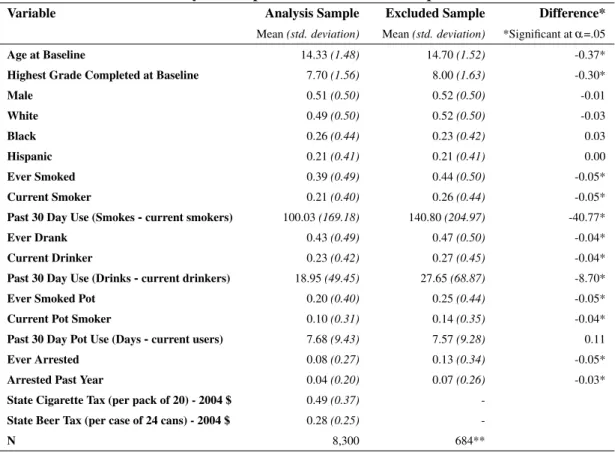
4.2 Analysis Sample versus Excluded Sample at Baseline . . . 31
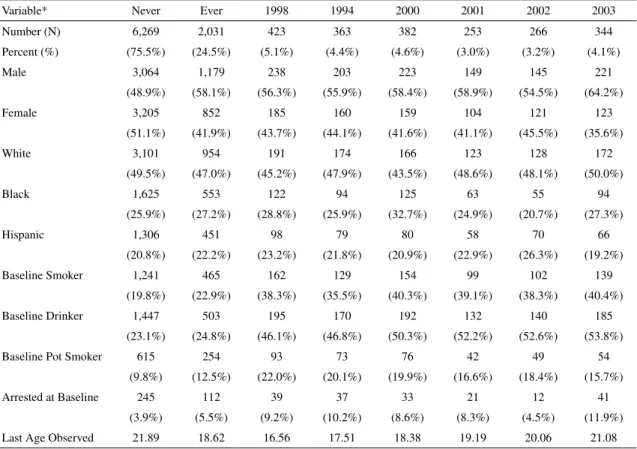
4.3 Sample Attrition over Time . . . 32
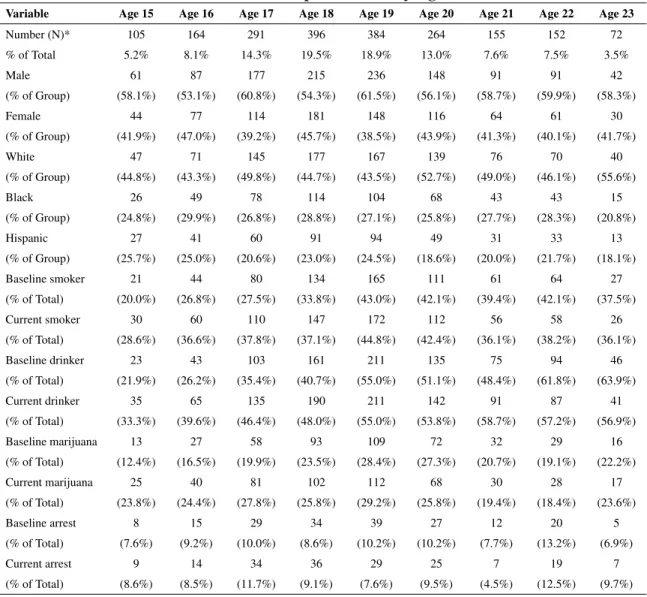
4.4 Sample Attrition by Age . . . 34
4.5 Drug Use Rates by Gender at Different Ages . . . 35
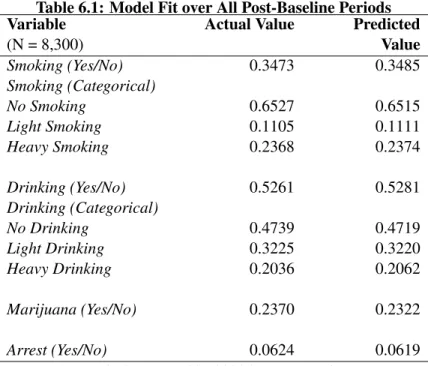
6.1 Model Fit over All Post-Baseline Periods . . . 49
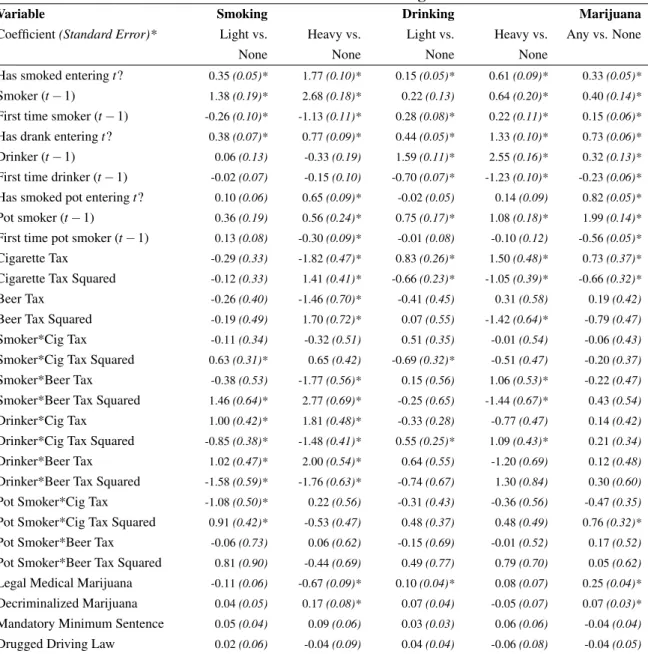
6.2 Parameter Estimates Controlling for Unobservables . . . 52
6.3 Parameter Estimates Not Controlling for Unobservables . . . 53
B.1 State-Level Marijuana Law Indicators . . . 79
C.1 Parameter Estimates - Initial Conditions Entering Baseline . . . 82
C.2 Parameter Estimates - Initial Conditions at Baseline . . . 84
C.3 Parameter Estimates - Longitudinal Drug Use . . . 86
C.4 Parameter Estimates - Longitudinal Arrest and Attrition . . . 88
C.5 Unobserved Heterogeneity Information . . . 90
D.1 Parameter Estimates - Initial Conditions Entering Baseline . . . 92
D.2 Parameter Estimates - Initial Conditions at Baseline . . . 93
D.3 Parameter Estimates - Longitudinal Drug Use . . . 95
D.4 Parameter Estimates - Longitudinal Arrest and Attrition . . . 97
List of Figures
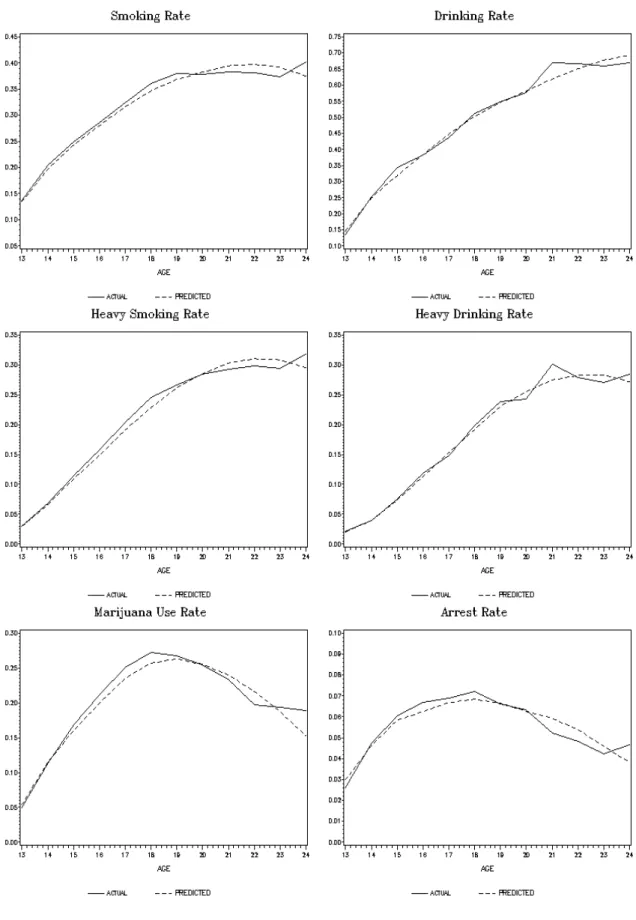
6.1 Model Fit by Age . . . 50
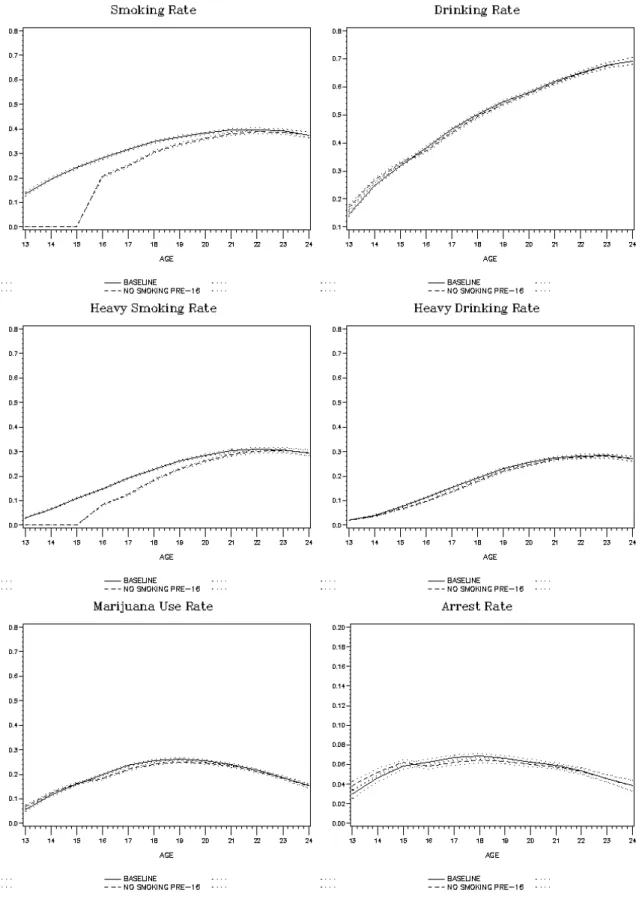
6.2 No One Smokes Before Age 16 . . . 55
6.3 No One Smokes Before Age 18 . . . 57
6.4 No One Drinks Before Age 21 . . . 58
6.5 No One Smokes Marijuana Before Age 21 . . . 60
6.6 Cigarette Tax Doubled . . . 62
6.7 Beer Tax Doubled . . . 63
6.8 Medical Marijuana - Legal Versus Illegal . . . 65
Chapter 1
Introduction
This study follows an initially adolescent cohort over eight years to investigate the gateway theory of
drug use by examining the joint consumption of cigarettes, alcohol, and marijuana. The gateway theory
hypothesizes that prior consumption of one drug leads to current consumption of another, and can be
applied to various combinations of drug consumption. The drugs most commonly viewed as gateways
are tobacco, alcohol, and marijuana. A version studied here posits that tobacco and alcohol consumption
increase the probability of subsequently using marijuana and then progressively more powerful drugs
(Martin, 2003). Various disciplines examine various versions of the theory, using methods ranging from
straightforward correlation analyses to investigations of whether changes in the price of a gateway drug
affect future consumption of a harder drug. This research is closer to the latter studies, examining
the theory from an economics perspective and using a discrete factor random effects model to jointly
estimate current cigarette, alcohol, and marijuana consumption as a function of prior drug consumption
behavior and current prices. The model directly controls for arrest activity and sample attrition by jointly
modeling those events as well. I postulate reduced form demand models for the consumption of the three
drugs by a cohort of adolescents transitioning into young adulthood, and then jointly estimate a dynamic
model that controls for unobservable heterogeneity and allows for an analysis of the effects of changes
in prior drug consumption and policy variables on observed behavior. Though the model is reduced
form, I account for unobservables directly by modeling endogenous past drug use and arrest behavior.
The current study does not allow an analysis of the idea that these drugs, and marijuana in particular,
serve as gateways into the use of drugs such as cocaine or heroin, but the results largely support the idea
that drinking and tobacco smoking serve as gateways into marijuana consumption. Gateway effects are
significantly lessened, however, after the implementation of controls for unobservable heterogeneity.
occurs, and consequent consumption patterns typically emerge, during adolescence (Kandel, 1975 and
1978). The gateway theory suggests that drugs that are legal for adults, i.e., alcohol and tobacco, lead
to marijuana use, and that partially decriminalized drugs like marijuana lead to consumption of harder
drugs. Supporters of the theory acknowledge that observed use patterns are consistent with the idea that
youth simply experiment with the most accessible, or cheapest, drugs first, but this acknowledgment
does not preclude a causal effect resulting from consumption of the gateway drug (Beenstock and
Ra-hav, 2002). For economists, the validity of the theory rests on an assessment of the demand relationship
between drugs, and the relevant economic literature typically examines the theory by evaluating whether
particular drugs are intertemporal economic complements or substitutes; evidence for complementarity
supports the theory; evidence for substitutability calls the theory into question (Pacula, 1995).1 Assess-ing all potential avenues for gateway demand relationships between drugs is not the goal of this study,
which will focus on potential gateways that lead, on net, from tobacco and alcohol use into marijuana
consumption, but the policy implications of any gateway effects are clear. Policies that successfully
discourage adolescent consumption of a gateway drug also discourage the consumption of the
comple-mentary harder drug (Golub and Johnson, 2001 and 2002); however, if adolescents simply substitute
one drug for another, then policies designed to discourage youthful use of, say, alcohol, might have the
unintended consequence of encouraging adolescent marijuana use (Pacula, 1995 and 1998b).
Though the empirical literature studying gateway effects largely supports a causal role for the
gate-way drugs (Golub and Johnson, 2001), questions still exist about attributing direct causality to use of
those drugs as opposed to other, potentially unobservable factors. A number of studies produce findings
that are not consistent with the theory,2 and Morral, McCaffrey, and Paddock (2002) develop a model showing that observed cannabis and hard drug usage patterns are consistent with alternative
explana-tions to marijuana serving as the gateway to those other drugs. The gateway literature in economics
largely focuses on the effects of gateway drug prices, especially lagged prices - e.g., Pacula (1997) - on
harder drug consumption. Few researchers implement controls for unobservables, but those that do find
that gateway effects are lessened after the implementation of such controls (Pudney, 2003; Van Ours, 1 This view is not universal, however. Saffer and Chaloupka (1999), for instance, argue that substitution implies the existence
of a gateway. Certainly, multiple and competing effects could be in play, but examining all such effects is beyond the scope of this study.
2 See, for example, Model (1993); Thies and Register (1993); Goel and Morey (1995); Chaloupka and Laixuthai (1997);
2003; Bretteville-Jensen, Melberg, and Jones, 2008). This study adds to the existing literature by
im-plementing robust controls for unobservable heterogeneity, controlling for current prices, and modeling
endogenous prior drug consumption along with endogenous arrest incidence and endogenous sample
attrition. The main premise of the gateway theory is that prior consumption of one drug directly
af-fects current demand of a harder drug, so I model current consumption as directly dependent upon past
consumption, allowing the implementation of experiments that speak directly to the study of gateway
effects. Federal, state, and local authorities spend billions of dollars a year not only to suppress drug
use but also to deal with the often costly consequences of such use. To the extent that existing policies
result from the idea that a gateway effect drives drug use progression, this study will provide valuable
evidence on the validity of those assumptions and the efficacy of the resulting policy approaches.
Much of the existing economic work investigating gateway theory suffers from various limitations.
Typically, studies use data that cover only one, or sometimes two, time periods, face a shortage of
in-formation on illegal drug prices, and/or model consumption of each drug separately. While this study
cannot perfectly circumvent all of these problems, I follow 1997 National Longitudinal Survey of Youth
(NLSY97) respondents over eight years and develop a methodology for incorporating non-pecuniary
prices for marijuana to estimate the joint consumption of three drugs - tobacco, alcohol, and cannabis.
The findings presented below generally support the idea that past cigarette smoking and drinking lead
to current marijuana use. The empirical approach, however, permits the implementation of robust
con-trols for both permanent and time-varying unobservable factors like risk preferences, social learning,
peer effects, or even budget constraints. These factors constitute avenues through which prior drug
con-sumption might impact current use, and offer an alternative explanation to those posited by proponents
of the gateway theory about the causal processes underlying adolescent drug progression (Zickler, 2006).
Though the purpose of this work is not to directly examine the different avenues through which latent
information impacts drug consumption, and I cannot empirically determine the relative importance of
any particular unobservable variable (e.g., peer effects) in explaining the results, the introduction of
controls for unobservable heterogeneity significantly reduces predicted gateway effects when compared
to results from a model without such controls.
This study does not address the idea that marijuana provides a starting point that leads to
consump-tion of more powerful drugs such as cocaine and heroin due to a lack of specific data on consumpconsump-tion
of harder drugs in the NLSY97. Instead, and unlike prior work, I model the joint consumption of
cigarettes, alcohol, and marijuana, accounting for unobservables while empirically estimating current
drug consumption as a function of three endogenous determinants of self-reported drug use: prior use,
arrest incidence, and attrition from the NLSY97 sample. The next chapter provides a more detailed
re-view of the relevant literature. Chapter 3 outlines a theoretical model of how adolescents make drug use
decisions; Chapter 4 presents more detailed information about the NLSY97 data and the analytic
sam-ple in particular; and Chapter 5 outlines the empirical model. Chapter 6 presents results, and Chapter 7
Chapter 2
Background
2.1 Gateway Theory
Gateway theory has no single definition. Across academic disciplines, the theory generally posits
that a dose-response relationship exists between a drug user and less powerful "gateway" drugs, with the
risk of progression to a more powerful drug increasing with use of the gateway drug (Bretteville-Jensen,
Melberg, and Jones, 2008).1 My work in particular builds off of empirical studies finding that cigarettes and alcohol serve as gateways into the use of illegal drugs,2as well as other work (generally not support-ive of gateway effects) that investigates the demand relationship between alcohol and marijuana.3 The theory originates in the fields of psychology and sociology, with early work based on data from various
epidemiological studies of U.S. youth and young adults in the late 1960’s and early 1970’s. Kandel
(1978) lists the general empirical observations underlying the theory:4
1. The period for risk of initiation into illicit drug use is over by the mid 20’s.
2. A high proportion of youths who have tried marijuana will eventually go on to experiment with other illicit drugs.
3. Later age of onset is associated with lesser involvement and greater probability of stopping.
4. Clear-cut developmental steps and sequences define drug behavior, so that use of one of the legal drugs almost always precedes use of illegal drugs.
The concept of one drug serving as a gateway to use of another first arose from commonly observed 1 See Lindsay and Rainey (1997) for a brief summary of potential causal mechanisms proposed over time to explain gateway
effects from perspectives outside of economics.
2 See Kandel (1975); Fishburne, Abelson, and Cisin (1980); Kandel and Maloff (1983); Yamaguchi and Kandel (1984a);
Ellickson and Hays (1991); Smith (1992); Abdel-Ghany and Wang (2003); Riala et al. (2004); Farrelly et al. (2001); Williams et al. (2001); Sen, Agarwal, and Hofler (2002); and Williams and Mahmoudi (2004).
3 This work includes Thies and Register (1993); Pacula (1995 and 1998b); Chaloupka and Laixuthai (1997); DeSimone
(1998); Saffer and Chaloupka (1999); DiNardo and Lemieux (2001); and Cameron and Williams (2001).
progression patterns among youth and young adult consumers of drugs. Drug initiation for both licit
and illicit substances almost always occurs during adolescence and follows a consistent consumption
pattern. This pattern sees adolescents move first from nonuse into tobacco and/or alcohol consumption,
then into marijuana use, and finally into the consumption of harder drugs (Kandel, 1975 and 1978).
The early literature largely ignores a role for unobservable factors as an explanation for individual drug
consumption patterns, and the general pattern is so consistent that teasing evidence for any alternative
explanations to gateway effects out of existing data presents a great challenge due to the sheer numbers
involved (Kleiman, 1992). When looking at users of harder drugs, for instance, nearly all use a gateway
drug first - a 1994 report (CASA, 1994) shows that prior to using cocaine, nearly 90 percent of
co-caine consumers had experience using each of the drugs under study here (i.e., cigarettes, alcohol, and
marijuana). Pacula (1995) summarizes general avenues for studying the causal mechanisms underlying
gateway theory as follows:
1. The standard economics approach, focusing on preferences and costs and using a rational addic-tion framework (Becker and Murphy, 1988) where individuals raaddic-tionally assess costs, including both pecuniary and non-pecuniary prices as well as potential health consequences. Individuals initiate into a new drug once the (discounted) expected marginal benefit of consumption exceeds the corresponding expected marginal cost.
2. Social interaction and learning theories that emphasize the importance of peer and family effects and social settings, where individual surroundings are the major determinant of drug demand. Particular social environments result in individuals trying certain drugs; in an alternative environment, no such experimentation would occur.
3. Information theories that relate to social interaction and offer that drug consumption decisions are initially determined by the individual’s environment. Preferences are subsequently updated, imperfectly, based on personal experience through experimentation, such that new drug experimentation occurs based on inaccurate assessments of the potential risks involved.
4. Development theories postulating that preferences for drug consumption change over time and are highly correlated with risk preferences and life experiences. Drug experimentation is a stage of ado-lescent psychosocial development where the degree of experimenation is determined by individual sur-roundings as well as tastes for risk.
Investigating the relative importance of these potential causal mechanisms, however, is difficult with
existing data. Data on many of the theorized causal mechanisms are often unobservable to the researcher.
Few if any datasets offer the information necessary to study drug consumption, prices, individual
peers, parents, family, school, church, and other factors associated with an adolescent’s social and
de-velopmental environment. A few studies attempt to control for unobserved heterogeneity that affects
observed drug demand, finding that such controls mitigate apparent gateway effects (Pudney, 2003; Van
Ours, 2003; Bretteville-Jensen, Melberg, and Jones, 2008). With so many potentially important
vari-ables unobservable, however, the researchers cannot speak to the relative importance of any particular
latent factor. In much of the gateway literature, though, the mechanisms underlying any relationship
are less important than the fact that a relationship exists, with the prevalence of observed
consump-tion patterns and the timing of drug initiaconsump-tions serving as proof of a causal relaconsump-tionship (O’Donnell
and Clayton, 1982). While not supporting the latter concept of causation, this study builds off of the
idea by estimating a reduced form demand model of current drug use as a function of previous drug
consumption behavior, allowing prior behavior to affect current drug consumption directly.
Despite an existing literature generally supportive of the gateway concept, an alternative view argues
that while intake of a gateway drug predicts progression to more powerful substances, such consumption
does not directly cause progression to a more powerful drug (Baumrind, 1983; Beenstock and Rahav,
2002). Under this alternative argument, unobservables are often the most important factors
underly-ing observed substance use patterns - factors that influence both the probability of usunderly-ing the gateway
drug and the subsequent drug. While not always finding strong evidence for the role of unobservables,
economists typically approach the subject with the idea that they play some role.
A standard definition of gateway effects in the field of economics is simply the existence of a
compli-mentary demand relationship between two drugs during or across time periods (Pacula, 1998a; Kenkel,
Mathios, and Pacula, 2001), where the use of one drug serves as the gateway to use of the other.5 Eco-nomic models of this demand relationship often build off of the single good rational addiction framework
of Becker and Murphy (1988).6 Gateway-related habit formation models incorporate consumption of more than one good, such that a reinforcing effect allows a stock of drug consumption to build up across
goods, or drugs. With respect to gateway theory, initiation occurs when the expected marginal benefit of 5 A positive sign for a coefficient estimate of the effect of the past price of a gateway drug on current consumption of a harder
drug is usually viewed as contradicting the concept of a gateway since it implies that increasing the price of the gateway drug decreases consumption of the gateway drug (by assumption) but increases consumption of the harder drug. The idea of a gateway implies that a decrease in use of the gateway drug would cause a similar reduction in consumption of the harder substance.
6 The Becker and Murphy model itself builds off of prior work by Stigler and Becker (1977) and Iannaccone (1984 and 1986).
See Becker, Grossman, and Murphy (1994) for an application of the model.
consumption exceeds the expected marginal cost (Pacula, 1997); an increasing tolerance to a lesser drug
decreases the marginal utility of consumption for that drug, increasing the likelihood that initiation into
a new, more powerful drug occurs due to altered expectations. Below, along the lines of Orphanides and
Zervos (1995) and Lochner (2007), I will incorporate an element of updating into the cost side of this
type of model, where a "bad outcome" resulting from drug use in one period, such as an arrest, affects
decisions to consume drugs going forward.7
Economists investigating the subject typically look for evidence contradicting gateway effect, such
as findings that gateway drugs and other drugs are intertemporal substitutes in consumption or that
gateway effects are dampened after instituting controls for unobservable heterogeneity. Indeed,
un-observable, individual-level heterogeneity might account for the fact that many users never make the
progression beyond the gateway drug. In 2008, Monitoring the Future (MTF) survey data (Johnston et
al., 2009) indicate that while 71.9 percent of high school seniors report drinking alcohol at some point
in their life and 54.7 percent report having been drunk at least once, only 42.6 percent report ever using
marijuana. Further, only 24.9 percent of those seniors record consumption of an illegal drug (beyond
alcohol) other than marijuana. With only 47.4 percent of seniors reporting ever using any illicit drug
(including marijuana), such numbers are not necessarily supportive of the idea that use of a gateway
drugcausesuse of the harder drug.
Indeed, Morral, McCaffrey, and Paddock (2002) find that gateway effects disappear after controlling
for an individual’s propensity to use drugs, which they theorize to be correlated both with the
opportu-nity to use drugs and the probability of use given such an opportuopportu-nity. Using a common factor model
based on parameter estimates generated from National Household Survey of Drug Abuse (NHSDA)
data, they impose a condition of no causal gateway effects and demonstrate that they can match observed
data use patterns among U.S. youth - patterns that are typically ascribed to gateway effects. Indeed, one
alternative (and straightforward) explanation for the initial use of the gateway drugs is wider availability,
and MTF data show that in 2008, over 92 percent of high school seniors state that alcohol is "fairly"
or "very" easy to get and that nearly 84 percent state the same for marijuana (Johnston et al., 2009). 7 Though Orphanides and Zervos (1995) focus on the negative effects of becoming addicted to the good being consumed, I
The highest corresponding percentage for any other drug (amphetamines) in the MTF data is less than
48 percent, potentially lending credence to the argument that availability differentials partially explain
observed drug usage. The availability hypothesis is just a theory, however, since the model does not
allow the authors to quantify the effects of specific unobservable factors. While this same limitation
affects this study, my contribution below is a study that jointly models consumption of three drugs,
in-cludes robust, dynamic controls for unobservables, and finds that such controls significantly reduce the
magnitude of estimated gateway effects but do not eliminate them completely.
2.2 Literature Review
Non-economic Studies
I categorize the relevant literature on adolescent substance use into economic and non-economic
studies, since economists do not perform much research on the subject prior to the 1990s. As such,
the literature is dominated by work from researchers in other academic disciplines such as psychology,
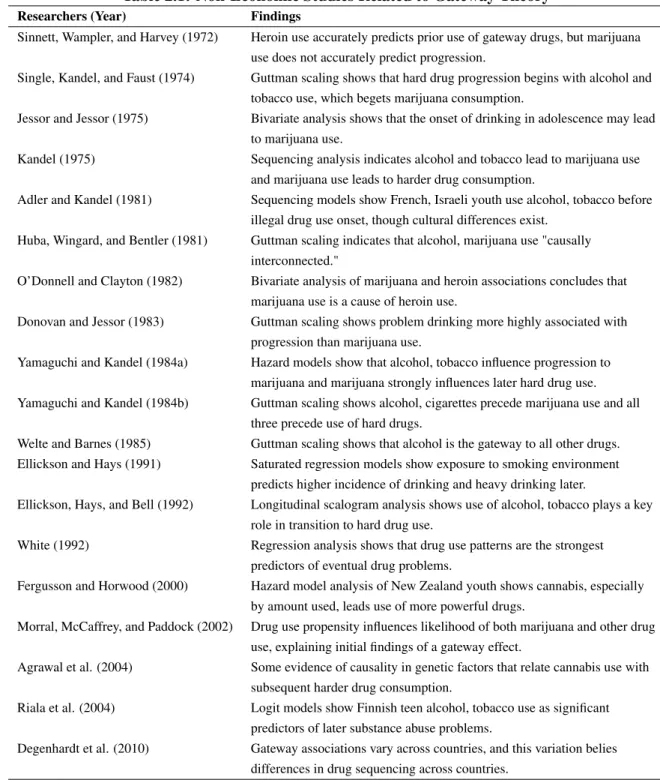
psychiatry, sociology, and public health. Table 2.1 provides an incomplete synopsis of these studies,
which are largely supportive of the gateway concept. The earliest studies tend to base findings on
cor-relations and sequencing analyses; only later do researchers turn to statistical modeling. The idea of
the gateway emerged with the seminal work of researchers such as Single, Kandel, and Faust (1974);
Kandel (1975); and Jessor and Jessor (1975). Simply stated, the theory asserts that hard drug
experi-mentation results directly from earlier consumption of drugs like tobacco and alcohol (Kandel, 1975;
Pacula, 1995). Early work supporting gateway theory tends to offer evidence based on use correlations
between drugs (Kleiman, 1992), and data bear out that drug use follows a remarkably consistent pattern.
Smoking and drinking precede marijuana use, which precedes use of more powerful drugs. The early
literature attempts to establish that the gateway effect results from a direct causal process based on the
strength of observed use correlations, usually without attempting to establish the plausibility of a direct
causal process.8 Later studies theorize how causation might operate.9 Researchers often posit that cau-8 Kandel (1978) and Clausen (1978) review these studies, and Kandel and Maloff (1983) provide a more detailed summary
of early research.
9 Since this research is based in the field of economics, a complete review of the vast literature on gateway theory that exists
in various fields of natural science or other social sciences is beyond the scope of the study. See Kandel and Jessor (2002); Agrawal et al. (2004); Ellgren, Spano, and Hurd (2007); Choo, Roh, and Robinson (2008); and Maldonado-Molina and Lanza (2010) for reviews.
Table 2.1: Non-Economic Studies Related to Gateway Theory
Researchers (Year) Findings
Sinnett, Wampler, and Harvey (1972) Heroin use accurately predicts prior use of gateway drugs, but marijuana use does not accurately predict progression.
Single, Kandel, and Faust (1974) Guttman scaling shows that hard drug progression begins with alcohol and tobacco use, which begets marijuana consumption.
Jessor and Jessor (1975) Bivariate analysis shows that the onset of drinking in adolescence may lead to marijuana use.
Kandel (1975) Sequencing analysis indicates alcohol and tobacco lead to marijuana use and marijuana use leads to harder drug consumption.
Adler and Kandel (1981) Sequencing models show French, Israeli youth use alcohol, tobacco before illegal drug use onset, though cultural differences exist.
Huba, Wingard, and Bentler (1981) Guttman scaling indicates that alcohol, marijuana use "causally interconnected."
O’Donnell and Clayton (1982) Bivariate analysis of marijuana and heroin associations concludes that marijuana use is a cause of heroin use.
Donovan and Jessor (1983) Guttman scaling shows problem drinking more highly associated with progression than marijuana use.
Yamaguchi and Kandel (1984a) Hazard models show that alcohol, tobacco influence progression to marijuana and marijuana strongly influences later hard drug use. Yamaguchi and Kandel (1984b) Guttman scaling shows alcohol, cigarettes precede marijuana use and all
three precede use of hard drugs.
Welte and Barnes (1985) Guttman scaling shows that alcohol is the gateway to all other drugs. Ellickson and Hays (1991) Saturated regression models show exposure to smoking environment
predicts higher incidence of drinking and heavy drinking later.
Ellickson, Hays, and Bell (1992) Longitudinal scalogram analysis shows use of alcohol, tobacco plays a key role in transition to hard drug use.
White (1992) Regression analysis shows that drug use patterns are the strongest predictors of eventual drug problems.
Fergusson and Horwood (2000) Hazard model analysis of New Zealand youth shows cannabis, especially by amount used, leads use of more powerful drugs.
Morral, McCaffrey, and Paddock (2002) Drug use propensity influences likelihood of both marijuana and other drug use, explaining initial findings of a gateway effect.
Agrawal et al. (2004) Some evidence of causality in genetic factors that relate cannabis use with subsequent harder drug consumption.
Riala et al. (2004) Logit models show Finnish teen alcohol, tobacco use as significant predictors of later substance abuse problems.
sation flows from the physical act of using one of the gateway drugs (O’Donnell and Clayton, 1982).
Two potential types of causal mechanisms - physiological and sociological - are most often cited
(Lind-say and Rainey, 1997; Pacula et al., 2000; Pudney, 2003; Degenhardt et al., 2010). Lind(Lind-say and Rainey
describe psychosocial-based explanations for causation: Learning-based models offer that use of a
gate-way drug like tobacco imparts learning on the user on a number of levels (legal, health, etc.), fostering
an increased likelihood of trying other drugs; alternatively, social and behavioral models emphasize
the potential gateway effects of social influences such as peer effects and social pressures. Two 1997
studies document marijuana’s effects on neurochemical processes (Rodriguez-de-Fonseca et al.; Tanda,
Pontieri, and Di Chiara), and additional physiological evidence from Ellgren, Spano, and Hurd (2007)
indicates that marijuana use may alter the brain’s opioid receptors in a way that promotes later use of
opiates. Agrawal et al. (2004) find a role for genetics in a study of twins. For the vast majority of this
work, the authors view their findings as being supportive of the gateway theory.
Economic Studies
Kleiman (1992), DeSimone (1998), and Pacula (1998b) generalize two avenues based in economic
theory through which a gateway effect might operate.10The first avenue reflects a reduced uneasiness or enhanced curiosity about trying progressively more powerful drugs after initiation into, and subsequent
use of, the gateway drug, where the initial experimentation proves enjoyable and increases utility.
Con-sumption of the gateway drug thereby alters the expected marginal benefit-marginal cost comparison
for initial use of other drugs, increasing the probability of subsequent initiations.11 The second pathway describes a rational addiction process, where the "high" from using a lower tier substance gradually
diminishes and the user subsequently experiments with more powerful substances in order to replicate
the lost effect on overall utility.
The relevant literature in economics can be divided into three categories: use of one substance in
isolation, single-period use of two or more substances, and multi-period use of more than one drug.
Kenkel, Mathios, and Pacula (2001) provide a concise outline of single-substance studies, which are
contextually relevant in describing the economics of substance use and abuse. Table 2.2 summarizes the 10I define economic studies as those done by economists and/or presenting results based off of an economic model of drug
demand.
11As noted above, my study introduces factors that influence expected costs in the form of legal risks, as also envisioned in
Pacula (1998b) and Kenkel, Mathios, and Pacula (2001).
Table 2.2: Single Period Economic Studies Related to Gateway Theory
Researchers (Year) Findings
Supporting Gateway Theory Drugs are complements in consumption
Moore and Cook (1995) Drinking patterns developed in adolescence persist into adulthood, mainly from habit formation instead of unobserved variables.
Chaloupka et al. (1999) Cigarette prices are inversely related to marijuana use, both for initial use as well as the amount of consumption by current users.
Dee (1999) Increasing the legal drinking age from 18 to 21 decreased youth smoking; higher tobacco taxes associate with less teenage drinking.
Farrelly et al. (2001) An increase in the tax on cigarettes induces a decrease in the level of marijuana use among current users.
Williams et al. (2001) College students use alcohol and marijuana in complement.
Williams and Mahmoudi (2004) Alcohol prices and fines for a higher blood alcohol content than legally allowed (for driving) are both negatively related to marijuana use.
Corman et al. (2004) Higher cocaine prices decrease illegal drug use among pregnant women. Marijuana is by far the drug most prevalently used by these women. Not Supporting Gateway Theory Drugs are substitutes in consumption
Model (1993) Marijuana decriminalization is correlated with a “significant reduction” in hospital emergency room visits related to harder drugs.
Goel and Morey (1995) Cigarettes and liquor are substitutes, though both appear to be complementary to leisure.
Chaloupka and Laixuthai (1997) Marijuana possession decriminalization by some states in the 1980’s led to decreased drinking among youth compared to criminalized states.
DiNardo and Lemieux (2001) The standardization of the legal drinking age in the U.S. (to 21 in 1984)* led to an increase in marijuana consumption.
Bask and Melkersson (2004) Swedish data show alcohol and cigarettes to be complements in consumption. Other Findings Mixed results about drug complementarity/substitutability
Grossman and Chaloupka (1998) Cocaine is a complement to marijuana but a substitute for alcohol. Decker and Schwartz (2000) Alcohol prices are inversely related to smoking participation, but cigarette
prices are positively correlated with alcohol use.
Cameron and Williams (2001) Marijuana substitutes for alcohol but is complementary to cigarette use; drinking and tobacco smoking are complementary.
DeSimone and Farrelly (2003) Higher cocaine prices depress marijuana demand, but youthful marijuana use is unaffected by cocaine prices.
Dave (2008) Cocaine and heroin are complements in consumption.
single-period, multi-drug studies. Many of these studies explicitly look for cross-price elasticity
esti-mates and do not claim to be studying gateway theory. Among those that claim gateway implications,
findings of contemporaneous complementarity are typically viewed as supportive of the gateway
hy-pothesis, since such complementarity does not contradict the observed gateway progression in the sense
that if use of one drug leads to use of another, research results should indicate that consumption of
those drugs exhibits complementarity. The concensus view, however, is that complementarity must be
intertemporal to support the existence of gateway effects (Pacula, 1995), since use of data from a single
time period does not provide robust evidence about a theory of drug use progression over time.
A commonly accepted methodology for investigating gateways in economics estimates
intertempo-ral cross-price elasticities based on individual-level demand equations (Pacula, 1998b; Kenkel, Mathios,
and Pacula, 2001). Finding data on illegal drug prices is difficult, so non-pecuniary prices such as the
severity of drug laws are often used instead. (I will do the same below.) Researchers often assume that
results support the gateway theory if a change in a policy, law, or monetary price affects future drug use
in a manner consistent with the theory; findings that these factors do not influence future consumption,
or influence future use in a way that is inconsistent with gateway effects, are seen as contradicting the
theory. A summary of the relevant multi-period economic literature appears in Table 2.3.12
The studies listed in Table 2.3 utilize a variety of methods to examine the use of multiple drugs and
contain conflicting findings, sometimes even within a single study. Thies and Register (1993), for
exam-ple, study the effects of marijuana decriminalization on alcohol, marijuana, and cocaine consumption
using Monitoring the Future (MTF) data, finding that results using the 1984 sample differ from those
using the 1988 sample. Decriminalization significantly increases cocaine consumption in 1984 but not
1988, and substantially decreases heavy drinking in 1988 but not in 1984. They take their results to be
unsupportive of the gateway idea that marijuana use leads to "compulsive" use of harder drugs, but that
continued decriminalized status for marijuana correlates with more occasions of consuming six or more
drinks in a single sitting. In the context of the Degenhardt et al. (2010) study mentioned above, though, 12The categorization of findings in Tables 2.2 and 2.3 is based on my own understanding of the literature, and does not
nec-essarily reflect the referenced investigators’ views on gateway theory. An example of a conflict between my categorization and the cited authors’ description of their findings in Table 2.3 is the Saffer and Chaloupka (1999) study. The authors see complementarity as simply "suggesting that drug users prefer to use various drugs together rather than to substitute one for the other."
Table 2.3: Multiple Period Economic Studies Related to Gateway Theory
Researchers (Year) Findings
Supporting Gateway Theory Drugs are complements in consumption
DeSimone (1998) Prior marijuana participation increases the chances of current cocaine use, and alcohol and marijuana are complements.
Pacula (1998b) Higher alcohol prices in the past lead to lower current marijuana use, though previous period marijuana prices have no effect on current alcohol consumption. Beenstock and Rahav (2002) A natural experiment among Israelis aged 18 to 40 indicates a "causal effect" of
smoking on later marijuana use, but no such effect for marijuana use on harder drug usage.
Sen, Agarwal, and Hofler (2002) Smoking and drinking are gateways to marijuana, and vice versa. Abdel-Ghany and Wang (2003) Cigarettes are a gateway to marijuana, though alcohol is not. Bretteville-Jensen, Melburg, and
Jones (2008)
Multivariate probit model shows that gateway effects remain considerable, though reduced, after controlling for unobserved heterogeneity.
Not Supporting Gateway Theory Drugs are substitutes in consumption
Thies and Register (1993) Marijuana decriminalization may have increased hard drug experimentation and is correlated with heavy drinking episodes, but did not cause strong gateway effects.
Saffer and Chaloupka (1999) Alcohol and marijuana are substitutes, though alcohol, marijuana, cocaine, and heroin are all complements with the noted exception. Marijuana
decriminalization results provide weak, but not meaningful, evidence for complementarity between marijuana and alcohol.
Pudney (2003) Controlling for associations between problem behaviors, gateway effects from models that do not control for these correlations are significantly lessened. Van Ours (2003) Sensitivity analysis shows that any gateway from marijuana to hard drugs is
limited and that evidence of complementarity reflects unobserved heterogeneity.
one might see such results as definitively contradicting the gateway concept since they indicate variation
in effects over time and are therefore not consistent with a straightforward causal process.
DeSimone (1998), using the 1979 National Longitudinal Survey of Youth (NLSY79), finds
sup-port for gateway effects in that prior marijuana use significantly increases the current probability of
using cocaine. Also employing the NLSY79, Pacula (1998b) finds evidence consistent with gateways
in that prior smoking and drinking increase the probability an individual currently smokes marijuana.
More recently, Beenstock and Rahav (2002) use Israeli data to show that cohorts growing up in
peri-ods of cheaper cigarette prices are more likely to smoke and to start smoking at a younger age than
cohorts growing up in times when cigarette prices are relatively higher. Both Beenstock and Rahav and
individual currently consumes marijuana.13
Other work calls the gateway theory into question, however. Utilizing the National Household
Sur-veys on Drug Abuse (NHSDA), Saffer and Chaloupka (1999) state that although statistically significant
results show that alcohol, marijuana, cocaine, and heroin are generally complements in consumption,
these results actually argue against gateway theory due to the small magnitude of the effects.
Pud-ney (2003), using a 1998 sample of British youth with retrospective information, employs a discrete
time random effects methodology to control for unobservables, finding in behavioral simulations that
gateway effects are substantially lessened when implementing these controls. Work by Van Ours (2003)
uses data from Amsterdam to similarly suggest the importance of unobserved heterogeneity among drug
users. The author uses a bivariate duration model to control for unobservables, reporting that marijuana
causally serves as a "stepping-stone" into cocaine use but that the relationship is highly correlated with
unobservable heterogeneity that leads individuals to consume both drugs. Finally, Bretteville-Jensen,
Melberg, and Jones (2008) work with a unique survey taken from a questionnaire mailed to young
adults in Oslo to determine that unobserved heterogeneity accounts for some of the gateway effect they
find, but that the estimated gateway remains substantial even after taking these unobservable factors into
account.
Particularly relevant for this research are the studies by Pacula (1995 and 1998b), Van Ours (2003),
and Bretteville-Jensen, Melberg, and Jones (2008). The Pacula (1998b) study inspires this work in
terms of the basic framework employed,14 as does Van Ours in terms of implementing controls for unobserved heterogeneity and observing more than two time periods of drug behavior. Finally,
Bret-teville-Jensen, Melberg, and Jones estimate a multinomial probit model to control for unobservable
heterogeneity, providing an impetus for measuring smoking and drinking behavior in a multinomial
framework. Specifically, using two panels of the NLSY79 cohort, Pacula (1998b) estimates the effects
of lagged beer prices (in the form of beer taxes) on current period marijuana consumption and vice versa,
with System to Retrieve Information from Drug Evidence (STRIDE) data from the Drug Enforcement
Administration (DEA) providing marijuana price information. She finds that alcohol and marijuana use
are complementary among the adolescent group under study, with higher beer taxes significantly de-13Alcohol use, however, does not affect the likelihood of marijuana use in the Abdel-Ghany and Wang (2003) study. The
authors use the 1999 National School-based Youth Risk Behavior Survey (YRBS).
14While this research uses the NLSY97 instead of the NLSY79, my related replication study of Pacula (1998b) uses the
NLSY79 and constructs similar price proxy measures to the ones used in the earlier work (Grider, 2005).
creasing both the likelihood of marijuana use and the amount used conditional on positive consumption.
These findings support the gateway idea, but the relevance of her work does not end there.
Also relevant to the current research is the inclusion of non-monetary prices such as whether or not
possession of small amounts of marijuana is decriminalized in the respondent’s state of residence. While
use of this decriminalization variable remains standard in such studies, Pacula’s (1998b) results lead her
to theorize that because of potential differences in perception of enforcement and actual enforcement,
variation in enforcement of a law may be more important than its existence.15 Consistent with initial evidence that marijuana consumption does not correlate with the standard definition for whether or
not a state has decriminalized marijuana (Johnston, O’Malley, and Bachman, 1981; Murphy, 1986;
Single, 1989; Thies and Register, 1993), Pacula, Chriqui, and King (2003) later find that the standard
definition lacks consistency, with four of the states normally defined as being decriminalized classifying
a first-time offense as a criminal offense. Seven states not normally defined to be decriminalized states,
however, classify first-time offenses to be non-criminal. The research below makes use of these insights
by defining decriminalized states as those in which a first-time possession offense is not classified as a
misdemeanor or felony. I also control for non-pecuniary marijuana prices, though I do so while jointly
estimating the effect of prior drug use on current drug consumption instead of following most authors of
related economic studies, which focus on how drug consumption varies with changes in either pecuniary
or non-pecuniary prices.
The Bretteville-Jensen, Melberg, and Jones (2008) and Van Ours (2003) studies both use
geograph-ically consistent panels (from Oslo and Amsterdam, respectively) and implement controls for
unob-servable, individual-level heterogeneity.16 Bretteville-Jensen, Melberg, and Jones condition on use of a defined gateway drug (or drugs), and subsequently estimate a multinomial equation capturing cannabis,
amphetamine, and cocaine consumption.17 Van Ours combines elements of a mixed proportional hazard model (to adjust initiation by age) and a bivariate duration model (to specify a joint density function for 15MacCoun et al. (2009) find evidence that individuals do not accurately assess whether or not marijuana is decriminalized
in their state.
16Bretteville-Jensen, Melberg, and Jones use a single round of survey questionnaires sent out to 21-30 year olds in Oslo,
Norway. The response rate to the questionnaires is 50 percent. Van Ours employs four rounds of a survey of Amsterdam residents aged 26-47 who are both of Dutch nationality and born in The Netherlands.
17Marijuana use likelihood is conditioned on prior alcohol use. The probability of amphetamine consumption is conditioned
duration of nonuse for both cocaine and cannabis) to allow unobservables to impact cocaine starting
rates. Both studies find that meaningful gateway effects persist after the implementation of controls for
unobservables. Bretteville-Jensen, Melberg, and Jones state that the gateway is lessened "substantially"
but remains "considerable," however, while Van Ours concludes that while a potential gateway exists,
the connection between cocaine and marijuana consumption mainly lies with unobserved individual
characteristics.
Indeed, unobservable factors may explain the observation by Abdel-Ghany and Wang (2003) that
"the earlier an individual starts using these gateway substances (cigarettes and alcohol), the more likely
such an individual is to progress to smoking marijuana." That statement suggests the presence of bias in
findings that do not control for individual-level variables that influence both early experimentation with
gateway drugs as well as any eventual progression into harder drugs. As outlined above, much work
has been done to study the gateway theory within an economics framework, where things like prices
matter and are often controlled for despite the difficulties involved with obtaining price information.
This study will combine standard price controls in the form of taxes for beer and cigarettes with new
controls for marijuana prices to circumvent the dearth of monetary price information. In addition, while
the research described in the preceding paragraphs implements controls for unobservables, I attempt to
implement such controls more robustly than prior work, estimating a system of equations defining basic
drug demand as depending on prior drug use, controlling for criminal activity and sample attrition, and
following the survey cohort over a longer period of time than previous gateway-related work. I outline
the theory behind this study in the next chapter.
Chapter 3
Theoretical Framework
This model provides a framework for assessing gateway theory by analyzing the degree to which
prior consumption of tobacco, alcohol, and marijuana impact current demand for those drugs by
ado-lescents and young adults. The model accounts for observable and unobservable factors that
simultane-ously affect consumption of each of the three subtances under study. Solving a dynamic optimization
problem suggests that the derived demand function is a direct function of prior consumption of all three
drugs. As noted above, the approach offers the advantages of estimating demand equations for
individ-ual drugs that directly control for prior drug use in addition to current prices, instead of using a standard
approach that instruments for prior consumption with prior-period prices. I implement controls for
un-observable heterogeneity, and unlike prior studies that do the same, I follow a diverse, representative
cohort of individuals over many (eight) time periods. Finally, I also model arrests and sample attrition,
behaviors that directly relate to drug use and reported use. The timing of the model is as follows:
1. An adolescent/young adult enters each period with a history of tobacco, alcohol, and marijuana use, inclusive of the option of complete abstention from all drugs, and the experience of any legal repercus-sions resulting from positive past consumption.
2. The individual chooses a drug consumption combination from a set of eight possible choices, ranging from complete abstention to consumption of all three drugs.
3. The individual potentially experiences legal repercussions from positive drug consumption.
3.1 Demand for Multiple Drugs
While the empirical work in this study analyzes three drugs, the underlying economic model can
be extended to incorporate any number of drugs. For instance, while this study attempts to examine
potential gateway effects surrounding the joint consumption of cigarettes, alcohol, and marijuana, a
study using different data might examine the gateway from marijuana to cocaine. From a theoretical
standpoint, the gateway theory can be examined using a rational addiction framework1that analyzes the effect an accumulated addictive stock of (prior) gateway drug consumption has on current consumption
of a more powerful drug. In practice, prior consumption is typically proxied for using prior prices or
taxes (Pacula, 1997; Kenkel, Mathios, and Pacula, 2001), and, as outlined above, the assessment of
gateway effects depends on the sign of the coefficient estimate on those price variables. In this chapter,
however, I specify a system of equations that allows prior consumption to enter the demand equation
directly along with current-period drug prices and observable and unobservable covariates.2
During each periodt, individuals choose to either abstain from or consume three potentially
addic-tive drugs. For each periodt, drug consumption choices can be represented by a vector of dichotomous
indicatorsdjt∈ {0,1}defining consumption of drug j, j=1,2,3, where jcorresponds to cigarettes,
alcohol, and marijuana, respectively. I denote eight possible consumption combinations for the three
drugs bydt=d,d=0, . . . ,7. An alternative formulation ofdjt could employ a multinomial indicator
to distinguish between no use and "light" and "heavy" consumption of the drug, a count variable, or
even a continuous variable to capture use amounts. Definitions of light and heavy use might vary by
drug or the age of the consumer. I posit that empirically, it is important to define, conditional on
posi-tive consumption of a particular drug, how much of that drug the individual consumes. As outlined in
the Becker and Murphy (1988) model of rational addiction, an addictive stock of accumulated past use
builds up over time when an individual uses a drug, increasing current and future consumption amounts
of that good. Whereas non-addictive good consumption only affects current utility through current
con-sumption, the stock of past addictive good use affects current utility through the addiction mechanisms 1 See Stigler and Becker (1977); Iannaccone (1984 and 1986); Becker and Murphy (1988); and Becker, Grossman, and
Murphy (1994).
2 The theoretical formulation is used to motivate specification of an estimable empirical model below. Using the estimated
model, the effect of the addictive stock of past use will be examined by establishing a baseline of simulated behavior against which results from alternative behaviors and policy experiments will be compared.
of habit, tolerance, and withdrawal.3 While much of the rational addiction literature focuses on con-sumption decisions as they relate to one good, the concept of rational addiction in a gateway theory
context allows the addictive stock to accumulate additively across drugs. Over time, as individuals’
consumption of, and tolerance to, gateway drugs increases, so does the likelihood that these individuals
initiate into consumption of harder drugs (Pacula, 1997; Kenkel, Mathios, and Pacula, 2001).4 Thus, an
appropriate methodology for examining gateway effects is to estimate current consumption as a function
of the stock of past consumption while controlling for current prices.
To capture the stock of past addictive good use, any number of variables might be included in a
vector of state variables Ωt, which consists of observable factors that evolve over time and influence
current period drug consumption decisions. Time-varying drug consumption stock variables inΩt are
defined enteringt. For example, one might define a series of variables that represents the addictive drug
consumption stockStj,k, wherejcontinues to identify the drug andkenumerates the variable that defines
a particular type of addictive stock, k∈[0,1, . . . ,K]. Stock variables include experience (cumulative
amount of time spent as a user), duration (consecutive amount of time in consumption spent by current
users), and variables that describe prior consumption (e.g., use indicators and conditional consumption
amounts). The empirical work below will employ information about whether or not a person has ever
(separately) used cigarettes, alcohol, and marijuana entering periodt, whether the person is a current a
user of each drug enteringt(i.e., did he use in periodt-1?), and a conditional indicator for whether or
not positive use of a particular drug att-1 represents the individual’s first ever use of that drug. Note
that the drug use state variables, while defined with atsubscript, apply to variables definedenteringthe
period, such that their values represent the state of the world at the end of the prior period.
The representation of the drug use state variables in this model flexibly accommodates
consump-tion measured in time, amount, or by some other definiconsump-tion. Addiconsump-tional state variables include a vector 3 Because this is a model of drug use by adolescents and young adults, the model presented here largely ignores health effects
that might also impact current period utility. While an argument can be made for directly including health consequences in a theoretical model of addictive good consumption over the life cycle, I do not directly incorporate health here since the study only covers the initiation stages of drug use. Instead, this model captures health effects via the idiosyncratic error term, through a potential health shock like the type that might be experienced with an overdose. Given that initiation into any drug almost universally occurs by the mid-20’s (Kandel, 1978), long-term health effects should be, or at least be perceived to be, minimal for most adolescents and young adults (Lindsay and Rainey, 1997). To the extent such effects do occur, it seems likely that they might either go unnoticed or simply not affect the consumption decision significantly.
4 One way to think about this process is that for an adolescent who drinks alcohol, is becoming accustomed to drinking, and
of observable personal characteristics (Xt) and a vector of local factors (Zt) that might affect an
indi-vidual’s ongoing drug consumption. Examples of variables inZt include factors like unemployment
(Ruhm, 1995), which correlate with income, or regional arrest rates,5 which reflect law enforcement priorities and the degree to which laws are enforced. Finally, a vector of variablesCtj,l,l∈[0,1, . . . ,L]
describes drug-related arrests and captures an individual’s history of trouble with the police with respect
to drug-related crime (alongL dimensions) entering each period. It also includes current-period drug
use.6 In the empirical model below, the variables defined inCtj,l are analogous to the drug use state variables, including an indictor for ever having experienced any arrest (not necessarily a drug-related
one) enteringt. Additional variables indicate whether the person was arrested duringt-1 and whether
or not a periodt-1arrest was the respondent’s first arrest. The theoretical model, however, limits itself
to drug-related arrests, and might include other variables such as a cumulative number of drug-related
arrests or an individual’s history, in terms of calendar time, of such interactions with law enforcement
for drug-related criminal activity.
The importance of these potential legal consequences lies in an information updating process that
affects future drug consumption decisions. Prior to initiation into use of a particular drug, the
conse-quences of use are difficult to gauge.7 After initiation, consumption that results in favorable experiences and no ill consequences will tend to affect future consumption decisions positively (Pacula et al., 2000),
while unfavorable experiences along any dimension (e.g., an arrest resulting from positive
consump-tion) will tend to decrease future consumption. The rational addiction literature is based on the idea of
a drug consumer rationally assessing expected benefits and costs of substance use (Becker and Murphy,
1988), but does not focus much attention on the cost side of the decision to use a drug. Orphanides and
Zervos (1995) outline a model of substance use behavior that describes the costs of becoming addicted
to the drug. I build off of that idea in this model, explicitly modeling costs, in the form of drug-related
arrests, under the assumption that an arrest (or lack thereof) impacts future drug consumption through
an updating process that affects individual assessments of the likelihood of a future arrest. Prior work
supports the idea that the experience of an arrest alters an adolescent’s perception of the likelihood of 5 See Pacula (1995 and 1998b) and Caulkins, Feichtenger, and Tragler (2001).
6 Cj,l
t includes whether or not the person consumes drugsthisperiod, since a drug user’s current utility from drug consumption
undoubtedly depends upon whether or not they have recently been arrested or are currently in jail.
7 In fact, in the theoretical model, one might also incorporate other potential consequences of drug consumption, such as
school-related or parental punishments, that potentially impact an adolescent’s decision to use drugs.
being arrested in the future (Lochner, 2007). As mentioned above, Pacula (1998b) and Kenkel, Mathios,
and Pacula (2001) describe models incorporating a drug-specific legal risk of using a drug, but do not
specify the risk, nor directly control for it empirically in the manner I do here.
Entering periodt, then, the information available to the individual as he makes the period tdrug
consumption decision,dtj, is summarized by the following vector of state variables:
Ωt =
n
Stj,k,Xt,Zt,Ctj,l
o
(3.1)
The drug consumption stock variables represented byStj,k take on positive values for current and
past users but zeroes for non-initiates. Using the variables described above (experience entering period
t-1and use during the period) as examples, four drug-specific alternatives describe a person’s state of
drug use entering periodt(as noted above, leaving a total of 12 such states):
1. Complete abstainer (never used beforet-1and did not use int-1) 2. Former user (used beforet-1but not int-1)
3. New user (initiated int-1)
4. Continuing user (used beforet-1and continued to use duringt-1)
On the basis of these four potential states of drug use entering periodt, a similar construct for four
states of drug-related criminal history, observables, and, as described in the next section, factors that are
unobservable to the researcher, the individual makes the periodtconsumption decision.
3.2 Gateways - Current Consumption as a Function of Past Use
At t, adolescents make drug consumption decisions that maximize expected lifetime utility, which
depends on drug consumption, consumption of a standard composite good (Gt) with price normalized
to one, and two types of taste shifting factors that alter the consumption utility of both drugs and the
composite good. In the case ofSt,Xt,Zt, andCt,8these taste shifters are observable. The other type of
taste shifters includes unobservables in the form of permanent (µ), time-varying (νt), and idiosyncratic
(εt) heterogeneity. Not all unobservable factors can be definitively classified into these three categories
of latent variables, but an example of a drug-related shock captured byεt could include a sudden health
problem, such as one resulting from an overdose. Alternatively, an example of permanent heterogeneity
affecting drug use decisions between individuals would be innate, time-invariant differentials in risk 8 For notational simplicity, I suppress the superscripts onSj,k
preferences, where one person is a risk taker and therefore more likely to experiment with drugs than a
relatively more risk averse individual. Examples of time-varying heterogeneity could include influences
like peer or parental effects that vary both between individuals as well as over time for a particular
individual.9 (Of course, risk aversion might vary over time as well.) Thus, utility depends on current consumption decisions, but shifts based on unobservables, the amount of the stock of accumulated drug
use, police detected criminal activity, and observables inXt andZt. Defining β as a discount factor,
expected lifetime utility can be written as
Et
"
T
∑
t=0βtUt(Gt,dt;St,Xt,Zt,Ct,µ,νt,εt)
#
(3.2)
whereEt[·]is the expectations operator. Note that current utility directly depends on past drug
con-sumption in this rational addiction-type framework through St. Current utility also depends directly
on whether or not one experiences a legal consequence from use of a drug during the current period.
In terms of model timing, the drug consumption decision is made duringtand any legal trouble from
that decision occurs in the same period, presumably while one is still "high" on the drug(s) being used.
Those drug use decisions, any legal consequences that result, and other factors that the researcher either
can or cannot observe factor into next period’s decisions. Defining a drug price vectorPt= [Pt1,Pt2,Pt3]
for each drug,10expected lifetime utility is maximized subject to a lifetime budget constraint,
T
∑
t=0RtYt = T
∑
t=0(Gt+Pt•dt) (3.3)
whereYtis periodtincome andRt =(1+1r)t−1 is a discount factor that depends on the market interest rate
r. Recalling thatΩt=
n
Stj,k,Xt,Zt,Ctj,l
o
and allowing realized drug-related consequences to be defined
9 It is well accepted that unobservable factors such as family influences (Altonji, Cattan, and Ware, 2010) and peer effects
(Kandel, 1985) play a role in youthful substance use decisions. In the context of gateway effects, however, determining the relative importance of any particular latent factor is empirically difficult and not a goal of the current study. Like prior work that controls for unobservable heterogeneity, then, this study makes no explicit claim about the exact avenue through which unobservable variables affect drug consumption, just that they play a role.
10Ctmight be thought of as a price, since a previous drug-related arrest would tend to increase the full price (pecuniary plus
non-pecuniary) of future drug consumption (Grossman, Chaloupka, and Shim, 2002). For instance, a second drug arrest results in harsher penalties than a first arrest. As such,Ctcan be modeled as a function of prior and/or current drug use, since the history and levels of current use both impact a drug user’s likelihood of current arrest. For current use, a DWI arrest necessitates use of a drug (usually alcohol) in close proximity to the time of arrest. In terms of looking at the potential impact of past drug use on an arrest, a 1999 study of DWI probationers reveals that nearly 70 percent had used drugs at some point in the past and that 17 percent report drug use in the month prior to their arrest (Maruschak, 1999).
asc∈[0,C],whereCis the maximum possible drug-related punishment, the periodtlifetime value of
choosing a combination of drug consumptiondis defined as:
Vdc(Ωt,εt) =Ut
Gt,dt;Ωt,µ,νt,εtd
+β
"
C
∑
c0=0Prob(ct+1=c)Vc 0
(Ωt+1)
#
(3.4)
where the maximum expected lifetime utility value is:
Vc(Ωt) =Et−1
maxd∈[0,7][Vdc(Ωt,εt)] ∀t (3.5)
At the end of each period, the individual’s drug use and criminal histories evolve based on the drug
use decisions made during the period and the resulting legal consequences of those decisions, if any. An
arrest for possession of marijuana in one period, for instance, should affect the decision to use marijuana
in the following period.11 The evolution of both histories reflects the drug consumption choices made during the period. The drug consumption stock variables provide the main parameters of interest in this
model, in the form of testable hypotheses regarding the importance of a joint stock of drug consumption
capital, controlling for current prices and arrest history as well as the impact of these factors on current
drug demand. Specifically, the empirical model described below will conduct various policy
experi-ments that compare the effects of theoretical “full enforcement” policies12versus the effects of changes in pecuniary and non-pecuniary prices. Discussion will focus on potential gateways from cigarettes and
alcohol use into marijuana consumption, as well as the relationship between marijuana consumption
and demand for cigarettes and alcohol. Before discussing the empirical model based on the framework
presented above, though, in the next chapter I describe the data used to estimate the model.
11As mentioned above, Lochner (2007) uses NLSY97 data to study an individual’s assessment of the likelihood of arrest
upon commission of a crime. He finds that the experience of an arrest increases the individual’s belief about the probability of being arrested upon the commission of a future crime, while the commission of a crime without an arrest causes the individual to reduce his or her assessment of that probability.
12I define a full enforcement policy to be a hypothetical policy that succeeds in completely eliminating a certain type of drug