ON THE BACKS OF TORTOISES:
CONSERVING EVOLUTION IN THE GALÁPAGOS ISLANDS
Elizabeth Ann Hennessy
A dissertation submitted to the faculty at the University of North Carolina at Chapel Hill in partial fulfillment of the requirements for the degree of
Doctor of Philosophy in the Department of Geography.
Chapel Hill 2014
Approved by:
Wendy Wolford John Pickles Scott Kirsch
ii ©2014
ABSTRACT
Elizabeth Ann Hennessy: On the Backs of Tortoises: Conserving Evolution in the Galápagos Islands
(Under the direction of Wendy Wolford)
The Galápagos Islands are today considered a world-renown “natural laboratory of evolution” and one of the best-preserved ecosystems on earth. Yet even this remote archipelago is not immune from global environmental crises: in 2007, UNESCO put the Galápagos on its list of World Heritage Sites In Danger because of booming tourism development. Most analyses explain this crisis as a Malthusian problem of over-development on fragile islands. However, I argue that adequately understanding current problems in the Galápagos requires a return to the annals of evolutionary science to analyze how that history shaped the islands. This dissertation traces this history on the backs of the islands’ most iconic species, giant tortoises, to show how the development of evolutionary science has reshaped understandings of island nature and how it is managed.
The dissertation traces a “history of the present” through detailed archival and
iv
particular, they track how scientific valuations of the islands as a natural laboratory justified both conservation work and tourism development. By detailing the relationship between conservation and tourism through which giant tortoises became charismatic icons, the dissertation reframes the recent crisis not as the intrusion of globalization into a space of pristine nature, but as produced through an alliance between scientific conservation and global capitalism.
ACKNOWLEDGEMENTS
I never intended to write a dissertation about tortoises, but it has been my great fortune that my plans turned and twisted in ways that led me to the Galápagos. This work would not have been possible without the openness, patience, and enthusiasm of countless others. To be able to build a career from a desire to travel and learn more about the world is a remarkable gift. For getting me interested in Geography as an undergraduate at Miami University, I must first thank Howell Lloyd and Stan Toops. For inviting me to Galápagos, I will always be indebted to Steve Walsh. To Wendy Wolford, thank you for seeing potential and pushing me to reach it. For eight years. To my committee, John Pickles, Scott Kirsch, Larry Grossberg, and Margaret Wiener, thank you for challenging and cheerleading, leading and listening. To Brenda Baletti, Sara Safransky, and Holly Worthen, I am so glad we were in it all together. My time in graduate school would have been much less productive and far less fun without you. To Joe Bryan, thank you for leading the darkside at a crucial moment.
vi
Caccone, your willingness to explain your work at length was crucial for the success of the project. To Fredy Cabrera and Steve Blake, thank you for allowing me to tag along on your projects, and for slowing down enough for me to keep up. To Craig MacFarland, Tom Fritts, Howard Snell, and many others, thank you for reflecting on your own Galápagos histories in ways that greatly enriched my understanding of the place today. To Swen Lorenz, thank you for being a friend, and of course, the unsurpassed accommodations. Thank you also to Matt James and Barbara West. Paola Pozo, thank you for your enthusiastic help and for making me feel at home. Kim Engie, Laura Brewington, and Liza Guzman, Galápagos life would not have been the same without you! I also owe a huge debt of thanks to all the Galapagueños, local or otherwise, who welcomed me and took the time to share their worlds with me.
This research also depended on the skills of numerous archivists and librarians, among whom I must especially thank Becky Morin and Christina Fidler at the California Academy of Sciences, Paul Martyn Cooper and Daisy Cunynghame at the British Museum (Natural History), Erika Loor at the Charles Darwin Research Station, Madeleine Thompson at the Wilderness Conservation Society, and Alexandre Coutelle at UNESCO. At the San Diego Zoo and Safari
Park, thank you to Amy Jankowski, Kim Lovich, Tommy Owens, Jenna Lyons, and Oliver
Ryder.
This research was made possible by funding and support from the following institutions,
to which I am most grateful: the American Council of Learned Societies/Mellon Foundation, the
Social Science Research Council/Mellon Foundation, the National Science Foundation (Grant
Back at home, I have many friends and writing partners to thank, without whom
dissertating would have been far less enjoyable. Thanks particularly to Ashley Carse, Kim Engie,
Annelies Goger, Conor Harrison, Sara Safranksy, Freya Thimsen, Autumn Thoyre, and Holly
Worthen.
Finally, last but very far from least, thank you to my family: Pat, Mark and Melissa, Judy
and John, Jean, Tricia, and most of all my mom, Linda, for being by biggest supporter and
viii
PREFACE
On a Sunday morning in June of 2012, long-time Galápagos resident and tortoise keeper Fausto Llerena made his usual morning rounds at the Galápagos National Park’s Giant Tortoise
Breeding Center, which has been named for Don Fausto since 1999 in honor of more than three decades of service. On this particular morning, Don Fausto found something unexpected: Lonesome George, the most famous Galápagos tortoise, had passed during the night. The news broke quickly across international media; Lonesome George was eulogized in Nature, The Economist, and the New York Times. For hundreds of thousands of tourists, George had become an icon of conservation efforts. The last of his particular species of Galápagos tortoise, from Pinta Island, he had lived in captivity since he was found alone on Pinta in 1971. His solitary plight was said to sound a clarion call about the human role in species extinctions.
For centuries, Pacific sailors depended on Galápagos tortoises as a key source of fresh meat. Tortoise hunting was also taken up by island colonists when the Galápagos were first settled in the nineteenth century. The large, slow creatures were relatively easy catch in a
islands’ other unusual species and pushed for the creation of the national park to protect island flora and fauna.
Today, the Galápagos are one of the world's most storied tropical archipelagos, famous for
their unusual species, inspiring Darwin's theory of evolution, and as a top eco-tourism
destination. Tortoises today are consumed mainly through tourism, where they continue to shape people’s livelihoods. Nearly 30,000 people live in the Galápagos today—the majority are
Ecuadorians who work in tourism and support industries, in government jobs, and as
conservationists. Residents inhabit only three percent of the archipelago; they live mostly in three coastal towns and adjacent land in the highlands, where six months of misty garua rains make agriculture feasible. The vast majority of land is protected national park, accessible only to tourists in carefully managed visitor sites and scientists working with research permits. Because of the cost of tours, most residents have never seen the Galápagos represented in nature
documentaries. Nor have most seen a giant tortoise in the wild, although in places on the most populated island, Santa Cruz, tortoises and people co-inhabit agricultural areas.
Because of such inequalities, tortoises—particularly Lonesome George—have been lightening rods for political protests among island residents upset at the resources spent on conservation and the way that conservation goals often infringe on their rights, particularly to fish in the Galápagos Marine Reserve. The legacy that George leaves then is not a
straightforward tale of human destruction of the natural world. The human community in the Galápagos—residents, conservationists, scientists, government officials, and tourists—is diverse and multifaceted, much like the islands’ landscapes and the nonhuman creatures that inhabit them. Exploring the history that produced Lonesome George as an iconic animal and the
x
TABLE OF CONTENTS
LIST OF TABLES... xiv
LIST OF FIGURES ...xv
CHAPTER I: INTRODUCTION ...1
Tortoises All the Way Down ...5
Critical Geography of Evolution ...9
Methods ...26
Chapter Outline...39
CHAPTER II: THE SCRAMBLE FOR CONSERVATION: SCIENCE, EMPIRE, AND THE MAKING OF A NATURAL LABORATORY, 1930-1965 ...42
Introduction ...42
Science, Empire, and Conservation...47
Background...52
In Situ Conservation Efforts ...57
A Military Base ...69
UNESCO Takes on a Mission: 1950s ...70
Strategies of Environmental Geopolitics...81
A Working Laboratory ...92
Tourism...95
Conclusion ...98
xii
Conserving a Natural Laboratory ...102
Evolutionary Biopolitics...108
Conclusion ...144
CHAPTER IV: PRODUCING ‘PREHISTORIC’ LIFE: THE REMAKING OF GIANT TORTOISE GENEALOGIES ...148
Introduction ...148
Saving “Prehistoric” Animals...150
Conservation Breeding and the Production of Wildlife ...154
Learning Reproduction: Tortoise Care at the San Diego Zoo ...162
Diego Goes Home: A New Breeding Center in the Galápagos...170
Breeding Atmospheres: Making Natural Spaces of Experiment...173
Conclusion: Conserving Hybrid Natures...185
CHAPTER V: GENETIC PHYLOGENIES, NONHUMAN BIOPOLITICS, AND THE RE-ANIMATION OF LIFE...188
Introduction ...188
Genetic Revolution and the Redefinition of Life ...191
Galápagos Case...202
Placing Aliens...207
Conclusion ...229
CHAPTER VI: THE CONTRADICTIONS OF COMMODIFYING TORTOISE ENCOUNTERS...232
Introduction ...232
Conservation Icons as Boundary Objects...235
Encounters of the Nonhuman Kind ...238
Tourism, Conservation, Encounter Value ...246
Nature of the Crisis...259
Tensions of Iconism...265
Conclusion ...272
CHAPTER VII: CONCLUSION...275
xiv
LIST OF TABLES
Table 1.1 Research Questions and Hypotheses ...27
Table 1.2 Ethnographic Research Methods ...30
Table 1.3 Archival Collections Researched...35
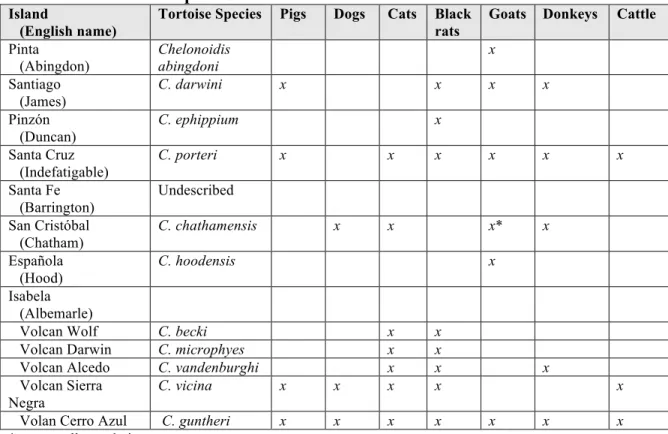
Table 2.1 Status of Giant Tortoise Populations by Island ...79
LIST OF FIGURES
Figure 1.1 Darwin Watches over Puerto Ayora...10
Figure 2.1 The UNESCO/Life Team ‘On the Trail of Darwin,’ 1958...74
Figure 2.2 ‘A Fit Shore for Pandemonium’ Life Illustration of Fernandina Island, 1958...76
Figure 2.3 Crowd Gathered for Dedication of Darwin Research Station, 1964...94
Figure 4.1 Diego Returns to the Galápagos Giant Tortoise Breeding Center, 1977 ...171
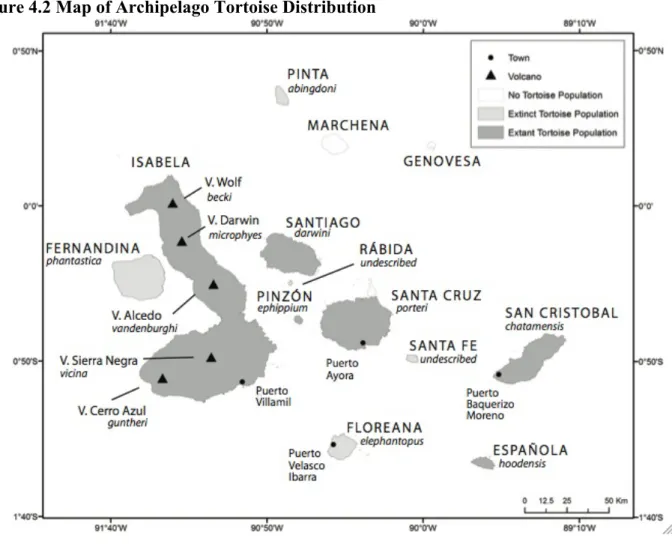
Figure 4.2 Map of Archipelago Tortoise Distribution...176
Figure 4.3 Galápagos National Park Guards Mark Excavated Tortoise Eggs...178
Figure 4.4 Design of Early Tortoise Incubators ...180
Figure 4.5 Hair-dryer Heated Incubation Cabinet ...182
Figure 5.1 Distribution of Giant Tortoises ...203
Figure 5.2 Phylogeny of Giant Tortoises...215
Figure 5.3 Phylogeographic History of Galápagos Tortoises...218
Figure 6.1 Photo of Tortoise Donation Receptacle at CDRS Headquarters...245
Figure 6.2 Tortoise Symbolism in Puerto Ayora, Santa Cruz ...246
Figure 6.3 “Pristine” Landscape, from Bartolomé Island...253
Figure 6.4 “Warning: He who consumes Kastdalen dairy products will live longer than Lonesome George.” ...270
CHAPTER I: INTRODUCTION
"The natural history of these islands is eminently curious, and well deserves attention. Most of the organic productions are aboriginal creations, found nowhere else; there is even a difference between the inhabitants of the different islands; yet all show a marked relationship with those of America, though separated from that continent by an open space of ocean, between 500 and 600 miles in width. The archipelago is a little world within itself, or rather a satellite attached to
America..."
– Charles Darwin, Journal of Researches, 1845, p. 358
Charles Darwin once wrote that the austere landscapes and fauna of the Galápagos Islands were a key piece of the “origin…of all my views” (1959, p. 7). Since Darwin’s visit in 1835, the archipelago has become world-renown as a “natural laboratory” for the study of evolution. Today, work in the field of island biogeography—much of it conducted in the
Galápagos in Darwin’s wake—has shown why oceanic archipelagos are places where evolution can be readily visible (Quammen 1996, MacArthur et al. 1967). As one scholar explained, the Galápagos were significant to Darwin because the isolation, demanding ecological conditions, and relative absence of competitor or predatory species allowed for unique evolutionary
adaptations—adaptations that make the archipelago’s species vulnerable to change.1 Many of the plant and animal species found on the Galápagos are endemic—found nowhere else in the world. Of the 560 species of vascular plants in the archipelago, 180 species—32 percent—are endemic (Lawesson et al. 1987). Fifty-nine percent of vertebrate fauna are endemic—including the islands’ giant tortoises, flightless cormorants, land and marine iguanas, and famous finches
1 William Durham, “What Darwin Found Convincing in Galápagos,” Presentation at the 2009 Galápagos Science
(Snell et al. 2002). Over the past fifty years, considerable efforts to protect these fabled islands have made them one of the best-preserved ecosystems on earth: a place where scientists and tourists alike can go to witness this nature as it supposedly was before the influence of man. Since 1959, 97 percent of the remote archipelago, which straddles the equator 600 miles off the coast of Ecuador in the Pacific Ocean, has been protected as a national park. As a result,
scientists estimate the islands retain 95 percent of their original (pre-human discovery) endemic biodiversity (CDF and WWF 2002).
But over the past 10 years, the islands have been in news headlines around the world not for the success of conservation efforts, but as a site of crisis. Today, this iconic site of “pristine” nature faces a crisis of development that conservationists see as threatening the isolation that allowed for the development of the islands’ endemic species. In 2007, UNESCO put the Galápagos on its list of World Heritage Sites In Danger because of booms in tourism and migration from continental Ecuador. Since the early 1980s, the number of tourists visiting the islands each year has increased more than ten-fold, from just fewer than 12,000 in 1979 to more than 180,000 in 2012. The local population has grown apace, from some 2,000 settlers in the 1960s to 25,000 in 2010. The Ecuadorian Government also declared the islands to be “at risk” because of a host of political, ecological, and social problems associated with growing
3
In the Galápagos, most analyses situate this crisis moment in a neo-Malthusian history of increasing developmental pressure over the past 30 years spurred by the growing popularity of eco-tourism (Gonzalez et. al. 2008, Watkins and Cruz 2007). However, in this dissertation I argue that adequately understanding current problems in the Galápagos requires a return to the annals of evolutionary science to analyze how this history has shaped the islands and their species. Before the islands were a world-renown eco-tourism destination and “evolutionary Eden,” their stark landscapes were better known—in Herman Melville’s words—as an “evilly enchanted” hell on earth (2002 [1854]). The rocky, volcanic islands have little fresh water and the still seas that surround them were a curse for becalmed sailors. The very conditions that made life difficult on the islands were those that proved so interesting for Darwin and biologists
working in his wake. But it took more than Darwin’s influence to shift popular imaginations of the Galápagos from a cursed purgatory to an evolutionary Eden. While an increasing number of naturalists visited the Galápagos in the late-nineteenth and early-twentieth century, in the 1940s the islands were mostly known for the Ecuadorian penal colonies they housed and as a refuge for European settlers who had fled the world wars. As the dissertation will show, this shift in popular imaginations of the Galápagos slowly evolved over the twentieth century, laying the foundation for the tourism industry that is seen as threatening the islands’ nature today.
“pristine” nature, I trace a history of the global flows into and out of this archipelago that made these islands into a desirable tourist attraction and place to live. The popular imagined geography of islands as isolated from modernity belies the fundamental role island landscapes have played in the development of modernity (DeLoughrey 2007). This is perhaps nowhere more true than where Charles Darwin is said to have “discovered” his theory of evolution by natural selection (but see Sulloway 2009 on the Darwin-Galápagos myth). Darwin, in 1835, did not strike upon the islands undiscovered or untouched, but as a territory of the nascent state of Ecuador and a landscape that had sheltered and fed whalers, pirates, and explorers for centuries. The Galápagos were foundational to modernity not only because of their role in inspiring Darwin, but also for supporting seventeenth and eighteenth century maritime economies, and for housing citizens cast out of both a new nineteenth century republic and the tumultuous twentieth century reordering of modernity’s core.
5
my contention that it is this history, and the variety of attempts it has inspired to manage the islands as a site of pristine nature, that shaped the crisis moment. But to say this is not to identify a direct cause, nor to attribute responsibility. Rather than a causal explanation that traces the roots of the crisis, I explore the particular, contradictory, and ever-changing assemblages of humans and nonhumans that have formed the natures, institutions, and flows that have made and remade the Galápagos Islands. Based on Foucault’s reading of Nietzschean genealogies as a method of history, this genealogical approach does not trace a linear unfolding of history nor patterns of descent—as Foucault wrote, “Genealogy does not resemble the evolution of a species and does not map the destiny of a people” (1977, p. 146). Instead, it traces descent in all its complexity, attending to the false starts, contradictions, and struggles that move history as well as their various unintended consequences.
Tortoises All the Way Down
Darwin wrote that the tortoises appeared “antediluvian” (1845, p. 356)—their leathery, gray skin and well-worn armor make them seem to be “survivors from a past age of reptiles” (Rothschild 1983, p. 197). But I use the more recent history of these other-worldly creatures as a foil for accounts that frame them as “prehistoric” nature. I explore how over the past century the
development and celebration of scientific understandings of nature in the Galápagos have shaped the islands and the giant tortoises through transnational governance regimes, conservation work, and tourism development.
Galápagos giant tortoises have been a key species in world history for centuries. These animals have been at the center of scientific discovery, conservation imperatives, and
controversies over the use of natural resources. They are not passive entities, but agents that work to organize the socio-ecological spaces around them in what Sarah Whatmore (2002) terms “wildlife topologies” (also Philo and Wilbert 2000, Wolch and Emel 1998). During the
7
largest herbivores, the tortoises are “keystone” species that act as “ecological engineers” and are thus central to the restoration of island ecosystems (Gibbs et al. 2010). Since the 1980s, giant tortoises have become icons of conservation and tourism. As such, they also organize other landscapes: images of tortoises adorn the logos of most all Galápagos conservation, science, and tourism organizations. Breeding centers and eco-farms are major attractions for an industry that has tripled in size over the past 15 years (Watkins and Cruz 2007). Yet tortoises have also been targets of political protest among Galápagos residents who see conservation as eclipsing opportunities for development (Ospina 2006). Over the past 25 years, Park guards have
repeatedly found crushed eggs and sacrificed tortoises—acts apparently done by local residents in protest of conservation policies (ibid). In the Galápagos, it is tortoises all the way down.
By telling the story of the Galápagos on the backs of tortoises, I take both the symbolism and the materiality of nature seriously. Giant tortoises have long been associated with origin stories from various cultures around world (Chambers 2006)—that the Galápagos tortoises have come to be associated with Darwin’s theory of evolution presents a modern, scientific version of a long-standing tale. Stephen Hawking opened his A Brief History of Time (1988) with the
The story is often used to speak to different cosmologies, different knowledge systems for understanding the world. Clifford Geertz (1973) uses the story—which he recounts as an Indian tale about an exchange between an Englishman and a local—to think through the task of anthropology as the interpretation of culture. He warns against searching for foundational turtles to explain culture, instead advocating thick description of the “hard surfaces of life.” Philosopher of science Isabelle Stengers also recounts the story, this time to caution against the quest in modern science for a transparent foundation for knowledge, a quest that has too often led to “a foundation that makes reference to that which it is supposed to ground” (1997, p. 63). She uses the “theoretical turtles” to push us toward asking not “what they rested on, but with whom they lived,” arguing that we should “recognize them as a rigorous exploration of problems accepted as both relative and fully positive” (1997, p. 65).
9
temporally they seem to take us all the way down to a pre-human, prehistoric landscape. As such, they are a powerful hold for conservationists’ claims to manage the islands as a “bastion of pristine nature” (Watkins and Cruz 2007). But in offering a geographic perspective on the so-called turtle problem, I argue that taking the tortoise seriously, constructing a thick description of “with whom the tortoises live,” demonstrates that even for this most prehistoric-looking species, it is nature-cultures all the way down. Even in these isolated islands, there is no foundational Nature on which to gain special insight into the origins of life or on which to base political claims to govern the islands. Instead, I analyze how and to what effect histories of evolutionary science, conservation, and development have materially and symbolically co-evolved with giant tortoises.
Critical Geography of Evolution
Larson 2001 for an excellent study along these lines, before and after Darwin). Nor is my point to reassert the “Darwin-Galápagos myth” (Sulloway 2009) that he discovered evolution in the islands through direct observation of the various shapes of the beaks of finches or the shell shapes of tortoises.2 Instead, I examine why such myths exist, how they have circulated in projects of island management, how they have affected social and natural life on the islands, and what all of this, in turn, might tell us about the relationships between nature and culture.
Figure 1.1 Darwin Watches over Puerto Ayora
Darwin watches over the fauna of the Galápagos Islands from an arch near the entrance to the Galápagos National Park and Charles Darwin Research Station in Puerto Ayora, Santa Cruz. In March 2012, another Darwin statue was erected below this, allowing Darwin to watch over himself as well. Photo/ E Hennessy.
By focusing on evolution, I return to a Darwinian history that was foundational to the development of Geography as an academic discipline (Livingstone 1992), but has long since fallen out of favor because of histories of environmental determinism and racist social
2 Historians of science have disproven this myth of instantaneous discovery through what are now decades of
11
Darwinism (Castree 2009, Stoddard 1966). My work advances a critical geography of evolution that begins from the assertion that evolution is not only a biological process, but also is shaped by social histories. This critical approach to evolution involves two related elements: (a) a relational understanding of evolution informed by philosophies of biology and critical
environmental geographers’ attention to the ways in which people’s interactions with nature are culturally, economically, and politically mediated; and (b) attention to the geographies of evolutionary science in which the circulation and celebration of Darwinism order relationships between nature and society and in doing so shape particular places. Combining these theoretical approaches helps me to avoid reproducing determinist understandings evolution and the
relationship between nature and culture that underwrote much early twentieth century geography. In this section, I briefly review this history before turning to discuss the three approaches.
History of Disciplinary Engagement with Evolution
Evolution has had a troubled history in geography. Part of the trouble, according to David Livingstone’s disciplinary history, is that geographers have for decades broadly failed to engage with Darwinian thought (1992, but see Driver 2010). A good deal of attention has been paid in recent years to reconsidering some of the founders of geographic thought (e.g., Elden 2009). Yet despite assertions that Charles Darwin is among geographers’ “most distinguished predecessors” (Kennedy 2004, p. 402), recent calls to reengage with his life and work (Castree 2009a, 2009b) have provoked debate (c.f., Environment and Planning A 2010 special issue), but do not seem to have inspired much sustained scholarship. This is despite longstanding engagement with
own “species being” (Harvey 2000), and for “more than human” biogeographies (Lorimer 2010, Whatmore 2002).
So why is evolution not a central theme in a discipline broadly concerned with understanding nature-society relations and environmental change? There are several possible explanations for Darwin’s conspicuous absence in much disciplinary history (Livingstone 1992, for example, see Hartshorne 1939). Perhaps most notable is the trouble of the deterministic, racist, and imperialistic engagements with evolution that helped to institutionalize geography as an academic discipline (Livingstone 1992, also Stoddart 1966).3 In his disciplinary history,
David Livingstone contends that professional geography was launched as an academic discipline dedicated to “keeping nature and culture under the same conceptual umbrella” (1992, p. 177). Evolutionary thought was crucial to this undertaking and thus the discipline’s establishment (ibid, Stoddart 1966). Stoddart claimed that “much of the geographical work of the past hundred years…has either explicitly or implicitly taken inspiration from biology, and in particular from Darwin” (Quoted in Livingstone 1992, p. 178).4 As Livingstone contends, echoing Stoddart’s review, British, German, and American geography were each shaped through engagements with evolutionary thought at the turn of the twentieth century as leading practitioners applied the biological metaphor to explain patterns of natural and social development. Stoddart identifies
3 Other reasons include characterizations of geographic engagement with evolution as Lamarckian rather than
Darwinian (something largely [and somewhat unfairly] considered an unscientific slur in much contemporary biological thought (cf, Oyama 2000; Livingstone 1992); belief that evolution only happens in geological time scales, not on human time scales (Russell 2011); and the divergence of such a field-based discipline from the increasingly laboratory-oriented science of molecular neo-Darwinism during the latter half of the twentieth century (Keller 2000; Kohler 2002). As far as the lack of contemporary re-engagement with evolution, there is also the fact that it is a dauntingly broad subject—Darwin has been one of the most influential ‘founders of a discourse’ in modern thought. Without a tradition of disciplinary instruction in even basic evolutionary biology (island biogeography is a large exception) it is difficult to know where to start.
4 Not all geographers were willing to acknowledge this inspiration. Livingstone takes historians of geography to task
13
four themes translated from Darwinian to geographical thought: (a) a focus on development through time; (b) an emphasis on the relationship between organisms and their environments, used to frame states and regions as organic beings; (c) struggle and selection, often applied deterministically in human and political geography; and, later, (d) the random nature of original variation, which had been largely ignored in the first waves of determinist thought (1966).
Both authors point to problematic interpretations of evolutionary thought, seeking in part to explain why Darwin fell out of fashion in the discipline. The turn of the twentieth century was a period of widespread “Social Darwinism” in which evolutionary idioms were applied to a diverse array of social processes: from a natural justification for imperialism and nationalist aggression to eugenic policies and laissez-faire individualism. Stoddart and Livingstone demonstrate that geography was certainly not immune to this, sharing similar reductionist interpretations of evolution. Evolution in geography was often framed as teleologically
progressive and determinist (Stoddart 1966). As Stoddart noted, “for a time ‘evolution’ implied little more than the idea of change, development, and ‘progress,’ and Darwin was in spite of himself seen as its author” (1966, p. 688).
the “survival of the fittest” (coined not by Darwin, but Herbert Spencer and only written into the Origin in its sixth edition) was a central theme of social Darwinism, used as what Richard Peet called a “legitimation ideology” to bolster American exceptionalism and monopoly capitalism (1985). In geography, it surfaced again in Ratzelian interpretations of states and regions as organisms in need of expansion to provide “living space” and was used in the service of imperial governments.
Another feature of evolutionary geographic thought were reductionist causal
interpretations of the relationship between people and their environments (Huntington 1924 [1915]), Semple 1911) which are widely cited today for their environmental determinism.5 Semple, for example, was a key figure of geographic education for several decades in the early twentieth century. Although she attempted to strip out a focus on the “survival of the fittest,” she defined geography as the “scientific investigation of the physical conditions of historical events” (Semple 1911, p. 10) and thus reinscribed Spencer’s focus on the “life-giving connection
between land and people” (Peet 1985, p. 318).
Stoddart argued that the determinism that characterized geographic engagements with evolution was due in part to a lack of acknowledgement of the role of randomness and chance in shaping variation. He concludes that “biological influences in geography during the past century,
5 Livingstone contends that these key figures’ works were more inspired by Lamarckian belief in the inheritance of
15
therefore, although often claiming descent from evolution or from Darwin, have been interpreted in ways which at times subtly and at times blatantly diverge from Darwin's actual philosophy” (1996, p. 697).6 We might well classify uses of evolutionary theory to naturalize class politics as
cases of Social Darwinism in which a theory about the natural world was inaccurately applied to social patterns. Indeed, as Steve Hinchliffe notes, this is a “wonderful ruse” in which “nature is made to adhere to social orders and in being so conveys a moral authority upon those orders” (2007, p. 33). As David Harvey puts it, the “…metaphors and patterns projected onto nature (and thought therefore to be encoded in our genes) are derived precisely from the human social
institutions that thereby become ‘naturalized’ through biological enquiry” (1996, p. 166). But the distinction between natural laws and social theories in such a reading is problematic, for, as many scholars have pointed out, Darwin’s theory of evolution was itself shaped by Malthus’ theory of population growth (Hinchliffe 2007, Williams 2005 [1980], Harvey 1996, Livingstone 1992). Thus in conceptualizing evolution as based on competition for scarce resources, Darwin’s account of nature was shaped by dominant political concerns of his day (Desmond and Moore 1991). 7 As Harvey explains, the problem is that “if values reside in nature, we have no scientific
6 This is an important point, and one I will revisit in the next section. Yet reengaging with Darwin and evolutionary
thought today in a way that does not reinstate its determinist past is not simply a matter of more closely adhering to “Darwin’s actual philosophy.” Though I agree with Stoddart that evolution as conceptualized by Darwin is far from the deterministic interpretations that swept geography, there is no one “true” version of Darwinian philosophy. This is a point Livingstone clearly makes in his comparison of dominant the interpretations of Darwinian thought across late nineteenth century Charleston, South Carolina, Wellington, New Zealand, and St. Petersburg. In each of these cities, local history and politics shaped the ways in which social groups interpreted evolution and mobilized the theory to certain ends: from justifications for slavery in Charleston, to moral authority for white colonialism in New Zealand, to accounts of selection that emphasized not struggle but mutual aid in St. Petersburg. Theories travel, and in doing so, are remade (Livingstone 2005, Said 1983).
7 Despite Darwin’s emphasis on chance and unpredictability, the idea of survival of the fittest invoked his framing of
evolution as a “struggle for existence,” a phrase he included in the Origin’s subtitle. The concept of struggle was often at the center of deterministic interpretations in geography (and broadly in social Darwinist interpretations) (Stoddart 1966). As Livingstone explains, it was a concept Darwin took largely from Malthus, but his interpretation of struggle in nature differed from popular emphasis on the violence of natural life:
way of knowing what they are independently of the values implicit in the metaphors deployed in mounting specific lines of scientific enquiry” (1996, p. 162).
Such social constructionist critiques of the ideology of “universal nature” (Smith 1984) point to the particular histories and geographies of conceptions of nature (Hinchliffe 2007). But while constructionist accounts have convincingly demonstrated that what we understand nature to be is always shaped by the contexts of human society, they are problematic because they too often cast nature in a passive role or fail to account for how natures change in relation with human societies. To escape the pitfalls of social constructionism, human geographers have broadly turned to a relational instead of dualistic approach to nature-society relations that attends to the “co-production of nature and society” (Hinchliffe 2007, Braun 2008). For Hinchliffe, nature is best understood as “enacted”: “…nature and society make one another (so thus are not independent), but are not necessarily reducible to one another (so thus are not strictly
dependent)” (2007, p. 9). Although there are several perspectives from which to make this argument—from historical materialism, to hybridity (Hinchliffe 2007), Latourian nature-cultures (2004), or Deleuzean assemblages (Deleuze and Guattari 1987)—the overarching point is that neither nature nor culture can be taken as pre-given, determining forces, but emerge in relation to each other. This is a point also made by contemporary readings of Darwinian evolution, as I will explore in the following section.
realized that organisms must die if they multiplied beyond the carrying capacity of their environments. Here, then, was the basis of another metaphor, that of a struggle for existence. Darwin did not mean by struggle, as Tennyson had earlier portrayed it, that nature was ‘red in tooth and claw.’ It was rather a question of some organisms being better adapted to their environments, and in every case better adapted in the terms of leaving more descendents. It was a struggle to reproduce, that is to say, it was a theory of relative reproductive success” (1992, p. 182-183).
17 Relational Approach to Evolution
The mutual shaping of natures and cultures is a central theme of critical environmental geographies. Accounts that stress the relational emergence of natures and cultures are now widely accepted by critical geographers. Assertions that nature and culture are hybrid (Latour 2003) or emerge relationally (Hinchliffe 2007) are now a starting point for analysis rather than a conclusion. Broad concepts such as “nature” and “environment” that implicitly posited
distinctions between natural and social realms have been displaced by many other analytics – nature-cultures, actants, quasi-objects, assemblages, etc. (Braun 2008). The forms through which a relational understanding of nature and culture can be theorized are multiple, but share an emphasis on the “liveliness” of nature (Lorimer 2010) refusing to relegate nonhuman things to passive backgrounds or frame them as inert matter in accounts of human social worlds (Braun 2008). The key questions are how, why, and to what effect do natures and cultures co-emerge in particular ways in particular times and places. Answering such questions requires a variety of analytical tools to attend to different situations and contexts. Throughout this dissertation, I will draw on a number of such tools, particularly from accounts of capitalist production of nature (Castree 2003, Smith 1984), studies of how science enacts its objects (Law and Lien 2012, Callon 1986), and work on conservation as a form of biopower (Biermann and Mansfield 2014, Lorimer and Driessen 2013). Increasingly, detailed understanding of ecology informs such studies but the science of evolution remains understudied.
the mutual interplay and interdependent emergence of natures and cultures. This is an expansion of the biological definition of co-evolution, which refers to organisms that developed traits with remarkable mutual adaptation—orchids and hummingbirds are a famous example. It recognizes that it is not only the changes in nonhuman natures that should be considered biological. As Donna Haraway has argued, “…it is a mistake to see the alterations of dogs’ bodies and minds as biological and the changes in human bodies and lives, for example in the emergence of herding or agricultural societies, as cultural, and so not about co-evolution” (2003, p. 31). Instead, in addition to attending to the liveliness of nonhumans, critical scholars must also take into account how cultural preferences shape the evolution of other species (Russell 2011).
In this dissertation, I seek to further develop a critical co-evolutionary perspective. The point of this focus on co-evolution is not to apply evolutionary metaphors to explain or justify patterns of social life or environmental management, as did early evolutionary determinists. Instead, I am arguing for an understanding of evolution that takes into account patterns of social life, that does not start from the assumption that the natural world and social world are discrete realms, but attends to how social worlds shape biological processes and vice versa. The key questions are: How have past patterns of evolution shaped the conditions of possibility for the development of social processes (such as capitalist commodification, knowledge production, and state formation)? And how, in turn, do these social processes shape the conditions of possibility for the future evolution of species? The key to answering these questions is attention to
19
understood geographically, as situated in particular times and places, both for processes of “co-evolution” and for the production and circulation of evolutionary knowledge.
The first step in elucidating a relational, nondeterministic approach to evolution is an accurate understanding of what evolution is. Although there is no one truth of evolutionary theory, there are certainly better and worse interpretations.8 To avoid the “errors of emphasis” (Williams 2005 [1980], p. 86) that led to troubling social invocations of evolution, I turn to readings that stress relational contingency in Darwin’s texts and modern evolutionary biology. In doing so, my intention is to follow Doreen Massey’s call to critically engage with natural
science, neither refuting its contentions nor appealing to it as a natural truth. As she writes, “References to the natural sciences cannot be mobilized as some kind of final corroboration, nor as resort to a higher court whose forms of knowledge production give them an authority to which on occasions it is convenient to appeal” (2005, p. 35).
In contrast to popular invocations of evolution as a teleological unfolding of history, Darwin’s work critiques both essentialism and teleology by “…provid[ing] a dynamic and open-ended understanding of the intermingling of history and biology” (Grosz 2004, p. 17). For Darwin life is not a state of being, but a process: he transforms life from “a static quality [alive] to a dynamic process [living]; being is transformed into becoming” (p. 36). I draw on Elizabeth Grosz’s Deleuzean interpretation of evolution, which stands in contrast to the determinist
8 Evolution is commonly defined as change in the inherited traits of a population over time (Russell 2011, p. 8). But
accounts that remain popular in contemporary discourse. As she writes, “The movement of evolution is in principle unpredictable, in principle historical, in the sense that the nature of species in the past prefigures and provides the raw material for present and future species, but in no way contains, limits or directs them to any particular goal or destination” (p. 38).9 For
Darwin, evolution is not predetermined, but is processual, all the way down. All of the elements of evolutionary action, from genes to organisms to environments are relational products shaped through their interactions.
The relational interplay between genes, organisms, and environments is the crux of Darwin’s theory of evolution, at the center of which is natural selection. As Darwin wrote, “It may metaphorically be said that natural selection is daily and hourly scrutinizing, throughout the world, the slightest variations; rejecting those that are bad, preserving and adding up all that are good; silently and insensibly working, whenever and wherever opportunity offers, at the
improvement of each organic being in relation to its organic and inorganic conditions of life’ (quoted in Grosz 2004, p. 48-49). There is no Nature consciously making selections, guiding the development of the “fittest” species.10 Nor is selection only “natural.” Darwin also developed
9 The continued influence of determinist interpretations of evolution can be attributed in part to the metaphors we
use to understand the processes of life—in this case, particularly the metaphor of development (Lewontin 2000). The word evolution is from the Latin e-volvere, meaning to unfold or unroll (Grosz 2004, p. 24), the same root as the word development: “the biological problem itself is described by a metaphor, the problem of ‘development.’ The word ‘development’ (desarrollo in Spanish, Entwicklung in German) means literally an unfolding or unrolling of what is already present, a making manifest of what is already latent” (Lewontin 2000, p. xii). This meaning is reflected in popular progressive understandings of development—analogies of adolescent maturation are applied widely to the development of nations, economies, even racial groups (Gupta 1998). Given the popular progressive understanding of development, it is little wonder that biological development is often taken to be genetically programmed to proceed along a linear path, as if ‘genes’ were blueprints or a ‘computer program’ (Lewontin 2000, p. xii). But information comes into existence only in the process of ontogeny: “Developmental information itself, in other words, has a developmental history. It neither preexists its operations nor arises from random disorder. It is neither necessary, in an ultimate sense, nor a function of pure chance, though contingency and variation are crucial to its formation and its function. Information is a difference that makes a difference” (Oyama 2000, p. 3).
10 The term “survival of the fittest” is not Darwin’s, but Herbert Spencer’s. In his 1864 Principles of Biology,
21
concepts of sexual, methodological, and unconscious selection—the last two of which are often classed as “artificial” or human-influenced selection (Russell 2011). For Donna Haraway, “the distinction between artificial and natural selection is empty because all the way down the story is about differential reproduction” (2003, p. 30). Each of these forms of selection works to shape species populations according to their adaptation or the fitness of their traits to a particular environment. The essential components of evolutionary process thus include: a population (group of individuals of a given species living in a certain place); variation among individuals in heritable traits; reproduction; and change in inherited traits of a population over generations.11
Thus evolution shapes the genealogies of species and populations through a variety of interrelated processes. Attention to a relational understanding of evolution as shaped by interplay between genes, organisms, and environments provides a foundation for a nondeterministic geographic engagement. Instead of emphasizing any innate superiority, the concept of fitness is understood as an organism’s ability to reproduce in stable and changing environments, where chance events may quickly tilt the playing field (Grosz 2004). Opposed to emphasizing struggle, or applying the idiom of “survival of the fittest” to naturalizing power relations, genealogies are highly contingent, shaped by collaboration as well as competition. Instead of progressing along a predetermined path, evolution is the production of endless variation, endless difference. As Grosz puts it, evolution is “the emergence in time of biological innovation and surprise” (2004, p. 19)—it is, in a Deluezean sense, the “elaboration of difference” (p. 24). I use this emphasis on difference to ask how and why do particular socio-natural landscapes change in particular ways? How do these changes shape evolutionary processes in different ways?
11 Although Darwin never understood the mechanism of inheritance (genes) through which selection functioned
Placing a ‘Universal’ Theory – Geographies of Evolution
The other central element of a critical geography of evolution is the placing of a
“universal” theory. In Biology, evolution by natural selection is as close as it gets to the natural laws celebrated in the so-called ‘hard’ sciences. It is the paradigm through which to understand the processes of life—as Theodosious Dobzhansky wrote, none of the “why” questions in
Biology make sense without evolution (quoted in Mayr, 1997). Although Darwin sets out “broad principles rather than universal laws” (Grosz 2004, p. 21), evolution as a theory and a trope often operates as what Anna Tsing refers to as a “Natural Universal” in which “Nature, like God, forms the basis for a universal truth” (2005, p. 97). In Tsing’s examples, Natural Universals work through classificatory frameworks, like Linnaean taxonomy, or theories of natural
selection, that allow for generalization across otherwise disparate natural facts. In this way, they are a way of making sense of or finding patterns in chaos. A snapshot of Galápagos finches with various beak sizes means little other than a collection of data points, but compared across populations, environments and time, patterns emerge that shed light on the life and development of finch populations (Weiner 1994).
These generalizations in effect jump scale from the particularity of a specimen or data point collected in a specific time and place to reveal a place-less “universal” pattern or truth. This is what is going on when the Galápagos Islands are mythologized as the place where Darwin “discovered” evolution. Like Muir’s Yosemite, the Galápagos appears to be a place that offers a window into the universal. As Yosemite was for Muir and thousands of other
23
The “Darwin-Galápagos myth” (Sulloway 2009) illustrates Tsing’s point. In jumping scale, universal generalizations effectively cover up the placed, social processes of science through which these facts are made—seeming in their universality to come from nowhere, what Haraway calls the “god’s eye trick” (1991). Indeed, for Tsing, natural universals depend on two moves: first, generalization from the particular, which requires a space of compatibility; and second, “tentative and contingent collaborations necessary to turn incompatible facts into compatible ones” (2005, p. 89). These two movements, she argues, “cover each other up: the specificity of collaborations is erased by pre-established unity; the a priori status of unity is denied by turning its instantiation in collaborations. Buoyed by axioms of unity, collaborations create convincingly agreed upon observations and facts that then appear to support generalization directly, that is, without the prior mediation of the collaboration.” Thus, the social relations of knowledge production are in effect erased, inconsequential to the universality of scientific facts.
Placing a universal theory must attend to the many sites and processes involved in the production of scientific knowledge. Attention to the production of knowledge is a central theme of science and technology studies as scholars have attended to the both the situatedness of all knowledge (Haraway 1991) as well as the socio-natural networks through which knowledge circulates (Latour 1987). This work pushes attention to the geopolitics of science. The notion that science has a politics is anathema to traditional understandings of scientific knowledge—facts are supposed to be value-free. Indeed, science and politics are often framed in linear relation: in a modern, rational society, objective scientific knowledge should be applied as the basis for
adoption of Malthus’s work. Instead, extensive work in science and technology studies has attended to the “co-production” of science and politics (Latour 1993).
“Co-production” is an idiom that stresses that “ways of knowing the world are inseparably linked to the ways people seek to order and control it” (Jasanoff 2004). Values adhere in facts. And because science is always situated, co-production has a geography. This is a point made clear in both Darwin’s use of Malthus’s theory, a geographically specific response to growing population and scarce natural resources in England (Desmond and Moore 1991) as well as in Livingstone’s (2003) analysis of different interpretations and mobilizations of evolutionary theory in late-nineteenth century South Carolina, New Zealand, and Russia. In this dissertation, I do not present a new analysis of the production of Darwinian evolutionary theory because it has—for this most famous of scientists and theories—been done so extensively and so well (Browne 1995, 2002; Desmond and Moore 1991, Sulloway 2009). Instead, I explore the
production of new evolutionary and ecological knowledge abut tortoises, particularly examining how genetic studies shed new light on processes of adaptive radiation the for which the
Galápagos are so well known. (This is the subject of Chapter 5).
25
space into conversation with geographies of traveling theory (Livingstone 2003) as well as histories of conservation (Adams and Hutton 1997, Neumann 1998, Barrow 2009) and environmental governance (Drayton 2000).
Together, this work addresses the networks and institutions through which scientific knowledge is mobilized to shape resource use—for, as Richard Drayton noted of the relation between natural history and colonialism, “knowledge of nature would allow for the best possible use of resources” (2000, p. xv). As Livingstone (2003) shows, tracing the geographies of science is a broad and complex undertaking because evolutionary theory has been taken up differently in different contexts. I focus narrowly on the Galápagos Islands, examining both how the islands came to be famous as the “birthplace of evolution” (given much recent work demonstrating deconstructing the myth) and how evolution has operated as a “natural universal” to shape social and natural orders in the Galápagos through interrelated projects of conservation, capitalism, and social governance. This is a theme specifically addressed in Chapters 3 and 6. I use this
framework to analyze the geopolitics of environmental governance, exploring how the islands’ Darwinian history was used to justify their conservation, focusing on the creation of the
Galápagos National Park and Charles Darwin Research Station in 1959. This is the topic of Chapter 2, which explores how evolutionary theory was mobilized through networks of scientists and conservationists working in early institutions of transnational environmental governance to shape the beginnings of Latin American conservation.
Opposed to reductionist and determinist accounts of evolution that characterized geography a century ago, it is a highly situated and relational approach. I see this framework as a starting point for a critical engagement with evolutionary science analysis. I seek neither to uncritically accept evolution as a natural truth through which to explain patterns of life, nor to deconstruct the validity of this well-proven scientific theory. Instead, I seek to explore the work that evolution has done and continues to do in the Galápagos as celebrations of Darwin and
applications of his insights structure productions of nature and social life through conservation and tourism and in doing so rework the very natures so famous for inspiring the theory.
Methods
To show how social histories become embodied in tortoises—and how tortoises in turn shape social histories—requires an interdisciplinary approach that uses mixed-methods,
27 Table 1.1 Research Questions and Hypotheses
Research Questions Hypotheses
Question 1 [Production of Scientific Knowledge, 1830-1930]:
How did Darwin’s work on the Galápagos change how scientists conceptualized and used giant tortoises (or not) and to what effect?
Hypothesis: With Darwin’s theory of evolution, Galápagos tortoises went from being seen primarily as a food resource to a scientific curiosity, but despite this change, human-tortoise relations remained characterized by processes of collection by natural historians that decimated island populations. These processes of collection were shaped by (and in turn shaped) the unusual nature of tortoises as well as the development of Western centers of scientific study.
Question 2 [Construction of a Conservation Space, 1950-1980]:
How and by whom was conservation of the islands rationalized, and how did conservation policies re-structure relations between people and tortoises?
Hypothesis: In the mid-1950s, scientific interest in tortoises shifted from a desire to collect them to a need to protect them in situ, in parallel with the rise of transnational governance. Conservation rhetoric focused on protecting tortoises by separating them from people, but this was made possible only by processes of the production of tortoises through both breeding programs and capitalist commodification via tourism. This intertwining of protection and production worked to isolate tortoise
populations from their natural habitats as well as to restructure human social relations on the islands around ideas of who were (and were not) appropriate conservation actors.
Question 3 [Development and Crisis, 1990-present]: How are contemporary declarations of crisis restructuring relations between science, conservation, and development on the islands and to what effect for tortoises?
Hypothesis: The crisis discourse centers on a critique of a development model that is out of line with conservation goals. In response, new policies focus on melding conservation and development through participatory environmental management that no longer seeks to separate (most) people from the environment. This emerging paradigm, based on human care for instead of control over and separation from nature, is sending tortoises back to their native habitats and disproving long-held assumptions about the detrimental effects of their coexistence with humans.
Geography
Tracing a “history of present” (Foucault 1977) of a moment of crisis necessitated combining contemporary and historical data. Completing this mixed-method and
interdisciplinary study required multi-sited research, specifically archival research, ethnographic work in the Galápagos Islands, and in-depth interviews with tortoise scientists and
conservationists who work with Galápagos giant tortoises, but live in the United States. I
Moreno on San Cristobal Island, the seat of provincial government, and Puerto Villamil on Isabela Island. These are the two other major settlements in the Galápagos. As a participant observer-tourist, I visited the small settlement on Floreana Island, camped at a tortoise eco-farm on Isabela Island, and toured the southern part of the archipelago on a sailboat cruise.
As I discuss below, following tortoises and the humans who study them also led me on a circuitous path through the United States and Europe. I visited archives in San Francisco, New York, Washington, DC, London, and Paris as well as zoos in London, New York, and San Diego. I also visited tortoise scientists at Yale University, the State University of New York-College of Environmental Science and Forestry, the University of New Mexico, and Colorado State University—and caught up with many more by phone when time and funding would not allow visits. (Tracing the tortoises through museums is certainly a project that could be
extended—my choice of archives depended both on my language fluency in English [I did not spend much time at all in the Paris Natural History Museum, nor did I venture to Belgium nor Germany] as well as limited funding.)
I followed the tortoises closely to ground a wide-ranging study. At times, this meant literally hanging out with tortoises all day—particularly during the month I spent as a volunteer doing participant observation at the Galápagos National Park’s Giant Tortoise Breeding
29
The lived experience of conducting this research varied tremendously, from arduous muddy hikes to the dry quiet of museum archives. The combined methodology gave me very different perspectives on giant tortoises and the socio-natural relations in which they are embedded (and dis-embedded). Hiking their natural landscapes on Santa Cruz Island—where hours of hopping across lava rock or losing boots to several inches of mud were the norm—gave me newfound understanding for the expedition narratives I read in the archives and the
fieldworkers who had been my predecessors (and who could not return home at night to a hot shower and bottle of wine). The thought of doing some of these hikes without guides who know the routes and while “shouldering” a 50-100 pound (or more!) tortoise is nearly inconceivable to me. In the reverse, the experience of working at, for example, the Tring Museum on an estate outside London and the American Museum of Natural History on Central Park West, and reading letters traded among elite naturalists at these and other scientific institutions shed light on how these tortoise specimens moved not only from vibrant tropical habitats to dusty museum shelves, but also across social worlds following networks of power and wealth. Being able to physically follow some of the paths through which tortoises move and have been moved has centrally shaped my understanding of tortoise histories—the project would have been incomplete with out them.
Interviews and Participant Observation
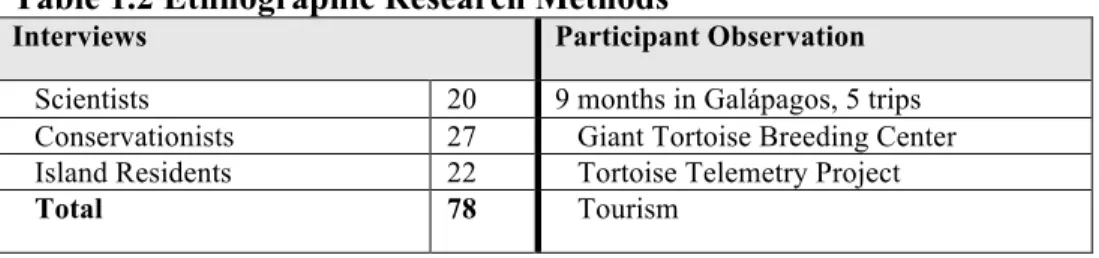
involved with the Charles Darwin Research Station but have now retired or are teaching in the United States. I also conducted two interviews in Quito with scientists teaching at Ecuadorian universities who have been heavily involved in the Galápagos during their careers. Altogether, I completed seventy-eight interviews with sixty-nine different informants.
Table 1.2 Ethnographic Research Methods
Interviews Participant Observation
Scientists 20 9 months in Galápagos, 5 trips Conservationists 27 Giant Tortoise Breeding Center Island Residents 22 Tortoise Telemetry Project
Total 78 Tourism
As shown in the chart above, I generally classify these interviews into three groups for the sake of clarity: scientists (distinguished by the PhD, although one informant was finishing a master’s thesis at the time I interviewed her), conservationists, and island residents. These are necessarily arbitrary and overly simplified classifications. I use education to delineate one group, geography of residence to delineate another, and moral outlook to delineate the third. This is problematic, as any classification would be, if not least because many “conservationists” and “scientists” also live in the islands. (All the PhDs I interviewed were foreign-born, not
Ecuadorian. This is telling, but by no means representative of Galápagos scholarship—there are many Ecuadorian PhDs working in the islands, just not on tortoises. This is likely because, as one informant told me, foreign scientists have tended to “own” species in the islands, although this is diminishing today. Once a project on certain species is established, it is difficult for others to enter unless they are trained by the authoritative figure. This sociological aspect of Biology is by no means unique to Galápagos.) But here I use residents to denote people who are not
31
analytically. I only present them here as shorthand to generally explain whom the actors I engaged with are. These in-depth interviews were further informed by numerous informal conversations and experiences I had while living in the islands. I also conducted twenty quick surveys of tourists as they visited the corral of Lonesome George at the tortoise breeding center to assess how George was used to communicate a conservation message to visitors. The goal of this quick snapshot was not to provide an authoritative account of tourists’ views of George, but to test whether a random sample of tourists brought up the same ideas and points that are often attributed to tourists in the Galápagos. (They largely did. More on this in Chapter VI.)
To complete the research, I obtained a research permit from the GNP, although my central sponsor was the Universidad San Francisco de Quito. The affiliation with GNP made it possible for me to volunteer at the breeding center, shadow park guards, and gain credibility with scientists. It was essential for getting close to the tortoises and the relationship between science and conservation. Within these communities, informants were interested in my project and happy to help, although I think they were often perplexed about why I wanted to volunteer and collect data about the processes of conservation and science, rather than the tortoises or ecosystems themselves.
find that my affiliation with the GNPS shaped my interviews, which was something I was concerned about. But I did not wear anything to identify myself as belonging to the park, nor did I make rounds to agricultural zones with park guards. On the contrary, I found informants quite willing to talk about tourism and priorities for the future. Most were less inclined, however, to talk about the tortoises—particularly as political symbols. I think this reflects a genuine
ambivalence among many residents to the animals, which they rarely see during their daily lives. (The few fishers I interviewed during research in 2011/2012 about past strikes targeting tortoises either denied the tortoises were a central target or were not interested in discussing tortoises as political symbols, which is contrary to earlier interviews with fishers conducted during 2007. I think this partly reflects a shifting political landscape and partly reflects me introducing the project as focused on tortoises.) This was something I stopped doing in interviews with local residents who were not themselves closely tied to tortoises (because some had a hard time understanding why I wanted to talk with them, so instead I explained that the project was about relationships between science, conservation, and development.)
Overall, I found most informants to be happy to talk with me. In particular, most older and retired park guards were eager to share field stories, although not all wanted to be
interviewed. One informant was particularly critical about the number of outsiders who come to Galápagos to collect information to build their careers without helping the islands. (I am
33
for several days (I was set to go on one trip, but it fell through at the last moment because of problems securing fuel for the ship.)
About half the interviews were conducted in English and half in Spanish, depending usually on the native language of the interviewee. (One Ecuadorian interviewee who had spent considerable time working in the United States wanted to talk in English.) I transcribed all the English interviews (using F5 qualitative transcription software). To transcribe the Spanish interviews, I hired an Ecuadorian who is a native Spanish-speaker. I have translated pieces of the Spanish interviews as needed to include as quotes in this dissertation. Otherwise, I analyzed them in Spanish.
In the dissertation, I identify scientists and key conservation figures (for example, the Park Director in Charge of Terrestrial Control) by name. This is done with their written informed consent. Because the community of Galápagos tortoise scientists is small (I have interviewed almost all of them), because I engage with their publications, and because the questions I asked focused on their professional more so than personal identities (to the extent these are possible to distinguish) I have not attempted to anonymize them. I do however extend the cover of
anonymity to other informants, whom I identify mainly by their occupation and its relationship to tortoises or tortoise-centered activities (for example, someone who works in a souvenir shop, as a tourist guide, or people who run tortoise tourism farms).
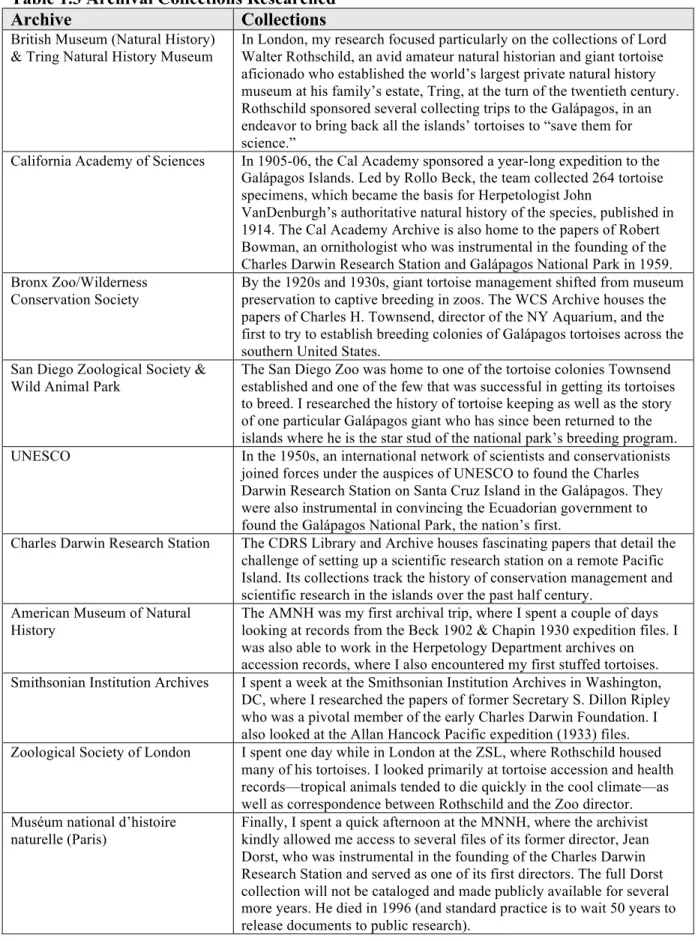
Archives
museums with Galápagos tortoises. The archives were chosen based on the strength of their institutional connections to the Galápagos. For example, the California Academy of Sciences launched a major expedition to the Galápagos in 1905-1906; while the team was traveling, the San Francisco fire destroyed the museum—when the ship returned, its trove of Galápagos specimens was the museum (see James 2010). The California Academy has since been a major center for Galápagos research. Edward Larson’s (2001) meticulously researched history of science in the Galápagos was a great help in steering me to relevant archival collections. John Woram’s Galápagos History Web site (http://www.Galápagos.to) was another crucial resource. The particular collections are listed below.