BITS CREATING BONDS: LORE AS A FORM OF HISTORY IN CREATIVE WRITING AND COMPOSITION PEDAGOGY
Phil Sandick
A dissertation submitted to the faculty at the University of North Carolina at Chapel Hill in partial fulfillment of the requirements for the degree of Doctor of Philosophy in the Department
of English and Comparative Literature.
Chapel Hill 2017
Approved by:
Daniel Anderson
Jordynn Jack
Randall Kenan
Megan Matchinske
ABSTRACT
Phil Sandick: Bits Creating Bonds: Lore as a Form of History in Creative Writing and Composition Pedagogy
(Under the direction of Daniel Anderson and Jordynn Jack)
This dissertation develops around a series of related arguments about lore: the role lore
played in the disciplinary histories of both composition and creative writing, the longstanding yet
diminishing dependence on lore in creative writing pedagogy, the distributed network created
from tidbits of author testimony that helps students form social bonds, and finally, the mode by
which contemporary students are situated through new media to be bricoleurs—or bricolores— of the array of conventional wisdom regarding how writing is “done, learned, and taught.”
The canon of creative writing craft books and author interviews constitutes a major
source of creative writing’s rich mythography. The House of Lore is largely comprised
of and informed by these tidbits, and, through pedagogical dissemination, these fragments of
writing advice, reflections on writing processes, and ruminations on “the writing life” are passed
down through the generations. These fragments have a profoundly historical charge, and actually
contain within thems a record of how creative works come into existence. When these fragments
subsequently become part of individual student narratives of learning, apprentice writers in turn
have the ability to form strong and meaningful bonds with mentors, fellow students, as well as
with creative writing’s past.
Lore’s potential for productive value might be elucidated if we can refocus our attention
on the relational and history-specific contexts that shape these new encounters. All—
recombine/remake/remix them to meet new needs in what we can begin to think of as “Lore 2.0.”
These tidbits can fuel further rhetorical invention, as well as create social bonds. Through the
theoretical lens of Actor-network theory, we may better visualize and understand contemporary
student learning narratives with respect to writing, both in first-year composition and creative
ACKNOWLEDGEMENTS
The long and arduous tasks of research and writing are long and arduous for many
reasons, but are made easier and more approachable by the support of wonderful people: mentors,
colleagues, friends, and family. Many sincere thanks to all who guided my research and
development as an instructor.
First to Ariel, for journeying back east from Southern California and for supporting my
work each and every day.
To my parents, Howard and Joan, who were two teaching dynamos both in the New York
City public school system and at home.
To my committee—I was extremely lucky to work with such a dynamic group of writers
and thinkers. Daniel Anderson for his cutting-edge pedagogies, continual exposure to interesting
people, ideas, and things, and wonderful feedback every step of the way. To Jordynn Jack for
mentoring me in the fine art of Writing Program Administration and for her careful and creative
thoughts regarding my research and professional development.
Thanks to Todd Taylor for leading an unofficial teaching practicum twice a week for two
semesters of film class—I learned as much about keeping students engaged intellectually as I
learned about film (which was substantial).
To Randall Kenan for his years of generous mentorship, advice, and reading
recommendations—this project truly came into focus after our conversations about creative
Finally to Megan Matchinske for her encouragement and careful attention to my work
from this project’s earliest incarnation. Professor Matchinske was instrumental in considering
along with me the implications of merging the philosophy of history with creative writing
pedagogy. I appreciate each member of my committee’s willingness to allow me to follow this
project wherever it might lead; I cannot overstatement my appreciation of their mentorship.
Thanks to the mentorship of countless faculty members at UNC—especially to Bill
Balthrop, Carole Blair, Christian Lundberg, Robert Cantwell and Stephen Neigher.
Similarly, I am deeply indebted to many of the graduate students at UNC-Chapel Hill, especially
Chelsea Redeker Milbourne, Jason Loan, Alex Funt, Emi Steumke, Sarah Singer, Erich Werner,
Ashley Hall, L. Lamar Wilson, Lindsay Starck, Sarah Workman, Anna Levett, Lee Norton, and
Matthew Hotham. Thank you to the UNC Chapel Hill Libraries and the staff at Davis Library for
all that they do to support undergraduate and graduate student learning.
To my colleagues from the Kelly Writers House: Janine Catalano, Tom Devaney, Al
Filreis, Jamie-Lee Josselyn, Blake Martin, and Jennifer Snead. To my wonderful professors at
Penn, especially Max Apple, Susan Stewart, and Kitsi Watterson.
To my Wisconsin cohort: Nate Brown, Samar Fitzgerald, Emma Snyder, Emma
Fusco-Straub, and to Ben Thompson (who I was also lucky to call a Chapel Hill friend and neighbor as
well). You are all excellent teachers as well as kind friends.
A warm thank you to Judith Claire Mitchell, Lorrie Moore, and Jesse Lee Kercheval for
their outstanding workshops and for being exemplars are excellent creative writing instruction.
Thanks to those I learned from in UW-Madison’s Rhetoric and Composition program as well:
writing program directors at Philadelphia University, John Eliason and Dolores Pfeuffer-Scherer,
for their commitment to teaching and teachers.
Thank you to my in-laws, Gregory Djanikian and Alysa Bennett for their advice,
conversation, support, and good cheer.
This dissertation is dedicated to all of the students I have taught in Madison, Philadelphia,
and Chapel Hill. An extra loud shout-out to the class of English 128, Major American Authors,
Fall 2016.
Finally, the biggest thank you goes to Elaina for continually asking, “Why?” and to
TABLE OF CONTENTS
LIST OF FIGURES ...x
LIST OF TABLES ... xi
CHAPTER 1: A 21st-CENTURY LOOK AT LORE ...1
Narratives of How Texts Come into Being ...10
Lore as Historically-Charged Agent ...12
Tidbits Create Social Bonds ...29
“Lore 2.0” ...38
Chapter Outlines ...40
CHAPTER 2: THE FRAUGHT RELATIONSHIP BETWEEN COMPOSITION STUDIES AND CREATIVE WRITING AND LORE AT THE HEART OF THIS DIVISION ...44
Seeking Common Ground and More Open Borders ...44
A Longstanding Yet Uneasy Partnership ...49
The Closing of Borders ...59
Stereotypical Aversions: The Strong Oppositions between First-Year Composition and Creative Writing ...64
Lore at the Heart of a Pedagogical Divide: Theory and Practice ...72
Resisting Lore: Practitioner Knowledge at the Margins of Pedagogical Scholarship, a Response from Creative Writing Studies ...77
Toward a More Coherent Partnership ...90
Addressing the How and the What ...95
Exercises in Style ...99
CHAPTER 3: REIMAGINING LORE AS A HISTORICAL PHENOMENON: A
WELLSPRING OF TIDBITS ...109
Pedagogical Metanarratives and Self-Reflexivity ...109
Lore as a Form of History: Writing about Writing as Historiographic Emplotment ...114
The Historicity of Lore ...125
The Archive: Locating and Valuing Sources of Lore ...133
“Rooting Through the Discard Heap”: Student as Bricoleur ...138
CHAPTER 4: THE NETWORK OF LORE: IMITATIVE TRANSCRIPTION AS A CASE STUDY ...144
Key moves of Actor-network Theory ...146
Tracing a Unit of Lore ...153
Age and Cognitive Development: “Just eleven or twelve” ...154
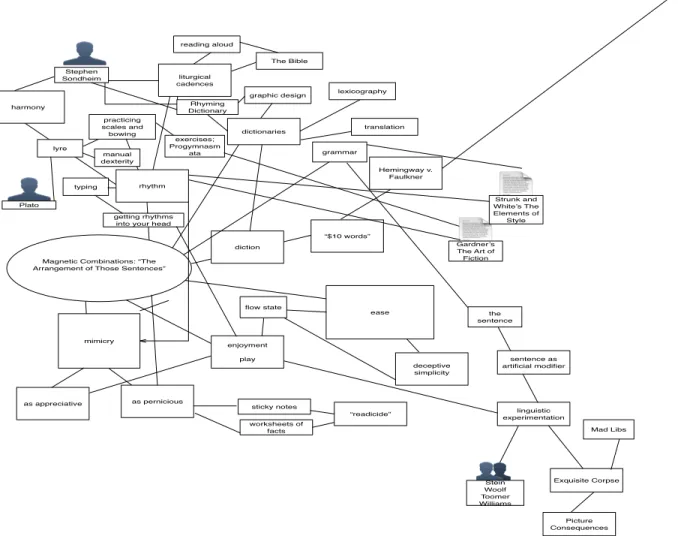
Magnetic Combinations: “The Arrangement of Those Sentences” ...165
Form Precedes Freedom: “They were so simple” and “I thought I could learn” 181 The Aura of the “Famous Writer”: Hemingway ...200
The Value of Self-Appointed Apprenticeship: “See how they worked” ...214
CHAPTER 5: CONCLUSION: WHAT THE “LORE 2.0” NETWORK MIGHT MEAN FOR CREATIVE WRITING AND FIRST-YEAR COMPOSITION STUDENTS AND PROGRAMS ...224
Bits Creating Bonds: Pedagogical Implications and New Directions ...231
The New Graduate Scholar: A Bricolore ...232
Creative Writing Pedagogy 2.0 ...235
“We Are All Practitioners” ...239
Composition, Creative Writing, and Living in The Future (of English Studies) ...244
LIST OF FIGURES
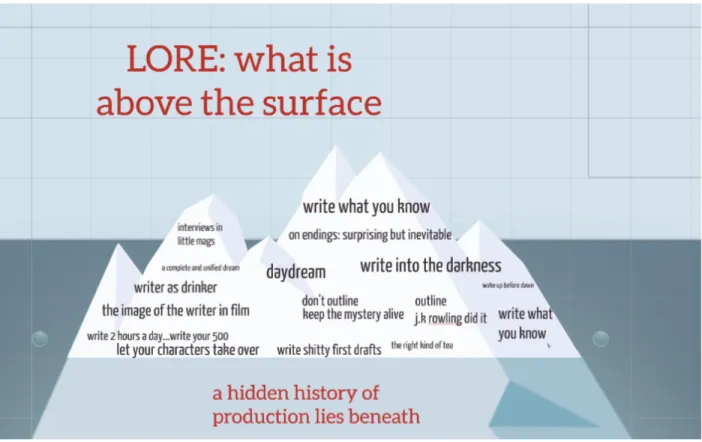
Figure 1 – Lore as iceberg ...14
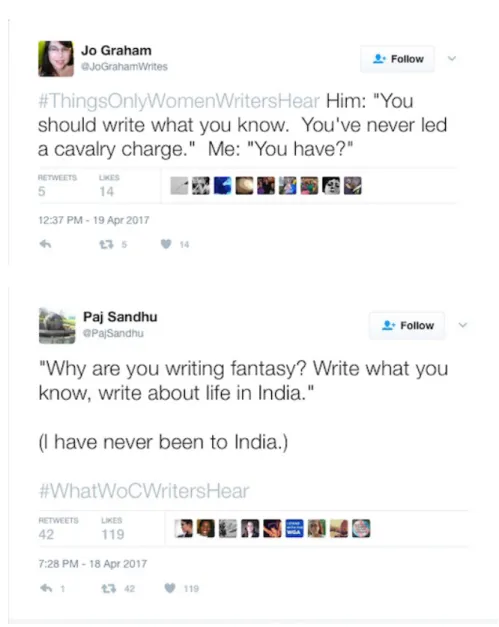
Figure 2 – Writers on Twitter re-interpreting lore ...123
Figure 3 – Writers on Twitter re-interpreting lore ...123
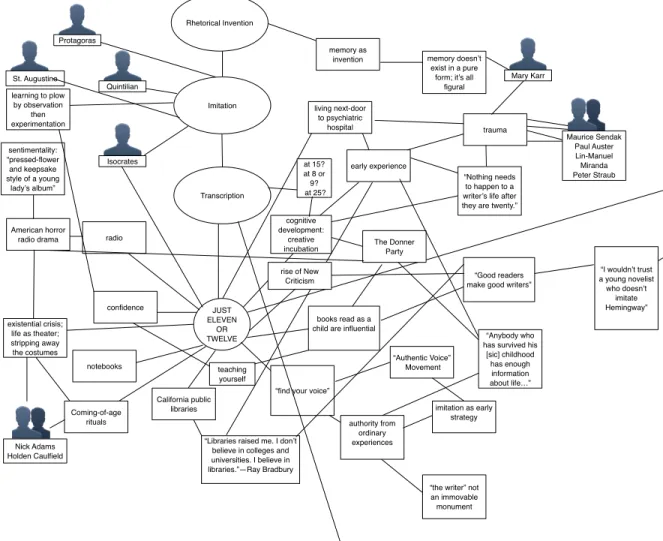
Figure 4 – Snapshot of first trace ...164
Figure 5 – Snapshot of second trace ...180
Figure 6 – Lan Samantha Chang on the importance of retaining early narratives of becoming a writer ...232
LIST OF TABLES
CHAPTER ONE: A 21ST-CENTURY LOOK AT LORE
The problem with icons is that they are static, unable, from their brittle pedestals, to respond to sea changes that surround them, to evolve and remain relevant to the society in which they were anointed.
--Stephanie Vanderslice
A further exploration is in order, an exploration of institutional and historical factors that have both helped to create and to sustain the lore of creative writing.
--Tim Mayers
In The Making of Knowledge in Composition: Portrait of an Emerging Field (1987), Stephen North defines lore as the “accumulat[ion] of traditions, practices, and beliefs” that
influence “how writing is done, learned and taught,” and, in the context of teaching writing, is a
kind of “experienced-based framework” that is “driven...by a pragmatic logic” (North, The Making of Knowledge, 22, 23). Practitioners continue to remake lore, repeatedly, in a never-ending House of Lore, “in a way that suits their needs in a particular time and place” (25).
Throughout these chapters, I will make the argument that teaching strategies dependent on lore
still possess great potential if seen through contemporary theoretical lenses (Ritter and
Vanderslice, “Creative Writing and the Persistence of Lore” xiv). Today, in 2017, lore still
retains its original definition, and is commonly considered in rhetoric and composition to be a set
of “ideas and assumptions that are grounded in local experience,” infrequently “informed by
research,” not “generalizable or transmutable” and “passed along informally…from one faculty
member to the next” (Hesse, “We Know What Works”). The “practitioner” in the field (as
opposed to the historian or the philosopher), both then and now, uses lore as the go-to, default
higher status within the academy, it was necessary to move past the use of practitioner logic as
the main form of reasoning. There were a variety of methods and methodologies that
composition was already engaging with, and the field needed to branch out from its reliance on
conventional wisdom alone and pursue a research program akin to other departments.
Creative writing and first-year rhetoric and composition pedagogy have both confronted
the overuse of practitioner logic and experiential-based knowledge, referred to in both fields as
“lore.” Each field has sought to push back against pedagogical tendencies that rely only on
conventional wisdom as evidence of best practices (i.e., the workshop model for creative writing,
the dissemination of classroom activities without theoretical grounding within composition and
rhetoric). The emerging field of creative writing studies has similarly sought to push back against
its own lore, frequently in its resistance to the “Bobby Knight school” of aggressive creative
writing workshops that came with the democratization of creative writing within American
academia in the latter half of the 20th Century (Vanderslice, “Once More to the Workshop”). In particular, each field has sought to push back against scholarship that relies on unsystematic
ideas about how to best teach writing.
Even given the trend toward writing pedagogies informed by ideas and interpretive
positions that go far beyond the personal or the anecdotal, there seems to be something
inextricable about lore’s continued power within actual college writing pedagogical practice.
Lore’s original, though now obsolete, meaning was one and the same with instruction itself:
“The act of teaching” (“lore, n.1”). Lore also, from the tenth to nineteenth centuries, referred to
the knowledge conveyed by the teaching act: “that which is taught,” “that which is learned,” and
traditional facts, anecdotes, or beliefs relating to some particular subject,” which often take on a
noun, like “plant lore” or “bird lore” or “baseball lore.” Douglas Hesse similarly notes that “lore
is a form of knowledge in every field,” and we can easily see how students are positioned in any
field or subject to acquire lore from their teachers, mentors, peers, and from their own activities
within that domain (Hesse, “We Know What Works”). We can see how lore can quickly take on
slippery definitions that slide from expressivism, to unsystematic pedagogical ideas, to the use of
anecdotes in teaching practice. Lore is not singular, as we will see in this attempt to define a
methodology for something inherently unsystematic. However, much like Hayden White saw
narrative inherent to all acts of historical interpretation, some degree of lore, in this context, is
inherent to all pedagogical practice and research about effective teaching.
In the early nineties, and again within the past decade, many scholars in composition
studies “attempted to rehabilitate lore (the personal-narrative-based method) as a credible way to
make knowledge,” and at present, lore and its associated philosophies of invention are still
undergoing numerous reconsiderations as objects of study (Fulkerson, “The Epistemic Paradoxes
of ‘Lore’” 53).1 Lore continues to be topical in part due to its well-outlined potency: North originally depicted the practitioner-based model as “very rich and powerful,” seeing as it was the
go-to teaching and research method for 1980s compositionists, and perhaps still is currently
(North, The Making of Knowledge 27). North’s portrayal of lore was not dismissive, but rather was one that elevated practitioner logic to a kind of inquiry that could exist alongside history,
philosophy, and sociology. North represented lore as an unfinished house built with new and old
materials, attending to its fundamentally historical valences. By having its own specific “past and
1 See Massey and Gephardt’s 2011 edited collection, Changing of Knowledge in Composition: Contemporary
present,” North gave “lore and practitioners a chance for a legitimate scholarly future, on par
with other disciplines” (Butler et al.).
North’s text has served as an emerging map for the territories of writing studies that have
since been extensively filled in, at the same time that they have fragmented considerably
(Massey 305). Perhaps, in retrospect, it is unlikely that a “debut book by an untenured Writing
Center Director” that served as a fairly incomplete map of the field, would stir such debate and
precipitate disciplinary discussions for years to come, but it is obvious to scholars working today
that rhetoric and composition has evolved to include an even broader range of methods and
methodologies, and that the intervening thirty years have “further blur[red] already indefinite
boundaries” (North, “Notes on the Origins Of” 11, Butler et al.). 2 The intersections of creative writing pedagogy and rhetoric and composition, the subject of this dissertation, is one such area
of disciplinary cross-pollination, advocated by Douglas Hesse in the September 2010 College Composition and Communication article, “The Place of Creative Writing in Composition
Studies.” The map itself of rhetoric and composition today might appear less as a map and more
as an interactive work of art—a truer portrait—with multiple transparencies stacked atop one
another. Creative writing appears to be moving along its own parallel timeline of slowly excising
practitioner logic from its criticism, despite its continued use and value in the classroom.
Critical affordances and cultural developments within the last thirty
years—Actor-network theory, remix culture, new media literacies, and the “DIY” and craft movements, to
name only a few—have fundamentally changed how students and teachers interact with lore
within college writing. Given that, major theorists within rhetoric and composition, such as Paul
Butler (“Remixing the House of Lore: Theory, Practice, and the New Graduate Scholar”) and
Victor Villanueva (“Rhetoric, Racism, and the Remaking of Knowledge-Making in
Composition”), have entered the conversation on lore’s evolving epistemology.
Further, many in creative writing have started to theorize on the importance of moving
beyond the traditional writing workshop format, and to challenge the conventional wisdom that
craft is the only teachable aspect of creative writing. Ron McFarland notes in his 1993 College English article, “An Apologia for Creative Writing,” that of all the things it takes to be a writer, such as drive, talent, etc., craft is the only one that can be taught. While this is generally the
agreed upon principle in creative writing pedagogy, there is a critical mass of discussion about
early memory and the role of unconscious processes—non-craft issues—in creative writing lore.
For example, Ron Carlson describes in Ron Carlson Writes a Story his particular conversion narrative from being craft-obsessed to becoming process-oriented. Carlson describes his
twenty-five years of teaching experience, in which he taught creative writing at the high school and
college level and even contributed to one of the earliest scholarly collections of creative writing
pedagogy, Creative Writing in America. After years of teaching, Carlson changed his mind. He found that most students attended to sentence-level issues and the issues of point of view,
persona, pacing, and dialogue on their own, and that what students really needed was an
encouragement to feel confident in their process.
Compositionists and scholars of writing studies working in creative writing pedagogy
need to change our epistemological stance toward lore in order to get up to date with the new
directions that rhetoric and composition has taken. This dissertation develops around a series of
related arguments about creative writing studies changing its epistemological stance toward lore
in order to get up to date with these new directions: about the role lore played in the disciplinary
dependence on lore in creative writing pedagogy, the nature of lore as a historical entity, the
distributed network created from tidbits of author testimony that helps students form social
bonds, and how contemporary students are situated through new media to be bricoleurs—or
bricolores—mixing and matching from the array of conventional wisdom on how writing is “done, learned, and taught.”
If scholars working at the intersection of creative writing and first-year composition are
truly to follow Douglas Hesse’s 2010 call in “The Place of Creative Writing in Composition
Studies” to “examine writerly activities and processes,” then our investigations should be as
inclusive as possible (43). We should aim to not only understand how powerful myths about
writing influence student writing processes but also look into where that mythography comes
from, how it continues to be deployed through lore, and “embod[ied]” in “ritual, writing, and talk”
(North, The Making of Knowledge 29).
So, what exactly do these fragments look like? The array is almost overwhelming.
Because lore remains so dominant within creative writing pedagogy, it might be advantageous to
start with creative writing classrooms, and specifically fiction writing classrooms, which
emphasize lore in the writings, recorded speeches, interviews, letters or other testimony given by
canonical authors. In what Stephen North has called the unfinished House of Lore, we discover,
among other things, adages and fragments of writerly advice that often have an unclear origin:
write 500 words per day, write two hours each day, or don’t take days off; type out sentences or
verses of literary greats in order to see them from the inside; recapture a childlike state of seeing;
pretend you’re explaining _______ to a visitor from a distant planet who has never seen or heard
of it before; you can create any world you want, as long as your rules are consistent; and of
classrooms, and composition retains its own present-day lore of assignments and lessons: the
go-to ethos/pathos/logos in-class rhego-torical analysis of a TV ad; the recursive mentioning of the idea
that “writing is a recursive process;” the discussion of rough drafts vs. first drafts and the iconic
essay “Shitty First Drafts;” the topic of the “Five Paragraph Essay” and learning to forget
everything you learned in high school; the handling of persistent questions about whether to use
a personal vs. impersonal, formal or informal writing style; the advice to students that they read
their papers aloud to catch typos; and the marginal comment to “eliminate ‘to be’ verbs” or
“avoid passive voice.”
Lore-based writing pedagogies can give off an impression of softness, of lacking in
intellectual rigor; they can signal an isolated discipline guilty of mindless traditionalism or, at the
very least, one that refuses to actively keep its teaching practices in check. A dependence on
lore-based pedagogies in creative writing of late has opened the door for various indictments, the
most pointed of which come from practitioners working in the emerging field of creative writing
studies. The charges include a critique of lore’s properties of mystification, a critique of teachers
who often reinforce a sense of writing’s “unteachability,” as well as a critique of lore that
characterizes creative writing as ultimately a “romantic process that exists outside the boundaries
of the classroom” (Ritter and Vanderslice, “Creative Writing and the Persistence of Lore” xvi).
While lore-based pedagogy in creative writing has isolated the field from more
research-based disciplines, it is potentially hazardous to be too hasty in looking for ways to dismiss lore
from our pedagogical frameworks.For instance, we might encounter the transmission of
practical “advice” or literary tidbits and/or experience-based anecdotes in response to student
ideas or to student work. Over the course of a semester, the students and the instructor often
creative writing professor used to emphasize the way stories often benefit from unexpected, or
even whimsical turns of plot. This professor described such a turn from an obscure Victorian
novel he had read in graduate school, and repeatedly came back to this text in future workshops,
using this author’s work as shorthand for a reminder about striving for dynamic pacing and
plotting.
Another major source for these classroom conversations is the canon of creative writing
craft books, which exists within a larger continuum of texts that I will refer to here as “the
archive of writers on writing.” This group of texts exerts considerable influence over the
teaching of creative writing, and in many ways, is the engine of the field’s sociality. The little
tidbits, or fragments that comprise the lore can often be the discussion starters or discussion
extenders that serve to cement affective bonds within the creative writing classroom. This
capacious archive serves as a kind of universal source text or dataset for what becomes creative
writing lore, and embodies a diverse spread in terms of genre, intended function, and
consideration of audience. Most are popular texts, intended for aspiring or established writers, or
those with an interest in language, literature, cultural studies, literary culture, and/or literary
history. In the classroom, all of this information is up for grabs and units of lore are continuously
borrowed and re-borrowed and sometimes repurposed by students and teachers to fit various
exigencies: structuring a workshop, leading a discussion, offering feedback, revising a poem.
This seemingly haphazard method of instruction has proven to be steadily persistent, even as
writing theorists continue to note both its drawbacks and the field’s overdependence on, what
Tim Mayers has termed, “institutional-conventional wisdom.”
To address this question, I believe we must delve deeper into the nature of lore, and
consider how the anecdotes, myths, conventional wisdom, and bits of advice present in all
writing classrooms possess a value to practitioners beyond obvious or superficial writing advice.
In fact, we can see lore working in complex ways within the context of the writing process. We
can see aspects of the complexity in lore, connected to the writing process. The very nature of
“process” (as a series of actions, both conscious and unconscious) makes it impossible to discuss
an act of composing with complete thoroughness; there are bound to be omissions and elisions as
writers reconstruct narratives of how texts come into being. As Paul Prior discusses in his
analysis of writing as a practice: “A text does not fully or unambiguously display its history—
even the most insightful of interpretation and analyses are only likely to recover some elements
of its fuller history….” (Prior 171). Likewise, Graeme Harper points out that the “evidence trail
of writerly action” does not rely solely on the finished work (Harper, “Creative Writing in the
Age of Synapses” 14). And yet, through lore, we may be able to gather clues. In other words,
lore can point toward a history of writing processes and thoughts—and a history of creative
writing instruction—and say, “I can’t show you the whole process of writing or teaching, but I
can show you some recoverable bits.” Lore’s productive value might be elucidated if we can
refocus our attention on relational and history-specific contexts that shape its new encounters—
as well as the role of those who come in contact with fragments of processes and pedagogies and
recombine/remake/remix them to meet new needs. Specifically, we should be looking at the
narratives of writers discussing writing in order to figure out how this information travels and is
Narratives of How Texts Come into Being
Hesse rightly notes that studying the archive of writers on writing is a part of a larger and
longer tradition of the work of the “interpretive humanities” and “the tradition of artists speaking
about artistry.” Hesse notes how creative writing has been “largely disinterested in (and
occasionally contemptuous of) systematic research on writing and writers, especially empirical
studies, trusting instead authors’ own accounts, in memoir, essay, or interview” (Hesse, “The
Place of Creative Writing” 32). Similarly, but within the context of rhetoric and composition,
Kelly Pender has argued there has not been enough research into the intricacies of invention
(Massey and Gephardt 7). Both compositionists and creative writing studies theorists need to do
more to make an intervention and begin systematic research on lore. On one hand, the move to
perform systematic research on something so outwardly unsystematic as lore may be problematic.
On the other hand, though, “lore” and “systematic research” come to us with particular residues
of meaning, prior to engagement with their actual content. After all, even “systematic research”
has lore-based, anecdotal, testimonial elements, and much lore about what works in writing or
the teaching of writing has been derived from systematic research. Through the attempted
development of a research methodology for lore, we might better see how narrative functions
within pedagogical and social systems.
My immediate intervention involves contemplating the critical nature of lore in
understanding the disciplinary histories of both rhetoric and composition and creative writing,
viewing lore itself as a form of history, and using actor-network theory-inspired tracing in order
to better understand how students are positioned in order to accept or reject
institutional-conventional wisdom. Institutional and disciplinary structures reinforce lore, and surely much
that lore’s distribution channels have been fundamentally and irrevocably altered. Following
Adam Koehler’s “Digitizing Craft: Creative Writing Studies and New Media,” both composition
and creative writing studies must better theorize how “digital spaces alter the act of composing
‘creatively’ and help teachers, writers, and scholars of creative writing and composition better
theorize our current methods and practices” (380). Students and teachers are interacting
on-demand with high capacities of conventional wisdom about writing both within and beyond the
classroom, all the while making affective investments with people and ideas, and repurposing
writing advice for new ends. These new interconnected webs then become new “interpretive
lens[es] to filter new experiences” (“Story as the Landscape of Knowing”).
We can comfortably move past much of the prior anxiety about lore’s contradictory
nature in order to reach a conceptual framework where we see those tidbits as existing alongside
objects, materials, and various forms of affective and relational ties. 3 Academic conversation abounds that promotes embracing ambiguity and contradiction, and exploring “both/and” options
in order to transcend “either/or” dichotomous thinking. The 2014 NCTE Convention theme,
“Story as the Landscape of Knowing,” called for proposals that explored the dimensions of
stories as sites of pedagogical innovation: “Each story carries a multiplicity of meanings that
capture the richness and nuances of life and accommodate the ambiguity and complexity of
experience.” Lore, then, has an inextricable connection not only to subjects, learning, and
teaching, but also to people, communities, and shared experiences.
There is also potential value in the contradictions or “double binds” that exist in
interdisciplinary pedagogies, those that Stanley Fish famously referred to as “pedagogies of
antiknowledge” (Fish, “Being Interdisciplinary” 18). Fish’s claim that pedagogies that “call into
3 See Fulkerson’s continued critique of lore-based knowledge as existing with an epistemic paradox (“Beyond
question the foundations of all disciplines” are “pedagog[ies] of antiknowledge” seems to not
stand the test of time, especially when academic discourse has tended within the last decade to
look at the ways people are marginalized from a multidimensional point of view. As Rebecca S.
Nowacek argues in 2009:
Both students and instructors I argue, must negotiate double binds placed upon them
when various disciplines conflict. Those double binds can limit and constrain the work of
individuals, but if made an object of reflection, the double bind can also facilitate
higher-order thinking about disciplines and the role of writing within them. (Nowacek 494)
The move to resist lore—and bind lore with “process theory” in composition—was a reactive yet
necessary move in order to build prestige across the academy. Fundamentally, not enough voices
in creative writing and rhetoric and composition have read lore through contemporary theoretical
lenses. This dissertation serves as one specific historical and theoretical intervention. Much lore
derives from writers’ testimony about the act of writing. This form of lore is fundamentally
intellectual work that seeks to narrativize the lived experience and micro-level processes inherent
in making. Further, lore has irrevocably shaped the disciplinary histories of creative writing and
composition, and while many writing studies theorists would rather discard author testimony, I
advocate going through the dustbin of the past in order to further interrogate lore as a form of
history.
Lore as Historically-Charged Agent
The fields of composition and creative writing can develop a closer understanding of each other
by reassessing what we mean when we talk about lore. Lore in composition and creative writing represents a particular kind of knowledge that stems from the act of writing itself and takes a
understand lore both as a historical entity (existing in time) and as a rhetorical entity, meant for
primary and secondary audiences. Again, drawing from North’s definition of lore from his
foundational 1987 book, The Making of Knowledge in Composition, we can view lore as a site of history, which is embodied in its “accumulat[ion] of traditions, practices, and beliefs…that
influence how writing is done, learned and taught” (North, The Making of Knowledge 23). And yet this is in no way a complete history. Because a majority of traditions, practices, and beliefs
come through the performance of writing itself—the acts of typing or writing by hand—lore is
not a full description, but a capturing of what remains from the largely unrecoverable history of
writing production. In other words, despite the thorough critical work undertaken by scholars, the
process of how a text comes into being is fundamentally elusive. Textual and contextual criticism may construct narratives to help us imagine this process; and author autobiographies, interviews,
and contemporary “craft talks” might help us imagine somewhat further, especially when
combined with literary criticism; but still, the accessible history of the creative act remains
fragmented and largely incomplete. A helpful visual might be something akin to Hemingway’s
iceberg in which lore is the tip above the surface of the water, and the unrecoverable material of
a work’s production is below (see Fig. 1). The mysterious and invisible history beneath the
surface is akin to a kind of unconscious or unknown space. It points toward the ineffable. We
know that this history is there; it must be because the creative texts themselves exist. But lore is a
vital and potential access point to that history. Because of its very condition, lore is bound to be
resting above a region known for its exoticism, its hugeness, its formlessness, and its
randomness.4 Ultimately, what so many scholars (both in composition and in creative writing) fail to understand is that lore stands in for an infinite number of ephemeral writing processes and
performance modes. This material is valuable and mysterious, and valuable in its mysteriousness.
To put this new definition of lore succinctly: Lore captures the recoverable fragments of a mostly unrecoverable history of writing production.
Figure 1 – Lore as iceberg
In this study, I do not wish to argue that viewing lore as “history” does not present
large-scale issues. Any rehabilitation or reconsideration of lore must, ethically, address the inherent
problem in “doing things as they’ve always been done.” For instance, the archetype of the
“famous writer” as the “famous male writer” endures as a classroom stereotype. Conventional
or Barthes’s “writer on holiday” and the mythic image of the hardworking writer who cannot
even take time off because a writer is always working. This gives way to mystification of writing
processes, as well as playing into anxieties about writing that are still a subject of conversation in
many classrooms. Further, institutions can easily play a part in this mindless reinforcement of
lore, where past practices are continually “naturalized by positioning creative writing”—and one
might infer, composition—“in relation to both English studies and the academy at large”
(Mayers, (Re)Writing Craft 14). It might not be difficult to see, given this conception of lore, how the call to resist mindless repetition of lore became something of a rallying cry for an
emerging field.
Along the same lines, there have been many formidable arguments that describe lore as
an unreliable or uncertain access point to knowledge. Richard Fulkerson is one of the chief
skeptics of lore, noting that lore elides assessment because “any composition teacher” can make
a claim about “what works or has worked” because nothing gets ruled out. It is impossible,
Fulkerson argues, to ever get around the epistemic paradox of lore, to ever know “what works”
or even if we can know “what works,” and if we could, whether it would count as knowledge (Fulkerson, “The Epistemic Paradoxes of ‘Lore’”). Similarly, Hesse expresses doubts about
lore’s capacity for truth. Hesse responded in early 2017 to a piece by Joseph Teller that used
first-person experience to question, “Are We Teaching Composition All Wrong?” by writing a
response entitled, “We Know What Works in Teaching Composition.” Within his response,
Hesse argues that “Teller’s essay participates in the tradition of lore” and does not pass muster
for any truth value beyond local experience (Hesse, “Are We Teaching”). The various research
methodologies used in contemporary rhetoric and composition have certainly advanced our
North, in what was no less than a seismic shift for the field, emphasized how composition
was in the process of moving past its reliance on lore in order to develop as a field of inquiry
with its own research methods and deployment of critical methodologies, independent of literary
studies traditions. The case against the mindless use of lore is a good one, but we still haven’t
resolved the question of how to use critical apparatus to view lore. It still plays a massive role in
the teaching and scholarship of compositionists and creative writing instructors, and we actually
may have the methods and methodologies to get a better handle on how it works, and even
account for its apparent epistemic paradox. Pender argues, in part referring to the scholarship of
Janice Lauer, that “after the 1980s, compositionists weren’t exactly lining up to answer the
question, what is invention?” (Pender 66). North’s book, according to Pender, created “the perception of an impasse” into “explicit research on invention” because of rhetorical invention’s
links to a research methodology based on lore (67). The vast majority of theoretical perspectives
on rhetoric and composition have moved past lore-based scholarship. Hesse, in his most recent
defense of the field, seems to be advocating for his own conventional wisdom—that the field
knows what it is doing—when it counters essays like Teller’s, which “participate in the tradition
of lore.” However, with the transition toward craft and making in the new millennium, perhaps
it’s time to give lore another reconsideration.
In general, there have been two principal kinds of responses to lore’s wide range and its
pervasiveness both inside and outside the academy: either a wholesale and uncritical acceptance
or an overly comfortable rejection of lore. The first mode—acceptance—we find alive and well
in the halls of creative writing departments: not only in the attitude of their instructors, but in
their deep institutional structures. In the field of creative writing, for instance, teachers are often
There is very little emphasis on teacher training or pedagogical professional development. The
real-life result is that most creative writing instructors operate within the classroom by drawing
upon their own reading, writing, classroom experiences, and network of authors to invite to
campus, as well as whatever archive of writing advice they have happened to come into contact
with over the course of their own training. In the vast majority of cases, an instructor will come
up against very little counterpoint and/or theoretical challenges to however he or she has decided
to run his or her workshop. Though there are some exceptions, most MFA programs do not run
pedagogy workshops specifically designed to teach undergraduate creative writing, with the
result that there is little encouragement of critical perspectives within the field, even for
beginning instructors. Mayers, who sees certain problems with an overly accepting attitude
toward lore, describes lore operating within creative writing departments as such:
[Institutional-conventional wisdom] denotes a system of belief that often appears to some
creative writers to be a form of “natural” or “commonsense” knowledge. Thus, it is
“conventional wisdom,” believed by many to be beyond dispute. But it is also
“institutional” in the sense that it has become embedded within institutional structures
and therefore has helped to form the kind of academic enterprise creative writing is.
((Re)Writing Craft 13)
Lore, in other words, has its own history and reasons for being advanced and favored; much in
the way that “official” historical records that aim for objective standards of truth are constructed,
and possess an authoritative content inherent in their form as “official.” This marks a sharp
contrast to the way that composition seeks out published research that uses methods and
methodologies that move beyond lore. Mayers illustrates the cycle by which lore—within
distribute their work, this is how we ask students to engage with new media)—is institutionally
re-inscribed without such checks and balances.
On another level, seen from that remove, lore represents a “body of knowledge very
much like those accumulated among practitioners of other arts—art here being broadly
conceived—like painting or parenting” that may not have a direct pedagogical function but
serves as the core conceptual framework (North, The Making of Knowledge 23). This “reflective, pedagogical talk” is almost akin to “recipe swapping,” where one passing recommendation of
one instance of perceived classroom success is enough to signal pedagogical success. While the
wholesale movement away from lore in the late 1980s was understandable, given the academic
climate, it still remains troubling. For instance, “craft criticism,” as Mayers has explored, is a
genre of critique that rose in popularity with the rise of MFA degrees, especially in the 1990s, in
which creative writing pedagogues discuss issues of process, genre, authorship, and
institutionality. Mayers offers a preliminary definition of craft criticism as follows: “in craft
criticism, we find a genre of writing about writing that refers to critical prose written by self- or
institutionally identified ‘creative writers’…. [and] a concern with textual production takes
precedence over any concern with textual interpretation” ((Re)Writing Craft 34). Mayers adds that “often, though not always, craft criticism has a pedagogical element” (34). These pieces of
writing often have the intellectual heft to question the nature of how we talk about writerly
activities and processes, and might too easily be put into this same category of lore even though
technically they are questioning rather than re-articulating a set of traditions, practices, or beliefs
based on how writing is learned and taught. This kind of work is often read on popular websites
Chronicle). Since craft criticism is an officially sanctioned form of scholarship—and will often help with promotion and tenure within academic creative writing—it suggests that grappling
with lore already has some theoretical ground to stand on.
Additionally, the resistance to even the examination of lore in composition is a fairly
troubling state of things, considering that the dissemination of lore seems to be a natural
byproduct of writing pedagogies. Shortly after the publication of The Making of Knowledge in Composition, Patricia Harkin explored lore’s “nondisciplinary” nature in “The Postdisciplinary Politics of Lore” (1991). Considering lore’s “limits and possibilities as a form of inquiry in
composition,” Harkin argues that lore is, “capable, at least in some circumstances, of usefully
addressing pedagogical problems for which the traditional limits of disciplinary inquiry would be
too constraining” (Harkin qtd. in Mayers, “Figuring the Future” 2). Though we work at the
margins of both composition studies and creative writing, creative writing studies scholars
believe that lore is “well worth examining.” Writing in 2007, Mayers wonders if perhaps we are
at a “similar moment in the development of creative writing” (Harkin). Nearly a decade later, the
role of conventional wisdom in composition and creative writing pedagogies is still greatly
under-explored.
Author testimonies have a limitation inherent to their form: that testimony is singular and
prone to contradiction. Why not celebrate this complication, when the large part of academic
thought (so-called “critical thinking”) is acknowledging complications and adding further
nuanced ways of considering individual acts. As Andrew Pickering uncovers in his analysis of
scientific experiments, most creative acts and discoveries come about through manifestations of
a surprisingly large set of prior actions and thoughts. In this “mangle of practice,” as he calls it,
creation and experiment. I believe we can use the concept of “the mangle of practice,” derived in
part from actor-network theory, in describing how creative works come into existence. This
approach can help account for the individual instances, as in North’s original description of lore
as a form of knowledge-making: “The communal lore offers options, resources, and perhaps
some directional pressure; but the individual, finally, decides what to do and whether (or how) it
has worked—decides, in short, what counts as knowledge” (North, The Making of Knowledge
28). Here practitioners have a heightened degree of agency,5 which coincides with the recent prosumer turn in creative literacy.6 Meanwhile, lore gives us an account of the composing process—this complicated mangle—and also provides a component in future composing
practices for others. Or as Patricia Harkin pointed out in the context of composition research,
lore tells us “what practitioners do” instead of offering “abstract accounts” of process (Harkin
125).
There is no experience-less classroom, just as there is no experience-less instructor, or
scholar, or student. While practitioner-based scholarship might be cast off by many composition
researchers—be it 1987 or 2017—as not “scientific[ally]” rigorous and as a “muddled
combination of half-truths, myths, and superstitions,” we can see that lore when read
intertextually or through some of the critical apparatus meets present-day requirements for truth
value and social scientific rigor, and represents the reflections and experiences of writers with
the rhetorical purpose of describing their practices to an audience, which automatically takes on
an official yet informal pedagogical function (North, The Making of Knowledge 23). While the mechanism by which lore was endlessly repeated and propagated was surely in need of fixing,
5 North here refers to practitioners as “relatively free agents.”
6 See Steve Healey’s “Beyond the Literary: Why Creative Literacy Matters” in Donnelly and Harper’s Key Issues in
the notion that all of the micro-level processes of all of the elements of the “mangle of
practice”—knowledge about writing derived from writers’ recollections of the process—would
be lost to the same bin as lazy pedagogues assigning freewriting without comprehensive thought
is similarly frightening. Not only was the baby thrown out with the proverbial bathwater, but
pedagogy derived from the experiences—the activities and process of composing—of literary
writers was once again pushed to the margins, this time for creative writing.
The mythologies that inevitably stem from writer accounts and the “cyclical” use of lore
in the classroom are indeed complex, but they are still, I would argue, analyzable, particularly in
their nature as a “collective history” (“Creative Writing and the Persistence of Lore” xvi, emphasis mine). Each unit of lore carries a historical trace, and in its deployment, leaves a
historical trace. As Ritter and Vanderslice have said: “Behind our collective pedagogies as
teachers of creative writing lies a collective history of learning fueled by lore” (xvi). And, “to
ignore this history and its deceptively simple construction does a great disservice to the field”
(xvi). Instructors are constantly doing the work of historical writing when we categorize
structures and processes of the past into our own pedagogical narratives. For instance, imagine a
college student attending a reading where a poet instructs the audience to “write into the dark,”
and twenty years later, this same student, now an assistant professor, makes the same claim in a
graduate poetry workshop. If we take a step back and consider the discursive nature of lore,
perhaps we can learn more about how individual writers are actually interacting with some
amount of process-based knowledge that precedes them.
Lore, in this understanding, does not exist in a vacuum, but functions as both a historical
entity (existing in time) and as a rhetorical entity, meant for both primary audiences and in many
beliefs and customs that stems from our collective activities and processes of writing, and is
passed from generation to generation through spoken, written, audiovisual transmission, and
even interactions with materials: visual art, new media objects, writing tools, writing spaces, and
even Hesse’s mention of the best kind of tea for writers to drink (Hesse, “The Place of Creative
Writing” 33). Our first instinct may be to laugh or shrug shoulders at this sort of advice, but is
that really fair? For instance, what have cognitivists said about caffeine, creativity and the flow
state? How does the scene of writing (in a café, at home, at the library, in writers’ spaces or
writing colonies, on the subway, in a car, on an airplane) affect output? How does the ritual of
drinking tea compare to other writerly rituals? These are the sorts of mundane, yet potentially
eye-opening questions that our field has yet to research. In the haste of resisting the more
counterfeit-seeming or cliché-sounding parts of writing’s powerful mythography, there’s the
very real possibility that we will discard time-tested strategies that work for many students.
These tidbits of writing mythology come to new audiences circuitously, often through
indirect channels and a large dispersed network of agents—via “the mangle”—but nonetheless
are traceable. Seen through this lens, I would like to engage with the idea of lore as a form of
historical discourse: specifically, the history of how we talk about how texts come into existence.
In this framework, each unit of lore is not necessarily prescriptive or proscriptive in and of itself,
but rather represents a topos within a larger, more expansive, socially contingent, and potentially chaotic system of knowledge-making. Particular units of lore, then, serve as signposts toward
even deeper and more complicated histories of both teaching and composing in the literary arts.
Lore is unofficial, unvetted, fairly chaotic, and even teetering on irrationality, yet still it remains
significant in its accumulation of past practices, traditions, and beliefs regarding writing
The history of any act of compositional creation is always, only partially recoverable. We
can assume that we never really get it exactly right when we describe and narrativize how a work
came into creation. They are all attempts where oversimplification misses the nuances of
construction. This narratological consideration reminds us of the problem that many philosophers
of history and historiographers have explored. Historical writing can never truly get the ineffable
aspects of lived experience, but it can attempt to record an account of causation of how and why
certain events occurred as they did. Similarly, “to write a history of [a work of] art” is to
fundamentally “diminish the force of…artistic events” (Deleuze and Guattari qtd. in Bell and
Colebrook 4).
Geffrey Sirc notes that “by dumbing down the complicated process of composition to a
scrupulously teachable method,” we have “reduc[ed] the roles of chance and the imagination in
the production of textual knowledge” (“Resisting Entropy” 512). If lore—and in particular the
archive of writers on writing—points us toward a unique interaction with a fluid collection of
composition activities and processes, then self-reports should become far more important to
writing researchers than they presently are.
These self reports, in turn, become their own points of emphasis. For example, there is
Hemingway’s decree that “writers write,” Woolf’s call for “A Room of One’s Own,” Forster’s
“only connect,” Lamott’s “bird by bird,” and that type of iconic guidance. On beginnings, start
them inmedias res. When coming to the final scene of a story, aim for surprising but inevitable endings. On the feel of a story, John Gardner advises writers to aim for an uninterrupted fictional
dream. Even discussions of how to live life in a “literary” way become part of the lore: whether
to get married, whether to have children, how to take notes surreptitiously at parties, and should
Here drugs and alcohol often come into the mix—the mythic images of the writer as drinker (or
continually inebriated) both finds its backers and its detractors in lore. Emphasis on the writer as
worker is a pretty universal form of lore (see The Paris Review Interviews and “Writers at Work” series). Some writers suggest outlining, others suggest letting plot follow from character, and
“letting your characters take over.” Some writers argue for writing complete drafts before going
back and playing with sentences; other writers swear by meticulously crafted prose even in early
drafts. And often, a third position takes over: that there are two ways of doing things, and you
have to do what works for you. This choose-your-poison approach is also part of the lore.
As observed here, many units of lore can be contradictory, with camps of writers holding
antithetical positions. This makes some theorists very uncomfortable, and the obvious question
emerges: if these units are fragmented, contradictory, and conditional, then why does lore have
any place in pedagogy, and even dominate the prevailing creative writing pedagogy? Is this not
the pedagogical equivalent and throwing darts at a dartboard? To address these concerns, we
must return to the idea of lore as the remnants of a mostly un-recoverable history: specifically,
the history of how texts come into existence.
Lore serves the essential function of reminding student writers that there is a subterranean
structure that exists below the surface of textual production. Its presence consistently reminds us
of the complicated processes that engender final products. The very nature of “process” (as a
series of actions, both conscious and unconscious) makes it impossible to discuss, be it in
composition, in creative writing, or in any setting, with complete thoroughness; there are bound
to be omissions and elisions in reconstructing narratives of how texts come into being. When
looking at the formal definition of “recovery,” in the larger context of historical recovery, the
of obtaining usable substances from unusable sources.” I’d like to alter the definition just slightly,
while using “recovery” in the context of lore. Here, recovery is the act of obtaining usable
substances from unknowable rather than unusable sources.
I am aware of the unorthodox, on some level, connection between lore and history or
historiography: lore is not often considered a trustworthy historical site. As a space of shared
memory, lore often gets attacked, and its connections to truth are seen as tainted, irrelevant,
misguided, and tinged with metanarratives. In the post-Lyotard age, that kind of mistrust diffuses
out not only onto the form that lore takes (oral or textual transmission) but also to its content.
Here, however, is exactly where I wish to afford lore a certain degree of credibility that the
imprimatur of “history” provides. As part of this claim, I hope to demonstrate that lore has many
positive properties that have not been explored or analyzed fully. I revisit the topic of “lore”
nearly thirty years after The Making of Knowledge in Composition and attempt to re-describe the generation of lore as a necessary byproduct of all processes of composing. In this way, I hope to
bridge composition and creative writing pedagogies and explore the relation of both fields to
process in the “new postprocess world” (Hesse, “The Place of Creative Writing” 40). While I
agree with Ritter and Vanderslice when they mention creative writing’s position as “a separatist
site of teaching and learning, whose practice and traditions are rooted in a powerful lore that
sustains such separation, with negative results for both faculty members and students,” I also
believe that lore serves as inspiration and guidance for teaching and learning—for both students
and instructors—and I wonder if lore needs to be the dividing force that it has become.
While Douglass Hesse has acknowledged the rich tradition within the humanities of
“artists speaking about artistry” as “healthy complements to more social scientific traditions,”
treatment of lore in the classroom, our attitude toward lore as theorists, and its mode of
dissemination—represents much more than a wild or inchoate collection of disparate pieces of
writing advice and unconnected material (Hesse, “The Place of Creative Writing” 33). Rather, as
Ritter and Vanderslice note in their introduction to the first edition of Can It Really Be Taught?: Resisting Lore in Creative Writing: “Behind our collective pedagogies as teachers of creative writing lies a collective history of learning fueled by lore; to ignore this history and its
deceptively simple construction does a great disservice to the field” (xvii).
In the context of describing the overly romantic “rosy nostalgia” of the traditional
mid-century Iowa-style creative writing workshop, Vanderslice identifies the need for creative
writing instructors to resist this “iconic tendency.” Fundamentally, lore-centered pedagogies, in
the way they have been characterized, make no room for critical pedagogy, no room for the
political, little room to intervene in contemporary conversations, and even less room for
improvisation, imitation with a difference (which Linda Hutcheon notes in her writing on
parody), remix, or deviation from the conventional wisdom. Part of composition’s move away
from current-traditional rhetoric was a desire to have the field’s practices catch up, in a sense, to
advancements in critical theory/cultural studies. Successfully, by most accounts, this move
against practitioner-based knowledge as the sole source of knowledge, helped push the field’s
research and practices past contradictory pedagogies that lacked any accountability for why some
practice might work, and why another might fail. Oddly enough, pedagogies based solely on the
needs of the present moment—and driven by “pragmatic logic”—were seen as inherently
reactionary and fairly conformist, traditionalist, and reflecting the same societal biases embedded
By contrast, the work of creative writing instructors has remained largely dependent on
lore-based teaching practices. Creative writing’s “privileged marginality” and isolation from
larger academic circles has been greatly documented, and often the blame for such sequestration
has been placed on a mythos within the field that writers in the academy are writers first, and
teachers/academics second (Mayers). In recent years, the emerging field of creative writing
studies has endorsed strategies similar to what we have seen in composition: to move away from
its substantial dependence on lore and push creative writing pedagogy toward more theory-based
practices. This move has been met by new linkages between the two fields. Composition and
rhetoric has featured special issues of College English 71.3 (January 2009) dedicated to creative writing pedagogy and College Composition and Communication 51.1 (September 1999)
dedicated to “teaching writing creatively” and featuring a Letters/Interchanges section on
“Inquiring into the Nexus of Composition Studies and Creative Writing.” However, these links
are nascent and pedagogical and theoretical approaches have yet to take hold within the vast
majority of creative writing classrooms, making this is a crucial moment for evaluating precisely
the lore-steeped modes of teaching practices that many seek to excise, and for continuing the
work of refiguring composition.
While interventions successfully helped rhetoric and composition cultivate professional
respect and legitimacy both within English departments and across colleges and universities, the
issue of what has been lost by these necessary revisions is understudied and largely unremarked upon within current composition scholarship. As creative writing continues traveling along this
same path for further critical pedagogies and awareness of the variety of teaching practices (as
opposed to the conventional workshop), how will it deal with its rich body of traditional facts,
become a “creative writer?” Further, how might creative writing still work with its “place of
memory,” embodied in much creative writing lore, in new ways rather than letting it stand frozen,
as an “idealized icon?” (Vanderslice, “Once More to the Workshop” 30).
This project is not alone in its desire to bring history into conversation with lore. Paul
Butler describes the work of graduate student Erica Friscaro-Pawlowski:
The compatibility of history and lore—history and practice—seems to be precisely what
Erica Frisicaro-Pawlowski has in mind. Echoing what many of my fellow
teacher-practitioners and I have discovered, Frisicaro-Pawlowski suggests that our most
often-used tools of the trade—what we might call the foundation or roots of our “lore”—are
also the basis of a new kind of history in the field. She writes, “[O]bjects of study—
including textbooks, testimonials, curricular designs, and so forth—continue to form the
primary locus of the contemporary historical impulse. The field’s historians are more
likely to use the material, measureable artifacts of composition as their data, rather than
less tangible forms of evidence”…Of course, to formalize lore would require a different
sort of history entirely. Instead of examining all of the theoretical texts that have been
created, emerging scholars would examine successful practitioners at work.” (Butler et al.)
Here, Butler focuses on this same notion of lore as “a new kind of history in the field,” a theory
that I have been proposing in relation to creative writing lore throughout my graduate studies.
The examination of studying micro-level processes of successful practitioners at work hearkens
back to Elbow’s metaphors of cooking and growing for his taxonomy of practitioners; no matter
what the special topic of one’s practice, there is a special knowledge base that comes out of that
work. It may or may not be transferable, and as historical evidence it may not be as tangible, but
Tidbits Create Social Bonds
Tidbits that make up the body of writing lore are probably familiar to most teachers of
creative writing. They are often extracted from the archive of writers on writing or from
conversations in the field or advice from teachers or writers, and are deployed with a sensibility
of “Try it this way; it works” (Lardner qtd. in Ritter and Vanderslice, “Teaching Lore” 105). In
addition to those mentioned in the prior section, we also find: “Find your voice”; “Trust the
process”; “Everyone knows that poets are born and not made in school”;7 “The one thing you can teach is craft”; “The writer whose piece is being workshopped does not speak, except for perhaps
one question after”; “This is a course for literary writing: no vampires, no talking squirrels, no
caveman allegories”;8 “Write what you know”; “Write into the dark, write what you don’t know yet”; “Learn the rules first and then you can break them.”
Again, most of us draw on teaching lore in our instruction and/or have benefited from its
use in our own writing, often without thinking much about the epistemological phenomenon that
is taking place. We might be testing their truth value informally, but not to the extent as to excise
anecdote or pithy wisdom altogether. But what is really happening when these fragments of
writing wisdom become part of real conversations between students and teachers? And how do
these units of teaching lore come off when an instructor offers them up in a classroom?
In order to answer these questions, let’s take a closer look at the way that lore truly
operates within the context of writing instruction. Composition has in many ways moved past
lore in its scholarship, but if we look to the field of creative writing, we can perceive more
clearly the role lore takes in shaping student-learning narratives. In creative writing, because all
teachers of creative writing are, customarily, practicing writers, they embody Bishop’s notion of
the writer-teacher, leading from experience—not just personal experience, but from the collected
testimony of authorship that every creative writer has encountered. Typically, this mode of
instruction exists in fragments (maxims, activities, prompts, rules for workshop, ideas for
generating discussions) that pedagogues, writers, and scholars collect and repurpose for their
own ends (immediately invoking both “I” and the “future me”). Indeed, the mechanism by which
writing lore travels and spreads is certainly complex, though not without explanation. Lore is a
tool for consciousness shaping that is very much in dialogue with practitioners as they approach
writing or teaching situations. North explored the way lore often travels through action-oriented
conversations. These conversations take place in a variety of settings, where practitioners are
“faced over and over again with variations on the problem of what to do about teaching writing” (North, The Making of Knowledge 22). And Bishop might have put it best when considering how lore travels via the mechanism of stealability. She explains her process of teaching and writing as
follows: “I often read expressivist-leaning authors for what is stealable, for their aphoristic
qualities, for their metaphors, and the issues they raise, as much as for their linear arguments”
(Bishop 16).
To look specifically at one instance of “teaching lore” traveling through time, we might
take the example of the writing advice, “kill your darlings,” or your “best” sentences, since they
are probably overwritten and mannered, markedly stylistically different from the tone of the rest
of the composition. This advice is, without a doubt, repeated daily in English-speaking
undergraduate and graduate classrooms throughout the world when workshopping a piece or
discussing the topic of efficient writing. I had initially thought that this was either Gertrude
Stein’s or Ernest Hemingway’s saying, but web searches led me to believe my assumption was