arXiv:astro-ph/0607642v1 28 Jul 2006
Does Radiative Feedback by the First Stars Promote or
Prevent Second Generation Star Formation?
Kyungjin Ahn
⋆and Paul R. Shapiro
†
Department of Astronomy, The University of Texas at Austin, 1 University Station C1400, Austin, TX 78712, USA
7 February 2020
ABSTRACT
We study the effect of starlight from the first stars on the ability of other minihaloes in their neighborhood to form additional stars. The first stars in the ΛCDM universe are believed to have formed in minihaloes of total mass ∼105−6M
⊙ at redshifts z >∼20,
when molecular hydrogen (H2) formed and cooled the dense gas at their centres,
leading to gravitational collapse. Simulations suggest that the Population III (Pop III) stars thus formed were massive (∼ 100M⊙) and luminous enough in ionizing
radiation to cause an ionization front (I-front) to sweep outward, through their host minihalo and beyond, into the intergalactic medium. Our previous work suggested that this I-front was trapped when it encountered other, nearby minihaloes, and that it failed to penetrate the dense gas at their centres within the lifetime of the Pop III stars (<
∼3 Myrs). The question of what the dynamical consequences were for these
target minihaloes, of their exposure to the ionizing and dissociating starlight from the Pop III star requires further study, however. Towards this end, we have performed a series of detailed, 1D, radiation-hydrodynamical simulations to answer the question of whether star formation in these surrounding minihaloes was triggered or suppressed by radiation from the first stars. We have varied the distance to the source (and, hence, the flux) and the mass and evolutionary stage of the target haloes to quantify this effect. We find: (1) trapping of the I-front and its transformation from R-type to D-type, preceded by a shock front; (2) photoevaporation of the ionized gas (i.e. all gas originally located outside the trapping radius); (3) formation of an H2precursor shell which leads
the I-front, stimulated by partial photoionization; and (4) the shock- induced formation of H2 in the minihalo neutral core when the shock speeds up and partially ionizes the
gas. The fate of the neutral core is mostly determined by the response of the core to this shock front, which leads to molecular cooling and collapse that, when compared to the same halo without external radiation, is either: (a) expedited, (b) delayed, (c) unaltered, or (d) reversed or prevented, depending upon the flux (i.e. distance to the source) and the halo mass and evolutionary stage. When collapse is expedited, star formation in neighboring minihaloes or in merging subhalos within the host minihalo sometimes occurswithin the lifetime of the first star. Roughly speaking, most haloes
that were destined to cool, collapse, and form stars in the absence of external radiation are found to do so even when exposed to the first Pop III star in their neighborhood, while those that would not have done so are still not able to. A widely held view that the first Pop III stars must exert either positive or negative feedback on the formation of the stars in neighboring minihaloes should, therefore, be revisited.
Key words: cosmology: large-scale structure of universe – cosmology: theory – early universe – stars: formation – galaxies: formation
⋆ Email: [email protected]
† Email: [email protected]
1 INTRODUCTION
Cosmological minihaloes at high redshift – i.e. dark-matter dominated haloes with virial temperatures Tvir < 104K,
with masses above the Jeans mass in the intergalactic medium (IGM) before reionization (104<
are believed to have been the sites of the first star forma-tion in the universe. To form a star, the gas inside these haloes must first have cooled radiatively and compressed, so that the baryonic component could become self-gravitating and gravitational collapse could ensue. For the neutral gas of H and He atT <104K inside minihaloes, this requires that a sufficient trace abundance of H2 molecules formed to cool
the gas by atomic collisional excitation of the rotational-vibrational lines of H2 . The formation of this trace
abun-dance of H2proceeds via the creation of intermediaries, H−
or H+2, which act as catalysts, which in turn requires the presence of a trace ionized fraction, in the following two-step gas-phase reactions (see, e.g., Peebles & Dicke 1968; Saslaw & Zipoy 1967; Lepp & Shull 1984; Shapiro & Kang 1987; Shapiro, Giroux, & Babul 1994, henceforth, “SGB94”; Galli & Palla 1998):
H + e−
→H−
+γ,
H−
+ H→H2+ e−, (1)
and
H + H+→H+2 +γ,
H+2 + H→H2+ H+. (2)
Unless there is a strong destruction mechanism for H−
(e.g. cosmic microwave background atz >∼100), the former (equa-tion 1) is generally the dominant process for H2formation.
Gas-dynamical simulations of the Cold Dark Matter (CDM) universe suggest that the first stars formed in this way when the dense gas at the centres of minihaloes of mass M ∼ 105−6M
⊙ cooled and collapsed gravitationally
at redshiftsz >∼20 (e.g. Abel, Bryan, & Norman 2000, 2002; Bromm, Coppi, & Larson 1999, 2002; Yoshida et al. 2003; Machacek, Bryan, & Abel 2001, 2003; Yoshida et al. 2006). This work and others further suggest that these stars were massive (M∗>∼100M⊙), hot (Teff≃105K), and short-lived
(t∗<∼3 Myrs), thus copious emitters of ionizing and
dissoci-ating radiation.
These stars constitute the Population III (Pop III) stars, or zero metallicity stars, which are believed to have exerted a strong, radiative feedback on their environment. The details of this feedback and even the overall sign (i.e. negative or positive) are poorly understood. Once the ion-izing radiation escaped from its halo of origin, it created H II regions in the IGM, beginning the process of cosmic reionization. The photoheating which accompanies this pho-toionization raises the gas pressure in the IGM, thereby pre-venting baryons from collapsing gravitationally out of the IGM into minihaloes, an effect known as “Jeans-mass fil-tering” (SGB94; Gnedin & Hui 1998; Oh & Haiman 2003). A strong background of UV photons in the Lyman-Werner (LW) bands of H2also builds up which can dissociate
molec-ular hydrogen inside the minihaloes to disable further col-lapse and, thence, star formation (Haiman, Abel, & Rees 2000). This conclusion changes, however, if some additional sources of partial ionization existed to stimulate H2
forma-tion without heating the gas to the usually high temper-ature of fully photoionized gas (∼ 104K) at which colli-sional dissociation occurs, such as X-rays from miniquasars (Haiman, Rees, & Loeb 1996a) or if stellar sources create a partially-ionized boundary layer outside of intergalactic H II regions (Ricotti, Gnedin, & Shull 2001). The study of
feed-back effects has been limited mainly by technical difficulties. Haiman et al. (2000) studied the feedback of LW, ultravio-let (UV), and X-ray backgrounds on minihaloes without al-lowing hydrodynamic evolution. Ricotti et al. (2001) stud-ied the radiative feedback effect of stellar sources only on a static, uniform IGM. Ricotti, Gnedin, & Shull (2002a,b) studied stellar feedback more self-consistently by perform-ing cosmological hydrodynamic simulations with radiative transfer, but the resolution of these simulations is not ad-equate for resolving minihaloes. Machacek, Bryan, & Abel (2001, 2003) also performed cosmological hydrodynamic simulations, with higher resolution, but radiative feedback was treated assuming the optically thin limit, which overes-timates the ionization efficiency, especially in the high den-sity regions which would initially be easily protected from ionizing radiation due to their high optical depth. The first self-consistent, radiation-hydrodynamical simulations of the feedback effect of external starlight on cosmological mini-haloes were those of Shapiro, Iliev, & Raga (2004, hence-forth, SIR) and Iliev, Shapiro, & Raga (2005, hencehence-forth, ISR), who studied the encounter between the intergalactic I-fronts that reionized the universe and individual minihaloes along their path. These simulations used Eulerian, grid-based hydrodynamics with radiative transfer and adaptive mesh refinement (AMR) to “zoom-in” with very high reso-lution, to demonstrate that the I-fronts from external ion-izing sources are trapped when they encounter minihaloes, slowing down and transforming from weak, R-type to D-type, preceded by a shock. The gas on the ionized side of these I-fronts was found to be evaporated in a supersonic wind, and, if the radiative source continued to shine for a long enough time, the I-front eventually penetrated the minihaloes entirely and expelled all of the gas. These simu-lations elucidated the impact of the I-front and the physical effects of ionizing radiation on minihalo gas, quantifying the timescales and photon consumption required to complete the photoevaporation. They did not, however, address the after-math of “interrupted” evaporation, when the source turns off before evaporation is finished.
Recent studies by O’Shea et al. (2005), Alvarez, Bromm, & Shapiro (2006a), and Mesinger, Bryan, & Haiman (2006) addressed this question for minihaloes exposed to the radiation from the first Pop III star in their neighborhood, instead of the effect of either a steadily-driven I-front during global reionization or a uniform global background. The results of O’Shea et al. (2005) and Mesinger et al. (2006) are seriously misleading, however, since they did not account properly for the optical depth to hydrogen ionizing photons.
O’Shea et al. (2005) assumed that the UV radiation from the first Pop III star that formed inside a minihalo in some region would fully ionize the gas in the neighbor-ing minihaloes. Usneighbor-ing 3D hydrodynamics simulations, they found that, when the star turned off, H2molecules formed in
the dense gas that remained at the centre of the neighboring minihalo, fast enough to cool the gas radiatively and cause gravitational collapse leading to more star formation. The H2formation mechanism was the same as that described by
Shapiro & Kang (1987), in which ionized gas of primordial composition at a temperature T >∼104K cools radiatively
and recombines out of ionization equilibrium, enabling an enhanced residual ionized fraction to drive reaction (1) (and
[2], as well) as the temperature falls below the level at which collisional dissociation suppresses molecule formation. As a result, O’Shea et al. (2005) concluded that the radiative feedback of the first Pop III stars was positive, triggering a second generation of star formation in the minihaloes sur-rounding the one that hosted the first star.
Mesinger, Bryan, & Haiman (2006) also used 3D hydro-dynamics simulations to consider the fate of the gas in the relic H II regions created by the first Pop III stars. they con-cluded that the radiative feedback of the first stars could be either negative or positive and estimated a critical UV in-tensity which would mark the transition from negative to positive feedback. Mesinger et al. (2006), however, studied this effect only in the optically thin limit, as had also been done by Machacek et al. (2001, 2003). The main mecha-nisms of the positive feedback effect in O’Shea et al. (2005) and Mesinger et al. (2006) are, therefore, identical.
Alvarez et al. (2006a), on the other hand, performed a high-resolution ray-tracing calculation to track the position of the I-front created by the first Pop III star as it swept outward in the density field of a 3D cosmological SPH sim-ulation of primordial star formation in the ΛCDM universe over the lifetime of the star. When this I-front encountered the minihaloes in the neighborhood of the one which hosted the first Pop III star, it was trapped by the minihalo gas be-fore it could reach the high-density region (core), due to the minihalo’s high column density of neutral hydrogen. This is consistent with the results of SIR and ISR mentioned above. According to Alvarez et al. (2006a), in fact, the lifetime of the Pop III star is less than the evaporation times deter-mined by SIR and ISR for the relevant minihalo masses and flux levels in this case, so the neutral gas in the core is never ionized by the I-front. It seems that the initial assumption of full ionization of nearby haloes by O’Shea et al. (2005) and the optically thin limit assumed by Mesinger et al. (2006) are invalid.
The final fate of this protected neutral core, however, is still unclear, because the I-front tracking calculations by Alvarez et al. (2006a) did not include the hydrodynamical response of the minihalo gas to its ionization, a full treat-ment of radiative transfer or the primordial chemistry in-volving H2. One might naively expect that the net effect
would be negative, because heating from photoionization would ultimately expel most of gas from minihaloes, al-though the results of SIR and ISR, again, show that this minihalo evaporation would not be complete within the life-time of the Pop III star. On the other hand, partial ioniza-tion beyond the I-front by hard photons from a Pop III star might be able topromoteH2formation, once the
dissociat-ing UV radiation from the star is turned off, which would then lead to a cooling and collapsing core. This issue can be addressed only by a fully coupled calculation of radiative transfer, chemistry, and hydrodynamics, which will be the focus of this paper.
We shall attempt to answer the following questions: Does the light from the first Pop III star in some neighbor-hood promote or prevent the formation of more Pop III stars in the surrounding minihaloes? More specifically, do the neu-tral cores of these nearby minihaloes, which are shielded from the ionizing radiation from the external Pop III star, subsequently cool and collapse gravitationally, as they must in order to form stars, or are they prevented from doing so?
Toward this end, we simulate the evolution of these target haloes under the influence of an external Pop III star us-ing the 1-D spherical, Lagrangian, radiation-hydrodynamics code we have developed. We adopt a 120M⊙ Pop III star
as a source, and place different mass haloes at different dis-tances to explore a wide range of the parameter space for this problem. Masses of target haloes are chosen to span the range from those too low for haloes to cool and collapse by H2 cooling without external radiation to those massive
enough to do so on their own.
Our calculation is the first self-consistent gas-dynamical calculation of the feedback effects of a single Pop III star on nearby haloes. A similar approach by 1-D radiation-hydrodynamics calculation has been performed by Kitayama et al. (2001). Their work, however, focuses on the effect of a steady global background from quasars and from stars with surface temperatures T∗ ∼ 104K, rather than
a single, short-lived Pop III star withT∗∼105K. In
addi-tion, while we were preparing this manuscript, a study which is similar to our work was reported by Susa & Umemura (2006), where a 3D radiation-hydrodynamics calculation with SPH particles was performed1. A major difference of
their work from ours is that they focus on the subclumps of the halo which hosts the first Pop III star, while we focus on external minihaloes in the neighborhood of such a host halo. We also apply a more accurate treatment of H2
self-shielding, as well as a more complete chemistry network of neutral and ionic species of H, He, and H2. A more
funda-mental difference from these previous studies is our finding of a novel H2formation mechanism:collisional ionization of pre-I-front gas by a shock detached from a D-type I-front. This mechanism occurs at the centre of target haloes, which would otherwise remain very neutral. This mechanism cre-ates new electrons abundant enough to promote further H2
formation, which can even expedite the core collapse. In §2 we describe the details of the 1-D spherical radiation-hydrodynamics code we have developed. Some de-tails left out in §2 will be described in our Appendix. In
§3.1, we describe the initial setup of our problem. We briefly describe a test case in §4, where we let a minihalo evolve from an initially ionized state, to show that our code re-produces the result of O’Shea et al. (2005) in that case. In
§5 and§6, we present the main results of our full radiation-hydrodynamics calculation. We summarize our results in§7. Throughout this paper, we use the ΛCDM cosmological pa-rameters, (ΩΛ, Ω0, Ωb,h) = (0.73, 0.27, 0.043, 0.7),
consis-tent with theWMAPfirst-year data (Spergel et al. 2003)2.
1 A new preprint by Abel, Wise, & Bryan (2006) has also ap-peared which addresses this issue. We will discuss this further in
§6.6
2 As we do not perform a statistical study, our result is inde-pendent of the cosmic density power spectrum. The three-year
WMAPdata does not show a big discrepancy in the set of cos-mological parameters of the interest in this paper (Spergel et al. 2006). The change inσ8 and the index of the primordial power spectrumnwould translate to∼1.4 redshift delay of structure formation and reionization (Alvarez et al. 2006b)
2 NUMERICAL METHOD: 1-D SPHERICAL, RADIATION-HYDRODYNAMICS WITH PRIMORDIAL CHEMISTRY NETWORK
In this section, we describe in detail the 1-D spherical, La-grangian, radiation-hydrodynamics code we have developed for both dark and baryonic matter. We describe how hy-drodynamics, dark matter dynamics, radiative transfer, ra-diative heating and cooling, and finally the nonequilibrium chemistry are handled. The finite differencing scheme, re-action rates, and certain other details not treated in this section will be described in the Appendix. We include the neutral and ionic species of H, He and H2, namely H, H+,
He, He+, He++, H−
, H2, H+2 and e−, in order to treat the
primordial chemistry fully. As deuterium and lithium exist in a negligible amount, we neglect D and Li species3.
2.1 Hydrodynamic Conservation Equations
The baryonic gas obeys inviscid fluid conservation equations,
∂ρ
∂t +
∂
r2∂r(r
2(ρu)) = 0, (3)
∂
∂t(ρu) +
∂
∂r(p+ρu
2) +2
rρu
2=−ρGm
r2 , (4)
De
Dt =−
p ρ
∂
r2∂r(r
2u) +Γ−Λ
ρ , (5)
wheree ≡(3p)/(2ρ) is the internal energy per unit baryon mass, Γ is the external heating rate, and Λ is the radiative cooling rate. Note that all the variables in equations (3) - (5) denote baryonic properties, except form, the mass enclosed by a radiusr, which is composed of both dark and baryonic matter.
We do not change the adiabatic indexγthroughout the simulation. As long as monatomic species, H and He, domi-nate the abundance,γ= 5/3 is the right value to use. This ratio of specific heats,γ, can change significantly, however, if a large fraction of H is converted into molecules. For ex-ample, the three-body H2 formation process,
H + H + H→H2+ H, (6)
will occur vigorously whennH>∼108cm s−1 andT <∼103K,
which will invalidate the use of a constantγ. To circumvent such a problem, when such high density occurs, we simply stop the simulation. This process is, nevertheless, important in forming the protostellar molecular cloud (e.g. Abel et al. 2002). This issue will be further discussed in §6, when we define the criterion for the collapse of cooling regions.
3 D and Li components have usually been neglected due to their relatively low abundance, hence the negligible contribution to cooling (e.g. Lepp & Shull 1984; Shapiro & Kang 1987). Recent study by Johnson & Bromm (2005), however, indicates that HD cooling might cool strongly-shocked, ionized primordial gas below the temperature of∼100 K already achieved by H2cooling alone, down to the temperature of the CMB. As the HD cooling process is unimportant in cases where the gas does not go through a fully ionized phase, however, we may safely neglect the HD cooling process in our calculation as long as gas remains mostly neutral. We confirm that the centres of haloes never reach a fully-ionized state, and this justifies our neglect of HD cooling here. We will discuss this issue further in§7.
The shock is treated using the usual artificial viscos-ity technique (e.g. Von Neumann & Richtmyer 1950). The pressure p in equations (4) and (5) contains the artificial viscosity term. The details of this implementation are de-scribed in Appendix.
2.2 Dark Matter Dynamics
Gravity is contributed both by the dark matter and the baryonic components. Let us first focus on the dark mat-ter component. In order to treat the dark matmat-ter gravity under spherical symmetry, almost all previous studies have used either a frozen dark matter potential or a set of self-gravitating dark matter shells in radial motion only (e.g. Thoul & Weinberg 1995). Both methods have their own lim-itations. The frozen potential approximation cannot address the effect of a possible evolution of the gravitational po-tential. The radial-only dark matter approximation suffers from the lack of any tangential motion, producing a virial-ized structure whose central density profile is much steeper (ρ ∝ r−β with β ≥ 2; see e.g. ) than that of haloes in
cosmological, 3-D N-body simulations (β ≈ 1, as found in Navarro, Frenk, & White 1997).
In order to treat the dynamics of dark matter more ac-curately than these previous treatments, we use the the fluid approximation we have developed and reported elsewhere (Ahn & Shapiro 2005). We briefly summarize its derivation here; for a detailed description, see Ahn & Shapiro (2005). Collisionless CDM particles are described by the collisionless Boltzmann equation. When integrated, it yields an infinite set of conservation equations, which is called the BBGKY hierarchy (e.g. Binney & Tremaine 1987). However, CDM N-body simulations show that virialized haloes are well ap-proximated by spherical symmetry. These simulations also show that the velocity dispersions are highly isotropic: radial dispersion is almost the same as the tangential dispersion. These two conditions make it possible to truncate the hi-erarchy of equations to a good approximation, which then yields only three sets of conservation equations. Amazingly enough, these equations are identical to the normal fluid conservation equations for the adiabatic indexγ= 5/3 gas:
∂ρd
∂t +
∂
r2∂r(r
2(ρ
dud)) = 0, (7)
∂
∂t(ρdud) +
∂
∂r(pd+ρdu
2
d) +
2
rρdu
2
d=−ρdGm
r2 , (8)
Ded
Dt =−
pd
ρd
∂
r2∂r(r
2u
d), (9)
where the subscriptdrepresents dark matter, the effective pressure pd ≡ ρdhud− hudii2 is the product of the dark
matter density and the velocity dispersion at a given radius, and the effective internal energy per dark matter massed≡
3pd/2ρd. We use these effective fluid conservation equations
(equation [7], [8], [9]) to handle the motion of dark matter particles.
Note that dark matter shells in this code represent a collection of dark matter particles in spherical bins, in or-der to describe “coarse-grained” properties such as density (ρd) and the effective pressure (pd). As these coarse-grained
variables follow the usual fluid conservation equations, the hyperbolicity of these equations leads to the formation of
an effective “shock.” The location of this shock will deter-mine the effective “post-shock” region. This post-shock re-gion corresponds to the dark matter shell-crossing rere-gion. Because of the presence of this effective shock, we also use the artificial viscosity technique. This collisional behavior of our coarse-grained dark matter shells originates from our choice of physical variable. For further details, the reader is referred to Ahn & Shapiro (2005) and Alvarez et al. (2003) for description and application of our fluid approximation.
The mass enclosed by a dark matter shell of radiusr,
m(< r) =mDM(< r) +mbary(< r), (10)
enters equations (4) and (8). When computingm(< r), we properly take account of the mismatch of the location of dark matter shells and baryon shells.
2.3 Radiative transfer
A full, multi-frequency, radiative transfer calculation is per-formed in the code. Since H2cooling if of prime importance
here, we first pay special attention to calculating the optical depth to UV dissociating photons in the LW bands and the corresponding H2 self-shielding function. We then describe
how we calculate the optical depth associated with any other species depending upon the location of the radiation source. The finite difference scheme for the calculation of radiative rates is described in the Appendix.
2.3.1 Photodissociation ofH2 and Self-Shielding
Hydrogen molecules are photodissociated when a UV photon in the LW bands between 11 eV and 13.6 eV excites H2to an
excited electronic state from which dissociation sometimes occurs. When the column density of H2becomes high enough
(NH2>∼10
14cm−2), the optical depth to photons in these
Lyman-Werner bands can be high, so H2 can “self-shield”
from dissociating photons. Exact calculation of this self-shielding requires a full treatment of all 76 Lyman-Werner lines, even when only the lowest energy level transitions are included. Such a calculation is feasible under simplified con-ditions such as a radiative transfer problem through a static medium (e.g. Haiman et al. 2000; Ricotti et al. 2001). Un-fortunately, for combined calculations of radiative transfer and hydrodynamics, such a full treatment is computation-ally very expensive.
Under certain circumstances, however, one can use a pre-computed self-shielding function expressed in terms of the molecular column densityNH2 and the temperature T
of gas, which saves a great amount of computation time. A widely used self-shielding function for acold, static medium is provided by Draine & Bertoldi (1996):
Fshield= min
1, NH2
1014cm−2
−3/4
. (11)
The photodissociation rate is then given by
kH2 = 1.38×10
9(J
ν)hν=12.87eVFshield, (12)
where (Jν)hν=12.87eV (erg s
−1cm−2Hz−1sr−1) is the mean
intensity in the spectral region of the LW bands. This ap-proximation has been widely used in the study of high redshift structure formation (e.g. Kitayama et al. 2001;
Glover & Brand 2001; Yoshida et al. 2003; Kitayama et al. 2004).
The problem with equation (11) is that when the gas temperature is high or gas has motion along the line of sight to the source, the thermal and velocity broadening of the LW bands caused by the Doppler effect can significantly reduce the optical depth. A better treatment for thermal broadening is also given by Draine & Bertoldi (1996), now in terms of the molecular column densityNH2and the
velocity-spread parameterbof the gas:
Fshield= 0.965
(1 +x/b5)2
+ 0.035 (1 +x)0.5
×exp[−8.5×10⁻⁴(1 +x)0.5], (13)
wherex≡NH2/5×10
14cm−2,b
5 ≡b/105cm s−1, andb=
1.29×10⁴(TK/A)1/2cm s−1,whereA is the atomic weight
(Spitzer 1978). For H2,b= 9.12 km s−1 T /104K 1/2
. In the problem treated in this paper, we frequently find
T ≈103−5×10³K in the gas parcel (shell) which contributes
most of the H2 column density. We also find that this gas
parcel usually moves at v ≈ 2−5 km s−1 (see §6.2). The
combined effect of the thermal broadening and the Doppler shift on the shielding function, then, may be well approx-imated by a thermally broadened shielding function with
T ≈104K. Throughout this paper, therefore, we use
equa-tion (13) withT = 104K to calculate the self-shielding. For
the photo-dissociation rate, we use equation (12).
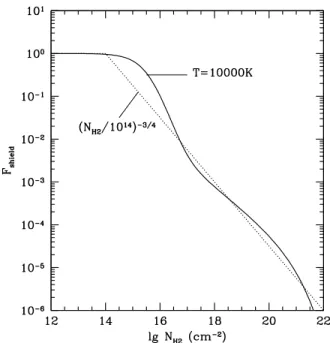
We show in Fig. 1 how much the static, cold shielding function (equation 11) may overestimate the self-shielding in our problem, by comparing this to the thermally-broadened shielding function (equation 13) atT = 104K. The biggest
discrepancy between these two shielding functions exists for
NH2 ≈10
14−1016cm−2. Interestingly enough, the H 2
col-umn density in our problem usually resides in this regime. It is crucial, therefore, to take into account the effects of thermal broadening and Doppler shift carefully, as we do in this paper.
2.3.2 External Source
Since our calculations are 1-D, spherically-symmetric, we have assumed the external radiation source contributes a radial flux Fext
ν (r) at frequency ν and radius r, measured
from the minihalo centre, given by
Fνext(r) =
Lextν
4πD2e
−τν(>r), (14)
whereLextν is the source luminosity, and τν(> r) is the
op-tical depth along the radial direction from radiusr to the source located at a distancer=D.
The radiative rate of speciesiat radiusris then given by
ki(r) =
Z ∞ 0
dνσi,ν4πJν(r)
hν =
Z ∞ 0
dνσi,νF
ext
ν (r)
hν , (15)
where we have used the fact that 4πJν =Fνext, as long as
the external radiation can be approximated as a 1D planar flux. In practice, one calculates this rate in a given grid-cell – i.e. spherical shell – with finite thickness. If such a grid-cell has a small optical depth,Fνext is almost constant
Figure 1.Power-law self-shielding function for cold, static gas vs. self-shielding function for hot gas atT = 104K. The problem of interest to us resides in the sensitive region, NH2 ≈ 10
14− 1016cm−2, where the biggest discrepancy exists.
Fext
ν to calculate ki(r). This naive scheme, however, does
not yield an accurate result when a grid-cell is optically thick, whereFνextmay vary significantly over the cell width.
This problem occurs frequently for solving radiative transfer through optically thick media, where individual cells have large optical depth. In order to resolve this problem, we use a “photon-conserving” scheme like that described by Razoumov & Scott (1999) and Abel et al. (1999). The de-tails of our implementation of this scheme are described in the Appendix.
2.4 Heating and Cooling
2.4.1 Photoheating
Photoheating results from thermalization of the residual ki-netic energy of electrons after they are photoionized. In gen-eral, the photoheating function is described by
Γ =X
i
Γi =
X
i
ni
Z ∞ 0
dν4πJνσν
hν (hν−hνi,th)
= X
i
ni
Z ∞ 0
dνF
ext
ν σν
hν (hν−hνi,th), (16)
wherehνi,th is the threshold energy over which the residual
photon energy is converted into the kinetic energy of elec-trons, and the net heating function Γ is the sum of individual heating functions ({Γi}). In finite-differencing equation (16),
we also use the photon-conserving scheme as we do for equa-tion (15). This prevents cells with large optical depth from obtaining unphysically high heating rates. See Appendix for details.
2.4.2 Radiative cooling
Cooling occurs through various processes. For atomic species, it comes from collisional excitation, collisional ion-ization, recombination, free-free emission, and CMB pho-tons scattering off free electrons (Compton cooling/heating). For atomic H and He, cooling is dominated by collisional excitation (for T <∼2×10⁵K) and free-free emission (for
T >∼2×10⁵K). The atomic cooling rate decreases rapidly
atT <∼104K, as there are no collisions energetic enough to
cause excitation. It is difficult, therefore, to cool gas below
T ≈104K solely by atomic cooling of primordial gas. Molecular hydrogen (H2), however, is able to cool gas
below T ≈ 104K, down to T ≈ 100K, by collisional
exci-tation of roexci-tational-vibrational lines by H atoms. An im-portant question to address is how much H2 is created,
maintained, or destroyed under the influence of an ioniz-ing and dissociationiz-ing radiation field. Even a small fraction,
nH2/nH>∼10
−4, is sometimes enough to cool gas below 104K
(e.g. see Shapiro & Kang 1987).
We use cooling rates in the parametrized forms given by Anninos et al. (1997), except for the hydrogen molecular cooling. For H2cooling, we use the fit given by Galli & Palla
(1998), where the low density cooling rate has been updated significantly from the previously used rate by Lepp & Shull (1984), which suffers from the uncertainties associated with the only collisional coefficients available at that time. At low densities, nH<∼102cm−3, the cooling rate of Lepp & Shull
(1984) is bigger by an order of magnitude than that of Galli & Palla (1998) atT ≈1000K.
2.5 Nonequilibrium chemistry
The general rate equation for the abundance of speciesiis given by
∂ni
∂t =Ci(T,{nj})−Di(T,{nj})ni, (17)
where Ci is the collective source term for the creation of
speciesi, and the second term is the collective “sink” term for the destruction of speciesi. The processes included and adopted are shown in Table 5 in the Appendix. Most of the rate coefficients are those from the fits by Shapiro & Kang (1987), with a few updates.
We also adopt the rate solving scheme proposed by Abel et al. (1997). It is well known that coupled rate equa-tions in the form of equation (17) are “stiff” differential equations, whose numerical solution suffers from instability if explicit ODE solvers are used. Abel et al. (1997) show that their implicit, backward difference scheme provides enough stability. Accuracy of the solution is achieved by updating each species in some specific order, rather than updating all species simultaneously from their values at the last time step. In addition, the abundance of the relatively fast reac-tions of H−and H+
2 are approximated by their equilibrium
values, which are expressed by simple algebraic equations. See the Appendix for the corresponding finite-differencing scheme.
We will frequently quote our results in terms of the fractional number density of speciesi, yi≡ nnHi, wherenH
We usex, however, to denote the fractional electron number density,ye, which is a measure of the ionized fraction.
2.6 Code tests
We tested our code against the following problems which have analytic solutions:
test problems which included gravity, radiative transfer, chemistry and hydrodynamics simultaneously.
(A) the self-similar, spherical, cosmological infall and accretion shock resulting from a point-mass perturbation in an Einstein-de Sitter universe of gas and collisionless dark matter (Bertschinger 1985);
(B) the self-similar blast wave which results from a strong, adiabatic point explosion in a uniform gas – the Se-dov solution (SeSe-dov 1959;
(C) the propagation of an I-front from a steady point-source in a uniform, static medium
(D) the gas-dynamical expansion of an H II region from a point source in a uniform gas (Lasker 1966)
(E) the gas-dynamical expansion-phase of the H II re-gion from a point-source in a nonuniform gas whose density varies with distance r from the source as r−w, w = 3/2
(Franco, Tenorio-Tagle, & Bodenheimer 1990).
Our code passed all the tests described above with an acceptable accuracy.
3 THE SIMULATIONS 3.1 Initial Setup
We now describe the initial setup for the problem of radia-tive feedback effects of Pop III stars on nearby haloes at
z ≈20. The first stars form inside rare, high density peaks at high redshift. We place target haloes of different mass
M = [2.5×104,5×104,105,2×105,4×105,8×105]M
⊙
at different locations from the source, with proper distance
D = {180, 360, 540, 1000}pc, which are all assumed to be affected directly by the radiation field from the source Pop III star of mass M∗ = 120M⊙4. We expose the
tar-get halo to this radiation field for the lifetime of the star,
t∗(120M⊙)≃2.5 Myrs (Schaerer 2002). The source Pop III
star is assumed to be located in a halo of massM ≃106M ⊙.
Time is measured from the arrival of the stellar radiation at the location of the target minihalo.
This setup is well justified by the cosmological simu-lations by Alvarez et al. (2006a). A cosmological gas and N-body simulation of structure formation in the ΛCDM uni-verse on small scales by a GADGET/SPH code was used to identify the site at which the first Pop III star would form. This occurred atz= 20, at the location of the highest den-sity SPH particle in the simulation box, located within a halo of massM≃106M⊙.This provided the initial density
field for the I-front tracking calculations in Alvarez et al. (2006a). The I-front from this first star escaped from the
4 The additional case ofD= 50 pc,F0= 600,M= 5.5×10⁵M⊙, will be discussed separately in §6.6 with regard to the case in which the target minihalo is merging with the minihalo which hosts the star, separated by less than its virial radius from the star
host halo quickly with high escape fraction, traveling as a supersonic, weak R-type front. By the end of the lifetime of the star (∼[3−2] Myrs) for stellar masses in the range
M∗ ∼[80−200]M⊙, the star’s H II region had reached a
maximum radius of about 3 kpc.
We approximate the spectral energy distribution (SED) of the source star by a blackbody spectrum. A Pop III star of mass M∗ ≈ 120M⊙, according to Schaerer (2002), has
the time-average effective temperatureTeff ≈105K and
lu-minosity L = R0∞dνLν ≈ 106.243L⊙. The corresponding
ionizing photon luminosity with this blackbody spectrum is
Q∗≡
R∞
νHdνLν/hν= 1.5×10
50s−1, wherehν
H≡13.6 eV is
the hydrogen ionization threshold energy. We assume that the source radiates with these time-averaged values through-out its lifetime, then stops. As the photons escape in a time scale short compared to the lifetime of the star and the es-cape fraction is high, we simply ignore the effect of the in-tervening gas (e.g. optical depth from the host halo and the IGM) and assume that the bare radiation field hits the edge of target haloes directly.
As we fix the luminosity of the source, different distances correspond to different fluxes. We express the frequency-integrated ionizing photon flux, F in units of 1050s−1kpc−2, to give the dimensionless flux, F
0 ≡
Nph,50/D2kpc = Nph,56/D2Mpc, where Nph,50 is the ionizing
photon luminosity (in units of 1050s−1) andD
kpc(DMpc) is
the distance in units of kpc (Mpc), respectively. The value
F0≈1 is typical for minihaloes encountered by
intergalac-tic I-fronts during global reionization (e.g. see Shapiro et al. 2004). Interestingly enough,F0 for our “small-scale”
prob-lem has a similar value. The Pop III star in our probprob-lem has
Nph,50 ≡ Q∗/1050s−1 = 1.5. For distances 180 pc, 360 pc,
540 pc and 1000 pc, F0 corresponds to 46.3, 11.6, 5.14 and
1.5, respectively.
3.2 Initial Halo Structure
For the initial halo structure, we adopt the minimum-energy truncated isothermal sphere (TIS) model (Shapiro, Iliev, & Raga 1999; Iliev & Shapiro 2001), which will be described further in §3.2.1. The thermo-dynamic properties and chemical abundances of the gas in these target haloes, however, is somewhat ambiguous. The density and virial temperature of these haloes are higher than those of the IGM in general, which drives their chemical abundances to change from the IGM equilibrium state to a new equilibrium state. The most notable feature is the change of yH2 and x. The IGM equilibrium value
of the electron abundance, x ≈ 10−4, is high enough to
promote H2 formation inside minihaloes to yield a high
molecule fraction,yH2≈10
−4−10−3. At the density of gas
in the halo core, this newly created H2 is capable of cooling
the minihalo gas to T ≈ 100 K, and depending on the virial temperature, the minihalo may, therefore, undergo a runaway collapse.
The time for this evolution of the target halo gas is short compared to the age of the universe when the first star forms in their neighborhood. As a result, it is likely that the target haloes are exposed to the ionizing and dissociating radiation from that first star as they are in the midst of evolving, with fine-tuning required to catch all of them in a particular stage
of this evolution. As the evolutionary “phase” of our target haloes is uncertain, we adopt two different phases as our representative initial conditions. In Phase I, chemical abun-dances have not yet evolved away from their IGM equilib-rium values. This stage is characterized by low H2 fraction,
yH2∼2×10
−6 and high electron fraction,x∼10−4. Phase
II is the state which is reached, after allowing the Phase I minihalo to evolve chemically, thermodynamically and hy-drodynamically for a few million years (a small fraction of a Hubble time,tH= 186 Myrs atz= 20), until the electron
fraction has decreased tox∼10−5. Phase II is characterized
by high H2fraction,yH2∼10
−4−10−3, and cooling-induced
compression of the core relative to Phase I, by a factor be-tween 1 and 20, higher for higher minihalo mass.
3.2.1 Phase I: Unevolved Halo with IGM chemical abundance in hydrostatic equilibrium
The first phase we choose is the initial state we assumed above, namely the nonsingular TIS structure with IGM chemical abundances. This phase is characterized by gas in hydrostatic equilibrium, with the truncation radius (outer boundary of the halo)
rt = 102.3
Ω0
0.27
−1/3 h
0.7
−2/3
×
M
2·105M⊙
1/3 1 +z
1 + 20
−1
pc, (18) the virial temperature
T = 593.5 µ
1.22 Ω0
0.27
1/3 h
0.7
2/3
×
M
2·105M ⊙
2/3 1 +z
1 + 20
K, (19)
whereµis the mean molecular weight (1.22 for neutral gas and 0.59 for ionized gas) and the central density
ρ0= 4.144×10⁻²²
Ω0
0.27
h
0.7
21 +z
1 + 20
3
g cm−3,(20)
which can also be expressed in terms of the hydrogen number density by
nH,0 = X(Ωb/Ω0)ρ0
mH
= 30 X 0.76
Ωb
0.043
h
0.7
21 +z
1 + 20
3
cm−3(21),
whereXis the hydrogen mass fraction in the baryon compo-nent. This central density is about 1.8×10⁴ρ(z),whereρ(z) is the mean matter density at redshift z, while at r=rtr,
ρ= 35ρ(z). For more details, see Shapiro et al. (1999) and Iliev & Shapiro (2001).
We assign chemical abundances that reflect the IGM equilibrium state, which is characterized by high electron fraction – high enough to promote H2 formation under the
right conditions – and low H2 fraction – low enough to
contribute negligible molecular cooling. We adopt yH = 1,
yHe= 0.0789,x≃yH+= 10−4,yH2= 2×10⁻⁶, and{yi}= 0
for other species (see, e.g. SGB94; Ricotti et al. 2001).
3.2.2 Phase II: Evolved Halo with Recombining and Cooling Core
The second initial condition we choose is the evolved state (Phase II) reached by allowing the system to evolve from Phase I initial conditions before the arrival of radiation from the Pop III star. In particular, we follow this evolution until the central electron fraction has dropped to 10−5 by
recom-bination from Phase I. We choose this condition because it is now characterized by high molecule and low electron frac-tion, contrary to Phase I. The fate of this halo will then mainly be determined by how easily this abundant H2 is
protected against dissociating radiation after the star turns on. The answer will also depend upon how much change has occurred hydrodynamically, because in some cases the halo core may have cooled and collapsed significantly enough to be unaffected by the feedback fromlateirradiation.
The time to reach Phase II is different for different mass haloes because of different gas properties. Initially, as we start from the TIS density profile whose central density is in-dependent of the halo mass, the recombination rate is higher for smaller mass haloes, because hydrogen recombines ac-cording to the following:
dx
dt ∝nHne−T
−0.7. (22)
The situation becomes complicated, however, once evolution begins and density changes. The H2cooling and collapse in
the central region of the haloes is increasingly effective as halo mass increases, because of the increasingly large dif-ference between the virial temperature and the H2 cooling
temperature plateau,∼100 K. The corresponding rapid col-lapse and cooling in massive haloes can easily offset the ini-tial temperature dependence by obtaining high density and low temperature, as is seen in equation (22). Phase II for large mass haloes represents haloes that have already started their cooling and collapse.
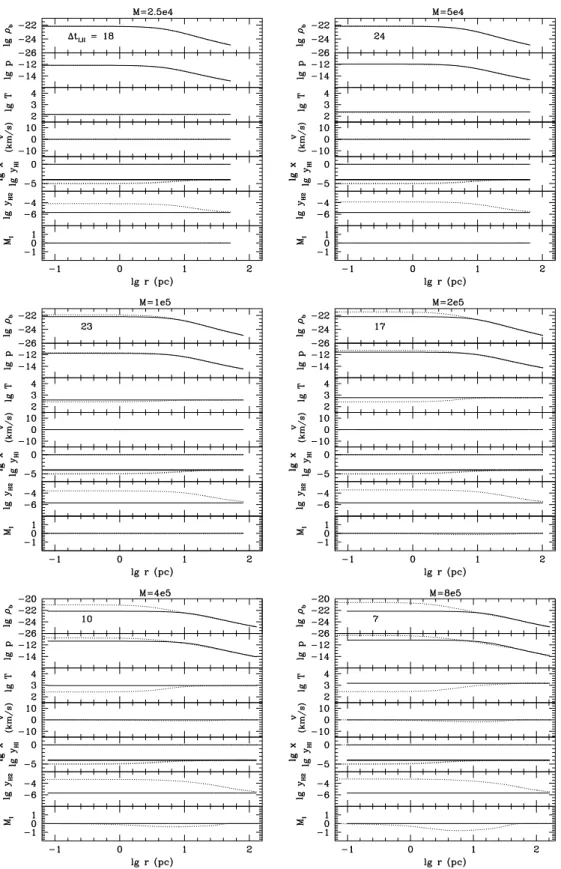
In Fig. 2, we show halo profiles in Phase I and Phase II for different halo masses. We also show how much time it takes for the haloes to evolve from Phase I to Phase II. The times for gas at the halo centre to recombine tox= 10−5
are in the range 7 ≤ ∆tI,II(Myrs) ≤ 24 for halo masses
0.25 ≤ M/(105M
⊙) ≤ 8, peaked at ∆tI,II = 24 Myrs for
M = 5×10⁴M
⊙. In all cases, ∆tI,II≪tH= 186 Myrs, the
age of the universe atz= 20.
4 HALO EVOLUTION FROM FULLY-IONIZED
INITIAL CONDITIONS: THE
CONSEQUENCES OF IRRADIATION WITHOUT OPTICAL DEPTH
Before describing the results of our full radiative transfer, hydrodynamics calculation, we describe an experiment de-signed to show the effect of neglecting the optical depth of the minihalo to ionizing radiation from the external star dur-ing the star’s lifetime on the minihalo’s evolution after the star shuts off. For this purpose, we assume the target mini-halo is initially fully-ionized and heated to the temperature of a photoionized gas as it would be if it were instanta-neously flash-ionized by starlight in the optically-thin limit. Such a setup is equivalent to that used by O’Shea et al.
Figure 2.Initial conditions for target haloes. We choose two different phases of TIS halo evolution as separate initial conditions. Phase I (unevolved; IGM abundance; solid) and Phase II (evolved from Phase I for a time ∆tI,IIuntilx= 10−5 at centre; dotted) are plotted for each mass of target halo. Each panel is labelled with the value of ∆tI,II in Myrs. Note that hydrodynamic difference between two phases is evident in haloes of massM >∼2×10⁵M
(2005), where they find that second-generation star forma-tion is triggered when the ionizaforma-tion of the minihalo caused by the nearby Pop III star leads to cooling by H2. The high
initial electron fraction present because of the assumption of full ionization allows quick formation of H2, which then
cools the central region before it reaches the escape velocity. For this experiment, we initialized ionized fractions as following: yHI = 6.4×10⁻⁴, x = 1.15, yHII = 1, yHeI =
6.8×10⁻⁶,y
HeII= 8.9×10⁻³,yHeIII= 7×10⁻²,yi= 0 for
other species. Without disturbing the halo density profile – we use the TIS halo model, which is described in §3.2.1 –, we also assigned a high initial temperature appropriate for photoionized gas, T = 2×10⁴K. These abundance and temperature values roughly mimic the condition found in typical H II regions.
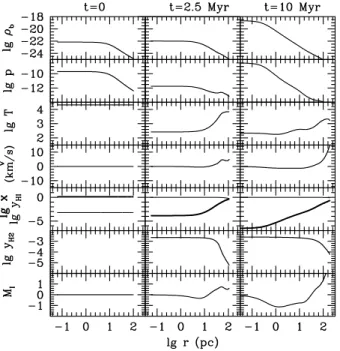
We find that such an initial condition leads to the col-lapse of the core region, when the formation of H2stimulated
by the high initial electron fraction enables H2 cooling. Gas
in the outskirts evaporates from the halo, however, because pressure forces accelerate the gas to escape velocity before it can form H2and cool. The H2cooling and adiabatic cooling
which happen later in this outflowing gas do not reverse the evaporation (Fig. [3]).
Our results for this case agree with the outcome of O’Shea et al. (2005). This led those authors to suggest that the first stars exerted a positive feedback effect on their sur-roundings, triggering a second generation of star formation. A question arises, however, as to whether this fully-ionized initial condition of nearby minihaloes is actually achieved by the first Pop III star to form in their neighborhood. As already mentioned in§1, Alvarez et al. (2006a) found that the I-front from this Pop III star gets trapped in those mini-haloes and cannot reach the central region before the star dies. In this paper, we will confirm that the fully-ionized ini-tial condition of O’Shea et al. (2005) is never achieved when one considers the coupled radiative and hydrodynamic pro-cesses more fully. We will also show that, if any protostellar region is to form in the target halo, it does so in the neutral core region which the ionizing photons do not penetrate.
5 MINIMUM HALO MASS FOR COLLAPSE:
THE CASE WITHOUT RADIATIVE FEEDBACK
When a minihalo forms as a nonlinear, virialized, gravitationally-bound structure out of the linearly per-turbed IGM, a change of chemical abundance occurs due to the change of gas properties. Most importantly, the hy-drogen molecule fraction changes from the IGM equilib-rium value, yH2 ∼ 2×10
−6, to a new equilibrium value,
yH2>∼10
−4. Even with such a small fraction, H
2 can cool
gas toTH2 ≃100 K, whereTH2 represents the temperature
“plateau” that gas in primordial composition can reach by H2cooling.
There exists a minimum collapse mass of minihaloes,
Mc,min, above which haloes, in the absence of external
ra-diation, can form cooling and collapsing cores within the Hubble time at a given redshift. The gap between the H2
cooling plateau temperature, TH2, and the minihalo virial
temperature, Tvir, given by equation (19) is a useful
indi-cator of the success or failure of collapse. For instance, at
Figure 3.Evolution of a “flash-ionized” TIS halo – i.e. initially fully-ionized at T = 2×10⁴K ofM = 2×10⁵M
⊙. From left
to right, each panel corresponds tot=0, 2.5, and 7.5 Myrs. Note that initially (t=0) absent H2is quickly created and cools the cen-tral region, while the initially hot gas in the outskirts evaporates before it cools. In each panel, from top to bottom, baryon den-sityρb, pressurep, temperatureT, velocityv, electron fraction(x;
thick)/neutral fraction(yHI; thin), molecule fractionyH2 and the
isothermal Mach number MI are plotted, respectively. Unless specified otherwise, the subsequent figures will follow the con-vention used in this figure.
z≈20,Tvir∼160 K forM = 2.5×10⁴M⊙. AsTvir≃TH2
, even after gas cools toTH2, it cannot collapse fast enough
to serve as a site for star formation. On the other hand,
Tvir ∼ 103K for M = 4×10⁵M⊙, and the temperature’s
cooling down toTH2≈100 K will make the gas
gravitation-ally unstable, which will lead to runaway collapse. This argu-ment is supported by the results of Haiman, Thoul, & Loeb (1996b), for example, that collapse can occur only in haloes withTvir>∼100 K.
We model the initial minihalo structure by the TIS model as described in§3.2.1 and let it evolve in the absence of radiation, starting from the IGM chemical abundance and minihalo virial temperature (Phase I). We determineMc,min
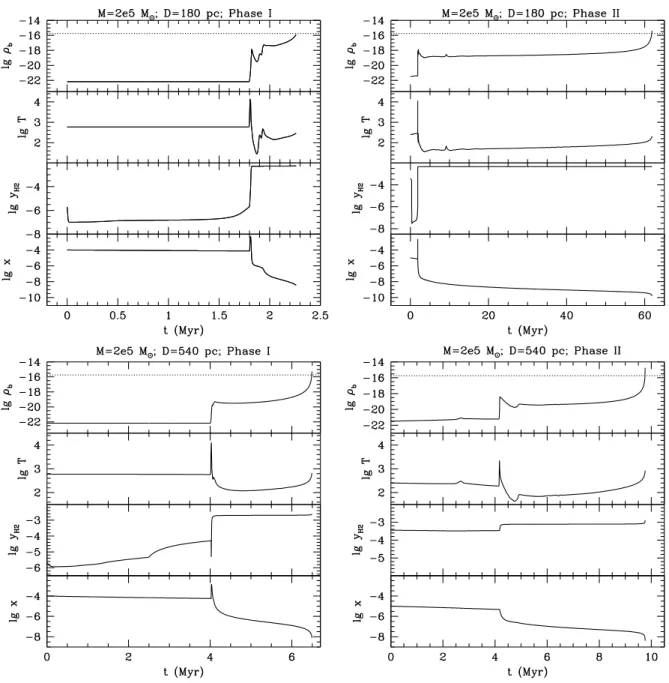
by the criterion
tcoll=tH, (23)
wheretcoll is the time at which the central density reaches
nH = 108cm−3 (the density suitable for initiating
three-body H2 formation; see e.g. Abel et al. 2000), andtHis the
Hubble time at a given redshift.
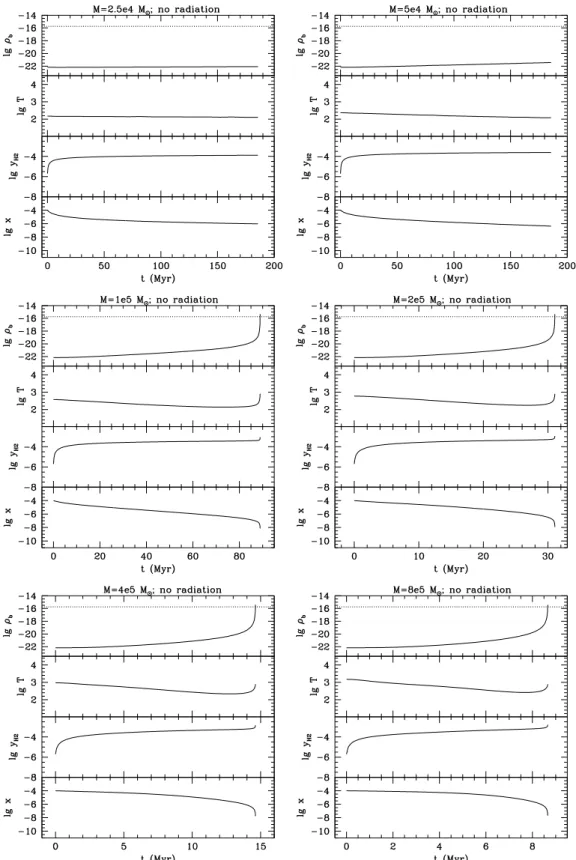
We find thatMc,min≃7×10⁴M⊙ atz = 20 (see Fig.
4). We have plotted the evolution of minihalo centres in the absence of radiation, where each run starts from Phase I. This is in rough agreement withMc,min ≃ 1.25×10⁵M⊙,
the value found by Machacek et al. (2001). The discrep-ancy is larger with results by Fuller & Couchman (2000) and Yoshida et al. (2003), where they obtain Mc,min ≃
7×10⁵M
Figure 4.Evolution of the centre of TIS minihaloes without radiation. Initially, minihaloes have structure described by the TIS model (see Phase I depicted by solid lines in Fig. 2) with the equilibrium value of primordial IGM chemical abundances. We definetcollas the time to reachnH= 108cm−3, represented by the horizontal dotted lines.
(1997), where they find Mc,min ≃2×10⁶M⊙ at z ≈ 20,
almost 30 times as large as our findings.
We argue that this discrepancy in minimum collapse mass results primarily from how well the minihalo struc-ture is resolved. Unless the centre, which gains the high-est molecule formation rate due to the highhigh-est density, is fully resolved, one could be misled by a poor numerical res-olution such that certain low-mass haloes, which can cool and collapse in reality, are in hydrostatic equilibrium in the simulation. The resolution becomes poorer in the fol-lowing sequence: Machacek et al. (2001), which gives the best agreement with our result, used an adaptive mesh refinement (AMR) scheme, resolving baryonic mass down to Mb ∼ 5M⊙. Such high resolution is suitable to
re-solve even the central part of the smallest minihaloes whose total baryonic mass content is roughly 2−3×10³M
⊙.
Fuller & Couchman (2000) and Yoshida et al. (2003), on the other hand, used the smoothed particle hydrodynam-ics (SPH) scheme, using SPH particles of mass Mb ∼
40−140×102M
⊙. Finally, Tegmark et al. (1997) used a
uniform top-hat model, where there is no radial variation in gas properties such as density and temperature, thus the central region is, in effect, completely unresolved. In addi-tion, some of the rates used in Tegmark et al. (1997) were not accurate (Fuller & Couchman 2000).
We believe thatMc,min≃7×10⁴M⊙atz= 20 is close
to reality, because our 1-D spherical setup is based upon the TIS model which is a highly concentrated structure, and the resolution of our code is superior to previous calculations5.
It is not our objective, however, to settle the exact value of
Mc,min. This estimate is based upon our specific criterion
described in this section, and is subject to change under dif-ferent criteria. This may also change if one adopts a more realistic halo formation history to account, for instance, for dynamical heating by accretion (see Yoshida et al. 2003). As the haloes we choose are rather conservatively divided into successful collapse (for M ≥105M
⊙) and failure (for
M < 105M
⊙), agreeing with AMR simulation result by
Machacek et al. 2001, we shall proceed with our choice of parameter space andsee how this fate of minihaloes changes as a result of external radiation from a Pop III star.
6 RESULTS: RADIATIVE FEEDBACK ON NEARBY MINIHALOES BY AN EXTERNAL POP III STAR
As described in §3.1, we expose target haloes of different mass to the radiation from a Pop III star whose spectrum is approximated as a 105K blackbody radiation field and
whose flux is attenuated by the geometrical factor RD
∗
−2
for different values ofD. In this section, we summarize the simulation results for both the Phase I (early irradiation) and the Phase II (late irradiation) initial conditions.
5 After this paper was written a new preprint was posted which is consistent with our description here, findingMc,min≈105M⊙
(O’Shea & Norman 2006).
6.1 I-front trapping and photo-evaporation
In all cases, even in the presence of evaporation, we find no evidence of penetration of ionizing radiation into the halo core. This is consistent with the results of Alvarez et al. (2006a) for the H II regions of the first Pop III stars and of Shapiro et al. (2004) and Iliev et al. (2005) for the en-counters between intergalactic I-fronts and minihaloes dur-ing reionization. There are two main reasons for this be-havior. First, the total intervening hydrogen column den-sity is initially high enough to trap the I-front outside the core. Second, the lifetime of the source is short compared to the evaporation time. If the source lived longer than the evaporation time, the I-front would eventually have reached the centre of the halo. In that case, Shapiro et al. (2004) find that the minihalo gas is completely evaporated. In our problem, however, the slow evaporation does not allow the I-front to reach the centre within the lifetime of a Pop III star.
The I-front entering the minihaloes propagates as a weak R-type front in the beginning. The I-front then makes the transition to the D-type, after reaching the R-critical state. This R-critical state is reached when the I-front ve-locityvI satisfies the following condition:
vI=cI,2+ (c2I,2−c2I,1)0.5, (24)
where cI is the isothermal sound speed, cI ≡
p
p/ρ, and subscripts 1 and 2 represent pfront and post-front, re-spectively. When the I-front propagates into a cold region (T ≪104K, as in our problem, this condition is
approxi-mately vI ≈ 2cI,2 ≈ 20 km s−1. In all cases, we find that
this transition occurs in times less than the lifetime of the source star, 2.5 Myrs. After reaching the R-critical state, gas in front of the I-front forms a shock, which then de-taches from the slowed I-front. As an example, we plot in Fig. 5 the profiles of Phase I, 4×10⁵M
⊙halo att=tR−crit
under different fluxes.
All of the post-front (ionized) gas, initially undisturbed, eventually evaporates away, accelerated outward by a large pressure gradient. As the line-of-sight is cleared by this evaporation, ionizing radiation penetrates deeper, until the source turns off. See Figs. 5, 6 and 7 for the evolution of the I-front.
This result invalidates the initial condition adopted by O’Shea et al. (2005) and Mesinger et al. (2006) which led them to find that H2formed in the core region after it was
ionized and then cooled while recombining, once the source turned off. As we show, the core remains neutral before and after the source is turned off, so the mechanism explored by O’Shea et al. (2005) does not work. This neutral core, therefore, must find a different way to cool and collapse if star formation is to happen in the target minihalo.
What happens to the initially ionized gas after the star turns off? This gas recombines as it cools radiatively and by adiabatic expansion, even forming H2molecules. We find
that this cooling cannot reverse the evaporation, however. Gas is simply carried away with the initial momentum given to it when it was in an ionized state. In Table 1, we list the fraction of the baryonic halo mass which is ionized during the lifetime of the star. This mass serves as a crude estimate of the mass lost from these haloes by evaporation. We found
Table 1.Ionized mass fraction of baryons for different mass target haloes (columns) at different distances from a 120M⊙Pop III star
(rows; fluxes in units of 1050s−1kpc−2,F
0, in square brackets). The ratio shown here is the mass ionized during the lifetime of the star to the total baryon mass.
Total Halo Mass in 105M ⊙units
(Halo Baryon Mass in 105M ⊙units)
D(pc) [F0] 0.25 0.5·104 1 2 4 8
(0.043) (0.086) (0.17) (0.34) (0.69) (1.371)
180 [46.3] 0.95 0.92 0.88 0.84 0.82 0.79
360 [11.6] 0.85 0.81 0.77 0.74 0.70 0.67
540 [5.14] 0.78 0.74 0.70 0.66 0.62 0.59
1000 [1.5] 0.66 0.60 0.55 0.50 0.47 0.43
Figure 5.Radial profiles of 4×10⁵M
⊙ halo att=tR−crit in Phase I, for different fluxes (distances). R-critical condition is met by the conditionvI≈2cs,I,2≈20 km s−1, when the I-front makes a transition from R-type to D-type. Different distances to the source are represented by different line types: D = 180pc (F0 = 46.3; black, solid), D = 360pc (F0 = 11.6; red, short-dashed), D = 540pc (F0 = 5.14; green, dotted), D = 1000pc (F0 = 1.5; blue, long-dashed). In the fifth panel from top, electron fraction
xand neutral hydrogen fractionyH(thin) are plotted. As is shown in the density (ρb) plot, gas just starts to respond to the I-front
hydrodynamically, as the initial R-type, supersonic I-front slows down to reach the R-critical phase. Also note that the shorter the distance, the deeper the I-front is (i.e. smaller r) att=tR−crit.
no major difference between Phase I and Phase II in this matter, so we provide only one table.
6.2 Formation ofH2 precursor shell in Front of the I-Front
We find that a thin shell of H2 is formed just ahead of
the I-front, with peak abundance yH2 ≈ 10
−4. It happens
mainly because the increased electron fraction across the I-front promotes the formation of H2. More precisely, the gas
Figure 6.Radial profiles of 4×10⁵M
⊙halo att= 0.5t∗in Phase
I, for different fluxes (distances). Same line types are used as in figure 5.
ahead of the I-front is ionized to the extent that the electron abundance is large enough to form H2, but at the same time
too low to drive significant collisional dissociation of H2. The
width of this H2 shell and the amount of H2 in this region
is determined by the hardness of the energy spectrum of the source: the width of the I-front is of the order of the mean free path of the ionizing photons. Pop III stars, in general, produce a large number of hard photons due to their high temperature, which can penetrate deeper into the neutral region than soft photons.
This precursor H2 shell feature is evident in Figs 5, 6,
and 7. We show the detailed structure of these H2 shells in
Figure 8, where we plot the radial profile of the abundance of different species for the case ofM = 4×10⁵M⊙, Phase I,
D= 540 pc (F0= 5.14) att= 0.5t∗. We note the similarity
between our results and those of Ricotti, Gnedin, & Shull (2001) for an I-front in a uniform, static IGM at the mean density (see Fig. [3] in Ricotti et al. 2001) which also show
Figure 7.Radial profiles of 4×10⁵M
⊙halo att=t∗in Phase
I, for different fluxes (distances). Same line types are used as in figure 5.
a precursor H2 shell. A similar effect was reported by
Susa & Umemura (2006), as well.
What is the importance of this H2 shell in protecting
the central region of haloes from dissociating radiation? The molecular column density obtained by this H2 shell
some-times reaches ∼ 1016cm−2, which provides an
apprecia-ble amount of self-shielding. The self-shielding due to the H2 shell, however, is not the major factor that determines
whether or not the H2 in the core region is protected. A more important factor is which evolutionary phase the tar-get halo is in when it is irradiated. Roughly speaking, when a target halo is irradiated early in its evolution (Phase I), the precursor H2 shell dominates the total H2 column
den-sity available to shield the central region, but this shielding is not sufficient to prevent photodissociation there anyway. On the other hand, if the halo is irradiated later in its evo-lution (Phase II), the H2 column density of the shell is only
a small part of the total H2 column density, so shielding is
successful independent of the precursor shell. We describe this in more detail as follows.
In order to understand quantitatively the importance of the H2 shell in protecting the central H2 fraction, we have
performed simulations with a source SED that is identical to the Pop III SED below 13.6 eV, but zero above 13.6 eV. As the radiation is now incapable of ionizing the halo gas, the H2 shell formation by partial ionization will not occur.
This enables us to compare our results where the H2 shell
is present to those cases without an H2 shell. We describe a
specific case ofM= 2×10⁵M⊙as an illustration. Roughly
speaking, the H2 shell which forms only in the presence
of ionizing radiation compensates for the amount by which the initial molecular column density,NH2, is reduced when
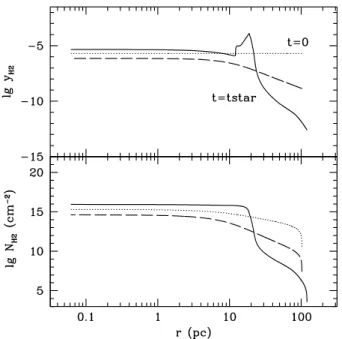
molecules in the ionized region are destroyed by collisional dissociation. The net column density in the case where the H2 shell is present even exceeds that in the case without
Figure 8.Radial profile of abundance of primordial gas species att= 0.6t∗, for a halo ofM= 2×10⁵M⊙in Phase I, illuminated
atD= 540 pc (F0 = 5.14). Labels are self-explanatory; electron abundance x is represented by the dotted curve, which closely follows the H II abundance. The flux is coming from the right hand side, so this figure can be compared to the mirror image of Figure 3 in Ricotti et al. (2001) for an I-front in a static, uniform IGM at the mean density.
the H2 shell (Figs. 9 and 10). The net effect is the increase
of the self-shielding. Such an increase of the self-shielding, however, is not too dramatic. In the case ofM= 2×10⁵M
⊙
with Phase I initial conditions,yH2 ≈10
−5.3 at the centre,
about an order of magnitude higher than the centralyH2 of
the case without ionizing photons (Fig. 9). This molecule fraction is still too low, however, to cool the gas. On the other hand, in the case of M = 2×10⁵M
⊙ with Phase II
initial conditions,yH2≈10
−3.5at the centre throughout the
lifetime of the Pop III source, whether or not the H2 shell
is formed. The depth (radius) of penetration of dissociating photons differs by a factor of 2 if the shell is included, but the central H2 is still protected because of the high H2 column
densityapartfrom the precursor shell (Fig. 10). The major factor that determines the fate of the central H2 fraction is
instead the evolutionary phase of a target halo when it is irradiated. The short lifetime of a Pop III star plays an im-portant role of either reconstituting or protecting molecules in the core, depending upon the evolutionary phase of the halo, as will be described in§6.4.
Note that in all cases, we use equation (13), the shield-ing function for thermally-broadened lines withT = 104K. This is justified by the fact that the H2 shell moves
in-ward with v ≈ 2−5 km s−1 and the shell achieves T =
Tsh ≈103−5×10³K, where Tsh denotes the temperature
of the shell. If we take this peculiar velocity as sound speed,
v ≈ 2−5 km s−1 corresponds to T = T
p ≡ v2µmH/k =
6×10²−3.7×10³K, where the subscript p denotes the
peculiar velocity. A crude way to imitate both effects by thermal broadening is to use the sum of these two
temper-Figure 9.Radial profiles of H2fraction (top) and the H2column density (bottom) forM= 2×10⁵M
⊙, Phase I initial conditions,
att= 0 (dotted) and att=t∗(solid). The source is at a distance
D = 540 pc (F0 = 5.14). Also plotted are those for a radiation composed only of dissociating photons (dashed) att=t∗. Even
though H2 shell provides self-shielding by contributing NH2 ≈
1016cm2, the molecule fraction y
H2 is held at <∼10
−5.3 due to strong dissociating radiation.
atures (Tsh andTp). We take the most conservative stand –
the least self-shielding effect – in order not to overestimate the self-shielding, and use T = 104K as the temperature responsible for the net thermal broadening of the molecular LW bands.
6.3 Formation of shock and Evolution of core
After the I-front decelerates as it enters the target halo, transforming from R-type to D-type, a shock front forms to lead the D-type front. The neutral gas in the core is strongly affected by this shock front as it propagates. This shock plays an important role in providing both positive and neg-ative feedback effects. By identifying successive evolutionary stages of the shock, we now describe how the core responds to the shock and evolves accordingly.
6.3.1 Stage I: Formation and acceleration of Shock
A shock starts to form as the I-front, initially moving super-sonically as an R-type, slows down and turns into a D-type. The pfront gas – neutral gas ahead of the I-front – can re-spond to the I-front before it is swept by the I-front, because the D-type front moves subsonically into the neutral gas. It is easier to understand the formation of the shock by using the I-front jump conditions: the pre-front gas speed in the rest frame of the I-front,v1, derived from the I-front jump
con-ditions, should satisfy eitherv1≥vR≡cI,2+ (cI2,2−c2I,1)0.5,
or v1 ≤ vD ≡cI,2−(c2I,2−c2I,1)0.5, wherecI,1 and cI,2 are
the isothermal sound speeds of the pre-front and post-front
Figure 10.Radial profiles of H2fraction (top) and the H2column density (bottom) forM= 2×10⁵M
⊙, Phase II initial conditions,
at t= 0 (dotted) and att = 0.5t∗ (solid). The source is at a
distance D = 540 pc (F0 = 5.14). Also plotted are those for a radiation composed only of dissociating photons (dashed) att=
t∗. Contrary to Fig. 9, the core H2 fraction is well protected to a high level,yH2 ≈10
−3.5. The role of H
2 shell is, however, not dramatic, because even without this shell, the core is protected from dissociating radiation (dashed). It rather offsets the loss to the molecular column density from collisional dissociation in the ionized region.
gas, respectively.vR andvD have a gap of 2(c2I,2−c2I,1)0.5,
which is nonzero in general. As the I-front slows down andv1
starts to crossvR,v1encounters a value which is not allowed
mathematically. This paradox is resolved, however, because the pre-front gas now “prepares” a new hydrodynamic con-dition by forming a shock. The shock wave increasesρ1and
thereby reducesv1 and increasesvD, making it possible to
satisfy the D-type condition,v1≤vD.
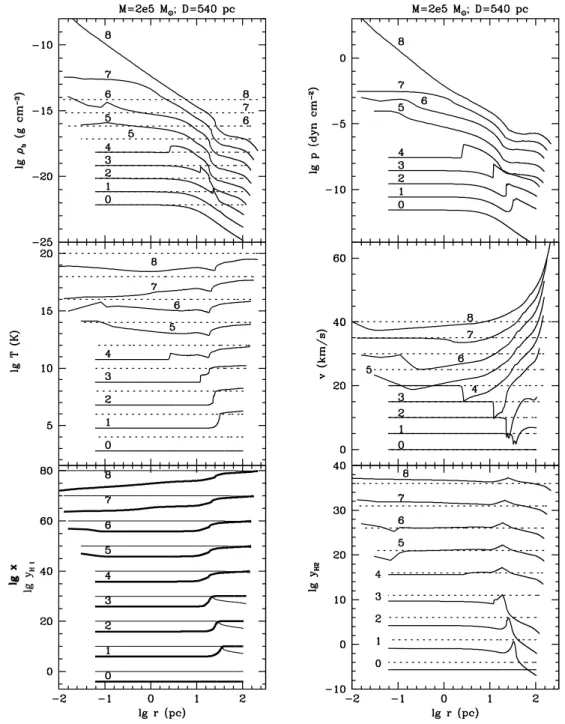
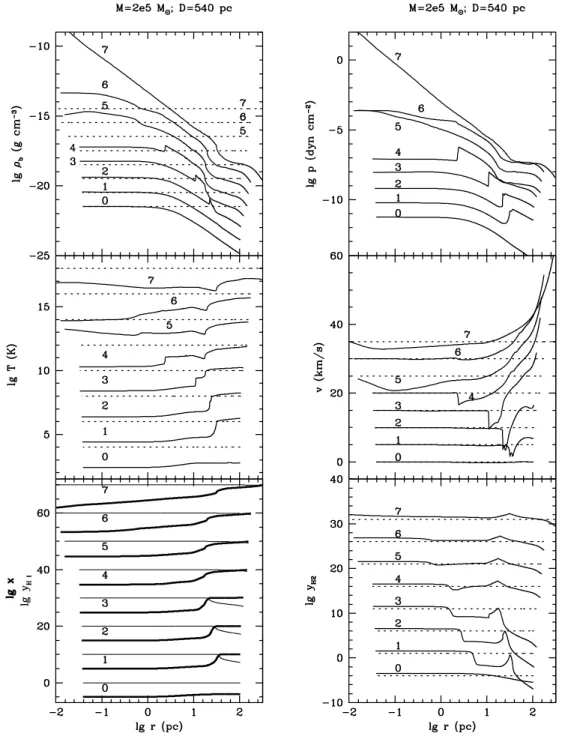
This shock-front then propagates inward, separating from the I-front, due to the discrepancy between the speed of the front and the speed of the I-front. As the shock-front enters the flat-density core, the shock shock-front starts to accelerate, leaving behind the post-shock gas with ever in-creasing temperature (e.g. see time steps 4 and 5 in Fig. 11, where the post-shock temperature increases as the radiusr
decreases).
As the shock boosts the density and temperature in the neutral, post-shock gas, the H2 formation rate there
increases, boosting the H2 column density even further.
We can understand the evolution of yH2 in the presence
of this shock quantitatively by using its equilibrium value,
yH2,eq. The increase of density and temperature due to
this shock promotes H2 formation, as follows. When there
is no significant H−
destruction mechanism, the dominant H2 formation mechanism is through H− (equation 1), and
the H2 formation rate becomes equivalent to the H−
for-mation rate. Photo-dissociation dominates over collisional dissociation in destroying H2, which occurs when x <∼4×