Te
st
in
g
Func
tional T
es
tin
g
Contrary, testing SAS-the Substa-tion AutomaSubsta-tion Systems, which in-volves many automation, control and SCADA functionalities, is usually performed manually. When looking at the time spent during commission-ing, for example, testing the automa-tion and communicaautoma-tion system is currently more time consuming than testing the protection functions. Au-tomation systems have become in-creasingly complex and the efforts for testing communication, interlocking logic, and proper operation of all sig-nals transmitted to SCADA systems have grown dramatically.
In substations, all connection in-terfaces between IEDs and primary equipment need to be checked as part of the FAT and SAT. For hard-wired interfaces, as an example, this is usually performed one-by-one in a manual process of “green marking” all interfaces on printed functional and wiring diagrams.
For testing the implemented logic functions such as command inter-lockings, many physical inputs need to be forced at the same time, and the logic verified by executing the related control operation. For testing the SCADA signaling, an end-to-end check is performed by stimulating the signals directly at the equipment level in the switchyard or by forcing them at the IED’s input terminals. Additional documentation is typi-cally required, like a spreadsheet with Remote Terminal Unit (RTU) signal and mappings list.
This process, which is ideally performed during FAT before de-livery and installation at site, re-quires several weeks for a typical substation and involves several experienced control and SCADA engineers.
The following hardware, soft-ware and technical competencies shall be available for system testing in the factory:
Ideally the entire SAS with all bay IEDs, networking equipment, gateways, HMIs, etc.
A switchgear simulator hardwired to the IEDs (can be simple switches and LED indica-tors up to sophisticated PLC based simulators)
Control center simulator sup-porting the used SCADA protocol (e.g. IEC 60870-5-104, DNP3)
Network testing and IED spe-cific maintenance tools
Deep knowledge about the implemented vendor products, IEC 61850 and Ethernet networks
Well prepared test plans and documentation (Signal spread-sheet, interlocking logics and other test procedures)
Usually, not all components of the SAS are available at the factory, e.g. in cases where IEDs are part of switchgear deliveries and shipped directly to site without proper sys-tem testing. In such cases, testing must be exclusively performed on site, with consequences in terms of efforts and costs.
Christian Brauner received his engi-neering degree at the polytechnical college St. Pölten/Austria in the field of communication technology. In the last 30 years he was employed by manufac-turers of substation automation (SAS), control, protection and SCADA systems for electric utilities. He started his ca-reer as a technical sales expert in Aus-tria with VA TECH SAT (now Siemens), later as sales manager with SPRECHER AUTOMATION. He has been involved in a variety if IEC 61850 related projects and frame contracts for large utilities all over Europe.
Since 2018 he has been working for OMICRON Vienna as sales development manager. His special focus is on testing and monitoring products and solutions for substation automation systems. Practical experience shows that
the better the system is tested in the factory, the less problems oc-cur during installation and testing on site, and the more efficient and smooth the project finally is.
During the testing procedure, bugs and errors in device param-eters but sometimes also in the device’s firmware are detected and fixed. But every update of firmware version and as well as any change of device settings requires at least retesting of the involved function, ideally a retest of the entire system. This process is not efficient if manual testing is performed, there-fore a new approach towards more automated and efficient system testing is heavily needed. Such a so-lution is available today and based on the SCL concept which is part of the IEC 61850 standard.
IEC 61850 and the SCL Concept
IEC 61850, the international standard for Communication net-works and systems for power util-ity automation, defines not just communication protocols, but also data models for substation equipment.
Moreover, the standard also specifies a common, vendor inde-pendent, configuration concept. Machine readable configuration information in an XML based stan-dardized format is used in this pro-cess - the System Configuration Language (SCL).
Testing the protection element settings of IEDs and protection schemes are
well established practices when testing a Protection, Automation and Control (PAC)
system. Tools and methods are available to support standardized and automated
protection testing routines. Test plans can be created for specific relay types and
schemes to be reused during distinct phases of a project, like Factory Acceptance
Tests (FAT), commissioning, Site Acceptance Tests (SAT) and maintenance.
Substation Automation
Systems
Eugenio Carvalheira received his B.Sc. in Electrical Engineering at UFPE in Bra-zil and his M.Sc. in Computational En-gineering at the University of Erlangen in Germany. He has over 18 years of experience in the design and commis-sioning of power systems protection, automation and control systems. He joined OMICRON in 2008 as an Applica-tion Engineer and is currently Engineer-ing Manager for North America based in Houston, TX. He is also an active member of IEEE PSRC working groups.
Maintenance Security Updates Commissioning
SAT Engineering
FAT Specification
System Configuration Tool
(SCT)
Conductive Equipment
Simulated equipment Testing with real equipment
ICD
CID
ICT SST
SCD SSD
Subequip. Phase Bay
Voltage Level Substation Substation
Communication IEDs
Logical
Node Data Logical
Device Server
IED
Access-Point Sub
Network
Te
st
in
g
by Christian Brauner, OMICRON electronics GmbH, Austria and Eugenio Carvalheira, OMICRON electronics Corp., USA
40
Incr
ea
sed V
isibilit
y
SCD (System Configuration
Description): contains all
config-ured IEDs, the communication configuration and all IEC 61850 aspects for a given system. It is cre-ated by the System Configuration Tool (SCT)
CID (Configured IED
Descrip-tion): contains a subset of the SCD
file with all information related to one specific IED. Private extensions are allowed
In principle, there are three types of engineering tools in this process: System Specification Tool (SST), System Configuration Tool (SCT) and IED Configuration Tool (ICT). Practically, an all-in-one tool and no SSD is often used in case of single-vendor systems. In multi-vendor installations with multi-vendor specific ICTs, typically a dedicated SCT is used. Today, more and more users understand the need for stan-dardization and use an SST for the specification process.
The SCT allows engineers to design and configure the system-wide IEC 61850 communication dataflow. ICD files from all IEDs SCL Engineering Process:
The SCL concept is defined in IEC 61850-6. Its main purpose is to al-low the exchange of configuration data, in a compatible way, between different configuration and testing tools.
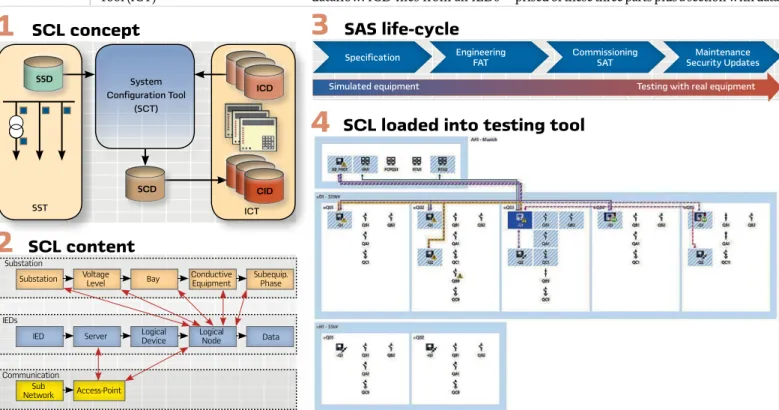
Figure 1 shows the general con-cept of the engineering process of a substation automation system with the usage of SCL data exchange.
The following types of SCL files, with different extensions, are speci-fied for exchange of information:
SSD (System Specification
De-scription): describes the single line
diagram of the substation, voltage levels, primary equipment and re-quired logical nodes (LN) for imple-menting the substation functions. The SSD file is generated by a System Specification Tool (SST)
ICD (IED Capability
Descrip-tion): describes the functional
capa-bilities of an IED type. Each IED type has its related ICD file. It contains the IED logical nodes, data and sup-ported services. It is generated by the vendor specific IED Configuration Tool (ICT)
and the SSD file can be imported into the SCT. The tool should allow the configuration of IEC 61850 related features of the IEDs, configuration of horizontal communication links (GOOSE and Sampled Values) and configuration of vertical communication links (Client/Server Reports). By using data from the SSD file or by direct entry, the engineer can associate IED functions (Logical Nodes) to the single-line equipment and func-tions. Ultimately, the SCD file, documenting the complete system, is generated by the SCT.
SCL Content:The SCL language in its full scope allows to describe a model of the substation comprising of three basic parts:
Substation: describes the single line diagram of the substation, primary equipment and func-tions; The substation equipment such as a Circuit Breaker is “connected” to the virtual logical nodes contained in the IED
IED: describes all the hardware devices (IEDs) used in the substation automation sys-tem. The data model implemented in the IED including its logical devices and logical nodes are described in this part. IEDs are connected to the communication system via its access-points
Communication: describes logically possible connections between IEDs in sub-networks by means of access-points (communication ports)
The content of a complete SCD file is com-prised of these three parts plus a section with data
SCL concept
1
SCL content
2
SAS life-cycle
3
SCL loaded into testing tool
and attributes are used by the IEDs. (see Figure 2).
Substation Structure and Func-tional Naming: The substation struc-ture represents the primary system architecture and describes which pri-mary equipment functions are used, and how the equipment is connected. The objects in this section are hierar-chically structured and designated ac-cording to IEC 81346.
The main purpose of this section is to derive a clear functional designation for the abstract logical nodes, which are implemented in the IEDs to the primary equipment in the substation. Otherwise it might be difficult for the system tester to find out which spe-cific LN-instance in the IED is “con-nected” to which primary element in the switchgear.
Content and Usage of SCD Files: As explained above, the SCD file is the ultimate file resulting from a completed IEC 61850 system design. The SCD file is not only used by engi-neering tools and for documentation purposes, but also by testing tools. Testing tools can support a more effi-cient testing, taking advantage of the SCD file information about the sub-station under test. However, while the standard defines a clear concept for the engineering process, it does not define a minimum content requirement for
in the substation section, for exam-ple, is optional. Information in the IED section depends on the capa-bilities of the specific IED products used in the project. So, it is strongly recommended for substation own-ers to include minimum require-ments on the SCD file into SAS specifications used for project ten-ders and service contracts, such as:
Substation section must contain all voltage levels, bays and CBs/disconnectors with their LN references (XCBR/XSWI, CSWI and CILO)
Data Objects include "desc" description attributes with signal text as defined by the owner
GOOSE subscriptions use <IEDName> elements in the <GSEControl> element, and use <Inputs><ExtRef type="GOOSE"> elements
RTUs/Gateways or HMIs must be defined, have the Report Control Blocks in the IED reserved and declared using <ClientLN> in the <ReportControl> element
All data sets used in reports are of static type (dynamic data sets are not documented in the SCD)
The better the quality and con-tent of the substation’s SCD file, the higher the efficiency of system testing will be. A compliant SCD
file is also highly supporting later extensions of the station as described below.
New SAS Testing approach based on SCD Files
Test Approach: As mentioned, testing of the automation and control functionality are usually performed in a manual way. Since many years, tools are available offering testing capabilities on a per IED basis, allowing manual test and simula-tion of individual IEDs.
The method presented here extends the test from single IED testing and simulation to testing of the entire Substation Automation System. The test is entirely based on the SCD configuration file. By importing the SCD file, the entire system can be visualized and all information available in the SCD is used. The information in the substa-tion secsubsta-tion is used to place IEDs and switchgear equipment within their voltage levels and bays. As can be seen in Figure 4, the tester gets to view the system in a very similar way as the single-line diagram or the local substation HMI, which he is already familiar with.
The method proposed is suitable for testing the SAS during its entire project lifecycle, which project phases are described at IEC 61850-4 and illustrated in Figure 3. The tool using this method should support both monitoring as well as simu-lation of the system. When testing, the test set should have access to the GOOSE network traffic and a MMS connection to the IEDs.
During the specification phase, the SCD file, the signals and communication services can be validated without the need of any physical device. Later, testing of SCADA gateways and HMIs can be performed by simulating the communication behavior and signals of all IEDs - again without any real IED. During the FAT, IEDs that are not yet present can be simulated to test those ones which are already available. As the project moves into the commissioning stage, more monitor-ing and testmonitor-ing of the real IEDs is done instead of simulation. One of the key factors for an effi-cient approach is the option to create test plans. A test procedure can be documented and reused throughout the SAS lifecycle. Test sequences can
Check of GOOSE publisher-subscriber links
5
was presented for testing the
communication, automation, control
and SCADA part of the SAS system,
which is based on
the SCD file information.
Figure 5
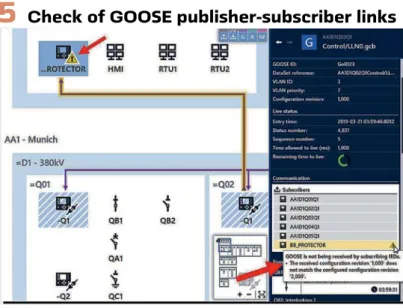
illustrates an example where the GOOSE published by an IED is verified in the network, but a problem is identified at one of the subscribers due to a mismatch in the configuration revision.
Signal Logics IEC Reference/Step in Testcase 1 2 3 4 5 6 7 8 9 10 11
BB11 No-Voltage --- --- --- --- --- --- --- J1Q02R1LD0/MVGAPC2.Ind4.stVal TRUE TRUE TRUE TRUE TRUE TRUE TRUE TRUE TRUE TRUE FALSE Q02-QB1 Open --- --- --- --- --- --- J1Q02R1CTRL/DCXSWI1.Pos.stVal OPEN OPEN OPEN OPEN OPEN OPEN OPEN OPEN OPEN CLOSE OPEN Q03-QB11 Open --- --- --- --- J1Q03R1CTRL/DCXSWI1.Pos.stVal OPEN OPEN OPEN OPEN OPEN OPEN OPEN CLOSE CLOSE OPEN OPEN Q08-QB1 Open --- --- J1Q08R1CTRL/DCXSWI1.Pos.stVal OPEN OPEN OPEN OPEN OPEN OPEN CLOSE CLOSE OPEN OPEN OPEN Q10-QB1 Open --- J1Q10R1CTRL/DCXSWI1.Pos.stVal OPEN OPEN OPEN OPEN OPEN CLOSE CLOSE CLOSE OPEN OPEN OPEN Q04-QB11 Open --- --- --- --- J1Q04R1CTRL/DCXSWI1.Pos.stVal OPEN OPEN OPEN CLOSE CLOSE OPEN OPEN OPEN OPEN OPEN OPEN Q06-QB1 Open --- --- J1Q06R1CTRL/DCXSWI1.Pos.stVal OPEN OPEN CLOSE CLOSE OPEN OPEN OPEN OPEN OPEN OPEN OPEN Q07-QB1 Open --- J1Q07R1CTRL/DCXSWI1.Pos.stVal OPEN CLOSE CLOSE CLOSE OPEN OPEN OPEN OPEN OPEN OPEN OPEN
QC11 EnableClose J1Q02R1CTRL/ESCIL02.EnaCls.stVal TRUE TRUE TRUE FALSE TRUE TRUE TRUE FALSE TRUE FALSE FALSE &
& &
& >=1 >=1
Te
st
in
g
by Christian Brauner, OMICRON electronics GmbH, Austria and Eugenio Carvalheira, OMICRON electronics Corp., USA
Func
tional T
es
tin
g
42
7
Interlocking logics and definition of test steps in spreadsheet
be performed and assessed auto-matically. Some test cases related to the SAS system are discussed in the following sections.
Verification of Communication Links: By loading the SCD file and having access to the network traffic and MMS connection to the IEDs, the testing tool can automatically validate all GOOSE, Sampled Values and Report communication links.
The test set can poll for attributes in the IEDs and validate against the model. It can check, for example, if the Report Control Blocks are En-abled and if the Owners of the Re-ports are the Clients declared in the SCD file. GOOSE communication links can be verified for:
GOOSE mismatch on the
send-er side: by vsend-erifying Control Block
settings
GOOSE publishing errors: by sniffing on the network and compar-ing against SCD
GOOSE subscription errors: by verifying the LGOS statuses at each
subscribing IED. Mismatches are also checked
Figure 5 illustrates an example where the GOOSE published by an IED is verified in the network, but a problem is identified at one of the subscribers due to a mismatch in the configuration revision. The connection link is highlighted in yellow and warning signs are dis-played to indicate the issue.
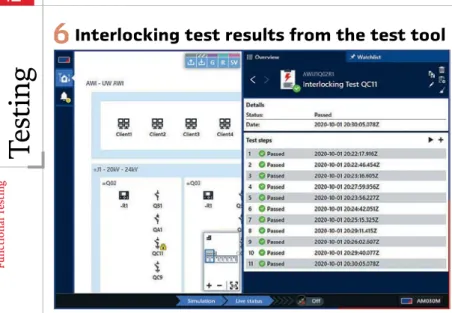
Testing Interlocking Logics: Logic is implemented in IEDs to cover many automation functions. They can automatically be tested using this approach by simulating the inputs of the logic (either via IED simulation or real switchgear status) and the result of the logic can be assessed. One application example is the use of logics for interlocking schemes to ensure proper operation of disconnect and grounding switches. To represent the result of interlocking logic con-ditions, IEC 61850 defines the sta-tus of the release in the logical node
CILO. For testing, a subset or ideally all possible combinations of inputs can be tested, and the logic output assessed by automatically reading the CILO status values. (see Figures 6 and 7).
Troubleshooting by Tracing Signals: There are multiple transfers of messages and signals within a SAS system. A signal passes multiple steps until it arrives at the control center. If there is an error in this communication, the commission-ing engineer needs to follow the signal on its way through the SAS. Finding such signal errors can be very time consuming. Using the test method described in this article, it is possible to follow how the signals propagate through the SAS.
Testing RTU/Gateway and local HMI Config-uration: Gateways, RTUs and local HMIs usually communicate with almost all IEDs in the system, mainly via Reports, but also GOOSE. Typically, several thousands of signals need to be tested. During commissioning, at least the most critical signals are tested point-to-point by stimulating the signal in the switchyard. All other signals can be simulated by a testing tool. A test plan can be built with the testing tool simulating all IEDs and signals of the substation for a quicker verification.
Gateways/RTUs, HMIs and other IEDs in general are often exposed to firmware updates and security patches during their life time. The devices can be easily re-tested (sanity check) af-ter the update by executing the test plan already prepared for that device before it is put back into operation. Those tests can be performed in the substation with all other IEDs simulated by a modern test tool without affecting the devices in operation.
Practical Use Case: Extension of an ex-isting substation
For an important 20 kV Indoor Substation with around 55 IEDs, 3 busbars and two bus sec-tions in a large industrial complex, the owner
de-To represent the result of interlocking
logic conditions, IEC 61850
defines the status of the release in the
logical node CILO.
Interlocking test results from the test tool
Local HMI
Reports
Control Center
MV Switchgear - Existing
(Orange… Scope of extension project)
Station LAN IEC 61850 Gateways
A and B
Interlocking IED
MV Switchgear - Extension
GOOSE
Test Tool
IEDs IEDs
new IEDs
Interlocking IED (spare)
Existing IEDs simulated by test tool
Station LAN IEC 61850
Principle system diagram of the SAS
8
with several additional bays. The sub-station was commissioned around 10 years ago with a modern PAC system based on IEC 61850. Due to the opera-tional constraints, the extension must be performed without de-energizing and during operation of the substa-tion. The command interlockings have been implemented by PLC functions in the IEDs and GOOSE is used for ex-change of the relevant signals between the IEDs.The bay-related interlocks are im-plemented in the respective bay de-vice. In addition, a dedicated station interlocking IED calculates the station-wide interlockings (see Figure 8). To realize this, the bay devices send their switch positions and other informa-tion via GOOSE to the interlocking IED, which calculates topological in-formation such as "busbar 1 grounded" and sends this information again via GOOSE back to the bay devices, where the final command releases are cal-culated. Benefit: If the central device fails, the bay-related interlocks remain available. And most important: Exist-ing bay IEDs are not affected in case of extensions of the substation!
This way of implementation allows subsequent extension without retest-ing the existretest-ing bays and – when us-ing modern testus-ing tools - also durus-ing operation.
Factory testing of the new IEDs: As the majority of the IEDs are already in operation, the IEDs for the new bays could not be factory tested together with the existing IEDs and station level devices. Therefore, the owner decided to perform the test of the new IEDs with a spare Interlocking IED and the rest of the substation to be simulated by the testing tool (Figure 9).
At first, the engineer imported the existing SCD file into a new project da-ta base, added the new IEDs, updated the central interlocking IED, the HMI and the gateways in order to incorpo-rate the new bays and finally created a new SCD file of the entire substation (existing + extension). The existing bay control and protection IEDs remained unaffected and will not be loaded with new parameter files.
close operation in the new bays, test cases with >50 test steps have been defined as a permutation table in spread sheet (Figure 7) and im-plemented in the test tool. The test cases have been created just once for a typical bay and easily copied for the others. Finally, those test steps have been executed by simu-lation of the existing IEDs and as-sessment of the relevant CILO data objects in the new IEDs (Figure 6). This way, the correct implementa-tion of the interlocking scheme in the central interlocking IED as well as in the new bay IEDs has been verified.
Testing of the updated gate-ways: A second part of the exten-sion project involves the update of the existing gateways with latest CPU hardware and firmware for cybersecurity reasons. Consid-ering the extensive evolution of hardware and firmware during the past 10 years, a complete retest of around 2.000 signals from the IEDs to the Control Center after the up-date was highly recommended.
As the station is equipped with redundant gateways, one of the two gateways can be disconnected from the Station LAN without dis-turbing remote control from the
control center. Each gateway will be upgraded, and a complete signal test will be performed by simulating all reports and SCADA signals with the test tool, verifying the correct function of the gateway up to the control center.
Conclusion
An innovative test approach was presented for testing the communication, automation, con-trol and SCADA part of the SAS system, which is based on the SCD file information. Test plans can now be created to automate the test and docu-ment procedures that have been very time con-suming until now.
Automated test plans also enable a quick re-test after security patches and firmware updates, which are performed quite often nowadays. Test-ing is becomTest-ing an integral part of the system and quickly evolving into a supervision and monitor-ing role.
Figure 8:
Benefit: If the central device fails, the bay-related interlocks remain available.