SSL Insight and Cisco FirePOWER
Deployment Guide
Disclaimer
This document does not create any express or implied warranty about A10 Networks or about its products or services, including but not limited to fitness for a particular use and noninfringement. A10 Networks has made reasonable efforts to verify that the information contained herein is accurate, but A10 Networks assumes no responsibility for its use. All information is provided “as-is.” The product specifications and features described in this publication are based on the latest information available; however, specifications are subject to change without notice, and certain features may not be available upon initial product release. Contact A10 Networks for current information regarding its products or services. A10 Networks’ products and services are subject to A10 Networks’ standard terms and conditions.
Table of Contents
Overview ...3
SSL Insight Technology ...3
Deployment Requirements ...3
Deployment Mode ...4
Accessing Thunder ADC...4
How to Configure Partitions on Thunder ADC (Optional) ...5
Network Configuration ...5
Interface Assignments ...6
Configuring an Internal Thunder ADC Instance ...6
Configuring an External Thunder ADC Instance...6
Predeployment Requirements ...6
Internal Thunder ADC Requirements ...6
External Thunder ADC Instance Requirements and Clarifications ...7
The A10 Networks Cisco FirePOWER Deployment Solution ...8
Internal Thunder ADC Instance Configuration ...8
ACL configuration:...9
Server configuration: ...9
Server port configuration: ...9
Adding a server member in a service group: ...10
Virtual server configuration: ...10
External Thunder ADC Instance Configuration ...11
Preconfiguration requirements: ...11
ACL configuration:...12
Service group configuration: ...12
Virtual server configuration: ...13
Webroot BrightCloud URL classification configuration: ...14
Explicit Proxy Configuration...15
Cisco FirePOWER Configuration ...16
Cisco FirePOWER System Licensing ...17
Summary ...18
Appendix A ...19
A10 Internal Device Configuration...19
A10 External Device Configuration ...20
Appendix B ...22
Appendix C ...22
Overview
With the growth in encrypted traffic, increasing SSL key lengths and more computationally complex SSL ciphers, it is increasingly difficult for inline security devices to decrypt SSL traffic. This guide provides step-by-step instructions for the deployment of an A10 Networks® SSL Insight™ configuration with Cisco FirePOWER to address these challenges. SSL Insight is an essential feature in the A10 Networks Thunder® ADC line of Application Delivery Controllers. It eliminates the SSL blind spot in corporate defenses and enables security devices to inspect encrypted traffic, not just clear text. This SSL decryption and inspection solution is based on a Layer 2 environment and can be deployed with a single Thunder ADC appliance using Application Delivery Partitions (ADPs) to create multiple, logical Thunder ADC instances.
SSL Insight Technology
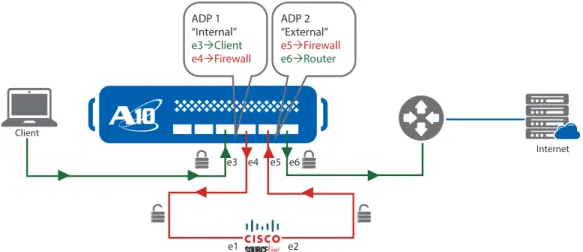
This guide describes the configuration of SSL Insight using a single Thunder ADC appliance, with one Thunder ADC partition decrypting SSL traffic and a second Thunder ADC partition encrypting traffic. The partition that decrypts outbound SSL traffic is referred to as the “Internal Thunder ADC Instance.” The partition that encrypts outbound SSL traffic is referred to as the “External Thunder ADC Instance.” Here’s how SSL Insight works:
• Encrypted traffic originates from internal clients.
• Traffic is intercepted and decrypted by the Internal Thunder ADC Instance and the clear-text content is redirected to the Cisco FirePOWER appliance.
• Cisco FirePOWER inspects the data in clear text and forwards it to the next-hop router. • The External Thunder ADC Instance intercepts and encrypts the traffic. At this point:
- An encrypted session is created to the remote server.
- A client media access control (MAC) address is stored for this session. - Outbound traffic is forwarded to the default gateway.
• The remote server receives the encrypted request. • The remote server sends back the encrypted response.
• The External Thunder ADC Instance decrypts the response and forwards the clear-text traffic to the security device. At this point:
- The session is matched and the source MAC address is retrieved. - Traffic is sent back to the client MAC address.
• Return traffic from the remote server is sent to the Cisco FirePOWER appliance for further inspection. If Thunder ADC is load balancing multiple FirePOWER appliances, it will forward traffic to the same appliance that inspected the outbound request.
• The Internal Thunder ADC Instance receives the clear-text traffic from Cisco FirePOWER, encrypts it and sends it to the client.
• The client receives the encrypted response.
Deployment Requirements
To deploy the SSL Insight solution with Cisco FirePOWER, the following are required:
• A10 Networks Advanced Core Operating System (ACOS®) 4.0.1 build 214 or higher (supported with virtual or hardware-based Thunder ADC appliances)
• Cisco FirePOWER 4.5.1.1 or higher (supported with virtual or hardware-based Cisco FirePOWER appliances) • Cisco FirePOWER Sensor
• Cisco FirePOWER Defense Management Center (required)
Deployment Mode
A10 recommends deploying the SSL Insight feature in a single device topology. With Application Delivery Partition (ADP), a single device Thunder ADC appliance can be partitioned for “Internal” and “External” partitions. ADP is available on virtual and hardware-based appliances with a minimum of 32 partitions per device. With the SSL Insight solution, it will require at least 2 partitions to get the solution to work.
ADP 1 “Internal”
e3ÒClient
e4ÒFirewall
ADP 2 “External”
e5ÒFirewall
e6ÒRouter
e3
e1 e2
e4 e5 e6 Client
Internet
Figure 1: SSL Insight in a single-appliance deployment
Deployment considerations:
• Virtual/appliance-based sensors deployment can support Layer 2 transparent mode only. • Limited to the number of interface ports within a single device solution.
• Cisco FireSIGHT Management Center is required to manage the Cisco Sensors. Each Cisco FireSIGHT Management center can support up to 25 sensors.
• This guide only provides a Cisco interface configuration as every packet inspection solution has different policies.
For other deployment options, refer to Appendix B for multi-device deployment details.
Accessing Thunder ADC
This section describes how to access the Thunder ADC appliance. Thunder ADC can be accessed either from a Command Line Interface (CLI) or a Graphical User Interface (GUI):
• CLI
- Text-based interface in which you type commands on a command line. You can access the CLI directly through the serial console or over the network using either of the following protocols:
› Secure protocol – Secure Shell (SSH) version 2
› Unsecure protocol – Telnet (if enabled and not recommended) • GUI
- Web-based interface in which you click to access configuration or management pages and type or select values to configure or manage the device. You can access the GUI using the following protocol:
› Secure protocol – Hypertext Transfer Protocol over Secure Socket Layer (HTTPS)
Note: HTTP requests are redirected to HTTPS by default on the Thunder ADC device. - Default username: admin
- Default password: a10
For detailed information describing how to access the Thunder ADC appliance, please refer to the Thunder System Configuration and Administration Guide1.
Note: The first configuration change to consider would be to change the management port IP address for GUI or CLI access. If you are using two separate devices to deploy SSL Insight, make sure that both systems are configured with a management address.
How to Configure Partitions on Thunder ADC (Optional)
This option is only valid for a single appliance solution; if you are deploying two appliances – one to decrypt SSL traffic and a second appliance to encrypt SSL traffic – you can skip this section. When deploying a single appliance solution, please keep in mind the number of interfaces allocated within the platform as its capacity is limited.
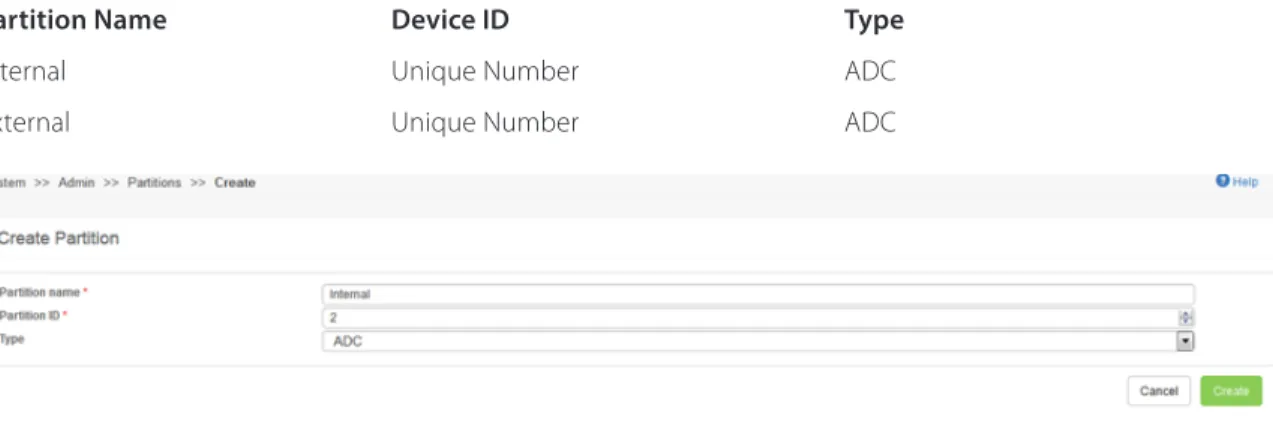
To create a partition, navigate to the right-hand side of the GUI and click the dropdown under Partition: shared, then select +Create.
Administrator account privilege is required to create partitions:
Partition Name Device ID Type
Internal Unique Number ADC
External Unique Number ADC
Figure 2: Partition creation
To navigate from one partition to another, select the top right-hand corner under Partition:”xxxx” and select the appropriate partition to configure.
Here are a few commonly used CLI commands for an ADP configuration:
• To create a partition: SSLi(config)#partition “internal” id 2 application-type adc • To switch from one partition to another: SSLi(config)#active-partition “internal” • Current active partition: internal
• SSLi[internal](config)#
Once the SSL Insight partitions have been configured, the Thunder ADC appliance should have at least three partitions: Shared, Internal and External.
Note: Please make sure that you are on the correct partition when creating configurations. In addition, you will need to use the command system ve-mac-scheme system-mac to support MAC address duplication for a single device solution.
Network Configuration
Once the partition is configured, select the interface required to deploy the SSL Insight solution. In this case, L2 mode is being used, hence untagged ports are required. In this deployment example, we will use 192.0.2.x network for internal addressing. For a simplified configuration, we recommend using the CLI to configure the ports.
Note: Ethernet numbers described below are used for reference purposes only.
Interface Assignments
• Ethernet 3 interface connecting to the client networks
• Ethernet 4 interface connected to Cisco FirePOWER firewall (ingress) • Ethernet 5 interface connected to Cisco FirePOWER firewall (egress) • Ethernet 6 interface connected to public network
Note: See Figure 1.
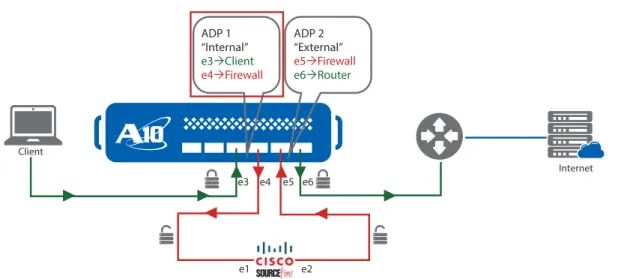
Configuring an Internal Thunder ADC Instance
vlan 100
untagged ethernet 3 untagged ethernet 4 router-interface ve 100 interface ve 100
enable
ip address 192.0.2.1 255.255.255.0 ip allow-promiscuous-vip
Note: The ip allow-promiscuous-vip command is required for any configuration that uses a wildcard virtual IP (VIP) 0.0.0.0. This command enables client traffic received on this interface and addressed to any port to be load balanced to any VIP address.
Configuring an External Thunder ADC Instance
vlan 101
untagged ethernet 5 untagged ethernet 6 router-interface ve 101 interface ve 101
enable
ip address 192.0.2.2 255.255.255.0
ip allow-promiscuous-vip (required as well for outside configuration)
Predeployment Requirements
This section of the guide describes how to configure Thunder ADC in a multi-device deployment.
Internal Thunder ADC Requirements
ADP 1 “Internal”
e3ÒClient
e4ÒFirewall
ADP 2 “External”
e5ÒFirewall
e6ÒRouter
e3
e1 e2
e4 e5 e6 Client
Internet
• Create a self-signed certificate from Thunder ADC or import a certification authority (CA) certificate with a known private key.
• Create a client SSL template with forward-proxy enable configured.
• Any TCP or UDP traffic that is intercepted must have an access control list (ACL) configured within the wildcard VIP to define traffic of interest. Once the ACL has been created with the correct IP address source and destination, the ACL can be applied within the VIP.
• CA root certificate must be pushed to all client machines for the client to accept the self-signed certificate from the Internal Thunder ADC Instance when it creates an SSL session to a remote server. For more information about generating a CA certificate and importing these certificates to Microsoft
Windows machines and Google Chrome and Mozilla Firefox browsers, refer to the SSL Insight
Certificate Installation Guide2.
• SSL traffic entering on port 443 is intercepted and must be defined under a wildcard VIP.
• With HTTPS to HTTP, the destination port is changed from 443 to 8080, hence the service group must be defined with port 8080 and bound with the virtual port.
• The command no-dest-nat-port-translation is required to ensure that the destination IP remains unchanged and the port number is changed to the destination port (port 8080 from inside to outside to send clear-text traffic).
• Incoming SSL sessions that are intercepted and decrypted are forwarded as clear text over HTTP on port 8080 through Cisco FirePOWER.
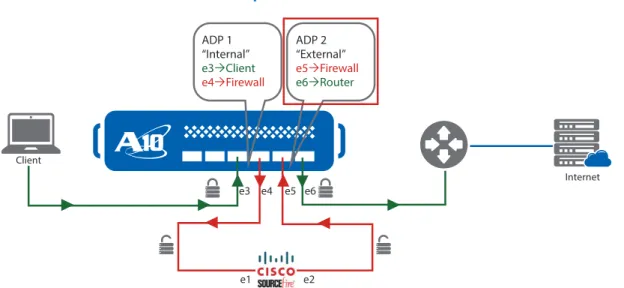
External Thunder ADC Instance Requirements and Clarifications
ADP 1 “Internal”
e3ÒClient e4ÒFirewall
ADP 2 “External” e5ÒFirewall e6ÒRouter
e3
e1 e2
e4 e5 e6 Client
Internet
Figure 4: External SSL Insight implementation
• Using the wildcard VIP, clear-text HTTP traffic on port 8080 is intercepted by the External Thunder ADC Instance.
• Any TCP or UDP traffic that is intercepted must have an access control list configured within the wildcard VIP to define traffic of interest. Once the ACL is created with the correct access source/destination, it can be applied within the VIP.
• A next-hop gateway (default route) is defined as the server load balancing server with port 443 configured.
• Any clear-text HTTP traffic that is passed by the Cisco device gets converted to HTTPS traffic (port 443). The service-group must be configured as port 443.
• The command no-dest-nat-port-translation is required to ensure that the destination IP remains unchanged. In addition, this command also converts incoming TCP port 8080 traffic to HTTPS port 443. 2Go to https://www.a10networks.com/sites/default/files/A10-DG-16140-EN.pdf to view/download this guide.
• The SSL server template needs to have the forward-proxy-enabled feature enabled.
• The command use-rcv-hop-for-resp will preserve any incoming source MAC addresses so that traffic can
be sent to the same security device from which it originated.
Note: For detailed instructions on creating self-signed certificates or importing a CA certificate to the Thunder ADC appliance, please refer to our Thunder CLI and GUI Administrator Guide3.
To create a client SSL template in CLI, enter the following commands:
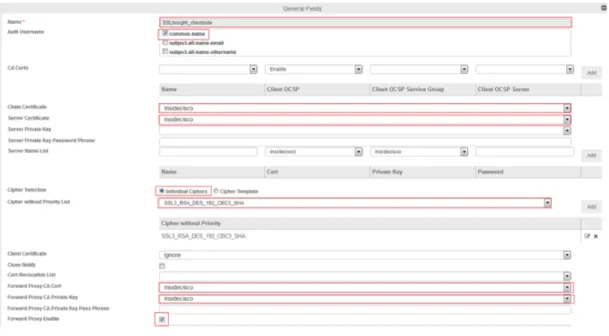
slb template client-ssl SSLInsight_clientside forward-proxy-ca-cert ssli-inside-cert forward-proxy-ca-key ssli-inside-key forward-proxy-enable
Note: The same certificate is also installed on all clients as a trusted CA certificate.
The forward-proxy-enable command essentially enables SSL Insight under the client or server SSL template. To create a client SSL template in the GUI, navigate to ADC > Templates > SSL, then click on +Create and select Client SSL.
Note: This assumes that the SSL certificate has been created or imported from the Thunder ADC appliance. In this guide, we will reference the certificate name as insidecisco.
Figure 5: Client SSL template
The A10 Networks Cisco FirePOWER Deployment Solution
As mentioned in the previous sections, there are two Thunder ADC configurations required to deploy an SSL Insight solution. This section of the guide will be segmented into instructions for configuring the Internal Thunder ADC Instance and the External Thunder ADC Instance.
Internal Thunder ADC Instance Configuration
The Internal Thunder ADC Instance appliance is responsible for decrypting SSL traffic and sending clear-text traffic to Cisco FirePOWER for inspection. The clear-clear-text traffic is sent to the ingress port of the Cisco FirePOWER.
For the “IN” configuration, the following commands are required: 3Go to https://www.a10networks.com/support to download/view this guide. Site registration is required.
ACL configuration:
access-list 100 permit ip x.x.x.0 0.255.255.255 any vlan 100 log
Server configuration:
slb server gateway 192.0.2.10 health-check-disable port 0 tcp
health-check-disable port 0 udp
health-check-disable port 8080 tcp
health-check-disable
TCP, UDP and other wildcard vPorts cause all allowed traffic to be subjected to the wildcard VIP. • These wildcard vPorts are required for the following reasons:
- In addition to load balancing non-SSL traffic, TCP wildcard vPort is also used on the External Thunder ADC Instance for fetching SSL certificates from a new remote site.
- UDP wildcard vPorts are used for all UDP traffic such as DNS requests/responses.
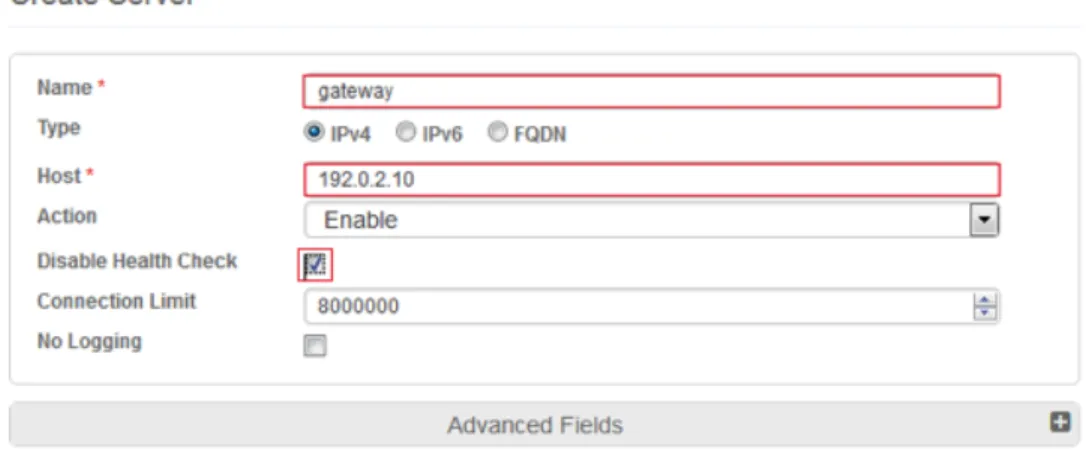
- Other wildcard vPorts are used for all non-TCP or non-UDP traffic, such as ICMP echoes or echo-replies. To configure the server configuration on the GUI, navigate to ADC > SLB > Servers, then click on +Create.
Figure 6: Server template
Server port configuration:
On the port section of the server, add the following:
Once the server ports have been configured, create a server group/pool and the necessary servers. In this guide, there is only one Cisco FirePOWER in the pool but you can add additional servers as required. The server group will be named according to the port number and protocol details for easy management.
slb service-group gateway_tcp_0 tcp member gateway 0
!
slb service-group gateway_tcp_8080 tcp member gateway 8080
!
slb service-group gateway_udp_0 udp member gateway 0
To configure the service group in the GUI, navigate to ADC > SLB > Service Groups and click on +Create.
Figure 8: Service group configuration
Adding a server member in a service group:
To add a server in the service group, click Create on the right-hand side of the GUI. You must enter the correct server name and port (port 0 TCP, port 0 UDP and port 8080 TCP).
Figure 9: Server member configuration
Virtual server configuration:
To create the VIP configuration, use the following CLI commands.
slb virtual-server inbound_to_cisco 0.0.0.0 acl 100 port 0 tcp
name to_gw_tcp service-group GW_tcp no-dest-nat
port 0 udp name to_gw_udp
service-group inside_GW_udp no-dest-nat
port 443 tcp
name internal_in_to_out_443 service-group SSL
template client-ssl A10-Client no-dest-nat port-translation
To create the virtual server configuration, navigate to ADC > SLB > Virtual Servers and click on +Create.
Figure 10: Virtual server configuration
On the virtual port configuration, configure the following port numbers: for port 0 TCP and port 0 UDP, configure the designated service groups, noting that both should use the “no-dest-nat” feature for each virtual port; for virtual port 443, use HTTPS.
Figure 11: Virtual server port options
The next step is to validate the virtual port. This is how the Virtual Ports should look like once completed. Click Update and continue.
Figure 12: Virtual port configuration
External Thunder ADC Instance Configuration
The External Thunder ADC Instance appliance is responsible for encrypting 8080 traffic originating from the egress port of Cisco FirePOWER. Once the traffic is received from the External Thunder ADC Instance, the clear-text traffic is encrypted to HTTPS/443 and sent to the default router/Internet.
Preconfiguration requirements:
The first step is to prepare the server SSL template and enable the forward-proxy feature within that template. To create the server SSL template within the CLI, use either of the following commands:
slb template server-ssl OutsideSSL forward-proxy-enable
In the GUI, navigate to ADC > Templates > SSL and then click on +Create.
Enter the server SSL name and enable the feature called SSL Forward Proxy. This SSL template will be bound
Figure 13: SSL forward proxy configuration
ACL configuration:
For the access control list configuration, use the following CLI commands.
access-list 101 permit ip x.x.x.0 0.255.255.255 any vlan 101 log
The next step is to configure the server load balancing server, which is typically on the router that connects to the Internet or server. Using the CLI, enter the following required server IP and ports.
slb server Default_Gateway 20.1.1.10 port 443 tcp
no health-check port 0 udp no health-check port 0 tcp no health-check
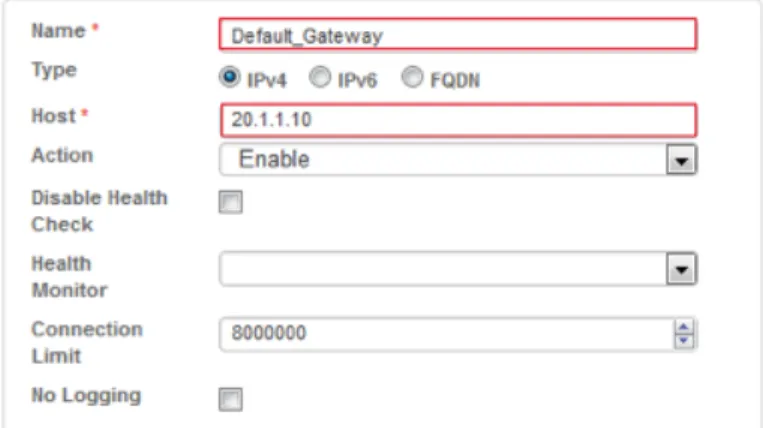
For a GUI configuration, navigate to ADC > SLB > Server and click on +Create.
Figure 14: Server load balancing configuration
Service group configuration:
The next step is to add the server to a service group. The service group will be called DG_SSL. To add the server/port configuration to a service group, follow the CLI steps below.
slb service-group DG_TCP tcp member Default_Gateway:0 slb service-group DG_UDP udp member Default_Gateway:0 slb service-group DG_SSL tcp member Default_Gateway:443
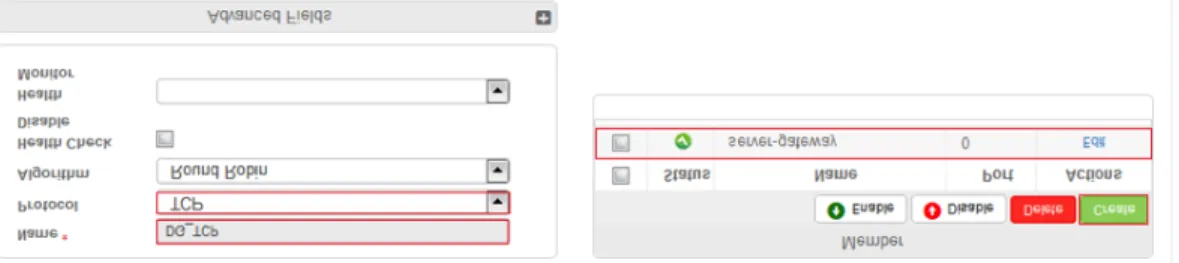
To configure the server(s) to be added to the service group using the GUI, navigate to ADC > SLB > Service Group and click on +Create. Enter the name and protocol and add the server name in the member section. The service group for TCP, UDP and SSL must be configured.
Figure 15: Service group configuration
Virtual server configuration:
In the virtual server configuration, there are four sets of virtual ports that will be required: port 0 TCP, port 0 UDP, port 0 others (any other traffic) and port 8080 HTTP. In addition, the server SSL preconfigured in the earlier
chapter will have to be bound within port 8080 and will require a no-dest-nat port-translation command so
that the destination IP remains unchanged.
slb virtual-server SSLi-Wildcard 0.0.0.0 acl 101 port 0 tcp
no-dest-nat
service-group DG_TCP use-rcv-hop-for-resp port 0 udp
no-dest-nat
service-group DG_UDP use-rcv-hop-for-resp port 0 others
no-dest-nat
service-group DG_UDP use-rcv-hop-for-resp port 8080 http
no-dest-nat port-translation service-group DG_SSL
use-rcv-hop-for-resp template server-ssl SSLi
To configure the virtual server in the GUI, navigate to ADC > SLB > Virtual Servers and click on +Create.
Webroot BrightCloud URL classification configuration: Internet Server
A10 Thunder ADC
Encrypted Encrypted
Security Device
Client
Web Classification Cloud
Internet
Internet
Decrypted
Figure 17: A10 and Webroot architecture
SSL Insight technology includes a subscription service called Dynamic Web Category Classification. This service allows customers to granularly control which types of SSL traffic to decrypt and which types to forward without inspection. Thunder ADC customers can analyze and secure SSL traffic while bypassing communications to sensitive sites such as banking and healthcare applications.
When a user’s client browser sends a request to a URL, ACOS checks the category of the URL.
• If the category of the URL is allowed by the configuration, the SSL Insight internal partition leaves the data encrypted and sends it to the SSL Insight external partition, which sends the encrypted data to the server. • If the category of the URL is not allowed by the configuration, the SSL Insight internal partition decrypts
the traffic and sends it to the traffic inspection device. Installation requirements:
• Must have a Webroot/BrightCloud URL Classification subscription with each Thunder ADC device licensing (contact your Regional Sales Director for pricing).
• Internal partition of the Thunder ADC must have access to the Internet for Webroot database download. • DNS configuration is required.
To install the URL classification feature, you must have a Webroot token license sent from the A10 Global License Manager (GLM). Once received, initiate the following command within the CLI only:
SSLi(config)#internal Imp.ort web-category-license “license token name”
Once the license has been imported, initiate a web-category enable command. This feature enables
the Thunder ADC device to communicate with the BrightCloud database server and downloa.d the URL classification database. When the download is complete, there will be a “Done” confirmation from the CLI if the import was successfully initiated; otherwise, an error message will appear. For additional debugging and installation reference, please refer to the Webroot Category Installation Guide4.
vThunder(config)#import web-category-license license use-mgmt-port scp:// [email protected]/home/jsmith/webroot_license.json
Done. <-- this brief message confirms successful import of the license If a failure occurs, ACOS will display an error message similar to the following:
vThunder(config)# import web-category-license license use-mgmt-port scp:// [email protected]/home/jsmith/webroot_license.json
Communication with license server failed <-- this message indicates failed import
Note: The Webroot database will download from the data interface by default. There is an option to configure from the management interface but it is not recommended.
To enable the Webroot URL classification feature, you must have the following configuration within the client SSL template.
Here is a sample configuration:
slb template client-ssl ssli-client-template forward-proxy-enable
forward-proxy-bypass web-category financial-services forward-proxy-bypass web-category business-and-economy forward-proxy-bypass web-category health-and-medicine
Explicit Proxy Configuration
The Explicit Proxy feature enables the Thunder ADC device to control client access to hosts based on lists of allowed traffic source (clients) and destination (hosts).
Client
Explicit Proxy
Internet
Class-ListPolicy Template
Figure 18: Explicit Proxy topology
This feature is available on ACOS release 2.7.2 and was reintroduced in ACOS release 4.0.1 SP9. When this feature is enabled, an HTTP virtual port on the Thunder ADC device intercepts the HTTP requests from the client, validates both the source and destination, and forwards only those requests that come from valid sources and destinations, and are sent to permitted destinations. Destinations are validated based on URL or hostname strings. For approved destinations, the DNS is used to obtain the IP addresses.
For an Explicit Proxy sample configuration, refer to Appendix C. For additional details on how to configure advanced Explicit Proxy solutions, refer to the A10 Thunder Series 4.0.1 SP9 Release Notes5.
Cisco FirePOWER Configuration
To access the Cisco FirePOWER instance, use a web browser and navigate to the management IP via HTTPS only. Default Access:
• Username: Admin
• Password: FirePOWER
Figure 19: FireSIGHT login portal
During the deployment of the Cisco Sensor, make sure that the interfaces are configured in Inline Mode. To configure and validate the interface settings, navigate to Devices > Device Management > Interfaces and make sure that the interface is configured as Default Inline Set. This is the only supported interface configuration for Cisco FirePOWER.
Figure 20: Device interface configuration
For Cisco FirePOWER to work, you need to have a Network Time Protocol (NTP) configuration that matches the Cisco Sensors. To configure the NTP on Cisco, navigate to System > Local Policy > Time Synchronization. Select Enabled from the Serve via NTP Time section, and then select your NTP server of choice.
To add a new device in FirePOWER, click Add on the top right corner of the portal and select new device.
Figure 22: Adding a device on the Cisco FirePOWER system portal
In the Add Device section, enter the following: • Host: This is the IP address of the Cisco Sensor.
• Registration Key: This is a unique identifier to register a device within FirePOWER.
• Access Control Policy: This is a preconfigured access policy created within the Policy tab. Access policy configurations will vary as each company has different security policies.
Figure 23: Device configuration
Cisco FirePOWER System Licensing
To obtain a license for Cisco FirePOWER, navigate to System > Add New System License. In the example below, copy the license key “66:00:0C:29:4B:9D:E6” (a license key is required for license generation). Once the key has been generated, cut and paste the license and click on Submit License.
Figure 24: Adding a license
Figure 25: Licensing configuration
Summary
The growth in encrypted traffic, coupled with increasing SSL key lengths and more computationally complex SSL ciphers, makes it difficult for inline security devices to decrypt SSL traffic. A wide range of security devices, including Cisco FirePOWER appliances, require visibility into encrypted traffic to discover attacks, intrusions and malware. This guide lays out the steps required to configure A10 Thunder ADCs’ SSL Insight feature with Cisco FirePOWER. Once you have completed the instructions described in this guide, you will be ready to use your new deployment to decrypt SSL traffic.
SSL Insight technology, included as a standard feature of A10 Thunder ADC, offers organizations a powerful solution for load balancing, high availability and SSL inspection. Using SSL Insight, organizations can:
• Analyze all network data, including encrypted data, eliminating blind spots in their threat protection solution
• Provide advanced SSL inspection features and SSL decryption for third-party security devices • Detect encrypted malware, insider abuse and attacks transported over SSL/TLS
• Deploy best-of-breed content inspection solutions to fend off cyber attacks
• Maximize the performance, availability and scalability of corporate networks by leveraging A10’s 64-bit ACOS platform, Flexible Traffic Acceleration (FTA) technology and specialized security processors For more information about Thunder ADC products, please visit:
https://www.a10networks.com/products/ssl-insight-securing-encrypted-traffic https://www.a10networks.com/products/thunder-application-delivery-controller.php https://www.a10networks.com/resources/solutionsheets.php
Appendix A
The following sample configurations are based on a multi-device configuration.
A10 Internal Device Configuration
!
multi-config enable !
system promiscuous-mode !
terminal idle-timeout 60 !
access-list 100 permit ip x.x.x.0 0.255.255.255 any vlan 77 log ip dns primary 8.8.8.8
!
ip dns suffix a10lab.local !
vlan 77
untagged ethernet 1 to 2 router-interface ve 77 !
hostname A10-SSL-Inside !
timezone America/Los Angeles !
interface management
ip address 192.0.2.20 255.255.255.0 ip control-apps-use-mgmt-port ip default-gateway 192.0.2.1 !
interface ethernet 1 name A10-SSL-Client enable
!
interface ethernet 2
name A10-Inside-Sourcefire enable
!
interface ve 77
ip address 203.0.113.20 255.255.255.0 ip allow-promiscuous-vip
!
ip route 0.0.0.0 /0 203.0.113.1 !
web-category enable !
slb server gateway 203.0.113.1 health-check-disable
port 0 tcp
health-check-disable port 0 udp
health-check-disable port 8080 tcp
!
slb service-group gateway_tcp_0 tcp member gateway 0
!
slb service-group gateway_tcp_8080 tcp member gateway 8080
!
slb service-group gateway_udp_0 udp member gateway 0
!
slb template client-ssl ssli-client-template forward-proxy-ca-cert ssli-inside-cert forward-proxy-ca-key ssli-inside-key forward-proxy-enable
forward-proxy-bypass web-category financial-services forward-proxy-bypass web-category business-and-economy forward-proxy-bypass web-category health-and-medicine !
slb virtual-server SSLi-Wildcard 0.0.0.0 acl 100 port 0 tcp
no-dest-nat
service-group gateway_tcp_0 port 0 udp
no-dest-nat
service-group gateway_udp_0 port 0 others
no-dest-nat
service-group gateway_udp_0 port 443 https
no-dest-nat port-translation service-group gateway_tcp_8080
template client-ssl ssli-client-template !
end
A10 External Device Configuration
!Current configuration: 720 bytes
!Configuration last updated at 11:57:51 CST Wed Jul 8 2015 !Configuration last saved at 11:57:51 CST Wed Jul 8 2015 !64-bit Advanced Core OS (ACOS) version 4.0.1-SP6, build 12 (May-14-2015,20:20)
!
multi-config enable !
system promiscuous-mode !
terminal idle-timeout 60 !
access-list 101 permit ip x.x.x.0 0.255.255.255 any vlan 77 log ip dns primary 8.8.8.8
!
ip dns suffix a10lab.local !
vlan 77
untagged ethernet 1 to 2 router-interface ve 77 !
hostname A10-SSL-Outside !
timezone America/Chicago nodst !
interface management
ip address 192.0.2.100 255.255.255.0 ip control-apps-use-mgmt-port
ip default-gateway 192.0.2.1 !
interface ethernet 1
name A10-Outside-Sourcefire enable
!
interface ethernet 2 name Datacenter-Services enable
!
interface ve 77
ip address 203.0.113.30 255.255.255.0 ip allow-promiscuous-vip
! !
ip route 0.0.0.0 /0 203.0.113.1
!
slb template server-ssl SSLi forward-proxy-enable !
slb server gateway 203.0.113.1 health-check-disable
port 0 tcp
health-check-disable port 0 udp
health-check-disable port 443 tcp
health-check-disable !
slb service-group default_gateway_tcp_0 tcp member gateway 0
!
slb service-group default_gateway_tcp_443 tcp member gateway 443
!
slb service-group default_gateway_udp_0 udp member gateway 0
!
slb virtual-server SSLi-Wildcard 0.0.0.0 acl 101 port 0 tcp
no-dest-nat
service-group default_gateway_tcp_0 use-rcv-hop-for-resp
port 0 udp no-dest-nat
service-group default_gateway_udp_0 use-rcv-hop-for-resp
port 0 others no-dest-nat
service-group default_gateway_tcp_0 use-rcv-hop-for-resp
port 8080 http
no-dest-nat port-translation
service-group default_gateway_tcp_443 use-rcv-hop-for-resp
template server-ssl SSLi !
End
Appendix B
Optional Topology: An SSL Insight two-appliance deployment, with one A10 vThunder ADC virtual appliance decrypting traffic and a second, separate vThunder ADC virtual appliance encrypting traffic. This topology can also be deployed in an A10 hardware appliance version.
Client Internet
e1 e2 e1 e2 e1 e2
Virtual Sensor
Internal External
Figure 26: SSL Insight in a multi-device deployment
Note: When deploying SSL Insight with ADPs, it is recommended that you deploy an A10 Networks Thunder 3030S or higher performing platform with SSL acceleration hardware.
Deployment considerations:
• Virtual/appliance-based sensors deployment can support Layer 2 transparent mode only. • Hardware-based ASA with Cisco Sensor can support either Layer 2 or Layer 3 deployments.
• Cisco FireSIGHT Management Center is required to manage the Cisco Sensors. Each Cisco FireSIGHT Management center can support up to 25 sensors.
• This guide only provides a Cisco interface configuration as every packet inspection solution has different policies.
Appendix C
The following is a sample configuration for Explicit Proxy.
The Class-list will match on the alphabetic strings that contain any of the 26 letters of the English alphabet. If the string matches it will forward to the correct destination.
class-list dest ac contains example contains google contains test !
class-list dest1 ac contains example1 contains america
!
class-list dest2 ac contains bank contains sample !
class-list src ipv4 192.0.2.212/32
203.0.113.0/24 198.51.100.0/24 !
slb server fake-server 192.168.230.101 port 80 tcp
port 443 tcp
health-check-disable !
slb server ubuntu_serv 192.168.221.70 port 80 tcp
port 443 tcp
slb service-group fake-sg tcp health-check-disable
member fake-server 80 member fake-server 443 !
slb service-group ubuntu_sg tcp member ubuntu_serv 80
member ubuntu_serv 443 !
slb template policy test forward-policy
action a1
forward-to-internet fake-sg snat snat fallback ubuntu_sg snat snat log
action a2
forward-to-service-group ubuntu_sg snat snat log
action a3 drop log source s1
match-class-list src
destination class-list dest action a1 url priority 10 destination class-list dest1 action a2 url priority 300 destination class-list dest2 action a3 url priority 15 source s2
match-any
destination any action a1 slb virtual-server test 10.50.10.123 port 8080 http
service-group fake-sg template policy test !
24 Corporate Headquarters
A10 Networks, Inc 3 West Plumeria Ave. San Jose, CA 95134 USA Tel: +1 408 325-8668 Fax: +1 408 325-8666 www.a10networks.com
Part Number: A10-DG-16152-EN-02 Sep 2015
Worldwide Offices North America
Europe
South America
Japan
China
Hong Kong
Taiwan
Korea
South Asia
Australia/New Zealand
To learn more about the A10 Thunder Application Service Gateways and how it can enhance your business, contact A10 Networks at: www.a10networks.com/contact or call to talk to an A10 sales representative.
©2015 A10 Networks, Inc. All rights reserved. The A10 logo, A10 Harmony, A10 Lightning, A10 Networks, A10 Thunder, aCloud, ACOS, Affinity, aFleX, aFlow, aGalaxy, aVCS, aXAPI, IDsentrie, IP-to-ID, SSL Insight, Thunder, Thunder TPS, UASG, and vThunder are trademarks or registered trademarks of A10 Networks, Inc. All other trademarks are property of their respective owners. A10 Networks assumes no responsibility for any inaccuracies in this document. A10 Networks reserves the right to change, modify, transfer, or otherwise revise this
About A10 Networks
A10 Networks is a leader in application networking, providing a range of high-performance application networking solutions that help organizations ensure that their data center applications and networks remain highly available, accelerated and secure. Founded in 2004, A10 Networks is based in San Jose, California, and serves customers globally with offices worldwide. For more information, visit: