REENTRY OF
THE NETWORK
OPERATOR INTO
THE APPLICATIONS
VALUE CHAIN
A NEW BUSINESS MODEL SUPPORTING
AGGREGATION OF NETWORK AND
APPLICATION APIS ACROSS MULTIPLE
NETWORKS AND VERTICAL INDUSTRIES
STRATEGIC WHITE PAPER
Alcatel-Lucent Bell Labs Business Modeling has assessed a business model that aggregates network-specific capabilities such as location, authentication and payment. The aggregation business model offers one-stop shopping to application developers in large enterprises and software houses to develop once and to deliver across network operators and multiple devices. This paper compares an ID authentication service, based on open APIs and aggregation across network operators, with other models based on standalone services. We see significant benefits for the network operator as well as for consumers and vertical industries, with faster TTM and lower cost of deployment.
TABLE OF CONTENTS
1. Introduction / 12. Mobile user fragmentation / 1
3. The aggregation business model explained / 2 4. Valuation from bell labs analysis / 3
5. Aggregation is a valid growth relay / 4 6. About Bell Labs Advisory services / 5 7. Acronyms / 5
Reentry of the Network Operator Into the Applications Value Chain
ALCATEL-LUCENT WHITE PAPER 1
1. INTRODUCTION
The Alcatel-Lucent Open API Platform is an end-to-end application programming interface (API) and application life-cycle management platform: a collection of modular solutions that deliver the capabilities service providers and enterprises need to:
• Securely expose, manage, optimize, monetize and analyze network and business assets • Proactively and successfully engage both internal and external developer communities • Create new revenue streams with Alcatel-Lucent Application Enablement and the
creation of new distribution channels
Bell Labs Business Modeling has estimated the cost benefit of implementing a specific service with the Alcatel-Lucent Open API Platform in comparison to the same service using legacy methods. The platform also enables business model benefits for service providers and system integrators.
2. MOBILE USER FRAGMENTATION
The Web is the IT industry standard for massively delivering applications over fixed broadband networks. Conversely, the market for mobile application platforms is fragmented, limiting the potential penetration of applications for businesses and public institutions willing to leverage mobile channels to market: for example, banks, media companies, patient monitoring services and electronic passports. Each platform requires specific application development tools and life-cycle management. In general, a mobile application is first launched for the Apple® iPhone® and shortly after for Google™ Android™ or RIM® devices, but it still cannot reach all mobile users.
Even though the marginal cost of developing a mobile application is low for a large business — typically a few tens of thousands of euros or dollars — fragmentation of the device market prevents mass-market distribution of online mobile services. The aggrega-tion business model outlined in this document solves this problem.
Another critical factor is time-to-market (TTM) because network operators have a limited window of business opportunity. They need to rapidly build a significant market footprint to avoid their marginalization on application markets relative to over-the-top (OTT) application platforms, which have already entered into the finalization of business consolidation.
Behind the two leaders, Apple iPhone and Google Android, Nokia® and Microsoft® have formed an alliance to try to make a comeback in the smartphone business while RIM strives to remain in the game. Google has just announced the acquisition of the Motorola device business, which could create an opportunity for HP® to license its webOS — part of the HP Palm acquisition, favored by developers — to leading original equipment manufacturers (OEMs) such as Samsung and HTC. These OEMs have been put into a competitive situation by their application platform supplier (Google/Android).
It is critical for network operators to grow their footprint in mobile applications until the market is consolidated around a handful of worldwide giants. The aggregation business model serves this purpose.
3. THE AGGREGATION
BUSINESS MODEL EXPLAINED
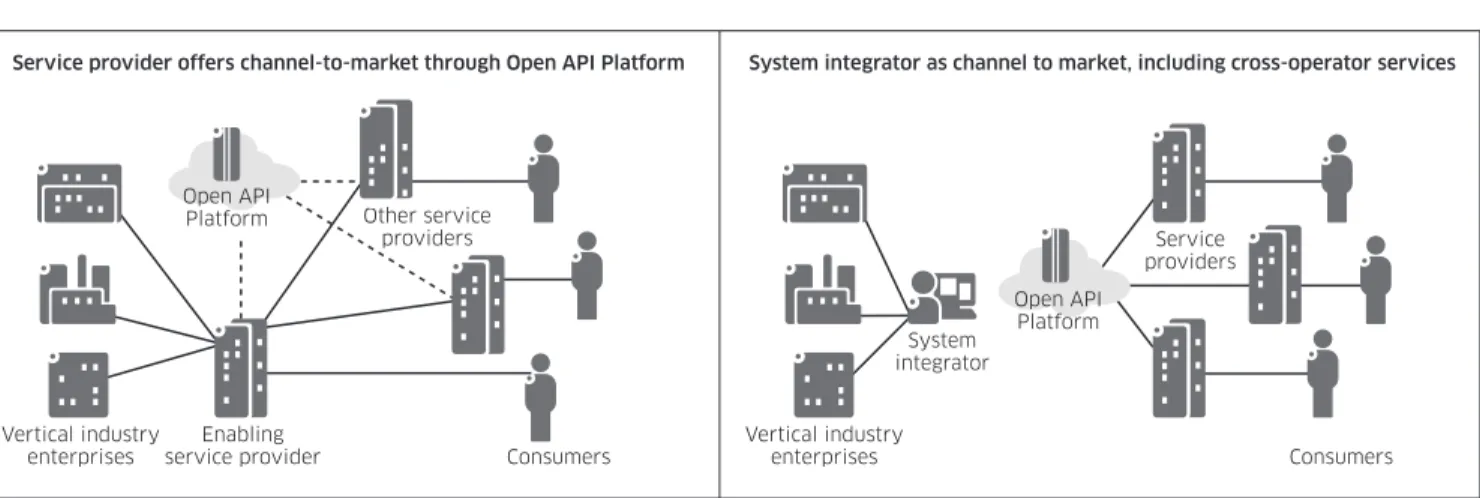
The aggregation business model can be implemented by a network operator, enterprise or public institution to deliver applications that leverage network capabilities — for example, location, pre-Rich Communication Suite (RCS) presence, identification and payment — that are not currently interoperable. The Alcatel-Lucent Open API Platform acts as a service broker to aggregate the enablers from different networks and expose them through a single API to application developers, therefore creating the impression of a single network. The left diagram in Figure 1 shows a network operator that sells a complete service to different vertical industry enterprises, providing users with the content and services to which they have subscribed. Thin arrows reflect interoperable services (telephony, messaging) that are naturally interoperable and do not need mediation.
The right diagram in Figure 1 characterizes a situation where the service broker is employed to enable a white label offering. Many different instantiations of this model are possible.
Figure 1. Aggregation business model examples
Figure 2 shows an example of the value chain for a specific use case: ID management for an mBanking service. The dotted-line box delineates the perimeter of the vertical industry partner — in this case, the banking entity — that benefits from the aggregation business model. The green background highlights the position of the service broker.
Figure 2. Aggregation business model: applications value chain Open API
Platform
Enabling
service provider Consumers Consumers
Other service providers Service providers System integrator Vertical industry enterprises Vertical industry enterprises
System integrator as channel to market, including cross-operator services Service provider offers channel-to-market through Open API Platform
Open API Platform
Consumers Business users B2C, where “C” includes
SOHO, SMBs, other mass market enterprises Network enabler broker
API directory Developer resources Network abstraction Hosting
Service provider 1 Service provider 2 ...
Service provider 1 Service provider 2 Enterprise 1 ...
Vertical industry partner
Bank customer
Buys services from the bank
Service retail Branch, ATM, call center, web, mobile Service creation Deposit, loan payment, clearing Service broker Aggregation, mediation, settlement SP enterprise division Sells online to vertical industries Network wholesaler ID, location, payment, SMS, telephony, etc.
Reentry of the Network Operator Into the Applications Value Chain
ALCATEL-LUCENT WHITE PAPER 3
4. VALUATION FROM
BELL LABS ANALYSIS
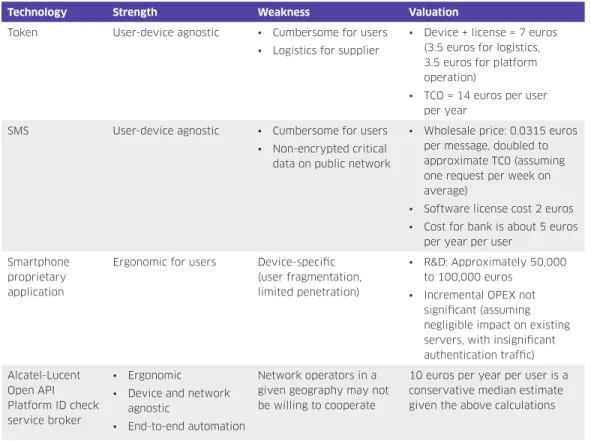
A good method of estimating the value of a new service is to compare it with a legacy alternative. For example, the functionality provided by an Alcatel-Lucent Open API Platform ID check service is currently provided using a one-time password (OTP). The OTP is generated using a token device (previously shipped to the user) or a one-time Short Message Service (SMS) sent to the customer. In addition, identification with an Alcatel-Lucent Open API Platform ID check brings the convenience of single sign-on (SSO), allowing users to avoid the reentry of lengthy passwords. As shown in Table 1, the Alcatel-Lucent Open API Platform ID check exceeds the benefits provided by OTP and SSO solutions, which cannot be achieved with a more basic web implementation.
Table 1. Comparison and valuation of ID check technologies
Technology Strength Weakness Valuation
Token User-device agnostic • Cumbersome for users • Logistics for supplier
• Device + license = 7 euros (3.5 euros for logistics, 3.5 euros for platform operation)
• TCO = 14 euros per user per year
SMS User-device agnostic • Cumbersome for users • Non-encrypted critical
data on public network
• Wholesale price: 0.0315 euros per message, doubled to approximate TC0 (assuming one request per week on average)
• Software license cost 2 euros • Cost for bank is about 5 euros
per year per user Smartphone
proprietary application
Ergonomic for users Device-specific (user fragmentation, limited penetration)
• R&D: Approximately 50,000 to 100,000 euros
• Incremental OPEX not significant (assuming negligible impact on existing servers, with insignificant authentication traffic) Alcatel-Lucent
Open API Platform ID check service broker
• Ergonomic
• Device and network agnostic
• End-to-end automation
Network operators in a given geography may not be willing to cooperate
10 euros per year per user is a conservative median estimate given the above calculations
As a sanity check, the cost of an ID service can be compared with other banking costs. Prices for premium banking packages range from 130 to 280 euros, with a mean of 160 euros. Therefore, a 10-euro ID check service costs a bank 6 percent of the price of a premium package. Industry reports indicate that fraud represents 7 percent of a bank’s costs, so a 10-euro ID check service seems to provide reasonable value.
5. AGGREGATION IS A
VALID GROWTH RELAY
The IT industry structures itself around business processes to address the specific needs of verticals, such as banking, energy, transportation, government and medicine. Conversely, communication services provided by network operators are valuable for their interoperability and ubiquity across processes and geographies (transversely). As an operator mediates aggregated information between IT and communications, the operator facilitates the articulation and implementation of service features with high technical and operational efficiency. Leveraging its competitive advantage, each player in the value chain leads to greater value creation and overall efficiency.
The service broker business model, with aggregation of network enablers, can be instan-tiated for multiple industries, companies and features such as payment, location and user status. In a valuation exercise with a particular customer, Bell Labs Business Modeling quantified that the revenue opportunity from the re-intermediation of network operators was at telecommunications industry scale. This is why the aggregation business model is effectively a substantial growth stimulus for the communications industry.
Following a holistic approach, Bell Labs Business Modeling has qualified the benefits for players along the value chain, as listed in Table 2. There is high confidence in the sustainability of the business model, given the tangible benefits illustrated for all parties.
Table 2. Benefits of Alcatel-Lucent Open API Platform ID check to applications value chain players Players in value chain Alcatel-Lucent Open API Platform ID check benefits
Vertical application developer • Global APIs that virtualize networks greatly simplify applications development, reducing R&D cost and shortening TTM
• Natural integration into IT frameworks reduces operation cost while improving user experience
• Connecting brands and public institutions to global audiences makes digital channels relevant, especially in the mobile space for one-to-one marketing Network operator • Competitive advantage gained against OTTs
• Revenue generation within months at marginal costs, for better return on investment (ROI)
• Low impact on consumer bills, therefore no subscriber negative feelings • Improved balance of power in device procurement negotiations Service broker/aggregator Materialization of a new business opportunity to address a pending
market need
www.alcatel-lucent.com Alcatel, Lucent, Alcatel-Lucent and the Alcatel-Lucent logo are trademarks of Alcatel-Lucent. All other trademarks are the property of their respective owners. The information presented is subject to change without notice. Alcatel-Lucent assumes no responsibility for inaccuracies contained herein. Copyright © 2011 Alcatel-Lucent. All rights reserved. M201110923 (November)
6. ABOUT BELL LABS
ADVISORY SERVICES
Bell Labs is the innovation engine of Alcatel-Lucent. Bell Labs Advisory Services applies innovative and advanced analysis-driven problem solving expertise to address your complex business, network, strategic and operations challenges.
Tailored to your unique needs, a multi-disciplinary team of Bell Labs scientists, technologists, modelers and Alcatel-Lucent services and solutions experts will perform an objective analysis and provide you with actionable insights and confidential recommendations. Contact us to:
• Request a first-of-its-kind analysis or get a second opinion on focused topics • Learn how emerging technologies will perform in specific scenarios
For more information on this study or how Alcatel-Lucent is working with service providers and stakeholders globally to better understand consumer needs, please contact Bell Labs Advisory Services.
7. ACRONYMS
ATM automated teller machine B2C business-to-consumer
OEM original equipment manufacturer OTP one-time password
OTT over-the-top
RCS Rich Communication Suite ROI return on investment SMB small and medium business SMS Short Message Service SOHO small office home office SSO single sign-on
TCO total cost of ownership TTM time-to-market