TABLE OF CONTENTS
I. PURPOSE... 4
II. SUMMARY OF FINDINGS... 5
III. BACKGROUND AND GENERAL OBSERVATIONS ... 5
August 11, 2010 ... 5
September 20, 2013... 6
Employee Interviews ... 6
Employee Interviews For Classroom 1 ... 6
Employee Interviews For Classroom 2 ... 7
Employee Interviews For Classroom 3 ... 7
Employee Interviews For Classroom 14 ... 7
Classroom 1 Field Observations ... 7
Costume Storage Room Field Observations ... 7
October 4, 2013 ... 7
Classroom 2 Field Observations ... 8
Classroom 3 Field Observations ... 8
Classroom 10 Field Observations ... 8
Classroom 14 Field Observations ... 8
Carpet Care... 8
IV. SURVEY PROCEDURES ... 9
INDOOR AIR QUALITY MEASUREMENTS... 9
MOISTURE MEASUREMENTS... 9
BIOLOGICAL MEASUREMENTS (MOLD) ... 9
Total Viable and Non-Viable Spores ... 9
Non-Cultured Surface Sampling ... 9
Non-Cultured Bulk Sampling... 10
Surface Dust/Particle Characterization Samples ... 10
V. RESULTS... 10
MOISTURE MEASUREMENTS... 10
BIOLOGICAL MEASUREMENTS (MOLD) ... 11
Total Viable and Non-Viable Spores ... 11
TAPE LIFT SAMPLES... 11
BULK SAMPLE... 11
IEQ AND DUST ASSESSMENT... 11
SAMPLE RESULTS Table I – Indoor Air Quality Measurements – Total Viable and Non-Viable Molds ... 12
Table II – Tape Samples (Surface Material) – Molds ... 17
Table III – Bulk Samples (Surface Material) – Molds ... 18
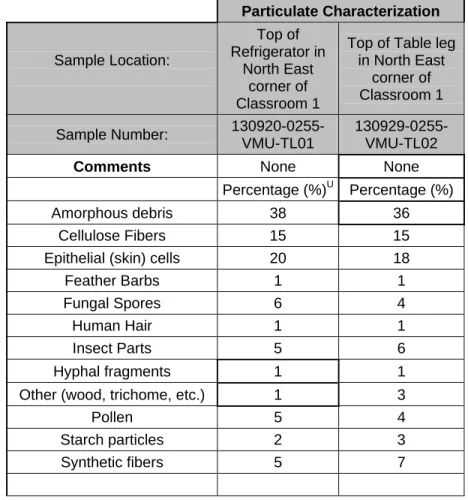
Table IV – Tape Sample (Surface Contamination) – Particulate Characterization... 19
VI. DISCUSSION ... 20
BIOLOGICAL MEASUREMENTS (MOLD) ... 20
Mold Species Information... 21
Air Cleaning Devices ... 22
VII. RECOMMENDATIONS ... 22
VIII. DISCLAIMER ... 24
APPENDICES
Appendix A – Photograph Log Appendix B – Laboratory Report
INDUSTRIAL HYGIENE SURVEY REPORT SANTA MONICA MALIBU SCHOOL DISTRICT
MALIBU HIGH SCHOOL EE Project #: 13-A0118-0255
ASCIP Project # LC5115
Client: Mr. Gary Bradbury
Risk Management Specialist
Alliance of Schools for Cooperative Insurance Programs (ASCIP) 16550 Bloomfield Avenue
Cerritos, CA 90703
Survey Date: September 20 and October 4, 2013
School Site: Malibu High School, Classrooms 1, 2, 3, 10, 14 and the Costume Storage Room (also known as Room 17)
30215 Morning View Drive
Santa Monica, California 90265
Survey By: Vicki Uchida, MBA, CIH, CSP
Senior Industrial Hygienist, Executive Environmental (EE)
Report By: Vicki Uchida, MBA, CIH, CSP
Senior Industrial Hygienist, EE
Reviewed By: Daniel H. Ginsborg, MSIH, CIH, CSP
Chief Executive Officer, EE
Report
Distribution: Kevin Hobby
Senior Risk Services Consultant, ASCIP
I. PURPOSE
The purpose of this study was to provide an indoor environmental quality (IEQ) assessment focusing on potential moldA growth in Classrooms 1, 2, 3, 10, 14 and The Costume Storage Room at Malibu High School at the request of the Santa Monica Malibu School District (hereinafter, the District). This survey was provided by and partially funded as a benefit of membership in the Alliance of Schools for Cooperative Insurance Programs (ASCIP).
This IEQ assessment was conducted by request to investigate odors and potential mold growth in the areas of interest. Consequently, EE provided an IEQ investigation following protocols recommended by the Environmental Protection Agency (EPA) Tools for Schools ProgramB and the EPA “Mold Remediation in Schools and Commercial Buildings” document. This procedure
A “Mold” is used here as a general term to describe fungal growth. In fact, molds are only one group of the Kingdom Fungi. “Fungi” is a general classification for spore producing organisms that are usually classified as “plants that lack chlorophyll” – that is, they are not photosynthetic. Fungi include molds, rusts, smuts, mildews, mushrooms, and yeasts.
involves identifying sources of water intrusion in the building, measuring moisture levels in building components, looking for visual suspect mold growth in accessible areas, and taking photographs. The areas were also monitored for indoor air quality (IAQ) parameters such as carbon dioxide, carbon monoxide, temperature, and relative humidity.
II.
SUMMARY OF FINDINGS
This limited IEQ assessment included air and surface testing for mold as well as measurements of carbon dioxide, carbon monoxide, temperature, and humidity. In addition, visual and instrumental inspections were conducted to screen interior materials for elevated moisture content.
Outside ambient conditions were also measured and compared to the indoor conditions.
• On September 20, 2013, total viable and non-viable mold spore concentrations inside Classroom 1 ranged from 53 to 110 spores per cubic meter (spores/m3) and were lower than the outdoor levels, which ranged from 310 to 630 spores/m3. The concentration in
The Costume Storage Room was 910 spores/m3. Indoor mold levels were neither
amplified nor suggestive of hidden mold growth.
• Mold growth was found on a paperback book and the carpet beneath it in Classroom 1. • Carbon dioxide, carbon monoxide, and humidity were within acceptable parameters.
Relative humidity levels indoors ranged from 64 to 72 percent which were above the 60 percent or higher level needed to support mold growth. However, the relative humidity outdoors ranged from 68 to 74 because it was cloudy so indoor levels are acceptable. • The assessment indicated that the carpet was dry in Classroom 1.
• On October 4, 2013, total viable and non-viable mold spore concentrations in Classroom 2 ranged were 110 spores/m3, Classroom 10 ranged from 93 to 270 spores/m3, Classroom 14 ranged from 13 to 200 spores/m3, and Classroom 3 ranged from 93 to 730 spores/m3. These levels were significantly below the outdoor concentrations which ranged from 530 to 2,600 spores/m3.
• The predominant mold type both indoors and outdoors was Cladosporium species.
Cladosporium is the most common mold type found indoors and outdoors in Southern California and is not indicative of water damage or building-related mold concerns.
• Carbon dioxide, carbon monoxide, and humidity were within acceptable parameters. Relative humidity levels indoors ranged from 41 to 55 percent – well below the 60 percent or higher level needed to support mold growth.
• There was a slight dusty and musty odor in these naturally ventilated (ie no mechanical ventilation) classrooms inspected.
• Results of this study were conveyed to the District via e-mail on September 30 and October 8, 2013.
A photograph log can be found in Appendix A. The laboratory report is in Appendix B.
III.
BACKGROUND AND GENERAL OBSERVATIONS
AUGUST 11,2010
On August 11, 2010, Ms. Vicki Uchida, MBA, CIH, CSP, Senior Industrial Hygienist of EE, inspected Classroom 1 and the Costume Storage Room to address concerns about indoor environmental quality (IEQ), potential allergens, molds, and dust in the building . The IEQ
assessment included a visual inspection of the classroom of concern, an interview with the teacher, and measurement of airborne and surface mold, particles, and allergens in the aforementioned classroom. Additional historical information is contained in Executive Environmental Report addressed to Gary Bradbury dated September 22, 2010.
SEPTEMBER 20,2013
On September 20, 2013, Ms. Uchida returned and inspected Classroom 1 and the Costume Storage Room as a follow-up to the first inspection to address concerns about molds, dust, tile adhesive and pests in the classroom. Out of an abundance of caution, the District requested an IEQ inspection by EE after school. Select employees were interviewed and rooms were assessed on September 20th.
Employee Interviews: On September 20, 2013, twelve teachers were interviewed. The concerns the teachers have are summarized as follows:
1) Since February 2013, three teachers have been diagnosed with thyroid cancer, and one additional teacher is on high doses of thyroid medication.
2) 6 teachers reported having migraines. One teacher was removed from a classroom in Building E into a new building and has not has migraines since.
3) One teacher reported having asthma that has been continually worsening. 4) One teacher reported having a rash for several years.
5) Several years ago "toxic dirt" was removed from the Quad area. Classrooms surround the area so there are concerns of exposure to the occupants of those classrooms. 6) Classrooms 1 and 2 had trenches dug through them during the summer to install
conduit, and the rooms were not cleaned after. The teachers are worried that they were exposed to the "toxic dirt" that may have been under the classrooms.
7) Teachers have found rats, cockroaches, squirrels, birds and ants in the classrooms.
All interviews were conducted on September 20, 2013 and only the detailed interviews for the classrooms inspected, are contained in this report. The teacher for Classroom 10 was not interviewed because she was not available on September 20th, or October 4th.
Many employees shared specific medical issues and concerns. Because of the potential public nature of this report, these issues and concerns will not be replicated in this report. They will only be shared with the District in an amalgamation of general terms without a relationship or traceability to a specific employee or room. Further gathering of potential health concerns will be under the direction of Mr. Mark Katchen, CIH, Managing Principal. The Phylmar Group, Inc.
Employee Interview for Classroom 1: Ms. Bridget Leonard was interviewed on August 10, 2010 and again on September 20, 2013. She had initially reported noticing bad odors in Classroom 1 and the Costume Storage Room. She has continued teaching Theater Arts in Classroom 1. On September 20, 2013, she reported that she continues to have the same concerns expressed on August 10, 2010.
She reported that at the end of summer a five-foot deep trench was dug through Classroom 1 and into Classroom 2 and curved into the storage room next to Classroom 2. A strip of linoleum tile was installed from the door to the back of the classroom where the trench had been. She went to her classroom after the construction had been completed and noticed odors resembling wet dog, mold and new linoleum. It caused her to have difficulty breathing and to cough continuously while in the room. Ms. Leonard reported that she had to rearrange all the items in the classroom to
prepare for the start of school and the room had not been cleaned. Dust and chunks of white material were on everything in the classroom. Custodial staff cleaned the classroom the day before school started. Ms. Leonard and the custodial staff brought an Environizer, two large blowers and fans into the room to help dry the carpet. Ms. Leonard was then relocated to Classroom 511 and then to 513 where she reported she was still located in on October 4, 2013.
Employee Interview for Classroom 2: Mr. Ari Jacobs has taught in Classroom 2 for three years and was previously in Classroom 204 for two years. He teaches Social Studies and English and has between 37 and 39 students in his classroom. He reported that the classroom smells very musty, especially in the morning after the room has been closed up overnight. He reported that he keeps the door and windows open.
Mr. Jacobs reported that during the summer a trench was dug in the floor through his room. This caused everything in the classroom to get dusty despite the plastic sheeting that was put up. The classroom is still dusty.
Employee Interview for Classroom 3: Ms. Julie Jones has been teaching Humanities in Classroom 3 for four years. She started working at the school, approximately 17 years ago. She reported seeing cockroaches in the classroom for the last two years.
Employee Interview for Classroom 14: Ms. Lynne Flowers has been teaching Special
Education Reading in Classroom 14 for ten years. She reported that the classroom smells musty all the time.
Classroom 1 Field Observations: Photos 1 and 2 show the layout of the classroom. There were no water-damaged ceiling tiles. There was a noticeable dusty and animal-like odor. There was clutter on horizontal surfaces which prevents them from being dusted and cleaned. Rat droppings, silverfish and spiders were observed in the classroom.
Photo 3 shows a large carpet stain under the refrigerator. Ms. Leonard reported that her refrigerator had been unplugged during the construction and the contents defrosted and leaked onto the carpet. A small area in front of the refrigerator, approximately one inch by one inch in diameter, measured 25% moisture but the remaining carpet was dry, below 15%. It was most likely from condensation from the refrigerator when the door was opened during the inspection.
Photo 4 shows a water stained paperback book with suspect mold. A small patch of carpet from underneath the book was collected and is shown in Photos 5 and 6. Photo 7 shows the top of the personal refrigerator in the northeast corner of Classroom 1. Photos 8 and 9 show the Environizer, electric air cleaner that uses an ionizer.
A Safety Data Sheet was provided by the District for the S-515 Clear Thin Spread Floor Tile Adhesive that was applied to the linoleum and it states that this product is considered to be a non-hazardous substance under OSHA standard 29 CFR 1910.1200. Ms. Leonard reported that the odor from the linoleum floor had dissipated.
Costume Storage Room Field Observations: Photo 10 shows the Costume Storage Room. There is a noticeable musty odor in the room. Costumes are hanging on metal racks and some supplies are in plastic storage boxes. The lights are still inoperable and due to the overcrowding of material, the Costume Storage Room could not be entered to be inspected.
On October 4, 2013, Ms. Uchida returned to the site and met with Mr. Gary Bradbury, Risk Management, Santa Monica Malibu Unified School District, Mr. Jerry Block, Principal, and Mr. Phil Wenker, Assistant Principal. Classrooms chosen to be inspected in Building E were determined to be representative of those in the building.
Classroom 2 Field Observations: Classroom 2 is located directly east of Classroom 1. Photos 11 and 12 show an overview of the classroom. There is a noticeable dusty and musty odor in the room. There was clutter on horizontal surfaces and surfaces were dusty. No water stained ceiling tiles or suspect mold were observed.
Classroom 3 Field Observations: Classroom 3 is located on the west side of Building E. Photos 13 and 14 show the overview of the classroom. There was a slight dusty and musty odor in the classroom. There were no water stained ceiling tiles. Horizontal surfaces were dusty.
Classroom 10 Field Observations:
Classroom 10 is located on the north side of the building between Classroom 8 and the Boys Restroom. The doors and windows were closed prior to entry and the room had a slight dusty and musty odor. Photos 15 and 16 show an overview of the classroom.
There was no water stained ceiling tiles. Horizontal surfaces were dusty.
Classroom 14 Field Observations: Classroom 14 is located on the north end of the building. The room has one exterior door and no windows. Two restrooms are located adjacent to the classroom. Photos 17 and 18 show the overview of the room. There was a slight musty odor in the room. There were no water stained ceiling tiles. Horizontal surfaces were dusty.
CARPET CARE
Mr. Dan Heiderman, Custodian, was interviewed on October 4th. The carpet cleaning equipment was out for repair so they could not be inspected. He reported that the carpets in the classrooms are vacuumed every other day. If there is a spill, the carpet is “submerged” in Waxie Lemon Quat Disinfectant Cleaner #764 and cleaned with a bonnet. The carpets are shampooed once a year in the summer. The custodial staff has been instructed not to touch teachers’ personal items so they will dust and clean carpets around any personal belongings in the classrooms. Teachers leave many belongings in the classrooms during the summer so some classrooms have areas that are not cleanable.
In an email from Mr. Gary Bradbury on October 8, 2013, he mentioned that Terrance Venable clarified with Malibu custodial staff the process for using the Lemon Quat 764 Disinfectant. The carpet is designed to be cleaned only with water, however due to age, staining and concerns for odor/mold the staff use this product to shampoo the carpet. It does have anti-fungal properties. Mr. Venable checked with a representative from Waxie who told him that it was okay to use it on carpet even though it is primarily designed to be used on hard surfaces.
The product description of the Lemon Quat 764 Disinfectant is as follows:
Phosphate-free, pH neutral formulation designed to provide effective cleaning, deodorizing, and disinfectant for all hard, nonporous surfaces. Will not dull or
blush finished floors. Effective against a broad spectrum of bacteria, is virucidal (including HIV-1 and HBV), fungicidal, and inhibits the growth of mold and mildew. Lemon fragrance. EPA registration #1839-169-14994. Dilution: Disinfecting and deodorizing 64:1 or 2 ounces to one gallon. Four 3-liter bottles per case.
V. SURVEY
PROCEDURES
INDOOR AIR QUALITY MEASUREMENTS
During the inspection, a Quest Technologies AQ5000Pro (serial numbers 2277 was used on October 4th and 2280 was used on September 20th) Indoor Air Monitor was used to measure fresh air adequacy and indoor air quality (IAQ). The AQ5000 is a direct-reading instrument used to evaluate carbon dioxide, carbon monoxide, temperature, and relative humidity. Each AQ5000 is calibrated annually and was last calibrated by Dick Munns Company on June 20, 2013 (unit serial number 2277) and September 5 (unit serial number 2280).
MOISTURE MEASUREMENTS
A General Electric Protimeter Survey Master was used to detect moisture in the building components. The Survey Master is a dual-mode device that uses a combination of radio frequency (search mode) and two pin electrodes (measure mode) to detect water content when placed on the surface of building materials. In all areas measured, search mode was used to screen the building components for moisture content. Areas measuring less than 15 percent moisture are considered dry and not supportive of mold growth. Moisture readings above 20 percent will support mold growth. All moisture readings were below 15 percent, indicating dry conditions. One spot, approximately one inch in diameter, had a reading in excess of 20 percent but it was mostly likely from condensation that dripped onto the carpet when the refrigerator door was opened.
BIOLOGICAL MEASUREMENTS (MOLD)
The biological samples were analyzed by the EMLab P&K laboratory located in Glendale, California. EMLab P&K is accredited by the Environmental Microbiology Laboratory Accreditation Program (EMLAP) of the American Industrial Hygiene Association (AIHA), certificate number 173068.
Total Viable and Non-Viable Spores: Mold sampling is used to determine the ambient airborne concentration of viable and non-viable mold. Air-O-Cell cassettes (manufactured by Zefon Analytical, Lot # 29711, expiration June 2014) were used for total viable and non-viable spores, pollen, animal- and insect-based particles, and other non-biological particles (e.g., fiberglass).
Samples were collected at approximately four feet above ground to simulate the breathing zone. Air-O-Cell™ samples were collected for five minutes at 15 liters per minute (lpm) with a Zefon sampling pump. Flow rates for the Zefon sampling pump were checked by a Zefon Analytical rotameter. Outdoor samples were also collected at the commencement and conclusion of indoor air sampling.
Non-Cultured Surface Sampling: Surface sampling is used to determine the presence of biological material on various surfaces. A two-inch length of 3M Tape was used to collect dust samples and suspect fungal growth for direct macroscopic and microscopic examination to
determine the presence of fungal species. Suspect material was collected on sticky tape by gently pressing the tape to the test surface, as described in “Bioaerosols: Assessment and Control.” The clear adhesive tape was then applied to a precleaned microscope slide and subsequently analyzed by an aerobiologist.
Non-Cultured Bulk Sampling: Bulk sampling is used to determine the presence of biological material on various material. A bulk material is collect with suspect fungal growth and water damage for direct macroscopic and microscopic examination to determine the presence of fungal species. The bulk material is subsequently analyzed by an aerobiologist.
Surface Dust/Particle Characterization Samples: Particle characterization is used to determine the presence of biological and non-biological material on various surfaces. A two-inch length of 3M Crystal Clear Tape was used to collect dust samples for direct macroscopic and microscopic examination by polarized light microscopy. Suspect material was collected on sticky tape by gently pressing the tape to the test surface, as described in Bioaerosols: Assessment and Control.C The clear, adhesive tape was then applied to a pre-cleaned microscope slide and subsequently analyzed by the laboratory.
V. RESULTS
Results of this study are compared to the latest versions of the following:
• The California Occupational Safety and Health Administration (Cal/OSHA) Permissible Exposure Limits (PELs), California Code of Regulations, Title 8, Section 5155 (abbreviated as 8 CCR 5155).
• American Conference of Governmental Industrial Hygienists (ACGIH) Threshold Limit Values (TLVs).
• National Institute for Occupational Safety and Health (NIOSH) Recommended Exposure Levels (RELs).
• The American Society of Heating, Refrigerating and Air-Conditioning Engineers (ASHRAE) Standards (ASHRAE 62.1 Ventilation for Acceptable Indoor Air Quality and ASHRAE 55 Thermal Environmental Conditions).
The California Occupational Safety and Health Administration uses Cal/OSHA PELs as a governmental regulation. The PELs are intended for industry applications and may not be directly comparable to an indoor environment. The California Occupational Safety and Health Administration has not yet developed standards for IAQ. The ACGIH TLVs, NIOSH RELs, and ASHRAE standards are not government regulations but represent the most current health hazard opinion and can be cited under Cal/OSHA general duty clause. Further, the TLVs are reviewed annually. The OSHA PELs, ACGIH TLVs, NIOSH RELs, and ASHRAE standards were considered in forming conclusions.
MOISTURE MEASUREMENTS
One small area measured in Classroom 1, in front of the refrigerator, approximately one square inch, was in excess of 20 percent moisture. This was most likely due to opening the refrigerator door and condensation dripping onto the carpet. The remainders of the readings were below 15 percent moisture.
C Macher, J. et al; BioAerosols: Assessment and Control; American Conference of Governmental Industrial Hygienist (ACGIH); Cincinnati, Ohio; 1999.
BIOLOGICAL MEASUREMENTS (MOLD)
Total Viable and Non-Viable Spores: On September 20, 2013, total viable and non-viable fungal (mold) spore concentrations in Classroom 1 ranged from 53 to 110 spores per cubic meter (spores/m3) and were lower than the outdoor levels, which ranged from 310 to 630 spores/m3. The types of mold species indoors and outdoors were similar. The airborne sample taken in The Costume Storage Room indicate slightly higher spore counts, with the predominant species being Penicillium/Aspergillus types, than outdoor levels and are within acceptable levels. The Penicillium/Aspergillus type spores were higher indoors than outdoors but were within the extended outdoor concentrations during September in California (53 to 1,200 spores per cubic meter and 53 to 1,000 spores per cubic meter, respectively). These levels are within the statistical variations in the methodologies used for mold sampling and analysis and are not indicative of a hidden source or mold.
On October 4, 2013, total viable and non-viable fungal (mold) spore concentrations in Classroom 2 ranged were 110 spores/m3; Classroom 10 ranged from 93 to 270 spores/m3; Classroom 14 ranged from 13 to 200, and Classroom 3 ranged from 93- to 730 spores/m3. These levels were significantly below the outdoor concentrations which ranged from 530 to 2,600 spores/m3.
Sampling results are listed in the attached EMLab P&K report numbers 5099470, dated September 25, 2013 and 1124069, dated October 8, 2013.
Tape Lift Samples: Mold growth was not detected in either of the two surface samples. The results are summarized in Table II and the attached EMLab P&K report number 1117707, dated September 25, 2013,
Bulk Sample: Mold growth was found on the two bulk samples collected in Classroom 1, a water stained paperback book and carpet sample collected from underneath the book. The predominating mold types were Aspergillus, Ascomycetes and Stachybotrys species.
Sampling results are listed in Table III and the attached EMLab P&K report number 1117707, dated September 26, 2013.
IEQ AND DUST ASSESSMENT
The dust loading was very heavy. The materials collected and identified from the top of the refrigerator and table leg in classroom 1 are commonly found on surfaces everywhere and are a component of household dust. The majority of materials identified (thirty-six to thirty-eight percent of the material) is amorphous debris, which is non-biological particulate matter, which can be construction dust. Other constituents in the sample are a result of human occupancy and consist of cellulose fibers (paper), epithelial skin cells, synthetic fibers from clothing, and human hair from the occupants of the room. Other components of the dust included outdoor particles like fungal spores, pollen, and insect parts.
Results of the tape lift surface sample are summarized in Table IV and the attached EMLab P&K report number 1117707, dated September 26, 2013.
Table I – Indoor Air Quality Measurements – Total Viable and Non-Viable MoldsD Malibu High School
September 20, 2013
Spores per cubic meter (Spores/m3) E Sample Location:
(All samples taken ~ 50 inches above ground or floor)
Outdoor South Side Of Room 1
North Side Of Room 1
Costume Storage Room Heating, Ventilation, and
Air-Conditioning (HVAC):
Not Applicable Off Off Off
Door or window open? Not Applicable Door Door Door
Temperature/Relative Humidity: 71°F/68% 74°F/64% 74°F/66% 72 °F/69% Sample Number: ST01 ST02 ST03 ST04 Spores: Ascospores BDLF BDL BDL BDL Aureobasidium BDL BDL BDL BDL Basidiospores 53 BDL BDL BDL Bipolaris/Drechslera group BDL BDL BDL BDL Botrytis BDL BDL BDL BDL Chaetomium 13 BDL BDL BDL Cladosporium 480 110 53 53 Curvularia BDL BDL BDL BDL Epicoccum BDL BDL BDL BDL Fusarium BDL BDL BDL BDL Myrothecium BDL BDL BDL BDL Nigrospora 13 BDL BDL BDL Other colorless BDL BDL BDL BDL Penicillium/Aspergillus types BDL BDL BDL 850 Pithomyces BDL BDL BDL BDL Rusts BDL BDL BDL BDL
Smuts, Periconia, Myxomycetes 67 BDL BDL BDL
Stachybotrys BDL BDL BDL BDL Stemphylium BDL BDL BDL BDL Torula BDL BDL BDL BDL Ulocladium BDL BDL BDL BDL Zygomycetes BDL BDL BDL BDL Total Spores/m3 630 110 53 910
Sampling media: Air-O-Cell™ cassettes.
Summary of EMLab P&K Report 1117707, dated September 25, 2013.
D Viable mold spores are organisms that are dormant, nonliving, but given the right conditions such as moisture and a food source will germinate and begin to grow. Non-viable mold spores will not germinate.
E The reported result in spores/m3 is a normalized number based on the sample volume, the number of specific spores observed, the microscopic magnification necessary to identify specific spore types, and the number of fields viewed at that magnification. F Below detection limit, 1 spore, which with the volume measured is equivalent to 13 spores/m3.
Table I – Indoor Air Quality Measurements – Total Viable and Non-Viable MoldsG (continued)
Malibu High School September 20, 2013
Spores per cubic meter (Spores/m3) H Sample Location:
(All samples taken ~ 50 inches above ground or floor)
Outdoor
Heating, Ventilation, and Air-Conditioning (HVAC):
Not Applicable
Door or window open? Not Applicable
Temperature/Relative Humidity: 67°F/74% Sample Number: ST05 Spores: Ascospores BDLI Aureobasidium BDL Basidiospores BDL Bipolaris/Drechslera group BDL Botrytis BDL Chaetomium 13 Cladosporium 270 Curvularia BDL Epicoccum BDL Fusarium BDL Myrothecium BDL Nigrospora BDL Other colorless BDL Penicillium/Aspergillus types BDL Pithomyces BDL Rusts BDL
Smuts, Periconia, Myxomycetes BDL
Stachybotrys BDL Stemphylium BDL Torula BDL Ulocladium 27 Zygomycetes BDL Total Spores/m3 310
Sampling media: Air-O-Cell™ cassettes.
Summary of EMLab P&K Report 1117707, dated September 25, 2013.
G Viable mold spores are organisms that are dormant, nonliving, but given the right conditions such as moisture and a food source will germinate and begin to grow. Non-viable mold spores will not germinate.
H The reported result in spores/m3 is a normalized number based on the sample volume, the number of specific spores observed, the microscopic magnification necessary to identify specific spore types, and the number of fields viewed at that magnification. I Below detection limit, 1 spore, which with the volume measured is equivalent to 13 spores/m3.
Table I – Indoor Air Quality Measurements – Total Viable and Non-Viable MoldsJ (continued)
Malibu High School October 4, 2013
Spores per cubic meter (Spores/m3) K Sample Location:
(All samples taken ~ 50 inches above ground or floor)
Outdoor North side of classroom 2
South side of classroom 2
North side of classroom 10 Heating, Ventilation, and
Air-Conditioning (HVAC):
Not Applicable Off Off Off
Door or window open? Not Applicable Door Door Door
Temperature/Relative Humidity: 78°F/53% 80°F/54% 81°F/54% 81°F/51% Sample Number: 131004-0255-VMU-ST01 131004-0255-VMU-ST02 131004-0255-VMU-ST03 131004-0255-VMU-ST04 Spores: Alternaria BDLL BDL BDL BDL Ascospores BDL BDL BDL BDL Basidiospores BDL 13 BDL BDL Chaetomium 53 13 BDL BDL Cladosporium 370 53 53 53 Curvularia 13 BDL BDL BDL Epicoccum BDL BDL BDL BDL Oidium BDL BDL BDL BDL Other brown 13 BDL 27 BDL Other colorless BDL BDL BDL BDL Penicillium/Aspergillus types BDL BDL BDL BDL Pithomyces BDL BDL BDL BDL Pyricularia BDL BDL BDL BDL Rusts 13 BDL 13 BDL
Smuts, Periconia, Myxomycetes 40 27 13 27
Stachybotrys 13 BDL BDL BDL Stemphylium BDL BDL BDL BDL Torula BDL BDL BDL BDL Trichocladium BDL BDL BDL 13 Ulocladium 13 BDL BDL BDL Zygomycetes BDL BDL BDL BDL Total Spores/m3 530 110 110 93
Sampling media: Air-O-Cell™ cassettes.
Summary of EMLab P&K Report 1124069, dated October 8, 2013.
J The reported result in spores/m3 is a normalized number based on the sample volume, the number of specific spores observed, the microscopic magnification necessary to identify specific spore types, and the number of fields viewed at that magnification. K The reported result in spores/m3 is a normalized number based on the sample volume, the number of specific spores observed, the microscopic magnification necessary to identify specific spore types, and the number of fields viewed at that magnification. L Below detection limit, 1 spore, which with the volume measured is equivalent to 13 spores/m3.
Table I – Indoor Air Quality Measurements – Total Viable and Non-Viable MoldsM (continued)
Malibu High School October 4, 2013
Spores per cubic meter (Spores/m3) N Sample Location:
(All samples taken ~ 50 inches above ground or floor)
South side of classroom 10 West side of classroom 14 East side of classroom 14 South side of classroom 3 Heating, Ventilation, and
Air-Conditioning (HVAC):
Off Off Off Off
Door or window open? Door Door Door Door
Temperature/Relative Humidity: 81°F/53% 81°F/55% 82°F/47% 82°F/49% Sample Number: 131004-0255-VMU-ST05 131004-0255-VMU-ST06 131004-0255-VMU-ST07 131004-0255-VMU-ST08 Spores: Alternaria 13 BDLO BDL BDL Ascospores BDL BDL BDL BDL Basidiospores 13 BDL BDL BDL Chaetomium BDL BDL 27 BDL Cladosporium 160 BDL 110 53 Curvularia BDL BDL BDL BDL Epicoccum BDL 13 BDL BDL Oidium 27 BDL BDL BDL Other brown 13 BDL 27 BDL Other colorless BDL BDL BDL BDL Penicillium/Aspergillus types BDL BDL BDL BDL Pithomyces BDL BDL BDL BDL Pyricularia BDL BDL BDL BDL Rusts BDL BDL BDL BDL
Smuts, Periconia, Myxomycetes 40 BDL 40 27
Stachybotrys BDL BDL BDL 13 Stemphylium BDL BDL BDL BDL Torula BDL BDL BDL BDL Trichocladium BDL BDL BDL BDL Ulocladium BDL BDL BDL BDL Zygomycetes BDL BDL BDL BDL Total Spores/m3 270 13 200 93
Sampling media: Air-O-Cell™ cassettes.
Summary of EMLab P&K Report 1124069, dated October 8, 2013.
M The reported result in spores/m3 is a normalized number based on the sample volume, the number of specific spores observed, the microscopic magnification necessary to identify specific spore types, and the number of fields viewed at that magnification.
N The reported result in spores/m3 is a normalized number based on the sample volume, the number of specific spores observed, the microscopic magnification necessary to identify specific spore types, and the number of fields viewed at that magnification. O Below detection limit, 1 spore, which with the volume measured is equivalent to 13 spores/m3.
Table I – Indoor Air Quality Measurements – Total Viable and Non-Viable MoldsP (continued)
Malibu High School October 4, 2013
Spores per cubic meter (Spores/m3) Q Sample Location:
(All samples taken ~ 50 inches above ground or floor)
North side of classroom 3 Outdoor
Heating, Ventilation, and Air-Conditioning (HVAC):
Off Not Applicable
Door or window open? Door Not Applicable
Temperature/Relative Humidity: 83°F/41% 88°F/11%
Sample Number: 131004-0255-VMU-ST09 131004-0255-VMU-ST10 Spores: Alternaria BDLR 13 Ascospores 13 BDL Basidiospores BDL BDL Chaetomium BDL 13 Cladosporium 480 2,400 Curvularia BDL BDL Epicoccum BDL BDL Oidium 13 BDL Other brown 53 67 Other colorless BDL BDL Penicillium/Aspergillus types 53 53 Pithomyces BDL BDL Pyricularia 13 BDL Rusts BDL 13
Smuts, Periconia, Myxomycetes 40 80
Stachybotrys 27 BDL Stemphylium BDL BDL Torula BDL 13 Trichocladium BDL BDL Ulocladium 40 27 Zygomycetes BDL BDL Total Spores/m3 730 2,600
Sampling media: Air-O-Cell™ cassettes.
Summary of EMLab P&K Report 1124069, dated October 8, 2013.
P The reported result in spores/m3 is a normalized number based on the sample volume, the number of specific spores observed, the microscopic magnification necessary to identify specific spore types, and the number of fields viewed at that magnification. Q The reported result in spores/m3 is a normalized number based on the sample volume, the number of specific spores observed, the microscopic magnification necessary to identify specific spore types, and the number of fields viewed at that magnification. R Below detection limit, 1 spore, which with the volume measured is equivalent to 13 spores/m3.
Table II – Tape Samples (Surface Material) – Molds S Malibu High School
September 20, 2013
Sample Number Sample Location Background
Debris
Miscellaneous Spores
Mold Growth General
Impression
TL01 Top Of Refrigerator in Classroom 1 Very Heavy Variety None Normal trappingT
TL02 Table Leg in Classroom 1 Very Heavy Variety None Normal trapping
Summary of EMLab P&K Report1117707, dated September 25, 2013.
S Viable mold spores are organisms that are dormant, nonliving, but given the right conditions such as moisture and a food source will germinate and begin to grow. Non-viable
mold spores will not germinate.
Table III – Bulk Samples (Surface Material) – Molds Malibu High School
September 20, 2013
Sample Number Sample Location Background
Debris
Miscellaneous Spores
Mold Growth General
Impression
B01 East Side Of Classroom 1 Paper (Book) Very few Aspergillus species
ascomycetes
Stachybotrys species
Chaetomium species
Ulocladium species
Mold growth
B02 East Side Of Classroom 1 Carpet Very few Aspergillus species Mold growth
Table IV – Tape Sample (Surface Contamination) – Particulate Characterization Malibu High School
September 20, 2013 Particulate Characterization Sample Location: Top of Refrigerator in North East corner of Classroom 1
Top of Table leg in North East corner of Classroom 1 Sample Number: 130920-0255-VMU-TL01 130929-0255-VMU-TL02
Comments None None
Percentage (%)U Percentage (%)
Amorphous debris 38 36
Cellulose Fibers 15 15
Epithelial (skin) cells 20 18
Feather Barbs 1 1
Fungal Spores 6 4
Human Hair 1 1
Insect Parts 5 6
Hyphal fragments 1 1
Other (wood, trichome, etc.) 1 3
Pollen 5 4
Starch particles 2 3
Synthetic fibers 5 7
Summary of EMLab P&K Report1117707, dated September 26, 2012. Subsequent evaluation of tape lifts for particle characterization.
VI. DISCUSSION
BIOLOGICAL MEASUREMENTS (MOLD)
Interpreting mold spore levels is more of an art than a science, and interpretation is highly dependent on the investigator’s experience, training, and education. Ultimately, the visual evaluation of the building, surroundings, and ventilation system is generally more important than the sampling results which can occasionally be inconclusive or even misleadingV. Sample collection is typically one tool used in indoor air quality assessment but is not the sole criterion for the determination of whether the room is free of potential hazards or not. There are no regulated levels or quantitative health-based microbial exposure guidelines or thresholds for acceptable or unacceptable quantities of mold because each species interacts differently with each individual. This is in contrast to regulated substances such as benzene and lead, which have numerical exposure levels that may not be exceeded, at any time, in the workplace.
While the California Occupational Safety and Health Administration (Cal/OSHA) has not established exposure levels for mold and biological (bioaerosols) contaminants, Cal/OSHA does consider mold and mold-infested materials to be an unsanitary workplace condition that the employer must clean or remove. Eight CCR 3362(g) states that, “when exterior water intrusion, leakage from interior water sources, or other uncontrolled accumulation of water occurs, the intrusion, leakage or accumulation shall be corrected because of the potential for these conditions to cause the growth of mold.”
The American Conference of Governmental Industrial Hygienists (ACGIH) has not established a TLV for biological agentsW because there is no established dose response relationshipX. ACGIH’s recommended approach to assessing and controlling bioaerosol exposures relies on visually inspecting buildings, assessing occupant symptoms, evaluating building performance, monitoring potential environmental sources, and applying professional judgment; this is the approach used by EE.
Molds are quantified as total non-viable and viable, and culturable. Viable spores are analogous to seeds used to plant flowers in a garden; they are living and growing organisms. Non-viable spores will not germinate or grow. Culturable spores are a subset of the viable molds that may begin to grow when a source of moisture and appropriate food is available. Both types of spores may contain allergens that can cause respiratory and skin reactions in allergic individuals.
Generally, an area is considered to be normal or typical when the total quantity of spores per cubic meter (spores/m3) inside is less than the total quantity of spores/m3 outside. Generally, the types and amounts of mold spores indoors will be similar to that found outdoors. Low levels of certain mold species (one or two raw spore counts) found indoors but not outdoors are commonly seen and should not pose a reason for heightened concern.
Depending on the species identified and absent a moisture source, species found outdoors are generally expected to be found indoors but in lesser quantities. This is because people enter buildings carrying the naturally occurring mold spores on them. Rooms with exterior doors that are opened frequently during the day will have higher mold spore levels than interior rooms (such as in a high-rise office building) with no exterior doors.
V 2013 ACGIH TLVs and BEIs, p. 219.
W A substance of biological origin that is capable of producing an adverse effect – e.g., an infection or hypersensitivity, irritant, inflammatory, or other response. Bioaerosols and mold are examples of biological agents.
Levels measured indoors generally do not exceed the outdoor levels by a significant magnitude. Outdoor levels are highly variable depending on the season, time of day, location and weather. Generally, outdoor levels are greater than 1,000 total spore counts. Comparisons of indoors to outdoors can be less useful when the outdoor levels are low – falling below 1,000 spores/m3. Low outdoor spore levels occur during hot, dry, windless days in Southern California. For example, in general, a level measured indoors of 500 spores/m3, compared to a low level of 130 spores/m3 outdoors is not a significant magnitude difference; however, a level measured indoors of 1,300 spores/m3 compared to a level of 130 spores/m3 outdoors may be significant depending on the specific species present. However, a level measured indoors of 13,000 spores/m3 compared to a level of 130 spores/m3 outdoors is a significant magnitude difference and would suggest an amplification of an active mold growth, requiring attention and further investigation.
Mold Species Information: Common marker species found indoors and outdoors in dry (non-moist) environments include Alternaria, Basidiospores (mushrooms), Cladosporium, Curvularia,
Drechslera/Bipolaris group, Epicoccum, and Torula. These molds grow on a wide variety of indoor materials specific to the genus.
Common marker species found indoors and outdoors in damp, wet, or water-damaged
environments include Acremonium, Ascospores, Aspergillus, Aureobasidium (mildew),
Chaetomium, Fusarium, Penicillium, Sporobolomyces, Stachybotrys, and Ulocladium. These species require more than a basic moisture source to thrive. The moisture source is usually water-logged/water-damaged material, prolonged dampness, or prolonged wetness. Generally, eliminating the moisture source, cleaning up the visible mold growth, and treating with a biocide can prevent reoccurrence.
Rusts and smuts are common plant parasites, which cannot exist without the host plant. Airborne levels generally indicate that a plant in the area is diseased. Elimination of the diseased plants in an area with airborne rusts and smuts will eliminate the source and potential reoccurrence.
Mold Assessment: On September 20, 2013, total mold spore levels inside Classroom 1 were lower than levels sampled outdoors. Sampling results for airborne mold spores indicated that the types and amounts of indoor mold spores were very low indoors and outdoors. No current moisture intrusion, dampness (other then condensate spillage when the mini refrigerator was opened), Mold growth was found on a paperback book and underlying carpet in Classroom 1. These items were removed by Ms. Uchida. The types of mold spores found on the bulk items were not reported in the air samples.
Tape lift samples of the settled dust from the top of the mini refrigerator indicated that it was a Normal Trapping, that is, the expected mix of spores normally present in the outdoor environment. Dust/particle characterization suggest that the dust is typical, coming from environments occupied by people. They type of dust is suggestive of a greater need for more through cleaning.
The slightly elevated level of the Penicillium/Aspergillus types in the non-occupied Costume Storage Rooms (also known as Room 17) is suggestive of a house keeping issue. The space needs to be cleaned out and all material (garments/costumes) as well as the interior building components need to be inspected for mold growth, water damage and pest activities. The current state of the room does not allow for a proper inspection or assessment.
On October 4, 2013, total mold spore levels inside Classrooms 2, 3, 10, and 14 were lower than levels sampled outdoors. Sampling results for airborne mold spores indicated that the types and amounts of indoor mold spores were very low indoors and outdoors. No current moisture intrusion, dampness or mold growth was found or noted.
Considering employee interviews, site observations, sample collection, conditions of the room, maintenance and cleaning, the results do not suggest a hidden source of mold. It is more likely that the odors are related to poor natural ventilation and dusty rooms. All assessments were made after completion of the school day when the rooms were either unoccupied or had one or two occupants. The rooms should be reassessed during typical occupancy in terms of ventilation of sufficient fresh outside air. To further reduce the odors, all rooms in Building E need to be deep cleaned in a top down fashion with the various personal items removed to facilitate the cleaning. Finally, the Costume Storage Room needs to be cleared out to facilitate inspection of the room and the contents.
AIR CLEANING DEVICES
Commercially available air cleaning devices can be effective at removing dust and cigarette smoke particles. Most air cleaning devices are not effective at removing odors and gaseous substances such as fragrances. According to the American Lung Association (ALA) and the United States Environmental Protective Agency (EPA), the three methods of reducing pollutants in indoor air in order of effectiveness are:
1. Removal of the source of emissions (source control) 2. Ventilation (open windows and/or increase fresh air supply) 3. Air Cleaning.
The October 2003 issue of Consumer Reports rated portable room air cleaner’s effectiveness in removing smoke under controlled conditions. Their top picks include the Friedrich C-90A electrostatic precipitator and the Whirlpool HEPA (High Efficiency Particulate Air) Filter; however, neither model was effective in removing odors; further, the Friedrich model may generate ozone which is a respiratory irritant. The study found that the heavily promoted Sharper Image Ionic Breeze and the Honeywell Environizer (as used in Room 1) are quiet but ineffective.
The Institute of Medicine of the National AcademiesY concluded that “Overall, the data suggest that [particulate] air cleaners are helpful in some situations in reducing allergy or asthma symptoms, particularly seasonal symptoms, but it is clear that air cleaning, as applied in the studies, is not consistently and highly effective in reducing symptoms.”
Please see the attached Info Bulletins on Ionizers in Appendix C of this report.
VII. RECOMMENDATIONS
13-10-A. Costume Storage Area:1. Remove all items from the Costume Storage Area and thoroughly clean hard surfaces with appropriate detergent.
2. Inspect garments for mold growth, discard any garment (costume) with mold growth.
3. Clean all containers.
13-10-B. Carpet maintenance:
1. Carpet cleaning and maintenance should follow the Carpet and Rug Institute (CRI) guidelines.
2. Continue to deep clean the carpet annually. If a hot water extraction system is used, the carpet should be completely dry within 12 hours of cleaning. The process used should extract 99 percent of the water at the time of cleaning. Consider the benefits of deep cleaning the carpets semiannually.
3. Ensure that the custodial staff knows how to properly operate the carpet cleaning equipment and that all equipment is in good working condition.
4. Install a step-off mat at the entry to each classroom door. A typical mat is 2’ x 3’, is made of dense level-loop woven nylon pile, and has nonslip rubber backing. 5. Use no-fragrance or fragrance-free carpet care products and cleaners.
6. Consider replacing the current vacuum with a model equipped with a high efficiency particulate air (HEPA) filter to control dust.
13-10-C. Pest Control:
1. Have a licensed pest control company inspect all classrooms in the E Building and treat for pests including rats, silver fish and ants.
2. Inform teachers that only the District’s licensed pest control company should treat for pests.
3. Provide notification as required on any treatment for pests in accordance with the District’s Integrated Pest Management (IPM) Plan.
13-10-D. Housekeeping:
1. Box up personal items such as stuffed animals, books, and paper such that the tops of cabinets and bookshelves can be cleaned on a regular basis.
2. Wet-wipe all horizontal surfaces, windows and window frames to remove accumulated dust.
3. Deep-clean all of the classrooms in Building E.
4. Remove all unapproved cleaning products and insecticides from the school that are labeled “Keep Out of Reach of Children.”
5. Consider adding wet wiping of the registers and adjoining ceiling with a damp cloth to the regular housekeeping activities.
13-10-E. When the rooms are occupied in Building E, windows must be opened for fresh air and ventilation.
13-10-F. If odor complaints continue after the Building E classrooms have been deep cleaned and the implementation of the above recommendations, collect indoor air quality parameters, most importantly, carbon dioxide levels, under the direction of a qualified industrial hygienist while the classrooms are occupied with students.
13-10-G. Re-evaluate any of the areas if they should become wet or if any additional, non-identifiable indoor environmental quality concerns arise.
13-10-H. If visible mold should appear, or if a mold-like odor becomes noticeable, open and inspect the inside of any such areas under the direction of a qualified industrial hygienist.
13-10-I. Provide employees represented by this study with access to this report and the results contained herein, in accordance with 8 CCR 3204(e).
VIII. DISCLAIMER
All reports and recommendations are based on conditions and practices observed and information made available to Executive Environmental (EE) by the client and the designated sites/facilities on the days sampling was conducted. This report does not purport to set forth all hazards nor to indicate that other hazards do not exist. No responsibility is assumed by EE for the control or correction of conditions or practices existing at the facilities, or at any other premises, surveyed by EE for and on the behalf of the client. Services provided by EE shall be governed by the standard of practice for professional services measured at the time those services are rendered.
Consulting services and/or other products or recommendations provided as a part of this engagement, which may be provided all or in part by an ASCIP contractor (Executive Environmental) as a benefit of JPA membership, do not and are not intended to assume, take the place of, or relieve any other insurance program or responsible party of any duty, obligation, or responsibility to respond to or provide benefits on behalf of its client. Where a client has insurance coverage other than ASCIP, or where a responsible party is identified at the time such services, products, or recommendations are desired, the client should first contact that insurer or responsible party to request such assistance and to provide them with an opportunity to respond in an appropriate manner.
Appendix A Photograph Log
Executive Environmental Santa Monica Malibu School District
Photo 1 – Classroom 1, facing northeast; air samples 130920-0255-VMU-ST02 and 130920-0255-VMU-ST03.
Executive Environmental Santa Monica Malibu School District
Photo 3 – Carpet stain by refrigerator in northeast corner of Classroom 1.
Photo 4 – Water stained paperback book collected from Classroom 1; Sample 130920-0255-VMU-B01.
Executive Environmental Santa Monica Malibu School District
Photo 5 – Carpet underneath paperback book in Classroom 1; Sample 130920-0255-VMU-B02.
Executive Environmental Santa Monica Malibu School District
Photo 7 – Top of refrigerator in northeast corner of Classroom 1; Tape lift Surface Sample 130920-0255-VMU-TL01.
Executive Environmental Santa Monica Malibu School District
Photo 9 – Top view of air cleaner in Classroom 1.
Executive Environmental Santa Monica Malibu School District
Photo 11 – Classroom 2 facing west; Air Samples 131004-0255-VMU-ST02 and 131004-0255-VMU-ST03.
Executive Environmental Santa Monica Malibu School District
Photo 13 – Classroom 3, facing southeast corner; Air Samples 131004-0255-VMU-ST08 and 131004-0255-VMU-ST09.
Executive Environmental Santa Monica Malibu School District
Photo 15 – Classroom 10 facing the southwest corner; Samples 131004-0255-VMU-ST04 and 131004-0255-VMU-ST05.
Executive Environmental Santa Monica Malibu School District
Photo 17 -, Room 14, facing southeast corner; Air Samples 131004-0255-VMU-ST07 and 131004-0255-VMU-ST08.
Appendix B Laboratory Report
Approved by:
Technical Manager Roshanak Kalantari Report for:
Ms. Vicki Uchida
Executive Environmental Services Corp. 310 East Foothill Blvd.
Suite 200
Arcadia, CA 91006
Regarding: Project: 13-A0118-0255
EML ID: 1117707
All samples were received in acceptable condition unless noted in the Report Comments portion in the body of the report. Due to the nature of the analyses performed, field blank correction of results is not applied. The results relate only to the items tested. EMLab P&K ("the Company") shall have no liability to the client or the client's customer with respect to decisions or
recommendations made, actions taken or courses of conduct implemented by either the client or the client's customer as a result of or based upon the Test Results. In no event shall the Company be liable to the client with respect to the Test Results except for the Company's own willful misconduct or gross negligence nor shall the Company be liable for incidental or consequential damages or lost profits or revenues to the fullest extent such liability may be disclaimed by law, even if the Company has been advised of the possibility of such damages, lost profits or lost revenues. In no event shall the Company's liability with respect to the Test Results exceed the amount paid to the Company by the client therefor.
Dates of Analysis:
Dust characterization: 09-26-2013
EMLab P&K
1010 N Central Avenue, Glendale, CA 91202
(866) 465-6653 Fax (858) 569-5806 www.emlab.com
Client: Executive Environmental Services Corp.
C/O: Ms. Vicki Uchida
Re: 13-A0118-0255
Date of Sampling: 09-20-2013
Date of Receipt: 09-24-2013
Date of Report: 09-26-2013
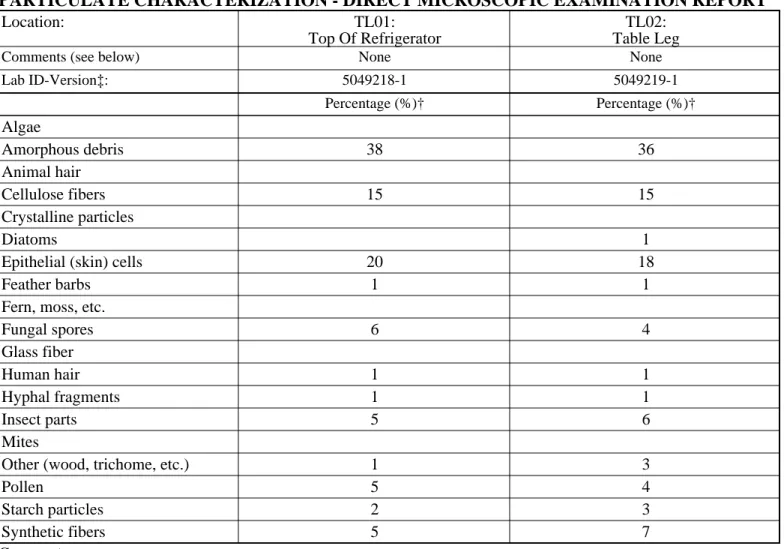
PARTICULATE CHARACTERIZATION - DIRECT MICROSCOPIC EXAMINATION REPORT
Location: TL01:
Top Of Refrigerator
TL02: Table Leg
Comments (see below) None None
Lab ID-Version‡: 5049218-1 5049219-1 Percentage (%)† Percentage (%)† Algae Amorphous debris 38 36 Animal hair Cellulose fibers 15 15 Crystalline particles Diatoms 1
Epithelial (skin) cells 20 18
Feather barbs 1 1
Fern, moss, etc.
Fungal spores 6 4 Glass fiber Human hair 1 1 Hyphal fragments 1 1 Insect parts 5 6 Mites
Other (wood, trichome, etc.) 1 3
Pollen 5 4
Starch particles 2 3
Synthetic fibers 5 7
Comments:
† The percentages reported are approximate values.
Particle types listed without a percentage or data entry were not detected during the course of the analysis for the respective sample.
Interpretation is left to the company and/or persons who conducted the field work.
‡ A "Version" indicated by -"x" after the Lab ID# with a value greater than 1 indicates a sample with amended data. The revision number is reflected by the value of "x".
Approved by:
Technical Manager Roshanak Kalantari Report for:
Ms. Vicki Uchida
Executive Environmental Services Corp. 310 East Foothill Blvd.
Suite 200
Arcadia, CA 91006
Regarding: Project: 13-A0118-0255
EML ID: 1117707
All samples were received in acceptable condition unless noted in the Report Comments portion in the body of the report. Due to the nature of the analyses performed, field blank correction of results is not applied. The results relate only to the items tested. EMLab P&K ("the Company") shall have no liability to the client or the client's customer with respect to decisions or
recommendations made, actions taken or courses of conduct implemented by either the client or the client's customer as a result of or based upon the Test Results. In no event shall the Company be liable to the client with respect to the Test Results except for the Company's own willful misconduct or gross negligence nor shall the Company be liable for incidental or consequential damages or lost profits or revenues to the fullest extent such liability may be disclaimed by law, even if the Company has been advised of the possibility of such damages, lost profits or lost revenues. In no event shall the Company's liability with respect to the Test Results exceed the amount paid to the Company by the client therefor.
Dates of Analysis:
Spore trap analysis: 09-25-2013
Service SOPs: Spore trap analysis (1038)
EMLab P&K
1010 N Central Avenue, Glendale, CA 91202
(866) 465-6653 Fax (858) 569-5806 www.emlab.com
Client: Executive Environmental Services Corp.
C/O: Ms. Vicki Uchida
Re: 13-A0118-0255
Date of Sampling: 09-20-2013
Date of Receipt: 09-24-2013
Date of Report: 09-25-2013
SPORE TRAP REPORT: NON-VIABLE METHODOLOGY
Location: ST01: Outdoor ST02: East Side Of Room 1 ST03: West Side Of Room 1 ST04: Storage Room ST05: Outdoor
Comments (see below) None None None None None
Lab ID-Version‡: 5045028-1 5045029-1 5045030-1 5045031-1 5045032-1
Analysis Date: 09/25/2013 09/25/2013 09/25/2013 09/25/2013 09/25/2013
raw ct. spores/m3 raw ct. spores/m3 raw ct. spores/m3 raw ct. spores/m3 raw ct. spores/m3
Ascospores
Basidiospores
1
53
Botrytis
Chaetomium
1
13
1
13
Cladosporium
9
480
2
110
1
53
1
53
5
270
Curvularia
Epicoccum
Fusarium
Myrothecium
Nigrospora
1
13
Other colorless
Penicillium/Aspergillus types†
16
850
Pithomyces
Rusts
Smuts, Periconia, Myxomycetes
5
67
Stachybotrys
Stemphylium
Torula
Ulocladium
2
27
Zygomycetes
Background debris (1-4+)††
2+
2+
2+
2+
2+
Hyphal fragments/m3
13
< 13
< 13
27
< 13
Pollen/m3
< 13
< 13
< 13
< 13
13
Skin cells (1-4+)
< 1+
< 1+
< 1+
< 1+
< 1+
Sample volume (liters) 75 75 75 75 75
§ TOTAL SPORES/m3
630
110
53
910
310
Comments:
Spore types listed without a count or data entry were not detected during the course of the analysis for the respective sample.
† The spores of Aspergillus and Penicillium (and others such as Acremonium, Paecilomyces) are small and round with very few distinguishing characteristics. They cannot be differentiated by non-viable sampling methods. Also, some species with very small spores are easily missed, and may be undercounted.
††Background debris indicates the amount of non-biological particulate matter present on the trace (dust in the air) and the resulting visibility for the analyst. It is rated from 1+ (low) to 4+ (high). Counts from areas with 4+ background debris should be regarded as minimal counts and may be higher then reported. It is important to account for samples volumes when evaluating dust levels.
The analytical sensitivity is the spores/m3 divided by the raw count. The limit of detection is the analytical sensitivity multiplied by the sample volume divided by 1000.
For more information regarding analytical sensitivity, please contact QA by calling the laboratory.
‡ A "Version" indicated by -"x" after the Lab ID# with a value greater than 1 indicates a sample with amended data. The revision number is reflected by the value of "x".
EMLab P&K
1010 N Central Avenue, Glendale, CA 91202
(866) 465-6653 Fax (858) 569-5806 www.emlab.com
Client: Executive Environmental Services Corp.
C/O: Ms. Vicki Uchida
Re: 13-A0118-0255
Date of Sampling: 09-20-2013
Date of Receipt: 09-24-2013
Date of Report: 09-25-2013
MoldRANGE™: Extended Outdoor Comparison
Outdoor Location: ST01, Outdoor
Fungi Identified Outdoor Typical Outdoor Data for: Typical Outdoor Data for: data September in California† (n‡=15188) The entire year in California† (n‡=188141) spores/m3 very
low low med high
very high
freq % very
low low med high
very high
freq %
Generally able to grow indoors*
Alternaria - 13 13 27 53 93 60 13 13 27 67 110 54 Bipolaris/Drechslera group - 7 13 13 27 53 19 7 13 13 27 40 12 Chaetomium 13 8 13 13 27 53 27 8 13 13 27 47 19 Cladosporium 480 160 320 830 2,100 3,500 99 110 210 630 1,700 2,800 97 Curvularia - 7 13 13 40 67 16 7 13 13 27 53 6 Nigrospora 13 10 13 13 40 93 18 7 13 13 27 53 8 Penicillium/Aspergillus types - 53 110 270 750 1,200 90 53 100 210 590 1,000 85 Stachybotrys - 7 13 13 27 63 5 7 13 13 33 67 4 Torula - 8 13 13 40 67 14 8 13 13 40 67 12 Ulocladium - 7 13 13 27 53 12 8 13 13 27 40 10
Seldom found growing indoors**
Ascospores - 13 38 89 210 370 68 25 53 110 360 690 71
Basidiospores 53 53 67 190 480 850 93 53 80 270 1,000 2,400 93
Rusts - 10 13 13 40 80 26 13 13 13 53 80 27
Smuts, Periconia, Myxomycetes 67 13 13 40 120 200 74 13 13 40 110 200 68
§ TOTAL SPORES/m3 630
†The 'Typical Outdoor Data' represents the typical outdoor spore levels for the location and time frame indicated. The last column represents the frequency of occurrence. The very low, low, med, high, and very high values represent the 10, 20, 50, 80, and 90 percentile values of the spore type when it is detected. For example, if the frequency of occurrence is 63% and the low value is 53, it would mean that the given spore type is detected 63% of the time and, when detected, 20% of the time it is present in levels above the detection limit and below 53 spores/m3. These values are updated periodically, and if enough data is not available to make a statistically meaningful assessment, it is indicated with a dash.
§ Total Spores/m3 has been rounded to two significant figures to reflect analytical precision.
* The spores in this category are generally capable of growing on wet building materials in addition to growing outdoors. Building related growth is dependent upon the fungal type, moisture level, type of material, and other factors. Cladosporium is one of the predominant spore types worldwide and is frequently present in high numbers. Penicillium/Aspergillus species colonize both outdoor and indoor wet surfaces rapidly and are very easily dispersed. Other genera are usually present in lesser numbers.
** These fungi are generally not found growing on wet building materials. For example, the rusts and smuts are obligate plant pathogens. However, in each group there are notable exceptions. For example, agents of wood decay are members of the basidiomycetes and high counts of a single morphological type of basidiospore on an inside sample should be considered significant.
‡n = number of samples used to calculate data.
Interpretation of the data contained in this report is left to the client or the persons who conducted the field work. This report is provided for informational and comparative purposes only and should not be relied upon for any other purpose. "Typical outdoor data" are based on the results of the analysis of samples delivered to and analyzed by EMLab P&K and assumptions regarding the origins of those samples. Sampling techniques, contaminants infecting samples, unrepresentative samples and other similar or dissimilar factors may affect these results. In addition, EMLab P&K may not have received and tested a representative number of samples for every region or time period. EMLab P&K hereby disclaims any liability for any and all direct, indirect, punitive, incidental, special or consequential damages arising out of the use or interpretation of the data contained in, or any actions taken or omitted in reliance upon, this report.