Annex K
Environmental
Management Programme
(EMPr)
CONTENTS
ABBREVIATIONS 0
DEFINITIONS AND TERMINOLOGY 1
1 BACKGROUND TO PROJECT 4
1.1 REGULATORY REQUIREMENT FOR THE EMPR 4
1.2 OBJECTIVES OF THE EMPR 4
1.3 STRUCTURE OF THE EMPR 5
2 IMPLEMENTATION OF THE EMPR 7
2.1 INTRODUCTION 7
2.2 ROLES AND RESPONSIBILITIES 7
2.3 THE DEVELOPER 8
2.4 THE ENGINEER 9
2.5 THE CONTRACTOR 10
2.6 ENVIRONMENTAL CONTROL OFFICER 10
2.7 ENVIRONMENTAL SITE MANAGER 11
2.8 COMMUNICATION CHANNELS ON THE SITE 12
2.8.1 Site Meetings during the Construction Phase 12
2.8.2 Environmental Education and Awareness 13
2.8.3 Method Statements 13
2.8.4 ECO Diary/Logbook Entries 14
2.8.5 Site Memo Entries 14
2.8.6 Legislative Framework 15
2.8.7 Dispute Resolution 16
2.8.8 Stakeholder Relations 16
2.8.9 Social Responsibilities 16
2.8.10 Recycling of Waste 17
3 PRE- CONSTRUCTION EMPR 18
3.1 SCOPE AND APPLICATION 18
3.2 PRE-CONSTRUCTION EMPR REQUIREMENTS 18
3.2.1 Permit Requirements 18
3.2.2 Tender Documentation 18
3.3 SPECIFIC PRE-CONSTRUCTION SPECIFICATIONS 18
4 CONSTRUCTION ENVIRONMENTAL MANAGEMENT PROGRAMME
(CEMPR) 25
4.3.1 Temporary Staging Areas and Site Division 26
4.3.2 Vegetation Clearing 26
4.3.3 Topsoil 26
4.3.4 Access/Haul Routes 26
4.3.5 Fuel Storage and Use 26
4.3.6 Solid Waste Management 26
4.3.7 Contaminated Water 26
4.3.8 Hazardous Substances 26
4.3.9 Cement and Concrete Batching 27
4.3.10 Emergency Procedures 27
4.3.11 Erosion and Sedimentation Control 27
4.4 SITE ESTABLISHMENT 27
4.4.1 Site Division 27
4.4.2 Site Demarcation 27
4.4.3 Site Clearance 28
4.4.4 Access Routes/ Haul Roads 28
4.5 GENERAL REQUIREMENTS 28
4.5.1 Materials Handling, Use and Storage 28
4.5.2 Fuel (Petrol and Diesel) and Oil 29
4.5.3 Solid Waste Management 30
4.5.4 Ablution Facilities 31 4.5.5 Eating Areas 32 4.5.6 Drinking Water 32 4.5.7 Contaminated Water 32 4.5.8 Hazardous Substances 33 4.5.9 Site Structures 33
4.5.10 Workshop, Equipment Maintenance and Storage 33
4.5.11 Environmental Awareness Training 34
4.5.12 Contractor’s Environmental Officer 35
4.5.13 "No go" Areas 35
4.5.14 Fire Control 35
4.5.15 Concrete and Cement Work 36
4.5.16 Emergency Procedures 36
4.5.17 Safety 37
4.5.18 Security 37
4.5.19 Community Relations 37
4.5.20 Erosion and Sedimentation Control 38
4.5.21 Aesthetics 38
4.5.22 Dust Control 38
4.5.23 Pollution 38
4.5.24 Working Hours 39
4.5.25 Excavation and Trenching 39
4.5.26 Temporary Site Closure 39
4.6 SITE CLEAN UP 40
4.7 TOLERANCES 41
4.8 SPECIFIC CONSTRUCTION SPECIFICATIONS 41
5 OPERATIONAL ENVIRONMENTAL MANAGEMENT PROGRAMME
5.2 AIM AND PURPOSE OF THE OEMPR 49
5.3 APPLICATION 49
5.3.1 Independent Environmental Control Officer (ECO) 49
5.4 FINANCING FOR ENVIRONMENTAL MANAGEMENT 50
5.5 GENERAL REQUIREMENTS 50
5.5.1 Litter and Waste Management 50
5.5.2 Maintenance of Development 51
5.5.3 Emergency Procedures 51
5.5.4 OEMPr Review and Audit 52
ABBREVIATIONS
CEMPr ConstructionEnvironmental Management Programme CTMM Cape Town Metropolitan Municipality
DEA Department of Environmental Affairs
DEADP Department of Environmental Affairs and development Planning
ECO Environmental Control Officer
EMPr Environmental Management Programme
ESM Environmental Site Manager
NEMA National Environmental Management Act
DEFINITIONS AND TERMINOLOGY
Bund: Enclosure under / around a storage facility to contain any spillage.
Contractor: The principal persons /company undertaking the construction of the Development.
• The main contractor as engaged by the Developer;
• Selected subcontractors; and
• Any other contractor from time to time engaged by the Developer directly in connection with the construction part of the Works.
Contaminated water: Water contaminated by the Contractor's activities, e.g. concrete water and runoff from plant/ personnel wash areas.
Construction camp: The area designated for all temporary site offices, storage sheds and areas, parking areas, maintenance workshops, staff welfare
facilities, accommodation, etc.
Construction Environmental Management Programme (CEMPr): The construction phase Environmental Management Programme, containing the Environmental Specifications for Civil and Building Works, also forming part of the civils and building contract documentation.
Engineer: A person representing the Developer on site and who is responsible for the technical and contractual implementation of the works to be
undertaken. This is usually the engineer, but may be any other person, such as an architect or project manager, authorized by the Developer to fulfil this role.
Environment: The surroundings within which humans exist and that are made up of the land, water and atmosphere of the earth, viz.:
• micro-organisms, plant and animal life;
• any part or combination of the above and the inter-relationships among and between them; and
• the physical, chemical, aesthetic and cultural properties and conditions of the foregoing that influence human health and well-being.
Environmental Education Programme: An environmental education course for the Contractor’s management staff and labour force, which informs them of the requirements of the CEMPr. The ECO will present and co-ordinate such courses.
Environmental Control Officer (ECO): The individual or company appointed by the Developer to ensure the implementation of the CEMPr and suitable environmental management practices on site for the duration of the construction phase of the Project.
Method Statement: A written submission by the Contractor to the Engineer and ECO in response to the Specifications or a request by the Engineer, setting out the plant, materials, labour and method the Contractor proposes using to carry out an activity, identified by the relevant specification or the Engineer when requesting the Method Statement, in such detail that the Engineer is enabled to assess whether the Contractor's proposal is in accordance with the Specifications and/or will produce results in accordance with the
Specifications.
The Method Statement shall cover applicable details with regard to:
• construction procedures;
• materials and plant to be used;
• transport of materials and plant to and from site;
• how the plant/ material will be moved while on site;
• how and where material will be stored;
• the containment (or action to be taken if containment is not possible) of leaks or spills of any liquid or material that may occur;
• timing and location of activities;
• compliance/ non-compliance with the Specifications; and
• any other information deemed necessary by the Engineer.
No Go Areas: Areas identified as being environmentally sensitive in some manner and delineated on plan, and on the Project site with pegs or fencing, and which are out of bounds to unauthorised persons. Authorisation must be obtained prior to entry.
Operational Environmental Management Programme (OEMPr): The operation phase Environmental Management Programme, containing the Environmental Specifications for the on-going maintenance and operational activities, also forming part of the contract documentation.
Potentially hazardous substance: A substance which, in the reasonable opinion of the Engineer, can have a deleterious effect on the environment.
Reasonable: Means, unless the context indicates otherwise, reasonable in the opinion of the Engineer after he has consulted with a person, not an employee of the Employer, suitably experienced in "environmental implementation plans" and "environmental management programmes" (both as defined in the National Environmental Management Act (No 107, 1998)).
Project site (site): The (future) primary operational area for the Project activities. Private transport corridors (i.e., those dedicated for use solely by Project operational activities) are included as part of the site.
Solid waste: Means all solid waste, including construction debris, chemical waste, excess cement/ concrete, packaging materials, timber, tins and cans, drums, wire, nails, food and domestic waste (e.g. plastic packets and wrappers).
Specification: A technical description of the standards of materials and workmanship that the Contractor is to use in the Works to be executed, the performance of the Works when completed and the manner in which payment is to be made.
Works: The construction operations and all related and incidental works, such as site works, earthworks, installation of services, rehabilitation etc., in connection with the execution and carrying to completion of the
1 BACKGROUND TO PROJECT
Burgan Cape Terminals (Proprietary) Limited hereafter referred to as Burgan Oil, appointed Environmental Resources Management Southern Africa (Pty) Ltd, hereafter referred to as ERM, as independent Environmental Assessment Practitioners (EAPs) to undertake the Environmental Impact Assessment (EIA) process for the proposed development of an oil and fuel storage and distribution facility (the facility) at the Eastern Mole, Port of Cape Town, Western Cape.
1.1 REGULATORY REQUIREMENT FOR THE EMPR
An Environmental Management Program (EMPr) for the facility is required under the Regulations in terms of Chapter 5 of the National Environmental Management Act (NEMA) (No 107, 1998), as amended). The EMPr tends to become a legally binding document on the applicant as a condition of approval of the Project by the Department of Environment Affairs and Development Planning (DEADP), in addition to other conditions that may be stipulated in the Record of Decision / Environmental Authorisation.
1.2 OBJECTIVES OF THE EMPR
The aim of an EMPr is to facilitate appropriate environmental controls during all phases of the Project to minimise environmental damage arising from implementation of the Project during construction and operational phases. To achieve this, the EMPr must make recommendations for the planning and design (pre-construction/design phase), specify the limitations the contractor must abide by during construction, detail the issues that should be taken cognisance of and indicate specific actions that must be undertaken so as to ensure that the environment is not unnecessarily damaged. The EMPr thus specifies the framework within which the contractor must carry out
operations. Management and monitoring measures for the operational phase are also included to provide environmental guidance for the lifetime of the Development.
In addition, the EMPr provides a clear indication of the responsibilities for environmental management requirements by each of the role players involved in the construction and operational phases of the Development. Guidance for the implementation of the EMPr is provided, including the compilation of method statements which are required to be implemented to achieve
compliance with the Environmental Specifications. Corrective actions in the event of non-compliance with the EMPr are also defined.
No closure or decommissioning EMPr is provided in this EMPr since the activities involved in future decommissioning would likely trigger a
requirement to undertake a further Environmental Assessment and EMPr, as would presently be the case in terms of activity 27 of Government Notice 544 of 2010. An Environmental Impact Assessment for decommissioning would assess the impacts and opportunities of decommissioning activities in greater detail than is possible at this time, and would include a specific
decommissioning EMPr. The decommissioning EMPr should take into
consideration the mitigation measures identified in the Environmental Impact Report (EIR). A detailed decommissioning and rehabilitation plan should be developed prior to decommissioning of the oil and fuel storage and
distribution facility that takes into account best available technological options for dismantling and disposal available at the time. This plan should include, but should not be limited to, removal of storage tanks and supporting structures and other infrastructure, management of waste and/or contaminated soil, dust suppression and rehabilitation.
The EMPr is required in order to:
• assist in ensuring continuing compliance with South African legislation and Burgan Oil’s Environmental Health and Safety Policy;
• provide a mechanism for ensuring that measures identified in the EIR designed to mitigate potentially adverse impacts, are implemented;
• provide a framework for mitigating impacts that may be unforeseen or unidentified until construction is underway;
• provide assurance to regulators and stakeholders that their requirements with respect to environmental and socio-economic performance will be met; and
• provide a framework for compliance auditing and inspection programs. The overall EMPr contains sections that specifically deal with the design and planning phase, the construction phase (Construction Environmental
Management Programme (CEMPr)) and the operational phase (Operational Environmental Management Programme (OEMPr)).
1.3 STRUCTURE OF THE EMPR
The structure of the EMPr is indicated Table 1.1.
Table 1.1 Structure of the EMPr
Section Heading Content
Section1 Background to Project Provides background information regarding
Section Heading Content
Section 2 Implementation of the EMPr Provides details of the communication and organisational structures within which the EMPr will be implemented, responsibilities of key role players, and provides the terms of reference for the Environmental Control Officer (ECO).
Section 3 Environmental Management
Specifications for the Pre-Construction Phase
Provides environmental specifications for the Pre-Construction phase
Section 4 Environmental Management
Specifications for Construction Phase (CEMPr)
Provides all construction phase
environmental management requirements applicable to the principal construction contractors, and their subcontractors.
Section 5 Environmental Management
Specifications for Operational Phase (OEMPr)
Provides all operational phase environmental management requirements applicable to applicant and any sub-contractors.
2 IMPLEMENTATION OF THE EMPR
2.1 INTRODUCTION
This document details the required mitigation measures, and is partly
prescriptive, identifying specific people or organisations to undertake specific tasks in order to ensure that impacts on the environment are minimised
during the lifecycle of this Project. The EMPr is applicable to all work activities during the pre-construction, construction and operation of the oil and fuel storage and distribution facility. It is an open-ended document implying that information gained during pre-construction, construction and operational activities and/or monitoring of procedures on the site could lead to changes in the EMPr.
An ECO (Environmental Control Officer) will be appointed to monitor
compliance with the EMPr and other Conditions of Approval as they relate to environmental matters. This EMPr specifies responsibility for implementation of the prescribed mitigation measures to various responsible parties who are expected to co-operate closely to minimise or avoid environmental impacts. The Contractor is obliged to inform the ECO and Engineer immediately of events that may cause serious environmental damage or breach the
requirements of the EMPr. The ECO in turn will immediately inform Burgan Oil and, if necessary the Local, Provincial and or National Authority, of such events should they likely result in significant residual environmental or social impact.
2.2 ROLES AND RESPONSIBILITIES
The key role-players during the construction phase of the Development, for the purposes of environmental management on the site, include but are not limited to: the Developer (Burgan Oil), the Engineer, the main Contractors (direct appointments including civil works contractor, building contractor, landscape contractor etc.), the Environmental Control Officer (ECO), and representatives of the relevant Authority/ies.
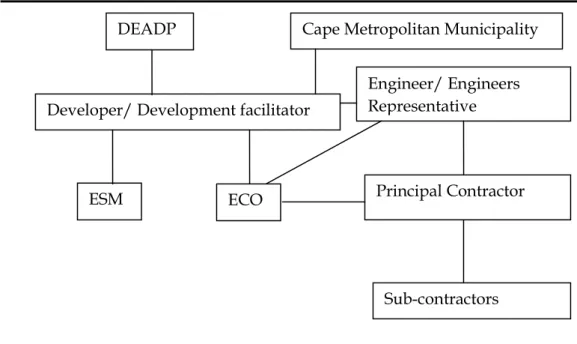
Details of the responsibilities of each of the key role-players have been provided in Sections 2.3 to 2.6 below. Lines of communication and reporting between the various parties are illustrated in Figure 2.1 below.
Figure 2.1 Roles and Responsibilities
2.3 THE DEVELOPER
For the purpose of this document, “the Developer” and its appointed facilitators refers to those to whom permission has been granted to proceed with the oil and fuel storage and distribution facility (i.e. Burgan Oil), and who is thus ultimately responsible for compliance with all conditions of approval of Project Development or any aspect thereof by any authority. With respect to the pre-construction phase of the Project, the Developer is to:
• Implement the recommendations outlined in the pre-construction EMPr; and
• Implement as many recommendations as possible that will lessen the total environmental impact of the Project from the design stage, through to construction and ultimately the operational phase.
With respect to the construction phase of the Project, the Developer is to:
• Ensure that all relevant approvals and permits have been obtained prior to the start of construction activities on the site;
• Ensure that the EMPr has been approved by DEADP prior to the start of construction activities on the site;
• Ensure that DEADP has been notified of the date on which construction activities will be starting, prior to commencement of the activity;
• Ensure that all conditions of approval have been complied with;
• Appoint the required specialists to make input into the
pre-construction/design phase (refer to Section 3.2);and
Cape Metropolitan Municipality
Developer/ Development facilitator
Sub-contractors Principal Contractor Engineer/ Engineers Representative ECO DEADP ESM
• Appoint a suitably qualified or experienced ECO prior to the start of construction activities on the site, and for the duration of the construction phase.
With respect to the operational phase of the Project, the developer is to:
• Ensure that operation of the facility is undertaken in line with the
requirements of the operational phase EMPr; and
• Continuously seek to improve any negative environmental impacts
which result from the operational phase.
• The implementation of the OEMPr, as well as the adherence to any
conditions within the Environmental Authorization relating to the operational phase of the Project, shall be the responsibility of developer. The developer will appoint an Environmental Site Manager and various specialists as required to ensure that the specifications of this document as they relate to general site management and maintenance, as well as environmental audits, are suitably implemented on the site.
2.4 THE ENGINEER
For the purposes of this document, “The Engineer” refers to the engineer for the Project, or any other person authorised by the Developer, to be responsible for the technical and contractual implementation of the works to be
undertaken.
The responsibilities of the Engineer are to:
• Ensure that the requirements as set out in this EMPr and any other conditions stipulated by the relevant Authorities are implemented;
• Assist the ECO in ensuring that the conditions of the Construction Environmental Management Programme (CEMPr) are adhered to and promptly issue instructions requested by the ECO to the Contractor. All instructions relating to environmental matters issued by the Engineer at the site to the Contractor are to be copied in writing to the ECO;
• Assist the ECO in making decisions and finding solutions to
environmental problems that may arise during the construction phase;
• Review and approve construction method statements with input from the ECO;
• Order the removal of person(s) and/or equipment not complying with the specifications (as required by the ECO or otherwise); and
2.5 THE CONTRACTOR
For the purposes of this document “The Contractor” refers to any company or individual appointed by the Developer to implement any aspect of the works. The Contractor is to:
• Ensure implementation of all applicable Environmental Specifications during all works on the site, including all additional requirements as may be contained in approved method statements.
• Ensure that all sub-contractors’, employees, suppliers, agents etc. are fully aware of the environmental requirements detailed in the Environmental Specifications;
• Liaise closely with the Engineer and the ECO and ensure that the works on the site are conducted in an environmentally controlled manner;
• Inform the Engineer as well as the ECO should environmental conditions on the site deteriorate, e.g. dumping, pollution, littering and damage to vegetation; and
• Carry out instructions issued by the Engineer, on request of the ECO, required to comply with the CEMPr.
2.6 ENVIRONMENTAL CONTROL OFFICER
During the construction phase of the project, the ECO is to:
• Ensure that the Contractor has a copy of the CEMPr and all agreed method statements;
• Undertake regular site inspections (with frequency determined by the nature of the on-site activities as may be appropriate) to audit compliance of all parties with the requirements of the CEMPr;
• Advise/recommend on actions or issues impacting on the environment to the Engineer, who shall issue any required site instructions to the Contractor;
• Conduct environmentally education and awareness training with the
Contractor and his/her staff on key requirements of the EMPr, environmental safeguards, good housekeeping practices, and general aspects relating to Site sensitivity. ;
• Review and approve construction/landscape method statements together with the Engineer/Landscaper (when applicable);
• Assist the Contractor in finding environmentally responsible solutions to problems that may arise;
• Recommend to the Engineer the removal of person(s) and/or equipment
not complying with the Specifications;
• Undertake photographic monitoring of the construction at the site;
• Keep records of all activities/ incidents concerning the environment on the site in a Site Diary / Logbook;
• Complete temporary and permanent site closure checklists;
• Take immediate action on the site to stop works where significant and irreparable damage is being inflicted on the environment, and to inform the Engineer immediately of the occurrence and action taken; and
• Undertake regular internal review of the EMPr and make
recommendations regarding its updating to the Engineer and Developer. The ECO has the authority to recommend to DEADP that works be stopped if in his/her opinion serious harm to, or impact on the environment is likely to occur or has occurred and such actual or potential harm or impact is in contravention of the EMPr, and which is or may be caused by construction or related works.
In the event of failure by the Contractor or Contractor’s employee to show adequate consideration to the environmental aspects of this contract, the ECO may recommend to the Engineer and the project management team to have the Contractor’s representative or any employee(s) removed from the site or to suspend work until the matter is remedied.
The ECO shall keep a Site Diary or Logbook in which events and concerns of environmental significance are to be recorded. The ECO will compile a monthly report of such events, concerns and general compliance of the Contractor with the construction phase requirements of the EMPr. The ECO’s monthly report will be submitted to the Engineer and if required, to DEADP and the Cape Town Metropolitan Municipality. The ECO is also required to attend regular meetings of the project management team to report on environmental issues and to minute the requirements that emerge.
The ECO will be responsible for the compilation of a final completion checklist for the Project, completed when all construction works related to the Project have terminated and the site has been cleared of all construction related debris, materials or equipment not forming part of the permanent works. The completion checklist will audit the Contractor’s compliance with the
construction phase requirements of the EMPr throughout the duration of the construction phase and, together with a final written report, will be submitted to DEADP and the Cape Town Metropolitan Municipality in order to achieve “environmental closure” for the construction phase of the Project.
2.7 ENVIRONMENTAL SITE MANAGER
A suitably qualified and trained individual appointed by Burgan Oil prior to the operation of the facility, will fulfil the role of the Environmental Site Manager. The primary roles and responsibilities of the ESM will be:
• to visit the site on a monthly basis and advise on areas of environmental management, or compliance with the OEMPr, requiring attention;
• to visit the site more regularly during the first three months of operation, during which more frequent monitoring may be required for the establishment of certain programmes or aspects of environmental management;
• to be called to the site in the case of any emergency situation which may impact on the local environment;
• to liaise with various specialists and the local authorities if required, regarding issues relating to environmental management;
• to report on compliance with the OEMPr specifications to Burgan Oil;
• to facilitate environmental audits and ensure that they are undertaken, as required;
• to keep a comprehensive record of environmental management, issues of non-compliance and minutes of meetings for audit purposes; and
• to undertake any other tasks outlined in this document, on the behalf of Burgan Oil.
2.8 COMMUNICATION CHANNELS ON THE SITE
2.8.1 Site Meetings during the Construction Phase
The ECO is required to attend regular meetings of the project management team to facilitate the transfer of information and to update all parties on the environmental compliance of the Project as a whole. The ECO or delegated person will minute the discussions, and specifically any decisions arising relating to environmental management actions and responsibility.
The ECO will compile a summary report outlining the main construction activities relating to the environment, aspects of non-compliance, and
document agreed environmental actions and dates of achieving compliance by the Contractor.
The summary report will form part of the construction phase EMPr records. . The following people should attend these meetings:
• Developer’s Representative;
• Engineer;
• The ECO; and
2.8.2 Environmental Education and Awareness
The Contractor, in consultation with the ECO, shall arrange for a presentation to site staff to familiarise them with the environmental requirements of the construction phase of the EMPr within seven days from the commencement date of construction. This presentation should take cognizance of the level of education, designation and language preferences of the staff. General site staff would commonly receive a basic environmental awareness presentation or talk highlighting general environmental and social “do’s and don’ts”,
including good housekeeping practices. This information would be provided throughout construction in the form of regular toolbox talks. Management level staff on the site, e.g. site agents and foremen, who require more detailed knowledge about the environmental sensitivities on site and the construction phase requirements of the EMPr, will benefit from a separate and more detailed presentation of these issues. If required, the ECO may call upon the services of a professional trainer or environmental consultant to present the technical contents of the EMPr.
Environmental education of staff can be assisted by compilation of posters placed in staff venues eg canteens and site offices.
2.8.3 Method Statements
The Contractor shall compile and provide Method Statements to the ECO and the Engineer for approval prior to work commencing on construction
activities. Method statements will be required for specific activities that are deemed or identified to pose a risk to the environment and/or which require site specific detail beyond that contained in the EMPr or when requested by the Engineer or ECO.
A Method Statement is a “live document” in that modifications are negotiated between the Contractor and the ECO/project management team, as
circumstances unfold. Changes to, and adaptations of, Method Statements can be implemented with the prior consent of all parties. All Method Statements will form part of the construction phase of the EMPr documentation and are subject to the terms and conditions contained within the construction phase of the EMPr.
Note that a Method Statement is a starting point for understanding the nature of the intended actions to be carried out and allows for all parties to review and understand the procedures to be followed in order to minimise risk of harm to the environment.
A Method Statement describes the scope of the intended work in a step-by-step description, in order for the ECO and the Engineer to understand the Contractor’s intentions. This will enable them to assist in devising any
mitigation measures, which would minimize environmental impact during these tasks.
For each instance where it is requested that the Contractor submit a Method Statement to the satisfaction of the Engineer and ECO, the format should clearly indicate the following:
• What - a brief description of the work to be undertaken;
• How - a detailed description of the process of work, methods and materials;
• Where - a description/sketch map of the locality of work (if applicable);
• When - the sequencing of actions with due commencement dates and completion date estimates;
• Who – The person responsible for undertaking the works described in the Method Statement; and
• Why – a description of why the activity is required.
All Method Statements must be developed to the satisfaction of the ECO, Engineer and, where practical or stipulated in the Environmental
Authorisation, should be endorsed as being acceptable by the environmental representative of DEADP.
A list of possible Method Statements that the Contractor may be required to submit during the course of the construction contract is provided in Section 4, along with an indication of those which the ECO may require the Contractor to provide prior to the start of works on the site.
2.8.4 ECO Diary/Logbook Entries
The ECO will maintain a Site diary or logbook that relates to environmental issues as they occur on the site for record keeping purposes. Recorded issues will form part of feedback presented at Project meetings by the ECO.
2.8.5 Site Memo Entries
Site memos, stipulating recommended actions required to improve
compliance with the construction phase of the EMPr by the Contractor, will be issued by the ECO to the Engineer, who in turn will ensure that the Contractor is informed of the recommended instruction.
Comments made by the ECO in the Site Memo book are advisory and all consequential Site Instructions required may only be issued by the Engineer. Site Memos will also be used for the issuing of stop work orders to the Contractor for activities deemed to pose immediate and serious risk of unnecessary damage to the environment.
2.8.6 Legislative Framework
Obligations imposed by the EMPr are legally binding in terms of
environmental statutory legislation (i.e. the Environmental Authorization in terms of the National Environmental Management Act No.107 of 1998, as amended) and in accordance with any other requirements specified by the DEADP.
The requirements of this EMPr do not release the Developer from the requirements of any other legislation that may be applicable to the Project such as those listed below.
National:
• National Environmental Management Act (Act No. 107 of 1998), as amended;
• NEMA EIA Regulations 2010, (Government Notice No R543, R544, R545 and R546 of June 2010);
• National Environmental Management Waste Act (Act No. 59 of 2008);
• National Environment Management: Air Quality Act (Act No. 39 of 2004);
• National Water Act (Act No. 36 of 1998);
• National Environmental Management: Biodiversity Act (Act No. 10 of 2004);
• National Heritage Resources Act ( Act No. 25 of 1999);
• Hazardous Substances Act (Act No. 15 of 1973);
• Major Hazardous Installations Regulations (GNR 96 of 998 and GNR 692 of 2001); and
• Occupational Health and Safety (Act No. 85 of 1993).
Provincial:
• Department of Environmental Affairs & Development Planning
(DEA&DP) NEMA EIA Regulations Guideline and Information Document Series, 2010.
Metropolitan:
• Cape Town Metropolitan Integrated Waste Management By- Law;
• Wastewater and Industrial Effluent By-law;
• Stormwater Management By-law;
• Treated Effluent By-law;
• Cape Town Metropolitan Municipality By-law for Air Pollution Control; and
2.8.7 Dispute Resolution
Any disputes or disagreements between role players on the site (with regard to environmental management) will firstly be referred to the Engineer during the construction phase, or to a DEADP officer during the operational phase. If no resolution on the matter is reached by either the Engineer and/or a
DEADP officer, the matter will be referred to the DEA for clarification.
2.8.8 Stakeholder Relations
Burgan Oil should continue to engage with stakeholders throughout Project construction and operation. The objectives of communication and liaison with local stakeholders are the following:
• To provide stakeholders in the vicinity of the Project and other interested stakeholders with regular information on the progress of work and its implications;
• To monitor implementation of mitigation measures and the impact of construction on stakeholders via direct monitoring and feedback from those affected, in order to ensure the mitigation objectives are achieved; and
• To manage any disputes between Burgan Oil, the Contractors and local stakeholders.
Grievance Procedure
Burgan Oil should develop a Grievance Procedure to ensure fair and prompt resolution of problems arising from the Project. The grievance procedure should be underpinned by the following principles and commitments:
• Implement a transparent grievance procedure, and disseminate key information to directly impacted stakeholders;
• Seek to resolve all grievances timeously; and
• Maintain full written records of each grievance case and the associated process of resolution and outcome for transparent, external reporting. The responsibility for resolution of grievances will lie with Burgan Oil and its Contractors.
2.8.9 Social Responsibilities
The Developer and Contractors shall encourage and implement wherever possible the procurement of locally based labour, skills and materials. Burgan Oil will develop a Project specific Procurement and Recruitment Policy.
2.8.10 Recycling of Waste
Wherever possible, in order to adhere to waste minimisation principles, materials used or generated by construction and operation will be recycled or reused. Containers for glass, paper and metals will be provided separate to general waste bins particularly in office and camp areas during construction. Where possible and practical, waste should be sorted for recycling (eg, at stores and offices). Recycling protocols will sort materials into the following categories:
• Paper / cardboard;
• Any packaging materials suitable for re-use;
• Plastics;
• Aluminium;
• Metals (other than aluminium);
• Wood;
• Organic waste;
• Glass; and
3 PRE- CONSTRUCTION EMPR
3.1 SCOPE AND APPLICATION
This section covers the mitigation measures and recommendations required during the pre-construction and detailed design stage of the Project.
3.2 PRE-CONSTRUCTION EMPR REQUIREMENTS
3.2.1 Permit Requirements
Activities undertaken during site preparation, construction and operation may require additional permits, over and above the Environmental Authorisation. Burgan Oil is responsible for ensuring that they hold the necessary permits in order to comply with national and local regulations.
3.2.2 Tender Documentation
Burgan Oil shall ensure that this EMPr is included within the tender documents for all Contractors tendering to undertake any aspects of the construction phase of the Project. Costs of compliance with the EMPr must be adequately allowed for in the adjudication of tenders.
3.3 SPECIFIC PRE-CONSTRUCTION SPECIFICATIONS
In order to ensure compliance with environmental legislation and best practice guidelines, the following actions are applicable to the pre-construction planning phase for the Project. The persons responsible for implementation of the actions are listed in the table below, the majority of which are the responsibility of Burgan Oil.
PRE-CONSTRUCTION PLANNING PHASE
Aspect Objective Actions to be undertaken to Mitigate Environmental Impact Parameters for
Monitoring Responsibility Frequency & Timing # Description of
Aspect # Commitment / Actions Required / Key Controls
1. Stakeholder engagement
Notify all registered Interested and Affected Parties of Environmental Authorisation (EA).
1.1 Notify all registered I&APs and key stakeholders of the opportunity for appeal of the Environmental Authorisation.
Notices sent to relevant parties on the stakeholder database. List of those to whom it was sent on file.
ERM Within the number of DEADP-required days from the issuing of the Environmental Authorisation.
2. Permit Requirements
Ensure compliance with legal and other permitting requirements.
2.1 2.2 2.3
Ensure that all relevant legal requirements have been met.
The relevant Air and Emissions Licence must be applied for in terms of NEM: AQA, 2004.
Should there be any fuel burning equipment, as defined in terms of the City of Cape Town Air Quality Management By-Law, no 6772, 30 July 2010, an application in terms of Section 13 of the above mentioned By-Law for the installation of the such equipment must be submitted to the Air Quality Management Department.
Permits Burgan Oil Prior to construction
3. Finalisation of EMPr and Contractor Compliance Standards
Update EMPr with EA conditions and other mitigation measures from monitoring.
3.1 Incorporate additional mitigation measures specified by DEADP in the
EA into the EMPr and Contractor Compliance Standards. EMPr and Contractor Compliance Standards
Burgan Oil Prior to construction
4. Notification to DEADP: Director of Compliance Monitoring
Ensure that DEADP are notified of commencement date.
4.1 Notify DEADP prior to commencement of construction. Proof of
communication Burgan Oil 14-days in advance of commencement of construction. Keep DEADP informed of
any aspects of non-compliance with EMPr or EA
4.2 Notify DEADP with reasons if any provisions of the EMPr or EA cannot be implemented, and provide alternative
DEADP notification Burgan Oil Prior to construction
Keep DEADP informed of current contact details of applicant.
4.3 Notify DEADP of any change of contact details of the applicant DEADP notification Burgan Oil Prior to construction Keep DEADP informed of
contact details of ECO 4.4 Submit the name and contact details of the appointed ECO prior to construction DEADP notification Burgan Oil Prior to construction 5. Subsidiary Plans Develop Subsidiary Plans to
minimises environmental
5.1 The following subsidiary plans may be required prior to construction: • Health and Safety Plan
PRE-CONSTRUCTION PLANNING PHASE
Aspect Objective Actions to be undertaken to Mitigate Environmental Impact Parameters for
Monitoring Responsibility Frequency & Timing # Description of
Aspect # Commitment / Actions Required / Key Controls
and social risks • Traffic Management Plan • HIV Policy and Awareness Plan • Recruitment Policy
• Procurement Policy • Code of Conduct • Waste Management Plan • Emergency Response Plan • Oil Spill Response Plan
• Preventative Maintenance Programme • Dust Management Plan
6. Health and Safety Ensure the health and safety of site personnel during construction.
6.1 A Health and Safety Plan must be developed prior to the
commencement of construction to identify and avoid work related accidents. This shall include:
• Safety zones from current offices, roads, rights of way. • Chemical ablution facilities.
Health and Safety
Documentation Burgan Oil Prior to construction
7. Procurement of Services and Tender Procedures
Ensure that procurement of local, regional and national services is maximised: 7.1 7.2 7.3 7.4 7.5
Establish a Procurement Policy which sets reasonable targets for the procurement of goods and services from South African residents /suppliers, particularly local residents as far as possible.
Procurement should advertise tenders in local and national newspapers. Procurement processes should identify and invite bids from local suppliers.
Adopt transparent adjudication process for local suppliers. Burgan Oil will include requirements for local employment in the contracts that they establish with subcontractors and require that all contractors recruit in accordance with the Burgan Oil Recruitment Policy and RFP documents.
Procurement policy
Local and national advertisements Invited bids from local suppliers Demonstrate transparent process of adjudicating tenders
Burgan Oil Prior to construction
8. Grievance
Procedure Manage grievances raised by stakeholders 8.1 Burgan Oil will develop and implement a Grievance Procedure whereby stakeholders can lodge grievances regarding the Project and be responded to.
Grievance
Procedure Burgan Oil Prior to construction 9. Hazardous
Installation Impacts
Reduce the risk of a
hazardous installation 9.1 Pre-construction Emergency Planning: The current Burgan Emergency Response Plan (ERP) to be reviewed and where necessary revised to take into account of the findings of QRA
PRE-CONSTRUCTION PLANNING PHASE
Aspect Objective Actions to be undertaken to Mitigate Environmental Impact Parameters for
Monitoring Responsibility Frequency & Timing # Description of
Aspect # Commitment / Actions Required / Key Controls
9.2 9.3 9.4 9.5 9.6 9.7 9.8 9.10
and must comply with the regulations as outlined below.
The ERP must include an oil spill contingency plan, making reference to the Department of Environmental Affairs: Oceans and Coasts oil spill contingency plans and the TNPA oil spill emergency response plans. The potential consequences of the incidents identified in this QRA should be discussed with the local Emergency Services, Transnet Port Authorities, the City of Cape Town and the Burgan Oil personnel, with the ERP being revised as a result of the discussions where necessary. The ERP will be maintained and tested regularly. The Local Emergency Services, Transnet Port Authorities and the adjacent industries will also be kept informed of Burgan Oil emergency plans, and included in future trial emergency drills.
Major Hazardous Installations Regulations, Section 6 – On-site Emergency Plan:
Section 6 of the Major Hazard Installation Regulations; outline the requirements for on-site emergency planning. All of these points will be complied with by Burgan Oil within the ERP.
‘6.(1) An employer, self-employed person and user shall after submission of the information contemplated in regulation 3 (4) –
a) establish an on-site emergency plan to be followed inside the premises of the installation or part of the installation classified as a major hazard installation in consultation with the relevant health and safety representative or the relevant health and safety committee;
b) discuss the emergency plan with the relevant local government, taking into consideration any comment on the risk related to the health and safety of the public;
c) review the on-site emergency plan and where necessary, update the plan, in consultation with the relevant local government service at least once every three years;
PRE-CONSTRUCTION PLANNING PHASE
Aspect Objective Actions to be undertaken to Mitigate Environmental Impact Parameters for
Monitoring Responsibility Frequency & Timing # Description of
Aspect # Commitment / Actions Required / Key Controls
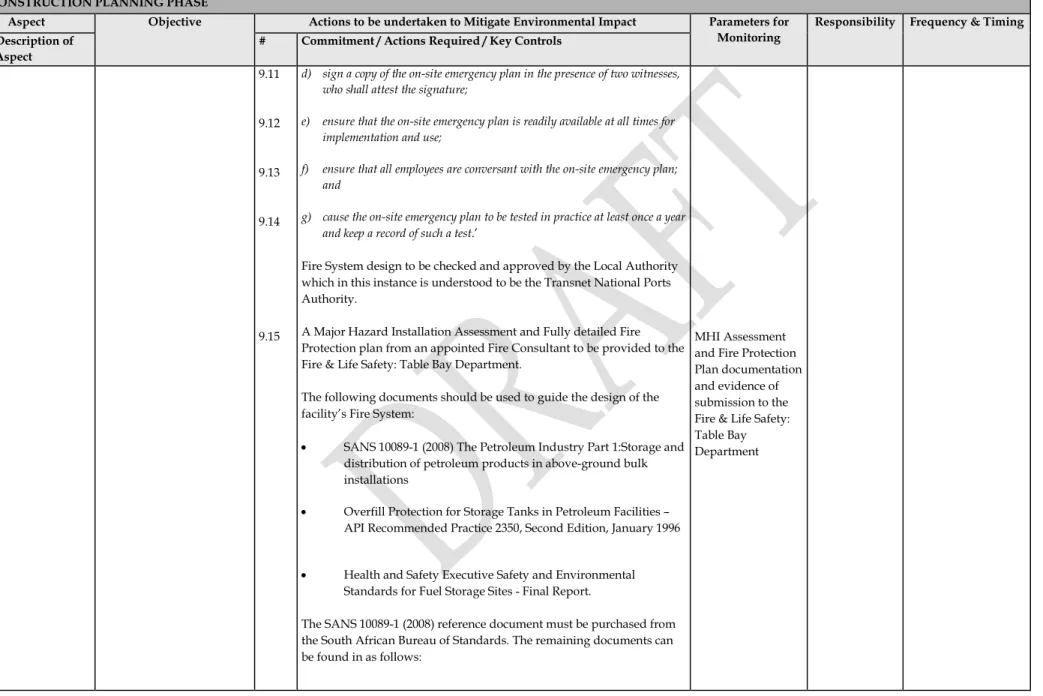
9.11 9.12 9.13 9.14
9.15
d) sign a copy of the on-site emergency plan in the presence of two witnesses, who shall attest the signature;
e) ensure that the on-site emergency plan is readily available at all times for implementation and use;
f) ensure that all employees are conversant with the on-site emergency plan; and
g) cause the on-site emergency plan to be tested in practice at least once a year and keep a record of such a test.’
Fire System design to be checked and approved by the Local Authority which in this instance is understood to be the Transnet National Ports Authority.
A Major Hazard Installation Assessment and Fully detailed Fire Protection plan from an appointed Fire Consultant to be provided to the Fire & Life Safety: Table Bay Department.
The following documents should be used to guide the design of the facility’s Fire System:
• SANS 10089-1 (2008) The Petroleum Industry Part 1:Storage and distribution of petroleum products in above-ground bulk installations
• Overfill Protection for Storage Tanks in Petroleum Facilities – API Recommended Practice 2350, Second Edition, January 1996 • Health and Safety Executive Safety and Environmental
Standards for Fuel Storage Sites - Final Report.
The SANS 10089-1 (2008) reference document must be purchased from the South African Bureau of Standards. The remaining documents can be found in as follows:
MHI Assessment and Fire Protection Plan documentation and evidence of submission to the Fire & Life Safety: Table Bay Department
PRE-CONSTRUCTION PLANNING PHASE
Aspect Objective Actions to be undertaken to Mitigate Environmental Impact Parameters for
Monitoring Responsibility Frequency & Timing # Description of
Aspect # Commitment / Actions Required / Key Controls
• Overfill Protection for Storage Tanks in Petroleum Facilities (see Annex H of EIR).
• Health and Safety Executive Safety and Environmental Standards for Fuel Storage Sites
http://www.hse.gov.uk/comah/buncefield/fuel-storage-sites.pdf.
• Burgan Oil has committed to an Operating and Control Philosophy (see Operating and Control Philosophy and commitment letter appended in Annex H of the EIR)
Operating and Control Philosophy 10. Soils and
Groundwater Manage the risks of soil and groundwater contamination 10.1 It is recommended that additional soil sampling be conducted and water samples be taken from surface to water below by means of drilling. This should be conducted prior to construction to form part of the baseline for the site. Following the construction of the facilities, monitoring wells should be installed to allow regular sampling of the sea water below site.
Odex Drilling for Soil and Water Sampling: Overview:
In order to complete a more comprehensive contamination baseline for the site of the proposed Burgan Oil facilities, it is recommended that drilling be conducted in order to obtain samples of the fill material down to water level as well as to obtain water samples from below the site. It is proposed that six holes be drilled on the larger northwestern portion of the site, and three or four on the smaller southeastern portion. Drilling and Sampling Specifications:
Given the partially consolidated and highly variable nature of the backfill material which includes concrete, bricks and sand, boreholes are likely to collapse during drilling and retard sampling. It is therefore recommended that percussion drilling using the Odex method should be used. The Odex drill method involves the insertion of temporary metal casing as the drill bit advances, thereby keeping the borehole open. Once the required borehole depth is reached, the drill stem is retracted through the casing allowing water at the base of the hole to be sampled. After sampling, the casing is retracted and the borehole filled up or allowed to collapse.
Visual inspection Study
documentation
PRE-CONSTRUCTION PLANNING PHASE
Aspect Objective Actions to be undertaken to Mitigate Environmental Impact Parameters for
Monitoring Responsibility Frequency & Timing # Description of
Aspect # Commitment / Actions Required / Key Controls
During drilling, individual soil samples should be taken from each meter to obtain a vertical profile through the site. A water sample should be taken from the base of each borehole once it has reached the required depth. Given that sea level is ~3m below, it is recommended that boreholes be advanced to 4m.
Laboratory Analyses:
Soil and water samples should be submitted to Eurofins Analytico (Barneveld) for the same analyses conducted on the samples taken during this phase of work, viz. metals and hydrocarbons. The latter includes analyses for mono aromatic hydrocarbons (BTEXN), total petroleum hydrocarbons (TPH), and TPH volatiles.
4 CONSTRUCTION ENVIRONMENTAL MANAGEMENT PROGRAMME (CEMPR)
4.1 SCOPE
This Specification covers the requirements for controlling the impact on the environment of all construction activities for the facility. All construction activities shall observe the requirements of this specification as well as any relevant environmental legislation and in so doing shall be undertaken in such a manner as to minimise impacts on the natural and social environment.
4.2 APPLICATION
This Specification contains clauses that are generally applicable to the undertaking of civil engineering works in areas where it is necessary to impose pro-active controls on the extent to which the construction activities impact on the environment. The roles and responsibilities in terms of the application and implementation of this Specification have been outlined in
Section 2 above.
4.3 METHOD STATEMENTS
Any Method Statement required by the Engineer or the Environmental Specification shall be produced within such reasonable time as the Engineer shall specify or as required by the Specification. The Contractor shall not commence the activity until the Method Statement has been approved and shall, except in the case of emergency activities, allow a period of two weeks for approval of the Method Statement by the Engineer. Such approval shall not unreasonably be withheld.
The Engineer or ECO may request a Method Statement for any activity they believe may impact on the environment. The Engineer in consultation with the ECO may also require changes to a Method Statement if the proposal does not comply with the Specification or, if in the reasonable opinion of the
Engineer, the proposal may result in, or carry a greater than reasonable risk of, damage to the environment in excess of that permitted by the Specifications. Approved Method Statements shall be readily available on the site and shall be communicated to all relevant personnel. The Contractor shall carry out the Works in accordance with the approved Method Statement. Approval of the Method Statement shall not absolve the Contractor from any of his/her obligations or responsibilities in terms of the Contract.
The following Method Statements shall be provided by the Contractor and submitted to the Engineer and ECO at least 7 working days before site establishment:
4.3.1 Temporary Staging Areas and Site Division
The location, layout and method of establishment of the temporary staging areas (including all buildings, offices, lay down yards, vehicle washing areas, fuel storage areas, batching areas and other infrastructure required for the construction of the project).
4.3.2 Vegetation Clearing
Method of vegetation clearing during site establishment and disposal procedure for cleared material.
4.3.3 Topsoil
Method of clearing topsoil and location of topsoil stockpiles including erosion protection.
4.3.4 Access/Haul Routes
Details, including a drawing, showing where and how the access points and routes will be located and managed, including traffic safety measures.
4.3.5 Fuel Storage and Use
The design, location and construction of the fuel storage area, for the filling and dispensing from storage tanks and management of drip trays.
4.3.6 Solid Waste Management
Expected solid waste types, quantities, methods of recycling to be employed, monitoring and record keeping procedures, staff responsible for the oversight of waste management and recycling and frequency of collection and disposal of the non-recycled component, as well as location of disposal sites.
4.3.7 Contaminated Water
Methods of minimising, controlling, collecting and disposing of contaminated water.
4.3.8 Hazardous Substances
Details of any hazardous substances / materials to be used, together with the transport, storage, handling and disposal procedures for the substances.
4.3.9 Cement and Concrete Batching
Location, layout and preparation of cement/ concrete mixing areas including the methods employed for the mixing of concrete, and particularly the containment of runoff water from such areas, as well as the method of transportation of concrete.
4.3.10 Emergency Procedures
Emergency procedures for fire and accidental leaks and spillages of hazardous substances (including fuel and oil). Include details of risk reduction measures to be implemented, such as fire fighting equipment, fire prevention
procedures and spill kits (materials and compounds used to reduce the extent of spills and to breakdown or encapsulate hydrocarbons).
Other Method Statements required by the Engineer and ECO during the course of construction are to be provided by the Contractor a minimum of 14 working days prior to commencement of the works or activities to which they apply (these activities may not commence on site before these Method
Statements have been approved except in the case of emergency activities).
4.3.11 Erosion and Sedimentation Control
The proposed methods of Sedimentation and Erosion Control for bulk earthworks in particular and the remainder of the construction period.
4.4 SITE ESTABLISHMENT
4.4.1 Site Division
The Contractor shall restrict all his activities, materials, equipment and personnel to within the area specified, and shall restrict his activities to only those areas that are necessary to undertake the works.
A Method Statement detailing the layout and method of establishment of the temporary staging areas, all buildings, offices, lay down areas, fuel storage areas, batching areas and other infrastructure required for the running of the project shall be submitted.
4.4.2 Site Demarcation
The Contractor shall erect and maintain permanent and/ or temporary fences of the type and in the locations directed by the Engineer. Such fences shall, if so specified, be erected before undertaking designated activities. The
temporary staging areas, material stores and lay-down areas should be screened.
4.4.3 Site Clearance
Soil shall be stored in areas demarcated by the ECO and Engineer and in piles not higher than 2 m. The stockpiles shall not be compacted or disturbed, and shall be domed at the top to promote runoff. The period between the
stockpiling of soil and its utilization shall be as short as possible, and ideally the topsoil should be transferred to its intended site of use immediately following site clearance and stockpiling. This would also avoid double handling. Stockpiles that are to be stored should be covered with shade-cloth or geotextile fabrics or similarly suitable material to prevent erosion.
4.4.4 Access Routes/ Haul Roads
The Contractor shall control the movement of all vehicles including that of his suppliers so that they remain on designated routes, are distributed so as not to cause an undue concentration of traffic and that all relevant laws are complied with. In addition, such vehicles shall be so routed and operated as to
minimise disruption to regular users of the routes not on the site. The vehicles of the Contractor and his suppliers shall not exceed a speed of 30 km/h on roads on site.
During construction, arrangements and routes for abnormal loads (if required) must be agreed in advance with the relevant authorities and the appropriate permit must be obtained for the use of public roads.
4.5 GENERAL REQUIREMENTS
4.5.1 Materials Handling, Use and Storage
The Contractor shall ensure that any delivery drivers are informed of all procedures and restrictions (including "no go" areas) required to comply with the Specifications. The Contractor shall ensure that these delivery drivers are supervised during off loading, by someone with an adequate understanding of the requirements of the Specifications.
Materials shall be appropriately secured to ensure safe passage between destinations. Loads including, but not limited to, sand, stone chips, fine vegetation, refuse, paper and cement, shall have appropriate cover to prevent them spilling from the vehicle during transit. The Contractor shall be
responsible for any clean-up resulting from the failure by his employees or suppliers to properly secure transported materials.
All manufactured and/ or imported material shall be stored within the Contractor's temporary staging areas. All lay down areas outside of the temporary staging areas shall be subject to the Engineer's approval. All building materials should be removed after construction.
4.5.2 Fuel (Petrol and Diesel) and Oil
All fuel is to be stored within a demarcated area in the Contractor’s temporary staging area. No refuelling of vehicles or machinery is to take place outside of this demarcated area unless authorised by the Engineer. The Engineer shall be advised of the area that the Contractor intends using for the storage of fuel. The Contractor shall ensure that all liquid fuels (petrol and diesel) are stored in tanks with lids, which are kept firmly shut. Only empty and externally clean tanks may be stored on the bare ground. All empty and externally dirty tanks shall be sealed and stored in an area where the ground has been
protected.
Tanks containing fuels shall be situated on a smooth impermeable surface (plastic or concrete) base with a bund (if plastic, it must have sand on top to prevent perishing) to contain any possible spills and prevent infiltration of fuel into the ground. The impermeable lining shall extend to the crest of the bund and the volume inside the bund shall make up 110 percent of the total capacity of all the storage tanks.
The floor of the bund shall be sloped towards an oil trap or sump to enable any spilled fuel to be removed. An Enretech or similar hydrocarbon absorption/remediation product approved by the ECO shall be installed in the sump to reduce the risk of pollution. Bulk fuel storage and bunded areas shall have overhead cover to prevent rain from entering the bunded area. The Contractor shall keep fuel under lock and key at all times.
If fuel is dispensed from 200 litre drums, the proper dispensing equipment shall be used, and the drum shall not be tipped in order to dispense fuel. The dispensing mechanism used to dispense fuel from the drums shall be stored in a waterproof container when not in use.
During fuel tanker delivery, the tanker driver must be present at all times during offloading of product. An emergency cut-off switch must be installed to immediately stop fuel delivery should an accident occur. An anti-flash nozzle must be installed at the end of the vent pipe with a fuel dispenser equipped with an automatic cut-off switch to prevent fuel tank overfills. No smoking shall be allowed in the vicinity of the stores. Symbolic safety signs depicting “No Smoking”, “No Naked Lights” and “Danger” are to be provided, and are to conform to the requirement of SABS 1186. The volume capacity of the tank shall be displayed. The product contained within the tank shall be clearly identified using the emergency information system detailed in SABS 0232 part 1. Any electrical or petrol-driven pump shall be equipped and positioned, so as not to cause any danger of ignition of the product.
Areas for storage of fuels and other flammable materials shall comply with standard fire safety regulations and may require the approval of the Municipal Fire Prevention Officer.
The Contractor shall ensure that there is adequate fire-fighting equipment at the fuel stores.
Where reasonably practical, vehicles and equipment shall be refuelled at a designated re-fuelling area or at the workshop as applicable. If it is not
reasonably practical then the surface under the temporary refuelling area shall be protected against pollution and drip trays used to the reasonable
satisfaction of the Engineer prior to any refuelling activities. The Contractor shall ensure that there is always a supply of appropriate material readily available to absorb/ breakdown and where possible be designed to
encapsulate minor hydrocarbon spillage. The quantity of such materials shall be able to handle a minimum of 200 litres of hydrocarbon liquid spill. This material must be approved by the Engineer prior to any refuelling or maintenance activities.
4.5.3 Solid Waste Management
For the purposes of these Environmental Specifications, solid waste includes all debris and waste (e.g. litter, food waste, hardware discards, vegetation, building rubble, etc.), including hazardous waste (e.g. oils) resulting from any construction activities on site.
The Contractor shall be responsible for the establishment of a waste control system (Waste Management Plan) that is acceptable to the Engineer and ECO, and a method statement is required in this regard. The Contractor shall keep detailed records of all waste removed from site, together with proof of recycling or legal disposal at a registered landfill site (disposal certificates). No refuse or waste material will be disposed of by burying on site.
Refuse Control
The Contractor shall provide labourers to clean up the Contractor's temporary staging area and working areas on a daily basis.
Litter and waste materials (excluding rubble and hazardous waste materials) shall be disposed of into scavenger- and weather-proof bins. The Contractor shall provide sufficient bins with lids on site to store the waste produced on a daily basis. In order to facilitate recycling it is recommended that a number of bins be provided at each location, and that such bins be clearly marked
according to the category of waste being recycled (e.g. paper, metals, plastics, glass, etc.) Bins shall not be allowed to become overfull and shall be emptied a minimum of once a week. The waste may be temporarily stored on site in a central waste area that is weatherproof and scavenger-proof, and which the